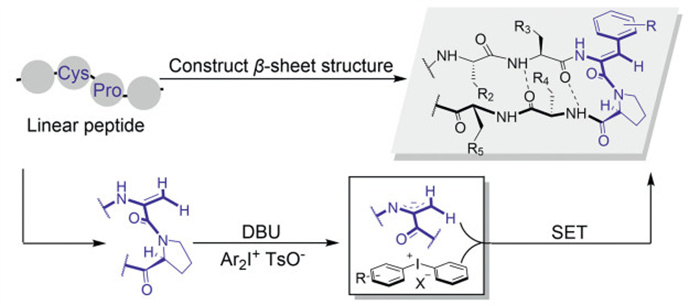
Figure 1.
The construction and modification of β-sheet peptides guided by the physicochemical properties of Dha.

Construction-modification method of β-sheet peptides guided by dehydroalanine properties
Pengxin Wang , Jinyuan Gong , Yuntao Shi , Luping Liu , Rui Wang


The molecular recognition events between proteins are crucial in both pathological and biological processes. Among various types of modulators, peptides adopt appropriate conformationally constrained structures to bind their targets, thus exhibiting potent affinity and selectivity [1-3]. Therefore, peptides with specific constrained structures, such as α-helices, β-sheets or cyclic/bicyclic peptides, have been emerging as powerful therapeutic agents in recent years, promoting the development of various strategies towards constructing these structures. Among recent advances, peptide macrocyclization, including one-component cyclization [4] and two/multicomponent modification cyclization with different cyclic linkers [5,6], is an important strategy to form a folding conformation. Compared with the former, the two/multicomponent modification cyclization of peptides can do the double purpose of locking the folding conformation and introducing an additional functional group for labeling, conjugation and skeletal diversity [7,8]. In practical applications of the "construction-modification" methods, the introduced functional groups, such as lipids, sugars and PEGs, significantly change the physicochemical properties or improve the biological activities of constrained peptides [9]. The constrained peptides could also be efficiently decorated with useful therapeutic functionalities to endow peptides with additional functions [10-12], such as chelation groups for coupling nuclides and fluorescent tags for imaging. In addition, the methods can increase the diversification of constrained peptides to improve the probability of peptide drug screening [13], such as phage display [14] and one-bead one-compound (OBOC) libraries [15,16]. A variety of construction-modification methods for the synthesis of modified α-helices and cyclic peptides have been extensively developed. However, comparable strategies to synthesize the functionalized β-sheet peptides remain notably underdeveloped.
In past decades, various elegant methods have been explored to construct β-sheet structures. These seminal efforts mainly include noncovalent/covalent side chain bridges [17-28], hydrogen bond surrogates [29,30], substitution of the backbone amide [31-35] and turn templates [36-42]. Among these approaches, turn templates inducing methods employ turn templates, such as DPro-XX (LPro, Gly) sequence, δOrn and azobenzene, to enforce proximity and hydrogen bonding formation between the two β-strands. These methods have gradually emerged as favorites for stabilizing β-hairpin peptides, thus widely applicable in peptide self-assembles [43-46], catalysts design [47,48] and pharmaceutical studies [49-52]. To date, there have been three β-sheet peptide drugs stabilized by DPro-LPro template in clinical development [53]. However, all these methods are mainly focused on "construction", lacking an additional "modification" method. Waters group has demonstrated that turn sequences with modified functional groups only exhibit a small effect on the extent of folding in β-hairpin peptides [54]. In 2020, Wessjohann and Rivera group combined the DPro-DADME turn template with Ugi chemistry to synthesize functionalized parallel β-sheets [55]. Novel construction-modification methods based on turn templates are highly desirable to meet the new growing demand for diverse antiparallel β-sheet peptides in biological research and drug discovery.
Advancing this field requires the discovery and utilization of amino acid physicochemical properties to enable targeted alteration of the backbone conformation and function of peptides. α,β-Dehydroamino acids (ΔAAs) are naturally occurring amino acids and widely found in natural peptides, such as nisin and lasiodine A [56]. ΔAAs alter the backbone conformation of peptides to provide special folded structures like β-turn, β-hairpins or 310-helices [57-59]. However, it has not been demonstrated that peptides with different lengths and amino acid sequences are able to form β-sheet conformation constrained by ΔAAs in these reports. Therefore, we wondered if ΔAAs could act as a turn template to stabilize β-sheet structure and a reactive handle for functionalization simultaneously.
The discovery of new properties for amino acids is fundamental to understanding the bioactivity mechanism or biosynthesis pathway of biomolecules [60]. Furthermore, the new properties are also guiding us to design peptide modification reactions for the diversification of peptides [61]. Dehydroalanine (Dha), a kind of ΔAAs, has emerged as particularly valuable in peptide and protein engineering. Polar double bonds endow Dha with electron-poor property due to the electron-withdrawing carbonyl. The property explains the lantibiotic biosynthesis mechanism of enzymes-catalyzed intramolecular 1,4-conjugate additions using S, C, and N nucleophiles [62]. In peptide modification, Dha has been used as a Michael acceptor for radical/nucleophilic addition [51] and α,β-unsaturated carbonyl moiety for metal-catalyzed coupling reactions [63,64]. For example, Suga and coworkers applied a Heck-type cross-coupling reaction of Dha with aryl N-methylimidodiacetic acid boronates to produce the (Z)-alkene geometry-preserved peptides [64]. In addition, push-pull electronic property of Dha also allows us to answer the thiopeptide biosynthesis mechanism of installing pyridine rings [65]. Based on the property, a variety of cycloaddition modification methods are also designed to enrich Dha-containing peptides [66-69]. Despite these advances, the development of new properties of Dha and related modification reactions is still highly desired.
In this paper, a novel construction-modification method has been developed to synthesize functionalized antiparallel β-sheet peptides guided by the physicochemical properties of Dha (Fig. 1). Given Dha's conformational effects on peptides, we hypothesized that Dha-containing turn template while retaining its double bond might simultaneously stabilize the β-sheet structure and provide a reactive handle. We then disclosed a unique property of Dha and designed a double bond retained modification reaction to functionalize the β-sheet peptides.
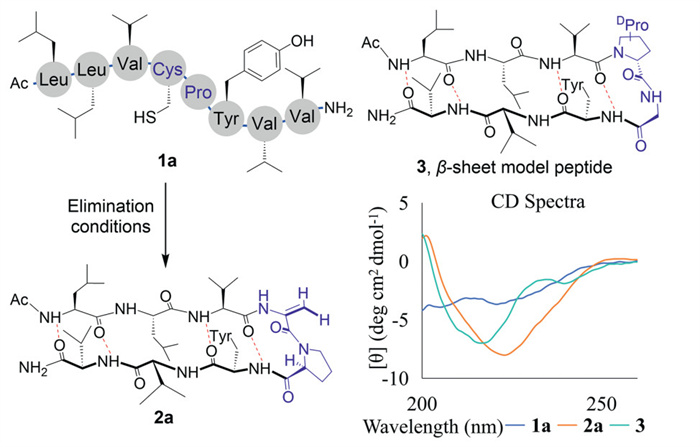
Based on the above hypothesis, we set out to develop a Dha-containing turn template to constrain peptides into a β-sheet structure (Fig. 2). In the previous report, peptide 3 was a β-sheet peptide induced by the DPro-Gly motif [70], which was selected as the β-sheet model peptide to verify our idea. Inspired by previous work that has shown incorporation of proline into the peptide could induce the β-turn [71], we hypothesized that the Dha-Pro motif could constrain peptides to form β-sheet. DPro-Gly motif in peptide 3 was replaced by Cys-Pro to give peptide 1a, and then the Cys residue underwent an elimination reaction to form a Dha-containing peptide 2a. Compared with linear peptide 1a, the CD spectrum of peptide 2a is slightly red-shifted (to 222 nm) and exhibits features characteristic of a β-sheet, similar to those of 3. These results demonstrate that the Dha-Pro motif serves as an efficient turn template for inducing β-sheet structures.
We then turned our attention to developing a double bond retained Dha modification reaction. N-Ac-Dha methyl ester 4a and diaryliodonium salt 5a were selected as model substrates to optimize the conditions. After screening various conditions, we were delighted to find the optimized conditions: The reaction was performed in the presence of 1.5 equiv. of 5a and 1.5 equiv. of DBU in DMSO to offer dehydrophenylalanine (ΔPhe) 6a in 88% yield (Table S5 in Supporting information). We next examined the compatibility of peptides under the optimized conditions (Fig. 3). Scaling up the model reaction using 5a (7.5 mmol) and 4aa (5 mmol) was successful, achieving a 75% isolated yield. The reaction tolerated aromatic and sterically hindered amino acids within dipeptides, providing a good isolated yield (6ac-6ah). The reaction was also compatible with acidic and basic amino acids, such as aspartic acid and histidine (6ak and 6am). Although tyrosine could undergo an O-addition reaction with diaryliodonium salts under alkaline conditions [72], no such side reaction was observed for dipeptide 4af. We then studied the generality of the diaryliodonium salts (Fig. S27 in Supporting information). The results showed that para/meta-EWG-substituted diaryliodonium salts generally give higher yields, while steric hindering substituents (e.g., ortho-fluoro) lower the yield. The promising results observed on oligopeptides drove us to apply the methodology to complex peptides. The reaction was compatible with different lengths, positions of Dha and several sensitive residues in the peptides, such as Arg, Glu, Asn, His, suggesting broad application for peptide modification. The stereochemistry of 6aa was identified as (Z)-configuration based on its NOE spectra (Fig. S28 in Supporting information). The stereochemistry of products was also identified as (Z)-configuration through comparing the NMR data with previous reports [64]. Furthermore, the preferential formation of the (Z)-alkene is in agreement with its greater thermodynamic stability (by 2.4 kcal/mol) relative to the (E)-isomer [64].
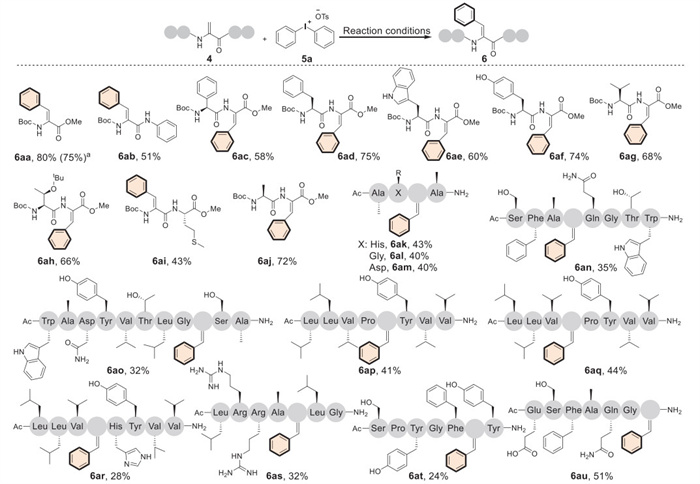
Encouraged by the success of double bond retained modification of peptides, we sought to explore the formation of β-sheet structure using the ΔPhe-Pro template after modification (Fig. S83 in Supporting information). To further examine the structure of phenyl-modified 6aq, we measured the chemical shift of the α-protons, which are widely used to probe the secondary structure of peptides. Compared with a linear or α-helix peptide, the chemical shift of α-protons in β-sheet is typically downfield [73]. The α-proton chemical shifts of residues 1-3 and 7-8 are significantly downfield (Fig. S83b). A slightly positive ∆δHα value for residue Y6 may result from the magnetic anisotropy of ΔPhe at position 4 [74]. The NOEs represented in Fig. S83d exhibit an extensive network of cross-strand NOEs, which are associated with hydrogen-bonded β-hairpin formation. The CD spectrum of 6aq also indicates that it is a β-sheet structure (Fig. S83e). Red-shifted Cotton effects were observed for 6aq, probably due to the double bond chromophore of ΔPhe [75]. The replacement of Pro with His (6br) or the exchange of the position of ΔPhe and Pro (6bp) resulted in linear rather than β-sheet structures, indicating the indispensability and unchangeability of the ΔPhe-Pro motif for the construction of β-sheet structure.
We further expanded the double-bond retained modification reaction of Dha-Pro motif-containing peptides to produce diverse β-sheet peptides via resin synthesis (Fig. 4). After insertion of Cys through Fmoc-SPPS on resin, the peptide-containing resins underwent deprotection and elimination reactions to offer the substrates with Dha residue [68]. After incubation with diaryliodonium salt and DBU in DMSO for 24 h, the solid-supported peptides were then cleaved from the resin and purified by semi-preparative HPLC. Diverse β-sheet peptides bearing variously substituted phenyl groups and spanning different lengths (6-12 residues) were prepared through the synthesis methods. The primary limitations in this SPPS route were the deprotection and elimination steps, which are often incomplete, especially for longer or more complex sequences. In addition, the potential pre-formation of β-sheet structure on resin may also contribute to the yield drop.
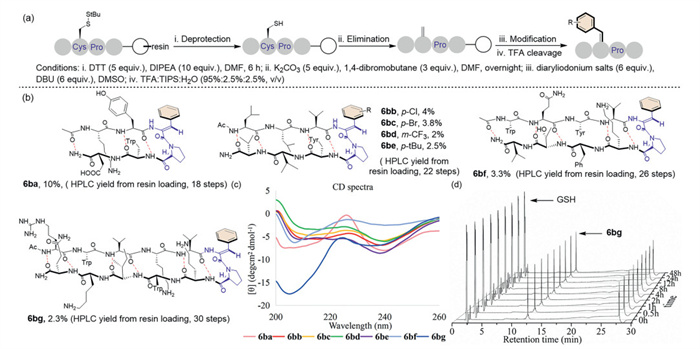
The CD spectra of 6-mer peptide 6ba shows a broad negative bond at ~210 nm and a significantly positive bond at ~225 nm, indicating edge-to-face orientation between tryptophan and tyrosine in the β-sheet structure [76,77]. Peptides 6bb-6be (same sequence as 6aq) were modified with various diaryliodonium salts. The CD spectra of 6bb-6be are similar to that of 6aq, suggesting that these peptides adopt β-sheet structures. The sequence of 6bf originates from Nowick's report [43]. The CD spectrum of 6bf has a broad maximum at 225 nm and a minimum at ~208 nm, similar to Nowick's work, indicating a mixture of β-sheet and random coil conformations. The 12-mer peptide 6bg originates from Waters's report [78]. The CD spectrum of 6bg shows a strong maximum at 225 nm, reflecting cross-strand interactions between the two tryptophans [76,77,79]. Meanwhile, the peptide has a minimum signal around 207 nm, similar to Waters's work, suggesting the formation of a β-sheet structure. The result that slightly shifted from the minimum of 215 nm is likely an effect of Trp-Trp exciton coupling, as also suggested by by the maximum at 226 nm [78]. All the results demonstrate that the modification method is a versatile and efficient approach for constructing diverse β-sheet peptide analogues. The modified peptides are also stable toward nucleophiles. When 6bg was dissolved in 50 mmol/L GSH PBS buffer solution at pH 7.4, no obvious GSH adduct formed even after 48 h of incubation (Fig. 4d). As we all know, Dha could serve as a highly reactive, electrophilic group in peptides. The critical "protective/capping" step not only introduced a phenyl group into the peptide but also converted Dha into a stable, nucleophile-resistant derivative, enhancing chemical stability and potential in vivo utility. The CD thermal denaturation experiments of 6bc-6be indicated that the stability of β-sheets was not significantly affected by different substituents (Section 7 in Supporting information).
Several control experiments were carried out to gain mechanistic insight (Fig. S92 in Supporting information). The radical-involved mechanism was confirmed by radical quenching studies. When the reaction was performed in the presence of 3.0 equiv. of TEMPO (2,2,6,6-tetramethylpiperidin-1-oxyl) or 1,1-diphenylethylene, the standard reaction was suppressed (Fig. S92a). The phenyl radical generated from diaryliodonium salts could be trapped by 1,1-diphenylethylene, and the adduct 7 was identified by HRMS and LC-MS (Section 7 in Supporting information). However, the phenyl radical could not be detected by HRMS from the mixture of diaryliodonium salt 5a and DBU, indicating that phenyl radical was not generated from the interaction between 5a and DBU. In the control experiments (Fig. S92b), when the reaction was carried out in the absence of DBU, no 6a was detected. The bi-N-protected Dha 8 failed to yield the corresponding product, suggesting that deprotonation of amide hydrogen by DBU might be the key step in initiating the radical reaction. To obtain information on the nature of the Dha intermediate, the sodium salt of enamine anion was obtained in the presence of NaOH or NaOtBu after deprotonation of the amide hydrogen. The reaction between the enamine anion and 5a produced the desired product 6a. Thus, the Dha forms an electron-rich enamine anion, which is derived from the deprotonation of amide hydrogen in the presence of base, and then participates in the single electron transfer (SET) process.
Walsh and coworkers have reported that base-mediated deprotonation of N-benzyl ketimines generates electron-rich 2-azaallyl anions, which can act as electron donor to reduce aryl iodides and alkyl halides via a SET process [80]. Based on our investigations and prior reports, we proposed a possible mechanism (Fig. S92c). Firstly, deprotonation of the Dha residue by base yields an electron-rich enamine anion intermediate. Then, the intermediate undergoes a SET to diaryliodonium salt, generating a phenyl radical and Dha radical. Finally, the radical-radical cross-coupling between the two radical species provides the final double bond retained modification products.
While cyclic modifications represent a well-established strategy for inducing α-helix/cyclic peptides conformations with skeletal diversity, construction-modification methods of β-sheet structures remain underdeveloped. The discovery of novel amino acid physicochemical properties advances this field and enables deeper control of conformation and modification of peptides. Here, we introduce a Dha-Pro turn template that constrains peptides into β-sheet conformations, where Dha serves as a versatile handle for metal-free, double bond-retained peptide diversification. Using this approach, we synthesized a diverse array of β-sheet peptides featuring functionalized phenyl substituents. Mechanistic studies reveal a unique deprotonation pathway for Dha, followed by a SET between the in situ generated electron-rich enamine and the diaryliodonium salt. Subsequent C(sp2)-C(sp2) bond formation occurs via radical coupling of the Dha- and phenyl-derived intermediates. The novel deprotonation property of Dha and mechanism pathway might provide experimental insight into the synthesis starting of the nitrogen-containing heterocycle core in the thiopeptides biosynthesis [81]. Furthermore, this method also expands the synthetic utility of enamine chemistry and the toolbox of Dha-containing peptide modifications. We envision that this construction-modification method of β-sheet peptides would fine wide applications in medicinal chemistry and chemical biology of peptides.
Pengxin Wang: Visualization, Validation, Project administration, Methodology, Investigation, Data curation. Jinyuan Gong: Validation, Methodology, Investigation. Yuntao Shi: Visualization, Validation, Methodology. Luping Liu: Writing – review & editing, Writing – original draft, Supervision, Funding acquisition, Conceptualization. Rui Wang: Writing – review & editing, Writing – original draft, Supervision, Funding acquisition, Conceptualization.
The authors declare that they have no known competing financial interests or personal relationships that could have appeared to influence the work reported in this paper.
The work was supported by the CAMS Innovation Fund for Medical Sciences (CIFMS) (Nos. 2021-I2M-1-026, 2021-I2M-3-001, 2023-I2M-2-006), Non-profit Central Research Institute Fund of Chinese Academy of Medical Sciences (No. 2022-RC350-02).
Supplementary material associated with this article can be found, in the online version, at doi:
R.R. Araghi, A.E. Keating, Curr. Opin. Struct. Biol. 39 (2016) 27–38. doi: 10.1016/j.sbi.2016.04.001
P.G. Dougherty, Z.Q. Qian, D.H. Pei, Biochem. J. 474 (2017) 1109–1125. doi: 10.1042/BCJ20160619
J.L. Arenas, J. Kaffy, S. Ongeri, Curr. Opin. Chem. Biol. 52 (2019) 157–167. doi: 10.1016/j.cbpa.2019.07.008
Y.H. Lau, P. de Andrade, Y.T. Wu, D.R. Spring, Chem. Soc. Rev. 44 (2015) 91–102. doi: 10.1039/C4CS00246F
L. Reguera, D.G. Rivera, Chem. Rev. 119 (2019) 9836–9860. doi: 10.1021/acs.chemrev.8b00744
X. Li, S. Chen, W.D. Zhang, H.G. Hu, Chem. Rev. 120 (2020) 10079–10144. doi: 10.1021/acs.chemrev.0c00532
A.V. Vasco, Y. Méndez, A. Porzel, et al., Bioconjug. Chem. 30 (2019) 253–259. doi: 10.1021/acs.bioconjchem.8b00906
K. Sharma, D.L. Kunciw, W. Xu, et al., Cyclic Peptides: From Bioorganic Synthesis to Applications, The Royal Society of Chemistry, London, 2018, pp. 164–187.
M. Erak, K. Bellmann-Sickert, S. Els-Heindl, et al., Bioorg. Med. Chem. 26 (2018) 2759–2765. doi: 10.1016/j.bmc.2018.01.012
J. Ceballos, E. Grinhagena, G. Sangouard, et al., Angew. Chem. Int. Ed. 60 (2021) 9022–9031. doi: 10.1002/anie.202014511
X.Y. Liu, W. Cai, N. Ronceray, et al., J. Am. Chem. Soc. 145 (2023) 26525–26531. doi: 10.1021/jacs.3c09261
M.R. Wang, D. Pan, Q. Zhang, et al., J. Am. Chem. Soc. 146 (2024) 6675–6685. doi: 10.1021/jacs.3c12879
A.A. Vinogradov, Y.Z. Yin, H. Suga, J. Am. Chem. Soc. 141 (2019) 4167–4181. doi: 10.1021/jacs.8b13178
J.T. Hampton, W.R. Liu, Chem. Rev. 124 (2024) 6051–6077. doi: 10.1021/acs.chemrev.4c00004
G.K. Mothukuri, J. Vesin, S.S. Kale, et al., Chem. Sci. 11 (2020) 7858–7863. doi: 10.1039/d0sc01944e
S. Habeshian, M.L. Merz, G. Sangouard, et al., Nat. Commun. 13 (2022) 3823. doi: 10.1038/s41467-022-31428-8
R. Mahalakshmi, Arch. Biochem. Biophys. 661 (2019) 39–49. doi: 10.1016/j.abb.2018.11.001
A.G. Cochran, R.T. Tong, M.A. Starovasnik, et al., J. Am. Chem. Soc. 123 (2001) 625–632. doi: 10.1021/ja003369x
A.J. Riemen, M.L. Waters, Biochemistry 48 (2009) 1525–1531. doi: 10.1021/bi801706k
K. Holland-Nell, M. Meldal, Angew. Chem. Int. Ed. 50 (2011) 5204–5206. doi: 10.1002/anie.201005846
V. Celentano, D. Diana, L. De Rosa, et al., Chem. Commun. 48 (2012) 762–764. doi: 10.1039/C1CC16017F
J.H. Park, M.L. Waters, Org. Biomol. Chem. 11 (2013) 69–77. doi: 10.1039/C2OB26445E
H. Lingard, J.T. Han, A.L. Thompson, et al., Angew. Chem. Int. Ed. 53 (2014) 3650–3653. doi: 10.1002/anie.201309353
J.R. Pace, B.J. Lampkin, C. Abakah, et al., J. Am. Chem. Soc. 143 (2021) 15039–15044. doi: 10.1021/jacs.1c04378
Z.C. Adams, A.P. Silvestri, S. Chiorean, et al., ACS Cent. Sci. 9 (2023) 648–656. doi: 10.1021/acscentsci.2c01462
E.E. Cawood, E. Baker, T.A. Edwards, et al., Chem. Sci. 15 (2024) 10237–10245. doi: 10.1039/d4sc02240h
A. Dangi, I.J. Angera, J.R. Del Valle, J. Am. Chem. Soc. 147 (2025) 29930–29938. doi: 10.1021/jacs.5c06944
B.C. Zhao, D. Yang, J.H. Wong, et al., ChemBioChem 17 (2016) 1416–1420. doi: 10.1002/cbic.201600179
N. Sawyer, P.S. Arora, ACS Chem. Biol. 13 (2018) 2027–2032. doi: 10.1021/acschembio.8b00641
A. Nazzaro, B. Lu, N. Sawyer, et al., Angew. Chem. Int. Ed. 62 (2023) e202303943. doi: 10.1002/anie.202303943
M.P. Sarnowski, C.W. Kang, Y.M. Elbatrawi, et al., Angew. Chem. Int. Ed. 56 (2017) 2083–2086. doi: 10.1002/anie.201609395
M.P. Sarnowski, K.P. Pedretty, N. Giddings, et al., Bioorg. Med. Chem. 26 (2018) 1162–1166. doi: 10.1016/j.bmc.2017.08.017
M.P. Sarnowski, J.R. Del Valle, Org. Biomol. Chem. 18 (2020) 3690–3696. doi: 10.1039/d0ob00664e
A.D. Richaud, S.P. Roche, J. Org. Chem. 85 (2020) 12329–12342. doi: 10.1021/acs.joc.0c01441
B.M. Rathman, J.L. Rowe, J.R. Del Valle, Methods Enzymol. 656 (2021) 271–294.
H. Diaz, K.Y. Tsang, D. Choo, et al., J. Am. Chem. Soc. 115 (1993) 3790–3791. doi: 10.1021/ja00062a061
T.S. Haque, J.C. Little, S.H. Gellman, J. Am. Chem. Soc. 116 (1994) 4105–4106. doi: 10.1021/ja00088a067
T.S. Haque, S.H. Gellman, J. Am. Chem. Soc. 119 (1997) 2303–2304. doi: 10.1021/ja963653h
S.R. Griffiths-Jones, A.J. Maynard, G.J. Sharman, et al., Chem. Commun. (1998) 789–790.
M. Favre, K. Moehle, L. Jiang, et al., J. Am. Chem. Soc. 121 (1999) 2679–2685. doi: 10.1021/ja984016p
X.Y. Li, A.L. Sabol, M. Wierzbicki, et al., Angew. Chem. Int. Ed. 60 (2021) 22776–22782. doi: 10.1002/anie.202105559
R. Parlato, J. Volarić, A. Lasorsa, et al., J. Am. Chem. Soc. 146 (2024) 2062–2071. doi: 10.1021/jacs.3c11155
J.P. Schneider, D.J. Pochan, B. Ozbas, et al., J. Am. Chem. Soc. 124 (2002) 15030–15037. doi: 10.1021/ja027993g
L. Haines-Butterick, K. Rajagopal, M. Branco, et al., Proc. Natl. Acad. Sci. U. S. A. 104 (2007) 7791–7796. doi: 10.1073/pnas.0701980104
D.A. Salick, J.K. Kretsinger, D.J. Pochan, et al., J. Am. Chem. Soc. 129 (2007) 14793–14799. doi: 10.1021/ja076300z
F.D. Yang, P.L. Zhang, J.B. Liu, et al., Chin. Chem. Lett. 36 (2025) 110785. doi: 10.1016/j.cclet.2024.110785
E.R. Jarvo, G.T. Copeland, N. Papaioannou, et al., J. Am. Chem. Soc. 121 (1999) 11638–11643. doi: 10.1021/ja9931776
M. Matsumoto, S.J. Lee, M.L. Waters, et al., J. Am. Chem. Soc. 136 (2014) 15817–15820. doi: 10.1021/ja503012g
S.C. Shankaramma, Z. Athanassiou, O. Zerbe, et al., ChemBioChem 3 (2002) 1126–1133. doi: 10.1002/1439-7633(20021104)3:11<1126::AID-CBIC1126>3.0.CO;2-I
N. Srinivas, P. Jetter, B.J. Ueberbacher, et al., Science 327 (2010) 1010–1013. doi: 10.1126/science.1182749
G. Andolina, L.C. Bencze, K. Zerbe, et al., ACS Chem. Biol. 13 (2018) 666–675. doi: 10.1021/acschembio.7b00822
D. Yang, W.R. Qin, X.D. Shi, et al., J. Med. Chem. 61 (2018) 8174–8185. doi: 10.1021/acs.jmedchem.8b00418
Spexis Company,
W.J. Cooper, M.L. Waters, Org. Lett. 7 (2005) 3825–3828. doi: 10.1021/ol0510116
M.G. Ricardo, C.G. Moya, C.S. Pérez, et al., Angew. Chem. Int. Ed. 59 (2020) 259–263. doi: 10.1002/anie.201912095
S. Wang, K. Wu, Y. Tang, et al., Nat. Prod. Rep. 41 (2024) 273–297. doi: 10.1039/d3np00041a
M. Gupta, V.S. Chauhan, Biopolymers 95 (2011) 161–173. doi: 10.1002/bip.21561
D.N. Le, J. Riedel, N. Kozlyuk, et al., Org. Lett. 19 (2017) 114–117. doi: 10.1021/acs.orglett.6b03308
A. Jalan, D.W. Kastner, K.G.I. Webber, et al., Org. Lett. 19 (2017) 5190–5193. doi: 10.1021/acs.orglett.7b02455
J.W. Bogart, A.A. Bowers, Org. Biomol. Chem. 17 (2019) 3653–3669. doi: 10.1039/c8ob03155j
C.J. Yu, G.J. Bao, W.S. Sun, ChemBioChem 26 (2025) 202500349. doi: 10.1002/cbic.202500349
L.M. Repka, J.R. Chekan, S.K. Nair, et al., Chem. Rev. 117 (2017) 5457–5520. doi: 10.1021/acs.chemrev.6b00591
R.J. Scamp, E. de Ramon, E.K. Paulson, et al., Angew. Chem. Int. Ed. 59 (2020) 890–895. doi: 10.1002/anie.201911886
A.A. Vinogradov, S.Y. Pan, H. Suga, J. Am. Chem. Soc. 147 (2025) 7533–7544. doi: 10.1021/jacs.4c16525
W.J. Wever, J.W. Bogart, J.A. Baccile, et al., J. Am. Chem. Soc. 137 (2015) 3494–3497. doi: 10.1021/jacs.5b00940
L.M. Repka, J. Ni, S.E. Reisman, J. Am. Chem. Soc. 132 (2010) 14418–14420. doi: 10.1021/ja107328g
R.H. de Vries, J.H. Viel, R. Oudshoorn, et al., Chem. Eur. J. 25 (2019) 12698–12702. doi: 10.1002/chem.201902907
G. Bao, P. Wang, G. Li, et al., Angew. Chem. Int. Ed. 60 (2021) 5331–5338. doi: 10.1002/anie.202012523
M. Zhang, P. He, Y. Li, Chem. Sci. 14 (2023) 9418–9426. doi: 10.1039/d3sc02818f
C. Basu, H.K. Ganguly, G. Basu, Chem. Commun. 57 (2021) 7172–7175. doi: 10.1039/d1cc02640b
Y. Che, G.R. Marshall, Biopolymers 81 (2006) 392–406. doi: 10.1002/bip.20431
H. Xu, T. Tan, Y. Zhang, et al., Adv. Sci. 9 (2022) 2202790. doi: 10.1002/advs.202202790
D.S. Wishart, B.D. Sykes, F.M. Richards, Biochemistry 31 (1992) 1647–1651. doi: 10.1021/bi00121a010
O. Khakshoor, W.A. Russu, J.S. Nowick, J. Am. Chem. Soc. 129 (2007) 2548–2558. doi: 10.1021/ja0667965
S. Imazu, Y. Shimohigashi, H. Kodama, et al., Int. J. Pept. Protein Res. 32 (1988) 298–306. doi: 10.1111/j.1399-3011.1988.tb01264.x
A.G. Cochran, N.J. Skelton, M.A. Starovasnik, Proc. Natl. Acad. Sci. U. S. A. 98 (2001) 5578. doi: 10.1073/pnas.091100898
L. Wu, D. McElheny, T. Takekiyo, et al., Biochemistry 49 (2010) 4705–4714. doi: 10.1021/bi100491s
L.L. Cline, M.L. Waters, Biopolymers 92 (2009) 502–507. doi: 10.1002/bip.21266
S. Honda, K. Yamasaki, Y. Sawada, et al., Structure 12 (2004) 1507–1518. doi: 10.1016/j.str.2004.05.022
M. Li, O. Berritt, L. Matuszewski, et al., J. Am. Chem. Soc. 139 (2017) 16327–16333. doi: 10.1021/jacs.7b09394
J.W. Bogart, N.J. Kramer, A. Turlik, et al., J. Am. Chem. Soc. 142 (2020) 13170–13179. doi: 10.1021/jacs.0c05639

Figure 1 The construction and modification of β-sheet peptides guided by the physicochemical properties of Dha.

Figure 2 The development of Dha-Pro turn template to constrain model peptide to form β-sheet structure.

Figure 3 Modification of Dha and Dha-containing peptides. The synthesis of 6aa-6aj were performed with 4 (0.1 mmol), 5a (0.15 mmol), DBU (0.15 mmol) and DMSO (1 mL) for 1 h at r.t.; the synthesis of 6ak-6au were performed with 4 (0.01 mmol), 5a (0.03 mmol), DIEA (0.02 mmol), DBU (0.03 mmol) and DMSO (0.2 mL) for 3 h at 37 ℃. aThe synthesis of 6aa was performed with 4aa (5 mmol), 5a (7.5 mmol), DBU (7.5 mmol) and DMSO (50 mL) for 1.5 h at r.t.

 扫一扫看文章


扫一扫关注我们
 DownLoad:
 下载:

 下载: