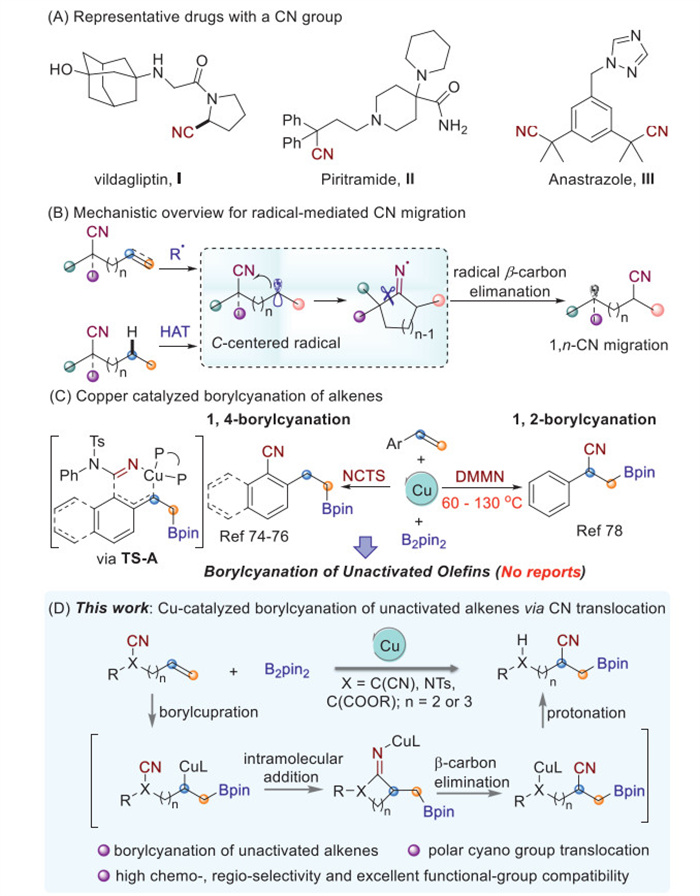
Figure 1.
Motivation for borylcyanation reaction of unactivated alkenes via CN group translocation.

Copper-catalyzed borylcyanation of unactivated alkenes via cyano group translocation
Xiuping Yuan , Jiamin Yuan , Jiaqiong Sun , Jianjun Yin , Simin Wang , Dazhen Shi , Shucheng Ma , Xiaoyu Li , Qian Zhang , Tao Xiong


Nitriles hold a prominent position in the chemical sciences, serving as versatile building blocks in organic synthesis and functioning as valuable bioactive probes in medicinal chemistry [1-3]. For example, vildagliptin (Ⅰ), a marketed antidiabetic drug, contains an aminonitrile moiety. Piritramide (Ⅱ), a synthetic opioid, is prescribed for postoperative pain management. Anastrozole (Ⅲ), a blockbuster drug, is widely recognized as the first-line therapeutic agent for estrogen-dependent breast cancer (Fig. 1A). Moreover, alkyl nitriles are versatile precursors that can be readily converted into carboxylic acids, amides, amines, and related derivatives [4-7]. Therefore, the efficient and precise synthesis of cyano-functionalized molecules is of significant interest.
Functional group translocation refers to the migration of a functional group from one position within a molecule to another, accompanied by a single chemical bond cleavage and formation, that occurs independently of bond dissociation energies (BDEs). Recent advances have demonstrated the migrations of diverse groups, including aryl [8-14], cyano [15-30], alkenyl [31-35], alkynyl [36-40], heteroaryl [41-46], imino [47-49], carbonyl [47,50-52], and heteroatoms [53-57] (e.g., halogens, boron, silicon), providing innovative pathways for molecular reorganization and representing an attractive tool in some crucial transformations such as alkene/alkyne difunctionalization and C-H functionalization [8-62]. In this regard, transformations of cyano group (CN) translocation have revolutionized the synthetic routes to conventional inaccessible complex functionalized nitrile compounds via skeletal reorganization. Specifically, the group of Zhu has developed seminal radical cyanofunctionalization of alkenes and alkynes via 1,4- or 1,5-CN migration [22-30]. More recently, Xu et al. has achieved an elegant CN translocation through reversible C−H sampling, facilitating direct and precise positional exchange of a CN group with a single inert C−H bond among multiple and similar unactivated C–H sites [63]. Despite these notable advances, the key CN translocation in these reports has relied on an intramolecular radical addition with CN, followed by a site-selective β-fragmentation of the resulting iminyl radical species, which was typically governed by the generation of a thermodynamically more favorable radical intermediate (Fig. 1B). In contrast, analogous CN translocation reaction proceeding via a polar mechanism remains a largely uncharted territory [64,65], probably attributed to the inherently low electrophilicity of the CN group. Until 2024, Huang and Jiang et al. [64] have reported a nickel-catalyzed arylcyanation of unactivated alkenes via CN translocation using aryl boronic acids as the aryl source. Given the intriguing characteristics of functional-group translocation, the development of an alternative, non-radical synthetic pathway could fully unlock the synthetical potential of this emerging approach, not only addressing inherent limitations of radical reactions but also offering a complementary, and even orthogonal, reactivity patterns to further expand the current synthetic toolbox.
The incorporation of boron groups into organic molecules is highly desirable, owing to their importance in medicinal chemistry [66] and materials science [67-70], as well as their versatility as synthetic intermediates for further functionalization [71-73]. Among various methods, the borylcyanation of alkenes is particularly attractive, as it simultaneously installs synthetically flexible C–B and C–CN bonds across the double bond in a single step. In this area, the groups of Buchwald [74] and Montgomery [75] reported pioneering copper-catalyzed 1,4-borylation/ortho-cyanation reactions of styrenes using electrophilic CN sourse N-cyano-N-phenyl-p-toluenesulfonamide (NCTS) as the cyanating agent through the formation of crucial six-membered cyclic transition state (TS-A, Fig. 1C, left) [76]. Such a procedure suggests that the 1,2-borylcyanation of alkenes, particularly alkyl substituted alkenes, is mechanically challenging. Within this context, Meng and coworkers developed a Cu-catalyzed enantioselective 1,2-borylcyanation specifically for 3-indolyl-substituted alkenes, wherein dearomatization of the low-aromaticity indole ring serves as the key step enabling the reaction [77]. In contrast, the group of Xiao and Fu reported a Cu-catalyzed 1,2-borylcyanation strategy applicable to general styrene derivatives using dimethylmalononitrile (DMMN) as the cyanating agent, while required relatively harsh reaction conditions (Fig. 1C, right) [78]. Despite these advances, these precedents relied on exogenous chemicals as CN supplier, and analogous conversions for more challenging, unactivated alkenes remains unexplored. This is likely attributed to the following factors: (1) The migration insertion of Cu–Bpin into unactivated C=C bonds is often sluggish [79], and meanwhile, the regioselectivity must also be precisely controlled [80-82] (2) The likelihood of in-situ formed alkyl- and iminocopper intermediates, which could be directly quenched by an alcohol [83-85], should also be considered, and wherein the former requires sufficient reactivity toward the weakly electrophilic CN group, while the latter necessitates a regioselective β-C elimination to enable CN translocation. As part of our continued interest in boron chemistry [86-93], we herein present a copper catalytic system that could efficiently surmount these hurdles, successfully implementing a borylcyanation of unactivated alkenes via intramolecular CN translocation. To our knowledge, this represents an unprecedented borylcyanation of unactivated alkene through a rare polar-type CN migration mechanism under exceptionally mild conditions (Fig. 1D).
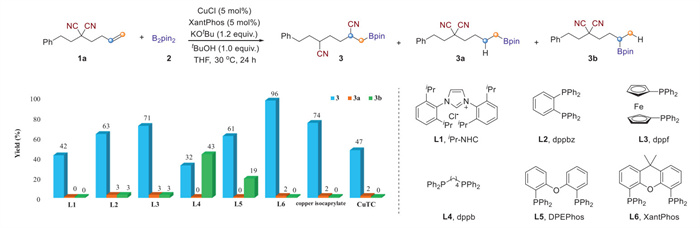
We selected alkenyl nitrile 1a and B2pin2 as model substrates to investigate the copper-catalyzed borylcyanation of unactivated alkenes (Fig. 2). Initial ligand screening showed that the NHC ligand L1 afforded product 3 in a moderate yield of 42%. Subsequent evaluation of bidentate phosphine ligands revealed that L2–L5 provided yields between 32% and 71%, accompanied by the formation of the protodeborylation byproduct 3b. Notably, further screening identified XantPhos L6 as a superior ligand, sig-nificantly improving the yield to 96%. Switching the copper catalyst to copper isocaprylate and CuTC resulted in reduced catalytic efficiency. In addition, NiCl2(DME) and FeCl2 proved no catalytic reactivity under the present reaction conditions (Table S4 in Supporting information). Therefore, the CuCl/L6 catalytic system was selected as the optimal conditions for further exploration of the substrate scope.
With the optimized reaction conditions established, we proceeded to evaluate the substrate scope of various alkenyl nitriles. The reaction was first examined with benzyl-substituted malononitrile 1b, which afforded the target product 4 in 73% yield. We subsequently explored the compatibility of diverse aromatic ring substituents by investigating a series of benzylic groups installed at the α-position of the malononitrile moiety. As summarized in Scheme 1, both electron-donating and electron-withdrawing groups on the aromatic rings were well tolerated under the standard conditions, yielding the corresponding borylcyanation products 4–23 in good to excellent yields (46%–99%). A wide variety of functional groups were compatible, including alkyl (5 and 6, 56%–94%), thiomethyl (7, 68%), phenyl (8, 95%), alkoxy (9, 69%), halogen (10–16, 46%–96%), methyl benzoate (17, 88%), tert-butoxycarbonyl (18, 73%), trifluoromethoxy (19, 87%), and boronate (21, 99%) substituents. The reaction also accommodated ortho-, meta-, and multi-substituted aromatic rings, as evidenced by the formation of compounds 9, 12–16, and 20. Furthermore, 2-naphthyl and anthryl substrates were suitable under the reaction conditions, providing the desired products 22–23 in 78%–92% yields.
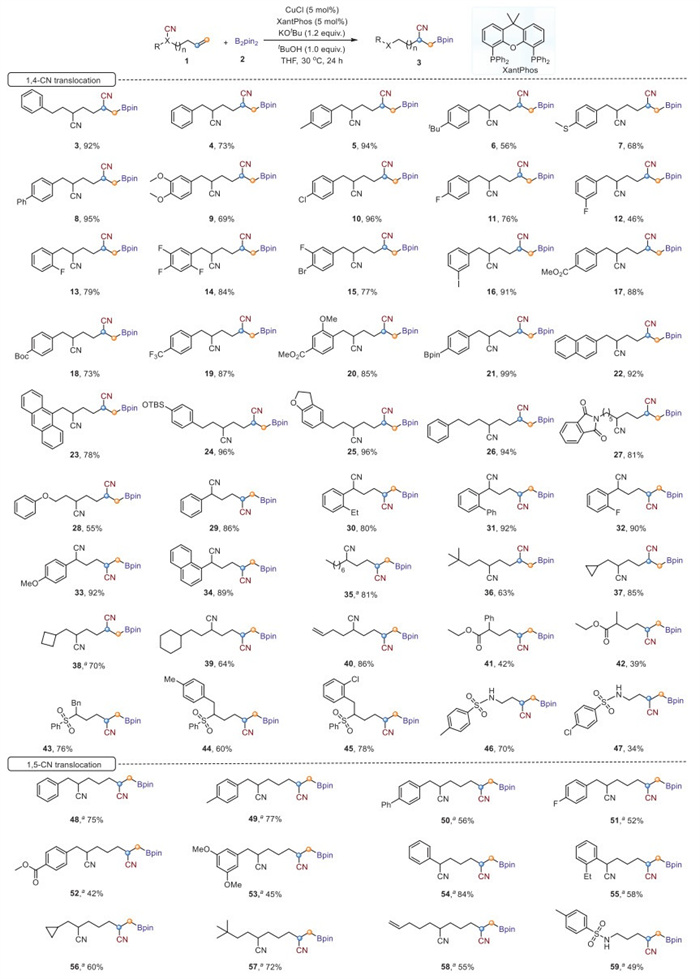
In addition to benzylic-substituted alkenes, a range of unactivated alkenes bearing extended alkyl chains also underwent efficient reaction, affording products 24–28 in yields ranging from 55% to 96%. Substrates featuring siloxy (24, 96%), dihydrobenzofuranyl (25, 96%), phthalimide (27, 81%), and ether (28, 55%) functional groups were all viable in the CN translocation process. Notably, malononitrile derivatives directly linked to phenyl rings with electron-donating or electron-withdrawing groups were converted to the target products 29–34 in 80%–92% yields. The reaction was also applicable to a range of aliphatic alkyl groups, including both linear and cyclic systems, affording the desired borylcyanation products (35–39, 63%–85% yields) that are otherwise challenging to access. For the symmetric substrate containing two alkene units, borylative CN translocation occurred selectively at one alkene moiety, yielding product 40 in 86% yield. To further broaden the substrate scope, we replaced one CN group with other electron-withdrawing groups such as ester or benzenesulfonyl. These modifications still permitted the transformation to proceed smoothly, delivering the expected products 41–45 in 39%–78% yields. Additionally, we extended the methodology to alkenes bearing an NTs–CN group to access 4-aminonitriles. This variant successfully achieved translocation of the CN group from nitrogen to carbon, affording products 46 and 47 in 70% and 34% yields, respectively. Further investigation into additional substrate classes, such as 2-phenylhex-5-enenitrile, 2-(but-3-en-1-yl)malononitrile and 2-allyl-2-phenylmalononitrile, proved unsuccessful for the target transformation. Instead, these substrates were found to be susceptible to side reactions, primarily hydroboration or decyanation. Additionally, we also examined internal alkenes and found to be incompatible with this transformation (Fig. S1 in Supporting information).
To further examine the influence of aliphatic chain length on the intramolecular CN translocation, systematic structural modifications were introduced into the substrate design (Scheme 1). The translocation, which proceeds via a 1,5-CN shift through a kinetically favored six-membered cyclic transition state, efficiently afforded the desired products 48–59 in 42%–84% yields under slightly modified conditions. It should be noted that 1,5-CN translocation process had proven challenging under previous polar reaction systems [64]. The study encompassed a variety of structural motifs, including benzylic groups (48–53, 42%–77% yields), substituted benzene rings (54–55, 58%–84% yields), cyclic (56, 60%) and linear (57, 72%) alkyl substituents, olefin-tethered chains (58, 55%), and NTs–CN units (59, 49%) at the α-position of the malononitrile moiety. The efficiency of the 1,5-CN cyano migration was hampered by competing hydroboration, as evidenced by the synthesis of compounds 52 and 53, where hydroboration byproducts were obtained in considerable yields of 59% and 50%, respectively.
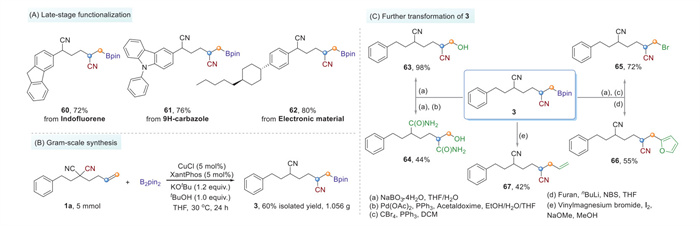
The synthetic potential of this borylcyanation protocol for unactivated alkenes was further demonstrated through late-stage functionalization. As illustrated in Fig. 3A, a range of complex substrates derived from indofluorene (60), 9H-carbazole (61), and an electronic material derivative (62) were successfully converted into desired products in 72%–80% yields. Gram-scale synthesis was carried out at 5 mmol scale, delivering 3 in 60% yield (Fig. 3B). The versatility of the resulting CN and boryl groups in compound 3 was also explored (Fig. 3C). The CN group could be converted into alcohol 63 and amide 64 [94] under mild conditions. Meanwhile, the boryl group underwent further transformations to bromide 65, furan ring 66 [95] and vinyl group 67 [96], which provides a modular platform for the synthesis of multi-functionalized molecules.
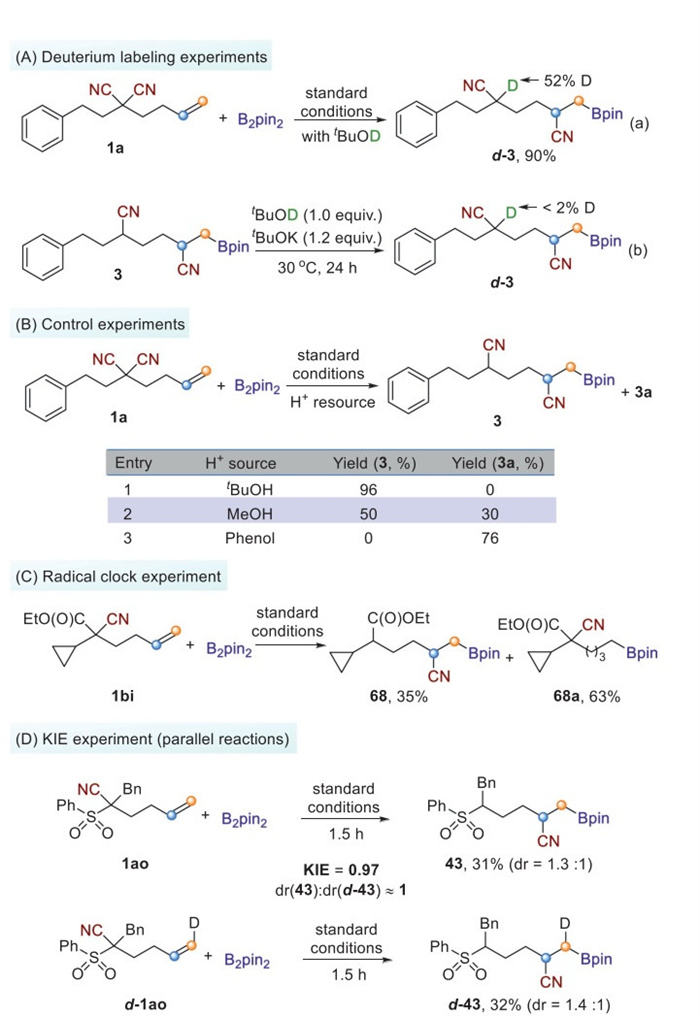
To gain preliminary insights into the reaction mechanism, a series of mechanistic experiments were conducted. As shown in Fig. 4A, the use of tBuOD resulted in the incorporation of approximately 0.5 deuterium atoms at the ipso-position of CN group (Fig. 4A, (a)). Heating substrate 3 at 30 ℃ for 24 h in the presence of tBuOK and additional tBuOD did not lead to detectable H/D exchange (Fig. 4A, (b)). These results collectively suggest that the H atom in the newly formed C–H bond originates primarily from tBuOD via a protonation process [97-99], and further indicate that the CN translocation is more likely to proceed via a polar rather than a radical pathway. Subsequently, tBuOH was replaced with MeOH and phenol. As the acidity increased, the conversion of the alkene to the borylcyanation product 3 gradually decreased, while formation of the protoboration product 3a correspondingly increased (Fig. 4B) [99]. This result demonstrates that the choice of proton source can influence the overall reaction pathway by modulating the protonation rate. Further evidence was provided using substrate 1bi, which contains a cyclopropane ring. This substrate afforded the desired product 68 in 35% yield, along with the protoboration byproduct 68a in 63% yield. Notably, no ring-opening product of the cyclopropane was detected, indicating that radical pathway is unlikely in the CN translocation step (Fig. 4C). As depicted in Fig. 4D, a kinetic isotope effect (KIE) of 0.97 (kH/kD) was measured for the conversion of Csp2–H to Csp3–H [98]. The absence of an inverse secondary KIE suggests that the insertion of the Cu–Bpin complex into the unactivated alkene may not involve in the rate-limiting step. Moreover, the deuterated substrate did not result additional diastereomers, supporting a concerted mechanism for the borylcupration step.
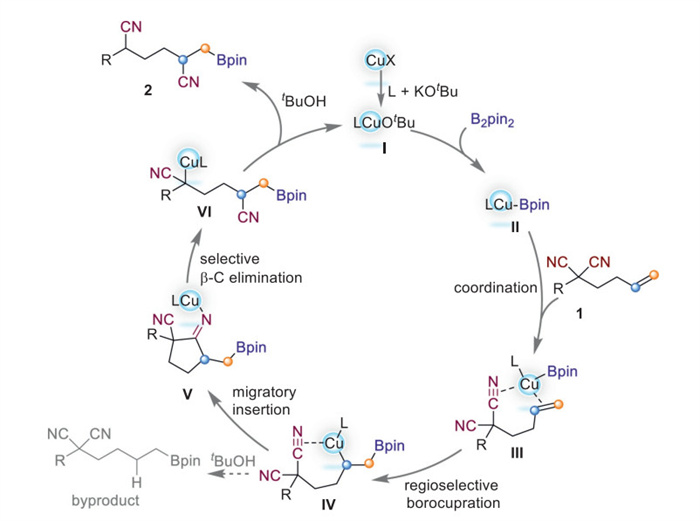
Based on the above experimental findings and previous reports [86-93,97-99], a proposed catalytic cycle for the Cu-mediated borylcyanation is depicted in Fig. 5. The cycle begins with coordination of the copper catalyst to the ligand and base, forming copper alkoxide intermediate Ⅰ. Subsequent σ-bond metathesis between Ⅰ and B2pin2 generates the active Cu–Bpin complex Ⅱ. This species engages in dual activation by coordinating both the alkene π-system and the CN group, leading to the pre-insertion complex Ⅲ [83,84]. Migratory insertion of the Cu–Bpin moiety into the unactivated C=C bond then affords the alkylcopper intermediate Ⅳ, stabilized by chelation with the CN group. A concerted translocation of the CN group to the alkyl–Cu bond forms iminocopper species Ⅴ. β-Carbon elimination of Ⅴ delivering alkyl-Cu intermediate Ⅵ, which rapidly protonated by tBuOH releases the CN migrated product 3 and regenerates the active Cu(Ⅰ) species Ⅰ, then closing the catalytic cycle.
In summary, we have established an unprecedented copper-catalyzed protocol for the borylcyanation of unactivated alkenes through an intramolecular CN translocation strategy. These transformations underwent a polar relay catalytic process assembly of a Cu–Bpin migratory insertion into unactivated olefins and a rare polar cyanide translocation pathway, enabling efficient synthesis of medicinally relevant boryl-substituted 1,n-dinitriles, 1,4-ester nitriles, and 4-amino nitriles from commercially available precursors. The success of this methodology is attributed to a bidentate phosphine-ligated copper catalyst, which exhibits high regioselectivity and effectively suppresses competing protonation of the in situ generated alkyl–copper intermediate by alcohols. The methodology proceeds under mild conditions, demonstrates excellent regioselectivity and functional group compatibility and broad applicability across linear and cyclic alkene architectures. Further studies toward CN translocation are in progress in our laboratory.
Xiuping Yuan: Methodology, Investigation, Data curation. Jiamin Yuan: Investigation, Data curation. Jiaqiong Sun: Writing – original draft, Funding acquisition. Jianjun Yin: Data curation. Simin Wang: Data curation. Dazhen Shi: Data curation. Shucheng Ma: Data curation. Xiaoyu Li: Data curation. Qian Zhang: Funding acquisition. Tao Xiong: Writing – review & editing, Project administration, Investigation, Funding acquisition.
The authors declare that they have no conflict of interest.
We acknowledge the National Key R&D Program of China (No. 2024YFA1509701), the National Natural Science Foundation of China (Nos. 22571037, 22171042, 22193012, and 22201033), the National Youth Talent Climbing Program of NENU and the Fundamental Research Funds for the Central Universities for generous financial support.
Supplementary material associated with this article can be found, in the online version, at doi:
F.F. Fleming, L. Yao, P. Ravikumar, et al., J. Med. Chem. 53 (2010) 7902–7917. doi: 10.1021/jm100762r
H. Wang, C. Zhao, Z. Burešová, et al., J. Mater. Chem. A 11 (2023) 3753–3770. doi: 10.1039/d2ta09699d
X. Wang, Y. Wang, X. Li, et al., RSC Med. Chem. 12 (2021) 1650–1671. doi: 10.1039/d1md00131k
V.Y. Kukushkin, A.J.L. Pombeiro, Chem. Rev. 102 (2002) 1771–1802. doi: 10.1021/cr0103266
R.A. Michelin, M. Mozzon, R. Bertani, Coord. Chem. Rev. 147 (1996) 299–338. doi: 10.1016/0010-8545(94)01128-1
Z.P. Demko, K.B. Sharpless, J. Org. Chem. 66 (2001) 7945–7950. doi: 10.1021/jo010635w
C.L. Allen, A.A. Lapkin, J.M.J. Williams, Tetrahedron Lett. 50 (2009) 4262–4264. doi: 10.1016/j.tetlet.2009.05.021
K.A. Parker, D.M. Spero, K.C. Inman, Tetrahedron Lett. 27 (1986) 2833–2836. doi: 10.1016/S0040-4039(00)84654-7
X. Liu, F. Xiong, X. Huang, et al., Angew. Chem. Int. Ed. 52 (2013) 6962–6966. doi: 10.1002/anie.201302673
Z. Guan, H. Wang, Y. Huang, et al., Org. Lett. 21 (2019) 4619–4622. doi: 10.1021/acs.orglett.9b01518
S. Wen, J. Chen, Y. Zheng, et al., Angew. Chem. Int. Ed. 64 (2025) e202415495. doi: 10.1002/anie.202415495
N. Fuentes, W. Kong, L. Fernández-Sánchez, et al., J. Am. Chem. Soc. 137 (2015) 964–973. doi: 10.1021/ja5115858
N. Luo, J. Jiang, M. Suleman, et al., Chin. Chem. Lett. 37 (2026) 111556. doi: 10.1016/j.cclet.2025.111556
C. He, Y. Wang, Q. Li, et al., Chin. Chem. Lett. 36 (2025) 110253. doi: 10.1016/j.cclet.2024.110253
S. Wang, X. Luo, Y. Wang, et al., Nat. Chem. 16 (2024) 1621–1629. doi: 10.1038/s41557-024-01633-7
Y. Zheng, Q. Dong, S. Wen, et al., J. Am. Chem. Soc. 146 (2024) 18210–18217. doi: 10.1021/jacs.4c04370
J. Wang, Y. Wang, J. Li, et al., Chem. Commun. 59 (2023) 5395–5398. doi: 10.1039/d3cc01625k
K. Guo, C. Gu, Y. Li, et al., Adv. Synth. Catal. 364 (2022) 1388–1393. doi: 10.1002/adsc.202101519
Y. Xu, J. Huang, T. Pang, et al., Chem. Catal. 4 (2024) 101099.
H. Deng, Y. Hong, ChemPhotoChem 9 (2024) e202400282.
N. Wang, L. Li, Z. Li, et al., Org. Lett. 18 (2016) 6026–6029. doi: 10.1021/acs.orglett.6b02960
Y. Chen, S. Wang, T. Wang, et al., Angew. Chem. Int. Ed. 64 (2025) e202507557. doi: 10.1002/anie.202507557
S. Song, S. Wang, Z. Wang, et al., Angew. Chem. Int. Ed. 64 (2025) e202418350. doi: 10.1002/anie.202418350
Z. Wang, Y. Chen, J. Li, et al., Sci. China Chem. 68 (2025) 241–248. doi: 10.1007/s11426-024-2172-1
X. Wang, S. Wang, S. Song, et al., Sci. Adv. 10 (2024) eadp7385. doi: 10.1126/sciadv.adp7385
Z. Wu, R. Ren, C. Zhu, Angew. Chem. Int. Ed. 55 (2016) 10821–10824. doi: 10.1002/anie.201605130
M. Ji, Z. Wu, J. Yu, et al., Adv. Synth. Catal. 359 (2017) 1–5.
M. Ji, Z. Wu, C. Zhu, Chem. Commun. 55 (2019) 2368–2371. doi: 10.1039/c9cc00378a
M. Ji, J. Yu, C. Zhu, Chem. Commun. 54 (2018) 6812–6815. doi: 10.1039/c8cc01189c
M. Ji, Z. Wu, J. Yu, et al., Adv. Synth. Catal. 359 (2017) 1959–1962. doi: 10.1002/adsc.201700218
L. Li, Z. Li, Q. Gu, et al., Sci. Adv. 3 (2017) e1701487. doi: 10.1126/sciadv.1701487
X. Tang, A. Studer, Angew. Chem. Int. Ed. 57 (2018) 814–817. doi: 10.1002/anie.201710397
Y. Gao, H. Mei, J. Han, et al., Chem. Eur. J. 24 (2018) 17205–17209. doi: 10.1002/chem.201804157
J. Sun, G. Zheng, Q. Zhang, et al., Org. Lett. 19 (2017) 3767–3770. doi: 10.1021/acs.orglett.7b01599
J. Yu, H. Zhang, X. Wu, et al., CCS Chem. 3 (2021) 1426–1434. doi: 10.3390/electronics10121426
Y. Xu, Z. Wu, J. Jiang, et al., Angew. Chem. Int. Ed. 56 (2017) 4545–4548. doi: 10.1002/anie.201700413
X. Tang, A. Studer, Chem. Sci. 8 (2017) 6888–6892. doi: 10.1039/C7SC02175E
J. Liu, W. Li, J. Xie, et al., Org. Chem. Front. 5 (2018) 797–800. doi: 10.1039/c7qo00808b
Q. Zhao, W. Hao, H. Shi, et al., Org. Lett. 21 (2019) 9784–9789. doi: 10.1021/acs.orglett.9b04018
Q. Zhao, X. Ji, Y. Gao, et al., Org. Lett. 20 (2018) 3596–3600. doi: 10.1021/acs.orglett.8b01382
Z. Wu, D. Wang, Y. Liu, et al., J. Am. Chem. Soc. 139 (2017) 1388–1391. doi: 10.1021/jacs.6b11234
L. Gu, Y. Gao, X. Ai, et al., Chem. Commun. 53 (2017) 12946–12949. doi: 10.1039/C7CC06484E
W. Zhang, Z. Zou, Y. Wang, et al., Angew. Chem. Int. Ed. 58 (2019) 624–627. doi: 10.1002/anie.201812192
J. Yu, Z. Wu, C. Zhu, Angew. Chem. Int. Ed. 57 (2018) 17156–17160. doi: 10.1002/anie.201811346
R. Wei, H. Bao, Chin. J. Org. Chem. 40 (2020) 1797–1799. doi: 10.6023/cjoc202000034
X. Wei, T. Noël, J. Org. Chem. 83 (2018) 11377–11384. doi: 10.1021/acs.joc.8b01624
J. Yu, D. Wang, Y. Xu, et al., Adv. Synth. Catal. 360 (2018) 744–750. doi: 10.1002/adsc.201701229
D. Chen, Z. Wu, Y. Yao, et al., Org. Chem. Front. 5 (2018) 2370–2374. doi: 10.1039/c8qo00558c
N. Wang, J. Wang, Y. Guo, et al., Chem. Commun. 54 (2018) 8885–8888. doi: 10.1039/c8cc05186k
P. Renaud, J.P. Vionnet, J. Org. Chem. 58 (1993) 5895–5896. doi: 10.1021/jo00074a011
Z. Li, X. Li, N. Wang, et al., Angew. Chem. Int. Ed. 55 (2016) 15100–15104. doi: 10.1002/anie.201608198
S. Sarkar, A. Banerjee, W. Yao, et al., ACS Catal. 9 (2019) 10358–10364. doi: 10.1021/acscatal.9b03570
H. Chen, D. Wei, J. Zhang, et al., Org. Lett. 20 (2018) 2906–2910. doi: 10.1021/acs.orglett.8b00967
J.C. Dalton, R.A. Bourque, J. Am. Chem. Soc. 103 (1981) 699–700. doi: 10.1021/ja00393a049
R. Batey, D. Smil, Angew. Chem. Int. Ed. 38 (1999) 1798–1800. doi: 10.1002/(SICI)1521-3773(19990614)38:12<1798::AID-ANIE1798>3.0.CO;2-0
K. Jana, A. Bhunia, A. Studer, Chem 6 (2020) 512–522. doi: 10.1016/j.chempr.2019.12.022
D. Wang, C. Mück-Lichtenfeld, A. Studer, J. Am. Chem. Soc. 142 (2020) 9119–9123. doi: 10.1021/jacs.0c03058
W. Li, W. Xu, J. Xie, Chem. Soc. Rev. 47 (2018) 654–667. doi: 10.1039/c7cs00507e
X. Wu, C. Zhu, Acc. Chem. Res. 53 (2020) 1620–1636. doi: 10.1021/acs.accounts.0c00306
X. Wu, S. Wu, C. Zhu, Tetrahedron Lett. 59 (2018) 1328–1336. doi: 10.1016/j.tetlet.2018.02.053
P. Sivaguru, Z. Wang, G. Zanoni, et al., Chem. Soc. Rev. 48 (2019) 2615–2656. doi: 10.1039/c8cs00386f
X. Wu, Z. Ma, T. Feng, et al., Chem. Soc. Rev. 50 (2021) 11577–11613. doi: 10.1039/d1cs00529d
K. Chen, Q. Zeng, L. Xie, et al., Nature 620 (2023) 1007–1012. doi: 10.1038/s41586-023-06347-3
X. Li, S. Wang, X. Fu, et al., Sci. China Chem. 67 (2024) 2975–2981. doi: 10.1007/s11426-024-2006-1
C. Guo, D. Xing, H. Jiang, et al., Sci. China Chem. 66 (2023) 2283–2291. doi: 10.1007/s11426-023-1645-x
S.K. Mellerup, S. Wang, Chem. Soc. Rev. 48 (2019) 3537–3549. doi: 10.1039/c9cs00153k
P.C. Trippier, C. McGuigan, MedChemComm 1 (2010) 183–198. doi: 10.1039/c0md00119h
R. Smoum, A. Rubinstein, V.M. Dembitsky, et al., Chem. Rev. 112 (2012) 4156–4220. doi: 10.1021/cr608202m
Q. Fu, S. Sun, K. Lu, et al., Chin. Chem. Lett. 35 (2024) 109136. doi: 10.1016/j.cclet.2023.109136
M. Fan, X. Liang, Q. Li, et al., Chin. Chem. Lett. 34 (2023) 107275. doi: 10.1016/j.cclet.2022.02.080
D. Leonori, V.K. Aggarwal, Angew. Chem. Int. Ed. 54 (2015) 1082–1096. doi: 10.1002/anie.201407701
C.M. Crudden, B.W. Crudden, C.J. Lata, Chem. Commun. 28 (2009) 6704–6716. doi: 10.1039/b911537d
S.N. Mlynarski, A.S. Karns, J.P. Morken, J. Am. Chem. Soc. 134 (2012) 16449–16451. doi: 10.1021/ja305448w
Y. Yang, S.L. Buchwald, Angew. Chem. Int. Ed. 53 (2014) 8677–8681. doi: 10.1002/anie.201402449
W. Zhao, J. Montgomery, Angew. Chem. Int. Ed. 54 (2015) 12683–12686. doi: 10.1002/anie.201507303
Y. Yang, P. Liu, ACS Catal. 5 (2015) 2944–2951. doi: 10.1021/acscatal.5b00443
X. Jie, Y. Zhao, Q. Chong, et al., Asian J. Org. Chem. 12 (2023) e202300362. doi: 10.1002/ajoc.202300362
S. He, B. Wang, X. Lu, et al., Org. Lett. 20 (2018) 5208–5212. doi: 10.1021/acs.orglett.8b02155
T. Jin, Y. Ge, A. Zhang, et al., J. Org. Chem. 90 (2025) 7519–7525. doi: 10.1021/acs.joc.5c00691
H. Iwamoto, K. Kubota, H. Ito, Chem. Commun. 52 (2016) 5916–5919. doi: 10.1039/C6CC00782A
Y. Cai, X. Yang, S. Zhang, et al., Angew. Chem. Int. Ed. 57 (2018) 1376–1380. doi: 10.1002/anie.201711229
H. Iwamoto, T. Imamoto, H. Ito, Nat. Commun. 9 (2018) 2290. doi: 10.1038/s41467-018-04693-9
Y. Zheng, C. Li, W. Liu, et al., J. Org. Chem. 87 (2022) 16079–16083. doi: 10.1021/acs.joc.2c01269
Z. Lu, X. Hu, H. Zhang, et al., J. Am. Chem. Soc. 142 (2020) 7328–7333. doi: 10.1021/jacs.0c02075
S. Zhang, J.D. Pozo, F. Romiti, et al., Science 364 (2019) 45–51. doi: 10.1126/science.aaw4029
Z. Wang, X. He, R. Zhang, et al., Org. Lett. 19 (2017) 3067–3070. doi: 10.1021/acs.orglett.7b01135
G. Zhang, A. Cang, Y. Wang, et al., Org. Lett. 20 (2018) 1798–1801. doi: 10.1021/acs.orglett.8b00246
G. Zhang, Y. Li, Y. Wang, et al., Angew. Chem. Int. Ed. 59 (2020) 11927–11931. doi: 10.1002/anie.202005341
Q. Zhang, S. Wang, J. Yin, et al., Angew. Chem. Int. Ed. 61 (2022) e202202713. doi: 10.1002/anie.202202713
Y. Zhao, B. Fu, S. Wang, et al., Org. Lett. 25 (2023) 2492–2497. doi: 10.1021/acs.orglett.3c00671
X. Yuan, Y. Zhang, Y. Li, et al., Angew. Chem. Int. Ed. 62 (2023) e202313770. doi: 10.1002/anie.202313770
S. Wang, K. Chen, J. Niu, et al., Angew. Chem. Int. Ed. 63 (2024) e202410833.
J. Yin, X. Yuan, S. Wang, et al., J. Am. Chem. Soc. 147 (2025) 25592–25602. doi: 10.1021/jacs.5c06354
E.S. Kim, H.S. Kim, J.N. Kim, Tetrahedron Lett. 50 (2009) 2973–2975. doi: 10.1016/j.tetlet.2009.04.007
A. Bonet, M. Odachowski, D. Leonori, et al., Nat. Chem. 6 (2014) 584–589. doi: 10.1038/nchem.1971
V.K. Aggarwal, M. Binanzer, M.C. de Ceglie, et al., Org. Lett. 13 (2011) 1490–1493. doi: 10.1021/ol200177f
A. Reyes, E.R. Torres, Z.P. Vang, et al., Chem. Eur. J. 28 (2022) e202104340. doi: 10.1002/chem.202104340
Q. Guan, Y. Ji, Q. Zhao, et al., CCS Chem. 4 (2022) 1545–1556. doi: 10.31635/ccschem.021.202100947
P.M. Rutz, C. Kleeberg, Chem. Asian J. 19 (2024) e202400286. doi: 10.1002/asia.202400286

Figure 1 Motivation for borylcyanation reaction of unactivated alkenes via CN group translocation.

Figure 2 Reaction development of borylcyanation of unactivated alkenes. Reaction conditions: 1a (0.2 mmol), B2pin2 (0.24 mmol, 1.2 equiv.), tBuOH (0.2 mmol, 1.0 equiv.), KOtBu (0.24 mmol, 1.2 equiv.), Cu catalyst (5 mol%) and ligand (5 mol%) in dry THF (2 mL) at 30 ℃ for 24 h; the yields were determined by 1H NMR analysis by using CH2Br2 as an internal standard.

Scheme 1 Substrate scope of unactivated alkenes. Reaction conditions: 1 (0.2 mmol), B2pin2 (0.24 mmol, 1.2 equiv.), tBuOH (0.2 mmol, 1.0 equiv.), KOtBu (0.24 mmol, 1.2 equiv.), CuCl (5 mol%) and XantPhos (5 mol%) in dry THF (2 mL) at 30 ℃ for 24 h. a Reaction was carried out at 30 ℃ for 48 h.

 扫一扫看文章


扫一扫关注我们
 DownLoad:
 下载:


 下载: