Citation:
Yuheng Qiu, Jihui Zhao, Jie Liu, Hongjin Zhong. Carbon dots for high-performance cement: Insights into the enhancement mechanisms of an advanced nanomaterial[J]. Chinese Chemical Letters,
2027, 38(1): 112398.
doi:
10.1016/j.cclet.2026.112398
Carbon dots for high-performance cement: Insights into the enhancement mechanisms of an advanced nanomaterial
English
Carbon dots for high-performance cement: Insights into the enhancement mechanisms of an advanced nanomaterial
Received Date:
02 October 2025 Accepted Date:
08 January 2026 Revised Date:
07 January 2026 Available Online:
12 January 2027
Abstract:
Carbon dots (CDs), zero-dimensional carbon-based nanomaterials typically composed of sp2/sp3-hybridized carbon skeletons and abundant surface functional groups/polymer chains. CDs have a unique structure that is different from GOs and CNTs. Their nanoscale size (<10 nm) contributes to the formation of nucleation and pore-filling effects. Which contributes to the formation of hydration products such as hydrated calcium silicate (C-S-H) gels and Friedel's salts (Fs). In addition, CDs are cost-effective and easy to functionalize. This makes CDs are emerging as an advantageous new type of nano-reinforcements for cement-based materials (CBMs). However, a comprehensive review of the CDs as a CBMs nano-reinforcements is still lacking. This work first summarizes the top-down and bottom-up synthesis of CDs, the four classifications of CDs based on physical and chemical structure, and several types of applications common to CDs (optical, electrical and biological). Besides, the advantages of CDs as a novel carbon-based nano-reinforcement (outstanding dispersibility and good cost-effectiveness) and corresponds to the physicochemical structural features of CDs, and then reviews the influence of CDs, at varying sizes and dosages, on the workability, hydration kinetics, hardened properties, and durability of CBMs, elucidating the underlying mechanisms. Furthermore, a comparative analysis highlights the superior advantages of CDs over graphene oxide (GO) and carbon nanotubes (CNTs) for cement modification. Finally, the future directions of CDs as a CBMs nano-reinforcement are further proposed.
Cement-based materials (CBMs) are indispensable in the construction industry. Global cement production currently exceeds 3.6 billion tons annually, with China contributing approximately 60% of the global output [1,2]. However, conventional cement materials with monofunctional properties fail to meet the demands of modern construction projects and environmental sustainability. Therefore, there is a pressing need to develop cement-based functional composites exhibiting enhanced mechanical strength and durability. To address these limitations, reinforcing fibres and chemical additives are commonly incorporated into cement matrices.
Most conventional fibres (e.g., steel fibres and polyvinyl alcohol (PVA) fibres) and additives (e.g., cementitious capillary crystalline waterproof material (CCCW) [3] and granulated blast furnace slag (GBFS) [4]) are organic-based composites. The interfacial bonding strength between organic reinforcing materials and inorganic cement-based matrices is generally insufficient, usually reaching only 10%–15% of the ideal value. This weak interface zone not only significantly inhibits the development of the overall mechanical properties of CBMs, but also forms persistent microstructural defects, posing a potential threat to the long-term performance degradation of the materials.
The strategic incorporation of nanomaterials in CBMs leverages three intrinsic nanoscale mechanisms: (1) Catalytic acceleration of hydration kinetics through surface effects, (2) pore structure densification via nanofiller packing, [5,6] and (3) interfacial bond enhancement that collectively elevate mechanical performance and durability while mitigating cement consumption [7], which means some nanomaterials can be used as admixtures to promote the hydration reaction of CBMs. Among carbon nanomaterials, CDs have recently emerged as a technologically distinct category, combining inherited quantum properties with superior colloidal stability, scalable synthesis, and environmental compatibility [8,9]. This contrasts with conventional carbon nanotubes (CNTs) and graphene oxide (GO), which face persistent challenges including aggregation propensity, economic barriers to large-scale adoption, and reliance on dispersant additives [10,11]. Despite growing interest in CDs-modified CBMs, current research exhibits critical fragmentation in three aspects: (1) Mechanistic understanding of hydration modulation, (2) standardization of composite fabrication protocols, and (3) consensus on long-term performance metrics.
This review synthesizes existing knowledge to establish coherent structure-property relationships, resolve methodological discrepancies, and propose unified frameworks for advancing nanomaterial-engineered cementitious systems. Beginning with an analysis of CDs' physicochemical and structural characteristics, we systematically evaluate their dosage-dependent effects on cement workability, hydration kinetics, microstructural evolution, and durability enhancement, while deciphering the underlying interfacial reinforcement mechanisms. Finally, the application prospects of CDs-modified CBMs are pointed out, as well as the current problems and future development direction.
2.
Preparation, structural characteristics, and application potential of CDs
2.1
Synthesis of CDs
Carbon-based nanomaterials such as nanodiamonds, fullerenes, CNTs, graphene, etc. have been the focus of attention in the field of materials science due to their abundant reserves and environmental friendliness [12,13]. However, large-size carbon materials lack a suitable band gap to serve as ideal luminescent materials and tend to be poorly dispersed, limiting multifaceted applications. Since 2004, Xu et al. discovered CDs with unique fluorescence properties and good dispersion during electrophoretic purification of single-walled CNTs synthesized by arc [14], thus opening a new era of carbon materials.
CDs are prepared with a wide range of raw materials (graphite, small molecules, polymers, and natural materials, etc.) [15-19]. As shown in Fig. S1 (Supporting information), the preparation methods of CDs are mainly divided into top-down (T-D approach) and bottom-up (B-U approach). T-D approach refers to the decomposition of large materials (such as CNTs, graphite, and ash) into small carbon-based materials using electrical, thermal, chemical, and mechanical energies [20]. Such as arc discharge [21], laser ablation [22], electrochemical [23], chemical oxidation [24], pyrolysis [25], ultrasonic [26], ball milling [27]. The current study shows that the quantum yield of CDs prepared by the T-D approach is generally lower than that of the bottom-up method [28]. The B-U approach involves the selection of different carbon precursors as carbon sources and the use of methods. Such as hydrothermal [29], solvothermal [30], carbonation [31], template pyrolysis [32], hydroxyl aldehyde condensation polymerization [33], electromagnetic induction heating [34], plasma [35], microfluidics [36] and microwave-assisted [37] to produce CDs, is by far the most widely used method of preparation. By controlling precursors and reaction conditions [38], the B-U approach is more conducive to modulating the composition and physicochemical properties of CDs and confers more potential applications for CDs.
2.2
Structural characteristics and classification of CDs
CDs, as a new type of carbon-based nanomaterial, have the following commonalities. As shown in the transmission electron microscopy (TEM) and atomic force microscopy (AFM) results [39] in Figs. S2a and c (Supporting information), CDs are generally smaller than 20 nm in size and usually consist of sp2/sp3 carbon backbones and abundant functional/polymer chains. Among them, the central carbon core structure composed of sp2/sp3 carbon atoms can show graphitic lattice or amorphous carbon morphology, as shown in Fig. S2b, CDs reveal a characteristic lattice fringe spacing of 0.21 nm, which may originate from AA-stacked graphene layers within the CDs' carbon core (rather than the ABAB stacking commonly observed in graphite) [40]. CDs typically have a large number of surface groups/polymer chains (e.g., carboxyl, hydroxyl, amine or aromatic rings) on their surfaces, giving them excellent dispersibility in a wide range of solvents [41,42] and thus facilitating compounding with other materials without phase separation. In addition, CDs exhibit structure-dependent tunable photoluminescence, where their emission colour and spectral profile, modulated by synthesis conditions, are directly visualized under varied excitation wavelengths (Figs. S2d and e in Supporting information) [43,44], very low cytotoxicity, and easy surface modification capabilities [45]. Notably, CDs not only have better photostability (resistance to photodegradation, photobleaching, and photoluminescence scintillation) and higher photoluminescence quantum yields than other kinds of carbon nanomaterials, organic dyes, and some conventional cadmium- or lead-containing quantum dots but also have low environmental toxicity, low cost, and good biocompatibility [46,47].
Nowadays, CDs have become a common concept to define a large class of 0 D nanomaterials with carbon as the main component. CDs are further classified based on the carbon core structure, surface groups, and properties. As shown in Fig. S3 (Supporting information), CDs are currently classified into graphene quantum dots (GQDs), carbon quantum dots (CQDs), carbon nanodots (CNDs) and carbonated polymer dots (CPDs) based on the summary and analysis of their structures and properties [48,49], and their structural properties and applications are described. Table S1 (Supporting information) summarizes the key structural properties, optical/electronic characteristics, and applications of four classes of carbon-based quantum dots: GQDs, CQDs, CNDs, and CPDs. The comparison highlights distinct morphological features (e.g., anisotropy in GQDs vs. quasi-sphericity in CQDs/CNDs), photoluminescence mechanisms (e.g., quantum confinement in GQDs/CQDs vs. crosslink-enhanced emission in CPDs), and application-specific advantages (e.g., bioimaging for CQDs vs. optoelectronics for GQDs).
2.3
Application fields of CDs
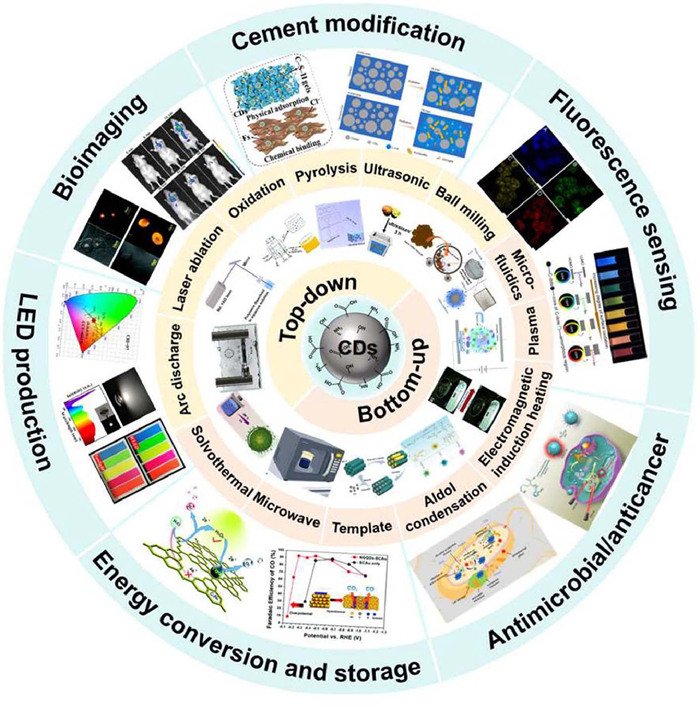
Since the discovery of CDs in 2004, their low toxicity, environmental friendliness, excellent optical properties, good dispersibility, and structural inheritance have attracted much attention, as shown in Fig. 1, and with the continuous efforts of researchers, CDs have demonstrated their potential in a wide range of applications, including optical devices, biomedical technology, optoelectronics, fluorescent sensors, and photocatalysis, etc. [21,25,27,29,34-36,44,50-63].
Figure 1
Figure 1.
Summary of preparation methods and application fields for CDs. Reproduced with permission [50]. Copyright 2021, American Chemical Society. Reproduced with permission [21]. Copyright 2021, AIP Publishing. Reproduced with permission [25]. Copyright 2023, Elsevier. Reproduced with permission [27]. Reproduced with permission [29]. Copyright 2018, Elsevier. Reproduced with permission [34]. Copyright 2014, the Royal Society of Chemistry. Reproduced with permission [35]. Copyright 2017, the Royal Society of Chemistry. Copyright 2022, MDPI. Reproduced with permission [36]. Copyright 2023, Elsevier. Copyright 2023, Elsevier. Reproduced with permission [44]. Copyright 2015, American Chemical Society. Reproduced with permission [51]. Copyright 2022, Elsevier. Reproduced with permission [52]. Copyright 2024, Elsevier. Reproduced with permission [53]. Copyright 2018, American Chemical Society. Reproduced with permission [54]. Copyright 2025, Elsevier. Reproduced with permission [55]. Copyright 2025, Elsevier. Reproduced with permission [56]. Copyright 2021, American Chemical Society. Reproduced with permission [57]. Copyright 2023, the Royal Society of Chemistry. Reproduced with permission [58]. Copyright 2015, Science. Reproduced with permission [59]. Copyright 2018, American Chemical Society. Reproduced with permission [60]. Reproduced with permission [61]. Copyright 2017, the Royal Society of Chemistry. Reproduced with permission [62]. Copyright 2023, American Chemical Society. Reproduced with permission [63]. Copyright 2017, Wiley-VCH.
Further, some examples of precursors, synthesis methods, and applications of CDs are given in Table S2 (Supporting information). The primary reasons responsible for this phenomenon can be categorized into two major aspects: (i) The B-U approach greatly broadens the choice of precursors for CDs [64], which allows researchers to select and design precursor molecules to give the CDs a more directed function; (ii) the synthesis methods of the B-U approach are more diverse, which have been progressively developed from the classical hydrothermal/solvent-thermal synthesis method to the plasma method, microfluidic method, etc. The abundant synthesis methods give CDs more diversified structures and make CDs have more potential functions.
In addition to the applications mentioned in the Table S2 (Supporting information), considering the performance similarities between CDs and GO as well as CNTs [65-67]. It can be inferred that CDs possess the potential to enhance various properties of CBMs akin to GO and CNTs, while exhibiting significant advantages in terms of environmental friendliness and dispersibility. Consequently, CDs are increasingly emerging as a promising candidate for the enhancement of CBMs.
2.4
Superiority of CDs applied to CBMs
In Table 1 [68-76], the differences in physicochemical structure and properties between CDs and other carbon nanomaterials (GO and CNTs as examples) are summarized, and the unique advantages of CDs are analysed.
Table 1
Table 1.
Physical and chemical characteristics comparison of CDs, GO, and CNTs.
0 D spherical nanoparticles (size < 10 nm), amorphous or crystalline carbon core, surface rich in functional groups (-COOH, -OH, -NH2)
2 D lamellar structure, single atomic layer thickness, surface containing oxygen-containing groups such as epoxy groups, hydroxyl groups, carboxyl groups
1 D tubular structures, including single-walled (SWCNTs) or multi-walled (MWCNTs), with an aspect ratio > 1000
High hydrophilicity, high functional group modifiability (such as amination, sulfonation)
Hydrophilicity, oxygen-containing groups provide reaction sites, but functional groups are easily lost after reduction
Hydrophobicity requires covalent modification (such as carboxylation) or non-covalent encapsulation (such as polyvinylpyrrolidone (PVP)) to enhance dispersibility
Multicolour emission dependent on excitation wavelength, strong resistance to photobleaching; UV-vis absorption peaks at 270 nm (π-π*) and 350 nm (n-π*)
(ⅰ) Dispersion and processing simplicity: The abundant hydrophilic functional groups on the surface of CDs make them spontaneously dispersed in water and polar solvents without the need of ultrasound or dispersant, which greatly simplifies the process. Meanwhile, the dispersion stability can still be maintained in a strong alkaline environment.
(ⅱ) Optical tunability and biocompatibility: Multi-colour luminescence (blue → red) is suitable for multi-channel bio-imaging, and low toxicity, adaptable to a variety of applications.
(ⅲ) Environmentally friendly: can be synthesized using biomass precursors (citric acid, cellulose), degradation products without ecological accumulation risk.
3.
Effect of CDs on the properties of CBMs
3.1
Application fields of CDs
Benefiting from their inherent hydrophilicity imparted by abundant surface functional groups, carbon dots (CDs) exhibit spontaneous and stable dispersion in cementitious matrices without requiring additional dispersing agents. Since the optical properties of CDs can be impaired or even disappear due to the aggregation quenching effect (ACQ). Long et al. proposed to utilize the intrinsic optical properties of CDs (UV-visible (UV-vis) absorption spectra and photoluminescence (PL) spectra) to evaluate their dispersion stability in simulated concrete pore solutions [77].
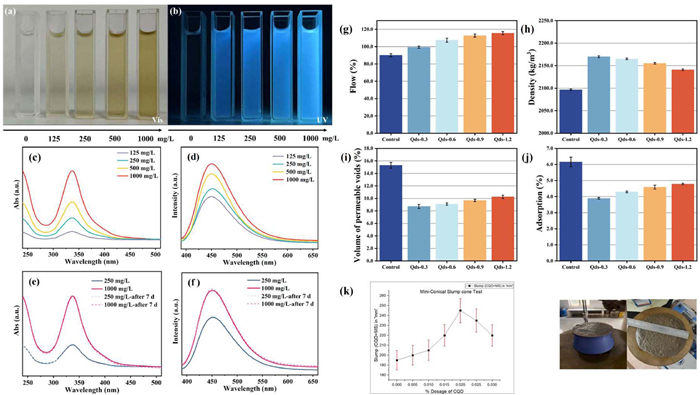
As shown in Figs. 2a-f, their long-term dispersion stability in simulated concrete pore solutions across various concentrations has been confirmed by UV-vis and photoluminescence spectroscopy. There was no visible precipitation in the respective solutions containing CDs after 7 days of resting. With the increase of CDs concentration, the peak intensity of each increased gradually, and the peak intensity was the same before and after the same concentration solution was left to stand. This indicates that CDs are well dispersed in the simulated concrete pore solution regardless of the concentration and show excellent long-term dispersion stability. This fundamental characteristic overcomes the agglomeration issue common with other nanomaterials like GO and CNTs, thereby establishing a critical foundation for their subsequent reinforcing functions.
Figure 2
Figure 2.
Photographs of simulated concrete pore solutions containing CDs under (a) sunlight and (b) 365 nm UV irradiation. (c, d) UV-vis and maximum PL spectra of simulated concrete pore solutions containing CDs. (e, f) Spectra before and after 7 days of resting of solutions with different concentrations of CDs. Copied with permission [77]. Copyright 2024, Elsevier. Physical properties of mortar containing CDs: (g) Fluidity, (h) density, (i) water permeable void volume (VPV), (j) water absorption. Copied with permission [80]. Copyright 2024, Elsevier. (k) Mini-conical slump flow test results of mortar samples with different CQDs additions and photographs of the experimental procedure. Copied with permission [87]. Copyright 2024, Elsevier.
Workability is the main parameter for assessing the homogeneity, ease of transportation, ease of placement, and compaction of fresh concrete mixtures [78]. The rheology of CBMs is an extremely critical issue in predicting their strength, durability, and application in the construction industry [79].
Win et al. [80] did a series of characterizations of the physical properties of CDs-containing mortars. As shown in Figs. 2g-k, the flow values of fresh mortars containing CDs ranged from 99% to 115%. The incorporation of CDs into the fresh mortar improved the workability. Higher CDs content resulted in higher flow values compared to the control samples. As the CDs content increased from 0.3% to 1.2%, the new mortar's workability improved by 10%, 19%, 24%, and 28%, respectively, compared to the control mixture. Compared to the GO-added CBMs, the water-to-binder ratio was higher because GO was insoluble in water and CDs had good dispersibility, eliminating the dispersion step, as the solution state of the CDs helped them to integrate into the mixtures without affecting the workability. Several researchers have already utilized efficient water reducers to improve the processability of CBMs incorporating GO [81,82].
CBMs require high fluidity, moderate viscosity, and adequate cohesive stability to achieve uniform, engineering-quality distribution in cement composites [83]. Relevant studies [84-86] have shown that the addition of nanomaterial GO negatively affects the slump of CBMs, and the slump value decreases with the increase of GO addition. However, unlike GO, the addition of CDs does not adversely affect the slump of concrete. Jayachandra et al. evaluated the effect of CQDs on mortar properties using small-scale slump tests with addition mass ratios ranging from 0.005% to 0.030% [87]. As shown in Fig. 2k, the overall CQDs-cement mortar samples exhibited strong initial slump and moderate slump loss. Analysed in conjunction with the conclusions of Qu et al. [51], this may be due to the abundance of hydrophilic groups such as carboxyl and amide groups on the surface of CDs. The hydrophilicity of CDs converts hydrogen atoms into protons, which leads to an increase in acidity, an increase in the polarity of the -OH- and -NH- bonds, and the formation of ligands by Ca2+ with the carbons and nitrogens of the amide structure [65,88]. Further, at a water-cement ratio of 0.5, adding 0.020% CQDs increased the slump diameter by 48.9%, but adding 0.025% CQDs reduced it, likely because the CQDs reduced the available water in the mortar. Additionally, polycarboxylate admixtures have been reported to significantly improve the compatibility of CQDs-cement mortar.
In summary, the carboxyl and amide groups of CDs can affect the concentration of Ca2+ in the cement pore solution to a certain extent, thus reducing the adverse effect on the cement slump due to the large specific surface area and high water absorption. However, despite extensive research confirming the positive influence of CDs on the workability of freshly mixed cementitious materials, the microscopic mechanisms underlying their rheological behaviour remain poorly understood. Current studies predominantly attribute the dispersibility of CDs to macroscopic descriptions of electrostatic repulsion and steric hindrance, yet lack in-depth exploration of quantitative relationships between their surface charge density, zeta potential, and cement paste rheological parameters such as yield stress and plastic viscosity. More significantly, the synergistic and competitive effects between CDs and high-efficiency water-reducing agents of varying chemical structures represent a near-total research void. This ambiguity in their interactions may lead to unpredictable losses in flow properties over time within practical engineering composite formulations, constituting a potential risk in their industrial application.
3.3
Hydration properties of CBMs containing CDs
3.3.1
Setting time of CBMs containing CDs
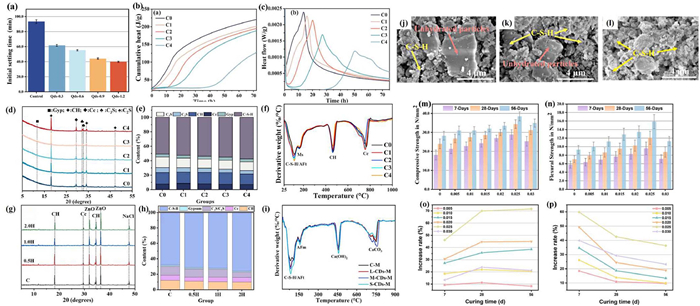
As shown in Fig. 3a, Win et al. investigated the effect of supra-GQDs on the coagulation time of CBMs [89]. The results showed that at ambient temperature, the addition of supra-GQDs resulted in an earlier setting time than the control sample. It is inferred that CDs can accelerate the hydration process of cement because they can provide nucleation sites. Meanwhile, it can be inferred that the cement paste with added CDs can produce more C-S-H gel, thus enhancing the mechanical properties.
Figure 3
Figure 3.
(a) Effect of Supra-GQDs on initial setting time of cement composite system. Copied with permission [89]. Copyright 2024, Elsevier. Hydration process of cement pastes with different CDs concentrations: (b) Cumulative heat release curves, (c) heat flow curves. (d) XRD patterns of diverse mortar after 28 d curing. (e) Phase composition calculated by Rietveld method. (f) DTG of all specimens after 28 d curing. Copied with permission [77]. Copyright 2024, Elsevier. (g) XRD patterns of diverse mortar after 28-d curing. (h) Phase composition calculated by Rietveld method. (i) DTG of all specimens after 28 d curing. Copied with permission [91]. Copyright 2024, Elsevier. SEM images of each group of samples: (j-l) C0, C2, C4 after 28 days of curing. Copied with permission [77]. Copyright 2024, Elsevier. (m) Effect of CQDs addition ratio on compressive strength. (n) Effect of CQDs addition ratio on flexural strength. (o) Growth rate of compressive strength. (p) Growth rate of flexural strength. Copied with permission [87]. Copyright 2024, Elsevier.
Regarding the effect of CDs on the hydration properties of cement. Most of the studies concluded that the effect of CDs on cement hydration is similar to that of other nanomaterials. CDs can promote clinker dissolution, provide nucleation sites for hydration products, significantly accelerate the rate of the hydration reaction. Furthermore, the promotional effect of CDs on the hydration process is augmented with the reduction in their size [90,91]. However, this conclusion was further expanded by Long et al. [77]. As shown in Figs. 3b and c, C0, C1, C2, C3, C4 represent the addition levels of CDs at 0, 0.025, 0.05, 0.1, and 0.2 wt% respectively. As the amounts of CDs added increased, the timing of the main peak of hydration exothermicity was delayed from 13.7 h to 16.1, 20.2, 27.1, and 50.3 h, while the cumulative exothermic heat at the final time point (72 h) decreased by 8.6%, 11.4%, 14.4%, and 42.4% respectively. In conclusion, CDs can significantly retard the early hydration process of cement paste, with an effective range of 0–0.2 wt%. We speculate that this may be related to the use of citric acid as the precursor for CDs in this study, as CDs may “inherit” certain properties from their precursors.
3.3.3
Hydration product of CBMs containing CDs
Typically, the main components of cement hydration products include C-S-H gel (hydrated calcium silicate) gel, Ca(OH)2 (CH), and ettringite/monosulfate (AFt/Ms). Of which, CH undergoes a carbonation reaction with CO2 to produce the carbonation product CaCO3 (Cc). Long et al. explored the effect of different additions of CDs on the hydration products of cement [77], where C0-C4 denotes the additions of CDs from 0–0.2 wt%. As shown in Fig. 3d, the XRD patterns of all the samples exhibited similar peaks, including CH (peaks at 18.1°, 34°, and 47.1°), Cc (peak at 29.4°), and several unhydrated products (peaks at 11.7°, 32.3°, and 32.7°), which can be attributed to gypsum (Gyp), tricalcium silicate (C3S), and dicalcium silicate (C2S), respectively. This indicates that CDs do not change the type of cement hydration products. As shown in Fig. 3e, the quantitative analysis was carried out by the Rietveld method. The results showed that the contents of Gyp, C2S, and C3S gradually decreased with the increase of CDs addition, while the C-S-H gel content showed an increasing trend. This phenomenon indicated that CDs significantly promoted the hydration of cement after 28 d of curing, thus reducing the content of unhydrated products and generating more C-S-H gel. Among them, the C-S-H gel content of the C4 reached 57.38%, which was 13.06% higher than that of the C0, which contributed to the improvement of the late mechanical properties and the physical adsorption capacity of chloride ions in CBMs.
As shown in Fig. 3f, the TGA/DTG results further corroborate the XRD findings. All samples exhibited the same mass loss peaks in specific temperature ranges, including 50–150, 150–200, 410–500, and 600–800 ℃, respectively, associated with C-S-H gel/AFt, Ms, CH, and Cc decomposition correlation [92,93]. The results showed that the addition of CDs could not change the type of hydration products. The C-S-H gel in the CDs-containing samples exhibited a stronger weight loss peak than the control (C0), and the content of C-S-H gel increased with the addition of CDs. This further suggests that CDs can promote the formation of C-S-H gel, thus contributing to the improvement of the late mechanical properties and the physical adsorption of chloride ions in cement composites.
Further, He et al. further examined the effect of CDs size on hydration products, keeping surface groups and additions constant [91]. As shown in Fig. 3g, all samples exhibited identical characteristic peaks for CH (18.1°), SiO2 (21.2° and 26.9°), Cc (29.5°), and unhydrated C2S/C3S (34.6°), indicating that CDs size does not alter the phase composition. Quantitative analysis (Fig. 3h) revealed that the sample modified with the smallest CDs (S-CDs-M) had the highest C-S-H gel content (75.07%), which decreased with increasing CDs size: M-CDs-M (72.21%) and L-CDs-M (71.04%). Correspondingly, CH content increased from 7.56% to 9.57%, while unhydrated C2S/C3S decreased from 16.96% to 6.62% as CDs size increased. The DTG results (Fig. 3i) were consistent with XRD, showing stronger C-S-H gel/AFt and AFm mass loss peaks for the S-CDs-M group. These findings suggest that smaller CDs are more effective in accelerating cement hydration and promoting C-S-H gel formation.
Quantitative analysis via XRD-Rietveld refinement and TGA/DTG revealed that the incorporation of CDs led to a significant increase in the content of C-S-H gel and a concurrent reduction in unhydrated phases. Moreover, these phenomena become more pronounced as the size of the CDs decrease. This indicates a promoted overall hydration degree, the mechanisms of which are delved into in chapter 4.
3.3.4
Microstructure of CBMs containing CDs
SEM images are presented in Figs. 3j-l [77]. C0 is the control group without CDs, while C2 and C4 contain 0.1 and 0.2 wt% CDs, respectively. After 28 days of curing, the C0 group (Fig. 3j) showed numerous unhydrated particles, 6–8 µm in diameter, with only a small amount of amorphous C-S-H gel adsorbed around them. With the addition of CDs (Fig. 3k), the unhydrated particle size decreased to 3–4 µm and their surfaces were covered by more C-S-H gel. At the higher CDs content in C4 (Fig. 3l), the particle size was further reduced to 1–2 µm, and nearly all particles were fully covered by C-S-H gel. The C4 sample exhibited a clear increase in C-S-H gel, which was also more densely distributed. These results indicate that CDs accelerate cement clinker dissolution and promote C-S-H gel formation after 28 days, with the effect becoming more pronounced at higher additions, consistent with XRD and TGA/DTG findings. Furthermore, well-dispersed CDs help regulate C-S-H gel distribution, resulting in a denser and more homogeneous microstructure.
Current research has reached a consensus on the “early inhibition, late promotion” phenomenon of CDs regulating hydration, yet explanations for the triggering mechanism at this inflection point remain overly generalised. The vast majority of proposed mechanisms (such as chelation-dissociation release) rely on indirect evidence and inference, lacking direct molecular-level characterisation of the dynamic binding energies between specific functional groups on the CDs surface (e.g., carboxyl, amino groups) and Ca2+ or silicate ions. Furthermore, conclusions in the literature suggesting that “smaller sizes yield stronger promotion” may conflate the size effect with the influence of coupled factors such as specific surface area and functional group density. Clarifying these dominant factors and employing in-situ techniques to capture early-stage interfacial processes during hydration are crucial for overcoming current cognitive limitations.
3.4
Hardening properties of CBMs containing CDs
As shown in Table 2 [51,77,80,87,91,94], the addition of CDs can effectively improve the compressive and flexural properties of CBMs. However, there is no linear relationship between the addition of CDs and the mechanical properties of the CBMs. With the increase of CDs content, the mechanical properties at each curing age are gradually enhanced, but when the content is too high or too low, the strength improvement effect is weak or even lower than that of the control group.
Table 2
Table 2.
Summary of mechanical properties of CDs modified CBMs.
As shown in Figs. 3m-p, Anand et al. explored the changes in mechanical properties of CDs-modified cement mortars at different ages [87]. The strength of the mortar increased gradually as it aged, and after 56 d of curing, the compressive strength increased by 73% and the flexural strength by 59% when the CDs/cement ratio was increased from 0.005% to 0.025%. However, when the CQDs/cement ratio exceeded 0.025%, the compressive and flexural strengths suddenly decreased. He et al. investigated the effect of different sizes of CDs on the mechanical properties of cement mortar and found that independent of the curing time [91], the compressive strength of CDs-modified mortar showed a tendency to increase and then decrease at all curing ages as the size of CDs decreased. In the size range of 1.81–12.53 nm, CDs with an average size of 5.86 nm had the optimal modification effect on the mechanical behavior of mortar (15.7% increase in compressive strength after 7 d of curing).
Reports in the literature concerning the enhancement of mechanical properties by CDs predominantly focus on improvements in macroscopic mechanical indicators, whilst lacking in-depth exploration of their toughening mechanisms and interfacial strengthening effects at the nano-micro scale. A key limitation lies in our continued uncertainty as to whether CDs function as nanofillers directly bearing loads, or as structural orienting agents regulating the assembly of C-S-H gel to enhance its bulk strength. Current research has failed to directly correlate the incorporation of CDs with the evolution of micro-scale toughness (such as fracture energy) in cement matrices. Furthermore, the competing contributions of the “nucleation effect” and “air-entraining effect” to macroscopic strength remain unquantified, precluding the precise design of optimal CD parameters for specific mechanical performance objectives.
3.5
Durability properties of CBMs containing CDs
3.5.1
Water absorption of CBMs containing CDs
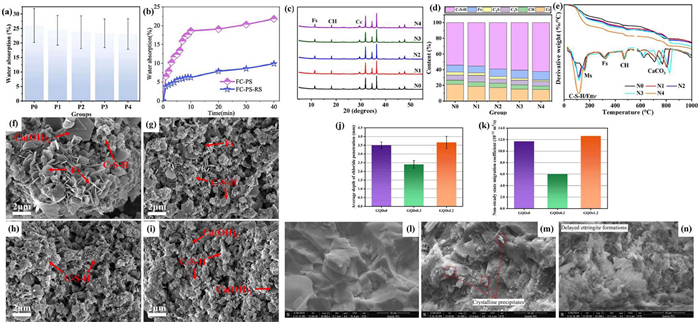
Typically, the water adsorption ratio (Wa) of CBMs reflects their intrinsic porosity and permeability and plays a key role in evaluating the resistance of the cement matrix to chloride migration [95]. Long et al. tested water absorption of cement paste with different CDs contents after 28 d curing [96]. As shown in Fig. 4a, the Wa of samples containing CDs was consistently lower than that of P0, decreasing with higher CDs content. P4 had the lowest Wa (23.04%), 11.5% lower than the reference. This indicates that introducing highly dispersed porous particles promotes a denser cement matrix, effectively hindering water (and chloride ion) penetration through pores and thus significantly improving chloride erosion resistance.
Figure 4
Figure 4.
(a) The Wa of various CDs-adding paste samples after 28-day curing. Copied with permission [96]. Copyright 2024, Elsevier. (b) Water absorption of foamed concrete. Copied with permission [97]. Copyright 2023, Elsevier. (c) XRD patterns of each group of samples before and after 14 d of immersion in 3 mol/L NaCl solution. (d) XRD-Rietveld analysis results; (e) TGA/DTG plot lines. SEM images of each sample group after immersion in 3 mol/L NaCl solution for 14 days: (f) N0, (g) N2, (h) N3, (i) N4. Copied with permission [102]. Copyright 2023, Elsevier. (j) Average depth of penetration of chlorine. (k) Non-steady state migration coefficient. FESEM images of (l) GQDs 0, (m) GQDs 0.3 and (n) GQDs 1.2. Copied with permission [104]. Copyright 2024, Elsevier.
Song et al. investigated the effect of CDs on water absorption of concrete as shown in Fig. 4b [97]. The addition of RHBCD (FC-PS-RS group) reduced the water absorption of the samples by 13.1%. This indicates that RHBCD is favourable for reducing the water absorption of foam concrete. The foam with the highest viscosity (PS-RS) is conducive to reducing foam coalescence and drainage, as well as optimizing the pore size of the sample. Thus, the mechanical properties of the samples are improved and the reduction of water absorption of the samples is achieved [37]. Since the overall water absorption of foam concrete is attributed to its matrix composition [98]. Therefore, it can be assumed that CDs can reduce the water absorption of foam concrete by filling its capillaries [99].
3.5.2
Chloride binding of CBMs containing CDs
CDs, as the members of carbon-based nanomaterials, not only inherit some of the properties of CNTs and GO but also have the advantages of excellent dispersion stability, easy preparation, cost-effectiveness, low toxicity and good environmental friendliness [46,100]. These properties endow CDs with potential applications in cement matrix chloride binding technology. Currently, some studies have verified that CDs can promote the chloride-binding properties of CBMs, which will provide a new type of highly dispersible and low-cost nanomaterials to improve the durability of CBMs. As shown in Table 3 [45,52,77,90,96,101], a variety of CDs had a significant enhancing effect on the chloride binding capacity of CBMs.
Table 3
Table 3.
Comparison of the enhancement of chloride binding capacity of different CDs materials under optimal conditions.
Note: P.I 52.5R cement was used in all cases; the concentration of NaCl solution used was 3 mol/L.
He et al. used XRD, TGA/DTG, and SEM to analyse the phase compositions of cement pastes containing different levels of CDs before and after 14 days of immersion in 3 mol/L NaCl solution [102]. As shown in Fig. 4c, new diffraction peaks corresponding to Fs (peaks at 11°, 22°, and 23°) appeared in all samples after soaking, indicating complete chloride ion binding induced by Fs. It should be noted that Fs and Kuzel’s salt (Ks) form from the reaction of the monosulfate phase with free chloride ions. At low free chloride ion concentrations, Ks tends to form, whereas at higher levels ( ≥ 1 mol/L), Fs dominates [103]. In this study, Fs crystals chemically bind chloride ions since the free chloride ion concentration far exceeds 1 mol/L.
The Rietveld method (Fig. 4d) was used to quantify Fs and other phases in each group. After 14 d in NaCl solution, the mass ratio of unhydrated products (C2S/C3S) decreased with increasing CDs addition, while that of C-S-H gel increased, indicating that CDs promote cement hydration, with larger additions having a more significant effect. The Fs content rose from 8.7% (N0 group) to 10.1% (N4 group), suggesting CDs slightly enhance the chemical binding of chloride ions via Fs. Thus, XRD results show that CDs significantly improve physical chloride adsorption, slightly increase chemical binding, and ultimately enhance chloride binding capacity at dosages of 0–0.2 wt%.
In addition to XRD, TGA/DTG provided detailed phase content information. As shown in Fig. 4e, all pastes exhibited mass loss peaks in the ranges 90–140 ℃ (C-S-H gel/ettringite), 140–190 ℃ (monosulfate, Ms), 280–360 ℃ (Fs), 450–500 ℃ (CH), and 600–850 ℃ (Cc). Within 0.2 wt% CDs, the C-S-H gel peak was much stronger than in the blank group, and its intensity increased with CDs content, confirming that CDs promote cement hydration and C-S-H gel formation, thereby enhancing physical chloride adsorption. Moreover, the Ms and Fs peaks were slightly stronger with CDs, indicating a modest increase in these phases for chemical chloride binding, consistent with XRD inferences.
As shown in Figs. 4f–i, SEM was used to observe the morphology of each sample after immersion. In the blank group (Fig. 4f), similar hexagonal plate crystals (1–3 µm) are Fs, while larger hexagonal plates ( > 3 µm) are CH crystals, with abundant amorphous C-S-H gel aggregates randomly distributed. In the N2 group with 0.05 wt% CDs (Fig. 4g), more C-S-H gel covered the Fs and CH crystals, without a significant increase in Fs number, confirming that CDs enhance physical chloride adsorption by promoting C-S-H gel formation. For the N3 and N4 groups (Figs. 4h and i), C-S-H gel increased markedly while Fs crystals only rose slightly, aligning well with XRD and TGA/DTG results.
Raj et al. performed chloride penetration tests on samples with GQDs addition percentages of 0, 0.3% and 1.2%, respectively [104]. As shown in Fig. 4j, the depth of penetration was maximum and minimum for GQDs 1.2 and GQDs 0.3 samples, respectively. The average chloride penetration depth of GQDs 0.3 samples is 30% lower than that of GQDs 0 samples. As can be seen in Fig. 4k, the magnitude of the unsteady-state migration coefficients for the GQDs 0 and GQDs 1.2 samples are close to each other. However, the unsteady-state migration coefficient of the GQDs 0.3 sample is much lower. As illustrated, compared to the control group (Fig. 4l), the intrinsic pores within the concrete of the GQDs0.3 sample (Fig. 4m) were observed to be substantially filled. This phenomenon is primarily attributed to the in situ formation of C-S-H gel and newly crystallised phases following the incorporation of 0.3% quantum dots. It may therefore be inferred that the judicious incorporation of quantum dots enhances the chloride ion permeability resistance of carbon-based materials. However, when GQDs exceeded 0.3% (Fig. 4n), densely distributed acicular precipitates emerged within the concrete matrix. These deposits, arising from delayed calcium hydroxide formation due to excess carbon dioxide, indicate that higher GQD concentrations may induce detrimental chemical interactions within the concrete matrix.
These findings demonstrate the potential of CDs in enhancing the chloride corrosion resistance of cement pastes and are expected to provide a new highly dispersible and cost-effective nanomaterial to promote the durability of reinforced concrete structures in complex coastal environments and de-icing salt application sites. However, current research of CDs’ role in improving durability is highly concentrated on chloride ion behaviour, resulting in a significant cognitive imbalance. The impact of CDs on other critical durability metrics, such as resistance to sulphate attack, alkali-aggregate reaction, and long-term carbonation behaviour, remains almost entirely unknown. Even regarding chloride binding, research has primarily confirmed enhanced physical adsorption, with scant evidence on whether or how CDs chemically modulate the morphology, stability, and transformation of Friedel’s salts. The most significant gap lies in the fact that virtually all durability data originate from short-term, idealised laboratory accelerated tests. There is a critical lack of long-term performance data under complex coupled environmental conditions (e.g., chloride-freeze-thaw-wet-dry cycles), introducing substantial uncertainty in assessing their reliability for service in severe environments.
4.
Modification mechanism of CBMs containing CDs
4.1
CDs-induced hydration retardation
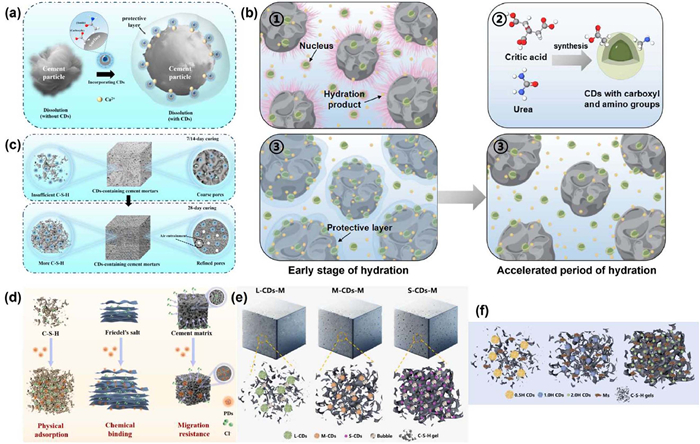
From the conclusions obtained in Section 3.3.2, it is clear that CDs retard the pre-hydration process of CBMs. As shown in Fig. 5a, the hydration retardation effect of CDs on cement can be interpreted as a result of the composite of the following mechanisms:
(ⅰ) CDs containing a large number of O/N groups formed a protective barrier against hydration through the complexation of their abundant surface groups with Ca2+. Thus, the Ca2+ concentration in the liquid phase is controlled at the early stage of hydration, resulting in a retardation effect.
(ⅱ) CDs are often “hereditary” (i.e., inheriting certain physical and chemical characteristics from the carbon source). In the study by Long et al., the carbon source of CDs was citric acid, and thus CDs have physicochemical characteristics similar to those of citric acid [77], which also significantly retarded hydration.
(ⅲ) The N of the amide formed by the condensation reaction between citric acid and urea in the raw material on the surface of the CDs also complexes with Ca2+ to form a ligand, which reduces the concentration of Ca2+ released during the hydration process, thus slowing down the hydration process of the cement.
Figure 5
Figure 5.
(a) Schematic representation of the mechanism of CDs-induced delay in hydration. Copied with permission [77]. Copyright 2024, Elsevier. (b) Several possible mechanisms by which CDs affect hydration processes: ① corresponds to the mechanism described in (ⅰ), ② corresponds to the mechanism described in (ⅱ), ③ corresponds to the mechanism described in (ⅲ). (c) Schematic diagram of the mechanism by which CDs affect the mechanical properties of CBMs. Copied with permission [77]. Copyright 2024, Elsevier. (d) Schematic representation of the combined effects of nucleation and air entrainment on phase composition and pore structure. Copied with permission [91]. Copyright 2024, Elsevier. (e) Schematic representation of the mechanism by which CDs enhance the chloride binding capacity of CBMs. Copied with permission [96]. Copyright 2024, Elsevier. (f) Schematic representation of the mechanism of the effect of CDs size on chloride binding. Copied with permission [45]. Copyright 2024, Elsevier.
4.2
Mechanism of CDs affecting the hydration process of CBMs
Although CDs retard the early hydration of CBMs, they promote the hydration process in general. As shown in Fig. 5b, the influence of CDs on the hydration process of CBMs can be attributed to the following.
(ⅰ) Nucleation effect: Previous studies have demonstrated that nanomaterials have a nucleation effect that accelerates cement hydration [46,105]. As demonstrated by the experimental phenomena in Section 3.3.3, CDs also exhibit nucleation effects similar to those observed in other nanomaterials. Specifically, the nucleation rate of the hydration products on the surface of the nanomaterials is lower than that in the pore solution, which makes it easier for the hydration products to grow on the surface of the nanomaterials [95]. This leads to an acceleration of cement hydration, generating more C-S-H gel and refining the interfacial transition zone (ITZ) and pore structure. The high dispersibility and high specific surface area of CDs provided more nucleation sites in the cement paste, significantly promoting cement hydration and reducing the content of unhydrated products.
(ⅱ) “Hereditary” of CDs: CDs can inherit some of their physical and chemical characteristics from their precursors, and when the precursor of CDs is a substance that promotes hydration, CDs may also possess the same properties, thus promoting the hydration process.
(ⅲ) Surface groups: The O/N groups enriched on the surface of CDs generate unstable complexes with Ca2+ in the early stage of hydration that decompose on their own as the hydration process proceeds, and do not affect the hydration reaction rate in ·the accelerated period of hydration [106].
4.3
Mechanism of CDs affecting the hardening properties of CBMs
4.3.1
Water absorption of CBMs containing CDs
The effect of CDs on the mechanical properties of mortar is significantly different from that of nanomaterials such as GOs and CNTs. As shown in Fig. 5c [77], Long et al. rationally analysed the mechanism of the mechanical properties of mortar affected by CDs through compressive/flexural strength tests, XRD, TGA/DTG, SEM, and MIP as a combined effect of the nucleation effect, retardation effect, and air entrapment effect of CDs [46,105]. At the early stage (before 14 d of curing), all added amounts of CDs reduced the mechanical properties of the mortar. This was attributed to the fact that CDs retarded the early hydration reaction, resulting in an insufficient degree of hydration. At the same time, CDs as retarders with abundant surface groups usually cause air entrapment effects, leading to the emergence of a large number of pores within the cement matrix, thus negatively affecting the mechanical properties. More seriously, the mechanical properties of mortars containing CDs were lower than those of the reference group in the early stages due to the delayed induction of CDs resulting in insufficient Ca2+ release during cement dissolution, which prevented the CDs from exerting their nucleation effect.
However, when the cement was cured for 28 d, the CDs provided nucleation sites that significantly promoted cement hydration reduced the content of unhydrated products and facilitated the production of more evenly distributed C-S-H gel. The improvement induced by CDs was more effective as the amounts of CDs incorporated increased. Also, the introduction of CDs reduced the pore size of the mortar. These CDs-induced changes were beneficial in promoting the mechanical action of the CBMs. However, the cumulative pore volume of CD-containing samples increased due to air entrapment induced by CDs. When the amounts of CDs added is below a certain threshold, the nucleation effect of CDs counteracts the unfavourable effect of their air entrainment effect, thus improving the mechanical properties of the mortar. Conversely, when CDs were added above this threshold, the air-entrainment effect was more pronounced, leading to an increase in cumulative pore volume, which impaired the mechanical properties. When cured for 28 d, the retardation effect of CDs did not significantly affect the mechanical properties of the mortar.
4.3.2
Mechanism of CDs size affecting mechanical properties of CBMs
As shown in Fig. 5d, based on Section 3.4, He et al. further added the mechanism of the effect of CDs size on the mechanical properties of mortar [91]. The nucleation effect of CDs and the air entraining synchronously affect the mechanical properties of mortar. Due to the excellent long-term dispersion stability of CDs in cement pore solutions and the fact that smaller-sized CDs contain more nanoparticles and have a higher specific surface area at the same addition level [107], this leads to an increase in the number of nucleation sites. Thus, the nucleation effect of CDs is dominant compared to the air entrainment effect and the smaller the size of CDs, the stronger the effect of accelerating cement hydration, leading to an increase in the production of C-S-H gel. This helps to refine the microstructure and thus increase the compressive strength of the mortar. Considering only the nucleation effect, the mechanical properties of mortar containing CDs gradually increase with the decrease in the size of CDs.
However, at the same time, CDs can significantly affect the pore structure of mortar through air-entraining effects. Previous studies have indicated that the air-entraining effect reduces the compressive strength of CBMs [108]. In addition, the addition of GO causes more air bubbles to be created in the cementitious material [109]. Since CDs also have some structural and physical properties similar to those of GO, it makes the same gas-entraining effect of CDs in CBMs. CDs and air-entraining agent molecules have similar bubble-generating mechanisms in CBMs, i.e., the air-entraining efficiency is enhanced with the increase in the number of air-entraining agent molecules [110]. Therefore, at the same CDs addition, the negative impact caused by air entrapment gradually increases with the decrease in CDs size, leading to an increase in the harmful porosity and weakening the positive impact of the nucleation effect. The strength of each of the two effects varies with the size of the CDs, resulting in a first increase and then a decrease in the mechanical properties of the mortar as the size of the CDs decreases.
Since the enhancement of the mechanical properties of CBMs can be achieved by changing the addition of CDs, and it is highly dispersible and low-cost at the same time, it can replace GO and CNTs as a new generation of nano-reinforced materials for improving the mechanical properties of CBMs.
4.4
Mechanism of CDs affecting the durability of CBMs
4.4.1
Mechanism of CDs affecting the chloride binding of CBMs
Since He et al. first proposed the use of highly dispersed and cost-effective nitrogen-doped graphene quantum dots, N-GQD [101], to improve the chloride-binding properties of cement, several studies [52,90,96] have pointed out that CDs synthesized from other carbon sources likewise have the same potential to be applied to improve chloride binding capacity, and have derived similar chloride-binding mechanisms.
In a word, as shown in Fig. 5e, the incorporation of CDs contributes to the production and compression of C-S-H gel and Fs, thereby greatly amplifying the chloride physisorption and chemical binding capacity within the cement paste. Firstly, the nucleation effect of CDs promotes complete hydration, enhances the generation of C-S-H gel and Fs [46] and refines the porosity of the cement matrix, which effectively enhances their migration resistance in the cement matrix. Secondly, CDs, due to their ultra-small particle size, allow them to fill the pore structure of the cement matrix to a certain extent, thus greatly reducing the proportion of harmful pores and increasing the proportion of harmless pores. At the same time, its surface is rich in N-/O- groups, which contribute to the improvement of cement hydration [101]. Based on these properties, a large number of high-density C-S-H gel are produced, thus showing a significant positive effect on the physisorption of chlorides. In addition to this, CDs slightly promote the formation of more Fs, which mildly enhances the chloride chemical binding capacity of the cement material.
4.4.2
Mechanism of CDs size affecting chloride binding of CBMs
Based on Section 3.3.1, as shown in Fig. 5f, He et al. further explored the mechanism by which the size of CDs affects the binding of cement paste chlorides [91]. This suggests that smaller-sized CDs can more significantly stimulate the production of C-S-H gel and Ms through their nucleation effects, thereby greatly facilitating the physisorption and chemical binding of cement paste. At the same additive amount, larger-sized CDs have a smaller number of particles, resulting in fewer nucleation sites. At the same time, the nucleation sites of the hydration products increase with the increase in the specific surface area of the CDs, due to the negative correlation between the specific surface area and the particle diameter [6,101]. Consequently, smaller-sized CDs provide more nucleation sites, which are more conducive to driving the hydration reaction of CBMs to produce more C-S-H gel and Ms. And the smaller the size of CDs, the stronger the binding capacity for chloride ions in CBMs.
5.
Comparative analysis of carbon nanomaterials applied for modification of CBMs
GOs and CNTs, which belong to the same family of carbon nanomaterials as CDs, have been widely used in the modification studies of CBMs. To reflect the significant difference between CDs and GO and CNTs and to show the superiority of CDs. The effects of the three on the properties, modification mechanism, synthetic expandability and ecotoxicity of CBMs were compared in Table 4 [69,70,73-77,87,111-116]:
(1) CDs have much stronger dispersibility than GO and CNTs, without chemical modification and auxiliary dispersing means.
(2) Due to the difference in structural morphology, CDs enhance the strength of CBMs in a way different from that of GO and CNTs. (e.g., improving the hydration process by chelating Ca2+ and nano-filling effect), and can achieve an enhancement effect not inferior to that of GO and CNTs.
(3) CDs do not affect the workability of the cement paste as GO and CNTs do, and can reduce water demand.
(4) CDs have the advantages of diverse synthesis methods, diverse raw materials and lower cost. They have greater potential for expanded production than GO and CNTs.
(5) CDs can be produced without ecotoxicity in the whole process. And CDs themselves are green and non-toxic.
Table 4
Table 4.
Comparative analysis of carbon nanomaterials in CBMs.
In Fig. S4 (Supporting information), the main mechanism by which CDs, GO, and CNTs enhance the strength of CBMs is visualized using SEM. Compared with GOs and CNTs, CDs did not show significant bridging effects, and the enhancement effect on CBMs was mainly achieved by accelerated hydration and filling effects.
6.
Conclusions and perspectives
6.1
Conclusions
CDs, as an emerging carbon nanomaterial, possess the small size effect, quantum effect and nucleation effect of nanomaterials, which are conducive to the enhancement of the performance of CBMs. Combined with the current status of the research on CDs-modified CBMs in terms of ease of use, hydration process, hardening properties, durability and microscopic action mechanism. The conclusions are as follows:
(1) The rich surface groups of CDs give them excellent dispersibility compared to GOs and CNTs. Therefore, higher water-to-binder ratios do not negatively affect the processability and flow of CBMs, and do not require additional modification or addition of water-reducing admixture.
(2) CDs (citrate precursors) would retard the early hydration of CBMs through complexation with Ca2+ but significantly contribute to the later hydration. Overall, CDs had the effect of significantly accelerating the hydration process, promoting the production and homogenizing the distribution of C-S-H gel, and this effect was enhanced as the size of CDs decreased. However, CDs could not change the types of hydration products.
(3) CDs can effectively improve the compressive and flexural properties of CBMs through nucleation and packing effects. However, there is no linear relationship between the addition of CDs and mechanical properties, and the strength improvement effect is weak when the addition amount is too high or too low.
(4) The current research on the effect of CDs on the durability of CBMs mainly focuses on the resistance to chloride corrosion. CDs can make the microstructure of CBMs denser and reduce the water absorption rate. They can enhance the physical adsorption and chemical binding ability of CBMs to chloride ions by significantly promoting the generation of C-S-H gel and slightly promoting the generation of Fs, thus improving the chloride binding ability and resistance to chloride ion penetration of CBMs.
Nowadays, there are many meaningful results in the research of CDs-modified CBMs, but more attention should be paid to the following aspects there are still some problems to be further studied:
(1) The study of the effect of CDs on the properties of CBMs is still too limited, with only a slightly deeper exploration of the mechanical properties and chloride corrosion resistance.
(2) A one-to-one relationship between the structure of CDs and the properties of CBMs has not been established. For example, the mechanisms by which CDs regulate various aspects of the properties of CBMs are only in their infancy.
(3) The adsorption-dispersion mechanism of CDs as a new type of admixture added to CBMs could not be clarified, and only the phenomenon of change in cement paste compatibility was described.
(4) There is a lack of investigation into the hydration kinetics of cement after the addition of CDs, and the explanation of the phenomenon of CDs blocking the hydration reaction in the early stage and accelerating the overall hydration process is too one-sided. For example, the evolution of the microstructure of cement hydration products after the addition of CDs has not been elucidated. As well as failing to systematically study the mechanism of CDs affecting the dissolution-precipitation reaction.
6.2
Perspectives
Although CDs demonstrate significant potential in modifying CBMs, their transition from laboratory achievements to industrial applications remains contingent upon addressing several specific challenges through targeted research. Future studies are recommended to focus on the following specific directions:
(1) Standardized protocols for performance evaluation. Currently, there is a lack of standardised methods for dispersing and quantifying CDs within cementitious materials, leading to difficulties in reproducing data. Therefore, future work must establish: (ⅰ) Dispersion standards: Define optimal ultrasonic energy levels, duration, and chemical additive specifications for different CD types within simulated cement pore solutions. (ⅱ) Performance metrics: Develop unified testing protocols to quantitatively correlate CD characteristics (type, size, surface charge, functional group type, functional group density, etc.) with specific cement properties (fresh workability, early strength, elastic modulus, permeability resistance, chemical resistance, volume stability, freeze-thaw resistance, etc.).
(2) Deciphering structure-activity relationships through advanced characterizations. The precise mechanism of action at the carbon-cement interface remains incompletely understood. Further research may be pursued through the following two avenues: (ⅰ) Probe the Interface: Employing solid-state nuclear magnetic resonance and synchrotron-based X-ray techniques to chemically image interactions between surface functional groups on CDs (e.g., -COOH, -NH2) and hydration products (C-S-H, AFm), thereby transcending indirect evidence. (ⅱ) Real-time monitoring: Employing in situ X-ray diffraction and isothermal calorimetry to quantitatively elucidate the dual “inhibitory-promoting” effect of CDs on C3S hydration kinetics.
(3) Designing next-generation “smart” CDs for CBMs. The future application of CDs in CBMs should evolve towards multifunctionality, transcending their purely passive enhancement role. This may encompass the following approaches: (ⅰ) Self-sensing CDs: Design CDs exhibiting strain-dependent fluorescence or piezoresistive properties to develop concrete capable of real-time structural health monitoring. (ⅱ) Self-healing CDs: Synthesis of CDs loaded with corrosion inhibitors or repair agents, which release these substances in response to localized pH changes induced by corrosion or microcracks. (ⅲ) Environmentally responsive CDs: CDs engineered to exhibit changes in fluorescent colour or intensity under specific conditions. Upon concrete deterioration, these CDs provide early warning through altered fluorescent signals, long before macroscopic phenomena become apparent.
(4) Overcoming barriers to industrial application. The transition of laboratory research findings into industrial applications presents challenges in the following key areas: (ⅰ) Cost-effective manufacturing: Research must focus on continuous-flow reactors (such as microfluidic systems) for kilogram-scale CDs production, utilizing industrial waste streams (e.g., lignin, pyrolysis oil) as primary carbon sources, with the objective of reducing costs to below $10/kg. (ⅱ) Compatibility and long-term performance: Comprehensive research is required into the long-term durability ( ≥ 5 years) of CDs-modified concrete under real-world environmental conditions, encompassing carbonation, freeze-thaw cycles, and the influence of CDs on the corrosion behaviour of reinforcing steel. (ⅲ) Environmental and regulatory barriers: A comprehensive life-cycle assessment must be conducted to validate the environmental benefits of CDs materials. Furthermore, establishing clear regulatory guidelines for the use of CDs materials in construction is crucial for industry acceptance.
(5) Scale-up synthesis and cost-effectiveness. To bridge the gap between laboratory research and field application, the development of cost-effective, large-scale synthesis methods for CDs is paramount. As summarized in Tables S3 and S4 (Supporting information), various strategies, such as microwave-assisted and hydrothermal methods, have demonstrated the potential for gram-to-kilogram production using low-cost precursors. Future research should prioritize continuous-flow reactors and the utilization of industrial waste streams as carbon sources to further reduce production costs, aiming for a target below $10/kg to ensure economic viability for the construction industry.
The authors declare that they have no known competing financial interests or personal relationships that could have appeared to influence the work reported in this paper.
Acknowledgments
This work was supported by the Guangdong Basic and Applied Basic Research Foundation (No. 2024B1515020087) and National Natural Science Foundation of China (No. 52378280).
M. Rafieizonooz, J.J. Kim, J. Kim, et al., Materials 17 (2024) 2851. doi: 10.3390/ma17122851
[115]
P. Zhang, L. Wang, H. Wei, et al., Adv. Civ. Eng. 2021 (2021) 8827124. doi: 10.1155/2021/8827124
[116]
J.A. Abdalla, B.S. Thomas, R.A. Hawileh, et al., Mater. Today: Proc. 65 (2022) 2073–2076. doi: 10.1016/j.matpr.2022.06.429
Figure 1
Summary of preparation methods and application fields for CDs. Reproduced with permission [50]. Copyright 2021, American Chemical Society. Reproduced with permission [21]. Copyright 2021, AIP Publishing. Reproduced with permission [25]. Copyright 2023, Elsevier. Reproduced with permission [27]. Reproduced with permission [29]. Copyright 2018, Elsevier. Reproduced with permission [34]. Copyright 2014, the Royal Society of Chemistry. Reproduced with permission [35]. Copyright 2017, the Royal Society of Chemistry. Copyright 2022, MDPI. Reproduced with permission [36]. Copyright 2023, Elsevier. Copyright 2023, Elsevier. Reproduced with permission [44]. Copyright 2015, American Chemical Society. Reproduced with permission [51]. Copyright 2022, Elsevier. Reproduced with permission [52]. Copyright 2024, Elsevier. Reproduced with permission [53]. Copyright 2018, American Chemical Society. Reproduced with permission [54]. Copyright 2025, Elsevier. Reproduced with permission [55]. Copyright 2025, Elsevier. Reproduced with permission [56]. Copyright 2021, American Chemical Society. Reproduced with permission [57]. Copyright 2023, the Royal Society of Chemistry. Reproduced with permission [58]. Copyright 2015, Science. Reproduced with permission [59]. Copyright 2018, American Chemical Society. Reproduced with permission [60]. Reproduced with permission [61]. Copyright 2017, the Royal Society of Chemistry. Reproduced with permission [62]. Copyright 2023, American Chemical Society. Reproduced with permission [63]. Copyright 2017, Wiley-VCH.
Figure 2
Photographs of simulated concrete pore solutions containing CDs under (a) sunlight and (b) 365 nm UV irradiation. (c, d) UV-vis and maximum PL spectra of simulated concrete pore solutions containing CDs. (e, f) Spectra before and after 7 days of resting of solutions with different concentrations of CDs. Copied with permission [77]. Copyright 2024, Elsevier. Physical properties of mortar containing CDs: (g) Fluidity, (h) density, (i) water permeable void volume (VPV), (j) water absorption. Copied with permission [80]. Copyright 2024, Elsevier. (k) Mini-conical slump flow test results of mortar samples with different CQDs additions and photographs of the experimental procedure. Copied with permission [87]. Copyright 2024, Elsevier.
Figure 3
(a) Effect of Supra-GQDs on initial setting time of cement composite system. Copied with permission [89]. Copyright 2024, Elsevier. Hydration process of cement pastes with different CDs concentrations: (b) Cumulative heat release curves, (c) heat flow curves. (d) XRD patterns of diverse mortar after 28 d curing. (e) Phase composition calculated by Rietveld method. (f) DTG of all specimens after 28 d curing. Copied with permission [77]. Copyright 2024, Elsevier. (g) XRD patterns of diverse mortar after 28-d curing. (h) Phase composition calculated by Rietveld method. (i) DTG of all specimens after 28 d curing. Copied with permission [91]. Copyright 2024, Elsevier. SEM images of each group of samples: (j-l) C0, C2, C4 after 28 days of curing. Copied with permission [77]. Copyright 2024, Elsevier. (m) Effect of CQDs addition ratio on compressive strength. (n) Effect of CQDs addition ratio on flexural strength. (o) Growth rate of compressive strength. (p) Growth rate of flexural strength. Copied with permission [87]. Copyright 2024, Elsevier.
Figure 4
(a) The Wa of various CDs-adding paste samples after 28-day curing. Copied with permission [96]. Copyright 2024, Elsevier. (b) Water absorption of foamed concrete. Copied with permission [97]. Copyright 2023, Elsevier. (c) XRD patterns of each group of samples before and after 14 d of immersion in 3 mol/L NaCl solution. (d) XRD-Rietveld analysis results; (e) TGA/DTG plot lines. SEM images of each sample group after immersion in 3 mol/L NaCl solution for 14 days: (f) N0, (g) N2, (h) N3, (i) N4. Copied with permission [102]. Copyright 2023, Elsevier. (j) Average depth of penetration of chlorine. (k) Non-steady state migration coefficient. FESEM images of (l) GQDs 0, (m) GQDs 0.3 and (n) GQDs 1.2. Copied with permission [104]. Copyright 2024, Elsevier.
Figure 5
(a) Schematic representation of the mechanism of CDs-induced delay in hydration. Copied with permission [77]. Copyright 2024, Elsevier. (b) Several possible mechanisms by which CDs affect hydration processes: ① corresponds to the mechanism described in (ⅰ), ② corresponds to the mechanism described in (ⅱ), ③ corresponds to the mechanism described in (ⅲ). (c) Schematic diagram of the mechanism by which CDs affect the mechanical properties of CBMs. Copied with permission [77]. Copyright 2024, Elsevier. (d) Schematic representation of the combined effects of nucleation and air entrainment on phase composition and pore structure. Copied with permission [91]. Copyright 2024, Elsevier. (e) Schematic representation of the mechanism by which CDs enhance the chloride binding capacity of CBMs. Copied with permission [96]. Copyright 2024, Elsevier. (f) Schematic representation of the mechanism of the effect of CDs size on chloride binding. Copied with permission [45]. Copyright 2024, Elsevier.
Table 1.
Physical and chemical characteristics comparison of CDs, GO, and CNTs.
Property
CDs
GO
CNTs
Ref.
Dimensions and structures
0 D spherical nanoparticles (size < 10 nm), amorphous or crystalline carbon core, surface rich in functional groups (-COOH, -OH, -NH2)
2 D lamellar structure, single atomic layer thickness, surface containing oxygen-containing groups such as epoxy groups, hydroxyl groups, carboxyl groups
1 D tubular structures, including single-walled (SWCNTs) or multi-walled (MWCNTs), with an aspect ratio > 1000
High hydrophilicity, high functional group modifiability (such as amination, sulfonation)
Hydrophilicity, oxygen-containing groups provide reaction sites, but functional groups are easily lost after reduction
Hydrophobicity requires covalent modification (such as carboxylation) or non-covalent encapsulation (such as polyvinylpyrrolidone (PVP)) to enhance dispersibility
Multicolour emission dependent on excitation wavelength, strong resistance to photobleaching; UV-vis absorption peaks at 270 nm (π-π*) and 350 nm (n-π*)


 DownLoad:

 下载:


 下载:

