Synergistic enhancement of hydrogen evolution reaction performance on Pt nanoclusters via strong metal-support interaction and surface hydrogen bond engineering
Citation:
Shuo Zhang, Yiqing Zhang, Miao Wan, Jiayi Zhang, Shuxin Wang. Synergistic enhancement of hydrogen evolution reaction performance on Pt nanoclusters via strong metal-support interaction and surface hydrogen bond engineering[J]. Chinese Chemical Letters,
2027, 38(1): 112385.
doi:
10.1016/j.cclet.2026.112385
Synergistic enhancement of hydrogen evolution reaction performance on Pt nanoclusters via strong metal-support interaction and surface hydrogen bond engineering
English
Synergistic enhancement of hydrogen evolution reaction performance on Pt nanoclusters via strong metal-support interaction and surface hydrogen bond engineering
State Key Laboratory of Advanced Optical Polymer and Manufacturing Technology, College of Materials Science and Engineering, Qingdao University of Science and Technology, Qingdao 266042, China
b.
Key Laboratory of Optic-Electric Sensing and Analytical Chemistry for Life Science, MOE, College of Chemistry and Molecular Engineering, Qingdao University of Science and Technology, Qingdao 266042, China
Received Date:
26 May 2025 Accepted Date:
08 January 2026 Revised Date:
31 December 2025 Available Online:
12 January 2027
Abstract:
The hydrogen evolution reaction (HER) is a pivotal process in electrochemical water splitting for sustainable energy systems. Despite their unmatched catalytic activity, Pt-based materials face challenges in commercialization due to low precious metal atom utilization and structural instability. Here, we report a dual-engineering strategy that integrates strong metal-support interaction (SMSI) with surface hydrogen-bond network engineering to construct F and Cl co-doped carbon nanomaterial-supported Pt nanoclusters, achieving high atomic activity and stability for hydrogen evolution reaction. In the unique 0D/2D heterojunctions, the SMSI effect modulates the Pt d-band center, optimizing hydrogen adsorption free energy. Further, the introduction of 4-dimethylaminopyridine enhances the surface hydrogen-bond network, enabling the catalyst to achieve a low overpotential of 56 mV at 100 mA/cm2 with the remarkable stability over 50 h. This work establishes a new paradigm for developing next-generation electrocatalysts with tailored electronic and interfacial properties, concurrently enhancing atomic efficiency, structural stability, and reaction kinetics.
Hydrogen production through electrochemical water splitting represents a pivotal pathway toward sustainable energy systems, with proton exchange membrane electrolyzers standing at the forefront [1-4]. Among electrocatalysts, Pt-based materials remain unparalleled for the hydrogen evolution reaction (HER) in acidic media, owing to their optimal hydrogen adsorption free energy (ΔGH* ≈ 0 eV) [5-8]. However, the widespread commercialization of high-cost Pt catalysts is hindered by two major challenges: the low atomic utilization efficiency of precious metal atoms and the inevitable degradation caused by nanoparticle coalescence or detachment during prolonged operation.
Recent advances in wet-chemical synthesis have enabled atomic-level precision in constructing Pt nanoclusters with defined nuclearity (e.g., Pt6, Pt15, Pt17, Pt23), achieving near-100% atomic exposure through rational design [9-14]. While these atomically precise sub-2 nm Pt clusters show potential to exhibit exceptional mass activity significantly surpassing commercial Pt/C and elucidate structure-activity relationships for HER, their inherent thermodynamic instability under harsh acidic HER conditions leads to rapid coalescence, which occurs due to lowered surface energy barriers and accelerated agglomeration rates. This fundamental conflict between maximizing atom utilization and maintaining structural stability has spurred innovative strategies in Pt nanocluster-based HER catalyst design. This fundamental conflict between maximizing atomic utilization and maintaining structural stability has led to the development of innovative strategies in Pt nanocluster-based HER catalyst design.
The emergence of strong metal-support interaction (SMSI) effects in two-dimensional (2D) material systems provides a transformative solution. 2D substrates like carbon materials [6,15-20], coordination compounds [21,22], MoS2 [23], MXene [24-26], offer abundant anchoring sites. Distinct from conventional lattice-matched epitaxial growth in heterostructure engineering, the chemical interplay between active nanoclusters and substrates governs the rational design of unique 0D/2D heterojunction catalysts, where precisely engineered interfacial interactions override traditional crystallographic constraints [27-29]. The d-p orbital coupling between Pt nanoclusters and 2D substrates induces charge redistribution, optimally tuning Pt d-band centers to weaken H* overbinding [30-33]. Thus, screening appropriate 2D substrates to optimize ΔGH* approaching 0 eV has consistently been a critical research objective. Heteroatom doping strategies serve as a critical methodology for modulating the d-p orbital coupling strength between substrate atoms and Pt nanocluster atoms to achieve optimal ΔGH* [34-39].
Our research bridges this critical gap through synergistic integration of SMSI (strong metal-support interaction)-driven cluster stabilization with surface hydrogen bond network engineering. Based on theoretical calculations, F and Cl co-doped carbon nanomaterials-supported Pt10 nanoclusters were precisely engineered for the acidic hydrogen evolution reaction (HER). The introduction of 4-dimethylaminopyridine further modulates the hydrogen-bond network on the doped carbon surface, enabling the catalyst to achieve a low overpotential of 56 mV at 100 mA/cm2 with remarkable stability exceeding 50 h of continuous operation. This work establishes a pioneering dual-engineering paradigm that concurrently addresses three fundamental challenges: atomic efficiency, structural stability, and reaction kinetics, while provides novel mechanistic insights into HER catalysis at the sub-nanocluster level. The demonstrated synergy between SMSI effects and optimized hydrogen bond networks creates a blueprint for developing next-generation electrocatalysts with tailored electronic and interfacial properties.
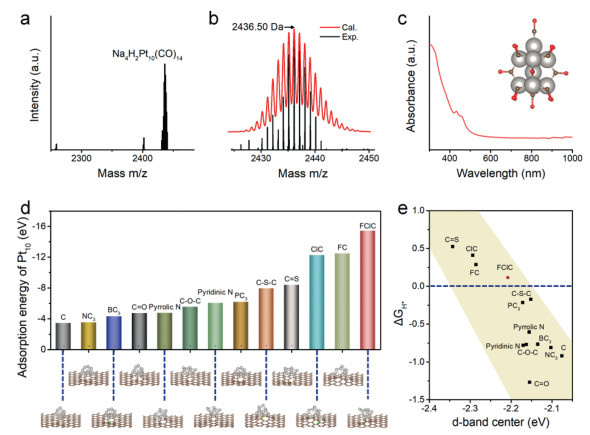
Carbonyl-ligated Pt10 nanoclusters were synthesized by modifying the previously reported method [13]. Electrospray ionization mass spectrometry (ESI-MS) and ultraviolet-visible (UV–vis) spectroscopy data confirm the nanostructural characteristics of Pt10 nanoclusters (Figs. 1a-c). Isolated Pt10 exhibits a d-band center at −8.19 eV with a ΔGH* of 3.37 eV. To systematically screen suitable doped 2D carbon nanomaterials as substrates to optimize ΔGH* on Pt10, we performed density functional theory (DFT) simulations to calculate the adsorption energies of Pt10 nanoclusters on carbon materials with different doping configurations. Compared to the undoped 2D carbon surface, twelve types of heteroatom-doped carbon surfaces exhibit enhanced adsorption energies for Pt10 nanoclusters (Fig. 1d), confirming that nonmetal doping strategies strengthen d-p orbital coupling between Pt10 and dopant atoms, and thereby achieve strong metal-support interaction (SMSI) as evidenced by charge density difference analysis (Fig. S1 in Supporting information). Among single-atom doped carbon models, fluorine-doped carbon (FC) and chlorine-doped carbon (ClC) show the highest Pt10 adsorption energies, attributed to their strong electronegativity-induced electronic modulation of adjacent C atoms. The F and Cl co-doping strategy further elevates the Pt10 adsorption energy, amplifying SMSI between 2D doped carbon and Pt10.
Figure 1
Figure 1.
(a) The ESI-MS of Pt10. (b) The experimental (black line) and calculated (red line) isotopic patterns. (c) The UV–vis of Pt10. (d) The calculated adsorption energies of Pt10 on carbon materials with different doping types. The inset is the optimized Pt10 adsorption configurations on various theoretical carbon surface models (brown: C; grey: Pt; light blue: N; bottle green: B; red: O; purple: P; yellow: S; green: Cl; ochre: F). (e) The relationship between d-band center and ΔGH* in a series of Pt10-supported carbon materials with different doping types.
SMSI-mediated d-p orbital coupling significantly modulates the d-band center of Pt active sites in Pt10 supported on heteroatom-doped carbon, which consequently alters the ΔGH* and governs HER performance. Fig. 1e shows the correlation between d-band center and ΔGH* for Pt10 supported on various doped carbon materials. A monotonic decrease in ΔGH* is observed as the d-band center of Pt shifts down. F and Cl co-doped carbon (FClC) shifts the d-band center of Pt to −2.21 eV and optimizes ΔGH* to 0.12 eV, approaching the thermoneutral ideal (ΔGH* ≈ 0 eV) [40]. Further elevation of d-band centers of Pt leads to overly strong hydrogen bonding (ΔGH* < 0), hindering efficient hydrogen desorption. For instance, the Pt d-band center for Pt10 supported on the undoped carbon surface shifts down to −2.08 eV, accompanied by an over-strong ΔGH* of −0.92 eV, rendering the H desorption process thermodynamically unfavorable and severely limiting HER efficiency. These results identify FClC as an optimal substrate that simultaneously stabilizes Pt nanoclusters and optimizes electronic structures for enhanced HER activity through robust SMSI.
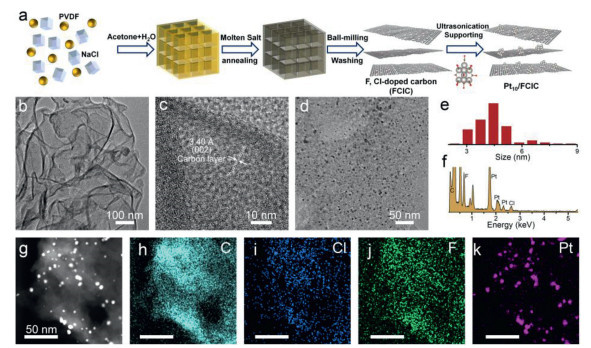
Based the results of theoretical calculations, NaCl served as both a template and a chlorine source, while polyvinylidene fluoride (PVDF) served as carbon and fluorine sources. Through a one-step template/doping treatment involving high-temperature calcination at 900 ℃ followed by grinding and washing, two-dimensional FClC nanosheets were successfully synthesized as catalyst supports for Pt metal nanoclusters (Fig. 2a). The crystal structure of FClC was determined through XRD analysis (Fig. S2 in Supporting information). The XRD pattern of FClC reveals characteristics of turbostratic carbon, displaying two broad diffraction peaks at approximately 24° and 44°, which correspond to the (002) and (100) lattice planes typical of turbostratic carbon structures. TEM analysis confirms the ultra-thin two-dimensional nanostructure of FClC obtained via the hard-template method (Fig. 2b). Consistently, the HRTEM image (Fig. 2c) reveals a turbostratic graphite configuration (disordered graphitic lattices) with an average interlayer spacing of 0.34 nm corresponding to the (002) plane. The abundant edge structures of the FClC nanosheets significantly contribute to the exceptionally high surface area. A stable composite material featuring 0D nanoclusters supported on 2D nanosheets has been achieved through stable adsorption of wet chemically synthesized Pt10 nanoclusters onto FClC, as evidenced by TEM results (Fig. 2d). TEM-based size distribution analysis demonstrates that the loaded Pt nanoclusters maintain an average diameter of 4.2 nm (Fig. 2e). The XRD pattern of Pt10/FClC exclusively exhibits characteristic peaks of the carbon matrix with no observable Pt-related Bragg reflections, demonstrating that Pt remains in the form of ultra-small nanoclusters (Fig. S2). EDS spectrum and elemental mapping of Pt10@FClC clearly reveal the coexistence of F, Cl, C, and Pt elements in the catalyst, with Pt existing as sub-nanometer clusters on the F/Cl co-doped two-dimensional carbon matrix (Figs. 2f-k). X-ray photoelectron spectroscopy (XPS) tests display the systematic downshift in binding energies of F 1s, Cl 2p, and Pt 4f spectra, confirming interfacial charge transfer between Pt10 nanoclusters and the FClC support with the removal of CO adsorbates from the Pt10 surface (Figs. S3 and S4 in Supporting information) [41-45].
Figure 2
Figure 2.
(a) Schematic illustration of the synthesis procedure of Pt10/FClC. TEM images of (b, c) FClC, (d) Pt10/FClC. (e) Size distribution of Pt NC in Pt10/FClC. (f) EDS spectrum and (g-k) HAADF-STEM image and elemental mapping of Pt10/FClC. The scale bar is 50 nm.
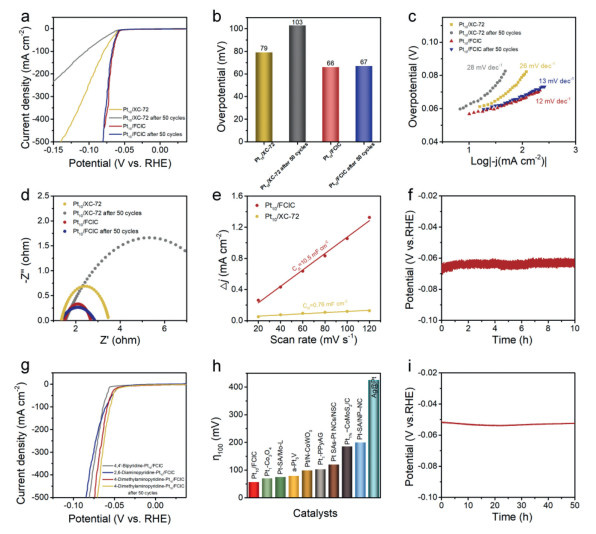
Given the structure-dependent electrochemical characteristics of electrode materials, the engineered 0D/2D architecture of Pt10/FClC not only stabilizes the dispersion of Pt paternosters but also enables precise modulation of the d-band center electronic structure at Pt active sites, thereby optimizing the electrocatalytic HER performance. Vulcan XC-72 carbon from Cabot was used as a control sample. The HER performance of Pt10/XC-72 and Pt10/FClC products was examined through linear sweep voltammetry (LSV) scans at 5 mV/s in 0.5 mol/L H2SO4 at room temperature (~25 ℃). As shown in Fig. 3a, Pt10/FClC has a significantly higher HER activity than the Pt10/XC-72 counterpart. Pt10/FClC requires overpotentials of only 56 and 66 mV to deliver typical current densities of 10 and 100 mA/cm2 compared with 60 and 79 mV for Pt10/XC-72 (Fig. 3b). Surprisingly, the activity of Pt10/FClC remained almost unchanged after 50 cycles, whereas that of Pt10/XC-72 deteriorated. Pt10/XC-72 after 50 cycles needs higher overpotentials of 63 and 105 mV to reach 10 and 100 mA/cm2, which is due to the intense agglomeration of Pt10 nanoclusters (Fig. 3b and Fig. S5 in Supporting information). Particularly, after 50 cycles, the current density of Pt10/FClC reaches 500 mA/cm2 at overpotentials of only 80 mV, which are much lower than those of Pt10/XC-72 (246 mV). Accordingly, Pt10/FClC exhibits a lower Tafel slope of 12 mV/dec compared with Pt10/XC-72 (26 mV/dec), indicating superior HER kinetics (Fig. 3c). Electrochemical impedance spectroscopy (EIS) tests were carried out to provide clearer insights into the variations in physicochemical properties induced by substrate differences and the changes in electrochemical HER activity before and after 50 cycles (Fig. 3d). The Pt10/FClC catalyst demonstrated a lower charge transfer resistance (Rct = 1.2 Ω), compared with Pt10/XC-72 (Rct = 2.2 Ω). Notably, after 50 cycles, the charge transfer resistance of Pt10/FClC remained nearly unchanged (Rct = 1.5 Ω), whereas that of Pt10/XC-72 increased significantly to 7.2 Ω. Meanwhile, double-layer capacitances (Cdl) were estimated by non-Faradaic CV measurements (Fig. S6 in Supporting information), in which Pt10/FClC has a higher value of 10.5 mF/cm2 compared to Pt10/XC-72 (0.76 mF/cm2) (Fig. 3e), indicating a rger electrochemically active surface area. In the following, chronopotentiometry (CP) tests were conducted under a high-current density of 100 mA/cm2 to assess the stability of Pt10/FClC. The potential of Pt10/FClC remains essentially stable throughout the constant operation for 10 h (Fig. 3f). However, the current fluctuation are attributed to the accumulation and release of gas bubbles on the catalyst electrode surface.
Figure 3
Figure 3.
(a) LSV curves toward the acidic HER. (b) Comparison of overpotential at 100 mA/cm2. (c) Tafel curves, which are derived from the LSV curves in (a). (d) Nyquist plots and (e) Cdl values of Pt10/XC-72 and Pt10/FClC catalysts. (f) Long-term stability of Pt10/FClC for 10 h at 100 mA/cm2. (g) LSV curves toward HER in 0.5 mol/L H2SO4 with 4,4′-bipyridine, 2,6-diaminopyridine, 4-dimethylaminopyridine. (h) Comparison of η100 values with other Pt-based catalysts. (i) Long-term stability of 4-dimethylaminopyridine-Pt10/FClC for 50 h at 100 mA/cm2.
To better facilitate the efficiency of H2 evolution, the hydrogen-bonding characteristics at the 2D confined catalytic surface. are critically reshaped by adjusting the functional group composition in the near-surface region: confined water molecules exhibit higher orientational ordering than bulk electrolyte, while proton relay pathways adopt Grotthuss-type hopping modes [30]. The hydrogen-bond network governs both the initial water dissociation kinetics (Volmer step) and proton supply efficiency [39], yet its engineering remains underexplored on the surface of 0D/2D heterojunctions. Benefiting from the high surface energy of Pt10 nanoclusters for preferential adsorption of organic ligands, we strategically modulated the surface hydrogen-bonding microenvironment of Pt10/FClC by in situ introducing nitrogen-containing organic additives (4,4′-bipyridine, 2,6-diaminopyridine, 4-dimethylaminopyridine) into 0.5 mol/L H2SO4 electrolyte. LSV curves at 5 mV/s reveal progressively enhanced HER activity with 4,4′-bipyridine, 2,6-diaminopyridine, 4-dimethylaminopyridine additives, yielding overpotentials of 64, 61, and 59 mV at 100 mA/cm2, respectively (Fig. 3g and Fig. S6). Notably, after 50 activation cycles, the 4-dimethylaminopyridine-modified Pt10/FClC catalyst exhibits a further reduced overpotential of 56 mV at 100 mA/cm2, outperforming the other two additives (Fig. S8 in Supporting information). Compared to overpotentials reported for other Pt-based catalysts in the literature (Fig. 3h and Table S1 in Supporting information), 4-dimethylaminopyridine-modified Pt10/FClC is among the state-of-the-art. The Tafel slope analysis further confirm accelerated HER kinetics for 4-dimethylaminopyridine-Pt10/FClC (15 mV/dec) relative to 4,4′-bipyridine-Pt10/FClC (16 mV/dec) and 2,6-diaminopyridine-Pt10/FClC (27 mV/dec) (Fig. S9 in Supporting information). EIS tests in Fig. S10 (Supporting information) further validate this trend, with 4-dimethylaminopyridine-Pt10/FClC demonstrating the lowest charge-transfer resistance (Rct = 0.7 Ω) compared to 4,4′-bipyridine-Pt10/FClC (1.5 Ω) and 2,6-diaminopyridine-Pt10/FClC (1.3 Ω). Cdl results show negligible variation in the electrochemically active surface area (10.0 mF/cm2 for 4-dimethylaminopyridine-Pt10/FClC) across all additive-containing electrolytes versus pure 0.5 mol/L H2SO4, ruling out surface area effects as the origin of performance enhancement (Figs. S11 and S12 in Supporting information).
Multi-step CP tests of the 4-dimethylaminopyridine-Pt10/FClC catalyst were conducted under progressively intensified cathodic current densities (10–200 mA/cm2), revealing exceptional mass transport kinetics and polarization resilience at the catalyst-electrolyte interface (Fig. S13 in Supporting information). Long-term CP tests under high current density conditions (100 mA/cm2) were performed to evaluate the enhanced hydrogen bubble detachment kinetics enabled by the modified hydrogen-bonding microenvironment on the 4-dimethylaminopyridine-Pt10/FClC catalyst during sustained HER operation (Fig. 3i). The electrode potential of 4-dimethylaminopyridine-Pt10/FClC remained stable throughout the 50-h durability test, demonstrating superior operational robustness compared to the unmodified Pt10/FClC system in baseline 0.5 mol/L H2SO4 electrolyte. As observed in Multi-step CP and Long-term CP tests, the consistently minimal potential overshoot and significantly reduced voltage fluctuations directly correlate with optimized hydrogen adsorption/desorption dynamics mediated by nitrogen-ligand-enhanced proton diffusion pathway and interfacial charge redistribution. This validates the 4-dimethylaminopyridine-Pt10/FClC catalyst's hydrogen-bonding regulation for stable high-current-density electrocatalysis. Post-stability test characterization was performed on Pt10/FClC. Post-test TEM, EDS elemental mapping and XPS results confirm the retention of the original 0D/2D heterostructure in 4-dimethylaminopyridine-Pt10/FClC after a 50-h stability test, elucidating the interaction between 4-dimethylaminopyridine and Pt10/FClC (Fig. S14 in Supporting information) [46].
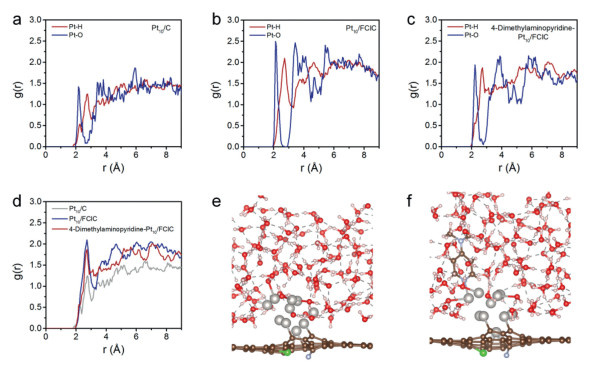
Despite these advances, current SMSI strategies predominantly focus on electronic structure modulation of Pt nanoclusters, often overlooking the critical role of dynamic water restructuring at catalytic interfaces [30,37,38]. Charge density difference calculations confirm that 4-dimethylaminopyridine adsorbs stably on Pt sites with a stronger adsorption energy of −1.07 eV than other nitrogenous ligands, mediating significant electron transfer with Pt sites and thereby modulating the electronic structure (Fig. S15 in Supporting information). To elucidate the mechanistic roles of 4-dimethylaminopyridine and FClC in the hydrogen evolution reaction (HER), we performed ab initio molecular dynamics (AIMD) simulations on three interfacial systems: Pt10/C, Pt10/FClC, and 4-dimethylaminopyridine-Pt10/FClC immersed in water environments. The spatial configuration of water molecules near Pt10 nanoclusters was quantitatively analyzed through z-axis density profiles. Critical observations reveal that across all three supported Pt10 systems, the first coordination peak of Pt-H bonds appears at longer radial distances than that of Pt-O bonds (Figs. 4a-c, e and f, Fig. S16 in Supporting information). This specific orientation, where oxygen terminals of water molecules preferentially orient toward Pt10 nanoclusters, strongly suggests that supported Pt10 systems enhance water dissociation kinetics in the Volmer step [47,48]. Comparative analysis of hydrogen distribution functions on Pt10 nanocluster surfaces provides atomic-level insights into the modulation of the hydrogen-bond network mediated by the FClC substrate and 4-dimethylaminopyridine ligands (Fig. 4d). The FClC substrate induces a ca. 35% increase in hydrogen bonding density beyond 2.7 Å, while 4-dimethylaminopyridine ligands eliminate the inherent discontinuity in the hydrogen-bond network at 3.2 Å observed in pristine FClC systems. This dual optimization strategy facilitates rapid proton relay under high-current-density conditions, enhancing intrinsic HER kinetics by lowered energy barriers for water dissociation and proton-coupled electron transfer steps.
Figure 4
Figure 4.
Distribution function of O and H on the surface of Pt10 along the surface radial direction r in (a) Pt10/C, (b) Pt10/FClC, and (c) 4-dimethylaminopyridine-Pt10/FClC. (d) The comparison of H distribution function. (e) Representative snapshots after AIMD on (d) Pt10/FClC and (f) 4-dimethylaminopyridine-Pt10/FClC. The Pt, O, H, C, Cl, F and N are colored in grey, red, white, brown, green, ochre, and bule, respectively. The dashed lines represent the H bonds.
In conclusion, our research demonstrates a synergistic enhancement strategy for HER performance of Pt nanoclusters supported on FClC. By leveraging the SMSI effect, this distinctive 0D/2D heterointerface architecture achieves high atomic exposure and structural stability of Pt10 nanoclusters, and optimizing the Pt d-band center for enhanced HER activity. Furthermore, the introduction of 4-dimethylaminopyridine modulates the surface hydrogen-bond network, leading to a significant improvement in HER kinetics and 50-h long-term stability with a low overpotential of 56 mV at 100 mA/cm2. The demonstrated synergy between SMSI effects and optimized hydrogen-bond networks highlights a promising direction for future research in HER catalysis. This dual-engineering approach not only addresses the fundamental challenges of atomic efficiency and structural stability, but also paves the way for the development of organic-ligand-protected metal-nanocluster electrocatalysts with tailored regulation of surface hydrogen bonding properties for sustainable energy applications.
CRediT authorship contribution statement
Shuo Zhang: Writing – original draft, Data curation. Yiqing Zhang: Writing – original draft, Formal analysis, Data curation. Miao Wan: Writing – original draft, Data curation. Jiayi Zhang: Writing – original draft, Data curation. Shuxin Wang: Writing – review & editing, Supervision, Investigation, Funding acquisition, Formal analysis, Data curation, Conceptualization.
Declaration of competing interest
The authors declare that they have no known competing financial interests or personal relationships that could have appeared to influence the work reported in this paper.
Acknowledgments
This work is supported by National Natural Science Foundation of China (Nos. 22171156 and 21803001), Scientific Research Innovation Capability Support Project for Young Faculty (No. SRICSPYF-BS2025055), Taishan Scholar Foundation of Shandong Province (China), Shandong Province Excellent Youth Innovation Team and Startup Funds from Qingdao University of Science and Technology, the Postdoctoral Fellowship Program of CPSF (No. GZC20240774), Shandong Postdoctoral Science Foundation (No. SDCX-ZG-202503091), Qingdao Postdoctoral Researcher Applied Research Project (No. QDBSH20240202122).
Supplementary materials
Supplementary material associated with this article can be found, in the online version, at doi:10.1016/j.cclet.2026.112385.
[1]
Y. Zhu, M. Klingenhof, C. Gao, et al., Nat. Commun. 15 (2024) 1447–1459. doi: 10.1038/s41467-024-45654-9
[2]
Z. Zhong, Y. Tu, L. Zhang, et al., ACS Catal. 14 (2024) 2917–2923. doi: 10.1021/acscatal.3c06291
L. Deng, H. Chen, S. Hung, et al., J. Am. Chem. Soc. 146 (2024) 35438–35448. doi: 10.1021/jacs.4c14529
[48]
J. Mao, J. Liang, Y. Li, et al., J. Am. Chem. Soc. 147 (2025) 7711–7720. doi: 10.1021/jacs.4c17373
Figure 1
(a) The ESI-MS of Pt10. (b) The experimental (black line) and calculated (red line) isotopic patterns. (c) The UV–vis of Pt10. (d) The calculated adsorption energies of Pt10 on carbon materials with different doping types. The inset is the optimized Pt10 adsorption configurations on various theoretical carbon surface models (brown: C; grey: Pt; light blue: N; bottle green: B; red: O; purple: P; yellow: S; green: Cl; ochre: F). (e) The relationship between d-band center and ΔGH* in a series of Pt10-supported carbon materials with different doping types.
Figure 2
(a) Schematic illustration of the synthesis procedure of Pt10/FClC. TEM images of (b, c) FClC, (d) Pt10/FClC. (e) Size distribution of Pt NC in Pt10/FClC. (f) EDS spectrum and (g-k) HAADF-STEM image and elemental mapping of Pt10/FClC. The scale bar is 50 nm.
Figure 3
(a) LSV curves toward the acidic HER. (b) Comparison of overpotential at 100 mA/cm2. (c) Tafel curves, which are derived from the LSV curves in (a). (d) Nyquist plots and (e) Cdl values of Pt10/XC-72 and Pt10/FClC catalysts. (f) Long-term stability of Pt10/FClC for 10 h at 100 mA/cm2. (g) LSV curves toward HER in 0.5 mol/L H2SO4 with 4,4′-bipyridine, 2,6-diaminopyridine, 4-dimethylaminopyridine. (h) Comparison of η100 values with other Pt-based catalysts. (i) Long-term stability of 4-dimethylaminopyridine-Pt10/FClC for 50 h at 100 mA/cm2.
Figure 4
Distribution function of O and H on the surface of Pt10 along the surface radial direction r in (a) Pt10/C, (b) Pt10/FClC, and (c) 4-dimethylaminopyridine-Pt10/FClC. (d) The comparison of H distribution function. (e) Representative snapshots after AIMD on (d) Pt10/FClC and (f) 4-dimethylaminopyridine-Pt10/FClC. The Pt, O, H, C, Cl, F and N are colored in grey, red, white, brown, green, ochre, and bule, respectively. The dashed lines represent the H bonds.


 DownLoad:

 下载:


 下载:

