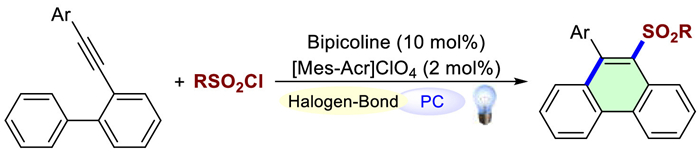
Scheme 1.
Photochemical/halogen-bond dual catalysis.

Synergistic homogeneous photochemical and halogen-bond catalysis toward antitumor sulfonylated fused (hetero)arenes
Jia-Sheng Wang , Lin-Heng He , Yan-Ting Liu , Yu-Ting Wu , Hai-Tao Zhu , Sheng-Hua Wang , Yu-Yu Tan , Wei-Min He , Yong-Hong Zhang


Homogeneous photocatalysis has become a significant and versatile strategy in synthetic organic chemistry, utilizing sustainable light energy to drive radical reactions under mild conditions [1–3]. In this approach, homogeneous photocatalysts are excited upon visible light absorption and subsequently engage with radical precursors via single-electron transfer (SET, in photoredox catalysis) [4–11] or energy transfer (EnT, in energy transfer catalysis) [12–18] to generate radical or radical ion intermediates. These species then react with radical acceptor substrates to form diverse target molecules. However, this methodology often proves ineffective for challenging transformations involving low-reactivity substrates.
In recent years, cooperative catalysis combining photocatalysis with organocatalysis [19–21] has emerged as a powerful approach, merging their distinct catalytic cycles to enable chemical bond formation from traditionally inert substrates [22–29]. The halogen bond (XB), a noncovalent interaction between an electron-deficient halogen atom and a Lewis base, has been widely utilized in chemical and biological systems [30]. Recently, XB has gained increasing attention for activating C-X bonds in organic halides, facilitating their participation in subsequent transformations [31]. Nevertheless, within homogeneous photocatalytic systems, the well-established photochemical/hydrogen-bond dual catalysis [32–35] contrasts sharply with the still underdeveloped synergistic photochemical/XB dual catalysis [36].
Sulfone-containing compounds, particularly sulfonyl-substituted aromatics and heteroaromatics, are highly valued for their broad synthetic utility and their frequent occurrence in biologically active molecules with pharmacological potential. In recent years, significant efforts have been devoted to developing efficient methods for their construction [37]. Sulfonylated phenanthrenes, as an important class of aromatic compounds, have attracted considerable interest from the synthetic chemistry community due to their promising applications in pharmaceutical and materials sciences [38]. The sulfonylation-annulation of 2-alkynyl biaryls represents a straightforward and efficient approach to such structures, benefiting from the ready availability of starting materials. Nevertheless, homogeneous photocatalytic sulfonylation-annulation using inexpensive and readily accessible sulfonyl chlorides (RSO2Cl) remains underexplored, which may be attributed to the generally low reactivity of RSO2Cl.
To address this limitation, we propose a synergistic dual catalytic system that integrates homogeneous photocatalysis with XB organocatalysis. This strategy leverages XB interactions to pre-activate RSO2Cl, thereby facilitating its photochemical conversion into valuable sulfone compounds. As part of our continuing interest in green chemistry [39–47], we herein report a dual homogeneous photochemical/XB catalytic system that enables sulfonylation-annulation of (hetero)arene-tethered alkynes and alkenes with RSO2Cl. Using [Mes-Acr]ClO4 as the homogeneous photocatalyst and an azaarene-based Lewis base as the XB acceptor, the sulfonylation-annulation proceeds efficiently under mild conditions with blue light irradiation. This method delivers structurally diverse sulfonylated fused (hetero)arenes in high yields (Scheme 1). A key mechanistic feature is the azaarene-facilitated cleavage of the S-Cl bond in RSO2Cl via XB activation.
Initial investigation commenced with the reaction between 2-alkynyl biaryl (1a) and TsCl (2a) as the template reaction (Table 1). After systematic optimization, the target sulfonyl-phenanthrene (3aa) was obtained in an 93% GC yield with [Mes-Acr]ClO4 as the photoredox catalyst, bipicoline as an azaarene-based Lewis base in a mixture of HFIP and DCE under blue LED irradiation at ambient temperature under a nitrogen atmosphere for 12 h (entry 1). Replacement of [Mes-Acr]ClO4 with other organic small-molecule photocatalysts (Rhodamine B, Eosin Y, 9-phenylacridine or 4CzIPN) led to lower reaction efficiencies (entry 2). A residual yield of 31% observed in the absence of a photocatalyst suggests that some reaction components may possess weak inherent photoactivity (entry 3). Control experiments underscored the critical role of the azaarene-based Lewis base. Its importance was evident when its replacement with other nitrogen-containing ligands, such as Bpy, Dtbbpy, Bathocuproine, or 4-Ph-Terpyridine, resulted in significantly diminished yields (entry 4). More strikingly, the complete omission of the azaarene-based Lewis base led to a drastic reduction in yield to merely 24% (compared to 93% with it) (entry 5). This pronounced contrast strongly indicates that the azaarene-based Lewis base acts as an effective XB acceptor, which is pivotal for driving the reaction efficiently. However, the reaction was completely shut down in the absence of both the photocatalyst and the azaarene-based Lewis base (entry 6), highlighting their synergistic necessity. Solvent optimization revealed that neither HFIP nor DCE alone, nor altering the composition of the mixed solvent, could match the efficiency of the identified binary mixture (entries 7 and 8). Similarly, no improved outcomes were achieved using alternative light sources (e.g., purple, green, or white LEDs) (entry 9). Decreasing the LED power was found to lead to a lower yield of product 3aa (59%, entry 10). Finally, the reaction proved inactive under dark conditions (entry 11).
 DownLoad:
CSV
DownLoad:
CSV
 |
||
| Entry | Deviation from the above conditions | Yield (%)b |
| 1 | No | 93 |
| 2 | Rhodamine B, Eosin Y, 9-phenylacridine or 4CzIPN was used | 48, 61, 70, 59 |
| 3 | No photocatalyst | 31 |
| 4 | Bpy, Dtbbpy, Bathocuproine or 4-Ph-Terpyidine was used | 64, 71, 83, 58 |
| 5 | No azaarene-based Lewis base | 24 |
| 6 | No photocatalyst and no azaarene-based Lewis Base | N.R. |
| 7 | HFIP or DCE was used | 35, 27 |
| 8 | HFIP/MeCN, HFIP/THF or HFIP/DMF was used | 53, 22, 12 |
| 9 | Purple, green, white LED was used | 37, 65, trace |
| 10 | Blue LED (5 W) was used | 59 |
| 11 | No light | N.R. |
| a Conditions: 1a (0.2 mmol), 2a (0.2 mmol), [Mes-Acr]ClO4 (2 mol%), Bipicoline (10 mol%), HFIP (2 mL), DCE (1 mL), Blue LED (10 W), N 2, room temperature, 12 h. b Estimated by GC using dodecane as an internal reference. | ||
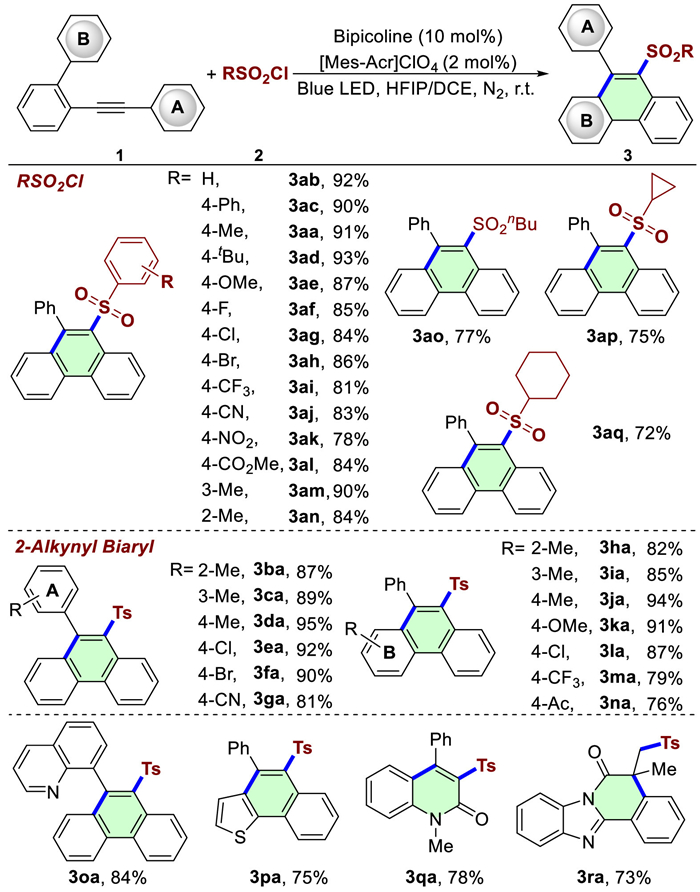
After determining the optimal reaction conditions (Table 1, entry 1), the substrate scope of this transformation with respect to both RSO2Cl and unsaturated hydrocarbons were evaluated (Scheme 2). Notably, the photocatalytic system demonstrated broad applicability toward diverse sulfonyl chlorides. A wide range of aryl sulfonyl chlorides bearing electron-neutral, electron-donating, electron-withdrawing, or sterically demanding substituents all reacted efficiently, affording the desired products in good to excellent yields (3aa-3an). The reaction tolerated a variety of synthetically valuable functional groups on the arene ring, including alkyl, methoxy, halogen, trifluoromethyl, cyano, nitro, and ester groups, thereby offering considerable potential for further late-stage functionalization. Furthermore, alkyl sulfonyl chlorides, such as 1-butane-, cyclopropane-, and cyclohexanesulfonyl chloride, were also viable substrates, being efficiently converted into the corresponding products (3ao-3aq) in good yields. The scope of the unsaturated hydrocarbon partner was similarly broad. 2-Alkynyl biaryls 1 with substituents on phenyl ring A, regardless of their electronic nature or steric demand, underwent smooth reaction with 2a to deliver the products (3ba-3ga) in high yields. Similarly, substitutions on phenyl ring B were well tolerated, affording the target sulfonylated phenanthrenes in good to excellent yields with minimal electronic or steric influence (3 ha-3na). Heteroaromatic rings were also compatible; both quinolyl-substituted ethynyl biphenyl and a thienyl-bearing diphenylethyne successfully participated in the cascade cyclization, providing products 3oa and 3pa in 84% and 75% yield, respectively. Finally, we confirmed that the reaction scope could be extended to other unsaturated hydrocarbons beyond biaryl alkynes. For instance, N-phenylpropiolamide and N-allyl benzamide were also suitable substrates, furnishing the corresponding heterocyclic products 3qa and 3ra in good yields. When CF3SO2Cl was employed, the reaction yielded only a complex mixture of un-identified products.
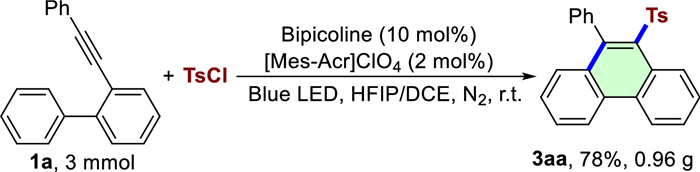
The scalability of the present protocol was investigated under the standard conditions with a 3 mmol scale of 1a (Scheme 3). Gratifyingly, the reaction remained efficient, providing 3aa in a commendable yield of 78%, which underscores its promise for larger-scale industrial implementation.
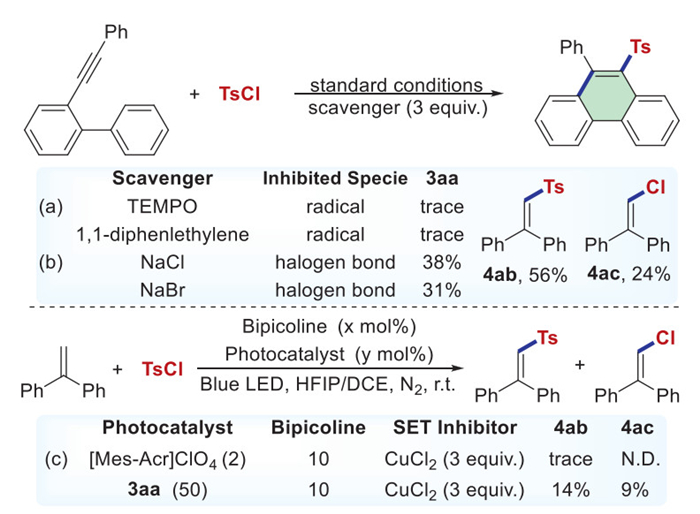
To elucidate the mechanism of this synergistically catalyzed reaction, a series of mechanistic investigations were performed (Scheme 4). The reaction was completely suppressed in the presence of radical scavengers (TEMPO or 1,1-diphenylethene) under standard conditions, indicating the involvement of radical intermediates. GC-MS analysis detected both a Ts-diphenylethene adduct (4ab, 56%) and a Cl-diphenylethene adduct (4ac, 24%), supporting the generation of Ts radical (Ts˙) and Cl radical (Cl˙) during the process (Schemes 4a). The addition of 2 equiv. of halide anions (e.g., Cl¯ or Br¯) as competitive XB acceptors significantly inhibited the transformation (Schemes 4b), thereby demonstrating that halogen bonding between TsCl and Bipicoline is critical for reactivity [48]. When the SET inhibitor CuCl2 (3 equiv.) was introduced using [Mes-Acr]ClO4 as the sole photocatalyst, only trace amount of 4ab were detected, and no 4ac was observed, suggesting that Bipicoline-promoted activation of TsCl proceeds mainly via a SET pathway, leading to heterolysis. In contrast, when 3aa was employed as the sole photosensitizer (in the absence of [Mes-Acr]ClO4) together with CuCl2, homolysis of Bipicoline-activated TsCl occurred under blue light irradiation via an EnT pathway, generating both Ts˙ and Cl˙ (Schemes 4c). The visible light on/off experiment (see Supporting information) confirmed the light-driven nature of the catalytic system and ruled out the possibility of a radical chain propagation mechanism.
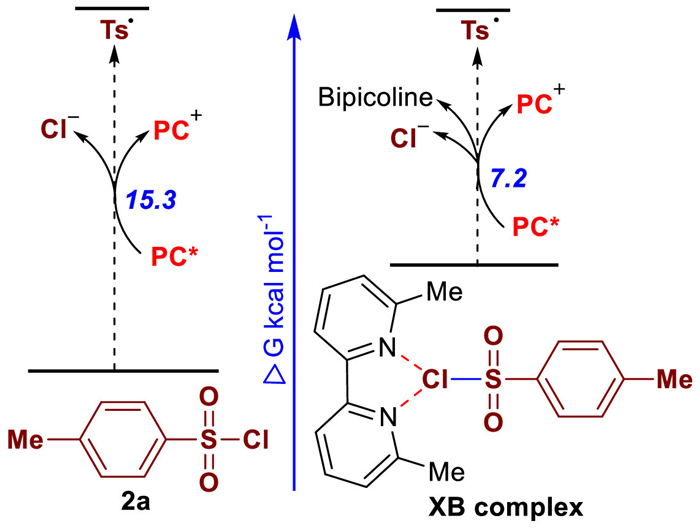
As shown in Scheme 5, our computations indicate that the energy required for the heterolytic S-Cl bond cleavage in TsCl drops from 15.3 kcal/mol to just 7.2 kcal/mol upon the assembly of the halogen-bond complex involving 2a and bipicoline, demonstrating the facilitating role of the XB complex.
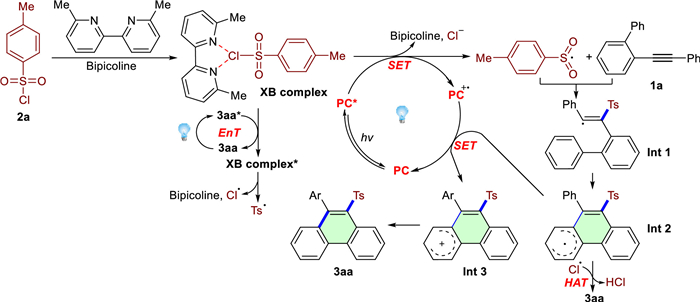
Based on the above-mentioned experimental results and literature evidence [36,49,50], the sulfonylation-annulation is proposed to occur predominantly through a SET pathway, with only a minor contribution from an EnT mechanism (Scheme 6). The process initiates with the in situ assembly of a XB complex between TsCl (2a) and bipicoline. Under the dominant SET mechanism, visible light first photoexcites the acridinium photocatalyst (PC) to its excited state (PC*). The excited PC* then participates in a SET event with XB complex, leading to the formation of a Ts˙, Cl⁻, and oxidized photocatalyst (PC⁺˙), accompanied by the dissociation of Bipicoline. The resulting electrophilic Ts˙ adds across the alkyne unit of 2-alkynyl biaryl 1a, generating the vinyl radical intermediate Int 1, which rapidly undergoes annulation to give the cyclic radical Int 2. Int 2 is then oxidized by PC⁺˙ in a second SET step, forming a cationic intermediate Int 3, which upon deprotonation delivers the final sulfonylated phenanthrene product 3aa. In the minor EnT pathway, ground-state product 3aa can itself be photoexcited to excited species 3aa*, which transfers energy to XB complex to form the excited XB complex*. Homolytic cleavage of the S-Cl bond in XB complex * then produces a Ts˙ and a Cl˙. The Ts˙ subsequently initiates the radical cascade, ultimately leading to Int 2. Finally, hydrogen atom transfer (HAT) from Int 2 to Cl˙ furnishes the product 3aa. Control experiments and reaction optimization studies conclusively establish the SET route as the major pathway, with the EnT mechanism playing a secondary role.
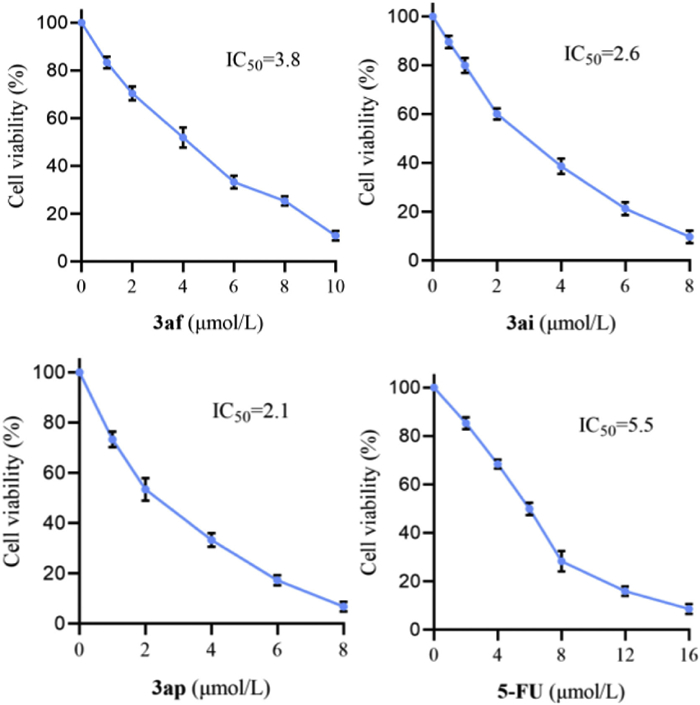
Tumor resistance to conventional chemotherapy represents a significant obstacle in clinical oncology, highlighting a critical need for novel therapeutic agents. In this study, we evaluated the antitumor activity of a series of novel sulfonylated fused arenes using human choroidal melanoma (MUM-2B) cells. Among the tested compounds, 3ap exhibited notably potent activity, showing approximately 2.6-fold greater potency than the widely used 5-fluorouracil (5-FU) (Fig. 1). To our knowledge, this study provides the first evidence of antitumor efficacy in this class of sulfonylated phenanthrens. We anticipate that further investigation of 3ap, guided by the methodology presented here, may facilitate the development of new antitumor therapeutics.
Conclusively, we have developed a synergistic dual catalytic platform integrating homogeneous photocatalysis and XB organocatalysis. This system efficiently drives radical sulfonylation-annulation reactions, with mechanistic insights highlighting a critical sequence: first, a XB complex between RSO2Cl and the azaarene activator pre-organizes and polarizes the substrate. Subsequently, the photoredox catalyst [Mes-Acr]ClO4 induces heterolytic S-Cl cleavage via SET on this activated complex. An EnT pathway for homolytic cleavage was also identified. This methodology facilitates the sustainable synthesis of a variety of sulfonyl fused (hetero)arenes, demonstrating the powerful role of XB in enabling novel photocatalytic manifolds.
The authors declare that they have no known competing financial interests or personal relationships that could have appeared to influence the work reported in this paper.
Jia-Sheng Wang: Investigation, Formal analysis. Lin-Heng He: Investigation, Formal analysis, Data curation. Yan-Ting Liu: Investigation. Yu-Ting Wu: Investigation. Hai-Tao Zhu: Investigation. Sheng-Hua Wang: Investigation. Yu-Yu Tan: Writing – review & editing, Funding acquisition. Wei-Min He: Writing – review & editing, Conceptualization. Yong-Hong Zhang: Methodology, Funding acquisition, Formal analysis.
The authors are grateful for financial support from the University of South China.
Supplementary material associated with this article can be found, in the online version, at doi:
P. Bellotti, H.M. Huang, T. Faber, F. Glorius, Chem. Rev. 123 (2023) 4237–4352. doi: 10.1021/acs.chemrev.2c00478
A. Das, S. Gouthaman, K.R. Justin Thomas, Green Chem. 26 (2024) 1223–1280. doi: 10.1039/d3gc03971d
Y. Liu, W. Chen, Z. Zhao, et al., Chin. J. Org. Chem. 45 (2025) 3546–3586. doi: 10.6023/cjoc202505018
N.A. Romero, D.A. Nicewicz, Chem. Rev. 116 (2016) 10075–10166. doi: 10.1021/acs.chemrev.6b00057
T.T. Song, Y.K. Mei, Y. Liu, et al., Angew. Chem. Int. Ed. 63 (2024) e202314304. doi: 10.1002/anie.202314304
Y. Zhao, X. Li, H. Xu, et al., Org. Lett. 27 (2025) 9322–9327. doi: 10.1021/acs.orglett.5c02985
Y. Wang, J. Wang, C. Chen, et al., Chem. Commun. 61 (2025) 10812–10815. doi: 10.1039/d5cc02744f
Y. Tan, J. Ying, B. Yu, Z. Lu, Chin. J. Org. Chem. 45 (2025) 1684–1690. doi: 10.6023/cjoc202409002
D. Liu, A. Kadierya, Q. Zhang, et al., Acta Chim. Sinica 83 (2025) 319–325. doi: 10.6023/a25010008
G. Li, B. Zhu, T. Hu, et al., Acta Chim. Sinica 83 (2025) 199–205. doi: 10.6023/a24100307
W. Yang, Z. Zhang, Z. Yang, et al., J. Org. Chem. 90 (2025) 16403–16413. doi: 10.1021/acs.joc.5c01813
S. Dutta, J.E. Erchinger, F. Strieth-Kalthoff, R. Kleinmans, F. Glorius, Chem. Soc. Rev. 53 (2024) 1068–1089. doi: 10.1039/d3cs00190c
K. Sun, C. Ge, X. Chen, et al., Nat. Commun. 15 (2024) 9693. doi: 10.1038/s41467-024-54079-3
W.T. Ouyang, J. Jiang, Y.F. Jiang, et al., Chin. Chem. Lett. 35 (2024) 110038. doi: 10.1016/j.cclet.2024.110038
H. Jiao, Y. Jing, K. Niu, et al., J. Org. Chem. 89 (2024) 5371–5381. doi: 10.1021/acs.joc.3c02781
X. Li, H. Yao, Chin. J. Org. Chem. 44 (2024) 660–662. doi: 10.6023/cjoc202400007
J. Peng, G.P. Luo, C. Wu, C. Wang, Chin. Chem. Lett. 36 (2025) 111255. doi: 10.1016/j.cclet.2025.111255
W. Huang, T. Wang, S.Y. Chen, Q. Zhou, L. Wang, Org. Biomol. Chem. 23 (2025) 5564–5568. doi: 10.1039/d5ob00557d
J.H. Shen, M. Shi, Y. Wei, Chem. Eur. J. 29 (2023) e202301157. doi: 10.1002/chem.202301157
X. He, F. Liu, T. Tu, Chin. Chem. Lett. 36 (2025) 110621. doi: 10.1016/j.cclet.2024.110621
J.C. Hou, W. Cai, H.T. Ji, L.J. Ou, W.M. He, Chin. Chem. Lett. 36 (2025) 110469. doi: 10.1016/j.cclet.2024.110469
J.C. Hou, H.T. Ji, Y.H. Lu, et al., Chin. Chem. Lett. 35 (2024) 109514. doi: 10.1016/j.cclet.2024.109514
Q.Z. Li, M.H. He, R. Zeng, et al., J. Am. Chem. Soc. 146 (2024) 22829–22839. doi: 10.1021/jacs.4c08163
H.T. Ji, Y.H. Lu, Y.T. Liu, et al., Chin. Chem. Lett. 36 (2025) 110568. doi: 10.1016/j.cclet.2024.110568
H.S. Wang, H.C. Li, X.Y. Yuan, et al., Green Chem. 27 (2025) 4655–4663. doi: 10.1039/d4gc06209d
Q.H. Peng, N.B. Li, J.C. Hou, et al., Chin. Chem. Lett. 36 (2025) 111402. doi: 10.1016/j.cclet.2025.111402
J. Huang, J. Chen, Chin. J. Org. Chem. 45 (2025) 4236–4237. doi: 10.6023/cjoc202500025
J. Wu, L. Wang, H. Yue, et al., Chem. Commun. 61 (2025) 16782–16785. doi: 10.1039/d5cc04089b
Y. Hong, C. Park, J. Jang, et al., J. Am. Chem. Soc. 147 (2025) 19583–19594. doi: 10.1021/jacs.5c00352
G. Cavallo, P. Metrangolo, R. Milani, et al., Chem. Rev. 116 (2016) 2478–2601. doi: 10.1021/acs.chemrev.5b00484
R.L. Sutar, S.M. Huber, ACS Catal. 9 (2019) 9622–9639. doi: 10.1021/acscatal.9b02894
Y. Yin, X. Zhao, B. Qiao, Z. Jiang, Org. Chem. Front. 7 (2020) 1283–1296. doi: 10.1039/d0qo00276c
S. Selvakumar, Asian J. Org. Chem. 12 (2023) e202300374. doi: 10.1002/ajoc.202300374
X. Chai, X. Hu, X. Zhao, et al., Angew. Chem. Int. Ed. 61 (2022) e202115110.
B. Sun, S. Zhou, J. Wang, et al., Angew. Chem. Int. Ed. 64 (2025) e202506022. doi: 10.1002/anie.202506022
Y.H. Wang, L.H. He, Y.Y. Tan, et al., Adv. Sci. 13 (2026) e15993. doi: 10.1002/advs.202515993(2025)
A.X. Huang, R. Li, Q.Y. Lv, B. Yu, Chem. Eur. J. 30 (2024) e202402416. doi: 10.1002/chem.202402416
C. Liu, Q. Dai, Y. Li, et al., J. Org. Chem. 88 (2023) 7281–7289. doi: 10.1021/acs.joc.3c00517
C. Xin, J. Jiang, Z.W. Deng, L.J. Ou, W.M. He, Acta Chim. Sinica 82 (2024) 1109–1113. doi: 10.6023/a24100329
C. Xin, W. He, Chin. J. Org. Chem. 44 (2024) 2955–2957. doi: 10.6023/cjoc202400047
M. Peng, W.M. He, Chin. Chem. Lett. 35 (2024) 109899.
H.Y. Song, J. Jiang, Y.H. Song, et al., Chin. Chem. Lett. 35 (2024) 109246. doi: 10.1016/j.cclet.2023.109246
Y.C. Wen, J.C. Hou, Q. Zhou, et al., Chin. Chem. Lett. 36 (2025) 111795. doi: 10.1016/j.cclet.2025.111795
Y.C. Wen, L.J. Zhu, R.N. Yi, et al., Acta Chim. Sinica 83 (2025) 1124–1128. doi: 10.6023/a25050173
Q.H. Peng, J. Peng, Y.L. Cai, et al., Acta Chim. Sinica 83 (2025) 1013–1017. doi: 10.6023/A25060202
W. He, R. Yi, Z. Yang, Z. Wu, W.M. He, Chin. J. Org. Chem. 45 (2025) 3534–3545. doi: 10.6023/cjoc202506034
Y.Y. Zeng, J. Jiang, Y.C. Wen, et al., Chin. Chem. Lett. 37 (2026) 111776.
N. Kato, T. Nanjo, Y. Takemoto, ACS Catal. 12 (2022) 7843–7849. doi: 10.1021/acscatal.2c02067
H.D. Tian, Z.H. Fu, C. Li, et al., Org. Lett. 24 (2022) 9322–9326. doi: 10.1021/acs.orglett.2c03948
J. Gong, F. Wang, Y.B. Kang, J.P. Qu, J. Org. Chem. 90 (2025) 8596–8600. doi: 10.1021/acs.joc.5c00648

Scheme 2 Reaction scope. Conditions: 1 (0.2 mmol), 2 (0.2 mmol), [Mes-Acr]ClO4 (2 mol%), bipicoline (10 mol%), HFIP (2 mL), DCE (1 mL), blue LED (10 W), N2, room temperature.
Table 1. Optimization of reaction conditions.a
|
||
| Entry | Deviation from the above conditions | Yield (%)b |
| 1 | No | 93 |
| 2 | Rhodamine B, Eosin Y, 9-phenylacridine or 4CzIPN was used | 48, 61, 70, 59 |
| 3 | No photocatalyst | 31 |
| 4 | Bpy, Dtbbpy, Bathocuproine or 4-Ph-Terpyidine was used | 64, 71, 83, 58 |
| 5 | No azaarene-based Lewis base | 24 |
| 6 | No photocatalyst and no azaarene-based Lewis Base | N.R. |
| 7 | HFIP or DCE was used | 35, 27 |
| 8 | HFIP/MeCN, HFIP/THF or HFIP/DMF was used | 53, 22, 12 |
| 9 | Purple, green, white LED was used | 37, 65, trace |
| 10 | Blue LED (5 W) was used | 59 |
| 11 | No light | N.R. |
| a Conditions: 1a (0.2 mmol), 2a (0.2 mmol), [Mes-Acr]ClO4 (2 mol%), Bipicoline (10 mol%), HFIP (2 mL), DCE (1 mL), Blue LED (10 W), N 2, room temperature, 12 h. b Estimated by GC using dodecane as an internal reference. | ||
 下载: 导出CSV

 扫一扫看文章


扫一扫关注我们


 下载:
下载: