Received Date:
09 September 2025 Accepted Date:
06 January 2026 Revised Date:
29 December 2025 Available Online:
15 November 2026
Abstract:
The asymmetric hydroalkylation of conjugated dienes is a key strategy for the direct synthesis of chiral molecules. While notable progress has been made in the study of linear and branched dienes, research on the asymmetric hydroalkylation of conjugated dienes embedded in heterocyclic systems remains limited. Here we report for the first time the asymmetric hydroalkylation of heterocycle-embedded dienes. Using palladium and a chiral urea-phosphine ligand, a series of chiral coumarin derivatives with adjacent chiral centers were synthesized with excellent enantioselectivity, diastereoselectivity, and regioselectivity. Furthermore, the reaction is scalable and adaptable, and the resulting coumarin derivatives exhibit selective antitumor activity. The enantiocontrol model is proposed based on density functional theory (DFT) results, where the bifunctional ligand plays a crucial role in this enantioselective control.
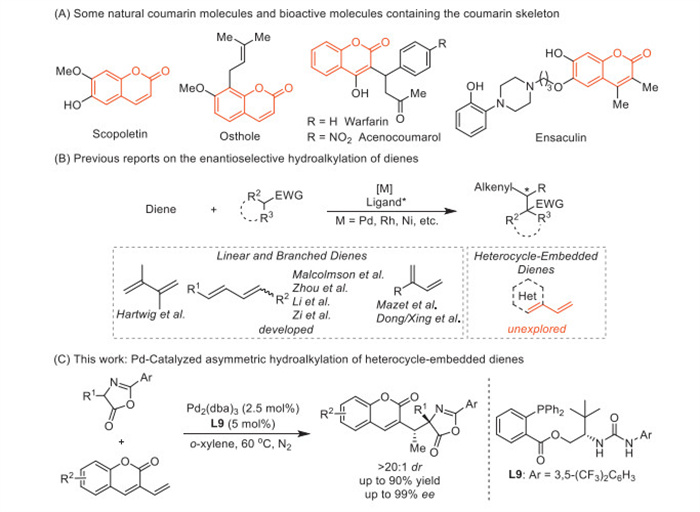
Coumarin derivatives are a significant class of heterocyclic compounds, widely found in natural products and pharmacologically active molecules [1–4]. They are characterized by a fused structure comprising a benzene ring and an α-pyrone moiety (Scheme 1A). This unique structural feature enables coumarins to engage in various non-covalent interactions with biological systems, including hydrophobic interactions, metal coordination, electrostatic forces, and hydrogen bonding. These interactions underlie their broad spectrum of biological activities, such as antitumor [5], anti-inflammatory [6], antioxidant [7], and antiviral [8] effects. As a result, the synthesis of coumarin derivatives has garnered considerable research attention.
Scheme 1
Scheme 1.
(A) Some natural coumarin molecules and bioactive molecules containing the coumarin skeleton. (B) Previous reports on the enantioselective hydroalkylation of dienes. (C) Pd-catalyzed asymmetric hydroalkylation of heterocycle-embedded dienes.
Asymmetric hydrofunctionalization reactions catalyzed by transition metals are among the most direct and atom-efficient strategies for synthesizing valuable chiral compounds. Conjugated dienes, as crucial substrates, have been extensively studied in this context [9–12]. However, controlling regioselectivity in the hydrofunctionalization of conjugated dienes remains a challenge, as variations in proton addition sites and nucleophilic attack positions can lead to the formation of multiple isomers. Despite significant advances in various hydrofunctionalization reactions of dienes over the past two decades [13–16] reports on regioselective and enantioselective hydroalkylation reactions of dienes remain limited. In 2004, Hartwig first reported the palladium-catalyzed addition of mono- and dicarbonyl compounds to conjugated dienes, yielding alkylation products with moderate to good enantioselectivity [17]. Since then, major breakthroughs in enantioselective hydroalkylation reactions using catalytic systems based on metals such as palladium, rhodium, and nickel have been reported by researchers such as Malcolmson [18–20], Zi [21], Dong and Wang [22], Zhou [23], Dong and Xing [24], Mazet [25], and Li [26] (Scheme 1B). However, the dienes involved in these reactions have been limited to linear and branched dienes, with only one example involving cyclohexadiene [17]. Due to the electronic and coordination effects of heterocycles, which can influence the formation and stability of allylpalladium intermediates, achieving asymmetric hydroalkylation of conjugated dienes embedded in heterocyclic systems remains a challenging task. To the best of our knowledge, no reports have yet been made on asymmetric hydroalkylation reactions of conjugated dienes embedded in heterocyclic systems.
Herein, we present an asymmetric hydroalkylation reaction be conjugated dienes embedded in heterocyclic systems, resulting in a novel coumarin scaffold with adjacent chiral centers at quaternary and tertiary carbons. This reaction exhibits excellent enantioselectivity, as well as high regioselectivity and diastereoselectivity. Moreover, the resulting products demonstrate promising inhibition rates in antitumor activity screening (Scheme 1C).
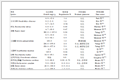
Azlactones, widely recognized as versatile precursors for the synthesis of quaternary amino acids, have been extensively investigated and reported in recent years [27–29]. Motivated by their synthetic potential, our initial investigations focused on the reaction between 3-vinylcoumarin (1a) and alanine-derived azlactone (2a), catalyzed by 5 mol% L1 in toluene at 60 ℃. Screening of Pd catalysts revealed that Pd2(dba)3 was the most effective catalyst, producing product 3aa in 58% yield with 89% ee (Table 1, entry 1). In contrast, Pd(diphos)2 and Pd(acac)2 delivered lower yields with 42% and 74% ee, respectively (Table 1, entries 2 and 3), while Pd(dppf)Cl2 and PdCl2 were inactive (Table 1, entries 4 and 5). Subsequent ligand evaluation emphasized the importance of the chiral environment. The planar chiral P, N-ligand L2 resulted in a racemic mixture of 3aa (Table 1, entry 6), whereas ligands L3 and the bisphosphine L4 provided moderate yields with 79% ee (Table 1, entries 7 and 8). Despite extensive screening of alternative chiral ligands, which failed to yield satisfactory results (Table S1 in Supporting information). Building on our group's previous studies on bifunctional catalysts [30–35], we hypothesized that hydrogen bonding could stabilize the transition state and thereby enhance selectivity. As a result, chiral urea-phosphine ligands were tested [36,37]. Notably, among the bifunctional ligands L5-L9, L9 proved to be the most efficient, providing 3aa with 98% ee, although the yield remained moderate (Table 1, entry 13). Solvent screening identified o-xylene as the optimal solvent, resulting in a slight increase in efficiency while maintaining high enantiocontrol. Other solvents failed to balance both efficiency and enantioselectivity (Table 1, entries 14–19). Finally, further optimization of substrate stoichiometry, catalyst loading, and temperature in o-xylene (Table S2 in Supporting information) afforded 3aa in 90% yield, 98% ee, and > 20:1 dr (Table 1, entry 20).
Table 1
Table 1.
Optimization of the Pd-catalyzed asymmetric hydroalkylation of heterocycle-embedded dienes.a
a Reaction conditions: 1a (0.10 mmol) and 2a (0.10 mmol) in 1.0 mL of solvent in a closed flask. b Isolated yield of 3aa. c All dr values are greater than 20:1 (dr was determined by crude 1H NMR). d Determined by chiral HPLC analysis. e 0.1 mmol of 1a and 0.15 mmol of 2a were employed in o-xylene (0.5 mL).
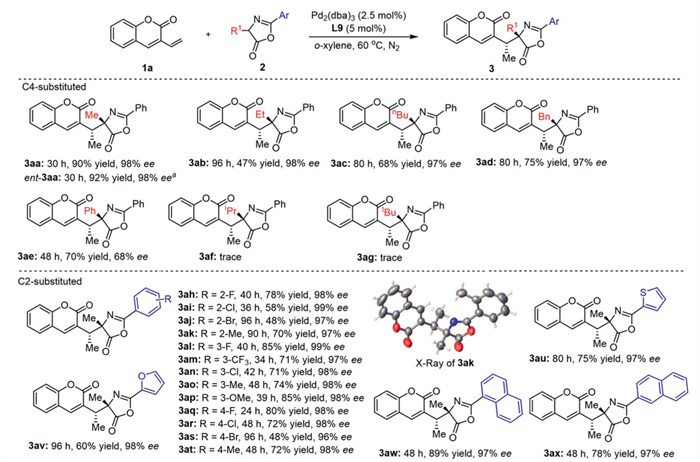
Under the optimized reaction conditions (Table 1, entry 20), we examined the scope of different azlactones, with the results summarized in Scheme 2. Various C4-alkyl azlactones were well-tolerated, yielding the corresponding chiral products in moderate to good yields, with enantioselectivity ranging from 97% to 98% ee (3aa-3ac). However, no reactions were observed with iPr- and tBu-substituted azlactones, likely due to steric hindrance (3af, 3ag). The C4-benzyl azlactone produced the desired product 3ad in 75% isolated yield with 97% ee, while C4-phenyl-substituted azlactones resulted in lower yields and enantioselectivity (3ad, 3ae). Additionally, C2-substituted azlactones were also investigated. The electronic effects of C4-aryl groups on the reactions were minimal. Both electron-donating and electron-withdrawing groups led to the formation of products (3ah-3at) in yields ranging from 48% to 85%, with enantioselectivity between 97% and 99% ee. Among them, Br-substituted azlactones required 96 h to yield products 3aj and 3as, but the yields were only 48%, probably due to oxidative addition of the C(sp2)-Br bond to the Pd(0) center. For heteroaryl azlactones, thienyl- and furyl-substituted variants produced the desired products 3au and 3av with good results (60%−75% yields, 97%−98% ee). Substrates bearing naphthalene rings were also well-tolerated, producing products 3aw and 3ax in 89% and 79% yields, respectively, both with 97% ee.
Scheme 2
Scheme 2.
Azlactones substrate scope. Reaction conditions: 1a (0.2 mmol), 2 (0.2 mmol), Pd2(dba)3 (2.5 mol%) and L9 (5 mol%) in o-xylene (1 mL) in a closed flask at 60 ℃. The yield is isolated yield. The dr values of all products are > 20:1. a 5 mol% ent–L9 was used.
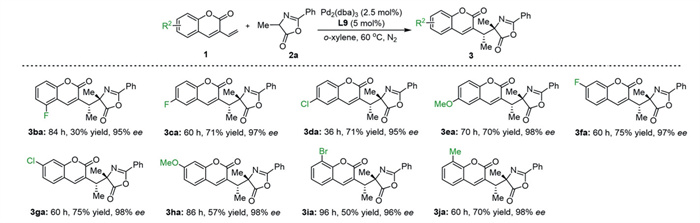
Next, we explored the generality of the reaction with respect to coumarins (Scheme 3). Fluorination at the C5 position of 3-vinylcoumarin resulted in the product 3ba, but only in 30% yield and with 95% ee. Beyond this, the position and electronic nature of the substituents had minimal impact on the reaction, leading to moderate to good yields of the corresponding products (3ca-3ja), all with excellent regioselectivity, as well as good diastereoselectivity and enantioselectivity (> 20:1 dr, 95%−98% ee). To further investigate the influence of substituents on the reaction, substrates 1a, 1f, 1g, and 1h with different electronic effects were selected for further study to establish a Hammett linear relationship (Fig. S3 in Supporting information). Although no linear correlation was observed between the substituent constants and the reaction rates, an interesting positive correlation was noted between the reaction rates and product yields: Whether an electron-donating group (such as methoxy) or an electron-withdrawing group (such as fluorine or chlorine) was introduced, the reaction rates were slower than those of the unsubstituted substrate. This trend is consistent with the yield observed experimentally.
Scheme 3
Scheme 3.
Coumarins substrate scope. Reaction conditions: 1 (0.2 mmol), 2a (0.2 mmol), Pd2(dba)3 (2.5 mol%) and L9 (5 mol%) in o-xylene (1 mL) in a closed flask at 60 ℃. The yield is isolated yield. The dr values of all products are > 20:1.
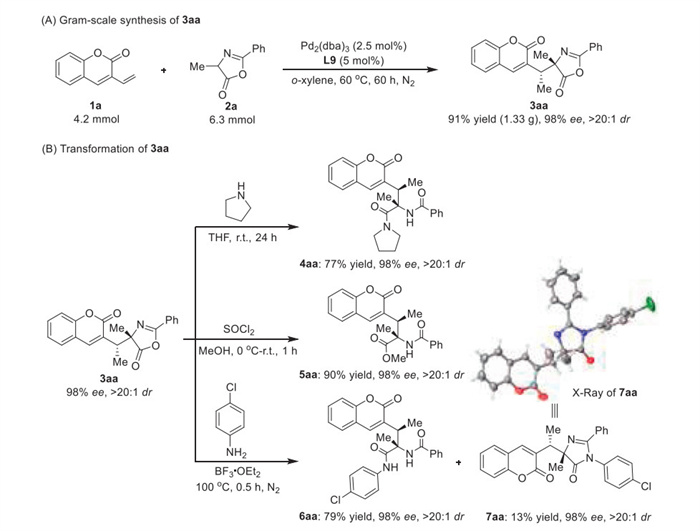
The scaled-up synthesis was subsequently carried out under standard reaction conditions, resulting in the corresponding product 3aa with 91% isolated yield, > 20:1 dr, and 98% ee (Scheme 4A). Various transformations of 3aa were also performed (Scheme 4B). Compound 3aa underwent ring-opening reactions to yield products 4aa and 5aa, both with excellent stereocontrol. After treating 3aa with 4-chloroaniline, in addition to product 6aa, a crucial imidazole structure, 7aa, commonly found in drug molecules, was also formed. The yields of 6aa and 7aa were 79% and 13%, respectively, with the same 98% ee. The absolute structure of 7aa was confirmed by single-crystal X-ray analysis.
Scheme 4
Scheme 4.
Scale-up reaction and further transformations of 3aa.
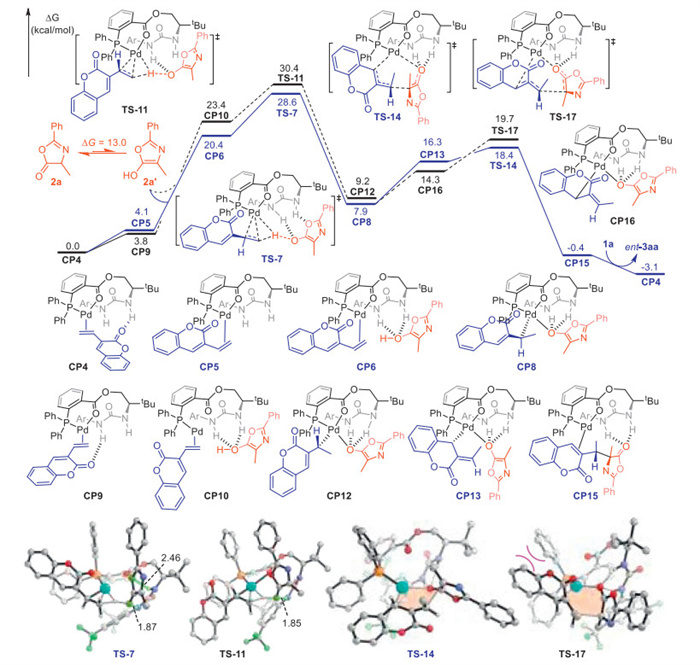
Density functional theory (DFT) calculations were performed to reveal detailed reaction mechanism and origin of enantio–selectivity for this palladium-catalyzed asymmetric hydroalkylation at the SMD(o-xylene)/M06L/6–311+g(d, p)-SDD//B3LYP-D3/6–31 g(d)-SDD level of theory. The 3-vinylcoumarin 1a, azlactone 2a, and bifunctional ligand ent–L9 assembled Pd-catalyst were chosen as the model reaction. As depicted in Fig. 1, isomerization of alkene-coordinated Pd complex CP4 could afford its isomer CP5 with 4.1 kcal/mol endothermic. Then, capture of enol 2a′ by urea moiety of bifunctional ligand through hydrogen-bond interaction gives intermediate CP6. The subsequent intramolecular protonation could rapidly occur via transition state TS-7 and furnish the allyl-Pd(Ⅱ) CP8. Similarly, protonation of intermediate CP10via transition state TS-11 could form its enantiomer CP12. The calculated relative free energy of protonation via transition state TS-11 is 1.8 kcal/mol higher than that of transition state TS-7, suggesting the formation of allyl-Pd(Ⅱ) CP8 is favorable. The optimized geometry information reveals that the bond length between the N—H groups of urea moiety and the oxygen atoms of enol 2a′ in TS-7 is 1.87 and 2.46 Å, respectively, indicating a beneficial double-hydrogen-bonding mode. As a contrast, only a single-hydrogen-bonding between those groups could be observed in TS-11 (1.85 Å). With the allyl-Pd(Ⅱ) CP8 in hand, two possible reductive elimination pathways via conjugated seven-membered-ring transition state TS-14 or TS-17 were taken into consideration, which could result in a pair of diastereomers. The calculated relative free energy of reductive elimination viaTS-17 is 19.7 kcal/mol, which is 1.3 kcal/mol higher than that of TS-14, implying the generation of intermediate CP15 is preferential. Optimized geometry information indicates that the calculated relatively higher free energy in TS-17 mainly originates from steric repulsion between the phenyl group of phosphine ligand and cyclic skeleton of azlactone (highlighted by pink lines). Therefore, the ent–3aa with high enantio–selectivity could be observed in experiments and theoretical calculations.
Figure 1
Figure 1.
Calculated free energy profiles for palladium-catalyzed asymmetric hydroalkylation of 3-vinylcoumarin 1a. The favored pathway is labeled by solid lines. The values given in kcal/mol are the relative free energies calculated by the SMD(o-xylene)/M06L/6–311+g(d, p)-SDD//B3LYP-D3/6–31 g(d)-SDD method. The hydrogen atoms of geometrical information were removed selectively for clarity.
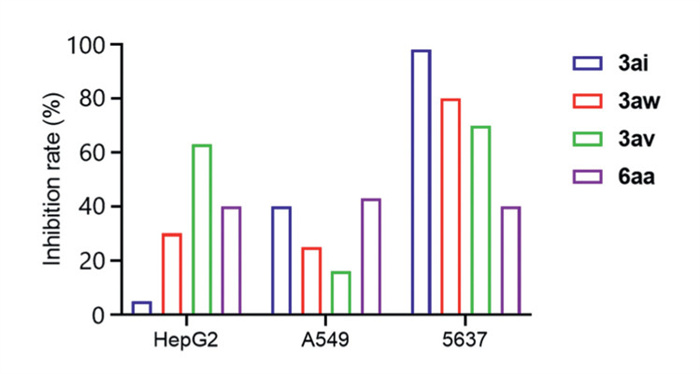
Given the potential antitumor activity of coumarin derivatives in the development of anticancer drugs, we evaluated the in vitro cytotoxicity of the synthesized compounds against human cancer cell lines using the CCK-8 assay. Specifically, the HepG2, A549, and 5637 cell lines were tested, and the results are presented in Fig. 2. At a concentration of 25 µmol/L, compounds 3ai, 3aw, 3av, and 6aa displayed antitumor activity. Among them, 3ai showed excellent selectivity against 5637 bladder cancer cells, with an inhibition rate of 98%, highlighting its potential for further application.
Figure 2
Figure 2.
Inhibition rate of the chiral coumarin compounds at 25 µmol/L in HepG2, A549 and 5637 cells (n = 3).
In summary, we have developed the first asymmetric hydroalkylation of heterocycle-embedded dienes. This Pd-catalyzed asymmetric reaction consistently achieves very good to excellent yields, with up to 99% ee and > 20:1 diastereomeric ratio. DFT calculations reveal that the chiral-urea-phosphine ligand plays a crucial role in controlling enantioselectivity through coordination and hydrogen bonding interactions. In addition, the reaction is scalable and adaptable, and the resulting coumarin derivatives exhibit selective antitumor activity, offering promising potential for further research and application in the pharmaceutical field.
The authors declare that they have no known competing financial interests or personal relationships that could have appeared to influence the work reported in this paper.
Acknowledgments
This work was supported by the National Natural Science Foundation of China (Nos. 82473767 and 82130103), the Research Project from Pingyuan Laboratory (No. 2023PY-ZZ-0204), and the Central Plains Scholars and Scientists Studio Fund (No. 2018002). We also acknowledge financial support from the Henan Key Laboratory of Organic Functional Molecules and Drug Innovation.
Supplementary materials
Supplementary material associated with this article can be found, in the online version, at doi:10.1016/j.cclet.2026.112371.
B. Zhu, H. Sun, H. Fan, et al., Org. Chem. Front. 9 (2022) 6631–6639. doi: 10.1039/d2qo01527g
[35]
B. Zhu, T. Yang, Y. Gu, et al., Org. Chem. Front. 8 (2021) 4160–4165. doi: 10.1039/d1qo00569c
[36]
Y. Zheng, T. Qin, W. Zi, J. Am. Chem. Soc. 143 (2021) 1038–1045. doi: 10.1021/jacs.0c11504
[37]
B. Wang, F. Hu, J. Bai, et al., Angew. Chem. Int. Ed. 63 (2024) e202319728. doi: 10.1002/anie.202319728
Scheme 1
(A) Some natural coumarin molecules and bioactive molecules containing the coumarin skeleton. (B) Previous reports on the enantioselective hydroalkylation of dienes. (C) Pd-catalyzed asymmetric hydroalkylation of heterocycle-embedded dienes.
Scheme 2
Azlactones substrate scope. Reaction conditions: 1a (0.2 mmol), 2 (0.2 mmol), Pd2(dba)3 (2.5 mol%) and L9 (5 mol%) in o-xylene (1 mL) in a closed flask at 60 ℃. The yield is isolated yield. The dr values of all products are > 20:1. a 5 mol% ent–L9 was used.
Scheme 3
Coumarins substrate scope. Reaction conditions: 1 (0.2 mmol), 2a (0.2 mmol), Pd2(dba)3 (2.5 mol%) and L9 (5 mol%) in o-xylene (1 mL) in a closed flask at 60 ℃. The yield is isolated yield. The dr values of all products are > 20:1.
Figure 1
Calculated free energy profiles for palladium-catalyzed asymmetric hydroalkylation of 3-vinylcoumarin 1a. The favored pathway is labeled by solid lines. The values given in kcal/mol are the relative free energies calculated by the SMD(o-xylene)/M06L/6–311+g(d, p)-SDD//B3LYP-D3/6–31 g(d)-SDD method. The hydrogen atoms of geometrical information were removed selectively for clarity.
Table 1.
Optimization of the Pd-catalyzed asymmetric hydroalkylation of heterocycle-embedded dienes.a
Entry
[Pd]
Ligand
Solvent
Yield (%)b,c
ee (%)d
1
Pd2(dba)3
L1
Toluene
58
89
2
Pd(diphos)2
L1
Toluene
50
42
3
Pd(acac)2
L1
Toluene
50
74
4
PdCl2
L1
Toluene
N.R.
-
5
Pd(dppf)Cl2
L1
Toluene
N.R.
-
6
Pd2(dba)3
L2
Toluene
35
0
7
Pd2(dba)3
L3
Toluene
46
79
8
Pd2(dba)3
L4
Toluene
50
79
9
Pd2(dba)3
L5
Toluene
N.R.
-
10
Pd2(dba)3
L6
Toluene
20
73
11
Pd2(dba)3
L7
Toluene
N.R.
-
12
Pd2(dba)3
L8
Toluene
15
70
13
Pd2(dba)3
L9
Toluene
45
98
14
Pd2(dba)3
L9
MeCN
20
98
15
Pd2(dba)3
L9
o-xylene
50
98
16
Pd2(dba)3
L9
m-xylene
15
96
17
Pd2(dba)3
L9
DCE
5
92
18
Pd2(dba)3
L9
PhCF3
10
49
19
Pd2(dba)3
L9
tBuOH
25
71
20e
Pd2(dba)3
L9
o-xylene
90
98
a Reaction conditions: 1a (0.10 mmol) and 2a (0.10 mmol) in 1.0 mL of solvent in a closed flask. b Isolated yield of 3aa. c All dr values are greater than 20:1 (dr was determined by crude 1H NMR). d Determined by chiral HPLC analysis. e 0.1 mmol of 1a and 0.15 mmol of 2a were employed in o-xylene (0.5 mL).


 DownLoad:


 下载:


 下载:

