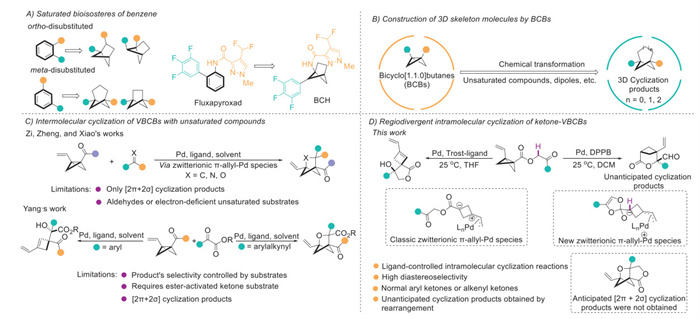
Scheme 1.
Research's backgrounds, our concept and rational design.

Palladium-catalyzed and ligand-controlled regiodivergent intramolecular cyclization of ketone-vinylbicyclo[1.1.0]butanes (Ketone-VC-BCBs)
Jun Yan , Shenghao Jiang , Yin Wei , Min Shi


Three-dimensional (3D) molecular scaffolds are ubiquitous in natural products and pharmaceutical agents, and they represent important motifs in total synthesis, polymer modification, and drug discovery [1–5]. In medicinal chemistry, replacing planar benzene rings with saturated 3D cyclic structures has attracted increasing attention (Scheme 1A). This structural transformation, known as "escape-from-flatland", has the potential to enhance the physicochemical properties and pharmacokinetics of drug candidates [6,7]. Accordingly, devising simple yet efficient synthetic strategies to access these 3D scaffolds remains an important and attractive goal in modern organic synthesis. Against this backdrop, bicyclo[1.1.0]butanes (BCBs) have recently emerged as versatile building blocks for the construction of saturated three-dimensional scaffolds. A range of diverse catalytic strategies have been successfully employed, including electron transfer [8–17], energy transfer [18–25], transition-metal [26–34], Lewis acid [35–52] catalysis, and so on [53–64] (Scheme 1B).
Among these, vinylbicyclo[1.1.0]butanes (VC-BCBs) are particularly attractive due to their unique structural attributes, which enable Pd(0) complexes to coordinate with the alkene moiety and promote cleavage of the adjacent strained ring. This transformation generates a zwitterionic intermediate under palladium catalysis, which can subsequently engage in cycloaddition with unsaturated substrates, thereby providing a variety of complex 3D architectures [65–69]. For example, in 2024, Zi and co-workers reported the first Pd-catalyzed intramolecular asymmetric [2π+2σ] cycloaddition of VC-BCBs with aldehydes and electron-deficient ketones [65]. Shortly thereafter, the groups of Zheng [66], Zi [67], and Xiao [68] extended this strategy to a variety of electron-deficient unsaturated substrates, including alkenes, imines, and ketones. Almost simultaneously, Yang [69] and co-workers described Pd-catalyzed reactions of VC-BCBs with α-ketoesters, in which modulation of the α-ketoester structure enabled a switch between Alder–Ene and [2π+2σ] cycloaddition pathways (Scheme 1C).
Despite these advancements, the scope of palladium-catalyzed VC-BCBs cyclization reactions remains relatively limited, being largely confined to aldehydes or electron-deficient unsaturated substrates. Moreover, current studies have focused exclusively on intermolecular [2π+2σ] cycloadditions, thereby restricting access to more diverse bicyclic architectures beyond the bicyclo[2.1.1]hexane motifs. To address these limitations, the further development of general strategies for constructing structurally diverse 3D frameworks is highly desirable. Herein, we report the design of a novel class of VC-BCBs substrates incorporating a carbonyl functionality (Ketone-VC-BCBs), which enables ligand-controlled, regiodivergent intramolecular cyclization under palladium catalysis (Scheme 1D). When Trost-Ph-Phos is employed, the zwitterionic intermediate undergoes intramolecular nucleophilic attack onto the carbonyl group, followed by a proton transfer, to afford the corresponding spirocyclic product. In contrast, when 1,4-bis(diphenylphosphino)butane (DPPB, L3) is used as the ligand, the zwitterionic intermediate does not engage with the intramolecular carbonyl group to furnish the expected [2π+2σ] products (bicyclo[2.1.1]hexanes). Instead, it undergoes a hydrogen migration and subsequent rearrangement to generate a distinct new zwitterionic palladium species, which ultimately delivers the unexpected bicyclo[3.1.1]heptane as the product.
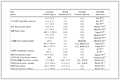
To evaluate our working hypothesis, we designed and synthesized ketone-VC-BCBs 1a as a model substrate through a nucleophilic substitution reaction between α-bromobenzophenone and a VC-BCBs-derived carboxylic acid. When 1,2-bis(diphenylphosphino)ethane (DPPE, L1) (10 mol%) was used as the ligand and Pd2(dba)3 (5 mol%) as the palladium source, the reaction of 1a in dichloromethane (2.0 mL) at 40℃ for 24 h afforded the cyclization product 2a in 7% yield. Unexpectedly, the anticipated [2π+2σ] cycloaddition product was not observed; instead, the rearranged cyclization product 3a was obtained in 69% yield (Table 1, entry 1). Encouraged by this result, we further examined a series of DPPE analogues including 1,3-bis(diphenylphosphino)propane (DPPP, L2), DPPB (L3), and 1,5-bis(diphenylphosphaneyl)pentane (DPPH, L4) (Table 1, entries 2-4); all of which predominantly afforded 3a as the major product. Among them, DPPB (L3) proved to be the most effective one, delivering 3a in 79% NMR yield. In contrast, evaluation of other ligands such as L5 to L11 (Table 1, entries 5-11) showed that, although the reactions proceeded smoothly, both the yield and regioselectivity were generally lower than those obtained under the optimized conditions. Encouragingly, when the Trost-type ligand L12 was employed, the cyclization product 2a was obtained in 56% NMR yield with excellent diastereoselectivity (dr > 20:1) and 3a was formed in trace amount (Table 1, entry 12). In contrast, another Trost-type ligand L13 afforded 2a in lower yield and with decreased diastereoselectivity (Table 1, entry 13, 48% NMR yield and dr = 2:1). Having established the optimal ligand conditions, we next examined the effects of solvent and temperature on the reaction outcome (for details, see Pages S5 and S6 in Supporting information). Lowering the reaction temperature to ambient conditions slightly improved the yield of cyclization product 3a using L3 as the ligand, with 87% NMR yield and 85% isolated yield (Table 1, entry 14). Furthermore, when tetrahydrofuran was used instead of dichloromethane, the yield of product 2a increased slightly, yet diastereoselectivity remained excellent (Table 1, entry 15). When Pd(PPh3)4 was used as the palladium source in the absence of additional ligands, the reaction also proceeded smoothly, affording products 2a and 3a in 17% and 50% NMR yields, respectively (Table 1, entry 16). Control experiments confirmed that without a palladium source, the reaction fails to proceed smoothly (Table 1, entry 17).
 DownLoad:
CSV
 |
|||||||||||||||||||||||||||||||||||||||||||||||||||||||||||||||||||||||||||||||||||||||||||||||||||||
| Entry | Ligand (x mol%) | Solvent | T (℃) | Yield (%)b | |||||||||||||||||||||||||||||||||||||||||||||||||||||||||||||||||||||||||||||||||||||||||||||||||
| 2a | 3a | ||||||||||||||||||||||||||||||||||||||||||||||||||||||||||||||||||||||||||||||||||||||||||||||||||||
| 1 | L1 (10) | DCM | 40 | 7c | 69c | ||||||||||||||||||||||||||||||||||||||||||||||||||||||||||||||||||||||||||||||||||||||||||||||||
| 2 | L2 (10) | DCM | 40 | 5 | 73 | ||||||||||||||||||||||||||||||||||||||||||||||||||||||||||||||||||||||||||||||||||||||||||||||||
| 3 | L3 (10) | DCM | 40 | 6 | 79 | ||||||||||||||||||||||||||||||||||||||||||||||||||||||||||||||||||||||||||||||||||||||||||||||||
| 4 | L4 (10) | DCM | 40 | 11 | 71 | ||||||||||||||||||||||||||||||||||||||||||||||||||||||||||||||||||||||||||||||||||||||||||||||||
| 5 | L5 (10) | DCM | 40 | trace | 60 | ||||||||||||||||||||||||||||||||||||||||||||||||||||||||||||||||||||||||||||||||||||||||||||||||
| 6 | L6 (10) | DCM | 40 | 36 (d.r. > 20:1) | 32 | ||||||||||||||||||||||||||||||||||||||||||||||||||||||||||||||||||||||||||||||||||||||||||||||||
| 7 | L7 (10) | DCM | 40 | 18 (d.r. > 20:1) | 41 | ||||||||||||||||||||||||||||||||||||||||||||||||||||||||||||||||||||||||||||||||||||||||||||||||
| 8 | L8 (10) | DCM | 40 | trace | 53 | ||||||||||||||||||||||||||||||||||||||||||||||||||||||||||||||||||||||||||||||||||||||||||||||||
| 9 | L9 (10) | DCM | 40 | trace | 52 | ||||||||||||||||||||||||||||||||||||||||||||||||||||||||||||||||||||||||||||||||||||||||||||||||
| 10 | L10 (20) | DCM | 40 | trace | 22 | ||||||||||||||||||||||||||||||||||||||||||||||||||||||||||||||||||||||||||||||||||||||||||||||||
| 11 | L11 (10) | DCM | 40 | trace | 44 | ||||||||||||||||||||||||||||||||||||||||||||||||||||||||||||||||||||||||||||||||||||||||||||||||
| 12 | L12 (10) | DCM | 40 | 56 (dr > 20:1) | trace | ||||||||||||||||||||||||||||||||||||||||||||||||||||||||||||||||||||||||||||||||||||||||||||||||
| 13 | L13 (10) | DCM | 40 | 48 (dr = 2:1) | trace | ||||||||||||||||||||||||||||||||||||||||||||||||||||||||||||||||||||||||||||||||||||||||||||||||
| 14 | L3 (10) | DCM | 25 | trace | 87 (85)d | ||||||||||||||||||||||||||||||||||||||||||||||||||||||||||||||||||||||||||||||||||||||||||||||||
| 15 | L12 (10) | THF | 25 | 72 (65)c (dr > 20:1) | trace | ||||||||||||||||||||||||||||||||||||||||||||||||||||||||||||||||||||||||||||||||||||||||||||||||
| 16c | - | DCM | 25 | 17 (dr > 20:1) | 50 | ||||||||||||||||||||||||||||||||||||||||||||||||||||||||||||||||||||||||||||||||||||||||||||||||
| 17e | L3 (10) | DCM | 25 | N.D. | N.D. | ||||||||||||||||||||||||||||||||||||||||||||||||||||||||||||||||||||||||||||||||||||||||||||||||
| a Reaction was conducted with 1a (0.1 mmol), Pd2(dba)3 (5.0 mol%) and L (10 or 20 mol%) under Ar for 24 h. b Yields were determined by 1H NMR analysis of the unpurified reaction mixtures using dibromomethane as an internal standard. c Pd(PPh 3)4 instead of Pd2(dba)3. d Isolated yield. e Reaction was conducted in the absence of Pd source. |
|||||||||||||||||||||||||||||||||||||||||||||||||||||||||||||||||||||||||||||||||||||||||||||||||||||
With the optimal conditions established, we next examined the substrate scope of the palladium-catalyzed intramolecular cyclization of ketone-VC-BCBs 1. As summarized in Scheme 2, a range of substrates successfully underwent cyclization under the standard conditions A, delivering the corresponding oxaspiro[3.4]oct-1-en-5-one derivatives 2 in moderate yields with excellent diastereoselectivity in most cases. For substrates bearing a monosubstituted benzene ring, the nature of the substituent, whether electron-donating (1b, 1c) or electron-withdrawing (1d-1m), exerted little influence on either the yields (51%-68%) or the diastereoselectivities (dr > 20:1) of products 2b-2m. In addition, the position of substitution on the benzene ring (para-, meta-, or ortho-) showed minimal impact, and the desired products (2d, 51% yield; 2h, 66% yield; 2i, 54% yield) were obtained smoothly in all cases. Beyond simple monosubstituted phenyl substrates, the reaction also exhibited good tolerance toward additional functional groups such as ester (1j, 62% yield), nitro (1k, 55% yield), phenyl (1l, 61% yield), and cyano (1m, 68% yield) substituents, affording the corresponding products (2j-2m) in moderate yields under the standard conditions A. In this protocol, although the substrates were all completely converted upon the reaction completion, some complexes were also observed. At the present stage, we cannot figure out their structures. The moderate yield is attributed to the inherent instability of the substrate, as evidenced by the formation of partially insoluble compounds after one week of storage at –20 ℃.
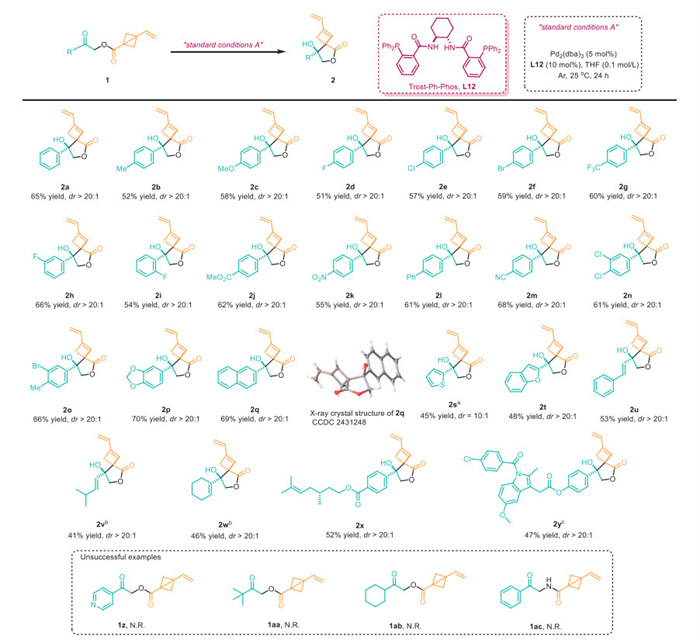
Moreover, substrates with disubstituted phenyl rings (1n-1p) or other aromatic substituents such as 2-naphthyl (1q), 2-thienyl (1s), and 2-benzofuranyl (1t) also underwent smooth cyclization, giving the desired products 2n to 2t in 45% to 70% yields along with good diastereoselectivities. The structure of 2q was unambiguously confirmed by X-ray diffraction, and the related CIF data are detailed on Page S182 in Supporting information. Notably, substrates bearing a 2-thienyl substituent required higher catalyst loadings and elevated temperatures, which resulted in the production of 2s in 45% yield along with dr = 10:1. This diminished reactivity is likely due to coordination of the thiophene's sulfur atom to the palladium center, thereby partially reducing catalytic efficiency. To further expand the substrate scope, the aryl ketone moiety was replaced with an alkenyl ketone (1u, 1v, and 1w), which also underwent smooth cyclization to yield the corresponding target products 2u, 2v, and 2w in 53%, 41% and 46% yields, respectively, albeit at higher temperature and the yield was somewhat reduced. Substrates incorporating a natural product fragment (Citronellol, 1x) or a pharmaceutical motif (Indomethacin, 1y) on the benzene ring also underwent the cyclization smoothly under the standard conditions A, affording the corresponding products (2x and 2y) in moderate yields. Regrettably, when the pyridine ketone (1z) or an alkyl ketone (1aa and 1ab) was introduced, or when the linker between the ketone and the VC-BCB unit was changed from oxygen to nitrogen (1ac, N-Ketone-VC-BCBs), the reaction did not proceed efficiently. Reactions of substrates 1aa and 1ab yielded recovered starting material, whereas those of 1z and 1ac gave complex mixtures with no detectable product or starting material.
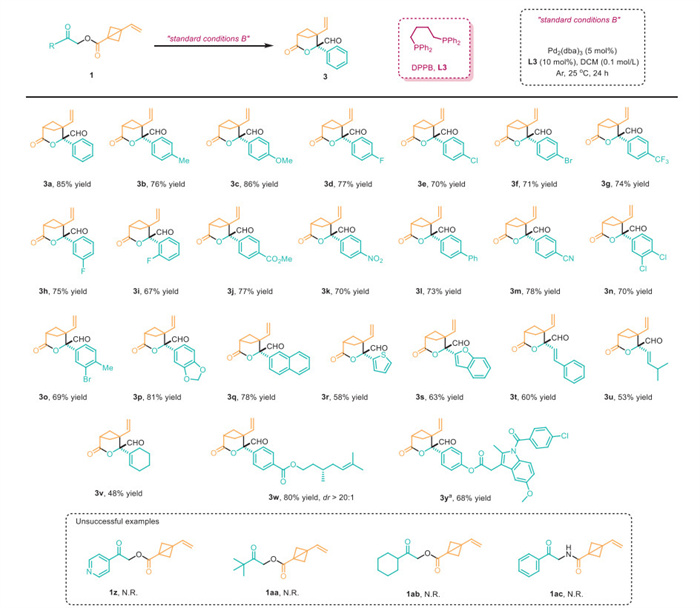
Having specified the substrate scope for the formation of products 2, we subsequently turned our attention to the rearranged cyclization process on the formation of products 3. Accordingly, the substrate scope for the formation of cyclization products 3 was evaluated under the standard conditions B (Scheme 3). Across a broad range of substituents, the reaction consistently afforded the desired cyclization products in moderate to good yields (48%-86%). Both electron-rich groups, such as methyl (3b) and methoxy (3c), and electron-deficient substituents, including fluoro (3d, 3h, and 3i), chloro (3e), bromo (3f), and trifluoromethyl (3g), were well accommodated. Furthermore, variations in substitution patterns on the phenyl ring, whether para (3d), meta (3h), or ortho (3i), exerted little influence on the outcome of the reaction. Similarly, substrates bearing ester, nitro, phenyl, and cyano substituents also underwent this transformation smoothly under the standard conditions B, affording products 3j-3m in moderate yields (70%-78%). In addition, disubstituted phenyl derivatives as well as substrates incorporating extended aromatic systems, such as 2-naphthyl, 2-thienyl, and 2-benzofuranyl, were effectively converted to the desired products 3n-3s in 58%-81% yields. Finally, substrates containing alkenyl ketone moieties, as well as those incorporating fragments from natural products or drug molecules, also underwent the cyclization efficiently to afford the rearranged cyclization products (3u-3y), albeit with slightly diminished yields (48%-80%). As with those under the standard conditions A, substrates bearing pyridine ketone (1z), alkyl ketone (1aa and 1ab) or N-ketone-VC-BCBs (1ac) cannot yield the desired cyclization product 3 under the standard conditions B, either.
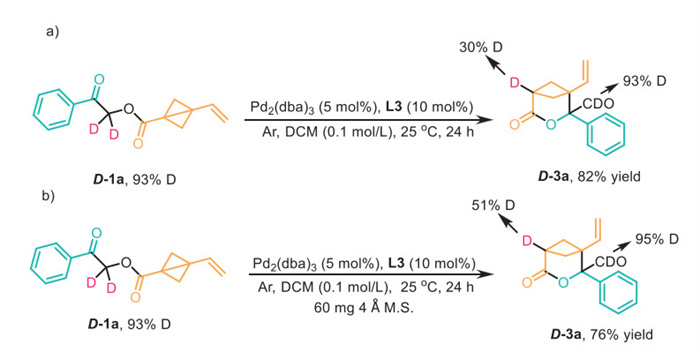
To gain more insights into the reaction pathway leading to the formation of the rearranged cyclization products 3, a series of deuterium-labeling experiments were carried out (Scheme 4). When deuterium-labeled substrate D-1a was subjected to the standard conditions B, the product D-3a was obtained in 82% yield along with deuterium incorporation of 30% at the α-position of the ester group and 93% at the aldehyde moiety (Scheme 4a). This partial incorporation is likely attributable to rapid hydrogen–deuterium exchange between the deuterium atom and ambient moisture present in the reaction system during the proton transfer process. Upon the addition of 60 mg of 4 Å molecular sieves to get rid of exogeneous moisture, the deuterium incorporation at the α-position in the cyclization product D-3a increased to 51% (Scheme 4b), indicating that residual moisture in the reaction system indeed interferes with deuterium incorporation during the proton transfer process.
DFT calculations were performed to gain a detailed understanding of the reaction mechanism (Scheme 5a). All calculations were carried out at the SMD(THF)/ωB97X-D/def2-TZVP//IEFPCM(THF)/ωB97X-D/def2-SVP level using the Gaussian 16 program (see Supporting information on Page S185 for computational details) [70]. The catalytically active Pd(0)/L12 species initially coordinates with the alkene moiety of the substrate 1a to generate an intermediate INT-1 (0.0 kcal/mol). Subsequent cleavage of the σ-bond of BCB moiety occurs via transition state TS-1 with an associated energy barrier of 16.5 kcal/mol, affording the zwitterionic π-allyl–Pd intermediate INT-2 (16.4 kcal/mol). Thereafter, the carbanion in INT-2 attacks the carbonyl group via TS-2 (27.1 kcal/mol, ΔG‡ = 10.7 kcal/mol), leading to the formation of the cyclic intermediate INT-3 (12.3 kcal/mol). An intramolecular proton transfer then occurs, in which the oxygen anion in INT-3 abstracts a proton, forming INT-4 (-8.5 kcal/mol) via TS-3 (16.6 kcal/mol), with an energy barrier of 4.3 kcal/mol. Finally, dissociation of Pd(0)/L12 from the alkene moiety affords the oxaspiro[3.4]oct-1-en-5-one product 2a (-11.5 kcal/mol, based on the Gibbs free energy of 1a) and simultaneously regenerates the catalytically active Pd(0)/L12 species for the next cycle.
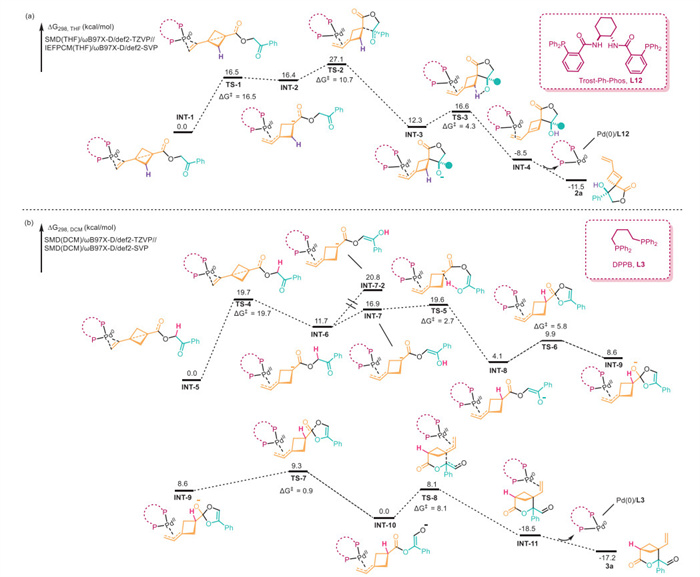
DFT calculations were performed to investigate the formation pathway of product 3a (Scheme 5b). All calculations were carried out at the SMD(DCM)/ωB97X-D/def2-TZVP//SMD(DCM)/ωB97X-D/def2-SVP level using the Gaussian 16 program (see Supporting information on Page S209 for computational details) [70]. The catalytically active Pd(0)/L3 species initially coordinates with the alkene moiety of the substrate 1a to generate an intermediate INT-5 (0.0 kcal/mol), which undergoes C–C bond cleavage of BCB moiety via TS-4 (ΔG‡ = 19.7 kcal/mol), generating the zwitterionic π-allyl–Pd intermediate INT-6 (11.7 kcal/mol). The intermediate INT-6 then undergoes enol tautomerization to form a (Z)-enol intermediate INT-7 (16.9 kcal/mol), which subsequently experiences an intramolecular proton migration via TS-5 (19.6 kcal/mol, ΔG‡ = 2.7 kcal/mol), affording a new zwitterionic π-allyl–Pd intermediate INT-8 (4.1 kcal/mol). Similarly, we calculated the energy of the (E)-enol intermediate INT-7-2 (20.8 kcal/mol) and found its energy is higher than that of the (Z)-enol intermediate INT-7 by 3.9 kcal/mol. The proton migration process is consistent with the results of deuterium-labeling experiments. The resulting enolate anion attacks the ester group via TS-6 (9.9 kcal/mol, ΔG‡ = 5.8 kcal/mol), forming the cyclic intermediate INT-9 (8.6 kcal/mol), followed by C–O bond cleavage through TS-7 (9.3 kcal/mol ΔG‡ = 0.9 kcal/mol), generating the rearranged zwitterionic intermediate INT-10 (0.0 kcal/mol). An intramolecular nucleophilic cyclization between the enolate and the π-allylic cationic fragment via TS-8 (ΔG‡ = 8.1 kcal/mol) produces the key intermediate INT-11 (-18.5 kcal/mol), with an activation barrier of 9.4 kcal/mol. Finally, dissociation of Pd(0)/L3 from the alkene yields 3a (-17.2 kcal/mol, based on the Gibbs free energy of 1a), while regenerating the catalytically active Pd(0)/L3 species for the next cycle. Overall, these results reveal that ligand-dependent modulation of proton transfer is the key factor governing the divergent cyclization pathways leading to 2 and 3.
To demonstrate the synthetic utility of this palladium-catalyzed intramolecular cyclization of ketone-VC-BCBs, two representative substrates were subjected to gram-scale synthesis. The target products 2f and 3a were obtained in 59% (dr > 20:1) and 78% yields, respectively (Scheme 6a). Next, the further transformation of the obtained products was performed (Scheme 6b). Initially, treatment of 2f with DIBAL-H at -20 ℃ effected reduction of the lactone moiety, providing the corresponding alcohol 4 in 46% yield. A series of drug-like molecules, including ibuprofen and naproxen, were then coupled with the hydroxyl group of 2f to afford the corresponding derivatives 5 and 6 in 72% and 82% yields, respectively. Transformations were also carried out using 3a as the substrate. Reaction of 3a with 2,4-dinitrophenylhydrazine under strong acidic conditions not only promoted condensation at the aldehyde group but also induced ethanolysis of the lactone, resulting in ring opening and formation of the trisubstituted cyclobutane product 7 in 69% yield along with dr 10:1. The structure of 7 was unambiguously confirmed by X-ray diffraction, and the CIF data have been provided in Supporting information on Page S183. In addition, 3c underwent the reaction with a stabilized phosphine ylide under Wittig reaction conditions, affording the corresponding trans-olefinic product 8 in 82% yield. To further elucidate the structure of 3a, the aldehyde group was condensed with 2,4-dinitrophenylhydrazine under milder conditions using camphorsulfonic acid as the catalyst in THF to prevent lactone ring opening and the corresponding condensation product 9 was successfully afforded. The structure of 9 was unequivocally determined by X-ray diffraction and its CIF data are summarized on Page S184 in Supporting information, thereby corroborating the structure of 3a.
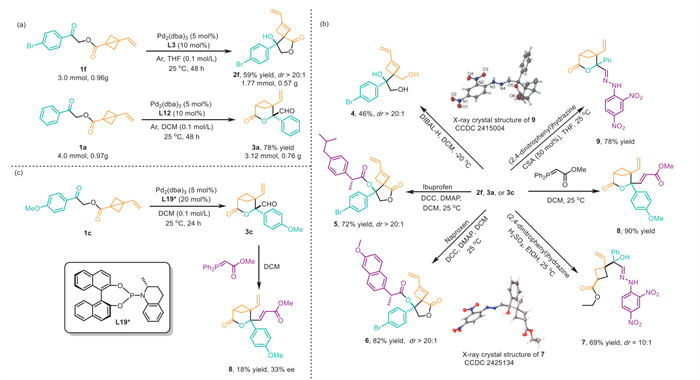
Subsequently, asymmetric catalysis was explored by screening a series of chiral ligands using 1c as substrate (for details, see Supporting information on Page S7). Since product 3c was not stable under HPLC analyzing condition, it was further transformed into the corresponding olefinic product 8. When the chiral phosphonamide ligand L19* was employed, 8 was obtained in 18% yield along with 33% ee value (Scheme 6c, for more datil, see Supporting information on Page S178). We hypothesize that the low enantioselectivity may be due to that the chiral environment of ligand is relatively away from the reaction center during the formation of the stereogenic center, and the structure of TS-8 in the DFT calculations supports this hypothesis. Other chiral ligands were also examined, and the results are indicated in Table S4 (Supporting information). In addition, we also tested adding a series of chiral Lewis acids into the reaction system, but the results were unsatisfactory in terms of both yield and enantioselectivity (Table S5 in Supporting information).
In summary, we have developed a novel palladium-catalyzed and ligand-controlled intramolecular divergent cyclization of ketone-VC-BCBs, providing an efficient and straightforward strategy for the construction of spirocyclic and fused polycyclic 3D molecular scaffolds under mild conditions. The reaction displays broad substrate scope, tolerates diverse functional groups and aromatic substitutions, and enables selective formation of distinct cyclization products through ligand tuning. Mechanistic studies, including deuterium-labeling experiments and DFT calculations, reveal that the formation of the spirocyclic product 2 proceeds through a C–C bond cleavage, cyclization, and proton migration, whereas the rearranged cyclization product 3 is generated through C–C bond cleavage, proton migration, rearrangement, and cyclization. The selective formation of two structurally distinct products is enabled by ligand-controlled modulation of proton transfer pathways, which governs divergent reaction outcomes. Gram-scale synthesis and subsequent functional group transformations further highlight the versatility and practical utility of this methodology. Ongoing efforts in our laboratory are directed toward expanding the scope of BCBs cyclization reactions, which are expected to provide new opportunities for the construction of diverse molecular architectures.
Jun Yan: Writing – original draft, Methodology, Investigation, Conceptualization. Shenghao Jiang: Investigation. Yin Wei: Writing – review & editing, Methodology, Investigation. Min Shi: Writing – review & editing, Methodology, Conceptualization.
The authors declare that they have no known competing financial interests or personal relationships that could have appeared to influence the work reported in this paper.
We are grateful for the financial support from the National Key R & D Program of China (No. 2023YFA1506700), the National Natural Science Foundation of China (Nos. 22171078 and 22571314), Project supported by Shanghai Municipal Science and Technology Major Project (No. 2018SHZDZX03) and the Fundamental Research Funds for the Central Universities (No. 222201717003).
Supplementary material associated with this article can be found, in the online version, at doi:
H.E. Diepers, J.C.L. Walker, Beilstein J. Org. Chem. 20 (2024) 859–890. doi: 10.3762/bjoc.20.78
K. Xia, Chem. Commun. 61 (2025) 6417–6425. doi: 10.1039/d5cc00816f
S. Lee, B.G. Kim, S. Geum, J. Kim, H.Y. Lee, Org. Lett. 23 (2021) 4651–4656. doi: 10.1021/acs.orglett.1c01391
F. Wang, L. Jiao, Angew. Chem. Int. Ed. 60 (2021) 12732–12736. doi: 10.1002/anie.202101161
G. Li, X. Xie, L. Zu, Angew. Chem. Int. Ed. 55 (2016) 10483–10486. doi: 10.1002/anie.201604770
F. Lovering, J. Bikker, C. Humblet, J. Med. Chem. 52 (2009) 6752–6756. doi: 10.1021/jm901241e
F. Lovering, Med. Chem. Commun. 4 (2013) 515-519. doi: 10.1039/c2md20347b
S. Agasti, F. Beltran, E. Pye, et al., Nat. Chem. 15 (2023) 535–541. doi: 10.1038/s41557-023-01135-y
J.L. Tyler, F. Schäfer, H. Shao, et al., J. Am. Chem. Soc. 146 (2024) 16237–16247. doi: 10.1021/jacs.4c04403
S. Yu, C. Romano, D.J. Procter, N. Kaltsoyannis, J. Org. Chem. 89 (2024) 15842–15850. doi: 10.1021/acs.joc.4c01996
K. Lin, C.R. Luo-Wei, Y. Gao, J. Lan, T. Zhu, J. Am. Chem. Soc. 147 (2025) 31521–31529. doi: 10.1021/jacs.5c05306
Y. Liu, S. Lin, Y. Li, et al., ACS Catal. 13 (2023) 5096–5103. doi: 10.1021/acscatal.3c00305
F. Zhang, S. Dutta, A. Petti, et al., Angew. Chem. Int. Ed. 64 (2025) e202418239. doi: 10.1002/anie.202418239
M. Golfmann, M. Reinhold, J.D. Steen, et al., ACS Catal. 14 (2024) 13987–13998. doi: 10.1021/acscatal.4c05067
C.C. Chintawar, R. Laskar, D. Rana, et al., Nat. Catal. 7 (2024) 1232–1242. doi: 10.1038/s41929-024-01239-9
Y. Li, X. Gu, Y. Wei, M. Shi, Sci. China Chem. 68 (2025) 4959–4972. doi: 10.1007/s11426-025-2704-x
K. Zhang, Z. Gao, Y. Xia, et al., Chem. Sci. 16 (2025) 1411–1416. doi: 10.1039/d4sc07243j
D. Rana, C. Hümpel, R. Laskar, et al., J. Am. Chem. Soc. 147 (2025) 28359–28369. doi: 10.1021/jacs.5c09249
Y. Liu, J.Y. Wu, S. Lin, et al., Angew. Chem. Int. Ed. 64 (2025) e202513774. doi: 10.1002/anie.202513774
M. De Robichon, T. Kratz, F. Beyer, et al., J. Am. Chem. Soc. 145 (2023) 24466–24470. doi: 10.1021/jacs.3c08404
R. Guo, Y.C. Chang, L. Herter, et al., J. Am. Chem. Soc. 144 (2022) 7988–7994. doi: 10.1021/jacs.2c02976
Y.P. Cai, S.R. Chen, Q.H. Song, Org. Chem. Front. 12 (2025) 2676–2686. doi: 10.1039/d5qo00205b
Z. Xu, X. Gu, Y. Wei, M. Shi, Angew. Chem. Int. Ed. 64 (2025) e202506073. doi: 10.1002/anie.202506073
P. Dey, S. Agasti, B. Maji, Org. Lett. 27 (2025) 6463–6468. doi: 10.1021/acs.orglett.5c01779
S. Tian, R. Liu, K. Zhang, et al., Org. Lett. 27 (2025) 3818–3824. doi: 10.1021/acs.orglett.5c00189
J.K. Sailer, D. Ly, D.G. Musaev, H.M.L. Davies, J. Am. Chem. Soc. 147 (2025) 31034–31041. doi: 10.1021/jacs.5c09039
X. Wang, N. Li, J. Wang, X. Li, ACS Catal. 15 (2025) 13207–13215. doi: 10.1021/acscatal.5c03423
P.P. Chen, P. Wipf, K.N. Houk, Nat. Commun. 13 (2022) 7292. doi: 10.1038/s41467-022-34837-x
X.Y. Gao, L. Tang, X. Zhang, J.J. Feng, Chem. Sci. 15 (2024) 13942–13948. doi: 10.1039/d4sc02998d
X.Y. Gao, Y. Xiao, X. Zhan, et al., Org. Chem. Front. 12 (2025) 4430–4438. doi: 10.1039/d5qo00460h
J.L. Zhou, Y. Xiao, L. He, et al., J. Am. Chem. Soc. 146 (2024) 19621–19628. doi: 10.1021/jacs.4c01851
M.A.A. Walczak, T. Krainz, P. Wipf, Acc. Chem. Res. 48 (2015) 1149–1158. doi: 10.1021/ar500437h
S. Liu, Y. Ning, W. Song, et al., Angew. Chem. Int. Ed. 64 (2025) e202514232. doi: 10.1002/anie.202514232
M. Borgini, Q.N. Huang, P.P. Chen, et al., J. Am. Chem. Soc. 146 (2024) 14927–14934. doi: 10.1021/jacs.4c04081
J. Zhang, J.Y. Su, H. Zheng, H. Li, W.P. Deng, ACS Catal. 14 (2024) 17837–17849. doi: 10.1021/acscatal.4c05622
Y.J. Li, Z.L. Wu, Q.S. Gu, et al., J. Am. Chem. Soc. 146 (2024) 34427–34441. doi: 10.1021/jacs.4c10968
J. Jeong, S. Cao, H.J. Kang, et al., J. Am. Chem. Soc. 146 (2024) 27830–27842. doi: 10.1021/jacs.4c10153
D. Ni, S. Hu, X. Tan, et al., Angew. Chem. Int. Ed. 62 (2023) e202308606. doi: 10.1002/anie.202308606
Q. Hu, Z. Geng, X. Bai, J. Chen, L. Zhou, Angew. Chem. Int. Ed. 64 (2025) e202506228. doi: 10.1002/anie.202506228
H. Ren, Z. Lin, T. Li, et al., ACS Catal. 15 (2025) 4634–4643. doi: 10.1021/acscatal.5c00303
L. Fan, P. Wang, C. He, et al., Chem. Sci. 16 (2025) 18255-18262. doi: 10.1039/d5sc05468k
Z. Lin, H. Ren, X. Lin, X. Yu, J. Zheng, J. Am. Chem. Soc. 146 (2024) 18565–18575. doi: 10.1021/jacs.4c04485
J. Wang, L. Tang, Y. Xiao, et al., Angew. Chem. Int. Ed. 63 (2024) e20240522.
S. Deswal, A. Guin, A.T. Biju, Angew. Chem. Int. Ed. 63 (2024) e202408610. doi: 10.1002/anie.202408610
N. Radhoff, C.G. Daniliuc, A. Studer, Angew. Chem. Int. Ed. 62 (2023) e202304771. doi: 10.1002/anie.202304771
F. Wu, Y. Xiao, M. Wei, G. Wang, J.J. Feng, Chin. Chem. Lett. (2025) 111963. doi: 10.1016/j.cclet.2025.111963
Q. Hu, L. Wang, X. Chen, et al., Angew. Chem. Int. Ed. 63 (2024) e202405781. doi: 10.1002/anie.202405781
J. Zhang, J. Su, H. Zheng, H. Li, W. Deng, Angew. Chem. Int. Ed. 63 (2024) e202318476. doi: 10.1002/anie.202318476
W.B. Wu, B. Xu, X.C. Yang, et al., Nat. Commun. 15 (2024) 8005. doi: 10.1038/s41467-024-52419-x
X. Wang, R. Gao, X. Li, J. Am. Chem. Soc. 146 (2024) 21069–21077. doi: 10.1021/jacs.4c06436
S. Dutta, C.G. Daniliuc, C. Mück-Lichtenfeld, A. Studer, J. Am. Chem. Soc. 146 (2024) 27204–27212. doi: 10.1021/jacs.4c11296
S. Dutta, D. Lee, K. Ozols, et al., J. Am. Chem. Soc. 146 (2024) 2789–2797. doi: 10.1021/jacs.3c12894
Y. Chang, R. Guo, T. Fessard, et al., Angew. Chem. Int. Ed. 64 (2025) e202513913. doi: 10.1002/anie.202513913
J.T. Che, H.B. Zhang, W.Y. Ding, S.H. Xiang, B. Tan, J. Am. Chem. Soc. 147 (2025) 33879–33887. doi: 10.1021/jacs.5c10649
S. Deswal, R.C. Das, D. Sarkar, A.T. Biju, Angew. Chem. Int. Ed. 64 (2025) e202501655. doi: 10.1002/anie.202501655
J. Ge, L. Cao, K. Lin, et al., Nat. Commun. 16 (2025) 9190. doi: 10.1038/s41467-025-64226-z
X. Gao, Y. Xiao, Q. Peng, et al., Angew. Chem. Int. Ed. 64 (2025) e202513768. doi: 10.1002/anie.202513768
S. Dutta, Y.L. Lu, J.E. Erchinger, et al., J. Am. Chem. Soc. 146 (2024) 5232–5241. doi: 10.1021/jacs.3c11563
J. Yang, B. Yao, H. Jiang, et al., Angew. Chem. Int. Ed. 64 (2025) e202505060. doi: 10.1002/anie.202505060
J. Zhou, X. Zhan, H. He, et al., Angew. Chem. Int. Ed. 64 (2025) e202507590. doi: 10.1002/anie.202507590
Q.B. Zhang, F. Li, B. Pan, et al., Green Chem. 26 (2024) 11083–11105. doi: 10.1039/d4gc03193h
Y. Zhang, T. Wang, Chem. Commun. 61 (2025) 61–68. doi: 10.1039/D4CC04731A
Y. Koo, J. Jeong, S. Hong, ACS Catal. 15 (2025) 8078–8093. doi: 10.1021/acscatal.5c01900
Y. Xiao, L. Tang, X.C. Yang, et al., CCS Chem. 7 (2025) 1903–1934. doi: 10.31635/ccschem.025.202505825
T. Qin, M. He, W. Zi, Nat. Synth. 4 (2024) 124–133. doi: 10.1038/s44160-024-00659-6
H. Zhang, W.J. Liang, J.A. Xiao, et al., Green Synth. Catal. (2024), doi: 10.1016/j.gresc.2024.11.004.
T. Qin, W. Zi, Chin. Chem. Lett. 37 (2026) 111072. doi: 10.1016/j.cclet.2025.111072
L. Zheng, Y.M. Yang, Z.P. Liu, et al., Org. Lett. 27 (2025) 229–234. doi: 10.1021/acs.orglett.4c04224
W. Wang, J.A. Xiao, L. Zheng, et al., Org. Lett. 26 (2024) 10645–10650. doi: 10.1021/acs.orglett.4c04251
M.J. Frisch, G.W. Trucks, H.B. Schlegel, et al., Gaussian 16, Revision C.01, Gaussian, Inc., Wallingford CT, 2016.

Scheme 2 Substrate scope of 2. Reactions were carried out with 1 (0.2 mmol, 1.0 equiv.), Pd2(dba)3 (5.0 mol%), L12 (10 mol%), and THF (2.0 mL), 25 ℃ under Ar for 24 h. Isolated yields. Diastereomeric ratio was determined by 1H NMR analysis of the isolated product 2. a Pd2(dba)3 (10 mol%), L12 (20 mol%), and THF (2.0 mL) under argon atmosphere at 60 ℃ for 24 h. b Pd2(dba)3 (5.0 mol%), L12 (10 mol%), and THF (2.0 mL) under argon atmosphere at 60 ℃ for 48 h. c 0.1 mmol scale.

Scheme 3 Substrate scope of 3. Reactions were carried out with 1 (0.2 mmol, 1.0 equiv.), Pd2(dba)3 (5.0 mol%), L3 (10 mol%), and DCM (2.0 mL), 25 ℃ under Ar for 24 h. Isolated yields. a 0.1 mmol scale.

Scheme 5 DFT calculations and possible reaction mechanisms (see Supporting information for the full calculation details). (a) Energy profile for the formation of 2a. (b) Energy profile for the formation of 3a.
Table 1. Optimization of the reaction conditions.a
|
|||||||||||||||||||||||||||||||||||||||||||||||||||||||||||||||||||||||||||||||||||||||||||||||||||||
| Entry | Ligand (x mol%) | Solvent | T (℃) | Yield (%)b | |||||||||||||||||||||||||||||||||||||||||||||||||||||||||||||||||||||||||||||||||||||||||||||||||
| 2a | 3a | ||||||||||||||||||||||||||||||||||||||||||||||||||||||||||||||||||||||||||||||||||||||||||||||||||||
| 1 | L1 (10) | DCM | 40 | 7c | 69c | ||||||||||||||||||||||||||||||||||||||||||||||||||||||||||||||||||||||||||||||||||||||||||||||||
| 2 | L2 (10) | DCM | 40 | 5 | 73 | ||||||||||||||||||||||||||||||||||||||||||||||||||||||||||||||||||||||||||||||||||||||||||||||||
| 3 | L3 (10) | DCM | 40 | 6 | 79 | ||||||||||||||||||||||||||||||||||||||||||||||||||||||||||||||||||||||||||||||||||||||||||||||||
| 4 | L4 (10) | DCM | 40 | 11 | 71 | ||||||||||||||||||||||||||||||||||||||||||||||||||||||||||||||||||||||||||||||||||||||||||||||||
| 5 | L5 (10) | DCM | 40 | trace | 60 | ||||||||||||||||||||||||||||||||||||||||||||||||||||||||||||||||||||||||||||||||||||||||||||||||
| 6 | L6 (10) | DCM | 40 | 36 (d.r. > 20:1) | 32 | ||||||||||||||||||||||||||||||||||||||||||||||||||||||||||||||||||||||||||||||||||||||||||||||||
| 7 | L7 (10) | DCM | 40 | 18 (d.r. > 20:1) | 41 | ||||||||||||||||||||||||||||||||||||||||||||||||||||||||||||||||||||||||||||||||||||||||||||||||
| 8 | L8 (10) | DCM | 40 | trace | 53 | ||||||||||||||||||||||||||||||||||||||||||||||||||||||||||||||||||||||||||||||||||||||||||||||||
| 9 | L9 (10) | DCM | 40 | trace | 52 | ||||||||||||||||||||||||||||||||||||||||||||||||||||||||||||||||||||||||||||||||||||||||||||||||
| 10 | L10 (20) | DCM | 40 | trace | 22 | ||||||||||||||||||||||||||||||||||||||||||||||||||||||||||||||||||||||||||||||||||||||||||||||||
| 11 | L11 (10) | DCM | 40 | trace | 44 | ||||||||||||||||||||||||||||||||||||||||||||||||||||||||||||||||||||||||||||||||||||||||||||||||
| 12 | L12 (10) | DCM | 40 | 56 (dr > 20:1) | trace | ||||||||||||||||||||||||||||||||||||||||||||||||||||||||||||||||||||||||||||||||||||||||||||||||
| 13 | L13 (10) | DCM | 40 | 48 (dr = 2:1) | trace | ||||||||||||||||||||||||||||||||||||||||||||||||||||||||||||||||||||||||||||||||||||||||||||||||
| 14 | L3 (10) | DCM | 25 | trace | 87 (85)d | ||||||||||||||||||||||||||||||||||||||||||||||||||||||||||||||||||||||||||||||||||||||||||||||||
| 15 | L12 (10) | THF | 25 | 72 (65)c (dr > 20:1) | trace | ||||||||||||||||||||||||||||||||||||||||||||||||||||||||||||||||||||||||||||||||||||||||||||||||
| 16c | - | DCM | 25 | 17 (dr > 20:1) | 50 | ||||||||||||||||||||||||||||||||||||||||||||||||||||||||||||||||||||||||||||||||||||||||||||||||
| 17e | L3 (10) | DCM | 25 | N.D. | N.D. | ||||||||||||||||||||||||||||||||||||||||||||||||||||||||||||||||||||||||||||||||||||||||||||||||
| a Reaction was conducted with 1a (0.1 mmol), Pd2(dba)3 (5.0 mol%) and L (10 or 20 mol%) under Ar for 24 h. b Yields were determined by 1H NMR analysis of the unpurified reaction mixtures using dibromomethane as an internal standard. c Pd(PPh 3)4 instead of Pd2(dba)3. d Isolated yield. e Reaction was conducted in the absence of Pd source. |
|||||||||||||||||||||||||||||||||||||||||||||||||||||||||||||||||||||||||||||||||||||||||||||||||||||
 下载: 导出CSV

 扫一扫看文章


扫一扫关注我们


 下载: