Jiangsu Collaborative Innovation Center of Biomedical Functional Materials, Jiangsu Key Laboratory of Biomedical Materials, College of Chemistry and Materials Science, Nanjing Normal University, Nanjing 210023, China
b.
School of Mechanical Engineering, Nanjing University of Science and Technology, Nanjing 210094, China
Received Date:
20 October 2025 Accepted Date:
29 December 2025 Revised Date:
15 December 2025 Available Online:
15 November 2026
Abstract:
Conductive eutectogels based on deep eutectic solvents (DESs) represent a promising platform for flexible electronics, addressing key limitations of conventional hydrogels such as freezing and unstable water content. Here, we develop a multi-network eutectogel (CML) through molecular integration of host–guest DESs and type Ⅳ DESs, composed of β-cyclodextrin, L-(-)-malic acid, and LiCl. The synergistic dynamic hydrogen-bond network and host–guest interactions endow the gel with tunable mechanical strength (Young's modulus: 39.35 MPa to 0.04 MPa), strong adhesion, and autonomous self-healing at low temperatures, while the ion-conducting network ensures high electrical conductivity. The CML eutectogel performs as a high-sensitivity strain and pressure sensor capable of detecting subtle human motions, and exhibits remarkable temperature sensitivity (2.37% per degree in the 34–42 ℃ range). Moreover, its intrinsic fluorescence under 365 nm light enables applications in information encryption and anti-counterfeiting. This multifunctional eutectogel demonstrates great potential for advanced wearable electronics and intelligent systems.
The rapid growth of flexible electronics and wearable sensors has intensified the demand for soft conductive materials that maintain functionality across diverse conditions [1–6]. While conductive hydrogels are promising candidates, their practical deployment is hampered by unstable water content, susceptibility to freezing, and inadequate mechanical strength [3,7]. Alternative ionogels based on ionic liquids (ILs) mitigate some limitations but face challenges regarding toxicity and cost [8–10]. Eutectogels, leveraging the low toxicity, biodegradability, and cost-effectiveness of deep eutectic solvents (DESs), have recently emerged as green and high-performance alternatives [10–12]. In particular, supramolecular eutectogels, which utilize reversible non-covalent interactions to form their network, are attracting growing interest for creating dynamic and multifunctional materials [13–16]. However, achieving a material that simultaneously combines robust mechanical strength, environmental stability, reliable sensing performance, and multifunctionality remains highly challenging. Most existing systems struggle to balance these properties effectively [17].
Here, we developed a multifunctional β-CD/L-(-)-malic acid/LiCl (CML) eutectogel. By integrating a host-guest DES (β-CD/L-(-)-malic acid) with a Type Ⅳ DES (LiCl/L-(-)-malic acid), we construct a dynamic yet robust network. This multi-network design synergistically integrates dynamic hydrogen bonds, host-guest interactions, and ion-associated networks, endowing the material with tunable mechanics, self-healing capability, adhesion, and stable ionic conductivity. The resulting CML eutectogel exhibits widely tunable mechanics, excellent strain-sensing performance, and intrinsic fluorescence. We demonstrate its utility in monitoring human motion-from subtle gestures to joint movements-transmitting Morse code, sensing temperature, and enabling fluorescence-based information encryption. This work provides an integrated material platform advancing the development of multifunctional flexible electronics.
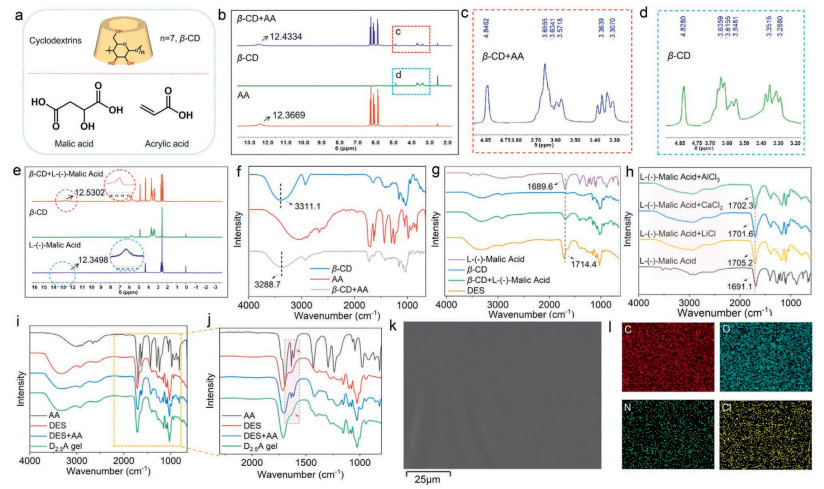
The intermolecular interactions within the gel matrix were verified by 1H NMR and ATR-FTIR. β-CD features a hydrophobic cavity (Fig. 1a) where H-3 and H-5 protons face inward, and H-1, H-2, H-4 remain on the hydrophilic exterior [18]. Upon inclusion of guest molecules, these protons exhibit characteristic chemical shift variations. As shown in Figs. 1b-d, the 1H NMR spectra of β-CD, AA, and their mixture reveal distinct downfield shifts of H-3 and H-5 (Table S1 in Supporting information), confirming β-CD/AA host–guest complexation [18]. DFT-optimized geometries further support this inclusion behavior (Fig. S1 in Supporting information). The downfield shift of the carboxylic proton also suggests hydrogen bonding between the carboxyl group of AA and the hydroxyls of β-CD. The ATR-FTIR spectrum (Fig. 1f) reveals a redshift of the -OH stretching band upon mixing β-CD with AA, confirming the coexistence of hydrogen-bonding and host-guest interactions. Fig. 1e illustrates that upon mixing β-CD with L-(-)-malic acid, the carboxylic proton undergoes a downfield shift, indicating hydrogen-bond formation. Fig. 1g compares the ATR-FTIR spectra of β-CD, L-(-)-malic acid, their mixture, and the β-CD/L-(-)-malic acid DES (prepared with trace water). While the direct mixture shows minimal spectral changes, the formation of DES induces distinct peak shifts: the C═O band of L-(-)-malic acid shifts from 1689.6 cm−1 to 1714.4 cm−1, and the -OH band of β-CD moves to higher wavenumbers. This observation may be explained by the fact that the formation of hydrogen bonds between β-CD and L-(-)-malic acid, as well as the preparation of their supramolecular DESs, likely requires the mediation of water molecules and thermal activation. The interaction of L-(-)-malic acid with LiCl, CaCl2, and AlCl3, supported by theoretical calculations (Table S2 in Supporting information), also induce notable C═O stretching shifts (Fig. 1h and Figs. S2–S4 in Supporting information), confirming hydrogen bond formation between carboxyl groups and metal ions. These multiple dynamic non-covalent interactions form a robust yet reversible network, imparting strong mechanical performance, self-healing, and superior adhesion to diverse substrates. After gelation, the disappearance of C═C vibration peaks (1635.0 cm−1 and 1615.3 cm−1) indicated complete polymerization of AA (Figs. 1i and j). SEM (Fig. 1k) and elemental mapping (Fig. 1l) confirmed a dense and uniform structure, with LiCl homogeneously distributed throughout the gel. This well-organized non-covalent network provides a robust yet dynamic foundation for the outstanding mechanical adaptability, autonomous self-healing, and adhesion properties of the CML eutectogel, making it ideal for use in flexible sensing systems.
Figure 1
Figure 1.
(a) Structural formulas of β-cyclodextrin (β-CD), L-(-)-malic acid, and acrylic acid (AA). (b) 1H NMR spectra of β-CD, AA, β-CD+AA. (c, d) Partial magnifications of (b). (e) 1H NMR spectra of β-CD, L-(-)-malic acid, and their mixture. (f) ATR-IR spectra of β-CD, AA, β-CD+AA. (g) ATR-IR spectra of β-CD, L-(-)-malic acid, β-CD+L-(-)-malic acid, deep eutectic solvent (DES, β-CD/L-(-)-malic acid/H2O). (h) ATR-IR spectra of L-(-)-malic acid, L-(-)-malic acid+LiCl, L-(-)-malic acid+CaCl2, L-(-)-malic acid+AlCl3.(i) ATR-IR spectra of AA, DES (β-CD/L-(-)-malic acid/H2O), DES+AA, D2.5A eutectogel (DES/AA = 2.5/1, mass ratio). (j) Partial magnification of (i). (k) SEM image of the β-CD/L-(-)-malic acid/LiCl (CML) eutectogel surface. (l) Mapping images of C, O, N, and Cl elements of (i).
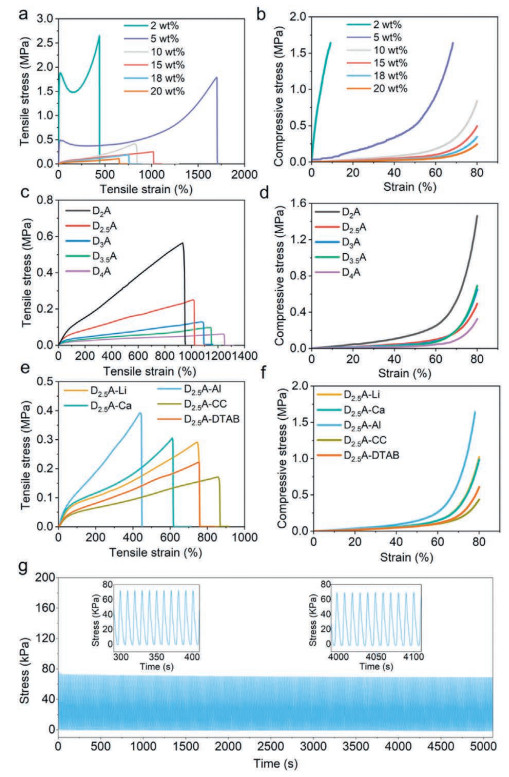
The mechanical properties of the CML eutectogel can be finely tuned by varying its composition, enabling a wide range of applicative possibilities. Detailed amounts of all components used for gel preparation are provided in Tables S3 and S4 (Supporting information). The photoinitiator Irgacure 2959 governs the polymerization initiation rate and monomer conversion efficiency. The crosslinker PEG200DA forms covalent junctions within the polymer matrix, and its concentration directly affects the crosslinking density, thereby influencing the gel's mechanical strength, elasticity, and toughness. Appropriate adjustment of these two components ensures uniform network formation and balanced mechanical performance. In this study, the concentrations of Irgacure 2959 and PEG200DA were consistently maintained at 0.3 wt% and 1.0 wt%, respectively, relative to the total monomer mass. Subsequently, the influence of the water content in the DES was investigated: Increasing water from 2 wt% to 20 wt% leads to a continuous decrease in Young's modulus from 39.35 MPa down to 0.04 MPa, while toughness first rises-reaching a maximum of 11.60 MJ/m3 at 5 wt% water-and then declines (Fig. 2a and Fig. S5a in Supporting information). This can be attributed to the fact that an appropriate amount of water molecules acts as a "regulator", enhancing their mobility, while simultaneously serving as a bridge to facilitate flexible hydrogen bonding interactions within the gel network. However, excessive water content weakens these interactions, leading to a looser gel network and a subsequent decline in toughness [19,20]. At low water content, the gel behaves as a rigid material (2.65 MPa tensile strength and 438.7% elongation at 2 wt% water), whereas above 10 wt%, it becomes highly soft and stretchable, with fracture elongation exceeding 1700% under optimal conditions. Compression tests further corroborate this softening trend, with stress at 80% strain dropping from 0.85 MPa to 0.25 MPa as water content increases from 10 wt% to 20 wt% (Fig. 2b). Varying the DES/AA mass ratio provides another effective tuning strategy. The mass ratios of DES to AA were set as 2/1, 2.5/1, 3/1, 3.5/1, and 4/1, and the corresponding eutectogels were named D2A, D2.5A, D3A, D3.5A, and D4A, respectively. Increasing the DES proportion enhances stretchability-elongation at break rises from 940% to 1240%, but reduces tensile strength and toughness due to a looser polymer network (Fig. 2c and Fig. S5b in Supporting information). In terms of compressive performance, when the DES/AA ratio increased from 2/1 to 4/1, the compressive stress at 80% strain decreased from 1.46 MPa to 0.33 MPa (Fig. 2d). A DES/AA ratio of 2.5 was selected for further studies as it offers a balanced combination of stretchability and strength. Metal salt incorporation further diversifies the mechanical behavior of the gels: Al3+ forms strong coordination with the polymer network [21], resulting in high stiffness and tensile strength but limited elongation, whereas D2.5A-Li gels exhibit superior toughness and extensibility. The D2.5A-Li gel, namely the CML eutectogel, was identified as the optimal system, exhibiting balanced mechanical performance suitable for flexible sensing (Figs. 2e and f, and Fig. S5c in Supporting information). 500-cyclic tensile tests confirm outstanding fatigue resistance and elastic recovery (Fig. 2g and Fig. S6 in Supporting information). This robust and adaptable mechanical performance underscores the potential of the CML eutectogel for use in durable and reliable flexible electronic devices.
Figure 2
Figure 2.
Mechanical properties. For eutectogels with different DES water contents: (a) Tensile stress-strain curves; (b) compressive stress-strain curves. For eutectogels with different DES/AA ratios: (c) Tensile stress-strain curves; (d) compressive stress-strain curves. For D2.5A-Li, D2.5A-Ca, D2.5A-Al, D2.5A-CC, D2.5A-DTAB: (e) Tensile stress-strain curves; (f) compressive stress-strain curves. (g) Stress of CML eutectogels during 500 consecutive loading-unloading cycles at 100% strain.
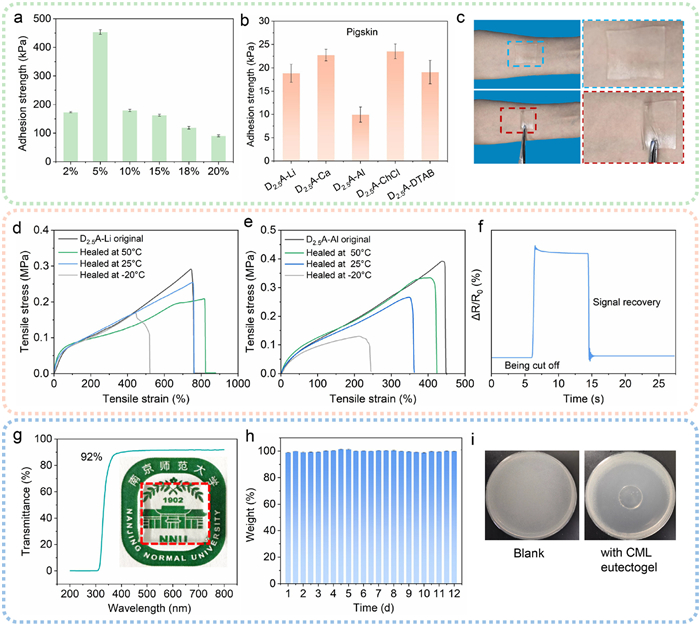
The CML eutectogel exhibits notable self-adhesive properties, allowing it to conform directly to diverse surfaces, including skin, glass, metal, rubber, and even polytetrafluoroethylene (PTFE), without requiring external adhesives (Fig. S7 in Supporting information). This intrinsic adhesion stems from abundant functional groups (such as carboxyl, hydroxyl, and ion pairs) in the polymer network, which facilitate multimodal interfacial interactions such as hydrogen bonding, metal coordination, and van der Waals forces (Fig. S8 in Supporting information). Adhesion strength was systematically evaluated via lap-shear tests (Fig. S9 in Supporting information). Initially, the influence of water content in the DES on adhesion performance (using copper as substrates) was investigated (Fig. 3a). As it increased from 2 wt% to 20 wt%, adhesion strength first increased, peaking at 453.6 kPa with 5 wt% water, and then decreased. This non-monotonic behavior reflects the competing effects of water-improving chain mobility and interfacial contact at moderate levels, but weakening internal cohesion when in excess [19–20,22–23]. The DES/AA ratio also influenced adhesion (Fig. S10 in Supporting information). Increasing the AA/DES ratio progressively improved adhesion strength; however, at high DES ratios (DES/AA > 2.5/1), the gel underwent cohesive failure within its bulk rather than interfacial detachment, as its intrinsic tensile strength was lower than the adhesion strength, resulting in central fracture with residual gel adhering to both substrates. When the AA/DES ratio reached 1/2.5, the gel's mechanical strength surpassed its adhesion strength, enabling complete interfacial detachment and accurate adhesion measurement. Then, when the AA/DES ratio was increased to 1/2, the adhesion strength hardly changed. Subsequently, the adhesion strength of five types of eutectic gels (D2.5A-Li, D2.5A-Ca, D2.5A-Al, D2.5A-CC, and D2.5A-DTAB) was evaluated on different substrates, including copper, glass, PVC, nitrile rubber, and pigskin (Fig. S11 in Supporting information). The results showed D2.5A-Al and D2.5A-Li showed strong adhesion to copper (~190 kPa), while D2.5A-Ca adhered best to glass (156 kPa). On biological surfaces such as pigskin, D2.5A-CC and D2.5A-Li exhibited moderate adhesion (18.85–23.54 kPa), sufficient for stable attachment yet gentle for painless removal (Figs. 3b and c). Notably, the eutectic gels demonstrated excellent reusability, with adhesion strength remaining almost unchanged after 10 cycles of detachment and reattachment (Fig. S12 in Supporting information). This can be attributed to the dynamic and reversible non-covalent interactions within the gel. When the CML eutectic gel adhered to rubber gloves or the skin surface, it conformed closely to the surface during multi-angle bending and stretching of the fingers, accurately reflecting the dynamic changes in finger movements. This outstanding mechanical compliance and appropriate adhesion strength are highly beneficial for precise motion detection and enhanced interface integration. The 90° peel test results of the gel's adhesion to arm skin indicated that gels with different added salts exhibited a certain degree of skin adhesion, slightly stronger than that of transparent adhesive tape and medical tape (Fig. S13 in Supporting information). The appropriate skin adhesion ensures that the bio-integrated gel sensor remains securely in place while being easily removed without causing discomfort or leaving any residues (Fig. 3c).
Figure 3
Figure 3.
(a) Adhesion strength of gels with different DES water contents on the copper sheet surface. (b) Adhesive strength of D2.5A-X eutectogels on pigskin surfaces (X = Li, Ca, Al, CC, and DTAB). (c) Pictures of gels before and after peeling off the skin surface. (d) Comparison of tensile strain-stress curves between the original D2.5A-Li eutectogel and those after 12 h self-healing at −20, 25, and 50 ℃. (e) Comparison of tensile strain-stress curves between the original D2.5A-Al eutectogel and those after 12-h self-healing at −20, 25, and 50 ℃. (f) Recovery of electrical signals in D2.5A-Li eutectogel after being cut and reconnected. (g) Transmittance of CML gel in the range of 200–800 nm. (h) Percentage mass change of CML eutectogel over time when stored in an ambient environment at room temperature for 12 days. (i) The antibacterial zones of Staphylococcus aureus without and with CML eutectogel placement.
The CML eutectogel demonstrates outstanding autonomous self-healing capability, a critical feature for enhancing the durability of flexible devices. This capability is facilitated by the dynamic host-guest complexes and reversible hydrogen-bonding networks within the material. After being severed into two pieces, the gel segments can spontaneously reintegrate upon contact without any external stimulus. To systematically evaluate its temperature-dependent healing performance, the eutectogel was precisely cut and rejoined under different temperature conditions, followed by mechanical testing. At room temperature (25 ℃), the D2.5A-Li gel achieves self-healing efficiencies of 96.8% in toughness and 87.1% in tensile strength. Impressively, even at a low temperature of −20 ℃, it still attains a strength recovery efficiency of 58.4% and can withstand stretching up to 450% elongation after healing (Figs. 3d and e). Another eutectogel system, D2.5A-Al, exhibits a similar ability to self-heal across a wide temperature range. After healing at −20 ℃, it shows an elongation at break of 214.3%, while at 50 ℃, its strength and toughness recovery efficiencies reach 85.1% and 89.4%, respectively. The self-healing efficiency increases with temperature, likely due to enhanced segmental mobility and accelerated dissociation–reconstruction of dynamic bonds at higher temperatures. The self-healing process is confirmed using dyed gel samples, which fuse into a unified piece within 5 min at room temperature and can subsequently bear substantial deformation recovering to its original state upon rejoining the cut interfaces (Fig. S14 in Supporting information). In addition to mechanical healing, the electrical self-healing performance was also investigated. Real-time monitoring indicates that the rejoined gel recovers nearly identical electrical signals as before cutting (Fig. 3f), confirming restoration of conductive pathways. And after self-healing at −20 ℃, the gel recovers 70.12% of its original conductivity (Fig. S15 in Supporting information). This reliable dual self-healing performance, encompassing both mechanical and electrical properties, ensures reliable operation and significantly extends the service life of devices incorporating this material.
The CML eutectogel integrates several essential auxiliary properties that enhance its suitability for practical applications. It exhibits high optical transparency (92% in the UV–vis range), enabling visual monitoring and compatibility with optoelectronic systems (Fig. 3g). The gel demonstrates outstanding thermal and environmental stability, with minimal mass loss (1.97 wt%) at 100.5 ℃ and no phase transitions observed between −60 ℃ and 60 ℃ (Fig. S16 in Supporting information), indicating a broad operational temperature window. Furthermore, it maintains excellent water retention, with mass retention of 100% ± 1.3% after 12 days under ambient conditions (25 ℃, 50% humidity), overcoming the dehydration issue common in conventional hydrogels (Fig. 3h). The material also exhibits remarkable puncture resistance, achieving a displacement of 36.6 mm when penetrated by a 1 mm needle, attributed to energy dissipation through its dynamic hydrogen-bonded and host-guest networks (Fig. S17 in Supporting information). Finally, the gel shows effective antibacterial activity against Staphylococcus aureus, owing to the presence of L-(-)-malic acid and LiCl (Fig. 3i). These combined properties, such as transparency, thermal stability, water retention, mechanical robustness, and antimicrobial function, make the CML eutectogel a comprehensive and reliable material platform for long-term wearable applications.
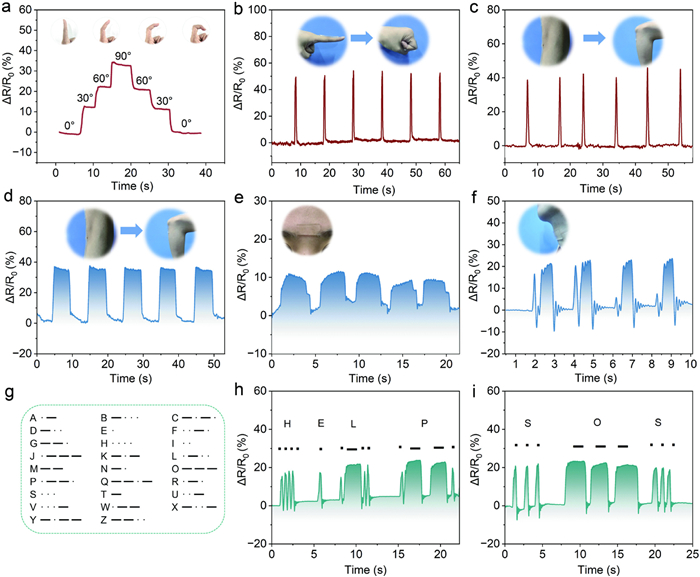
The CML eutectogel is designed to allow ions such as lithium ions and chloride ions, which can freely move within the material, to undergo directional migration under the influence of an electric field. This results in the formation of a stable ion flow system, endowing the material with significant ionic conductivity (Fig. S18a in Supporting information). Next, the strain sensing performance of the gel was evaluated. To assess the sensitivity of the strain sensor, real-time relative resistance changes over various strain ranges from 0 to 500% were monitored in a resistivity-based sensor. The Gauge factor (GF) was determined by fitting the ΔR/R0 curve, and linear regression analysis was used to assess the strain. As shown in Fig. S18b (Supporting information), three linear regions were observed in the ΔR/R0 curve during stretching, with GF values of 1.28 (for the 0%−50% strain range), 2.23 (for the 50%−200% strain range), and 3.31 (for the 200%−500% strain range), indicating that the eutectogel exhibits good sensitivity across the measured strain range. Cyclic tensile tests were performed at different strain levels (5%, 10%, 20%, 50%, 100%, and 200%), and the results showed obvious dynamic changes in the relative resistance (Figs. S18d-f in Supporting information). These changes were consistently observed at small strain ranges (2%, 5%), medium strain ranges (10%, 20%), and large strain ranges (50%, 100%, 200%). Stable electrical signals were obtained through multiple cycles of stretching. To evaluate the cycling stability of the strain sensor, the eutectogel strain sensor underwent 500 continuous cycles at 100% strain, with almost no signal degradation, indicating reliable and repeatable sensing performance (Fig. S18g in Supporting information). Furthermore, the gel sensor maintained fast, stable, and consistent signal output across various stretching rates (50, 100, 150, and 200 mm/min), indicating no rate-dependent behavior (Fig. S18c in Supporting information). These findings highlight the ability of the eutectogel sensor to effectively monitor strain of various magnitudes and at different rates, providing real-time, targeted feedback electrical signals. Based on CML eutectogel, we have successfully developed a wearable strain sensor with self-adhesive properties that can accurately monitor various human movements and the curvature of a sphere. As shown in Figs. 4a and b, the rectangular gel sensor can adhere firmly to the finger joint due to its self-adhesive ability, and it moves synchronously with the finger joint's movements, enabling effective monitoring of finger movements. The sensor demonstrates continuous and stable performance when detecting finger joint flexion. Similarly, when the sensor is applied to the elbow (Figs. 4c and d), it effectively detects elbow flexion motions. The sensor consistently provides accurate and stable electrical signals, whether the joint is moving quickly or held in a flexed position for a prolonged time Notably, when the finger is bent at various angles, such as 30°, 60°, and 90°, the CML eutectogel sensor shows a corresponding increase in relative resistance and outputs highly reproducible and stable electrical signals consistently outputs highly reproducible and stable electrical signals (Fig. 4a). Upon returning the finger to its straightened position, the relative resistance returns to its initial value. Remarkably, the high sensitivity of the CML eutectogel sensor enables it to be used on specific body parts to monitor subtle and complex movements, such as frowning (Fig. 4e) and swallowing (Fig. 4f). When precisely attached to the throat on a volunteer's body, the sensor can detect the subtle motion signals generated by swallowing, maintaining stable and continuous monitoring. These tiny motion signals are captured with high precision and repeatability by the CML eutectogel sensor. Collectively, these results demonstrate that the CML eutectogel sensor has excellent recognition capabilities and high reliability, making it well-suited for precise monitoring of fine human movements and providing a comprehensive and accurate solution for human motion detection.
Figure 4
Figure 4.
Application of CML gel as strain/pressure sensor. Large-scale human motion monitoring: (a) Finger bending at different angles, (b) finger clenching fist/straightening, (c) elbow bending/straightening, (d) elbow bending held for several seconds then straightening. Subtle human motion monitoring: (e) Frowning, (f) Swallowing. (g) Correspondence between Morse code and the 26 English letters. Information output via compression sensor: (h) "SOS", (i) "HELP".
In addition to monitoring human movement, this wearable sensor also has the ability to detect external pressure. When applying varying intensities of pressure to the CML eutectogel pressure sensor, the sensor generates signals with different amplitudes and frequency characteristics. Morse code, a well-established signaling system, uses a variety of dot and dash arrangements to represent the 26 letters of the alphabet (Fig. 4g). The CML eutectogel sensor can simulate dots and dashes by adjusting the duration of the applied pressure, thus encoding and transmitting specific words such as "SOS" and "HELP" (Figs. 4h and i). These experimental results strongly validate the exceptional performance and powerful capabilities of the CML eutectogel sensor for both human motion detection and information transmission, demonstrating its great potential and value in the field of wearable devices.
In the field of intelligent robotics, curvature monitoring provides "tactile perception" for flexible manipulators, enabling adaptive grasping of fragile or irregularly shaped objects such as biological tissues and precision components. This capability significantly enhances operational accuracy and reliability. Within chemical, energy, and related industries, monitoring subtle deformations of curved surfaces (mechanical parts, spherical pressure vessels, pipelines, etc.) holds critical importance for early fault warning and ensuring safe, stable operations. The CML eutectogel further demonstrates its potential for real-time curvature sensing. This capability was illustrated using an inflatable balloon as a model substrate. During both inflation and deflation, the sensor generated highly responsive and reproducible resistance signals that directly correlated with the changing curvature (Figs. S19a and b in Supporting information). A stable linear relationship was established between the relative resistance change and surface curvature (Fig. S19c in Supporting information), enabling precise real-time curvature tracking. The validity of this model was further confirmed by the close agreement between the curvature values derived from the sensor and those measured physically during deflation (Fig. S19d in Supporting information).
Beyond sensing, the gel also exhibits exceptional sealing performance. When applied over a puncture on the same balloon, it effectively contained the internal pressure without detachment during inflation (Fig. S19e in Supporting information). The sealing reliability was further evidenced over the long term, as the sealed balloon maintained its radius without noticeable leakage for 10 days (Fig. S19f in Supporting information). These combined capabilities, high-fidelity curvature monitoring and excellent air-tight adhesion, highlight the potential of CML eutectogels in advanced applications such as adaptive robotic grasping, inflatable structure monitoring, and functional surface integration.
In the temperature-sensing gel system, freely movable ions such as lithium and chloride ions undergo directional migration under the influence of an electric field, thereby establishing a stable ion flow system. When the ambient temperature rises, the migration speed of the ions within the gel increases, resulting in a decrease in the gel's electrical resistance, which serves as a key indicator of temperature changes. Compared to electrons in traditional electronic conductive materials like metals, ions exhibit superior sensitivity and responsiveness to minute temperature fluctuations [24]. Based on this principle, the temperature-sensing gel can immediately and accurately reflect temperature fluctuations in the monitored area through dynamic changes in its electrical resistance. Across the biologically critical range of 34–42 ℃, the gel exhibits a linear resistance response with a high temperature coefficient of resistance (TCR) of –2.37%/℃ (R2 = 0.998), as shown in Fig. S20a (Supporting information). This sensitive and linear behavior enables precise monitoring of temperature variations in this range. Furthermore, the sensor demonstrates excellent signal stability over eight repeated heating–cooling cycles between 34 ℃ and 42 ℃ (Fig. S20b in Supporting information), confirming its reliability for continuous temperature sensing applications such as wearable health monitoring and electronic skin.
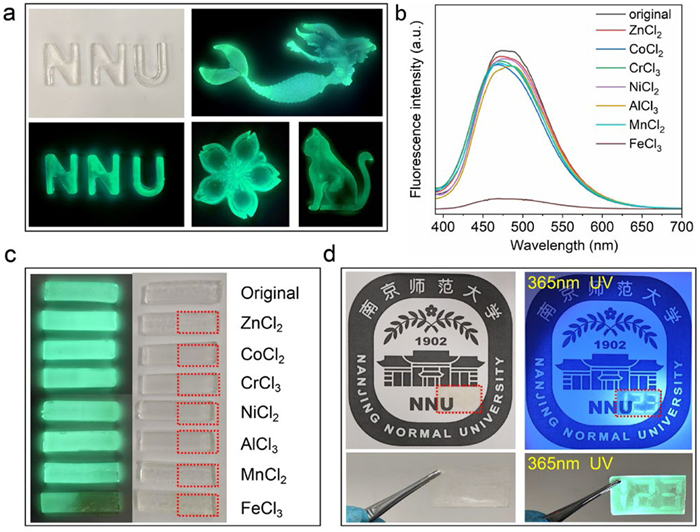
Intelligent fluorescent gels, which change color in response to external stimuli, have gained significant attention in the context of increasing data security threats and counterfeiting [25–31]. These gels offer advantages such as invisibility under visible light, ease of handling, and high information confidentiality. However, they often require complex design and organic synthesis, and suffer from limitations such as irreversible writing and insufficient adhesion. Therefore, we have also investigated the fluorescence properties of CML eutectogels, which exhibit excellent self-healing and self-adhesion capabilities. Under 365 nm UV irradiation, the CML eutectogel exhibits intense blue-green fluorescence due to the aggregation-induced emission of confined carbonyl groups, where restricted molecular mobility caused by entangled polymer chains suppresses non-radiative decay pathways and enhances radiative transitions [32]. As shown in Fig. 5a, due to its excellent processability, the CML eutectogel can be molded into various complex shapes and patterns. The gel's fluorescence quenching effect was evaluated by applying ethanol/water mixed solutions of various metal ions onto the gel surface (marked by a red-dashed rectangle in Fig. 5c). The quenching effects of different metal ions on the fluorescence of the gel were investigated. Among the metal ions tested, including Fe3+, Al3+, Co2+, Cr3+, Ni2+, Mn2+, Ca2+, and Zn2+, only Fe3+ exhibited a significant quenching effect (Figs. 5b and c). To elucidate the quenching mechanism, XPS (Fig. S21 in Supporting information) and time-resolved fluorescence decay measurements (Fig. S22 and Table S5 in Supporting information) were performed on the CML eutectogel before and after Fe3+ treatment. The C 1s spectrum of the pristine gel shows peaks at 284.8, 286.3, and 288.7 eV, corresponding to C–C, C–O, and O–C═O groups. After Fe3+ exposure, these peaks shift slightly to 284.8, 286.5, and 288.8 eV, indicating a decrease in electron density around the carbonyl groups. Similarly, the O 1s spectrum evolves from two components at 532.3 and 533.2 eV to three peaks at 530.2, 532.3, and 533.4 eV. The new low-binding-energy component at 530.2 eV, together with the appearance of Fe 2p3/2 and 2p1/2 peaks at 712.2/725.6 eV and their satellite peaks at 718.2/731.5 eV, confirms the formation of Fe–O coordination bonds between Fe3+ and the gel network. Time-resolved fluorescence decay was further employed to investigate the quenching mechanism (Fig. S22 and Table S5 in Supporting information). The pristine gel exhibits a biexponential decay with lifetimes of τ1 = 1.38 ns and τ2 = 4.58 ns. After Fe3+ treatment, the lifetimes are τ1 = 1.21 ns and τ2 = 4.55 ns, showing almost no variation. This indicates that the quenching is primarily attributed to static quenching induced by Fe3+–carbonyl coordination. The ion-specific response highlights the potential of CML eutectogels as tunable optical sensors for Fe3+ detection in environmental or biomedical applications, leveraging their tunable photophysical behavior modulated by Fe3+–carbonyl interactions. By utilizing the quenching effect of Fe3+, the fluorescence of any area of the gel can be quenched, thereby displaying information hidden under normal light under 365 nm ultraviolet light (Fig. 5d).
Figure 5
Figure 5.
Fluorescence properties and applications of CML eutectogel. (a) Fluorescent pattern "NNU" and imaging of different fluorescent patterns. (b) Original fluorescence intensity of CML gel and after surface coating with Fe3+, Al3+, Co2+, Cr3+, Ni2+, Mn2+, Ca2+, Zn2+. (c) Photos of original CML eutectogel and samples coated with Fe3+, Al3+, Co2+, Cr3+, Ni2+, Mn2+, Ca2+, Zn2+ under natural light and 365 nm UV light. (d) CML gel coated with Fe3+ displaying hidden information "1, 2, 3" under 365 nm UV light.
In summary, by molecularly blending the host-guest DES with type Ⅳ DES, we have developed a multifunctional eutectogel. This multi-network design confers a unique combination of broadly tunable mechanical properties (Young's modulus: 0.04–39.35 MPa, elongation at break: 442%–1703%), autonomous self-healing across a wide temperature range (−20 ℃ to 50 ℃), strong yet reversible adhesion (up to 453.6 kPa), and stable ionic conductivity. By varying the water content, DES/AA ratio, and type of metal salt, the gel's mechanical, adhesive, and electrical characteristics can be precisely tailored. The optimized CML gel also exhibits high fatigue resistance (88.3% strength retention after 500 cycles), excellent water retention, optical transparency, puncture resistance, and inherent antibacterial activity. These integrated properties enable its successful use in high-performance flexible sensors for monitoring human motion, from subtle gestures to joint movements, as well as in spherical curvature detection, pressure-driven Morse code communication, temperature sensing, and fluorescence-based information encryption. This work demonstrates a versatile and sustainable material platform suitable for next-generation wearable electronics, soft robotics, and anti-counterfeiting systems.
The authors declare that they have no known competing financial interests or personal relationships that could have appeared to influence the work reported in this paper.
Acknowledgments
This research was supported by the National Natural Science Foundation of China (No. 52075264), the Priority Academic Program Development of Jiangsu Higher Education Institutions, Jiangsu Collaborative Innovation Center of Biomedical Functional Materials, and Postgraduate Research & Practice Innovation Program of Jiangsu Province.
Supplementary materials
Supplementary material associated with this article can be found, in the online version, at doi:10.1016/j.cclet.2025.112342.
[1]
W.W. Li, L.Y. Kong, M.Z. Xu, et al., Research 7 (2024) 0452. doi: 10.34133/research.0452
H.X. Xu, Y. Tan, D. Wang, et al., Soft Matter 15 (2019) 3588–3594. doi: 10.1039/c9sm00034h
Figure 1
(a) Structural formulas of β-cyclodextrin (β-CD), L-(-)-malic acid, and acrylic acid (AA). (b) 1H NMR spectra of β-CD, AA, β-CD+AA. (c, d) Partial magnifications of (b). (e) 1H NMR spectra of β-CD, L-(-)-malic acid, and their mixture. (f) ATR-IR spectra of β-CD, AA, β-CD+AA. (g) ATR-IR spectra of β-CD, L-(-)-malic acid, β-CD+L-(-)-malic acid, deep eutectic solvent (DES, β-CD/L-(-)-malic acid/H2O). (h) ATR-IR spectra of L-(-)-malic acid, L-(-)-malic acid+LiCl, L-(-)-malic acid+CaCl2, L-(-)-malic acid+AlCl3.(i) ATR-IR spectra of AA, DES (β-CD/L-(-)-malic acid/H2O), DES+AA, D2.5A eutectogel (DES/AA = 2.5/1, mass ratio). (j) Partial magnification of (i). (k) SEM image of the β-CD/L-(-)-malic acid/LiCl (CML) eutectogel surface. (l) Mapping images of C, O, N, and Cl elements of (i).
Figure 2
Mechanical properties. For eutectogels with different DES water contents: (a) Tensile stress-strain curves; (b) compressive stress-strain curves. For eutectogels with different DES/AA ratios: (c) Tensile stress-strain curves; (d) compressive stress-strain curves. For D2.5A-Li, D2.5A-Ca, D2.5A-Al, D2.5A-CC, D2.5A-DTAB: (e) Tensile stress-strain curves; (f) compressive stress-strain curves. (g) Stress of CML eutectogels during 500 consecutive loading-unloading cycles at 100% strain.
Figure 3
(a) Adhesion strength of gels with different DES water contents on the copper sheet surface. (b) Adhesive strength of D2.5A-X eutectogels on pigskin surfaces (X = Li, Ca, Al, CC, and DTAB). (c) Pictures of gels before and after peeling off the skin surface. (d) Comparison of tensile strain-stress curves between the original D2.5A-Li eutectogel and those after 12 h self-healing at −20, 25, and 50 ℃. (e) Comparison of tensile strain-stress curves between the original D2.5A-Al eutectogel and those after 12-h self-healing at −20, 25, and 50 ℃. (f) Recovery of electrical signals in D2.5A-Li eutectogel after being cut and reconnected. (g) Transmittance of CML gel in the range of 200–800 nm. (h) Percentage mass change of CML eutectogel over time when stored in an ambient environment at room temperature for 12 days. (i) The antibacterial zones of Staphylococcus aureus without and with CML eutectogel placement.
Figure 4
Application of CML gel as strain/pressure sensor. Large-scale human motion monitoring: (a) Finger bending at different angles, (b) finger clenching fist/straightening, (c) elbow bending/straightening, (d) elbow bending held for several seconds then straightening. Subtle human motion monitoring: (e) Frowning, (f) Swallowing. (g) Correspondence between Morse code and the 26 English letters. Information output via compression sensor: (h) "SOS", (i) "HELP".
Figure 5
Fluorescence properties and applications of CML eutectogel. (a) Fluorescent pattern "NNU" and imaging of different fluorescent patterns. (b) Original fluorescence intensity of CML gel and after surface coating with Fe3+, Al3+, Co2+, Cr3+, Ni2+, Mn2+, Ca2+, Zn2+. (c) Photos of original CML eutectogel and samples coated with Fe3+, Al3+, Co2+, Cr3+, Ni2+, Mn2+, Ca2+, Zn2+ under natural light and 365 nm UV light. (d) CML gel coated with Fe3+ displaying hidden information "1, 2, 3" under 365 nm UV light.


 DownLoad:

 下载:


 下载:

