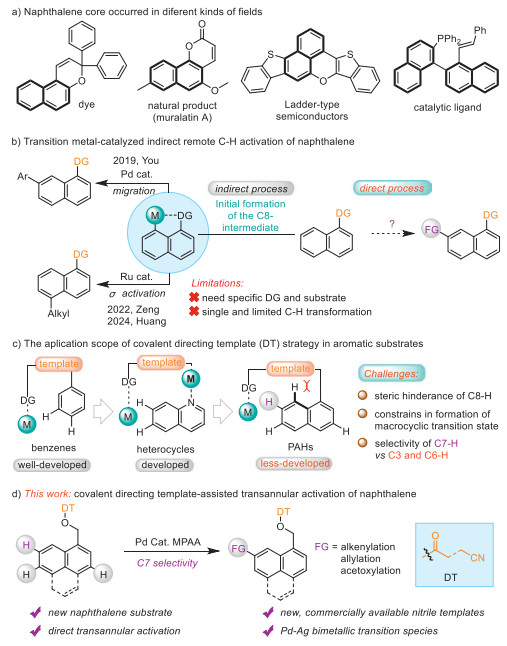
Figure 1.
Transition metal-catalyzed transannular C–H functionalization of PAHs.

Transannular C–H functionalizations of polycyclic aromatic compounds by covalently attached directing groups strategy
Yujian Mao , Xiaoting Song , Dandan Yuan , Yaoyu Lin , Junkai You , Yinan Zhang


Polycyclic aromatic hydrocarbons (PAHs) have garnered increasing attention due to their unique structural characteristics and extended aromatic properties [1–3]. Taking naphthalene as an example, the simplest polycyclic aromatic ring system has been widely used to design functional molecules, including industrial chemicals, pharmaceuticals, and electronic materials (Fig. 1a) [4–6]. Recently, benefiting from C–H activation that represents a powerful editing tool for inert C–H bonds, great progress has been achieved in proximal (C2 and C8) C(sp2)–H functionalization of representative naphthalene [7–23]. For example, our group provides a series of synthetic solutions on hydroxylation [15], methylation [17], and alkylation [22,23], as well as their application in access to polycyclic aromatic natural products [24,25]. Nevertheless, manipulating the site-selective cleavage of distal C–H bonds in PAHs is still under-explored, probably due to current fixed activation models that kinetically and thermodynamically favors to form small-metallacycle transition states.
Remote (meta- and para-positions) C–H activation can overcome inherent spatial or electronic biases, facilitating the rapid synthesis of high-value complex molecules from simple arenes [26–28]. Guided by this concept, the single-electron-transfer process [29–34] and palladium/norbornene cooperative catalysis [27] were successfully introduced to the naphthalene ring and advanced the homoannular C3- and C4-H functionalization. Comparatively, it remains a persistent challenge to achieve transcyclic C5-, C6- and C7–H functionalization in the presence of competitive homoannular C–H sites. Until 2019, You group first developed an amide-directed C7-aryaltion with aromatic boric acids via C8-palladation/aryl-migration [35]. Later, selective alkylation of the C5-H bond by using a PAr3(Ⅲ)/COOH-directed Ru-catalyzed σ-activation process was reported by the Zeng [36] and Huang [37] groups, respectively. As the rare examples in transannular C–H functionalization, the strategies relied on the initial formation of C8-metalation intermediates for limited C–H transformations (Fig. 1b). The strategy of covalently attached directing groups has been designed for directly targeting remote C–H bonds in benzenes [38–45]. It was next proved feasible in the heteroannular C–H activation of quinoline via a non-covalent N-Pd coordination [46–49]. However, naphthalene and other PAHs were neglect in the substrate exploration of these pioneer examples (Fig. 1c). We believed the asymmetric geometry and uneven electronic property of naphthalene ring lead to considerable difficulties in realizing reactivity and controlling selectivity. In the preparation of our submission, another C7‒H functionalization study on naphthalene ring that conbined naphthylacetic acid substrates and cyclohexyl nitrile/pyridyl moiety to control regioselectivity was disclosed by Yu group [50]. Despite the advantages of rigid nitrile templates in controlling selectivity, their implementation necessitates meticulous design. Adjusting the position of the rigid motif in the covalent template, coupling with simple and flexible nitrile units, may bring a more efficient attainment of the target molecules. Thus, we herein disclosed the direct transannular C–H functionalizations on the untapped but easily-parepared (1-naphthyl)methanol substrates at mild conditions, which enables diverse C7-H transformations across a broad scope of PAHs, from naphthalene to pyrene, by the new and feasible nitrile templates. Moreover, our detailed mechanistic study illustrated why silver salt could promote the catalytic efficiency and improve regioselectivity (Fig. 1d).
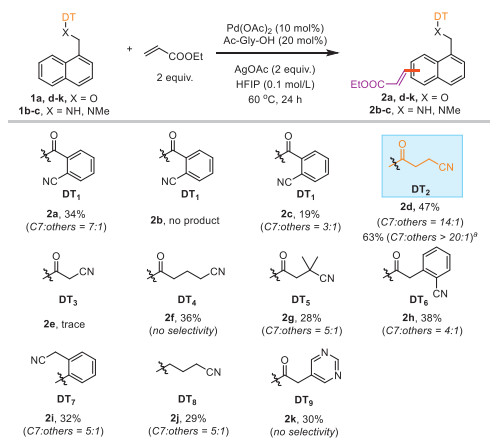
In previous reported examples, most directing templates (DTs) with proximal steric hindrance cannot consist in a favorable conformation for transannular C–H activation in naphthalene (Scheme S1 in Supporting information). We envisioned that methyl naphthalene scaffold may bypass the C8-H hindrance to reach the heteroannular site by a rotatable C(Ar)-C(Me) bond. Therefore, we began our investigation by screening DTs with a terminal nitrile group (1a-k) in hexafluoropropan-2-ol (HFIP) at 60 ℃, using ethyl acrylate as a coupling reagent, 10% Pd(OAc)2 as a catalyst, 20% N-Ac-Gly-OH as a ligand, and 2 equiv. of AgOAc as an oxidant (Scheme 1). As expected, a C7-alkenylated product 2a was detected in a 34% yield with good regioselectivity (C7:others = 7:1). While the production and selectivity were all decreased when changing to amide linker (1b-c), probably because the unexpected coordination of amide group to palladium [51]. To further improve the reactivity, ester-based DTs containing different chain and length (DT2–6) were examined. The results showed that flexible nitrile template DT2 gave the best yield and regioselectivity (C7:others = 14:1). Notably, compared with previous exquisite DT for remote functionalization, DT2 is commercially available. When ether linkers (DT8–9) were used, an obvious decline in production and selectivity was observed, suggesting that the rigid skeleton of the ester is critical for directing to the heteroannular remote C–H site. In addition, other common coordination terminal, such as pyrimidine (DT9) provided mixture alkenylated products. Next, we investigated different ligands to improve the reaction efficiency. The α-methyl substituted mono-protective amino acid N-Ac-Ala-OH (L14) was found optimal in the process and afforded the product in 50% yield [52]. Screening of oxidants showed that only Ag salts gave satisfying results with the best performance of AgOAc. A mixed solvent of HFIP/CHCl3 (2/1) also proved to be beneficial to further improve the yield with excellent regioselectivity (C7:others = 19:1). However, the acid and base additives had negative effects on the reactivity. Further assessment of temperature and time determined that the reaction give better results at 40 ℃ with extended reaction time (63%, C7:others > 20:1) (detailed information see Tables S1-S9 in Supporting information).
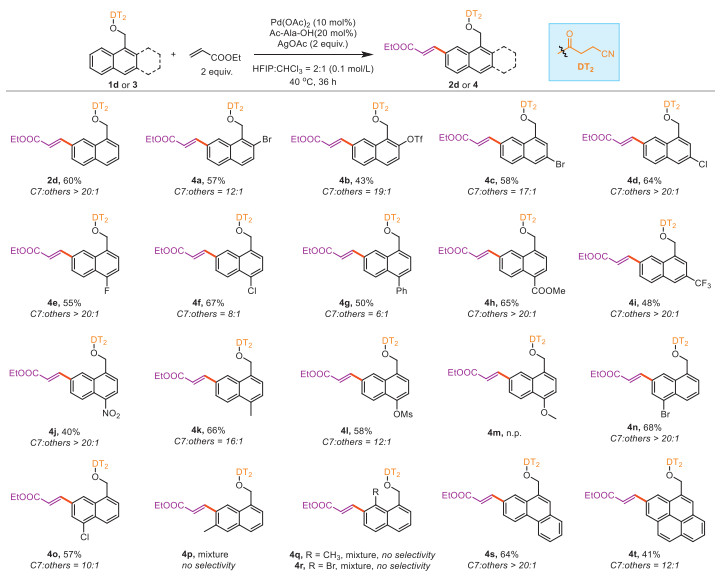
With the optimized reaction conditions in hand, we investigate the scope of the C7-H alkenylations (Scheme 2). By the treatment of ethyl acrylate as a coupling partner, different substituted naphthalenes bearing electron-neutral, -donating and -withdrawing groups smoothly transformed to the desired products in moderate yields with high C7-selectivity. Electron-neutral and withdrawing groups, such as halogen, phenyl, ester (3h), trifluoromethyl (3i), and even potential coordinated nitro group (3j) [53], were all tolerated. Although moderate electron-donating group (methyl, 3k) had little impact on the production and regioselectivity, strong electron-rich substrate (methoxy, 3m) exhibited an inhibitory reactivity. In addition, sensitive functional groups with the risk of Heck-type reaction, such as Br (3a, 3c, and 3n), OTf (3b) and OMs (3l), were also compatible in our reaction system. Unfortunately, the alkenyl group cannot be installed on the substrates with occupied neighbor sites (3p-r), which suggests that the remote control was greatly determined by the spatial interference. Notably, our condition was also amenable to the hyper-PAHs, such as phenanthrene (3s) and pyrene (3t).
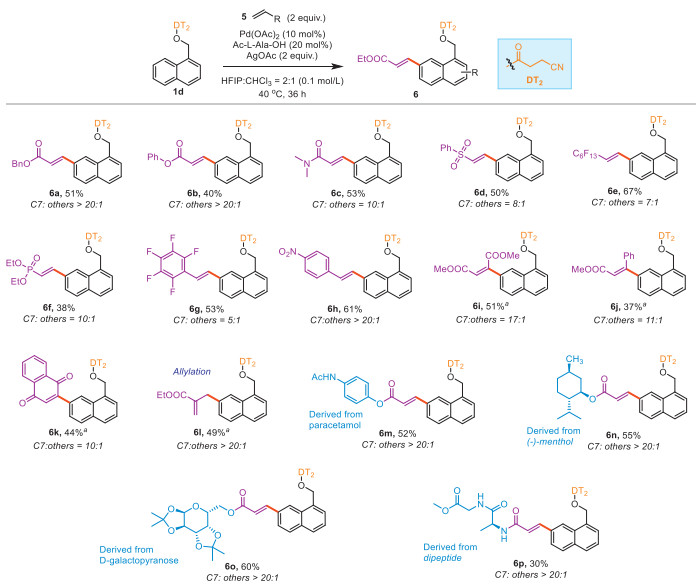
Different kinds of electron-deficient alkenes were further evaluated at the optimal condition (Scheme 3). Mono-substituted olefins, such as acrylates (5a-b), acrylamide (5c), alkenyl sulfone (5d), polyfluorosubstituted alkene (5e), diethyl vinylphosphonate (5f), and substituted styrene (5g-h), smoothly delivered corresponding products with high C7-selectivity. For di-substituted olefins, such as methyl fumarate (5i) and methyl trans-cinnamate (5j), elevated reaction temperature was need to overcome the additional steric hindrance. Naphthoquinone (5k) that widely occurred in natural products [54] also worked for the C7-installment of naphthalene in a one-step procedure. Surprisingly, ethyl methacrylate (5l) afforded allylated product (6l) in 49% yield via a selective elimination of β-H at methyl group. Besides, natural product- or drug-derived alkenes (5m-p), such as paracetamol, (-)-menthol, d-galactopyranose, and dipeptide, were also compatible to our reaction system with excellent regioselectivity.
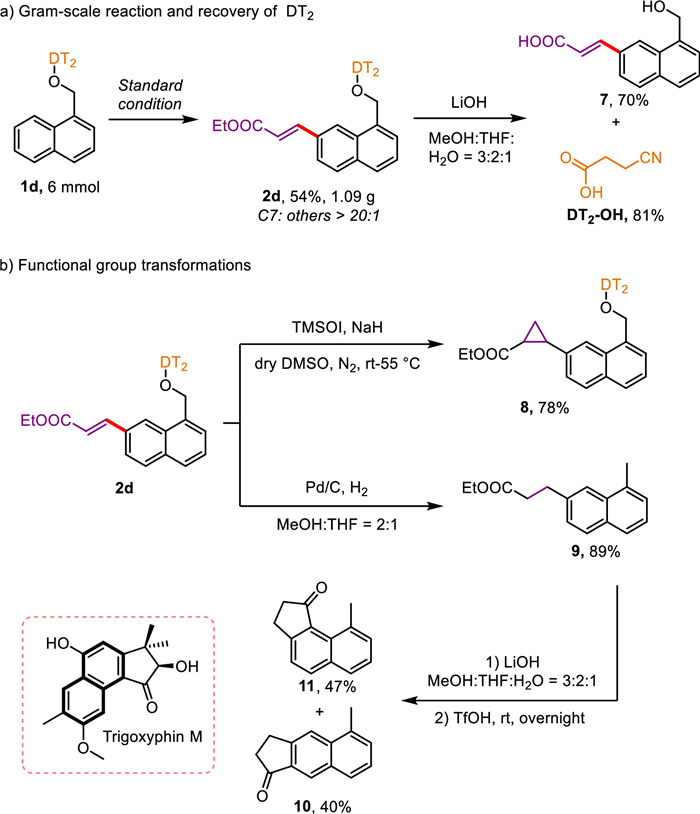
To illustrate the practicality of our selective alkenylation, a gram-scaled reaction of 1d was conducted at the standard condition (Scheme 4a). The desired C7-alkenylated naphthalene was obtained in a similar production with reproducible regioselectivity. Subsequent hydrolysis of 2d under basic condition gave 1-naphthyl methanol in a 70% yield, accompanied by 81% recovery of DT material 3-cyanopropionic acid. Additionally, cyclopropanation and hydrogenation were performed with 2d to yield compounds 8 and 9, the latter of which underwent Friedel-Crafts acylation to give indanones 10 and 11 bearing the bioactive natural skeleton (Scheme 4b) [55].
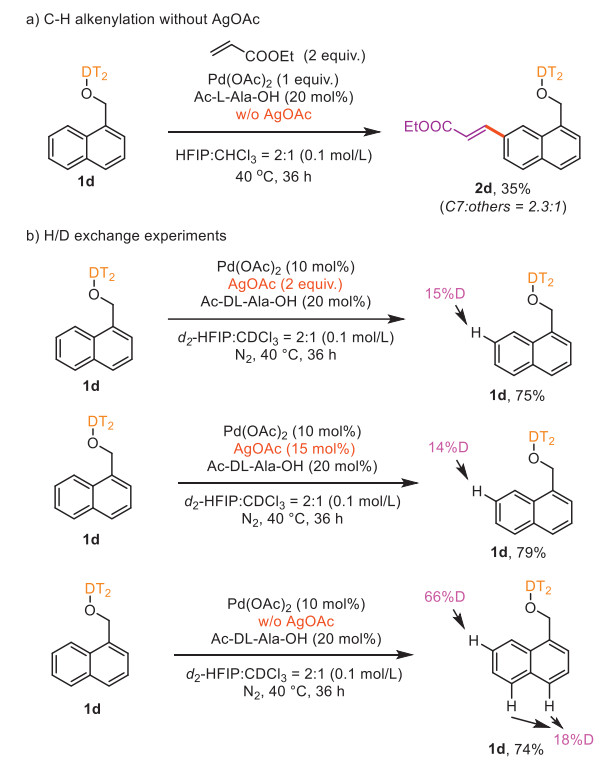
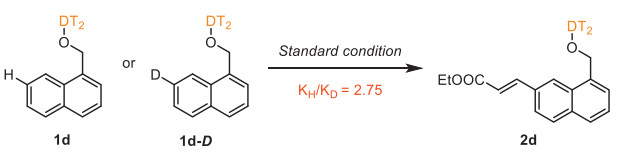
In order to clarify the mechanistic details, a series of control experiments were carried out (Scheme 5). It was demonstrated that Ag salts played crucial roles in reported DT-controlled remote C–H alkenylations, in which the active heterodimer PdAg(OAc)3 was proposed to formed in situ and promote C–H activation [56–58]. However, the catalytic process was merely supported by density functional theory (DFT) studies. Considering the significant involvement of Ag salts during the screen of oxidants, we surmised that Ag-assisted C–H activation was also present in our condition. To examine this hypothesis, the alkenylation was performed by using 1 equiv. of Pd(OAc)2 in the absence of AgOAc (Scheme 5a). An obvious decrease in yield and regioselectivity indicated that AgOAc did not work solely as an oxidant for regenerating the Pd(Ⅱ) species. To confirm the role of AgOAc, H/D exchange experiments were subsequently carried out (Scheme 5b). Expectedly, selective deuteration occurred at the C7-site when equivalent or catalytic amount of Ag salt was added, but diminished without the addition of AgOAc. Furthermore, the intermolecular kinetic isotope effect (KIE) was measured as 2.75 in parallel reactions of 1d and 1d-D, demonstrating that the cleavage of C7-H bond might be involved in the rate-determining step (Scheme 6). These results indicated that AgOAc indeed participated in the C–H activation step as co-catalyst and was responsible for the enhancement of reactivity and regioselectivity.
To clarify how AgOAc promotes the reactivity and selectivity, we initially calculated the energy barriers of the C7-H activation of naphthalene catalyzed by previously reported Pd–Ag bimetallic catalyst formed in situ from Ac-Ala-OH, Pd3(OAc)6 and Ag2(OAc)2 using density functional theory (DFT) [56–58]. The five possible transition states with different bridging and deprotonation ligands were investigated (Fig. S1a in Supporting information). Compared to TS1-A1 (ΔΔG‡ = 4.7 kcal/mol), Ac-Ala-OH, as either a bridging ligand (TS1-A2) or a deprotonation ligand (TS1-A4), effectively diminished the activation energy for inserting into the C7–H bond. When coupled with two molecules of Ac-Ala-OH ligand (TS1-A3 and TS1-A5), the energy barrier can further reduce (ΔΔG‡ = 0.3, 0 kcal/mol), giving the promising transition state. To determine TS1-A5 was possible for selectivity, the free energy calculations of corresponding C3-H positions were continued (Fig. S1b in Supporting information). It was found that the C3–H activation of TS1-A5-C3 (ΔΔG‡ = 2.2 kcal/mol) via a concerted metalation–deprotonation required more energy than that of TS1-A5 (ΔΔG‡ = 0 kcal/mol), which indicating that Ac-Ala-OH acted as the bridging and deprotonation ligand in the real selective C–H activation process.
Next, we performed the DFT analysis of the entire C7-H activation on naphthalene (Fig. S2a in Supporting information). The active Pd–Ag hetero-bimetallic intermediate reacted with substrate 1d and two molecules of Ac-Ala-OH, which afforded int1 by the removal of two acetic acids. Subsequently, C7-H bond of 1d was preferentially cleaved via a concerted metalation-deprotonation mechanism (TS1-A5), generating the macrocyclophane palladium intermediate int2. This process was endothermic by 7.1 kcal/mol with an energy barrier of 17.9 kcal/mol. Further ligand-exchange with ethyl acrylate to form int3. The syn-insertion of C(Ar)-Pd bond into alkene via TS2 (ΔG‡ = 5.8 kcal/mol) yielded int4 in a low-energy state. Finally, the conversion of int4 to int5 resulted in a favourable conformation for syn-β-hydride elimination via TS3, affording the complex int6 by overcoming a barrier of 17.6 kcal/mol. Overall, this process demonstrated that the proposed regioselective alkenylation catalyzed by a Pd-Ag hetero-bimetallic species is feasible under experimental conditions. The pathways involving the solely Pd-catalyzed C7-H activation (TS1-Pd) were also investigated. The requirement of high energy barrier (ΔG‡ = 30.1 kcal/mol) in this pathway illustrated that the Pd-Ag bimetallacycle was preferable to drive the catalytic cycle. Strikingly, the Pd-Ag intermediates were captured by HR-MS in the reaction mixture with equivalent palladium and silver species (Fig. S2b in Supporting information). While the silver salt promoted the reaction as the co-catalyst, its primary role of serving as a terminal oxidant to re-oxidize Pd(0) to Pd(Ⅱ) was indispensable for sustaining the catalytic cycle.
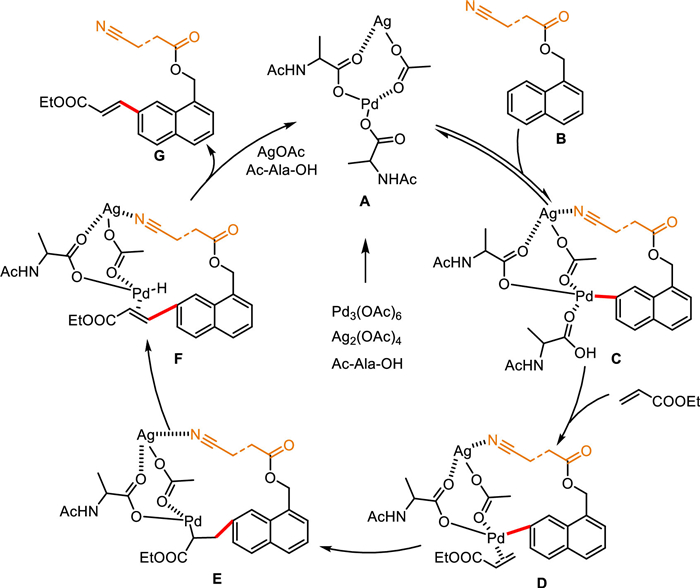
Based on these mechanistic evidences and previous reports [56–58], a Pd–Ag bimetallic catalyzed transannular C–H functionalization of naphthalene was proposed (Scheme 7). First, the active Pd–Ag bimetallic intermediate A promoted the cleavage of C7–H bond in naphthyl substrate B, yielding the macrocyclophane intermediate C. Subsequent ligand exchange converted C to D, which underwent the syn-insertion of C(Ar)–Pd bond into alkene to afford the intermediate E. The β-hydride elimination gave the complex F, which was finally dissociated to yield C7-alkenylated product G as well as releasing a Pd(0) species. Silver oxidation of Pd(0) to Pd(Ⅱ) regenerated the active catalyst A for the next catalytic cycle. Notably, the transcyclic activation model can also been applied to the acetoxylation of the C7–H bond by a similar directing template TD6, affording diverse naphthol derivatives in moderate yields with good functional compatibility (Scheme S2, detailed optimizations see Table S10-S14 in Supportitng information).
In conclusion, we have achieved the direct heteroannular remote C–H functionalization of PAHs using the new and feasible transannular nitrile templates. In this practical protocol, diverse functional groups including alkenyl, allyl, and acetoxy group can be installed at the C7 position. Mechanistic studies revealed that silver salt was involved in the Pd–Ag catalytic intermediate and stabilized the macrocyclic transition state for C–H insertion, enabling high regioselectivity and robust reactivity of transannular C–H activation in PAHs. This approach will facilitate the expansion of chemical space in complex aromatic rings in natural product chemistry and medicinal chemistry by strategy of covalently attached directing groups.
Yujian Mao: Writing – original draft, Methodology, Conceptualization. Xiaoting Song: Methodology, Investigation. Dandan Yuan: Validation, Investigation, Formal analysis. Yaoyu Lin: Methodology. Junkai You: Visualization, Validation. Yinan Zhang: Writing – review & editing, Supervision, Project administration, Conceptualization.
The authors declare that they have no known competing financial interests or personal relationships that could have appeared to influence the work reported in this paper.
This work was supported by the National Natural Science Foundation of China (No. 22177052, YZ), the Project of Institute of Chinese Medicine of Nanjing University and Aid Project of Nanjing Drum Tower Hospital Health, Education & Research Foundation (No. ICM2024008, YZ), Open Project of Chinese Materia Medica First-Class Discipline of Nanjing University of Chinese Medicine (No. ZYXYL2024-007, YZ), and University Distinguished Professor Research funding of Nanjing University of Chinese Medicine (No. 013038030002, YM).
Supplementary material associated with this article can be found, in the online version, at doi:
Y.J. Mao, X.T. Song, W.W. Xu, et al., Nat. Prod. Rep. 42 (2025) 1946–1989. doi: 10.1039/d5np00032g
C.C. Liu, Y. Ni, X.F. Lu, et al., Acc. Chem. Res. 52 (2019) 2309–2321. doi: 10.1021/acs.accounts.9b00257
W.E. Acree, S.A. Tucker, J.C. Fetzer, Poly. Arom. Comp. 2 (1991) 75–105. doi: 10.1080/10406639108048933
X. Ma, J. Wang, H. Tian, Acc. Chem. Res. 52 (2019) 738–748. doi: 10.1021/acs.accounts.8b00620
L.A.M. Murray, S.M.K. McKinnie, B.S. Moore, J.H. George, Nat. Prod. Rep. 37 (2020) 1334–1366. doi: 10.1039/d0np00018c
Y.D. Yang, Y.M. Wu, Z.Y. Bin, et al., J. Am. Chem. Soc. 146 (2024) 1224–1243. doi: 10.1021/jacs.3c12234
X.T. Li, X. Gong, M. Zhao, et al., Org. Lett. 13 (2011) 5808–5811. doi: 10.1021/ol2023856
L.H. Huang, Q. Li, C. Wang, C.Z. Qi, J. Org. Chem. 78 (2013) 3030–3038. doi: 10.1021/jo400017v
L. Grigorjeva, O. Daugulis, Angew. Chem. Int. Ed. 53 (2014) 10209–10212. doi: 10.1002/anie.201404579
Z.X. Li, S.Y. Sun, H.J. Qiao, et al., Org. Lett. 18 (2016) 4594–4597. doi: 10.1021/acs.orglett.6b02243
S. Rej, N. Chatani, ACS Catal. 8 (2018) 6699–6706. doi: 10.1021/acscatal.8b01675
B. Su, J.F. Hartwig, Angew. Chem. Int. Ed. 57 (2018) 10163–10167. doi: 10.1002/anie.201805086
X.M. Yu, F. Yang, Y.S. Wu, Y.J. Wu, Org. Lett. 21 (2019) 1726–1729. doi: 10.1021/acs.orglett.9b00283
M.L. Wang, M. Zhang, Y.Y. Luo, et al., Org. Lett. 22 (2020) 135–139. doi: 10.1021/acs.orglett.9b04046
J. Jiang, D.D. Yuan, C.Z. Ma, et al., Org. Lett. 23 (2021) 279–284. doi: 10.1021/acs.orglett.0c03701
Y.Q. Yao, S.T. Su, N. Wu, et al., Org. Chem. Front. 9 (2022) 5125–5132. doi: 10.1039/d2qo01131j
Y.J. Mao, D.D. Yuan, J. Jiang, et al., Chem. Sci. 13 (2022) 2900–2908. doi: 10.1039/d1sc05899a
Z. Liu, W.G. Han, J.B. Lan, et al., Angew. Chem. Int. Ed. 62 (2023) e202211412. doi: 10.1002/anie.202211412
J.L. Yin, J. Li, H.H. Chen, et al., Nat. Synth. 2 (2023) 838–847. doi: 10.1038/s44160-023-00306-6
S. Maji, S. Pradhan, K. Pidiyara, et al., Adv. Synth. Catal. 366 (2024) 838–843. doi: 10.1002/adsc.202300483
S. Maji, P. Rawal, A. Ghosh, et al., JACS Au 4 (2024) 3679–3689. doi: 10.1021/jacsau.4c00660
Y.J. Mao, X.T. Song, D.D. Yuan, et al., ACS Catal. 15 (2025) 3247–3255. doi: 10.1021/acscatal.4c07105
W.B. Song, X.M. Shi, W. Li, et al., Chin. J. Chem. 43 (2025) 1121–1128. doi: 10.1002/cjoc.202401211
Y.J. Mao, Z. Xia, L. Hu, Y. Zhang, Asian J. Org. Chem. 11 (2022) e202200198. doi: 10.1002/ajoc.202200198
J. Jiang, Y.J. Mao, Y. Lin, J. Shen, Y. Zhang, Org. Chem. Front. 10 (2023) 2471–2475. doi: 10.1039/d3qo00005b
J.A. Leitch, C.G. Frost, Chem. Soc. Rev. 46 (2017) 7145–7153. doi: 10.1039/C7CS00496F
J.C. Wang, G.B. Dong, Chem. Rev. 119 (2019) 7478–7528. doi: 10.1021/acs.chemrev.9b00079
J.E. Gillespie, A. Fanourakis, R.J. Phipps, J. Am. Chem. Soc. 144 (2022) 18195–18211. doi: 10.1021/jacs.2c08752
S. Liang, M. Bolte, G. Manolikakes, Chem. Eur. J. 23 (2017) 96–100. doi: 10.1002/chem.201605101
J.M. Li, Y.H. Wang, Y. Yu, et al., ACS Catal. 7 (2017) 2661–2667. doi: 10.1021/acscatal.6b03671
H.M. Zhu, S.Y. Sun, H.J. Qiao, et al., Org. Lett. 20 (2018) 620–623. doi: 10.1021/acs.orglett.7b03749
C.F. Jing, X.L. Chen, K. Sun, et al., Org. Lett. 21 (2019) 486–489. doi: 10.1021/acs.orglett.8b03768
S. Pradhan, U. Dutta, J.P. Biswas, et al., Org. Lett. 26 (2024) 10946–10950. doi: 10.1021/acs.orglett.4c04104
C. Sivaraj, S. Pradhan, T. Gandhi, D. Maiti, Org. Lett. 27 (2025) 1650–1655. doi: 10.1021/acs.orglett.4c04858
M. Zhang, A.P. Luo, Y. Shi, et al., ACS Catal. 9 (2019) 11802–11807. doi: 10.1021/acscatal.9b04352
Y.L.T. Fu, C.H. Chen, M.G. Huang, et al., ACS Catal. 12 (2022) 5036–5047. doi: 10.1021/acscatal.2c00839
X.L. Luo, P.C. Hou, J.Y. Shen, et al., Nat. Commun. 15 (2024) 5552–5561. doi: 10.1038/s41467-024-49362-2
D. Leow, G. Li, T.S. Mei, J.Q. Yu, Nature 486 (2012) 518–522. doi: 10.1038/nature11158
G.R. Meng, N.Y.S. Lam, E.L. Lucas, et al., J. Am. Chem. Soc. 142 (2020) 10571–10591. doi: 10.1021/jacs.0c04074
S.K. Sinha, S. Guin, S. Maiti, et al., Chem. Rev. 122 (2022) 5682–5841. doi: 10.1021/acs.chemrev.1c00220
S. Bag, T. Patra, A. Modak, et al., J. Am. Chem. Soc. 137 (2015) 11888–11891. doi: 10.1021/jacs.5b06793
T. Para, R. Watile, S. Agasti, et al., Chem. Commun. 52 (2016) 2027–2030. doi: 10.1039/C5CC09446A
A. Maji, B. Bhaskararao, S. Singha, et al., Chem. Sci. 7 (2016) 3147–3153. doi: 10.1039/C5SC04060D
E. Casali, P. Kalra, M. Brochetta, et al., Chem. Commun. 56 (2020) 7281–7284. doi: 10.1039/d0cc03172k
P.F. Zhang, Q.X. Ma, Z.W. Jiang, et al., Chin. Chem. Lett. 35 (2024) 109361. doi: 10.1016/j.cclet.2023.109361
Z.P. Zhang, K. Tanaka, J.Q. Yu, Nature 543 (2017) 538–542. doi: 10.1038/nature21418
K. Ramakrishna, J.P. Biswas, S. Jana, et al., Angew. Chem. Int. Ed. 58 (2019) 13808–13812. doi: 10.1002/anie.201907544
H. Shi, Y. Lu, J. Weng, et al., Nat. Chem. 12 (2020) 399–404. doi: 10.1038/s41557-020-0424-5
Z.L. Fan, X.Y. Chen, K. Tanaka, et al., Nature 610 (2022) 87–93. doi: 10.1038/s41586-022-05175-1
Z. Fan, M.E. Hoque, K. Wu, et al., J. Am. Chem. Soc. 147 (2025) 33850–33858. doi: 10.1021/jacs.5c10482
X.Q. Ning, S.J. Lou, Y.J. Mao, Z.Y. Xu, D.Q. Xu, Org. Lett. 20 (2018) 2445–2448. doi: 10.1021/acs.orglett.8b00793
Q. Shao, K. Wu, Z. Zhuang, et al., Acc. Chem. Res. 53 (2020) 833–851. doi: 10.1021/acs.accounts.9b00621
U. Dutta, A. Modak, B. Bhaskararao, et al., ACS Catal. 7 (2017) 3162–3168. doi: 10.1021/acscatal.7b00247
B.J. Naysmith, P.A. Hume, J. Sperry, M.A. Brimble, Nat. Prod. Rep. 34 (2017) 25–61. doi: 10.1039/C6NP00080K
B. Yang, G.Y. Chen, X.P. Song, et al., Bioorg. Med. Chem. Lett. 23 (2013) 5748–5751. doi: 10.1016/j.bmcl.2013.01.112
Y.F. Yang, G.J. Cheng, P. Liu, et al., J. Am. Chem. Soc. 136 (2014) 344–355. doi: 10.1021/ja410485g
L.Z. Fang, T.G. Saint-Denis, B.L.H. Taylor, et al., J. Am. Chem. Soc. 139 (2017) 10702–10714. doi: 10.1021/jacs.7b03296
Z.L. Fan, K.L. Bay, X.Y. Chen, et al., Angew. Chem. Int. Ed. 59 (2020) 4770–4777 doi: 10.1002/anie.201915624

Scheme 1 Optimization of DTs for transannular C–H activation of naphthalene. Reaction conditions: substrates (0.15 mmol), Pd(OAc)2 (0.015 mol), Ac-Gly-OH (0.03 mmol), AgOAc (0.3 mmol), HFIP (1.5 mL), ethyl acrylate (0.3 mmol), 60 ℃, sealed tube, 24 h. Yields and regioselectivity were determined by 1H NMR analysis of the crude reaction mixture using 1,3,5-trimethoxybenzene as an internal standard. aAc-Ala-OH (0.03 mmol), HFIP/CHCl3 = 2/1 (1.5 mL), 40 ℃, 36 h.

Scheme 2 Scope of (1-naphthyl)methanol derivatives for C7-H alkenylation. Reaction conditions: 1d or 3 (0.3 mmol), Pd(OAc)2 (0.03 mol), Ac-Ala-OH (0.06 mmol), AgOAc (0.6 mmol), HFIP/CHCl3 = 2/1 (3 mL), ethyl acrylate (0.6 mmol), 40 ℃, sealed tube, 36 h. The products were obtained in isolated yields. The regioselectivity was determined by 1H NMR analysis of the crude reaction mixture.

Scheme 3 Scope of electron-deficient alkene for C7-H alkenylation. Reaction conditions: 1d (0.3 mmol), Pd(OAc)2 (0.03 mol), Ac-Ala-OH (0.06 mmol), AgOAc (0.6 mmol), HFIP/CHCl3 = 2/1 (3 mL), 5 (0.6 mmol), 40 ℃, sealed tube, 36 h. The products were obtained in isolated yields. The regioselectivity was determined by 1H NMR analysis of the crude reaction mixture. a 80 ℃.

 扫一扫看文章


扫一扫关注我们
 DownLoad:

 下载:


 下载: