Three-component approach to unsymmetrical disulfides via pyrosulfite-driven 1,3-metallate migration and in-situ generation of divalent sulfur electrophiles
Citation:
Xiyao Chen, Xiaoyan Yuan, Yulin Zhou, Fuhong Xiao, Xiangyuan Yao, Zhigang Shen, Hongyun Yang, Guojun Deng, Wen Shao. Three-component approach to unsymmetrical disulfides via pyrosulfite-driven 1,3-metallate migration and in-situ generation of divalent sulfur electrophiles[J]. Chinese Chemical Letters,
2026, 37(11): 112331.
doi:
10.1016/j.cclet.2025.112331
Three-component approach to unsymmetrical disulfides via pyrosulfite-driven 1,3-metallate migration and in-situ generation of divalent sulfur electrophiles
English
Three-component approach to unsymmetrical disulfides via pyrosulfite-driven 1,3-metallate migration and in-situ generation of divalent sulfur electrophiles
Key Laboratory for Green Organic Synthesis and Application of Hunan Province, Key Laboratory of Environmentally Friendly, Chemistry and Application of Ministry of Education, College of Chemistry, Xiangtan University, Xiangtan 411105, China
b.
College of Chemical Engineering, Xiangtan University, Xiangtan 411105, China
c.
Department School of Chemistry and Chemical Engineering, Henan Normal University, Xinxiang 453007, China
* Corresponding authors. E-mail addresses: gjdeng@xtu.edu.cn (G. Deng)
Received Date:
19 September 2025 Accepted Date:
25 December 2025 Revised Date:
11 December 2025 Available Online:
15 November 2026
Abstract:
Unsymmetrical disulfides are ubiquitous in the field of chemical biology, pharmaceutical science, food chemistry and polymer science. Given the significance of disulfides and the urgent demand for their expeditious synthetic methods, we herein develop a [1 + 1 + 2] three-component strategy to access various disulfide molecules, enabled by commercially available boronic acids, K2S2O5 and thiols. In this study, C-S and S-S bonds are simultaneously formed during the one-pot reaction, in which pyrosulfite acts as both a promoter for the unprecedented 1,3-metallate migration process and a dual-deoxygenation activator for the in-situ generation of the novel divalent sulfur electrophiles. Notably, this method obviates the use of pre-functionalized disulfurating reagents and hazardous SO2 gas, featuring transition-metal-free conditions, a broad substrate scope, and the late-stage disulfide modification of bioactive molecules including captopril and estrone. It therefore offers a concise alternative to the modular assembly of versatile disulfides from more abundant and commercially available feedstocks.
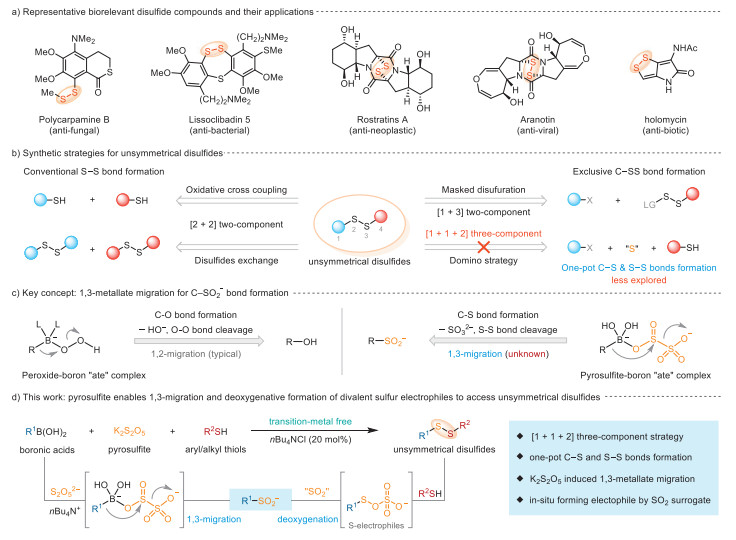
Disulfides are pivotal in sulfur-containing organic compounds, and are widely prevalent in natural products [1–6], pharmaceuticals [7,8], food chemistry [9,10], and agrochemicals (Scheme 1a) [11,12]. Notably, S–S bond serving as critical structural bridges that govern oxidative folding, stability, and biological functions in peptides and proteins in living entities [13–15]. Consequently, the multifunctional nature of disulfide compounds has continuously driven the development of synthetic strategies, especially toward unsymmetrical disulfides given their emerging rising prominence in recent research. Traditional methods for the preparation of unsymmetrical disulfides primarily rely on the oxidative cross coupling of two different thiols or the disulfides exchange, which can be recognized as a [2 + 2] two-component synthetic mode (Scheme 1b, left) [16–28]. However, these methodologies are often impeded by unavoidable homo-coupling by-products.
Scheme 1
Scheme 1.
(a) Representative biorelevant disulfide compounds. (b) Synthetic strategies for unsymmetrical disulfides. (c) Key concept for C–S bond formation via 1,3-metallate migration. (d) Pyrosulfite enables 1,3-migration and deoxygenative formation of divalent sulfur electrophiles to access unsymmetrical disulfides.
In contrast to S–S bond formation pathway, the approach for C–SS bond construction has benefited from the development of various "masked" disulfurating reagents [29–33], such as nucleophilic acetyl dithioesters (RSSAc) [34], electrophilic disulfurating reagents (RSS−SO2Ph [35–44], RSS−Phth [45–51], RSSOMe [52]), and tetrasulfides (RSSSSR) [53–59] as radical disulfide precursors, which brought the disulfane chemistry into a new sight (Scheme 1b, right). Within this domain, recent metal-catalytic or photocatalytic [1 + 3] two-component reactions have emerged as exclusive protocols for the preparation of unsymmetrical disulfides with another carbon-coupling partner. Lately, inspiring by the unilateral masked disulfuration strategy, the elegant bilateral disulfurating reagents have also been developed by Jiang and others [60–63], which allows for the effective synthesis of disulfide derivatives through a [1 + 2 + 1] three-component stepwise manner. Despite significant progress, these methods still face inherent challenges due to the tedious preparation of the functionalized disulfurating reagents, which generally require stringent experimental conditions and additional synthetic steps. Hence, the development of an expeditious three-component approach for the robustly preparation of unsymmetrical disulfides from all commercially available reagents has become imperative.
On the other hand, organoboron compounds are readily available and broadly valuable building blocks in organic synthesis [64–66]. 1,2-Metallate migration of boronate complexes demonstrates substantial synthetic utility on the construction of C–C [67–74] and C-heteroatom bonds [75–78]. Most representative reaction of this sort is the oxidative formation of C–O bonds between organoboron compounds and hydrogen peroxide (H2O2). Many of these elaborated reactions use the unique reactivity of tetracoordinate boronate derivatives with an attached leaving group, which have a tendency to undergo 1,2-rearrangement pathways (Scheme 1c, left). However, apart from recent innovation on the C–O bond formation via 1,4-migration developed by Li group [79], these processes are quite rare for long-distance reconfiguration, especially in creating valuable C-S bond. In another context, SO2 surrogates, such as DABSO, SOgen and potassium pyrosulfite (K2S2O5), are considerably safer alternatives compared to dangerous gaseous SO2, which have been widely applied to the synthesis of diverse hypervalent sulfur-containing compounds, including sulfonylative reactions [80–88]. More recently, SO2 surrogate as a divalent sulfur source has become a promising protocol for accessing sulfides or disulfides. For example, Konishi and Manabe group [89,90] reported a Pd-catalyzed method of synthesizing symmetrical diaryl sulfides using K2S2O5 as an SO2 surrogate. Lian group [91] utilized SOgen to generate perthiyl radicals by reacting SO2 with alkyl halides for the synthesis of unsymmetrical disulfides.
Pyrosulfite (S2O52−), as a cost-effective, commercially available and conveniently handled inorganic sulfur source, possesses distinctive structural characteristics that potentially facilitate 1,3-metallate migration: (1) A negative oxygen ion as a nucleophile to form activated tetracoordinate boron intermediates; (2) A fragile S–S bond that cleaves to initiate the migration; (3) A feasible leaving group, that is sulfite anion, as the driving force for migration. Therefore, we envisioned that pyrosulfite probably induce the unprecedented long-distance 1,3-migration of pyrosulfite-boron ate complex to produce organic sulfinate via C–S bond formation (Scheme 1c, right). Herein, we disclose a [1 + 1 + 2] three-component approach between boronic acids, potassium pyrosulfite and thiols, delivering a wide set of unsymmetrical disulfides under transition metal-free conditions (Scheme 1d). It is worth noting that C–S and S–S bonds are simultaneously formed during the one-pot reaction, in which K2S2O5 acts as both an inducer for 1,3-metallate shift process and a deoxygenation agent for the assembly of divalent sulfur electrophiles.
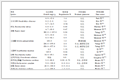
To establish proof-of-concept, we explore the coupling of (4-methoxyphenyl)boronic acid 1a, K2S2O5 and 4-methylbenzenethiol 2a using nBu4NCl as additive. As briefly illustrated in Table 1, acids could promote the three-component coupling reaction. After screening of various Brønsted and Lewis acids, TfOH was determined to be the optimal one, which afforded the target product in 64% yield (entries 1, 2, 7 and 8). It was further found that nBu4NCl could facilitate this coupling process, presumably serving as a phase transfer catalyst in 1,3-migration. Other quaternary ammonium salts such as nBu4NBr, nBu4NF and nBu4NOAc did not afford better efficiency (entries 4–6 vs. entry 2). The employment of excess amount of 1a and K2S2O5 was prove to be essential for the transformation (entries 9 and 10). In addition, lowering temperature to 120 ℃, the reaction gave an optimum yield of 74% (entries 11 and 12). Other various commercially available SO2 surrogates were explored, such as Na2S2O5 and DABSO, which demonstrated that K2S2O5 is still the optimal choice (entries 13 and 14). Further investigation of the other reaction parameters (for detailed condition optimization, see Supporting information) led us to identify the optimal conditions as follows: The reaction of boronic acid 1a (3.0 equiv.), K2S2O5 (4.0 equiv.) and mercaptan 2a (0.2 mmol), in the presence of TfOH (1.0 equiv.), nBu4NCl (20 mol%), in NMP (0.5 mL, 0.4 mol/L) at 120 ℃ for 24 h under argon gas produced 3a in 70% isolated yield.
a Reaction conditions: 1a (3.0 equiv.), 2a (0.2 mmol), K2S2O5 (4.0 equiv.), nBu4NCl (20 mol%), TfOH (1.0 equiv.) in NMP (0.5 mL) at 130 ℃, Ar, 24 h. TfOH: Trifluoromethanesulfonic acid; DABSO: 1,4-Diazabicyclo[2.2.2]octane bis(sulfur dioxide) adduct. b The yields were determined by GC with dodecane as internal standard (isolated yield in parentheses). c No TfOH. d At 120 ℃.
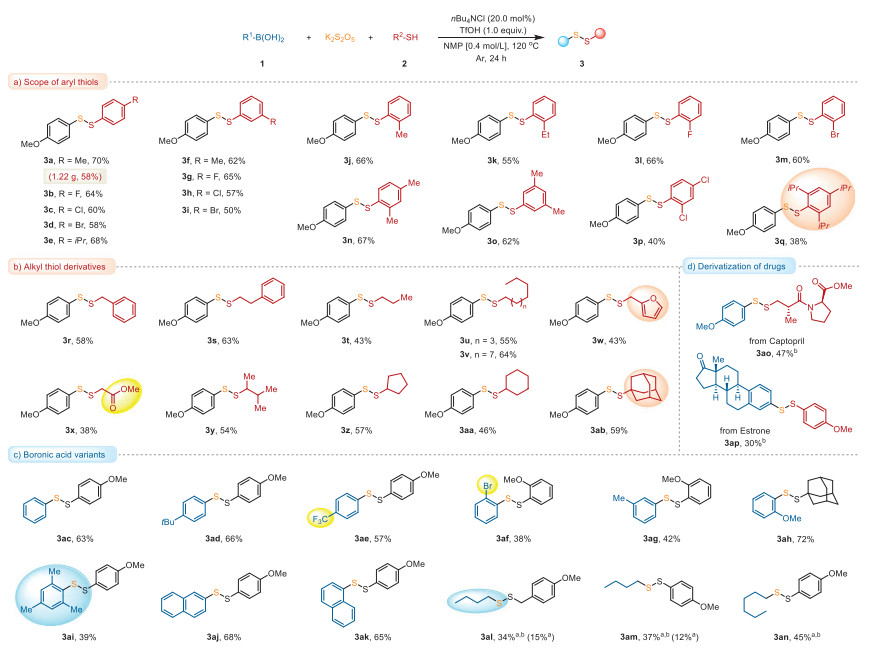
With the optimal condition in hand, we evaluated the substrate scope by firstly placing emphasis on an array of different aryl or alkyl substituted thiols (Schemes 2a and b). We found that a wide range of aryl thiols 2 bearing electron-donating or electron-withdrawing groups at para position, including methyl, isopropyl, halogen, could be smoothly converted to the corresponding unsymmetrical disulfides (3a-3e) in moderate to good yields (58%−70%). Moreover, the reaction proceeded smoothly for various substrates with different steric hindrances regardless of containing meta-, ortho- or poly-substituents, providing the desired products (3f-3q) in moderate yields (38%−67%). Notably, compound 3q was successfully synthesized from the corresponding steric hindered thiols, which underscores the potential applicability of this reaction in the preparation of the widely used bulky disulfide-type co-catalyst or HAT reagents. In addition, the methodology was next extended to the synthesis of unsymmetrical disulfides with alkyl mercaptans as the coupling partners. To our delight, alkyl thiols bearing benzyl, linear alkyl, α-branched alkyl, cyclopentyl, cyclohexyl, adamantyl substitutions could be well compatible, affording the disulfide compounds 3r-3z, 3aa and 3ab in 38%−64% yields. In particular, the methodology accommodated furfuryl mercaptan and methyl thioglycolate, producing 3w and 3x in moderate yield.
Scheme 2
Scheme 2.
Substrate scope of (a) aryl/(b) alkyl thiols and boronic acids. Reaction conditions: 1 (0.6 mmol), 2 (0.2 mmol), K2S2O5 (4.0 equiv.), nBu4NCl (20 mol%), TfOH (1.0 equiv.) in NMP (0.5 mL) at 120 ℃, Ar, 24 h, isolated yields. a The reaction was performed at 140 ℃. b The reaction was conducted for 3 h under standard conditions in the absence of thiol. After the addition of thiol, the reaction continued for another 21 h.
The feasibility of this platform was further illustrated by surveying the variants of boronic acid 1 (Scheme 2c). As participated, aryl boronic acids bearing either electron-donating or electron-withdrawing substituents at para-, meta- or ortho-positions, yielded the corresponding targeted unsymmetrical disulfides in 38%−72% yields (3ac-3ah). Remarkably, various polycyclic aromatic and sterically hindered substrates could also afford the target products in 39%−68% yields as well (3ai-3ak). Unfortunately, the coupling of aliphatic boronic acid with aryl or alkyl thiols was not effective under standard conditions. When increased the reaction temperature to 140 ℃, the di-alkyl substituted unsymmetrical disulfide (3al) was obtained in 15% yield. This is presumably attributed to the fact that 1,3-migration of aliphatic boronic acids is more difficult than that of aryl boronic acids and also due to the inferior stability of thiols in the presence of K2S2O5. Therefore, the reaction process for the aliphatic boronic acid substrates was further optimized by employing a one-pot two-step procedure at 140 ℃ (detailed information, see Supporting information), achieving the corresponding disulfide compounds (3al-3an) in relatively higher isolated yields (34%−45%). More importantly, the late-stage functionalization of variants of complex thiol and boronic acid derived from pharmaceuticals captopril and estrone, respectively, was proceeded smoothly, leading to structurally valuable disulfides in 30%−47% yields (Scheme 2d). To showcase the practical applicability of this method, a gram-scale experiment was performed. As expected, the reaction for the synthesis of 3a was amenable to increased scale in a benchtop setup while maintaining moderate yield (8.0 mmol scale, 1.22 g, 58% yield).
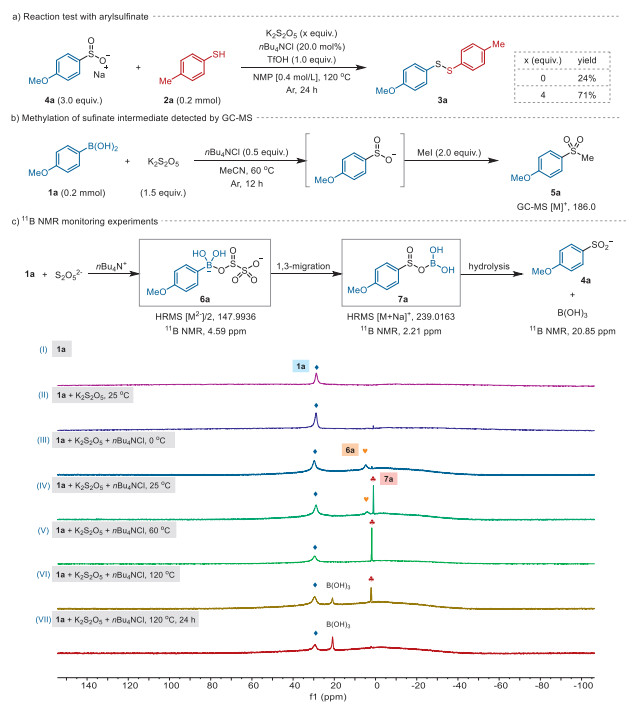
To gain more mechanistic insight into this protocol, a series of control experiments were conducted (Scheme 3). We presumed that sulfinate 4 should be involved under standard conditions. Thus, sodium 4-methoxybenzenesulfinate 4a was firstly pre-synthesized for evaluation as a coupling partner. The reaction of sulfinate 4a and thiol 2a was inhibited in the absence of K2S2O5, whereas the disulfide compound 3a was produced in 71% yield in the presence of K2S2O5 (Scheme 3a). We also found that the methylation-capture reaction between phenylboronic acids, K2S2O5, and MeI gave PhSO2Me 5a under standard conditions, which was obviously determined by GC–MS at m/z 186.0 (Scheme 3b). These results demonstrate sulfinate salt 4 was really formed at first between boronic acid 1 and pyrosulfite. To the best knowledge, the sulfinates were generally obtained by transition-metal catalyzed cross-coupling of boronic acids with various SO2 surrogates, typically via Au- [92–94], Cu- [95], and Pd- [96–100] catalysis. In our case, sulfinate could be unprecedentedly generated under transition-metal free conditions. In order to probe this quite unusual and intriguing phenomenon, we carried out 11B NMR spectroscopy to monitor the entire process, aiming to identify the real evolution of the boron-species throughout the transformation. Initially, it was found that no obvious complexation occurred when mixing K2S2O5 with boronic acid (Scheme 3c, Ⅰ & Ⅱ). However, using nBu4NCl as an additive to increase the solubility of potassium pyrosulfite, the intermediate pyrosulfite-phenylboronic acid complex 6a was detected by in 11B NMR spectroscopy at 4.59 ppm (Scheme 3c, Ⅲ). This boron-ate complex was further confirmed by high-resolution mass spectrometry (HRMS) at m/z 147.9936. In addition, increasing temperature from 0 ℃ to 25, 60 and 120 ℃, and keeping them for 12 h, a new signal was obviously observed at 2.21 ppm by 11B NMR monitoring, with a gradual increase in signal intensity (Scheme 3c, Ⅳ-Ⅵ). This species was supposed to be sulfinate-boronic acid 7a supported by HRMS at m/z 239.0163, which converted to sulfinate product 4a and boric acid (20.85 ppm) due to its facile hydrolysis. Moreover, when the reaction time was extended to 24 h, no 7a signal except for boric acid was observed in the 11B NMR spectrum (Scheme 3c, Ⅶ).
Scheme 3
Scheme 3.
Mechanistic studies. (a) Reaction test with arylsulfinate. (b) Methylation of sulfinate intermediate detected by GC–MS. (c) 11B NMR monitoring experiments. 1a: blue ♦, 6a: orange ♥, 7a: red ♣.
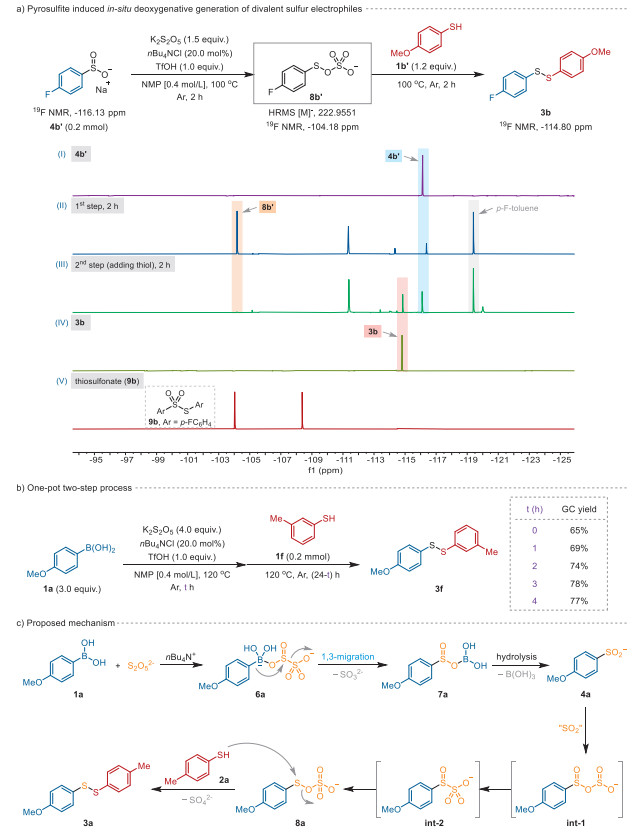
According to above observations, there should exist an unprecedented 1,3-metallate migration for the C–SO2 bond formation from the pyrosulfite-boron ate complex 6a to sulfinate-boronic acid species 7a. According to the literature, the divalent sulfur electrophile are the linchpins for the production of disulfides when thiols are used as nucleophiles [101–110]. In order to gain deep insight into the transformation of sulfinate to sulfur electrophile, sodium 4-fluorophenylsulfinate 4b' was evaluated as the coupling partner in the reaction. By 19F NMR monitoring, a new signal corresponding to the compound named 8b' was apparently observed at −104.18 ppm, which disappeared after the addition of mercaptan 1b'. At the same time, a new peak emerges at −114.80 ppm, which refers to product disulfide 3b (Scheme 4a, Ⅰ-Ⅳ). This results unambiguously demonstrated that compound 8b' should be the crucial divalent sulfur electrophile during the transformation. In this process, the possibility of thiosulfonate 9b as a typically reactive sulfur electrophile, which could be readily formed by disproportionation from sulfonate [111–113], was also ruled out (Scheme 4a, Ⅱ & Ⅴ). Therefore, this sulfur electrophile most probably obtained through the double deoxygenation process between sulfinate 4b' with thermally generated SO2 from metabisulfite salt. The species 8b' was confirmed by HRMS at m/z 222.9551, and further supported by the methylation capture assay to be m/z 260.9658. In order to further validate the hypothesis, we conducted a one-pot two-step process, the effects of time in the first step and temperature in the second step were investigated (Scheme 4b; for other detailed information, see Supporting information). As expected, we found that when the first-step reaction was performed for 3 h before the addition of thiol, the target product 3f was still afforded in a higher GC yield of 78% (vs. 65% GC yield in standard condition). These results indicate the sulfur-electrophile intermediates could be obtained undoubtably from boronic acids and pyrosulfite in the absence of mercaptans.
Based on mechanistic control experiments, a plausible mechanism was proposed in Scheme 4c. Initially, boron ate complex 6a was generated from boronic acid 1a and K2S2O5 in the presence of nBu4N+ cation. Then after 1,3-migration process, the intermediate sulfinate-phenylboronic acid species 7a was obtained, which was converted to sulfinate 4a and boric acid via hydrolysis. During the reaction, K2S2O5 could not only react with boronic acid by metallization, but also decompose to form sulfur dioxide upon heating. Under the reduction by SO2, sulfinate 4a went through dual-deoxygenation process probably via the intermediates of int-1 and int-2 to form the novel divalent sulfur electrophile 8a [114]. Finally, this in-situ formed electrophile (R1S–O–SO3−) was attacked by thiol reagent 2a to give targeted unsymmetrical disulfide 3a.
In summary, we have disclosed a [1 + 1 + 2] three-component synthetic strategy for the assembly of unsymmetrical disulfides via the cross-coupling reaction of boronic acids, thiols and K2S2O5. This newly developed protocol avoids the use of pre-functionalized disulfurating reagents and pertains to allow the vast collection of commercially available reagents as coupling partners. In contrast to precedent for the 1,2-migration of borate complexes, this novel 1,3-metallate migration of pyrosulfite-boron ate complex succeeded in relocating the aryl/alkyl moiety from B-center to S-center, thus constructing sulfinates from boronic acids and K2S2O5 under transition-metal free conditions. In addition, another key to the production of unsymmetrical disulfides is a dual deoxygenation process of sulfinates by using an inorganic sulfur dioxide surrogate, which leads to the in-situ formation of divalent sulfur electrophile. We foresee that the multi-component scenario would hold great potential in the precise construction of versatile disulfides, and the 1,3-migration strategy depicted is expected to be favorably received in further research.
The authors declare that they have no known competing financial interests or personal relationships that could have appeared to influence the work reported in this paper.
Acknowledgments
Financial support from the National Natural Science Foundation of China (Nos. 22271244 and 22201239), the Postgraduate Scientific Research Innovation Project of Hunan Province (No. CX20250919), the Undergraduate Investigated Study and Innovated Experiment Plan from Ministry of Education of China, the Open Research Fund of School of Chemistry and Chemical Engineering of Henan Normal University (No. 2022C02), the Process Intensification & Green Chemical Engineering Innovation Team Project of Hunan Province are gratefully acknowledged.
Supplementary materials
Supplementary material associated with this article can be found, in the online version, at doi:10.1016/j.cclet.2025.112331.
[1]
N. Wang, P. Saidhareddy, X. Jiang, Nat. Prod. Rep. 37 (2020) 246–275. doi: 10.1039/c8np00093j
[2]
D.H. Scharf, N. Remme, A. Habel, et al., J. Am. Chem. Soc. 133 (2011) 12322–12325. doi: 10.1021/ja201311d
Scheme 2
Substrate scope of (a) aryl/(b) alkyl thiols and boronic acids. Reaction conditions: 1 (0.6 mmol), 2 (0.2 mmol), K2S2O5 (4.0 equiv.), nBu4NCl (20 mol%), TfOH (1.0 equiv.) in NMP (0.5 mL) at 120 ℃, Ar, 24 h, isolated yields. a The reaction was performed at 140 ℃. b The reaction was conducted for 3 h under standard conditions in the absence of thiol. After the addition of thiol, the reaction continued for another 21 h.
a Reaction conditions: 1a (3.0 equiv.), 2a (0.2 mmol), K2S2O5 (4.0 equiv.), nBu4NCl (20 mol%), TfOH (1.0 equiv.) in NMP (0.5 mL) at 130 ℃, Ar, 24 h. TfOH: Trifluoromethanesulfonic acid; DABSO: 1,4-Diazabicyclo[2.2.2]octane bis(sulfur dioxide) adduct. b The yields were determined by GC with dodecane as internal standard (isolated yield in parentheses). c No TfOH. d At 120 ℃.


 DownLoad:


 下载:


 下载:

