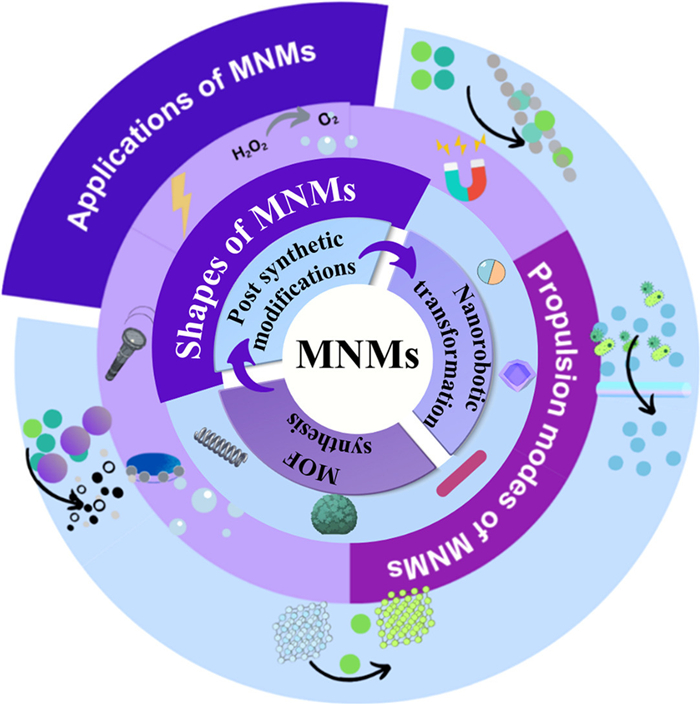
Figure 1.
Graphical illustration for the contents covered in this review article.

Metal-organic frameworks: Nanomachines for efficient water purification
Nadia Tahir , Tayyaba Najam , Muhammad Altaf Nazir , Ayesha Arif , Ayman Nafady , Manzar Sohail , Syed Shoaib Ahmad Shah


The pursuit of advanced water purification methodologies has increasingly focused on innovative materials capable of addressing the complex challenges of water contamination [1]. Metal-organic frameworks (MOFs) have emerged as prominent candidates in this field, distinguishing themselves not only through exceptional properties but also their potential integration into nanorobotic systems [2–4]. MOFs are crystalline substances consisting of metal ions or clusters linked to organic ligands, creating a highly porous, three-dimensional framework. Their modular structure and reticular chemistry allowed for precise manipulation of pore dimensions, surface chemistry, and functionality, making them ideal for use in gas storage, catalysis, and water purification. The extensive surface area and customizable characteristics of MOFs allow them to capture and break down pollutants with remarkable effectiveness [5–8]. While nanorobotics involves the creation and engineering of nanoscale robotic systems capable of performing specific functions. These systems employ cutting-edge materials, nano sensors, and actuators to achieve accuracy in tasks such as targeted drug delivery, environmental monitoring, and contaminant removal. Unlike conventional robotics, nanorobotics operates on principles of molecular manipulation and control, offering a platform for high-precision applications in challenging situations [9]. The integration of MOFs as nanorobotics enabled them to surpass other emerging materials, including carbon nanotubes [10], graphene-based materials [11], photocatalysts [12–14], and bio-inspired membranes [15,16]. By combining the unparalleled surface area, tunable porosity, and functional versatility of MOFs with the precision and mobility of nanorobotics, these hybrid systems offer a novel approach for capturing and neutralizing diverse contaminants [5,17]. A complementary fusion, the merger of MOFs and nanorobotics offers an unrivalled solution for water purification challenges. MOFs supply the advanced material properties necessary for contaminant capture and neutralization, while nanorobotics contributes precision, mobility, and adaptability. Together, they create a formidable combination capable of targeting pollutants with exceptional accuracy and efficiency, maneuvering through intricate aqueous environments, and enabling real-time, localized water treatment. The integration of MOFs with nanorobotics not only enhances their individual strengths but also sets a new standard for next-generation technologies in environmental remediation.
It is essential to distinguish nanomotors from nanorobots. Nanomotors are devices that transform energy into motion at the nanoscale. These energy sources can include chemical reactions, light, or magnetic fields, enabling nanomotors to carry out tasks such as propulsion, mixing, or targeted delivery. While crucial for achieving motion, they are generally limited in their ability to perform complex tasks independently. In contrast, nanorobots incorporate nanomotors along with sensing, decision-making, and actuation capabilities. This integration makes them autonomous systems able to navigate complex environments, react to stimuli, and execute multi-step tasks. Essentially, nanorobots represent a more advanced and functional evolution of nanomotors [18]. Though technically these terms are distinct but often used interchangeably in literature. In this review we will use word "Nanomachines" for both terms.
Micro/nanomachines (both motors and robots) are trending research areas and have been widely explored, and numerous reviews existed, including the recent strategies for integration and fabrication of general micro/nanomotors across various applications were reviewed [19,20] while Ye et al. summarized and discussed for environmental applications [21]. Nature-inspired micro/nanomotors has been thoroughly discussed by Chang et al. [22]. Reviews on emerging synthetic materials and functionalization techniques have also been published, discussing core materials and their transformation methods into nanomachines [23–25]. Different types of micromotors have been studied and reviewed individually as well, providing comprehensive overview of tubular micromotors, and biohybrid motors [23,26]. Recent advancements in motion manipulation [27], chemically powered [28], and fuel-free synthetic micro/nanomotors [29], have also been published, which summarized motion mode and mechanisms for nanomachines. MOF based micro-/nano-motors are getting popular in medicinal as well as in environmental applications nanomachines Biomedical advances of MOF based micro/nanomachines have been reviewed well, which discussed nanomachine types based upon their shapes and mode of propulsion as well as applications in targeted drug delivery or nano-surgery [18,30–44]. Almost all these articles placed MOFs as emerging material for micro-/nano-machines. While a comprehensive review on MOF nanomachines (MNMs) for water treatment hardly exists, although use of MNMs in water reclamation is growing fast. Further, MOF nanomachines have never been reviewed in such thorough way, which starts from MOF synthesis leading to their applications, including nanorobotic transformation and propulsion mechanisms. Hence, this review provides a detailed and unique overview for researchers in the field of MOF nanomachines, from MOF basics to cutting edge nanomachine designing and autonomous motion.
This review examines the advancements in MOF synthesis and post synthetic modifications in reference to their suitability for water applications, enlisting the methods tailored for preparation of nanosized MOF which can be incorporated into nanorobotic systems through different fabrication techniques. Shapes and propulsion mechanisms as well as speed and efficiency in their environmental implications and sustainability have also been discussed with special focus on nanomachines. It elucidates their potential as an innovative solution to water purification challenges in a rapidly evolving global context, describes environmental concerns and challenges as well as suggesting solutions and measures for pre-mature problems that can arise on the long-term use of MNMs blindly. Graphical illustration of review is given in Fig. 1.
In MOFs metal-linkers bonds are susceptible to hydrolysis, demanding more thoughtfulness in the selection of metal and linkers as well as techniques employed for the synthesis of MOF with water treatment applications. The right choice of metal node and organic linker is of prime importance, which is generally governed by HSAB (hard-soft acid base) principle. Hard metal nodes are better coordinated with hard organic bases while soft metal ions form strong bonds with soft organic linkers. Along with small radii and high valency of metal ions, comparable radius of metal orbital involved in bonding and organic linker contributes towards stronger bonding. To start MOF preparation from scratch with aim of micro-tuning for water treatment, many factors need consideration including metal and linker bond strength (thermodynamic factor), rigidity, hydrophobicity, porosity, interpenetration of framework (kinetic factors) pH, temperature, and acidity of application area (environmental factors) [45]. For example, to make MOFs water stable; porosity is reduced, hydrophobic functional groups are introduced, or surface hydrophobicity is created [46,47]. These modifications work well for other applications like drug delivery and gas storage but not for water treatment applications. Enhanced hydrophobicity reduces the interaction of water with MOF, and hence interaction with hydrophilic pollutants as well. Hydrophobic stable MOFs prefer interacting and adsorbing organic pollutants (hydrophobic) and show less affinity for water- and water-soluble pollutants (hydrophilic), so while tuning hydrophobicity and water stability of MOF target pollutant should be kept in consideration [48]. Similarly, reduced porosity makes MOFs stable but provide less area for absorbance of pollutants or contaminants from water making them less efficient, so fine adjustment of these parameters is required to maintain MOF structure and its performance in water treatment. Lyu et al. reported three MOFs of Zn named NU-903, NU-904 and NU-1008 with simple TCPB, nitro substituted TCPB and dibromo substituted TCPB respectively, pore size of NU-1008 was considerably larger than both and it showed 100% fixation of carbon dioxide into styrene oxide while other two showed about 20% efficiency, clearly showing how decreased porosity decrease adsorption and efficiency of MOF [49]. Another important point to be discussed is that increased hydrophobicity does not always decrease porosity and adsorption capacity. So critical analysis of all factors is required to balance hydrolytic stability and adsorption abilities of MOF [50].
For MOF preparation, few methods are well matured while others are in emerging phase. Generally, the publications of MNMs have less focus on MOF synthesis, but to give readers a consolidated picture of scattered knowledge on how to prepare MOFs for MNMs we have cited works of simple MOF synthesis as well. Although, these MOFs were not transformed into MNMs but are directly related and have potential to fabricated MNMs owing to nanoparticles and water stability, providing foundation for new researchers in the field. Solvothermal and ultrasonic methods of synthesis are discussed here as they are more relevant to MNMs due to achievable nano-range particles. Few other methods of MOF synthesis, particularly suited for water treatment, are discussed in detail in Supporting information, summarized with limitations and future horizons in Table S1 (Supporting information).
Solvothermal method involves dissolving metal salt and ligands in a solvent, heating at certain temperature and collecting the precipitated MOFs [51]. Resulting MOFs are highly crystalline with high porosity which makes them fit for removal of water pollutants owing to large surface area [52,53]. Use of green solvent is making process more sustainable without compromising on product quality [54,55]. Synthesis of nano-sized MIL-100(Fe), HKUST-1(Cu) was reported by solvothermal synthesis using dimethyl formamide (DMF) as solvent [56]. The method is simple and highly established, but time consumption is a major drawback. Attempts to deal with this limitation evolved into another method, which combine salt and linker under microwave irradiation in microwave reactor. It generates MOFs with high porosity, making them potential choice for the adsorption of contaminants like metals or dyes etc. This microwave-assisted method is quick so energy efficient as well, but defects may get generated due to un-even heating, making method un-suitable for large scale production. Zou et al. used microwave-assisted synthesis method to produce a highly selective HKUST-1 MOF (HKUST-1-MW) which showed excellent adsorption properties for heavy metal ions, and polyoxometalates (HKUST-1-MW@H3PW12O40) was attached to achieve greater water stability [57–59]. To sustainably synthesize MOFs on large scale, the mechanochemical method which belongs to solid state synthesis is employed, so it eliminates the use of solvent [60]. Tahmasebi et al. mechanochemically synthesized azine-decorated zinc(Ⅱ) MOFs which showed promising capacity to efficiently remove heavy metal ions from water [61]. Taheri et al. reported synthesis of Co-doped ZIF-8 by placing precursor of metal and ligand along with steel balls of 8 mm in milling vessel, further processing and analysis confirm MOF formation with particle size of 200–400 nm [62]. Future of this method lies in the continuous flow system instead of batch, also needs efforts to reduce the contamination risks to avoid defects [63].
Ultrasonic synthesis method uses ultrasonic frequency (20 kHz and 10 MHz) for nucleation, giving nano-sized MOFs, well suited for the adsorption of organic pollutants from water. Unlike mechanochemical, this method gives smaller and uniform sized particles through rapid crystallization, which showed enhanced uptake of pollutants like crystal violet and methylene blue [64]. Zarekarizi and team synthesized nano-sized TMU-69 by ultrasonic assisted method. It worked to absorb Congo red dye from water showing greater adsorption capacity and water stability [65]. MOF-199 was synthesized by ultrasonic assisted method on carbon cellulose fiber (CCF), it showed enhanced surface area and high adsorption capacity for methylene blue [66]. Better control on nucleation by fine tuning of ultrasound frequency can provide better regulation of MOF properties [67]. More studies are needed to better correlate MOF properties, nucleation and ultrasonic frequency. Further, there is need to find a way for thermally sensitive ligands [68]. MOFs prepared by this method are better suited to be transformed into MNMs for adsorption of organic pollutants.
Green solvents and green methods of synthesis are a step towards sustainability, to evaluate their practical feasibility critical assessment of life cycles and quantitative parameters like E-factors and atomic economy are needed. Systematic implementation of these parameters to MOF synthesis and in particular their functional nanomachines are crucial for transferring laboratory scale synthesis to commercial production for environmental remediation applications and is an open challenge in the field.
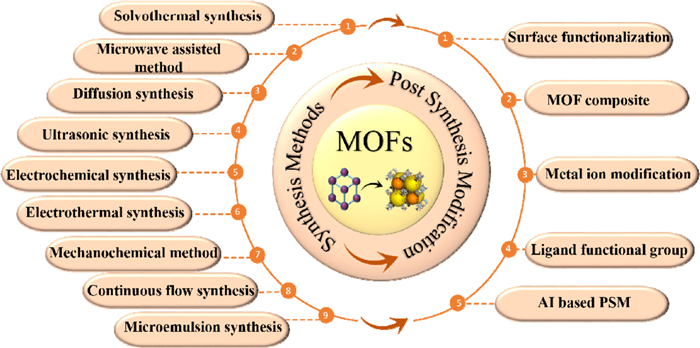
Though every synthesis method has its unique features and advantages, even then just the optimum choice of method is not enough to get tailored properties and performance of MOFs. To get the desired functionality of MOF, modular strategy must be applied instead of starting blindly with any combination of precursors. Even after synthesis, post synthesis modification (PSM) must be made in accordance with it to add features to make MOFs outperform in water treatment [69]. There are certain PSM approaches to make existing MOFs more suited for water-based applications, mainly include surface functionalization with hydrophilic groups, composite formation, metal ion and/or linker modification. These are explained in detail in Suppporting information and summarized in Table S2 (Suppporting information), further synthesis and post synthetic modifications methods for MOFs in water treatment are listed in Fig. 2.
Transformation of MOFs into nanorobots, for water treatment applications, is the integration of propulsion system for autonomous or semi-autonomous movement, sensing abilities and structural modification for enhanced water stability. This transformation can be in-situ or non-in-situ, in former MOF components (metal source and linker) as well as chemicals that impart propulsion and other functionalities are added in one pot, while in later one, MOFs are synthesized, and then other functionalities are added by same or different method/methods. MOF (Ce-CAU-281@Fe3O2 was synthesized by in-situ process, Liu et al. used 2,5-furandicarboxylic acid and cerium(Ⅳ) ammonium nitrate dissolved in DMF and formic acid as sources of organic linker and metals respectively, Fe2O3 nanoparticles were added in fixed amount during the process to impart magnetic propulsion. The whole solution was stirred for 12 min at 100 ℃ followed by filtration. The product was soaked and washed by methanol and DMF, later vacuum drying was performed for 12 h at 100 ℃ [70].
Grafting certain functional groups adds sensing abilities to MOF nanorobots, enabling them to respond to specific pollutants, sensing and moving according to concentration gradient, as well as making them temperature and pH responsive [19,71]. Such stimuli responsive nanomachines are practically in use for drug delivery and other applications in biomedicines but less privileged in environmental remediation presenting research gaps [72–74]. It is a widely adopted strategy to modify MNMs using organic and inorganic capping agents for example, thiol-based modifications specialized MNMs for oil collection and transportation [75], polymer-based coatings added targeting specificity [76], boronic acid derivatives enable monosaccharides recognition [77], graphene quantum dots (GQDs) empower MNMs with sensing abilities and when combined with boronic acid derivative facilitates fluorescence-based detection [78]. Functionalization also involves creating structural asymmetry to achieve directional propulsion. For example, in bubble propulsion design active catalytic sites are distributed asymmetrically leading to non-uniform bubble generation, enhancing speed and orientation [23,29]. Hybrid polymers also improve structural stability and propulsion efficiency [79–81]. Shapes of nanorobot and fabrication method have direct impact on propulsion type, so these are discussed briefly before going into detailed propulsion mechanism.
Nanorobots are future technology for water treatment applications due to their ability to actively target contaminants. Here nanorobots' shapes and methods of fabrication are discussed in correlation with promising features for water treatment; Tubular nanorobots are particularly ideal in systems with continuous flow as symmetrically elongated shape favors directional flow with minimum drag. Further catalyst can be loaded within tube generating propulsion through catalytic reactions by capturing and reacting with contaminants [82]. Helical shaped nanorobotics outperform viscous fluids in comparison to other shapes due to corkscrew pattern of motion. Its hydrodynamics helps in rapid interaction with targeted pollutants. Spherical nanorobots offer high surface area and symmetry, so optimum choice for better adsorption and uniform interaction with targeted contaminants. Cylindrical nanorobots are effective due to direction propulsion and surface optimization. Their surface allows more contact with water and more area for adsorption or reactions as compared to spherical ones [83]. Liu et al. fabricated cylindrical (rod shaped) MNMs with magnetically driven ability to move. SEM, TEM and HRTEM confirmed the nano-dimensions and cylindrical shape newly designed MOF (Ce-CAU-281)@Fe2O3 (Figs. 3a and b) [70]. Janus nanorobots offer dual functionality and self-propulsion due to asymmetric distinct faces, with capabilities to simultaneously recognize and degrade pollutants [37,84].
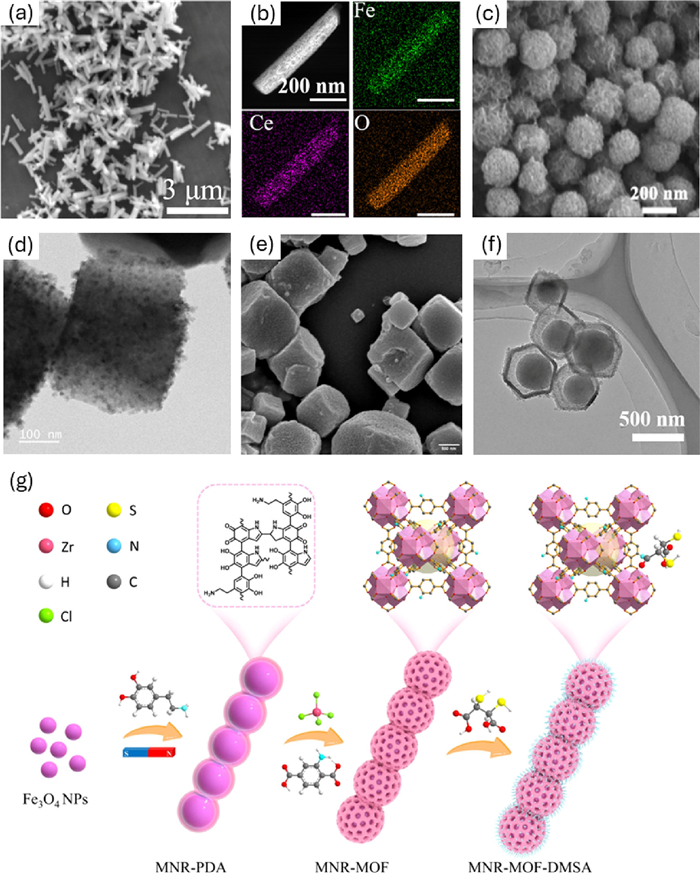
Currently use of micro and nanorobotics are uniform in shape while hybrid structures with combination of geometries can bring more efficiency in performance. Bio-inspired structures can better capture pollutants, needs more work on mimicking biological structures such as nanorobots [85]. Shape morphing is another emerging aspect which demands exploration in terms of nanorobotics, to better capture pollutants based upon environmental conditions and pollutant concentration in water. Little works on MOF Multi-layered nanorobots and MOF nanorobots with variable pore size indicate a research gap in this area. Yang et al. reported spherical shaped nanorobots of MOF composite (Fig. 3c), MnFe2O4@MIL-53@UiO-66@MnO2 spherical MnFe2O4 nanoparticles were obtained by hydrothermal method utilizing sodium acetate, MnCl2⋅4H2O and FeCl3⋅6H2O. Later MOF MIL-53, UiO-66 and MnO2 nanoparticles were deposited in it in sequence and spherical shape was retained by nanomotor along with gaining mobility and metal ion removal abilities [86]. MNMs can have other shapes as well, cube shaped nanorobots are also reported. Lan, Dawei, et al. prepared MOF-525(Co)-Fe by co-loading Fe2O3 nanoparticles during MOF-525 synthesis. The result was cube shaped composite MNMs just like pristine parent MOF, confirmed by TEM and SEM (Figs. 3d and e) [87]. Li et al. reported unique rhombohedral yolk shell MNMs with PDA shell and ZIF-67 core (Fig. 3f) [88]. Besides pod like nanorobots have also been synthesized, Li et al. reported MOF based magnetic nanorobots which were functionalized with dimercaptosuccinic acid (DMSA) and named as MNR-MOF-DMSA. It basically has Fe NPs arranged like pod and other components are attached on them in same fashion giving many nanorobots joined in pod like pattern (Fig. 3g) [89].
MOF nanomachines (MNMs) are advanced materials designed to accomplish different tasks by moving and interacting with their surroundings autonomously [90]. Function of MNMs vary as per its application, so various fabrication methods are employed to achieve diverse structures, architectures, and functionalities [19,28]. Key fabrication techniques include:
(a) Template based methods: Methods like membrane template-assisted electrodeposition, asymmetric bipolar electrodeposition, and physical based on various templates are widely used for constructing the motor framework [91,92]. More templates can be designed to take this method to the next level by adding more functionalities and hence fabricating multi-tasking nanorobots. However, limitation lies in the time taken for effective template design. Correlation of deposition (physical/electro) parameters with the nanorobot features stresses more research to enable fine-tuning of nanorobots morphology, composition and structure.
(b) Assembly of materials: This includes layer-by-layer assembly, encapsulation of micro-/nanoparticles (NPs), and integration of synthetic molecules for functional MNMs. Self-assembly takes advantage of the natural tendency of molecules to form well-defined structures [54]. Yang et al. used this fabrication technique to prepare MOF-composite nanomotor for water purification. MIL-53, UiO-66 and MnO2 growth on MnFe2O4 layer by layer one after the other, giving self-propelled MNMs, as represented in Fig. 4a [86].
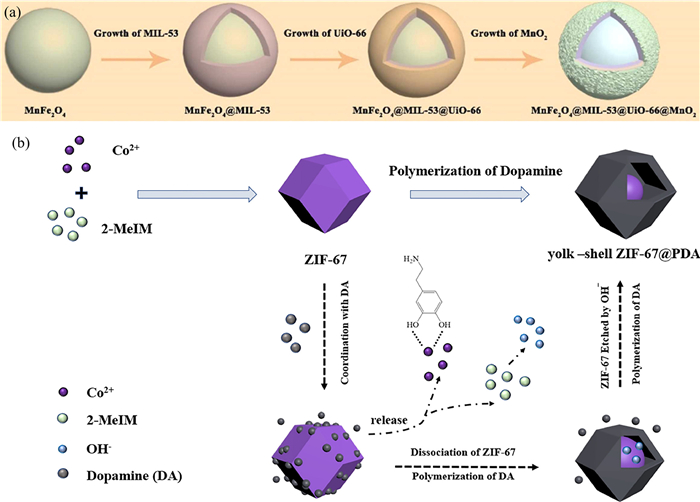
(c) Lithography techniques: Nano-scale devices are created by etching or printing patterns, it allows control over surface features and dimensions. But it is expensive and complex, further limited materials can be converted into nanorobots by this method. More studies are needed to find useful materials and bring costs down. Li et al. used etching to prepare NIR driven symmetric yolk-shell ZIF-67@PDA nanorobots. ZIF-67 NPs and dopamine were mixed with methanol separately in suitable amounts, both solutions were combined and ultra-sonicated for 5 min, later forming dopamine hydrochloride solution was added and further processed to collect product. Etching of inner ZIF-67 depends upon reaction time of ZIF-67 and PDA as well as on the ratio of dopamine hydrochloride and MOF ratio. Reaction time of 2 h gives core shell structure while increasing it up to 6 h decreases the volume of inner MOF and PDA maintains its rhombohedral shape. Similarly, etching is further supported by a high ratio of dopamine hydrochloride. 2/4 Mass ratio of dopamine hydrochloride/ZIF-67 cause ZIF-67 to shrink up to 60% of its original volume into spherical form giving egg yolk structure, if ratio of former is increased further it etch MOF completely and increase the thickness of PDA. Synthesis scheme has been reproduced in Fig. 4b [88].
(d) Strain engineering: It is applied to create intentional strain in nanorobots to get desired features. Research is limited in understanding of different strain levels effects on the nanorobots performance is limited particularly in dynamic aqueous environments. Studies are lacking in terms of strain effects on electrochemical and catalytic properties (pollutant degradation abilities) of nanorobots. Further designing materials which can tune strain as per environmental conditions with ability to target different contaminants in different conditions in future direction. However precise control of strain is challenging aspect [93,94].
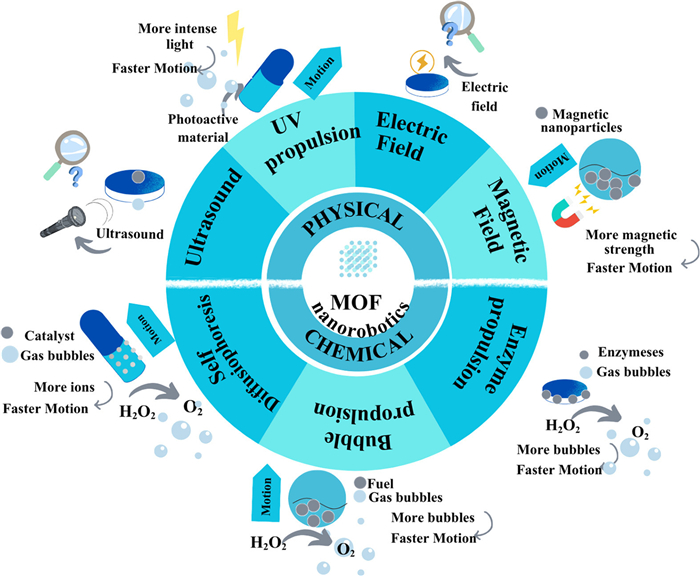
Propulsion mechanisms are a defining feature of MOF nanorobots enabling them to navigate and perform tasks in various environments. The propulsion mechanisms are categorized into chemically powered and physically driven systems, with an emphasis on their relevance in wastewater remediation.
Chemically powered MNMs rely on reactions in their environment to generate movement. These mechanisms typically involve the decomposition of fuels, such as hydrogen peroxide (H2O2), or other redox-active substances. It can be further sub-divided into bubble propulsion (in which MOF decomposes fuel, producing gas bubble, which propel the nanomachine forward), self-diffusiophoresis (in which relies on the creation of a concentration gradient of ions or molecules around the MNMs due to a surface reaction, asymmetry in the chemical gradient causes the movement) and enzyme powered propulsion (in this enzymes like catalase encapsulated in MNMs, they decompose biological fuels such as glucose or urea, generating a localized flow of reactants and products and bringing MNM in motion). Wang et al. designed Ag–ZIF Janus micromotors. These have asymmetrically deposited Ag patch on surface which catalyze decomposition of H2O2, producing oxygen bubble. The oxygen bubble cause propulsion at the speed of 310 μm/s [95]. Ying et al., Wang et al. and others have also reported micromotors that rely upon H2O2 fuel for bubble propulsion [96–101]. Liu et al. utilized self-degradation of MOFs in water as drive for ionic diffusionphoresis propulsion. ZIF-90 micromotors release Zn2+ ions which act as fuel for propulsion [102]. Enzyme drive propulsion has been reported by Yang et al. in UiO-66-type MOF (specifically Zr-fcu-azo/sti-30%), enzyme produced oxygen bubble upon catalysis which bring micro/nanorobot into motion [103]. Yang et al. fabricated nano-range MOF-composite with self-propulsion abilities after chemical decomposition of H2O2 in the environment. MnFe2O4@MIL-53@UiO-66@MnO2 composite uses it MnO2 to decompose the fuel causing propulsion. Recently, another self-propelled MOF composite nanorobot has been reported, motion relies on catalytic decomposition of H2O2 which is facilitated by cobalt doping on MNM. Co2+and Co3+ are interconverted with the production of water and oxygen gas from H2O2 which drive its propulsion. Concentration of H2O2 has direct impact on the velocity of MNM as higher concentration speeds them up, speed and propulsion pattern of the MNM as different H2O2 concentrations are shown in Fig. 5a [87].
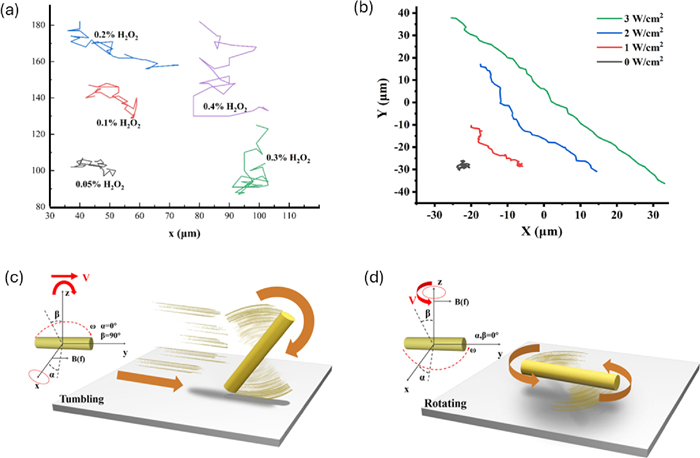
Physically driven MNMs leverage external energy sources to achieve propulsion. External energy sources can be light, magnetic field, ultrasound or electric field. These methods are advantageous in eliminating the need for chemical fuels, making them more environmentally benign and suitable for biomedical and environmental applications. In light-driven propulsion, light energy activates photoactive components (e.g., TiO2, Au) in the MNMs, generating thermal gradients, charge carriers, or chemical species that propel the motor. However, it has limited use in opaque media. Application mainly includes photocatalytic degradation of organic pollutants in water. Ikram et al. reported fuel-free colloidal MOF motors with UV controlled propulsion, light intensity has direct relation with the propulsion speed [104]. Jung et al. fabricated iron hexacyanoferrate (FeHCF) nanobot which showed visible light guided fuel free propulsion to capture nanoplastics [105]. Li et al. reported NIR light driven MNMs, these asymmetric yolk-shell ZIF-67@PDA NMs show propulsion under the light of 808 nm wavelength. NIR heat up MNM, due to different thermal conductivity of inner ZIF-67 and outer PDA a temperature gradient is generated, causing self-thermophoretic propulsion. At NIR irradiation of power density 1, 2, and 3 W/cm2, the MNM showed speed of 4, 71, and 10.3 µm/s, as shown in Fig. 5b [88].
Magnetic fields are used to navigate MNMs containing magnetic nanoparticles (e.g. Fe3O4), in magnetically driven propulsion. The field's strength and orientation determine the motor's movement. Main applications are targeted pollutant removal in wastewater and in-situ pollutant sensing. Vaghasiya et al. used external magnetic field to drive thermomagnetic (TM) nanorobots. Magnetite Fe2O3 particles deposited on nanorobot provide magnetic control, strength of magnetic field determined the speed of propulsion. Excellent recovery was also achieved through magnetic properties [106]. Liu et al. also synthesized Fe3O4@Ce-MOF nanorobots which showed propulsion under external magnetic field, these nanorobots showed two types of motion under magnetic field: Tumbling and rotating (Figs. 5c and d). Speed of both types of motion increase with increase in frequency of applied magnetic field reaching maximum values of 16.69 ± 1.10 mm/s and 498 ± 113.6 rpm, respectively. This increase is up to 10 Hz, after which decrease in speed is observed [70].
While in ultrasound-driven propulsion, high-frequency ultrasonic waves create localized acoustic streaming, driving the nanomachines forward. This method is particularly effective in high-viscosity environments. Many acoustically driven micro and nanorobots have been reported so far, particularly in biomedical applications, but MOF based nanorobots with ultrasound propulsion for water treatment show a wide research gap [107–111].
Alternating or direct current (AC/DC) electric fields induce electrophoresis or dielectrophoresis in nanomachines, causing electric field-driven propulsion. Selective removal of ionic pollutants from water is main application area, but these are limited to ionic solutions only. Electric field is applied along with other propulsion drives to make motion more precise and controlled, such MNM was reported by Guo et al. for cargo delivery. The nanomotor was mainly chemically propelled but showed enhanced precision when guided by AC current [112]. Use of electric fields to propel MNMs for water purification needs further exploration.
Fig. 6 summarizes all common propulsion modes of MNMs, showing how increase decomposition of H2O2 to produce oxygen bubbles, magnetic field strength and light intensity increase the propulsion velocity. While the effect of changing ultrasound frequency and electric field strength on propulsion are less explored areas. All these propulsion modes have been studied under controlled laboratory conditions for different pollutants removals and other functions like sensing while the propulsion of MNMs in real water conditions under synergistic effect of different types of pollutants, uncontrolled pH and temperature, may affect mechanisms of mobility and structural integration of MNMs, e.g., strong ionic conditions or organic pollutants may restrain bubble propulsion. Hence, the situation represents a wide research window which needs to be evaluated before real world applications of MNMs in environmental remediation.
Metal-organic framework-based nanomachines (MOF-MNMs) have shown significant potential for wastewater remediation, leveraging their mobility, superior adsorption, catalytic, and sensing properties. This section summarizes key advancements in using MOF-MNMs for removing water pollutants such as metals, dyes, and organic contaminants, while Fig. 7 gave illustration of main applications of MNMs.
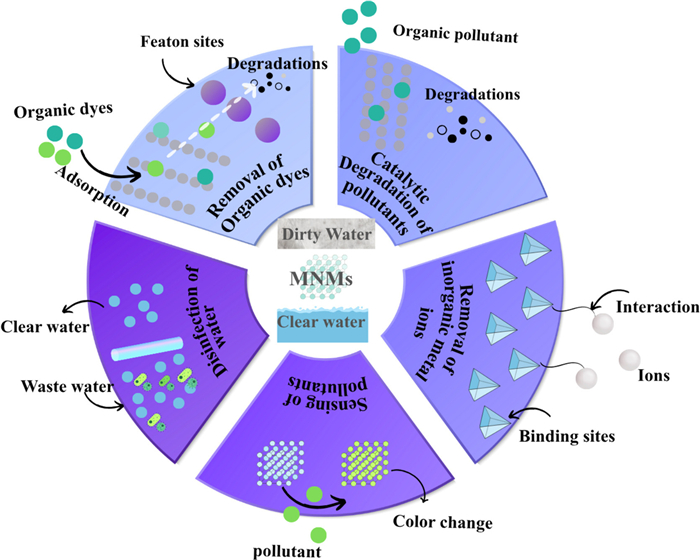
Adsorption is one of the main working mechanisms of MOF-MNMs due to their high surface area, porosity, and chemical stability. The predominant adsorption mechanisms of MOF-MNMs may include one or more of the followings: (ⅰ) Porous framework adsorption (MOF's pores trap metal ions and dyes), (ⅱ) Electrostatic attraction (adsorption derived by opposite charges of pollutants and MOF-MNMs surfaces), (ⅲ) Chemical bonding (functional groups such as —COOH enhance chemi-sorption), (ⅳ) π–π Stacking (this interaction is dominating between dye aromatic rings and MOF ligands, improving removal of such dyes) [113,114]. In multi-component systems like MNMs these mechanisms interplay and control over all process of adsorption through co-occurring and supporting or mitigating each other. Uptake of cationic dyes is boosted by synergistic play of π–π interactions and electrostatic forces (e.g., uptake of MB by DUT-23-Cu), similarly pore size and charge work to favor adsorption in accordance with size exclusion and electrostatic attraction. So, keeping these interactions in view, high porosity, large surface area, opposite surface charge relative to pollutant and functionalized ligands as per water conditions optimize the adsorption efficiency of MOFs [115,116].
MNMs may absorb the pollutant by taking it into MOF holes or may degrade it after coming in contact. Degradation is another mechanism which is followed by MOF nanorobots, they degrade the target substance into harmless or useful products. Later, MOFs are recovered, and pollutants are released in detoxicated form. Sometimes MNMs simply capture the target molecule into its pores, acting as a filter for that specific target.
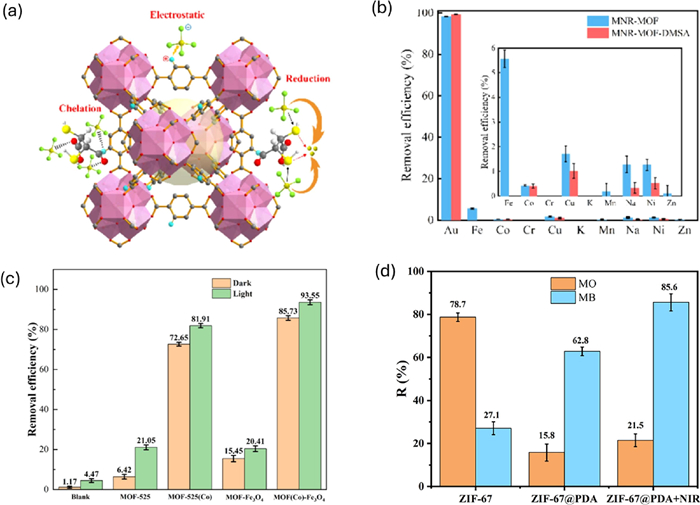
Numerous micromotors have been designed to removed metal ions like radioactive uranium, Fe3+ and Pb2+ and Cd2+ remediating the water [114,117,118]. Though nanomachines are not as common as micromachines but expanding very rapidly. The enzyme-powered Cat-ZIF-8 nanorobot embodies accurate motion under low concentrations of H2O2, which demonstrates its efficiency in adsorbing Ce, Cu, Co, Mn, and Ni ions, thereby attaining removal efficiencies of up to 99.9% for Ce [119]. ZIF-8 based nanomotor was fabricated with magnetic field driven propulsion, it effectively removed metal ions including Cu(Ⅱ), Ni(Ⅱ), and Co(Ⅱ) with removal efficiency of up to 90% [70]. MnFe2O4@MIL-53@UiO-66@MnO2, a MOF-composite NM which showed unparallel adsorption capacity for Cd(Ⅱ) and Pb(Ⅱ). This MNM shows self-propulsion using H2O2, so the higher the concentration of H2O2 is the more adsorption. Diffusion rate of metal ions also has equal effect on adsorption abilities, this diffusion mainly consists of 4 stages including mass transfer of bulk solution and then metal ions onto adsorbent film, followed by diffusion into intra-particle pores of MNM and finally bond formation between metal ions and active sites on MNM surface. By optimizing both factors: H2O2 concentration and diffusion rate, 1 g of the MNM achieved maximum adsorption of 1018 mg for Pb(Ⅱ) and 440.8 mg for Cd(Ⅱ). FTIR and XRD analysis showed basically that this adsorption is exchange between the Mn(Ⅱ) and Fe(Ⅱ) of MNM with Cd(Ⅱ) and Pd(Ⅱ) from solution [86]. Hao et al. fabricated MNM with and without DMSA for selective adsorption of Au(Ⅲ) from e-waste, which contains many other ions in comparatively higher concentrations. MNM has numerous active sites, where Au(Ⅲ) gets diffused, chelated and reduced to Au(0), as depicted in Fig. 8a. MNR-MOF also showed great adsorption for gold, but MNR-MOF-DMSA took the lead by gaining gold recovery of 1716 mg/g (Fig. 8b). This adsorption is a pseudo-second order process, which is highly efficient owing to stability of MNM and fast adsorption kinetics. Further the MNM showed degradation abilities for organic dyes and other pollutants owing to the gold NPs formed [89].
Understanding of active sites, diffusion process and exchange possibilities between metals ion and MNM surface, customized MNMs can be synthesized for the removal of metal ions and selective ion adsorption from waste and contaminated water.
Organic dyes are pollutant of concern as they bring harmful impacts for human and other living organisms if left in water as it is so, their removal is mandatory step in wastewater treatment [120,121]. Nano robots are reported less than microrobots for dye degradation as well, but still progress is significant, A Cat-ZIF-8 nanomotor achieved 91% removal of perfluorooctanoic acid (PFOA) within 2 min in 0.2% H2O2, significantly outperforming static systems. The enhanced performance was due to adsorption on ZIF-8 pores and high adsorption energy. Another research reported use of UiO-66. UiO-66 based nanomotor can achieve a moving speed of 18.8 μm/s under 980 nm NIR light irradiation, at a power density of 3 W/cm2. It showed adsorption capacity of 134 mg/g for methylene blue within 40 min, and removal efficiency is 78% [122]. MOF-525(Co)-Fe nanomotor was reported to remove Malachite Green (MG) by adsorption through π-π stacking, it also has photocatalytic degradation abilities. The MNM removed 85.73% MG in dark while 93.55% in the light, giving clear indication of photocatalytic role (Fig. 8c) [87]. Fe3O4@Ce-MOF nanorobot shows different types of motion under magnetic field due to Fe3O4 NPs functionalization. In tumbling mode of it showed adsorption efficiency of 26.28% for methylene blue, at 10 Hz frequency which reaches to 100% within 10 min while static MOF sank down showing much less adsorption. Hence movement of MNMs is the intelligent feature responsible for their better performance in pollutant removal [70]. Asymmetric ZIF-67@PDA has been reported to show selective adsorption of cationic dyes only, experiments were carried out to remove MB from mixture using simple ZIF-67, static ZIF-67@PDA and NIR irradiated ZIF-67@PDA. Results showed removal efficiency is more with PDA attached and further get increased when MNM is in motion reaching 80% removal capacity in 30 min. Further, the MNMs were reported to maintain more than 80% of adsorption capacity after 4 cycles of use, as shown in Fig. 8d [88]. With understanding of structure and reactivity of organic dyes, better MNMs can be designed, which can favor adsorption sites customized to the functional groups of dye. MNMs can also enable oxidative degradation of pollutants, with their motion enhancing interaction with contaminants. Ag-ZIF Micromotor and ZIF-8@ZnONPs|Fe3O4@AgNPs degrade Rhodamine B upto 93.1% and 98.6% via adsorption and photocatalysis [123,124].
MOF-MNMs are promising for pollutant sensing, employing fluorescence quenching and colorimetric detection mechanisms. Eu-MOF has ability to detect Fe3+ ions with high specificity via fluorescence quenching [117]. MOF based motors have been designed to detect and degrade hydroquinone as well [125].
Bacteria are critical water pollutants, and MOF-MNMs provide an innovative approach to antibacterial activity. Janus architecture MOFs with antibacterial activities has been developed. Gabriela et al. explained the working mechanism of Janus MOF particles in disinfection. Uncoated side of MOF releases metal ions which directly or indirectly kills bacteria. Other mechanisms include ROS generation, pH disruption, structural disruption of cell walls, proteins or necessary enzymes [126]. Utilizing these principles, many MOF based micromotors have been reported with water disinfection abilities, as well as nanomachines with particular focus on in-vivo anti-bacterial activity [127–129]. ZIF-8@PDA@ICG@Ur nanomotors which were driven by NIR. Through synergistic effect of mobility, released Zn(Ⅱ) ions and NIR irradiation 99.9% anti-bacterial activity was achieved. The nanomotor was reported to inhibit bacterial growth in body fluids as well [130]. So, MNMs also have great potential for water disinfection and need to be explored.
Metal-organic frameworks (MOFs) integrated into nanorobotics have shown significant promise in water treatment, even under harsh conditions. MOFs are known for their chemical stability, which can be further enhanced by selecting appropriate metal nodes and organic linkers. Zirconium-based MOFs (e.g., UiO-66) exhibit exceptional stability in acidic, basic, and high-salinity conditions, making them ideal for water treatment in industrial wastewater. Iron-based MOFs (e.g., MIL-100) are stable under oxidative conditions and can be used for Fenton-like reactions to degrade organic pollutants in highly contaminated water. Some MOFs, such as those based on thermally stable metals (e.g., Cr, Zr), can withstand high temperatures. This makes them suitable for water treatment in industrial settings where wastewater is often discharged at elevated temperatures and opens the door of future research. In oil-contaminated water (e.g., from oil spills), MOF-based nanorobots can effectively separate oil and water due to their hydrophobic/hydrophilic tunability. They can operate in highly saline or acidic conditions, which are common in marine environments. Yu et al. synthesized multifunctional MOF based polyurethane (PU). They immobilized Fe3O4-loaded NH2−MIL-101(Fe) on PU, these superhydrophobic MOF did not absorb water at all and showed greater adsorption capacity for organic solvents, the more is the density of organic solvent, the more it is adsorbed. Adsorption efficiency of MOF based PU is up to 93.5 times of its weight for some organic solvents (like chloroform). This MOF is also flame-retarding, making it safer to use as a practical solution for oil spillage. Real advantage of using MNMs on PU is that after using PU sponge can be collected using magnetic field because of its Fe3O4 and Fe part [131]. Similar MNMs can be fabricated with abilities to sense oil gradient and propel using some catalyst or enzyme and oil as fuel, clearing oil from water.
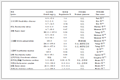
High salinity can destabilize many materials, but certain MOFs, such as those with robust metal-oxo clusters (e.g., UiO-66, MIL-53), remain stable and functional in saline water. This makes them more suitable for desalination and salt-laden wastewater treatment when integrated as MNMs. Transforming these MOFs (which are stable under harsh conditions) into MNMs will increase their efficiency many folds. The recent reports on MNMs; shape, propulsion type, mechanism and applications have been summarized in Table 1.
 DownLoad:
CSV
DownLoad:
CSV
| MNM | Shape and dimensions | Propulsion type (and speed) | Pollutant and removal efficiency | Working mechanism | Ref. |
| Fe3O4@Ce-CAU-28 | Rod like, 1 µm long and diameter of about 150 nm | Magnetic driven rotating and tumbling | MB, 100% removal efficiency after 10 min | Adsorption | [70] |
| MnFe2O4@MIL-53@UiO-66@MnO2 | Spherical with humps, 310 nm | Chemical propulsion by the catalytic decomposition of H2O2 and collected after use through magnetic field | Pb(Ⅱ), 1018 mg/g and Cd(Ⅱ), 440.8 mg/g | Chemisorption through ion exchange | [86] |
| MOF-525(Co)-Fe | Uniformly cubic, 700 nm | Chemical propulsion by the catalytic decomposition of H2O2 | MG, 85.73% in darkness and 93.55% in light | Adsorption and photocatalytic degradation | [87] |
| Asymmetric yolk-shell ZIF-67@PDA | Rhombohedral | NIR driven (10.3 μm/s) | MB | Selective adsorption | [88] |
| MNR-MOF-DMSA | Rod like arranged in pod-like pattern | Magnetic driven | Au(Ⅲ), 1716 mg/g at 318 K | Selective adsorption and reduction into Au(0) | [89] |
| CAT-ZIF-8 | Hexagonal, around 500 nm | Cyclic vertical motion by bubble propulsion through decomposition of H2O2 (0.2%−1%) by catalyze enzyme | Heavy metals and perfluorooctanoic acid (PFOA) with up to 99% removal efficiency, removal efficiency of up to 100% for Ce and 90% for Cu | Pollutant mass transfer and adsorption | [119] |
| PDA@UiO-66 | Spherical, 335 ± 10 nm | NIR (980 nm) driven through self-thermophoresis, 18.8 μm/s speed | MB with 78% removal efficiency | Adsorption | [122] |
MNMs carry not only toxicological concerns related to MOFs but additional ones related to propulsion fuel as well. Need to make propulsion mechanisms green is as necessary as green synthesis of MOFs [132]. Mostly chemically propelled MNMs rely on H2O2 as fuel (as we cited in Section 5.1), which can generate reactive oxygen species (ROS), oxidizing useful organic compounds as well. It can lead to pH change of water (especially disturbing microenvironments) and long-term use may cause oxidative stress in aquatic life. Despite toxicological effects, H2O2 fuel-based propulsion is most popular, researchers need to bring other sustainable propulsion methods in practice to minimize fuel toxicity.
MNMs are exceling in the removal of pollutants owing to faster adsorption kinetics and semi-autonomous or autonomous high mobility. Magnetic recovery option is available for MNMs with magnetic components through external magnetic and then reusing them for same application, making them sustainable and materials of future [114]. ZIF-67 based MNMs has shown up to 65% Au and Pd uptake even after five cycles of use, reduced activity is attributed to deactivation of MNM surface and loss of MNM during magnetic recovery [133]. MOFs contain transition metals and organic and inorganic functional entities, when all the components are integrated as MNMs, mostly they are not biodegradable. For biomedical applications, biodegradable MOF machines have shown some progress, there is need to consider nanomachines biodegradability in environmental applications as well [134]. MNMs or components of MNMs may act as secondary pollutants. In this way, on one side MNMs are working to remove heavy metals and organic pollutants but on the other side they may contribute towards nano-waste, transition metals leachates and toxic organic linkers just like pristine MOFs under certain conditions. As ZIF-67-SO4 used for ciprofloxacin removal showed Cu leaching up to 4.5 mg/L [135]. So, life cycle of MNMs in practical mimic environments needs to be evaluated before use for real applications. Quick decrease in performance with every cycle not only reduces their efficiency but makes them unsustainable in terms of economy and environment. Fate of MNMs after use is also a big question. Although, most concerns are visible after long-term use only and are much lesser than other materials used for water remediation still cannot be left unattended. Toxicological effects of biomedical MOF nanomachines have been somewhat discussed [136], but again toxicological study, accumulation, degradability and degradation pathways of MNMs in water treatment applications present a research gap demanding further experimental evaluation and case studies.
Major challenges lie in the synthesis of MNMs; we need to make it green and fast. Being nano-ranged materials, they provide more surface area but maintain this nano size, porosity and water stability while combing all functional entities is itself a challenge. Often pore size is reduced a lot while maintaining water stability. That is the reason, the ratio of reported MNMs in water treatment is much less than reported in biomedical applications. Future research can focus on increasing the stability and reusability of MNMs by working out on the more efficient methods to recollect MNMs after usage and exploring more DFT can be used to predict stable metals, linkers and other functionalities by running simulations of transformation upon interactions with specific pollutants. Similarly, stability of MNM under different conditions, its possible mechanism of pollutant removal can be predicted using DFT. It will not only optimize synthesis but help to fabricate more efficient MNMs. Artificial intelligence has been found helpful in designing MNMs tailored for specific jobs, so it is with machine learning. But machine learning algorithms are complicated and demands expertise which is difficult to get for a chemist. So, collaboration of ML scientists and chemists can take MNMs to the next level and is great dimension to follow in future research.
Further in MNMs, adsorption combined with catalytic degradation and other reactions is not only removing contaminants but also converting them into harmless compounds. It has potential to be future research with clear roadmap, with further extension to get useful products like ammonia, chlorine gas or other useful chlorinated compounds, hydrogen sulfide, carbon dioxide, hydrogen (as energy source) from nitrates/nitrites/urea, perchlorates, sulphates and phenolic compounds in wastewater from different sources. Using autonomous MNMs to get wastewater cleaned and getting these valuable byproducts will not only bring environmental remediation but support circular economy as well. Photocatalytic light propelled MNMs getting double advantages of mobility as well as catalytic action through light, is more exciting direction for future researchers. Scalability of these MNMs and mass production for real field applications is also a clear future roadmap to be explored along with their stability and functioning in complicated conditions of real waterbodies.
Metal-organic frameworks (MOFs) and nanorobotics are a new area of water treatment research with unparalleled virtues in selectivity, efficiency, and versatility. In this review, we critically evaluate the different synthesis pathways of MOFs and post synthetic modifications for water treatment applications, how these MOFS are transformed into autonomous nanomachines along with shapes of MNMs, their propulsion systems, and functionalization methods in a unique series unlike any other existing work. While MOFs possess high adsorption capacity, tunable porosity, and reusability. Likewise, nanorobotics offers efficient, autonomous, and targeted elimination of pollutants but their mass deployment is impeded by complicated fabrication pathways and toxicological hazard.
To address these challenges, inter-disciplinary breakthroughs in material engineering, catalysis, and bio-inspired design are needed. Future work should also aim at promoting long-term stability of MOFs in natural water matrices, maximizing nanorobotic propulsion for efficient removal of pollutants, and making eco-friendly degradation or recovery of released substances. Moreover, extensive environmental and toxicological investigations are needed to evaluate potential MOF and nanorobotics risks in aquatic environments. Use of Ai, ML and DFT is bit challenging for lab chemists but can help a lot in designing more effective MNMs. The integration of MOFs and nanorobotics is a paradigm shift in water treatment towards more efficient, autonomous, and smart treatment technologies. Yet, to narrow the gap between laboratory-scale research and practical applications, there is a need for interdisciplinary partnerships between researchers, industry players, and policymakers. Transcending the existing limitations and knowledge gaps, MOF-based nanorobotics can transform water treatment technologies into scalable, effective, and environmentally friendly solutions to the global water crisis.
Nadia Tahir: Writing – original draft, Methodology, Investigation, Formal analysis, Conceptualization. Tayyaba Najam: Visualization, Validation, Supervision, Software, Methodology, Investigation, Funding acquisition, Formal analysis, Conceptualization. Muhammad Altaf Nazir: Writing – review & editing, Investigation, Funding acquisition, Formal analysis, Conceptualization. Ayesha Arif: Visualization, Validation, Software, Resources, Methodology, Investigation, Formal analysis. Ayman Nafady: Visualization, Software, Resources, Investigation, Conceptualization. Manzar Sohail: Resources, Project administration, Methodology, Investigation, Funding acquisition, Formal analysis, Data curation. Syed Shoaib Ahmad Shah: Writing – review & editing, Supervision, Software, Resources, Methodology, Investigation, Conceptualization.
The authors express their appreciation to the Deputyship for Research and Innovation, "Ministry of Education" in Saudi Arabia for funding this research (No. IFKSU-HCRA-002–2), we are also thankful to NUST-Flagship Project (No. FSP-23–08) and Pakistan Science Foundation (No. PSF-NSFC-V/ENG/C—NUST/36).
Supplementary material associated with this article can be found, in the online version, at doi:
M. Hmoudah, Innovative Materials for Water Purification, Åbo Akademi University & Università di Napoli 'Federico Ⅱ, 2024.
B.M. Jun, Y.A. Al-Hamadani, A. Son, et al., Sep. Purif. Technol. 247 (2020) 116947. doi: 10.1016/j.seppur.2020.116947
M. Urso, M. Ussia, M. Pumera, Nat. Rev. Bioeng. 1 (2023) 236–251. doi: 10.1038/s44222-023-00025-9
J. Kim, P. Mayorga-Burrezo, S.J. Song, et al., Chem. Soc. Rev. 53 (2024) 9190–9253. doi: 10.1039/D3CS00777D
K. Leus, T. Bogaerts, J. De Decker, et al., Micropor. Mesopor. Mater. 226 (2016) 110–116. doi: 10.1016/j.micromeso.2015.11.055
Y. Li, R.T. Yang, Langmuir 23 (2007) 12937–12944. doi: 10.1021/la702466d
D.Y. Kang, J.S. Lee, Langmuir 39 (2023) 2871–2880. doi: 10.1021/acs.langmuir.2c03458
S. Mallakpour, E. Nikkhoo, C.M. Hussain, Coord. Chem. Rev. 451 (2022) 214262. doi: 10.1016/j.ccr.2021.214262
C. Hu, S. Pané, B.J. Nelson, Annu Rev. Control Robot. Auton. Syst. 1 (2018) 53–75. doi: 10.1146/annurev-control-060117-104947
B. Arora, P. Attri, J. Compos. Sci. 4 (2020) 135. doi: 10.3390/jcs4030135
M. Safarpour, A. Khataee, Graphene-based materials for water purification, in: S. Thomas, D. Pasquini, S. Leu, D.A. Gopakumar (Eds. ), Nanoscale Materials in Water Purification, Elsevier, 2019, pp. 383–430.
L. Wang, H. Du, X. Wang, et al., Environ. Res. 252 (2025) 121166.
H. Wang, X. Li, X. Zhao, et al., Chin. J. Catal. 43 (2022) 178–214. doi: 10.1016/S1872-2067(21)63910-4
B. Shen, H. Du, A. Liu, et al., J. Cleaner Prod. 523 (2025) 146458. doi: 10.1016/j.jclepro.2025.146458
L. Li, Z. Xu, W. Sun, et al., J. Membr. Sci. 598 (2020) 117661. doi: 10.1016/j.memsci.2019.117661
Y. Wang, Y. Guo, C. Yang, et al., J. Environ. Chem. Eng. 11 (2023) 109798. doi: 10.1016/j.jece.2023.109798
S. Yu, H. Pang, S. Huang, et al., Sci. Total. Environ. 800 (2021) 149662. doi: 10.1016/j.scitotenv.2021.149662
A. Terzopoulou, J.D. Nicholas, X.Z. Chen, et al., Chem. Rev. 120 (2020) 11175–11193. doi: 10.1021/acs.chemrev.0c00535
H. Wang, M. Pumera, Chem. Rev. 115 (2015) 8704–8735. doi: 10.1021/acs.chemrev.5b00047
X. Lin, Z. Wu, Y. Wu, et al., Adv. Mater. 28 (2016) 1060–1072. doi: 10.1002/adma.201502583
H. Ye, Y. Wang, D. Xu, et al., Appl. Mater. Today 23 (2021) 101007. doi: 10.1016/j.apmt.2021.101007
X. Chang, Y. Feng, B. Guo, et al., Nanoscale 14 (2022) 219–238. doi: 10.1039/D1NR07172F
Q. Yang, L. Xu, W. Zhong, et al., Adv. Intell. Syst. 2 (2020) 2000049. doi: 10.1002/aisy.202000049
F. Wong, K.K. Dey, A. Sen, Annu Rev. Mater. Res. 46 (2016) 407–432. doi: 10.1146/annurev-matsci-070115-032047
H. Wang, M. Pumera, Nanoscale 9 (2017) 2109–2116. doi: 10.1039/C6NR09217A
F. Zha, T. Wang, M. Luo, et al., Micromachines 9 (2018) 78. doi: 10.3390/mi9020078
Y. Tu, F. Peng, D.A. Wilson, Adv. Mater. 29 (2017) 1701970. doi: 10.1002/adma.201701970
S. Sánchez, L. Soler, J. Katuri, Angew. Chem. Int. Ed. 54 (2015) 1414–1444. doi: 10.1002/anie.201406096
T. Xu, W. Gao, L.P. Xu, et al., Adv. Mater. 29 (2017) 1603250. doi: 10.1002/adma.201603250
J. Parmar, D. Vilela, K. Villa, et al., J. Am. Chem. Soc. 140 (2018) 9317–9331. doi: 10.1021/jacs.8b05762
Z. Wang, Y. Tu, Y. Chen, et al., Adv. Intell. Syst. 2 (2020) 1900081. doi: 10.1002/aisy.201900081
G. Tezel, S.S. Timur, F. Kuralay, et al., J. Drug Target. 29 (2021) 29–45. doi: 10.1080/1061186X.2020.1797052
Y. Fu, H. Yu, X. Zhang, et al., Micromachines 13 (2022) 295. doi: 10.3390/mi13020295
Y. Ying, M. Pumera, Chem. Eur. J. 25 (2019) 106–121. doi: 10.1002/chem.201804189
J. Wang, Y. Dong, P. Ma, et al., Adv. Mater. 34 (2022) 2201051. doi: 10.1002/adma.202201051
Z. Wang, Z. Xu, B. Zhu, et al., Nanotechnology 33 (2022) 152001. doi: 10.1088/1361-6528/ac43e6
K. El-Naggar, Y. Yang, W. Tian, et al., SmartMat 4 (2024) 2400110.
B. Khezri, M. Pumera, Adv. Mater. 31 (2019) 1806530. doi: 10.1002/adma.201806530
Y. Liu, J. Ge, Chem. Commun. 58 (2022) 2458–2470.
K. Vikrant, K.H. Kim, Catal. Sci. Technol. 11 (2021) 6592–6600. doi: 10.1039/D1CY01124C
M. Falahati, M. Sharifi, T.L.T. Hagen, J. Nanobiotechnol. 20 (2022) 153. doi: 10.1186/s12951-022-01375-z
J. Bujalance-Fernández, B. Jurado-Sánchez, A. Escarpa, Chem. Commun. 59 (2023) 10464–10475. doi: 10.1039/D3CC02775A
H. Yang, L. Wang, X. Huang, Coord. Chem. Rev. 495 (2023) 215372. doi: 10.1016/j.ccr.2023.215372
K. Gu, F. Meng, Former research and recent advances of metalorganic frameworks (MOF) for anti-cancer drug delivery, J. Phys.: Conf. Ser. 2021 (2021) 012021. doi: 10.1088/1742-6596/2021/1/012021
G. Mouchaham, F.S. Cui, F. Nouar, et al., Trends. Chem. 2 (2020) 990–1003. doi: 10.1016/j.trechm.2020.09.004
P. Li, Y. Peng, J. Cai, et al., Bioengineering 10 (2023) 733. doi: 10.3390/bioengineering10060733
P. Narea, I. Brito, Y. Quintero, et al., Int. J. Mol. Sci. 25 (2023) 199. doi: 10.3390/ijms25010199
M.I. Severino, A. Al Mohtar, C.V. Soares, et al., J. Mater. Chem. A 11 (2023) 4238–4247. doi: 10.1039/D2TA09252B
J. Lyu, X. Zhang, K.I. Otake, et al., Chem. Sci. 10 (2019) 1186–1192. doi: 10.1039/C8SC04220A
L.H. Xie, M.M. Xu, X.M. Liu, et al., Adv. Sci. 7 (2020) 1901758. doi: 10.1002/advs.201901758
M.A. Gatou, I.A. Vagena, N. Lagopati, et al., Nanomaterials 13 (2023) 2224. doi: 10.3390/nano13152224
G. Wu, J. Ma, S. Li, et al., J. Colloid. Interface Sci. 528 (2018) 360–371. doi: 10.1016/j.jcis.2018.05.105
N.A. Khan, S.H. Jhung, Fuel Process. Technol. 100 (2012) 49–54. doi: 10.1016/j.fuproc.2012.03.006
S. Sundararaman, J. Chacko, D. Prabu, et al., Chemosphere 362 (2024) 142729. doi: 10.1016/j.chemosphere.2024.142729
D. Sud, G. Kaur, Polyhedron 193 (2021) 114897. doi: 10.1016/j.poly.2020.114897
A.B.D. Nandiyanto, Indones. J. Sci. Technol. 4 (2019) 220–228.
F. Zou, R. Yu, R. Li, et al., ChemPhysChem 14 (2013) 2825–2832. doi: 10.1002/cphc.201300215
J. Klinowski, F.A. Almeida Paz, P. Silva, et al., Dalton Trans. 40 (2011) 321–330. doi: 10.1039/C0DT00708K
P.T. Phan, J. Hong, N. Tran, et al., Nanomaterials 13 (2023) 352. doi: 10.3390/nano13020352
T. Friščić, Encycl. Inorg. Bioinorg. Chem. (2011) 1–19.
E. Tahmasebi, M.Y. Masoomi, Y. Yamini, et al., Inorg. Chem. 54 (2015) 425–433. doi: 10.1021/ic5015384
M. Taheri, T.G. Enge, T. Tsuzuki, Mater. Today Chem. 16 (2020) 100231. doi: 10.1016/j.mtchem.2019.100231
S.C. Motshekga, O.A. Oyewo, S.S. Makgato, J. Inorg. Organomet. Polym. Mater. 34 (2024) 3907–3930. doi: 10.1007/s10904-024-03063-x
A.R. Abbasi, M. Karimi, K. Daasbjerg, Ultrason. Sonochem. 37 (2017) 182–191. doi: 10.1016/j.ultsonch.2017.01.007
F. Zarekarizi, A. Morsali, Ultrason. Sonochem. 69 (2020) 105246. doi: 10.1016/j.ultsonch.2020.105246
Z. Liang, Y. Liang, P. Yu, et al., RSC Adv. 14 (2024) 15095–15105. doi: 10.1039/D4RA02099E
F. Israr, D.K. Kim, Y. Kim, et al., Ultrason. Sonochem. 29 (2016) 186–193. doi: 10.1016/j.ultsonch.2015.08.023
J. Abdi, A.J. Sisi, M. Hadipoor, et al., J. Hazard. Mater. 424 (2022) 127558. doi: 10.1016/j.jhazmat.2021.127558
Z. Wang, S.M. Cohen, Chem. Soc. Rev. 38 (2009) 1315–1329. doi: 10.1039/b802258p
X. Liu, R. Dong, Y. Chen, et al., Mater. Today Nano 18 (2022) 100182. doi: 10.1016/j.mtnano.2022.100182
Y. Zhang, K. Yuan, L. Zhang, Adv. Mater. Technol. 4 (2019) 1800636. doi: 10.1002/admt.201800636
B. Esteban-Fernández de Ávila, D.E. Ramírez-Herrera, S. Campuzano, et al., ACS Nano 11 (2017) 5367–5374. doi: 10.1021/acsnano.7b01926
Q. Cao, Y. Zhang, Y. Tang, et al., Sci. China Chem. 67 (2024) 1216–1223. doi: 10.1007/s11426-023-1875-7
Y. Zhou, M. Ye, C. Hu, et al., ACS Nano 17 (2023) 15254–15276. doi: 10.1021/acsnano.3c01942
M. Guix, J. Orozco, M. Garcia, et al., ACS Nano 6 (2012) 4445–4451. doi: 10.1021/nn301175b
A.C. Hortelao, R. Carrascosa, N. Murillo-Cremaes, et al., ACS Nano 13 (2018) 429–439.
B. Jurado-Sánchez, M. Pacheco, J. Rojo, et al., Angew. Chem. Int. Ed. 56 (2017) 6957–6961. doi: 10.1002/anie.201701396
F. Kuralay, S. Sattayasamitsathit, W. Gao, et al., J. Am. Chem. Soc. 134 (2012) 15217–15220. doi: 10.1021/ja306080t
V.V. Khutoryanskiy, Macromol. Biosci. 11 (2011) 748–764. doi: 10.1002/mabi.201000388
Y. Li, J. Wu, H. Oku, et al., Adv. Nanobiomed. Res. 2 (2022) 2200074. doi: 10.1002/anbr.202200074
J.A. Delezuk, D.E. Ramírez-Herrera, B.E.F. de Ávila, et al., Nanoscale 9 (2017) 2195–2200. doi: 10.1039/C6NR09799E
Z. Ma, H. Zhao, S. Jiang, et al., Sep. Purif. Technol. 354 (2025) 134835.
S. Preetam, Nanoscale Adv. 6 (2024) 2569–2581. doi: 10.1039/D3NA01106B
W. Gao, X. Feng, A. Pei, et al., Nanoscale 5 (2013) 4696–4700. doi: 10.1039/c3nr01458d
J. Ali, U.K. Cheang, J.D. Martindale, et al., Sci. Rep. 7 (2017) 14098. doi: 10.1038/s41598-017-14457-y
W. Yang, Y. Qiang, M. Du, et al., J. Hazard. Mater. 435 (2022) 128967. doi: 10.1016/j.jhazmat.2022.128967
D. Lan, J. Xue, Q. Chen, et al., Sustainable Mater. Technol. 43 (2025) e01324. doi: 10.1016/j.susmat.2025.e01324
X. Li, Q. Hao, Y. Luan, et al., Appl. Mater. Today 38 (2024) 102220. doi: 10.1016/j.apmt.2024.102220
H. Li, L. Luo, Y. Pan, et al., Sep. Purif. Technol. 354 (2025) 128997. doi: 10.1016/j.seppur.2024.128997
J. Katuri, X. Ma, M.M. Stanton, et al., Acc. Chem. Res. 50 (2017) 2–11. doi: 10.1021/acs.accounts.6b00386
Q. Wang, Y. Wang, B. Guo, et al., J. Mater. Chem. B 7 (2019) 2688–2695. doi: 10.1039/C9TB00131J
J. Li, S. Yang, J.Z. Jiang, et al., J. Electroanal. Chem. 781 (2016) 245–250. doi: 10.1016/j.jelechem.2016.07.039
N. Hu, M. Sun, X. Lin, et al., Adv. Funct. Mater. 28 (2018) 1705684. doi: 10.1002/adfm.201705684
C. Xin, D. Jin, R. Li, et al., Small 18 (2022) 2202272. doi: 10.1002/smll.202202272
R. Wang, W. Guo, X. Li, et al., RSC Adv. 7 (2017) 42462–42467. doi: 10.1039/C7RA08127H
S. Wang, H. Ye, Y. Wang, et al., ChemistrySelect 7 (2022) e202104034. doi: 10.1002/slct.202104034
Y. Ying, A.M. Pourrahimi, Z. k. Sofer, et al., ACS Nano 13 (2019) 11477–11487. doi: 10.1021/acsnano.9b04960
D. Vilela, J. Parmar, Y. Zeng, et al., Nano Lett. 16 (2016) 2860–2866. doi: 10.1021/acs.nanolett.6b00768
L. Chen, M.J. Zhang, S.Y. Zhang, et al., ACS Appl. Mater. Interfaces Provid. 12 (2020) 35120–35131. doi: 10.1021/acsami.0c11283
L. Soler, V. Magdanz, V.M. Fomin, et al., ACS Nano 7 (2013) 9611–9620. doi: 10.1021/nn405075d
L. Chen, H. Yuan, S. Chen, et al., ACS Appl. Mater. Interfaces Provid. 13 (2021) 31226–31235. doi: 10.1021/acsami.1c03595
X. Liu, X. Sun, Y. Peng, et al., ACS Nano 16 (2022) 14666–14678. doi: 10.1021/acsnano.2c05295
Y. Yang, X. Arqué, T. Patiño, et al., J. Am. Chem. Soc. 142 (2020) 20962–20967. doi: 10.1021/jacs.0c11061
M. Ikram, F. Hu, G. Peng, et al., ACS Appl. Mater. Interfaces Provid. 13 (2021) 51799–51806. doi: 10.1021/acsami.1c16902
Y. Jung, S.J. Yoon, J. Byun, et al., Water Res. 244 (2023) 120543. doi: 10.1016/j.watres.2023.120543
J.V. Vaghasiya, C.C. Mayorga-Martinez, S. Matějková, et al., Nat. Commun. 13 (2022) 1026. doi: 10.1038/s41467-022-28406-5
B. Esteban-Fernández de Ávila, C. Angell, F. Soto, et al., ACS Nano 10 (2016) 4997–5005. doi: 10.1021/acsnano.6b01415
T. Xu, F. Soto, W. Gao, et al., J. Am. Chem. Soc. 137 (2015) 2163–2166. doi: 10.1021/ja511012v
F. Zhang, J. Zhuang, B. Esteban Fernández de Ávila, et al., ACS Nano 13 (2019) 11996–12005. doi: 10.1021/acsnano.9b06127
V. Garcia-Gradilla, J. Orozco, S. Sattayasamitsathit, et al., ACS Nano 7 (2013) 9232–9240. doi: 10.1021/nn403851v
G. Mu, Y. Qiao, M. Sui, et al., Front. Bioeng. Biotechnol. 11 (2023) 1276485. doi: 10.3389/fbioe.2023.1276485
J. Guo, J.J. Gallegos, A.R. Tom, et al., ACS Nano 12 (2018) 1179–1187. doi: 10.1021/acsnano.7b06824
J. Liu, J. Li, G. Wang, et al., J. Colloid. Interface Sci. 555 (2019) 234–244. doi: 10.1016/j.jcis.2019.07.059
W. Yang, Y. Qiang, M. Du, et al., J. Hazard. Mater. 435 (2022) 128967. doi: 10.1016/j.jhazmat.2022.128967
Z.P. Qi, J.M. Yang, Y.S. Kang, et al., Dalton. Trans. 45 (2016) 8753–8759. doi: 10.1039/C6DT00886K
C. Liu, L.Q. Yu, Y.T. Zhao, et al., Microchim. Acta 185 (2018) 342. doi: 10.1007/s00604-018-2879-2
W. Yang, J. Li, Z. Xu, et al., J. Mater. Chem. C 7 (2019) 10297–10308. doi: 10.1039/C9TC03328A
J. Liu, P. Wang, H. Zhu, et al., Sep. Purif. Technol. 354 (2025) 134804.
Z. Guo, J. Liu, Y. Li, et al., Chem. Commun. 56 (2020) 14837–14840. doi: 10.1039/D0CC06429G
D. Lan, H. Zhu, J. Zhang, et al., Chemosphere 293 (2022) 133464. doi: 10.1016/j.chemosphere.2021.133464
H. Zangeneh, A.A. Zinatizadeh, M. Habibi, et al., J. Ind. Eng. Chem. 26 (2015) 1–36.
Y. Zhao, D. Wang, Y. Luan, et al., Mater. Today Sustain. 18 (2022) 100129.
R. Wang, W. Guo, X. Li, et al., RSC Adv. 7 (2017) 42462–42467. doi: 10.1039/C7RA08127H
L. Chen, M.J. Zhang, S.Y. Zhang, et al., ACS Appl. Mater. Interfaces Providence 12 (2020) 35120–35131. doi: 10.1021/acsami.0c11283
J. Yang, J. Li, X. Yan, et al., ACS Appl. Mater. Interfaces Providence 14 (2022) 6484–6498. doi: 10.1021/acsami.1c18086
G. Wyszogrodzka, B. Marszałek, B. Gil, et al., Drug Discov. Today 21 (2016) 1009–1018. doi: 10.1016/j.drudis.2016.04.009
H. Huang, Y. Zhao, H. Yang, et al., Nanoscale 15 (2023) 14165–14174. doi: 10.1039/D3NR02299D
Y. Zhao, M. Yuan, H. Yang, et al., Small 20 (2024) 2305189. doi: 10.1002/smll.202305189
W. Guo, Y. Wang, K. Zhang, et al., Chem. Mater. 35 (2023) 6853–6864. doi: 10.1021/acs.chemmater.3c01140
L. Zhang, Y. Liu, S. Liu, et al., Int. J. Biol. Macromol. 282 (2024) 137367. doi: 10.1016/j.ijbiomac.2024.137367
L. Yu, Q. Jia, C. Lu, et al., Sep. Purif. Technol. 354 (2025) 129088. doi: 10.1016/j.seppur.2024.129088
R. Ettlinger, U. Lächelt, R. Gref, et al., Chem. Soc. Rev. 51 (2022) 464–484. doi: 10.1039/D1CS00918D
S. Ali, Z. Zuhra, T. Nawaz, et al., J. Cleaner Prod. 522 (2025) 146366. doi: 10.1016/j.jclepro.2025.146366
A. Terzopoulou, X. Wang, X.Z. Chen, et al., Adv. Healthcare Mater. 9 (2020) 2001031. doi: 10.1002/adhm.202001031
A. Dehghan, A.A. Mohammadi, M. Yousefi, et al., Nanomaterials 9 (2019) 1422. doi: 10.3390/nano9101422
R. Arvidsson, S.F. Hansen, Environ. Sci.: Nano 7 (2020) 2875–2886. doi: 10.1039/D0EN00570C

Figure 2 Different synthesis and post synthesis modification methods for MOFs in water treatment applications.

Figure 3 (a) SEM image of Fe3O4@Ce-MOF. (b) TEM image and elemental mapping of Fe3O4@Ce-MOF. Reproduced with permission [70]. Copyright 2022, Elsevier. (c) SEM image of MnFe2O4@MIL-53@UiO-66@MnO2. Reproduced with permission [86]. Copyright 2022, Elsevier. (d) TEM images of MOF-525(Co)-Fe. (e) SEM image of MOF-525(Co)-Fe. Reproduced with permission [87]. Copyright 2025, Elsevier. (f) SEM images of ZIF-67@PDA at 20 h. Reproduced with permission [88]. Copyright 2024, Elsevier. (g) Schematic illustration of the preparation of MNR-MOF-DMSA. Reproduced with permission [89]. Copyright 2025, Elsevier.

Figure 4 (a) The preparation of MnFe2O4@MIL-53@UiO-66@MnO2. Reproduced with permission [86]. Copyright 2022, Elsevier. (b) Schematic illustration of the synthesis of asymmetric yolk-shell structured ZIF-67@PDA nanocomposites with rhombic dodecahedron shape. Reproduced with permission [88]. Copyright 2024, Elsevier.

Figure 5 (a) Moving trajectory of MOF-525(Co)-Fe nanomotors under different concentrations of H2O2. Reproduced with permission [87]. Copyright 2025, Elsevier. (b) Schematic illustration of ZIF-67@PDA nanomotors driven by NIR light. Reproduced with permission [88]. Copyright 2024, Elsevier. Schematic diagram of a single nanomotor Fe3O4@Ce-MOF in (c) tumbling mode and (d) rotating mode. Reproduced with permission [70]. Copyright 2022, Elsevier.

Figure 6 Illustration of different propulsion mechanisms of MNMs: Bubble propulsion, enzymatic propulsion, magnetic propulsion, electric propulsion, UV propulsion, ultrasonic propulsion and self-diffusiophoretic propulsion.

Figure 7 Illustration of MNMs applications: Catalytic degradation, adsorption and removal of dyes and ions, pollutant sensing and disinfection.

Figure 8 (a) Adsorption mechanism of gold ions by MNR-MOF-DMSA. (b) Removal efficiency of MNR-MOF and MNR-MOF-DMSA for different metal ions from solution. Reproduced with permission [89]. Copyright 2025, Elsevier. (c) Malachite green removal efficiencies of different MOF samples. Reproduced with permission [87]. Copyright 2025, Elsevier. (d) Removal efficiency (R %) of MB and MO under different conditions at 30 min adsorption. Reproduced with permission [88]. Copyright 2024, Elsevier.
Table 1. Summary of remarkable features of recent MNMs.
| MNM | Shape and dimensions | Propulsion type (and speed) | Pollutant and removal efficiency | Working mechanism | Ref. |
| Fe3O4@Ce-CAU-28 | Rod like, 1 µm long and diameter of about 150 nm | Magnetic driven rotating and tumbling | MB, 100% removal efficiency after 10 min | Adsorption | [70] |
| MnFe2O4@MIL-53@UiO-66@MnO2 | Spherical with humps, 310 nm | Chemical propulsion by the catalytic decomposition of H2O2 and collected after use through magnetic field | Pb(Ⅱ), 1018 mg/g and Cd(Ⅱ), 440.8 mg/g | Chemisorption through ion exchange | [86] |
| MOF-525(Co)-Fe | Uniformly cubic, 700 nm | Chemical propulsion by the catalytic decomposition of H2O2 | MG, 85.73% in darkness and 93.55% in light | Adsorption and photocatalytic degradation | [87] |
| Asymmetric yolk-shell ZIF-67@PDA | Rhombohedral | NIR driven (10.3 μm/s) | MB | Selective adsorption | [88] |
| MNR-MOF-DMSA | Rod like arranged in pod-like pattern | Magnetic driven | Au(Ⅲ), 1716 mg/g at 318 K | Selective adsorption and reduction into Au(0) | [89] |
| CAT-ZIF-8 | Hexagonal, around 500 nm | Cyclic vertical motion by bubble propulsion through decomposition of H2O2 (0.2%−1%) by catalyze enzyme | Heavy metals and perfluorooctanoic acid (PFOA) with up to 99% removal efficiency, removal efficiency of up to 100% for Ce and 90% for Cu | Pollutant mass transfer and adsorption | [119] |
| PDA@UiO-66 | Spherical, 335 ± 10 nm | NIR (980 nm) driven through self-thermophoresis, 18.8 μm/s speed | MB with 78% removal efficiency | Adsorption | [122] |
 下载: 导出CSV

 扫一扫看文章


扫一扫关注我们

 下载:
下载: