Citation:
Zhimin Wu, Syed Ali Abbas Abedi, Rongrong Huang, Lili Lin, Xiaogang Liu. Barrierless conical intersection as a photophysical design principle for photoacoustic and photothermal contrast agents[J]. Chinese Chemical Letters,
2026, 37(12): 112315.
doi:
10.1016/j.cclet.2025.112315
Barrierless conical intersection as a photophysical design principle for photoacoustic and photothermal contrast agents
English
Barrierless conical intersection as a photophysical design principle for photoacoustic and photothermal contrast agents
Shandong Key Laboratory of Medical Physics and Image Processing & Shandong Provincial Engineering and Technical Center of Light Manipulations, School of Physics and Electronics, Shandong Normal University, Ji’nan 250358, China
b.
Fluorescence Research Group, Singapore University of Technology and Design, Singapore 487372, Singapore
c.
School of Chemistry, Chemical Engineering and Biotechnology, Nanyang Technological University, Singapore 637371, Singapore
Received Date:
30 August 2025 Accepted Date:
22 December 2025 Revised Date:
22 December 2025 Available Online:
15 December 2026
Abstract:
Photoacoustic imaging (PAI) and photothermal therapy (PTT) require contrast agents that combine strong near-infrared (NIR) absorption, high photothermal conversion efficiency, and exceptional photostability. Despite the proliferation of PAI/PTT contrast agents, most have been developed empirically, with limited mechanistic understanding guiding design. Here, we introduce the NIR–barrierless access to conical-intersection thermocycling (NIR-BLACIT) model as a guiding photophysical framework for high-performance PAI/PTT agents. In this model, strong NIR absorption couples to ultrafast, barrierless transitions to conical intersection (CI) formation and rapid nonradiative decay, minimizing excited-state lifetimes and maximizing heat release. Using combined computational and experimental analysis, we identify structural determinants of NIR-BLACIT behavior in positive examples (T-AzHCy series and QC-1) and negative controls (indocyanine green (ICG) and E-AzCy7). We demonstrate that backbone-integrated azo linkages enhance the TICT propensity, lower rotational barriers, and increase the driving energies toward CI access. Guided by this principle, we designed NN7Cy and NNBDP, two novel azo-cyanine derivatives, that achieve strong NIR absorption, high oscillator strengths, and (nearly) barrierless CI access. This strategy extends beyond azo linkages; other low-energy-gap systems, such as BAF dyes, also meet the NIR-BLACIT criteria. Our findings establish NIR-BLACIT as a predictive and generalizable design principle for next-generation optoacoustic and photothermal agents.
Photoacoustic imaging (PAI) and photothermal therapy (PTT) are two complementary biomedical techniques that convert absorbed light into heat for diagnostic and therapeutic purposes [1-3]. While PAI enables high-resolution, non-invasive imaging at depths of several centimeters [4-6], and PTT delivers localized hyperthermia for targeted ablation [7,8], both rely critically on the performance of molecular contrast agents [3,9,10]. Despite significant experimental progress [11-15], the rational design of agents that combine strong near-infrared (NIR) absorption, efficient photothermal conversion, and high photostability remains a considerable challenge. Most existing agents have been developed empirically, and the lack of a guiding photophysical framework continues to limit predictive molecular engineering.
The molecular requirements for high-performance PAI and PTT agents are strikingly similar. Both demand strong absorption in the NIR-Ⅰ (650–950 nm) or NIR-Ⅱ (1000–1350 nm) windows to maximize tissue penetration while minimizing scattering and phototoxicity [10,16,17]. High molar absorptivity in these regions boosts energy deposition, which is essential for both strong photoacoustic signal generation and effective photothermal heating [13,18,19]. Efficient nonradiative decay pathways are needed to maximize heat production [8,20,21], while high photostability ensures long-lasting performance during extended imaging or treatment sessions [22]. In vivo compatibility and low phototoxicity are equally critical for clinical translation [3,10].
Numerous PAI/PTT agents have been reported, including indocyanine green (ICG) [16,23], hemicyanine derivatives [17,24], and benzobisthiadiazole-based dyes such as BAF4 [25,26]. ICG remains a clinical standard due to its U.S. Food and Drug Administration approval and favorable biocompatibility, yet it suffers from poor photostability and suboptimal photothermal conversion efficiency [10,27]. Hemicyanines [28] and BAF4 [29] exhibit impressive in vitro and in vivo performance—BAF4 nanoparticles, for example, reach photothermal conversion efficiencies of up to 80% under NIR-Ⅱ irradiation—but their underlying photophysical mechanisms remain elusive. In particular, the origin of their high performance is often attributed qualitatively to “fast relaxation” or “enhanced nonradiative decay” without a detailed mechanistic explanation [4,24]. This lack of clarity hinders the rational design of next-generation agents with predictable and tunable properties.
To address these limitations, we propose the NIR–barrierless access to conical-intersection thermocycling (NIR-BLACIT) model as a guiding photophysical framework for both PAI and PTT agent design. In NIR-BLACIT, strong NIR absorption is coupled to an ultrafast, barrierless transition from the first singlet excited state to a conical intersection (CI), enabling rapid nonradiative decay to the ground state. This mechanism yields ultrashort excited-state lifetimes, thereby suppressing photobleaching, reducing the formation of phototoxic reactive species, and maximizing heat release within each time frame. By explicitly linking structural features to excited-state dynamics, NIR-BLACIT provides a rational basis for designing photostable, high-efficiency agents for deep-tissue imaging and long-term therapeutic applications.
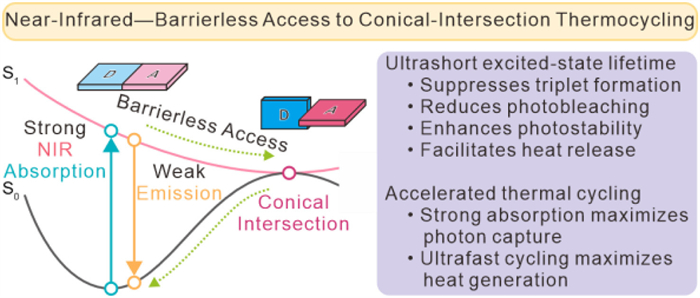
In this NIR-BLACIT framework, the molecule starts in its most stable ground-state geometry with strong absorption in the NIR window (Fig. 1). Upon NIR photoexcitation, it is promoted to the first singlet excited state (S1). The key feature of NIR-BLACIT is a barrierless pathway from the Franck-Condon region to a CI, often accessed through a twisted intramolecular charge transfer (TICT)-like motion. The significant driving force along this coordinate ensures a rapid, unhindered descent to the CI, where strong vibronic coupling enables ultrafast nonradiative decay back to the ground state, completing one thermocycling event.
Figure 1
Figure 1.
Schematic representation of the NIR-BLACIT mechanism. NIR absorption promotes the molecule from S0 to S1, followed by a barrierless downhill pathway to a CI. Ultrafast nonradiative decay returns the molecule to its ground state, S0, releasing energy as heat. The short excited-state lifetime enables rapid thermocycling, high heat output, and enhanced photostability.
By funneling nearly all the absorbed photon energy into vibrational modes, the NIR-BLACIT mechanism produces minimal fluorescence but strong heat output. This property is essential for PAI, where acoustic signal strength scales with thermal expansion, and for PTT, where heat drives therapeutic ablation.
A significant advantage of NIR-BLACIT is the intrinsically short excited-state lifetime. Minimizing the residence time in S1 reduces the probability of photobleaching and intersystem crossing (ISC) to triplet states, both of which are common causes of performance degradation and phototoxicity. Although photobleaching and ISC are not strictly forbidden, the excited-state population returns to the ground state (S0) so quickly that these competing processes have little opportunity to occur. This rapid decay is driven by a CI-mediated internal conversion, which dominates regardless of whether the excited state is locally excited (LE) or an electron-transfer (ET) state. Consequently, dyes operating under this mechanism exhibit enhanced photostability and biocompatibility, even under prolonged irradiation. It is worth noting that this mechanism, while enhancing photostability and biocompatibility, comes at the expense of fluorescence quantum yield. This trade-off makes the approach ideal for PTT and PAI applications, where strong fluorescence is not essential. However, for fluorescence-based imaging and sensing, alternative strategies, such as chemical structure modifications, tuning the local environment, or optimizing laser excitation conditions, should be considered to achieve better performance.
Short lifetimes also increase the maximum achievable thermal cycling rate. For example, if the excited-state lifetime is 1 ns, the upper limit is ~109 excitation-decay cycles per second. Reducing the lifetime to 10 ps raises this limit to ~1011 cycles per second, a hundred-fold increase, providing proportional amplification in potential heat output. This acceleration directly benefits both PAI signal intensity and PTT therapeutic efficacy. The critical role of shortening excited-state lifetimes in enhancing PAI/PTT performance has also been independently emphasized by several groups (such as Thorn-Seshold et al. [30], Stains et al. [31], as well as our own [32]).
To illustrate the NIR-BLACIT model, we studied representative contrast agents, positive examples including the T-AzHCy series (wsT-AzHCy, T-AzHCy1, T-AzHCy2) and QC-1, alongside negative controls such as ICG and E-AzCy7 (Table 1). The experimental data on these dyes reported by Thorn-Seshold et al. [30] enable us to elucidate their working mechanism through computational analysis.
Table 1
Table 1.
The experimental UV–vis–NIR absorption maxima (λabs), molar extinction coefficients (ε), fluorescence quantum yields, photoacoustic efficiencies of representative molecules, and remarks on their photoacoustic performance.a
a Data reported by Thorn-Seshold et al., unless otherwise stated [30]. b Data in ethanol reported by Draney et al. [33]. c Data reported by Sletten et al. [34]. d Not measured due to non-NIR spectra, poor solubility, or other issues.
Most of these dyes contain an azo fragment grafted onto the cyanine scaffold. The azo group, common in many dark quenchers, is well known for driving efficient nonradiative decay and heat generation. However, our results reveal that the precise position of azo incorporation has a profound impact on the performance of PAI. Combined computational studies (from our group) and experimental analyses (reported previously by the Thorn-Seshold group) allowed us to correlate azo placement with excited-state dynamics and PAI efficiency.
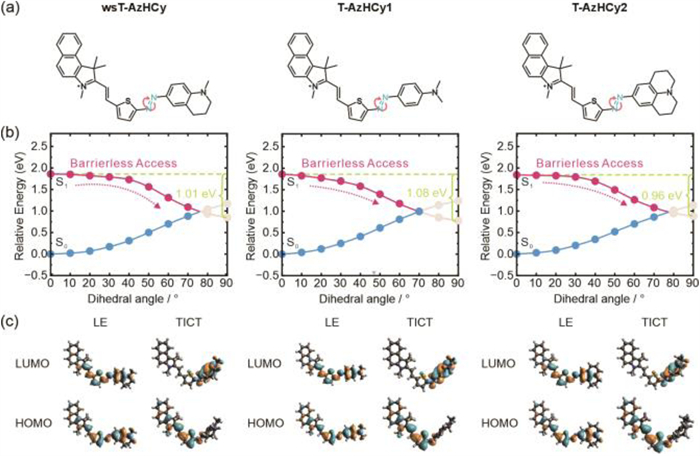
Backbone-integrated azo groups enable superior performance in the T-AzHCy series (Fig. 2a). These dyes combine strong NIR absorption, high photothermal conversion efficiency, robust photostability, and excellent PAI signal generation. The defining structural feature is the direct incorporation of the azo group into the main π-conjugated backbone, enabling barrierless access to CIs.
Figure 2
Figure 2.
Molecular structures and excited-state properties of wsT-AzHCy, T-AzHCy1, and T-AzHCy2. (a) Chemical structures of the three compounds, with the rotatable azo bond highlighted. (b) Potential energy surfaces of S0 and S1 as a function of rotation along the dihedral angle (as indicated by arrows in panel a) in water, showing barrierless access to the CI for all three compounds. Due to strong nonadiabatic coupling near the CI, TD-DFT calculations performed in this region may yield unreliable adiabatic state assignments and excitation energies. Accordingly, post-CI data are presented for qualitative illustration only. (c) Corresponding charge distributions of the frontier molecular orbitals, HOMO and LUMO, in both the LE and TICT states.
Extended π-conjugation enhances optical absorption and photothermal conversion. In the T-AzHCy series, extended conjugation yields red-shifted absorption with significant molar extinction coefficients (ε ≈ 4.0×10⁴ L mol−1 cm−1 per experimental measurements), consistent with high oscillator strengths (f > 2) obtained from quantum chemical calculations. These optical characteristics enable efficient photon capture.
Barrierless TICT rotation provides a direct route to CI formation with an ultrashort excited-state lifetime. Excited-state mapping revealed a 0.00 eV barrier for twisted intramolecular charge-transfer (TICT) rotation in the T-AzHCy series, leading to a CI at ~90° dihedral twist (Figs. 2b and c). To examine rotational tendencies, we constructed potential energy surfaces by incrementally rotating flexible bonds from ~0° to 90° in ~10° steps along the azo bond. According to the TICT model, a 90° twist separates the fluorophore into orthogonal donor and acceptor fragments, producing complete charge separation (oscillator strength f ≈ 0). This charge-separated state is highly polar, stabilized by solvent interactions, and naturally approaches the CI where the S1 and S0 surfaces intersect in NIR dyes.
The azo moiety exhibits a strong TICT propensity. Upon rotation of the azo-moiety in the T-AzHCy series, all key TICT characteristics are observed. Charge distribution analysis reveals a pronounced highest occupied molecular orbital (HOMO)–lowest unoccupied molecular orbital (LUMO) electron density shift, accompanied by minimal orbital overlap, which confirms complete charge separation. CI states occur near perpendicular configurations, consistent with the NIR-BLACIT mechanism.
It is worth noting that standard time-dependent density functional theory (TD-DFT) often produces negative excitation energies for CIs due to its limitations with near-degenerate states. To overcome this, spin-flip TD-DFT was used to locate the CI, revealing that the CI state is significantly more stable than the LE state (Tables S1 and S2 in Supporting information). These calculations confirm the energetic feasibility of CI access via TICT-driven relaxation, explaining the dyes’ low fluorescence quantum yields and strong PAI performance.
QC-1, a widely used fluorescence quencher, exhibits strong NIR absorption (λabs ≈ 790 nm), a near-zero fluorescence quantum yield, and a low-barrier TICT pathway (0.01 eV) leading to CI formation, meeting the NIR-BLACIT criteria (Fig. S1 in Supporting information). Despite these favorable photophysical features, in vivo PAI results reveal an uneven signal distribution, likely due to poor solubility and suboptimal distribution. With improved solubility or optimized bioassay conditions, however, QC-1 and its derivatives could serve as excellent PTT and PAI contrast agents. Notably, its molar extinction coefficient (ε ≈ 9.8×10⁴ L mol−1 cm−1) surpasses that of the T-AzHCy series (ε ≈ 4.0×10⁴ L mol−1 cm−1).
To further validate the robustness of the NIR-BLACIT framework, it is equally important to examine cases where the design principles are not fulfilled. By contrasting high-performing NIR-BLACIT-compatible dyes with these non-BLACIT counterparts, we can reinforce the predictive power of the model and demonstrate that deviations from this model consistently correlate with diminished photothermal and photoacoustic performance.
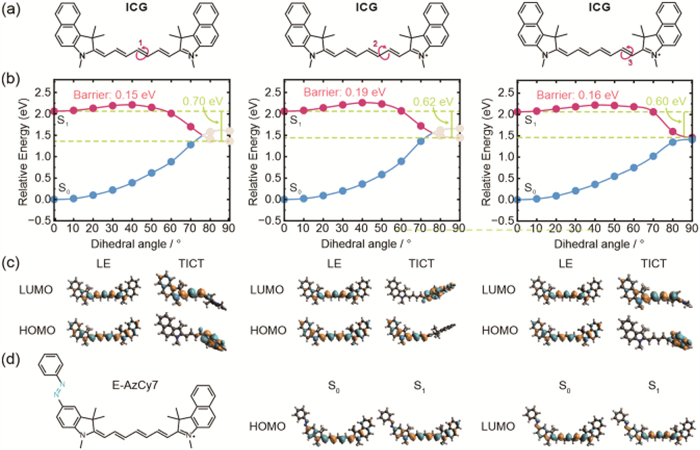
ICG exhibits high CI access barriers and suboptimal photothermal effects (Figs. 3a–c and Fig. S2 in Supporting information). Unlike NIR-BLACIT-compatible dyes, ICG faces substantial energy barriers (>0.15 eV) to reach a CI. Potential energy surfaces for S1, mapped along four torsional coordinates (rotated from 0° to 90° in ~10° increments), revealed that the TICT state is energetically favored over the LE state, yet rotational barriers remain high, 0.15, 0.19, 0.16, and 0.35 eV, far exceeding those of the T-AzHCy series.
Figure 3
Figure 3.
Chemical structure and excited-state properties of ICG and E-AzCy7. (a) The chemical structure of ICG, highlighting different rotation positions. (b) Potential energy surfaces of S0 and S1 as a function of rotation along the dihedral angle (as indicated by arrows in panel a) in water. Due to strong nonadiabatic coupling near the CI, TD-DFT calculations performed in this region may yield unreliable adiabatic state assignments and excitation energies. Accordingly, post-CI data are presented for qualitative illustration only. (c) Corresponding charge distributions of the frontier molecular orbitals, HOMO and LUMO, in both the LE and TICT states. (d) Chemical structure and frontier molecular orbitals of E-AzCy7 in the ground (S0) and excited (S1) states.
These high barriers trap ICG largely in the emissive LE state. The absence of barrierless TICT rotation prolongs excited-state lifetimes, resulting in bright NIR fluorescence rather than efficient heat generation. Prolonged LE residence also increases the probability of ISC and photobleaching, reducing photostability. Experimentally, ICG displays a fluorescence quantum yield of ~14%, significantly higher than that of the T-AzHCy series (~0%), but generates weak PAI signals and exhibits poor stability under irradiation.
E-AzCy7 further illustrates the critical role of azo placement (Fig. 3d). E-AzCy7, where the azo group is not attached to the polymethine chain, shows weak azo contribution to the frontier molecular orbitals. As a result, any potential TICT rotation must occur along the polymethine chain, a pathway with higher barriers, like ICG. Indeed, E-AzCy7 exhibits a high fluorescence quantum yield (10%), significantly higher than those of the T-AzHCy series (~0%), indicating inefficient nonradiative decay and poor PAI efficiency of E-AzCy7.
Collectively, these examples illustrate the performance trade-offs of deviating from NIR-BLACIT principles. Inability to achieve barrierless CI access, as in ICG, limits photothermal conversion efficiency and operational stability, underscoring the critical importance of low rotational barriers and strong driving forces. Equally, weak azo participation in frontier molecular orbitals, or non-strategic azo placement, can severely compromise photothermal and photoacoustic outcomes, reinforcing the notion that optimal PAI/PTT performance depends on strategic molecular design that integrates all these factors.
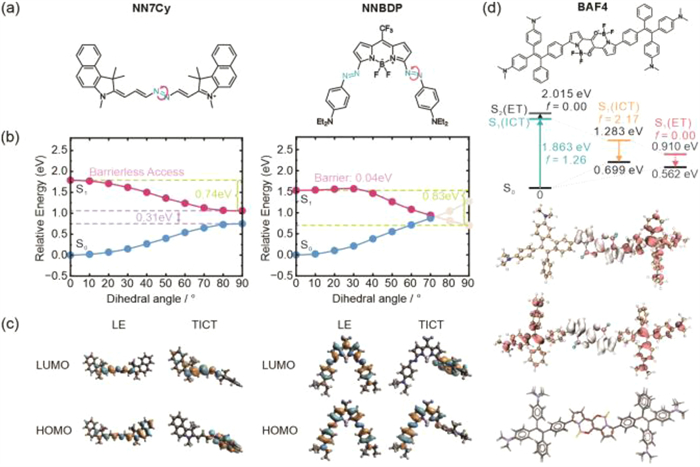
Given that incorporating azo linkages into the main molecular chain enhances PAI/PTT performance, we thus propose a design strategy that embeds an N=N azo unit into the primary π-conjugated backbone to strengthen the TICT process and facilitate CI formation. Based on this principle, we designed two new molecules, NN7Cy and NNBDP, by replacing the C=C bond in the main chain of conventional ICG and BDP dyes with an N=N bond. Their chemical structures and relevant rotational coordinates are shown in Fig. 4a. Note that this backbone N=N replacement is intended solely as a mechanistic construct to probe bond weakening and CI facilitation, rather than as a synthetic design. Adjustments may be explored to enhance synthetic feasibility.
Figure 4
Figure 4.
Chemical structures and excited-state properties of NN7Cy, NNBDP, and BAF4. (a) The chemical structure of NN7Cy and NNBDP, highlighting different rotation positions. (b) Potential energy surfaces of S0 and S1 as a function of rotation along the dihedral angle (as indicated by arrows in panel a) in water. Due to strong nonadiabatic coupling near the CI, TD-DFT calculations performed in this region may yield unreliable adiabatic state assignments and excitation energies. Accordingly, post-CI data are presented for qualitative illustration only. (c) Corresponding charge distributions of the frontier molecular orbitals, HOMO and LUMO, in both the LE and TICT states. (d) Molecular structure of BAF4 and associated excited-state properties. The diagram illustrates the energy levels and oscillator strength (f) of the relevant excited states during absorption and relaxation, as well as the electron-hole distributions of the optimized ICT and ET states on the S1 potential energy surface. Additionally, it shows the superimposed geometries of these optimized structures. In the electron-hole plots, holes are shown in pink and electrons in white. A state crossing occurs from the ICT to the ET state: Although ET is not the lowest-energy state at absorption, it becomes stabilized after geometry optimization on the S1 surface. The alkyl chains of BAF4 were truncated to reduce the computational cost. Because they lie outside the conjugated system, these chains do not affect the electronic properties but instead provide free volume that facilitates conformational changes in solid nanoparticles.
Both NN7Cy and NNBDP exhibit extended π-conjugation, which red-shifts absorption into the NIR region. NNBDP’s calculated λabs exceeds that of ICG, and both molecules display considerable oscillator strengths, indicative of high molar extinction coefficients, key properties for high-performance PAI/PTT agents.
Computational results indicate that NN7Cy undergoes TICT through the azo bond with a 0.00 eV rotational barrier and a high driving energy (−0.74 eV), enabling direct access to a dark, non-emissive state (Figs. 4b and c). This rapid decay shortens excited-state lifetimes, suppresses ISC, enhances photostability, and boosts heat generation. Furthermore, the small energy gap at the TICT state (only 0.31 eV) further accelerates nonradiative decay, as predicted by the energy gap law.
NNBDP exhibits a slightly higher but still negligible rotational barrier (0.04 eV) and a significant driving energy (−0.83 eV), enabling efficient twisting to a CI near perpendicular geometry (Figs. 4b and c). Its extensive conjugation places it well within the NIR window, making it suitable for deep-tissue imaging. While its barrier is marginally higher, its TICT driving energy is enhanced compared to that of NN7Cy. NNBDP remains an effective PAI/PTT agent.
These findings confirm that embedding azo linkages into the main chain of TICT-capable compounds enhances (nearly) barrierless rotation and facilitates CI access. This structural modification strengthens nonradiative decay and boosts PAI/PTT signal generation, offering a generalizable framework for rational contrast-agent design.
Finally, while barrierless access to CIs remains the hallmark of the NIR-BLACIT framework, its principles also extend to systems lacking a CI but possessing intrinsically small S1-S0 energy gaps, such as NIR-Ⅱ dyes. In such systems, narrow gaps still promote rapid nonradiative decay and efficient heat generation, consistent with the energy-gap law. In particular, pre-twisted donor-acceptor (D-A) structures undergoing photoinduced electron transfer (PET) provide an alternative route to minimize the optical gap. The formation of ET states lowers the excited-state energy, accelerates internal conversion, and thereby enhances photothermal output.
One representative example is BAF4, reported by Liu and co-workers (Fig. 4d) [29]. Upon photoexcitation, our calculations revealed two characteristic states: A bright intramolecular charge-transfer (ICT) state with strong NIR absorption (f = 1.26, 1.86 eV), and a dark ET state at 2.02 eV with negligible oscillator strength. After geometry relaxation, the ET state becomes ~0.37 eV more stable than the ICT state, further narrowing the optical gap from 0.58 eV to 0.35 eV, strongly favoring nonradiative decay. Electron-hole analysis reveals that the ICT state maintains electron-hole overlap across the central core and a tetraphenylethylene (TPE) fragment. In contrast, the ET state exhibits pronounced charge separation between the TPE and the central scaffold.
Structurally, the transition between ICT and ET involves only minor conformational adjustments, with phenyl rotations in the TPE fragment giving an RMSD of just 0.44 Å. Such minimal rearrangements are feasible even in solid nanoparticles, facilitated by the free volume created by the non-conjugated alkyl chains. This rigidity explains why BAF4 remains non-emissive in aggregates, contrary to the aggregation-induced emission (AIE) expected from TPE units, instead dissipating energy through the stabilized ET channel.
These findings underscore that photoinduced electron transfer in pre-twisted D-A frameworks provides an effective strategy for reducing optical gaps and enhancing photothermal effects. Their structural diversity goes beyond conventional azo dyes, further demonstrating the universality of the extended NIR-BLACIT model and its potential to guide the design of next-generation optoacoustic and photothermal contrast agents.
This work establishes the NIR-BLACIT model as a robust and predictive photophysical framework for the rational design of PAI/PTT agents. By explicitly linking structural features, such as backbone-integrated azo linkages, to excited-state dynamics, we demonstrate that (nearly) barrierless rotations into the CI states are key to achieving ultrafast nonradiative decay, high photothermal efficiency, and enhanced photostability. A comparative analysis of positive and negative examples confirms that low rotational barriers and high driving energies are crucial for optimal performance. In contrast, poor azo placement or high CI access barriers severely compromise efficacy. Guided by NIR-BLACIT, our newly designed NN7Cy and NNBDP molecules exhibit (nearly) desired photophysical traits and strong PAI/PTT potential. Furthermore, we show that the model’s core principles extend to alternative scaffolds, including pre-twisted donor-acceptor architectures with low-energy gaps and ultrafast decays, broadening its applicability. The NIR-BLACIT framework thus provides a versatile, mechanistically grounded approach for developing next-generation photoacoustic and photothermal agents with predictable, tunable performance. We anticipate that this framework will accelerate the rational development of clinically viable PAI/PTT agents and broaden the scope of molecular photomedicine.
CRediT authorship contribution statement
Zhimin Wu: Writing – original draft, Visualization, Validation, Methodology, Investigation, Data curation, Conceptualization. Syed Ali Abbas Abedi: Validation, Software, Formal analysis. Rongrong Huang: Visualization, Validation, Formal analysis. Lili Lin: Writing – review & editing, Supervision, Methodology. Xiaogang Liu: Writing – review & editing, Supervision, Software, Methodology, Investigation, Data curation, Conceptualization.
Declaration of competing interest
The authors declare that they have no known competing financial interests or personal relationships that could have appeared to influence the work reported in this paper.
Acknowledgments
This work was supported by the Ministry of Education, Singapore (No. MOE-T2EP10222-0001), Nanyang Technological University (No. 025527-00001), the Singapore University of Technology and Design (Nos. SKI 2021_03_10, SKI 2021_04_09), and the National Natural Science Foundation of China (No. 12574289). The authors also gratefully acknowledge the computing resources provided by NTU and the National Supercomputing Center, Singapore. Support from the Taishan Scholar Project of Shandong Province is also acknowledged. We also thank Geraldine Goie Shi Min for assistance with the graphical illustration.
Supplementary materials
Supplementary material associated with this article can be found, in the online version, at doi:10.1016/j.cclet.2025.112315.
Figure 1
Schematic representation of the NIR-BLACIT mechanism. NIR absorption promotes the molecule from S0 to S1, followed by a barrierless downhill pathway to a CI. Ultrafast nonradiative decay returns the molecule to its ground state, S0, releasing energy as heat. The short excited-state lifetime enables rapid thermocycling, high heat output, and enhanced photostability.
Figure 2
Molecular structures and excited-state properties of wsT-AzHCy, T-AzHCy1, and T-AzHCy2. (a) Chemical structures of the three compounds, with the rotatable azo bond highlighted. (b) Potential energy surfaces of S0 and S1 as a function of rotation along the dihedral angle (as indicated by arrows in panel a) in water, showing barrierless access to the CI for all three compounds. Due to strong nonadiabatic coupling near the CI, TD-DFT calculations performed in this region may yield unreliable adiabatic state assignments and excitation energies. Accordingly, post-CI data are presented for qualitative illustration only. (c) Corresponding charge distributions of the frontier molecular orbitals, HOMO and LUMO, in both the LE and TICT states.
Figure 3
Chemical structure and excited-state properties of ICG and E-AzCy7. (a) The chemical structure of ICG, highlighting different rotation positions. (b) Potential energy surfaces of S0 and S1 as a function of rotation along the dihedral angle (as indicated by arrows in panel a) in water. Due to strong nonadiabatic coupling near the CI, TD-DFT calculations performed in this region may yield unreliable adiabatic state assignments and excitation energies. Accordingly, post-CI data are presented for qualitative illustration only. (c) Corresponding charge distributions of the frontier molecular orbitals, HOMO and LUMO, in both the LE and TICT states. (d) Chemical structure and frontier molecular orbitals of E-AzCy7 in the ground (S0) and excited (S1) states.
Figure 4
Chemical structures and excited-state properties of NN7Cy, NNBDP, and BAF4. (a) The chemical structure of NN7Cy and NNBDP, highlighting different rotation positions. (b) Potential energy surfaces of S0 and S1 as a function of rotation along the dihedral angle (as indicated by arrows in panel a) in water. Due to strong nonadiabatic coupling near the CI, TD-DFT calculations performed in this region may yield unreliable adiabatic state assignments and excitation energies. Accordingly, post-CI data are presented for qualitative illustration only. (c) Corresponding charge distributions of the frontier molecular orbitals, HOMO and LUMO, in both the LE and TICT states. (d) Molecular structure of BAF4 and associated excited-state properties. The diagram illustrates the energy levels and oscillator strength (f) of the relevant excited states during absorption and relaxation, as well as the electron-hole distributions of the optimized ICT and ET states on the S1 potential energy surface. Additionally, it shows the superimposed geometries of these optimized structures. In the electron-hole plots, holes are shown in pink and electrons in white. A state crossing occurs from the ICT to the ET state: Although ET is not the lowest-energy state at absorption, it becomes stabilized after geometry optimization on the S1 surface. The alkyl chains of BAF4 were truncated to reduce the computational cost. Because they lie outside the conjugated system, these chains do not affect the electronic properties but instead provide free volume that facilitates conformational changes in solid nanoparticles.
Table 1.
The experimental UV–vis–NIR absorption maxima (λabs), molar extinction coefficients (ε), fluorescence quantum yields, photoacoustic efficiencies of representative molecules, and remarks on their photoacoustic performance.a
Compounds
λabs (nm) (1:1 ethanol:PBS)
ε (104 L mol−1 cm−1)
Φ (ethanol)
Photoacoustic signal generation efficacy (SGE)
Remarks on SGE
wsT-AzHCy
729
3.7
<0.001
3.2
Good
T-AzHCy1
685
4.4
<0.001
-
Potentially goodd
T-AzHCy2
779
3.5
<0.001
3.1
Good
QC-1
788b
9.8b
~0
-
Potentially goodd
ICG
787
17.2
0.14c
1.0
Poor
E-AzCy7
785
11.1
0.10
1.4
Poor
a Data reported by Thorn-Seshold et al., unless otherwise stated [30]. b Data in ethanol reported by Draney et al. [33]. c Data reported by Sletten et al. [34]. d Not measured due to non-NIR spectra, poor solubility, or other issues.


 DownLoad:

 下载:


 下载:

