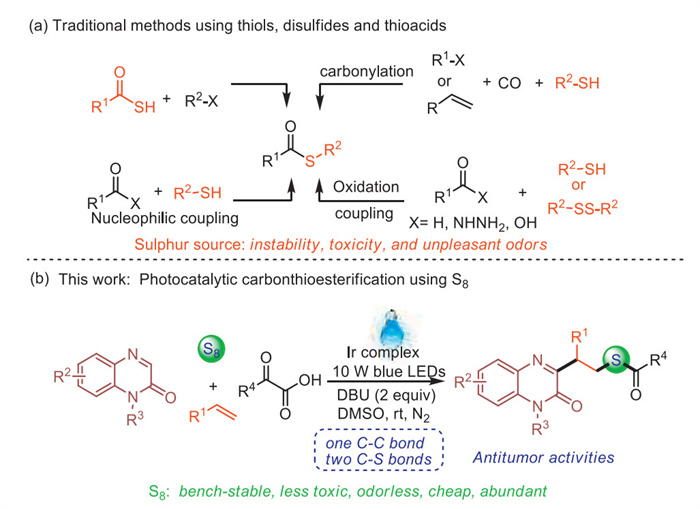
Scheme 1.
Strategies for the synthesis of substituted thioesters.

Photocatalytic multi-component carbonthioesterification reactions to construct quinoxalin-2(1H)-one-containing thioesters and their antitumor activities against HepG2
Yufen Lv , Lianhui Song , Huilan Yue , Zuli Wang , Wei Wei


As significant sulfur-containing compounds, thioesters have drawn a great number of interests of chemists owing to their wide range of applications in pharmaceutical industry, agrochemistry, materials science, and life science [1-6]. Besides that, they are also frequently employed as synthetic intermediates in organic synthesis for accomplishing various synthetic transformations such as acyl transfer reactions and coupling reactions [7-12]. In term of their importance, numerous methods have been developed for the construction of thioesters. The most commonly employed strategies are focus on the thioesterification reactions using sulfur reagents such as thiols [13-16], disulfides [17,18] and thioacids [19-21], which suffer from some limitations including instability, toxicity, and unpleasant odors (Scheme 1a). Elemental sulfur is odorless, less toxic, cheap, bench-stable and abundant raw material [22-24]. Therefore, continuous efforts have been devoted to constructing sulfur-containing molecules using elemental sulphur as sulphur source in organic synthesis. Traditional activation of elemental sulphur generally involves the use of harsh reaction conditions such as strong bases, acids, or high temperature [25-30], which are not suitable for thioester synthesis. Visible light photoredox catalysis has been widely utilized in organic synthesis to accomplish various synthetic transformations under mild conditions [31-45]. Recently, visible-light mediated hydrothioesterification reactions using S8 have been elegantly developed for the synthesis of thioesters based on the easily reduced nature of S8, which involved the hydrogen-atom transfer (HAT) process [46,47]. Nevertheless, visible-light promoted carbonthioesterification reactions using elemental sulfur have never been explored. Thus, the development of a new photocatalytic multi-component carbonthioesterification reaction to construct more diverse biologically important thioesters is still highly desirable.
Quinoxalin-2(1H)-ones are highly valuable structural scaffolds in a variety of natural products, pharmaceuticals and biologically active molecules [48,49], which have attracted increasingly synthetic pursuit of chemists in term of their unique physical characters and diverse biological activities [50-62]. With our ongoing interests in multi-component reactions and the synthesis of quinoxalin-2(1H)-one-containing compounds [63-66], herein, we wish to describe a visible-light mediated multi-component method for the synthesis of quinoxalin-2(1H)-one-containing thioesters via direct carbonthioesterification reaction of alkenes with quinoxalin-2(1H)-ones, elemental sulfur and α-ketoacids (Scheme 1b). This photocatalytic four-component reaction could be conducted under mild conditions by using elemental sulfur as sulfur source, in which one C-C bond and two C-S bonds were efficiently formed in one step operation. Notably, some products showed antitumor activities against HepG2, which have potential application value in pharmaceutical chemistry.
Initially, the reaction of styrene (1a), 1-methylquinoxalin-2(1H)-one (2a), S8 (3), and 2-oxo-2-phenylacetic acid (4a) was employed to investigate the optimal conditions under the irradiation of 10W Blue LED lamps. The desired product 5aa was only obtained in 13% yield when the model reaction was conducted in DMSO under N2 by using Rose Bengal and Na2CO3 as photocatalyst and base, respectively (Table 1, entry 1). Subsequently, a number of photocatalysts including Rhodamine 6G, Methylene blue, Eosin Y, [Ir(dtbbpy)(ppy)2]PF6, Ir[dF(CF3)ppy]2(dtbbpy)PF6, 4CzIPN, Mes-Acr-ClO4 and Ru(bpy)3Cl2·3H2O (2 mol%) were examined (Table 1, entries 2-9). Delightly, Ir[dF(CF3)ppy]2(dtbbpy)PF6 was found to be a suitable photocatalyst to give the product 5aa in 55% yield (Table 1, entry 6). Then, the influence of bases on the reaction efficiency was tested by using Ir[dF(CF3)ppy]2(dtbbpy)PF6 as photocatalyst (Table 1, entries 10-18). Among various inorganic and organic bases examined, DBU exhibited the best effectiveness to promote the reaction and gave the product 5aa in 75% yield (Table 1, entry 15). No transformation was observed in the absence of base or photocatalyst (Table 1, entries 19 and 20). The increase or decrease of photocatalyst loading had not obvious effect on the reaction efficiency (Table 1, entries 21 and 22). Further screening of different light sources found that the best yield was obtained under irradiation of 10 W blue LEDs (Table 1, entries 23-26). Finally, a series of solvents were investigated, and result showed that DMSO was still the best reaction medium (Table 1, entry 15, and Supporting information). In addition, when the model reaction was carried out in air, the corresponding product 5aa was only obtained in 46% yield (entry 27).
 DownLoad:
CSV
 |
|||||||||||||||||||||||||||||||||||||||||||||||||||||||||||||||||||||||||||||||||||||||||||||||||||||||||||
| Entry | Photocatalyst (x mol%) | Base | Yield (%)b | ||||||||||||||||||||||||||||||||||||||||||||||||||||||||||||||||||||||||||||||||||||||||||||||||||||||||
| 1 | Rose Bengal (2) | Na2CO3 | 13 | ||||||||||||||||||||||||||||||||||||||||||||||||||||||||||||||||||||||||||||||||||||||||||||||||||||||||
| 2 | Rhodamine 6G (2) | Na2CO3 | 8 | ||||||||||||||||||||||||||||||||||||||||||||||||||||||||||||||||||||||||||||||||||||||||||||||||||||||||
| 3 | Methylene blue (2) | Na2CO3 | 0 | ||||||||||||||||||||||||||||||||||||||||||||||||||||||||||||||||||||||||||||||||||||||||||||||||||||||||
| 4 | Eosin Y (2) | Na2CO3 | 12 | ||||||||||||||||||||||||||||||||||||||||||||||||||||||||||||||||||||||||||||||||||||||||||||||||||||||||
| 5 | [Ir(dtbbpy)(ppy)2]PF6 (2) | Na2CO3 | 28 | ||||||||||||||||||||||||||||||||||||||||||||||||||||||||||||||||||||||||||||||||||||||||||||||||||||||||
| 6 | Ir[dF(CF3)ppy]2(dtbbpy)PF6 (2) | Na2CO3 | 55 | ||||||||||||||||||||||||||||||||||||||||||||||||||||||||||||||||||||||||||||||||||||||||||||||||||||||||
| 7 | 4CzIPN (2) | Na2CO3 | 33 | ||||||||||||||||||||||||||||||||||||||||||||||||||||||||||||||||||||||||||||||||||||||||||||||||||||||||
| 8 | Mes-Acr-ClO4 (2) | Na2CO3 | Trace | ||||||||||||||||||||||||||||||||||||||||||||||||||||||||||||||||||||||||||||||||||||||||||||||||||||||||
| 9 | Ru(bpy)3Cl2·3H2O (2) | Na2CO3 | 0 | ||||||||||||||||||||||||||||||||||||||||||||||||||||||||||||||||||||||||||||||||||||||||||||||||||||||||
| 10 | Ir[dF(CF3)ppy]2(dtbbpy)PF6 (2) | KOH | Trace | ||||||||||||||||||||||||||||||||||||||||||||||||||||||||||||||||||||||||||||||||||||||||||||||||||||||||
| 11 | Ir[dF(CF3)ppy]2(dtbbpy)PF6 (2) | K2CO3 | 36 | ||||||||||||||||||||||||||||||||||||||||||||||||||||||||||||||||||||||||||||||||||||||||||||||||||||||||
| 12 | Ir[dF(CF3)ppy]2(dtbbpy)PF6 (2) | tBuOK | 0 | ||||||||||||||||||||||||||||||||||||||||||||||||||||||||||||||||||||||||||||||||||||||||||||||||||||||||
| 13 | Ir[dF(CF3)ppy]2(dtbbpy)PF6 (2) | NaOH | 23 | ||||||||||||||||||||||||||||||||||||||||||||||||||||||||||||||||||||||||||||||||||||||||||||||||||||||||
| 14 | Ir[dF(CF3)ppy]2(dtbbpy)PF6 (2) | NaHCO3 | 52 | ||||||||||||||||||||||||||||||||||||||||||||||||||||||||||||||||||||||||||||||||||||||||||||||||||||||||
| 15 | Ir[dF(CF3)ppy]2(dtbbpy)PF6 (2) | DBU | 75 | ||||||||||||||||||||||||||||||||||||||||||||||||||||||||||||||||||||||||||||||||||||||||||||||||||||||||
| 16 | Ir[dF(CF3)ppy]2(dtbbpy)PF6 (2) | DIPEA | 5 | ||||||||||||||||||||||||||||||||||||||||||||||||||||||||||||||||||||||||||||||||||||||||||||||||||||||||
| 17 | Ir[dF(CF3)ppy]2(dtbbpy)PF6 (2) | DABCO | 50 | ||||||||||||||||||||||||||||||||||||||||||||||||||||||||||||||||||||||||||||||||||||||||||||||||||||||||
| 18 | Ir[dF(CF3)ppy]2(dtbbpy)PF6 (2) | Et3N | 36 | ||||||||||||||||||||||||||||||||||||||||||||||||||||||||||||||||||||||||||||||||||||||||||||||||||||||||
| 19 | Ir[dF(CF3)ppy]2(dtbbpy)PF6 (2) | – | 0 | ||||||||||||||||||||||||||||||||||||||||||||||||||||||||||||||||||||||||||||||||||||||||||||||||||||||||
| 20 | – | DBU | 0 | ||||||||||||||||||||||||||||||||||||||||||||||||||||||||||||||||||||||||||||||||||||||||||||||||||||||||
| 21 | Ir[dF(CF3)ppy]2(dtbbpy)PF6 (1) | DBU | 72 | ||||||||||||||||||||||||||||||||||||||||||||||||||||||||||||||||||||||||||||||||||||||||||||||||||||||||
| 22 | Ir[dF(CF3)ppy]2(dtbbpy)PF6 (5) | DBU | 70 | ||||||||||||||||||||||||||||||||||||||||||||||||||||||||||||||||||||||||||||||||||||||||||||||||||||||||
| 23 | Ir[dF(CF3)ppy]2(dtbbpy)PF6 (2) | DBU | 17c | ||||||||||||||||||||||||||||||||||||||||||||||||||||||||||||||||||||||||||||||||||||||||||||||||||||||||
| 24 | Ir[dF(CF3)ppy]2(dtbbpy)PF6 (2) | DBU | 23d | ||||||||||||||||||||||||||||||||||||||||||||||||||||||||||||||||||||||||||||||||||||||||||||||||||||||||
| 25 | Ir[dF(CF3)ppy]2(dtbbpy)PF6 (2) | DBU | 50e | ||||||||||||||||||||||||||||||||||||||||||||||||||||||||||||||||||||||||||||||||||||||||||||||||||||||||
| 26 | Ir[dF(CF3)ppy]2(dtbbpy)PF6 (2) | DBU | 69f | ||||||||||||||||||||||||||||||||||||||||||||||||||||||||||||||||||||||||||||||||||||||||||||||||||||||||
| 27 | Ir[dF(CF3)ppy]2(dtbbpy)PF6 (2) | DBU | 46g | ||||||||||||||||||||||||||||||||||||||||||||||||||||||||||||||||||||||||||||||||||||||||||||||||||||||||
| a Reaction conditions: 1a (0.2 mmol), 2a (0.1 mmol), S8 (0.3 mmol), 4a (0.2 mmol), photocatalyst (1-5 mol%), 10 W blue LEDs, DMSO (2 mL), N2, r.t., 12 h. b Isolated yields based on 2a. c 10 W green LEDs. d 10 W white LEDs. e 3 W blue LEDs, f 5 W blue LED. g In air. |
|||||||||||||||||||||||||||||||||||||||||||||||||||||||||||||||||||||||||||||||||||||||||||||||||||||||||||
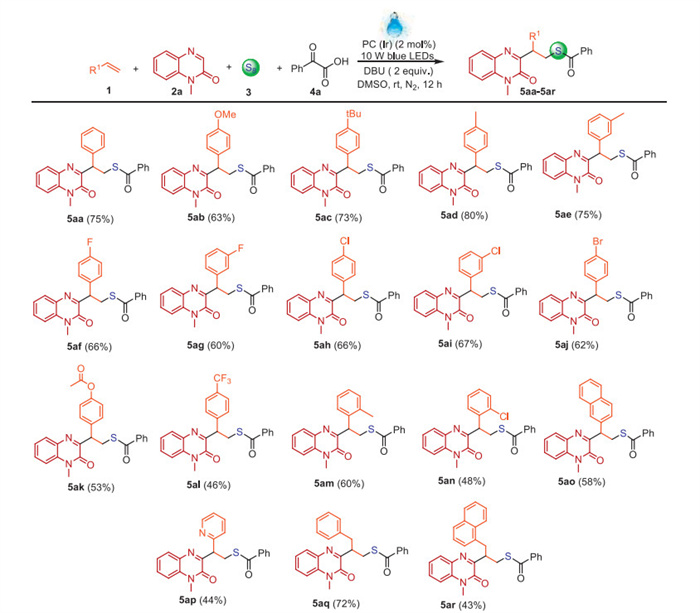
With the optimized conditions in hand, we turned our attention to the scope and limitations this carbonthioesterification reaction of alkenes with quinoxalin-2(1H)-ones, elemental sulfur and α-ketoacids (Scheme 2). The electronic effect was investigated using various aromatic alkenes with electron-donating groups (EDG) and electron-withdrawing groups (EWG) at the para- and meta-positions of the benzene ring. The result demonstrated that aromatic alkenes with electron-donating groups (MeO-, t-Bu, Me, acetoxyl) displayed comparable reactivity to those with electron-withdrawing groups (F, Cl, Br, CF3) to afford the corresponding products 5ab-5al in moderate to good yields. The steric hindrance had obvious influence on the reaction efficiency, and the inferior yields (5am and 5an) were obtained when the sterically demanding ortho-substituted styrenes such as 2-methylstyrene and 2-chlorostyrene were used in this reaction system. Notably, naphthalene and heteroaromatic ring such as pyridine can be incorporated in alkenes leading to the desired thioesters in moderate yields (5ao and 5ap). In addition, the reaction was also feasible with aliphatic alkenes such as allylbenzene and 1-allylnaphthalene to afford the corresponding products 5aq and 5ar in 43% and 72% yields, respectively.
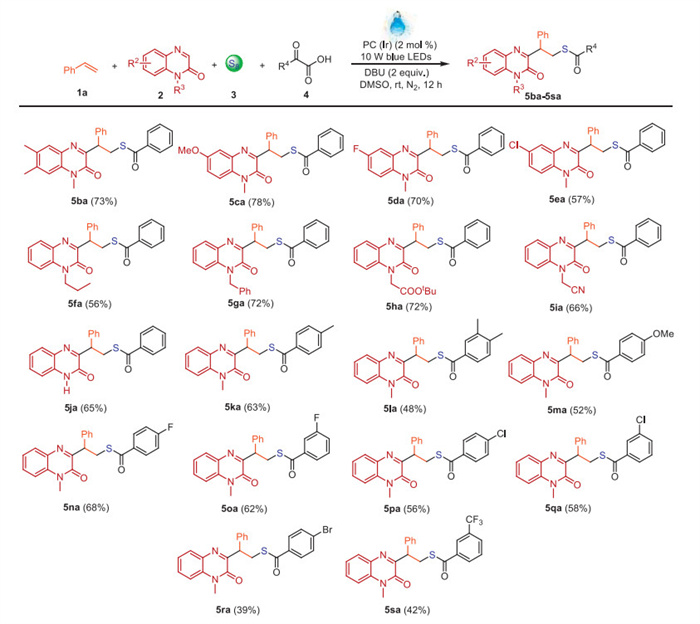
Next, the scope of quinoxalin-2(1H)-ones and α-ketoacids were further examined (Scheme 3). Quinoxalin-2(1H)-ones bearing both electron-donating groups and electron-withdrawing groups on the aryl ring proceeded smoothly in this procedure, and the corresponding products 5ba-5ea were obtained in moderate to good yields. In addition to N-methyl quinoxalin-2(1H)-one, quinoxalin-2(1H)-ones bearing other N-alkyl substitutes such as N-propyl, N-benzyl, N-esteryl and N-cyanomethyl groups were also suitable substrates leading to the corresponding products 5fa-5ia in 56%-72% yields. It should be noted that N-free protected quinoxalin-2(1H)-one was also tolerated in this procedure affording the desired product 5ja in 65% yield. Finally, various substituted aryl α-ketoacids were tested under the standard conditions. The results demonstrated that both electron-donating and electron-withdrawing groups substituted aryl α-ketoacids underwent this carbonthioesterification process smoothly to give the corresponding products 5ka-5sa in moderate to good yields. Unfortunately, none of the desired product was observed when aliphatic α-ketoacid such as ethanethioic S-acid was employed in this reaction system.
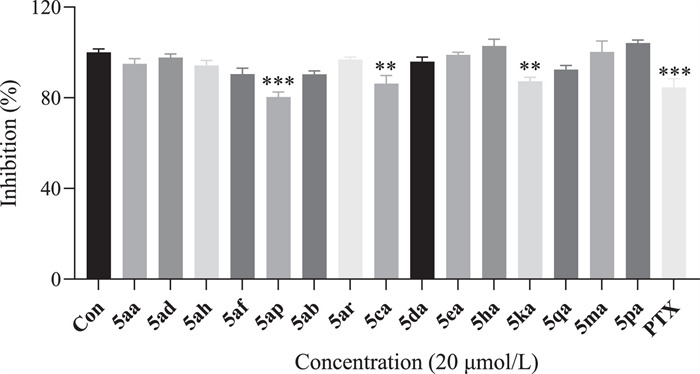
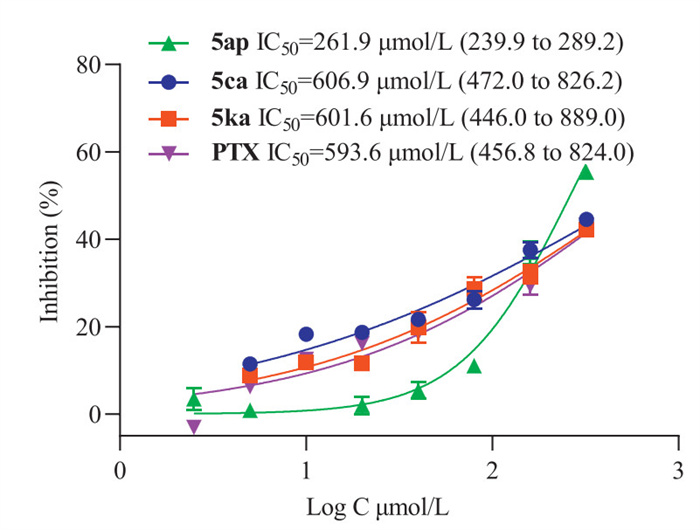
To exhibit the potential application value of this reaction, some products were further evaluated for their inhibitory activities against human hepatoma cell line (HepG2). As the results outlined in Fig. 1, compounds 5ap, 5ca and 5ka and positive drug paclitaxel (PTX) showed inhibitory activities against HepG2 compared with control group. The IC50 values of 5ap, 5ca, 5ka, and PTX are depicted in Fig. 2. Compound 5ap showed strong inhibitory activity on the HepG2 with IC50 value of 261.9 μmol/L (95% confidence interval 239.9-289.2), which is more potent than PTX (IC50 = 593.6 μmol/L).
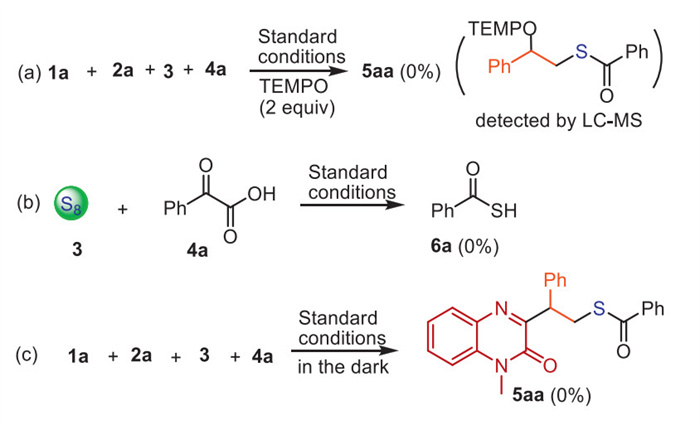
To understand the present photocatalytic carbonthioesterification of alkenes, several control experiments were carried out (Scheme 4). Firstly, when TEMPO (a radical scavenger) was added in the model reaction system, this multi-component reaction was completely inhibited and TEMPO-trapped alkyl complex A was detected by LC-MS. This result suggested that this multi-component reaction might involve a radical process (Scheme 4a). Secondly, thiobenzoic acid was not observed by the direct interaction of S8 with 2-oxo-2-phenylacetic acid (4a) under standard conditions. This result excluded the possibility that thiobenzoic acid as a key intermediate existed in this transformation (Scheme 4b). Visible-light is proved to be essential for promoting this transformation and none of the product was observed without visible-light irradiation (Scheme 4c). Furthermore, on/off experiments showed that this multi-component reaction should not proceed through a radical-chain pathway (see Supporting information for details). In addition, photocatalytic electron transfer process between excited state Ir* and S8 was proved by fluorescence quenching experiments (see Supporting information for details).
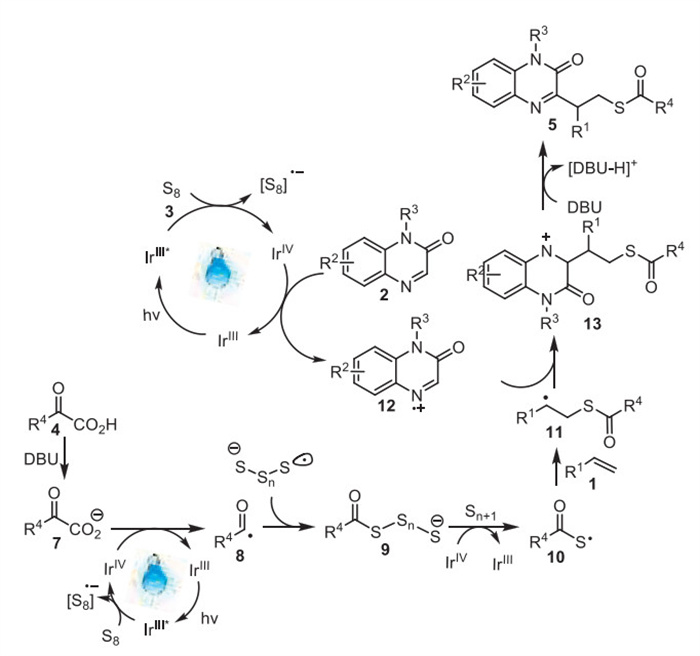
On the basis of above experimental results and previous reports [46,47,67-69], a plausible reaction mechanism for this photocatalytic multi-component reaction has been proposed as shown in Scheme 5. Firstly, IrⅢ* complex is generated from IrⅢ complex under visible-light irradiation, which is easily quenched by S8 generating IrⅣ complex and a polysulfide radical anion through a single-electron transfer (SET) process [41]. Subsequently, the oxidation of α-ketocarboxylate 7 by IrⅣ complex and subsequent decarboxylation would lead to the formation of acyl radical 8 with the release of IrⅢ catalyst. Then, the interaction of acyl radical 8 with polysulfide radical anion gives intermediate 9, which is converted into carbonyl thiyl radical 10 through a single-electron transfer with IrⅣ complex. The addition of carbonyl thiyl radical 10 to the alkene 1 generates alkyl radical intermediate 11. Next, a nitrogen cation intermediate 13 is formed through the addition of alkyl radical intermediate 11 to nitrogen radical cation 12 that is generated from quinoxalin-2(1H)-one 2 with the help of photocatalysis. Finally, the deprotonation of nitrogen cation intermediate 13 by DBU produces the desired product 5.
In summary, a new visible-light mediated strategy for construction of quinoxalin-2(1H)-one-containing thioesters has been developed through four-component reaction of alkenes, quinoxalin-2(1H)-ones, elemental sulfur and α-ketoacids. This photocatalytic carbonthioesterification reaction of alkenes allows introducing both quinoxalin-2(1H)-one and thioester structural moieties into one molecular framework, in which one C-C bond and two C-S bonds were conveniently formed in one pot procedure. Through this methodology, a series of quinoxalin-2-one-containing thioesters could be selectively obtained in moderate to good yields from simple starting materials at room temperature, which avoids the use of malodorous and unstable thiols or thioacids. Photocatalytic carbonyl thiyl radical participated reaction pathway is proposed based on the mechanistic studies. Notably, compound 5ap showed significant antitumor activities against HepG2, which has potential application value in pharmaceutical chemistry.
Yufen Lv: Methodology, Investigation, Formal analysis, Data curation. Lianhui Song: Methodology, Investigation, Formal analysis. Huilan Yue: Resources, Project administration, Funding acquisition, Formal analysis. Zuli Wang: Writing – review & editing, Resources, Data curation. Wei Wei: Writing – review & editing, Writing – original draft, Supervision, Funding acquisition, Conceptualization.
The authors declare that they have no known competing financial interests or personal relationships that could have appeared to influence the work reported in this paper.
This work was supported by supported by the Program of Science and Technology International Cooperation Project of Qinghai Province (No. 2026-HZ-814) and Central guidance of local scientific and technological development funds in Qinghai Province (No. 2025ZY008).
Supplementary material associated with this article can be found, in the online version, at doi:
A. Yurek-George, F. Habens, M. Brimmell, et al., J. Am. Chem. Soc. 126 (2004) 1030-1031. doi: 10.1021/ja039258q
K. Jayakanthan, S. Mohan, B.M. Pinto, J. Am. Chem. Soc. 131 (2009) 5621-5626. doi: 10.1021/ja900867q
J.S. Yu, H.M. Huang, P.G. Ding, et al., ACS Catal. 6 (2016) 5319-5344. doi: 10.1021/acscatal.6b01496
M. Smietana, P. Clayette, P. Mialocq, et al., Bioorg. Chem. 36 (2008) 133-140. doi: 10.1016/j.bioorg.2008.02.001
J. Kalia, R.T. Raines, ChemBioChem. 7 (2006) 1375-1383. doi: 10.1002/cbic.200600150
N. Wang, P. Saidhareddy, X. Jiang, Nat. Prod. Rep. 37 (2020) 246-275. doi: 10.1039/c8np00093j
M.P. Grillo, C. Li, L.Z. Benet, Med. Chem. Res. 32 (2023) 2058-2070. doi: 10.1007/s00044-023-03144-5
V. Hirschbeck, P.H. Gehrtz, I. Fleischer, Chem. Eur. J. 24 (2018) 7092-7107. doi: 10.1002/chem.201705025
V. Hirschbeck, P.H. Gehrtz, I. Fleischer, Angew. Chem. Int. Ed. 47 (2008) 6851-6855. doi: 10.1002/anie.200705471
V. Agouridas, O. El Mahdi, V. Diemer, et al., Chem. Rev. 119 (2019) 7328-7443. doi: 10.1021/acs.chemrev.8b00712
J. Lou, Q. Wang, P. Wu, et al., Chem. Soc. Rev. 49 (2020) 4307-4359. doi: 10.1039/c9cs00837c
Y. Wang, R. Li, J. Huang, et al., Chem. Commun. 61 (2025) 17137-17140. doi: 10.1039/d5cc04878h
S. Sikandar, A.F. Zahoor, S. Naheed, et al., Mol. Divers. 26 (2022) 589-628. doi: 10.1007/s11030-021-10194-7
M. Kazemi, L. Shiri, J. Sulfur Chem. 36 (2015) 613-623. doi: 10.1080/17415993.2015.1075023
M. Xuan, C. Lu, M. Liu, B.L. Lin, J. Org. Chem. 84 (2019) 7694-7701. doi: 10.1021/acs.joc.9b00500
J.X. Xu, L.C. Wang, X.F. Wu, Org. Lett. 24 (2022) 4820-4824. doi: 10.1021/acs.orglett.2c01951
G. Rong, J. Mao, D. Liu, et al., RSC Adv. 5 (2015) 26461-26464. doi: 10.1039/C4RA15751F
J. Su, A. Chen, G. Zhang, et al., Org. Lett. 25 (2023) 8033-8037. doi: 10.1021/acs.orglett.3c03249
R. Wang, J.L. Yuan, K.L. Liang, et al., J. Org. Chem. 89 (2024) 9597-9608. doi: 10.1021/acs.joc.4c01087
X. Zhou, R. Li, Z. Sun, Org. Lett. 25 (2023) 4173-4176. doi: 10.1021/acs.orglett.3c01481
H. Ali, B. Mahto, A. Barhoi, S. Hussain, ACS Appl. Nano Mater 8 (2025) 5001-5013. doi: 10.1021/acsanm.4c06514
T.B. Nguyen, Adv. Synth. Catal. 359 (2017) 1066-1130. doi: 10.1002/adsc.201601329
W.J. Chung, J.J. Griebel, E.T. Kim, et al., Nat. Chem. 5 (2013) 518-524. doi: 10.1038/nchem.1624
A. Savateev, B. Kurpil, A. Mishchenko, et al., Chem. Sci. 9 (2018) 3584-3591. doi: 10.1039/c8sc00745d
T. Guntreddi, R. Vanjari, K.N. Singh, Org. Lett. 17 (2015) 976-978. doi: 10.1021/acs.orglett.5b00079
T.B. Nguyen, K. Pasturaud, L. Ermolenko, A. Al-Mourabit, Org. Lett. 17 (2015) 2562-2565. doi: 10.1021/acs.orglett.5b01182
T.B. Nguyen, L. Ermolenko, P. Retailleau, A. Al-Mourabit, Angew. Chem. Int. Ed. 53 (2014) 13808-13812. doi: 10.1002/anie.201408397
H. Liu, X. Jiang, Chem. Asian J. 8 (2013) 2546-2563. doi: 10.1002/asia.201300636
T.B. Nguyen, Adv. Synth. Catal. 362 (2020) 3448-3484. doi: 10.1002/adsc.202000535
S. Liu, G.J. Deng, H. Huang, Synlett (2021) 142-158.
Y.H. Lu, C. Wu, J.C. Hou, et al., ACS Catal. 13 (2023) 13071-13076. doi: 10.1021/acscatal.3c02268
W. Yang, Z. Zhang, Z. Yang, et al., J. Org. Chem. 90 (2025) 16403-16413. doi: 10.1021/acs.joc.5c01813
Y. Lv, H. Ding, J. You, et al., Chin. Chem. Lett. 35 (2024) 109107. doi: 10.1016/j.cclet.2023.109107
H. Xu, X. Li, J. Ma, et al., Chin. Chem. Lett. 34 (2023) 108403. doi: 10.1016/j.cclet.2023.108403
C.H. Liu, Z.W. Zhang, Z.J. Zhao, et al., J. Org. Chem. 90 (2025) 11982-11989. doi: 10.1021/acs.joc.5c01659
C.K. Prier, D.A. Rankic, D.W.C. MacMillan, Chem. Rev. 113 (2013) 5322-5363. doi: 10.1021/cr300503r
Z. Wang, N. Meng, Y. Lv, et al., Chin. Chem. Lett. 34 (2023) 107599. doi: 10.1016/j.cclet.2022.06.022
H.C. Li, M. Zhang, Q. Lv, et al., Chin. Chem. Lett. 36 (2025) 110579. doi: 10.1016/j.cclet.2024.110579
L. Wang, Y. Hou, H. Ding, et al., Chin. J. Org. Chem. 45 (2025) 3495-3516. doi: 10.6023/cjoc202506019
Q. Zhao, Q. Zhang, X. Wu, et al., Chin. Chem. Lett. 36 (2025) 11067.
F. Zhao, H. Ding, T. Sun, et al., Chin. Chem. Lett. 37 (2026) 111834. doi: 10.1016/j.cclet.2025.111834
C. Cui, X. Qiao, T. Shi, et al., Chem. Commun. 61 (2025) 17890-17893. doi: 10.1039/d5cc04758g
J.B. Wang, T. Yue, L. Xu, et al., Green Chem. 26 (2024) 12034-12042. doi: 10.1039/d4gc05239k
S.L. Kang, T. Yue, D.D. Su, et al., ACS Sustainable Chem. Eng. 12 (2024) 18200-18210. doi: 10.1021/acssuschemeng.4c07589
J.Q. Di, S.Z. Zhang, D.D. Su, et al., ChemSusChem. 18 (2025) e202500596. doi: 10.1002/cssc.202500596
S. Murakami, T. Nanjo, Y. Takemoto, Org. Lett. 23 (2021) 7650-7655. doi: 10.1021/acs.orglett.1c02904
H. Tang, M. Zhang, Y. Zhang, et al., J. Am. Chem. Soc. 145 (2023) 5846-5854. doi: 10.1021/jacs.2c13157
S.A.M. El-Hawash, N.S. Habib, M.A. Kassem, Arch. Pharm. 339 (2006) 564-571. doi: 10.1002/ardp.200600061
R. Liu, Z. Huang, M.G. Murray, et al., J. Med. Chem. 54 (2011) 5747-5768. doi: 10.1021/jm200394x
Q. Ke, G. Yan, J. Yu, X. Wu, Org. Biomol. Chem. 17 (2019) 5863-5881. doi: 10.1039/c9ob00782b
M. Zhang, G. Nan, X. Zhao, W. Wei, Chin. J. Org. Chem. 42 (2022) 4315-4322. doi: 10.6023/cjoc202209013
Z. Wang, Q. Liu, R. Liu, et al., Chin. Chem. Lett. 33 (2022) 1479-1482. doi: 10.1016/j.cclet.2021.08.036
L. Lin, P. Wang, T. Dong, et al., Org. Lett. 25 (2023) 1088-1093. doi: 10.1021/acs.orglett.2c04315
Y.Y. Zeng, J. Jiang, Y.C. Wen, et al., Chin. Chem. Lett. 37 (2026) 111776. doi: 10.1016/j.cclet.2025.111776
Q.H. Peng, Y.L. Cai, H. Dai, et al., J. Org. Chem. 90 (2025) 14786-14795. doi: 10.1021/acs.joc.5c02000
S. Singh, N. Dagar, G. Pal, S.Raha Roy, Green Chem. 24 (2022) 8460–8465. doi: 10.1039/d2gc03017a
Y.C. Wen, J.C. Hou, Q. Zhou, et al., Chin. Chem. Lett. 36 (2025) 111795. doi: 10.1016/j.cclet.2025.111795
H. Cui, Z. Ma, W. Wei, et al., J. Org. Chem. 90 (2025) 18092-18092. doi: 10.1021/acs.joc.5c02640
L. Yang, P. Gao, X.H. Duan, et al., Org. Lett. 20 (2018) 1034-1037. doi: 10.1021/acs.orglett.7b03984
F. Xiang, D. Wang, K. Xu, C.C. Zeng, Org. Lett. 26 (2024) 411-415. doi: 10.1021/acs.orglett.3c04124
Y. Wang, J. Wang, C. Chen, et al., Chem. Commun. 61 (2025) 10812-10815. doi: 10.1039/d5cc02744f
X.M. Chen, L. Song, J. Pan, et al., Chin. Chem. Lett. 35 (2024) 110112. doi: 10.1016/j.cclet.2024.110112
J. Huang, R. Li, Y. Lv, et al., J. Org. Chem. 90 (2025) 14805-14813. doi: 10.1021/acs.joc.5c02106
Q. Feng, J. Hao, Y. Hu, et al., Chin. Chem. Lett. 36 (2025) 110582. doi: 10.1016/j.cclet.2024.110582
J.Q. Chen, R. Chang, Y.L. Wei, et al., J. Org. Chem. 83 (2018) 253-259. doi: 10.1021/acs.joc.7b02628
H. Sun, X. Bin, Q. Zhang, et al., Chem. Commun. 60 (2024) 8107-8110. doi: 10.1039/d4cc01914h
H.L. Zhu, F.L. Zeng, X.L. Chen, et al., Org. Lett. 23 (2021) 2976-2980. doi: 10.1021/acs.orglett.1c00655
J. An, Q. Lv, K. Sun, et al., Chin. J. Org. Chem. 44 (2024) 3747-3752. doi: 10.6023/cjoc202405043
C. Ge, L. Qiao, Y. Zhang, et al., Chin. J. Chem. 42 (2024) 1679-1685. doi: 10.1002/cjoc.202400089

Scheme 2 Substrate scope of alkenes. Reaction conditions: 1 (0.2 mmol), 2a (0.1 mmol), S8 (0.3 mmol), 4a (0.2 mmol), Ir[dF(CF3)ppy]2(dtbbpy)PF6 (2 mol%), DBU (0.2 mmol), 10 W blue LEDs, DMSO (2 mL), N2, r.t., 12 h. Isolated yields based on 2a.

Scheme 3 Substrate scope of quinoxalin-2(1H)-ones and α-ketoacids. Reaction conditions: 1a (0.2 mmol), 2 (0.1 mmol), S8 (0.3 mmol), 4 (0.2 mmol), Ir[dF(CF3)ppy]2(dtbbpy)PF6 (2 mol%), DBU (0.2 mmol), 10 W blue LEDs, DMSO (2 mL), N2, r.t., 12 h. Isolated yields based on 2.
Table 1. Screening of the reaction conditions.a
|
|||||||||||||||||||||||||||||||||||||||||||||||||||||||||||||||||||||||||||||||||||||||||||||||||||||||||||
| Entry | Photocatalyst (x mol%) | Base | Yield (%)b | ||||||||||||||||||||||||||||||||||||||||||||||||||||||||||||||||||||||||||||||||||||||||||||||||||||||||
| 1 | Rose Bengal (2) | Na2CO3 | 13 | ||||||||||||||||||||||||||||||||||||||||||||||||||||||||||||||||||||||||||||||||||||||||||||||||||||||||
| 2 | Rhodamine 6G (2) | Na2CO3 | 8 | ||||||||||||||||||||||||||||||||||||||||||||||||||||||||||||||||||||||||||||||||||||||||||||||||||||||||
| 3 | Methylene blue (2) | Na2CO3 | 0 | ||||||||||||||||||||||||||||||||||||||||||||||||||||||||||||||||||||||||||||||||||||||||||||||||||||||||
| 4 | Eosin Y (2) | Na2CO3 | 12 | ||||||||||||||||||||||||||||||||||||||||||||||||||||||||||||||||||||||||||||||||||||||||||||||||||||||||
| 5 | [Ir(dtbbpy)(ppy)2]PF6 (2) | Na2CO3 | 28 | ||||||||||||||||||||||||||||||||||||||||||||||||||||||||||||||||||||||||||||||||||||||||||||||||||||||||
| 6 | Ir[dF(CF3)ppy]2(dtbbpy)PF6 (2) | Na2CO3 | 55 | ||||||||||||||||||||||||||||||||||||||||||||||||||||||||||||||||||||||||||||||||||||||||||||||||||||||||
| 7 | 4CzIPN (2) | Na2CO3 | 33 | ||||||||||||||||||||||||||||||||||||||||||||||||||||||||||||||||||||||||||||||||||||||||||||||||||||||||
| 8 | Mes-Acr-ClO4 (2) | Na2CO3 | Trace | ||||||||||||||||||||||||||||||||||||||||||||||||||||||||||||||||||||||||||||||||||||||||||||||||||||||||
| 9 | Ru(bpy)3Cl2·3H2O (2) | Na2CO3 | 0 | ||||||||||||||||||||||||||||||||||||||||||||||||||||||||||||||||||||||||||||||||||||||||||||||||||||||||
| 10 | Ir[dF(CF3)ppy]2(dtbbpy)PF6 (2) | KOH | Trace | ||||||||||||||||||||||||||||||||||||||||||||||||||||||||||||||||||||||||||||||||||||||||||||||||||||||||
| 11 | Ir[dF(CF3)ppy]2(dtbbpy)PF6 (2) | K2CO3 | 36 | ||||||||||||||||||||||||||||||||||||||||||||||||||||||||||||||||||||||||||||||||||||||||||||||||||||||||
| 12 | Ir[dF(CF3)ppy]2(dtbbpy)PF6 (2) | tBuOK | 0 | ||||||||||||||||||||||||||||||||||||||||||||||||||||||||||||||||||||||||||||||||||||||||||||||||||||||||
| 13 | Ir[dF(CF3)ppy]2(dtbbpy)PF6 (2) | NaOH | 23 | ||||||||||||||||||||||||||||||||||||||||||||||||||||||||||||||||||||||||||||||||||||||||||||||||||||||||
| 14 | Ir[dF(CF3)ppy]2(dtbbpy)PF6 (2) | NaHCO3 | 52 | ||||||||||||||||||||||||||||||||||||||||||||||||||||||||||||||||||||||||||||||||||||||||||||||||||||||||
| 15 | Ir[dF(CF3)ppy]2(dtbbpy)PF6 (2) | DBU | 75 | ||||||||||||||||||||||||||||||||||||||||||||||||||||||||||||||||||||||||||||||||||||||||||||||||||||||||
| 16 | Ir[dF(CF3)ppy]2(dtbbpy)PF6 (2) | DIPEA | 5 | ||||||||||||||||||||||||||||||||||||||||||||||||||||||||||||||||||||||||||||||||||||||||||||||||||||||||
| 17 | Ir[dF(CF3)ppy]2(dtbbpy)PF6 (2) | DABCO | 50 | ||||||||||||||||||||||||||||||||||||||||||||||||||||||||||||||||||||||||||||||||||||||||||||||||||||||||
| 18 | Ir[dF(CF3)ppy]2(dtbbpy)PF6 (2) | Et3N | 36 | ||||||||||||||||||||||||||||||||||||||||||||||||||||||||||||||||||||||||||||||||||||||||||||||||||||||||
| 19 | Ir[dF(CF3)ppy]2(dtbbpy)PF6 (2) | – | 0 | ||||||||||||||||||||||||||||||||||||||||||||||||||||||||||||||||||||||||||||||||||||||||||||||||||||||||
| 20 | – | DBU | 0 | ||||||||||||||||||||||||||||||||||||||||||||||||||||||||||||||||||||||||||||||||||||||||||||||||||||||||
| 21 | Ir[dF(CF3)ppy]2(dtbbpy)PF6 (1) | DBU | 72 | ||||||||||||||||||||||||||||||||||||||||||||||||||||||||||||||||||||||||||||||||||||||||||||||||||||||||
| 22 | Ir[dF(CF3)ppy]2(dtbbpy)PF6 (5) | DBU | 70 | ||||||||||||||||||||||||||||||||||||||||||||||||||||||||||||||||||||||||||||||||||||||||||||||||||||||||
| 23 | Ir[dF(CF3)ppy]2(dtbbpy)PF6 (2) | DBU | 17c | ||||||||||||||||||||||||||||||||||||||||||||||||||||||||||||||||||||||||||||||||||||||||||||||||||||||||
| 24 | Ir[dF(CF3)ppy]2(dtbbpy)PF6 (2) | DBU | 23d | ||||||||||||||||||||||||||||||||||||||||||||||||||||||||||||||||||||||||||||||||||||||||||||||||||||||||
| 25 | Ir[dF(CF3)ppy]2(dtbbpy)PF6 (2) | DBU | 50e | ||||||||||||||||||||||||||||||||||||||||||||||||||||||||||||||||||||||||||||||||||||||||||||||||||||||||
| 26 | Ir[dF(CF3)ppy]2(dtbbpy)PF6 (2) | DBU | 69f | ||||||||||||||||||||||||||||||||||||||||||||||||||||||||||||||||||||||||||||||||||||||||||||||||||||||||
| 27 | Ir[dF(CF3)ppy]2(dtbbpy)PF6 (2) | DBU | 46g | ||||||||||||||||||||||||||||||||||||||||||||||||||||||||||||||||||||||||||||||||||||||||||||||||||||||||
| a Reaction conditions: 1a (0.2 mmol), 2a (0.1 mmol), S8 (0.3 mmol), 4a (0.2 mmol), photocatalyst (1-5 mol%), 10 W blue LEDs, DMSO (2 mL), N2, r.t., 12 h. b Isolated yields based on 2a. c 10 W green LEDs. d 10 W white LEDs. e 3 W blue LEDs, f 5 W blue LED. g In air. |
|||||||||||||||||||||||||||||||||||||||||||||||||||||||||||||||||||||||||||||||||||||||||||||||||||||||||||
 下载: 导出CSV

 扫一扫看文章


扫一扫关注我们


 下载: