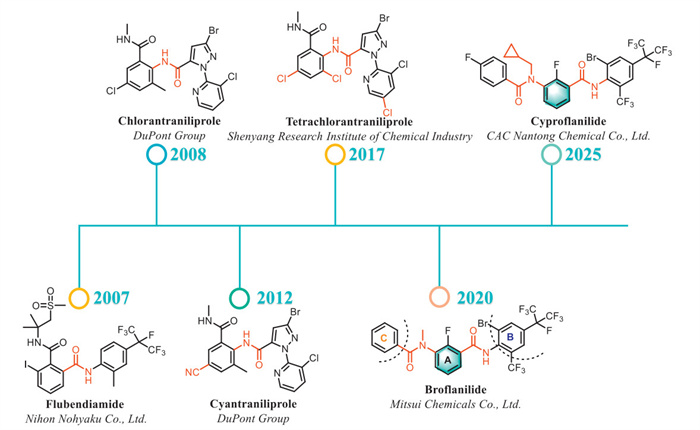
Figure 1.
Timeline for the market launch of representative commercialized diamide insecticides.

Recent advances of meta-diamide derivatives as insecticides targeting GABA receptor
Huanan Zeng , Yue Wu , Yang Liu , Ziwen Wang , Jun Chen , Qingmin Wang


In 2007, Nihon Nohyaku Co., Ltd. and Bayer Group jointly developed the first commercial diamide insecticide, Flubendiamide (Fig. 1), which ushered in a new era of diamide insecticides targeting the insect ryanodine receptor [1-3]. A series of diamide insecticides has been successfully launched on the market (Fig. 1), accompanied by extensive research into diamide derivatives targeting the ryanodine receptor, expanding its insecticidal spectrum from Lepidoptera to Coleoptera, Hemiptera, and Diptera [4-16]. However, resistance to diamide insecticides grew increasingly prominent [17-21]. Driven by globalization and population increase, the food demand continues to face substantial problems [22]. Insecticides are an essential tool for guaranteeing crop quality and yields. Therefore, the urgent need has emerged to find new types of insecticides that are highly effective, broad spectrum, safe, environmentally compatible and no cross resistant to existing insecticides.
Mitsui Chemicals Co., Ltd. found that the meta-diamide compounds still had certain insecticidal activity after converting ortho-diamide to meta-diamide using Flubendiamide as a pioneer, finally screened out Broflanilide (Fig. 1), a meta-diamide insecticide with a new structure and a novel mechanism of action [23-25]. The optimization of its synthetic route has been reported [26,27]. Unlike the conventional diamides, Broflanilide acts on the γ-aminobutyric acid (GABA) receptor, which is a GABA-gated chloride channel allosteric modulator, and allosterically inhibits the GABA-activated chloride channel in insects, thereby inducing hyperexcitability and convulsions that lead to the death of insects, which has been recognized as a novel mechanism of action by the Insecticide Resistance Action Committee (IRAC) and categorized into a new IRAC group 30, GABA-gated chloride channel allosteric modulators [28-32]. Therefore, Broflanilide and its novel chemotype offer a distinct solution to cross-resistance against pests resistant not only to diamide insecticides but also to other classes, such as cyclodienes and fipronil, which act at distinct sites on the GABA receptor [33,34]. Research on Broflanilide has been continuous since its introduction in 2020. Cyproflanilide (Fig. 1) was created by CAC Nantong Chemical Co., Ltd. (CAC) by derivatizing the amide bond of Broflanilide [35], which demonstrates the enormous possibility of developing new agricultural insecticides utilizing Broflanilide as a starting point.
With the growth of the global population and the change in dietary patterns, the requirement for agricultural products has been growing steadily [36,37]. Moreover, climate change has exacerbated the frequency and complexity of pests and diseases [38,39]. Against the backdrop of a continuously expanding market demand for pesticides, a new pesticide with a completely novel mechanism of action is likely to occupy a large market share and generate substantial profits quickly. It indicates that Broflanilide is a pesticide with tremendous market potential. Therefore, employing Broflanilide as a lead molecule and derivatizing its meta-diamide scaffold holds significant research value and has emerged as a popular area for research in the field of pesticide development in recent years. This review comprehensively summarizes correlative meta-diamide compounds derived from Broflanilide, and their corresponding insecticidal activities, also discusses the preliminary structure-activity relationship (SAR) and the unconventional mechanisms of action, filling a knowledge gap and providing a foundation for the future development of novel meta-diamide insecticides targeting the GABA receptor.
Before Broflanilide was marketed, many researchers conducted extensive work on the development of meta-diamide-based insecticidal derivatives with subtle structural modifications [40-58]. Herein, we have summarized the insecticidal activities of the representative Broflanilide-derived meta-diamide compounds and divided them into four sections [59-128], presenting the structural differences in sequence, including the A ring, B ring, C ring and the bisamide bond as shown in Fig. 1. Furthermore, we have provided some examples of other studies that were derived from Broflanilide but have undergone significant structural breakthroughs [129-135].
Compounds 1 and 2 were developed by Syngenta (Fig. 2). The conversion of the A ring of compound 1 to thiophene enabled it to exhibit good insecticidal activity against Spodoptera littoralis with an 80% inhibition at 200 mg/L [59]. The compound 2 gave at least 80% control of Spodoptera littoralis and Heliothis virescens at an application rate of 200 mg/L [60]. Mitsui Chemicals attempted to replace the A ring with five-membered or six-membered heterocycles [61]. Compound 3 (Fig. 2) as well as most of the compounds had insecticidal activity against Spodoptera litura, Plutella xylostella, Adoxophyes honmai, Choristoneura magnanima and Helicoverpa armigera with a mortality rate of over 70% at 1 mg/L. By introducing a pyridine group utilizing the electronic isosterism, compound 4 (Fig. 2) showed good insecticidal activity at 0.1 mg/L against Plutella xylostella with a mortality rate of 86.67%, slightly better than that of Cyproflanilide (80%) [62]. Compound 5 (Fig. 2) showed 100% lethality against Tetranychus cinnabarinus at 10 mg/L with an LC50 (median lethal concentration) value of 3.099 mg/L, which was superior to that of Cyproflanilide (0%) [62]. The SAR indicate that the presence of substituents on the A ring can enhance the insecticidal activity, and the introduction of a fluorine atom produces the most significant effect compared to the others. That is, as the electronegativity of the halogen increases, the insecticidal activity of the compound slightly decreases.

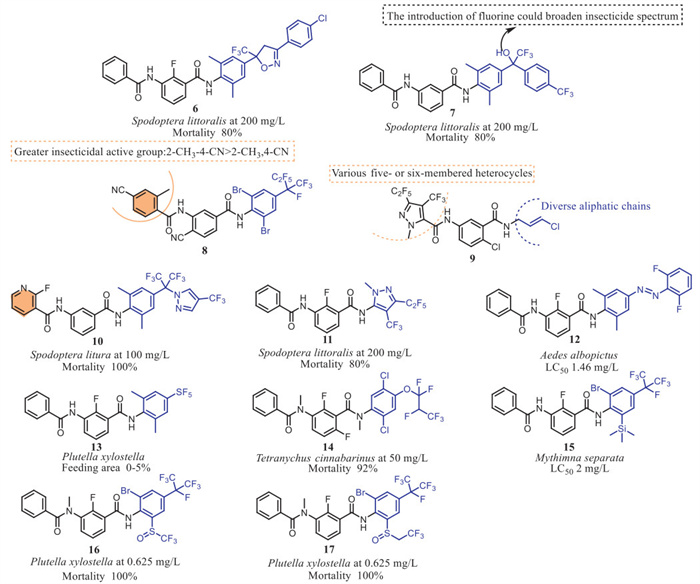
As shown in Fig. 3, compound 6, carrying a trifluoromethyl-containing isoxazole ring on the B ring, showed an 80% fatality rate against Spodoptera littoralis, Heliothis virescens, Plutella xylostella and Diabrotica balteata at 200 mg/L, and also gave at least 80% control of Aedes aegypti [63,64]. Compound 7 (Fig. 3) exhibited at least 80% control of Spodoptera littoralis, Heliothis virescens and Plutella xylostella at 200 mg/L [65]. When a fluorine atom replaced the hydroxyl group, the insecticidal spectrum of the compounds was broadened for the control of Thrips tabaci, Myzus persicae and Tetranychus urticae [66]. Compound 8 (Fig. 3) is a representative derivative in which the heptafluoroisopropyl group of the B ring was replaced with a polyfluoroalkyl or a halogenated polyfluoroalkyl group [67,68]. Bayer derived the B ring into an aliphatic group while transforming the C ring into different five and six-membered heterocycles. The derivatives, such as compound 9 (Fig. 3), exhibited larvicidal and ovicidal activities against external parasitic pests including Boophilus microplus, Amblyomma hebraeum and others at 500 g/ha [69,70]. Meanwhile, compound 7 was modified to produce compound 10 (Fig. 3), which had 100% insecticidal efficacy against Spodoptera litura, Aulacophora femoralis, Ctenocephalides felis and Lucillia cuprina at 100 mg/L [71]. Compound 11 (Fig. 3) showed 80% control of Spodoptera littoralis, Heliothis virescens, Plutella xylostella, Diabrotica balteata, Myzus persicae, Thrips tabaci and Tetranychus urticae at 200 mg/L [72]. Shao et al. synthesized photochemical meta-diamide derivatives by introducing azobenzene with the property of photoisomerization, in which compound 12 (Fig. 3) showed insecticidal activity against Aedes albopictus [73]. The cis-compound 12 showed better insecticidal activity with a 1.5-fold increase due to light-dependent differences. Compound 13 (Fig. 3) had an inhibitory effect on the feeding behavior of third instar larvae of Plutella xylostella that was comparable to Broflanilide with a feeding area in the range of 0–5% [74]. However, its insecticidal activity was much lower than that of Broflanilide, indirectly verifying the importance of heptafluoroisopropyl as the active group. Compound 14 (Fig. 3) showed good inhibitory activity against Tetranychus cinnabarinus with the mortality rate of 92% at 50 mg/L, which was slightly better than the positive control Propargite (85%) [75]. Silicon, which is often introduced into active molecules as a bioequivalent substitute for carbon in drug development. Maienfisch et al. found that introducing a silicon atom at the ortho position of the benzene ring was more effective in insecticidal activity [76]. Compound 15 (Fig. 3) had a 100% corrected mortality rate for Mythimna separata at 50 mg/L with an LC50 value of 2 mg/L. This work partly demonstrates that the insertion of organosilicon substituents can positively affect the biological activity and provide a novel strategy for agrochemical research. At 0.625 mg/L, compounds 16 and 17 (Fig. 3) showed 100% lethality against Plutella xylostella which was comparable to Broflanilide (100%) [77].
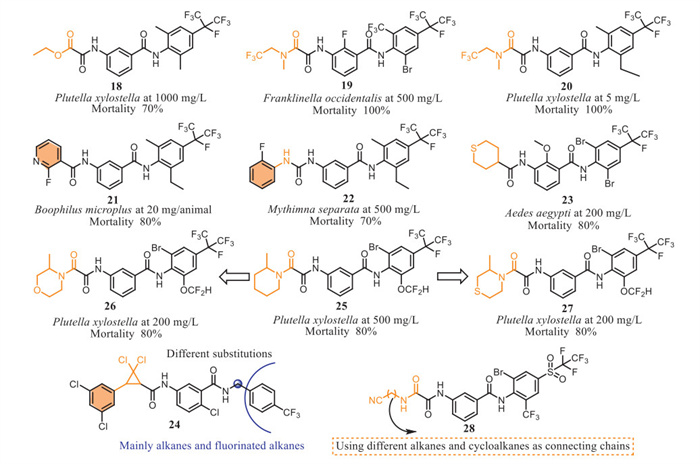
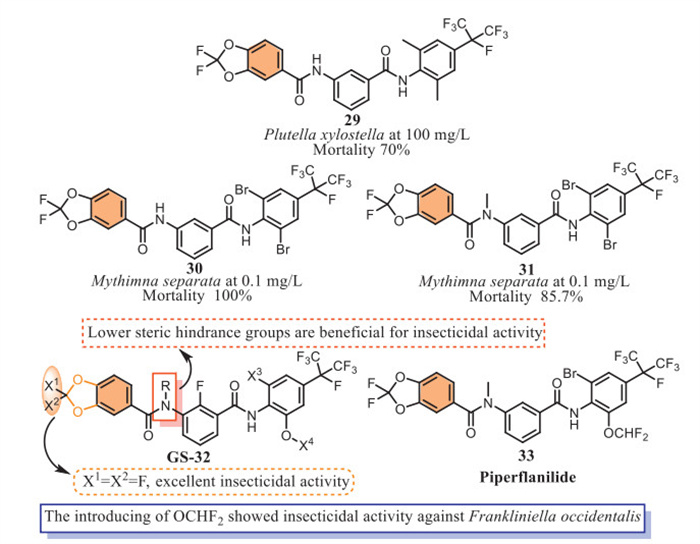
Other than a few minor group changes in the C ring [78-80], a series of typical structural transformations deserves attention. In 2006, compounds bearing ester groups in the C ring were prepared by Mitsui Chemicals [81]. As a representative one, compound 18 (Fig. 4) gave ≥70% kill of Spodoptera litura, Plutella xylostella and Laodelphax striatellus at 1000 mg/L. After the ester groups in the C ring were derivatized into a diamide structure, the compounds exhibited enhanced insecticidal activity against thysanoptera pests such as Franklinella occidentalis, Thrips palmi and Thrips tabaci, taking compound 19 (Fig. 4) as a typical example [82]. Furthermore, compound 20 (Fig. 4) synthesized by Agro-Kanesho Co., Ltd., exhibited excellent insecticidal activity against Plutella xylostella, Tetranychus urticae and Myzus persicae with a mortality rate of 100% at 5 mg/L [83]. In addition, Agro-Kanesho had made various derivations and modifications to the functional groups of these compounds [84-86]. Bayer publicly disclosed a series of compounds with the C ring being a pyridine ring in 2009. Compound 21 (Fig. 4) showed good activity of ≥80% against Boophilus microplus at an application rate of 20 μg/animal, as well as Ctenocephalides felis, Lucillia cuprina, Musca domestica and Amblyomma hebraeum at 100 mg/L [87]. Syngenta had carried out similar work mainly targeting lepidoptera, coleoptera, hemiptera and thysanoptera pests [88-90]. Urea-based compound 22 (Fig. 4) synthesized by Zhejiang Chemical Industry Research Institute Co., Ltd. had over 70% inhibitory effect on Mythimna separata at 500 mg/L [91]. Compound 23 (Fig. 4), one of the meta-diamide derivatives wherein the C ring was 4 or 6-membered heterocyclics comprising 1 or 2 sulfur atoms preferably a thietane-3-yl, dithiolane-4-yl and tetrahydrothiopyran-4-yl group, displayed at least 80% control of Aedes aegypti and Anopheles stephensi after 24 h at 200 mg/L [92]. Compound 24 (Fig. 4) was a representative structure of Dow Chemical Company that inserts a cyclopropyl group into the amide bond near the C ring, which exhibited good insecticidal activity against Spodoptera exigua and Trichoplusia ni [93]. Based on compound 25 [94], Sumitomo Chemical Co., Ltd. provided meta-diamide compounds 26 and 27 (Fig. 4) showed an enhanced controlling effect against harmful arthropods [95,96]. Furthermore, they introduced cyano groups to obtain the common structure 28 (Fig. 4) [97]. Using natural active molecules as precursors for structural modification is one of the important approaches in the discovery of medicines and pesticides. There are relatively few research reports on the use of the natural active component piperonylic acid in pepper as a precursor for pesticide discovery. In 2014, Mitsui Chemicals disclosed a meta-diamide derivative 29 (Fig. 5) containing a piperonylic ring, which has a mortality rate of over 70% against Spodoptera litura and Plutella xylostella at a concentration of 100 mg/L [98]. Subsequently, Wu et al. designed analogous derivatives in 2019 [99,100]. Compounds 30 and 31 (Fig. 5) still exhibited 100 and 85.7% mortality rates against Mythimna separata when the concentration was reduced to 0.1 mg/L, outperforming the control 29 (0%) and DMBF (28.6%) [99]. Meanwhile, the compounds 32 with the general structural (GS) formula as shown in Fig. 5 were synthesized and exhibited certain insecticidal activity against Frankliniella occidentalis [100]. Compound 33 (Fig. 5) was found to have over 90% insecticidal activity against Frankliniella occidentalis, Mythimna separata and Plutella xylostella at 10 mg/L, which is currently undergoing registration as a new meta-diamide insecticide under the generic name "Piperflanilide" [100]. The SAR reveal that groups with relatively little steric hindrance on the amide nitrogen and containing fluorinated piperonylic rings are conducive to exerting the insecticidal effect.
Initially, Mitsui Chemicals published a patent in which they designed and synthesized a large number of meta-diamide compounds of the general formula GS-34 as shown in Fig. 6 [25]. The structural modification of the compound mainly focused on the substituents at the nitrogen position of the amide bond. The results of biological activity assays showed that most compounds had good insecticidal activity against Spodoptera litura with a mortality rate of over 70% at a concentration of 1 mg/L. There are too many compounds to show all of them, compound 35 (Fig. 6) is used as an illustration [25]. Furthermore, CAC has also made significant progress in the derivatization of the amide bonds. Lv et al. introduced different cycloalkanes into the amide bonds to synthesize compounds 36–39 (Fig. 6) [101]. Compound 36 exhibited 90% efficacy against Chilo suppressalis at a low concentration of 1.25 mg/L, which was superior to that of compound 37 (46.67%). It indicates that the substitution position of the cyclopropylmethyl group at the amide bond has a significant impact on the insecticidal activity. Meanwhile, compounds 38 and 39 demonstrated significantly lower insecticidal activity compared to the aforementioned compounds, suggesting that the size of the ring exerts a certain influence on insecticidal activity.
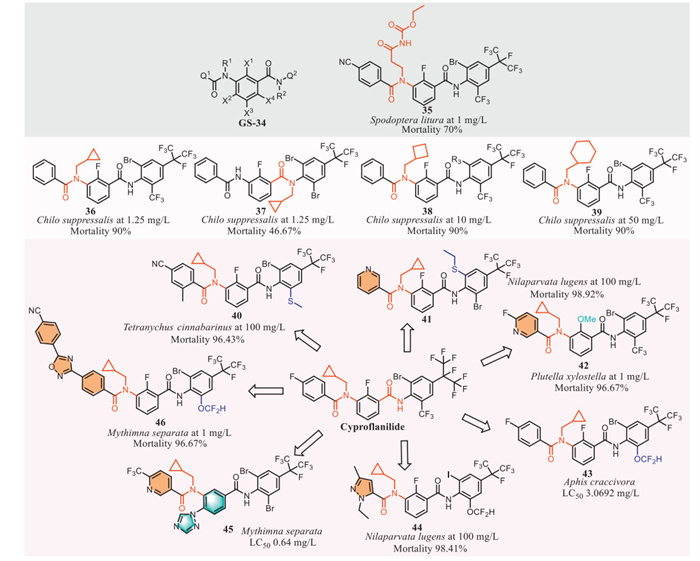
During the in-depth research on the cyclopropylmethyl group, Cyproflanilide (Fig. 6) was developed and marketed [35,102,103]. Cyproflanilide has a novel mode of action and a broad spectrum of insecticidal activity. It is effective against lepidoptera pests such as Chilo suppressalis, Cnaphalocrocis medinalis, Spodoptera exigua, Plutella xylostella, and Spodoptera frugiperda, as well as hemiptera pests. Particularly, Cyproflanilide demonstrates exceptional efficacy against Chilo suppressalis in paddy fields and exhibits no cross-resistance with existing insecticides, which can effectively address the problem of the absence of available pesticides in areas where Chilo suppressalis has developed resistance. Since then, CAC continues to carry out a considerable amount of structural modification work regarding Cyproflanilide. Liu et al. used Cyproflanilide as the lead compound and replaced the trifluoromethyl group with a methylthio group to synthesize a series of meta-diamides containing sulfur, sulfoxide and sulfone groups. The preliminary insecticidal activity test results showed that the compounds had almost no activity against Plutella xylostella at 0.1 mg/L. However, compound 40 (Fig. 6) showed a 96.43% mortality rate against Tetranychus cinnabarinus at 100 mg/L, which was superior to Cyproflanilide (34.52%) [104]. Compound 41 (Fig. 6) respectively exhibited an inhibitory effect on Nilaparvata lugens and Aphis craccivora with lethality rates of 98.92% and 79.81% at 100 mg/L, better than that of Cyproflanilide (0 and 25.60%) [105]. Compound 42 (Fig. 6) displayed a 96.67% mortality rate against Plutella xylostella at 1 mg/L, which was close to Cyproflanilide (100%) [106]. The insecticidal activity against Plutella xylostella of compound 43 (Fig. 6) was comparable to that of Cyproflanilide, both achieving a 96.67% mortality rate at 0.1 mg/L [107]. Additionally, compound 43 demonstrated excellent insecticidal activity against Aphis craccivora and Tetranychus cinnabarinus with LC50 values of 3.0692 mg/L and 3.7059 mg/L respectively, significantly better than Cyproflanilide, which had an LC50 value of 112.0501 mg/L for Aphis craccivora and over 400 mg/L for Tetranychus cinnabarinus. The SAR indicates that the extension of the alkyl chain in the alkoxyl group has a certain positive impact on the insecticidal activity when the trifluoromethyl group of Cyproflanilide is substituted with alkoxyl groups. Moreover, the addition of fluorine atoms can have an enhancing effect. However, the insecticidal activity will weaken as the number of fluorine atoms increases or as the carbon chain lengthens accompanied by the addition of fluorine atoms. Compound 44 (Fig. 6) incorporating a pyrazole moiety demonstrated a lethality rate exceeding 98.41% against Nilaparvata lugens at 100 mg/L, while Cyproflanilide exhibited no activity at the same concentration [108]. Based on the previous work of Syngenta and Bayer [109,110], Liu et al. designed a series of novel meta-diamide compounds containing 1, 2, 4-triazole with Cyproflanilide as a lead compound [111,112]. Compound 45 (Fig. 6) had good activity against Plutella xylostella and Mythimna separata with LC50 values of 0.90 mg/L and 0.64 mg/L respectively, which was inferior to Cyprofllanilide (0.10 mg/L and 0.03 mg/L), revealing the 6-trifluoromethylpyridyl showed the best insecticidal activity [111,112]. Compound 46 (Fig. 6), containing a 1, 2, 4-oxadiazole group, had relatively lower insecticidal activity with 96.67% mortality against Mythimna separata and 0% mortality against Plutella xylostella than Cyproflanilide with 100% mortality at 1 mg/L [113]. It confirmed that the introduction of 1, 2, 4-oxadiazole into Cyprofllanilide reduced the insecticidal activity against Plutella xylostella and Mythimna separata.
In the large-scale process study of Cyproflanilide, its cyclopropylmethyl can be ring-opened to form the by-product N-butyl meta-diamide derivatives. Liu et al. from CAC introduced alkyl chains of different lengths into the amide bonds to prepare a series of N-alkyl meta-diamide derivatives [114-116]. Among them, N-butyl compound 47 (Fig. 7) demonstrated the optimal insecticidal activity. Compound 47 showed better insecticidal activity against Alfalfa sprouts with a mortality of 98.89% than Cyproflanilide (25.60%) at 100 mg/L, simultaneously exhibited the same insecticidal activity against Spodoptera frugiperda as Cyproflanilide (100%) at 0.1 mg/L [114,115]. Compound 48 (Fig. 7) containing an N-propyl group exhibited 100% lethality at a concentration of 1 mg/L against both Plutella xylostella and Mythimna separata. Compounds with single substitutions on the benzene ring showed significantly better insecticidal activity than those with double substitutions [116]. Zhang et al. developed a N-cyanomethylated meta-diamide 49 (Fig. 7) by introducing a cyanoalkyl moiety into the amide bond. Compound 49 showed good insecticidal activity against Plutella xylostella with a mortality of 96.67% at 0.05 mg/L, which was superior to Broflanilide with a mortality of 33.33% [117,118]. Furthermore, they designed compounds 50 and 51 (Fig. 7), which contained allyl and propargyl groups respectively at the nitrogen position of the amide bonds [119]. The meta-diamide derivatives have over 90% insecticidal efficacy against lepidoptera thanks to the inclusion of unsaturated hydrocarbons. Liu performed similar work in synthesizing meta-diamide compounds containing an alkenyl unit, while compound 52 (Fig. 7) showed superior insecticidal activity, achieving a mortality of 100% against Plutella xylostella at a concentration of 0.1 mg/L compared with Broflanilide (66.67%) [120]. Hailir Pesticides and Chemicals Group Co., Ltd. introduced methoxy and ethoxy groups at the nitrogen position of the amide bond of meta-diamide using a fixed methylene linkage to obtain compounds 53–55 (Fig. 7) by varying the substituted aromatic rings when the six-membered ring was transformed into a five-membered ring [121], contributing to weaken the insecticidal activity against Chilo suppressalis with the lethality rate of Chilo suppressalis decreasing from 100% to 80%.
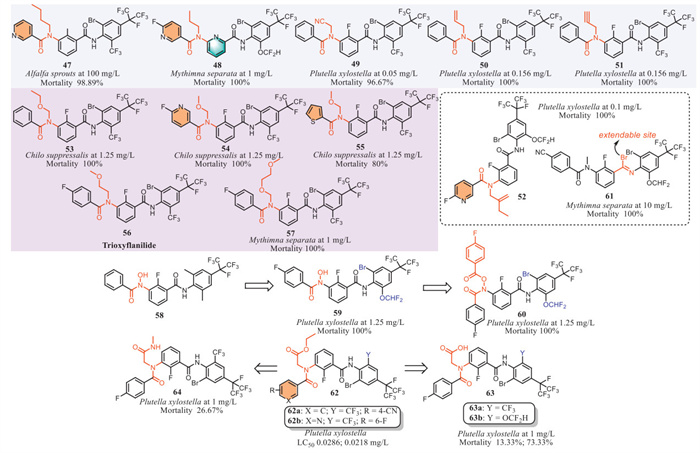
Commonly named with Trioxyflanilide by the International Organization for Standardization (ISO), compound 56 (Fig. 7) discovered by Zhejiang Udragon Bioscience Co., Ltd. had respectively 60% and 70% mortality rates against the resistant strain (RS) and the sensitive strain (SS) of Plutella xylostella for 72 h at 0.05 mg/L, which was better than Broflanilide (36.67% for RS and 66.67% for SS) [122,123]. The rapid efficacy assay against Plutella xylostella demonstrated that compound 56 possessed a faster action speed, resulting in a 60% mortality rate after 12 h. The LC50 of compound 56 and Broflanilide against Plutella xylostella for 72 h was 0.0735 and 0.0659 mg/L, respectively. Particularly for Spodoptera frugiperda at 0.125 mg/L, compound 56 showed a 100% mortality rate. Comparative bioactivity assays using both wild-type (w1118) and mutant (RDLG335M) Drosophila melanogaster, with LC50 values of 0.27 mg/kg for w1118 larvae and over 100 mg/kg for homozygous RDLG335 larvae, confirming RDLG335 could be one of the action sites for compound 56. Dioxaalkyl-substituted meta-diamide compound 57 (Fig. 7) showed 100% insecticidal activity against Mythimna separata at 1 mg/L [124]. Mitsui Chemicals disclosed the introduction of a hydroxyl group into the nitrogen position of the meta-diamide to form meta-diamide derivative 58 (Fig. 7) containing hydroxylamines in 2007 [125]. Based on this compound, Wu et al. further derivatized hydroxylamine to obtain the meta-diamide derivatives 59 and 60 (Fig. 7) [126], whose insecticidal activities against Plutella xylostella with 100% mortality rates were superior to that of compound 58 with no activity at 1.25 mg/L. The meta-diamide containing aryl imine compound 61 (Fig. 7) had a better control effect on Mythimna separata and Plutella xylostella with a mortality rate of 100% for both when the concentration was 10 mg/L [127]. In 2023, Liu et al. introduced ethyl acetate to the nitrogen position of Broflanilide to synthesize compounds 62, which were further hydrolyzed to obtain the corresponding compounds 63 (Fig. 7) [128]. Additionally, compound 62 underwent an amino ester exchange reaction with methylamine hydrochloride to yield compound 64 (Fig. 7) [128]. Among them, compounds 62a and 62b exhibited 100% lethality rates against Plutella xylostella at a drug dose of 0.1 mg/L, with LC50 values of 0.0286 mg/L and 0.0218 mg/L respectively, which were comparable to Broflanilide (100%, LC50 = 0.0226 mg/L). Bioactivity assays indicate that adding an ester group at the nitrogen position of the amide bond is beneficial to insecticidal activity, while the introduction of a carboxyl or an amide group results in suboptimal insecticidal activity.
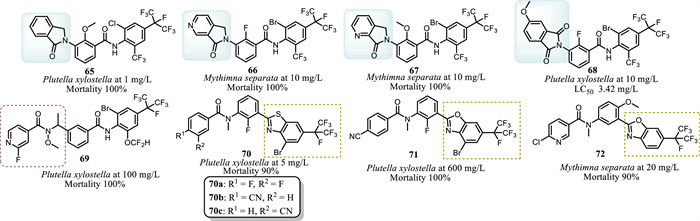
Apart from the derivatization on the original scaffold, which includes the A/B/C rings and the amide bonds of meta-diamide mentioned above, many related works break through the intrinsic structure to generate various compounds. Unlike typical derivatives that retain both meta-amide bonds on the phenyl ring of Broflanilide, these studies explore a novel strategy. Using Broflanilide as the lead compound, they designed and synthesized new analogs by either converting the amide bonds into heterocycles or extending the carbon chains. The meta-amide derivative 65 (Fig. 8) containing a polyfluoroalkyl isoindolin-1-one unit displayed 100% insecticidal activity against Mythimna separata and Plutella xylostella at 1 mg/L [129]. Polyheterocyclic compounds 66 and 67 (Fig. 8) bearing a pyrrolidone moiety had a 100% insecticidal effect on Mythimna separata at 10 mg/L [130]. In 2024, Li et al. introduced phthalimide into Broflanilide to design and synthesize derivative 68 (Fig. 8) by a scaffold hopping strategy [131]. The insecticidal activities of compound 68 with LC50 values of 3.82 and 3.42 mg/L against Mythimna separata and Plutella xylostella were inferior to those of Broflanilide with LC50 values of 0.05 and 0.03 mg/L. Meanwhile, compound 68 was confirmed to exert its insecticidal activity by targeting the GABA receptor by means of electrophysiological studies using Xenopus oocytes. Compound 69 (Fig. 8) showed insecticidal activity against Mythimna separata and Plutella xylostelal at 100 mg/L [132], with a fatality rate of 100%, which was equal to Broflanilide (100%). The SAR manifests that extending the carbon chain of the N-alkoxy moiety reduces insecticidal activity, with N-methoxy being the most effective. Compound 70 (Fig. 8) including a benzothiazole moiety was prepared to have an effect both on Mythimna separata and Plutella xylostell with 90% fatality rates at 5 mg/L [133]. The insecticidal activities of compounds 71 and 72 (Fig. 8) were much weakened constitutionally when benzothiazole was adjusted to a benzoxazole moiety [134,135].
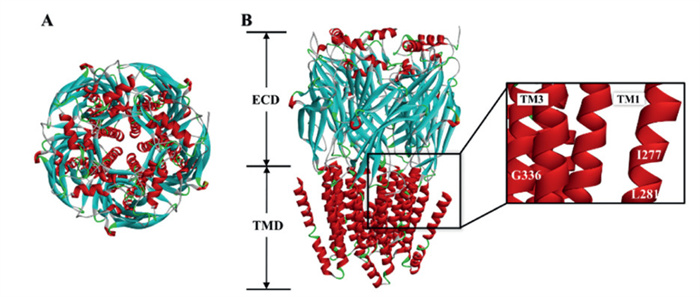
The subunit of the insect GABA receptor was first cloned from Dieldrin-resistant Drosophila melanogaster was thus named Resistant to Dieldrin (RDL) [136,137]. The GABA receptor formed by RDL subunits as a well-established insect model system contains multiple binding sites, and there is no obvious cross-resistance between the binding sites, which is identified as a major target of insecticides and often used for insecticide mechanistic studies [34,138,139]. Due to the significant potential heterogeneity in composition, stoichiometry, and arrangement of GABA receptor subunits, the pharmacological studies of GABA receptors are rather complex [140-142]. So far, the three-dimensional structures of insect RDL GABA receptors that have been resolved are still relatively few, because of the difficulty in purifying and dissociating transmembrane proteins [143]. As research on the RDL GABA receptors in insects is not in-depth limited by the relevant technologies and instruments, it is currently generally believed that the RDL GABA receptors in insects are roughly the same as GABAA receptors in vertebrates, both being pentameric ligand-gated chloride channels composed of five subunits [33,144], taking the human GABAA receptor β3 first resolved by Miller as an example [145], which structure is shown in Fig. 9. GABA binds to the orthosteric binding site (the native ligand's binding site) located at the extracellular N-terminal position between GABA receptor subunits. Competitive antagonists compete with GABA for binding to this site. Additionally, allosteric binding sites exist within the subunit channel, which can bind positive modulators and negative modulators namely noncompetitive antagonists (NCAs) [146,147]. NCAs interact with amino acid residues of GABA-gated chloride channels, causing conformational changes in the GABA receptor, blocking chloride channels, and thereby disrupting the normal functioning of the central nervous system, leading to excessive excitation and eventual death in insects. Currently, all insecticides targeting the GABA receptor that have been successfully developed, except for avermectin, belong to the NCAs category [148]. Broflanilide, as the most representative one of meta-diamides, is also an NCA and acts as an allosteric modulator (a substance that binds to a site on the receptor distinct from the orthosteric site, thereby modulating the receptor's activity) of the GABA receptor.
Based on their conserved meta-diamide core scaffold, it is generally accepted that the meta-diamide derivatives share a precise binding mode analogous to that of Broflanilide. During the development of meta-diamide insecticide Broflanilide, Mitsui Chemicals demonstrated that meta-diamide compounds are unique RDL receptor antagonists, and their mode of action differs from conventional NCAs [30]. The results of the membrane potential assay on mutant Drosophila melanogaster RDL GABA receptor expressed in Drosophila melanogaster Mel-2 cells revealed that conventional NCAs had no inhibitory activity against at least one of the three mutant receptors (The alanine at 2′ position was respectively mutated to serine, glycine and asparagine, A2'S, A2'G and A2'N for short), which were reported to confer resistance to NCAs [149-153]. In contrast, the corresponding meta-diamide compound inhibited all three mutant receptors but showed no effect on a G336M mutation in the third transmembrane domain of the RDL GABA receptor (The glycine located at position 336 was mutated to methionine, G336M for short), while G336 is an important amino acid for the channel function of the insect RDL GABA receptor in the third transmembrane domain [154]. Molecular modeling studies also suggested that the binding site of meta-diamides was different from that of NCAs. Similar experiments were conducted on Spodoptera litura RDL GABA receptor with no difference in results [31]. meta-Diamides displayed no inhibition of the equivalent G319M mutation in the third transmembrane domain of the Spodoptera litura RDL homomers. They further investigated and discovered that meta-diamide is a prodrug (a biologically inactive compound that is metabolized in vivo into an active insecticide), which is metabolized into a demethylated product to exert its effect in vivo [29,32]. The demethylated product acts on a site near G336 in the third transmembrane domain of Drosophila melanogaster RDL. Although there appears to be some overlap with the active sites of macrocyclic lactones, it has been demonstrated that they have different modes of action [155]. Furthermore, Mitsui Chemicals confirmed at the organismal level in 2024 that the amino acid residue G336 in the third transmembrane domain of Drosophila melanogaster RDL receptor is involved in mediating the interaction with meta-diamide insecticide Broflanilide [156]. Moreover, low-level inhibitory activities of meta-diamides have been demonstrated against the human GABAA receptor α1β2γ2S and β3, mammalian GABAA receptor α1β3γ2S, and human glycine receptor α1 and α1β according to the membrane potential assay and computational docking [157-159]. The selectivity of meta-diamides stems from fundamental differences in the binding site residues between RDL receptor and mammalian GABA receptors [158]. Therefore, the meta-diamides have high specificity for the RDL receptor of insects and excellent selectivity for different organisms.
Apart from the G336 that was previously reported, isoleucine 277 and leucine 281, whose mutations were related to meta-diamide binding, were positioned at the entrance of the inter-subunit transmembrane cavity in the first transmembrane domain of Drosophila melanogaster RDL receptor [30,32]. Nakao et al. reported that the mutations I277F and L281C (The isoleucine at position 277 and the leucine at position 281 were respectively mutated to phenylalanine and cysteine, I277F and L281C for short) weakened their antagonist inhibitory activity of desmethyl-Broflanilide (the metabolite of Broflanilide in vivo, abbreviated as DMBF) by approximately 5–10 fold compared to wild-type Drosophila melanogaster RDL, proposing that the vicinity of these mutations is likely the DMBF-binding site [32]. The G336, I277 and L281 residues in Drosophila melanogaster RDL receptor correspond to G277, I218 and L222 residues in the human GABAA receptor β3 utilizing the numbering of the amino acid sequence. Liu et al. clarified that the two mutations I218F and L222C did not affect the binding of DMBF to the key amino acid G336, but weakened the binding of DMBF to the RDL receptor through in silico simulations [160]. Notably, the G277M mutation caused an increase in the volume of amino acid residues, thereby blocking the entrance to the binding pocket and making it difficult for the DMBF to enter the binding pocket, which led to a decrease in the inhibitory activity of the DMBF to the RDL receptor. Huang et al. found all the tested A2'N mutant Drosophila were sensitive to Broflanilide, indicating the A2' residue in the second transmembrane domain of the RDL receptor may not be the site of action where Broflanilide binds to the receptor [161]. However, the tested G335M mutant Drosophila displayed high levels of resistance to Broflanilide [162]. Zhao et al. used in silico analysis to identify the G3' residue in the third transmembrane domain that is critical for the interaction between Broflanilide and RDL receptor, which was also confirmed by the expression of Chilo suppressalis RDL in oocytes of the African clawed frog [163]. Subsequently, the homozygous G3'M mutant Drosophila larvae showed significant resistance to Broflanilide. In addition, homozygotes exhibited severe impairment of motility and inability to survive to the pupal stage, indicating that the G3'M mutation has a high fitness cost. The residue N318 in the second transmembrane domain was confirmed not to be the target site of Broflanilide [164]. They believed that the substitution of glycine by methionine at the third position in the third transmembrane domain of the RDL receptor in vertebrates had the greatest impact on their binding efficacy.
Insecticides protect the healthy growth of crops by effectively controlling pests, serving as the cornerstone for enhancing agricultural productivity, ensuring food security, and promoting sustainable agricultural development. The discovery of Broflanilide further broadens the spectrum and enriches the types of insecticide mechanisms of action, establishing it as one of the most promising varieties among the newcomers. Currently, modifications to the core A ring primarily focus on enhancing insecticidal activity with the benzene ring demonstrating superior efficacy compared to other rings. Retaining the benzene ring while introducing different substituents, such as 2-fluoro substitution, tends to improve insecticidal activity. Modifications to the B ring mainly introduce substituents into the benzene ring. Beyond fluorinated alkyl, alkoxy, and fluorinated alkoxy groups, elements like sulfur and silicon also exhibit certain insecticidal activity. The heptafluoroisopropyl group on the B ring appears to be crucial for insecticidal activity. The modifications of the C ring mainly involve the replacement with substituted aromatic heterocycles or fluorine or chlorine-containing alkyl chains, which is beneficial to insecticidal activity. Introducing hydrocarbons or esters at the amide nitrogen position near the C ring facilitates prodrug metabolism, thereby boosting insecticidal efficacy. Research on amide bonds near the B ring side is relatively scarce. Additionally, benzoheterocyclic meta-diamide compounds synthesized by breaking conventional skeletal designs exhibit moderate insecticidal activity. Overall, the SAR for meta-diamide derivatives remain poorly defined. Furthermore, these meta-diamides mostly exhibit excellent activity against lepidoptera pests such as Plutella xylostella, indicating limited applicability. Their specific physicochemical properties may not be ideal for all application methods or crop systems. Drug formulation challenges and the need for particular storage or handling protocols can also pose practical limitations for insecticidal activity. In order to enhance their persistence and broad-spectrum properties, the development of meta-diamide insecticides should proceed in parallel with strategies to maximize their active ingredients' efficacy. Previous studies have reported that Broflanilide is toxic to aquatic organisms like zebrafish [165-172]. Broflanilide is a readily degradable pesticide in both aqueous environment and agricultural soil [173]. At present, multiple documents is available on the residue distribution and ecotoxicity of Broflanilide and its metabolites [165,171,174-176]. Conducting in-depth research to identify and characterize the ecotoxicity of key metabolites is crucial for the subsequent development of novel meta-diamide insecticides based on Broflanilide. Molecular modification should aim to guide degradation towards more benign metabolites and increase the soil organic carbon-water partitioning coefficient. This approach reduces environmental mobility, thereby minimizing the risk of groundwater contamination and runoff into aquatic systems and protecting aquatic organisms.
The alteration of the amide bond leads to a conformational change, thereby affecting the interaction with the target, and simultaneously giving rise to a new mechanism of action. Current understanding of insect GABA receptors primarily stems from Drosophila melanogaster, with limited investigation into other subunits and their combinations. Meanwhile, the limitation in high-resolution structural studies of the GABA receptor has resulted in an unclear understanding of the specific binding sites for meta-diamides. At the cellular and organismic level, the key amino acid has been proven to be G336 in the third transmembrane region (The numbering is based on the full-length mature protein sequence, starting from the initiator methionine, and that the designation G336 follows this convention, ensuring consistency with previous key literature in the field). In other words, Broflanilide is metabolized in vivo to a demethylated metabolite DMBF that acts on a pocket surrounding the G336 residue in the third transmembrane domain of the insect RDL. The DMBF allosterically modulates the chloride channel, inhibiting the inward transport of chloride ions, leading to excessive excitation and convulsions in the insect, ultimately causing their death. The unique mechanism of action ensures that the meta-diamides have no cross-resistance with existing insecticides. Moreover, while GABA receptor subunits share high homology among different insect species, they differ significantly from those in mammals. Consequently, the meta-diamides are relatively safe and non-toxic to humans and other mammals. Despite being a novel GABA-gated chloride channel antagonist, over-reliance on meta-diamides alone can select for resistant pest populations. This is particularly concerning due to the potential for cross-resistance with other NCAs that share a similar binding site. A proactive resistance management strategy, mandating its use within rotations or mixtures with insecticides from different IRAC groups, is essential to preserve its efficacy.
This review outlines the structures and insecticidal activities of novel meta-diamide compounds derived from the representative lead compound Broflanilide. To date, the relationship between the substitution positions on each ring and the bond linkages of meta-diamide derivatives and their biological activity remains unclear, and the specific active sites are also unknown. Furthermore, whether the structural variations result in a different mechanism of action is still an open question, which facts have limited the in-depth optimization of the structures of the meta-diamides. It is imperative for future work to define the exact binding modes of these most potent meta-diamide derivatives, which is essential to corroborate the mechanism of action and eliminate the possibility of ancillary target sites. Current research on meta-diamide compounds employs computational techniques to elucidate the active sites of these compounds. Unfortunately, computational simulations exhibit discrepancies with the actual three-dimensional structures of insect GABA receptors. Therefore, it is anticipated that the future resolution of the three-dimensional crystal structures of relevant GABA receptors will provide crucial theoretical foundations for understanding the interactions between meta-diamide insecticides and GABA receptors, thereby broadening perspectives for designing insecticides against refractory and resistant agricultural pests, and ultimately developing more efficient, safer, and broad-spectrum meta-diamide insecticides targeting the GABA receptor.
The authors declare that they have no known competing financial interests or personal relationships that could have appeared to influence the work reported in this paper.
Huanan Zeng: Writing – review & editing, Writing – original draft, Methodology, Investigation, Formal analysis, Data curation, Conceptualization. Yue Wu: Methodology, Investigation. Yang Liu: Methodology, Investigation. Ziwen Wang: Writing – review & editing, Writing – original draft, Methodology, Investigation, Data curation, Conceptualization. Jun Chen: Writing – review & editing, Supervision, Conceptualization. Qingmin Wang: Writing – review & editing, Supervision, Project administration, Funding acquisition, Conceptualization.
This work is supported by the National Natural Science Foundation of China (No. 22271166) and the Frontiers Science Center for New Organic Matter, Nankai University (No. 63181206) for generous financial support for our programs.
M. Tohnishi, H. Nakao, T. Furuya, et al., J. Pestic. Sci. 30 (2005) 354–360. doi: 10.1584/jpestics.30.354
U. Ebbinghaus-Kintscher, P. Luemmen, N. Lobitz, et al., J. Cell Calcium. 39 (2006) 21–33. doi: 10.1016/j.ceca.2005.09.002
S.Q. Du, X.P. Hu, J. Agric. Food Chem. 71 (2023) 3620–3638. doi: 10.1021/acs.jafc.2c08414
G.P. Lahm, T.P. Selby, J.H. Freudenberger, et al., Bioorg. Med. Chem. Lett. 15 (2005) 4898–4906. doi: 10.1016/j.bmcl.2005.08.034
Y.B. Chen, J.L. Li, X.S. Shao, et al., Chin. Chem. Lett. 24 (2013) 673–676. doi: 10.1016/j.cclet.2013.04.047
T.P. Selby, G.P. Lahm, T.M. Steveson, et al., Bioorg. Med. Chem. Lett. 23 (2013) 6341–6345. doi: 10.1016/j.bmcl.2013.09.076
D.P. Jiang, C.C. Zhu, X.S. Shao, et al., Chin. Chem. Lett. 26 (2015) 662–666. doi: 10.1016/j.cclet.2015.04.010
B. Li, H.B. Yang, J.F. Wang, et al., Mod. Agrochem. 13 (2014) 17–20+40.
Y. Liu, C. Lei, X.Y. Xu, et al., Chin. Chem. Lett. 27 (2016) 321–324. doi: 10.1016/j.cclet.2015.12.011
Z.B. Wu, X. Zhou, Y.Q. Ye, et al., Chin. Chem. Lett. 28 (2017) 121–125. doi: 10.3390/app7020121
C.C. Wu, B.L. Wang, J.B. Liu, et al., Chin. Chem. Lett. 28 (2017) 1248–1251. doi: 10.1016/j.cclet.2017.01.019
S.P. Foster, I. Denholm, J.L. Rison, et al., Pest Manag. Sci. 68 (2012) 629–633. doi: 10.1002/ps.2306
J.J. Shi, G.H. Ren, N.J. Wu, et al., Chin. Chem. Lett. 28 (2017) 1727–1730. doi: 10.1016/j.cclet.2017.05.015
S. Zhou, S. Zhou, Y.T. Xie, et al., Chin. Chem. Lett. 29 (2018) 1254–1256. doi: 10.1016/j.cclet.2017.10.022
W.J. Liu, J. LI, K. He, et al., Chin. Chem. Lett. 30 (2019) 417–420. doi: 10.1016/j.cclet.2018.05.023
H. Li, H. Liu, Y. Zhang, et al., Chin. Chem. Lett. 32 (2021) 2893–2898. doi: 10.1016/j.cclet.2021.02.002
E. Roditakis, D. Steinbach, G. Moritz, et al., Insect Biochem. Mol. Biol. 80 (2017) 11–20. doi: 10.1016/j.ibmb.2016.11.003
Y. Sun, L. Xu, Q. Chen, et al., Pest Manag. Sci. 74 (2018) 1416–1423. doi: 10.1002/ps.4824
X.L. Wang, Y.D. Wu, Econ. Entomol. 105 (2012) 1019–1023. doi: 10.1603/EC12059
L. Guo, P. Liang, X.G. Zhou, et al., Sci. Rep. 4 (2014) 6924. doi: 10.1038/srep06924
Y.Y. Zuo, H.H. Ma, W.J. Lu, et al., Insect Sci. 27 (2020) 791–800. doi: 10.1111/1744-7917.12695
B.L. Wang, H.X. Wang, H. Liu, et al., Chin. Chem. Lett. 31 (2020) 739–745. doi: 10.1016/j.cclet.2019.07.064
X.H. Zhang, P. Zhang, S.X. Zhang, et al., Agrochemicals 58 (2019) 79–85.
K. Yoshida, T. Wakita, H. Katsuta, et al., Patent, WO2005073165, 2005.
Y. Kobayashi, H. Katsuta, M. Nomura, et al., Patent, WO2010013567, 2010.
J. Wang, S. Qin, Z.B. Sheng, et al., Mod. Agrochem. 19 (2020) 20–24+29. doi: 10.3390/insects12010020
C.Y. Luo, Q. Xu, C.Q. Huang, et al., Org. Process Res. Dev. 24 (2020) 1024–1031. doi: 10.1021/acs.oprd.0c00028
H. Katsuta, M. Nomura, T. Wakita, et al., J. Pestic. Sci. 44 (2019) 120–128. doi: 10.1584/jpestics.d18-088
Y. Ozoe, T. Kita, F. Ozoe, et al., Pest. Biochem. Physiol. 107 (2013) 285–292. doi: 10.1016/j.pestbp.2013.09.005
T. Nakao, S. Banba, M. Nomura, et al., Insect Biochem. Mol. Biol. 43 (2013) 366–375. doi: 10.1016/j.ibmb.2013.02.002
T. Nakao, K. Hirase, J. Pestic. Sci. 38 (2013) 123–128. doi: 10.1584/jpestics.D13-024
T. Nakao, S. Banba, Bioorg. Med. Chem. 24 (2016) 372–377. doi: 10.1016/j.bmc.2015.08.008
X.J. Zheng, H.G. Li, G.Y. Liu, et al., Chin. J. Pestic. Sci. 19 (2017) 665–671.
J.E. Casida, K.A. Durkin, Pest. Biochem. Physiol. 121 (2015) 22–30. doi: 10.1016/j.pestbp.2014.11.006
J.Y. Liu, L.Q. Zhou, J.C. Xiang, et al., World Pestic. 43 (2021) 34–38.
J.J. Li, G.B. Song, S.M. Ma, et al., J. Clean. Prod. 276 (2020) 124283. doi: 10.1016/j.jclepro.2020.124283
Z.X. Sun, Y.J. Zhan, L.C. Liu, et al., Sustain. Prod. Consump. 49 (2024) 61–71. doi: 10.1016/j.spc.2024.06.018
M. Matzrafi, Pest Manag. Sci. 75 (2019) 9–13. doi: 10.1002/ps.5121
Y. Yang, D. Tilman, Z.N. Jin, et al., Science 385 (2024) 3747. doi: 10.1039/d4mh00313f
K. Yoshida, T. Wakita, H. Katsuta, et al., Patent, WO2005021488, 2005.
A. Kai, T. Wakita, H. Katsuta, et al., Patent, WO2006137376, 2006.
K. Takahashi, A. Kai, T. Wakita, Patent, JP2006225340, 2006.
A. Kai, T. Wakita, K. Yoshida, et al., Patent, JP2006306771, 2006.
N. Kawahara, M. Nomura, H. Daido, Patent, WO2007013150, 2007.
M. Nomura, N. Tomura, R. Ezaki, et al., Patent, WO2007013332, 2007.
A. Yanagi, Y. Watanabe, K. Wada, et al., Patent, WO2007017075, 2007.
A. Yanagi, Y. Watanabe, J. Mihara, et al., Patent, WO2007051560, 2007.
H. Katsuta, K. Yoshida, Patent, JP2007302617, 2007.
P. Maienfisch, W. Zambach, P. Jung, et al., Patent, WO2008000438, 2008.
P. Renold, P. Maienfisch, P. Jung, et al., Patent, WO2008012027, 2008.
M. Nomura, N. Tomura, A. Kawahara, et al., Patent, WO2008075453, 2008.
M. Nomura, N. Tomura, A. Kawahara, et al., Patent, WO2008075454, 2008.
M. Nomura, N. Tomura, A. Kawahara, et al., Patent, WO2008075459, 2008.
M. Nomura, N. Tomura, A. Kawahara, et al., Patent, WO2008075465, 2008.
U. Goergens, A. Yanagi, K. Wada, et al., Patent, WO2009080203, 2009.
H. Katsuta, A. Kai, T. Wakita, et al., Patent, JP2009209090, 2009.
P. Maienfisch, C.R.A. Godfrey, P.J.M. Jung, et al., Patent, WO2010127928, 2010.
P.J.M. Jung, P. Danko, C.R.A. Godfrey, et al., Patent, WO2011113756, 2011.
P. Jung, P. Durieux, W. Lutz, et al., Patent, WO2007128410, 2007.
P. Jung, C.R.A. Godfrey, W. Lutz, et al., Patent, WO2008074427, 2008.
M. Nomura, Patent, CN102119143, 2011.
Y. Yao, J. Liu, L. Zhou, et al., Chem. Biodivers. 21 (2024) e202400816. doi: 10.1002/cbdv.202400816
P. Renold, P. Maienfisch, P. Jung, et al., Patent, WO2008012027, 2008.
P.M.J. Jung, P. Renold, C.R.A. Godfrey, et al., Patent, WO2009049844, 2009.
A.D. Stoller, P.J.M. Jung, C.R.A. Godfrey, et al., Patent, WO2009049845, 2009.
P.J.M. Jung, C.R.A. Godfrey, O.F. Hueter, et al., Patent, WO2011095462, 2011.
P.J.M. Jung, C.R.A. Godfrey, O.F. Hueter, et al., Patent, WO2010127926, 2010.
A. Edmunds, A. Stoller, T. Pitterna, Patent, WO2015097091, 2015.
M. Maue, I. Adelt, W. Giencke, et al., Patent, WO2010051926, 2010.
M. Maue, I. Adelt, W. Giencke, et al., Patent, WO2010133312, 2010.
J. Mihara, T. Murata, K. Domon, et al., Patent, WO2010015355, 2010.
P.J.M. Jung, O.F. Hueter, P. Renold, et al., Patent, WO2012069366, 2012.
C.C. Zhou, Y.F. Ji, L.P. Ren, et al., Photochem. Photobiol. Sci. 19 (2020) 854. doi: 10.1039/d0pp00045k
J.G. Kim, O.Y. Kang, S.M. Kim, et al., Molecules 25 (2020) 5536. doi: 10.3390/molecules25235536
B.Y. Zhu, R.S. Zhang, S. Jiang, et al., Shandong Chem. Ind. 52 (2023) 24–27 33.
X.C. Quan, L. Xu, Z. Li, et al., J. Agric. Food Chem. 71 (2023) 18188–18196. doi: 10.1021/acs.jafc.3c01342
J. Wu, S. Dang, Y. Zhang, et al., Molecules 29 (2024) 1337. doi: 10.3390/molecules29061337
J.C. Ge, T.L. Hu, L. Li, et al., Patent, CN114394912, 2022.
Y.T. Li, C.W. Wang, J.X. Xu, et al., Patent, CN114573547, 2022.
J.B. Xu, H.F. Wu, X.M. Cheng, et al., Patent, CN115872889, 2023.
A. Kai, T. Wakita, K. Yoshida, et al., Patent, JP2006306771, 2006.
K. Yoshida, Y. Kobayashi, M. Nomura, et al., Patent, WO2006137395, 2006.
S. Usui, T. Fukuchi, Y. Kinoshita, Patent, WO2010090282, 2010.
S. Usui, T. Fukuchi, S. Kinoshita, Patent, WO2012020483, 2012.
S. Usui, S. Kakinuma, T. Fukuchi, et al., Patent, WO2012077221, 2012.
S. Usui, S. Kakinuma, T. Fukuchi, et al., Patent, WO2012164698, 2012.
U. Goergens, A. Yanagi, K. Wada, et al., Patent, WO2009080203, 2009.
A. Stoller, A. Edmunds, T. Pitterna, et al., Patent, WO2014161848. 2014.
O.F. Hueter, T. Pitterna, A. Stoller, et al., Patent, WO2014161849. 2014.
T. Pitterna, A. Stoller, A. Edmunds, Patent, WO2015097094, 2015.
Q. Feng, J. Yuan, H.M. Zhang, et al., Patent, CN102993054, 2013.
T. Pitterna, C.R.A. Godfrey, F.H. Ottmar, et al., Patent, GB2520098, 2015.
T.P. Martin, J.D. Eckelbarger, R. Ross, et al., Patent, WO2016168059, 2016.
S. Usui, S. Kakinuma, T. Fukuchi, et al., Patent, WO2012164698, 2012.
M. Takahashi, Patent, WO2016143652, 2016.
M. Takahashi, Patent, WO2016143650, 2016.
M. Takahashi, Patent, WO2017026298, 2017.
Y. Kei, W. Tekeo, K. Hiroyuki, et al., Patent, US20140206727, 2014.
H.F. Wu, J.B. Xu, S.W. Liu, et al., Patent, CN109206397, 2019.
H.F. Wu, J.B. Xu, S.W. Liu, et al., Patent, CN112457288, 2021.
L. Lv, J.Y. Liu, J.C. Xiang, et al., Patent, CN108586279, 2018.
L. Lv, J.Y. Liu, J.C. Xiang, et al., Patent, CN109497062, 2019.
C.Y. Luo, W.J. Ma, L. Lv, et al., J. Org. Chem. 40 (2020) 2963–2970. doi: 10.6023/cjoc202003025
M.H. Huang, X.W. Liu, M.H. Liu, et al., Lett. Drug Des. Discov. 21 (2024) 496–503. doi: 10.2174/1570180820666221115143850
H.Y. Long, D.X. Wu, J.X. Wang, et al., Tetrahedron Lett. 118 (2023) 154388. doi: 10.1016/j.tetlet.2023.154388
L.M. Liang, M.H. Wu, P.M. Huang, et al., J. Braz. Chem. Soc. 35 (2024) e–202301111–11.
J.Y. Liu, M.H. Wu, J.C. Xiang, et al., Chin. J. Org. Chem. 44 (2024) 1584–1591. doi: 10.6023/cjoc202311015
J.Y. Liu, Y. Yan, M.H. Wu, et al., Heterocycl. Commun. 30 (2024) 20220177. doi: 10.1515/hc-2022-0177
P. Maienfisch, C.R.A. Godfrey, P.J.M. Jung, Patent, WO2010127927, 2010.
J. Mihara, K. Araki, T. Mori, et al., Patent, WO2011018170, 2011.
L. Zhang, J. Liu, L. Zhou, et al., J. Heterocycl. Chem. 61 (2024) 1411. doi: 10.1002/jhet.4866
C. Yan, J. Liu, J. Xiang, et al., Chem. Biodivers. 22 (2025) e202402460. doi: 10.1002/cbdv.202402460
P.M. Huang, T. Yang, J.Y. Liu, et al., J. Braz. Chem. Soc. 36 (2025) e–202401251–11.
J.Y. Liu, R.Z. Wang, J.C. Xiang, et al., Patent, CN113321595, 2021.
M.H. Huang, M.H. Wu, L. Lv, et al., Tetrahedron Lett. 96 (2022) 153743. doi: 10.1016/j.tetlet.2022.153743
D.X. Wu, B.Q. Li, J.Y. Liu, et al., Med. Chem. Res. 34 (2025) 700–708. doi: 10.1007/s00044-025-03374-9
L.X. Zhang, J. Zhang, J. Wang, et al., Patent, WO2021139370, 2021.
J. Zhang, H.Y. Pei, F. Wang, et al., Fine Chem. 39 (2022) 769–774. doi: 10.22323/1.414.0769
L.X. Zhang, J. Zhang, H.Y. Pei, et al., Patent, CN115611767, 2023.
T. Liu, L.T. Hu, L. Lv, et al., Agrochemicals 64 (2025) 322–327.
J.C. Ge, T.L. Hu, J.P. Qiu, et al., Patent, CN115304510, 2022.
X.L. Shen, H.L. Wu, Patent, CN115925576, 2023.
S. Zhou, H. Shen, H.L. Wu, et al., J. Agric. Food Chem. 73 (2025) 17446–17457. doi: 10.1021/acs.jafc.5c03018
Y.K. Sang, Q.A. Deng, Z.H. Li, et al., Patent, CN118439971, 2024.
T. Wakita, H. Daido, A. Kai, et al., Patent, JP2007099761, 2007.
H.F. Wu, J.B. Xu, S.W. Liu, et al., Patent, CN115872904, 2023.
H.F. Wu, J.B. Xu, J. Sun, et al., Patent, CN115872901, 2023.
J.X. Wang, J.C. Xiang, M.H. Wu, et al., Chem. Biodivers. 20 (2023) e202300060. doi: 10.1002/cbdv.202300060
T.M. Xu, J.H. Xing, L.J. Zhao, et al., Patent, CN112778192, 2022.
X.C. Lu, Y.K. Sang, Z.H. Li, et al., Patent, CN118440079, 2024.
L. Zhang, Z.G. Zhang, Q.T. Huang, et al., J. Agric. Food Chem. 72 (2024) 26626–26632. doi: 10.1021/acs.jafc.4c05418
A.Y. Wang, M.H. Wu, L. Lv, et al., Agrochemicals 63 (2024) 319–324.
J.L. Han, J.B. Xu, X.H. Chang, et al., Agrochemicals 63 (2024) 8–12.
J.B. Xu, J.L. Han, X.H. Chang, et al., Agrochemicals 63 (2024) 163–167.
J.J. Shi, W.W. Li, C.X. Tan, et al., Res. Chem. Intermed. 50 (2024) 1809–1825.
R.H. Ffrench-Constant, R.T. Roush, D. Mortlock, et al., J. Econ. Entomol. 83 (1990) 1733–1737. doi: 10.1093/jee/83.5.1733
R.H. Ffrench-Constant, D.P. Mortlock, C.D. Shaffer, Proc. Natl. Acad. Sci. U. S. A. 88 (1991) 7209–7213. doi: 10.1073/pnas.88.16.7209
J.E. Casida, Chem. Res. Toxicol. 22 (2009) 609–619. doi: 10.1021/tx8004949
K. Yamaura, S. Kiyonaka, T. Numata, et al., Nat. Chem. Biol. 12 (2016) 822–830. doi: 10.1038/nchembio.2150
W. Sieghart, K. Fuchs, V. Tretter, et al., Neurochem. Int. 34 (1999) 379–385. doi: 10.1016/S0197-0186(99)00045-5
R.W. Olsen, W. Sieghart, Neuropharmacology 56 (2009) 141–148. doi: 10.1016/j.neuropharm.2008.07.045
F.H. Mohamad, M.A.M. Jamali, A.T.C. Has, Mol. Neurosci. 73 (2023) 804–817. doi: 10.1007/s12031-023-02158-3
R. Puthenveetil, C.J. Lee, A. Banerjee, Curr. Protoc. Cell Biol. 87 (2020) e106. doi: 10.1002/cpcb.106
Y. Ozoe, Adv. Insect Physiol. 44 (2013) 211–286.
P.S. Miller, A.R. Aricescu, Nature 512 (2014) 270–275. doi: 10.1038/nature13293
W. Löscher, M.A. Rogawski, Epilepsia 53 (2012) 12–25. doi: 10.1111/epi.12025
E. Sigel, B.P.A. Luscher, Curr. Top. Med. Chem. 11 (2011) 241–246. doi: 10.2174/156802611794863562
S.C.R. Lummis, Biochem. Soc. Trans. 37 (2009) 1343–1346. doi: 10.1042/BST0371343
R.H. Ffrench-Constant, T.A. Rocheleau, J.C. Steichen, et al., Nature 363 (1993) 449–451. doi: 10.1038/363449a0
M. Thompson, J.C. Steichen, R.H. Ffrench-Constant, Insect Mol. Biol. 2 (1993) 149–154. doi: 10.1111/j.1365-2583.1993.tb00134.x
J.R. Gao, T. Kozaki, C.A. Leichter, Pestic. Biochem. Physiol. 88 (2007) 66–70. doi: 10.1016/j.pestbp.2006.09.001
T. Nakao, A. Naoi, M. Hama, et al., Econ. Entomol. 105 (2012) 1781–1788. doi: 10.1603/EC12073
T. Nakao, NeuroToxicology 60 (2017) 293–298. doi: 10.1016/j.neuro.2016.03.009
T. Nakao, S. Banba, Pest Manag. Sci. 77 (2021) 3753–3762. doi: 10.1002/ps.6121
T. Nakao, S. Banba, K. Hirase, Pest. Biochem. Physiol. 120 (2015) 101–108. doi: 10.1016/j.pestbp.2014.09.011
Y. Ozoe, T. Nakao, S. Kondo, et al., Pest. Biochem. Physiol. 199 (2024) 105776. doi: 10.1016/j.pestbp.2024.105776
T. Nakao, K. Hirase, J. Pestic. Sci. 39 (2014) 144–151. doi: 10.1584/jpestics.D14-043
T. Nakao, S. Banba, Pest. Manag. Sci. 77 (2021) 3744–3752. doi: 10.1002/ps.6116
S. Banba, J. Pestic. Sci. 46 (2021) 283–289. doi: 10.1584/jpestics.j21-01
Y. Gao, Y.C. Zhang, F.S. Wu, et al., J. Agric. Food Chem. 68 (2020) 14768–14780. doi: 10.1021/acs.jafc.0c05728
X.M. Qiao, T.H. Zhou, J. Zhang, et al., Pest Manag. Sci. 80 (2024) 1924–1929. doi: 10.1002/ps.7929
T.H. Zhou, W.P. Wu, S.H. Ma, et al., Insects 15 (2024) 334. doi: 10.3390/insects15050334
Y.C. Zhang, Q.T. Huang, C.W. Sheng, et al., PLoS Genet. 19 (2023) e1010814. doi: 10.1371/journal.pgen.1010814
Y.C. Zhang, X.Y. Liu, J.Y. Wang, et al., J. Agric. Food Chem. 72 (2024) 22554–22561.
Z.Q. Jia, Y.C. Zhang, Q.T. Huang, et al., J. Hazard. Mater. 394 (2020) 122521. doi: 10.1016/j.jhazmat.2020.122521
M. Duan, J. Zhang, J. Liu, et al., Environ. Pollut. 286 (2021) 117481. doi: 10.1016/j.envpol.2021.117481
K. Wang, C.J. Wang, J.H. Wang, et al., Chemosphere 305 (2022) 135426. doi: 10.1016/j.chemosphere.2022.135426
S.J. Patuel, C. English, V. Lopez-Scarim, et al., Data Brief 50 (2023) 109534. doi: 10.1016/j.dib.2023.109534
X.Y. Mu, K. Wang, L. He, et al., Environ. Sci. Technol. 57 (2023) 14138–14149. doi: 10.1021/acs.est.3c03626
S.J. Patuel, C. English, V. Lopez-Scarim, et al., Sci. Total Environ. 904 (2023) 167072. doi: 10.1016/j.scitotenv.2023.167072
H.F. Lin, Y.P. Yang, N. Li, et al., Environ. Res. 248 (2024) 118327. doi: 10.1016/j.envres.2024.118327
K. Wang, X.Y. Mu, X.Y. Liu, et al., Aquat. Toxicol. 283 (2025) 107355. doi: 10.1016/j.aquatox.2025.107355
Y. Cui, S. Wang, X. Mao, et al., Bull. Environ. Contam. Toxicol. 111 (2023) 8. doi: 10.1007/s00128-023-03759-9
X. An, J. Xu, F. Dong, et al., J. Sep. Sci. 41 (2018) 4515–4524. doi: 10.1002/jssc.201800631
Z. Wang, C. Li, Y. Wang, et al., Chemosphere 320 (2023) 138060. doi: 10.1016/j.chemosphere.2023.138060
G. Xie, W.W. Zhou, M.X. Jin, et al., Int. J. Anal. Chem. 2020 (2020) 8845387.

Figure 1 Timeline for the market launch of representative commercialized diamide insecticides.

Figure 2 Chemical structures of meta-diamide compounds 1–5 modified in the A ring of Broflanilide.

Figure 3 Chemical structures of meta-diamide compounds 6–17 modified in the B ring of Broflanilide.

Figure 4 Chemical structures of meta-diamide compounds 18–28 modified in the C ring of Broflanilide.

Figure 5 Chemical structures of meta-diamide compounds 29–33 modified in the C ring of Broflanilide.

Figure 6 Chemical structures of meta-diamide compounds 34–46 modified in the amide bonds of Broflanilide.

Figure 7 Chemical structures of meta-diamide compounds 47–64 modified in the amide bonds of Broflanilide.

Figure 9 The top view (A) and side view (B) of the crystal structure of human GABAA receptor β3 homopentamer (PDB ID: 4COF). Its extracellular domain (ECD) and transmembrane domains (TMD) are shown by blue and red ribbons, respectively. Given the differences in the proteins, Fig. 9 was modified according to Nakao et al. [30,32,155], supplementing further details and indicating analogous key amino acid positions for reference.

 扫一扫看文章


扫一扫关注我们
 DownLoad:
 下载:
下载:

 下载:
下载: