Citation:
Quoc Hoang Pham, Ivan Sliusarevskyi, Argha Saha, Lennard Kloene, Nico J. Linnartz, Claire Empel, Iris M. Oppel, Debabrata Maiti, Rene M. Koenigs. A metal-catalyzed triplet relay strategy for aza-Pauson-Khand reactions[J]. Chinese Chemical Letters,
2026, 37(10): 112306.
doi:
10.1016/j.cclet.2025.112306
A metal-catalyzed triplet relay strategy for aza-Pauson-Khand reactions
English
A metal-catalyzed triplet relay strategy for aza-Pauson-Khand reactions
Received Date:
04 September 2025 Accepted Date:
21 December 2025 Revised Date:
05 December 2025 Available Online:
15 October 2026
Abstract:
The reactivity of metal-catalyzed nitrene transfer reaction is typically governed by (2 + 1) cycloaddition reaction chemistry to forge aziridine heterocycles. Herein, we describe a strategy to overcome this classic reactivity using mixed-valency diruthenium(Ⅱ,Ⅲ) paddlewheel complexes or silver(I) catalysts. These metal complexes allow the efficient relay of the diradical nature of triplet nitrene reagents in catalytic fashion and enable (2 + 2 + 1) cycloaddition reactions of 1,6-dienes with nitrenes as an N1 unit. We have exemplified this concept in a broad substrate scope, including the functionalization of drug molecules and describe applications of the reaction products in the synthesis of drug analogues. This catalytic (2 + 2 + 1) cycloaddition now opens up new concepts and strategies in leveraging catalytic nitrene transfer reactions beyond classic aziridination chemistry.
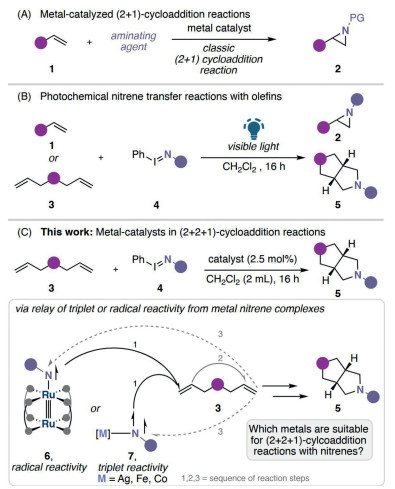
Catalytic amination reactions belong to the most important transformations in synthesis with widespread application in pharmaceutical, agrochemical and material research [1–9]. Not surprisingly, a vast range of methods has been developed in the past years, among which the transfer of a nitrene fragment, a highly reactive low-valent nitrogen species with one substituent, has received significant attention [9–11]. An important feature of low-valent intermediates lies within their spin state, which recently attracted the interest of chemists in the realm of photochemical carbene and nitrene transfer reactions [3,12,13]. These reactions proceed in the absence of a catalyst and via the respective free unbound species. The spin state of the reagent is controlled by steric, electronic or geometric properties of the reactive intermediate [13]. Recent reports describe significant advances, where conventional reactivity paradigms of such low-valent species can be overcome through the access of a triplet spin state. For instance, depending on the reaction conditions, the reactivity of triplet reagents with unsaturated systems can result in pathways, where conventional (2 + 1) cycloaddition is not taking place. Instead, coupling reactions or complex cycloaddition reactions can be accessed [14].
The most common method for stabilization of low-valent nitrene intermediates, however, lies within the use of transition metal catalysts for stabilization of the pivotal nitrene intermediate and for control of nitrene transfer reactions. In the reaction with unsaturated compounds, commonly (2 + 1) cycloaddition reactions, or aziridination reactions, occur and catalytic higher-order cycloaddition reactions remain significantly underdeveloped (Fig. 1a).
Figure 1
Figure 1.
Cycloaddition reactions with nitrenes and their limitations. (A) (2 + 1) cycloaddition reactions. (B) Photochemical nitrene transfer reactions with olefines. (C) This work: (2 + 2 + 1) cycloaddition reactions via metal-catalyzed relay of triplet nitrene reactivity.
Recent advances by Koenigs and co-workers demonstrated that free triplet nitrene intermediates can be generated under photochemical conditions enabling (2 + 1) cycloaddition reactions [11,15]. Moreover, such free triplet nitrene intermediates can be involved in more advanced cycloaddition reactions such as photochemical (2 + 2 + 1) cycloadditions (Fig. 1b) [14].
While photochemical (2 + 2 + 1) cycloadditions rely on triplet nitrene generation, many substrates are unstable under irradiation or undergo competing photodecomposition, limiting their applicability. We hypothesized that identifying strategies to relay triplet nitrene reactivity under metal-catalyzed, light-free conditions would significantly expand the portfolio of advanced nitrene cycloaddition chemistry. A previous report describes two single compounds that arise from such advanced cycloaddition process albeit with severe synthetic limitations, such as stoichiometric amounts of metal salts and low yields [16]. We considered that a key challenge for this approach thus lies in the identification of suitable catalysts enabling a triplet relay strategy and avoiding the outcome of conventional aziridination reactions. To address this challenge, we considered two distinct approaches - either through the formation of an intermediate metal nitrene complex that adopts a doublet spin state possessing radical reactivity, or through formation of suitable metal triplet nitrene complex (Fig. 1c).
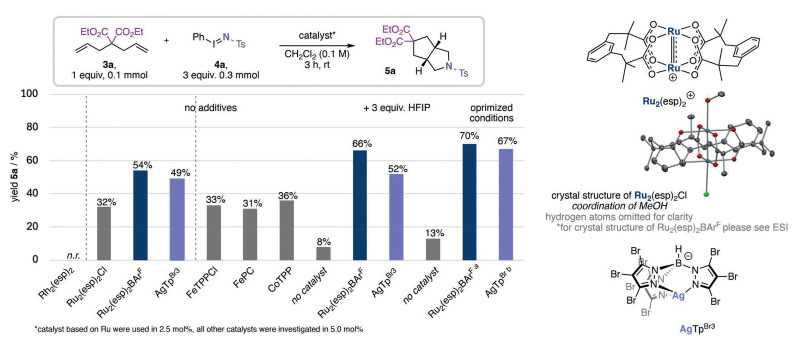
To validate the viability of catalytic relay of the triplet nitrene reactivity, we examined the reaction of diallyl malonate 3a and iminoiodinane 4a. In this case, the traditional reactivity of metal-nitrene complexes results in the formation of an aziridine reaction product. Contrarily, the relay of the triplet reactivity would result in an aza-Pauson-Khand reaction, where the triplet reactivity is relayed by a 5-exo cyclization reaction, ultimately leading to the formation of a newly formed azabicyclic core system. For evaluation of this hypothesis, we therefore examined this transformation in the presence of a selection of archetypal nitrene transfer catalysts. Rhodium paddlewheel complexes, however, failed to give the desired (2 + 2 + 1) cycloaddition product, resulting mainly in the formation of tosyl amide. On the contrary, mixed-oxidation state Ru(Ⅱ,Ⅲ) paddlewheel complexes have been described to adopt a doublet spin state with nitrene reagents [17–20]. In this case, we observed a good yield of the bicyclic pyrrolidine 5a, with little by-product formation. Notably, the reaction proceeded with high cis-diastereoselectivity and no formation of the trans-cyclization product was observed. In a similar fashion, a Ag(Ⅰ)Tp complex gave the desired bicyclic pyrrolidine 5a in good yield, presumably via triplet nitrene reactivity [21–27]. Early transition metal complexes proved compatible, yet lower yields of the desired (2 + 2 + 1) cycloaddition reaction product were observed. Further reaction optimization consisted of the evaluation of further mixed-valency Ru(Ⅱ,Ⅲ) and AgTp catalysts, solvents, stoichiometries, etc. (for details, please see Tables S2-S5 in Supporting information). The most notable influence on the reaction yield was observed, when 3 equiv. of HFIP were added to the reaction mixture (Scheme 1). HFIP can effectively suppresses catalyst deactivation by engaging in stabilizing interactions with nucleophilic species that would otherwise poison the metal center [28]. It is further important to note that counterion exchange from chloride to BArF resulted in a significant improvement of catalyst reactivity, which may be rationalized by the tight binding of the chloride counterion, as also observed by single crystal structure analysis (Scheme 1).
Scheme 1
Scheme 1.
Realization of metal-catalyzed (2 + 2 + 1) cycloaddition reactions. Catalyst screening and reaction optimization. Reaction conditions: 1,6-diene (0.1 mmol), iminoiodinane (0.3 mmol), [M] ([M] = Ru or Rh 2.5 mol%/all other metal catalysts 5 mol%), CH2Cl2 (0.1 mol/L), r.t., 3 h; yields were determined by 1H NMR using mesitylene as an internal. a Reaction was carried out in CHCl3 (0.2 mol/L), r.t., 16 h. b Reaction was carried out in CH2Cl2 (0.025 mol/L), r.t., 16 h.
The different reactivities of the BArF and chloride catalysts may further be explained by the differences in their respective crystal structures. While bond lengths and angles remain almost unaffected, exchanging the chloride ion for the weakly coordinating BArF leads to a significant increase in catalyst activity (Scheme 1). This can be explained by the tight binding of the chloride counterion to the ruthenium centers compared to BArF, which does not coordinate to the metal centers at all. It may also be rationalized from scXRD data that the free ligand sites around the ruthenium atoms can be occupied by solvent molecules, as exemplified by the coordination of two κO-DMF molecules and one methanol for the BArF and chloride structure, respectively (for details please see Supporting information). This can potentially elucidate as to why some solvents such as THF or trace of water appear to inhibit the reaction entirely, whereas others like MeCN do not (for details please see Table S2 in Supporting information). Solvents which can act as κO-donor ligands may block the active sites in a similar vein to chloride ions. In contrast, the catalyst appears less sensitive towards potential κN-coordinating solvents, which still afforded the product in a 50% yield when using MeCN as solvent (for details please see Table S2).
However, it should be noted, that this observation relates to the bulk reaction since small amounts of HFIP actually enhance the reactivity and lead to more product formation (Scheme 1).
A robustness screen further indicates that the reaction outcome is significantly altered, if the reaction is performed in air or in the presence of water. Less pronounced effects were observed with regards reaction temperature or concentration (for details, please see Figs. S1 and S2 in Supporting information).
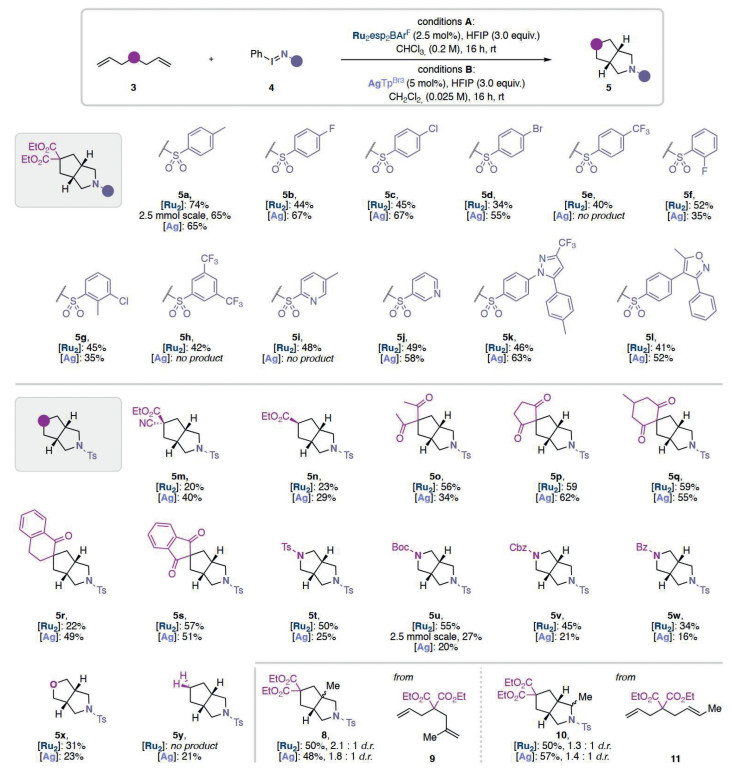
With the optimized conditions in hand for both catalysts, we then explored the generality of these catalytic (2 + 2 + 1)-cycloaddition protocols (Scheme 2). For the Ru(Ⅱ,Ⅲ)-catalyzed process, a wide array of iminoiodinanes bearing diversely substituted sulfonyl moieties were all found to be well-tolerated, all of which reacted smoothly to furnish the desired bicyclic pyrrolidine products in moderate to good yields (5a-l). The scope of the diallyl reaction partner was examined next. Various 1,6-heptadienes were first subjected to the established reaction conditions, which afforded the corresponding product in good yields (5m-x) except hepta-1,6-diene, which did not show any product formation in the ruthenium-catalyzed reaction. In comparison to the silver-catalyzed reaction, a significant decline in yield was observed when with different unsymmetrically substituted counterparts, although good to high diastereo-selectivity were observed in all cases (5m and 5r). Furthermore, the optimized protocol was found to tolerate various N-protected diallylamines as well as diallyl ether as substrates, all of which provided the corresponding products in moderate to good yields, even on a large scale (5a and 5u). Introduction of a methyl substituent to one of the olefin moieties—either at the terminal or internal position—resulted in only a slight decrease in yields, with modest diastereoselectivity observed in both cases (8 and 10).
Scheme 2
Scheme 2.
Investigations on the substrate scope and limitations of the present methodology. Reaction conditions: A: 1,6-diene (0.2 mmol), iminoiodinane (0.6 mmol), Ru2esp2BArF (2.5 mol%), HFIP (0.6 mmol), CHCl3 (0.2 mol/L), r.t., 16 h. Reaction conditions B: 1,6-diene (0.2 mmol), iminoiodinane (0.6 mmol), AgTpBr3 (2.5 mol%), HFIP (0.6 mmol), CH2Cl2 (0.025 mol/L), r.t., 16 h. Isolated yields are reported.
Regarding the scope of the Ag(Ⅰ)Tp-catalyzed process, while the majority of iminoiodinanes employed were well tolerated, substrates bearing strong electron-withdrawing moieties proved to be completely inactive (for example compound 5e). No side products were detected in these cases, suggesting that strongly electron-withdrawing substituents hinder formation of the key Ag–nitrene complex required to initiate the C–N bond-forming step. Compared to the aforementioned Ru(Ⅱ,Ⅲ) protocol, overall, the optimized silver-catalyzed conditions proved to better tolerate different 1,6-diene derivatives, all of which afforded the desired product in moderate to good yields.
However, a significant decline in yields was observed with various N-protected diallyl amines and no identifiable side products were detected (5t-w). Employment of core-substituted derivatives, similar to that previously observed with the Ru2-catalyzed procedure, had little effect on the efficacy of the transformation.
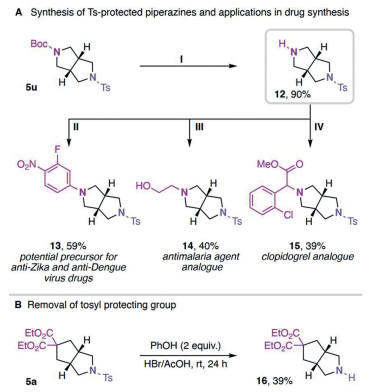
The wide array of bicyclic bioisosteres prepared herein can serve as useful synthetic building blocks, particularly in a medicinal chemistry setting. Piperazine bioisoster 5u, bearing two orthogonal N-protecting groups, readily undergoes Boc-deprotection under mild acidic conditions to afford the free NH product 12 in 90% yield, which can be further derivatized to access valuable medicinally relevant scaffolds (Scheme 3A). Derivative 12 undergoes SNAr with 2,4-difluoronitrobenzene to afford 13, an analogue of several prospective mosquitocides, in 59% yield [29]. Antimalarial analogue 14 can also be accessed in 40% yield from 12via simple tethering with 2-chloroethanol [30]. Furthermore, Clopidogrel analogue 15 can also be conveniently prepared via a N—H insertion reaction with the corresponding diazo precursor under photochemical conditions (39% yield). In addition, removal of tosyl group of 5a was also successfully realized with phenol in HBr/AcOH to afford the free NH analogue 16 in 39% yield (Scheme 3B).
Scheme 3
Scheme 3.
(A) Synthetic applications. Reaction conditions: (i) TFA (15 equiv.), CH2Cl2 (0.1 mol/L), r.t., overnight. (ii) Methyl 2-(2-chlorophenyl)-2-diazoacetate (1.1 equiv.), CH2Cl2 (0.1 mol/L), r.t., blue LED, 12 h. (iii) 2-Chloroethanol (1.5 equiv.), KI (1.5 equiv.), K2CO3 (1.2 equiv.), acetone (0.1 mol/L), reflux, 72 h. (iv) 2,4-Difluoro-1-nitrobenzene (1.8 equiv.), K2CO3 (2.8 equiv.), MeCN (0.2 mol/L), reflux, 18 h. (B) Removal of Ts-protecting group.
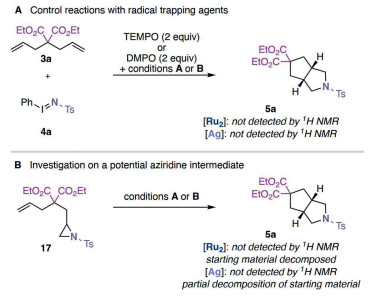
Several control experiments were performed to probe the mechanisms of these catalytic processes (Scheme 4). For both protocols, the presence of a radical trapping agent such as TEMPO or DMPO, fully suppressed product formation, confirming the radical nature of both transformations. When investigating vinyl cyclopropanes as reaction parter, we only observed the decomposition of 4a and no product formation arising from a ring-opening reaction of the cyclopropane unit was detected (for details please see Supporting information). The involvement of an aziridine intermediate was then probed, in which 17 was subjected to the reaction conditions. In both cases, 1H NMR analysis of the crude reaction mixtures showed no trace of the desired bicyclic product 5a, and decomposition of the aziridine species was observed.
Scheme 4
Scheme 4.
Control experiments. (A) In the presence of radical trapping agents. (B) Investigation of 17. Detailed conditions information of A or B, see Scheme 2.
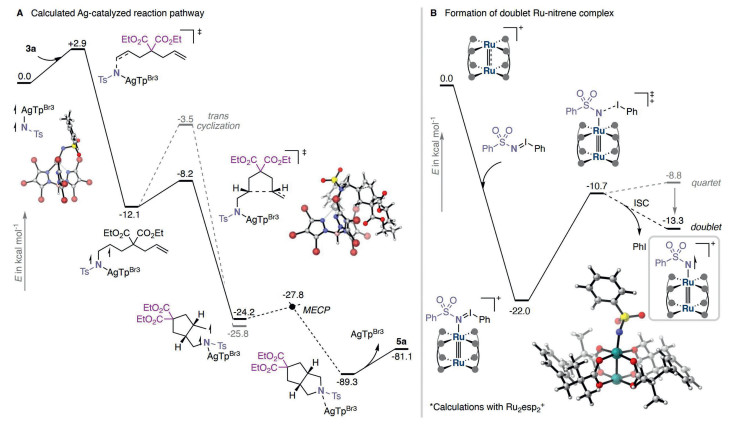
To gain insight into the reaction mechanism of this transition metal-catalyzed (2 + 2 + 1)-cycloaddition, we conducted DFT studies. From a mechanism perspective, we consider that the relay of the triplet nitrene reactivity is achieved by through two related reaction mechanisms.
For the silver-catalyzed variant, we consider the formation of a silver nitrene complex, as previously described by Pérez and co-workers [25]. This complex preferentially adopts a triplet spin state. Following initial C–N bond formation via the low-energy transition state (∆G‡ = 2.9 kcal/mol), the reaction proceeds through cis-cyclization (∆G‡cis = 3.9 kcal/mol vs. ∆G‡trans = 8.6 kcal/mol). After an intersystem crossing (ISC) via a low-lying minimum energy crossing point (MECP), the desired product is formed. Notably, the silver center remains coordinated to the nitrogen atom, while release of the free product is thermodynamically uphill by 8.2 kcal/mol. This observation provides a rationale for the importance of HFIP as an additive: by coordinating to the basic nitrogen, it facilitates a more facile dissociation of the silver catalyst and therefore enables a more efficient catalysis (Scheme 5A and Fig. S3 in Supporting information) [28].
Scheme 5
Scheme 5.
Computational studies. (A) Calculated reaction mechanism in the presence of AgTpBr3. (B) Formation of doublet spin state ruthenium nitrene complex.
In the case of diruthenium(Ⅱ,Ⅲ) paddlewheel complexes, the respective metal nitrene complex takes up a doublet spin state as described by Du Bois and co-workers [17]. This stabilization is favored due to the mixed valency and results in a radical mechanism for C–N bond formation (Scheme 5B). Based on the radical nature of this nitrene complex, we consider that the observed (2 + 2 + 1) cycloaddition reaction therefore occurs through a radical mechanism.
In summary, we herein report on transition metal-catalyzed (2 + 2 + 1) cycloaddition reactions employing 1,6-dienes and iminoiodinanes as reagents and HFIP as a key additive to improve reactivity of the metal catalyst. We identified diruthenium(Ⅱ,Ⅲ) paddlewheel complexes and silver scorpionate complexes as privileged catalysts to access this advanced cycloaddition reaction, while more commonly used dirhodium paddlewheel complexes proved incompatible. This concept was exemplified in the synthesis of a range of different bicyclic pyrrolidines and their application in drug analogue synthesis. This work describes a conceptually distinct strategy in accessing cycloaddition reactions with nitrenes beyond aziridination chemistry and it can be expected that future research will significantly expand the scope of complex cycloaddition reactions with nitrenes from both fundamental and applied perspective.
J.C. Sharland, D. Dunstan, D. Majumdar, et al., ACS Catal. 12 (2022) 12530–12542. doi: 10.1021/acscatal.2c03909
[29]
C.D. Aretz, S.V. Kharade, K. Chronister, et al., ChemMedChem 16 (2021) 319–327. doi: 10.1002/cmdc.202000598
[30]
J.T. Kilbile, Y. Tamboli, S.S. Gadekar, et al., J. Mol. Struct. 1278 (2023) 134971.
Figure 1
Cycloaddition reactions with nitrenes and their limitations. (A) (2 + 1) cycloaddition reactions. (B) Photochemical nitrene transfer reactions with olefines. (C) This work: (2 + 2 + 1) cycloaddition reactions via metal-catalyzed relay of triplet nitrene reactivity.
Scheme 1
Realization of metal-catalyzed (2 + 2 + 1) cycloaddition reactions. Catalyst screening and reaction optimization. Reaction conditions: 1,6-diene (0.1 mmol), iminoiodinane (0.3 mmol), [M] ([M] = Ru or Rh 2.5 mol%/all other metal catalysts 5 mol%), CH2Cl2 (0.1 mol/L), r.t., 3 h; yields were determined by 1H NMR using mesitylene as an internal. a Reaction was carried out in CHCl3 (0.2 mol/L), r.t., 16 h. b Reaction was carried out in CH2Cl2 (0.025 mol/L), r.t., 16 h.
Scheme 4
Control experiments. (A) In the presence of radical trapping agents. (B) Investigation of 17. Detailed conditions information of A or B, see Scheme 2.
Scheme 5
Computational studies. (A) Calculated reaction mechanism in the presence of AgTpBr3. (B) Formation of doublet spin state ruthenium nitrene complex.


 DownLoad:

 下载:
下载:


 下载:
下载:

