Citation:
Zhi-hao Shang, Lei Luo, Yihao Hu, Ren Lai, Jingjing Wu. Concise synthesis and bioactivity evaluation of 5α,6-dihydroveragranine A, (-)-veragranines A & B, and their analogs[J]. Chinese Chemical Letters,
2026, 37(10): 112282.
doi:
10.1016/j.cclet.2025.112282
Concise synthesis and bioactivity evaluation of 5α,6-dihydroveragranine A, (-)-veragranines A & B, and their analogs
English
Concise synthesis and bioactivity evaluation of 5α,6-dihydroveragranine A, (-)-veragranines A & B, and their analogs
State Key Laboratory of Synergistic Chem-Bio Synthesis, Frontiers Science Center for Transformative Molecules, Shanghai Key Laboratory for Molecular Engineering of Chiral Drugs, School of Chemistry and Chemical Engineering, Zhangjiang Institute for Advanced Study, Shanghai Jiao Tong University, Shanghai 200240, China
b.
State Key Laboratory of Genetic Evolution and Animal Models, Engineering Laboratory of Peptides of Chinese Academy of Sciences, Key Laboratory of Bioactive Peptides of Yunnan Province, KIZ-CUHK Joint Laboratory of Bioresources and Molecular Research in Common Diseases, National Resource Center for Non-Human Primates, National Research Facility for Phenotypic & Genetic Analysis of Model Animals (Primate Facility), State Key Laboratory of Genetic Evolution & Animal Models, Sino-African Joint Research Center, and New Cornerstone Science Laboratory, Kunming Institute of Zoology, the Chinese Academy of Sciences, Kunming 650201, China
Received Date:
04 November 2025 Accepted Date:
12 December 2025 Revised Date:
11 December 2025 Available Online:
15 October 2026
Abstract:
(-)-Veragranines A and B are two steroidal alkaloids that exhibit potent analgesic activity. Herein, we report a 5-step biomimetic synthesis of 5α,6-dihydroveragranine A form hecogenin acetate, which incorporates two well-designed cascade processes that significantly improve the synthetic efficiency. Based on synthesis, an alternative biosynthetic proposal of veragranines was proposed. Subsequently, we developed the first divergent approach enabling the synthesis of veragranines A and B in 10~12 steps from deoxycholic acid. The synthesis features a photoredox-catalyzed decarboxylative Minisci reaction that achieved good regioselective control and C20 stereochemistry inversion via a radical process. Besides, the strategic use of an A/B cis-fused starting material enabled late-stage introduction of the Δ5(6) double bond, simplifying its installation and providing a valuable strategy for the synthesis of related natural products. Notably, we evaluated a series of synthetic intermediates and derivatives of veragranines to assess their in vitro analgesic activity. We find that compound 16, which is easily accessible and features a saturated pyridine as the F-ring, emerges as a promising lead compound.
Steroidal alkaloids, a class of nitrogen-containing derivatives of natural steroids, constitute a significant group of alkaloids and secondary metabolites present in plants, amphibians, and marine organisms [1,2]. Notably, several steroidal alkaloids have been successfully developed into therapeutic agents, with abiraterone acetate, a steroidal antiandrogen approved by the FDA in 2011 for treating metastatic castration-resistant prostate cancer, being a prominent example [3,4]. This has spurred extensive interest in the synthesis of bioactive steroidal alkaloids with unique structural features, including rearranged skeletons (e.g., cyclopamine [5–8]) and unusual bond connectivities (e.g., batrachotoxin [9–11]) [12].
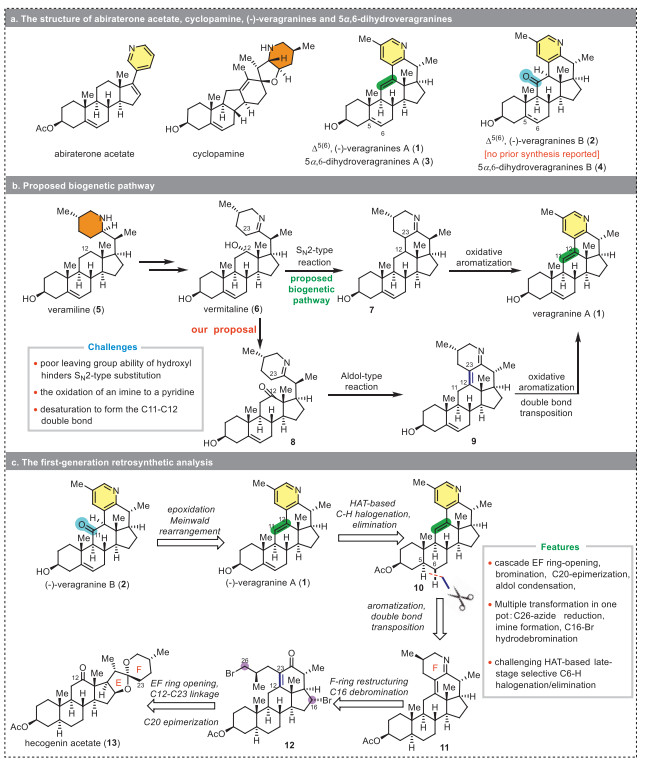
In light of the global opioid crisis, the development of non-opioid analgesics has become an important topic [13,14]. (-)-Veragranines A (1) and B (2), two non-opioid steroidal alkaloids isolated from Veratrum grandiflorum by Luo and co-workers, have attracted significant attention owing to their potent analgesic activity (Fig. 1a) [15]. These compounds act as CaV2.2 voltage-gated calcium channel (VGCC) inhibitors, with IC50 values of 45.76 ± 1.14 and 7.82 ± 1.10 µmol/L, respectively, making them promising candidates for further biological investigation. However, the extremely low natural abundance of 1 and 2 (approximately 0.00004 wt%) poses a significant challenge for conducting comprehensive biological evaluations. To overcome this limitation, efficient chemical syntheses are not only crucial but also indispensable. Structurally, both 1 and 2 feature a complex 6/6/6/5/6/6 hexacyclic ring system, a unique C12-C23 linkage, and a trisubstituted pyridine ring. Driven by our ongoing interest in the synthesis of steroidal alkaloids [16–19], veragranines have attracted our attention due to their natural scarcity, unique structures, and promising biological activities. Herein, we report our divergent synthesis of 1 and 2 along with their dihydrogenated analog 5α,6-dihydroveragranines A (3) through two distinct strategies. Notably, in 2022, concurrent with our study, Shi reported the synthesis of 3 and 4 [20]. During the preparation of this manuscript, Dai disclosed a semisynthesis of 1 and its analogs [21]. It is important to note that our work remains the first approach enabling the synthesis of both 1 and 2.
Figure 1
Figure 1.
Proposed biosynthesis pathways and the first-generation retrosynthetic analysis. (a) The structure of abiraterone acetate, cyclopamine, (-)-veragranines and 5α,6-dihydroveragranines. (b) Proposed biogenetic pathway. (c) The first-generation retrosynthetic analysis.
Two similar biosynthetic pathways were proposed by Luo and Dai [15,21], where they believed 1 and 2 could be biosynthesized from veramiline (5), a major steroidal alkaloid of V. grandiflorum. According to their hypothesis, veramiline could be converted to vermitaline (6) via an enzymatic C12-H hydroxylation and dehydrogenation of the piperidine ring. Subsequently, Luo postulated a stepwise process: Initially, oxidative aromatization of the F ring to a pyridine, followed by an SN2-type substitution to form the C23-C12 σ-bond. Whereas Dai proposed an alternative sequence, first, construction of the C23-C12 σ-bond through a similar SN2 reaction, then oxidative aromatization and epimerization of the C20 stereochemistry to give 1. We conducted a comprehensive evaluation of the biomimetic approach as a potential synthetic pathway. Based on a detailed analysis, we concluded that the SN2-type substitution could be challenging because the hydroxyl group is a poor leaving group. Additionally, there could be difficulties in the subsequent steps, including the oxidation of an imine to a pyridine and the desaturation to form a C11-C12 double bond. We then proposed an alternative biosynthetic pathway involving two key transformations: First, the selective oxidation of the C12-OH in 6 to yield ketone 8; second, an aldol condensation to form the C23-C12 bond, generating the α,β-unsaturated imine 9, which subsequently undergoes oxidative aromatization followed by double bond transposition to afford 1 (Fig. 1b).
Based on our biosynthetic proposal, the first-generation retrosynthetic analysis is presented in Fig. 1c. Since the C11 ketone of 2 could be constructed from a C11-C12 epoxide via Meinwald rearrangement [20], we prioritized the synthesis of 1. The Δ5(6) double bond of 1 could be introduced from 10, through a challenging HAT-based late-stage C6-H halogenation/elimination strategy. We envisaged 10 could be obtained from 11 through our proposed biomimetic oxidative aromatization, double bond transposition. Then 11 could be synthesized from 12 through C26 azidination followed by reductive imine formation and C16 debromination. Moreover, 12 could be easily prepared from hecogenin acetate (13) through BF3·Et2O-promoted bromination/ring-opening of steroidal sapogenins, the methodology we previously developed [16].
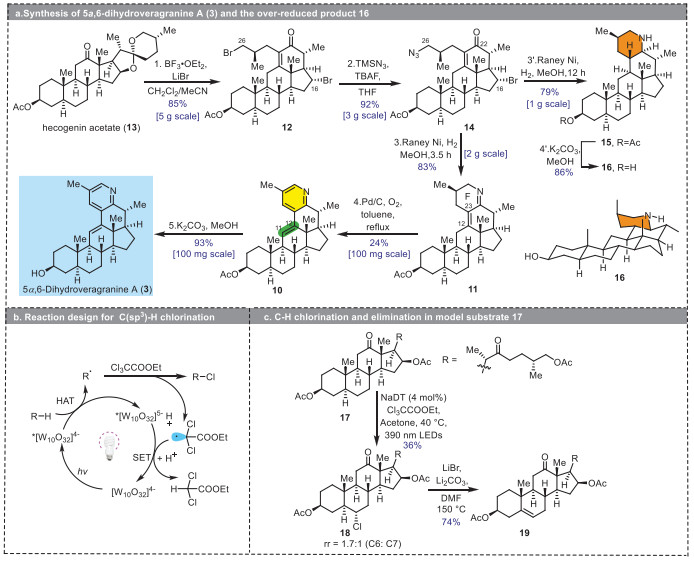
As shown in Fig. 2a, our synthesis started with the preparation of dibromide compound 12 from 13. Then regioselective azidination of the less hindered C26-Br gave the desired product 14 in 92% yield. We hypothesized that the C26-azide reduction, C22 imine formation, and C16-Br hydrodebromination transformations could be performed in the same flask. After systematic optimization (see Supporting Information for details), we discovered that the Raney Ni/H2 reduction conditions facilitated this cascade transformation efficiently, affording the desired product 11 in 83% yield. Remarkably, extending the reaction time enabled the formation of the complete hydrogenation product 15 in high yield. Subsequent hydrolysis afforded product 16, featuring a piperidine as the F ring, which was also evaluated for bioactivity. With 11 in hand, we proceeded to investigate the key biomimetic oxidative aromatization of the F ring with transposition of the Δ12(23) double bond to Δ11(12). After unsuccessful attempts with reagents such as DDQ, IBX, and others, we found that using Pd/C as the catalyst and oxygen as the oxidant provided the desired product 10 in 24% yield. After hydrolysis, the desired product 5α,6-dihydroveragranine A (3) was obtained in good yield.
Figure 2
Figure 2.
Synthesis of 5α,6-dihydroveragranine A (3), the over-reduced product 16, and the development of a HAT-based C(sp3)-H chlorination.
In order to obtain the natural product veragranine A (1), we decided to implement a strategy featuring HAT-based late-stage C(sp3)-H halogenation/elimination [22–28]. Inspired by the pioneering work reported by Wu [29], we designed a decatungstate photoredox-catalyzed C—H chlorination (Fig. 2b). Prior to applying the desired substrate 10, we selected an easily accessible compound 17 as the model substrate. After optimization (see Supporting Information for details), the desired C—H chlorination product could be obtained in 36% yield, with 1.7:1 (C6:C7) regioselectivity (Fig. 2c). A further elimination step was carried out to transfer the C6-Cl product 18 into Δ5(6) compound 19. Although this strategy could be successfully applied to introduce a Δ5(6) double bond in model substrate 17, unfortunately, it did not work on real substrate 10. After spending half a year studying HAT-based C—H functionalization conditions to introduce the Δ5(6) double bond, we could not find an efficient solution. We therefore started our second-generation synthetic route.
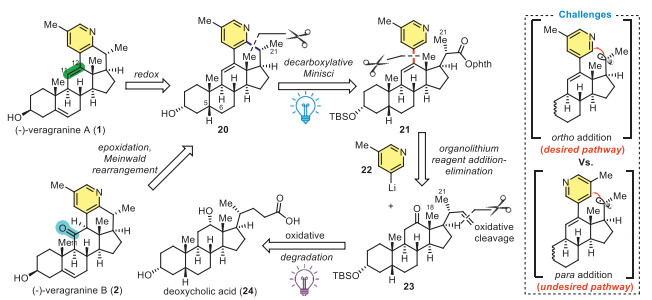
Given the challenge of late-stage introduction of a Δ5(6) double bond in the A/B trans-fused steroid system, and considering that it is easier to introduce a Δ4(5) double bond in A/B cis-fused steroids (which can further undergo transposition to Δ5(6)) [30,31], we chose the abundantly available deoxycholic acid (24) as the starting material. Our second-generation retrosynthetic analysis is presented in Fig. 3, where both 1 and 2 could be synthesized from 20 through late-stage oxidation to introduce a Δ4(5) double bond. According to Shi’s result [20], late-stage introduction of a C11 ketone group in 2 from the Δ11(12) olefin in 20 is also feasible. The E ring of 20 could be constructed through a photoredox-catalyzed decarboxylative Minisci reaction from 21 [32–34]. The pyridine fragment of 21 could be introduced through the addition of organolithium reagent 22 to the C12-ketone of 23. Subsequent elimination of the newly formed C12-OH afforded the Δ11(12) double bond. Also, the C22 carboxylic acid of 21 could be easily obtained via oxidative cleavage of the terminal Δ22(23) olefin of 23. In turn, 23 could be constructed from 24 through photoredox-catalyzed oxidative degradation of the side chain [35,36].
Figure 3
Figure 3.
The second-generation retrosynthetic analysis.
As the key step in our synthetic plan, the decarboxylative Minisci reaction faced two major challenges. First, radical cyclization to the pyridine ring could lead to ortho-addition (C22) and para-addition (C24), thus regioselectivity needs to be controlled. We believed that the Me- group on the pyridine ring (C25) would make the para-addition to the C24 position more sterically hindered, therefore our desired ortho-addition product would be the major product. Second, the C21-Me configuration needs to be inverted through this step. Since the decarboxylation step would generate a radical at the C20, we hypothesized that during the cyclization, the C21-Me would prefer to be in the pseudo-equatorial position to avoid strong 1,3-diaxial interaction with the C18-Me, thus providing the desired inverted stereochemistry at C20.
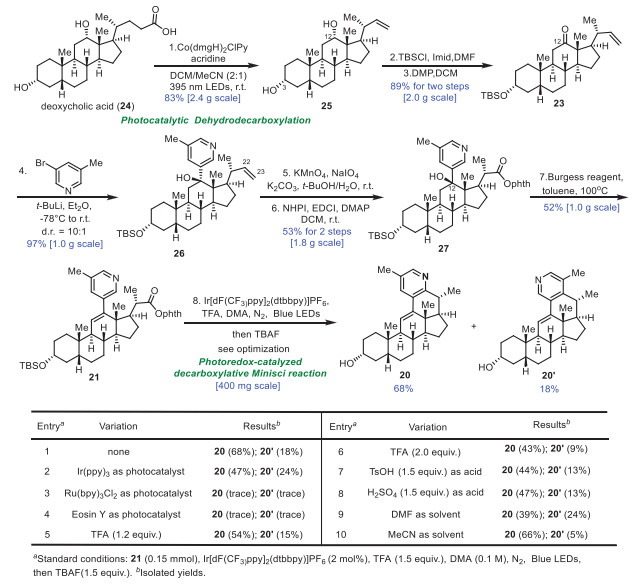
As illustrated in Fig. 4, utilizing the method developed by the Ritter and Larionov group [35,36], we initiated our synthesis with photoredox-catalyzed decarboxyolefination of 24, yielding the desired product 25 in 83% yield. After selective TBS-protection of the less hindered C3-OH and subsequent Dess-Martin oxidation of the C12-OH, intermediate 23 was obtained in 89% yield on a 2-gram scale. Following successful preparation of organolithium reagent 22 through in-situ lithium-bromine exchange, we investigated the addition of the 22 to the C12-ketone of 23.
Figure 4
Figure 4.
Optimization of the decarboxylative Minisci reaction enabled the synthesis of intermediate 20.
To our delight, this reaction proceeded smoothly, affording the desired product 26 in 97% yield, with a 10:1 diastereomeric ratio. We next explored the oxidative cleavage of the terminal Δ22(23) olefin to a carboxylic acid. Several conventional methods, including the RuCl3/NaIO4 system or ozonolysis followed by Pinnick oxidation, gave low yields (see Supporting information for details). Fortunately, we found that with a basic KMnO4/NaIO4 system [37], the desired product could be obtained in moderate yield. Since the desired carboxylic acid was highly polar and difficult to isolate, the crude product was directly subjected to the EDCI condensation. Delightfully, the desired redox-active-ester 27 could be obtained in 53% yield. We then proceeded to perform a C12-OH elimination reaction to introduce the Δ11(12) double bond. Delightfully, with Burgess reagent, the desired product 21 was obtained in 52% yield. Other elimination conditions, such as SOCl2/pyridine and POCl3/pyridine, were found to be unsuccessful (see Supporting information for details).
We then proceeded to investigate the key decarboxylative Minisci reaction. Initially, the photoredox-catalyzed direct oxidative decarboxylative Minisci reaction from the carboxylic acid was also tested [38–40], but it failed to yield the desired product. Consequently, we shifted to redox-active-ester 21. As shown in Fig. 4, after screening a series of conditions, the desired product 20 was successfully synthesized in 68% yield, accompanied by 18% of the regioisomer 20′, using Ir[dF(CF3)ppy]2(dtbbpy)PF6 as the photocatalyst, TFA (1.5 equiv.) as the acid, and DMA as the solvent under blue LED irradiation (Entry 1). Using Ir(ppy)3 as the photocatalyst resulted in a lower yield of 20 and reduced regioselectivity, whereas photocatalysts Ru(bpy)3Cl2 and Eosin Y showed no reactivity (entries 2–4). Both reducing or increasing the amount of TFA resulted in lower yields (entries 5 and 6). Replacement of TFA with TsOH or H2SO4 also decreased the yield (entries 7 and 8). Switching the solvent to DMF resulted in a decrease in the yield and regioselectivity, whereas MeCN provided a comparable yield and improved regioselectivity (entries 9 and 10).
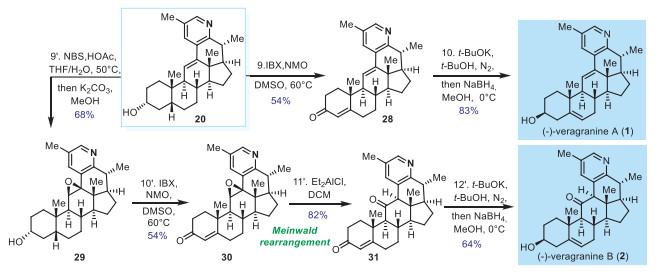
With the advanced intermediate 20 in hand, we proceeded to finish the divergent synthesis of 1 and 2 (Fig. 5). After IBX/NMO oxidation [41], 20 was converted to Δ4(5)-3-one product 28 in 54% yield. Then, after enolization with t-BuOK/t-BuOH and subsequent quenching in acidic conditions, the Δ4(5) double bond underwent transposition to Δ5(6) [30]. Finally, reduction of the C3-ketone with NaBH4 afforded the desired natural product (-)-veragranine A (1) in 83% yield. Next, we focused on the synthesis of 2. Treatment of 20 with NBS/HOAc in aqueous THF solution, followed by hydrolysis of the crude bromohydrin acetate afforded β-epoxide 29 in 68% yield. Subsequent IBX/NMO oxidation yielded Δ4(5)-3-one product 30 in 54% yield. The Et2AlCl-promoted Meinwald rearrangement afforded the C11-ketone product 31 in 82% yield [20]. Subsequently, after a similar Δ4(5) double bond transposition to Δ5(6) and selective reduction of the less hindered C3-ketone with NaBH4, the desired natural product (-)-veragranine B (2) was obtained in 64% yield.
Figure 5
Figure 5.
Divergent synthesis of (-)-veragranines A and B.
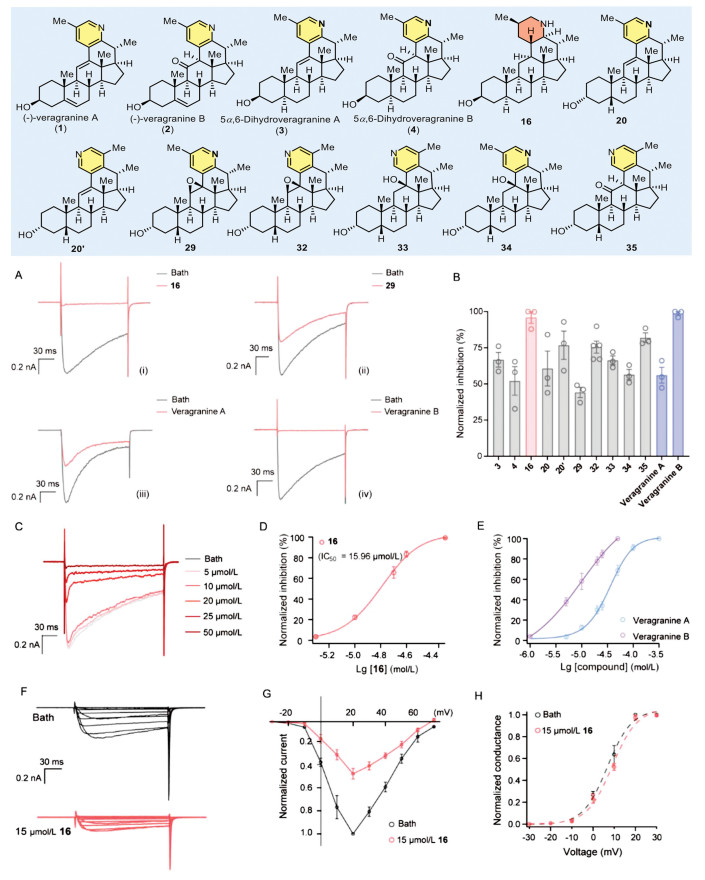
Prior to initiating our biological assays, we noted that Dai et al. had concurrently reported their synthesis of veragranine A and analogs [21]. To secure the novelty of our research and facilitate early-stage scholarly communication, we therefore made our synthetic routes to veragranines A and B publicly available as a preprint on ChemRxiv [42]. Subsequently, with (-)-veragranines A/B, 5α,6-dihydroveragranine A and their analogs in hand (Fig. 6, top), we performed a comprehensive evaluation of their bioactivity to explore their therapeutic potential. The detailed synthetic procedures for analogs 32–35 are provided in Supporting information. Building on prior reports demonstrating that veragranines A and B potently inhibit CaV2.2 channels [15], key mediators of nociceptive signaling, we employed whole-cell patch-clamp recordings to evaluate the inhibitory effects of a panel of synthetic derivatives. Initial screening revealed compound 16 as the most potent inhibitor, exhibiting activity comparable to the natural compound veragranine B (Figs. 6A and B). Concentration-response analysis revealed that 16 suppressed CaV2.2 currents in a concentration-dependent manner (Fig. 6C), with a half-maximal inhibitory concentration (IC50) of 15.96 ± 1.71 µmol/L at a holding potential of −80 mV (Fig. 6D). Notably, the IC50 of 16 was intermediate between those of veragranines A and B, positioning it as a synthetic analog with balanced efficacy (Figs. 6D and E).
Figure 6
Figure 6.
Bioactivity evaluation of veragranine analogs on the electrophysiological properties of human CaV2.2 channel. (A) Representative current traces of CaV2.2 channels under bath (control), 16 (50 µmol/L), 29 (50 µmol/L), veragranine A (50 µmol/L) and veragranine B (50 µmol/L), treatments (scale: 30 ms, 0.2 nA). (B) Normalized inhibition percentages of synthetic derivatives, veragranines A and B acting on CaV2.2 channels. Compound 16 exhibits the strongest inhibition, comparable to veragranine B. Concentration, 50 µmol/L. (C) Representative whole-cell CaV2.2 currents elicited by a 150 ms depolarization of +10 mV in the absence and presence of different concentrations of 16. (D) Dose-response curves displaying the 16-induced inhibition of the CaV2.2 channel. Data were fit using a Hill equation. The IC50 and slope factor values are 15.96 ± 1.71 µmol/L and 1.85 ± 0.59 (n = 6 cells). (E) Concentration-dependent inhibition of CaV2.2 currents by veragranines A and B. The IC50 of veragranine A and veragranine B are 7.99 ± 1.03 and 34.56 ± 1.95 µmol/L, respectively. (F) Representative CaV2.2 current traces in response to various membrane potentials from −80 mV to +70 mV in 10 mV increments before (black) and after (red) application of 15 µmol/L compound 16. (G) Current-voltage (I-V) relationship for CaV2.2 currents before and after application of 15 µmol/L compound 16 (n = 3). (H) Normalized conductance (G/Gmax) versus voltage relationships for the traces as in G. Data were fit using the Boltzmann equation (n = 3).
Steady-state current-voltage (I-V) relationship studies further demonstrated that 16 did not alter the voltage sensitivity of CaV2.2 channels, as indicated by the unperturbed activation curve (Figs. 6F-H). This behavior mirrored the effects of 16 and veragranines, indicating a shared mechanistic basis involving direct interaction with the channel pore region to block ion permeation, rather than modulation of voltage-gated domains. Combining high synthetic efficiency, a streamlined preparation route, and selective CaV2.2 antagonism, 16 emerges as a promising lead compound for the development of targeted therapeutics against CaV2.2-dependent pathologies.
In conclusion, we have explored two distinct strategies for the synthesis of veragranines. The first approach enabled the concise synthesis of 5α,6-dihydroveragranine A in 5 steps (14.5% overall yield) from hecogenin acetate, featuring: (1) Two well-designed cascade processes that significantly improve the synthetic efficiency; (2) Differing from the proposed SN2-type biogenetic pathway, we proposed an aldol-type condensation to form the α,β-unsaturated imine, which was successfully converted into veragranines through oxidative aromatization and double bond transposition, thereby supporting this alternative biosynthetic route. The second strategy provided the first divergent synthesis of veragranines A and B in 10–12 steps (6%–2.6% overall yield) from deoxycholic acid, featuring: (1) Photoredox-catalyzed decarboxylative Minisci reaction for E ring closure with C20 stereoinversion; (2) Late-stage introduction of the Δ5(6) double bond via a strategic A/B cis-fused intermediate, circumventing regioselectivity challenges between the Δ11(12) and Δ5(6) double bonds and enabling the first synthesis of (–)-veragranine B. After further bioactivity studies of veragranines and their 10 analogs, we are delighted to identify the easily accessible compound 16 as a promising lead compound. Its dual advantages of mechanistic clarity and synthetic feasibility establish it as a versatile scaffold for probing CaV2.2 biology and accelerating analgesic drug discovery.
CRediT authorship contribution statement
Zhi-hao Shang: Methodology, Investigation, Data curation. Lei Luo: Writing – original draft, Investigation, Data curation. Yihao Hu: Investigation. Ren Lai: Supervision. Jingjing Wu: Writing – review & editing, Supervision, Project administration, Funding acquisition.
Declaration of competing interest
The authors declare that they have no known competing financial interests or personal relationships that could have appeared to influence the work reported in this paper.
Acknowledgments
The authors gratefully acknowledge Prof. Jinghan Gui from Shanghai Institute of Organic Chemistry (SIOC) and Prof. Phillip. S. Grant from Nanyang Technological University for helpful discussion. We thank Prof. Yong Shi from Yunnan University for providing 5α,6-dihydroveragranine B for bioactivity study. Financial support was provided by National Natural Science Foundation of China (NSFC, Nos. 22101173 and 32522015), Fundamental Research Funds for the Central Universities (No. 24X010301678), “Thousand Talents Plan, Youth Project”, and Yunnan Major Science and Technology Project (No. 202402AA310010).
Supplementary materials
Supplementary material associated with this article can be found, in the online version, at doi:10.1016/j.cclet.2025.112282.
Figure 1
Proposed biosynthesis pathways and the first-generation retrosynthetic analysis. (a) The structure of abiraterone acetate, cyclopamine, (-)-veragranines and 5α,6-dihydroveragranines. (b) Proposed biogenetic pathway. (c) The first-generation retrosynthetic analysis.
Figure 6
Bioactivity evaluation of veragranine analogs on the electrophysiological properties of human CaV2.2 channel. (A) Representative current traces of CaV2.2 channels under bath (control), 16 (50 µmol/L), 29 (50 µmol/L), veragranine A (50 µmol/L) and veragranine B (50 µmol/L), treatments (scale: 30 ms, 0.2 nA). (B) Normalized inhibition percentages of synthetic derivatives, veragranines A and B acting on CaV2.2 channels. Compound 16 exhibits the strongest inhibition, comparable to veragranine B. Concentration, 50 µmol/L. (C) Representative whole-cell CaV2.2 currents elicited by a 150 ms depolarization of +10 mV in the absence and presence of different concentrations of 16. (D) Dose-response curves displaying the 16-induced inhibition of the CaV2.2 channel. Data were fit using a Hill equation. The IC50 and slope factor values are 15.96 ± 1.71 µmol/L and 1.85 ± 0.59 (n = 6 cells). (E) Concentration-dependent inhibition of CaV2.2 currents by veragranines A and B. The IC50 of veragranine A and veragranine B are 7.99 ± 1.03 and 34.56 ± 1.95 µmol/L, respectively. (F) Representative CaV2.2 current traces in response to various membrane potentials from −80 mV to +70 mV in 10 mV increments before (black) and after (red) application of 15 µmol/L compound 16. (G) Current-voltage (I-V) relationship for CaV2.2 currents before and after application of 15 µmol/L compound 16 (n = 3). (H) Normalized conductance (G/Gmax) versus voltage relationships for the traces as in G. Data were fit using the Boltzmann equation (n = 3).


 DownLoad:

 下载:
下载:


 下载:
下载:

