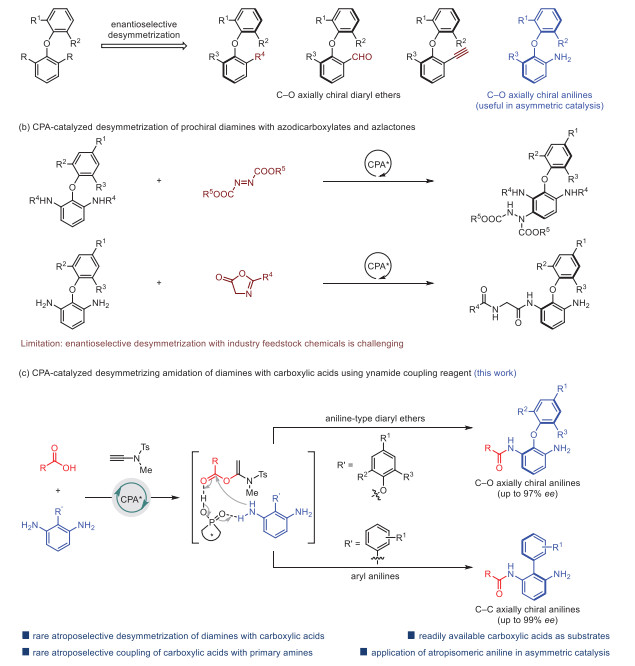
Scheme 1.
Catalytic atroposelective construction of C–O axially chiral anilines.

Brønsted acid-catalyzed atroposelective desymmetrization of diamines with carboxylic acids via ynamide-mediated amidation
Guang-Hui Wang , Jia-Tian Jiang , Jian Yang , Ze-Shu Wang , Gongde Wu , Long-Wu Ye , Bo Zhou


During the past decades, axially chiral molecules have attracted considerable research interest because of their applications in asymmetric catalysis, bioactive compounds, and materials [1–5]. Axial chirality typically results from the restricted rotation about a σ bond, such as atropisomeric (hetero)biaryls, styrenes, amides, anilines, and others [6–14]. Alternatively, C–O axially chiral diaryl ethers are unique atropisomeric skeletons bearing dual-axial chirality, which have important applications in synthetic chemistry and medicinal chemistry [15–19]. Compared with the frequently reported atropisomeric biaryls, the enantioselective synthesis of axially chiral diaryl ethers is far less explored [20–22]. The more flexible dual C–O axes and relatively lower rotational barriers result in additional difficulties in the construction of axially chiral diaryl ethers [23,24]. In 2008, Clayden and co-workers disclosed a seminal work on the atroposelective synthesis of diaryl ethers by dynamic resolution with chiral sulfoxide auxiliary [25]. The more challenging catalytic enantioselective synthesis was then pioneered by Clayden’s group using biocatalytic desymmetrization [26] and by Gustafson group through organocatalytic C(sp2)–H alkylation [27], however limited scope or only moderate enantioselectivities could be obtained. Recently, various enantioselective desymmetrization reactions have been developed to achieve axially chiral diaryl ethers, such as copper(I)-catalyzed azide-alkyne cycloaddition (CuAAC) of prochiral dialkynyl diaryl ethers [28,29], cobalt-catalyzed photoreductive coupling of dialdehydes with alkynes [30], N-heterocyclic carbene (NHC)-catalyzed esterification of prochiral dialdehydes [31–33], chiral Brønsted acid-catalyzed transfer hydrogenation of prochiral dialdehydes [34], and chiral Brønsted acid-catalyzed Povarov reaction (Scheme 1a) [35]. In spite of these advances based on asymmetric desymmetrization, a new catalytic system that operated by metal-free conditions and simple starting materrials is still highly desirable for the enantioselective construction of C–O axially chiral diaryl ethers.
Atropisomeric amines are important chiral skeletons that have been frequently used as chiral ligands and catalysts [36,37]. Atroposelective desymmetrization of prochiral di-amines is an efficient pathway for the preparation of atropoisomeric amines [38–42]. In 2023, Yang and co-workers disclosed an elegant chiral phosphoric acid (CPA)-catalyzed electrophilic amination of prochiral diamines with azodicarboxylates for the synthesis of C–O axially chiral anilines [41]. In 2024, Li and co-workers developed a CPA-catalyzed acylation of prochiral diamines with azlactones to access C–O axially chiral anilines (Scheme 1b) [42]. Despite the efficacy of these established approaches, the use of industry feedstock chemicals for the atroposelective desymmetrization of diamines is still challenging, especially for the construction of C–O axial chirality.
Carboxylic acids are important industry feedstock chemicals. The amidation of amines with carboxylic acids is a fundamental transformation in organic synthesis, and various coupling reagents have been developed to promote this dehydrative coupling process [43,44]. Due to the availability of carboxylic acids, the atroposelective amidation of amines with carboxylic acids is an ideal protocol for the synthesis of atropisomers, but it remains undeveloped for long time. By using ynamides as coupling reagents [45–48], our group recently reported the only example of CPA-catalyzed atroposelective coupling of carboxylic acids with amines, affording axially chiral amides [49]. However, the requirement of specific secondary amines and the generation of particular axially chiral amides limited the further application of this methodology. To overcome the inherent challenges in the ynamide-mediated catalytic atroposelective coupling and the synthesis of C–O axially chiral anilines, we hypothesized that ynamides could be employed as coupling reagents in the catalytic atroposelective amidation of diamines with carboxylic acids by developing new cata-lytic systems. The success of this desymmetrizing amidation relies on addressing the following key challenges: (1) The compatibility of CPA catalysts with diamine substrates is unknown, especially for primary diamines. (2) The requirement of bulky substituents for the stability of axial chirality may reduce the nucleophilicity of prochiral diamines. (3) The balance of the desymmetrization of substrates and the further kinetic resolution of products is pivotal for high yields and enantioselectivities. Therefore, efficient catalytic systems with good reactivity and enantio-control are critical for the transformation.
As part of our overarching goal to develop ynamides as versatile building blocks in organic synthesis [50–55], we have achieved a series of CPA-catalyzed enantioselective transformations of ynamides through direct activation of carbon–carbon triple bonds and resulted in diverse centrally and axially chiral heterocycles [56–61]. Inspired by these results and our recent studies on catalytic atroposelective synthesis [62–66], we envisioned to combine CPA catalysis with the atroposelective desymmetrization of diamines with carboxylic acids by using ynamides as coupling reagents, and the enantioselectivity could be controlled by multiple hydrogen bonding interactions. Here we describe the realization of such a CPA-catalyzed desymmetrizing amidation of diamines with carboxylic acids via ynamide mediation, leading to the efficient preparation of C–O axially chiral anilines. Moreover, this atroposelective desymmetrization could also be employed in the assembly of C–C axially chiral anilines. Of note, the constructed axially chiral skeletons could be easily transformed into chiral ligands and organocatalysts, and applied in asymmetric catalysis. This reaction represents a rare atroposelective desymmetrization of diamines with carboxylic acids, as well as a rare atroposelective coupling of carboxylic acids with primary amines (Scheme 1c).
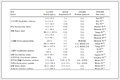
To simplify the catalytic system, this ynamide-mediated atroposelective desymmetrizing amidation of diamines with carboxylic acids was first investigated in a stepwise manner. Initially, the facile reaction of carboxylic acid with ynamide was conducted without catalyst to give a bench stable α-acyloxyenamide 1a, which was used in the further condition optimization of atroposelective desymmetrization of diamine 2a (Table 1). The proof-of-concept experiment was performed with a bulky BINOL-derived CPA A1 as catalyst in CH2Cl2 at 25 ℃, delivering the desired axially chiral diaryl ether 3a in 56% yield with 20% ee (entry 1). To our delight, the exploration of different CPAs A2–A5 bearing polycyclic aryl groups resulted in significantly improved enantiocontrol (entries 2–5), and 10-phenylanthracen-9-yl group-substituted CPA A5 gave the desymmetrization product in 80% yield with 75% ee (entry 5). However, the switch of BINOL skeleton to H8-BINOL-derived CPA A6 led to hugely decreased enantioselectivity (entry 6). Moreover, SPINOL-derived CPAs with 2,4,6-triisopropylphenyl A7 and polycyclic aryl group A8–A10 were also investigated, affording 3a in 66%–76% yields with 39%–67% ee values (entries 7–10). Subsequent screening of different solvents, such as Et2O, THF, toluene, and PhCF3, successfully improved the enantioselectivity (entries 11–14), and PhCF3 was selected as the optimal solvent (entry 14). Gratifyingly, further decreasing the reaction temperature to 15 ℃ and improving the equivalent of α-acyloxyenamide 1a to 1.4 equiv. allowed the formation of axially chiral diaryl ether 3a in 67% yield with 92% ee (entries 15–17).
 DownLoad:
CSV
DownLoad:
CSV
 |
||||||
| Entry | Catalyst | Solvent | Temp (℃) | Time (h) | Yield (%) b of 3a | ee (%) c of 3a |
| 1 | A1 | CH2Cl2 | 25 | 4 | 56 | 20 |
| 2 | A2 | CH2Cl2 | 25 | 4 | 57 | 51 |
| 3 | A3 | CH2Cl2 | 25 | 4 | 63 | 45 |
| 4 | A4 | CH2Cl2 | 25 | 4 | 66 | 10 |
| 5 | A5 | CH2Cl2 | 25 | 4 | 80 | 75 |
| 6 | A6 | CH2Cl2 | 25 | 4 | 53 | −19 |
| 7 | A7 | CH2Cl2 | 25 | 4 | 76 | −47 |
| 8 | A8 | CH2Cl2 | 25 | 4 | 74 | −43 |
| 9 | A9 | CH2Cl2 | 25 | 4 | 71 | −39 |
| 10 | A10 | CH2Cl2 | 25 | 4 | 66 | −67 |
| 11 | A5 | Et2O | 25 | 4 | 71 | 70 |
| 12 | A5 | THF | 25 | 4 | 60 | 41 |
| 13 | A5 | Toluene | 25 | 4 | 73 | 71 |
| 14 | A5 | PhCF3 | 25 | 4 | 78 | 81 |
| 15 | A5 | PhCF3 | 15 | 4 | 82 | 83 |
| 16d | A5 | PhCF3 | 15 | 4 | 74 | 87 |
| 17e | A5 | PhCF3 | 15 | 2 | 67 | 92 |
| a Reaction conditions: 1a (0.055 mmol), 2a (0.05 mmol), catalyst (0.005 mmol), solvent (1.5 mL), 15–25 ℃, 2–4 h, in vials. b Measured by 1H NMR using 1,3,5-trimethoxybenzene as the internal standard. c Determined by HPLC analysis. d 0.06 mmol of 1a was used. e 0.07 mmol of 1a was used. | ||||||
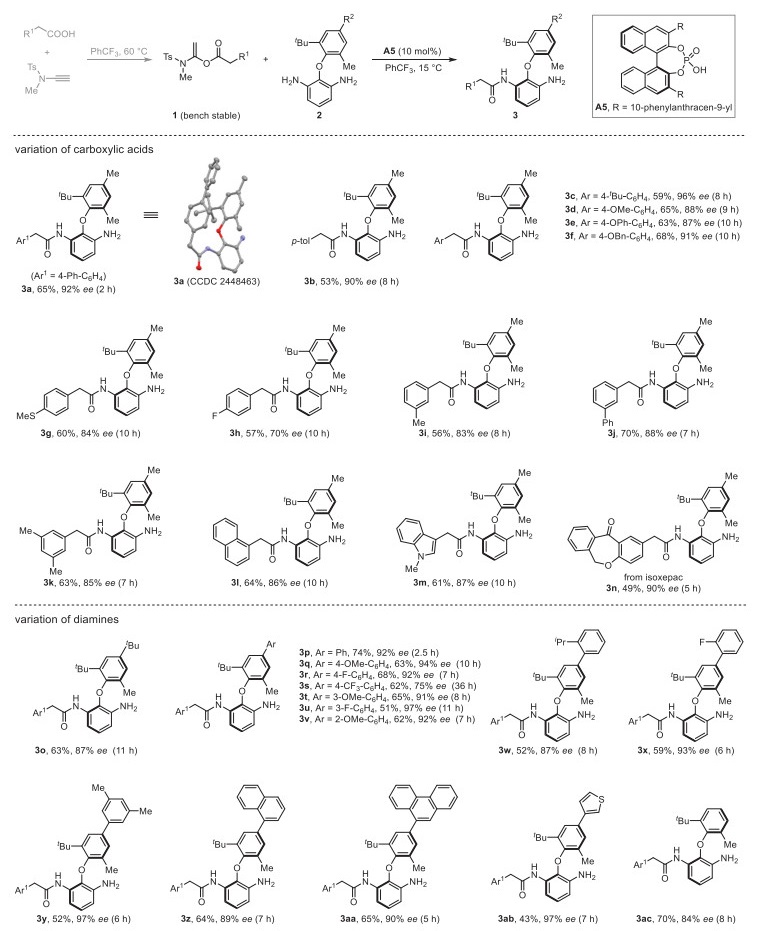
Having established the optimal reaction conditions, the substrate scope of this atroposelective desymmetrization of diamines was explored (Scheme 2). A variety of carboxylic acids were employed to react with ynamide coupling reagent to generate α-acyloxyenamides 1, which were used in the further desymmetrizing amidation with diamines 2. First, phenylacetic acids bearing electron-donating (Me, tBu, OMe, OPh, OBn, and SMe) and electron-withdrawing groups (such as F and pH) on the benzene ring at the para- and meta-positions reacted smoothly to deliver the expected C–O axially chiral diaryl ethers 3a–3j in 53%–70% yields with 70%–96% ee values. Disubstituted phenylacetic acid was found to be suitable for the transformation, furnishing the corresponding product 3k in 63% yield with 85% ee. This atroposelective desymmetrization proceeded well with carboxylic acids bearing (hetero)aromatic rings, including naphthyl and Me-protected indole, affording the desired anilines in good enantioselectivities (3l, 3m). Interestingly, isoxepac could be directly used as a competent carboxylic acid to give 3n in 49% yield with 90% ee. Then, the scope of different diamines 2 was examined. The replacement of methyl at the para-position of 2-aryloxy with tBu and phenyl groups resulted in anilines 3o and 3p in 63%–74% yields with 87%–92% ee values. Furthermore, diamines equipped with various aryl groups at the para-position of 2-aryloxy, including 4-OMe, 4-F, 4-CF3, 3-OMe, 3-F, 2-OMe, 2-iPr, 2-F, and 3,5-dimethyl substituted phenyl groups, as well as 1-naphthyl, 9-phenanthryl and 3-thienyl groups, reacted efficiently to produce the corresponding 3q–3z, 3aa and 3ab in 43%–68% yields with 75%–97% ee values. In addition, diamine substrate bearing disubstituted phenyl group was evaluated in this reaction, and the expected product 3ac was generated in 70% yield with 84% ee. The absolute configuration of 3a was confirmed by X-ray diffraction. Details can be found in Supporting information
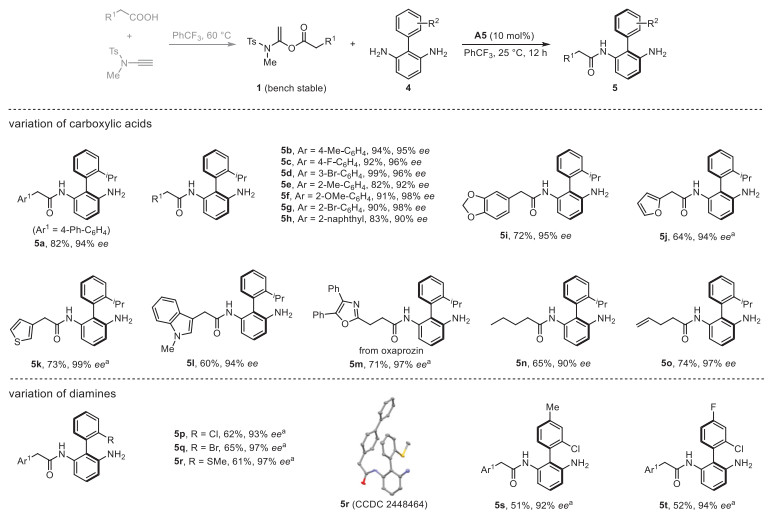
To further explore the capacity of this atroposelective desymmetrization, we proposed to further extend this methodology to the synthesis of C–C axially chiral anilines [38–40]. After systematic evaluation of reaction conditions (see Supporting information for details), the ynamide-mediated amidation of diaryl anilines with carboxylic acids was first conducted in a stepwise process. As shown in Scheme 3, a variety of phenylacetic acids with both electron-donating and electron-withdrawing substituents at different positions of phenyl ring, such as Me, OMe, pH, F, and Br, could undergo this atroposelective amidation efficiently to generate atropisomeric anilines 5a–5g in 82%–99% yields with 92%–98% ee values. Other (hetero)aromatic moieties, including 2-naphthyl (5h), 1,3-benzodioxole (5i), furan (5j), thiophene (5k), and Me-protected indole (5l) were all compatible in the transformation, delivering the desired products in 60%–83% yields with 90%–99% ee values. Oxaprozin could also be transformed into the corresponding axially chiral product 5m smoothly. The arylacetic acid could be replaced with valeric acid and 4-pentenoic acid to give 5n and 5o in 65%–74% yields with 90%–97% ee values. Next, we turned to explore the scope of diamines 4. The replacement of isopropyl on diaryl aniline substrate with Cl, Br, and SMe, successfully produced the target 5p–5r in 61%–65% yields with 93%–97% ee values. Moreover, diamines equipped with disubstituted aryl group were also suitable substrates for the amidation reaction, affording 5s and 5t in moderate yields with high enantioselectivities. The absolute configuration of 5r was confirmed by single crystal X-ray crystallographic analysis (see Supporting information for details). This protocol provides a concise way for the construction of axial chirality [67–73].
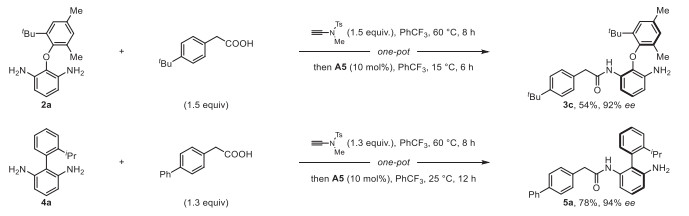
Encouraged by the stepwise reactions, the one-pot desymmetrizing amidation of diamines with carboxylic acids was successfully realized by ynamide coupling reagent. As shown in Scheme 4, the one-pot atroposelective amidation of diamine 2a with 2-(4-(tert–butyl)phenyl)acetic acid proceeded smoothly to deliver C–O axially chiral aniline 3c in 54% yield with 92% ee, and the one-pot reaction of diamine 4a with 2-([1,1′-biphenyl]−4-yl)acetic acid afforded C–C axially chiral aniline 5a in 78% yield with 94% ee. Therefore, this CPA-catalyzed strategy enables the effective atroposelective amidation of diamines with readily available carboxylic acids.
To explore the synthetic utility of this strategy, the scale-up reaction of α-acyloxyenamide 1a with diamine 2a was performed, and the desired C–O axially chiral aniline 3a could be obtained in 62% yield with 92% ee (Scheme 5a). The aniline moiety enabled diverse transformations, such as diazotisation reaction and Michael addition with 1,1′-binaphthyl-2,2′-diyl hydrogenphosphate (BNDHP) to yield axially chiral diaryl ethers 6 and 7 efficiently. The treatment of free aniline with thiophosgene (CSCl2) and (1S,2S)-N,N'-dimethylcyclohexane-1,2-diamine delivered a diastereomeric tertiary amine-thiourea bifunctional catalyst 8. Furthermore, axially chiral free amine 3a could undergo condensation with 2-(diphenylphosphino)benzaldehyde to synthesize the C–O axially chiral P,N-ligand 9. Notably, these transformations proceeded without erosion of enantiopurity (Scheme 5b).
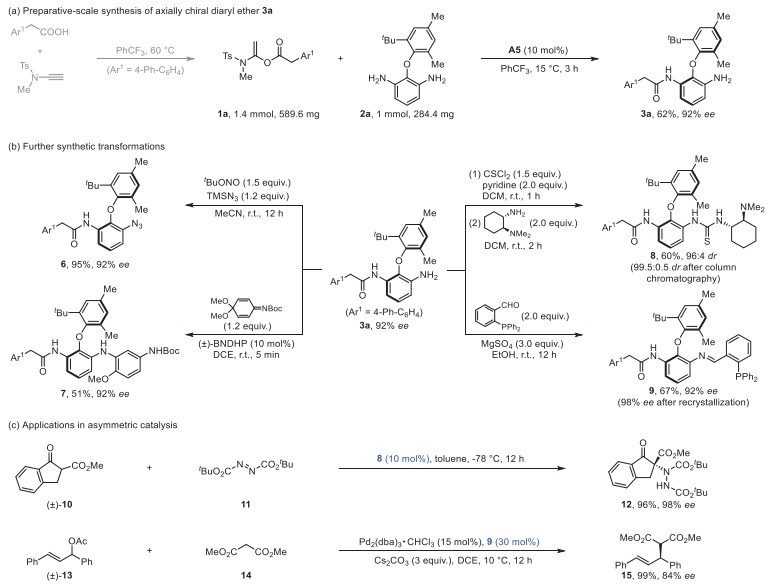
The application of above C–O axially chiral skeletons in asymmetric catalysis was then investigated (Scheme 5c). Importantly, thiourea 8 could be used as a competent organocatalyst for the enantioselective Michael addition of β-ketoester 10 with di-tert-butyl azodicarboxylate (DBAD) 11, affording the α-hydrazination product 12 in 96% yield with 98% ee. Moreover, axially chiral phosphine 9 was demonstrated to be an effective ligand in palladium-catalyzed asymmetric Tsuji-Trost allylation of 1,3-diphenylallyl acetate 13 and dimethyl malonate 14, and the desired product 15 could be isolated in almost quantative yield with 84% ee. These results indicate the potential application of the constructed axially chiral aniline skeletons in the field of asymmetric catalysis.
To probe the reaction mechanism and origin of enantioselectivity, a series of control experiments were carried out. As shown in Scheme 6a, the desymmetrization of diamine 2a with 0.55 equiv. of α-acyloxyenamide 1a was conducted, leading to C–O axially chiral aniline (R)-3a in 39% yield with 73% ee, accompanied with trace amount of diamidation product 16 (KR/KS = 6.4:1). The kinetic resolution of racemic 3a with 0.55 equiv. of α-acyloxyenamide 1a afforded (R)-3a in 61% yield with 33% ee, as well as diamidation product 16 in 31% yield (VS/VR = 3:1, the selective factor s = 4.3). These results demonstrate that desymmetrization is the major contributor for enantiocontrol, and the following kinetic resolution improved the enantioselectivity of 3a. Similarly, the desymmetrization of diamine 4a and kinetic resolution of racemic 5a were also performed, indicating that desymmetrization is the key contributor for enantiocontrol, and the following kinetic resolution slightly improved the enantioselectivity of 5a (KR/KS = 24:1; VS/VR = 4.8:1, the selective factor s = 13.2).
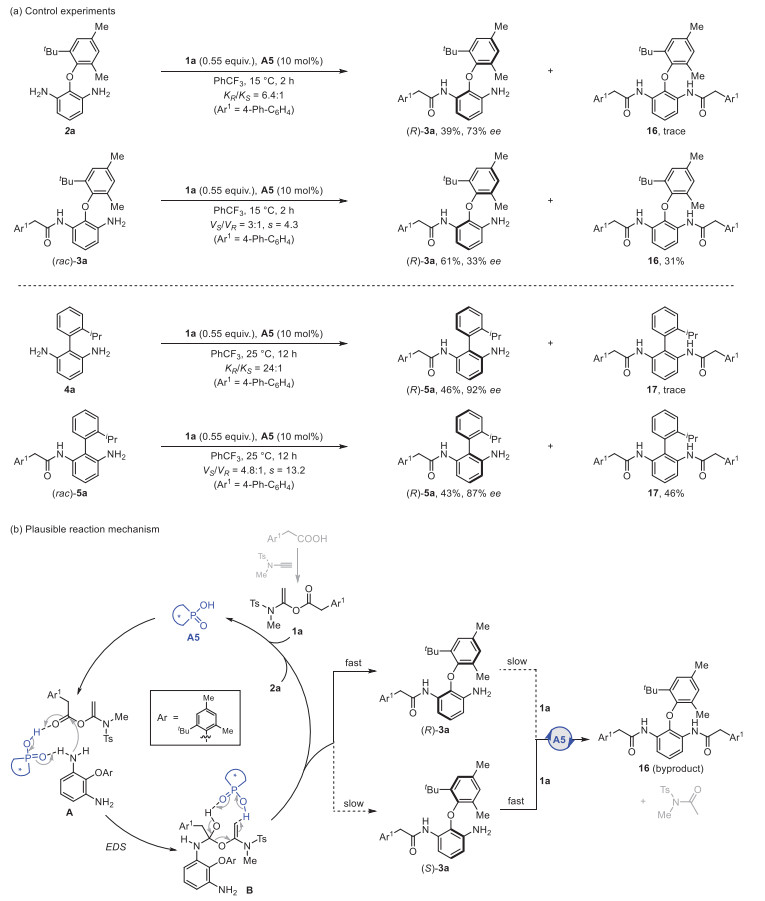
Based on the control experiments and the previous studies on ynamide-mediated coupling reaction [49], the plausible reaction mechanism is postulated (Scheme 6b). After the synthesis of α-acyloxyenamide 1a from the reaction of carboxylic acid with ynamide, CPA catalyst A5 promotes the atroposelective nucleophilic addition of diamine 2a onto α-acyloxyenamide 1a via double hydrogen bonding interactions (intermediate A) to form tertiary alcohol-type intermediate B, which is the enantio-determining step (EDS). Subsequently, a hydrogen bonding-assisted proton transfer takes place to afford axially chiral diaryl ether (R)-3a and regenerate the catalyst. The enantioselectivity of (R)-3a is further improved by the following kinetic resolution of undesired (S)-3a through the second amidation, which generates diamidation byproduct 16 and sulfonyl-protected N-methylacetamide. Of note, the sulfonyl-protected N-methylacetamide byproduct can be easily converted into ynamide coupling reagent and applied into other reactions [50].
In conclusion, a Brønsted acid-catalyzed atroposelective desymmetrizing amidation of diamines with carboxylic acids has been developed by using ynamide as coupling reagent, leading to the assembly of C–O and C–C axially chiral anilines in high enantioselectivities. Importantly, the one-pot atroposelective amidation of diamines with carboxylic acids was successfully realized via ynamide-mediation, which showed good tolerance towards primary diamines. This reaction represents a rare atroposelective desymmetrization of diamines with carboxylic acids. Mechanistic studies indicate that this atroposelective amidation involves a desymmetrization/kinetic resolution cascade sequence. The scale-up reaction and synthetic transformations led to the constructions of C–O axially chiral organocatalyst and P,N-ligand, which could be applied in asymmetric catalysis. Further investigation into the ynamide-mediated enantioselective coupling strategy for the efficient synthesis of chiral functional molecules is underway in our laboratory.
Guang-Hui Wang: Data curation. Jia-Tian Jiang: Data curation. Jian Yang: Data curation. Ze-Shu Wang: Data curation. Gongde Wu: Formal analysis. Long-Wu Ye: Supervision. Bo Zhou: Writing – review & editing, Supervision, Project administration, Funding acquisition, Conceptualization.
The authors declare that they have no known competing financial interests or personal relationships that could have appeared to influence the work reported in this paper.
We are grateful for financial support from the National Natural Science Foundation of China (Nos. 22301250, 22125108, and 22331004), the Natural Science Foundation of Fujian Province of China (No. 2023J05005), the Natural Science Foundation of Xiamen, China (No. 3502Z202371002), the Fundamental Research Funds for the Central Universities (No. 20720230003), the Postdoctoral Fellowship Program of China Postdoctoral Science Foundation (No. GZC20231402), the China Postdoctoral Science Foundation (No. 2024M751765), and the Foundation of Wenzhou Science & Technology Bureau (No. L2023002).
Supplementary material associated with this article can be found, in the online version, at doi:
M. Basilaia, M.H. Chen, J. Secka, J.L. Gustafson, Acc. Chem. Res. 55 (2022) 2904–2919. doi: 10.1021/acs.accounts.2c00500
J.E. Smyth, N.M. Butler, P.A. Keller, Nat. Prod. Rep. 32 (2015) 1562–1583. doi: 10.1039/C4NP00121D
X. Zhang, J. Yin, J. Yoon, Chem. Rev. 114 (2014) 4918–4959. doi: 10.1021/cr400568b
G. Bringmann, T. Gulder, T.A.M. Gulder, M. Breuning, Chem. Rev. 111 (2011) 563–639. doi: 10.1021/cr100155e
Q.L. Zhou, Privileged Chiral Ligands and Catalysts, Wiley, Hoboken, 2011, pp. 1–53.
T.A. Schmidt, V. Hutskalova, C. Sparr, Nat. Rev. Chem. 8 (2024) 497–517. doi: 10.1038/s41570-024-00618-x
S.H. Xiang, W.Y. Ding, Y.B. Wang, B. Tan, Nat. Catal. 7 (2024) 483–498. doi: 10.1038/s41929-024-01138-z
G. Centonze, C. Portolani, P. Righi, G. Bencivenni, Angew. Chem. Int. Ed. 62 (2023) e202303966. doi: 10.1002/anie.202303966
W. Qin, Y. Liu, H. Yan, Acc. Chem. Res. 55 (2022) 2780–2795. doi: 10.1021/acs.accounts.2c00486
X. Zhang, K. Zhao, Z. Gu, Acc. Chem. Res. 55 (2022) 1620–1633. doi: 10.1021/acs.accounts.2c00175
J.A. Carmona, C. Rodríguez-Franco, R. Fernández, V. Hornillos, J.M. Lassaletta, Chem. Soc. Rev. 50 (2021) 2968–2983. doi: 10.1039/d0cs00870b
J.K. Cheng, S.H. Xiang, S. Li, L. Ye, B. Tan, Chem. Rev. 121 (2021) 4805–4902. doi: 10.1021/acs.chemrev.0c01306
G. Liao, T. Zhou, Q.J. Yao, B.F. Shi, Chem. Commun. 55 (2019) 8514–8523. doi: 10.1039/c9cc03967h
E. Kumarasamy, R. Raghunathan, M.P. Sibi, J. Sivaguru, Chem. Rev. 115 (2015) 11239–11300. doi: 10.1021/acs.chemrev.5b00136
Z.C. Wu, D.L. Boger, Acc. Chem. Res. 53 (2020) 2587–2599. doi: 10.1021/acs.accounts.0c00569
B.M. Crowley, D.L. Boger, J. Am. Chem. Soc. 128 (2006) 2885–2892. doi: 10.1021/ja0572912
K.C. Nicolaou, C.N.C. Boddy, J. Am. Chem. Soc. 124 (2002) 10451–10455. doi: 10.1021/ja020736r
K.C. Nicolaou, C.N.C. Boddy, S. Bräse, N. Winssinge, Angew. Chem. Int. Ed. 38 (1999) 2096–2152. doi: 10.1002/(SICI)1521-3773(19990802)38:15<2096::AID-ANIE2096>3.0.CO;2-F
B.M. Duggan, D.J. Craik, J. Med. Chem. 40 (1997) 2259–2265. doi: 10.1021/jm9606610
A. Naghim, J. Rodriguez, O. Chuzel, G. Chouraqui, D. Bonne, Angew. Chem. Int. Ed. 63 (2024) e202407767. doi: 10.1002/anie.202407767
N. Kotwala, P. Chauhan, Chem. Commun. 60 (2024) 6837–6846. doi: 10.1039/D4CC01655F
R. Farooqi, A. Mustafai, A.G. Woldegiorgis, X. Lin, P. Wang, ACS Catal. 15 (2025) 7891–7911. doi: 10.1021/acscatal.5c01262
M.S. Betson, J. Clayden, C.P. Worrall, S. Peace, Angew. Chem. Int. Ed. 45 (2006) 5803–5807. doi: 10.1002/anie.200601866
K. Fuji, T. Oka, T. Kawabata, T. Kinoshitab, Tetrahedron Lett. 39 (1998) 1373–1376. doi: 10.1016/S0040-4039(97)10848-6
J. Clayden, C.P. Worrall, W.J. Moran, M. Helliwell, Angew. Chem. Int. Ed. 47 (2008) 3234–3237. doi: 10.1002/anie.200705660
B. Yuan, A. Page, C.P. Worrall, et al., Angew. Chem. Int. Ed. 49 (2010) 7010–7013. doi: 10.1002/anie.201002580
A.N. Dinh, R.R. Noorbehesht, S.T. Toenjes, et al., Synlett 29 (2018) 2155–2160. doi: 10.1055/s-0037-1609581
X. Han, L. Chen, Y. Yan, et al., ACS Catal. 14 (2024) 3475–3481. doi: 10.1021/acscatal.3c06148
L. Dai, X. Zhou, J. Guo, Q. Huang, Y. Lu, Chem. Sci. 15 (2024) 5993–6001. doi: 10.1039/d4sc01074d
Y. Wang, R. Mi, S. Yu, X. Li, ACS Catal. 14 (2024) 4638–4647. doi: 10.1021/acscatal.4c00001
B.A. Zhou, X.N. Li, C.L. Zhang, Z.X. Wang, S. Ye, Angew. Chem. Int. Ed. 63 (2024) e202314228. doi: 10.1002/anie.202314228
Y. Wu, X. Guan, H. Zhao, et al., Chem. Sci. 15 (2024) 4564–4570. doi: 10.1039/d3sc06444a
S. Shee, S.S. Ranganathappa, M.S. Gadhave, R. Gogoi, A.T. Biju, Angew. Chem. Int. Ed. 62 (2023) e202311709. doi: 10.1002/anie.202311709
L. Dai, Y. Liu, Q. Xu, et al., Angew. Chem. Int. Ed. 62 (2023) e202216534. doi: 10.1002/anie.202216534
Z. Ye, W. Xie, W. Liu, C. Zhou, X. Yang, Adv. Sci. 11 (2024) e2403125. doi: 10.1002/advs.202403125
K. Ding, H. Guo, X. Li, Y. Yuan, Y. Wang, Top. Catal. 35 (2005) 105–116. doi: 10.1007/s11244-005-3816-2
P. Kočovský, Š. Vyskočil, M. Smrčina, Chem. Rev. 103 (2003) 3213–3246. doi: 10.1021/cr9900230
H. Zhu, L. Cheng, J, Wang, et al., Org. Chem. Front. 11 (2024) 6672–6677. doi: 10.1039/d4qo01413h
X.Y. Zhang, D. Zhu, Y.X. Huo, L.L. Chen, Z.M. Chen, Org. Lett. 25 (2023) 3445–3450. doi: 10.1021/acs.orglett.3c01002
S. Shirakawa, X. Wu, S. Liu, K. Maruoka, Tetrahedron 72 (2016) 5163–5171. doi: 10.1016/j.tet.2015.10.074
H. Bao, Y. Chen, X. Yang, Angew. Chem. Int. Ed. 62 (2023) e202300481. doi: 10.1002/anie.202300481
J. Xu, W. Lin, H. Zheng, X. Li, ACS Catal. 14 (2024) 6667–6673. doi: 10.1021/acscatal.4c01489
A. El-Faham, F. Albericio, Chem. Rev. 111 (2011) 6557–6602. doi: 10.1021/cr100048w
A. Parenty, X. Moreau, J.M. Campagne, Chem. Rev. 106 (2006) 911–939. doi: 10.1021/cr0301402
S. Xu, D. Jiang, Z. Peng, et al., Angew. Chem. Int. Ed. 61 (2022) e202212247. doi: 10.1002/anie.202212247
T. Liu, Z. Peng, M. Lai, L. Hu, J. Zhao, J. Am. Chem. Soc. 146 (2024) 4270–4280. doi: 10.1021/jacs.4c00314
M. Yang, X. Wang, J. Zhao, ACS Catal. 10 (2020) 5230–5235. doi: 10.1021/acscatal.0c00523
L. Hu, S. Xu, Z. Zhao, et al., J. Am. Chem. Soc. 138 (2016) 13135–13138. doi: 10.1021/jacs.6b07230
H.H. Chen, J.T. Jiang, Y.N. Yang, L.W. Ye, B. Zhou, Angew. Chem. Int. Ed. 64 (2025) e202505167. doi: 10.1002/anie.202505167
L. Hu, J. Zhao, Acc. Chem. Res. 57 (2024) 855–869. doi: 10.1021/acs.accounts.3c00743
Y.C. Hu, Y. Zhao, B. Wan, Q.A. Chen, Chem. Soc. Rev. 50 (2021) 2582–2625. doi: 10.1039/d0cs00283f
Y.B. Chen, P.C. Qian, L.W. Ye, Chem. Soc. Rev. 49 (2020) 8897–8909. doi: 10.1039/d0cs00474j
C.C. Lynch, A. Sripada, C. Wolf, Chem. Soc. Rev. 49 (2020) 8543–8583. doi: 10.1039/d0cs00769b
G. Evano, C. Theunissen, M. Lecomte, Aldrichim. Acta 48 (2015) 59–80.
X.N. Wang, H.S. Yeom, L.C. Fang, et al., Acc. Chem. Res. 47 (2014) 560–578. doi: 10.1021/ar400193g
D.Q. Cui, G.L. Qian, H.L. Zheng, et al., ACS Catal. 15 (2025) 2424–2433. doi: 10.1021/acscatal.4c08055
Y. Xu, G.L. Qian, D.Q. Cui, et al., ACS Catal. 13 (2023) 8803–8812. doi: 10.1021/acscatal.3c01680
Z.S. Wang, L.J. Zhu, C.T. Li, et al., Angew. Chem. Int. Ed. 61 (2022) e202201436. doi: 10.1002/anie.202201436
P.F. Chen, B. Zhou, P. Wu, B. Wang, L.W. Ye, Angew. Chem. Int. Ed. 60 (2021) 27164–27170. doi: 10.1002/anie.202113464
Y.Q. Zhang, Y.B. Chen, J.R. Liu, et al., Nat. Chem. 13 (2021) 1093–1100. doi: 10.1038/s41557-021-00778-z
B. Zhou, Y.Q. Zhang, K. Zhang, et al., Nat. Commun. 10 (2019) 3234–3244. doi: 10.1038/s41467-019-11245-2
C.Y. Weng, L.G. Liu, M. Sun, et al., Angew. Chem. Int. Ed. 64 (2025) e202418254. doi: 10.1002/anie.202418254
H.H. Chen, Y.B. Chen, J.Z. Gao, L.W. Ye, B. Zhou, Angew. Chem. Int. Ed. 63 (2024) e202411709. doi: 10.1002/anie.202411709
C.T. Li, L.J. Qi, L.G. Liu, et al., Nat. Commun. 14 (2023) 7058–7067. doi: 10.1038/s41467-023-42805-2
Y.B. Chen, L.G. Liu, C.M. Chen, et al., Angew. Chem. Int. Ed. 62 (2023) e202303670. doi: 10.1002/anie.202303670
Z.X. Zhang, L.G. Liu, Y.X. Liu, et al., Chem. Sci. 14 (2023) 5918–5924. doi: 10.1039/d3sc01880f
D.J. Cheng, L. Yan, S.K. Tian, et al., Angew. Chem. Int. Ed. 53 (2014) 3684–3687. doi: 10.1002/anie.201310562
P. Ramírez-Lopez, A. Ros, A. Romero-Arenas, et al., J. Am. Chem. Soc. 138 (2016) 12053–12056. doi: 10.1021/jacs.6b07972
W. Liu, Q. Jiang, X. Yang, Angew. Chem. Int. Ed. 59 (2020) 23598–23602. doi: 10.1002/anie.202009395
X.J. Zhao, Z.H. Li, T.M. Ding, et al., Angew. Chem. Int. Ed. 60 (2021) 7061–7065. doi: 10.1002/anie.202015001
Z. Han, L. Wei, C. Nian, et al., Sci. China Chem. 69 (2026) 1266–1272. doi: 10.1007/s11426-025-2834-6
C. Zhao, J. Liao, Y. Zhu, et al., Chin. Chem. Lett. 36 (2025) 110337. doi: 10.1016/j.cclet.2024.110337
Y. Gu, T. Wang, M. Gao, Z.J. Yao, Chin. Chem. Lett. 32 (2021) 380–384. doi: 10.1016/j.cclet.2020.02.015

Scheme 2 Substrate scope for the construction of C–O axially chiral anilines 3. Reaction conditions: 1 (0.14 mmol), 2 (0.1 mmol), A5 (0.01 mmol), PhCF3 (3.0 mL), 15 ℃, 2–36 h, in vials; yields were those for the isolated products; ee values were determined by HPLC analysis.

Scheme 3 Substrate scope for the construction of C–C axially chiral anilines 5. Reaction conditions: 1 (0.11 mmol), 4 (0.1 mmol), A5 (0.01 mmol), PhCF3 (3.0 mL), 25 ℃, 12 h, in vials; yields were those for the isolated products; ee values were determined by HPLC analysis. a1 (0.14 mmol).

Scheme 4 One-pot atroposelective desymmetrizing amidation of diamines with carboxylic acids.

Scheme 6 One-pot atroposelective desymmetrizing amidation of diamines with carboxylic acids.
Table 1. Optimization of reaction conditions for the atroposelective desymmetrization of diamine 2a.a
|
||||||
| Entry | Catalyst | Solvent | Temp (℃) | Time (h) | Yield (%) b of 3a | ee (%) c of 3a |
| 1 | A1 | CH2Cl2 | 25 | 4 | 56 | 20 |
| 2 | A2 | CH2Cl2 | 25 | 4 | 57 | 51 |
| 3 | A3 | CH2Cl2 | 25 | 4 | 63 | 45 |
| 4 | A4 | CH2Cl2 | 25 | 4 | 66 | 10 |
| 5 | A5 | CH2Cl2 | 25 | 4 | 80 | 75 |
| 6 | A6 | CH2Cl2 | 25 | 4 | 53 | −19 |
| 7 | A7 | CH2Cl2 | 25 | 4 | 76 | −47 |
| 8 | A8 | CH2Cl2 | 25 | 4 | 74 | −43 |
| 9 | A9 | CH2Cl2 | 25 | 4 | 71 | −39 |
| 10 | A10 | CH2Cl2 | 25 | 4 | 66 | −67 |
| 11 | A5 | Et2O | 25 | 4 | 71 | 70 |
| 12 | A5 | THF | 25 | 4 | 60 | 41 |
| 13 | A5 | Toluene | 25 | 4 | 73 | 71 |
| 14 | A5 | PhCF3 | 25 | 4 | 78 | 81 |
| 15 | A5 | PhCF3 | 15 | 4 | 82 | 83 |
| 16d | A5 | PhCF3 | 15 | 4 | 74 | 87 |
| 17e | A5 | PhCF3 | 15 | 2 | 67 | 92 |
| a Reaction conditions: 1a (0.055 mmol), 2a (0.05 mmol), catalyst (0.005 mmol), solvent (1.5 mL), 15–25 ℃, 2–4 h, in vials. b Measured by 1H NMR using 1,3,5-trimethoxybenzene as the internal standard. c Determined by HPLC analysis. d 0.06 mmol of 1a was used. e 0.07 mmol of 1a was used. | ||||||
 下载: 导出CSV

 扫一扫看文章


扫一扫关注我们


 下载:
下载: