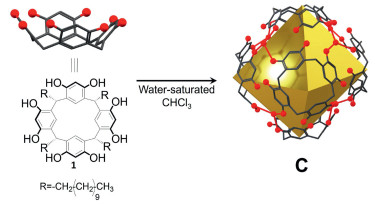
Figure 1.
Self-assembly driven by hydrogen bonding between six resorcinarene molecules and eight water molecules leads to the formation of the hexameric resorcinarene capsule C.

Indane synthesis in resorcinarene capsules: The crucial role of the carbocation counter anion
Veronica Iuliano , Placido Neri , Margherita De Rosa , Paolo Della Sala , Carmine Gaeta , Carmen Talotta


In recent years, the synthesis of organic molecules within the confined spaces of the self-assembled resorcinarene capsule C (Fig. 1) [1,2] has emerged as a powerful tool in chemistry [3–7]. It is now well-established that chemical reactions occurring in the confined space of capsule C can differ significantly from those in bulk media [8–13]. Inside the cavity of capsule C, cationic intermediates and transition states are shielded from interactions with other molecules, which leads to reaction outcomes that can differ markedly from those in bulk environments [3–7]. Additionally, this protection from nucleophilic attacks by water or other potential reactants often favors unimolecular processes like cyclization over alternative pathways [12,13]. In this regard, Tiefenbacher reported several intriguing examples of terpene cyclase mimicking using the self-assembled resorcinarene capsule C [12,13].
As is known the hexameric resorcinarene capsule C (Fig. 1) is formed by the self-assembly of six resorcinarene macrocycles 1 and eight water molecules, stabilized by an intricate network of 60 hydrogen-bonding interactions. The structural water within this network serves as important hydrogen-bonding donors, enabling capsule C to effectively catalyze Friedel-Crafts reactions [8–11,14,15].
Indanes are important carbocycles that provide a unique structural framework for novel pharmaceuticals [16–18]. In recent decades, numerous synthetic procedures for indanes have been reported, often relying on metal catalysis and utilizing structurally complex and costly reagents [19]. These methods encompass various cyclization strategies [20–24], including Michael-type reactions, cycloaddition processes [20], and intramolecular Friedel–Crafts cyclizations [21].
Based on these considerations, we propose an organocatalytic approach for the nanoconfined synthesis of indanes. This method exploits the confined space of the self-assembled resorcinarene capsule C and employs inexpensive reagents, such as styrene and acid co-catalysts. Our strategy is designed to improve reaction efficiency and selectivity while minimizing the environmental impact typically associated with conventional metal-catalyzed processes [21,23,24].
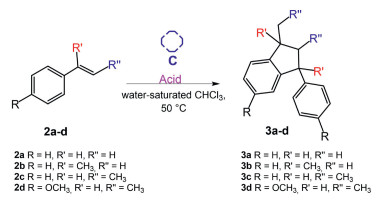
Initially, we aimed to investigate the reaction outcome of HBr addition to the double bond of styrene derivatives 2a-d (Fig. 2) within the confined space of capsule C. The treatment of styrene 2a with HBr (1 equiv.) in the presence of hexameric capsule C (0.26 equiv.) in water-saturated CHCl3 at 50 ℃ for 16 h resulted in the formation of product 3a with a yield of 60% (Table 1, entry 1). The GC–MS spectrum displayed a molecular ion peak at 208 m/z, consistent with the molecular formula of 3a, and indicative of the dimerization product of styrene 2a.
 DownLoad:
CSV
DownLoad:
CSV
| Entry | C (equiv.) | Acid | Acid (equiv.) | 2a‒d | Time (h) | 3a‒d (%)b |
| 1 | 0.26 | HBr | 1 | 2a | 16 | 60 |
| 2c | 0.26 | / | / | 2a | 16 | / |
| 3c | 0.26 | HCl | 0.03 | 2a | 16 | / |
| 4c | / | HBr | 1 | 2a | 16 | / |
| 5c,d | 0.26 | HBr | 1 | 2a | 16 | / |
| 6 | 0.26 | HBr | 1 | 2b | 1 | 85 |
| 7 | 0.26 | HBr | 1 | cis -2c | 16 | 94 |
| 8 | 0.26 | HBr | 1 | trans -2c | 16 | 94 |
| 9 | 0.26 | HBr | 1 | 2d | 16 | 96 |
| 10 | 0.26 | HCl | 1 | trans-2c | 16 | 81 |
| 11 | 0.26 | HCl | 1 | 2a | 16 | 50 |
| 12 | 0.26 | HI | 1 | trans-2c | 16 | / |
| 13 | 0.26 | TFA | 1 | trans-2c | 16 | / |
| 14 | 0.26 | AcOH | 1 | trans-2c | 16 | / |
| 15 | 0.26 | HClO4 | 1 | trans-2c | 16 | / |
| 16 | 0.26 | HCOOH | 1 | trans-2c | 16 | 58 |
| 17 | 0.26 | HBF4 | 1 | trans-2c | 16 | 72 |
| 18e | 0.26 | HBr | 1 | cis -2c | 16 | 94 |
| a Unless noted otherwise, reaction conditions are: 2a-d (84.9 µmol), acid (84.9 µmol, 1 equiv.), C [26 mol%, corresponding to 141 mg of 1 (127.4 µmol)], water-saturated CHCl 3 (0.55 mL). b Isolated yield determined by chromatographic column; isolated yields refer to the combined yields of all stereoisomers; all reactions were performed in triplicate; the reported yields correspond to average values with a reproducibility within ±3%. c No product formation; only starting materials recovered. d Reaction performed with tetraethylammonium tetrafluoroborate (46 mg, 212.5 µmol). e Experiments on the reusability of C; the activity was maintained after different cycles. | ||||||
Detailed analysis using 1D and 2D NMR spectroscopy (COSY and HSQC) and GC–MS analysis (see Supporting information for details) indicated that compound 3a consists of a 50:50 mixture of two cis/trans diastereoisomers. The assignment of NMR signals corresponding to each diastereomer was facilitated by DFT-simulated 1H NMR spectrum, generated using Gaussian software (Supporting information). Based on these results, we investigated the formation of compound 3a within the nanoconfined environment of capsule C in the absence of HBr (Table 1, entry 2). After 16 h at 50 ℃, no hint of 3a was detected in the reaction mixture. Data previously reported in the literature [14] showed that the addition of 0.03 equiv. of HCl in CDCl3 (with 10 mol% capsule) enhances the capsule’s acidity and promotes substrate protonation [14]. In contrast, excess water is disadvantageous for many cyclizations [15]. However, under our conditions, reacting 2a with 0.03 equiv. of HCl within capsule C at 50 ℃ yielded no detectable 3a (Table 1, entry 3). Similarly, no product formation was observed when 2a was treated with HBr in the absence of capsule C (Table 1, entry 4), demonstrating that both capsule C and a stoichiometric amount of HBr (relative to styrene) are crucial for the reaction. Finally, adding tetraethylammonium tetrafluoroborate to the reaction mixture containing capsule C and HBr also failed to produce 3a (Table 1, entry 5, Fig. S34 in Supporting information). Tetraethylammonium tetrafluoroborate is a well-known competitive guest that exhibits a high affinity for the inner cavity of capsule C [3–11]. Based on these observations, it can be inferred that the reaction occurs specifically within the cavity of the capsule. To confirm that capsule C maintains its hexameric structure in the presence of HBr, we conducted a DOSY experiment (Supporting information), which shows that C remains stable under the conditions in Fig. 2.
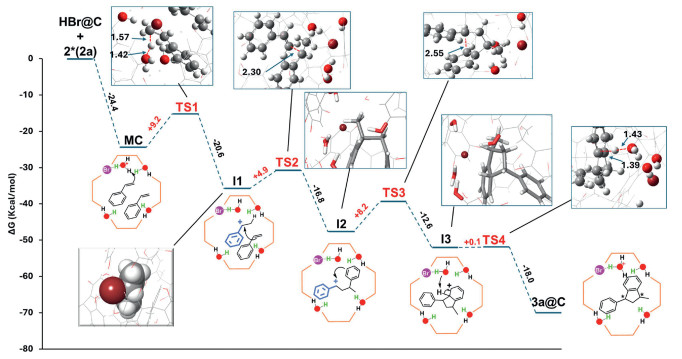
With these results in hands, a quantum mechanical (QM) investigation was conducted to gain mechanistic insight into the Friedel–Crafts (FC) cyclodimerization of substrate 2a within the confined environment of capsule C (Fig. 3). Following the previously reported protocol [8–11], a reduced model of the capsule with truncated alkyl chains was employed, and the ONIOM method (M06–2X/PM6) was used to explore the reaction pathway leading to the formation of the cis-3a product (Fig. 3). We examined the formation of the catalytically active heterocomplex MC [(2a)2 + HBr@C], in which two molecules of 2a are encapsulated inside the cavity of capsule C, in the presence of a hydronium ion (H3O−), with Br− replacing a bridged water molecule. This choice is consistent with previous report [14] showing that protonation of bound water molecules inside the capsule can generate H3O−, which acts as a proton shuttle to the encapsulated substrate. The formation of this ternary complex MC (Fig. 3) yields an overall stabilization of −24.4 kcal/mol, supported by hydrogen-bonding interactions involving both H3O+ and Br− with polar groups at the capsule interior. The reaction initiates via protonation of a styrene unit, leading to the formation of a benzylic carbocation through transition state TS1, with an activation energy of 9.2 kcal/mol. Consistent with a finding previously reported in literature [25, 26], the calculations indicate that within the hexameric capsule, the bromide counteranion forms a tight ion pair (carbocation···Br− distance of 4.36 Å), which contributes to the enhanced stabilization of the carbocation I1. The resulting intermediate I1 lies 20.6 kcal/mol below TS1 and forms a tight ion pair with Br− (carbocation···Br− distance = 2.09 Å), which further stabilizes the cationic species. Subsequently, carbocation I1 undergoes nucleophilic attack by a second styrene molecule through transition state TS2, which is located 4.9 kcal/mol above I1. From TS2, the second carbocation, I2, is formed, residing 16.8 kcal/mol below TS2. In intermediate I2, a carbocation···Br− distance of 4.91 Å was calculated. Following this, carbocation I2 undergoes intramolecular cyclization to yield intermediate I3 via transition state TS3. I3 then rearomatizes via a low-barrier transition state (TS4) to produce the final product, cis-3a. The formation of cis-3a from I3 involves a rearomatization step characterized by a very low energy barrier at TS4.
Based on these findings, we explored the scope of the Friedel–Crafts (FC) dimerization reaction catalyzed by capsule C by evaluating various styrene derivatives (Figs. 2 and 4, and Table 1).
We investigated the reactivity of α-methylstyrene (2b). Due to the increased stability of tertiary carbocation, the reaction proceeded more rapidly (1 h) than with 2a and yielded a high conversion rate (Table 1, entry 6).
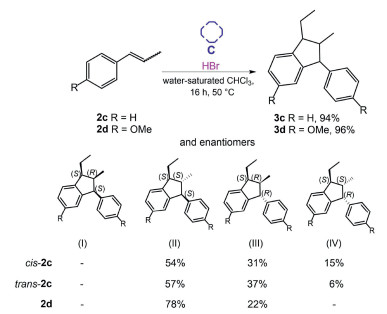
β-Methylstyrene 2c was studied using both trans and cis stereoisomers (Fig. 4, Table 1, entries 7 and 8). Starting with cis-2c, the product 3c was formed after 16 h in 94% yield (Table 1, entry 7).
Given the three stereocenters in 3c, four diastereoisomers (Ⅰ‒Ⅳ in Fig. 4) were expected as enantiomeric pairs. However, NMR spectroscopy and quantum mechanical (QM) simulations of the 1H NMR spectrum revealed the presence of diastereoisomers Ⅱ, Ⅲ, and Ⅳ in yields of 54%, 31%, and 15%, respectively, which was confirmed by GC–MS analysis. The reaction was then repeated using trans-2c (Fig. 4), also yielding product 3c in 94% after 16 h (Table 1, entry 8). Again, NMR and QM simulations showed Ⅱ, Ⅲ, and Ⅳ in yields of 57%, 37%, and 6%, respectively, confirmed by GC–MS analysis. The low stereoselectivity observed is consistent with literature reports on the dimerization of β-methylstyrene under different conditions [24].
Trans-anethole 2d (Fig. 4) was converted to compound 3d with a yield of 96% (Table 1, entry 9). The reaction showed remarkable stereoselectivity, favoring the all-trans product Ⅱ with a Ⅱ/Ⅲ selectivity ratio of 78:22. Similar stereoselectivity was reported for the dimerization of trans-anethole 2d in the presence of H2SO4 in water at reflux [22].
In summary, the QM calculations presented in Fig. 4 suggest that during the cyclodimerization of 2a within capsule C, the carbocation intermediates I1-I3 are stabilized by tight ion pairs with bromide counter-anions. The bromide can replace a water molecule on the exterior surface of the capsule. More importantly, the anion can participate in the hydrogen-bonding network that stabilizes the capsule. This stabilization (Br−···cation) through electrostatic interactions is a crucial driving force for the cyclodimerization of styrenes in the confined space of C. Based on this finding, we investigated the role of the acid counter-anion in the dimerization trans-2c with various acids in the presence of C, as detailed in Table 1 (entries 10–17). When HCl was used in the presence of C, the desired product 3c was obtained with 81% yield (entry 10). In addition, HCl was effective also in the dimerization of 2a with C, resulting in the formation of 3a with 50% yield (entry 11). In contrast, no dimerization of trans-2c occurred in the presence of the stronger acid HI and C (entry 12).
Instead, the reaction resembled the control experiment without C, resulting solely in the hydrohalogenation of 2c by HI addition to the double bond. These findings strongly suggest that the addition of HI to the double bond of 2c took place in the bulk medium. As we previously reported [27], the larger iodide anion is a weaker hydrogen-bond acceptor compared to chloride or bromide, making it poorly accommodated within capsule C. This likely hinders the formation of a tight ion pair between I− and the carbocation inside C, as was observed between Br− and I1-I3 (Fig. 4). Similarly, the reaction of trans-2c in the presence of C, with HClO4, TFA, or acetic acid (entries 13–15), did not yield the desired product, likely due to the inability of their larger counteranions to co-encapsulate with two styrene units, which is necessary for effective carbocation stabilization, as shown in Fig. 3. To investigate the interaction and encapsulation of anions within resorcinarene capsule C, we recorded the 1H NMR spectra of capsule C in the presence of acetic acid, perchloric acid, hydrobromic acid, and formic acid (Fig. S35 in Supporting information). These experiments were conducted using the same capsule-to-acid ratios and concentrations as those employed under catalytic conditions. The spectra display distinct features in the hydroxyl region (9–10 ppm), which is highly sensitive to the capsule’s aggregation state and hydrogen-bonding network. Notably, the presence of perchlorate and acetate ions did not significantly perturb the OH signals, indicating that these anions do not interfere with the hydrogen-bonding network and are poorly encapsulated. Conversely, the addition of hydrobromic acid and formic acid resulted in broadening or disappearance of the OH signals, suggesting effective participation of Br− and formate ions in the hydrogen-bonded capsule framework (Fig. S35). These results (Table 1, entries 10–17) clearly demonstrate that the cyclodimerization of styrenic derivatives inside the capsule occurs only in the presence of small counter-anions capable of being co-encapsulated with the carbocationic species within the capsule, which needs to be stabilized. In agreement, data previously reported [25] highlighted that Ir-complex salts with small counteranions (Cl− and Br−) can be encapsulated within the resorcinarene capsule, whereas encapsulation does not occur with larger counteranions such as ClO4−. Supporting this, Colasson [28] showed that the perchlorate anion does not co-encapsulate with its Cu(I) complex within capsule C; instead, it tends to displace water at the corners, leading to kinetic destabilization of the hexameric structure. In contrast, the use of weaker acids compared to HClO4, such as HCOOH and HBF4, resulted in yields of 58% (entry 16) and 72% (entry 17) for compound 3c, respectively [28]. This outcome aligns with the known ability of the tetrafluoroborate (BF4−) anion to co-encapsulate with organic ammonium cations within the capsule [29]. Naturally, as demonstrated by Rebek [29], the ability of the capsule to encapsulate ions pairs also largely depends on their sizes.
In conclusion, this study highlights the essential role of hexameric capsule C in facilitating the organocatalytic cyclodimerization of two styrenes to indanes in the presence of acids. The findings underscore the importance of the acid counter-anion for stabilizing carbocation intermediates. Effective stabilization through electrostatic interactions requires the co-encapsulation of the counter-anion with carbocation; otherwise, the reaction fails to proceed successfully in the confined space. This co-encapsulation is facilitated by hydrogen bonding interactions between the counter anion and water molecules at the corners of capsule C. Ultimately, these results demonstrate the potential to fine-tune the catalytic activity of hexameric capsule C by selecting appropriate anions.
Veronica Iuliano: Writing – original draft, Supervision. Placido Neri: Visualization. Margherita De Rosa: Methodology. Paolo Della Sala: Data curation. Carmine Gaeta: Writing – review & editing, Conceptualization. Carmen Talotta: Supervision, Conceptualization.
The authors declare that they have no known competing financial interests or personal relationships that could have appeared to influence the work reported in this paper.
We acknowledge financial support under the National Recovery and Resilience Plan (NRRP), Mission 4, Component 2, Investment 1.1, Call for tender No. 104 published on 2.2.2022 by the Italian Ministry of University and Research (MUR), funded by the European Union – Next Generation EU–Project Title: CAGED: Supramolecular Catalysis In Self-Organized Nanocontainers–CUP D53D23010470006-Grant Assignment Decree No. 1064 adopted on 18/07/2023 by the Italian Ministry of Ministry of University and Research (MUR).
Supplementary material associated with this article can be found, in the online version, at doi:
L.R. MacGillivray, J.L. Atwood, Nature 389 (1997) 469‒472. doi: 10.1038/38985
L. Avram, Y. Cohen, J. Am. Chem. Soc. 124 (2002) 15148‒15149. doi: 10.1021/ja0272686
Q. Zhang, L. Catti, K. Tiefenbacher, Acc. Chem. Res. 51 (2018) 2107–2114. doi: 10.1021/acs.accounts.8b00320
G. Borsato, J. Rebek Jr., A. Scarso, Capsules and cavitands: synthetic catalysts of nanometric dimension, in: A. Zecchina, S. Bordiga, E.E. Groppo (Eds.), Selective Nanocatalysts and Nanoscience: Concepts for Heterogeneous and Homogeneous Catalysis, Wiley-VCH, Weinheim, 2011, pp. 105–168.
C. Wang, L. Xu, Z. Jia, T.P. Loh, Chin. Chem. Lett. 35 (2024) 109075. doi: 10.1016/j.cclet.2023.109075
K. Wang, Q. Liu, L. Zhou, et al., Chin. Chem. Lett. 34 (2023) 108559. doi: 10.1016/j.cclet.2023.108559
V. Iuliano, P. Della Sala, C. Talotta, et al., Curr. Opin. Colloid Interface Sci. 65 (2023) 101692. doi: 10.1016/j.cocis.2023.101692
P. La Manna, C. Talotta, G. Floresta, et al., Angew. Chem. Int. Ed. 57 (2018) 5423‒5428. doi: 10.1002/anie.201801642
V. Iuliano, C. Talotta, M. De Rosa, et al., Org. Lett. 25 (2023) 6464–6468. doi: 10.1021/acs.orglett.3c01935
S. Gambaro, C. Talotta, P.D. Sala, et al., J. Am. Chem. Soc. 142 (2020) 14914–14923. doi: 10.1021/jacs.0c04705
S. Gambaro, M. De Rosa, A. Soriente, et al., Org. Chem. Front. 6 (2019) 2339–2347. doi: 10.1039/c9qo00224c
Q. Zhang, J. Rinkel, B. Goldfuss, J.S. Dickschat, K. Tiefenbcher, Nat. Catal. 1 (2018) 609–615. doi: 10.1038/s41929-018-0115-4
Q. Zhang, K. Tiefenbacher, Nat. Chem. 7 (2015) 197–202. doi: 10.1038/nchem.2181
S. Merget, L. Catti, G. Piccini, K. Tiefenbacher, J. Am. Chem. Soc. 142 (2020) 4400–4410. doi: 10.1021/jacs.9b13239
Cornu, L.D. Syntrivanis, K. Tiefenbacher, Nat. Protoc. 19 (2024) 313–339. doi: 10.1038/s41596-023-00919-3
T. Zhang, V. Bandero, C. Corcoran, et al., Eur. J. Pharm. Sci. 188 (2023) 106529. doi: 10.1016/j.ejps.2023.106529
L.M. Leoni, E. Hamel, D. Genini, et al., J. Natl. Cancer Inst. 92 (2000) 217–224. doi: 10.1093/jnci/92.3.217
C.B. Xue, L. Chen, G. Cao, et al., ACS Med. Chem. Lett. 1 (2010) 483–487. doi: 10.1021/ml1001536
G. Bartolo R. Mancuso, L. Veltri Chem. Eur. J. 22 (2016) 5056–5094. doi: 10.1002/chem.201503933
P.J. Chua, B. Tan, L. Yang, et al., Chem. Commun. 46 (2010) 7611–7613. doi: 10.1039/c0cc01577f
C.P. Johnston, A. Kothari, T. Sergeieva, et al., Nat. Chem. 7 (2015) 171–177. doi: 10.1038/nchem.2150
M.C. Davis, A.J. Guenthner, T.J. Groshens, J.T. Reams, J.M. Mabry, J. Polym. Sci. A Polym. Chem. 50 (2012) 4127–4136. doi: 10.1002/pola.26218
A.H. Farquhar, K.E. Gardner, S. Acosta-Calle, et al., Organometallics 41 (2022) 3366–3372. doi: 10.1021/acs.organomet.2c00315
J.M. Begouin, F. Capitta, X. Wu, M. Niggemann, Org. Lett. 15 (2013) 1370–1373. doi: 10.1021/ol400341p
S. Horiuchi, C. Matsuo, E. Sakuda, et al., Dalton Trans. 49 (2020) 8472–8477. doi: 10.1039/d0dt01485k
Q. Zhang, L. Catti, V.R.I. Kaila, K. Tiefenbacher, Chem. Sci. 8 (2017) 1653–1657. doi: 10.1039/C6SC04565K
M. De Rosa, S. Gambaro, A. Soriente, et al., Chem. Sci. 13 (2022) 8618–8625. doi: 10.1039/d2sc02901d
H. Ichou, K. Telliez, S. Lajnef, F. Peyrot, B. Doistau, L. Leherte, B. Colasson, Inorg. Chem. Front. 12 (2025) 1028–1039. doi: 10.1039/d4qi02896a
A. Shivanyuk, J. Rebek Jr, Proc. Natl. Acad. Sci. U.S.A. 98 (2001) 7662–7665. doi: 10.1073/pnas.141226898

Figure 1 Self-assembly driven by hydrogen bonding between six resorcinarene molecules and eight water molecules leads to the formation of the hexameric resorcinarene capsule C.

Figure 2 Dimerization of styrene derivatives promoted within the nano-confined cavity of capsule C in the presence of acid.

Figure 3 In-silico studies of the cyclodimerization of styrene and nomenclature adopted. Capsule C is schematically represented in yellow. The oxygen atom of structural water is shown as a red dot. For TS1–4, magnified views of the minimized structures are provided, highlighting the O‒H···Br distances. These distances, measured in Å, represent the interactions between the bromine atom of HBr and the closest resorcinarene-OH group as well as the capsular water (indicated by a red circle).

Figure 4 Dimerization of cis/trans-2c and 2d in the presence of C and HBr. Diastereoisomers Ⅱ, Ⅲ, and Ⅳ of compounds 3c and 3d, obtained from cis/trans-2c and 2d, were formed as racemic mixtures.
Table 1. Dimerization of styrene derivatives 2a-d inside C.a
| Entry | C (equiv.) | Acid | Acid (equiv.) | 2a‒d | Time (h) | 3a‒d (%)b |
| 1 | 0.26 | HBr | 1 | 2a | 16 | 60 |
| 2c | 0.26 | / | / | 2a | 16 | / |
| 3c | 0.26 | HCl | 0.03 | 2a | 16 | / |
| 4c | / | HBr | 1 | 2a | 16 | / |
| 5c,d | 0.26 | HBr | 1 | 2a | 16 | / |
| 6 | 0.26 | HBr | 1 | 2b | 1 | 85 |
| 7 | 0.26 | HBr | 1 | cis -2c | 16 | 94 |
| 8 | 0.26 | HBr | 1 | trans -2c | 16 | 94 |
| 9 | 0.26 | HBr | 1 | 2d | 16 | 96 |
| 10 | 0.26 | HCl | 1 | trans-2c | 16 | 81 |
| 11 | 0.26 | HCl | 1 | 2a | 16 | 50 |
| 12 | 0.26 | HI | 1 | trans-2c | 16 | / |
| 13 | 0.26 | TFA | 1 | trans-2c | 16 | / |
| 14 | 0.26 | AcOH | 1 | trans-2c | 16 | / |
| 15 | 0.26 | HClO4 | 1 | trans-2c | 16 | / |
| 16 | 0.26 | HCOOH | 1 | trans-2c | 16 | 58 |
| 17 | 0.26 | HBF4 | 1 | trans-2c | 16 | 72 |
| 18e | 0.26 | HBr | 1 | cis -2c | 16 | 94 |
| a Unless noted otherwise, reaction conditions are: 2a-d (84.9 µmol), acid (84.9 µmol, 1 equiv.), C [26 mol%, corresponding to 141 mg of 1 (127.4 µmol)], water-saturated CHCl 3 (0.55 mL). b Isolated yield determined by chromatographic column; isolated yields refer to the combined yields of all stereoisomers; all reactions were performed in triplicate; the reported yields correspond to average values with a reproducibility within ±3%. c No product formation; only starting materials recovered. d Reaction performed with tetraethylammonium tetrafluoroborate (46 mg, 212.5 µmol). e Experiments on the reusability of C; the activity was maintained after different cycles. | ||||||
 下载: 导出CSV

 扫一扫看文章


扫一扫关注我们
 下载:
下载: