Citation:
Jie Liu, Jialin Ming, Da-Gang Yu. Photoexcited Ni-catalyzed regioselective cross-coupling of aryl chlorides with multifluoroarenes[J]. Chinese Chemical Letters,
2026, 37(5): 112260.
doi:
10.1016/j.cclet.2025.112260
Photoexcited Ni-catalyzed regioselective cross-coupling of aryl chlorides with multifluoroarenes
English
Photoexcited Ni-catalyzed regioselective cross-coupling of aryl chlorides with multifluoroarenes
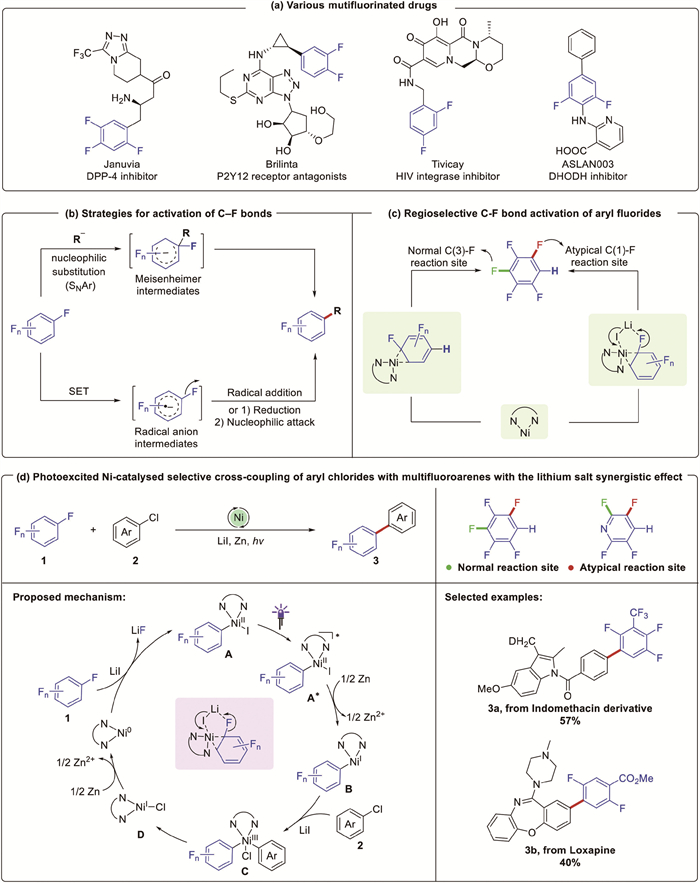
Fluorine-containing compounds, characterized by low polarity, weak intermolecular interactions, and smaller surface tension relative to hydrocarbons, are privileged molecules with broad applications across diverse fields, including medicinal chemistry, agrochemistry, and materials science [1]. Among them, polyfluoroarenes have attracted extensive attention from chemists (Fig. 1a) [2], as seven of them contain polyfluoroareness in Top 200 Pharmaceuticals by Retail Sales. Given the prevalence of polyfluoroareness, numerous catalytic strategies have been developed for their synthesis through transition-metal catalysis, photocatalysis, or electrochemistry [3]. Although significant progress has been achieved in the synthesis of polyfluoroarenes, the direct transformation of kinetically and thermodynamically robust C–F bonds remains a formidable challenge in synthetic chemistry. Currently, nucleophilic aromatic substitution (SNAr) of polyfluoroarenes via Meisenheimer intermediates represents one of the most effective strategies for C–F bond activation and the synthesis of polyfluoroarenes (Fig. 1b). However, this process typically requires highly nucleophilic reagents such as organolithiums or Grignard reagents. The single-electron transfer (SET) process of polyfluoroarenes can also activate C–F bonds under visible-light photoredox catalysis (Fig. 1b) [4], typically employing iridium complexes as photocatalysts. In such an outer-sphere process, the reaction feasibility is limited by the reducing ability of the photocatalyst, while the regioselectivity is usually dictated by the inherent electronic properties of the substrate.
Figure 1
Figure 1.
(a) Various polyfluoroarenes drugs. (b) Strategies for activation of C–F bonds. (c) Regioselective C-F bond activation of aryl fluorides. (d) Photoexcited Ni-catalysed selective cross-coupling of aryl chlorides with polyfluoroarenes with the lithium salt synergistic effect.
In contrast to photoredox catalysis, transition-metal catalysis provides distinctive advantages in governing chemoselectivity and regioselectivity, owing to the cooperative effects of ligands and additives. Accordingly, transition-metal-catalyzed approaches have emerged as powerful means to activate C–F bonds in polyfluoroarenes and to achieve their selective conversion. The selective activation of specific carbon–fluorine (C–F) bonds in polyfluoroarene compounds has garnered significant attention within the field. Predominantly, existing methodologies have relied on the use of directing groups to achieve such transformations. However, these approaches are often hindered by challenges including the necessity for subsequent removal of functional groups and limitations regarding substrate scope. Consequently, there remains an urgent need to develop broadly applicable and selective approaches for the activation of polyfluoroaromatic compounds.
In light of the synergistic effects observed between lithium salts and nickel catalysts, Xie’s atypical Ar–F bond activation strategy, revealed a cooperative interaction between lithium salts and nickel catalysts that promotes highly selective conversion of the C(1)–F bond in pentafluorobenzene [5], in contrast to the more commonly reactive C(3)–F site (Fig. 1c), under irradiation with 40 W purple LEDs.
The catalytic system employed comprises Ni(cod)2 and dtbbpy as the catalyst components, lithium iodide (LiI) as an additive, and zinc as a reductant, collectively facilitating cross-coupling between the aryl C–F bond and C(sp2)–Cl bond (Fig. 1d). This atypical Ar–F bond activation methodology exhibits a remarkably broad substrate scope and excellent functional group tolerance.
A series of control and nuclear magnetic resonance (NMR) experiments indicate that the addition of LiI to the reaction system significantly influences the reaction selectivity. Specifically, in the presence of LiI, the reaction rate is enhanced, and during the initial phase, oxidative addition of the C–F bond to the (dtbbpy)Ni0 species is favored over the oxidative addition of the C–Cl bond to either (dtbbpy)Ni0 or (dtbbpy)NiⅠ-I species. Concurrently, theoretical calculations suggest that the lithium salt interacts with both pentafluorobenzene and the nickel catalyst, effectively lowering the activation energy barrier and modulating regioselectivity. These findings underscore the pivotal role of LiI in facilitating atypical C–F bond activation. Kinetic studies reveal that the reduction of the nickel catalyst by zinc powder would be the turnover-limiting step of the reaction.
Drawing upon mechanistic insights and prior literature, a plausible reaction pathway is proposed for the cross-coupling of atypical Ar–F bonds and aryl chlorides mediated by photoexcited nickel catalysis. The pathway initiates with an oxidative addition step between (dtbbpy)Ni0 and ArFn+1, yielding the (dtbbpy)NiⅡ(ArFn)Ⅰ species through synergistic activation involving ArFn+1, nickel catalyst, and LiI. Upon light irradiation, the photoexcited Ni complex is generated from the (dtbbpy)NiⅡ(ArFn)Ⅰ intermediate. Subsequently, a SET process occurs between zinc powder and the photoexcited nickel complex (A*), producing the (dtbbpy)NiⅠ–(ArFn) intermediate (B), thereby circumventing disproportionation side reactions. Facilitated by LiI, the corresponding diarylnickel(Ⅲ) intermediate (C) forms with a reduced energy barrier, further emphasizing the critical function of LiI. Reductive elimination of this diarylnickel(Ⅲ) intermediate then affords the C–F/C–Cl cross-coupling product and generates a nickel(Ⅰ) chloride species. Finally, reduction of the nickel(Ⅰ) chloride species by zinc powder completes the catalytic cycle of the nickel catalyst.
In summary, Xie and co-workers reported an elegant photoexcited nickel-catalyzed strategy for atypical C–F bond activation, achieving efficient and selective arylation of polyfluoroarenes with aryl chlorides. The transformation displays broad substrate compatibility and high functional-group tolerance. Experimental and theoretical studies underscore the synergistic role of LiI in facilitating atypical C–F bond activation, as the cooperative interaction of LiI, pentafluorobenzene, and the nickel catalyst significantly reduces the activation barrier and dictates regioselectivity. We believe these findings are anticipated to provide novel perspectives and foundational design principles that will advance the development of Ar–F bond activation chemistry.
Declaration of competing interest
The authors declare that they have no known competing financial interests or personal relationships that could have appeared to influence the work reported in this paper.
Figure 1
(a) Various polyfluoroarenes drugs. (b) Strategies for activation of C–F bonds. (c) Regioselective C-F bond activation of aryl fluorides. (d) Photoexcited Ni-catalysed selective cross-coupling of aryl chlorides with polyfluoroarenes with the lithium salt synergistic effect.


 DownLoad:

 下载:
下载:


 下载:
下载:

