Department of Chemistry and Life Science, Gansu Normal University for Nationalities, Hezuo 747000, China
b.
Key Laboratory of Eco-functional Polymer Materials of Ministry of Education; Key Laboratory of Eco-environmental Polymer Materials of Gansu Province; College of Chemistry and Chemical Engineering, Northwest Normal University, Lanzhou 730070, China
Received Date:
29 September 2025 Accepted Date:
08 December 2025 Revised Date:
29 November 2025 Available Online:
15 July 2026
Abstract:
Macrocyclic compounds play a fundamental role in supramolecular chemistry, demonstrating significant prospect in functional materials owing to their precise cavities and tunable molecular recognition and assembly capabilities. However, the only cavity of the mono-macrocyclic hosts limited the development of traditional mono-macrocycle-based supramolecular materials in assembly dimensionality, recognition selectivity, and synergistic performance. Therefore, multi-macrocyclic hosts attracted increasing attention due to their unique advantages originated from multi-cavity cooperativity, which include more abundant guest suitability, multiple-dimension assembly, precise collaborative effect, and so on. Based on these merits, introducing multi-macrocyclic hosts into supramolecular materials can efficiently improve and enrich the properties of these kinds of materials. This review summarizes recent innovative design and constructing strategies for multi-macrocyclic hosts, including covalent chain bridged, covalent fused, coordinated, and mechanically interlocked pathway. And their applications in recognition, luminescence, catalysis, biomedical and chiral materials are highlighted, while the advantages of multi-macrocycles in enhancing binding affinity, selectivity, and stimulus-responsive behavior are elucidated. Furthermore, we discuss future directions, such as novel multifunctional hosts design, optimization of assembly strategies, and interdisciplinary applications, providing theoretical insights and practical guidance for the development of multi-macrocycles-based high performance supramolecular materials.
Macrocyclic compounds are quintessential supramolecular hosts, playing a pivotal role in supramolecular chemistry [1–15]. To date, numerous macrocyclic families have been developed, with crown ethers [16,17], cyclodextrins [18–20], cucurbiturils [21,22], calixarenes [23,24], and pillararene [25–29] serving as representative examples. These architectures exhibit distinctive host-guest recognition and supramolecular assembly properties based on their tunable binding capabilities which stems from their curved, twisted or rigid cyclic cavities. Such structural features facilitate selective molecular recognition through mechanisms of size complementarity, geometric constraints, and electronic interactions [30–40]. Therefore, these compounds show nice application prospect in various fields [41–49].
Conventional mono-macrocyclic molecules have demonstrated various advantages in molecular recognition and self-assembly, however, the mono-macrocyclic structure limit their functional diversity and restrict their applications in complex systems [50–56]. Specifically, during self-assembly processes, mono-macrocyclic molecules only can supply one cavity, which limit the assembly dimensionality for constructing sophisticated supramolecular architectures [57,58]. When interacting with guest molecules, the lack of multi-site synergistic effects often results in insufficient binding strength and selectivity to meet the requirements of high-precision recognition [59]. Furthermore, in response to external stimuli such as light, heat, or pH changes, mono-macrocyclic molecules generally suffer from poor tunability induced low responsiveness [60].
In order to overcome the limitations of mono-macrocyclic molecules, researchers have proposed construction strategies for multi-macrocyclic hosts in recent years [61–63]. These molecular systems, formed by linking multiple macrocyclic units via covalent or non-covalent interactions, are assuming an increasingly prominent role in supramolecular chemistry [64–82]. Compared to mono-macrocyclic systems, these architectures exhibit unique structural features that enable multi-cycle-synergy-based distinctive recognition, multi-dimensionality assembly behaviors, leading to widespread applications in molecular recognition [83–87], supramolecular self-assembly [88,89], and advanced materials [90–95].
This review systematically summarizes the latest research advancements in bi-macrocyclic, tri-macrocyclic, and multi-macrocyclic hosts over the past decade. It elaborates on their innovative design and construction strategies based on distinct connection methods including covalent chain bridged, covalent fused, coordinated, and mechanically interlocked pathway. Further presents the most recent research progress on the applications of these systems in fields such as sensing and recognition, luminescent materials, supramolecular catalysis, biomedical and chiral materials. Furthermore, the work provides an outlook on future development of multi-macrocyclic supramolecular systems.
2.
Strategies on construction multi-macrocyclic hosts
Multi-macrocyclic supramolecular functional materials, as hierarchically ordered architectures assembled through noncovalent or dynamic covalent interactions, exhibit structural and functional properties critically governed by their interconnection modes [96]. These materials are currently classified into four primary paradigms: covalent chain-bridged multi-macrocycles [97], covalent fused multi-macrocycles [98], coordinated multi-macrocycles [99], and mechanically interlocked macrocycle [100], each imparting distinct synergistic effects that enable precise modulation of assembly morphology, stimuli-responsive behavior, and functional performance. Systematic exploration and optimization of these topological strategies not only establish fundamental design principles but also advance the development of high-performance smart materials with transformative applications in biomedicine, energy storage, and adaptive devices [101–105].
2.1
Covalent chain bridged multi-macrocycles
Covalent chain-bridged macrocyclic compounds are multi-macrocyclic systems formed by connecting a mono-macrocyclic molecule through flexible or rigid connecting groups such as alkyl chains, aryl groups, polyether, demonstrating significant potential in the fields of molecular recognition, catalysis, biomedicine and material science. Its core advantage is that by designing the chemical composition and spatial configuration of the connecting group, the microenvironment of the macrocyclic cavity (such as size, electronic effect and steric hindrance) can be accurately regulated. More importantly, intermolecular or intramolecular adjacent multi-macrocycles can supply synergistic effect through collaboration of them, which enhance the guest binding ability of the host and provide a unique platform for the construction of smart molecular devices and the development of high-performance materials [106].
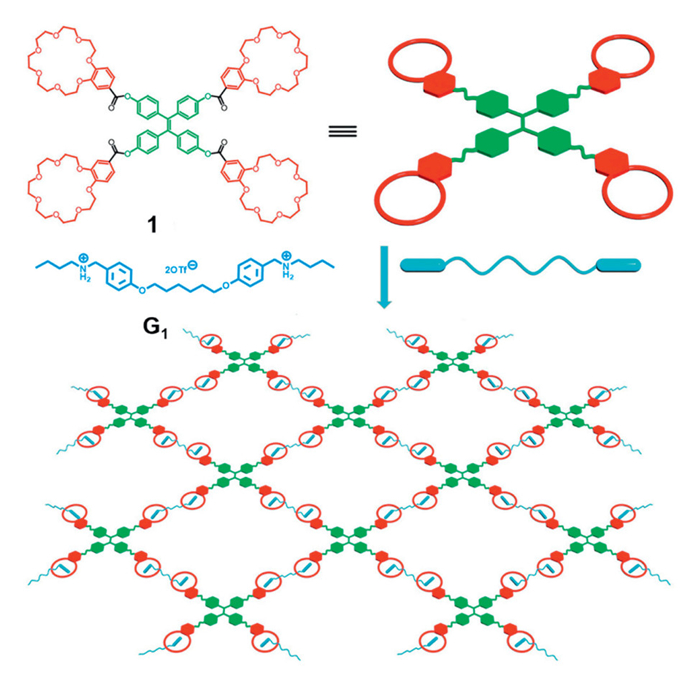
In 2018, Stang research team designed and synthesized a tetra-crown ether macrocyclic compound 1 based on a tetra-phenylethylene (TPE) rigid linker (Fig. 1) [107]. This study employed a metal coordination-driven self-assembly strategy to first construct a square prism-shaped metallacage structure functionalized with four 21-crown-7 moieties. Subsequently, through host-guest interactions between the 21C7 groups and a diammonium salt linker G1, a three-dimensional (3D) supramolecular polymer network was successfully fabricated, which could form a stable supramolecular gel system at high concentrations. Notably, owing to the incorporation of the TPE fluorophore, the resulting gel exhibited remarkable fluorescence emission properties. This work not only expanded the functionalization of fluorescent metallacage through sophisticated ligand design but also provided a methodology for preparing stimuli-responsive and self-healing supramolecular gels.
Figure 1
Figure 1.
Molecular structure (left) and cartoon representation (right) of the TPE-bridged tetra-crown ether macrocyclic compound 1. and achematic illustration of the two-dimensional supramolecular grid structure formed through orthogonal self-assembly between 1 and G1. Copied with permission [107]. Copyright 2018, American Chemical Society.
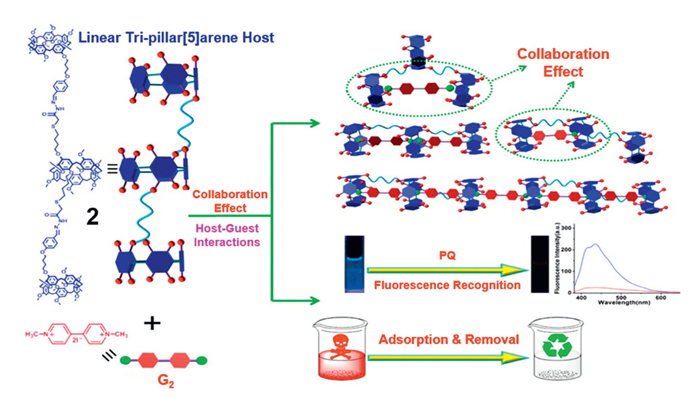
In 2021, our group introduced the concept of "synergistic effects" into the design of pillar[5]arene-based materials [108]. We designed and synthesized a novel linear-bridged tri-pillar[5]arene receptor 2 (Fig. 2), in which tri-pillar[5]arene units were rationally interconnected within a single receptor molecule. As anticipated, the linear pillar[5]arene 2 not only exhibited fluorescence responsiveness but also demonstrated high-efficiency separation and adsorption capabilities toward methyl viologen (G2). Compared with conventional adsorbents such as activated carbon and mono-pillar[5]arene receptors, compound 2 showed superior adsorption performance for methyl viologen (G2), which was attributed to the synergistic interactions between its adjacent pillar[5]arene moieties. The 2 could serve as a paraquat adsorbent material and convey greatly potential application in the field of removal of paraquat. The concept "employ collaboration effect to enhance the host-guest interactions" is a useful way for the development of adsorption materials.
Figure 2
Figure 2.
Schematic illustration of the fluorescence sensing and adsorption mechanism of bridged tri-pillar[5]arene 2 toward paraquat. Copied with permission [108]. Copyright 2021, Elsevier.
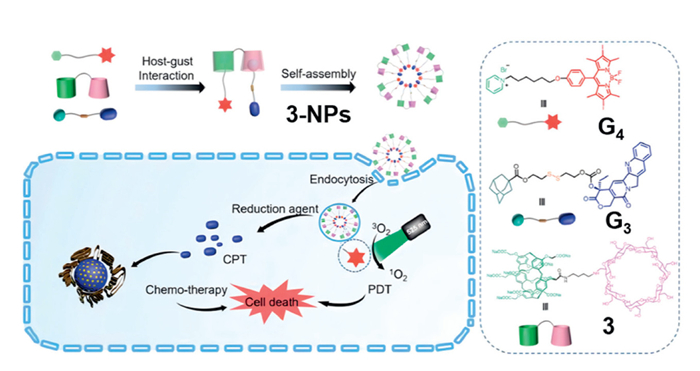
In 2023, Chen and co-workers synthesized a novel bi-macrocyclic molecule 3 by covalently linking two distinct macrocyclic hosts, water-soluble pillar[5]arene and β-cyclodextrin, via a flexible spacer (Fig. 3) [109]. Through orthogonal host-guest recognition and co-assembly, 3 specifically interacted with a photosensitizer (G3) and a camptothecin prodrug (G4) to form supramolecular nanoparticles (NPs) 3-NPs. Notably, the ratio of G3 to G4 in 3-NPs could be precisely tuned as needed. Owing to the host-guest interactions and stable self-assembly, 3-NPs exhibited exceptional colloidal stability and resistance to photobleaching. Under reducing conditions, camptothecin could be released for chemotherapy, while efficient singlet oxygen generation upon light irradiation enabled photodynamic therapy. This bi-macrocycles-based host-guest assembly strategy provides a new approach for constructing combined chemo-photodynamic therapeutic systems or even dual-drug combination therapies.
Figure 3
Figure 3.
Chemical structures of the bi-macrocyclic molecule 3 and guest molecules G3/G4, and schematic illustration of supramolecular nanoparticle assembly for photodynamic therapy. Copied with permission [109]. Copyright 2023, Elsevier.
Covalent fused multi-macrocyclic compounds are covalently linked multi-macrocyclic systems formed by macrocycle-to-macrocycle condensation. Its core advantage is that by regulating the interaction between macrocycle, it can break through the limitations of traditional mono-macrocyclic performance and provide a characteristic platform for the design of intelligent molecular devices [110].
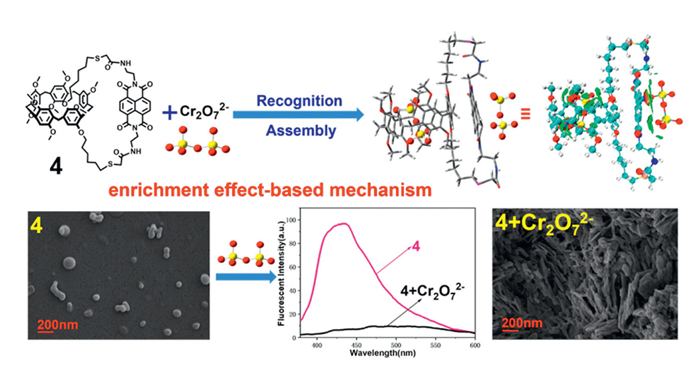
Later in 2024, our group designed and synthesized a novel fused bi-macrocyclic hosts molecule 4 (Fig. 4) based on pillar[5]arene [111]. In 4, the electron-rich cavity of pillar[5]arene is designed to complex cationic species accompanying dichromate anions (Cr2O72−), while the methoxy groups on the pillar[5]arene provide multiple hydrogen-bonding sites for Cr2O72− binding. Furthermore, a naphthalenediimide (NDI) unit and one phenyl group of the pillar[5]arene are bridged by an alkyl chain to form a side loop, which offers additional supramolecular interaction sites for enhanced Cr2O72− binding. Based on the individual double macrocyclic hosts 4, multiple Cr2O72− anions can be bound. The work provided an easy way to improving the sensitivity and selectivity of chemosensor by inducing enrichment effect.
Figure 4
Figure 4.
Schematic illustration of the highly selective and sensitive recognition of Cr2O72− by fused bi-macrocyclic hosts 4. Copied with permission [111]. Copyright 2024, Elsevier.
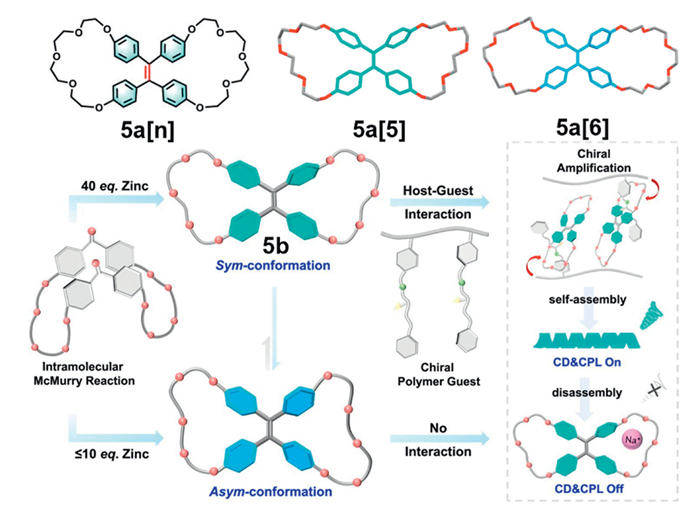
In 2024, Hu et al. reported an intramolecular coupling strategy to synthesize a series of TPE-based butterfly-shaped bi-crown ether macrocyclic (5a[n], n = 4–7), featuring two crown ether side loops and a central TPE core [112]. The variable-length flexible crown ether chains modulate molecular conformations through multiple intramolecular interactions, yielding two distinct semi-rigid stereostructures with specific symmetry/asymmetry (Fig. 5). These conformational isomers exhibit divergent fluorescence properties and host-guest binding capabilities. Significantly, only 5b functions as a chiral polymeric hosts, inducing the formation of chiral supramolecular assemblies through host-guest interactions with L- and D-type amino acid derivatives. Furthermore, both the circular dichroism (CD) and circularly polarized luminescence (CPL) signals of these chiral assemblies can be effectively "switched off" by Na+ addition. The work not only provides fundamental insights into structure-property relationships but also offers practical guidance for developing advanced materials with tailored optical and chiral recognition functionalities.
Figure 5
Figure 5.
Molecular structure of fused bi-macrocyclic hosts 5a and schematic illustration of guest-induced chiral supramolecular assembly formation through host-guest interactions. Copied with permission [112]. Copyright 2024, Nature Publishing Group.
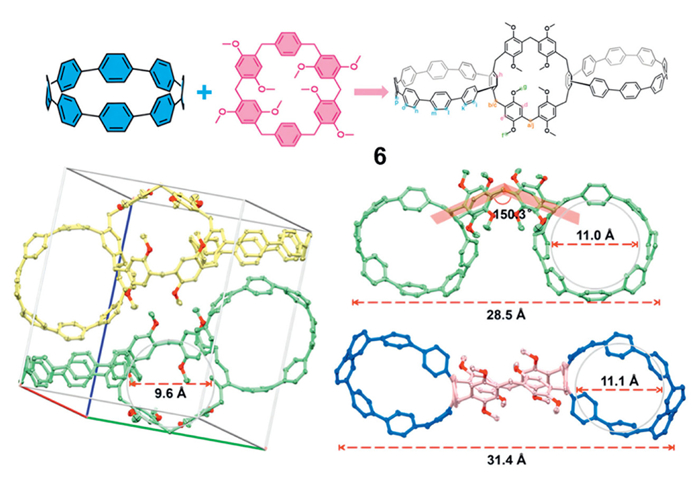
Very recently, Cheng's team reported a rigid fused tri-macrocyclic hosts molecule 6, consisting of two [8]cycloparaphenylene ([8]CPP) units and one pillar[6]arene unit (Fig. 6) [113]. This novel macrocyclic architecture enabled the isolation of both enantiomers and a meso–compound, providing a rare example of stereoisomerism in fused multi-macrocyclic systems. Through comprehensive structural characterization and photophysical studies, the researchers elucidated the distinct solid-state packing modes of these isomers, which significantly influenced their chiroptical properties. This work not only advances the synthetic strategies for multicyclic chiral macrocycle but also deepens the understanding of how molecular topology influences stereochemistry and functional properties in the solid state.
Figure 6
Figure 6.
Molecular and crystal structures of rigid fused tri-macrocyclic hosts molecule 6. Copied with permission [113]. Copyright 2025, American Chemical Society.
Metal-coordinated multi-macrocyclic compounds refer to supramolecular systems formed through the dynamic linkage of individual macrocycle via metal coordination [114]. In these architectures, metal ions or clusters serve as "nodes" that connect two or more macrocycle through coordinate bonds, generating well-defined two- or three-dimensional structures [115]. This linkage strategy offers dynamic reversibility and structural tunability, enabling system reconfiguration through modulation of metal species, ligand design, and external conditions [116].
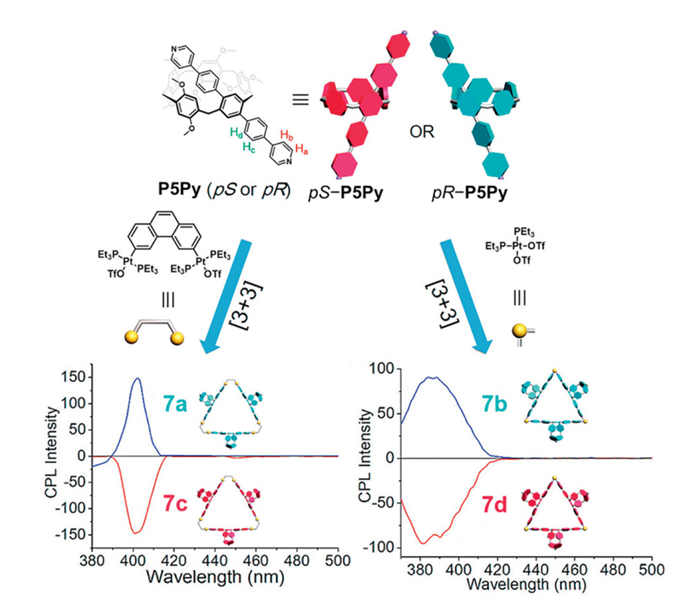
In 2020, Huang and co-workers synthesized four optically active metallacycles (7a–d, Fig. 7) with planar chirality by employing 60° and 90° Pt(Ⅱ) acceptors and planar chiral pillar[5]arene ligands [117]. These tetra-nuclear Pt-coordinated macrocycle exhibited distinct chiroptical properties: the pS enantiomers displayed negative Cotton effects, while the pR enantiomers showed positive Cotton effects in CD spectra. Notably, all metallacycles demonstrated CPL activity, suggesting their potential for optoelectronic applications. The work established a novel strategy for constructing planar chiral metal-organic macrocycle (MOCs), advancing the study of chiral supramolecular self-assembly and structure-property relationships.
Figure 7
Figure 7.
Synthetic route to planar chiral tetra-nuclear metallacycles 7a–7d and corresponding CPL spectra demonstrating chiroptical activity. Copied with permission [117]. Copyright 2020, American Chemical Society.
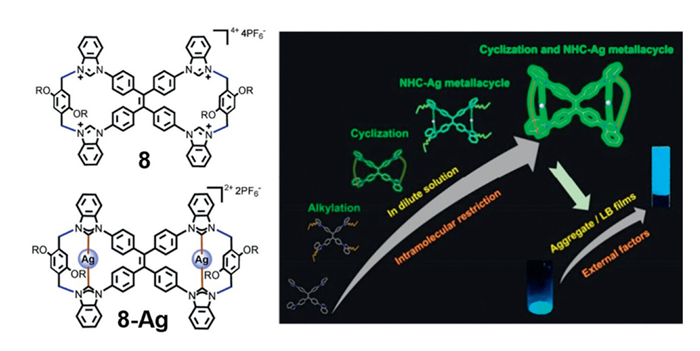
In 2024, the Qian team reported an amphiphilic TPE-based bi-macrocyclic hosts 8 featuring benzimidazolium salt moieties, along with its binuclear silver-coordinated counterpart 8-Ag (Fig. 8) [118]. Both macrocycle exhibited aggregation-induced emission (AIE) characteristics in solution, aggregated states, and thin films. The work not only provides a strategy for designing amphiphilic AIE-active macrocycle but also highlights the synergistic role of metal coordination and supramolecular assembly in modulating luminescence properties. The system holds promise for applications in stimuli-responsive smart materials and interfacial nanoscience.
Figure 8
Figure 8.
Molecular structures and photoluminescence enhancement mechanism of bi-macrocycles 8 and binuclear 8-Ag complex. Copied with permission [118]. Copyright 2024, American Chemical Society.
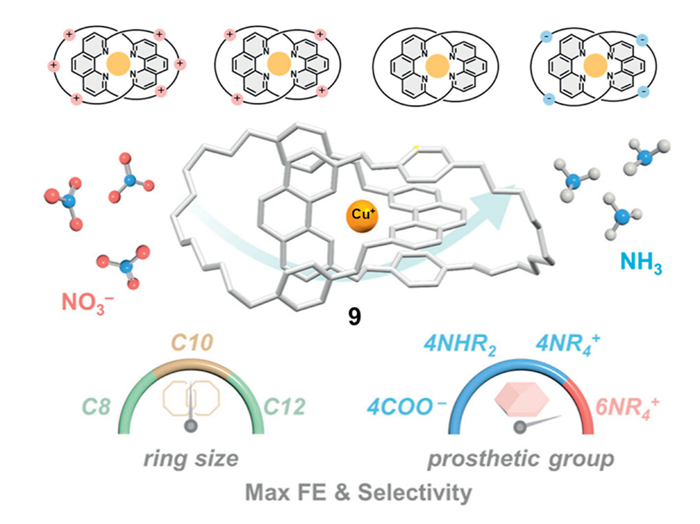
Very recently, Deng et al. developed a series of copper(Ⅰ)-based mononuclear metallacycles 9 featuring [2]catenane ligands through a combined strategy of mechanical interlocking and covalent modification (Fig. 9) [119]. These complexes demonstrated exceptional performance in the electrocatalytic nitrate reduction reaction (NO3RR), achieving highly selective ammonia (NH3) generation. This work successfully addressed the long-standing challenge of balancing activity, selectivity, and durability in non-precious metal catalysts, offering new perspectives for sustainable nitrogen cycling.
Figure 9
Figure 9.
Molecular structure of [2]catenane-ligated Cu(Ⅰ) mononuclear bi-macrocycles 9. Copied with permission [119]. Copyright 2025, American Chemical Society.
Mechanically interlocked macrocyclic compounds refer to supramolecular architectures formed through the dynamic intertwining or threading of individual macrocycle via non-covalent interactions (rotaxanes, catenanes [120–122]. Their defining characteristic is the absence of covalent bonds between constituent macrocycle, with stability achieved instead through physical interlocking or mechanical bonding [123].
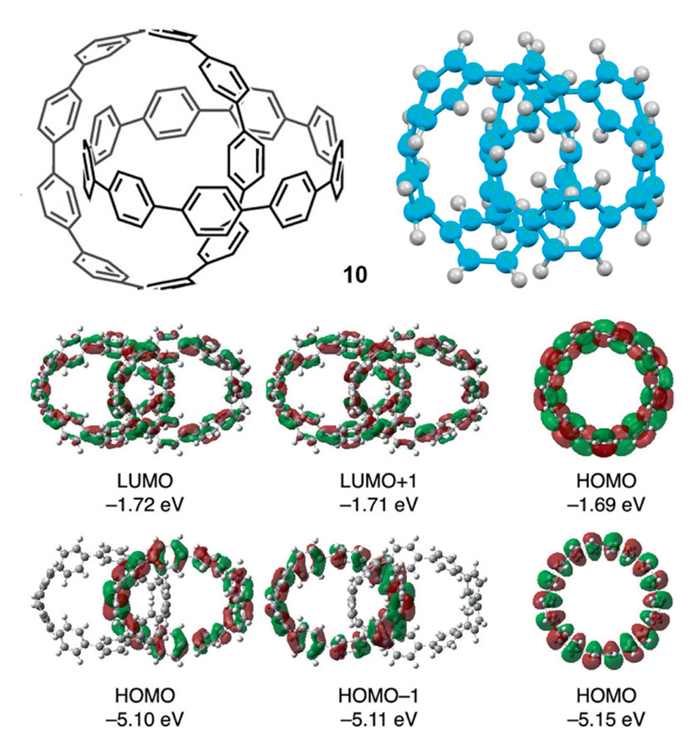
In 2024, Kenichiro Itami and co-workers reported the synthesis of a [9]cycloparaphenylene ([9]CPP)-based bi-macrocycles [2]catenane 10 (Fig. 10) [124]. Single-crystal X-ray diffraction analysis unambiguously confirmed its interlocked architecture. While the UV–vis absorption spectrum showed remarkable similarity to the monomeric precursor, the fluorescence emission exhibited a 10 nm bathochromic shift accompanied by a decrease in quantum yield from 0.73 to 0.54 and a reduced lifetime of 11.3 ns. The observed photophysical modifications suggest substantial inter-macrocycle electronic communication in the excited state, providing new insights into through-space conjugated systems. This advancement opens new avenues for designing functional materials with tailored optoelectronic properties.
Figure 10
Figure 10.
Structure, crystallographic data, and frontier orbital analysis of [9]CPP-based [2]catenane 10. Copied with permission [124]. Copyright 2024, American Chemical Society.
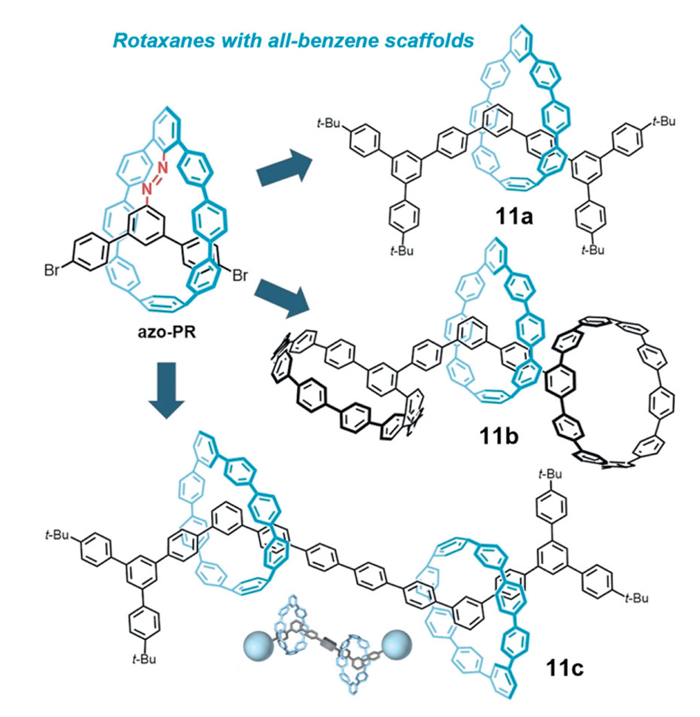
In 2024, Cong and co-workers designed and synthesized a separable azo-linked pseudorotaxane azo-PR, and used azo-PR as the core template to construct the all-benzene skeleton [2]- and [3]rotaxane 11a–c (Fig. 11), which not only enriched the supramolecular topology of the all-benzene interlocking structure, but also demonstrated the practicability of the azo-traceless template in the construction of mechanical bonds [125]. The synthesis of all-phenylene rotaxane and its related controllable motion properties are expected to provide new ideas for the design and synthesis of molecular switches and nanomachines in the future.
Figure 11
Figure 11.
The structures of pseudorotaxane azo-PR, all-benzene skeleton [2]- and [3]rotaxane 11a–c. Copied with permission [125]. Copyright 2024, WILEY-VCH.
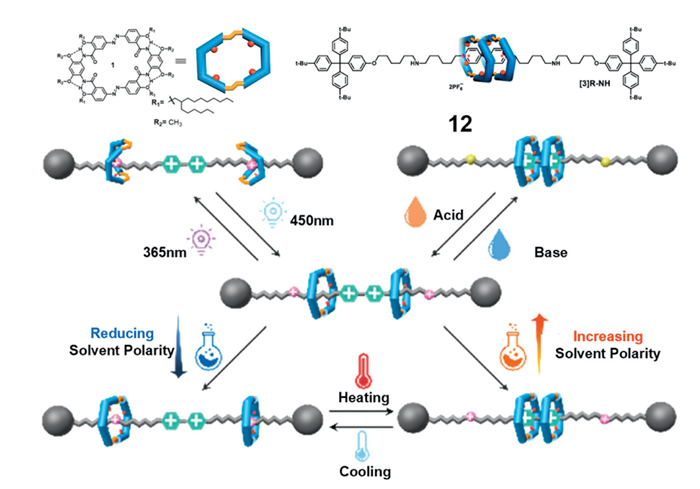
Very recently, Yuan's team reported a multi-stimuli-responsive [3]rotaxane compound 12 based on hydrogen-bonded aromatic amide azo macrocycle (Fig. 12) [126]. The molecule realizes the dynamic shuttle of macrocyclic components under acid-base, temperature, solvent polarity and light conditions through the double recognition sites of secondary ammonium cation and 4,4′-bipyridinium. This system pioneered the application of hydrogen-bonded aromatic amide macrocycle in higher-order rotaxanes and realized the precise regulation of mechanical interlocking molecular motion through multi-mode stimulation response mechanism, providing new ideas for the development of intelligent molecular devices and adaptive materials.
Figure 12
Figure 12.
The structure of [3]rotaxane compound 12 and the schematic diagram of multiple stimulus response. Copied with permission [126]. Copyright 2025, Elsevier.
3.
Application of multi-macrocyclic supramolecular functional materials
3.1
Recognition materials
The development of supramolecular chemistry promotes the study of functional molecules. As special molecular structures, macrocyclic compounds have attracted much attention due to their specific size and shape of cavities and host-guest recognition characteristics. Its cavity can interact with guest molecules to realize the detection of target molecules. Under the demand for high sensitivity and high selectivity sensors in the sensing field, the characteristics of multi-macrocyclic compounds provide the possibility to meet this demand [127].
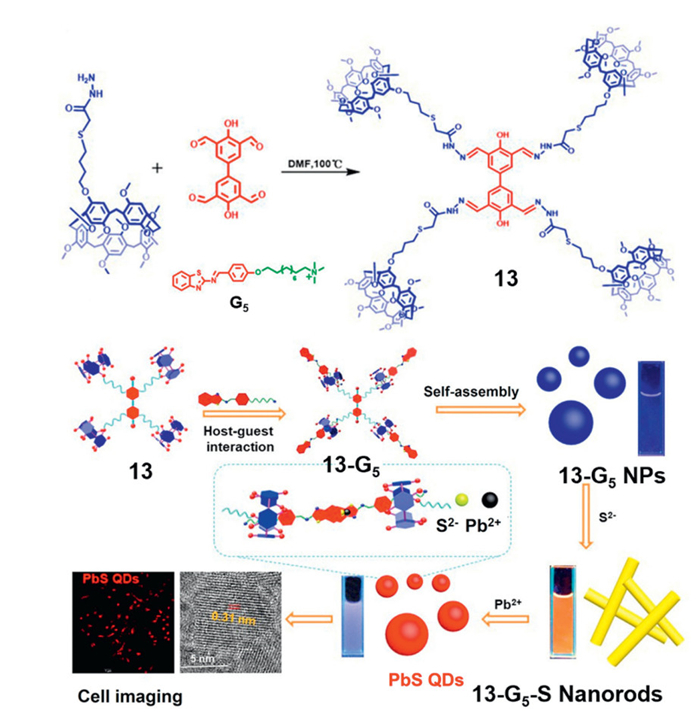
In 2022, our group synthesized a novel tetra-pillar[5]arene macrocyclic compound 13. Using an amphiphilic molecule G5 as the guest, host-guest interactions between 13 and G enabled their assembly into NPs 13-G5 in a DMSO/H2O mixed solution (Fig. 13) [128]. Subsequently, upon adding S2− to the 13-G5 supramolecular system, the NPs transformed into nanorods. Further introduction of Pb2+ into the system led to the in-situ formation of PbS quantum dots. After quantum dot formation, both fluorescence intensity and quantum yield significantly improved. This method of fluorescence enhancement via in situ generated PbS quantum dots enables the detection of Pb2+ in aqueous solutions and cells, with a detection limit of 4.52 × 10⁻⁷ mol/L. Therefore, this work provides an easy method for the construction of fluorescent nanomaterials based on a supramolecular system and a new approach for the in situ recognition of ions in cells by the in situ formation of nanomaterials such as QDs.
Figure 13
Figure 13.
Synthetic route of the tetra-pillar[5]arene macrocyclic compound 13 and schematic illustration of 13 and G5 self-assembling to form 13-G5 NPs; subsequent addition of S2− driven crosslinking to form 13-G5-S Nanorods; further introduction of Pb2+ leads to in situ generation of PbS quantum dots and their application in cellular imaging. Copied with permission [128]. Copyright 2022, American Chemical Society.
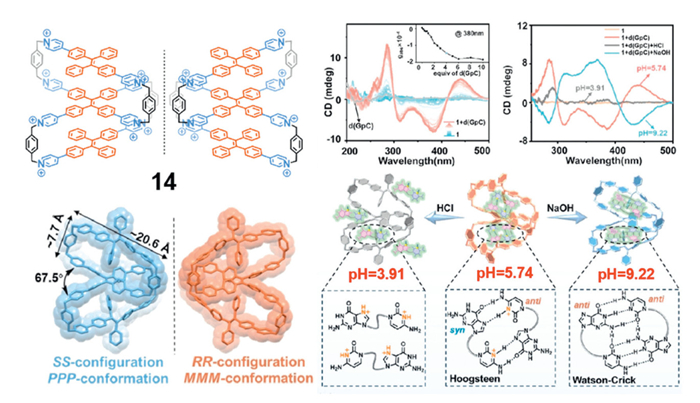
In early 2024, Cao et al. synthesized a 3D bi-macrocyclic compound 14 (Fig. 14) featuring dual hydrophobic cavities [129]. This architecturally unique host forms an exceptional 1:4 host-guest complex with d(GpC) dinucleotides through multivalent interactions. Therefore, this work not only shows a new artificial host system to capture biomimetic hydrogen-bonded G·C·G·C quadruplex for understanding the complex assembled substructure of DNA or RNA, but also offers a novel chiroptical sensor for monitoring and detecting different hydrogen-bonded nucleotide assemblies based on their different conformation chirality.
Figure 14
Figure 14.
Molecular architecture of bi-macrocycles 14 and its recognition mechanism for d(GpC) dinucleotides. Copied with permission [129]. Copyright 2024, WILEY-VCH.
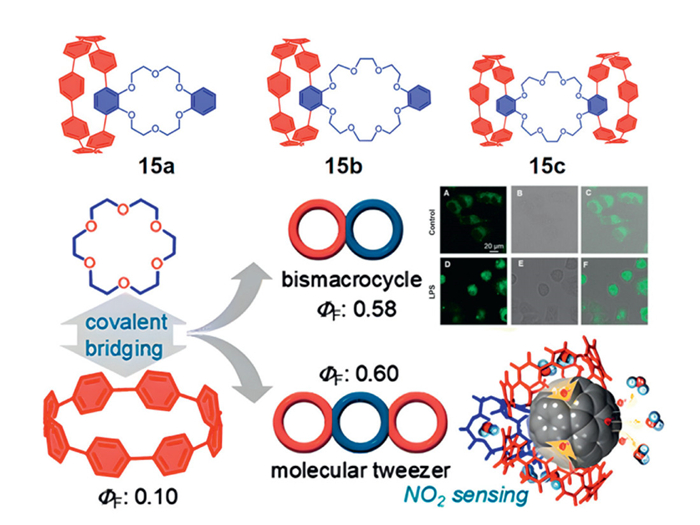
Very recently, Xu and co-workers successfully synthesized a series of crown ether-cycloparaphenylene bi-macrocyclic and tri-macrocyclic hybrid molecules 15a-c (Fig. 15) via Suzuki-Miyaura cross-coupling reactions [130]. These molecules not only exhibit excellent photophysical properties but also demonstrate diverse host-guest interaction characteristics. The study revealed that the tri-macrocyclic hybrid molecules can form unique molecular tweezer-like structures, showing significantly enhanced binding affinity for fullerenes. The resulting complexes exhibit both high sensitivity and good cycling stability in NO₂ detection. Meanwhile, the bi-macrocyclic hybrid molecules display dual functionality: demonstrating significant cytotoxicity against cancer cell lines at low concentrations while also being capable of detecting inflammatory responses through fluorescence signals, highlighting their potential in biosensing applications. These important findings fully demonstrate the multifunctional nature of crown ether-cycloparaphenylene hybrid multi-macrocyclic molecules in supramolecular sensing and biomedical research, providing new research directions for environmental monitoring and disease diagnosis.
Figure 15
Figure 15.
Synthesis and multifunctional applications of crown ether-cycloparaphenylene hybrid multi-macrocyclic molecules 15a-c in supramolecular sensing and biomedicine. Copied with permission [130]. Copyright 2025, Royal Society of Chemistry.
With the advancement of science and technology, the demand for luminescent materials continues to grow across various fields, including displays, lighting, and bioimaging. Traditional materials, limited by their luminescent efficiency, stability, and color tunability, struggle to meet these diverse requirements [131,132]. Multi-macrocyclic compounds have emerged as a focal point in the development of novel luminescent materials due to their unique structural and electronic properties [133]. The progress in supramolecular chemistry has provided both theoretical and technical support for their design and synthesis, enabling the precise modulation of structures to achieve desired luminescent performance [134].
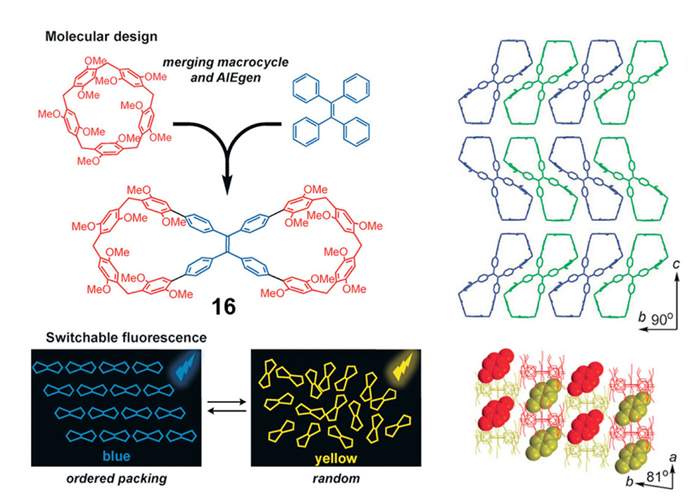
Later in 2019, Cong and co-workers reported a new type of fluorescent bi-macrocycles 16 (bowtie aromatics) based on pillar[5]arene (Fig. 16) [135]. It is worth noting that this molecular design will utilize the AIE properties of the TPE core and the supramolecular properties of the double electron-rich cavity. In addition, this new macrocycle also exhibits multi-stimuli-responsive convertible fluorescence from blue to yellow, which is closely related to the accumulation of molecules in the macrocycle. The work provides important design concepts and inspiration for the development of novel intelligent fluorescent materials, molecular sensors, and information encryption materials.
Figure 16
Figure 16.
Molecule single crystal structure, and fluorescence variation of the bow-tie aromatic hydrocarbon 16. Copied with permission [135]. Copyright 2019, WILEY-VCH.
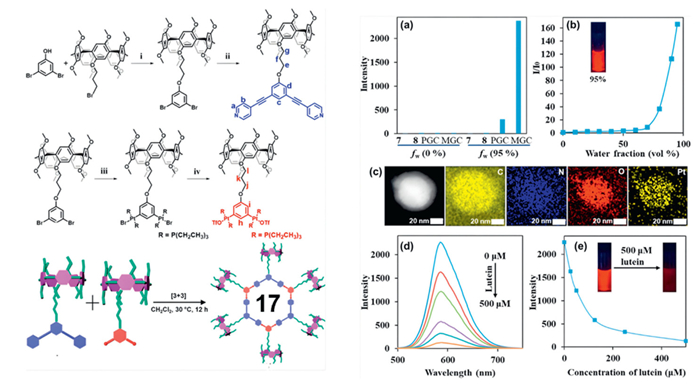
In 2020, the Stang team prepared a hexagonal Pt(Ⅱ) metal multi-macrocycles 17 decorated with six-pillar[5]arene (Fig. 17) to provide a platform [136]. The AIE effect is used to confirm this trend. As mentioned above, it was found that the metal macrocyclic promoted the aggregation of the guest in the acetone/water mixture through the host-guest interaction based on the metal macrocycle. As a result, 17 showed strong fluorescence emission in acetone/water solution (5:95), which was 166 times higher than that in acetone. It is expected that these findings will provide a basis for the design and synthesis of host-based metallacycles/metallacages and may enable the development of a range of new host-containing materials.
Figure 17
Figure 17.
The synthetic route of Pt(Ⅱ) metal multi-macrocycles 17 and its fluorescence spectra in the acetone/water mixed system. Copied with permission [136]. Copyright 2020, American Chemical Society.
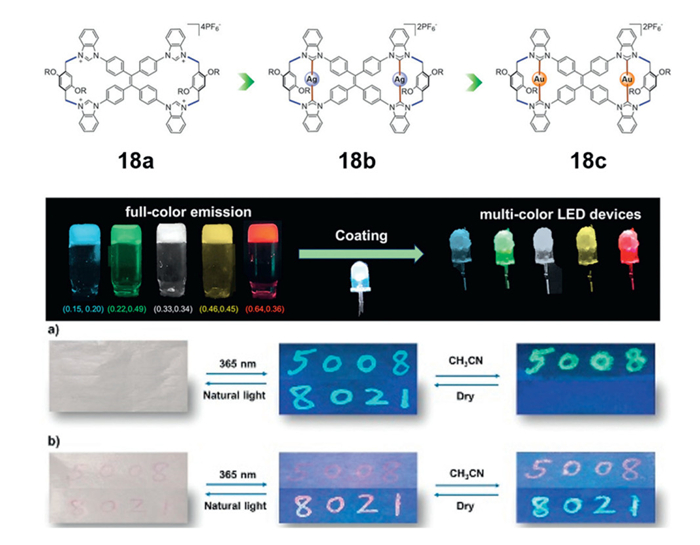
Later in 2024, Tu et al. reported two nitrogen-containing carbometallacycles 18a-M (M = Ag, Au), featuring TPE as the core (Fig. 18) [137]. This work utilized both covalent and coordination bonds to restrict rotation within the bi-metallacyclic, thereby enhancing their quantum yields. By adjusting the CH3CN/H2O solvent ratio, the luminescence of 18b could be tuned from blue to green. Further diversification of the emission spectrum, including high-quality white light (CIE coordinates 0.33, 0.34), was achieved through fluorescence resonance energy transfer (FRET). The compatibility of 18b with agarose gel enabled its application in information encryption and anti-counterfeiting. These results not only demonstrate the feasibility of achieving full-color emission using a dual-fluorophore system but also highlight its potential applications in information encryption, data storage, and anti-counterfeiting technologies.
Figure 18
Figure 18.
Bi-macrocyclic molecule 18a and bi-metallacycle 18b/18c: molecular structures, full-color emission, and information anti-counterfeiting applications. Copied with permission [137]. Copyright 2024, WILEY-VCH.
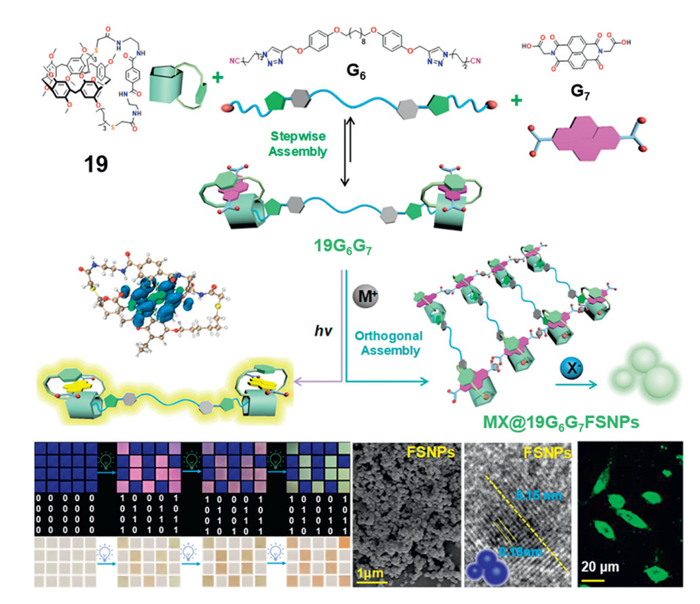
Very recently, our group designed and synthesized a novel fused bi-macrocyclic compound 19, and proposed a stepwise orthogonal assembly strategy based on this compound for constructing multifunctional supramolecular materials (Fig. 19) [138]. Compound 19 possesses two cavities with distinct sizes and electronic structures, enabling selective recognition of the cyanoalkyl chain-containing guest G6 and the naphthalene diimide (NDI)-functionalized guest G7, respectively, forming a stable 19G6G7 supramolecular system. This assembly significantly enhances the luminescent performance of the light-induced NDI radical through steric hindrance and encapsulation effects, increasing its quantum yield to three times that of G7 alone, and demonstrating excellent time-dependent fluorescence properties suitable for advanced information encryption. Furthermore, 19G6G7 can undergo further orthogonal assembly with metal ions such as Ag+, Pb2+, and Zn2+, as well as anions like I− and S2−, to construct a series of fluorescent supramolecular NPs (FSNPs). These NPs exhibit excellent biocompatibility and remarkable fluorescence properties, and have been successfully applied in cell imaging, demonstrating great potential in biomedical detection and imaging.
Figure 19
Figure 19.
Schematic illustration of the stepwise and orthogonal assembly between the fused bi-macrocyclic compound 19 and guest molecules G6 and G7 to construct multi-functional supramolecular NPs (FSNPs). Copied with permission [138]. Copyright 2025, Elsevier.
Macrocyclic supramolecular functional materials have emerged as "star materials" in the biomedical field due to their designable molecular recognition capabilities, dynamic self-assembly properties, and excellent biocompatibility. They demonstrate unique advantages in drug delivery, antibacterial/antiviral applications, biosensing, tissue engineering, and other areas, providing innovative solutions to overcome the limitations of traditional therapies [139–145].
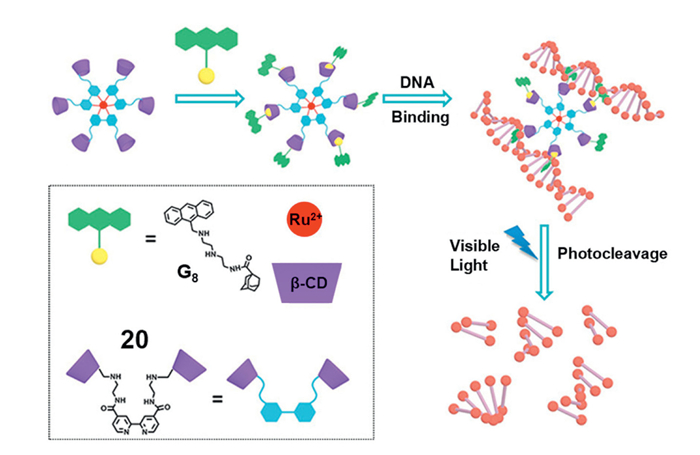
In 2018, Liu and co-workers successfully constructed a bi-(β-cyclodextrin)macrocyclic compound 20 (Fig. 20) using bipyridine as the bridging unit [146]. Studies revealed that this bi-cyclodextrin hosts molecule could form a 3:1 coordination complex with a Ru(Ⅱ) metal center. Furthermore, in an aqueous system, this complex efficiently assembled into a supramolecular architecture through host-guest interactions with an anthracene derivative functionalized by an adamantane group G8. Notably, this supramolecular system exhibited remarkable photo-responsive properties under visible light excitation: it could specifically accumulate in the nuclei of cancer cells and induce the highly efficient generation of reactive oxygen species (ROS), thereby demonstrating excellent antitumor activity. The work, based on the host-guest assembly strategy between a β-cyclodextrin-based bi-macrocyclic host and an anthracene-derived guest, provided an innovative approach for light-driven cancer therapy.
Figure 20
Figure 20.
Schematic illustration of a supramolecular polymer based on β-cyclodextrin bi-macrocycles 20 for light-driven cancer therapy. Copied with permission [146]. Copyright 2018, American Chemical Society.
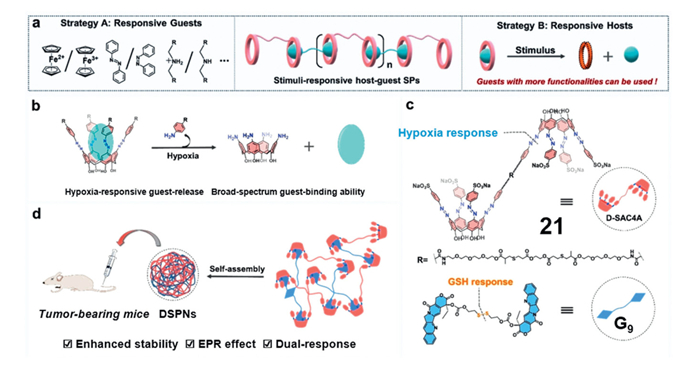
Later in 2022, Guo's team designed and synthesized a sulfonate-modified azocalix[4]arene dimer 21 (Fig. 21) [147]. The 21 can not only bind functional guest molecules for the preparation of host-responsive supramolecular polymers but also accommodate stimuli-responsive guests, thereby enabling the facile construction of multi-stimuli-responsive supramolecular polymers. As proof of concept, the team employed hypoxia-responsive 21 as the hosts molecule and a glutathione (GSH)-responsive camptothecin dimer (G9) linked by disulfide bonds as the guest molecule. When mixed at a 1:1 molar ratio in water, these components spontaneously assembled into a unique host-guest dual-responsive supramolecular polymer. The polymer chains further self-assembled into NPs (DSPNs), which were subsequently applied for tumor therapy. This work provides a general new method for the construction of 'host-responsive' supramolecular polymers, which can also be extended to other functional hosts.
Figure 21
Figure 21.
Chemical structure of bi-macrocycles 21 and schematic design of host-guest dual-stimuli-responsive supramolecular polymer. Copied with permission [147]. Copyright 2022, WILEY-VCH.
Multi-macrocyclic hosts molecular catalysts represent a class of structurally defined macrocyclic compounds that employ host-guest interactions, including hydrogen bonding, van der Waals forces, and π-π stacking, to selectively bind substrates or metal ions. This specific molecular recognition enables precise modulation of catalytic reactivity and selectivity, offering unique advantages in stereochemical control and reaction pathway regulation [148].
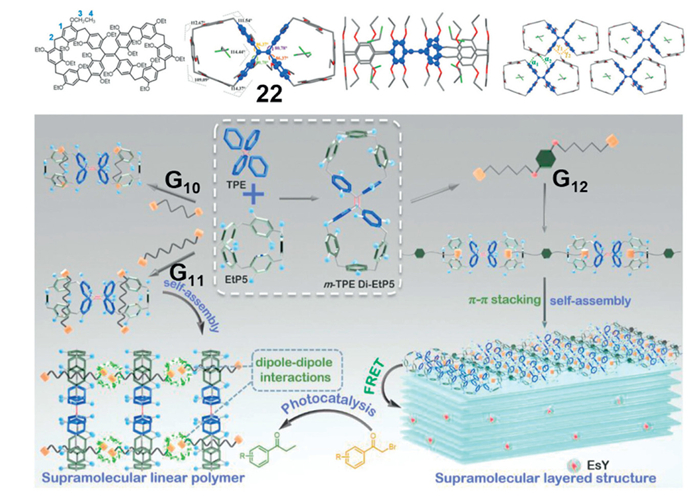
In early 2023, Hu et al. connected bi-pillar[5]arene by C—C double bond to obtain a bi-pillar[5]arene 22 containing a TPE unit (Fig. 22) [149]. Host-guest studies have shown that guest molecules, adiponitrile (G10) or sebaconitrile (G11), can enter the pillar[5]arene cavity pseudorotaxane structure with 22 in a ratio of 2:2, and 22 and G11 can form a linear supramolecular polymer. In addition, 22 forms a supramolecular layered polymer with a long chain dinitrile guest molecule containing a phenyl group (G12), and the polymer can be used as a photocatalyst to catalyze the dehalogenation reaction. The work successfully combines fluorescence properties with host-guest chemistry through ingenious molecular design and fine supramolecular regulation, and realizes multi-level functional integration from molecular recognition to material construction to photocatalytic application. It is an important milestone in the development of supramolecular chemistry to functionalization and systematization.
Figure 22
Figure 22.
The molecular and single crystal structures of bi-pillar[5]arene 22 and the schematic diagram of supramolecular polymers constructed with different guests. Copied with permission [149]. Copyright 2023, WILEY-VCH.
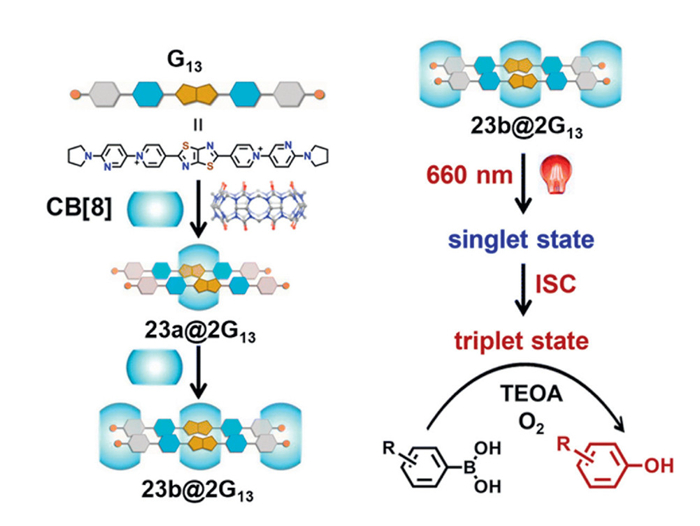
In 2024, Zhang and co-workers developed a red-light supramolecular photocatalytic system by preparing cucurbit[8]uril-mediated mono-macrocyclic 23a@2G13 and bi-macrocyclic complex 23b@2G13 (Fig. 23) [150]. The long-axis molecule 4,4′-(thiazole[5,4-d]thiazole-2,5-diyl)bi-(6(pyrrolidine-1-yl)-[1,3-bipyridyl]−1-ium)chloride (G13) can undergo two-step host-guest complexation with cucurbit[8]uril (CB[8]) to form two host-guest complexes 23a@2G13 and 23b@2G13 in turn. The formation of 23a@2G13 and 23b@2G13 leads to increasing intermolecular interaction between TPPs. Finally, 23b@2G13 exhibits strong red light absorption capacity and long-lived triplet state. In addition, the electron transfer and energy transfer between 23b@2G13 and oxygen are relatively smooth, so 23b@2G13 can be used as an efficient red-light catalyst for the oxidation of boric acid. In this work, the host-guest complexation was used to achieve precise regulation of intermolecular interactions, thereby creating a novel red-light responsive photocatalyst with a long-lived excited state.
Figure 23
Figure 23.
The two-step host-guest complexation reaction of G13 with CB[8] and the photocatalytic oxidation of boric acid under red light (660 nm) irradiation. Copied with permission [150]. Copyright 2024, Royal Society of Chemistry.
Multi-macrocyclic hosts molecular chiral materials represent a class of intelligent functional materials that integrate the cavity recognition advantages of macrocyclic structures with the selective properties of chiral characteristic molecules. The core design strategy thereof resides in modulating the intrinsic chirality, induced chirality, or supramolecular chirality of macrocycle, thereby achieving highly selective recognition of chiral enantiomers and function-oriented transformation [151–153].
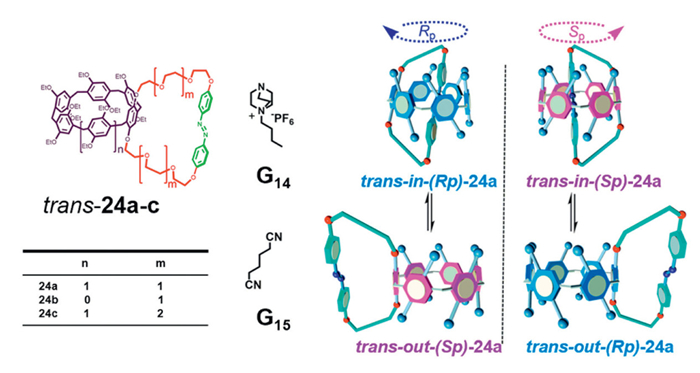
In 2021, Yang's group reported a case of temperature-overprotection functionalized molecular universal joint 24a–c based on pillar[n]arene (Fig. 24) [154]. The strategy involved integrating thermally responsive and photo-responsive functionalities into a pillar[n]arene-based bicyclic pseudorotaxane. The cis/trans photoisomerization of the azobenzene unit in 24a could induce an in/out conformational switching of the azobenzene-bearing side ring, resulting in the inversion of planar chirality in 24a. Simultaneously, temperature variations also triggered conformational chirality inversion due to significant entropy changes during the ring-flipping process. Consequently, when the temperature exceeded the upper threshold, the photo-induced switching could be inhibited, demonstrating an intelligent molecular photoswitch with temperature-overprotection functionality. This contrasts sharply with the commonly observed low-temperature gating effect. This study achieved the challenging high-temperature gating effect at the molecular level, marking a significant step toward constructing intelligent molecular devices capable of performing complex functions.
Figure 24
Figure 24.
Molecular structure of the pillar[n]arene-based bi-macrocyclic pseudorotaxane and schematic diagram of its chiral inversion. Copied with permission [154]. Copyright 2021, Springer Nature.
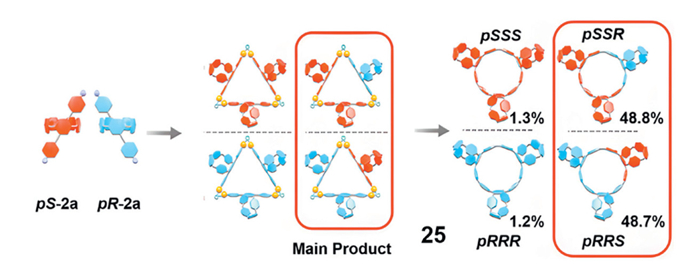
Very recently, Huang and co-workers propose an innovative social chirality self-sorting strategy to address stereoselectivity challenges in synthesizing multi-cavity pillararene macrocycle. Using triangular gold complexes, they achieve stereoselective synthesis of [9]cycloparaphenylene-pillar[5]arene trimers 25, overcoming traditional statistical mixtures via gold-bond reorganization and intermolecular forces (Fig. 25) [155]. The resulting materials exhibit excellent CPL properties and enable construction of supramolecular polymer networks with nanofiber morphology and high luminescence retention. This work not only solves a major problem in the synthesis of multi-macrocycles, but also provides new ideas and methods for the development of chiral functional materials.
Figure 25
Figure 25.
Schematic representation of the social chiral self-sorting synthesis of pSSR- and pRRS-25. Copied with permission [155]. Copyright 2025, WILEY-VCH.
Multi-macrocyclic hosts molecules have emerged as a versatile platform for constructing functional supramolecular systems benefited from their distinctive multi-cavity architectures, multiple recognition sites, and multi-dimensionality assembly properties. Recent advances in supramolecular materials based on these hosts have demonstrated significant breakthroughs across diverse domains, including molecular recognition, programmable self-assembly, chiral materials, stimuli-responsive systems, catalytic transformations, and biomedical applications, highlighting their considerable potential for addressing contemporary challenges in supramolecular and material chemistry. Despite these achievements, there are still many challenges in this field. (1) How to design multi-macrocyclic hosts compounds to precisely recognize sophisticated target guest. (2) How to accurately realize the multi-component collaborative assembly to construct high performance supramolecular materials. (3) How to realize specific applications based on these high-performance multi-macrocyclic supramolecular systems by targeting areas such as molecular recognition, functional optical materials, chiral and biomedical materials, thus harnessing their potential and generating tangible value. In summary, compared to mono-macrocyclic, multi-macrocyclic supramolecular materials offer us a diverse range of functional systems with satisfactory properties. It can be anticipated that multi-macrocyclic supramolecular materials hold unlimited promise in the near future. With the multi-macrocyclic systems, more unprecedented functionalities and applications will definitely emerge under the incessant effort contributed by researchers.
Declaration of competing interest
The authors declare that they have no known competing financial interests or personal relationships that could have appeared to influence the work reported in this paper.
This work was supported by the National Natural Science Foundation of China (Nos. 22471222, 22461040, 22165027), the Key R & D Program of Gansu Province (No. 21YF5GA066), the Top Leading Talents Project of Gansu Province, Gansu Province College Industry Support Plan Project (No. 2022CYZC-18), Northwest Normal University Postgraduate Research Funding Project (No. KYZZS2025157).
[1]
Y.J. Long, W.C. Guo, K.Z. Song, Y. Han, C.F. Chen, Org. Lett. 27 (2025) 11896–11900. doi: 10.1021/acs.orglett.5c03811
[2]
X. Ji, M. Ahmed, L. Long, et al., Chem. Soc. Rev. 48 (2019) 2682–2697. doi: 10.1039/c8cs00955d
S. Tan, Y. Han, G. Wang, et al., Angew. Chem. Int. Ed. 64 (2025) e202508361. doi: 10.1002/anie.202508361
Figure 1
Molecular structure (left) and cartoon representation (right) of the TPE-bridged tetra-crown ether macrocyclic compound 1. and achematic illustration of the two-dimensional supramolecular grid structure formed through orthogonal self-assembly between 1 and G1. Copied with permission [107]. Copyright 2018, American Chemical Society.
Figure 2
Schematic illustration of the fluorescence sensing and adsorption mechanism of bridged tri-pillar[5]arene 2 toward paraquat. Copied with permission [108]. Copyright 2021, Elsevier.
Figure 3
Chemical structures of the bi-macrocyclic molecule 3 and guest molecules G3/G4, and schematic illustration of supramolecular nanoparticle assembly for photodynamic therapy. Copied with permission [109]. Copyright 2023, Elsevier.
Figure 4
Schematic illustration of the highly selective and sensitive recognition of Cr2O72− by fused bi-macrocyclic hosts 4. Copied with permission [111]. Copyright 2024, Elsevier.
Figure 6
Molecular and crystal structures of rigid fused tri-macrocyclic hosts molecule 6. Copied with permission [113]. Copyright 2025, American Chemical Society.
Figure 8
Molecular structures and photoluminescence enhancement mechanism of bi-macrocycles 8 and binuclear 8-Ag complex. Copied with permission [118]. Copyright 2024, American Chemical Society.
Figure 9
Molecular structure of [2]catenane-ligated Cu(Ⅰ) mononuclear bi-macrocycles 9. Copied with permission [119]. Copyright 2025, American Chemical Society.
Figure 10
Structure, crystallographic data, and frontier orbital analysis of [9]CPP-based [2]catenane 10. Copied with permission [124]. Copyright 2024, American Chemical Society.
Figure 11
The structures of pseudorotaxane azo-PR, all-benzene skeleton [2]- and [3]rotaxane 11a–c. Copied with permission [125]. Copyright 2024, WILEY-VCH.
Figure 12
The structure of [3]rotaxane compound 12 and the schematic diagram of multiple stimulus response. Copied with permission [126]. Copyright 2025, Elsevier.
Figure 13
Synthetic route of the tetra-pillar[5]arene macrocyclic compound 13 and schematic illustration of 13 and G5 self-assembling to form 13-G5 NPs; subsequent addition of S2− driven crosslinking to form 13-G5-S Nanorods; further introduction of Pb2+ leads to in situ generation of PbS quantum dots and their application in cellular imaging. Copied with permission [128]. Copyright 2022, American Chemical Society.
Figure 14
Molecular architecture of bi-macrocycles 14 and its recognition mechanism for d(GpC) dinucleotides. Copied with permission [129]. Copyright 2024, WILEY-VCH.
Figure 15
Synthesis and multifunctional applications of crown ether-cycloparaphenylene hybrid multi-macrocyclic molecules 15a-c in supramolecular sensing and biomedicine. Copied with permission [130]. Copyright 2025, Royal Society of Chemistry.
Figure 16
Molecule single crystal structure, and fluorescence variation of the bow-tie aromatic hydrocarbon 16. Copied with permission [135]. Copyright 2019, WILEY-VCH.
Figure 17
The synthetic route of Pt(Ⅱ) metal multi-macrocycles 17 and its fluorescence spectra in the acetone/water mixed system. Copied with permission [136]. Copyright 2020, American Chemical Society.
Figure 19
Schematic illustration of the stepwise and orthogonal assembly between the fused bi-macrocyclic compound 19 and guest molecules G6 and G7 to construct multi-functional supramolecular NPs (FSNPs). Copied with permission [138]. Copyright 2025, Elsevier.
Figure 20
Schematic illustration of a supramolecular polymer based on β-cyclodextrin bi-macrocycles 20 for light-driven cancer therapy. Copied with permission [146]. Copyright 2018, American Chemical Society.
Figure 21
Chemical structure of bi-macrocycles 21 and schematic design of host-guest dual-stimuli-responsive supramolecular polymer. Copied with permission [147]. Copyright 2022, WILEY-VCH.
Figure 22
The molecular and single crystal structures of bi-pillar[5]arene 22 and the schematic diagram of supramolecular polymers constructed with different guests. Copied with permission [149]. Copyright 2023, WILEY-VCH.
Figure 23
The two-step host-guest complexation reaction of G13 with CB[8] and the photocatalytic oxidation of boric acid under red light (660 nm) irradiation. Copied with permission [150]. Copyright 2024, Royal Society of Chemistry.
Figure 24
Molecular structure of the pillar[n]arene-based bi-macrocyclic pseudorotaxane and schematic diagram of its chiral inversion. Copied with permission [154]. Copyright 2021, Springer Nature.
Figure 25
Schematic representation of the social chiral self-sorting synthesis of pSSR- and pRRS-25. Copied with permission [155]. Copyright 2025, WILEY-VCH.


 DownLoad:

 下载:
下载:


 下载:
下载:

