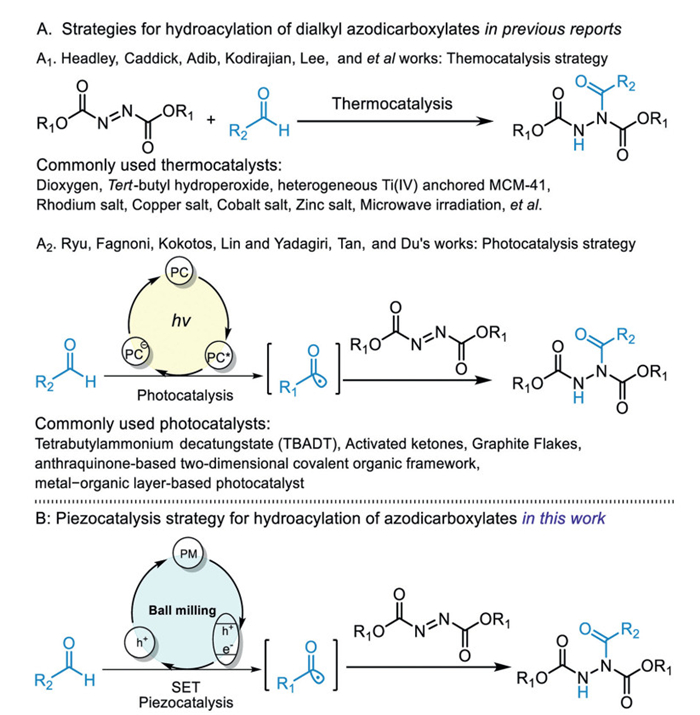
Figure 1.
A schematic illustration of strategies for the hydroacylation of azodicarboxylates. (A) Thermocatalytic and photocatalytic strategies in previous reports. (B) Piezocatalyst strategy used in this work.

Mechanoredox-mediated hydroacylation of dialkyl azodicarboxylates by piezoelectric catalysis
Binhong Jiang , Yongjin Zhang , Donghua He , Zhendong Feng , Hongxu Liu , Kun Zhang , Guohua Liu


The integration of mechanochemistry and piezocatalysis has emerged as a promising and environmentally friendly tool in synthetic chemistry, owing to its ability to generate electric fields under mechanical stress [1–7]. This unique capability enables piezoelectric materials to produce surface charges that drive redox reactions, offering distinct advantages in controlling product selectivity and enabling reaction pathways inaccessible through conventional methods. In recent years, numerous significant achievements have been documented in the literature involving a variety of piezocatalysts with enhanced reactivity [8–10]. A pioneering study reported by Ito and Kubota's team utilized BaTiO3 as a piezocatalyst to activate mechanoredox reactions through mechanical force. This approach efficiently facilitated the arylation and borylation of aryl diazonium salts, marking a significant advancement in synthetic chemistry [11]. Subsequently, the Yuan group applied BaTiO3 in piezocatalysis under ball-milling conditions for decarboxylative acylation reactions, enabling the C3-acylation of quinoxalin-2(1H)-one and paving the way for large-scale production processes [12]. More recently, Lian, Dai, and Cheng's team harnessed mechanical force to generate highly reductive species, successfully addressing challenging organic reactions for deuterium labeling of drug molecules and their derivatives [13]. Additionally, the Zheng group expanded the scope of piezocatalytic materials to metal-organic framework materials, which facilitated borylation and arylation reactions, thereby significantly broadening the applications of piezocatalysis [14]. Despite these remarkable achievements, many fundamental aspects remain incompletely understood, particularly the complex piezocatalytic mechanisms arising from the combination of mechanochemistry and piezocatalysis. Therefore, a deeper understanding of the catalytic processes is essential to provide theoretical guidance for piezocatalysis and propel further advancements in the field.
The hydroacylation of dialkyl azodicarboxylates is a representative reaction for synthesizing acyl hydrazides, with two common catalytic approaches: Thermal and photochemical catalysis [15–25], as shown in Fig. 1. Compared to traditional thermal catalysis (Fig. 1A1) [15–17], the photocatalytic approach typically involves a free radical process [15,18–25]. This process includes the generation of an acyl (or alkyl) radical by abstracting a hydrogen atom from an aldehyde or alkane through light-induced excitation. The resulting radical then adds to the N=N bond of dialkyl azodicarboxylates, forming a new C–N bond and yielding the acyl (or alkyl) hydrazide (Fig. 1A2). In earlier reports, Ryu and Fagnoni co-workers employed tetrabutylammonium decatungstate as a photocatalyst to achieve a photocatalytic hydroacylation reaction [18]. Subsequently, the Kokotos group utilized metal-free phenylglyoxylic acid as a photocatalyst, enabling the efficient synthesis of acyl (alkyl) hydrazides [19]. Later, they further introduced graphite flakes as a catalyst and PhCOCOOH as a photoinitiator to unveil a light-induced single electron transfer mechanism [20–22]. Interestingly, they also found that using water as a solvent significantly accelerated the hydroacylation of dialkyl azodicarboxylates with only light irradiation, applied to the efficient synthesis of vorinostat and moclobemide [23]. Most recently, the Lin group used 4-acyl-1,4-dihydropyridines (acyl-DHPs) to achieve a visible light-mediated, photocatalyst-free hydroacylation reaction without external catalysts or additives [24], while the Yadagiri group employed acyl silanes in reactions with azodicarboxylates, expanding the carbonyl sources and broadening the substrate scope [25]. Despite these significant advances, developing efficient new synthetic strategies and methods remains a potential and challenging unmet need.
Inspired by the partial similarity between the energy band theory of piezocatalysis and photocatalysis [26], we hypothesize that integrating mechanochemistry with piezocatalysis can help explain the working principle of the piezocatalytic hydroacylation reaction of dialkyl azodicarboxylates. More importantly, this approach enables the development of a green and highly efficient method for the synthesis of acyl (alkyl) hydrazides. As illustrated in Fig. 1B, this mechanochemical-photocatalytic strategy significantly enhances the catalytic efficiency of the hydroacylation reaction, offering a superior alternative to traditional photocatalytic synthesis.
To validate the feasibility of the piezoelectric materials-mediated hydroacylation of dialkyl azodicarboxylates, the reaction of diisopropyl (E)-diazene-1,2-dicarboxylate (1a) and benzaldehyde (2a) was chosen as a model, in which commercially available BaTiO3 particles (particle size: 0.6-1 µm, piezoelectric tetragonal) were used as the piezoelectric materials according to the reported method (Table 1) [12]. During this evaluation, the model reaction was performed with a planetary ball mill equipped with 25 mL jars and 25 stainless steel grinding balls (Ø 9 mm) at 25 ℃ (Table S1 in Supporting information).

 DownLoad:
CSV
DownLoad:
CSV
 |
||
| Entry | Piezoelectric material/additive/conditions | Yield of 3a (%)b |
| 1 | BaTiO3/- -/O2 | 14 |
| 2 | BaTiO3/- -/Ar | N.R. |
| 3 | - -/- -/O2 | N.R. |
| 4 | - -/(NH4)2S2O8/Ar | Trace |
| 5 | - -/(NH4)2S2O8/O2 | 29 |
| 6 | BaTiO3/(NH4)2S2O8/O2 | 95 |
| 7 | BaTiO3/(NH4)2S2O8/Ar | 46 |
| 8 | BaTiO3/(NH4)2S2O8/air | 93 |
| 9 | BaTiO3/Na2S2O8/air | 37 |
| 10 | BaTiO3/K2S2O8/air | Trace |
| 11 | BaTiO3/TBHP/air | 41 |
| 12 | BaTiO3/H2O2/air | Trace |
| 13 | BaTiO3 (0.2 µm)/(NH4)2S2O8/air | 89 |
| 14 | BaTiO3 (1-3 µm)/(NH4)2S2O8/air | 85 |
| 15 | Li2TiO3/(NH4)2S2O8/air | 63 |
| 16 | BaSO4/(NH4)2S2O8/air | 26 |
| 17 | TiO2/(NH4)2S2O8/air | 16 |
| 18 | NaCl/(NH4)2S2O8/air | 13 |
| a Reaction conditions: 1a (0.5 mmol, 1 equiv.), 2a (0.75 mmol, 1.5 equiv.), (NH 4) 2S 2O 8 (0.5 mmol, 1 equiv.), piezocatalyst (2.5 mmol, 5 equiv., 0.6-1.0 µm), air or O 2 or Ar atmosphere, 450 rpm at 25 ℃ for 1 h. b Isolated yields. N.R. = No reaction occurred. | ||
Initially, we observed that the reaction did not occur under an argon atmosphere and blank reaction, whereas it achieved a yield of 14% under an oxygen atmosphere (entry 1 versus entries 2 and 3). This comparison indicated that the piezoelectric material BaTiO3, under an oxygen atmosphere, was capable of activating molecular oxygen and facilitating electron transfer processes to initiate the reaction, albeit with a very low yield. Interestingly, compared to the trace amount of product obtained using (NH4)2S2O8 as an oxidant under an argon atmosphere in the absence of a BaTiO3 system, the comparative control experiment revealed that the reaction could also proceed under an oxygen atmosphere, resulting in a reaction yield of 29% (entry 4 versus entry 5). This finding indicated that, even under conventional ball-milling conditions, the reaction could be initiated using (NH4)2S2O8 as the oxidant with the assistance of molecular oxygen. These observations suggested that there were collaborative contributions of oxygen and ammonium persulfate. In particular, when the piezoelectric material BaTiO3 was introduced into the reaction system under the same conditions, the efficiency of the hydroacylation could be significantly improved from 29% to 95% yield (entry 6 versus entries 4 and 5). Furthermore, it was found that this outcome nearly doubled the yield observed in an argon environment (entry 6 versus entry 7). These comparisons clarified that BaTiO3, (NH4)2S2O8, and molecular oxygen were important reaction parameters, whose collaborative contributions significantly promoted the reaction, thereby demonstrating the advantage of piezocatalysis under ball-milling conditions (entry 6 versus entries 1, 4, 5, and 7). To our delight, the reaction conducted under an air atmosphere remained largely unaffected, still affording the target product 3a in up to 93% yield (entry 8 versus entry 6), which was identified as the optimal condition for the piezocatalytic reaction under the ball-milling conditions (entry 8). Noteworthy was the markedly accelerated model reaction, as the hydroacylation under ball-milling conditions reached completion within 1 h, in sharp contrast to 48 h under the conventional batch process [16]. The turnover frequency (TOF) of piezoelectric BaTiO3-mediated hydroacylation under ball-milling conditions reached 0.186 h⁻1, still exceeding the previously reported value (0.102 h⁻1) for the copper-catalyzed hydroacylation of 1a with 2a.
Subsequently, a comparison of several additives was conducted. It was found that when its analogs (sodium persulfate and potassium persulfate), or the corresponding oxidants (tert-butyl hydroperoxide (TBHP), or hydrogen peroxide) were used as additives, the reaction yield significantly decreased, thereby reinforcing that (NH4)2S2O8 was the optimal additive (entry 8 versus entries 9-12). Finally, several commercially available BaTiO3 nanoparticles with different particle sizes were further optimized, revealing that BaTiO3 with a particle size of 0.6-1 µm was the most effective (entry 8 versus entries 13 and 14). Additionally, it was determined that BaTiO3 was the superior piezoelectric material, which clearly outperforms other types of additives or piezoelectric materials (entry 8 versus entries 15-18).
To gain further insight into the reaction mechanism, a series of control experiments were conducted in the piezoelectric materials-mediated hydroacylation reaction of dialkyl azodicarboxylates under the ball-milling conditions, as outlined in Scheme 1. Initially, when TEMPO (2,2,6,6-tetramethyl-1-piperidinyloxy) or DMPO (5,5-dimethyl-1-pyridine-N-oxide) was introduced into the reaction system as a free radical trapping agent, the model reaction was significantly suppressed, yielding only trace amounts of the desired product, thereby confirming a radical process (Scheme 1A). Fortunately, although DMPO failed to capture the anticipated radical adduct, a 2g-TEMPO adduct was successfully detected through high-resolution mass spectrometry (HRMS) and confirmed by 1H NMR spectroscopy, with a yield of 36% (Experimental section and Fig. S1 in Supporting information). This result provided evidence for the involvement of an α-carbonyl radical in the reaction mechanism [22,27]. Next, comparative investigations were performed between the standard ball-milling reaction (Scheme 1B1) and two control experiments (Schemes 1B2 and 1B3). Compared to the only 26% yield of the reaction in the absence of (NH4)2S2O8 system (Scheme 1B2), the reaction of 1a and 2g under standard ball-milling conditions in the presence of (NH4)2S2O8 resulted in 91% yield of 3g (Scheme 1B1). This comparison suggested that the highly oxidizing sulfate radical (SO4•−), generated via the homolytic O-O bond cleavage of S2O82−, was the primary contributor in a single-electron transfer (SET) process responsible for the formation of the α-carbonyl radicals [28–32]. Furthermore, compared to the absence of product observed under an argon atmosphere without the assistance of molecular oxygen (Scheme 1B3), a 26% yield was obtained under ambient air conditions (Scheme 1B2), suggesting that the superoxide radical (O2•−) generated from molecular oxygen in the air also contributed to radical formation [33–40]. Fortunately, compared to the 26% yield observed under ambient air conditions (Scheme 1B2), when known superoxide radical scavengers, such as p-benzoquinone and ascorbic acid, were introduced into the reaction system, the reaction was completely inhibited, thereby confirming the involvement of the superoxide radicals (Scheme 1C) [41–43]. All these observations demonstrated that the collaborative contribution of (NH4)2S2O8 and air (O2) significantly enhanced the piezoelectric performance of BaTiO3 in mechanoredox catalysis, leading to the highly efficient synthesis of acyl (alkyl) hydrazides.
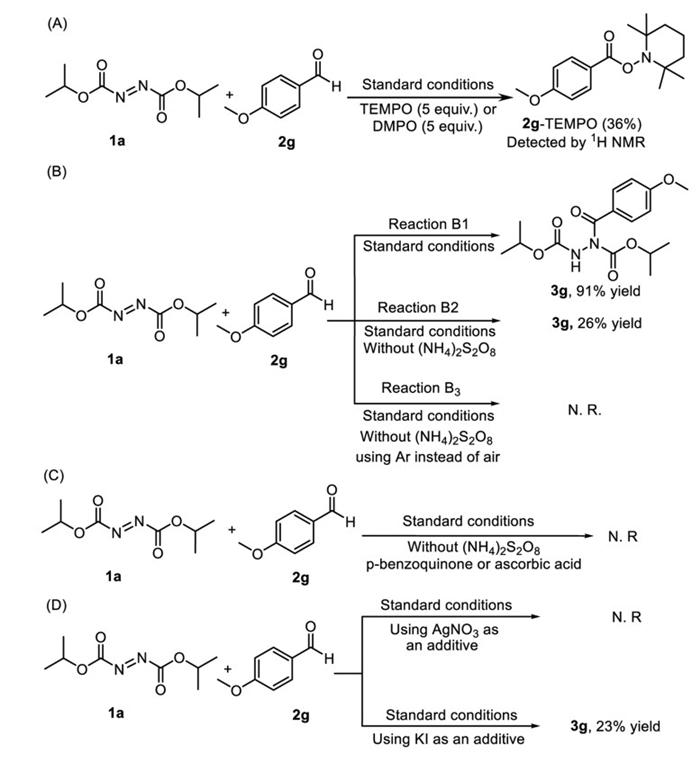
Finally, to elucidate the roles of piezoelectric materials in producing surface charges that drive redox reactions during the ball-milling process, the control experiments with electron scavenger AgNO3 and hole scavenger KI were investigated. It was observed that the addition of electron scavenger AgNO3 completely inhibited the model reaction, while the introduction of the hole scavenger KI reduced the reaction yield to 23% (Scheme 1D) [44]. The former observation indicated that the electron transfer induced by BaTiO3 polarization was suppressed, halting the reaction, while the latter suggested that the reaction cycle could be interrupted, leading to a significantly reduced yield. These findings confirm that the polarization of BaTiO3 under milling conditions, driven by mechanical force, plays a critical role in the reaction process.
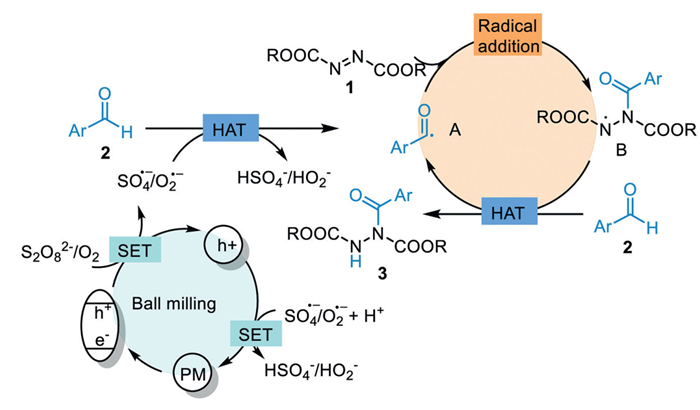
Based on the above investigations, a plausible reaction pathway was proposed, as depicted in Fig. 2. Initially, under ball-milling conditions, BaTiO3 undergoes polarization and directly reduces persulfate ions (S2O82−) and/or oxygen (from air) via a single electron transfer (SET) reaction, generating the corresponding sulfate radicals (SO4•−) and/or superoxide radicals (O2•−), as confirmed by the above control reactions [45,46]. Subsequently, the combined action of sulfate radicals (SO4•−) and/or superoxide radicals (O2•−) abstracts a hydrogen atom from 2 through a hydrogen atom transfer (HAT) pathway, generating bisulfate anion (HSO4−), hydroperoxide anion (HO2−), and the corresponding benzoyl radical (A). The radical trapping experiments verified the presence of this benzoyl radical (Scheme 1A). Next, the benzoyl radical (A) adds to substrate 1 to generate a nitrogen-centered radical intermediate (B), which subsequently abstracts a hydrogen atom from 2 via a HAT pathway, furnishing the desired product 3. Finally, the positively charged hole in excited BaTiO3 undergoes another SET step by accepting an electron to regenerate the neutral BaTiO3, thereby completing the entire catalytic cycle of piezocatalysis and radical addition.
Having established an efficient mechanoredox process, the reactions with a series of aryl- or alkyl-substituted aldehydes and dialkyl azodicarboxylates were further investigated to assess their general feasibility, as shown in Scheme 2. It was discovered that all the examined dialkyl azodicarboxylates consistently reacted with aromatic aldehydes under the optimal ball-milling conditions, yielding their respective products (3a-3z') with moderate to high isolated yields. These yields were superior to those obtained under conventional solvent-based conditions due to the significantly shortened reaction time (Fig. S2 in Supporting information). In the series of aromatic aldehydes, it was found that the position of the substituent on the aromatic ring had a notable impact on their catalytic performance. It was found that, unlike conventional solvent-based reactions, the electronic influence of substituents on the aromatic ring under piezoelectric ball-milling conditions did not follow a clear and consistent trend. For para-substituted substrates, the reactivity pattern remained largely consistent with that observed in solution, in which aromatic aldehydes bearing electron-donating groups afforded relatively higher yields than those with electron-withdrawing groups (e.g., 3c, 3d, 3f, and 3g versus 3i, 3l, 3m, 3o, and 3p). In contrast, for ortho- and meta-substituted aromatic aldehydes, the electronic nature of the substituents did not display an obvious correlation with reaction outcomes. It was observed that the steric properties of the substituents were found to significantly influence the reactivity. Specifically, aromatic aldehydes with ortho-substituents (e.g., 3b and 3q) showed markedly reduced catalytic performance compared to those with para-substituents or even meta-substituted analogs.
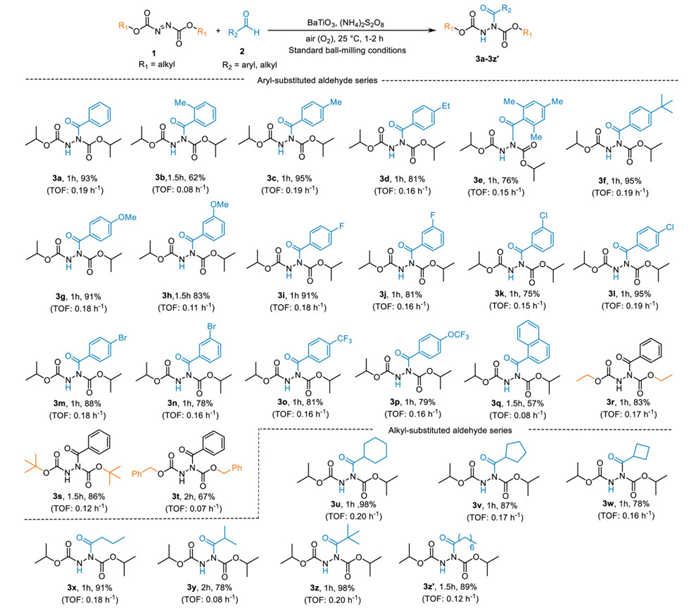
In addition to the general tolerance of aromatic aldehydes, this piezocatalytic hydroacylation reaction also proved to be compatible with the alkyl-substituted aldehydes. Several representative aldehydes were successfully engaged in reactions with 1a, leading to the formation of the desirable corresponding products (3u–3z'). Generally, it was found that aliphatic aldehydes afforded relatively higher yields compared to their aromatic counterparts (e.g., 3u, 3x, and 3z versus 3a, 3b, 3d, 3e, 3h, 3i, 3k, and 3j-3q), however, this trend became more intricate because of the catalytic nature of mechanical force under ball-milling conditions. Due to the intrinsic stability of free radicals, the reaction yield of cycloalkyl-substituted aliphatic aldehydes decreases as the ring size decreases from six-membered to four-membered (3u–3w). Similarly, for alkyl-substituted aliphatic aldehydes directly connected to alkanes, tert-butyl-substituted aldehydes achieved a yield of 98%, significantly outperforming other types of aliphatic aldehydes (3x–3z').
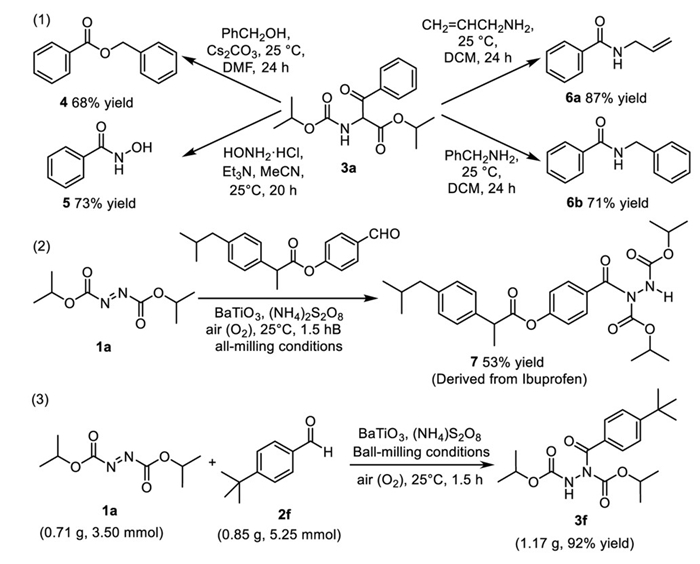
To demonstrate the synthetic utility of this transformation, four representative nucleophilic additions of the product 3a were performed. It was found that these nucleophilic substitutions of the product enabled the facile synthesis of ester 4 (68% yield), hydroxylamine 5 (73% yield), and amide derivative 6a-6b (87% and 71% yield) [21,25]. Moreover, the BaTiO3-mediated hydroacylation could also be directly applied to the late-stage derivatization of a bioactive ibuprofen-derived aromatic aldehyde, wherein the reaction of 1a and this aldehyde afforded the corresponding product 7 in 53% yield, as shown in equations 1-2 of Scheme 3 (Fig. S3 in Supporting information) [25]. Additionally, a gram-scale mechanochemical synthesis was performed to demonstrate its potential applications. To ensure complete substrate contact and thorough grinding of the piezoelectric material, five additional steel balls were added under standard conditions to enhance the reaction efficiency. It was found that the reaction of 3.50 mmol (0.71 g) of 1a and 5.25 mmol (0.85 g) of 2f produced 3f in 92% isolated yield (1.17 g) with a maintainable isolated yield (Scheme 3, Eq. 3) (see Experimental in Supporting information). Interestingly, BaTiO3 could be readily recovered and reused. In five consecutive recycling runs, BaTiO3 consistently delivered the corresponding product in 87% yield in the fifth cycle, thereby demonstrating the stability under ball-milling conditions confirmed by XRD analysis (Table S2 and Fig. S4 in Supporting information).
In conclusion, a green and efficient ball-milling method for the piezocatalytic hydroacylation of aldehydes and dialkyl azodicarboxylates using BaTiO3 as a piezoelectric material and ammonium persulfate as an oxidant under an air atmosphere is developed. The method demonstrated high catalytic efficiency, affording the desired products in high yields under ambient temperature conditions. This approach not only eliminates the need for solvents but also significantly enhances both the reaction rate and yield compared to traditional methods. Mechanistic investigations reveal that the piezoelectric effect of BaTiO3, along with the collaborative contributions of molecular oxygen and ammonium persulfate, plays a crucial role in driving the reaction forward. Further insights into the piezocatalytic conversion process also demonstrate that the benzoyl radicals, generated via polarization of BaTiO3 under mechanical activation, undergo radical addition to dialkyl azodicarboxylates, leading to the formation of acyl hydrazides. This efficient and sustainable strategy provides valuable insights for theoretical guidance in designing piezocatalysis for future research. This strategy also opens up new possibilities for sustainable and large-scale applications in the preparation of valuable acyl hydrazides and other nitrogen-containing intermediates for future applications.
Binhong Jiang: Writing – review & editing, Writing – original draft, Validation, Software, Formal analysis, Data curation, Conceptualization. Yongjin Zhang: Validation, Investigation, Formal analysis, Data curation. Donghua He: Investigation, Formal analysis, Data curation. Zhendong Feng: Formal analysis, Data curation. Hongxu Liu: Validation. Kun Zhang: Writing – original draft, Supervision, Conceptualization. Guohua Liu: Writing – review & editing, Writing – original draft, Supervision, Conceptualization.
We declare that we have no known competing financial interests or personal relationships that could have appeared to influence the work reported in this paper.
Supplementary material associated with this article can be found, in the online version, at doi:
H. Sudrajat, H. Hsu, F. Jérôme, J. Colmenares, ChemCatChem 17 (2025) e202401814. doi: 10.1002/cctc.202401814
R. Liu, X. He, T. Liu, et al., Chem. Eur. J. 30 (2024) e202401376. doi: 10.1002/chem.202401376
A. Stolle, T. Szuppa, S. Leonhardt, B. Ondruschka, Chem. Soc. Rev. 40 (2011) 2317–2329. doi: 10.1039/c0cs00195c
T. Jiang, Y. Wang, C. Cai, et al., Environ. Sci. Ecotechnol. 23 (2025) 100495. doi: 10.1016/j.ese.2024.100495
S. Jiang, M. Wang, Curr. Org. Chem. 28 (2024) 905–913. doi: 10.2174/0113852728306541240409034052
G. Wang, Chem. Soc. Rev. 42 (2013) 7668–7700. doi: 10.1039/c3cs35526h
T. Friščić, C. Mottillo, H. Titi, Angew. Chem. Int. Ed. 59 (2020) 1018–1029. doi: 10.1002/anie.201906755
M. Wang, B. Wang, F. Huang, Z. Lin, Angew. Chem. Int. Ed. 58 (2019) 7526–7536. doi: 10.1002/anie.201811709
C. Jin, D. Liu, L. Zhang, Small 19 (2023) 2303586. doi: 10.1002/smll.202303586
L. Zhou, L. Meng, H. Jia, et al., Adv. Sustainable Syst. 8 (2024) 2300652. doi: 10.1002/adsu.202300652
K. Kubota, Y. Pang, A. Miura, H. Ito, Science 366 (2019) 1500–1504. doi: 10.1126/science.aay8224
Y. He, G. Wang, W. Hu, et al., ACS Sustainable Chem. Eng. 11 (2023) 910–920. doi: 10.1021/acssuschemeng.2c04720
R. Qu, S. Wan, X. Zhang, et al., Angew. Chem. Int. Ed. 63 (2024) e202400645. doi: 10.1002/anie.202400645
R. Ding, Q. Liu, L. Zheng, Chem. Eur. J. 29 (2023) e202203792. doi: 10.1002/chem.202203792
A. Shamsabadi, V. Chudasama, Org. Biomol. Chem. 15 (2017) 17–33. doi: 10.1039/C6OB02099B
Y. Qin, Q. Peng, J. Song, D. Zhou, Tetrahedron Lett. 52 (2011) 5880–5883. doi: 10.1016/j.tetlet.2011.08.165
V. Chudasama, A.R. Akhbar, K.A. Bahou, R.J. Fitzmaurice, S. Caddick, Org. Biomol. Chem. 11 (2013) 7301–7317. doi: 10.1039/c3ob41632a
I. Ryu, A. Tani, T. Fukuyama, et al., Org. Lett. 15 (2013) 2554–2557. doi: 10.1021/ol401061v
G.N. Papadopoulos, D. Limnios, C.G. Kokotos, Chem. Eur. J. 20 (2014) 13811–13814. doi: 10.1002/chem.201403275
G.N. Papadopoulos, C.G. Kokotos, J. Org. Chem. 81 (2016) 7023–7028. doi: 10.1021/acs.joc.6b00488
G.S. Koutoulogenis, M.G. Kokotou, E. Voutyritsa, D. Limnios, C.G. Kokotos, Org. Lett. 19 (2017) 1760–1763. doi: 10.1021/acs.orglett.7b00519
N. Spiliopoulou, P.L. Gkizis, I. Triandafillidi, et al., Chem. Eur. J. 28 (2022) e202200023. doi: 10.1002/chem.202200023
N.A. Stini, E.T. Poursaitidis, N.F. Nikitas, et al., Org. Biomol. Chem. 21 (2023) 1284–1293. doi: 10.1039/d2ob02204d
Z. Wang, P. Yeary, Y. Fan, W. Lin, Chem. Sci. 15 (2024) 4920–4925. doi: 10.1039/d4sc00241e
M. Saleem, A. Ratwan, P. Yamini, D. Yadagiri, Org. Lett. 26 (2024) 2039–2044. doi: 10.1021/acs.orglett.4c00185
S. Tu, Y. Guo, Y. Zhang, et al., Adv. Funct. Mater. 30 (2020) 2005158. doi: 10.1002/adfm.202005158
Y. Yamashita, S. Kobayashi, Chem. Asian J. 19 (2024) e202400319. doi: 10.1002/asia.202400319
X. Gu, T. Wang, K. Yan, Org. Lett. 25 (2023) 7287–7292. doi: 10.1021/acs.orglett.3c02480
N. Li, S. Wu, H. Dai, et al., Chem. Eng. J. 450 (2022) 137976. doi: 10.1016/j.cej.2022.137976
M. Noorisepehr, B. Kakavandi, A.A. Isari, et al., Sep. Purif. Technol. 250 (2020) 116950. doi: 10.1016/j.seppur.2020.116950
W.D. Oh, Z. Dong, T.T. Lim, Appl. Catal. B: Environ. 194 (2016) 169–201. doi: 10.1016/j.apcatb.2016.04.003
Z. Xia, Z. Ye, T. Deng, et al., Angew. Chem. Int. Ed. 64 (2025) e202413847. doi: 10.1002/anie.202413847
V. Chudasama, R.J. Fitzmaurice, S. Caddick, Nat. Chem. 2 (2010) 592–596. doi: 10.1038/nchem.685
V. Chudasama, R.J. Fitzmaurice, J.M. Ahern, S. Caddick, Chem. Commun. 46 (2010) 133–135. doi: 10.1039/B914563J
V. Chudasama, J.M. Ahern, D.V. Dhokia, R.J. Fitzmaurice, S. Caddick, Chem. Commun. 47 (2011) 3269–3271. doi: 10.1039/c0cc04520a
V. Chudasama, A.R. Akhbar, K.A. Bahou, R.J. Fitzmaurice, S. Caddick, Org. Biomol. Chem. 11 (2013) 7301–7317. doi: 10.1039/c3ob41632a
A.R. Akhbar, V. Chudasama, R.J. Fitzmaurice, L. Powell, S. Caddick, Chem. Commun. 50 (2014) 743–746. doi: 10.1039/C3CC47967F
A. Shamsabadi, V. Chudasama, Chem. Commun. 54 (2018) 11180–11183. doi: 10.1039/c8cc06556j
A. Shamsabadi, A. Maruani, N. Ahmed, V. Chudasama, Org. Biomol. Chem. 18 (2020) 6258–6264. doi: 10.1039/d0ob01562h
Z. Jie, J. Liu, M. Shu, Y. Ying, H. Yang, Talanta 236 (2022) 122892. doi: 10.1016/j.talanta.2021.122892
A. Nandi, I.B. Chatterjee, J. Biosci. 11 (1987) 435–441. doi: 10.1007/BF02704692
A. Wang, Y. Guo, F. Ning, et al., Energy Fuels 38 (2024) 10324–10332. doi: 10.1021/acs.energyfuels.4c01730
J. Liu, L.Q. Lu, Y. Luo, et al., ACS Catal. 12 (2022) 1879–1885. doi: 10.1021/acscatal.1c05672
Q. Li, J. Wang, Y. Zhang, et al., ACS Appl. Mater. Interfaces 13 (2021) 39291–39303. doi: 10.1021/acsami.1c08951
M. Wang, H.Y. Ren, S. Jiang, et al., J. Org. Chem. 90 (2025) 2816–2821. doi: 10.1021/acs.joc.4c02526
G. Wang, J. Jia, Y. He, et al., RSC Adv. 12 (2022) 18407–18411. doi: 10.1039/d2ra02255a

Figure 1 A schematic illustration of strategies for the hydroacylation of azodicarboxylates. (A) Thermocatalytic and photocatalytic strategies in previous reports. (B) Piezocatalyst strategy used in this work.

Figure 2 A proposed mechanism for the mechanoredox-mediated hydroacylation of dialkyl azodicarboxylates.

Scheme 3 Synthetic utility. (1) Derivatization experiments of 3a. (2) The synthesis of a bioactive ibuprofen-derived acyl hydrazide. (3) Gram-scale mechanochemical synthesis.
Table 1. Optimizations of the reaction parameters.a
|
||
| Entry | Piezoelectric material/additive/conditions | Yield of 3a (%)b |
| 1 | BaTiO3/- -/O2 | 14 |
| 2 | BaTiO3/- -/Ar | N.R. |
| 3 | - -/- -/O2 | N.R. |
| 4 | - -/(NH4)2S2O8/Ar | Trace |
| 5 | - -/(NH4)2S2O8/O2 | 29 |
| 6 | BaTiO3/(NH4)2S2O8/O2 | 95 |
| 7 | BaTiO3/(NH4)2S2O8/Ar | 46 |
| 8 | BaTiO3/(NH4)2S2O8/air | 93 |
| 9 | BaTiO3/Na2S2O8/air | 37 |
| 10 | BaTiO3/K2S2O8/air | Trace |
| 11 | BaTiO3/TBHP/air | 41 |
| 12 | BaTiO3/H2O2/air | Trace |
| 13 | BaTiO3 (0.2 µm)/(NH4)2S2O8/air | 89 |
| 14 | BaTiO3 (1-3 µm)/(NH4)2S2O8/air | 85 |
| 15 | Li2TiO3/(NH4)2S2O8/air | 63 |
| 16 | BaSO4/(NH4)2S2O8/air | 26 |
| 17 | TiO2/(NH4)2S2O8/air | 16 |
| 18 | NaCl/(NH4)2S2O8/air | 13 |
| a Reaction conditions: 1a (0.5 mmol, 1 equiv.), 2a (0.75 mmol, 1.5 equiv.), (NH 4) 2S 2O 8 (0.5 mmol, 1 equiv.), piezocatalyst (2.5 mmol, 5 equiv., 0.6-1.0 µm), air or O 2 or Ar atmosphere, 450 rpm at 25 ℃ for 1 h. b Isolated yields. N.R. = No reaction occurred. | ||
 下载: 导出CSV

 扫一扫看文章


扫一扫关注我们


 下载:
下载: