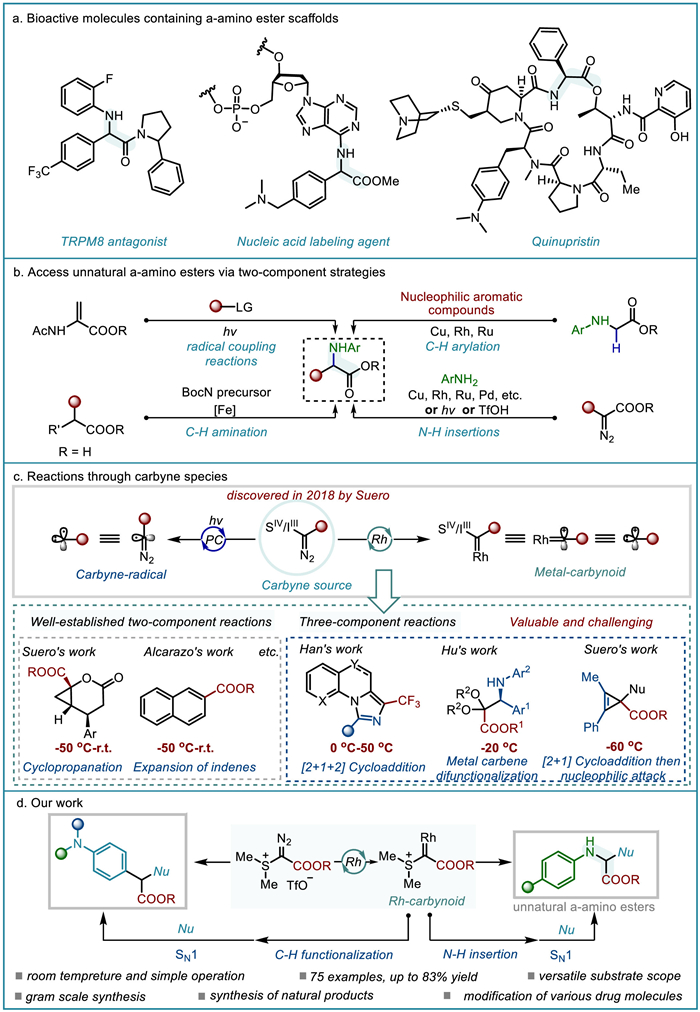
Scheme 1.
General approaches for synthesis of α-amino esters and reactions through carbyne species.

Tandem N–H insertion/C–H functionalization-SN1 reaction to access unnatural amino esters and the concise synthesis of Streptindole and Arsindoline B
Dingding Xia , Chundong Huang , Zhimin Hu , Zhiyong Leng , Miaomiao Zhuo , Shoubhik Das , Shaofei Ni , Yu Zhang , Weidong Zhang


Peptide-based drug discovery has gained significant attention in recent decades [1–3]. Currently, > 500 peptide-based drug candidates are under clinical or preclinical trials, highlighting their strong potential in drug development [4–6]. Amino acids/esters serve as essential building blocks for peptide construction. Although used extensively, proteinogenic amino acids from natural sources exhibit limitations, such as low permeability, poor bioavailability, or limited oral absorption. These challenges highlight the need for the development and rational modification of amino acids (Scheme 1a) [7–12]. Our group continuously focuses on drug discovery through the development of peptides with unnatural amino acids, such as stapled anoplin peptides and glycopeptides [13–16], which successfully proved the significance of unnatural amino acids/esters in peptide-based drug design. Notably, the diversity and availability of unnatural amino acids remain underexplored. Thus, developing novel unnatural amino acids/esters is crucial with important applications in organic synthesis and drug discovery.
Various strategies have been developed to access unnatural amino acids/esters. In addition to traditional methods [17–20], recent advancements have enhanced the efficiency of their synthesis [21–27]. For instance, dehydroalanine (Dha) can react with different radical precursors under photochemical conditions to afford unnatural amino acids and esters [28]. C–H functionalization is another robust and efficient strategy for accessing the unnatural amino acids/esters, enabling direct C–H arylation [29–31], or amination [32]. Another widely used approach utilizes carbenoid N–H insertions with diazo compounds and related carbene precursors (such as N-tosylhydrazones), facilitated by diverse methods, including transition-metal catalysis and photoinduced reactions (Scheme 1b) [33–38]. While these strategies have significantly advanced the synthesis of unnatural amino acid, expanded the space and diversity of unatural amino acids, the synthesis of architecturally complex novel unnatural amino acids/esters bearing multiple aryl motifs remains a formidable challenge, particularly through modular and step-economical strategies.
We would like to disclose the invention of unnatural amino esters based on our experience in the transformation of carbene precursors such as N-tosylhydrazones [39–43]. But this strategy was limited to the synthesis of β-amino esters and general aryl-substituted amino esters lacking unprotected amino groups [44]. Therefore, we aimed to devise a more versatile approach to overcome the above limitations. Chemists have introduced several diazo reagents including hypervalent iodonium reagents or sulfonium analogs [45–48], enabling the umpolung of the azomethine carbon in diazo compounds. Significant efforts have been made by several research groups, including those of the Suero groups [49–51] and Alcarazo groups [52–53]. The dual reactivities of formed carbyne-radical and metal carbynoid species generated from new diazo reagents have significantly expanded the applications of diazo and carbene chemistry (Scheme 1c). Notably, two-component strategies, using α-diazo sulfonium salts and α-diazo-λ3-iodanes have been well established [54–58]. To further leverage the umpolung reactivity of diazo compounds, three-component methods have been reported to access structurally complex products [59–63]. For instance, the Suero group developed a one-step strategy to synthesize cyclopropenium cations (CPCs) which could subsequently react with diverse nucleophiles [64]. Similarly, the Hu group reported the multifunctionalization of Rh carbynoids, enabling them to react with two nucleophiles and one electrophile [65]. However, most of the reports required the low temperature (−20 ℃ ~ −78 ℃) in the beginning to stabilize Rh carbynoids which somewhat limited the practical application of those diazo reagents [50].
Three-component reactions have proved to be efficient and valuable for constructing complex molecules [66]. We assumed whether the dual reactivity of those novel diazo reagents could be leveraged to synthesize unnatural amino acids through three-component reactions, expanding the structural diversity of unnatural amino acids. Based on the above information and our endeavor in peptide-based drug discovery [13–16], this study reported a tandem strategy for synthesizing unnatural amino esters via simultaneous N–H insertion/SN1 reactions of in-situ formed Rh carbynoids under room temperature. Additionally, a tandem C–H functionalization/SN1 reaction to construct diverse 1,1-di(hetero)aryl products were also achieved [67–73]. This strategy was further successfully applied to the synthesis of natural products and drug analogs (Scheme 1d).
First, the reaction of N,N-dimethylaniline 1a, p-toluidine 1b, and α-diazo sulfonium triflate 1c was investigated under various reaction conditions (Table 1). Gratifyingly, the N–H insertion proceeded smoothly in a catalytic system with Rh2(esp)2 (1.0 mol%) in dichloromethane (DCM). And the subsequently nucleophilic addition of 1a afforded the desired α-amino ester 1d in 83% yield (entry 1). Further optimization of the molar ratios of the three reactants revealed that the optimal ratio was 1a:1b:1c = 1:5:1 (entries 2−5). When the reactant composition ratio was adjusted to 1a:1b:1c = 5:1:1, the yield dropped to 22%, while the 1,1-diaryl compound formed through a competitive two-component pathway between 1a and 1c was obtained in 30% yield. Additionally, some diazo reagents reported in the literature were synthesized and screened for their applicability. Upon using diazo reagent 2c, the reaction solution turned black and produced smoke, resulting in a low yield of only 16% (entry 6), likely due to the instability of 2c in the reaction system. Similarly, the other two diazo reagents, 3c and 4c, were also found to be unsuitable (entries 7 and 8). Other catalysts including Rh2(OAc)4, Rh2(TPA)4, or Rh2(TFA)4 resulted in lower yields (entries 9−11). Furthermore, reducing the catalyst loading led to a slight decrease in yield, while increasing it to 3.0 mol% had no significant effect (entries 12 and 13). However, no product formation was observed in the absence of a catalyst, highlighting the crucial role of Rh2(esp)2 in the reaction (entry 14).

 DownLoad:
CSV
DownLoad:
CSV
 |
||
| Entry | Deviation from standard conditions | Yield (%)b |
| 1 | None | 83 |
| 2 | 1a:1b:1c = 5:1:1 | 22 |
| 3 | 1a:1b:1c = 1:3:1 | 52 |
| 4 | 1a:1b:1c = 1:10:1 | 81 |
| 5 | 1a:1b:1c = 1:1:2 | 5 |
| 6 | 2c in standard of 1c | 16 |
| 7 | 3c in standard of 1c | Trace |
| 8 | 4c in standard of 1c | Trace |
| 9 | Rh2(OAc)4 in standard of Rh2(esp)2 | 70 |
| 10 | Rh2(TPA)4 in standard of Rh2(esp)2 | 44 |
| 11 | Rh2(TFA)4 in standard of Rh2(esp)2 | 41 |
| 12 | Rh2(esp)2 0.5 mol% | 74 |
| 13 | Rh2(esp)2 3.0 mol% | 81 |
| 14 | No Rh2(esp)2 | 0 |
| a General reaction conditions: 1a (0.1 mmol, 1.0 equiv.), 1b (0.5 mmol, 5.0 equiv.), 1c (0.1 mmol, 1.0 equiv.), Rh 2(esp) 2 (1.0 mol%), DCM (1.0 mL), room temperature, 18 h. b Yields were determined by 1H NMR analysis using 1,3,5-trimethoxybenzene as an internal standard. | ||
With the optimized reaction conditions in hand, the scope of the reaction was explored using various amines and α-diazo sulfonium triflates (Scheme 2). First, the reactivity of primary anilines and tertiary anilines with diazo reagents was examined. Primary anilines with electron-rich (methyl, tert–butyl, methoxy, phenyl and cyclohexyl groups) and electron-deficient (halogens, ester and carbonyl groups) substituents at the para positions could be converted into the corresponding unnatural α-amino esters in moderate to excellent yields (1d−9d, 35%−82%). Moreover, the primary anilines bearing two and three different substituents at the meta or para positions successfully underwent this reaction, affording the desired products (10d−12d). The reaction also proceeded smoothly upon substituting the para-position of aniline bearing heterocycles such as benzothiazole, morpholine, piperidine, pyridazinone, and triazole, affording 13d−17d with moderate to good yields, proving the strong substituent tolerance of this strategy. Moreover, benzo-fused amines such as 5-aminoindan, 6-aminotetralin, and aminofluorene were found to be viable substrates, yielding products 18d−21d Nevertheless, the presence of electron-withdrawing groups on the alkyl cycles resulted in reduced yields (20d, 38%). It should be noted that the complex diphenylamine also underwent smoothly to afford the α-amino ester with one of the aniline positions without further protection, indicating the potential for the further derivation of the product (22d, 45%). Different tertiary amines, including 1-phenylpyrrolidine, N-phenylpiperidine and tetrahydroquinoline derivative, were also well-suited for the reaction, yielding the corresponding products in good yields (23d−25d).
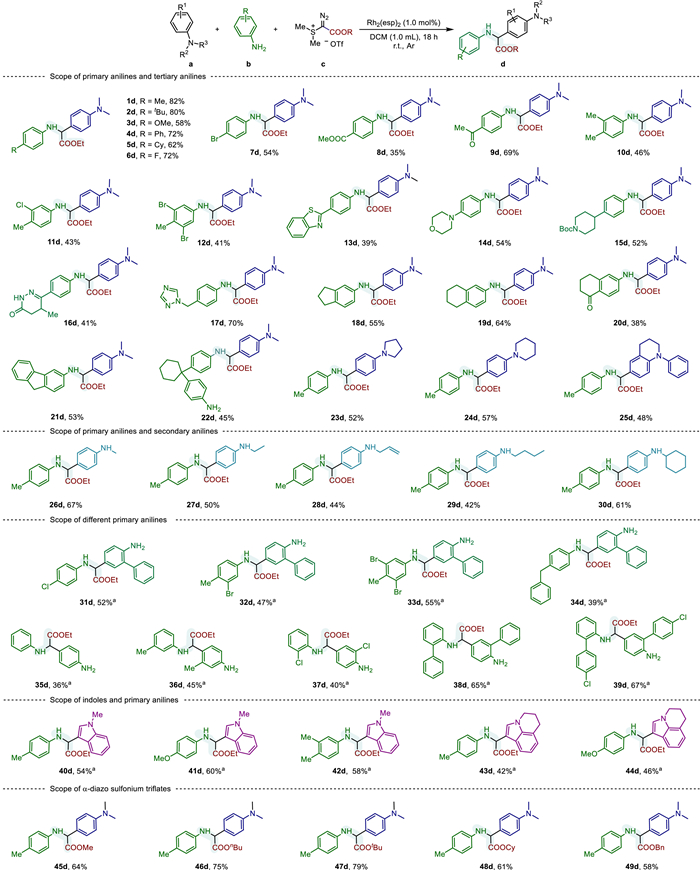
As expected, the three-component reaction of primary and secondary anilines with diazo reagents efficiently produced α-amino esters under standard conditions. This approach was further demonstrated suitability for secondary anilines with varying chain lengths and cyclic alkyl substitution (26d−30d). In addition, three-component strategy using different primary anilines reacted smoothly with diazo reagents and a series of α-amino esters were successfully synthesized under low-temperature conditions via the reaction of 2-biphenylamine with para-substituted di- and tri-substituted anilines (31d−34d). In the case of 34d, difficulties in purification led to a lower yield. Notably, when employing 5 equiv. of a single primary aniline with α-diazo sulfonium triflate, the reaction also proceeded smoothly through initial N–H insertion followed by an SN1 pathway to afford novel α-amino esters in moderate to good yields (35d−39d). The moderate yield of 35d is likely due to electronic effects that promote competitive pathways. Beside the combination of various anilines, indole could also function as a nucleophile reagent, with the reaction selectively occurring at the 3-position of the indole. In this case, indoles reacted with various primary anilines and diazo reagents under low-temperature conditions to yield the target products 40d−42d. The cyclic indole was also a viable substrate, participating in the reaction to afford the corresponding α-amino esters (43d−44d). Next, the scope of the α-diazo sulfonium triflate reagents was explored to expand the applicability. Diazonium reagents substituted with methyl, n–butyl, tert–butyl, cyclohexyl, and benzyl groups were successfully synthesized and reacted smoothly, yielding the corresponding α-amino esters (45d−49d) in good to excellent yield.
As expected, the three-component reaction of primary and secondary anilines with diazo reagents efficiently produced α-amino esters under standard conditions. This approach was further demonstrated suitability for secondary anilines with varying chain lengths and cyclic alkyl substitution (26d−30d). In addition, three-component strategy using different primary anilines reacted smoothly with diazo reagents and a series of α-amino esters were successfully synthesized under low-temperature conditions via the reaction of 2-biphenylamine with para-substituted di- and tri-substituted anilines (31d−34d). In the case of 34d, difficulties in purification led to a lower yield. Notably, when employing 5 equiv. of a single primary aniline with α-diazo sulfonium triflate, the reaction also proceeded smoothly through initial N–H insertion followed by an SN1 pathway to afford novel α-amino esters in moderate to good yields (35d−39d). The moderate yield of 35d is likely due to electronic effects that promote competitive pathways. Beside the combination of various anilines, indole could also function as a nucleophile reagent, with the reaction selectively occurring at the 3-position of the indole. In this case, indoles reacted with various primary anilines and diazo reagents under low-temperature conditions to yield the target products 40d−42d. The cyclic indole was also a viable substrate, participating in the reaction to afford the corresponding α-amino esters (43d−44d). Next, the scope of the α-diazo sulfonium triflate reagents was explored to expand the applicability. Diazonium reagents substituted with methyl, n–butyl, tert–butyl, cyclohexyl, and benzyl groups were successfully synthesized and reacted smoothly, yielding the corresponding α-amino esters (45d−49d) in good to excellent yield.
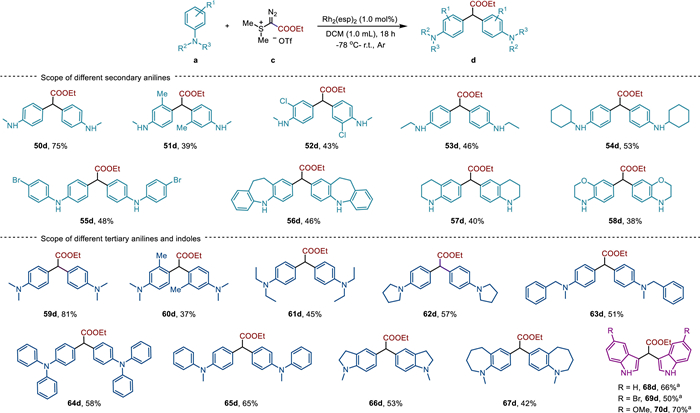
Afterwards, two-component reaction was also examined where only one type of amine reagent interacts with the diazo reagent. To our delight, the 1,1-diaryl compounds were formed, undergoing the tandem C–H functionalization/SN1 processes. Firstly, the scope of the reaction was evaluated with respect to secondary anilines (Scheme 3). Under standard conditions, N-methylaniline underwent C–H functionalization followed by nucleophilic substitution, affording 50d in 75% yield. Additionally, substituted N-methylaniline bearing methyl or chloride groups react well to form the corresponding products 51d and 52d. Upon extending the N-substituted alkyl chain or substituting with cyclohexyl and aryl groups, the target products were obtained in moderate yields (53d−55d, 46%−53%). Moreover, various benzo-fused secondary amines were smoothly converted to their corresponding products (56d−58d). Subsequently, tertiary anilines were investigated and provided the corresponding product (59d) in 81% yield. However, due to steric hindrance, the reaction yield decreased to 37% when a methyl group was introduced at the ortho position of the aryl ring (60d). Additionally, N,N-diethylaniline, 1-phenylpyrrolidine, and tertiary anilines substituted with benzyl and phenyl groups also showed good performance affording the corresponding products in moderate yields (61d−65d). Benzocyclic tertiary amines also exhibited good performance upon reactions with 1c, yielding the corresponding products (66d−67d). Next, the performances of diverse indoles as substrates were explored. Under low-temperature conditions, the bifunctionalization of indoles with 1c proceeded smoothly, affording the bisindole products in good yields (68d−70d, 50%−70%).
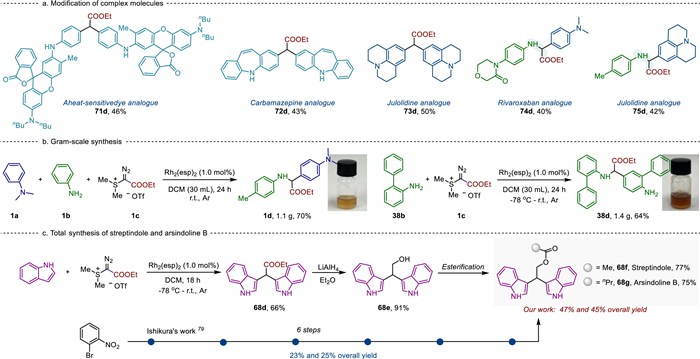
After the successful substrate scope, the utility of this protocol was determined by testing complex molecules and bioactive molecules, such as thermosensitive dyes, carbamazepine, julolidine, and rivaroxaban. As shown in Scheme 4a, a range of complex molecules and drug derivatives were obtained in acceptable yields (71d−75d). The potential of this reaction was further validated through gram-scale reactions, yielding products 1d (1.1 g) and 38d (1.4 g), respectively (Scheme 4b). It is well-known that indole alkaloids have attracted much attention due to their biological activity and structural diversity [74–77]. Streptindole and Arsindoline B are two biologically significant natural products [78]. Using 68d as the starting material—a bisindole product derived from indole and α-diazo sulfonium triflate. Both natural products were successfully obtained through a two-step method with yields of 77% and 75%, which greatly simplified the synthesis of both natural products and improved the overall yields compared to the previously reported method (Scheme 4c) [79].
DFT calculations were further performed to elucidate the mechanism of the reaction as shown in Scheme 5a. First, the rhodium catalyst Rh2(esp)2 undergoes a substitution reaction with α-diazo sulfonium triflate (1c) through the transition state TS1. This reaction proceeds with a Gibbs free energy barrier of 14.8 kcal/mol, forming intermediate I2 and releasing N2. In the next step, I2 undergoes an N–H insertion upon attack by p-toluidine, leading to the formation of I4–1, and the release of the rhodium catalyst. This step occurs with a Gibbs-free energy barrier of 3.5 kcal/mol. Following this, aniline interacts with the intermediate I4–1 and undergoes a nucleophilic substitution reaction through two transition states. From I5–1, the C-S bond undergoes cleavage, transferring the positive charge to carbon and forming intermediate I6–1. Subsequently, aniline attacks the resulting carbocation, leading to the formation of the intermediate I7–1 and the release of Me2S. The Gibbs free energy barriers for the corresponding transition states, TS3–1 and TS4–1, were calculated to be 1.7 kcal/mol and 13.3 kcal/mol, respectively. Next, with a Gibbs free energy barrier of 7.9 kcal/mol, a proton transfer occurs via transition state TS5–1. The OTf- captures the proton at the para position of the amino group, facilitating product rearomatization.
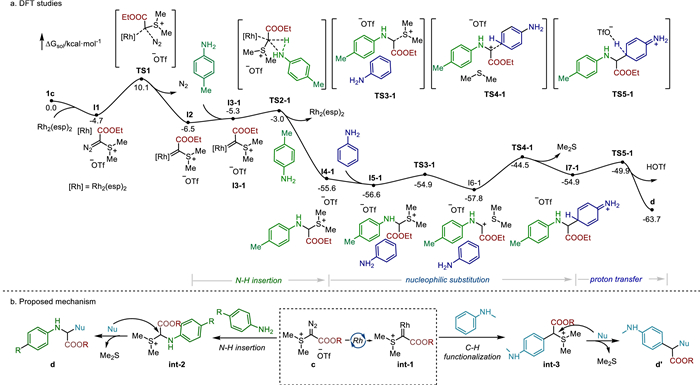
When a single amine reagent reacts with α-diazo sulfonium triflate, two-component reaction products are formed through similar reaction pathways (Fig. S5 in Supporting information). The initial step is identical to that of the three-component reaction Subsequently, N-methylaniline undergoes C–H functionalization with intermediate I2, leading to the formation of intermediate I4–2, and the release of the rhodium catalyst. This step proceeds via the transition state TS2–2. Due to the excessive solvent correction, the reaction pathway diagram suggests that the Gibbs free energy of TS2–2 is lower than that of intermediate I3–2. However, TS2–2 remains at a higher energy level in terms of gaseous electron energy. Additionally, the potential of N–H insertion between N-methylaniline and intermediate I2 was also explored. The calculations revealed that the Gibbs free energy barrier for the transition state of N–H insertion was 22.8 kcal/mol, making it non-competitive compared to the main reaction pathway. N-Methylaniline undergoes a nucleophilic substitution reaction with intermediate I4–2. This leads to the formation of Intermediate I5–2, which then undergoes C-S bond cleavage. The electrons are transferred from the imine group to the benzene ring and the carbon formerly bonded to sulfur results in intermediate I6–2 with a quinone-like structure. Subsequently, another molecule of N-methylaniline attacks the same position, forming intermediate I7–2 and releasing Me2S. The Gibbs free energy barriers for the two transition states, TS3–2 and TS4–2 are 16.1 and 18.3 kcal/mol, respectively. Finally, the OTf- combines with the hydrogen at the imine position, neutralizing the positive charge and promoting rearomatization through the transition state TS5–2, which has a Gibbs free energy barrier of 4.4 kcal/mol.
On the basis of the DFT calculations and recent studies, a simplified mechanistic pathway is depicted in Scheme 5b. Firstly, the diazo reagent is activated by the rhodium catalyst, forming a rhodium-carbynoid intermediate int-1 in situ. When reacting with primary anilines, the intermediate undergoes N–H insertion, forming intermediate int-3. In contrast, reactions with secondary amines, tertiary amines, and indoles, proceed via C–H functionalization at the para position of the aryl group or the 3-position of the indole, generating intermediate int-2. Subsequently, both int-2 and int-3 undergo an SN1 reaction with another nucleophilic reagent, leading to the formation of the final products.
In conclusion, we have established a three-component tandem reaction platform that effectively integrates C/N–H insertion-SN1 reaction, which was a big step forward compared to traditional methods. By exploiting the umpolung reactivity of α-diazo sulfonium salts, this methodology facilitates the efficient synthesis of unnatural α-amino esters and 1,1-di(hetero)aryl compounds with broad substrate scope and high functional-group tolerance. The synthetic utility of this strategy is further highlighted by its success in the late-stage functionalization of complex drug analogs and the concise synthesis of bioactive natural products, including Streptindole and Arsindoline B. Further application of those unnatural amino esters into peptide synthesis and modification was being processed in our lab.
Dingding Xia: Writing – review & editing, Writing – original draft, Methodology, Investigation, Data curation. Chundong Huang: Data curation. Zhimin Hu: Data curation. Zhiyong Leng: Data curation. Miaomiao Zhuo: Conceptualization. Shoubhik Das: Writing – review & editing. Shaofei Ni: Writing – review & editing, Data curation. Yu Zhang: Writing – review & editing, Methodology, Funding acquisition. Weidong Zhang: Funding acquisition.
The authors declare that they have no known competing financial interests or personal relationships that could have appeared to influence the work reported in this paper.
This work was supported by the General Project of Shanghai Natural Science Foundation (No. 24ZR1466700), National Natural Science Foundation of China (No. 82404460, Y. Zhang; No. 82141203, W. Zhang), Open Research Fund of School of Chemistry and Chemical Engineering, Henan Normal University (No. 2024Y08, Zhang), CAMS Innovation Fund for Medical Sciences (CIFMS) (No. 2023-I2M-3–009, W. Zhang), Key Project at Central Government Level: The Ability Establishment of Sustainable Use for Valuable Chinese Medicine Resources (No. 2060302–2305–02, W. Zhang), Guangdong Basic and Applied Basic Research Foundation (No. 2024A1515010323), the open research fund of Songshan Lake Materials Laboratory (No. 2023SLABFN16, S. Ni).
Supplementary material associated with this article can be found, in the online version, at doi:
I. Rady, I.A. Siddiqui, M. Rady, et al., Canc. Lett. 402 (2017) 16–31. doi: 10.1016/j.canlet.2017.05.010
A. Tilborg, B. Norberg, J. Wouters, Eur. J. Med. Chem. 74 (2014) 411–426. doi: 10.1016/j.ejmech.2013.11.045
X. Xu, R. Lai, Chem. Rev. 115 (2015) 1760–1846. doi: 10.1021/cr4006704
K.K. Sharma, K. Sharma, K. Rao, et al., J. Med. Chem. 67 (2024) 19932–19965. doi: 10.1021/acs.jmedchem.4c00110
N. Krall, F.P. da Cruz, O. Boutureira, et al., J. Med. Chem. 58 (2015) 7719–7733. doi: 10.1021/acs.jmedchem.5b00612
T.A. Hill, N.E. Shepherd, F. Diness, et al., Angew. Chem. Int. Ed. 53 (2014) 13020–13041. doi: 10.1002/anie.201401058
M.A.T. Blaskovich, J. Med. Chem. 59 (2016) 10807–10836. doi: 10.1021/acs.jmedchem.6b00319
C. Cabrele, T.A. Martinek, O. Reiser, et al., J. Med. Chem. 57 (2014) 9718–9739. doi: 10.1021/jm5010896
Z. Li, B. Yu, Chem. Eur. J. 25 (2019) 16528–16532. doi: 10.1002/chem.201904395
D. Gillingham, N. Fei, Chem. Soc. Rev. 42 (2013) 4918–4931. doi: 10.1039/c3cs35496b
K. Tishinov, N. Fei, D. Gillingham, Chem. Sci. 4 (2013) 4401–4406. doi: 10.1039/c3sc51363g
N.A. Tamayo, Y. Bo, V. Gore, et al., J. Med. Chem. 55 (2012) 1593–1611. doi: 10.1021/jm2013634
X. Li, S. Chen, W.D. Zhang, et al., Chem. Rev. 120 (2020) 10079–10144. doi: 10.1021/acs.chemrev.0c00532
Y. Wu, D. Lu, Y. Jiang, et al., J. Med. Chem. 64 (2021) 5802–5815. doi: 10.1021/acs.jmedchem.0c02237
X. Li, C. Liao, Y. Xu, et al., J. Am. Chem. Soc. 145 (2023) 322–333. doi: 10.1021/jacs.2c09990
Y. Zhang, J. Vanderghinste, J. Wang, et al., Nat. Comm. 15 (2024) 1474–1482. doi: 10.1038/s41467-024-45790-2
D.S. Dhanoa, S.W. Bagley, R.S.L. Chang, et al., J. Med. Chem. 36 (1993) 4239–4249. doi: 10.1021/jm00078a014
M.S. Sigman, E.N. Jacobsen, J. Am. Chem. Soc. 120 (1998) 4901–4902. doi: 10.1021/ja980139y
C. Zhu, T. Akiyama, Tetrahedron Lett. 53 (2012) 416–418. doi: 10.1016/j.tetlet.2011.11.061
E.P. Jones, P. Jones, A.G.M. Barrett, Org. Lett. 13 (2011) 1012–1015. doi: 10.1021/ol1030469
Y. Li, Y.X. Su, Y.T. Zhao, et al., ACS Catal. 12 (2022) 13143–13148. doi: 10.1021/acscatal.2c03937
M.L. Li, H. Yu, Y.H. Li, et al., Science 66 (2019) 990–994. doi: 10.1126/science.aaw9939
S. Li, X. Yang, Y. Wang, et al., Adv. Synth. Catal. 360 (2018) 4452–4456. doi: 10.1002/adsc.201801018
H. Tian, W. Xu, Y. Liu, et al., Org. Lett. 22 (2020) 5005–5008. doi: 10.1021/acs.orglett.0c01574
B. Liu, S.F. Zhu, W. Zhang, et al., J. Am. Chem. Soc. 129 (2007) 5834–5835. doi: 10.1021/ja0711765
I.K. Mangion, I.K. Nwamba, M. Shevlin, et al., Org. Lett. 11 (2009) 3566–3569. doi: 10.1021/ol901298p
Y. Matsumoto, J. Sawamura, Y. Murata, et al., J. Am. Chem. Soc. 142 (2020) 8498–8505. doi: 10.1021/jacs.0c02707
M. Wang, C. Wang, Y. Huo, et al., Nat. Commun. 12 (2021) 6873–6881. doi: 10.1038/s41467-021-27086-x
C. Huo, Y. Yuan, M. Wu, et al., Angew. Chem. Int. Ed. 53 (2014) 13544–13547. doi: 10.1002/anie.201406905
M. Salman, Z.Q. Zhu, Z.Z. Huang, Org. Lett. 18 (2016) 1526–1529. doi: 10.1021/acs.orglett.6b00162
K. Li, G. Tan, J. Huang, et al., Angew. Chem. Int. Ed. 52 (2013) 12942–12945. doi: 10.1002/anie.201306181
T.A. Trinh, J.M. Schomaker, Nat. Synth. 2 (2023) 600–601. doi: 10.1038/s44160-023-00278-7
C.J. Moody, Angew. Chem. Int. Ed. 46 (2007) 9148–9150. doi: 10.1002/anie.200703016
S. Biswas, C. Bolm, Org. Lett. 26 (2024) 1511–1516. doi: 10.1021/acs.orglett.4c00216
I.D. Jurberg, H.M.L. Davies, Chem. Sci. 9 (2018) 5112–5118. doi: 10.1039/c8sc01165f
S. Hu, J. Wu, Z. Lu, et al., J. Org. Chem. 86 (2021) 3223–3231. doi: 10.1021/acs.joc.0c02588
J. Aziz, J.D. Brion, A. Hamze, et al., Adv. Synth. Catal. 355 (2013) 2417–2429. doi: 10.1002/adsc.201300466
S.S. So, A.E. Mattson, J. Am. Chem. Soc. 134 (2012) 8798–8801. doi: 10.1021/ja3031054
D. Xia, R. Wu, J. Wang, et al., ACS Catal. 13 (2023) 9806–9816. doi: 10.1021/acscatal.3c02350
Y. Zhang, Y. Li, S.F. Ni, et al., Chem. Sci. 14 (2023) 10411–10419. doi: 10.1039/d3sc04188c
Q. Li, D. Wang, J. Wang, et al., Sci. China Chem. 68 (2025) 1937–1944. doi: 10.1007/s11426-024-2380-4
Y. Zhang, X. Han, P. Wang, et al., ACS Central Sci. 11 (2025) 742–752. doi: 10.1021/acscentsci.5c00099
X. Han, P. Wang, L. Zhang, et al., J. Nat. Prod. 88 (2025) 1663–1670. doi: 10.1021/acs.jnatprod.5c00420
Y. Zhang, X. Li, D. Li, et al., Green Chem. 6 (2024) 4600–4608. doi: 10.1039/d3gc04431a
R. Weiss, J. Seubert, F. Hampel, Angew. Chem. Int. Ed. 33 (1994) 1952-1593. doi: 10.1002/anie.199419521
S. Timmann, M. Alcarazo, Chem. Commun. 59 (2023) 8032–8042. doi: 10.1039/d3cc01620j
B. Xu, S.F. Zhu, Z.C. Zhang, et al., Chem. Sci. 5 (2014) 1442–1448. doi: 10.1039/c3sc52807c
Y. Liang, H. Zhou, Z.X. Yu, J. Am. Chem. Soc. 131 (2009) 17783–17785. doi: 10.1021/ja9086566
E. Palomo, A.K. Sharma, Z. Wang, et al., J. Am. Chem. Soc. 145 (2023) 4975–4981. doi: 10.1021/jacs.3c00012
L. Jiang, Z. Wang, M. Armstrong, et al., Angew. Chem. Int. Ed. 60 (2021) 6177–6184. doi: 10.1002/anie.202015077
Z. Wang, A.G. Herraiz, A.M. del Hoyo, et al., Nature 554 (2018) 86–91. doi: 10.1038/nature25185
S. Timmann, T.H. Wu, C. Golz, et al., Chem. Sci. 15 (2024) 5938–5943. doi: 10.1039/d4sc01138d
X. Li, C. Golz, M. Alcarazo, Angew. Chem. Int. Ed. 60 (2021) 6943–6948. doi: 10.1002/anie.202014775
X. Ma, A. Sun, K.K. Wang, New J. Chem. 46 (2022) 6856–6859. doi: 10.1039/d2nj01186g
L. Liu, Y. Zhang, Org. Lett. 25 (2023) 592–596. doi: 10.1021/acs.orglett.2c04114
J.Y. Dong, H. Wang, S. Mao, et al., Adv. Synth. Catal. 363 (2021) 2133–2139. doi: 10.1002/adsc.202001436
J. Li, X.C. Lu, Y. Xu, et al., Org. Lett. 22 (2020) 9621–9626. doi: 10.1021/acs.orglett.0c03663
X.C. Xu, Y. Sang, M. Yang, et al., Org. Chem. Front. 11 (2024) 5502–5510. doi: 10.1039/d4qo00652f
W.W. Zhao, M.Y. Tian, Y.L. Zhou, et al., Angew. Chem. Int. Ed. 63 (2024) e202318887. doi: 10.1002/anie.202318887
Z. Wang, L. Jiang, P. Sarró, et al., J. Am. Chem. Soc. 141 (2019) 15509–15514. doi: 10.1021/jacs.9b08632
L. Jiang, P. Sarró, W. Teo, et al., Chem. Sci. 13 (2022) 4327–4333. doi: 10.1039/d2sc00968d
X. Wang, W.Y. Tong, B. Huang, J. Am. Chem. Soc. 144 (2022) 4952–4965. doi: 10.1021/jacs.1c12874
J. Luo, M. Zhang, G. Liu, et al., Org. Chem. Front. 11 (2024) 3596–3601. doi: 10.1039/d4qo00401a
H.F. Tu, A. Jeandin, M.G. Suero, J. Am. Chem. Soc. 144 (2022) 16737–16743. doi: 10.1021/jacs.2c07769
Y. Qian, J. Tang, X. Zhou, et al., J. Am. Chem. Soc. 145 (2023) 26403–26411. doi: 10.1021/jacs.3c10460
X. Yang, X. Zhou, W. Hu, et al., Nat. Commun. 16 (2025) 1434-1412. doi: 10.1038/s41467-025-56446-0
Y. Wang, X. Wei, Y. Chen, et al., Org. Chem. Front. 12 (2025) 3653–3664.
J.D. Pizarro, I.L. Schmidtke, A. Nova, et al., ACS Catal. 12 (2022) 6851–6856. doi: 10.1021/acscatal.2c01713
X.S. Liu, Z. Tang, Z.Y. Si, et al., Angew. Chem. Int. Ed. 61 (2022) e202208874. doi: 10.1002/anie.202208874
S. Jia, D. Xing, D. Zhang, et al., Angew. Chem., Int. Ed. 53 (2014) 13098–13101. doi: 10.1002/anie.201406492
B. Ma, Z. Chu, B. Huang, et al., Angew. Chem. Int. Ed. 56 (2017) 2749–2753. doi: 10.1002/anie.201611809
B. Xu, M.L. Li, X.D. Zuo, et al., J. Am. Chem. Soc. 137 (2015) 8700–8703. doi: 10.1021/jacs.5b05086
Z. Yu, B. Ma, M. Chen, et al., J. Am. Chem. Soc. 136 (2014) 6904–6907. doi: 10.1021/ja503163k
L.P. Zhao, P.J. Li, L. Wang, et al., Angew. Chem. Int. Ed. 61 (2022) e202207360. doi: 10.1002/anie.202207360
L.P. Zhao, S.Y. Zhang, H.K. Liu, et al., J. Am. Chem. Soc. 145 (2023) 15553–15564. doi: 10.1021/jacs.3c04989
H. Li, Q. Li, Z. Lu, et al., J. Am. Chem. Soc. 138 (2016) 15555–15558. doi: 10.1021/jacs.6b10880
Z. Lu, H. Li, M. Bian, et al., J. Am. Chem. Soc. 137 (2015) 13764–13767. doi: 10.1021/jacs.5b09198
Y. Zhang, X. Yang, H. Zhou, et al., Org. Chem. Front. 5 (2018) 2120–2125. doi: 10.1039/c8qo00341f
T. Abe, S. Nakamura, R. Yanada, et al., Org. Lett. 15 (2013) 3622–3625. doi: 10.1021/ol401486s

Scheme 1 General approaches for synthesis of α-amino esters and reactions through carbyne species.

Scheme 2 Scope of anilines, indoles and α-diazo sulfonium triflates to synthesize unnatural α-amino esters. Reaction conditions: a (0.1 mmol, 1.0 equiv.), b (0.5 mmol, 5.0 equiv.), c (0.1 mmol, 1.0 equiv.), Rh2(esp)2 (1.0 mol%), DCM (1.0 mL), room temperature, 18 h. Isolated yield. a −78 ℃ to room temperature.

Scheme 3 Scope of anilines and indoles to construct 1,1-di(hetero)aryl compounds. Reaction conditions: a (0.1 mmol, 1.0 equiv.), c (0.1 mmol, 1.0 equiv.), Rh2(esp)2 (1.0 mol%), DCM (1.0 mL), room temperature, 18 h. Isolated yield. a −78 ℃ to room temperature.

Scheme 4 Modification of complex molecules, gram-scale synthesis and total synthesis of natural products.
Table 1. Optimization of the reaction conditions.a
|
||
| Entry | Deviation from standard conditions | Yield (%)b |
| 1 | None | 83 |
| 2 | 1a:1b:1c = 5:1:1 | 22 |
| 3 | 1a:1b:1c = 1:3:1 | 52 |
| 4 | 1a:1b:1c = 1:10:1 | 81 |
| 5 | 1a:1b:1c = 1:1:2 | 5 |
| 6 | 2c in standard of 1c | 16 |
| 7 | 3c in standard of 1c | Trace |
| 8 | 4c in standard of 1c | Trace |
| 9 | Rh2(OAc)4 in standard of Rh2(esp)2 | 70 |
| 10 | Rh2(TPA)4 in standard of Rh2(esp)2 | 44 |
| 11 | Rh2(TFA)4 in standard of Rh2(esp)2 | 41 |
| 12 | Rh2(esp)2 0.5 mol% | 74 |
| 13 | Rh2(esp)2 3.0 mol% | 81 |
| 14 | No Rh2(esp)2 | 0 |
| a General reaction conditions: 1a (0.1 mmol, 1.0 equiv.), 1b (0.5 mmol, 5.0 equiv.), 1c (0.1 mmol, 1.0 equiv.), Rh 2(esp) 2 (1.0 mol%), DCM (1.0 mL), room temperature, 18 h. b Yields were determined by 1H NMR analysis using 1,3,5-trimethoxybenzene as an internal standard. | ||
 下载: 导出CSV

 扫一扫看文章


扫一扫关注我们

 下载:
下载: