
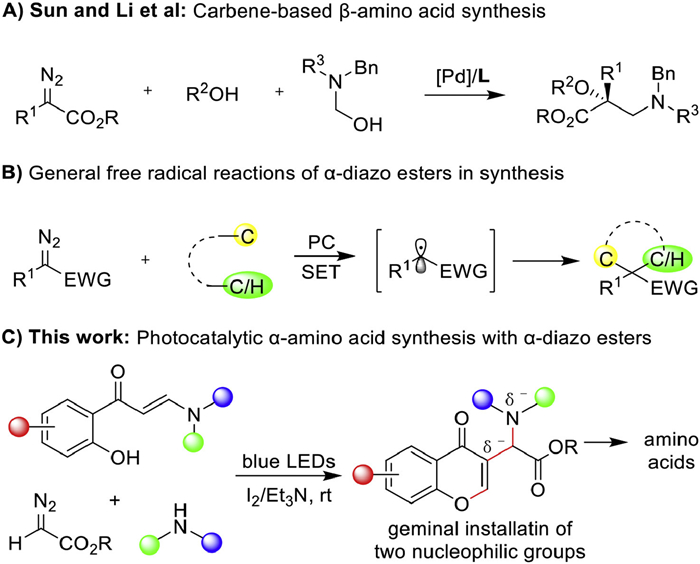
Scheme 1.
Amino acid synthesis and free radical reactions on diazo compounds.


As the fundamental structure moieties of key biomolecules in living systems, the amino acids occupy irreplaceable position in modern science and industries [1–5]. However, due to the limited types of amino acids in natural world, exploring and discovering more different amino acids mainly rely on the designation of practical synthetic methods to construct or modify amino acids. The past several decades have witnessed the arguable advances in the synthesis of amino acids [6–10]. However, the huge space in the application potential of amino acids demands much more efforts in the synthesis of amino acids, especially noncanonical amino acids [11–17]. Unsurprisingly, the research works on the synthesis of amino acids keeps receiving everlasting interest from the synthetic chemistry community. On major and reliable tactic to access new and diverse amino acids is the functionalization in readily available amino acids [18–20]. For instance, the C–H activation [21–24], fluoro-functionalization [25–26], chalcogenation [27], and a plethora of other bond transformations [28–35] have been successfully utilized. On the contrary, synthesizing amino acids with simple other chemicals could be more flexible in providing amino acids with expansion both in backbone and substructure diversity. The multi-functionalization or hydrofunctionalization reactions of alkene derivatives [36–38], hydrogenation of enamino esters [39–41], aminoalkylation of esters [42], reductive amination of oxo amides [43], hydroamination of sulfur ylides [44], synthesis with stepwise operation [45, 46], reaction based on migration chemistry [47–50], and the addition to imino acids [51], to name but a few, have displayed notable promise. Regardless of these advances, the synthetic methods toward amino acids are yet facing challenges such as the reliance on amino acids as substrates, use of transition metal catalyst, and multi-step operation. Consequently, new synthetic tactics featuring sustainability, step efficiency and product diversity are highly desirable for amino acid synthesis.
Stable α-diazo compounds, such as α-diazo ketones and esters, are synthons showcasing ubiquitous application in modern organic synthesis. In classical modes, such diazo compounds usually take part in reactions by forming carbene intermediate. For example, Sun and Li et al. have achieved the enantioselective synthesis of β-amino acid synthesis via the reactions of α-diazo esters, alcohols and N, O-aminals (Scheme 1A) [52]. Recently, the occurrence of new catalytic tactics such as photocatalytic synthesis have brought opportunities of synthesis via single electron transfer (SET) process in α-diazo compounds [53–58]. The hitherto reported reactions, however, are yet restricted by the tolerance mostly to alkenes and alkynes as reaction partners, allowing the installation of two electron neutral or near neural fragments into the geminal carbon site (Scheme 1B) [59–65]. The reaction enabling the formation of C-heteroatom bond by free radical reactions of α-diazo compounds, on the contrary, remains hardly accessible. More notably, the geminal difunctionalization of the α-diazo compounds by installing two electron rich groups into the carbon center is currently inapplicable either by carbene or free radical pathways. In this context, empowering the difunctionalization mode of α-diazo compounds by incorporating two nucleophilic groups or fragments are urgently required for further disclosing the synthetic application of α-diazo compounds. Herein, by making use of combined photocatalysis and iodine promotion, the synthesis of chromone functionalized α-amino acids has been achieved by the reactions of α-diazo esters, enaminones and amines (Scheme 1C).
First, the reaction of enaminone 1a, diazo ester 2a and secondary amine 3a was employed to probe reaction conditions. The reaction with different light sources indicated that blue LEDs was superior (entries 1–3, Table 1). The absence of amine 3a led the sharp decrease in the product yield (entry 4, Table 1). In addition, the loading of reactants displayed also evident impact to the result (entry 5, Table 1). Comparing different iodine-reagents proved that the molecular iodine was distinctively applicable (entries 6 and 7). The parallel experiments with different solvents as reaction medium, on the other hand, confirmed that DMF was the most favorable candidate (entries 8–10). Based on the systematic optimization (see Supporting information for full data), the α-amino carboxylate 4a was finally acquired with 86% yield.

 DownLoad:
CSV
DownLoad:
CSV
 |
||
| Entry | Variation from standard conditions | Yield (%) |
| 1 | No | 86 |
| 2 | Green LEDs instead of blue LEDs | 58 |
| 3 | White LEDs instead of blue LEDs | 63 |
| 4 | Without 3a | 31 |
| 5 | 2a/3a (2.0/2.0 equiv.) | 80 |
| 6 | As entry 5 and PIDA as I-reagent | trace |
| 7 | As entry 5 and KI as I-reagent | trace |
| 8 | As entry 5 and MeCN as solvent | 63 |
| 9 | As entry 5 and EtOH as solvent | 58 |
| 10 | As entry 5 and THF as solvent | 54 |
| a Standard conditions: 1a (0.2 mmol), 2a (0.8 mmol), 3a (0.6 mmol), I 2 (0.2 mmol), Et 3N (0.2 mmol) in DMF (1.0 mL), stirred at room temperature under the irradiation of blue LEDs for 10 h. | ||
With the optimized conditions in hand, the synthetic scope of the current method toward chromone functionalized α-amino esters 4 was investigated. The method, as outlined in Scheme 2A, displayed broad scope in the synthesis of target products. The enaminones 1 containing an array of different functional groups such as alkyl, alkoxyl, aryl, and haloatoms reacted with diazo ester 2a and corresponding dimethyl amine 3a to provide products 4b-4n with generally good to excellent yields regardless the electronic property, site and numbers of substituent. As example of fused aryl, the naphthyl derived enaminone could also participate the synthesis with practical result (4o, 62%). Analogously, the reaction of diazo esters featuring various alkyl groups were well tolerated and afforded the titled products 4p-4t with good yields (63%−74%). Finally, the reactions employing different secondary amines and related amino functionalized enaminones were executed. The secondary amines, including acyclic and cyclic amines were successfully utilized to give α-amino esters with diverse amino groups (4u-4z, 4aa). The acyclic amines with steric hindrance showed negative effect to the synthesis and the corresponding products were acquired with lower yield (4u, 4w-4x) than the equivalent entries using dimethyl amine and cyclic amines (4v, 4y-4z and 4aa). Notably, the primary aryl amine could also be used for the synthesis of corresponding amino acid derivative with good result (4ab). The reaction of N-methyl, N-phenyl amino enaminone and N-methylaniline could not give the amino acid product by reacting with 2a, possibly because of the high steric hindrance of the amino fragment.
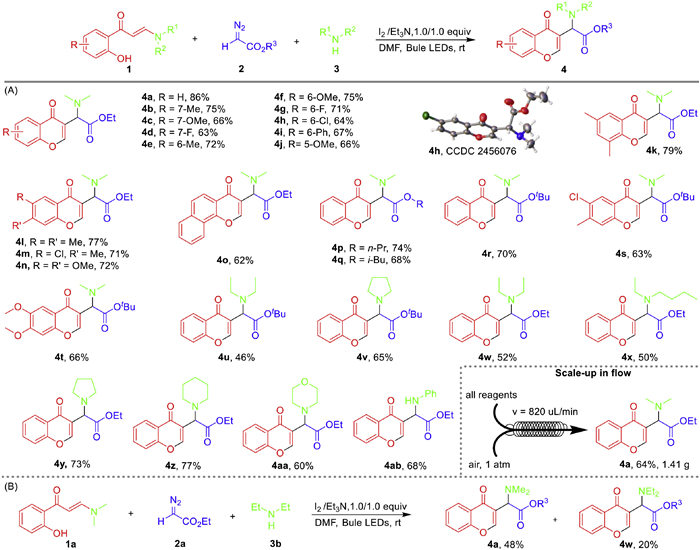
After verifying the synthetic scope, we then made efforts in scaling up the synthesis by switching the model reaction to continuous flow reactor. Delightfully, by running the reaction in the flow system with two inputs, one flowing all reagents in solution (v = 820 µL/min) and the other bumping air (1 atm) to facilitate the nitrogen extrusion of the diazo compound by blowing away the nitrogen gas generated in the reaction channel (see Supporting information for details), the product was afforded with satisfactory 65% yield in gram scale. The X-ray diffraction on single crystal of 4h (CCDC: 2456076) confirmed the product structure. Complimentarily, the reaction using enaminone 1a and a different amino precursor 2b led to the formation of two amino ester products 4a and 4w wherein 4a was obtained as the main product, further indicating the higher activity of substrate possessing less steric amino group (Scheme 2B).
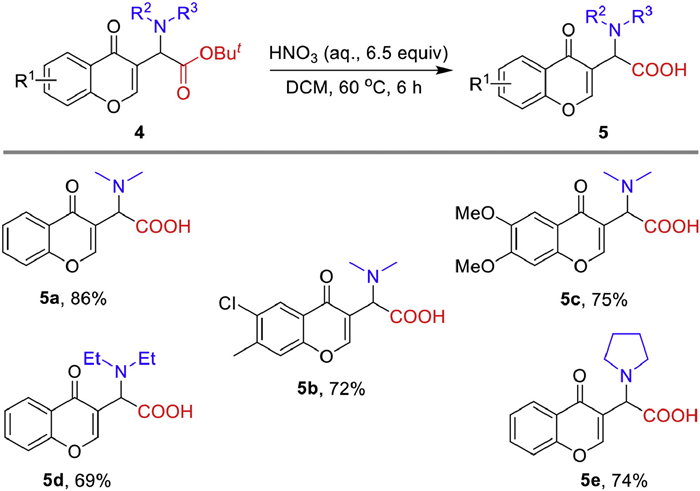
Following the successful synthesis of α-amino esters, their application in the synthesis of amino acids was also executed. By simply treating compounds 4 with aqueous nitric acid and heating at 60 ℃, a series of chromone derived amino acids 5 were efficiently accessed (5a-5e, Scheme 3). The steric hindrance of the amino group also hampered the amino ester hydrolysis by giving corresponding product with slightly lower yield (5d, Scheme 3).
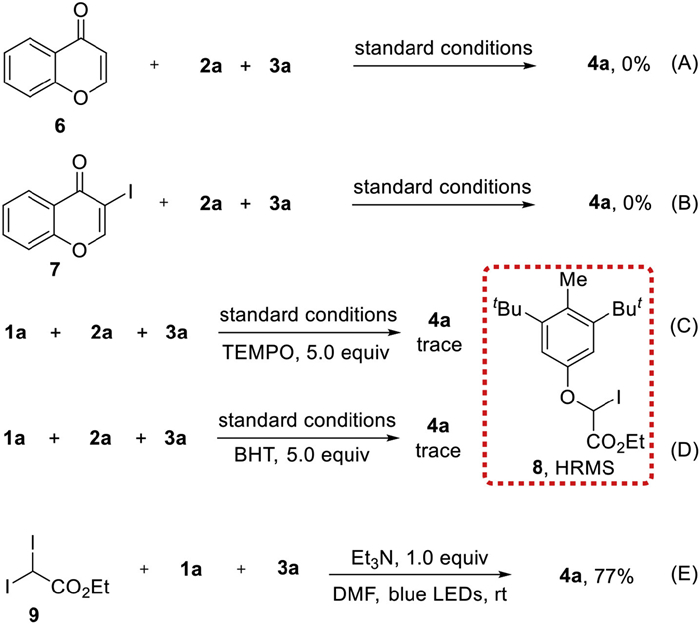
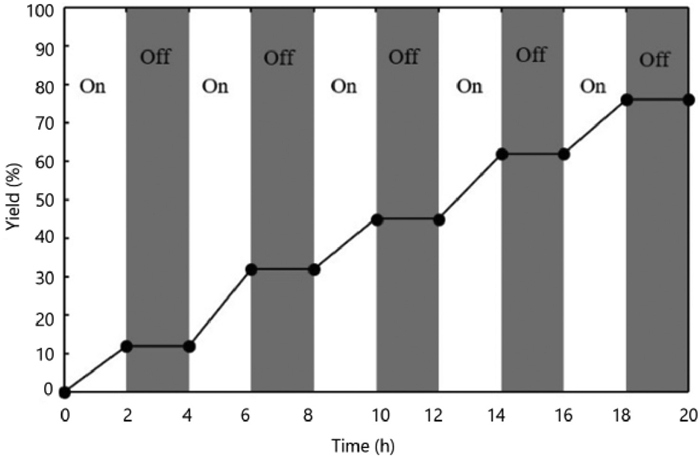
Later, to gain information on reaction mechanism, a series of control experiments were performed. First, for probing the possible reaction intermediate, the chromone 6 and 3-iodochromone 7 were employed to react with 2a and 3a under the standard conditions, respectively. No product 4a was observed in neither of the entry (Schemes 4A and B). Later, the model reaction was performed in the presence of free radical scavenger (FRS) such as TEMPO and BHT. Both scavengers exhibited evident suppression effect to the titled reaction, and only trace product was observed when 5 equiv. FRS was employed (Schemes 4C and D). In addition, the free radical adduct resulting from the corporation of an iodoalkyl radical with BHT has been observed by HRMS (Supporting information), supporting that the current reaction proceeded via free radical pathway. Although all the key intermediates were too sensitive to be captured by HMRS under the standard conditions, we prepared the gem‑diiodo ester 9 at low temperature following literature method [66]. Subjecting this intermediate with 1a and 3a under the photocatalytic conditions in the absence of iodine afforded product 4a with high yield (Scheme 4E), supporting that this compound was a key intermediate. Further, the on-off experiment on the model reaction was conducted. As found in Fig. 1, the experiment displayed clear reliance of the reaction on the continuous light irradiation. Turning off the light clearly led to the stop of the reaction, and such change took place repeatedly under identical on-off operation.
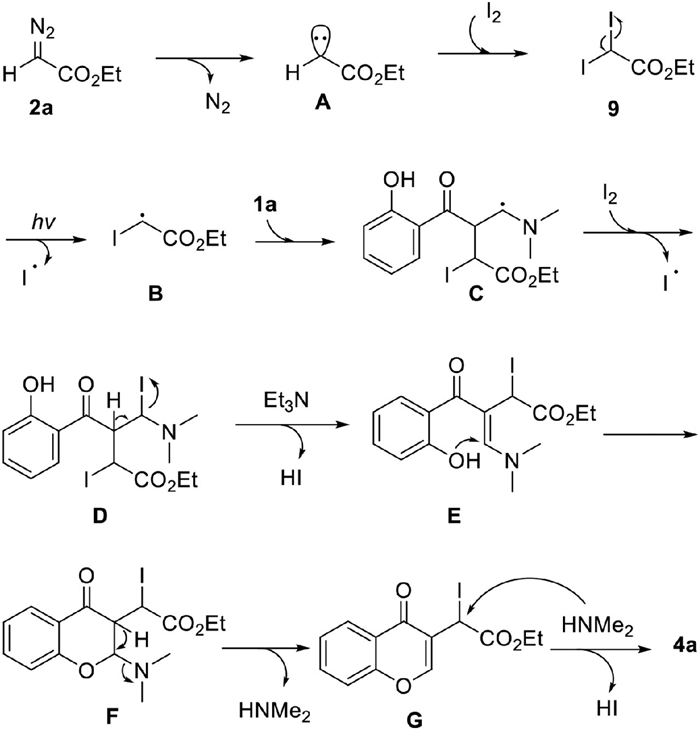
Following the clues from control experiments, the mechanism of the reaction on photocatalytic amino acid synthesis has been proposed (Scheme 5). Initially, the diazo compound undergoes classical energy transfer-based nitrogen extrusion with light irradiation to provide carbene A. The dipolar coupling of iodine to the carbene affords diiodinated ester 9. The further light irradiation to 9 leads to iodine radical and carbon centered radical B. The addition of B to enaminone 1a in the double bond provides intermediate C, and the subsequent corporation to molecular iodine generates intermediate D. The elimination of HI from D then provides E with the promotion of Et3N. The intramolecular addition takes place subsequently to give chromanone F which proceeds further to donate iodoalkyl functionalized chromone G via amine elimination. Finally, the nucleophilic substitution of the amine to the alkyl C-I bond gives the amino ester product 4a.
In conclusion, by making use of the iodine mediated formation of geminal diiodinated esters with α-diazo esters as a key transformation, we have developed a photocatalytic method for the direct synthesis of chromone functionalized α-amino acids with o-hydroxyaryl enaminones and amines as reaction partners. As verified by control experiments, the reactions proceed via free radical transformation resulting from the homolytic of the C-I bond in the geminal diiodinated intermediate. In addition to the clear-cut application in the synthesis of new amino acid scaffolds, the current reactions represent also an advance in diazo compound chemistry by allowing the installation of two formally nucleophilic groups into the carbon center, expanding the application scope of such diazo compounds from the known carbene-based zwitterionic transformation as well as the geminal difunctionalization of installing two near electron neutral carbon-based groups.
The authors declare that they have no known competing financial interests or personal relationships that could have appeared to influence the work reported in this paper.
Jingyan Liu: Writing – original draft, Methodology, Investigation. Wanting Liang: Investigation. Changfeng Wan: Investigation. Jie-Ping Wan: Writing – review & editing, Supervision, Project administration, Funding acquisition, Conceptualization.
This work is financially supported by the National Natural Science Foundation of China (No. 22561026).
Supplementary material associated with this article can be found, in the online version, at doi:
J.H. Jones, Amino Acids and Peptides, 23, The Royal Society of Chemistry, London, 1992.
P. Mylène, D. Nicolas, T. Daniel, Curr. Opin, Clin. Nutr. 12 (2009) 54–58.
E.A. Bell, J. Agric. Food Chem. 51 (2003) 2854–2856. doi: 10.1021/jf020880w
M. Serra, M. Terreni, E. Bernardi, et al., Eur. J. Org. Chem. 26 (2023) e202201394. doi: 10.1002/ejoc.202201394
S.S. Gupta, V. Mishra, M.D. Mukherjee, et al., Int. J. Biol. Macromol. 188 (2021) 542–567. doi: 10.1016/j.ijbiomac.2021.08.036
K. Maruoka, T. Ooi, Chem. Rev. 103 (2003) 3013–3028. doi: 10.1021/cr020020e
C. Nájera, J.M. Sansano, Chem. Rev. 107 (2007) 4584–4671. doi: 10.1021/cr050580o
J.A. Ma, Angew. Chem. Int. Ed. 42 (2003) 4290–4299. doi: 10.1002/anie.200301600
B. Weiner, D.B. Szymański, A.J. Minnaard Janssen, et al., Chem. Soc. Rev. 39 (2010) 1656–1691. doi: 10.1039/b919599h
Y. Wu, T. Gu, J. Zhao, et al., Eur. J. Org. Chem. 28 (2025) e202401299. doi: 10.1002/ejoc.202401299
C. De Faveri, J.M. Mattheisen, T.P. Sakmar, et al., Chem. Rev. 124 (2024) 12498–12550. doi: 10.1021/acs.chemrev.4c00181
D.S. Yang, J.C. Xiang, A.X. Wu, Chem. Commun. 60 (2024) 14318–14331. doi: 10.1039/D4CC05285D
Y. Zhang, J. Vanderghinste, J. Wang, et al., Nat. Commun. 15 (2024) 1474. doi: 10.1038/s41467-024-45790-2
Q. Shao, K. Wu, Z. Zhuang, et al., Acc. Chem. Res. 53 (2020) 833–851. doi: 10.1021/acs.accounts.9b00621
T. Wang, X. Han, F. Zhong, et al., Acc. Chem. Res. 49 (2016) 1369–1378. doi: 10.1021/acs.accounts.6b00163
Q. Wei, H. Xin, X. Wang, et al., Chin. Chem. Lett. 36 (2025) 111477. doi: 10.1016/j.cclet.2025.111477
Z. Dai, L. Tan, Y. Su, et al., Chin. Chem. Lett. 35 (2024) 109121. doi: 10.1016/j.cclet.2023.109121
I.S. De Jesus, J.A.C. Vélez, E.F. Pissinati, et al., Chem. Rec. 24 (2024) e202300322. doi: 10.1002/tcr.202300322
X. Fang, Y. Huang, X. Hu, et al., Chin. J. Org. Chem. 44 (2024) 903–926. doi: 10.6023/cjoc202310024
F. Xiang, F. Hu, Y. Weng, et al., Eur. J. Org. Chem. 27 (2024) e202400772. doi: 10.1002/ejoc.202400772
A.F.M. Noisier, M.A. Brimble, Chem. Rev. 114 (2014) 8775–8806. doi: 10.1021/cr500200x
G. He, B. Wang, W.A. Nack, et al., Acc. Chem. Res. 49 (2016) 635–645. doi: 10.1021/acs.accounts.6b00022
S.F. Ni, G. Huang, Y. Chen, et al., Coord. Chem. Rev. 455 (2022) 214255. doi: 10.1016/j.ccr.2021.214255
C. Wang, R. Qi, R. Wang, et al., Acc. Chem. Res. 56 (2023) 2110–2125. doi: 10.1021/acs.accounts.3c00260
J. Moschner, V. Stulberg, R. Fernandes, et al., Chem. Rev. 119 (2019) 10718–10801. doi: 10.1021/acs.chemrev.9b00024
M. Zhou, Z. Feng, X. Zhang, Chem. Commun. 59 (2023) 1434–1448. doi: 10.1039/D2CC06787K
R. Bag, M. Kar, N.K. Sharma, Eur. J. Org. Chem. 28 (2025) e202400513. doi: 10.1002/ejoc.202400513
Y. Wang, L.F. Deng, X. Zhang, et al., Angew. Chem. Int. Ed. 60 (2021) 2155–2159. doi: 10.1002/anie.202012503
L. Cheng, Z. Bo, B. Krohn-Hansen, et al., J. Am. Chem. Soc. 147 (2025) 4602–4612. doi: 10.1021/jacs.4c16716
H.H. Zhao, X.G. Zhang, H.W. Jiang, et al., Org. Lett. 27 (2025) 3952–3957. doi: 10.1021/acs.orglett.5c00888
Y. Hisata, T. Washio, S. Takizawa, et al., Nat. Commun. 15 (2024) 3708. doi: 10.1038/s41467-024-47984-0
Y. Liu, J. Zhou, Z. Sun, Chin. Chem. Lett. 35 (2024) 108553. doi: 10.1016/j.cclet.2023.108553
C. Zhang, X. Wu, J. Qu, et al., J. Am. Chem. Soc. 146 (2024) 25918–25926. doi: 10.1021/jacs.4c09556
C. Che, Y.N. Li, X. Cheng, et al., Angew. Chem. Int. Ed. 60 (2021) 4698–4704. doi: 10.1002/anie.202012909
S. Cao, H. Guo, Z. Zhong, et al., Sci. Adv. 11 (2025) eaea4120. doi: 10.1126/sciadv.aea4120
H. Hua, C. Ci, P.H. Dixneuf, et al., J. Am. Chem. Soc. 147 (2025) 6572–6582. doi: 10.1021/jacs.4c15284
Y. Chang, M. Cao, J.Z. Chan, et al., J. Am. Chem. Soc. 143 (2021) 2441–2445. doi: 10.1021/jacs.0c13200
L.C. Wang, Y. Yuan, Y. Zhang, et al., Nat. Commun. 14 (2023) 7439. doi: 10.1038/s41467-023-43306-y
A. Li, X. Song, Q. Ren, et al., Angew. Chem. Int. Ed. 62 (2023) e202301091. doi: 10.1002/anie.202301091
W. Tang, W. Wang, Y. Chi, et al., Angew. Chem. Int. Ed. 42 (2003) 3509–3511. doi: 10.1002/anie.200351465
M.J. Burk, J.G. Allen, W.F. Kiesman, J. Am. Chem. Soc. 120 (1998) 657–663. doi: 10.1021/ja9731074
F. Zhao, C. Shu, C.M. Young, et al., Angew. Chem. Int. Ed. 60 (2021) 11892–11900. doi: 10.1002/anie.202016220
L. Hu, Y.Z. Wang, L. Xu, et al., Angew. Chem. Int. Ed. 61 (2022) e202202552. doi: 10.1002/anie.202202552
W. Guo, Y. Luo, H.H.Y. Sung, et al., J. Am. Chem. Soc. 142 (2020) 14384–14390. doi: 10.1021/jacs.0c07210
M.J. Thompson, D. Yang, J.B.M. Higgins, et al., J. Am. Chem. Soc. 147 (2025) 13415–13423. doi: 10.1021/jacs.4c18706
C. Zhu, F. Mandrelli, H. Zhou, et al., J. Am. Chem. Soc. 143 (2021) 3312–3317. doi: 10.1021/jacs.1c00249
C.Y. Ye, X. Shen, S. Chen, et al., Nat. Catal. 14 (2022) 566–573.
Z. Liao, Z. Li, M. Xiao, et al., Nat. Commun. 16 (2025) 7218. doi: 10.1038/s41467-025-62092-3
Y. Hong, Z.C. Liao, J.J. Chen, et al., ACS Catal. 14 (2024) 5491–5502. doi: 10.1021/acscatal.4c01034
S. Tang, Z.H. Xu, T. Liu, et al., Angew. Chem. Int. Ed. 60 (2021) 21360–21367. doi: 10.1002/anie.202106273
X. Huang, D. Xu, Y. Liu, et al., Chin. Chem. Lett. 35 (2024) 109665. doi: 10.1016/j.cclet.2024.109665
Z. Kang, Y. Wang, D. Zhang, et al., J. Am. Chem. Soc. 141 (2019) 1473–1478. doi: 10.1021/jacs.8b12832
Z. Zhang, V. Gevorgyan, Chem. Rev. 124 (2024) 7214–7261. doi: 10.1021/acs.chemrev.3c00869
C. Zhang, J.P. Wan, Chem. Eur. J. 30 (2024) e202302718. doi: 10.1002/chem.202302718
X. Duan, D. Cui, Z. Wang, et al., Angew. Chem. Int. Ed. 62 (2023) e202214135. doi: 10.1002/anie.202214135
Y.J. Gu, M.P. Luo, H. Yuan, et al., Adv. Sci. 11 (2024) 2402272. doi: 10.1002/advs.202402272
Y.L. Su, G.X. Liu, J.W. Liu, et al., J. Am. Chem. Soc. 142 32 (2020) 13846–13855.
Y. Lv, H. Ding, J. You, et al., Chin. Chem. Lett. 35 (2024) 109107. doi: 10.1016/j.cclet.2023.109107
P. Li, J. Zhao, L. Shi, et al., Nat. Commun. 9 (2018) 1972. doi: 10.1038/s41467-018-04331-4
X. Fu, J. Tang, R. Hua, et al., Org. Lett. 24 (2022) 2208–2213. doi: 10.1021/acs.orglett.2c00516
Y. Liu, K. Zhu, J. Zhao, et al., Org. Lett. 24 (2022) 6834–6838. doi: 10.1021/acs.orglett.2c02749
Y. Xie, Y.P. Bao, X.Y. Zhuo, et al., Org. Lett. 26 (2024) 1393–1398. doi: 10.1021/acs.orglett.3c04331
M. Ma, W. Hao, L. Ma, et al., Org. Lett. 20 (2018) 5799–5802. doi: 10.1021/acs.orglett.8b02487
W. Li, L. Zhou, Green Chem. 23 (2021) 6652–6658. doi: 10.1039/D1GC02036F
J. Zeng, J.P. Wan, Y. Liu, J. Org. Chem. 90 (2025) 7540–7545. doi: 10.1021/acs.joc.5c00948
L. Pontini, J.A. Leitch, D.L. Browne, Green Chem. 25 (2023) 4319–4325. doi: 10.1039/D3GC00649B
Table 1. Typical results on condition optimization.a
|
||
| Entry | Variation from standard conditions | Yield (%) |
| 1 | No | 86 |
| 2 | Green LEDs instead of blue LEDs | 58 |
| 3 | White LEDs instead of blue LEDs | 63 |
| 4 | Without 3a | 31 |
| 5 | 2a/3a (2.0/2.0 equiv.) | 80 |
| 6 | As entry 5 and PIDA as I-reagent | trace |
| 7 | As entry 5 and KI as I-reagent | trace |
| 8 | As entry 5 and MeCN as solvent | 63 |
| 9 | As entry 5 and EtOH as solvent | 58 |
| 10 | As entry 5 and THF as solvent | 54 |
| a Standard conditions: 1a (0.2 mmol), 2a (0.8 mmol), 3a (0.6 mmol), I 2 (0.2 mmol), Et 3N (0.2 mmol) in DMF (1.0 mL), stirred at room temperature under the irradiation of blue LEDs for 10 h. | ||
 下载: 导出CSV

 扫一扫看文章


扫一扫关注我们


 下载:
下载: