
Scheme 1.
Divergent reactions of heteroaryl vinyl isonitriles.

Divergent reactions of indolyl vinyl isonitriles: A facile access to skeletally diverse carboline-based biheteroaryls
Yu Liu , Lan Bao , Xiang Lyu , Zhonglin Wang , Zhengrun Chen , Jinhuan Dong , Xianxiu Xu , Zhongyan Hu


The skeletal remodeling of heterocyclic cores provides new avenues for molecular design and has recently become a promising, though challenging, frontier in synthetic chemistry [1–5]. Among various heterocycles, indoles have received considerable attention, with numerous strategies developed to achieve structural diversification and novel functionality through single-atom insertion [6–11], swapping, or transmutation (Scheme 1a) [12–17]. These methods serve as powerful complements to traditional peripheral modifications, such as C-H functionalization [18,19] or dearomative cyclization [20,21]. However, transformative reactions in indoles that enable selective cleavage of the inert C2−N1 bond, accompanied by aromatic framework reorganization through a green and sustainable strategy, remain scarce and certainly highly desirable [22–26]. This is largely due to the high aromatic stability of the pyrrole ring and the poor leaving-group ability of the amino anion [6,27,28]. In this regard, the seminal studies by Studer [23], Lu [24], and Park [29] demonstrated transition-metal-free skeletal reorganization of indoles into anilines, quinoxaline, or meta-substituted pyridines via C2−N1 bond cleavage, achieved through silyl anion addition [23], an isodesmic reaction strategy [24], or the use of in situ–generated enamines as key intermediates [29]. Despite these advances, the development of new strategies for C2−N1 bond cleavage and aromatic skeleton reorganization, without reliance on metal reagents or additional additives, remains a compelling yet underexplored area of research [30–36].
Isonitriles are versatile building blocks for the construction of a wide range of azaheterocycles [37–40], and our group has maintained a long-standing interest in isonitrile dimerization chemistry [41–48]. Recently, we developed a novel strategy for synthesizing a broad array of 2,2′-bipyridines via the thermal dimerization of 1,3-dienyl isonitriles through a "head-to-head" cross-coupling and dipyridannulation process (Scheme 1b) [47]. In an effort to expand the scope of this dimerization reaction, indolyl vinyl isonitrile 1a was subjected to similar conditions. Unexpectedly, a novel product, 1-(2-pyridyl)-β-carboline 2a, was formed via a remarkably facile cascade featuring C2−N1 bond cleavage of the indole and reorganization of the aromatic skeleton (Scheme 1c). The reaction starting with a "head-to-head" cross-coupling of indolyl vinyl isonitriles, yielding a 1,4-diazabutatriene intermediate (I) [41,49–50]. Then, intermediate I undergoes a spontaneous 6π-electrocyclization process to yield the bis-dihydro-β-carboline intermediate II and its isomer III formed via a proton shift. Finally, aromatization serves as a driving force to promote the C-N bond cleavage [22,51] to furnish the final product 2a. Particularly, biheteroaryls are important structural motifs known for their diverse biological and physical properties, and are widely present in bioactive compounds, pharmaceuticals, organic functional materials, metal ligands, and natural products [52,53]. Among them, carboline-based biheteroaryls hold particular importance due to their prominent role in medicinal chemistry, especially as antitumor agents [54–58]. Hence, there is a strong demand for the development of new, efficient, and broadly applicable methodologies to access to these structurally diverse scaffolds [59–61]. Thus, this serendipitous observation prompted a more detailed investigation. Herein, we disclose an unprecedented dimerization of heteroaryl vinyl isonitriles that enables selective indole C2−N1 bond cleavage or oxidative aromatic dimerization, thereby offering a switchable strategy for the divergent synthesis of structurally diverse 1-(2-pyridyl)-β-carbolines, bis-β-carbolines, bis-γ-carbolines, and their chalcogen analogues (Scheme 1d).
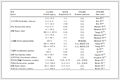
Since the standard reaction conditions of our previous report provided the desired product 1-(2-pyridyl)-β-carboline 2a in 57% yield (Table 1, entry 1) [47], we further optimized the reaction conditions to improve the yield of the product. Variation of solvents (PhMe, MeCN, DCE, DME, DMF, and EtOH) did not lead to higher yields (Table 1, entries 2−7). After carefully examining reaction temperature and concentration, we found that PhCl (0.2 mol/L) at 150 ℃ provided 2a in up to 66% yield (Table 1, entries 8−12). Accordingly, the conditions in entry 11 were identified as optimal (see Supporting information for details).
 DownLoad:
CSV
DownLoad:
CSV
 |
|||||
| Entry | Temp (℃) | Solvent | Time (h) | Conv. (%) | Yield of 2a (%)b |
| 1 | 150 | PhCl | 12 | 93 | 57 |
| 2 | 150 | PhMe | 12 | 45 | 21 |
| 3 | 150 | MeCN | 12 | 34 | 28 |
| 4 | 150 | DCE | 12 | 52 | 34 |
| 5 | 150 | DME | 12 | 75 | 44 |
| 6 | 150 | DMF | 12 | 92 | 55 |
| 7 | 150 | EtOH | 12 | 59 | 34 |
| 8 | 130 | PhCl | 12 | 64 | 44 |
| 9 | 170 | PhCl | 12 | 99 | 54 |
| 10c | 150 | PhCl | 12 | 99 | 56 |
| 11d | 150 | PhCl | 12 | 97 | 66 (64)f |
| 12e | 150 | PhCl | 12 | 92 | 56 |
| a Reaction conditions: 1 (0.2 mmol) in solvent (c = 0.1 mol/L) at 130−170 ℃ for 12 h. b Yields were determined by 1H NMR analysis of the crude reaction mixture using dibromomethane as an internal standard. c c = 0.3 mol/L. d c = 0.2 mol/L. e c = 0.05 mol/L. f Isolated yields. |
|||||
Next, we examined the generality of this protocol with a broad range of C3-substituted indolyl vinyl isonitriles. As shown in Scheme 2, the influence of substituents on the indole benzene ring was first investigated. Electron-donating groups (−Me, −OMe) and halogens (−F, −Cl, −Br) at different positions reacted smoothly to afford the corresponding products 2a−2m in satisfactory yields, demonstrating the wide applicability of this transformation. Multiple substituents on the benzene ring were also tolerated (2n). Notably, a C3-azaindolyl vinyl isonitrile proved suitable, providing 2o in moderate yield. Furthermore, indolyl vinyl isonitriles bearing carbomethoxy (−CO2Me), tert–butoxycarbonyl (−CO2tBu), amide (−CON(C2H4)2O), and tosyl (−Ts) groups readily underwent the cascade cyclization/ring-opening process, affording 1-(2-pyridyl)-β-carbolines 2p−2s in moderate yields. Variation of the N-substituent on the indole was also well tolerated: ethyl (−Et), benzyl (−Bn), allyl (−CH2CH═CH2), aryl (−Ph), heteroaryl (2-thienyl, 3-thienyl), and tert–butoxycarbonyl (−Boc) groups all furnished the desired products 2t−2z in moderate yields, highlighting the excellent functional group compatibility of this method. The structures of 1e (CCDC: 2499375) and 2z (CCDC: 2277411) were unambiguously confirmed by X-ray crystallographic analysis. Remarkably, even N-unsubstituted indolyl vinyl isonitrile participated efficiently, affording 2aa in moderate yield and high-lighting the broad synthetic utility and generality of this protocol.

To demonstrate the practical utility of this strategy, the pro-tocol was successfully applied to the scale-up synthesis of 2a and 2aa, with only a slight decrease in yield, underscoring its suitability for larger-scale applications (Scheme 3a). The synthetic versatility of 1-(2-pyridyl)-β-carbolines was further showcased through post-synthetic derivatizations. For example, reduction of the two ester groups in derivative 2a with LiAlH4 under mild conditions efficiently delivered diol 3 in high yield (Scheme 3b) [62]. Moreover, Pd-catalyzed cross-coupling of 2l furnished π-conjugated (2-pyridyl)-β-carbolines 4 and 5 in excellent yields, bearing p-methoxyphenyl and phenylethynyl substituents on their conjugated backbones, respectively (Scheme 3c) [63,64].

Under the optimized conditions, the ring-opened intermediate could not be detected. To gain deeper insight into the reaction mechanism, a series of control experiments was conducted (Scheme 4). The addition of 2,6-di–tert–butyl–4-methylphenol (BHT) as a radical scavenger only slightly affected the reaction, affording 2a in 62% yield. This observation suggests that the ring-opening process likely proceeds via an ionic rather than a radical pathway. In contrast, the addition of 2,2,6,6-tetramethylpiperidine 1-oxyl (TEMPO), another radical scavenger, suppressed the formation of 2a and instead promoted oxidative aromatization, giving 7a in 65% yield (see Supporting information for details). This outcome indicates that TEMPO acted as a commercially available oxidant rather than simply trapping radicals to generate a bis-β-carboline product [65,66]. Collectively, these findings support the notion that aromatization serves as the driving force for C2−N1 bond activation, consistent with the proposed pathway involving C2−N1 bond cleavage and aromatic framework reorganization [22,51].

Motivated by these findings, we explored the substrate scope, focusing on bis-β-carbolines 7 and other structurally related biheteroaryls. As illustrated in Scheme 5, treatment of C3-substituted indolyl vinyl isonitriles 1 with TEMPO in PhCl under reflux afforded the corresponding bis-β-carboline products 7a−7g in moderate yields (59%−68%). We next investigated ethyl (Z)-2-isocyano-3-(1-methyl-1H-indol-2-yl)acrylate (6a), which underwent direct dimerization to afford bis-γ-carboline 8a as the sole product, without bond cleavage (see Supporting information for details). The observed difference in selectivity between C3- and C2-indolyl vinyl isonitriles can be attributed to the distinct bond dissociation energies (BDEs) of intermediates III and III′ (Figs. S1 and S2 in Supporting information). The C2–N1 bond in III is substantially weaker (BDE = 47.7 kcal/mol) than the corresponding bonds in III′ (C(sp3)–C(sp2): 77.8 kcal/mol; C2–N1: 96.6 kcal/mol). Consequently, cleavage of the C(sp3)−C(sp2) or C2−N1 bond in III′ is disfavored, this intermediate preferentially undergoes oxidative aromatization under aerobic conditions. The scope of this transformation was further established with C2-indolyl vinyl isonitriles 6. Substrates bearing electron-donating (−Me) or halogen (−Cl) substituents on the indole ring smoothly delivered the desired products 8b−8c in moderate yields. The N-Ts substituent on the indole core was also compatible, affording 8d in good yield. Even the unsubstituted indole underwent smooth conversion, providing 8e in moderate yield. Notably, the reaction could be further extended to other C2-substituted heteroaryls, including benzofuran, benzothiophene, and thiophene, which furnished the corresponding products 8f−8h in moderate yields, thereby highlighting the broad functional-group tolerance of this protocol. The structures of 6g (CCDC: 2499374) and 8h (CCDC: 2486264) were unambiguously confirmed by X-ray crystallographic analysis.

In conclusion, we have developed a distinctive, metal-free dimerization strategy for synthesizing 1-(2-pyridyl)-β-carbolines from C3-indolyl vinyl isonitriles through an unprecedented ring-opening pyridannulation process. In addition, an oxidative aromatic dimerization of C3- and C2-substituted heteroaryl vinyl isonitriles has been established, enabling access to diverse carboline-based biheteroaryls, including bis-β-carbolines, bis-γ-carbolines, and their chalcogen analogues. Collectively, this work not only expands the scope of isonitrile dimerization chemistry but also establishes a versatile platform for the synthesis and discovery of novel bioactive biheteroaryls. Further studies are underway to broaden the applicability of this methodology to additional heterocyclic frameworks.
Yu Liu: Methodology. Lan Bao: Methodology. Xiang Lyu: Methodology. Zhonglin Wang: Methodology. Zhengrun Chen: Methodology. Jinhuan Dong: Methodology. Xianxiu Xu: Writing – review & editing, Conceptualization. Zhongyan Hu: Writing – review & editing, Writing – original draft, Conceptualization.
The authors declare that they have no known competing financial interests or personal relationships that could have appeared to influence the work reported in this paper.
We thank the National Natural Science Foundation of China (Nos. 22101159, 22171168), National Science Foundation of Shandong Province (Nos. ZR2022YQ11, ZR2025MS195), and Taishan Scholar Program of Shandong Province for financial support. We gratefully acknowledge Prof. Jianping Ma (SDNU) for assistance with the XRD analyses and Dr. Zhenhua Liu (SDNU) for help with the NMR measurements. Thanks for the Analysis and Test Center of College of Chemistry, Chemical Engineering and Materials Science.
Supplementary material associated with this article can be found, in the online version, at doi:
J. Jurczyk, J. Woo, S.F. Kim, et al., Nat. Synth. 1 (2022) 352–364. doi: 10.1038/s44160-022-00052-1
F.P. Wu, J.L. Tyler, F. Glorius, Acc. Chem. Res. 58 (2025) 893–906. doi: 10.1021/acs.accounts.4c00820
P. Xu, A. Studer, Acc. Chem. Res. 58 (2025) 647–658. doi: 10.1021/acs.accounts.4c00813
L. Ding, Y. Fan, H. Lu, Chem. Soc. Rev. 54 (2025) 8145–8169. doi: 10.1039/D4CS00974F
C. Jing, H.M. Jiang, Q. Yan, et al., Angew. Chem. Int. Ed. 64 (2025) e202512288. doi: 10.1002/anie.202512288
S. Tsuchiya, H. Saito, K. Nogi, H. Yorimitsu, Org. Lett. 21 (2019) 3855–3860. doi: 10.1021/acs.orglett.9b01353
B.D. Dherange, P.Q. Kelly, J.P. Liles, M.S. Sigman, M.D. Levin, J. Am. Chem. Soc. 143 (2021) 11337–11344. doi: 10.1021/jacs.1c06287
J.C. Reisenbauer, O. Green, A. Franchino, P. Finkelstein, B. Morandi, Science 377 (2022) 1104–1109. doi: 10.1126/science.add1383
B.S. Zhang, S.L. Homölle, T. Bauch, et al., Angew. Chem. Int. Ed. 63 (2024) e202407384. doi: 10.1002/anie.202407384
B. Li, V.G. Alfonso, A. Puggioli, et al., J. Am. Chem. Soc. 147 (2025) 24206–24212. doi: 10.1021/jacs.5c06139
B. Ghosh, P. Kafle, R. Mukherjee, et al., Science 387 (2025) 102–107. doi: 10.1126/science.adp0974
A.S. Paschke, Y. Brägger, B. Botlik, et al., Nat. Chem. 17 (2025) 1750–1756. doi: 10.1038/s41557-025-01904-x
Z. Wang, P. Xu, S.M. Guo, C.G. Daniliuc, A. Studer, Nature 642 (2025) 92–98. doi: 10.1038/s41586-025-09019-6
L.J. Liu, M.Y. Tian, Z.Y. Lang, et al., Angew. Chem. Int. Ed. 64 (2025) e202501966. doi: 10.1002/anie.202501966
V. Hutskalova, C. Sparr, Nature 638 (2025) 697–703. doi: 10.1038/s41586-024-08472-z
C. Xin, Z.J. Zhao, W.M. He, Chin. Chem. Lett. 36 (2025) 111583. doi: 10.1016/j.cclet.2025.111583
X. Zhang, Q. Song, S. Liu, et al., Nat. Chem. 17 (2025) 215–225. doi: 10.1038/s41557-024-01680-0
J.A. Leitch, Y. Bhonoah, C.G. Frost, ACS Catal. 7 (2017) 5618–5627. doi: 10.1021/acscatal.7b01785
B. Prabagar, Y. Yang, Z. Shi, Chem. Soc. Rev. 50 (2021) 11249–11269. doi: 10.1039/D0CS00334D
W. Zi, Z. Zuo, D. Ma, Acc. Chem. Res. 48 (2015) 702–711. doi: 10.1021/ar5004303
Y.Z. Liu, H. Song, C. Zheng, S.L. You, Nat. Synth. 1 (2022) 203–216. doi: 10.1038/s44160-022-00039-y
X. Zhang, J.Q. Zhang, Z.H. Sun, et al., Angew. Chem. Int. Ed. 64 (2025) e202420390. doi: 10.1002/anie.202420390
P. Xu, E.U. Würthwein, C.G. Daniliuc, A. Studer, Angew. Chem. Int. Ed. 56 (2017) 13872–13875. doi: 10.1002/anie.201707309
Y.Q. Xiao, K.X. Fang, Z. Zhang, et al., Angew. Chem. Int. Ed. 63 (2024) e202408426. doi: 10.1002/anie.202408426
Y. Zhou, L.S. Wang, Z.H. Li, et al., Org. Lett. 27 (2025) 11848–11853. doi: 10.1021/acs.orglett.5c03710
K. Li, H.F. Lin, H.Y. Bi, et al., Org. Lett. 27 (2025) 11596–11601. doi: 10.1021/acs.orglett.5c03703
P. von Ragué Schleyer, P.K. Freeman, H. Jiao, B. Goldfuss, Angew. Chem. Int. Ed. 34 (1995) 337–340. doi: 10.1002/anie.199503371
H. Saito, H. Yorimitsu, Chem. Lett. 48 (2019) 1019–1028. doi: 10.1246/cl.190393
B.V. Varun, K. Vaithegi, S. Yi, S.B. Park, Nat. Commun. 11 (2020) 6308. doi: 10.1038/s41467-020-19610-2
C. Ren, B. Han, H. Guo, et al., Angew. Chem. Int. Ed. 63 (2024) e202407222. doi: 10.1002/anie.202407222
Y.Z. Sun, Y.A. Wu, J. Shi, et al., Org. Lett. 26 (2024) 625–630. doi: 10.1021/acs.orglett.3c03942
Y. Tian, H. Sun, B. Cui, et al., Chem. Commun. 60 (2024) 11980–11983. doi: 10.1039/D4CC02998D
S. Luo, Z. Hu, Q. Zhu, Org. Chem. Front. 3 (2016) 364–367. doi: 10.1039/C5QO00394F
J. Wu, Z. Peng, T. Shen, Z.Q. Liu, Adv. Synth. Catal. 364 (2022) 2565–2570. doi: 10.1002/adsc.202200256
N. Llopis, P. Gisbert, A. Baeza, Adv. Synth. Catal. 363 (2021) 3245–3249. doi: 10.1002/adsc.202100214
H. Qin, Z. Yang, Z. Zhang, et al., Chem. Eur. J. 27 (2021) 13024–13028. doi: 10.1002/chem.202101527
A.V. Lygin, A. de Meijere, Angew. Chem. Int. Ed. 49 (2010) 9094–9124. doi: 10.1002/anie.201000723
B. Zhang, A. Studer, Chem. Soc. Rev. 44 (2015) 3505–3521. doi: 10.1039/C5CS00083A
M. Giustiniano, A. Basso, V. Mercalli, et al., Chem. Soc. Rev. 46 (2017) 1295–1357. doi: 10.1039/C6CS00444J
S.S. Liu, J.N. Zheng, Z.W. Zhao, et al., Org. Chem. Front. 12 (2025) 2643–2650. doi: 10.1039/D4QO02144D
Z. Hu, H. Yuan, Y. Men, et al., Angew. Chem. Int. Ed. 55 (2016) 7077–7080. doi: 10.1002/anie.201600257
Z. Hu, J. Dong, Y. Men, et al., Angew. Chem. Int. Ed. 56 (2017) 1805–1809. doi: 10.1002/anie.201611024
J. Wang, Z. Li, S. Bai, et al., Chin. Chem. Lett. 34 (2023) 107823. doi: 10.1016/j.cclet.2022.107823
X. Guo, J. Dong, Y. Zhu, et al., Chin. Chem. Lett. 34 (2023) 107608. doi: 10.1016/j.cclet.2022.06.031
G. Wang, M. Jia, H. Liu, et al., Chin. Chem. Lett. 36 (2025) 110705. doi: 10.1016/j.cclet.2024.110705
L. Zhang, L. Bao, T. Song, et al., Chin. Chem. Lett. 36 (2025) 110915. doi: 10.1016/j.cclet.2025.110915
Y. Liu, Q. Tan, L. Bao, et al., Org. Lett. 26 (2024) 5043–5048. doi: 10.1021/acs.orglett.4c01699
X. Guo, H. Wang, Z. Hu, et al., ACS Catal. 15 (2025) 5307–5317. doi: 10.1021/acscatal.5c00608
G. Höfle, B. Lange, Angew. Chem. Int. Ed. 16 (1977) 727–728. doi: 10.1002/anie.197707271
N. Shao, G.X. Pang, X.R. Wang, R.J. Wu, Y. Cheng, Tetrahedron 66 (2010) 7302–7308. doi: 10.1016/j.tet.2010.06.096
R. Adepu, J.R. Dhanaji, P. Samatha, P.S. Mainkar, S. Chan-drasekhar, Org. Lett. 22 (2020) 8224–8228. doi: 10.1021/acs.orglett.0c02749
C. Kaes, A. Katz, M.W. Hosseini, Chem. Rev. 100 (2000) 3553–3590. doi: 10.1021/cr990376z
X.A.F. Cook, A. de Gombert, J. McKnight, L.R.E. Pantaine, M.C. Willis, Angew. Chem. Int. Ed. 60 (2021) 11068–11091. doi: 10.1002/anie.202010631
M. Behforouz, W. Cai, M.G. Stocksdale, et al., J. Med. Chem. 46 (2003) 5773–5780. doi: 10.1021/jm0304414
S. -F. Li, Y. Zhang, Y. Li, et al., Bioorg. Med. Chem. Lett. 22 (2012) 2296–2299. doi: 10.1016/j.bmcl.2012.01.106
S.R.M. Ibrahim, G.A. Mohamed, M.F. Zayed, H.M. Sayed, Drug Res. 65 (2015) 361–365.
J.M. Giulietti, P.M. Tate, A. Cai, B. Cho, S.P. Mulcahy, Bioorg. Med. Chem. Lett. 26 (2016) 4705–4708. doi: 10.1016/j.bmcl.2016.08.047
L. Hao, Y.Y. Ling, J. Wang, et al., J. Med. Chem. 68 (2025) 338–347. doi: 10.1021/acs.jmedchem.4c01948
S.V. Chepyshev, J.A. Lujan-Montelongo, A. Chao, F.F. Fleming, Angew. Chem. Int. Ed. 56 (2017) 4310–4313. doi: 10.1002/anie.201612574
S. Dhiman, U.K. Mishra, S.S.V. Ramasastry, Angew. Chem. Int. Ed. 55 (2016) 7737–7741. doi: 10.1002/anie.201600840
Q. Chen, C. Ji, Y. Song, et al., Angew. Chem. Int. Ed. 52 (2013) 9980–9984. doi: 10.1002/anie.201303449
J.C. Jung, R. Kache, K.K. Vines, et al., J. Org. Chem. 69 (2004) 9269–9284. doi: 10.1021/jo048742o
D. Xu, L. Jin, M. Huang, W. Zhang, Green Chem. 27 (2025) 6880–6886. doi: 10.1039/D5GC01245G
B. Paroi, C.C. Chintawar, M.V. Mane, N.T. Patil, ACS Catal. 15 (2025) 11922–11930. doi: 10.1021/acscatal.5c02663
J.L. Li, Z. Yang, S. Shen, X.L. Yang, X. Niu, J. Org. Chem. 89 (2024) 44–56. doi: 10.1021/acs.joc.3c01316
A. Wang, Y.Z. Liu, Z. Shen, Z. Qiao, X. Ma, Org. Lett. 24 (2022) 1454–1459. doi: 10.1021/acs.orglett.2c00035

Scheme 2 Substrate scope of 1-(2-pyridyl)-β-carbolines. Reaction conditions: 1 (0.2 mmol) in PhCl (1 mL) at 150 ℃ for 12 h. Isolated yields.

Scheme 4 Control experiments and oxidative aromatization. Reaction conditions: 1a (0.2 mmol) and radical scavenger (0.6 mmol) in PhCl (1 mL) at 150 ℃ for 12 h. Isolated yields.

Scheme 5 Synthesis of bis-β-carbolines, bis-γ-carbolines, and their chalcogen analogues. a Reaction conditions A: 1 (0.2 mmol) and TEMPO (0.6 mmol) in PhCl (1 mL) at 150 ℃ for 12 h. b Reaction conditions B: 6 (0.2 mmol) in PhCl (1 mL) at 150 ℃ for 12 h. Isolated yields.
Table 1. Reaction optimization.a
|
|
|||||
| Entry | Temp (℃) | Solvent | Time (h) | Conv. (%) | Yield of 2a (%)b |
| 1 | 150 | PhCl | 12 | 93 | 57 |
| 2 | 150 | PhMe | 12 | 45 | 21 |
| 3 | 150 | MeCN | 12 | 34 | 28 |
| 4 | 150 | DCE | 12 | 52 | 34 |
| 5 | 150 | DME | 12 | 75 | 44 |
| 6 | 150 | DMF | 12 | 92 | 55 |
| 7 | 150 | EtOH | 12 | 59 | 34 |
| 8 | 130 | PhCl | 12 | 64 | 44 |
| 9 | 170 | PhCl | 12 | 99 | 54 |
| 10c | 150 | PhCl | 12 | 99 | 56 |
| 11d | 150 | PhCl | 12 | 97 | 66 (64)f |
| 12e | 150 | PhCl | 12 | 92 | 56 |
| a Reaction conditions: 1 (0.2 mmol) in solvent (c = 0.1 mol/L) at 130−170 ℃ for 12 h. b Yields were determined by 1H NMR analysis of the crude reaction mixture using dibromomethane as an internal standard. c c = 0.3 mol/L. d c = 0.2 mol/L. e c = 0.05 mol/L. f Isolated yields. |
|||||
 下载: 导出CSV

 扫一扫看文章


扫一扫关注我们


 下载:
下载: