School of Civil Engineering and Architecture, East China Jiaotong University, Nanchang 330013, China
b.
Institute of Advanced Materials, Beijing Key Laboratory of Functional Materials for Building Structure and Environment Remediation, Beijing University of Civil Engineering and Architecture, Beijing 100044, China
c.
School of Environmental Science and Engineering, Shandong University, Qingdao 266237, China
Received Date:
25 May 2025 Accepted Date:
26 November 2025 Revised Date:
03 November 2025 Available Online:
15 July 2026
Abstract:
In heterogeneous Fenton-like systems, the oxidative polymerization pathway is of great significance in the field of sustainable water treatment. Unlike the traditional mineralization pathway, it can convert organic pollutants into polymers, thereby achieving the recovery of carbon resources. This paper focuses on the core content related to this pathway, expounding that the mechanism of oxidative polymerization is influenced by multiple factors (catalysts, oxidants, organic matters). Meanwhile, various methods exist for identifying the polymerization pathway, such as electrochemical experiments, Raman spectroscopy analysis, and mass spectrometry technology, which can infer the reaction process and product structure. Additionally, this paper reveals two pathways for pollutant removal through oxidative polymerization: The radical pathway and the non-radical pathway. In the future, advanced characterization techniques should be used to deeply explore the microscopic mechanism of oxidative polymerization, optimize catalyst design, expand practical application research, and explore comprehensive utilization pathways for its products, so as to promote the development of sustainable water treatment technologies.
Over the past few decades, advancements in the field of chemistry have significantly driven societal development, leading to a substantial increase in both the quantity and variety of chemical substances used [1]. However, this has also resulted in the contamination of drinking water sources by complex chemical mixtures, which contain numerous chemicals of emerging concern (CECs) such as pesticides, industrial additives, pharmaceuticals, personal care products, and disinfection by-products [2,3]. These CECs are frequently detected in drinking water and human serum samples, and even at extremely low concentrations, they may exert harmful biological effects on the human body, posing serious threats to public health and the ecological environment [4]. To address the changes in drinking water quality, various water treatment technologies have been developed. Nevertheless, both traditional and advanced water treatment processes often face multiple issues, including heavy reliance on chemical additives, high energy consumption, significant environmental emissions, and stringent operational requirements [5–7]. Additionally, the chemicals used in water treatment processes may generate harmful disinfection by-products, further exacerbating pollution [8–10].
Heterogeneous Fenton-like systems have great potential in eliminating organic substances (such as CECs) from water matrices, which has been extensively explored in recent decades. In contrast, other emerging technologies such as electrocatalysis and photocatalysis, unlike heterogeneous Fenton-like processes, depend on external energy sources such as light irradiation or electricity. Heterogeneous Fenton-like technology, however, has no strict energy dependence. Meanwhile, compared with the continuous electricity consumption of electrocatalysis and the reliance of photocatalysis on specific light sources, the operating cost of heterogeneous Fenton-like technology is more manageable, making it particularly suitable for large-scale engineering applications. Researchers have mostly focused on improving the catalytic performance of heterogeneous Fenton-like systems by regulating the composition [11], size [12], coordination environment [13], and electronic structure [14] of heterogeneous catalysts [15]. However, in heterogeneous catalytic oxidation systems based on hydrogen peroxide (H2O2), persulfate (PS), high-valent metals, and non-metals, the degradation of organic substances does not always proceed through mineralization pathways. Studies have demonstrated that in heterogeneous Fenton-like systems, oxidative polymerization and mineralization are the two primary pathways for the transformation of organic pollutants, with fundamental differences in their reaction mechanisms and final products. Mineralization is a process in which the carbon skeletons of organic pollutants are completely disassembled under the combined action of oxidants and catalysts, ultimately converting them entirely into inorganic substances such as carbon dioxide and water [16–18]. Similar to the traditional Fenton reaction, the hydroxyl radicals (•OH) generated exhibit strong oxidizing properties, capable of gradually oxidizing and decomposing organic pollutants until complete mineralization is achieved [19]. In contrast, oxidative polymerization refers to the coupling reactions between organic pollutant molecules driven by free radicals or non-radical reactive species, leading to the formation of polymers [20]. During this process, the carbon skeletons of organic pollutants are not completely broken; instead, they form polymers with larger molecular weights through chemical bond linkages [21]. For example, in the metal oxyhalide (MOX)/H2O2 system, under specific conditions, pollutants are not decomposed but polymerized through electron transfer, and the generated solid polymers will adhere to the surface of the catalyst [22]. In simple terms, mineralization is deep oxidation with the aim of completely removing organic pollutants; while oxidative polymerization focuses more on the transformation of organic pollutants to achieve the recycling of carbon resources. Compared with the mineralization pathway, the polymerization reaction has lower requirements for oxidation capacity (potential). Studies have shown that in heterogeneous catalytic systems involving H2O2, peroxymonosulfate (PMS) and peroxydisulfate (PDS), the generation of highly oxidizing species such as •OH and sulfate radicals (SO4•−) is challenging, resulting in the occurrence of numerous weaker oxidation and selective non-radical mechanisms during pollutant oxidation, such as singlet oxygen (1O2) [23], electron transfer processes (ETP) [24–26], and high-valent metal oxides (HVMO) [26–28]. Therefore, in the weakly oxidizing environment of heterogeneous catalytic oxidation systems, once the reaction conditions are met, the polymerization pathway should have a higher priority than the mineralization pathway [21]. In the research of Gao et al., the Mn3O4/ACNT/PMS system improved the path selectivity of oligomers through spatial nano-refinement, redirecting the carbon evolution pathway from molecular fragmentation to polymerization, thus achieving energy harvesting and sustainable water purification [29]. Meanwhile, compared with electrocatalytic and photocatalytic technologies, heterogeneous Fenton-like technology can regulate the types and concentrations of free radicals through the selection of oxidant species and catalyst types, facilitating the coupling formation of polymers either in the solution phase or at the catalyst interface. In contrast, photogenerated free radicals tend to recombine on the catalyst surface, resulting in low concentrations of free radicals in the solution phase, which makes it difficult to drive the formation of long-chain polymers. For electrocatalysis, free radicals are mainly generated on the electrode surface, and mass transfer limitations in the solution phase may lead to the deposition of polymers on the electrode surface, causing electrode passivation.
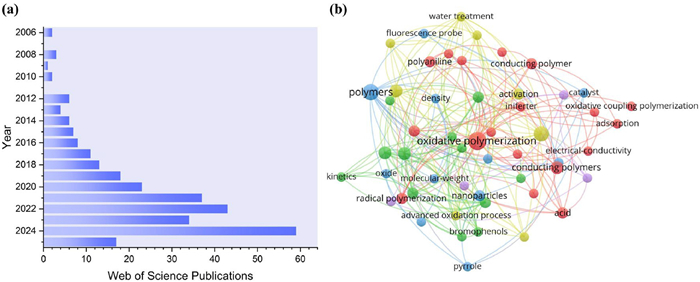
As an important component of heterogeneous Fenton-like systems, the oxidative polymerization pathway has become a research hotspot in the field of sustainable water treatment due to its unique advantages, such as economic efficiency in oxidant consumption and reduced CO2 emissions [21,30,31], high selectivity towards target pollutants, and the realization of carbon resource recovery and reuse, which is highly aligned with the concepts of green chemistry and circular economy [20,31–36]. Recently, the rapid growth in publications on advanced oxidation processes (AOPs) for oxidative polymerization (Fig. 1a), along with the emergence of related network keywords (Fig. 1b), confirms its contribution. However, the research in this field is still in its infancy. There are still a large number of unknowns in the reaction mechanism, influencing factors, and practical application effects of oxidative polymerization in heterogeneous Fenton-like systems, which urgently need to be explored in depth.
Figure 1
Figure 1.
(a) Number of published articles relevant to oxidative polymerization. (b) The corresponding keyword co-occurrence network map. The keyword oxidative polymerization was searched on Web of Science, and the keywords related to oxidative polymerization were visualized using VOS viewer.
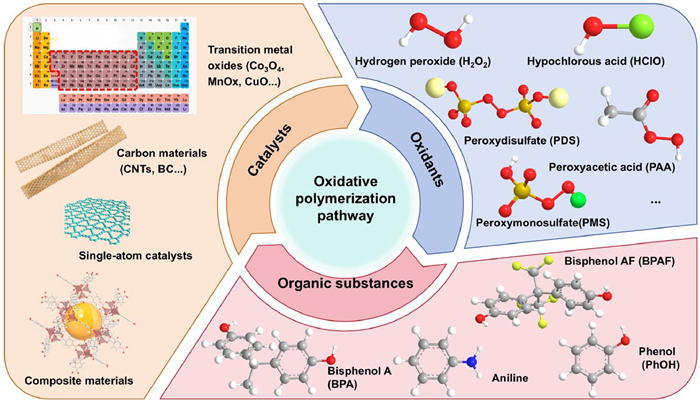
This review summarizes the latest progress in oxidative polymerization pathways within heterogeneous Fenton-like systems. It elaborates on the mechanisms of oxidative polymerization from the perspectives of catalysts, oxidants, and organic matter (Fig. 2), and summarizes the current identification methods of polymerization reactions as well as the mechanisms of polymerization arising from free radical/non-radical processes. Finally, it prospects the challenges and prospects of the oxidative polymerization pathway in practical wastewater treatment. This review provides an in-depth analysis of the oxidative polymerization process in heterogeneous Fenton-like systems, shifting the pollutant degradation pathway from complete mineralization to the green pathway of oxidative polymerization, which is of great significance for promoting the advancement of sustainable water treatment technologies.
Figure 2
Figure 2.
Schematic illustration of the generation pathway of oxidative polymerization.
2.
The mechanism of oxidative polymerization in heterogeneous Fenton-like systems
In heterogeneous Fenton-like systems, oxidative polymerization emerges as a promising pathway with dual values of pollutant removal and resource recovery. Its reaction efficiency and selectivity are synergistically regulated by multidimensional factors. Catalysts, oxidant types, and the intrinsic properties of organic compounds constitute the core determinants of this process (Fig. 2). These three elements collectively govern the initiation of polymerization pathways, generation of reactive species, and product distribution through complex interfacial interactions and multiple mechanisms. The key mechanistic insights and research advancements are analyzed from three aspects as follows:
2.1
The key role of catalysts
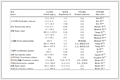
Catalysts play a central role in the oxidative polymerization reaction of heterogeneous Fenton-like systems. Transition metal oxides (such as Co3O4 [37], MnOx [38], NiO [33,39,40], and CuO), carbon materials (such as CNTs [41,42] and biochar [32,43]), and composite materials [44–47] are commonly used Fenton-like catalysts (Table 1) [22,32,33,35,37,38,50–57]. These catalysts have semiconductor or conductor properties, and the metal ions on their surfaces can interact with oxidants and organic pollutants, thereby initiating the oxidative polymerization reaction [48,49].
Table 1
Table 1.
Oxidative polymerization systems with pollutants, catalysts, oxidants, mechanism and polymerization products.
Heterogeneous catalysis, especially transition metal (TM) catalysis, has been widely used in the field of sewage purification due to its high efficiency and low cost [58]. Generally, the adsorbate transformation mechanism (AFM) [59] and the lattice oxygen oxidation mechanism (LOM) [60] of transition metals are the key functions as catalysts in heterogeneous Fenton-like systems. Transition metal oxides with different morphologies exhibit the selective exposure of crystal facets, and different exposed facets, by regulating the adsorption energy, reaction pathways, and surface species distribution, exert a decisive influence on the oxidative polymerization process. For example, cerium oxide (CeO2) is a transition metal oxide with a face-centered cubic crystal structure. Studies have shown that the main exposed plane of CeO2 nanoparticles is (111), while the exposed planes of CeO2 nanorods and nanocubes are located on the (110) and (100) planes respectively. The preferred exposed planes of rod-shaped nanostructures are the (110) and (100) planes, which can provide higher catalytic activity [61]. Similarly, the (110) plane of Co3O4 nanoparticles has a high adsorption energy, which is helpful for binding to oxidants. It can extract H atoms from phenol to form phenoxy radicals, which can further undergo a cross-linking process to form polymers under alkaline conditions [37]. In addition, the facet structure determines the dominant position of the two mechanisms (LOM and AFM). For example, in oxidative polymerization, the α-phase MnO2 (tunnel structure) tends to follow the LOM pathway due to its high lattice oxygen mobility, leading to the formation of linear polymers; in contrast, the γ-phase MnO2 (layered structure) forms cross-linked polymers through the AFM pathway. Yang et al. found that MnOx with controllable crystal structures (α, β, γ, and amorphous-MnO2) and redox states (Mn2O3 and MnO) can induce different oxidation pathways for organic polymerization under acidic conditions [38].
Therefore, the facet engineering strategies of transition metal oxides, such as regulating the exposure ratio of facets via etching or doping, optimizing the electronic structure of facets by introducing defects, and designing multi-facet synergistic catalysis, can regulate the role of oxidative polymerization in heterogeneous Fenton-like systems to a certain extent.
2.1.2
Carbon materials
Carbon materials, such as carbon nanotubes (CNTs), graphene, and biochar, are often used as catalysts or catalyst supports due to their large specific surface area and good electrical conductivity. Researchers usually use strategies such as heteroatom doping, metal loading, or structure regulation to accelerate the electron transfer rate of the system and promote the oxidative polymerization reaction [62]. Due to the fact that carbon atoms in carbon materials form a conjugated system through sp2 hybridization, which features strong electron delocalization but relatively low intrinsic activity, researchers often introduce heteroatoms (such as N, O, S, P, B) with different electronegativities or valence electron configurations from carbon. This introduction leads to the formation of local charge polarization around the doping sites, breaks the intrinsic electronic neutrality of carbon materials, introduces defect sites, and optimizes the charge distribution, thereby accelerating electron transfer. For example, nitrogen-doped carbon nanotubes (NCNTs) have little change in surface area and pore structure, but the graphitization degree and N content increase, breaking the chemical inertness of the C—C network [63]. During the calcination process, the decomposition of oxygen-containing functional groups generates electron holes, and the number of active sites for oxidant activation on NCNTs increases. At the same time, the graphitized structure plays a key role in the electron transfer of pollutants to PMS [64], inducing the transformation of reactive groups from surface-activated complexes to surface radicals, enabling the complete degradation of 2,4,4′-trihydroxybenzophenone within 2 h and the formation of polymer products [42]. Furthermore, the macro/mesoscopic structures of carbon materials (such as specific surface area, porous structure, and dimensionality) can directly affect the diffusion rate of reactants and the length of electron transfer pathways. Therefore, structural regulation can also shorten the electron transfer distance and increase the exposure of active sites, thereby accelerating oxidative polymerization. Wang et al. demonstrated that the fabrication of a hollow hetero-shell structure (H—CN@C) enlarges catalyst pore size, thereby enhancing electron transfer and mass transport rates between pollutants and oxidants. Through the polymerization pathway, this structure enables the conversion of bisphenol AF into less toxic polymeric products, achieving efficient pollutant removal with reduced CO2 emissions, lower oxidant consumption, and shorter reaction durations [55].
2.1.3
Single-atom catalysts
Single-atom catalysts (SACs) have become star materials in the field of heterogeneous Fenton-like systems due to their atomically dispersed active sites, ultrahigh atomic utilization, and tunable electronic structures, and they also play a core role in oxidative polymerization pathways. The electronic structure of SACs can determine the polymerization pathway [65,66]. In a study by Liu et al., the position of the D-band center of single atoms directly dictates their interaction modes with oxidants and pollutants [57]. For single atoms with low d-band centers (Cu, Co, and Ni single atoms), weak binding to peroxymonosulfate (PMS) generates phenoxy radicals through proton-coupled electron transfer (PCET), preferentially initiating surface polymerization reactions. In contrast, for single atoms with a higher D-band center, such as Fe single atoms, density functional theory (DFT) calculations reveal that the stronger interaction between the Fe 3d orbitals and O 2p orbitals leads to the formation of PMS*-Fe(Ⅳ)=O in the axial direction. This subsequently results in the over-oxidation of pollutants into small-molecule acids, triggering the mineralization of pollutants and a significant reduction in polymerization efficiency (with a polymerization transfer ratio of only 44.9%). Therefore, Liu et al. proposed that polymerization transfer (PT) can be achieved by lowering the D-band center. Additionally, the spatial location of single atoms and coordination environments affect the accessibility of active sites and reaction pathways. The Cusur−MgO catalyst with surface-supported sites features unsaturated coordination and high surface exposure, which accelerates PMS activation and phenoxy radical generation, achieving nearly 100% phenolic removal through a non-radical pathway with a PT ratio of 98.8%. In contrast, the Culat−MgO catalyst with lattice-embedded sites tends to generate radicals (•OH, SO4•−) due to saturated coordination, leading to a mixed pathway of polymerization and mineralization [67].
As a special type of single-atom catalyst, high-entropy spinel oxides (HESOs) achieve directional PT of pollutants through synergistic multi-metal sites and high-entropy structural regulation, mediating electron transfer via surface-activated PMS* [68]. This differs from the SACs mentioned above, which rely on high-valent metal-oxo species and radical pathways for PT. Therefore, polymerization in Fenton-like systems based on SACs is not formed by a specific radical/non-radical pathway, but rather initiates oxidative polymerization through corresponding pathways according to the different characteristics of each system, which will be discussed in Section 4 of the article.
2.1.4
Composite materials
Due to the special nature of some pollutants, single-component catalysts are difficult to meet the requirements of low-temperature activity, selectivity, and stability simultaneously [69]. Consequently, researchers have engineered diverse multicomponent catalysts to fabricate composite materials with superior activity, selectivity, and stability via multicomponent functional synergism. For instance, advanced materials like metal-organic frameworks (MOFs) and covalent organic frameworks (COFs) exhibit exceptional performance in oxidative polymerization reactions, attributed to their highly ordered architectures and abundant active sites [70]. The UiO-66-(NH2)-(Zr/Fe)/GA composite material can activate H2O2 to generate •OH by fixing active Fe sites, efficiently remove phenolic pollutants, and also change the reaction path from ring-opening to oligomerization [71]. In addition, Meng et al. prepared composite materials with asymmetric oxygen vacancies by a high-temperature oxygen-deficient calcination strategy, namely, the interface-type AS-Ovs CuxO/ZnO composite material and the surface-type AS-OVs Cu-doped ZnO (Cu-ZnO) composite material [56]. The interface AS-OVs can trigger the polymerization deposition path through ETP at a low PMS dosage, greatly improving the removal efficiency of the pollutant BPA, and also changing the carbon transfer path, significantly reducing the generation of toxic by-products.
2.2
The significant influence of oxidants
Different oxidants have different effects on the oxidative polymerization reaction in heterogeneous Fenton-like systems. H2O2 is one of the common oxidants. In Fenton-like reactions, it can be activated by catalysts to generate •OH, thereby initiating the oxidative polymerization of organic pollutants. In heterogeneous systems, metal ions play an important role in the •OH based polymerization process. For example, Fe2+, Fe3+, Cu2+, Co2+, which can not only promote the generation of •OH to assist hydroxylation/phenolation but also act as ligands in the coordination reaction between catechol groups and phenolic compounds, thus forming metal coordination polymers (metal-phenol networks) to achieve the efficient removal and polymerization of phenolic pollutants [72]. Due to their strong oxidizing power and wide pH application range, persulfates like PMS and PDS are widely used in oxidative polymerization reactions. PMS can be activated by transition metal ions, oxides, and carbonaceous semiconductors to generate reactive species such as SO4•−, •OH, and 1O2. High-entropy alloy nanoparticles (HEA-NPs) loaded onto nitrogen-doped carbon supports (HEAs) can first activate a low dose of PMS and selectively convert phenolic substances into high-molecular-weight products through the polymerization pathway, with an electron utilization efficiency of up to 213.4%. PDS is relatively stable in nature. Its symmetric molecular structure and strong O—O bond endow it with a unique role in the reaction. For example, under ultraviolet irradiation, phenol is oxidized by SO4•− to generate PhO•, triggering the coupling and polymerization process [73]. For the thermal/PDS process, the solid polymer yield increases with the increase in temperature. In the range of 50–80 ℃, due to the decomposition of PDS, the generation of radicals is controlled, and the polymerization kinetics is accelerated [74]. Compared with other common oxidants such as permanganate and periodate, peroxyacetic acid (PAA) does not change the color of the solution, and the possibility of generating toxic disinfection by-products is also low. It has currently been widely used in the fields of wastewater treatment, the textile industry, medicine, and food processing. Past studies have all used PAA as an oxidant to oxidize and remove natural polyphenol substances. Li et al. focused on the PAA-mediated natural polyphenol system and found that in the protocatechuic acid (PCA)/PAA system, PCA is directly oxidized by PAA to generate protocatechuic quinone (PCQ), which forms a covalent bond with the aniline in the sulfamethoxazole (SMX), and then generates oligomers, selectively removing the pollutant SMX through the polymerization pathway [75].
2.3
The important role of the properties of organic substances
The structure and properties of organic substances themselves have a non-negligible impact on the oxidative polymerization reaction in heterogeneous Fenton-like systems. Organic substances containing aromatic rings and electron-donating substituents, such as phenolic [76–79], aniline, pyrrole, and thiophene compounds, are more likely to undergo oxidative polymerization reactions. The electron cloud distribution characteristics of these compounds enable them to effectively interact with reactive species, thereby triggering the generation and polymerization reaction of radicals/non-radicals. Taking phenolic compounds as an example, the phenolic hydroxyl group is the reactive site of the reaction. Under alkaline conditions, the phenolic hydroxyl group is deprotonated to form a phenoxide anion, and then the phenoxide anion transfers electrons to the metal catalyst to form a phenoxy radical, thus triggering C—O coupling to form 2,6-dimethyl-1,4-phenoxy (PPO) or C—C coupling to form 3,3′,5,5′-tetramethyldiphenylquinone (DPQ) [80]. Aniline monomers can undergo C—N coupling to generate 4-aminodiphenylamine (4-ADPA), C—C coupling to generate benzidine, and N—N coupling to generate azobenzene under oxidation conditions. Pyrrole cation radicals can undergo C—C coupling to lose two protons to form neutral pyrrole dimers, or further undergo C—C coupling with another pyrrole cation radical to generate trimers. Thiophene undergoes C—C coupling in three specific forms, head-to-head (α-α), head-to-tail (α-β), and tail-to-tail (β-β), to form polythiophene chains [81,82]. However, there are still controversies regarding the specific coupling mechanisms mentioned above. In addition, the concentration of organic substances can also affect the oxidative polymerization reaction. Within a certain range, increasing the concentration of organic substances is beneficial to the progress of the polymerization reaction. However, when the concentration is too high, it may consume radicals excessively and instead inhibit the polymerization reaction [34]. In addition, the pH of the solution can change the existence form and reaction activity of organic substances, thereby affecting the efficiency of the oxidative polymerization reaction. In the CuO/PDS system, the polymerization efficiency of phenolic substances reaches the highest when the solution pH is close to its pKa value. This is because under this pH condition, through the PCET process, the hybrid hydrogen bond is more likely to break, promoting the polymerization reaction [33,39,40].
3.
Reaction pathways for pollutant removal by oxidative polymerization
3.1
Radical pathway
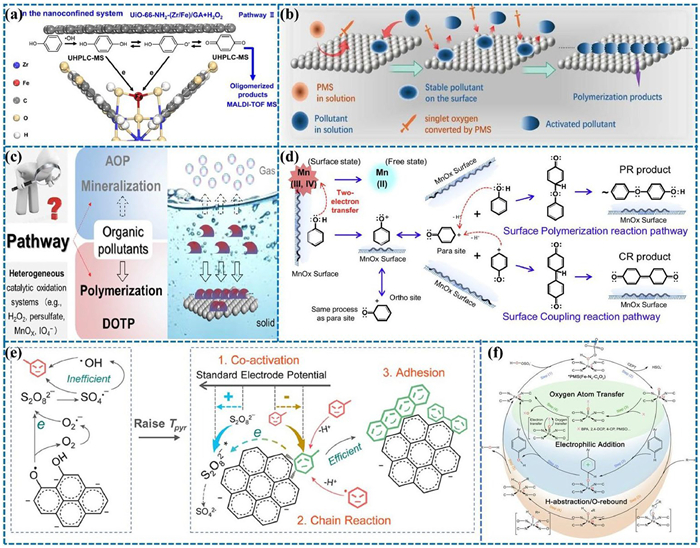
In heterogeneous Fenton-like systems, the radical pathway is an important approach for pollutant removal via oxidative polymerization. Once the oxidant in the system is activated by the catalyst, a large number of radicals such as •OH and SO4•− are generated [83]. These radicals possess extremely strong oxidizing power and can react with organic pollutants. Taking phenolic pollutants as an example, •OH can interact with phenolic hydroxyl groups through addition reactions or hydrogen atom abstraction reactions, generating phenoxy radicals. The phenoxy radicals then couple with each other to form dimers or polymers (Fig. 3a), thereby achieving the polymerization and removal of pollutants [51]. In reactions involving persulfates, SO4•− can react with aromatic compounds containing electron-donating substituents through single-electron transfer and radical addition reactions, generating aromatic radical cations and subsequently initiating the polymerization reaction. However, due to the excessively high reactivity of radicals, the reaction selectivity is relatively poor. This can easily lead to the over-oxidation of organic pollutants, producing small-molecule oxidation products or even complete mineralization. Moreover, radicals are highly susceptible to interference from other substances in the solution, such as background ions and dissolved organic matter, which can affect the efficiency and selectivity of the oxidative polymerization reaction.
Figure 3
Figure 3.
(a) The polymerization process in UiO-66-NH2-(Zr/Fe)/GA + H2O2 nanoconfined system. Copied with permission [51]. Copyright 2024, the authors. (b) Scheme of the oxidative polymerization of phenolic contaminant over CuO@CuCeyO1+2y+x/2-IE. Copied with permission [50]. Copyright 2024, Elsevier. (c) Schematic diagram of the polymerization pathway (solid black line) and mineralization pathway (dashed black line) in heterogeneous catalytic oxidation systems for the removal of organic pollutants from water. Copied with permission [21]. Copyright 2024, American Chemical Society. (d) Proposed elementary reaction pathways of PhOH (from reactants to the surface coupling and polymerization reaction products) in the MnOX solid–aqueous interface oxidation systems. Copied with permission [20]. Copyright 2023, the authors. (e) Proposed mechanisms of phenol degradation in biochar/PDS systems. Copied with permission [43]. Copyright 2023, American Chemical Society. (f) The Fe(Ⅳ)=O oxidizes pollutants through the OAT reaction, electrophilic addition, and H-abstraction/O-rebound mechanism. Copied with permission [84]. Copyright 2025, the authors.
The non-radical pathway is equally crucial in the process of pollutant removal by oxidative polymerization and exhibits high selectivity. 1O2 is an important non-radical reactive species. Although its reaction activity is relatively low, it has a high selectivity for electron-rich organic compounds. In some systems, 1O2 can be generated by activating oxidants such as persulfates. For example, in the system where CuO catalyzes and activates PMS, 1O2 can selectively attack the phenolic hydroxyl groups of phenolic pollutants, promoting the formation of polyphenols (Fig. 3b) [50]. The ETP is also an important non-radical pathway, including the catalyst-oxidant complex and the direct oxidation transfer process (DOTP). In the catalyst-oxidant complex pathway, the oxidant adsorbs onto the catalyst surface to form a reactive complex, which captures electrons from organic pollutants and initiates polymerization. Zhang et al. introduced the DOTP (two-electron direct oxidation pathway) to distinguish between mineralization and polymerization mechanisms in heterogeneous catalytic systems (Figs. 3c and d) [20,21]. It was proposed that there is a polymerization reaction through the two-electron direct oxidation pathway in heterogeneous reaction systems, enabling the efficient and complete removal of organic pollutants in water without degradation. The DOTP mechanism addresses a typical discrepancy in electron equivalent conservation, where the total electrons acquired by the oxidant are significantly fewer than those contributed by pollutants. During the DOTP process, the oxidized pollutant intermediates are adsorbed on the catalyst surface and directly undergo electron transfer, spontaneously coupling and polymerizing with other intermediates or pollutant molecules on the surface, promoting pollutant polymerization. This entire process requires much less oxidant, and there are almost no residual by-products in the water. This surface-dependent DOTP reaction is commonly found in high-valent MnOX (i.e., Mn3O4, Mn2O3, and MnO2) oxidation systems, as well as in solid FeOCl/H2O2 and Co3O4/PS heterogeneous Fenton catalytic oxidation systems, showing great potential in water purification applications. In addition, biochar can combine with persulfate to form an electrophilic complex. Meanwhile, phenolic pollutants are adsorbed on the catalyst surface, triggering electron transfer and achieving the polymerization and removal of phenolic pollutants(Fig. 3e) [43].
High-valent metal species, such as Fe(Ⅳ) and Mn(Ⅴ), can also initiate the polymerization reaction of organic pollutants. These high-valent metal species have strong oxidizing power and selectivity. The key step in oxidizing model pollutants is the transformation of high-valent metals (oxygen species) to low-valent metals, followed by the participation of low-valent metals in the cleavage of peroxy bonds. Currently, the three recognized oxidation pathways, namely the ETP, oxygen atom transfer (OAT), and hydrogen atom transfer (HAT), mainly revolve around electron transfer. However, this classification method has limitations. For example, ETP and OAT overemphasize electron transfer while ignoring the interfacial process, and HAT assumes that protons and electrons originate from and terminate at the same bond, which does not conform to the actual situation. In the study by Chen et al., in the Fe-N4C6O2/PMS system, the electrons in the transition metal-mediated activation process of the peroxy bond at the solid-liquid interface usually occupy the available d orbitals of metal sites, while protons attach to the interfacial oxygen atoms. It is not a simple single-electron transfer process. Instead, Fe(Ⅳ)=O fills the electrons of pollutants into the low σ* orbitals of Fe/O through the mechanisms of oxygen atom transfer, electrophilic addition, proton abstraction/oxygen rebound, forming a pollutant-O-Fe intermediate and driving the oxidative polymerization of Bisphenol A (BPA) (Fig. 3f) [84].
4.
Identification methods of the oxidative polymerization pathway
4.1
Conventional detection methods
Quenching experiments and electron paramagnetic resonance (EPR) technology [85] are important means for identifying reactive species in the oxidative polymerization pathway (Fig. 4a) [86]. However, EPR technology also has certain limitations. The advantage of the probe molecule method is its high specificity, which can accurately detect the target reactive species. However, appropriate probe molecules need to be selected, and it is necessary to ensure that their reactions with other substances cause minimal interference. By detecting the reaction products, the types of reactive species and the reaction pathways can be determined (Fig. 4b). In addition, the combination of multiple characterization techniques, such as transmission electron microscopy (TEM), electron energy loss spectroscopy (EELS), X-ray photoelectron spectroscopy (XPS), and Fourier transform infrared spectroscopy (FTIR), can better help identify the formation of polymer products. For example, EELS spectra can show whether there is a large amount of carbon accumulation on the catalyst surface after the reaction. At the same time, by combining XPS and FTIR to analyze the change characteristics of C—C, C—N, and C—O bonds. In the study by Mo et al., according to the Fourier transform infrared spectrum, an aromatic C═C/C—C stretching vibration was found at 1406–1613 cm-1 for the reactant 5M+Co. Meanwhile, a slight red shift of the peak of the substance on 5M+Co was observed in the spectrum of bisphenol A, indicating that bisphenol A had produced polymer products (Figs. 4c-f) [68].
Figure 4
Figure 4.
(a) EPR spectra of DMPOX adducts in the nZV-ClO2– system with different scavengers. (b) PMSO transformation and PMSO2 yield in the nZVI- ClO2– system and PMSO2 production and Fe(Ⅳ)=O selectivity in the reaction of nZVI with other conventional oxidants. Copied with permission [86]. Copyright 2023, the authors. (c) HR-TEM image of reacted 5M+Co catalysts. (d) C 1s XPS spectra of pristine and reacted 5M+Co catalysts. (e) Comparison of STEM-EELS spectra of pristine and reacted 5M+Co. (f) FTIR spectra of pristine and reacted 5M+Co catalysts and BPA. Copied with permission [68]. Copyright 2025, American Chemical Society.
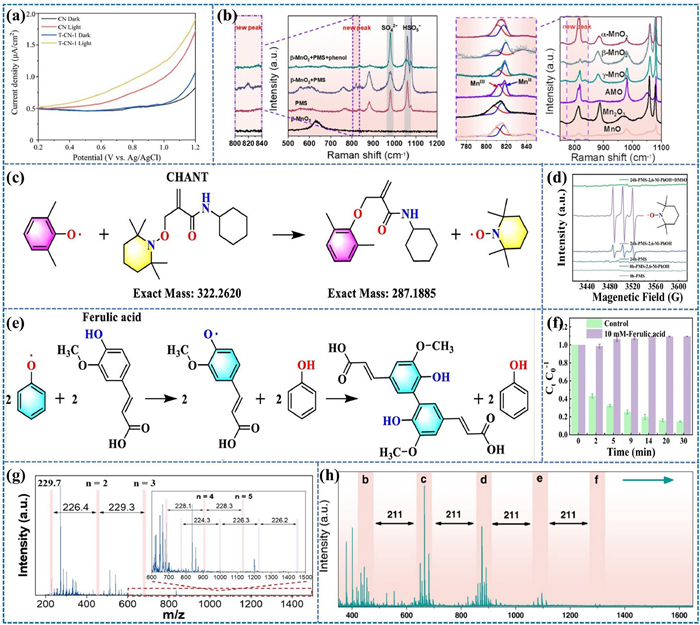
In addition to EPR technology and the probe molecule method, there are other methods available for identifying the oxidative polymerization pathway. Electrochemical experiments can study the ETP and the generation mechanism of reactive species in the reaction system by measuring parameters such as electrode potential and current. When studying a graphite-enhanced Fenton-like system, using linear sweep voltammetry (LSV) and open circuit potential testing (OCPT) can reveal the reduction process of iron ions and the formation of surface complexes (Fig. 5a) [87]. Furthermore, combining Raman spectroscopy analysis can detect changes in chemical bonds and reactive species on the catalyst surface, thereby inferring the reaction process and the formation of polymer products. In the study of the activation of PMS by Mn3O4 catalysis, Raman spectroscopy showed that as the reaction progressed, the characteristic peaks related to Mn3O4 changed, indicating that a chemical reaction occurred on the catalyst surface (Fig. 5b) [38]. Regarding the phenoxy radical, one of the important intermediates in the polymerization formation process, Liu et al. proposed two innovative schemes, using (2,2,6,6-tetramethylpiperidin-1-yl)oxyl (TEMPO) trapping agent (CHANT) as the trapping agent and ferulic acid (FA) as the quenching agent, to identify the phenoxy radical (Figs. 5c-f) [57]. Simultaneously, to mitigate false positives from trapping agents, mass spectrometry techniques, including ultra-high performance liquid chromatography-quadrupole time-of-flight mass spectrometry (UPLC-QTOF-MS) and matrix-assisted laser desorption/ionization time-of-flight mass spectrometry (MALDI-TOF-MS), are employed to characterize reaction products’ structures and compositions. This approach provides direct evidence for identifying oxidative polymerization pathways (Figs. 5g and h) [35,38]. In addition, a large number of transient intermediates (such as free radicals, cationic/anionic active species) are generated during the oxidative polymerization process, which are difficult to be directly captured by experimental methods. DFT can verify the rationality of these intermediates and explain their reactivity by optimizing their geometric structures, calculating their vibrational frequencies (for infrared spectrum simulation), and analyzing their electronic properties (such as charge distribution and spin density). For instance, in the oxidative polymerization of phenolic compounds, where intermediates form oligomers through C—C bond linkage, DFT can be employed to calculate the possible structures of dimers or trimers. By analyzing parameters like bond length and bond energy, the polymerization sites (e.g., ortho-position of benzene rings, para-position of amino groups) can be identified, thereby facilitating a better understanding of the formation of polymerization products.
Figure 5
Figure 5.
(a) Linear sweep voltammetry (LSV) curves of CN and T-CN-1 under dark and light irradiation conditions. Copied with permission [87]. Copyright 2023, Elsevier. (b) In situ Raman spectra of β-MnO2 in the liquid solution and Raman spectra of MnOx+PMS. Copied with permission [38]. Copyright 2022, Elsevier. (c) A versatile approach for seques-tering phenoxyl radicals using CHANT. (d) EPR spectra for probing the reaction product between CHANT and phenoxyl radicals. (e) Schematic illustration of phenoxyl radicals quenchingby FA. (f) The effect of FA on PhOH degradation. Copied with permission [57] Copyright 2024, the authors. (g) MALDI-TOF-MS spectra of the products eluted by THF (inset: enlarged image). Copied with permission [35] Copyright 2025, the authors. (h) MALDI-TOF mass spectra of polyphenols attached on β-MnO2 (β-MnO2-PMS. Copied with permission [38]. Copyright 2022, Elsevier.
The core environmental value of oxidative polymerization lies in breaking the traditional one-way consumption mode of degradation-mineralization and realizing the resource recycling of organic pollutants. The high-value application of polymeric products is exemplified by the conversion of pollutants containing aromatic rings or electron-donating groups (such as phenols, anilines, and thiophenes) into functional polymers like polyphenols, polyanilines, and polythiophenes through oxidative polymerization. These products, featuring excellent conductivity, adsorptivity, or chemical stability, can be directly applied in fields such as semiconductor materials, supercapacitor electrodes, and heavy metal adsorbents, thus achieving the direct transformation from waste to resource.
Meanwhile, heterogeneous catalysts (e.g., CNTs, MOFs) can remove the polymers attached to their surfaces through organic solvent elution, electrochemical oxidation, and other methods via surface modification or structural design, thereby regenerating active sites. For instance, after elution with ethanol, NCNTs retain over 85% of their initial polymerization efficiency for 2,4,4′-trihydroxybenzophenone, which reduces solid waste pollution caused by catalyst replacement and realizes resource reuse, forming a closed-loop cycle from pollutant to resource.
5.2
Current research gaps
Although the oxidative polymerization reaction in heterogeneous Fenton-like systems shows great potential in the field of water treatment, there are still many unresolved issues. In terms of the reaction mechanism, although certain knowledge about radical and non-radical pathways has been obtained, the generation, transformation, and interaction mechanisms of various reactive species under different reaction conditions remain to be further studied. For some complex organic pollutants, the specific reaction pathways and intermediate products of their oxidative polymerization are still unclear. In terms of catalysts, although many catalysts have been developed to promote the oxidative polymerization reaction, the stability and selectivity of catalysts still need to be further improved. Some catalysts are easily affected by organic pollutants or reaction products during the reaction process, resulting in a decrease in activity or even deactivation. In addition, a more in-depth exploration of the relationship between the structure and performance of catalysts is required to guide the design and development of new and efficient catalysts. In terms of practical applications, most current research remains at the laboratory stage. For engineering application problems in large-scale actual wastewater treatment, such as reactor design, operating costs, and the stability of treatment efficiency, further research and exploration are needed.
5.3
Future research directions
Future research can be carried out from the following aspects:
(1) Efforts should be made to strengthen the design and optimization of catalysts. By regulating the structure, composition, and surface properties of catalysts, their stability and selectivity can be enhanced. During the oxidative polymerization process, catalysts may face multiple challenges: first, the loss of active sites, such as the migration, agglomeration, or leaching of single atoms in a strong oxidizing environment; second, the coverage of polymerization products, as macromolecular polymers may block the catalyst pores or occupy active sites, leading to increased mass transfer resistance; third, chemical erosion from complex matrices, for instance, high concentrations of acids or alkalis may destroy the lattice structure or coordination bonds of the catalysts. In the future, it is necessary to combine high-resolution characterization techniques (e.g., aberration-corrected electron microscopy, in-situ XPS) to track the atomic-level structural changes of catalysts during the reaction, thereby revealing the coupled attenuation mechanism involving active site loss-polymer deposition-support corrosion. Meanwhile, strategies to improve stability through structural design should be explored, such as constructing core-shell structures to inhibit the leaching of active components, or introducing hydrophobic groups to modify the catalyst surface for reducing polymer adsorption, so as to achieve the synergistic optimization of high activity and high stability.
(2) Expand the application research of oxidative polymerization technology in actual wastewater treatment, and carry out pilot-scale and large-scale experiments to solve key issues in practical applications, such as improving treatment efficiency, reducing operating costs, and minimizing secondary pollution. Actual wastewater often contains high concentrations of salts (e.g., Cl-, SO42-), natural organic matter (NOM), coexisting ions (e.g., Ca2+, Mg2+), and complex pollutant mixtures. These components may affect catalytic efficiency through competitive adsorption on active sites, side reactions with oxidants, or altering the redox potential of the solution. Therefore, it is necessary to systematically investigate the dynamic interactions between the electronic structure, coordination environment of catalysts and matrix components in different actual wastewaters (e.g., printing and dyeing wastewater, coking wastewater, pharmaceutical wastewater), and establish a correlation model of catalyst structure-matrix characteristics-polymerization efficiency, so as to provide theoretical support for the targeted design of anti-interference catalysts. Additionally, study the applicability of oxidative polymerization technology under different water quality conditions and develop treatment processes for specific wastewaters.
(3) Explore comprehensive utilization pathways for oxidative polymerization products. Macromolecular polymers generated from oxidative polymerization reactions (e.g., phenolic polymers, dye aggregates) are currently mostly regarded as by-products or waste materials. However, by regulating reaction conditions (such as catalyst type, oxidant dosage, and reaction pH) to directionally control the molecular structure and physicochemical properties of the products, they can be converted into high-value-added products, thereby achieving a closed loop of wastewater treatment-resource recovery. For instance, phenolic polymers, which possess structural characteristics similar to natural humus, can serve as soil conditioners to enhance the fertilizer retention capacity of soil. Nitrogen-containing polymers (e.g., aniline-based polymerization products) are promising for the preparation of low-cost supercapacitor electrode materials due to their electrical conductivity. Moreover, polymeric products with porous structures can be transformed into high-efficiency adsorbents through simple modification (e.g., loading with metal ions), which can be used to remove heavy metals or dye pollutants from water. Future research should focus on the structure-performance relationship of polymerization products, establish an integrated process for product separation, purification, and functional modification, and evaluate their environmental safety in application scenarios (e.g., biological toxicity, degradability), so as to provide technical support for maximizing resource utilization.
Declaration of competing interest
The authors declare that they have no known competing financial interests or personal relationships that could have appeared to influence the work reported in this paper.
This work was supported by the Natural Science Foundation of China (No. 52160001), the Science and Technology Project of Water Resources Department of Jiangxi Province (No. 202526YBKT30), the Key Natural Science Foundation of Jiangxi Province (No. 20242BAB26085), Science and Technology Project of Water Resources Department of Jiangxi Province (No. 202425YBKT26).
[1]
A.C. Johnson, X. Jin, N. Nakada, et al., Sci. 367 (2020) 384–387. doi: 10.1126/science.aay6637
[2]
X.W. Yao, X. Chen, M. -L. Chen, et al., Process Saf. Environ. Prot. 186 (2024) 808–818. doi: 10.1016/j.psep.2024.04.076
Figure 1
(a) Number of published articles relevant to oxidative polymerization. (b) The corresponding keyword co-occurrence network map. The keyword oxidative polymerization was searched on Web of Science, and the keywords related to oxidative polymerization were visualized using VOS viewer.
Figure 3
(a) The polymerization process in UiO-66-NH2-(Zr/Fe)/GA + H2O2 nanoconfined system. Copied with permission [51]. Copyright 2024, the authors. (b) Scheme of the oxidative polymerization of phenolic contaminant over CuO@CuCeyO1+2y+x/2-IE. Copied with permission [50]. Copyright 2024, Elsevier. (c) Schematic diagram of the polymerization pathway (solid black line) and mineralization pathway (dashed black line) in heterogeneous catalytic oxidation systems for the removal of organic pollutants from water. Copied with permission [21]. Copyright 2024, American Chemical Society. (d) Proposed elementary reaction pathways of PhOH (from reactants to the surface coupling and polymerization reaction products) in the MnOX solid–aqueous interface oxidation systems. Copied with permission [20]. Copyright 2023, the authors. (e) Proposed mechanisms of phenol degradation in biochar/PDS systems. Copied with permission [43]. Copyright 2023, American Chemical Society. (f) The Fe(Ⅳ)=O oxidizes pollutants through the OAT reaction, electrophilic addition, and H-abstraction/O-rebound mechanism. Copied with permission [84]. Copyright 2025, the authors.
Figure 4
(a) EPR spectra of DMPOX adducts in the nZV-ClO2– system with different scavengers. (b) PMSO transformation and PMSO2 yield in the nZVI- ClO2– system and PMSO2 production and Fe(Ⅳ)=O selectivity in the reaction of nZVI with other conventional oxidants. Copied with permission [86]. Copyright 2023, the authors. (c) HR-TEM image of reacted 5M+Co catalysts. (d) C 1s XPS spectra of pristine and reacted 5M+Co catalysts. (e) Comparison of STEM-EELS spectra of pristine and reacted 5M+Co. (f) FTIR spectra of pristine and reacted 5M+Co catalysts and BPA. Copied with permission [68]. Copyright 2025, American Chemical Society.
Figure 5
(a) Linear sweep voltammetry (LSV) curves of CN and T-CN-1 under dark and light irradiation conditions. Copied with permission [87]. Copyright 2023, Elsevier. (b) In situ Raman spectra of β-MnO2 in the liquid solution and Raman spectra of MnOx+PMS. Copied with permission [38]. Copyright 2022, Elsevier. (c) A versatile approach for seques-tering phenoxyl radicals using CHANT. (d) EPR spectra for probing the reaction product between CHANT and phenoxyl radicals. (e) Schematic illustration of phenoxyl radicals quenchingby FA. (f) The effect of FA on PhOH degradation. Copied with permission [57] Copyright 2024, the authors. (g) MALDI-TOF-MS spectra of the products eluted by THF (inset: enlarged image). Copied with permission [35] Copyright 2025, the authors. (h) MALDI-TOF mass spectra of polyphenols attached on β-MnO2 (β-MnO2-PMS. Copied with permission [38]. Copyright 2022, Elsevier.


 DownLoad:


 下载:
下载:


 下载:
下载:

