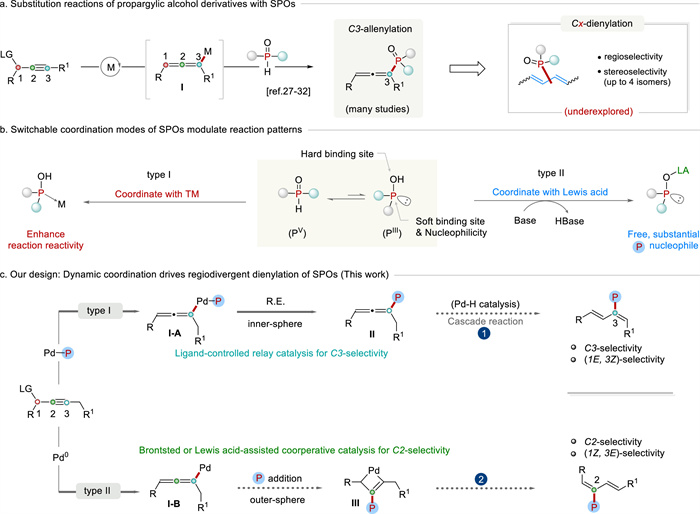
Scheme 1.
Difficulties and improvements in the synthesis of phosphinylated dienes.

Dynamic coordination drives regiodivergent dienylation of propargylic esters with phosphine oxides
Chen Zhou , Yuxuan Shi , Leyang Zhang , Mengfu Dai , Lanzhu Tai , Qiang Dai , Liang-An Chen


The continuous development of phosphorus chemistry remains an important theme in both industrial and academic contexts, with widespread applications across organic chemistry [1,2], materials science [3–7], and medicinal chemistry [8–10]. The strategic incorporation of phosphorus atoms enables significant modulation of the physicochemical properties of organic molecules, thereby enhancing molecular functionalities while simultaneously expanding structural diversity and complexity. As a result, molecular phosphating has emerged as a powerful and versatile strategy for designing and synthesizing structurally sophisticated molecules [11–16].
Among organophosphorus compounds, vinyl phosphines serve as key synthetic precursors for constructing essential molecular frameworks [12–14]. Notably, 1,3-dienyl phosphines featuring conjugated diene moieties represent a privileged structural class that functions as versatile synthetic building blocks (e.g., Diels-Alder cycloaddition) [2,3,16–20] and biologically active reagents [15,21,22]. Despite this significance, synthetic routes to 1,3-dienyl phosphorus compounds remain exceptionally limited [14,23–25].
Transition-metal catalyzed substitution of readily accessible propargylic electrophiles with synthetically versatile and air-stable secondary phosphine oxides (SPOs) constitutes a powerful strategy for constructing phosphorus-containing frameworks (Scheme 1a) [26–32]. While significant progress has been predominantly achieved in the highly regioselective synthesis of propargyl- [26] or allenyl-phosphines [27–32], the development of synthetic methodologies for synthetically useful 1,3-dienyl phosphines remains substantially underdeveloped (Scheme 1a). To date, the high regioselective dienylation of SPOs still suffers considerable challenges: (1) The dynamic tautomeric equilibrium of SPOs between pentavalent (phosphine oxide) and trivalent (phosphinous acid) forms imparts complex coordination behavior with catalytic metals [33,34], potentially generating unpredictable Type Ⅰ/Ⅱ catalytic pathways that compromise reaction selectivity and substrate compatibility (Scheme 1b) [35–37]. (2) The inherent complexity of allenyl-metal intermediates Ⅰ (Scheme 1a), featuring multiple potential reactive sites (C1, C2, and C3), makes regiocontrol particularly demanding [38–45]. (3) Controlling E/Z-stereoselectivity in conjugated diene systems represents a fundamental challenge, especially for non-terminal multisubstituted dienes that may generate up to four stereoisomers [46,47]. Guo’s group made an elegant contribution by developing a ligand-controlled strategy for the dienylation of SPOs with propargylic carbonates under acidic conditions, affording 1,3-dienyl phosphines with C2-selectivity [30]. Furthermore, Li and Ma groups strategically employed allenylic acetates and SPOs to achieve the synthesis of terminal 1,3-dienyl phosphines with high regio-selectivity [48]. Considering the limitations and challenges, establishing robust synthetic protocols to access structurally diverse 1,3-dienyl phosphines would significantly expand the available chemical space, enabling the exploration of novel molecular architectures with enhanced complexity and functionality.
We disclose our contribution to developing an efficient strategy for the dienylation of SPOs with propargylic esters in a predictable regio- and stereoselective manner, thereby providing a new entry point into diverse 1,3-dienyl phosphines. Inspired by the dynamic equilibrium effects of SPOs (Scheme 1b), we envision that tunable coordination patterns may provide a reliable means for regulating regioselectivity (Scheme 1c) [49,50]. Typically, in the precedent work, the preferred allenyl-type products [27–32,38] were generated via an inner-sphere reductive elimination of the M-P bond (Ⅰ-A, Scheme 1c) through the high binding affinity of the P-center coordination mode (type Ⅰ, Scheme 1b). Allene is a versatile synthetic intermediate for various transformations in organic synthesis, especially for Pd-H catalysis [51–57]. We imagined that if the in-situ generated allenyl phosphines intermediate Ⅱ [27–32] could engage in Pd-H-catalyzed cascade transformations, which might provide an ideal synthetic route to C3-selective 1,3-dienyl phosphines (Scheme 1c, top). To our knowledge, this Pd-H-catalyzed cascade process remains unprecedented, particularly for configurationally challenging trisubstituted allenes—a formidable obstacle.
On the other hand, we have recently developed a transition metal-catalyzed regioselective dienylation of propargylic electrophiles, which typically proceeds through the regioselective nucleophilic addition at the central C2-carbon of allenyl-metal complex to furnish diversely functionalized 1,3-dienes [58]. Notably, the oxygen atom of SPOs has been used as a suitable ligand for early transition metals [49]. Accompanying the deprotonation with a base, which might potentially favor the formation of substantial free P-centered nucleophiles (type Ⅱ, Scheme 1b) [50]. This process facilitates nucleophilic attack by SPOs at the C2-position of allenyl-metal intermediate Ⅰ-B via an outer-sphere pathway, forming metallacyclobutene Ⅲ [59–61]. Subsequent ring-opening/β-H elimination then affords C2-selective dienylation product (Scheme 1c, bottom) [41–43,62–64]. Moreover, suppressing reductive elimination from intermediate Ⅰ-A favors pathway divergence, redirecting the mechanism from the original inner-sphere route to the outer-sphere pathway (I-B → Ⅲ). These outer-sphere pathways exclusively afford C2-dienylation products, demonstrating distinct regioselectivity from the C3-selective inner-sphere pathway (Scheme 1c).
Thus, this switchable coordination model of SPOs enables the regiodivergent transformation of propargyl esters into site-selectivity-tunable, non-terminal 1,3-dienyl phosphines. Significantly, the successful implementation of this work, controlled by the dynamic coordination of SPOs, not only expands accessible phosphine architectures but also establishes a strategic blueprint for precise regiocontrol in allenyl-metal intermediate transformations.
To demonstrate our hypothesis, we start our investigation by using propargylic carbonate 1 and SPOs 2 as pilot substrates (Table 1, see Tables S1 and S2 in Supporting information for details). Notably, conventional catalytic systems strongly favor the formation of allenyl-type product 5 [27–32] without an additive (Table 1, entry 2), particularly in the presence of an abundant base (Table 1, entry 3), which facilitates the rapid anion exchange of SPOs to palladium and accelerates the reductive elimination of C-P [27]. Building upon the dynamic coordination effect of SPOs, we propose two feasible regulatory strategies to change this inherent reaction behavior. Firstly, it is well-precedented that phosphoric acids typically preferentially bond to a metal catalyst, followed by anion exchange with SPOs [65–67]. Inspired by this, our initial hypothesis aimed to introduce phosphoric acid to occupy the coordinate site of the palladium center and, at the same time, to alter the reaction path by regulating the anion exchange ability with SPOs. This approach yielded only minor amounts of C2-phosphinylated diene 3 (Table 1, entries 4–6), with C3-selectivity (4) dominating. This selectivity likely stems from proton migration in allenyl intermediate 5 via Pd-H catalysis, a process accelerated by phosphonic acid derivatives [66].

 DownLoad:
CSV
DownLoad:
CSV
 |
|||
| Entry | Change of conditions | 3/4 | 5 |
| 1 | No DPPF, no additive | 0/0 | 0 |
| 2 | No Additive | 0/0 | 70 |
| 3 | NEt3 | 0/0 | 80 |
| 4 | PA1 | <5/27 | 0 |
| 5 | PA2 | <5/54 | 0 |
| 6 | PA3 | 7/73 | 0 |
| 7 | DPPF/PA3 | 42/16 | 0 |
| 8 | Zn(OTf)2b | 56/0 | 0 |
| a For details of the experiment, please refer to Supporting information. Unless otherwise noted, 1a (LG = OBoc), 2a (R = n-Bu) were used. b 1p (LG = OPiv), 2f (R = Ph) were used at 120 ℃. |
|||
Notably, Brønsted acid with low steric hindrance and high acidity (PA3) exhibited superior efficacy in promoting this migration to afford product 4 (Table 1, entry 6). Secondly, to our surprise, the employment of narrower-bite-angle ligand DPPP (βn = 91°) [68–70] in conjunction with PA3 essentially switched the regioselectivity from C3 to C2-site, compared with the wider-bite-angle DPPF (βn = 99°) (Table 1, entries 6 and 7) [68], demonstrating the potential feasibility of modulating regioselectivity through ligand-bite-angle. Additionally, the introduced Lewis acids could synergistically deprotonate the SPOs [50], liberating free nucleophilic phosphine species (type Ⅱ, Scheme 1b), thereby enhancing the likelihood of C2-site selectivity in an outer-sphere manner (Scheme 1c). The extensive screening of Lewis acid catalysts revealed that Zn(OTf)2 enables a complete regioselectivity switching toward the C2-site product under elevated reaction temperatures, giving product 3 with excellent regio- and stereoselectivity (Table 1, entry 8, see Supporting information for more details).
After realizing a cascade reaction system that enables the highly C3-selective synthesis of 1,3-dienyl phosphines based on preliminary attempts at the aforementioned modulation strategies (Table 1, entry 6), we subsequently turned our interest to C2-selectivity. To further promote the selectivity of C2-site phosphinylation, based on our preliminary results (Table 1, entry 7), we first attempt to examine bidentate ligands with different bite angles (Table 2). The mixture of products 3 and 4 (1:1) was obtained when Binap (βn = 93°) [68] was used. Notably, using Xantphos (βn = 108°) [68] as the ligand exclusively delivered the allenyl-phosphine 5 and even hindered the proton transfer process to dienes (Table 2, entry 2). DPPP remained the most favorable ligand for C2-selectivity in ligand screening (Table 2, entries 1–4). Subsequently, by systematically adjusting the reaction parameters, we successfully achieved the efficient construction of C2-site phosphinylated diene product 3 in high regioselectivity (Table 2, entry 8, see Supporting information for more details). We speculate that the narrower-bite-angle coordination weakens the nucleophile binding of SPOs [69,70], thus allowing a relatively free phosphine nucleophile. On the other hand, excellent yield and selectivity can be obtained by using dipolar solvents in Lewis acid-modified conditions (Table 2, entries 10–12). The palladium cation was stabilized by the solvation effect to inhibit the chance of the phosphine anion coordination [71], thereby enhancing its free nucleophilic property. Clearly, ligand bite-angle regulation is not the dominant factor in such Lewis acid-modified systems (Table 2, entries 10 and 11, see Supporting information for more details).
DownLoad:
CSV
 |
|||||
| Entry | [Pd] | Ligand | Solvent | 3:4b | Yield (%)c |
| 1 | Pd(PPh3)4 | Binap | Dioxane | 1:1 | 35 |
| 2d | Pd(PPh3)4 | Xantphos | Dioxane | / | <5 |
| 3 | Pd(PPh3)4 | DCyPB | Dioxane | 2.5:1 | 40 |
| 4 | Pd(PPh3)4 | DPPP | Dioxane | 2.5:1 | 58 |
| 5 | Pd(PPh3)2(OAc)2 | DPPP | Dioxane | 3.5:1 | 53 |
| 6 | Pd(PPh3)2(OAc)2 | DPPP | CPME | 5:1 | 56 |
| 7 | Pd(PPh3)2(OAc)2 | DPPP | Toluene | 5:1 | 54 |
| 8e | Pd(PPh3)2(OAc)2 | DPPP | i-Pr2O | 10:1 | 54 |
| 9f | Pd(PPh3)4 | DPPF | i-Pr2O | / | 0 |
| 10f | Pd(PPh3)4 | DPPF | DMF | >20:1 | 85 |
| 11f | Pd(PPh3)4 | DPPP | DMF | >20:1 | 78 |
| 12f | Pd(PPh3)4 | DPPF | DMA | >20:1 | 87 |
| a Conditions unless otherwise noted: 1a (0.1 mmol, LG = OBoc), 2a (0.12 mmol, R = n-Bu), [Pd] (10 mol%), ligand (11 mol%), PA3 (50 mol%), solvent (0.025 mol/L), 80 ℃, N2, 12 h. For details of the experiment, please refer to Supporting information. DCyPB: 1,4-Bis-(dicyclohexylphosphino)butane. b The proportion was identified by 1H NMR test. c Isolated yields of the mixtures 3 and 4 after column chromatography are shown. d Allene 5 is a major product. e At 90 ℃. f Change of conditions: Zn(OTf)2 was used instead of PA3; 1p (0.1 mmol, LG = OPiv), 2f (0.3 mmol, R = Ph) were used at 120 ℃ for 10 h. |
|||||
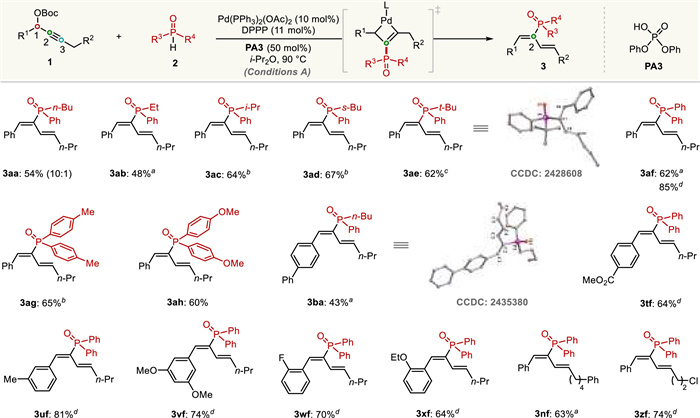
Building upon the established strategies, we first evaluated the substrate scope of C2-site selective dienylation across diverse coupling partners (Scheme 2). Both aryl-alkyl and diaryl-substituted secondary phosphine oxides exhibit excellent compatibility, maintaining robust C2-site selectivity under different catalytic protocols. Notably, aryl-tert-butyl secondary phosphine oxide demonstrated inherent steric control advantages in our strategy (3ae). By employing propargylic esters with varying substitution patterns, we achieved flexible functional group diversification at both terminals of the diene products (3ba and 3tf-3zf), establishing a highly efficient platform for structural diversity. Single-crystal X-ray analyses of representative products (3ae, 3ba) provided unambiguous confirmation of regio- and stereoselectivity. Moreover, the preparation protocols with PA3 or Zn(OTf)2 as additives give consistent results on the NMR spectra (3af), revealing remarkable structural consistency across different catalytic modes. These results underscore the broad applicability and precision of our strategy.
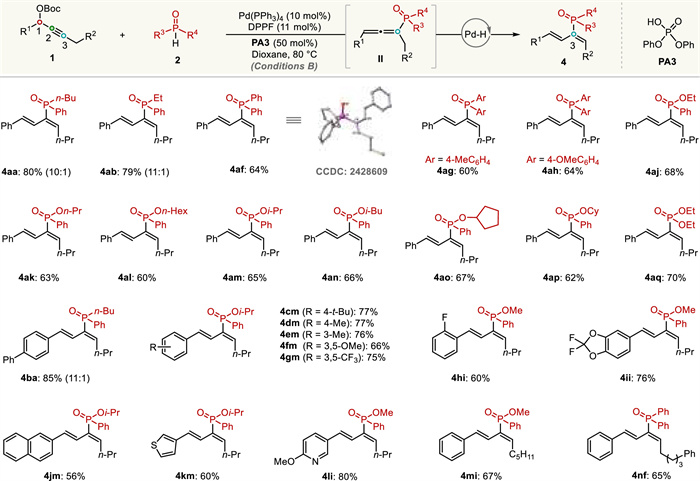
Using a relay catalysis strategy, we further expanded the scope to C3-site selective dienylation (Scheme 3). Through adjustments to the catalytic system (e.g., ligands), previously explored coupling partners readily switched from C2- to C3-site selectivity while maintaining broad compatibility and high chemo-, regio-, and stereo-selectivity. Single-crystal studies revealed that while the substitution site could be toggled, the olefin geometry of dienes followed analogous stereo-chemical trends, which is consistent with steric minimization principles during the reaction.
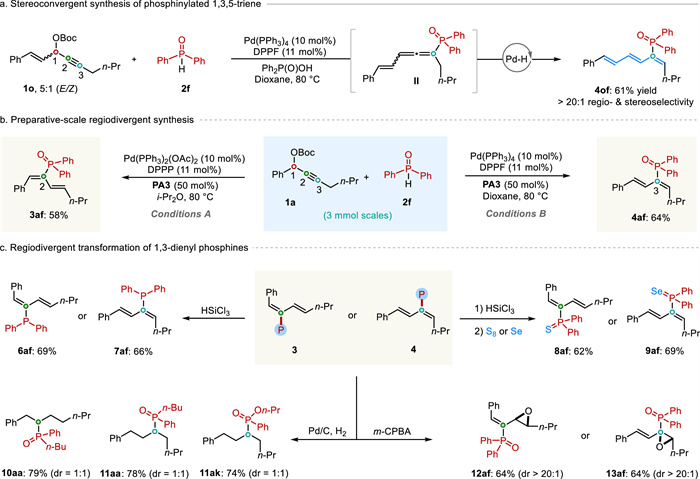
Inspired by the robustness of this method, the reaction was applied to the skipped enyne-type propargylic ester 1o, which was used as a 5:1 E/Z mixture (Scheme 4a). This cinnamaldehyde-derived substrate presented significant stereochemical challenges due to dynamic isomerization among complex η1-σ-, η3-π-allyl-Pd/propargyl-Pd/allene-Pd intermediates. Pleasingly, the palladium-catalyzed cascade reaction proceeded efficiently, affording phosphinylated 1,5-diene 4of with excellent regio- and stereoselectivity (>20:1). This result highlights the superior selectivity control of our catalytic system and its utility for the stereoconvergent synthesis of polyconjugated alkenes from E/Z-mixed alkene precursors. Moreover, preparative-scale syntheses delivered equally favorable outcomes, demonstrating the synthetic efficiency and scalability of this approach (Scheme 4b). The significance of 1,3-dienyl phosphine stems from its structural flexibility and diverse reactive sites. The phosphine oxide portion can be readily transformed under conventional reduction conditions to achieve the trivalent phosphorus species (6af, 7af), yielding products that serve as potential phosphine ligands or precursors for their preparation, or upon integration with chalcogens (sulfur or selenium) to generate aryl-phosphine sulfides/selenides incorporating conjugated diene moieties (8af, 9af). Such distinctive molecular backbone architecture may offer organic electrode materials with enhanced performance [72,73]. Additionally, the double bond moiety undergoes efficient hydrogenation under Pd/C catalysis to furnish branched alkyl-substituted phosphine oxide frameworks (10aa, 11aa, and 11ak). Notably, the epoxidation of these conjugated dienes selectively occurs on the individual double bonds with alkyl substitution, without being affected by the position of phosphinyl substitution (12af, 13af) [74]. These transformations collectively illustrated the versatility of 1,3-dienyl phosphine-derived products.
To elucidate the specific reaction path of each condition and the mechanism of site selectivity, we conducted a series of experimental studies (Scheme 5). Although standard conditions A and B exhibit nearly identical reaction profiles with different phosphine ligands, they demonstrate divergent site selectivity, suggesting distinct reaction pathways. Initial condition optimization (Table 1, entry 2, w/o additive) and control experiment (Scheme 5a) revealed that removing phosphonic acid from either conditions A or B consistently terminated the reaction at the allene product stage. These findings indicate that ligand-bite-angle modulation (DPPP vs. DPPF) alone cannot fully suppress reductive elimination, and latent bases in leaving groups accelerate anion coordination of SPOs, thereby promoting the transmetallation event and subsequent reductive elimination. These observations strongly imply that phosphonic acid participates in pathway regulation from the outset: Its anionic coordination preferentially occupies the fourth vacant orbital of palladium. Consequently, the reaction initially forms an allene-Pd-X intermediate (H-X = PA3). Subsequent anion exchange step with SPOs delays the transmetallation event, enabling pathway bifurcation.
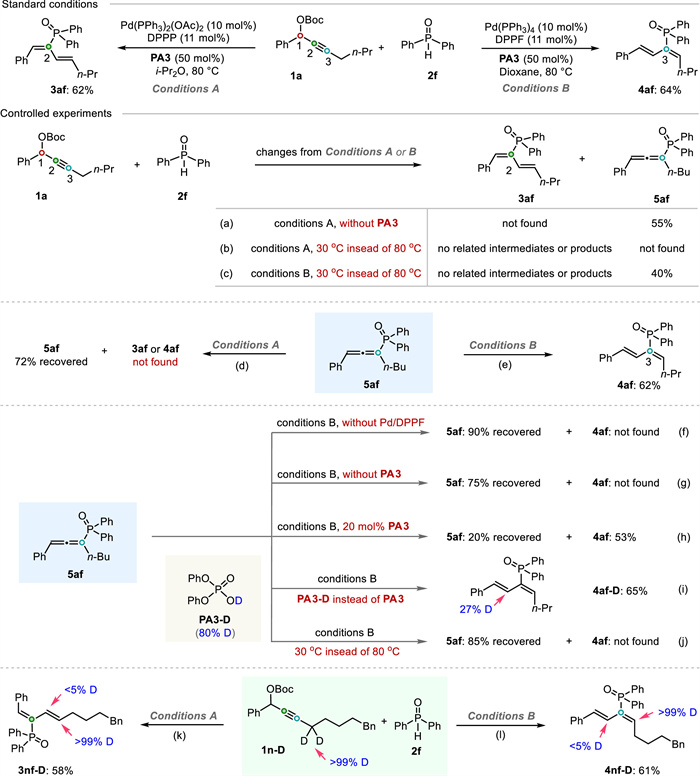
Subsequent studies showed that the allene intermediate 5af, under standard conditions A using a narrower-bite-angle DPPP as the ligand, cannot further convert to products 3af or 4af (Scheme 5d). In contrast, conditions B, which utilize a wider-bite-angle DPPF as the ligand, enable the smooth conversion of allene intermediates to the target product 4af (Scheme 5e). These findings suggest that the allene intermediate 5af is not the precursor of the C2-selective product 3af, but is likely responsible for forming the C3-selective product 4af. These results also indicate that the nature of the ligand played a key role in reaction patterns. At this stage, we reasonably assume that the bite-angle of the ligand can largely affect the reductive elimination ability of the allenyl-Pd-SPO transition state. Our control experiment demonstrates that ligands with a narrower bite angle (DPPP) may fail to weaken the Pd-PA3 coordination affinity sufficiently [69,70], thereby inhibiting allenyl-Pd-SPO formation through anion exchange with SPOs and favoring the formation of product 3af with excellent C2-selectivity. Validation experiments (Schemes 5f-h) confirm the necessity of a Pd catalyst and phosphonic acid, indicating a cooperative mechanism involving Pd/phosphonic acid.
Further isotopic labeling experiments employing deuterated phosphonic acid (PA3-D) provided compelling evidence for a credible Pd–H insertion/elimination mechanism (Scheme 5i) governing the allene-to-diene isomerization. However, the lower reaction temperature is not conducive to the occurrence of this isomerization from allene 5af (Scheme 5j). At the same temperature, the reaction remained capable of initiating and stably forming the allene intermediate (Scheme 5c). Notably, even when the generation of the allene intermediate was hindered by the use of a narrower-bite-angle ligand (DPPP), no intermediates or products attributable to Pd–H-mediated pathways were detected (Scheme 5b). These results imply that while prior studies of synergistic catalysis of Pd/phosphonic acid suggested preferential generation of Pd–H species to trigger hydro- or phosphinyl-palladation of alkynes [31], the putative Pd–H-involved pathway in our system requires a relatively high activation energy and does not dominate over the oxidative addition pathway under the investigated conditions. Experiments using propargylic deuterium-labeled substrates (Schemes 5k-l) under either conditions A or B fail to detect significant deuteration at the remaining site of the product, suggesting rapid flow of deuterium into the system after β-D elimination (rich in protons from secondary phosphine reagents, phosphonic acid, and solvent). Additionally, both conditions (A and B) indicate the final product of dienylation, and both are mediated by acidic reaction systems, suggesting that the reaction mechanism differs significantly from previous work [30].
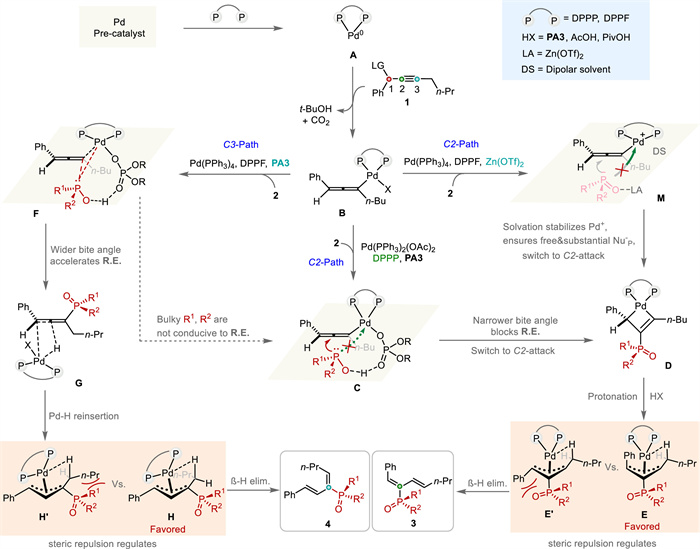
Based on the above results and prior research [42,43,58,62–64], we propose the mechanism of this palladium-catalyzed divergent synthesis (Scheme 6). The process initiates with the oxidative addition of the active palladium species A to the propargylic esters, generating the cationic allenyl-Pd intermediate B [75], and then branching into different reaction paths depending on the ligand and additive used. By employing narrower-bite-angle ligand DPPP, hindered anion exchange likely drives SPOs attack at the allene central carbon (in the intermediate C), forming the palladacyclobutene species D [59–61]. For SPO with a bulky group (such as tert-butyl), the anion exchange process is similarly hindered, thus also favoring C2-site nucleophilic pathway even in the case of using wider-bite-angle ligand (Scheme 2, 3ae). Subsequent protonation opens the palladacycle [42,43,63], yielding an η3-π-allylpalladium intermediate E or E’ (dynamic transformation of the two). Here, steric repulsion between adjacent substituents favors a trans-configured intermediate (intermediate E), which undergoes β-H elimination with high stereoselectivity to afford the C2-site phosphinylated diene product. On the contrary, accelerated reductive elimination is feasible with a wider-bite-angle ligand DPPF in intermediate F. The forming allene intermediate then undergoes Pd-H reinsertion via relay catalysis [51– 53] to generate a η3-π-allylpalladium intermediate H or H’. A similar steric effect enforces the trans-configured intermediate H, ensuring stereo-selective β-H elimination to deliver the C3-site phosphinylated diene product. Separately, a Lewis acid-assisted deprotonation strategy [50] combined with the stabilization of the palladium cation by using dipolar solvent [71] generates a freely accessible, stabilized, and nucleophilically enhanced phosphine reagent, enabling priority to the C2-site selective attack in intermediate M. However, this pathway requires elevated temperatures to dissociate the coordinating anion of palladium and facilitate deprotonation, which is concerted with the action of a Lewis acid. At lower temperatures, it would inherently terminate in allene intermediate 5 (for details, see Table S2) and fail to proceed toward diene formation due to the absence of a palladium-hydride species required for further transformation.
In summary, we have developed a dynamic coordination-directed strategy that enables palladium-catalyzed highly regiodivergent dienylation of propargylic esters with secondary phosphine oxides, providing efficient access to structurally diverse 1,3-dienyl phosphines with excellent regio- and stereoselectivity. By modulating ligand-bite-angle and employing Brønsted/Lewis acid-assisted dual catalysis to tune the coordination models of SPOs, we achieved precise control over C2- versus C3-selectivity, demonstrating the important role of metal-phosphine oxide coordination patterns in determining regiochemical outcomes. Our mechanistic investigations revealed that this regiodivergent dienylation proceeds through relay catalysis or bimetallic cooperative pathways, which are tuned by the dynamic inner- or outer-sphere coordination of phosphine oxides with palladium. This transformation exhibits broad compatibility with diverse coupling partners while delivering high levels of chemo-, regio-, and stereoselectivity, thereby offering efficient access to complex dienyl- and polyconjugated ene-substituted phosphines. This work not only expands the synthetic toolbox for functionalized dienyl phosphines that were previously unattainable by conventional methods but also underscores the potential of coordination-controlled reactivity in addressing challenges in selective transformations. Meanwhile, the construction of dienyl phosphine compounds containing P-stereogenicity is ongoing in our laboratory.
Chen Zhou: Responsible for the initial exploration of the project and main experimental work, data collection, and the organization of supporting information. Yuxuan Shi: Responsible for the main experimental work, data collection, and the organization of supporting information; Also be responsible for conducting supplementary experiments and collecting and organizing data during the revision of the manuscript. Leyang Zhang: Take on part of the experimental implementation tasks. Mengfu Dai: Responsible for part of the experimental guidance and data analysis. Lanzhu Tai: Responsible for the initial exploration of the project. Qiang Dai: Designed, optimized and determined this project; mainly responsible for guiding the experimental work of graduate students, formulating research plans, supervising the progress of the project, and solving experimental problems; Completed the original draft of the manuscript, and undertook the tasks of reviewing, editing and submitting. Liang-An Chen: Designed, optimized and determined this project; Responsible for project supervision, guidance and planning, as well as review and polishing of the manuscript. All authors discussed the results and commented on the paper.
All the authors in this manuscript declare that they have no known competing financial interests or personal relationships that could have appeared to influence the work reported in this paper.
We gratefully acknowledge funding from National Natural Science Foundation of China (Nos. 22371125, 22071111 and 22401154), Natural Science Foundation of Jiangsu Province of China (Nos. BK20240031 and BK20240577). The project was supported by Open Research Fund of State Key Laboratory of Coordination Chemistry, School of Chemistry and Chemical Engineering, Nanjing University.
Supplementary material associated with this article can be found, in the online version, at doi:
H. Fernández-Pérez, P. Etayo, A. Panossian, et al., Chem. Rev. 111 (2011) 2119–2176. doi: 10.1021/cr100244e
H. Guo, Y.C. Fan, Z. Sun, et al., Chem. Rev. 118 (2018) 10049–10293. doi: 10.1021/acs.chemrev.8b00081
T. Baumgartner, R. Réau, Chem. Rev. 106 (2006) 4681–4727. doi: 10.1021/cr040179m
Y. Ren, T. Baumgartner, Dalton Trans. 41 (2012) 7792–7800. doi: 10.1039/c2dt00024e
Y. Matano, H. Ohkubo, T. Miyata, et al., Eur. J. Inorg. Chem. 2014 (2014) 1620–1624. doi: 10.1002/ejic.201301132
Y. Cao, J.K. Nagle, M.O. Wolf, et al., J. Am. Chem. Soc. 147 (2015) 4888–4891. doi: 10.1021/jacs.5b02078
P. Ma, Y. Chen, Y. Man, et al., Angew. Chem. Int. Ed. 62 (2023) e202316479.
U. Pradere, E.C. Garnier-Amblard, S.J. Coats, et al., Chem. Rev. 114 (2014) 9154–9218. doi: 10.1021/cr5002035
Y. Mehellou, H.S. Rattan, J. Balzarini, J. Med. Chem. 61 (2018) 2211–2226. doi: 10.1021/acs.jmedchem.7b00734
J.B. Rodriguez, C. Gallo-Rodriguez, ChemMedChem 14 (2019) 190–216. doi: 10.1002/cmdc.201800693
H. Seto, T. Kuzuyama, Nat. Prod. Rep. 16 (1999) 589–596. doi: 10.1039/a809398i
L.D. Quin, A Guide to Oganophosphorus Chemistry, Wiley, 2000.
S. Monge, G. David, Phosphorus-Based Polymers: From Synthesis to Applications, RSC, 2014.
V. Iaroshenko, Organophosphorus Chemistry: from Molecules to Applications, Wiley, 2019.
H. Yu, H. Yang, E. Shi, et al., Med. Drug Discov. 8 (2020) 100063. doi: 10.1016/j.medidd.2020.100063
T. Imamoto, Chem. Rev. 124 (2024) 8657–8739. doi: 10.1021/acs.chemrev.3c00875
V. Hornillos, C. Vila, E. Otten, et al., Angew. Chem. Int. Ed. 54 (2015) 7867–7871. doi: 10.1002/anie.201502987
W.J. Yue, J.Z. Xiao, S. Zhang, et al., Angew. Chem. Int. Ed. 59 (2020) 7057–7062. doi: 10.1002/anie.201916076
A. Kondoh, S. Ishikawa, M. Terada, Org. Biomol. Chem. 18 (2020) 7814–7817. doi: 10.1039/d0ob01778g
L. Ge, S.R. Harutyunyan, Chem. Sci. 13 (2022) 1307–1312. doi: 10.1039/d1sc06694c
V. Ojea, S. Conde, M. Ruiz, et al., Tetrahedron Lett. 38 (1997) 4311–4314. doi: 10.1016/S0040-4039(97)00888-5
L.T. Burke, D.J. Dixon, S.V. Ley, et al., Org. Biomol. Chem. 3 (2005) 274–280. doi: 10.1039/B411350K
Y.Q. Zhang, X.Y. Han, Y. Wu, et al., Chem. Sci. 13 (2022) 4095–4102. doi: 10.1039/D2SC00091A
S.N. Yang, S.H. Sun, C.H. Liu, et al., Chin. Chem. Lett. 34 (2023) 107914. doi: 10.1016/j.cclet.2022.107914
Y. Jiang, K.W. Cheng, Z. Yang, et al., Chin. Chem. Lett. 36 (2025) 110231. doi: 10.1016/j.cclet.2024.110231
S. Liu, Y. Tanabe, S. Kuriyama, et al., Angew. Chem. Int. Ed. 60 (2021) 11231–11236. doi: 10.1002/anie.202102779
M. Kalek, T. Johansson, M. Jezowska, et al., Org. Lett. 12 (2010) 4702–4704. doi: 10.1021/ol102121j
H. Wang, H. Qian, J. Zhang, et al., J. Am. Chem. Soc. 144 (2022) 12619–12626. doi: 10.1021/jacs.2c04931
W.H. Wang, Y. Wu, H.T. Wang, et al., Nat. Synth. 1 (2022) 738–747. doi: 10.1038/s44160-022-00123-3
J. Zhang, X. Chang, X. Xu, et al., Nat. Commun. 13 (2022) 7049. doi: 10.1038/s41467-022-34764-x
X.D. Gu, K.Y. Ngai, W. Wang, et al., Chem. Catal. 4 (2024) 100903.
Z. Chen, H. Wang, P. Du, et al., J. Am. Chem. Soc. 147 (2025) 24958–24968. doi: 10.1021/jacs.5c07465
T.M. Shaikh, C.M. Weng, F.E. Hong, Coord. Chem. Rev. 256 (2012) 771–803. doi: 10.1016/j.ccr.2011.11.007
G. Manca, M. Caporali, A. Ienco, et al., J. Organomet. Chem. 760 (2014) 177–185. doi: 10.1016/j.jorganchem.2013.10.043
B.P. Nell, D.R. Tyler, Coord. Chem. Rev. 279 (2014) 23–42. doi: 10.1016/j.ccr.2014.07.002
P. Sutra, A. Igau, Coord. Chem. Rev. 308 (2016) 97–116. doi: 10.1016/j.ccr.2015.07.002
A. Gallen, A. Riera, X. Verdaguer, et al., Catal. Sci. Technol. 9 (2019) 5504–5561. doi: 10.1039/c9cy01501a
S. Ma, Eur. J. Org. Chem. (2004) 1175–1183 2004.
R. Geng, L. Peng, C. Guo, Chin. Chem. Lett. 35 (2024) 109433. doi: 10.1016/j.cclet.2023.109433
C.Q. O’Broin, P.J. Guiry, J. Org. Chem. 85 (2020) 10321–10333. doi: 10.1021/acs.joc.0c01218
M. Dai, L. Song, L.A. Chen, Sci. China Chem. 67 (2024) 1384–1396. doi: 10.1007/s11426-023-1925-4
T.M. Locascio, J.A. Tunge, Chem. Eur. J. 22 (2016) 18140–18146. doi: 10.1002/chem.201603481
M. Dai, Z. Sun, L.A. Chen, Angew. Chem. Int. Ed. 61 (2022) e202203835. doi: 10.1002/anie.202203835
X. Huang, S. Wu, W. Wu, et al., Nat. Commun. 7 (2016) 12382. doi: 10.1038/ncomms12382
H. Wang, H. Luo, Z.M. Zhang, et al., J. Am. Chem. Soc. 142 (2020) 9763–9771. doi: 10.1021/jacs.0c02876
T.J. Hu, M.Y. Li, Q. Zhao, et al., Angew. Chem. Int. Ed. 57 (2018) 5871–5875. doi: 10.1002/anie.201801963
X. Cheng, L. Zhang, CCS Chem. 2 (2020) 1989–2002. doi: 10.1093/bioinformatics/btz888
G. Li, S. Hong, X. Li, et al., Nat. Commun. 16 (2025) 6916. doi: 10.1038/s41467-025-62204-z
P.A. Donets, N. Cramer, J. Am. Chem. Soc. 135 (2013) 11772–11775. doi: 10.1021/ja406730t
S. Kwak, J. Choi, J. Han, et al., ACS Catal. 12 (2022) 212–218. doi: 10.1021/acscatal.1c04242
R. Blieck, M. Taillefer, F. Monnier, Chem. Rev. 120 (2020) 13545–13598. doi: 10.1021/acs.chemrev.0c00803
G.L. Li, X.H. Huo, X.Y. Jiang, et al., Chem. Soc. Rev. 49 (2020) 2060–2118. doi: 10.1039/c9cs00400a
Z.P. Yang, J. Wang, Angew. Chem. Int. Ed. 60 (2021) 27288–27292. doi: 10.1002/anie.202112285
B.M. Trost, V.J. Gerusz, J. Am. Chem. Soc. 117 (1995) 5156–5157. doi: 10.1021/ja00123a020
A. Hoffmann-Röder, N. Krause, Angew. Chem. Int. Ed. 43 (2004) 1196–1216. doi: 10.1002/anie.200300628
P. Rivera-Fuentes, F. Diederich, Angew. Chem. Int. Ed. 51 (2012) 2818–2828. doi: 10.1002/anie.201108001
S. Yu, S. Ma, Angew. Chem. Int. Ed. 51 (2012) 3074–3112. doi: 10.1002/anie.201101460
M.F. Dai, J.C. Chang, Z.M. Sun, et al., CCS Chem. 8 (2026) 1647–1659. doi: 10.31635/ccschem.025.202505704
M.W. Baize, P.W. Blosser, V. Plantevin, et al., Organometallics 15 (1996) 164–173. doi: 10.1021/om9506678
C.P. Casey, J.R. Nash, C.S. Yi, et al., J. Am. Chem. Soc. 120 (1998) 722–733. doi: 10.1021/ja9729847
Y.C. Cheng, Y.K. Chen, T.M. Huang, et al., Organometallics 17 (1998) 2953–2957. doi: 10.1021/om9708642
D.S.B. Daniels, A.S. Jones, A.L. Thompson, et al., Angew. Chem. Int. Ed. 53 (2014) 1915–1920. doi: 10.1002/anie.201309162
N. Ishida, Y. Hori, S. Okumura, et al., J. Am. Chem. Soc. 141 (2019) 84–88. doi: 10.1021/jacs.8b11159
C.Q. O’Broin, P.J. Guiry, Org. Lett. 22 (2020) 879–883. doi: 10.1021/acs.orglett.9b04413
S.H.M. Kaster, L. Zhu, W.L. Lyon, et al., Science 385 (2024) 1067–1076. doi: 10.1126/science.ado8027
S.Z. Nie, R.T. Davison, V.M. Dong, J. Am. Chem. Soc. 140 (2018) 16450–16454. doi: 10.1021/jacs.8b11150
B. Li, M. Liu, S.U. Rehman, et al., J. Am. Chem. Soc. 144 (2022) 2893–2898. doi: 10.1021/jacs.2c00239
M.N. Birkholz, Z. Freixa, P.W.N.M. van Leeuwen, Chem. Soc. Rev. 38 (2009) 1099–1118. doi: 10.1039/b806211k
M. Kranenburg, P.C.J. Kamer, P.W.N.M. van Leeuwen, Eur. J. Inorg. Chem. 1998 (1998) 155–157.
T. Gathy, O. Riant, D. Peeters, et al., J. Organomet. Chem. 696 (2011) 3425–3430. doi: 10.1016/j.jorganchem.2011.07.041
J. Sherwood, J.H. Clark, I.J.S. Fairlamb, et al., Green Chem. 21 (2019) 2164–2213. doi: 10.1039/c9gc00617f
Z. Chen, H. Cui, Y. Hou, et al., Chem 8 (2022) 2204–2216. doi: 10.1016/j.chempr.2022.05.001
Y. Lu, G. Wu, X. Zhao, et al., J. Colloid Interface Sci. 651 (2023) 296–303. doi: 10.1016/j.jcis.2023.07.208
M.N. Sheng, J.G. Zajacek, J. Org. Chem. 35 (1970) 1839–1843. doi: 10.1021/jo00831a027
Y. Miyazaki, K. Michigami, M. Ohashi, J. Am. Chem. Soc. 146 (2024) 8757–8767. doi: 10.1021/jacs.4c01738

Scheme 2 C2-site phosphinylation/dienylation of propargylic carbonates with SPOs. Conditions A: 1 (0.2 mmol), 2 (0.24 mmol), Pd(PPh3)2(OAc)2 (10 mol%), DPPP (11 mol%), PA3 (50 mol%), iPr2O (0.025 mol/L), 12 h under N2 atmosphere at 90 ℃. No isomers were observed unless otherwise noted. The regio-selectivity (C2:C3) is shown in parentheses. a At 80 ℃. b There is a small amount of olefin isomers, 3: isomer ≥ 10:1. c Change of conditions: Pd(PPh3)4 and DPPF were used, dioxane as solvent, at 80 ℃. d Change of conditions: OPiv was used instead of OBoc, 2 (0.6mmol), Pd(PPh3)4 and DPPF were used, Zn(OTf)2 as additive, DME as solvent, at 120 ℃ for 10 h.

Scheme 3 C3-site phosphinylation/dienylation of propargylic carbonates with SPOs. Conditions B: 1 (0.2 mmol), 2 (0.24 mmol), Pd(PPh3)4 (10 mol%), DPPF (11 mol%), PA3 (50 mol%), dioxane (0.025 mol/L), 12 h under N2 atmosphere at 80 ℃. No isomers were observed unless otherwise noted. The regio-selectivity (C3:C2) is shown in parentheses.
Table 1. Preliminary discovery of dynamic modulation of regioselectivity.a
|
|||
| Entry | Change of conditions | 3/4 | 5 |
| 1 | No DPPF, no additive | 0/0 | 0 |
| 2 | No Additive | 0/0 | 70 |
| 3 | NEt3 | 0/0 | 80 |
| 4 | PA1 | <5/27 | 0 |
| 5 | PA2 | <5/54 | 0 |
| 6 | PA3 | 7/73 | 0 |
| 7 | DPPF/PA3 | 42/16 | 0 |
| 8 | Zn(OTf)2b | 56/0 | 0 |
| a For details of the experiment, please refer to Supporting information. Unless otherwise noted, 1a (LG = OBoc), 2a (R = n-Bu) were used. b 1p (LG = OPiv), 2f (R = Ph) were used at 120 ℃. |
|||
 下载: 导出CSV
Table 2. Further optimization of the C2-site selectivity.a
|
|||||
| Entry | [Pd] | Ligand | Solvent | 3:4b | Yield (%)c |
| 1 | Pd(PPh3)4 | Binap | Dioxane | 1:1 | 35 |
| 2d | Pd(PPh3)4 | Xantphos | Dioxane | / | <5 |
| 3 | Pd(PPh3)4 | DCyPB | Dioxane | 2.5:1 | 40 |
| 4 | Pd(PPh3)4 | DPPP | Dioxane | 2.5:1 | 58 |
| 5 | Pd(PPh3)2(OAc)2 | DPPP | Dioxane | 3.5:1 | 53 |
| 6 | Pd(PPh3)2(OAc)2 | DPPP | CPME | 5:1 | 56 |
| 7 | Pd(PPh3)2(OAc)2 | DPPP | Toluene | 5:1 | 54 |
| 8e | Pd(PPh3)2(OAc)2 | DPPP | i-Pr2O | 10:1 | 54 |
| 9f | Pd(PPh3)4 | DPPF | i-Pr2O | / | 0 |
| 10f | Pd(PPh3)4 | DPPF | DMF | >20:1 | 85 |
| 11f | Pd(PPh3)4 | DPPP | DMF | >20:1 | 78 |
| 12f | Pd(PPh3)4 | DPPF | DMA | >20:1 | 87 |
| a Conditions unless otherwise noted: 1a (0.1 mmol, LG = OBoc), 2a (0.12 mmol, R = n-Bu), [Pd] (10 mol%), ligand (11 mol%), PA3 (50 mol%), solvent (0.025 mol/L), 80 ℃, N2, 12 h. For details of the experiment, please refer to Supporting information. DCyPB: 1,4-Bis-(dicyclohexylphosphino)butane. b The proportion was identified by 1H NMR test. c Isolated yields of the mixtures 3 and 4 after column chromatography are shown. d Allene 5 is a major product. e At 90 ℃. f Change of conditions: Zn(OTf)2 was used instead of PA3; 1p (0.1 mmol, LG = OPiv), 2f (0.3 mmol, R = Ph) were used at 120 ℃ for 10 h. |
|||||
下载: 导出CSV

 扫一扫看文章


扫一扫关注我们


