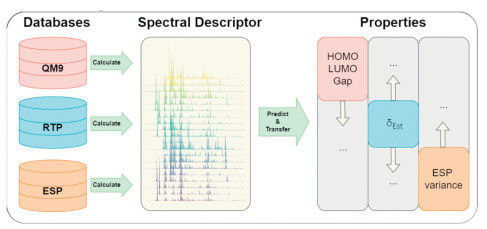
Figure 1.
Pipeline of cross-database property prediction and completion by using spectral descriptor.

Cross-database property prediction and multifunctional molecule screening via spectral descriptor
Hantao Zeng , Guokun Yang , Jiahui Du , Jun Jiang , Song Wang


The foundation of integrating artificial intelligence with chemical science lies in vast amounts of scientific data [1]. Thanks to abundant experimental measurements and theoretical computation resources, numerous molecular databases have been successively established and publicly released, including QM9, ZINC, FreeSolv, ESOL, ChEMBL, Tox21 [2-7]. These databases cover large amounts of structure-property data ranging from quantum chemical properties of small molecules to drug-related biological activities [8,9]. Data-driven approaches are advancing molecular property prediction and molecular AI-generation tasks [10-13]. A truly useful molecule is often multifunctional. However, it is regrettable that different databases vary significantly in their molecular coverage, target property dimensions, and experimental/computational origins. When these databases are combined, the properties within each database are clustered together with few overlaps, forming isolated "data islands". Even worse, the molecular structural data in each database exhibit domain shift, which will introduce local biases to machine learning (ML) models [14]. This weakens the model's generalization ability across different structures when learning structure-property relationships [15-20]. Even with the addition of transfer learning tasks, it remains challenging to achieve improvements in robustness metrics. Consequently, traditional structure-property fitting models struggle to address the issue of missing property labels across multi-source databases [21].
Molecular spectra use physicochemical equations to project molecules from different databases onto energy and frequency spaces. For example, infrared (IR) spectra correspond to changes in the dipole moment of a molecules in vibrational modes [8,22]. In addition, since molecular spectra inherently reflect physicochemical properties, they hold promise as a consistent intermediate variable across different databases [23]. Compared to traditional SMILES and molecular graph representations, spectra-based ML models possess stronger generalization ability [24-27]. Moreover, with the continuous advances in computational chemistry tools, theoretical spectral simulations can be completed within an affordable timescale. This means that molecules from various data sources can be processed through a unified pipeline to generate theoretical spectra. This allows for the spectral-domain alignment of different database.
In this study, we chose IR spectra as a case study to develop ML models for predicting multiple molecular properties. Three databases with different properties were selected, covering structural and partial property data for approximately 140,000 molecules. We computed IR spectra for these molecules with property annotations and trained neural network-based ML models for spectra-to-property mappings with highly accurate predictions [28-32]. These trained models were then directly applied to molecules lacking property annotations, effectively augmenting the databases by filling in missing property information (Fig. 1). To validate the approach, we randomly selected ~200 molecules for high-precision density functional theory (DFT) calculations [33-35]. The results confirmed that our spectral-based ML models exhibit excellent transferability across different databases. This demonstrates that the neural networks with spectral descriptor can achieve cross-domain prediction and property expansion even when molecular data across different databases do not overlap. This work not only overcomes the reliance of traditional structural-based ML models on label consistency and structural homogeneity, but also provides a broadly applicable spectral-based framework for collaborative multi-database modeling.
To evaluate the generality and predictive accuracy of this framework, we conducted systematic experiments using multiple molecular datasets. We utilized three molecular datasets for model training and validation. The first is the QM9s dataset, containing over 130,000 molecules with diverse electronic structure properties [36]. From this dataset, we selected the HOMO-LUMO gap as the prediction target, which is a property related to the luminescent performance of organic molecules. Two additional databases were constructed in-house: RTPSpec dataset contains approximately 6000 self-designed potential room-temperature phosphorescence (RTP) molecules with the singlet–triplet energy gap (δEst) as a property associated with RTP activity [37-39]; ESPSet dataset contains approximately 5000 typical organic molecules with the molecular surface electrostatic potential (ESP) distribution as a property related to molecular polarity and aqueous solubility (detailed computational procedures and descriptions of property labels for each dataset are provided in Supporting information) [40,41].
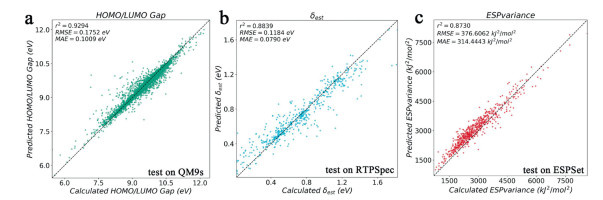
Since IR spectra are inherently one-dimensional, we employed a one-dimensional convolutional neural network (1D-CNN) as the core architecture of ML model for molecular property prediction (Fig. S1 in Supporting information, details of training code and hyperparameter settings are available in Supporting information) [42]. This architecture demonstrates strong effectiveness and generalization capabilities for processing spectral data. For each datasets, we trained separate models to predict properties selected above. As shown in Fig. 2, the correlation coefficient (r2) values of HOMO–LUMO gap (model-1), δEst (model-2), and ESP variance (model-3) reached 0.9294, 0.8839, and 0.8730. These satisfactory model performances indicate that the IR spectral descriptor can accurately predict various molecular properties across diverse datasets.
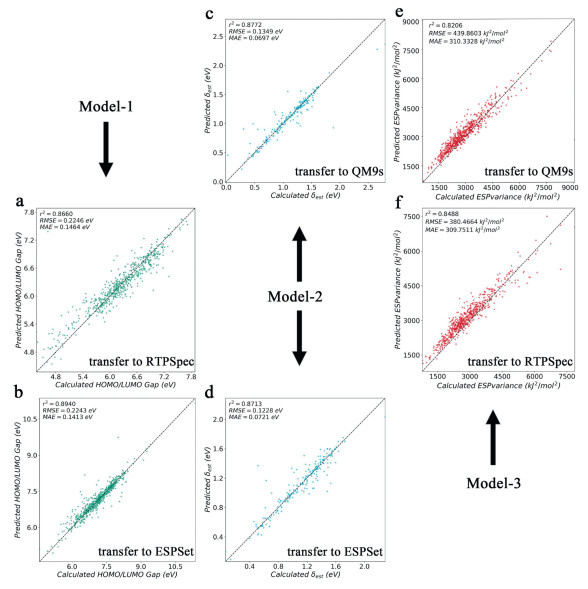
This study further evaluated the zero-shot transferability of the trained ML models across the three independent datasets. Specifically, we directly applied one of the three ML models to the other two datasets for prediction without any fine-tuning or transfer-learning. To quantify the zero-shot transferability, 200 molecules from each dataset were sampled as the test set for theoretical calculation validation. As shown in Figs. 3a and b, when transferred to the RTPSpec and ESPSet datasets, the model-1 achieved prediction r2 values of 0.8660 and 0.8940, respectively. Similarly, the model-2 achieved r2 values of 0.8772 and 0.8713 when it was transferred to the QM9s and ESPSet datasets (Figs. 3c and d), and the model-3 achieved r2 values of 0.8206 and 0.8488 when it was transferred to the QM9s and RTPSpec datasets (Figs. 3e and f). The observed cross-dataset transfer prediction performance is comparable to the models' performance on their original training datasets. It indicates that the ML models with IR spectral descriptor demonstrates excellent zero-shot transferability and model robustness when predicting various electronic properties, even when applied to structurally and chemically diverse datasets. Fig. S2 (Supporting information) further presents a clustering analysis comparing one-hot encoded SMILES representations with spectral descriptors. The results show that, in high-dimensional feature space, spectral descriptors exhibit a broader spread than SMILES and provide a more effective basis for multi-property integration.
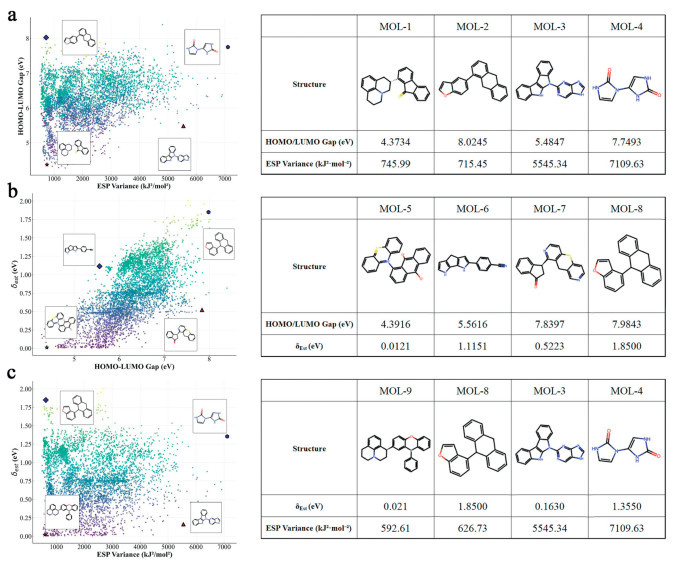
The ML models constructed above pave the way for cross-dataset completion of molecular properties and discovery of multifunctional molecules. Taking the ~6000 molecules in RTPSpec dataset as an example, we used the ML models to obtain all three properties (HOMO–LUMO gap, δEst, and ESP variance) of these molecules, and then analyzed their distributions. As shown in Fig. S3 (Supporting information), a three-dimensional visualization of the distributions reveals that molecules located at the outer boundaries correspond to those with extreme values for each property dimension (Fig. S4 in Supporting information). Subsequently, to screen for molecules with two simultaneous properties, we projected the data distributions onto two-dimensional coordinate planes. The Convex Hull Algorithm was used to identify representative molecules that possess two extreme properties (max-max, max-min, min-max, min-min), and high-accuracy DFT calculations were performed for validation. For example, as shown in Fig. 4a, MOL-1 exhibits both a small HOMO-LUMO gap and a small ESP variance value, MOL-2 demonstrates both a large HOMO-LUMO gap and a small ESP variance value, MOL-3 presents a small HOMO-LUMO gap and a large ESP variance value, while MOL-4 displays a large HOMO-LUMO gap and a large ESP variance value. Molecules with larger ESP variance values, namely MOL-4 and MOL-3, tend to exhibit stronger intermolecular interactions, along with higher sublimation and evaporation enthalpies, which prevent the molecules from readily escaping from the solid state. We also present the orbital analysis results of these molecules in Fig. S5 (Supporting information) to further support our viewpoint. This characteristic enables them to serve as potential candidates for high thermal stability thin films. Such films demonstrate enhanced stability under thermal stress, exhibiting reduced susceptibility to crystallization or phase separation, thereby facilitating the stability of optoelectronic performance in devices. The wide-bandgap MOL-4 and narrow-bandgap MOL-3 are suitable for applications in ultraviolet and near-infrared spectral regions respectively. Similarly, as shown in Fig. 4b, we identify MOL-5 as a molecule that simultaneously possesses a small HOMO-LUMO gap and a small δEst value. Its small δEst value enables the triplet state to potentially undergo thermal excitation leading to reverse intersystem crossing, thereby conferring potential for serving as a long-wavelength thermally activated delayed fluorescence (TADF) molecule. In Fig. 4c, MOL-3 and MOL-4 not only simultaneously exhibit higher sublimation and evaporation enthalpies, but their δEst values are equally noteworthy. The smaller δEst of MOL-3 endows it with similar potential to function as a TADF molecule, while the larger energy gap of MOL-4 hinders reverse intersystem crossing.
This study establishes infrared (IR) spectra as a universal and transferable descriptor for predicting key electronic properties across multiple molecular databases. By learning spectral–property correlations, the proposed framework effectively reconstructs relationships between vibrational features and quantum-chemical quantities such as the HOMO–LUMO gap, singlet–triplet energy difference, and electrostatic potential variance. The cross-dataset consistency achieved through spectral embedding demonstrates that IR features capture intrinsic physicochemical characteristics that transcend dataset boundaries, providing a unified representation space for property learning and transfer.
The underlying vibrational information encoded in IR spectra reflects the molecular force field and its dipole-moment response, providing a compact yet physically grounded view of molecular structure. Although distinct structural isomers may exhibit similar vibrational patterns, their corresponding variations in electronic parameters are sufficiently preserved in the spectral domain for accurate property prediction. This highlights the predictive, rather than reconstructive, nature of the model, in which statistical correlations between spectra and properties serve as effective learning signals.
Beyond the IR modality, the same spectral-embedding principle can extend naturally to other spectroscopic domains, such as Raman, UV–vis, and NMR, each providing complementary projections of the molecular Hamiltonian. The shared physicochemical foundation among these modalities offers a promising direction toward unified multi-spectral representation learning. By bridging data-driven prediction with physical interpretability, this framework provides a scalable path for transferable molecular design and the discovery of multifunctional materials.
Hantao Zeng: Writing – review & editing, Writing – original draft, Data curation, Conceptualization. Guokun Yang: Writing – original draft, Software, Data curation, Conceptualization. Jiahui Du: Writing – original draft, Visualization, Conceptualization. Jun Jiang: Writing – review & editing, Methodology, Funding acquisition. Song Wang: Writing – review & editing, Funding acquisition.
The authors declare that they have no known competing financial interests or personal relationships that could have appeared to influence the work reported in this paper.
All code used here are published on Github, see in
This work was financially supported by the National Natural Science Foundation of China (Nos. 22203082, 12227901, 22025304, 22033007), the Innovation Program for Quantum Science and Technology (No. 2021ZD0303303). We thank the Hefei advanced computing center for providing Numerical computations; and the USTC supercomputing center for providing computational resources for this project.
Supplementary material associated with this article can be found, in the online version, at doi:
X. Yang, Y. Wang, R. Byrne, et al., Chem. Rev. 119 (2019) 10520–10594. doi: 10.1021/acs.chemrev.8b00728
R. Ramakrishnan, P.O. Dral, M. Rupp, O.A. von Lilienfeld, Sci Data. 1 (2014) 140022. doi: 10.1038/sdata.2014.22
T. Sterling, J.J. Irwin, J. Chem. Inf. Model. 55 (2015) 2324–2337. doi: 10.1021/acs.jcim.5b00559
D.L. Mobley, J.P. Guthrie, J. Comput. Aided. Mol. Des. 28 (2014) 711–720. doi: 10.1007/s10822-014-9747-x
J.S. Delaney, J. Chem.Inf. Comput. Sci. 44 (2004) 1000–1005. doi: 10.1021/ci034243x
A. Gaulton, L.J. Bellis, A.P. Bento, et al., Nucleic Acids Res. 40 (2012) D1100–D1107. doi: 10.1093/nar/gkr777
R.S. Thomas, R.S. Paules, A. Simeonov, et al., ALTEX 35 (2018) 163–168. doi: 10.14573/altex.1803011
F. Wu, Y. Huang, G. Yang, et al., Proc. Natl. Acad. Sci. U. S. A. 121 (2024) e2409257121. doi: 10.1073/pnas.2409257121
G. Yang, H. Xiao, H. Gao, et al., J. Am. Chem. Soc. 146 (2024) 28491–28499.
J. Fang, L. Hu, J. Dong, et al., Sci. Rep. 11 (2021) 18686. doi: 10.1038/s41598-021-97146-1
H.B. Liu, X. Cheng, Z. Guo, et al., Chin. Chem. Lett. 36 (2025) 111149. doi: 10.1016/j.cclet.2025.111149
L. Li, J. Shen, Q. Xiao, et al., Chin. Chem. Lett. 36 (2025) 110421. doi: 10.1016/j.cclet.2024.110421
Y. Zheng, S. Sun, J. Liu, et al., Chin. Chem. Lett. 36 (2025) 110722. doi: 10.1016/j.cclet.2024.110722
L.H. Rieger, M. Wilson, T. Vegge, E. Flores, Digital Discov. 2 (2023) 1957–1968. doi: 10.1039/D3DD00203A
P. Yin, X. Niu, S.B. Li, et al., Nat. Commun. 15 (2024) 415. doi: 10.1111/psyg.13088
J. Sun, R. Tu, Y. Xu, et al., Nat. Commun. 15 (2024) 6036. doi: 10.1038/s41467-024-50417-7
Y. Song, S. Teng, D. Fang, et al., Energy Fuels 38 (2024) 11541–11561. doi: 10.1021/acs.energyfuels.4c02110
K. Ye, S. Wang, Y. Huang, et al., J. Phys. Chem. Lett. 15 (2024) 1956–1961. doi: 10.1021/acs.jpclett.3c03002
Q. Wei, L. Feng, H. Sun, et al., Mach. Learn. 113 (2024) 5423–5445. doi: 10.1007/s10994-023-06425-7
E. Heid, K.P. Greenman, Y. Chung, et al., J. Chem. Inf. Model. 64 (2024) 9–17. doi: 10.1021/acs.jcim.3c01250
G. Yang, S. Jiang, Y. Luo, et al., J. Phys. Chem. Lett. 15 (2024) 8766–8772. doi: 10.1021/acs.jpclett.4c02129
L. Zhao, J. Zhang, Y. Zhang, et al., JACS Au 1 (2021) 2377–84. doi: 10.1021/jacsau.1c00449
H. Li, D. Zhou, P.E.S. Smith, et al., Chem. Sci. 16 (2025) 4646–4653. doi: 10.1039/d4sc06552b
J. Zhang, W. Du, X. Yang, et al., Front. Mol. Biosci. 10 (2023), doi: 10.3389/fmolb.2023.1216765.
V. Bagal, R. Aggarwal, P.K. Vinod, U.D. Priyakumar, J. Chem. Inf. Model. 62 (2022) 2064–2076. doi: 10.1021/acs.jcim.1c00600
S. Wang, Y. Guo, Y. Wang, et al., Smiles-Bert, in: Proceedings of the 10th ACM International Conference on Bioinformatics, Computational Biology and Health Informatics, 2019, pp. 429–436.
F. Wu, G. Chen, K. Lai, et al., Chin. Chem. Lett. 36 (2025) 109884. doi: 10.1016/j.cclet.2024.109884
M. Grumet, C. von Scarpatetti, T. Bučko, D.A. Egger, J. Phys. Chem. C 128 (2024) 6464–6470. doi: 10.1021/acs.jpcc.4c00886
N. Saquer, R. Iqbal, J.D. Ellis, K. Yoshimatsu, Digital Discov. 3 (2024) 602–609. doi: 10.1039/D3DD00254C
D.H. Mok, H. Li, G. Zhang, et al., Nat. Commun. 14 (2023) 7303. doi: 10.1038/s41467-023-43118-0
Y. Chong, Y. Huo, S. Jiang, et al., Proc. Nat. Acad. Sci. U. S. A. 120 (2023) e2220789120. doi: 10.1073/pnas.2220789120
J. Yu, C. He, C. Pu, et al., Chin. Chem. Lett. 32 (2021) 3149–3154. doi: 10.1016/j.cclet.2021.02.046
S. Xu, Y. Yuan, X. Cai, et al., Chem. Sci. 6 (2015) 5824–5830. doi: 10.1039/C5SC01733E
F. Neese, T. Petrenko, D. Ganyushin, G. Olbrich, Coord. Chem. Rev. 251 (2007) 288–327. doi: 10.1016/j.ccr.2006.05.019
A. Dreuw, M. Head-Gordon, Chem. Rev. 105 (2005) 4009–4037. doi: 10.1021/cr0505627
Z. Zou, Y. Zhang, L. Liang, et al., Nat. Comput. Sci. 3 (2023) 957–964. doi: 10.1038/s43588-023-00550-y
J. Li, S. Hao, M. Li, et al., Angew. Chem. Int. Ed. 64 (2025) e202417426. doi: 10.1002/anie.202417426
M. He, C. Ding, H. Guo, Q. Li, Responsive Mater. 2 (2024) e20240014. doi: 10.1002/rpm.20240014
W. Zhao, T.S. Cheung, N. Jiang, et al., Nat. Commun. 10 (2019) 1595. doi: 10.1038/s41467-019-09561-8
M.A. Khoshooei, X. Wang, G. Vitale, et al., Science 384 (2024) 540–546. doi: 10.1126/science.adl1260
Y. Huang, G. Yang, Z. Yu, et al., Small 20 (2024) e2311351. doi: 10.1002/smll.202311351
Y. LeCun, Y. Bengio, G. Hinton, Nature 521 (2015) 436–444. doi: 10.1038/nature14539

Figure 1 Pipeline of cross-database property prediction and completion by using spectral descriptor.

Figure 2 Prediction results of ML models on test sets in (a) QM9s dataset, (b) RTPSpec dataset, (c) ESPSet dataset.

Figure 3 Prediction results of the trained ML models across three independent datasets without any fine-tuning. Transferability of model-1 in (a) RTPSpec dataset and (b) ESPSet dataset. Transferability of model-2 in (c) QM9s dataset and (d) ESPSet dataset. Transferability of model-3 in (e) QM9s dataset and (f) RTPSpec dataset.

 扫一扫看文章


扫一扫关注我们
 DownLoad:
 下载:

 下载: