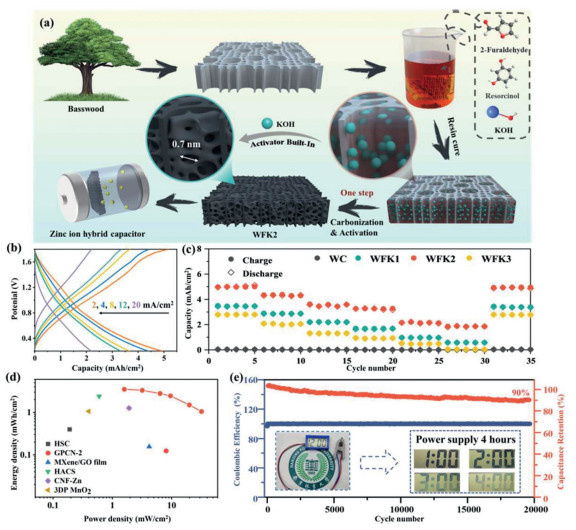
Figure 1.
(a) Schematic illustration of the synthesis route. (b) GCD curves of WFK2 at different current density. (c) Rate performance. (d) Ragon plot. (e) Cycle performance.

Pore transport-interface adsorption-charge transfer synergy strategy for zinc-ion hybrid capacitors via self-embedded activation of bio-resin in wood
Gaigai Duan , Zixuan Guo , Xiaoshuai Han , Zhiwei Tian , Yong Huang , Shiyuan Wang , Chunmei Zhang , Shuijian He , Shaohua Jiang


Energy storage devices are very important for the development of modern society. Different energy storage sources have been fast investigated, such as sodium-ion battery [1], supercapacitor [2-4], lithium-ion batteries [5], hybrid-ion batteries [6], Zn-air battery [7], ammonium-ion batteries [8,9], hydrovoltaic generation [10], and zinc-iodine batteries [11]. As an emerging energy storage device, zinc ion hybrid capacitors (ZIHCs) have attracted wide attention due to their unique energy storage mechanism and excellent comprehensive performance [12]. The pursuit of carbon electrodes with high-quality loads has become a core challenge to promote practical energy storage systems [13]. Especially in the field of ZIHCs, the synergistic improvement of energy density and power density needs to break the shackles of “low surface capacity-high transmission impedance” [14-16]. Theoretically, increasing the thickness of the electrode can significantly increase the active material loading, but the thick electrode constructed by the traditional powder coating process faces multi-dimensional physical and chemical limitations [17]. The breakthrough path lies in the development of high mass-loading self-supporting integrated electrodes.
Natural wood provides a unique biological template system for the construction of biomimetic ion/electron bicontinuous transmission networks by virtue of its vertically interconnected pore structure and functionalized chemical components [18-22]. Due to the absence of binders and additional conductive agents, the reduction of interface contact resistance and dead volume makes it superior to traditional powder coating or simple carbonization/composite routes. The original large pores can promote electrolyte penetration, but the excessive open pores lead to insufficient load density of active materials and limit the improvement of energy density. Moreover, in the ZIHCs system, the hydrodynamic diameter of [Zn(H2O)6]2+ solvation ions is up to 0.86 nm, and the diffusion energy barrier is strongly correlated with the pore size [23]. The diffusion in pores with unsuitable size needs to overcome a large energy barrier, which puts forward stricter requirements for the pore size design of the electrode [24,25]. How to achieve the collaborative optimization of space utilization and charge storage capacity determines the upper limit of wood-based thick carbon electrodes in ZIHCs.
In this work, we propose a spatially constrained coupling strategy that completely changes the design of biomass-derived electrodes. In-situ polymerization of furfural resin in the original pores of natural wood achieves maximum weight gain within the confined space. KOH built-in, catalytic polymerization at low temperature and etching at high temperature, and the pore size of suitable carriers is activated. This three-way coupling strategy successfully decouples the trade-off between traditional “high loading and low performance”, achieving ultra-high mass load while maintaining excellent electrochemical activity, showing satisfactory areal capacity (4.9 mAh/cm2) and ultra-fast kinetics. In addition, it has good cycle stability (90% after 20,000 cycles). This work not only provides a new paradigm for the high-value utilization of biomass resources, but also lays a theoretical and technical foundation for the development of next-generation energy storage devices with high energy density and low environmental footprint through multi-scale collaborative design.
Fig. 1a shows the preparation of wood-based/furfural resin composite thick carbon electrode and the assembly process of zinc ion hybrid capacitor. Natural basswood is cut into oriented chips and delignified to reconstruct pore structure and improve the surface wettability. The resorcinol, furfural monomer and potassium hydroxide are uniformly mixed to a low viscosity resin precursor solution. The delignification wood is immersed in the solution. The deep penetration of the solution in the multi-stage pores of the wood is achieved by negative pressure assisted impregnation (−0.1 MPa, 6 h). Then, the wood-phenolic resin interpenetrating network is formed by stepwise heating and curing by programmed heating. This multi-dimensional coordination of simultaneous adjustment of electrode micro-nano structure, establishment of conductive network and modification of interface characteristics provides a basis for breaking through the bottleneck of mass transfer under high load.
The morphological changes of the samples were observed by scanning electron microscopy [26,27]. The unique morphology of the “thin-walled-through channel” is the core reason for choosing basswood as a precursor-large pores and can be used as a macroscopic transport channel for resin precursor infiltration, while the thin-walled structure reduces the mass transfer resistance during carbonization and provides an ideal substrate for subsequent functionalization (Fig. S1a in Supporting information). As shown in Figs. S1b-d (Supporting information), after resin impregnation-curing-carbonization treatment, WFKn exhibited significant microstructure reconstruction: The hollow channels in the wood stencil are completely filled with dense bulk resin-derived carbon, which significantly increased the mass loading of the sample (Fig. S2 in Supporting information). With the gradual increase of KOH content, the mass loading of electrode tends to decrease because the high KOH/C ratio promotes the further reaction of C with KOH to generate K, K2CO3, H2/CO/CO2, and the carbon skeleton is more etched (Fig. S3 in Supporting information). In addition, the high-magnification SEM images clearly show the significant changes in the morphology of WFKn series samples (According to the added amounts of KOH, the samples are named WFK1 (4 g), WFK2 (5 g), WFK3 (6 g). As shown in Fig. S1e (Supporting information), a sparsely distributed pore structure can be seen on the surface of WFK1. In contrast, the surface of WFK2 sample presents a large number of uniformly distributed interconnected pore structures (Fig. S1f in Supporting information), which confirms the significant activation effect of KOH in-situ anchoring on carbon materials. With the further increase of KOH contents, the original interconnected pore structure collapsed locally, and the adjacent pore walls ruptured and merged with each other to form irregular large-scale voids (Fig. S1g in Supporting information). Transmission electron microscope (TEM) of WFK2 further confirmed the uniform distribution of its nanopores (Fig. S1h in Supporting information). The three-dimensional pore structure stroke-through ion transport network reduces the diffusion resistance of ions inside the electrode and overcomes the tortuous path problem caused by particle accumulation in traditional powder materials. The local sp2 hybrid carbon domain forms an electron hopping channel, which makes the electron transfer. The enriched micropores are more conducive to the rapid formation of the electric double layer.
The crystal structure is characterized by X-ray diffraction (XRD) [28]. From Fig. S4 (Supporting information), it can be seen that all samples have broad peaks at 23° and 43°, corresponding to graphite (002) and (101) crystal planes, respectively. The material has partial graphitization characteristics but the overall crystallinity is low, and there are many defects. Further, Raman spectroscopy is used to explore the structural defects and graphitization degree of the material, mainly analyzing ID/IG (Fig. S5 in Supporting information) [29]. The ID/IG value of WC is the smallest, due to the direct carbonization mainly occurs in the pyrolysis reaction and does not introduce a large number of new defects. Under the dual effect of the introduction of furfural resin and KOH activation, more defects are introduced, so ID/IG is greatly improved. X-ray photoelectron spectroscopy (XPS) provides elemental composition, chemical state, bonding state, etc. [30]. XPS confirmed the presence of C and O elements in WFK2. The deconvolution analysis of the C 1s spectrum shows that it is mainly composed of C═C (284.8 eV), C—O (285.4 eV), C═O (286.6 eV), O—C═O (288.8 eV) and π-π stacking satellite peaks (291.0 eV) caused by ordered or graphitized carbon layers in Fig. S6 (Supporting information). The O 1s fine scan can be seen mainly by —C═O (530.6 eV), —C—OH (532.5 eV), —O—C═O (534.1 eV), when the binding energy is 536 eV, the small peak appears to represent the chemical/physical adsorption of water. The higher hydroxyl peak represents the enhancement of electrolyte wettability, which means the decrease of interface impedance.
The core challenge of thick electrode is the long-distance transport of ions inside the electrode. The surface area and pore size distribution are quantitatively analyzed by N2 adsorption-desorption curve [31]. As shown in Fig. S7a (Supporting information), WC exhibits a type I isotherm. After delignification, the skeletons of cellulose and hemicellulose are exposed, forming natural microfibril gaps (1–2 nm). These gaps are retained and converted into micropores during carbonization, and cellulose pyrolysis released CO and CO2 to form ultra-micropores, resulting in WC dominated by micropores and small specific surface area [32,33]. However, WFKn is different, and there are hysteresis loops, which represents the presence of abundant mesopores in addition to micropores. KOH etched 2–5 nm mesopores in situ and refined the micropore size to 0.7 nm (Fig. S7b in Supporting information), so that the specific surface area of WFK2 increased to 1341 m2/g (Table S1 in Supporting information). The most ideal configuration is achieved under this strategy. The interconnected macropores act as the main channel to promote electrolyte penetration, and the mesopores act as branch channels to realize the rapid diffusion of ions inside the electrode, and finally connect to the micropores that provide storage. The balance between high ionic conductivity and high active surface area utilization in thick electrode is guaranteed to the maximum extent.
However, due to the large size of hydrated zinc ions, a large energy barrier needs to be overcome when they diffuse into smaller pores, which is the micropore effect [34,35]. The matching degree between the pore size and the size of the carrier is very important. Double-layer graphene is used to simulate the pore structure in porous carbon materials, and the intercalation energy of [Zn(H2O)6]2+ in 7 Å pores is analyzed by molecular dynamics simulation [36]. As shown in Fig. S8 (Supporting information), when the pore size is 7 Å, Ein is −3.83 eV, which means that the diffusion and adsorption of [Zn(H2O)6]2+ in 7 Å is a spontaneous process.
With WFK2 as the cathode, zinc foil as the anode, 2 mol/L ZnSO4 as the electrolyte, the glass fiber separator is selected to assemble the zinc ion hybrid capacitor to test its electrochemical performance. The cyclic voltammetry (CV) curves of WFKn show a mixed energy storage characteristic of rectangular at a scanning rate of 10 mV/s in Fig. S9 (Supporting information). Among them, WFK2 has the largest area enclosed, which directly reflects its highest specific capacity. In addition, Fig. S10 (Supporting information) shows the galvanostatic charge-discharge (GCD) curves of different samples at a current density of 2 mA/cm2. Compared with other samples, WFK2 has the longest charge-discharge time, which further confirms its excellent zinc ion storage performance. When the activation dose is insufficient, the carbon matrix cannot be effectively etched, resulting in underdeveloped pores and small specific surface area. On the contrary, excessive activators excessively consume the carbon skeleton, resulting in structural instability. Therefore, WFK2 has the highest capacity. Fig. S11 (Supporting information) shows the CV curves at different scan rates. When the scan rate increases to 40 mV/s, it can still maintain a nearly rectangular shape. Fig. 1b shows the GCD curves at different current densities. At a high current density of 20 mA/cm2, there is no IR drop, which indicates that the electrode has a very low impedance. As shown in Fig. 1c, when the current density is 4, 8, 12, 20, 40 mA/cm2, the capacity of WFK2 is 4.35, 3.6, 3.26, 2.16, 1.86 mAh/cm2, respectively. In Fig. 1d, the WFK2-based ZIHCs obtained a satisfactory energy density (3.5 Wh/cm2), which is better than other related works. At a current density of 10 mA/cm2, after 20,000 cycles, the capacity retention rate is 90%, showing excellent cycle stability (Fig. 1e). A single WFK2-based ZIHC can supply power to the electronic watch for 4 h after charging, showing the potential of application.
The kinetic process of the electrochemical reaction is further analyzed by the b value obtained by fitting the power function relationship between the response current and the scan rate of the cyclic voltammetry curve. As shown in Fig. 2a, the kinetic mechanism is revealed by the quantitative relationship between the peak current (ip) and the scanning rate (v): The log(ip)-log (v) curve is fitted with slopes of 0.87 and 0.91, respectively, confirming that the charge storage is mainly dominated by the surface-controlled ultrafast capacitance behavior. Based on the Dunn method, the capacitance contribution is quantitatively decoupled. At a scan rate of 10 mV/s, the contribution rates of the electric double layer capacitance and the pseudocapacitance are 82% and 18%, respectively (Fig. 2b). It is worth noting that when the scanning rate increases from 2 mV/s to 10 mV/s, the contribution of EDLC-dominated fast surface storage increases significantly from 76% to 82% in Fig. 2c. This is confirmed by the excellent rate performance and fast charge-discharge ability. The core of surface control lies in the efficient interface ion adsorption and desorption process. The adsorption process of zinc ions on different defective graphene structures was simulated by density functional theory calculation, and the adsorption energy was obtained.
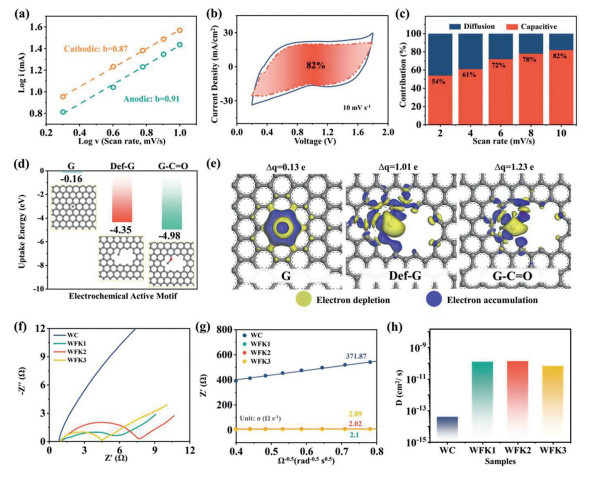
As shown in Fig. 2d, the presence of oxygen-containing functional groups significantly increases the adsorption energy of zinc ions on defective graphene or carbon-only defect structures. In the side view of the electron density difference of zinc ions adsorbed in different models in Fig. S13 (Supporting information), the adsorption strength can be directly seen according to the adsorption position and distance of zinc ions. In addition, Fig. 2e intuitively shows the charge transfer from the top perspective. The graphene model with C═O defects show the largest charge transfer of 1.23 electrons.
The fast kinetics of the WFK2 interface can also be verified by electrochemical impedance spectroscopy (EIS). As shown in the EIS curves of Fig. 2f, WFKn exhibit excellent charge transfer resistance compared with WC. This is attributed to the fact that the oxygen-containing functional groups are modified on the surface of the pores, transforming the physical pores into “electrochemically active channels”, providing high-density reaction sites, reducing the charge transfer activation energy, and optimizing the interface electric double layer structure. Furthermore, by calculating the Warburg coefficient σ to evaluate the diffusion resistance related to the ion transport process. As shown in Fig. 2g, compared with WC, WFKn is about 0.5% of WC, indicating that the ion diffusion efficiency is greatly improved. According to the Warburg coefficient σ, the diffusion coefficient is further calculated in Fig. 2h, and it is concluded that the diffusion coefficient of WFK2 is the largest,which confirmed that the pore structure of the hierarchical pore network is highly matched with the main carrier zinc hexahydrate ions, reducing the ion desolvation energy barrier and accelerating the migration.
On this basis, a series of in-situ and ex-situ characterizations are used to systematically study the collaborative storage mechanism [24]. Ex-situ XPS is used to track the dynamic evolution of anions and cations in the charge-discharge cycle from 0.2 V to 1.8 V. As shown in Fig. 3a, a constant current charge and discharge test is performed at a current density of 2 mA/cm2. Five state points at different potentials are selected during the charge and discharge process, and ex-situ XPS is performed. The changes of Zn and S with the adsorption and desorption of the potential can be clearly identified from Figs. 3b and c. Further combined with the fine spectrum analysis of C 1s in Fig. 3d, it is found that the relative content of C═O (286.8 eV) and C—O—Zn (288.8 eV) groups show a significant negative correlation during the charging process, and the discharge process show a completely reversible change. The alternating growth and decline of the characteristic peaks of C═O (531.5 eV) and C—O (533.2 eV) in the O 1s spectra in Fig. 3e further verify the redox reaction mechanism dominated by oxygen-containing functional groups. Similarly, five state points at different potentials are selected during the charging and discharging process (Fig. 3f). The microscopic evolution of carbon structure is investigated by in-situ Raman. It can be seen from Fig. 3g that only the reversible change of D/G band intensity and peak width is shown during the charging process of 0.2–1.8 V, while the peak position remains stable. This clearly confirms that the energy storage mechanism is the adsorption/desorption (non-intercalation) of cathode surface, and there is no G peak displacement caused by interlayer expansion. The periodic fluctuation of defect concentration (ID/IG cycle reversibility) is due to the structural relaxation and adsorption site regeneration caused by the desorption of large-sized hydrated zinc ions, which does not destroy the integrity of the carbon skeleton. Furthermore, the formation of by-products is attributed to the local alkaline environment after the proton participates in the redox reaction, and the coordination of Zn2+ with OH-and SO42- in Fig. 3h [37].
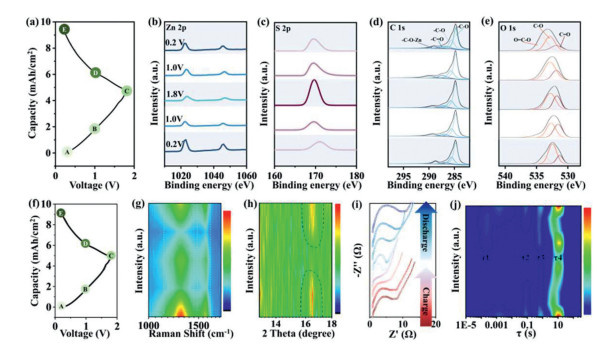
The dynamic impedance evolution of the device during charge and discharge is monitored in real time by in-situ EIS, which provides a key experimental basis for revealing its charge storage kinetics and interface behavior. From Fig. 3i and Fig. S14a (Supporting information), it can be seen that the change trend of the semicircle diameter is the same after the charge-discharge cycle. It gradually decreases during charging, which may be related to the formation and dissolution of by-products. Because the ionic conductivity of by-products is poor, resulting in a sharp increase in charge transfer resistance. It gradually becomes larger during the discharge process, which verifies that the formation and dissolution of by-products are reversible. Further analysis of the distribution relaxation time of the Nyquist curve reveals different physical processes in the system. By comparing the intensity of the four characteristic peaks (1 × 10⁻⁵–101 s) in the contour map of distribution of relaxation times (DRT) in Fig. 3j and Fig. S14b (Supporting information), it can be concluded that WFK2 maintains its rapid dynamic under high load [38]. The multi-dimensional characterization results show that the charge storage of WFK2 cathode is derived from the synergistic effect of reversible adsorption/desorption of Zn2+ and C═O/C—O redox reaction, which provides direct experimental evidence for understanding the dual ion storage mechanism (Fig. S15 and Table S2 in Supporting information).
In summary, we developed a green and efficient strategy to synthesize high-performance wood-derived carbon electrodes by in-situ KOH-mediated furfural resin impregnation and activation. Excessive KOH plays a dual role of resin polymerization catalyst and self-embedded activator, deep and uniform activation was achieved while achieving a high space utilization rate in the hierarchical wood matrix. This innovative method enables the fabrication of monolithic carbon electrodes with special mass loading (up to 32.4 mg/cm2). Satisfactory energy density (3.5 Wh/cm2) and excellent cycle stability (90% after 20,000 cycles) are achieved. Such sustainable and space-constrained synthesis strategy cleverly combines in-situ KOH-mediated furfural resin impregnation with self-activation engineering to construct high-load wood-derived carbon electrodes, solving the long-term challenge of achieving ultra-high mass loading and atomic-level activation uniformity in layered biomass matrices.
Gaigai Duan: Writing – review & editing, Writing – original draft, Methodology, Investigation, Formal analysis, Conceptualization. Zixuan Guo: Writing – review & editing, Writing – original draft, Methodology, Formal analysis. Xiaoshuai Han: Methodology, Investigation, Formal analysis, Conceptualization. Zhiwei Tian: Writing – review & editing, Supervision, Methodology, Investigation, Conceptualization. Yong Huang: Writing – original draft, Methodology, Formal analysis. Shiyuan Wang: Writing – original draft, Formal analysis. Chunmei Zhang: Supervision, Methodology, Formal analysis, Conceptualization. Shuijian He: Methodology, Investigation, Conceptualization. Shaohua Jiang: Supervision, Resources, Methodology, Funding acquisition, Conceptualization.
The authors declare that they have no known competing financial interests or personal relationships that could have appeared to influence the work reported in this paper.
This work is financially supported by the Natural Science Foundation of Jiangsu Province (No. BK20241898).
Supplementary material associated with this article can be found, in the online version, at doi:
H. Yin, D. Han, W. Wang, et al., Chin. Chem. Lett. 36 (2025) 110537. doi: 10.1016/j.cclet.2024.110537
Q. Lv, Z. Tian, W. Li, et al., Chin. Chem. Lett. 37 (2026) 110860. doi: 10.1016/j.cclet.2025.1110
H. Jin, T. Zhang, Z. Tian, et al., J. For. Eng. 9 (2024) 103–109.
Z. Guo, X. Han, C. Zhang, et al., Chin. Chem. Lett. 35 (2024) 109007. doi: 10.1016/j.cclet.2023.109007
T. Chen, Y. Zou, Y. Xu, et al., Chin. Chem. Lett. 37 (2026) 111869. doi: 10.1016/j.cclet.2025.111869
Y. Liu, K. Xiang, W. Zhou, et al., Small 20 (2024) 2308741. doi: 10.1002/smll.202308741
S. Zeng, G. Duan, R. Yu, et al., Prog. Mater. Sci. 147 (2025) 101356. doi: 10.1016/j.pmatsci.2024.101356
X.Y. Wen, W. Li, H. Chen, Rare Metals 44 (2025) 3881–3892. doi: 10.1007/s12598-024-03227-1
T. Guo, L. Tang, W. Deng, et al., Rare Metals 44 (2025) 4631–4641. doi: 10.1007/s12598-025-03278-y
M. Guo, Z. Lin, W. Du, J. For. Eng. 9 (2024) 1–9.
Y. Hou, C. Zhu, Q. Wang, et al., Chin. Chem. Lett. 35 (2024) 108697. doi: 10.1016/j.cclet.2023.108697
C. Lin, Y. Zhang, W. Lieu, et al., Adv. Funct. Mater. 35 (2025) 2413613. doi: 10.1002/adfm.202413613
Z. Xu, Z. Sun, J. Shan, et al., Adv. Funct. Mater. 34 (2023) 2302818.
J. Yin, W. Zhang, W. Wang, et al., Adv. Energy Mater. 10 (2020) 2001705. doi: 10.1002/aenm.202001705
J. Zhou, Q. Li, X. Hu, et al., Chin. Chem. Lett. 35 (2024) 109143. doi: 10.1016/j.cclet.2023.109143
W. Chen, Y. Liu, X. Zhang, et al., J. Power Sources 654 (2025) 237814. doi: 10.1016/j.jpowsour.2025.237814
Y. Xu, Z. Zheng, J. Feng, et al., Chin. Chem. Lett. 37 (2026) 110751. doi: 10.1016/j.cclet.2024.110751
C. Liu, T. Lei, F. Seidi, et al., Energy. Storge. Mater. 72 (2024) 103774.
C.M. Albert, K.C. Liew, J. Bioresour. Bioprod. 9 (2024) 27–42.
Y. Zhao, Y. Alsaid, B. Yao, et al., Adv. Funct. Mater. 30 (2020) 1909133. doi: 10.1002/adfm.201909133
J. Luo, H. Lu, M. Huang, et al., J. For. Eng. 9 (2024) 23–30.
A. Arpanaei, Q. Fu, T. Singh, J. Bioresour. Bioprod. 9 (2024) 3–26.
J. Li, K. Ge, A.O. Grammenos, et al., Adv. Mater. 37 (2025) 2502422. doi: 10.1002/adma.202502422
H. He, J. Lian, C. Chen, et al., Nano-Micro Lett. 14 (2022) 106. doi: 10.1007/s40820-022-00839-z
Y. Long, X. An, Y. Yang, et al., Adv. Funct. Mater. (2025) 2424551.
L. Long, Y. Zhang, H. Zhu, et al., J. Am. Ceram. Soc. 108 (2025) e20506. doi: 10.1111/jace.20506
H. Chen, F. Song, B. Wang, et al., Nat. Commun. 16 (2025) 3929. doi: 10.1038/s41467-025-59219-x
H. Zhu, Y. Hu, X. Men, et al., J. Am. Ceram. Soc. 108 (2025) e20301. doi: 10.1111/jace.20301
A. Jorio, A.G. Souza Filho, Annu. Rev. Mater. Res. 46 (2016) 357–382. doi: 10.1146/annurev-matsci-070115-032140
Y. Li, W. Yang, W. Yang, et al., Nano-Micro Lett. 13 (2021) 95. doi: 10.1007/s40820-021-00625-3
Y. Liang, M. Wu, A. Liu, et al., Adv. Sci. 11 (2024) 2407635. doi: 10.1002/advs.202407635
J. Li, C. Chen, J.Y. Zhu, Acc. Mater. Res. 2 (2021) 606–620. doi: 10.1021/accountsmr.1c00075
A.V. Movahedi-Rad, M. Ritter, R.O. Kindler, ACS Sustain Chem. Eng. 12 (2024) 14694–14703. doi: 10.1021/acssuschemeng.4c04652
Y. Marcus, Biophys. Chem. 51 (1994) 111–127. doi: 10.1016/0301-4622(94)00051-4
J. Zhang, R. Zhang, S. Zhang, et al., Chin. Chem. Lett. 37 (2026) 111867. doi: 10.1016/j.cclet.2025.111867
H. Ma, H. Chen, M. Wu, et al., Angew. Chem. 59 (2020) 14541–14549. doi: 10.1002/anie.202005270
H. Li, J. Wu, L. Wang, et al., Chem. Eng. J. 428 (2022) 131071. doi: 10.1016/j.cej.2021.131071
Q. Liang, S. Wang, X. Lu, et al., ACS Nano 18 (2024) 2395–2408. doi: 10.1021/acsnano.3c10731

Figure 1 (a) Schematic illustration of the synthesis route. (b) GCD curves of WFK2 at different current density. (c) Rate performance. (d) Ragon plot. (e) Cycle performance.

Figure 2 (a) b values of WFK2//Zn. (b) CV curves of WFK2//Zn with the capacitive contribution at 10 mV/s. (c) Capacitive contribution of different scan rates. (d) Adsorption energy of Zn2+ on three graphene configurations with corresponding defects. (e) The top view of electron density differences of Zn2+ adsorbed on the optimized active sites and the corresponding bader charge. (f) EIS plots. (g) Linear relationship between real resistance and angular frequency in the low frequency region, and (h) ion diffusion cofficients of different ZHICs.

Figure 3 (a, f) The GCD curve at 2 mA/cm2 and the corresponding five potential selected states. Ex-situ XPS spectra of (b) Zn 2p, (c) S 2p, (d) C 1s, (e) O 1s at various discharged/charged states. (g) In-situ Raman spectra, (h) in-situ XRD patterns, (i) Nyquist plots of the WFK2//Zn during the in-situ EIS measurements. (j) DRT contour plots ofWFK2//Zn.

 扫一扫看文章


扫一扫关注我们
 DownLoad:
 下载:
 下载: