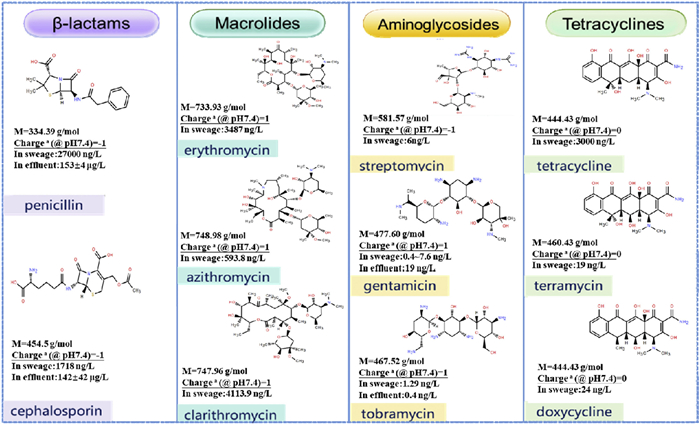
Figure 1.
Physicochemical properties of typical antibiotics.

Innovative research progress of antibiotic wastewater treatment technologies based on the whole-chain approach
Ting Zhang , Yi-Ting Shao , Bin Wang , Zhang-Bin Pan , Yu-Ping Li , Hong-Bin Cao , Li-An Hou


Globally, the widespread use and excessive discharge of antibiotics have caused serious environmental issues, particularly from the wastewater generated during the production process of pharmaceutical companies [1]. Data indicates that antibiotic concentrations in wastewater discharged daily by the pharmaceutical sector often reach hundreds of milligrams per liter [2-4]. With increasingly stringent environmental emission standards [5] and the expansion of antibiotic production scale, challenges such as low raw material utilization rates, inefficient water resource management, excessive wastewater discharge, high treatment costs, and insufficient pollutant removal have become pronounced. Achieving comprehensive compliance with low-cost wastewater discharge solely through end-of-pipe treatment is challenging, presenting a significant technical obstacle to the sustainable development of the industry [6].
In recent years, antibiotic control technologies included source emission reduction, green process control, and end treatment have become the direction of researchers’ efforts [7]. Enzymatic synthesis technology offers significant advantages over traditional chemical synthesis methods, as it does not rely on toxic and hazardous reagents and exhibits higher production efficiency, providing a robust approach to reducing environmental pollution during antibiotic production [8]. Stojanovski et al. [9] has successfully achieved the synthesis of gentamicin antibiotics using the enzymatic method. Mori et al. [10] has delved into the study of the selectivity differences in the enzymatic catalytic reactions during the biosynthesis of lincomycin antibiotics. Researchers including Thong [11] have explored new strategies for antibiotic production using gene editing techniques. In addition, significant process has been made in the top-level design of water pollution control and in key technologies for pollution management at the unit device scale [12,13]. This advancement encompasses areas such as pollution source analysis of typical processes, the optimization of pharmaceutical cleaner production through fermentation and extraction, the integration of physical, chemical and biochemical treatment methods for wastewater, and the resource utilization of sulfur-containing waste liquids [14]. The integrated water pollution control technology system for the entire pharmaceutical process has gained substantial attention from researchers.
However, the current literature primarily focuses on a comprehensive review of terminal antibiotic removal technologies, and it addresses only individual techniques such as adsorption, photocatalysis, electrochemical processes, membrane technology, constructed wetlands, advanced oxidation, and novel materials. These research outcomes undoubtedly provide a solid scientific foundation and practical guidance for the management of antibiotic contamination in wastewater. Nonetheless, it is imperative to recognize that the sources of wastewater in antibiotic industrial production are multifaceted, and the control of wastewater throughout the process is also crucial. In light of this, a systematical review and summarization of wastewater control strategies at different process stages, as well as the comprehensive management of the entire terminal treatment process chain, is urgently needed to address these issues.
This paper begins by constructing a clear and accurate knowledge framework for antibiotics. It conducts a meticulous classification of antibiotics, enabling readers to gain a deeper understanding of the characteristics and differences among various types of antibiotics. Meanwhile, it comprehensively summarizes the physical-chemical properties and concentration levels of typical antibiotics. Secondly, the paper focuses on the production and preparation processes of antibiotics, which are the sources of antibiotics entering the environment. It conducts an in-depth analysis of the sources of antibiotics and the variability in wastewater generation during their production. Finally, it provides a comprehensive summary of the full-chain treatment processes for end-of-pipe antibiotics, covering both conventional biological treatment processes and advanced treatment technologies. It quantitatively evaluates the removal efficiency and carbon emissions of different conventional treatment processes, and assesses the removal capabilities and application prospects of advanced treatment technologies. This review offers a comprehensive and systematic solution for the management of antibiotic pollution. At the theoretical level, it enriches the research content on the environmental behavior of antibiotics and treatment technologies, and provides new ideas and methods for subsequent research. At the practical level, it provides scientific decision - making basis for relevant stakeholders such as pharmaceutical enterprises and environmental protection departments, and contributes to promoting the green development of the antibiotic industry and the improvement of water environment quality.
Antibiotics can be categorized based on their chemical structure, mechanism of action, antimicrobial spectrum, and source. Once introduced into the environment as pollutants, their concentration and forms within ecosystems have become a central focus of current research. The transformation and degradation of antibiotics in the environment are primarily influenced by their chemical structures [15]. Accordingly, this study classifies antibiotics into six groups based on their chemical structure, summarizes their key characteristics, and outlines their concentrations in contemporary aqueous environments to provide theoretical support for future disposal strategies [16,17].
The bactericidal action of β-lactam is primarily achieved by interfering with bacterial cell wall synthesis [18,19]. These antibiotics are distinguished by a β-lactam ring structure at their active center, with various substituents introduced at different positions to produce different drug varieties [20]. The β-lactam ring consists of four atoms (three carbons and one nitrogen), forming a strained ring which is highly unstable and prone to ring-opening in acidic or alkaline environments. Currently, the most commonly used β-lactams are penicillin and cephalosporins.
(1) Penicillin: Penicillin consists primarily of a β-lactam ring and a five-membered thiazolidine ring, which microbial fermentation was used to synthesis penicillin G and then semi-synthetic methods are employed to prepare derivatives such as ampicillin and amoxicillin (Fig. 1). The concentration of penicillin in aquatic environments varies depending on usage and production processes. For example, the concentration of amoxycillin concentrations in municipal sewage in the US reached up to 27 μg/L (excluding metabolites) [21]. Li et al. [22] measured penicillin G concentrations in pharmaceutical wastewater at 153 ± 4 μg/L, with treated effluent containing 1.68 ± 0.48 μg/L and discharge points reporting 0.35 μg/L. However, penicillin concentration in waste liquids from animal husbandry, especially pig husbandry, was notably high at 1449 μg/L. The stability of penicillin in aquatic environments is significantly influenced by pH levels. In acidic conditions, the C-N bond in penicillin is more susceptible to hydrolysis, whereas alkaline conditions slow down this hydrolysis process.
(2) Cephalosporins: In contrast to penicillin, cephalosporins contain a dihydrothiazine ring with C-N and C-S bonds that resist certain chemical reactions, making the structure relatively stable (Fig. 1). In recent years, cephalosporins have been detected in aquatic environments. Their distribution is closely related to regional drug consumption patterns. For instance, Li and Zhang [23] analyzed antibiotic pollutant concentrations in influents of municipal sewage treatment plants in two districts of Hong Kong (China), and found that the concentration of cephalosporin pollutants (cefotaxime and cephalexin) in Shatin, an area with lower living standards, was significantly higher than in Stanley, reaching 1718 ng/L. Additionally, cephalosporin pollution in aquatic environments primarily originates from wastewater produced during manufacturing. Yu et al. [24] conducted an in-depth study of cephalosporin distribution in pharmaceutical wastewater, finding high concentrations of all seven cephalosporins tested, with cefotaxime topping the list at 141.55 ± 42.48 μg/L and cefazolin the lowest at 12.85 μg/L, indicating substantial pollution levels. Even after treatment, residual pollutant concentrations in wastewater still remained in the μg/L range.
Macrolide antibiotics achieve their antibacterial effects by binding to the 23S rRNA of the bacterial ribosome’s 50S subunit, which in turn inhibits peptide chain elongation. This binding disrupts the activity of peptidyl transferase, thereby preventing the elongation of peptide chains and ultimately inhibiting protein synthesis [25]. The physicochemical properties of macrolides are illustrated in Fig. 1. The macrolide ring structure includes a sugar unit connected by β-lactam bonds to a side chain that contains 3-12 carbon atoms [26]. The configuration of the side chain affects the antibiotic’s antimicrobial activity, solubility, and stability. The most commonly used macrolide antibiotics today are erythromycin, azithromycin, and clarithromycin.
Erythromycin, the first macrolide antibiotic used clinically for human infections, contributes to varying levels of pollution in aquatic environments depending on treatment methods [27]. Studies have shown that in Asia, erythromycin concentrations in rivers can reach up to 75.5 μg/L [28], while in Europe, concentration was around 3847 ng/L [29], and in North America, they are below 2250 ng/L [30]. Additionally, azithromycin and clarithromycin are widely used due to their stability, acid resistance, and high bioavailability. Baranauskaite-Fedorova et al. [31] used material flow analysis to examine antibiotic pollution in Lithuania, finding peak concentrations of azithromycin and clarithromycin in surface waters at 593.8 ng/L and 4113.9 ng/L, respectively. Bu et al. [32] performed an ecological risk assessment of pharmaceuticals in China, reporting environmental concentrations of azithromycin and clarithromycin at 0.096 and 0.155 μg/L, respectively.
Aminoglycoside antibiotics are characterized by a central ring structure made up of multiple aminoglycoside units linked by glycosidic bonds. These antibiotics work by binding to the 30S subunit of the bacterial ribosome, disrupting proper ribosomal pairing and translation, which leads to incorrect protein synthesis and ultimately bacterial death [33].
Streptomycin is one of the earliest discovered aminoglycosides, and its extensive use has resulted in widespread bacterial resistance. Haenni et al. [34] studied the impact of antibiotics, including streptomycin, on resistant water bodies in France by comparing environmental concentrations in wastewater, receiving water, and groundwater. According to Murray et al. [35], streptomycin concentrations were found to be 500 ng/L in groundwater and 6 ng/L in surface water. Another key aminoglycoside, gentamicin, is noted for its broad antimicrobial spectrum and clinical use, which has led to its frequent misuse. Löffler and Ternes [36] examined gentamicin levels in hospital wastewater, finding concentrations ranging from 0.4 μg/L to 7.6 μg/L. Gentamicin has also been detected in pharmaceutical wastewater, with concentrations up to 19 ng/L reported by Tarani et al. [37].
Tobramycin and amikacin, which are derivatives of gentamicin, are widely used because of their low cost and broad-spectrum activity, resulting in their widespread environmental presence. Li et al. [38] estimated environmental concentrations of tobramycin and amikacin at 0.012 μg/L and 0.252 μg/L, respectively, during an ecological risk assessment of pharmaceuticals used in China. In medical wastewater, these pollutants are often found at much higher concentrations. Sharma et al. [39] detected amikacin at a concentration of 11.72 μg/L in the wastewater of a maternity hospital, as well as in soil where manure had been applied.
Lincosamide antibiotics are characterized by a structure that includes an eight-carbon aminosugar and a pyrrolidinone ring, giving them distinctive antibacterial properties [40]. These antibiotics inhibit protein synthesis by binding to the 23S rRNA of the bacterial ribosome’s 50S subunit, which prevents peptide chain elongation and disrupts the activity of peptidyl transferase. Lincomycin and clindamycin are common lincosamides.
Lincomycin is notable for its chemical stability and resistance to natural degradation, allowing it to persist in the environment and contribute to significant contamination of aquatic ecosystems and soil. Watanabe et al. [41] detected lincomycin in the environment around dairy farms, where it is widely used, with concentrations ranging from 0.076 µg/L to 0.80 µg/L in various water samples. Kuchta et al. [42] measured lincomycin concentrations in soil fertilized with pig manure, finding levels between 46.3 μg/L and 117 µg/L.
Clindamycin, a semi-synthetic derivative of lincomycin, shares a similar structure but features a chlorine substituent in the eight-carbon sugar portion. High concentrations of clindamycin are frequently found in medical wastewater. Oertel et al. [43] detected clindamycin levels ranging from 11 μg/L to 103 ng/L in influent samples from various sewage treatment plants. Notably, clindamycin levels in treated effluent increased due to the conversion of clindamycin sulfoxide back to clindamycin, with concentrations ranging from 20 μg/L to 882 ng/L. This indicates a higher pollution risk and highlights the need for more effective treatment methods.
Peptide antibiotics are primarily composed of short peptide chains formed by the linking multiple amino acids through peptide bonds. These peptides often feather cyclic structures and specialized modifications to amino acids such as hydroxylation, methylation, or glycosylation. Such modification improves the antibiotics’ antibacterial activity, stability and specific binding to the target. Compared to other antibiotics types, the shorter peptide chains of peptide antibiotics facilitate their penetration through cell membranes and interaction with bacterial target, thereby exerting their antimicrobial effects [44]. Common examples include polymyxin, vancomycin, bacitracin, and daptomycin.
Polymyxin consists of a cyclic peptide chain and a fatty acid chain. The cyclic peptide portion of polymyxin contains several amino acid residues, including diaminobutyric acid residues, which give the molecule its cationic nature. Li et al. [16] used molecularly imprinted polymers for the solid-phase extraction of polymyxin from water in the Madrid area, detecting a concentration of 11.67 µg/L in the water.
Vancomycin is a complex glycopeptide antibiotic, with a core structure that includes benzene rings, phenol rings, and amino sugars, all connected by ether and amide bonds. Due to its extensive use, vancomycin has become widespread in the environment, contributing to significant drug resistance issues. Giebułtowicz et al. [45] examined the environmental risks and resistance selection risks of antimicrobial drugs in two Polish wastewater treatment plants and their receiving surface waters, finding vancomycin concentrations as high as 3200 ng/L in influent samples.
Bacitracin is an antibiotic made up of multiple structurally similar peptides. It is commonly used not only in some topical medications alongside other antibiotics but also as a feed additive to prevent disease and promote growth in livestock. Consequently, animal manure often becomes a major source of environmental pollution. Zhou et al. [46] tested waste from pig farms in southern China, finding extremely high concentrations of bacitracin: up to 19000 ± 2670 µg/kg in manure, 51200 ± 3220 ng/L in wash water, and 76100 ± 7220 ng/L in suspended particles. Such high concentrations are often inadequately treated, leading to significant environmental contamination around pig farms.
Daptomycin is a cyclic lipopeptide antibiotic widely used in clinical and veterinary medicine in Europe, which has drawn early attention from European researchers regarding its environmental impact. Cucina et al. [47] analyzed pharmaceutical sludge repurposed for agricultural soil and detected daptomycin residues at a concentration of 0.1 mg/kg.
Tetracyclines inhibit bacterial growth and reproduction primarily by preventing the binding of aminoacyl-tRNA to the A site of the ribosome, thereby hindering peptide chain extension [48]. Their core structure consists of a linear tetracyclic system composed of four six-membered carbon rings (A, B, C, and D) covalently linked together. This tetracyclic framework is adorned with various functional groups, including hydroxyl (-OH), methyl (-CH3), carboxyl (-COOH), and amino (-NH2) groups. The position and type of these functional groups significantly influence the antimicrobial activity and pharmacokinetic properties of the antibiotics [49].
Among tetracyclines, tetracycline itself is the most widely used, leading to its frequent detection in various aquatic environments. Dai et al. [50] investigated tetracycline contamination in groundwater, finding concentrations of 184.2 ng/L in shallow groundwater in China. Azanu et al. [51] examined tetracycline pollution across different water environments in Ghana, detecting the antibiotic at various concentrations in hospital wastewater, municipal wastewater, rivers, and irrigation water, with ranges of 58-116, 13-199, 11-24, 11-30, and 11-16 ng/L, respectively. Besides usage-related contamination, inadequately treated pharmaceutical wastewater discharge is a major source of environmental contamination. Hou et al. [52] studied the forms and pathways of antibiotic residues in pharmaceutical wastewater, revealing that even though wastewater treatment processes effectively remove a significant portion of tetracycline, substantial amounts still enter the environment via discharge outlets (with an effluent tetracycline concentration of 32 ± 6 mg/L) and dewatered sludge (with a sludge tetracycline concentration of 5481.1 ± 123 mg/kg), causing severe environmental impact.
In addition to tetracycline, doxycycline and minocycline are widely used antibiotics, both of which are semi-synthetic derivatives of tetracycline. Doxycycline is known for its superior oral absorption and longer half-life. It is frequently detected in effluents from medical facilities and aquaculture. Chen et al. [53] reported a concentration of 50.08 µg/L in actual wastewater treated by hydrothermal methods. Minocycline, which has higher lipophilicity and stronger antimicrobial activity, tends to persist and accumulate in soil and water environments due to its chemical stability and adsorption properties. Hou et al. [54] used SPE-UPLC to assess the distribution and ecological risk of tetracycline antibiotics in the Wei River, finding that minocycline concentrations averaged 1.7 ng/L in river water and 12.96 ng/L in sediments.
In summary, the concentration levels of antibiotics in the environmental are not only influenced by their inherent physicochemical properties but are also closely related to their production synthesis methods, frequency of use, and application scenarios. The concentration distribution of different types of antibiotics in various water bodies and wastewater ranges widely, from a few nanograms per liter (ng/L) to several hundred micrograms per liter (µg/L), with some even higher. This situation highlights the necessity of a deep understanding of the characteristics of antibiotics, which is crucial for identifying the key pollutants to focus on during the water treatment process. Knowledge of the properties of antibiotics helps us to recognize and select the optimal target pollutants, thereby providing a scientific theoretical basis and technical support for the design and optimization of subsequent water treatment processes.
The production process for bulk antibiotic raw materials through microbial fermentation generally involves several stages: Seed breeding, fermentation production, fermentation liquid pretreatment and solid-liquid separation, refining and purification, structural synthesis and transformation, and finally refining and drying. This entire process generates significant amounts of wastewater throughout the pharmaceutical production chain. The efficiency of raw material utilization in antibiotic production is low, typically less than 20%. As a result, a substantial amount of material is released into wastewater. For instance, producing one ton of penicillin generates approximately 800 tons to 1100 tons of high-concentration wastewater, while one ton of cephalosporin produces between 1500 tons and 2100 tons of high-concentration wastewater. The chemical oxygen demand (COD) in these effluents can reach between 15,000 mg/L and 26,000 mg/L, with sulfate concentrations ranging from 500 mg/L to 1000 mg/L. Similarly, producing one ton of streptomycin generates 1160 tons to 1600 tons of high-concentration wastewater, with COD levels as high as 5000 mg/L to 13,000 mg/L and sulfate concentrations between 500 mg/L and 800 mg/L [55]. More detailed information is given in Fig. 2. These effluents primarily originate from processes such as fermentation, extraction, solid-liquid separation, organic phase concentration, and crystallization.
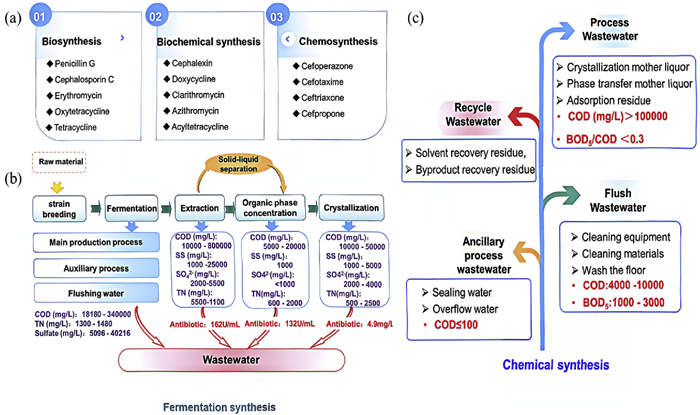
The wastewater generated during the fermentation process includes a small volume of high-concentration mother liquor wastewater and a large volume of low-concentration cleaning wastewater. Xue et al. [56] reported that the fermentation process for producing industrial potassium salt of penicillin G results in 400 tons of waste liquid daily, containing disinfectants, trace residual medium, and other substances. Additionally, this wastewater can contain high concentrations of heavy metal ions such as chromium, nickel, and copper. During the leaching/extraction process, large quantities of organic solvent wastewater and residual antibiotics are produced. Li et al. [57] improved the extraction efficiency of erythromycin using ultrafiltration technology; however, the waste liquid post-extraction still contained filter residues of proteins, polysaccharides, and other components.
Organic phase concentration is primarily conducted through evaporation or membrane concentration, followed by heating to remove the solvent. This process is designed to achieve a highly concentrated antibiotic solution. The liquid separated during membrane concentration is typically discharged as waste and usually contains a small amount of antibiotics. Zhang et al. [58] used a composite nanofiltration membrane to concentrate an antibiotic solution, achieving a 99% antibiotic rejection rate within 200 min. However, the separation liquid still contained about 132 U/mL of antibiotics. During the dissolution and crystallization process, the remaining solution is discharged as waste, which often contains higher concentrations of antibiotics. For example, Schwabbauer [59] found that the concentration of vancomycin in the waste solution was 4.9 mg/L after purification and crystallization.
In summary, each stage of the antibiotic production process generates wastewater that contains residual media, organic solvent residues, and partially extracted antibiotics. The discharge of untreated wastewater poses a significant environmental threat. Therefore, it is crucial to implement targeted strategies to treat the wastewater and address these pollutants effectively.
Source control and process optimization are effective strategies for reducing environmental pollution (Fig. 3). During fermentation, various nutrients are typically added to the initial fermentation medium and process fluid to support cell growth and target antibiotic synthesis. However, the excessive addition of these nutrients often results in a low utilization rate, leaving a substantial amount of unused or difficult-to-utilize raw materials in the fermentation broth, which increases the pollutant concentration in the wastewater [60]. Consequently, developing medium substitutions to reduce emissions from antibiotic fermentation has become a key area of research. By utilizing physiological metabolic parameters (such as the oxygen transfer rate between the liquid medium and mycelium, and the conductivity of the culture medium) as indicators, some studies have replaced traditional compound nitrogen sources (like corn steep liquor) with synthetic nutrient packages. This approach has not only significantly improved the yield of target antibiotics but also substantially decreased the concentrations of ammonia nitrogen and COD in the wastewater by 47% and 33%, respectively [61], Additionally, the morphological changes of mycelia during fermentation can influence the pollutants in fermentation wastewater. For example, during fermentation, the mycelium may expand into a mat-like structure. If nutrients are improperly added or cells age during the later stages of fermentation, autolysis and lysis of the enlarged spores can occur, releasing a large number of intracellular metabolites. This can affect the filtration rate and yield during the filtration stage, leading to increased pollutant discharge into the fermentation wastewater. Therefore, precise control of mycelial morphology is also an effective method for reducing emissions at the source.
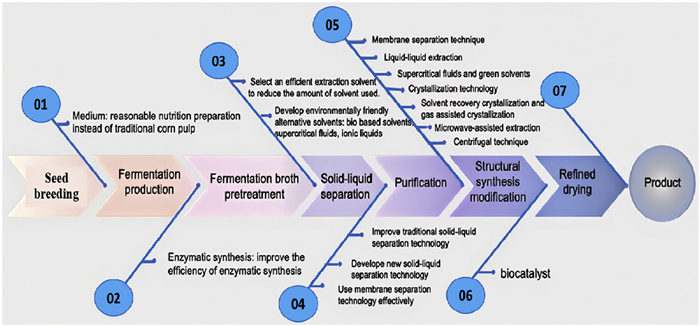
Enzyme-catalyzed synthesis is an environmentally friendly process that uses water as the reaction medium. It offers several advantages, including one-step synthesis, a simple process, mild reaction conditions, and reduced pollutant emissions. In 1969, Cole first proposed enzyme-catalyzed synthesis as an alternative to chemical synthesis for producing semi-synthetic β-lactam antibiotics [62]. Fan et al. [63] developed a new cepheximine complexation process that achieves high yields without volatile organic compounds (VOCs). This process reduced wastewater and COD by 35% and 74%, respectively, compared to chemical methods. The shift towards stepwise enzymatic synthesis, rather than high-polluting chemical synthesis, represents a significant advancement in reducing the environmental impact of antibiotic production.
The use of solvents is essential in the antibiotic production process, as they are crucial for the synthesis, extraction, and purification of antibiotics. However, these solvents can retain antibiotics during their use and may be discharged into the environment through wastewater, leading to pollution that affects ecosystems and human health. To reduce solvent usage and emissions, the production process can be optimized. For instance, more efficient synthesis methods can be implemented to improve the conversion rate and selectivity of raw materials. Environmentally friendly alternative solvents, such as green solvents, are being explored and developed to decrease reliance on traditional solvents. These alternatives include bio-based solvents, supercritical fluids, and ionic liquids. Additionally, the use of microwave energy for antibiotic extraction can increase reaction rates and efficiency, minimize solvent usage, and shorten processing times.
Moreover, optimizing the control parameters of the production process and adopting advanced technological processes can significantly improve antibiotic extraction efficiency, thereby reducing emissions. New membrane separation technologies, such as nanofiltration and reverse osmosis, enable the concentration of the organic phase at room temperature, thereby avoiding the energy consumption and environmental impact associated with traditional distillation methods. Specific enzymes can also be utilized to aid in the synthesis and extraction of antibiotics, thereby increasing production efficiency and reducing waste. High-efficiency centrifugation technology can quickly separate solids and liquids during the antibiotic production process, with low energy consumption and reduced resource waste.
In summary, by optimizing the composition of the medium, precisely controlling bacterial cell morphology during fermentation, utilizing enzymatic synthesis, and efficiently managing process technology, pollutant emissions in antibiotic production can be significantly reduced. This approach can also improve the yield and quality of antibiotics, leading to a more environmentally friendly, efficient, and sustainable antibiotic production process.
Antibiotic treatment processes generally include pretreatment, hydrolysis acidification, up-flow anaerobic bed, followed by anaerobic/oxic (A/O), sequencing biofilm batch reactor (SBBR) or membrane bio-reactor (MBR), and then advanced treatment of the effluent. The core difference lies in the three processes of A/O, SBBR and MBR (Fig. 4).
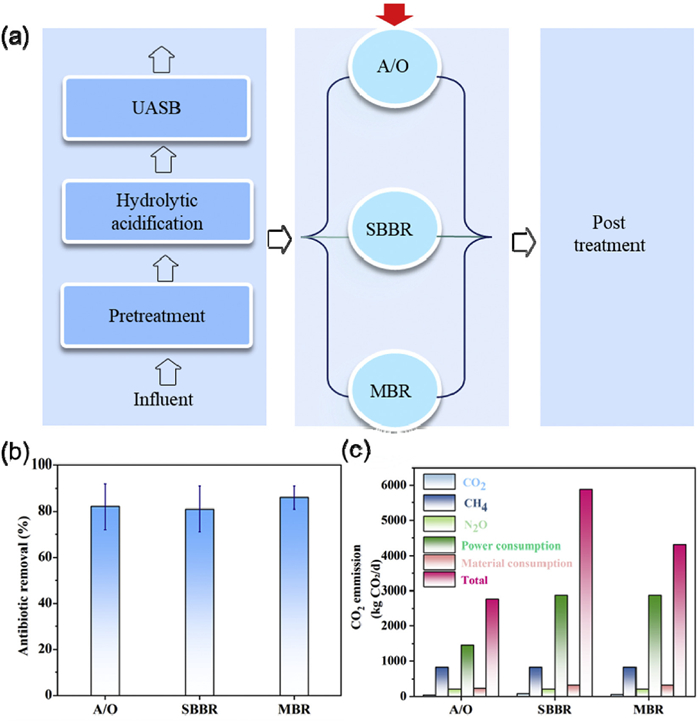
The A/O process consists of an anaerobic stage and an aerobic stage, which is used to remove organic matter and ammonia nitrogen from sewage. In the anaerobic stage, antibiotics undergo chemical transformation reactions such as reduction, hydrolysis, or ring cleavage, converting them into other forms of compounds, making them more susceptible to biodegradation or adsorption. In the aerobic stage, autotrophic bacteria nitrify ammonia nitrogen, and some antibiotics are removed through biodegradation or adsorption. This process has high treatment efficiency, can reduce power consumption and carbon source costs. The equipment investment and operation management are simple, and it has strong adaptability to water quality changes [64]. Studies have shown that lower or higher anaerobic time can improve the removal rate, which is about 30% higher on average than the continuous airflow control test [65]. When treating pig farm wastewater containing antibiotics, anaerobic digestion reduces COD, and aerobic biodegradation removes antibiotics. Within a hydraulic retention time of 3.3 h, the total removal rates of COD and antibiotics reach 95% and 92%, respectively [66].
The sequencing batch reactor (SBR) operates with intermittent aeration, and the microbial diversity will decrease as the antibiotic concentration increases [67]. The improved SBBR adds various fillers, combining the advantages of the activated sludge process and the biofilm process, creating a good environment for microorganisms. It has multiple operation modes, which improves the treatment efficiency and stability. The removal of antibiotics in SBBR relies on biodegradation and adsorption. The sludge adsorption contributes in the anaerobic stage, and biodegradation is the main mechanism in the aerobic stage [68]. When treating actual antibiotic-containing wastewater, the antibiotic removal rate reaches about 50% [64].
The MBR combines membrane separation and biological treatment technologies, which improves microbial diversity. The removal of antibiotics in MBR relies on membrane filtration and biodegradation. Membrane filtration retains most of the antibiotics, and biodegradation further decomposes them. Its antibiotic removal effect is better than that of the traditional activated sludge process. For example, the removal rates of Ofloxacin and Erythromycin in the MBR process are 94% and 67.3% respectively, while those in the traditional activated sludge process are both 23.8% [69]. The antibiotic adsorption removal rate of the MBR process is 24% higher on average than that of the A/A/O process, and the antibiotic biodegradation rate is 10% higher on average [70].
After completing the above work, we further focused on the carbon emissions of the three processes (A/O, MBR, and SBBR), and carried out more detailed calculations and comprehensive comparisons. During the calculation process, we disassembled and accurately accounted for the various components of carbon emissions, and found that power-consumption-related carbon emissions are the key factor causing the carbon-emission differences among the three processes. Specifically, through accurate measurement and analysis of power consumption data, we found that the A/O process has a significant advantage in power consumption during operation compared with the MBR and SBBR processes. The power consumption of the A/O process is only about one-third of that of the MBR and SBBR processes, that is, the power consumption of A/O is about two-thirds lower than that of MBR and SBBR. Since power-consumption-related carbon emissions are an important part of the total carbon emissions, the lower power consumption of the A/O process directly leads to its total carbon emissions being much lower than those of the MBR and SBBR processes. This result is not only verified by theoretical calculations but also further confirmed by actual project operation monitoring (Fig. 4 and Text S1 in Supporting information).
Adsorption is a crucial method for the end treatment of antibiotics. This technology employs adsorbent materials with high specific surface areas, such as activated carbon and its modified variants, as well as newer materials like metal-organic frameworks (MOFs) and nanomaterials. These adsorbents utilize various interaction forces, such as pore filling, electrostatic interactions, hydrogen bonding, hydrophobic interactions, π-π stacking, coordination interactions, and defect structures, to effectively remove antibiotics [71,72].
Traditional adsorbents like activated carbon are known for their good adsorption capacity for certain antibiotics, thanks to their pore structure and surface-active sites. However, the preparation process for activated carbon is complex, and the treatment efficiency and cost can be optimized further (Fig. 5). In contrast, new adsorbents like MOFs and nanomaterials offer higher specific surface areas and stronger adsorption capabilities. These materials often include additional functionalities, such as photocatalytic degradation. Although their preparation processes can be more complex and there are concerns regarding their stability and energy costs, these materials have shown significant advantages in improving removal efficiency. For instance, loading Ni-Co-S nanoparticles onto activated carbon has been shown to significantly improve the removal efficiency of tetracycline antibiotics. Additionally, ZIF-8 nanoparticles, which have a specific surface area of 1674 m2/g and an adsorption capacity of 359.61 mg/g, have demonstrated up to 91% tetracycline removal efficiency.
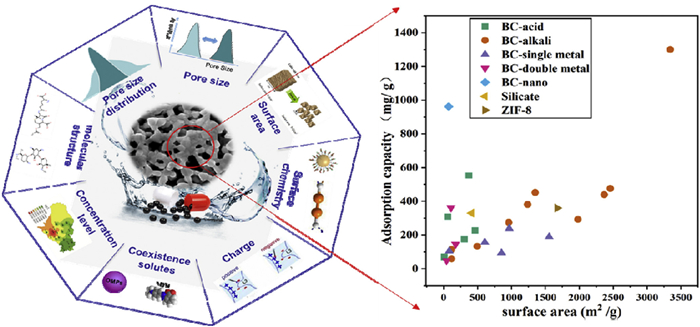
Biochar, as an environmentally friendly adsorbent, can be produced through alkali or acid activation, with its performance influenced by the activation methods and raw materials used. Typically, alkali-activated biochar has a higher specific surface area, though acid-activated biochar does not necessarily have lower adsorption capacity. For example, researchers have used materials like corn cobs, tea waste, willow branches, rice husks, camphor bark, algae, and alkali (KOH or NaOH) to prepare biochar for tetracycline adsorption and removal. The specific surface areas of this biochar were 2368, 1350.11, 3342, 494, 117.8, 959.9, 2457.36, and 1238.49 cm2/g, with corresponding adsorption capacities of 439.70, 451.49, 1300, 58.8, 274.8, 476.19, and 381.584 mg/g [69-81].
Similarly, biochar prepared from bagasse, corn straw, straw, and wood sawdust had specific surface areas of 9.3, 463.89, 372.2, 61.1, and 305.5 m2/g, with adsorption capacities of 68.2, 227.3, 552, 308, and 173.9 mg/g, respectively [82-100]. Some researchers have also developed magnetic biochar by incorporating metal ions to improve antibiotic removal (Table S1 in Supporting information). For instance, Wang et al. [73] created biochar from Astragalus membrane residue and modified it with zinc chloride to improve its adsorption capacity for tetracycline in water. At 30 ℃, the maximum adsorption capacities for chloramphenicol (CTC), tetracycline (TC), and oxytetracycline (OTC) were 200,188, and 129 mg/g, respectively. The adsorption process was found to be spontaneous, driven by hydrogen bonding and electrostatic interactions. Similarly, Liang et al. [74] used a hydrothermal method to synthesize a NiFe2O4/biochar magnetic composite (NFO/BC) for tetracycline removal from water. The results showed that the NFO/BC composite had a higher removal efficiency and better recyclability compared to pure BC and NFO. Additionally, its specific surface area was three times larger than that of pure NFO, achieving a TC removal rate of 93.9%, which was 1.9 times higher than NFO and 1.67 times higher than BC. Besides activated carbon, hybrid silicate adsorbents have also demonstrated effective antibiotic adsorption. For example, Tian et al. [75] synthesized a series of highly efficient hybrid silicate adsorbents using a simple one-step method. They used palygorskite (PAL) as the raw material, combined with sodium silicate (SS), magnesium sulfate (MS), and monochloroacetic acid (MCA). The process transformed PAL crystals and associated minerals into an amorphous and polycrystalline porous Mg, Al-silicate, with the active -COOH group introduced into the silicate, resulting in a mixed adsorbent with a specific surface area of 410.61 m2/g (compared to 52.87 m2/g for natural PAL). The hybrid silicate adsorbents showed excellent adsorption capacity for antibiotics, specifically CTC at 329.84 mg/g and TC at 207.47 mg/g, which represented increases of 218.9% and 107.9%, respectively, compared to natural PAL.
In summary, adsorption technology offers an effective method for managing antibiotic pollutants. Natural porous structural materials can be modified to provide distinct advantages in terms of specific surface area and adsorption capacity, offering diverse options for practical applications. However, further research is necessary to improve adsorption efficiency, reduce costs, and improve the stability of these materials.
Membrane separation technology utilizes semi-permeable membranes to separate substances based on their molecular weights. This technique is typically conducted through cross-flow or dead-end filtering. Membrane separation is regarded as one of the most promising methods in water treatment due to its broad applicability, straightforward operation, strong selectivity, high separation efficiency, low energy consumption, and environmental friendliness. It holds significant research value, particularly in the removal of emerging pollutants such as antibiotics and resistance genes.
The type of membrane and its pore size are critical factors influencing the effectiveness of antibiotic removal. Given the small size of antibiotic molecules, traditional membrane technologies often fall short, with limitations such as high energy consumption, elevated operational costs, and significant membrane fouling [101]. To address these challenges, recent research has focused on improving membrane selectivity and improving anti-fouling properties. New membrane materials, including nanoparticles, metal-organic frameworks (MOFs), covalent organic frameworks (COFs), graphene oxide, and carbon nanotubes, have shown higher permeability, selectivity, and resistance to fouling (Fig. 6). For instance, a self-cleaning photocatalytic composite film made from g-C3N4@MXene nanosheets has been developed to effectively remove antibiotics from wastewater [102]. Additionally, researchers [103] have created a novel anode film (D-UiO-66/Graphite/PVDF) by integrating a defective zirconium-based organic framework (D-UiO-66) and conductive graphite-zirconium particles into a PVDF matrix, achieving efficient tetracycline removal. Moreover, 2D layered MXene materials, known for their regular interlayer structures, are considered promising for membrane separation. However, these materials tend to stack face-to-face, forming dense structures that hinder water permeability and reduce separation performance. Cylindrical arenes, with their rigid skeletons and multi-site cooperative units, can effectively prevent the aggregation of 2D MXene layers. Based on this concept, Sun et al. [104] studied typical 2D layered MXene nanosheets and developed an organic-inorganic composite membrane material with a highly regular structure using a novel chemical modification method. This membrane demonstrated efficient antibiotic water purification. The study showed that the upper and lower edges of the cylindrical arenes were anchored to MXene nanosheets through covalent interactions, increasing the interaction between sheets and increasing the interlayer spacing, which is beneficial for effective antibiotic separation. The composite membrane material exhibited excellent separation performance, strong anti-fouling properties, and good stability under acidic and alkaline conditions. Compared to similar 2D membranes, the permeation flux of this organic-inorganic composite membrane increased by 100 times while maintaining similar retention performance.
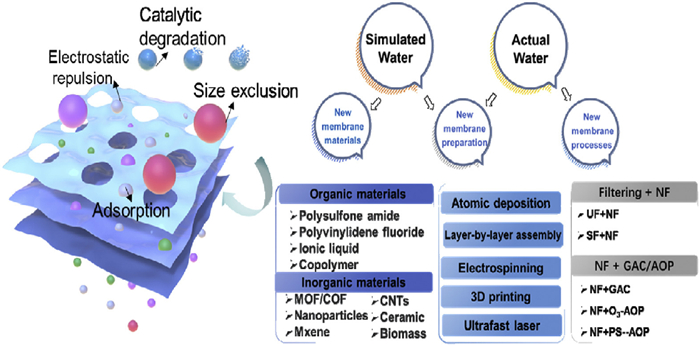
New membrane preparation techniques, such as cross-linking modification, Michael addition, and layer-by-layer assembly, are primarily employed to precisely customize membrane materials with specialized functions (Fig. 6). These techniques allow for the creation of membrane materials that are highly efficient in removing specific pollutants. For instance, Zheng and Wang [105] developed a self-assembled nanofiltration membrane with tailored selectivity by layering two strong polyelectrolytes, polydiallyl dimethylammonium chloride and sodium polystyrene sulfonate, layer by layer. This membrane was designed to remove inorganic salts, antibiotics, and ARGs from wastewater. The effectiveness of this membrane was tested on three antibiotics: chloramphenicol, tetracycline hydrochloride, and rifamycin. Due to its more open pore structure and lower surface charge density, the M-3L & 2D membrane system exhibited a lower rejection rate for chloramphenicol, which has a smaller molecular weight, in a neutral water environment. However, it still maintained a rejection rate above 70% and demonstrated better performance against the antibiotics in other water environments. For example, the rejection rate for chloramphenicol reached 83.6% in a complex salt solution and 90.3% in deionized water.
Dai et al. [106] used a layer-by-layer self-assembly method to construct COF nanoflowers with arbitrary orientation on the base membrane polyethersulfone (PES) surface. They then performed an interfacial polymerization reaction on this base to produce a polyamide nanofiltration membrane with a pleated morphology. The study revealed that, unlike the nodular polyamides directly polymerized on the surface of traditional PES films, the polyamides formed on the COF-modified base film displayed a novel wrinkle-like structure, and the thickness of the polyamide layer was significantly reduced. This membrane achieved a rejection rate of over 99% for tetracycline, oxytetracycline, and other antibiotics.
The new treatment process aims to maximize the advantages of each component within a combined system, tailored to the characteristics of each unit. Currently, this approach primarily involves integrating membrane filtration technology with Fenton oxidation, electrochemical oxidation, and photocatalytic oxidation technologies to efficiently remove antibiotics and address the issue of membrane fouling (Fig. 6). For instance, Qiu et al. [107] developed a hybrid microfiltration-forward osmosis membrane bioreactor (MF-FOMBR) for treating antibiotic-lad wastewater. In the first stage, a microfiltration membrane is used to remove large particles from the wastewater and achieve partial antibiotic removal, with a removal rate ranging from 58.9% to 83.8%. The second stage utilizes a forward osmosis membrane bioreactor, where the forward osmosis (FO) membrane demonstrates high rejection rates for various antibiotics during operation, ranging from 71% to 100%. The overall antibiotic removal efficiency of the system improves progressively over time.
Membrane contamination is a significant challenge that limits the effectiveness of membrane technology. To address this issue, researchers have improved membrane materials by incorporating photocatalytic properties, enabling them to degrade membrane pollutants under external voltage or light. For example, Song et al. [108] successfully synthesized a Bi2O2CO3/In(OH)3 (BON) composite through a one-pot hydrothermal method and created a Bi2O2CO3/In(OH)3/PVDF (BON-M-25) photocatalytic membrane using vacuum filtration. Under visible light, this membrane achieved a 100% degradation rate of tetracycline in water within 40 min without causing membrane contamination. Additionally, adjusting the interfacial polymerization reaction conditions to produce polyamide nanofiltration membranes with a wrinkled morphology has proven to be an effective approach to overcoming the permeability-selectivity trade-off in nanofiltration membranes. Previous studies indicated that a pleated polyamide nanofiltration membrane could be created by filtering soluble nanoparticles onto the base membrane surface, followed by interfacial polymerization, utilizing the "sacrificial template" effect of the nanoparticles. However, the control over forming this pleated morphology was limited. Yu et al. [109] successfully fabricated periodic striped polyamide nanofiltration membranes by growing cyclodextrin-based organic framework (CD-MOF) nanoparticles on the base membrane surface, followed by interfacial polymerization. Compared to the control membrane (PA/PES), the PA/iCM/PES membrane exhibited an increased surface area, reduced thickness, increased hydrophilicity, and a decreased crosslinking degree. The pure water permeability of the PA/iCM/PES membrane was boosted by 617% to 29.4 L m−2 h−1 bar−1, with 99% rejection of Na2SO4 and over 95% rejection of tetracycline [109].
In summary, to improve the effectiveness of membrane technology in removing antibiotics and other pollutants, researchers have extensively explored and experimented with membrane material selection, preparation process improvement, and treatment process innovation. These studies not only improve membrane selectivity and anti-fouling capabilities but also contribute to the development of more efficient, economical, and environmentally friendly water treatment technologies.
Advanced oxidation technology was first proposed by Glaze [110]. The core of this technology is to use hydroxyl radicals with strong oxidation to degrade refractory organic compounds and convert them into low or non-toxic small molecular substances. At present, the most widely used advanced oxidation technology is ozone and its advanced oxidation technology.
When evaluating the interaction between ozone and antibiotics, the reaction rate constant is often used as an indicator (Text S2 in Supporting information). Table 1 shows the reaction rate constants of common antibiotics with ozone. It can be seen that lincomycin has the largest first-order rate constant with ozone, which indicates that lincomycin is more easily oxidized directly by ozone, whereas penicillin G is following. Since natural organic matter is often present in water, and the first-order reaction rate constant between natural organic matter and ozone is usually in the range of 0.3-0.5 min−1 [111-117], which will compete with ozone and affect the degradation efficiency of ozone. Therefore, the presence of natural organic matter is a factor that must be considered during ozone removal of antibiotics. However, the presence of natural organic matter may catalyze the production of hydroxyl radicals with ozone, which may improve the antibiotics removal.

 DownLoad:
CSV
DownLoad:
CSV
| Antibiotics | Degradation method | First-order reaction rate constant (min−1) | Second order reaction rate constant (L mol−1 s−1) | Ref. |
| Penicillin G | O3 | 0.8255 | – | [111] |
| Tetracycline | O3 | – | 9.6 × 10⁴ ~ 4.7 × 10⁶ (pH 3-9) | [112,113] |
| Tetracycline | UV/PAA (peracetic acid) | 0.164 | – | [114] |
| Oxytetracycline | O3 | – | 6.9 × 10⁶ | [111] |
| Oxytetracycline | UV/PAA (peracetic acid) | 0.158 | – | [114] |
| Aureomycin | O3 | – | 1.7 × 10⁷ | [115] |
| Aureomycin | UV/PAA (peracetic acid) | 0.453 | – | [114] |
| Doxycycline | O3 | 4.8 × 10⁴ ~ 3.6 × 10⁵ (pH 2.5) | [116] | |
| Lincozymes | O3 | 4.3 | – | [117] |
In addition, another reaction rate constant for hydroxyl radicals react with antibiotics was higher than direct with ozone, which was in the range of 107-109 L mol−1 s−1. Therefore, in order to improve the removal of antibiotics, technologies such as photocatalysis, Fenton process, and ultrasonic oxidation have attracted the attention of researchers in recent years due to their high efficiency and continuous generation of free radicals.
Photocatalytic oxidation technology generates photogenerated holes and electrons on the photocatalyst to generate active substances with strong oxidative properties for efficient degradation of antibiotics. For example, Luo et al. [118] prepared the Ag/AgNbO3/BiVO4 with good photocatalytic activity and used it for the photocatalytic oxidative degradation of levofloxacin hydrochloride, and results showed that the removal rate of levofloxacin hydrochloride could be reached 88.68%. Photocatalysis combines the characteristics of photocatalytic oxidation and electrochemical technology by applying an external bias to increase the concentration of free radicals, thereby improving the degradation rate of organic matter. Tang et al. [119] constructed an electrode composed of titanium dioxide nanotubes and g-C3N4 nanosheets for photocatalytic to remove tetracycline, the results showed that the tetracycline was completely removed within two hours and the remove rate reached to 93%.
Fenton process uses Fenton reagents (hydrogen peroxide (H2O2) and ferrous ion (Fe2+)) to produce strongly oxidizing hydroxyl radicals (•OH) under acidic conditions to degrade antibiotics. Electro Fenton process (EF) is developed on the basis of the traditional Fenton process, which inhibits the recombination of photogenerated electron-holes through the power plant action, thereby improving the generation efficiency of free radicals. Tang et al. [120] constructed a set of two-cathode Fenton device for removing tetracycline, which showed extremely strong activation performance. The removal rate of tetracycline reached to 98.2% within 5 min. In order to further reduce the treatment energy consumption, researchers also proposed the photo Fenton process (PF), which combines the photocatalytic technology with Fenton reagent to realize the regeneration of ferrous ions (Fe2+) and the production of hydroxyl radicals under light conditions. The photo Fenton process usually uses ultraviolet lamp as the light source, so the energy cost is still not satisfactory. In view of this, researchers proposed solar Fenton process (SPF) to further save energy cost. Chen et al. [121] used BiVO4 as a light-absorbing semiconductor, used xenon lamp to simulate the solar light source, and treated antibiotic wastewater containing norfloxacin by solar Fenton process. The degradation rate of norfloxacin reached to 96% within 1 h, which greatly reduced the energy cost and drug administration cost while achieving very good treatment effect, fully demonstrating its effectiveness.
In summary, when addressing the challenge of antibiotic wastewater, advanced oxidation technology has demonstrated its powerful ability to efficiently degrade these compounds that are difficult to biotreat. However, considering the selective nature of oxidants, the specific composition of wastewater has an important influence on the oxidation process. Therefore, to achieve the highest treatment efficiency and economic benefits, the wastewater must be thoroughly analyzed, and the oxidation process must be selected and optimized according to its characteristics. To ensure that highly reactive oxidative species can concentrate on the degradation of antibiotics while avoiding non-target reactions with other substances in water, a process coupling strategy can be used. Through refined process control and innovative process integration, effective management of complex wastewater components and efficient removal of pollutants can be achieved.
The nature of antibiotics, their concentration distribution in the environment, and the emission characteristics of their production processes are all closely related to the degree of optimization of the production technology. By optimizing the production process, reducing the types and quantities of solvents used, and employing advanced separation and purification technologies, the loss of antibiotics during production can be minimized. Terminal treatment is the last barrier in the process of antibiotic management. The traditional low-carbon A2/O process is unable to achieve efficient removal of antibiotics. However, the coupling of membrane technology with chemical oxidation or physical adsorption can effectively remove competitive organic matter, thus achieving efficient removal of antibiotics. Future research should concentrate on the following key areas:
(1) Advancements in enzyme catalysis technology. By leveraging data mining, artificial intelligence, and DNA sequencing techniques, researchers can engineer and tailor enzymes to address specific environmental requirements. The development of comprehensive enzyme libraries will be crucial in tackling current environmental concerns.
(2) Enhancement of terminal treatment technologies. There is a need for continuous refinement in the selection of membrane materials for permeability, the efficiency of catalysts, and the performance of adsorbents to optimize end-treatment processes.
(3) Exploration and application of new membrane materials. Research efforts should be intensified to understand the separation mechanisms of novel membrane materials, refine their design and fabrication processes, enhance their performance and separation efficiency, and delve into the generation mechanisms of free radicals and the degradation pathways of pollutants.
(4) Management of actual antibiotic wastewater. Given the complexity and variability of wastewater components, it is essential to adopt appropriate treatment methods tailored to local conditions to facilitate the industrial application and practical viability of these technologies.
By pursuing these avenues, we can effectively manage antibiotic pollution, safeguard the environment and human health, and ensure that scientific and technological advancements have a positive impact on societal development.
The authors declare that they have no known competing financial interests or personal relationships that could have appeared to influence the work reported in this paper.
Ting Zhang: Writing – review & editing, Writing – original draft, Formal analysis, Data curation. Yi-Ting Shao: Data curation. Bin Wang: Formal analysis, Data curation. Zhang-Bin Pan: Formal analysis, Data curation. Yu-Ping Li: Formal analysis, Conceptualization. Hong-Bin Cao: Supervision, Conceptualization. Li-An Hou: Supervision, Investigation, Funding acquisition.
We acknowledge the funding for this research provided by the Strategic Research and Consulting Project of Chinese Academy of Engineering (No. 2023-JB-05).
Supplementary material associated with this article can be found, in the online version, at doi:
Y.F. Song, Z.H. Zhang, Y.B. Liu, et al., J. Hazard. Mater. 479 (2024) 135514. doi: 10.1016/j.jhazmat.2024.135514
B.Q. Wang, Z.X. Xu, B. Dong, J. Hazard. Mater. 469 (2024) 133925. doi: 10.1016/j.jhazmat.2024.133925
N. Wang, S.C. Li, M.L. Shi, et al., Water Res. 266 (2024) 122444. doi: 10.1016/j.watres.2024.122444
B.P. Bougnom, L.J. Piddock, Environ. Sci. Technol. 51 (2017) 5863–5864. doi: 10.1021/acs.est.7b01852
Word Health Organization, Genenva: Word Health Organization (2023) 1–47.
J. Lach, L. Stępniak, A. Ociepa-Kubicka, Probl. Ekorozw. 13 (2018) 197–207.
D. Balarak, A.D. Khatibi, K. Chandrika, Int. J. Pharmaceu. Invest. 10 (2020) 106–111. doi: 10.5530/ijpi.2020.2.19
C. Molinaro, Y. Kawasaki, G. Wanyoike, et al., J. Am. Chem. Soc. 144 (2022) 14838–14845. doi: 10.1021/jacs.2c06019
G. Stojanovski, H. Hailes, J. Ward, Green Chem. 24 (2022) 9542–9551. doi: 10.1039/d2gc03600b
T. Mori, Y. Moriwaki, K. Sakurada, et al., Nat. Chem. 17 (2025) 256–264. doi: 10.1038/s41557-024-01687-7
W.L. Thong, Y.X. Zhang, Y. Zhuo, et al., Nat. Commun. 12 (2021) 6872. doi: 10.1038/s41467-021-27139-1
X.S. Hui, W.J. Fang, G. Wang, et al., J. Clean. Prod. 401 (2023) 136786. doi: 10.1016/j.jclepro.2023.136786
M. Amarasiri, D. Sano, S. Suzuki, Environ. Sci. Technol. 50 (2020) 2016–2059. doi: 10.1080/10643389.2019.1692611
B.L. Phoon, C.C. Ong, M.S. Saheed, et al., J. Hazard. Mater. 400 (2020) 122961. doi: 10.1016/j.jhazmat.2020.122961
O. Jovanovic, C.F. Amábile-Cuevas, C. Shang, et al., ACS ES & T Water 1 (2021) 1334–1351. doi: 10.1021/acsestwater.0c00308
S.N. Li, P.L. Show, H.H. Ngo, et al., Environ. Sci. Ecotechnol. 9 (2022) 100145. doi: 10.1016/j.ese.2022.100145
J. Li, L. Zhao, M. Feng, et al., Water Res. 202 (2021) 117463. doi: 10.1016/j.watres.2021.117463
D. Kim, S. Kim, Y. Kwon, et al., Biomol. Ther. 31 (2) (2023) 141. doi: 10.4062/biomolther.2023.008
M. Dabhi, R. Patel, V. Shah, et al., J. Proteomics 15 (2024) 215–232. doi: 10.1007/s42485-024-00135-x
L.M. Lima, B.N.M. da Silva, G. Barbosa, et al., Eur. J. Med. Chem. 208 (2020) 112829. doi: 10.1016/j.ejmech.2020.112829
C.H. Huang, J.E. Renew, K.L. Smeby, et al., J. Contemp. Wat. Res. Ed. 120 (2011) 4. doi: 10.1167/11.6.4
D. Li, M. Yang, J. Hu, et al., Water Res. 42 (2008) 307–317. doi: 10.1016/j.watres.2007.07.016
B. Li, T. Zhang, Chemosphere 83 (2011) 1284–1289. doi: 10.1016/j.chemosphere.2011.03.002
X. Yu, X. Tang, J. Zuo, Sci. Total Environ. 569 (2016) 23–30.
B. Beckert, E.C. Leroy, S. Sothiselvam, et al., Nat. Commun. 12 (2021) 4466. doi: 10.1038/s41467-021-24674-9
T. Jednacak, I. Mikulandra, P. Novak, Int. J. Mol. Sci. 21 (2020) 7799. doi: 10.3390/ijms21207799
B.H. Schafhauser, L.A. Kristofco, C.M.R. de Oliveira, et al., Env. pollution 238 (2018) 440–451.
A.Y.C. Lin, Y.T. Tsai, Sci. Total Environ. 407 (2009) 3793–3802. doi: 10.1016/j.scitotenv.2009.03.009
Y. Valcárcel, S.G. Alonso, J.L. Rodríguez-Gil, Chemosphere 84 (2011) 1336–1348. doi: 10.1016/j.chemosphere.2011.05.014
M.E. Karpuzcu, D. Fairbairn, W.A. Arnold, et al., Environ. Sci-proc. Imp. 16 (2014) 2390–2399.
I. Baranauskaite-Fedorova, J. Dvarioniene, Water 15 (2022) 1–10.
Q.W. Bu, H.M. Cao, Q.S. Li, et al., Environ. Sci. Pollut. R. 28 (2021) 13515–13523. doi: 10.1007/s11356-020-11611-4
M. Jospe-Kaufman, L. Siomin, M. Fridman, Bioorg. Med. Chem. Lett. 30 (2020) 127218. doi: 10.1016/j.bmcl.2020.127218
M. Haenni, C. Dagot, O. Chesneau, et al., Environ. Int. 159 (2022) 107047. doi: 10.1016/j.envint.2021.107047
A.K. Murray, I. Stanton, W.H. Gaze, Water Res. 200 (2021) 117233. doi: 10.1016/j.watres.2021.117233
D. Löffler, T.A. Ternes, J. Chromatogr. A 1000 (2003) 583–588. doi: 10.1016/S0021-9673(03)00059-1
L. Tahrani, J. Van Loco, H. Ben Mansour, et al., J. Water Health 14 (2016) 208–213. doi: 10.2166/wh.2015.224
C. Li, A.H. Li, X.M. Hui, et al., Ecoto. Environ. Safe. 285 (2024) 117022. doi: 10.1016/j.ecoenv.2024.117022
G. Sharma, P. Pahade, A. Durgbanshi, et al., Environ. Pollution 296 (2022) 118719. doi: 10.1016/j.envpol.2021.118719
T. Mori, I. Abe, ChemBioChem 25 (2024) 840.
N. Watanabe, B.A. Bergamaschi, K.A. Loftin, et al., Environ. Sci. Technol. 44 (2010) 6591–6600. doi: 10.1021/es100834s
S.L. Kuchta, A.J. Cessna, J.A. Elliott, et al., J. Environ. Qual. 38 (2009) 1719–1727. doi: 10.2134/jeq2008.0365
R. Oertel, S. Schubert, V. Mühlbauer, et al., Environ. Sci. Pollut. 21 (2014) 11764–11769. doi: 10.1007/s11356-013-2333-2
S. Li, Y. Wang, Z. Xue, et al., Trends Food Sci. Tech. 109 (2021) 103–115. doi: 10.1016/j.tifs.2021.01.005
J. Giebułtowicz, G. Nałęcz-Jawecki, M. Harnisz, et al., Molecules 25 (2020) 1470. doi: 10.3390/molecules25061470
L.J. Zhou, G.G. Ying, R.Q. Zhang, et al., Environ. Sci. Process impacts 15 (2013) 802–813. doi: 10.1039/c3em30682h
M. Cucina, A. Ricci, C. Zadra, et al., Sci. Total Environ. 695 (2019) 133762. doi: 10.1016/j.scitotenv.2019.133762
A. Rusu, E.L. Buta, Pharmaceutics 13 (2021) 2085. doi: 10.3390/pharmaceutics13122085
R. Ramachanderan, B. Schaefer, ChemTexts 7 (2021) 18. doi: 10.1007/s40828-021-00138-x
Y. Dai, M. Liu, J. Li, et al., Sep. Sci. Technol. 55 (2020) 1005–1021. doi: 10.1080/01496395.2019.1577445
D. Azanu, B. Styrishave, G. Darko, et al., Sci. Total Environ. 622 (2018) 293–305.
J. Hou, C. Wang, D. Mao, et al., Environ. Sci. Pollut. 23 (2016) 1722–1731. doi: 10.1007/s11356-015-5431-5
J. Chen, Z. Huang, X. Wu, et al., J. Environ. Chem. Eng. 11 (2023) 109849. doi: 10.1016/j.jece.2023.109849
J. Hou, Z. Chen, J. Gao, et al., Water Res. 159 (2019) 511–520. doi: 10.1016/j.watres.2019.05.034
Z. Yu, T. Mei, T. Zhe, et al., J. China Environ. Eng. 12 (2018) 1–14.
J. Xue, D. Lei, X. Zhao, et al., Chemosphere 291 (2022) 132837. doi: 10.1016/j.chemosphere.2021.132837
S.Z. Li, X.Y. Li, Z.F. Cui, et al., Sep. Purif. Technol. 34 (2004) 115–123. doi: 10.1016/S1383-5866(03)00185-0
W. Zhang, G. He, P. Gao, Sep. Purif. Technol. 30 (2003) 27–35. doi: 10.1016/S1383-5866(02)00095-3
M.L. Schwabbauer, The American Journal of Medical Technology 41 (1975) 457–462.
R.D. Douma, L.P. de Jonge, C.T. Jonker, et al., Biotechnol. Bioeng. 107 (2010) 105–115. doi: 10.1002/bit.22786
A. Herr, R. Fischer, Metab. Eng. 25 (2014) 131–139. doi: 10.1016/j.ymben.2014.07.002
M. Cole, Biochem. J. 115 (1969) 747–756. doi: 10.1042/bj1150747
Y. Fan, Y. Li, Q. Liu, Biotechnol. Appl. Biochem. 68 (2021) 136–147. doi: 10.1002/bab.1903
Y. Jin, D. Ding, C. Feng, et al., Bioresour. Technol. 104 (2012) 12–18. doi: 10.1016/j.biortech.2011.08.086
C. Di Marcantonio, A. Chiavola, A. Bains, et al., Environ. Technol. Inno. 20 (2020) 101161. doi: 10.1016/j.eti.2020.101161
Y. Han, L. Yang, X. Chen, et al., Sci. Total Environ. 709 (2020) 136094. doi: 10.1016/j.scitotenv.2019.136094
Y. Zhang, J. Geng, H. Ma, et al., Sci. Total Environ. 571 (2016) 479–486. doi: 10.1109/PIC.2016.7949548
M. Matos, M.A. Pereira, P. Parpot, et al., Chemosphere 117 (2014) 295–302. doi: 10.1016/j.chemosphere.2014.06.094
J. Radjenovic, M. Petrovic, D. Barceló, Anal. Bioanal. Chem. 387 (2007) 1365–1377. doi: 10.1007/s00216-006-0883-6
J. Park, N. Yamashita, C. Park, et al., Chemosphere 179 (2017) 347–358. doi: 10.4048/jbc.2017.20.4.347
B. Qiu, Q. Shao, J. Shi, Sep. Purif. Technol. 300 (2022) 121925. doi: 10.1016/j.seppur.2022.121925
H. Fu, X. Li, J. Wang, et al., Environ. Sci. 56 (2017) 145–152. doi: 10.1016/j.jes.2016.09.010
H.G. Wang, X.X. Lou, Q. Hu, T. Sun, J. Mol. Liq. 325 (2021) 114967. doi: 10.1016/j.molliq.2020.114967
H. Liang, C. Zhu, A. Wang, et al., Carbon Res 3 (2024) 12. doi: 10.1007/s44246-024-00099-z
G. Tian, W. Wang, L. Zong, et al., Chem. Eng. J. 293 (2016) 376–385. doi: 10.1016/j.cej.2016.02.035
F.M. Jais, S. Ibrahim, C.Y. Chee, Sustain. Chem. Pharm. 24 (2021) 100541. doi: 10.1016/j.scp.2021.100541
Q. Yang, P. Wu, J. Liu, et al., Environ. Res. 181 (2020) 108899. doi: 10.1016/j.envres.2019.108899
T. Chen, L. Luo, S. Deng, Bioresour. Technol. 267 (2018) 431–437. doi: 10.1049/iet-ifs.2017.0606
M. Yuan, C. Li, B. Zhang, Chemosphere 280 (2021) 130877. doi: 10.1016/j.chemosphere.2021.130877
V.T. Nguyen, T.B. Nguyen, C.P. Huang, et al., J. Water Process. Eng. 40 (2021) 101908. doi: 10.1016/j.jwpe.2020.101908
H. Li, J. Hu, L. Yao, et al., J. Hazard. Mater. 390 (2020) 122127. doi: 10.1016/j.jhazmat.2020.122127
B. Li, Y. Huang, Z. Wang, et al., Environ. Sci. Pollut. 28 (2021) 44140–44151. doi: 10.1007/s11356-021-13817-6
T. Chen, L. Luo, S. Deng, et al., Bioresour. Technol. 267 (2018) 431. doi: 10.1049/iet-ifs.2017.0606
G.A. Haghighat, M.H. Saghi, I. Anastopoulos, et al., J. Mol. Liq. 313 (2020) 113523. doi: 10.1016/j.molliq.2020.113523
P. Liu, W.J. Liu, H. Jiang, et al., Bioresour. Technol. 121 (2012) 235–240. doi: 10.1016/j.biortech.2012.06.085
H.M. Jang, S. Yoo, Y.K. Choi, et al., Bioresour. Technol. 259 (2018) 24–31. doi: 10.1016/j.biortech.2018.03.013
D. Cheng, H.H. Ngo, W. Guo, Sci. Total Environ. 720 (2020) 137662. doi: 10.1016/j.scitotenv.2020.137662
M. Wei, F. Marrakchi, C. Yuan, J. Hazard. Mater. 425 (2022) 127887. doi: 10.1016/j.jhazmat.2021.127887
L. Yan, Y. Liu, Y. Zhang, Bioresour. Technol. 297 (2020) 122381. doi: 10.1016/j.biortech.2019.122381
J. Liu, B. Zhou, H. Zhang, et al., Bioresour. Technol. 294 (2019) 122152. doi: 10.1016/j.biortech.2019.122152
Y. Chen, J. Liu, Q. Zeng, et al., Bioresour. Technol. 329 (2021) 124856. doi: 10.1016/j.biortech.2021.124856
X. Li, J. Shi, Chemosphere 293 (2022) 133574. doi: 10.1016/j.chemosphere.2022.133574
Y. Mei, J. Xu, Y. Zhang, Bioresour. Technol. 325 (2021) 124732. doi: 10.1016/j.biortech.2021.124732
J. Wei, Y. Liu, J. Li, Chemosphere 236 (2019) 124254. doi: 10.1016/j.chemosphere.2019.06.224
J. Deng, X. Li, X. Wei, et al., Chem. Eng. J. 387 (2020) 124097. doi: 10.1016/j.cej.2020.124097
Y. Ma, M. Li, P. Li, Bioresour. Technol. 319 (2021) 124199. doi: 10.1016/j.biortech.2020.124199
N. Rattanachueskul, S. Kaowphong A. Saning, et al., Bioresour. Technol. 226 (2017) 164–172. doi: 10.1016/j.biortech.2016.12.024
A. Chowdhury, S. Kumari, A.A. Khan, Colloid Surface A 611 (2021) 125868. doi: 10.1016/j.colsurfa.2020.125868
G. Tian, W. Wang, L. Zong, et al., Chem. Eng. J. 293 (2016) 376–385. doi: 10.1016/j.cej.2016.02.035
K. Li, M. Chen, L. Chen, et al., Environ. Res. 241 (2024) 117588. doi: 10.1016/j.envres.2023.117588
S.J. Rooklidge, Sci. Total Environ. 325 (2004) 1–13.
G. Zeng, Z. He, T. Wan, et al., Sep. Purif. Technol. 292 (2022) 121037. doi: 10.1016/j.seppur.2022.121037
S. Zhou, J. Zhu, Z. Wang, et al., Water Res. 220 (2022) 118635. doi: 10.1016/j.watres.2022.118635
Y. Sun, F. Yi, R. Li, et al., Angew. Chem. Int. Ed. 61 (2022) e202200482. doi: 10.1002/anie.202200482
F. Zheng, Y. Wang, J. Membr. Sci. 659 (2022) 120836. doi: 10.1016/j.memsci.2022.120836
B. Dai, Y. Hu, Y. Ding, et al., Desalination 570 (2024) 117083. doi: 10.1016/j.desal.2023.117083
G. Qiu, H. Chen, D.S.S. Raghavan, Chem. Eng. J. 417 (2021) 129146. doi: 10.1016/j.cej.2021.129146
L. Song, B. Wang, J. Li, et al., Colloid Interface Sci. 671 (2024) 664–679. doi: 10.1016/j.jcis.2024.05.201
J. Yu, L. Zhang, L. Shen, et al., J. Membr. Sci. 694 (2024) 122413. doi: 10.1016/j.memsci.2024.122413
W. Glaze, Environ. Sci. Technol. 21 (1987) 224–234. doi: 10.1021/es00157a001
M. Cho, H. Kim, S.H. Cho, Ozone-Sci. Eng. 25 (2003) 251–259. doi: 10.1080/01919510390481577
J.L. Zhang, J. Wei, Y.Z. Ren, et al., Res. Environ. Sci. 32 (2019) 1231–1238.
M.C. Dodd, M.O. Buffle, U. Von Gunten, Environ. Sci. Technol. 40 (2006) 1969–1977. doi: 10.1021/es051369x
Z.R. Hopkins, L. Blaney, Sci. Total Environ. 468 (2014) 337–344.
L. Meng, J. Dong, J. Chen, et al., Chemosphere 320 (2023) 137969. doi: 10.1016/j.chemosphere.2023.137969
W. Ben, Z. Qiang, X. Pan, et al., Environ. Eng. 138 (2012) 272–277. doi: 10.1061/(ASCE)EE.1943-7870.0000404
G.U. Yong, T. Zhe, T. Mei, et al., J. China Environ. Eng. 13 (2019) 2789–2797.
D. Luo, P. Zhu, M. Duan, Sep. Purif. Technol. 311 (2023) 123287. doi: 10.1016/j.seppur.2023.123287
H. Tang, Q. Shang, Y. Tang, et al., J. Hazard. Mater. 384 (2020) 121248. doi: 10.1016/j.jhazmat.2019.121248
H. Tang, Z. Zhu, Q. Shang, et al., ACS Sustain. Chem. Eng. 9 (2021) 1414–1422. doi: 10.1021/acssuschemeng.0c08705
Y. Chen, Y. Li, N. Luo, et al., Chem. Eng. J. 429 (2022) 13257.

Figure 2 Antibiotic production processes (a) and characteristics of antibiotic wastewater from (b)fermentation synthesis and (c) chemical synthesis.


Table 1. Kinetics of the oxidation of selected organic compounds with ozone and OH radicals at ambient temperature.
| Antibiotics | Degradation method | First-order reaction rate constant (min−1) | Second order reaction rate constant (L mol−1 s−1) | Ref. |
| Penicillin G | O3 | 0.8255 | – | [111] |
| Tetracycline | O3 | – | 9.6 × 10⁴ ~ 4.7 × 10⁶ (pH 3-9) | [112,113] |
| Tetracycline | UV/PAA (peracetic acid) | 0.164 | – | [114] |
| Oxytetracycline | O3 | – | 6.9 × 10⁶ | [111] |
| Oxytetracycline | UV/PAA (peracetic acid) | 0.158 | – | [114] |
| Aureomycin | O3 | – | 1.7 × 10⁷ | [115] |
| Aureomycin | UV/PAA (peracetic acid) | 0.453 | – | [114] |
| Doxycycline | O3 | 4.8 × 10⁴ ~ 3.6 × 10⁵ (pH 2.5) | [116] | |
| Lincozymes | O3 | 4.3 | – | [117] |
 下载: 导出CSV

 扫一扫看文章


扫一扫关注我们


 下载:
下载: