Citation:
Brij Mohan, Rakesh Kumar Gupta, Matlab Khamiyev, Xiaoping Zhang, Ismayil M. Garazade, M. Fátima C. Guedes da Silva, Armando J.L. Pombeiro, Wei Sun. Understanding hydrogen-bonded organic frameworks in the separation of noble gases and lighter hydrocarbons[J]. Chinese Chemical Letters,
2026, 37(5): 112142.
doi:
10.1016/j.cclet.2025.112142
Understanding hydrogen-bonded organic frameworks in the separation of noble gases and lighter hydrocarbons
English
Understanding hydrogen-bonded organic frameworks in the separation of noble gases and lighter hydrocarbons
Hainan International Joint Research Center of Marine Advanced Photoelectric Functional Materials, College of Chemistry and Chemical Engineering, Hainan Normal University, Haikou 571158, China
b.
Centro de Química Estrutural, Institute of Molecular Sciences, Instituto Superior Técnico, Universidade de Lisboa, Av. Rovisco Pais, 1049-001 Lisboa, Portugal
c.
Key Lab of Colloid and Interface Chemistry, Ministry of Education, School of Chemistry and Chemical Engineering, State Key Laboratory of Crystal Materials, Shandong University, Ji'nan 250100, China
d.
Institute of Petrochemical Processes named after Academician Yusif Mammadaliyev, Ministry of Science and Education of the Republic of Azerbaijan, Khojaly Av. 30, AZ1025, Baku, Azerbaijan
Received Date:
15 May 2025 Accepted Date:
20 November 2025 Revised Date:
24 September 2025 Available Online:
15 May 2026
Abstract:
Hydrogen-bonded frameworks (HOFs) are attracting interest for industrial and environmental applications. This review emphasizes recent developments in HOFs, concentrating on their structural characteristics, types of hydrogen bonding, and the connections that affect their mechanical properties and environmental responsiveness. It highlights hinge-like flexibility, rigidity, and framework retention, which enhance adaptability and structural integrity while trapping gases. A proposed mechanism for the selective adsorption of noble gases and light hydrocarbons emphasizes their potential in gas storage and environmental remediation. Overall, HOFs are presented as versatile materials ready to tackle emerging industrial challenges.
Porous materials have long been favored for industrial applications and for addressing ecological challenges due to their tailored surfaces and structures [1–3]. The self-assembly of organic building blocks forms porous 3D supramolecular organic frameworks (SOFs) through weak interactions like hydrogen bonds and π···π stacking [4–6]. The most abundant class of SOFs, hydrogen-bonded organic frameworks (HOFs), represents a class of porous materials noted for their complex structures and unique properties, first identified in 1969 [7,8]. Unlike their early counterparts, which suffered from structural instability due to the inherently weak nature of hydrogen bonds, recent advancements in synthesis have led to the development of more robust HOF structures. These frameworks are composed of specific molecular building blocks that interact through various forces, including van der Waals interactions and hydrogen bonding. They have been utilized in a wide range of applications, such as drug delivery, catalysis, energy storage, separation processes, sensing, adsorption, and the removal of targeted molecules [9–13]. A key feature of HOFs is their reliance on supramolecular synthons, often utilizing building motifs such as carboxyl dimers and chains of benzimidazole. These motifs play a crucial role in determining the structural integrity and functionality of the materials. HOFs share significant characteristics with other types of porous materials, such as zeolites, metal-organic frameworks (MOFs), and covalent organic frameworks (COFs), especially in terms of their high surface area and the ability to manipulate pore shapes [14–16]. The tuned surface properties of porous materials provide a solution for separating, adsorbing, and removing various gases, hydrocarbons, and organic-inorganic compounds.
The challenges associated with the separation of hydrocarbons, xenon, and other gases have become increasingly critical across various industries. Efficient separation processes are necessary due to the rising demand for these substances. Hydrocarbon separation is vital for refining valuable products like gasoline, diesel, and jet fuel in the oil and gas sector. Poor separation techniques can compromise quality and supply, affecting the economy [17,18]. Similarly, xenon separation is critical in aerospace and medical imaging for applications like anesthesia and MRI contrast agents; thus, maintaining purity and efficiency is essential [19–21]. Porous materials play a crucial role in capturing molecules and have a variety of applications, including filtration, purification, desiccation, extraction, refrigeration, and catalysis. Zeolites are produced on a large scale for industrial use, while MOFs and COFs are designed for specific applications. Additionally, advancements in experimental methods, high-throughput techniques, machine learning, and collaborative research and engineering (CoRE) programs have made it easier to optimize separation performance, working capacity, and accuracy [22–25]. HOFs represent a novel category of porous materials notable for their tailorable porosity, with BET surface areas typically ranging from 300 m2/g to 2000 m2/g. This tunable porosity arises from the diverse hydrogen-bonding interactions and flexible molecular design strategies. The concept of the hydrogen bond was first identified over a century ago in the context of basicity [26]. In 1920, its significance in water was further clarified. Since then, numerous studies have documented instances of hydrogen bonding in organic compounds, which play a crucial role in the molecular structure of DNA [27]. A hydrogen bond is defined as an attractive interaction between a hydrogen atom from a molecule or a molecular fragment X-H in which X is more electronegative than H and an atom or a group of atoms in the same or a different molecule in which there is evidence of bond formation [28]. Generally, hydrogen bonds are weaker and less directional than other chemical bonds. Through hydrogen bonding, molecules can be intricately assembled, leading to structures of varying complexity and versatility [29,30]. HOFs are unique porous materials that create stable structures through hydrogen bonding, setting them apart from MOFs, zeolites, COFs, porous silica, and carbon materials (Section S1 in Supporting information) [31–33].
HOFs have weak, reversible hydrogen bonds that confer exceptional properties. They can be synthesized easily under mild conditions. Their remarkable reversible hydrogen bonds, enabling structural regeneration under specific stimuli, help maintain structural integrity [34]. In recent years, reviews on the applications of porous materials in separation and adsorption have gained attention. The reviews on HOFs related to carbon dioxide, as well as organic and inorganic compounds, have received significant interest due to the extensive literature available on these topics [35,36]. Additionally, there is a growing interest in using HOFs to separate xenon and hydrocarbons, which warrants a thorough discussion of the relationship between structure and separation efficiency [37]. This review aims to provide insights into the suitability of HOFs for this purpose. A systematic disussion presents evidence and comparisons of functionalities and surface properties, making this research area more comprehensible for researchers. It is important to note that HOFs' binding sites and mechanical strength are crucial for separation applications. Therefore, we recommend that researchers design HOFs with bridging or crosslinking agents to enhance separation efficiency, reusability, and stability.
2.
HOFs primary view
The intricate design and compelling structure of HOFs invite researchers into a captivating world where porous materials, such as MOFs, COFs, CNTs (carbon nanotubes), and silica, come into existence. These materials, each with its unique properties, form a diverse range: The delicate frameworks of MOFs resemble a fine crystalline network; the strong yet lightweight nature of CNTs is similar to woven carbon threads; and the stable structure of COFs offers various configurations. Silica, with its enduring presence, adds a layer of timeless elegance. Additionally, these HOFs' design and structural properties create a dynamic interplay that highlights the boundless potential for flexibility [38–41]. Due to their unique hydrogen bonding interactions, HOFs exhibit tunable pore sizes and high surface area values. In 2005, Zhang et al. demonstrated a hydrogen-bonded 2D grid structure with a nearly coplanar arrangement. Wavy chains along the b-axis are stabilized by multiple N–H···O interactions and strong π···π stacking. The framework is dense, void-free, and thermally stable up to 250 ℃ [42]. HOF-1, constructed from 1,3,6,8-tetrakis(p-benzoic acid)pyrene linkers through hydrogen bonding interactions, features a two-dimensional layered structure with a pore size of approximately 12 Å and a surface area of around 1000 m2/g, making it suitable for gas storage applications [43]. Additionally, supramolecular frameworks of HOFs offer multiple advantages, notably their structural diversity, allowing for the creation of materials with specific properties. Furthermore, these frameworks exhibit flexibility and can produce stimuli-responsive materials that adapt to external changes like temperature, pH, or light [44].
The design and synthesis of HOFs hinge on the strategic selection of organic building blocks and optimization of hydrogen bonding interactions, which govern their structural stability, flexibility, and functionality [45,46]. Strong hydrogen bonds formed between functional groups such as carboxyl, hydroxyl, amide, and amine create robust networks ideal for gas separation, sensing, and molecular storage applications. Stability can be further enhanced through the use of rigid building units and topological strategies based on reticular chemistry, which increase connectivity in the framework [47–49]. Notable examples include HOFs developed with carbazole and benzene-based units, achieving high surface areas and selective molecular recognition. Incorporating ionic interactions, such as ammonium–carboxylate or guanidinium–sulfonate pairs, further improves stability, especially under harsh conditions. Supramolecular synthons like carboxyl dimers, DAT dimers, and pyrazole trimers also play a critical role in forming stable, extended frameworks with diverse geometries and functional properties [50–52].
Balancing rigid and flexible components is essential for tailoring HOFs to specific applications. Rigid units impart mechanical strength and consistent pore structures, as seen in HOFs designed for gas separation. At the same time, flexible components enable responsiveness to environmental stimuli, beneficial for sensing and adaptive storage [53,54]. The types and directions of hydrogen bonding significantly influence framework behavior, allowing for the control of pore size, surface area, and selective adsorption. Functional groups can be fine-tuned to enhance interactions with target gases, and frameworks can be designed to adapt dynamically through reversible bonding [55,56]. Additionally, different bonding modes and synthons, such as those involving cyanine, pyrazoles, and pyridines, enable the creation of HOFs with pore sizes typically ranging from 6 Å to 14 Å and surface areas [57–59]. These properties, combined with their inherent flexibility and tunability, make HOFs auspicious materials for a wide range of advanced applications [60,61]. It is essential to understand the design and synthesis of HOFs to optimize hydrogen bonding interactions. The strategies to achieve this include: (1) Selecting appropriate building blocks (Section S2.1.1 in Supporting information), (2) choosing between rigid and flexible building blocks (Section S2.1.2 in Supporting information), (3) examining the types of hydrogen bonding involved (Section S2.1.3 in Supporting information), and (4) considering ionic HOFs and electrostatic interactions (Section S2.1.4 in Supporting information). These concepts are further elaborated in Supporting information sections.
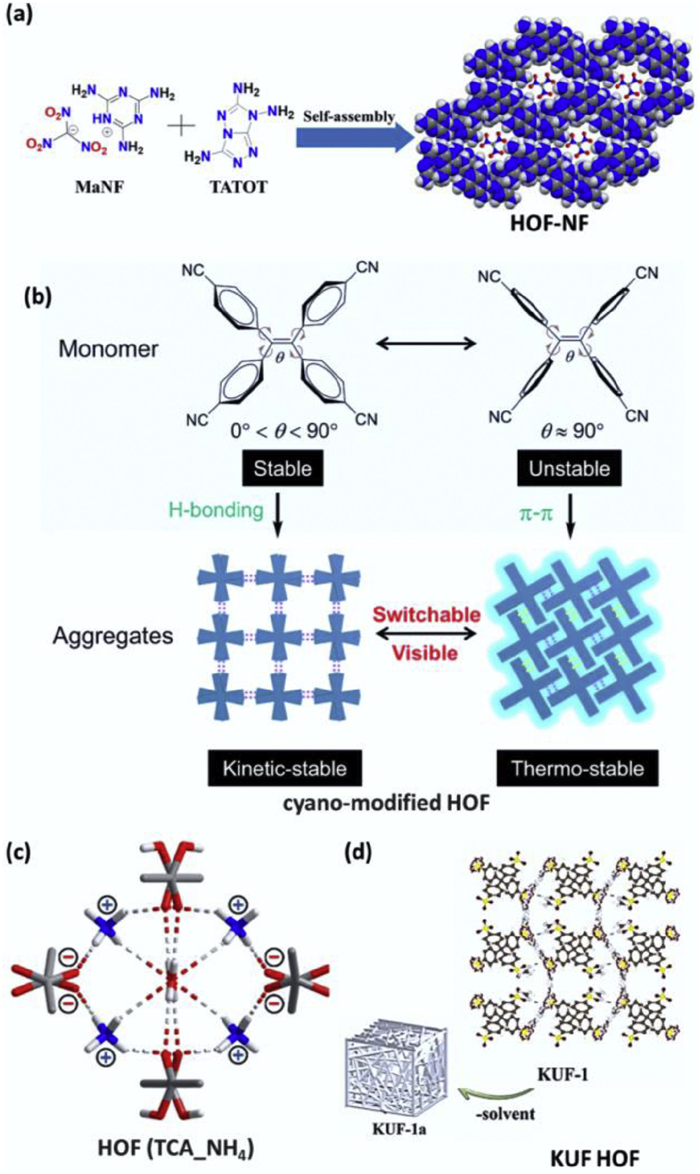
Recent reports on synthesizing HOFs highlight the diversity in their structures, mechanical strength, and stability. Yang et al. designed HOF-FJU-1 from bicarbazole units to form a dia network through hydrogen bonding, demonstrating permanent porosity and high thermal stability [62]. In their preview, Xie et al. highlighted HOF-FJU-1, which features a framework of microporous channels and has a BET surface area of 385 m2/g. Contrary to the common perception of HOFs as fragile, HOF-FJU-1 demonstrates remarkable stability in organic solvents and under extreme pH conditions, making it suitable for industrial separation applications [47]. Chen et al. demonstrated the rational design of HOF-FJU-2, which is constructed from 4,4′,4′′,4′′′-(9H-carbazole-1,3,6,8-tetrayl)tetrabenzaldehyde and tetrabenzaldehyde. This framework supports hydrogen bonding interactions that are thermally stable up to 300 ℃ and features carbazole N−H sites, which facilitate small molecule recognition due to the D-π-A aromatic nature of the building block [63]. Ionic HOFs, formed from cations and anions, exhibit high stability owing to the electrostatic attractions between these charged species [64]. Additionally, the high energy and structural integrity provided by the cyclo-pentazolate anion can enhance the thermal stability of HOFs [65]. Zhang et al. designed a nitrogen-rich HOF-NF based on nitroformate (NF) to improve thermal stability and structural properties due to strong H-bonding between guest molecules and their framework (Fig. 1a) [66]. Shi et al. introduced eleven kinetically stable HOFs and two thermally stable non-porous structures derived from a cyano-modified tetraphenylethylene tecton. The unique feature of these frameworks is their flexibility, with long-chain guest molecules enabling changes in emission color. Dynamic interactions and soft guests facilitate relaxation within the structure (Fig. 1b) [67]. The role of reticular chemistry in developing supramolecular porous frameworks with tailor-made architectures is vital. Advanced secondary building units (SBUs) can create geometrical cavities within HOFs. Shi et al. demonstrated a body-centered cubic HOF (TCA_NH4) constructed using a C3-symmetric building block and an NH4+ node-assembled cluster. This configuration allows the octahedral cages to encapsulate homogeneous haloforms in a truncated octahedron arrangement (Fig. 1c) [68]. HOF was created using the liquid phase/vapor diffusion method with tetrakis(4-sulfonic) methane and guanidinium hydrochloride (Gua-HCl), resulting in a sulfonic acid HOF material. The process follows precursors co-dissolved in MeOH/acetone and is slowly crystallized by dichloromethane vapor, yielding sulfonic acid-based frameworks (Fig. 1d) [69].
Figure 1
Figure 1.
(a) Self-assembly of HOF-NF. Reproduced with the permission [66]. Copyright 2021, The Author(s), Springer Nature. (b) Cyno-modified HOF. Reproduced with the permission [67]. Copyright 2022, The Author(s), Springer Nature. (c) SSBU-NH4−1 of (NH4)4(COOH)8(H2O)2 with concentrated polynuclear clusters and charge-assisted. Reproduced with the permission [68]. Copyright 2024, The Author(s), Springer Nature. (d) Sulfonic acid HOF material (KUF HOF). Reproduced with the permission [69]. Copyright 2025, Elsevier B.V.
HOFs demonstrate remarkable hinge-like flexibility, allowing their structures to adapt dynamically to external stimuli such as temperature, pressure, or guest molecule interaction [70,71]. This mechanical adaptability, driven by reversible hydrogen bonding and dynamic connector configurations, enables structural shifts without compromising framework integrity, making HOFs highly suitable for gas storage, separation, and sensing [72]. Notable examples, such as CageHOF-2 and tetracyano-bicarbazole-based HOFs, exhibit selective gating and structural memory, showcasing the role of flexible aromatic pillars, functional groups, and solvent-responsive behavior in tailoring porosity and selectivity [73]. Porosity in HOFs is governed by the nature and arrangement of hydrogen-bonded connectors, yielding a microporous structure, ideal for membrane technologies and separation processes [74,75]. Although HOFs rely on weaker hydrogen bonding than MOFs or COFs, strategic use of functional groups like DAT, carboxyls, and pyrazoles enhances their structural resilience. Frameworks constructed from dimers or catermeric motifs balance directional bonding with adaptability. In certain systems, HOFs have demonstrated lower density and reversible behavior due to their weaker intermolecular forces, distinguishing them from many MOFs and COFs, with diverse structural configurations supporting efficient gas capture and molecular recognition [76,77].
High-quality carboxylic acid-based HOF membranes such as HOF-S, HOF-M, HOF-L with tunable pore sizes of 6.2, 16, and 24 Å were synthesized by Wang et al. using a pore-tailoring strategy for selective H2 separation. Among them, the HOF-S membrane exhibited exceptional H2/CO2 selectivity up to 186 due to a combination of size exclusion and electrostatic interactions from carboxylic acid groups, effectively integrating molecular sieving and adsorption. Gas permeation tests confirmed that smaller pore sizes enhance H2 selectivity, and the optimized 0.86 µm HOF-S membrane demonstrated stable, high-performance separation under dry and wet conditions, highlighting its promise for advanced gas separation applications [78]. In their study, Liu et al. used HOF-101 and PVP@HOF-101 as fillers to fabricate Pebax-based hybrid membranes for toluene/N2 separation. The incorporation of PVP enhanced interfacial compatibility and dispersion, while the π-conjugated aromatic rings and ordered pores of HOF-101 improved toluene affinity and transport. The Pebax-PVP@HOF-101-1.0 membrane demonstrated optimal performance with a toluene permeability of 1.51 × 10⁻⁶ mol µm m−2 s−1 Pa−1 and a selectivity of 954 at 25 ℃ and 0.1 MPa. Performance improved with increasing filler content up to 1 wt%, but declined beyond that due to filler agglomeration [79].
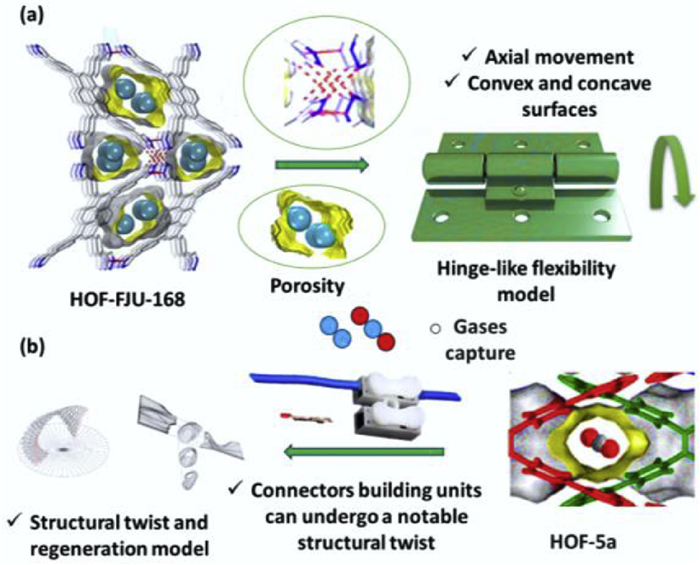
It is worth mentioning that the flexibility and mechanical properties of HOFs (Section S2.2 in Supporting information) and porosity (Section S2.3 in Supporting information) are crucial; some HOFs with specific molecular designs exhibit hinge-like flexibility, such as CageHOF. In contrast, others remain structurally rigid or fragile. Moreover, HOFs are characterized by a lower density when compared to MOFs, making them lighter and potentially more suitable for applications where weight is a critical factor. However, they also stand out regarding their structural diversity, offering a wider range of configurations than COFs, which can lead to unique properties and functionalities for various applications. Fig. 2 vividly illustrates the distinctive properties of HOFs in their capacity for gas capture. The innovative hinge-like structure, combined with the distinctive twisting of connectors, plays a crucial role in enhancing flexibility. This dynamic design not only amplifies the efficacy of HOFs but also enriches their overall performance in gas absorption [71,80].
Figure 2
Figure 2.
A schematic representation of HOFs' unique properties for gas capture: (a) hinge-like structure and (b) connector and structure twist. The HOFs model taken as HOF-FJU-168 is adopted with the permission [80]. Copyright 2025, John Wiley & Sons, and HOF-5a is adopted with the permission [71]. Copyright 2015, American Chemical Society.
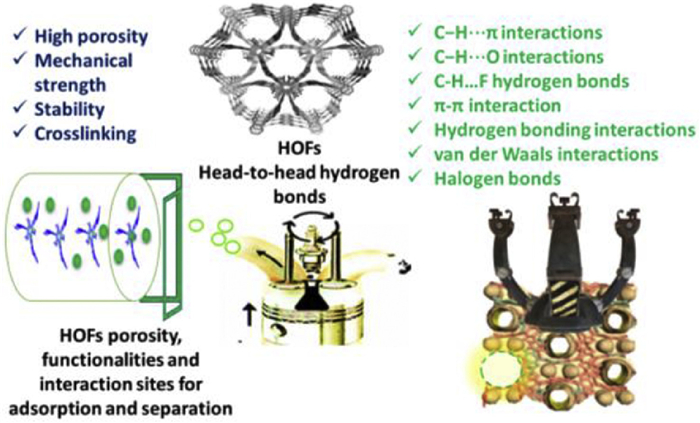
HOFs present complexities in the targeted adsorption and separation of gases. These frameworks optimize gas capture based on size and polarity. The strength and nature of the hydrogen bonds formed influence the ability to adsorb gases, leading to effective separation selectively. The arrangement of hydrogen bonds also affects the kinetics of gas uptake and release, allowing for regeneration cycles and contributing to sustainability [81]. HOFs offer significant opportunities for advancements in gas purification and carbon capture. Tunable pore sizes enable the selective adsorption of particular gases; for example, larger pores are effective for capturing CO2, while smaller pores preferentially adsorb H2 or CH4, which is crucial for industrial gas separation. The presence of functional groups in HOFs enhances their affinity for specific gases through hydrogen bonding, facilitating the selective removal of components [82]. To understand the selective removal of gases, it is crucial to consider the crystalline structure of HOFs. The presence of head-to-head hydrogen bonding and various types of interactions plays a crucial role in creating organized arrangements that form defined channels. These channels are capable of efficiently accommodating gas molecules. A well-balanced combination of functionality, tunable pore size, and different functional groups determines the selective gas adsorption capabilities of HOFs, making them promising candidates for gas separation applications (Fig. 3) [83].
Figure 3
Figure 3.
A schematic presentation of HOFs' suitability and possible interactions when applying for adsorption and separation applications. HOF structure is reproduced with the permission [83]. Copyright 2021, Wiley‐VCH GmbH.
HOFs with nitrogen nodes strategically rotate to reduce rigidity and steric effects, facilitating densification. This movement enhances structural integrity and stability, allowing these tectons to adjust orientation for optimal packing efficiency. The nitrogen nodes promote a compact arrangement by repositioning, increasing density, and improving mechanical properties. While rotational flexibility can enhance adaptability and help mitigate structural distortions, it may also introduce mechanical vulnerabilities under certain conditions, enabling adaptation to varying conditions without compromising integrity. Thus, it functions like a self-adjusting mechanism, ensuring robustness [84]. HOFs are gaining recognition for gas separation, particularly for noble gases like argon, krypton, xenon, and lighter hydrocarbons such as methane, ethane, and ethylene. Gas adsorption kinetics in HOFs depend on factors like diffusion rates, pore size, hydrogen bonding dynamics, and temperature. Smaller molecules, e.g., methane and argon, usually diffuse faster than larger ones, like xenon and ethane. Pore size also affects diffusion; ultramicropores (less than 5 Å) improve selectivity by restricting larger molecules, while larger pores enhance diffusion but reduce selectivity [85,86]. Porosity manipulation benefits gas adsorption selectivity and capacity; it has been manipulated in isomorphic HOFs, HOF-FJU-99, and HOF-FJU-100, each with distinct pore environments. The advanced features contribute to HOF-FJU-100′s microporous architecture, exceptional stability, and high selectivity for C2H2/CO2 mixtures [87].
Hydrogen bonding significantly influences the adsorption behavior of HOFs; weaker hydrogen bonds between the framework and guest molecules can facilitate faster adsorption–desorption kinetics due to lower interaction energies, whereas stronger hydrogen bonds may enhance selectivity but can hinder desorption and slow down the overall process [88,89]. Additionally, adsorption kinetics are temperature-dependent: higher temperatures typically increase molecular diffusion rates but can reduce adsorption capacity, as elevated thermal energy may weaken adsorbate–framework interactions. HOFs are primarily microporous materials stabilized by hydrogen bonding and secondary interactions, and consistently exhibit type-I adsorption isotherms, reflecting their small, well-defined pores. Observations of type-II behavior in HOFs are rare and, when reported, typically result from external surface adsorption or transient framework swelling rather than true multilayer adsorption seen in non-porous or macroporous systems [90–92]. Isotherms provide insights into adsorption capacity, interaction strength, and the underlying sorption mechanism. Common models used to describe HOF adsorption behavior include the Langmuir, Freundlich, and Brunauer–Emmett–Teller (BET) isotherms. The Langmuir model assumes monolayer adsorption on a uniform surface with a fixed number of identical sites, while the Freundlich model accounts for adsorption on heterogeneous surfaces with varying affinities. The BET model extends the Langmuir theory to multilayer adsorption and is widely applied to determine the surface area and porosity of HOFs in gas separation applications [93–96]. Table S1 (Supporting information) provides an overview of isotherm models and kinetic processes in substance separation and adsorption.
4.
HOFs in molecular separation
While HOF materials with porous nanoparticles have been successfully synthesized and demonstrate the ability to create direct channels for molecular separation, their application as membranes in gas filtration systems remains underexplored. Recent studies have shown that these HOF-based frameworks exhibit long-term stability and cycling performance, yet further research is necessary to enhance their mechanical stability, selectivity, and overall efficiency for practical gas filtration sorption applications. Optimizing the structural integrity and separation capabilities of HOF membranes under operational conditions is essential for advancing their practical use [97,98]. Density functional theory (DFT) simulations can help determine the size of gas molecules and their interactions to investigate the adsorption mechanism. As the molecular size of the gas increases, the interactions with the channels of the HOF framework also become stronger. The gas molecules interact with various functional groups through a range of strong and weak interactions [99]. The H-bonding motif uses NH4+ cations to control the assembly of carboxylic tectonics for robust frameworks with ultra-micropores and oxygen sites. This can create NH4+ bridges with diverse building blocks to build unique H-bonded networks with different pore structures [100].
4.1
Noble gas separation
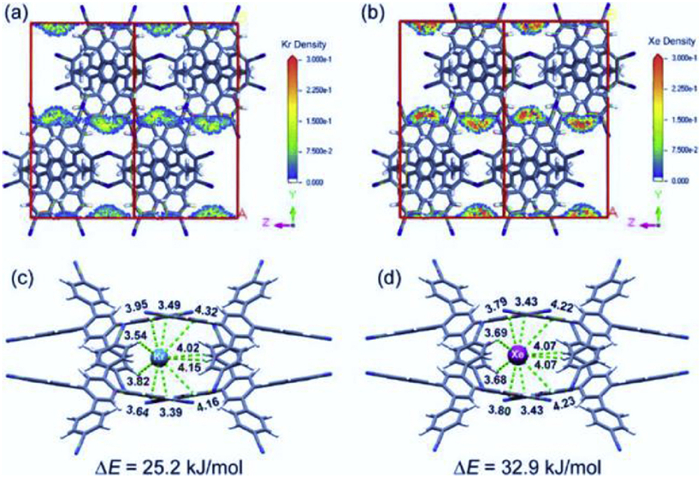
HOFs present a promising approach for gas separation applications. However, there are only a limited number of HOF structures incorporating hydrogen-bonding tetramers that have been thoroughly investigated. Huang et al. reported a unique microporous HOF, designated HOF-FJU-46, which features diamond networks and demonstrates remarkable stability. Notably, HOF-FJU-46 exhibited the highest xenon (Xe) uptake and selectivity for Xe/krypton (Kr) among the HOFs documented. Breakthrough testing has confirmed its exceptional ability to separate Xe from Kr. Additionally, X-ray diffraction and simulation studies have revealed robust C−H···Xe interactions within the structure of HOF-FJU-46. The high uptake and selectivity for Xe in HOFs arise from optimal pore size, strong van der Waals interactions, and favorable host-guest binding sites. Pores that match Xe's kinetic diameter enhance physisorption. Additionally, polarizable functional groups in hydrogen-rich environments create multiple weak interactions with Xe, improving its affinity and selectivity over krypton (Kr), which is less interactive due to its smaller size and lower polarizability. (Fig. S1 in Supporting information) [101]. Achieving efficient separation of Xe and Kr in HOFs presents a challenge due to the limited presence of gas-binding sites. In this study, He et al. introduced microporous HOF-FJU-168, constructed from helical chains that effectively prevent the self-aggregation of the pyrene core. The activated form of HOF-FJU-168 can separate Xe and Kr under ambient conditions, demonstrating high capacity and selectivity. The Xe adsorption capacity was recorded at 78.31 cm3/g, with a remarkable Xe/Kr selectivity of 22.0 at 296 K and 1 bar, exceeding previously known HOFs. Breakthrough experiments further confirm the superior separation performance, yielding high-purity krypton. Additionally, HOF-FJU-168 exhibited excellent stability and renewability. The study revealed that the unique electrostatic surface potential surrounding the pyrene sites enhances the interactions between the host framework and Xe [80]. Gong et al. demonstrated a novel ultramicroporous framework known as HOF-40, which better separates Xe from Kr. Grand Canonical Monte Carlo (GCMC) simulations revealed the significance of pore effects and binding sites in this process. The framework displays chemical stability under harsh conditions, and GCMC simulations are fundamental in understanding the adsorption mechanism. Both Xe and Kr were adsorbed in similar positions, but Xe exhibited a higher density. According to GCMC simulations, the binding energy of Xe was calculated to be 32.9 kJ/mol, suggesting strong physisorption relative to typical van der Waals interactions. In contrast, Kr demonstrated lower binding energy and weaker interactions, attributable to its inherent properties (Fig. 4) [102].
Figure 4
Figure 4.
GCMC simulated the density distribution and primary absorption sites of krypton (a, c) and xenon (b, d) in HOF-40. Reproduced with permission [102]. Copyright 2022, American Chemical Society.
A new strategy to enhance HOFs for gas separation involves increasing pore size by enlarging the monomer core. Yuan et al. demonstrated a pore engineering strategy that enlarges the core size of rigid monomers, replacing the benzene ring in HOF-40 with a larger dipyrrole ring to create HOF-FJU-8a with a slightly larger pore (4.2 × 4.6 Å2). HOF-FJU-8a exhibited the highest reported Xe/Kr separation performance, with a separation factor of 8.5 and Kr productivity exceeding 72 L/kg. The high performance was driven by a tailored pore size that enhances differential host-guest interactions. Single-crystal structures and simulations revealed that hydrogen atoms within the pores play a key role in binding Xe and Kr via multiple van der Waals interactions, with a stronger affinity toward Xe, as evidenced by closer interaction distances and greater unit cell contraction upon Xe adsorption. These findings demonstrate that precise pore size control in HOF-FJU-8a significantly improves selective adsorption and separation of Xe/Kr mixtures [103]. Lee et al. investigated Xe and Kr adsorption in HOF-BTB, revealing a strong preference for Xe with capacities of 3.37 mmol/g at 273 K and 2.01 mmol/g at 295 K. The authors demonstrated that HOF-BTB showed low isosteric heat of adsorption (Qst), indicating energy-efficient physisorption. Despite a 19% drop after five cycles, it remained stable in water and acids, adsorbing 30.5 wt% of water vapor, the highest among HOFs. Xe uptake was comparable to carbon materials but lower than MOFs, with Xe's higher polarizability and Qst contributing to superior selectivity over Kr [104].
Liu et al. developed two frameworks, HOF-ZJU-201 and HOF-ZJU-202, which effectively separate Xe from Kr. The HOF-ZJU-201a framework can adsorb 3.01 mmol/g of Xe at 298 K and 1.0 bar, achieving an ideal adsorbed solution theory (IAST) selectivity of 21.0 and a Henry's law selectivity of 21.6. Breakthrough experiments revealed that the Xe capacity from a mixture of Xe and Kr is 25.8 mmol/kg. Additionally, density functional theory was employed to elucidate the selective binding mechanism [105]. Hybrid HOFs made from charged components provide a variety of interactions for separation processes. Xie et al. demonstrated how halide anions can be coordinated to create hydrogen-bond synthons for microporous frameworks with adjustable polarity. These halide anions readily participated in the hydrogen-bonding assembly, resulting in robust frameworks with open pores. The frameworks preferred separating Xe from Kr due to their enhanced polarizability. A record-high separation factor was achieved, enabling efficient Xe/Kr separation in gas streams that simulate the conditions of spent nuclear fuel reprocessing [106].
Variations in functional groups within HOFs significantly impact their noble gas adsorption performance. Polar groups like -OH and -NH2 enhance interactions with noble gases through hydrogen bonding and dipole-dipole forces. In contrast, nonpolar groups, such as alkyl chains, exhibit weaker interactions, resulting in lower adsorption capacities. The spatial arrangement of functional groups also affects adsorption performance; well-organized arrangements create binding sites for selective noble gas adsorption. Additionally, the size and shape of these groups influence site accessibility; larger groups may impede noble gas diffusion, thus reducing overall adsorption efficiency. Understanding functional group contributions is crucial for designing materials tailored to specific gas separation needs.
4.2
Lighter hydrocarbon separation
Lighter hydrocarbons are crucial in global energy and chemical sectors, serving as fuels for transportation and heating and feedstocks for plastics, solvents, and detergents. The effective separation of hydrocarbon mixtures presents significant challenges due to the similar physical and chemical properties of these compounds, making standard techniques less effective. HOFs tackle these issues using adsorbent-based technologies that selectively capture specific hydrocarbons based on molecular size, weight, and polarity. By designing tailored adsorbents, HOF enhances hydrocarbon separation efficiency, leading to improved product purity and more sustainable processing [107].
4.2.1
Separation of acetylene (C2H2) and carbon dioxide (CO2)
The separation of acetylene (C2H2) from carbon dioxide (CO2) is essential for acetylene purification and presents a significant scientific challenge. In their research, Yang et al. introduced HOF-FJU-1, an organic framework designed to separate C2H2 from CO2 effectively. HOF-FJU-1 exhibits a strong affinity for C2H2, boasting the highest reported selectivity for this process. Analysis of the crystal structure of HOF-FJU-1 reveals its interactions with C2H2 molecules, while breakthrough experiments validate its exceptional performance in C2H2/CO2 separation [62]. Huang et al. synthesized three isostructural HOFs with tunable pore sizes using N–H···N tetramers. Notably, HOF-FJU-47a separated C2H2 from CO2 more effectively than HOF-FJU-45a and HOF-FJU-46a due to its optimal pore features. Dynamic experiments confirmed its separation efficiency. Theoretical calculations revealed several interactions between C2H2 and HOF-FJU-47a, emphasizing its effectiveness. Organic building blocks, TPPM, TPPSi, and TPPA, were synthesized using Suzuki–Miyaura coupling and validated by NMR spectroscopy. X-ray diffraction showed that HOF-FJU-45 and HOF-FJU-46 crystallize in the tetragonal space group P4/n, forming diamond-like networks with N–H···N distances of 2.906 Å for HOF-FJU-45 and 2.882 Å for HOF-FJU-46, with angles of 156.7° and 153.1°, respectively. The π···π interactions of the pyrazole rings had distances of 3.913 Å and 4.169 Å. These configurations allow for 4-fold interpenetration along the c-axis, featuring square pore apertures of 3.4 × 3.4 Å2 and 3.9 × 3.9 Å2 [59].
4.2.2
Separation of acetylene (C2H2) and methane (CH4)
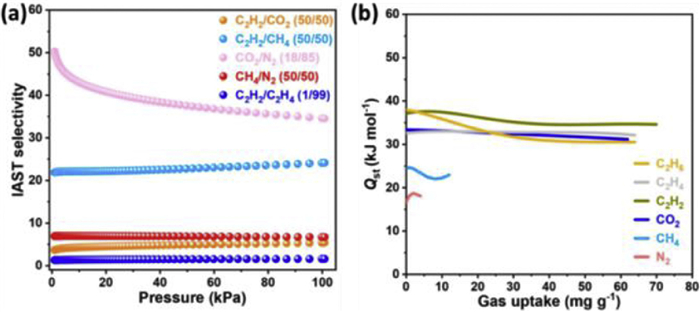
Robust microporous HOFs are crucial for studying physical adsorbents and structure-property relationships. However, rigidity in tectonic centers limits the production of dense, stable HOFs. In response, Cai et al. developed the flexible HOF-ZSTU-4 with nitrogen nodes in the tectonic center. Single-crystal X-ray diffraction showed a solid-to-solid phase transition due to carboxyl–carboxyl dimer torsion, altering the framework to HOF-ZSTU-4a. This variant achieved a C2H2 packing density of 0.54 kg/L, the highest for HOFs, and excellent separation selectivity for binary gas mixtures, confirmed by dynamic breakthrough tests. Gas adsorption tests at 273 and 298 K indicated different gas uptake at these temperatures. HOF-ZSTU-4a exhibited superior C2H2 uptake due to optimal pore size and higher packing density than other HOFs. It also demonstrated strong cyclic C2H2 uptake capability, with enhanced CH4 uptake from effective trapping in the reduced pore structure (Fig. 5 and Fig. S2 in Supporting information) [108].
Figure 5
Figure 5.
(a) CH4 uptake and C2H2/CH4 selectivity at 298 K, 1 bar for HOF-ZSTU-4a. (b) Isosteric heat of adsorption (Qst) plots for gases on HOF-ZSTU-4a. Reproduced with permission [108]. Copyright 2024, The Authors. Co-published by Zhejiang University and the American Chemical Society.
Cai et al. demonstrated that HOF-16 effectively separates C2H2 from CH4 due to its unique structure, showcasing excellent uptake and selectivity. Theoretical calculations confirm its efficiency in capturing C2H2, and experiments illustrate selective removal. HOF-16a extracts C2H2 using low energy, yielding high-purity CH4. The authors studied free–COOH sites in HOF-16a to evaluate the binding of C2H2, CH4, and CO2 through GCMC simulations. C2H2 binds in the hexagonal pore between –COOH groups via weak hydrogen bonds and C–H···π interactions. HOF-16a has a stronger C2H2 binding energy than HOF-11a due to multiple interactions and enhanced adsorption from hydrogen bonding with –COOH sites. To assess the potential for high-purity CH4, the authors evaluated selectivity for C2H2/CH4 and CO2/CH4 mixtures through dynamic breakthrough experiments at room temperature, achieving 99.9% CH4 purity with C2H2 detected after 38 min. Retention times were 49 min for C2H2 and 31 min for CO2, indicating effective separation. Vacuum regeneration of the HOF-16a column yielded over 98% pure C2H2 at 298 K, showing good regeneration and stability. HOF-16a's water stability enhances its potential in humid conditions [109].
4.2.3
Separation of ethylene (C2H4) and ethane (C2H6)
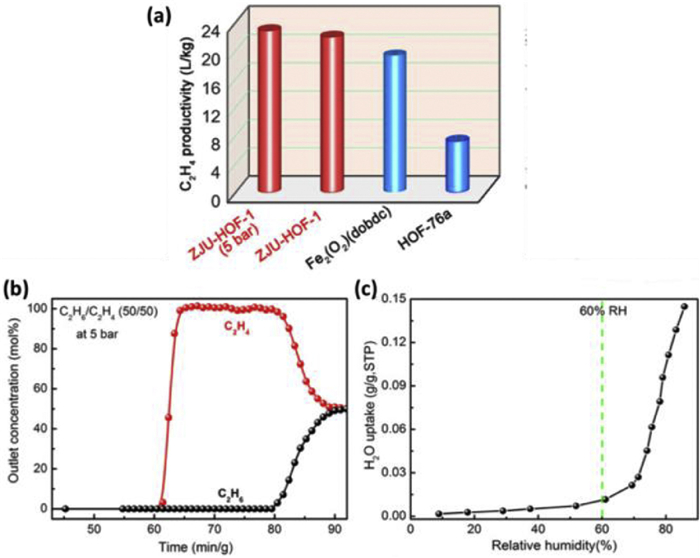
The morphology of HOFs enhances their gas separation capabilities. Zhou et al. specifically demonstrated this for the separation of C2H6 and C2H4 using graphene-sheet-like HOFs by adjusting pore polarization. Heating these frameworks induces a phase transformation from HOF-NBDA(DMA) to HOF-NBDA, which changes the skeleton from electronegative to neutral. This transformation exhibited the pore surface as nonpolar, favoring the adsorption of C2H6. The study demonstrated that HOF-NBDA exhibited a C2H6 capacity of 23.4 cm3/g and a C2H6/C2H4 uptake ratio of 136%, surpassing that of HOF-NBDA(DMA) [110]. Separating C2H6 from C2H4 presents challenges in achieving high material adsorption and selectivity. Zhang et al. developed the ZJU-HOF-1 framework, which contains optimized cavities and surfaces that enhance C2H6 interactions. This material exhibited a remarkable C2H6 uptake of 88 cm3/g at 0.5 bar and 298 K, alongside a selectivity of 2.25, surpassing many leading materials. Theoretical analyses suggest that its cage-like cavities and functional sites engage more effectively with C2H6 than C2H4. Demonstrating high stability and low water absorption, ZJU-HOF-1 efficiently captures C2H6 from 50/50 mixtures under 60% relative humidity, achieving an exceptional polymer-grade C2H4 productivity of 0.98 mmol/g. Elastic band calculations identified the minimum energy path to evaluate the transformation from JLU-SOF3 to ZJU-HOF-1. The net aligns the phenyl rings, allowing for rotation and contraction that creates new symmetry and uniform pores. The O–H⋯O distance is shortened, and pore channels facilitate the entry of C2H4 and C2H6, generating small pockets suitable for C2H6 confinement. Breakthrough simulations confirm efficient separation of C2H6/C2H4 mixtures, backed by experimental studies demonstrating complete separation and high C2H4 productivity. The ZJU-HOF-1 framework is stable and user-friendly for applications (Fig. 6 and Fig. S3 in Supporting information) [83].
Figure 6
Figure 6.
(a) C2H4 productivity comparison in volume per unit mass of various adsorbents: ZJU-HOF-1 C2H4 productivity (> 99.95% purity) reached 0.98 mmol/g, surpassing HOF-76a and Fe2(O2)(dobdc). (b) Breakthrough curves for 50/50 mixture at 298 K, 5 bar: ZJU-HOF-1 C2H4 productivity increases to 1.02 mmol/g at 5 bar. (c) Water vapor adsorption isotherm of ZJU-HOF-1,296 K: ZJU-HOF-1 shows negligible water uptake (0.011 g/g) up to 60% RH. Reproduced with permission [83]. Copyright 2021, John Wiley & Sons.
Guo et al. developed the microporous HOF HIAM-103, utilizing a hexacarboxylate linker. This framework features a trigonal crystal system and a four-fold interpenetrated network, demonstrating thermal stability and selective adsorption properties. The DFT analyses suggest that the selective adsorption capabilities arise from methyl group-decorated one-dimensional channels. DFT calculations for various gases, including C2H4, C2H6, Kr, and Xe, identify primary adsorption sites located near the methyl groups of H6TMBTI. The gases C2H4 and C2H6 interact with the methyl groups through H···H interactions, with distances measured at 4.10 Å and 4.94 Å, resulting in adsorption enthalpies of −0.35 eV for C2H6 and −0.31 eV for C2H4. Additionally, experimental results confirm that C2H6 is preferentially adsorbed, with similar behaviors observed for xenon and krypton, showing enthalpies of −0.25 eV and −0.20 eV, respectively [111].
4.2.4
Separation of and acetylene (C2H2) and ethylene (C2H4)
Jiao et al. utilized the organic linker H4L to develop an HOF featuring a bis-quinoxaline group specifically for C2 separation. The bis-quinoxaline structure provided a unique configuration that facilitated specific pore environments. This innovative design enhanced the interactions among organic units, leading to improved material processability. The frameworks demonstrated an increased adsorption of C2H2 while effectively repelling C2H4 molecules, resulting in efficient separation. HOFs incorporating the bis-quinoxaline group exhibited strong C2H2 adsorption and effective C2H2/C2H4 separation capabilities. This research presents a novel material option for C2 separation and broadens the application of HOFs in gas separation [112].
4.2.5
Separation of propylene (C3H6) and propane (C3H8)
The separation of propylene (C3H6) and propane (C3H8) holds significant importance in the chemical industry due to their similar properties and molecular sizes. Li et al. developed a flexible framework named HOF-FJU-106 using TTF-4CN. This framework can transition between open and closed states by sliding its layers or columns. Notably, HOF-FJU-106a demonstrated a high affinity for C3H6 and achieved a record gas uptake ratio. Additionally, it exhibited reversible gate pressure control at varying temperatures, thereby improving its gas separation performance [113]. Cai et al. developed HOF-ZSTU-M (where M = 1, 2, 3) by introducing structure-directing agents (SDAs) into the TCPP framework. The resulting HOFs exhibited a range of pore structures, transitioning from discrete to continuous multi-dimensional channels. Single-crystal X-ray diffraction (SCXRD) analysis revealed a variety of hydrogen-bonding configurations influenced mainly by the SDAs. Notably, HOF-ZSTU-2 established a robust hydrogen-bonding network with NH4+, facilitating selective capture of C3H6. The C3H6 storage density of HOF-ZSTU-2 at 298 K and 1 bar was measured at 0.6 kg/L, with a selectivity ratio of C3H6 to C3H8 of 12.2. Furthermore, theoretical calculations provided insights into C3H6 binding within the pearl-chain channel. Dynamic tests confirmed the effective separation of C3H6 using HOF-ZSTU-2 [114]. Gao et al. demonstrated that crystal engineering led to the functionalization of HOF-16 with –COOH sites for efficient separation. HOF-16 exhibits a significant difference in C3H6/C3H8 uptake and selectivity compared to other carboxylic acid-based HOFs. Modeling studies indicate that free-COOH groups and pore confinement enhance the recognition of gas molecules. Breakthrough experiments confirm the separation performance of HOF-16. Additionally, HOF-16 remains stable against firm acidity and water [115].
Moreover, the structural understanding needed to design an efficient separation platform using HOFs must be of the utmost importance. HOFs' H-bonding interactions significantly control the dihedral angles of π-conjugated benzene rings. There is a clear relationship between the dihedral angle and birefringence: a lower dihedral angle correlates with greater birefringence. H-bonding alters the dihedral angle in HOFs featuring two connected benzene rings in a π-conjugated system, affecting birefringence. A smaller dihedral angle enhances birefringence, demonstrating the influence of hydrogen bonding on the optical properties of π-conjugated systems. These interactions can change electron distribution within the rings, modifying the system's geometry and consequently impacting optical behavior and refractive indices along various axes [116–118]. HOFs maintain structural stability under humid conditions through several key mechanisms. Strong hydrogen bonds between the organic building blocks act as a molecular glue, ensuring robustness even in the presence of moisture. For instance, a HOF composed of organic molecules with multiple hydrogen-bonding functional groups enhances stability and flexibility, allowing it to adapt to environmental changes. Additionally, a well-defined three-dimensional arrangement of these strengthens the stability of HOFs, preventing water from disrupting crucial hydrogen bonds. Regarding gas separation efficiency, HOFs often outperform other MOFs and COFs due to their unique pore structures and larger pore sizes [119,120]. HOFs with narrow pores can selectively adsorb specific gas molecules based on size and shape, making them ideal for gas separation applications. In practical terms, utilizing HOFs for noble gases and lighter hydrocarbons (C2 and C3) can lead to increased efficiency and cost-effectiveness [121].
By enhancing the separation process, these materials contribute to higher purity levels of gases. Improved purity yields better product quality and reduces waste, enhancing overall process performance. Table S2 (Supporting information) overviews HOF applications in separating noble gases and carbohydrates. In addition to the current progress, several scalability, rigidity-flexibility, and regeneration challenges must be addressed. Furthermore, there are more opportunities for designing HOFs using machine learning and lab synthesis with functional groups in HOFs, such as -OH, -NH2, and -COOH, which can enhance selectivity by forming specific interactions with target gases (Section S3 and Summary S4 in Supporting information).
5.
Conclusion and future directions
In conclusion, HOFs hold strong potential for gas adsorption and separation due to their non-covalent interactions, high crystallinity, ease of purification, and recyclability. Enhancing their robustness through optimized building blocks and stronger hydrogen bonding will be key to expanding their practical use. Ultramicropores effectively separate small molecules like noble gases and light hydrocarbons, while functional groups such as –OH, –NH2, and –COOH improve selectivity via specific interactions. Framework flexibility further enhances adaptability and capacity. Adsorption performance is influenced by temperature, pressure, and framework chemistry, as revealed through isotherms, breakthrough experiments, and permeation studies. For industrial applications, future efforts must focus on improving HOF stability, scalability, and membrane design to compete with traditional separation technologies.
The advancement of HOFs depends on overcoming key challenges that limit their broader application, notably their stability in extreme environments and scalability. HOFs often degrade in humid or aqueous conditions due to weak hydrogen bonding. Enhancing water resistance through structural modifications, such as introducing hydrophobic groups, stronger hydrogen bonding sites, or covalent crosslinking, can improve durability. Reproducibility and large-scale synthesis are also problematic, as minor variations in reaction conditions can compromise consistency. Research is focused on controlling synthetic parameters and incorporating bridging agents to maintain structural integrity and uniform porosity. Moreover, achieving a balance between flexibility and stability is essential. While flexible frameworks benefit gas separation by adapting to different molecules, they often lack the robustness required for long-term use. Approaches such as engineering dynamic yet stable hydrogen bonds and developing reversible architectures are being explored to address this issue.
Another critical area is the regeneration and reusability of HOFs for industrial gas separation processes. Frameworks that can be easily regenerated without performance loss would enhance economic viability. Current efforts include designing reversible adsorption sites and self-repairing mechanisms. Machine learning (ML) is also emerging as a powerful tool in HOF development. ML models can predict key material properties, such as porosity, selectivity, and stability, and accelerate the discovery of optimal structures for specific separations. High-throughput computational screening and data-driven optimization of building blocks and synthesis conditions enable tailored design for applications like noble gas or hydrocarbon separation. Moving forward, a multidisciplinary strategy integrating synthetic chemistry, computational modeling, and engineering will be essential to develop HOFs that are stable, scalable, regenerable, and suitable for industrial deployment.
Declaration of competing interest
The authors declare that they have no known competing financial interests or personal relationships that could have appeared to influence the work reported in this paper.
The Open Foundation of Hainan International Joint Research Center of Marine Advanced Photoelectric Functional Materials (No. 2025MAPFM01) supports the work. We are grateful to the Fundação para a Ciência e a Tecnologia (FCT), Portugal, through the project (No. UIDB/00100/2025) of the Centro de Química Estrutural.
Supplementary materials
Supplementary material associated with this article can be found, in the online version, at doi:10.1016/j.cclet.2025.112142.
Figure 1
(a) Self-assembly of HOF-NF. Reproduced with the permission [66]. Copyright 2021, The Author(s), Springer Nature. (b) Cyno-modified HOF. Reproduced with the permission [67]. Copyright 2022, The Author(s), Springer Nature. (c) SSBU-NH4−1 of (NH4)4(COOH)8(H2O)2 with concentrated polynuclear clusters and charge-assisted. Reproduced with the permission [68]. Copyright 2024, The Author(s), Springer Nature. (d) Sulfonic acid HOF material (KUF HOF). Reproduced with the permission [69]. Copyright 2025, Elsevier B.V.
Figure 2
A schematic representation of HOFs' unique properties for gas capture: (a) hinge-like structure and (b) connector and structure twist. The HOFs model taken as HOF-FJU-168 is adopted with the permission [80]. Copyright 2025, John Wiley & Sons, and HOF-5a is adopted with the permission [71]. Copyright 2015, American Chemical Society.
Figure 3
A schematic presentation of HOFs' suitability and possible interactions when applying for adsorption and separation applications. HOF structure is reproduced with the permission [83]. Copyright 2021, Wiley‐VCH GmbH.
Figure 4
GCMC simulated the density distribution and primary absorption sites of krypton (a, c) and xenon (b, d) in HOF-40. Reproduced with permission [102]. Copyright 2022, American Chemical Society.
Figure 5
(a) CH4 uptake and C2H2/CH4 selectivity at 298 K, 1 bar for HOF-ZSTU-4a. (b) Isosteric heat of adsorption (Qst) plots for gases on HOF-ZSTU-4a. Reproduced with permission [108]. Copyright 2024, The Authors. Co-published by Zhejiang University and the American Chemical Society.
Figure 6
(a) C2H4 productivity comparison in volume per unit mass of various adsorbents: ZJU-HOF-1 C2H4 productivity (> 99.95% purity) reached 0.98 mmol/g, surpassing HOF-76a and Fe2(O2)(dobdc). (b) Breakthrough curves for 50/50 mixture at 298 K, 5 bar: ZJU-HOF-1 C2H4 productivity increases to 1.02 mmol/g at 5 bar. (c) Water vapor adsorption isotherm of ZJU-HOF-1,296 K: ZJU-HOF-1 shows negligible water uptake (0.011 g/g) up to 60% RH. Reproduced with permission [83]. Copyright 2021, John Wiley & Sons.


 DownLoad:

 下载:
下载:


 下载:
下载:

