Enhanced efficiency of solution-processed lanthanide-based OLEDs via ligand engineering: Tuning excited-state lifetime and charge transport with Se-modified ligand
Citation:
Zhipeng Guo, Arseny Gladkikh, Egor Latipov, Andrey Vashchenko, Yaxuan Liu, Alexey Medvedko, Alexander Goloveshkin, Olga Maloshitskaya, Alexey Alexandrov, Aowei Zhou, Yiming Yin, Yanan Zhu, Hong Meng, Valentina Utochnikova. Enhanced efficiency of solution-processed lanthanide-based OLEDs via ligand engineering: Tuning excited-state lifetime and charge transport with Se-modified ligand[J]. Chinese Chemical Letters,
2026, 37(10): 112136.
doi:
10.1016/j.cclet.2025.112136
Enhanced efficiency of solution-processed lanthanide-based OLEDs via ligand engineering: Tuning excited-state lifetime and charge transport with Se-modified ligand
English
Enhanced efficiency of solution-processed lanthanide-based OLEDs via ligand engineering: Tuning excited-state lifetime and charge transport with Se-modified ligand
Received Date:
25 September 2025 Accepted Date:
18 November 2025 Revised Date:
17 November 2025 Available Online:
15 October 2026
Abstract:
Lanthanide complexes attract significant attention for their narrow-band emission with nearly constant wavelengths; however, developing high-efficiency lanthanide-complex organic light-emitting diode (OLED) devices and methodologies remains a primary research focus. We selected neutral ligands [1,2,5]thiadiazolo[3,4-f][1,10]phenanthroline (TDZP) and its selenium (Se)-containing counterpart, [1,2,5]selenadiazolo[3,4-f][1,10]phenanthroline (SDZP), to form complexes with dibenzoylmethane (Hdbm). Detailed investigations combining theoretical calculations and experimental data reveal synergistic effects between excited-state lifetimes and charge carrier mobility in enhancing quantum efficiency. All the devices demonstrated characteristic lanthanide ion emission, with the Eu(dbm)3SDZP-based OLED achieving remarkable electroluminescent performance: a maximum quantum efficiency (EQEmax) of 6.7%, ranking among the highest reported values for Eu-based complex OLEDs. This integrated computational-experimental approach establishes a viable strategy for developing high-efficiency lanthanide-complex OLEDs.
The organic light-emitting diodes (OLEDs) have fundamentally revolutionized both display technologies and solid-state lighting solutions, primarily due to their exceptional color purity, remarkably wide viewing angles, and inherent compatibility with flexible plastic substrates [1]. While significant progress has undeniably been made in developing highly efficient fluorescence and phosphorescent emitters based on transition metals such as zinc, palladium, and other elements, a growing scientific interest has recently emerged in utilizing lanthanide complexes [2-6]. This interest arises from their unique narrow-line, essentially monochromatic emission characteristics and exceptionally high color purity, which are derived from well-shielded f-f electronic transitions. This property allows OLEDs to meet stringent color standards (e.g., Rec. 2020 for ultra-high-definition displays) without the need for additional color filters, thereby reducing light loss and enhancing energy efficiency [7,8].
In the context of biomedicine, red and near-infrared (NIR)-emitting OLEDs have garnered significant interest due to the deeper tissue penetration capability of red/NIR wavelengths, which experience reduced scattering and absorption in biological media. While extreme brightness is often unnecessary for such devices given their typical deployment in direct contact with target regions, high luminous efficiency remains critically important as it translates to lower operational power consumption, a critical advantage for battery-dependent wearable or implantable medical apparatus, while concurrently mitigating undesired heat generation during interface with delicate biological tissues [9-11]. To address these efficiency requirements, Eu3+ and Yb3+ complexes emerge as particularly promising lanthanide candidates; Eu3+ exhibits characteristically intense red emission from its hypersensitive 5D0 → 7F2 transition, whereas Yb3+ delivers efficient near-infrared luminescence via2F5/2 → 2F7/2 transition. These properties prove highly valuable for advanced optoelectronic applications, particularly in human bio-signal detection [8], with complementary research from our team demonstrating the practical feasibility of utilizing both complexes as key components in next-generation pulse oximeters [12].
Despite these advantages, the intrinsic luminescent properties of Eu3+ and Yb3+ complexes present a critical barrier to achieving the required luminous efficiency outlined above. Their characteristically long excited-state lifetimes (τ) directly limit achievable brightness and operational efficiency in OLED architectures [13]. Critically, this extended lifetime significantly increases the probability of detrimental processes like triplet-triplet annihilation (TTA), where accumulated long-lived excitons collide and decay non-radiatively. The efficiency of this loss pathway is further exacerbated by imbalanced electron and hole transport within the emitting layer (EML), as poor or mismatched charge mobility (µ) leads to localized charge accumulation and consequently, higher local triplet exciton densities. Consequently, advancing such systems necessitates strategic development of novel ligand architectures coupled with rigorous optimization of charge mobility, encompassing both electron and hole transport, within EML. This dual focus is imperative because the ultimate device performance depends critically on two interlinked factors: The ligand sensitization efficacy toward lanthanide ions and the EML charge-transport properties.
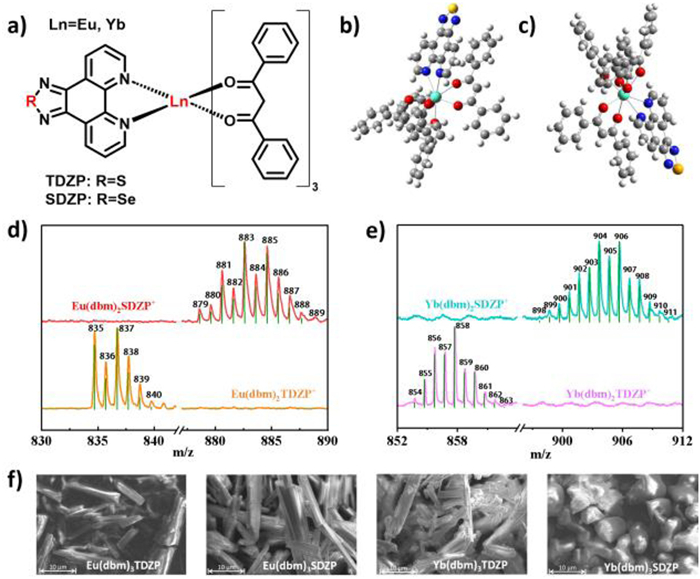
In this study, to develop Eu- and Yb-based OLED devices with enhanced luminescence properties, we selected neutral ligands [1,2,5]thiadiazolo[3,4-f][1,10]phenanthroline (TDZP), containing sulfur (S), and its structurally analogous but heavier selenium (Se)-containing counterpart, [1,2,5]selenadiazolo[3,4-f][1,10]phenanthroline (SDZP). Dibenzoylmethane (Hdbm) was chosen as the anionic ligand. This selection was driven by TDZP record-high brightness and efficiency achieved in previous lanthanide-complex OLEDs [14,15], and dbm− proven ability to deliver the highest brightness when used in Eu-based complexes as the OLED emitting layer [16,17]. Thus, the objects of this study were mixed-ligand complexes Ln(dbm)3L (Fig. 1a), in which Eu(dbm)3TDZP has also been reported by our group in previous work [18].
Figure 1
Figure 1.
(a) Structural formula of mixed-ligand complex Ln(dbm)3L. (b, c) Crystal structures of complexes: Eu(dbm)3TDZP and Eu(dbm)3SDZP. (d, e) MALDI MS spectrum of Ln(dbm)2L+ with the theoretical isotopic distribution of these complexes indicated by green sticks (calculated using https://www.chemcalc.org/). (f) SEM image of Ln(dbm)3L.
The complexes Ln(dbm)3L (Ln = Yb3+ or Eu3+, L = TDZP or SDZP) were synthesized via an exchange reaction in ethanol solution using YbCl3·6H2O or EuCl3·6H2O, Hdbm, the respective neutral ligand (TDZP or SDZP), and NEt3. The method of synthesis is described in references [19] and [20]. Single crystals of Eu(dbm)3TDZP and Eu(dbm)3SDZP were successfully grown by slow evaporation of their acetonitrile solutions. Both complexes are monomeric. In each, the central Eu3+ ion is coordinated by three dbm− anions and one TDZP or SDZP molecule, resulting in a coordination number (CN) of 8 and a twisted square antiprismatic (TSAP) geometry (Figs. 1b and c).
Powder X-ray diffraction (PXRD) data (Fig. S1 in Supporting information) revealed that among the four synthesized complexes, Yb(dbm)3SDZP was amorphous, while the other three are crystalline. The composition of all compounds was confirmed by matrix-assisted laser desorption/ionization mass spectrometry (MALDI MS) data (Figs. 1d and e), scanning electron microscopy (SEM) and X-ray spectroscopy data (Fig. 1f and Table S1 in Supporting information), thermogravimetric analysis (TGA) data (Fig. S2 in Supporting information), Fourier transform infrared (FTIR) spectroscopy data (Fig. S3 in Supporting information), and 1H NMR spectroscopy data (Fig. S4 in Supporting information).
MALDI MS spectra (Figs. 1d and e) exhibited strong signals corresponding to the fragment ions Eu(dbm)2L+ and Yb(dbm)2L+, formed by the loss of one dbm− anion from the parent complexes. This behavior was earlier observed for similar mixed-ligand diketonates [21].
The SEM images (Fig. 1f) revealed that the Eu(dbm)3TDZP complex forms well-defined rod-like crystals, indicating oriented crystal growth influenced by the TDZP ligand, whereas Eu(dbm)3SDZP exhibits irregular crystalline aggregates with a rough morphology, attributable to specific steric and electronic effects of the SDZP ligand. The Yb(dbm)3TDZP complex maintains a similar rod-like structure to its Eu counterpart but features smaller crystal dimensions and higher packing density, consistent with Yb3+ smaller ionic radius compared to Eu3+; conversely, Yb(dbm)3SDZP displays a completely amorphous morphology characterized by equiaxed grains.
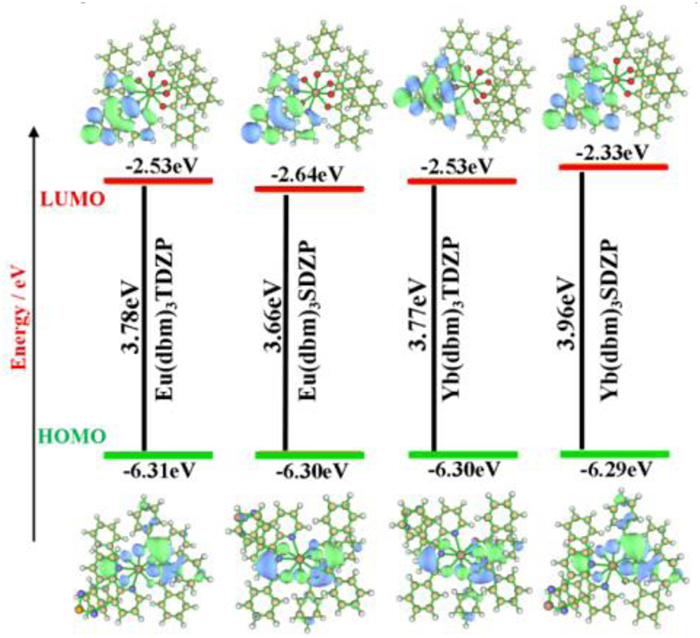
To determine frontier molecular orbital (FMO) distributions and electron and hole mobilities, density functional theory (DFT) and time-dependent density functional theory (TD-DFT) calculations were performed for the four complexes using the Gaussian09, Multiwfn and AMS programs [22]. Calculations for ligands Hdbm, TDZP, and SDZP in the ground state employed the B3LYP/6–31G(d,p) level, with relevant results presented in Fig. S5 and Table S2 (Supporting information). For the complexes, the central metal atom and ligand geometries in the ground state were optimized using the PBE0/SDD and PBE0/6–31G(d,p) level, respectively; these optimized structures were subsequently subjected to wavefunction stability tests using PBE0/SDD and PBE0/6–311G(d,p), all incorporating Grimme's D3 dispersion correction with the Becke Johnson (BJ) damping scheme [23-25], with relevant results presented in Fig. 2 [26,27]. All calculations successfully converged.
Figure 2
Figure 2.
The calculated HOMO and LUMO distributions of complexes.
According to Fig. 2, the highest occupied molecular orbital (HOMO) of the complexes is primarily localized on the carbonyl groups and phenyl rings of the anionic dbm− ligand, while the lowest unoccupied molecular orbital (LUMO) distribution is more diffuse, and its energy level is closely related to the ligand. In the Eu-based complexes, the α-LUMO is distributed around the central metal ion and the β-LUMO resides on the neutral TDZP or SDZP ligand; conversely, the Yb-based complexes exhibit the opposite pattern (Figs. S6 and S7 in Supporting information).
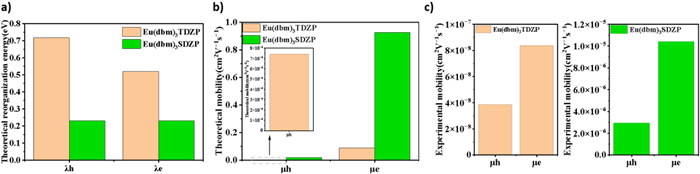
To gain deeper insight into the electron and hole transport properties of complexes with different ligands, we calculated the charge carrier mobility based on single-crystal structures of two europium-based complexes (Fig. S8 in Supporting information), with results presented in Figs. 3a, b and Tables S3 and S4 (Supporting information) [28-32]. The Eu(dbm)3TDZP complex exhibits higher hole and electron transfer integral values, particularly in the P-dimer configuration. In contrast, Eu(dbm)3SDZP displays significantly lower transfer integrals, notably with values in the parallel packing (P-dimer) configuration lower than those of Eu(dbm)3TDZP; under transverse packing direction (T1-T5), transfer integrals for both complexes approach zero. However, Eu(dbm)3TDZP exhibits higher λ for both transport modes, indicating significant kinetic barriers and lower transport efficiency. Conversely, Eu(dbm)3SDZP shows markedly lower λ for both modes, suggesting superior transport capability and favorable conditions for charge carrier migration. Experimentally measured mobility further confirms this observation: complexes with SDZP as the neutral ligand exhibit higher mobility than those with TDZP (Fig. 3c and Fig. S9 in Supporting information).
Figure 3
Figure 3.
(a) Reorganisation energies (λ) of Eu(dbm)3TDZP and Eu(dbm)3SDZP complexes in different charge states. (b) Theoretical and (c) experimental carrier mobility (µ) of Eu(dbm)3TDZP and Eu(dbm)3SDZP.
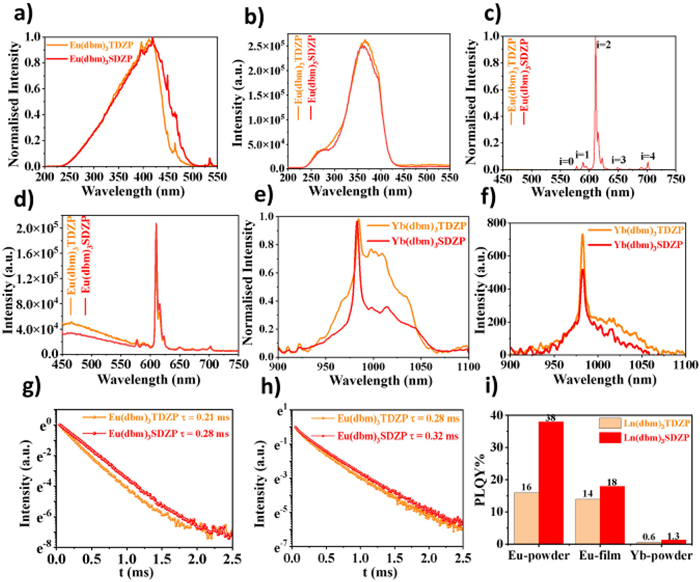
To study the photoluminescent properties (Table S6 in Supporting information) of the complexes under different states, we measured their excitation spectra, photoluminescence (PL) spectra, PL quantum yields (PLQY), and excited-state lifetimes (Fig. 4 and Figs. S10–S12 in Supporting information) both in the powder state and as spin-coated thin films from tetrahydrofuran (THF) solutions (5 g/L).
Figure 4
Figure 4.
Absorption spectra of (a) powder and (b) film of Eu(dbm)3TDZP and Eu(dbm)3SDZP complexes. Luminescence spectra of (c) powder (λex = 420 nm, 298 K) and (d) film (λex = 360 nm, 298 K) of Eu(dbm)3TDZP and Eu(dbm)3SDZP complexes. Luminescence spectra of (e) powder and (f) film of Yb(dbm)3TDZP and Yb(dbm)3SDZP complexes. Luminescence decay curves of (g) powder and (h) film of Eu(dbm)3TDZP and Eu(dbm)3SDZP complexes. (i) PLQY (%) of four pure complexes in different form. Films were deposited from a 5 g/L solution of the pure complex (without doping) in THF, then heated at 120 ℃ for 20 min.
For Eu-complexes in powder form, excitation peaks appear at ~420 nm (Fig. 4a), whereas in THF this peak shifts to ~350 nm (Fig. 4b). The emission spectra of Eu3+ complexes in powder (Fig. 4c) and THF films (Fig. 4d) exhibit characteristic transitions: 578 nm (5D0 → 7F0), 590 nm (5D0 → 7F1, magnetic dipole radiation), 611 nm (5D0 → 7F2, electric dipole radiation, hypersensitive transition), along with peaks at 650 nm (5D0 → 7F3) and 702 nm (5D0 → 7F4). The significantly higher intensity of the 5D0 → 7F2 peak relative to 5D0 → 7F1 indicates high monochromaticity; the narrow linewidth of the unsplit, symmetric 5D0 → 7F0 peak confirms high compound purity and uniform metal-ion coordination environments. Emission spectra of both Yb-containing complexes (Figs. 4e and f) display characteristic Yb3+ features: a characteristic emission peak at ~984 nm in the NIR region corresponding to the 2F5/2 → 2F7/2 transition, typical for Yb3+ ions in octahedral coordination.
Both the luminescence lifetimes and PLQYs are higher for complexes incorporating the SDZP ligand compared to those with TDZP, for both Eu3+ and Yb3+ (Figs. 4g–i). This difference can be attributed to the enhanced heavy-atom effect in SDZP, which promotes spin-orbit coupling, facilitating more efficient intersystem crossing and energy transfer from the ligand to the lanthanide center. As a result, nonradiative decay pathways are suppressed, leading to longer emission lifetimes and higher quantum yields. The extended lifetimes are particularly indicative of a reduction in nonradiative deactivation processes, such as vibrational quenching or defect-related trapping, underscoring the role of the ligand in shielding the metal ion and enhancing radiative decay. Similarly, the improved PLQYs reflect a more efficient antenna effect, wherein the ligand absorbs light and transfers energy to the emitting lanthanide ion with minimal losses. These results confirm that both TDZP and SDZP act as effective antenna ligands, but the structural or electronic modifications in SDZP contribute significantly to superior photophysical properties, making it a more promising candidate for applications in lighting, sensing, or bioimaging where high luminescence efficiency and stability are required.
Based on the photoluminescence properties and the results of mobility, sufficiently intense photoluminescence of ytterbium and europium are observed for SDZP as ligand. Thus, Eu(dbm)3SDZP and Yb(dbm)3SDZP can be recommended as emission layer materials for OLED.
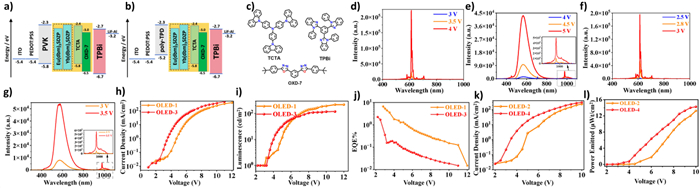
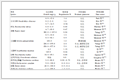
Based on the mobility data, the complexes with SDZP as the ligand exhibit higher electron mobility than hole mobility. To enhance the hole mobility and balance the carrier transport, a host:emitter system containing a hole-transporting host capable of efficient energy transfer to the emitter must be employed. Therefore, to achieve better luminescent performance, based on our previous works, we adopted TCTA and OXD-7 as mixed host materials (ratio of 1 emitter: 6TCTA: 3OXD-7) in emission layer (EML) and used PVK or poly-TPD as hole-transporting layers (HTL), respectively [19,33-36]. Complexes Ln(dbm)3SDZP were tested in solution-processed OLEDs named OLED-1 and OLED-2 with heterostructure ITO/PEDOT:PSS/PVK/EML/TPBi/LiF/Al, and OLEDs named OLED-3 and OLED-4 with heterostructure ITO/PEDOT:PSS/poly-TPD/EML/TPBi/LiF/Al (Figs. 5a and b). The molecular structures of these materials are presented in Fig. 5c. The EL spectra of OLEDs are presented in Figs. 5d–g. The EL characteristics of OLEDs are presented in Figs. 5h–l and Table 1.
Figure 5
Figure 5.
(a) The schematic energy level diagram of related materials used in the fabrication of the OLED devices 1–2. (b) The schematic energy level diagram of related materials used in the fabrication of the OLED 3–4. (c) Chemical structures of functional layers of the devices based on Ln(dbm)3SDZP. EL spectra of (d) OLED-1, (e) OLED-2, (f) OLED-3, (g) OLED-4. Characteristics of OLED-1 and OLED-3: (h) current density–voltage (J–V), (i) luminance–voltage (L–V), (j) external quantum efficiency with the voltage. Characteristics of OLED-2 and OLED-4: (k) current density–voltage (J–V), (l) power emitted–voltage (P–V).
aLmax: maximum brightness. bUon: the turn-on voltage at 1 cd/m2. c EQEmax: maximum quantum efficiency. dPemit: power emitted.
These OLED devices exhibit characteristic luminescence from central lanthanide ions (Eu3+ or Yb3+), and there are no ligand or host emission in the EL spectrum of all the devices, which proves that the energy is effectively confined to the Ln3+ ion. Notably, OLED-2 reaches a EQEmax% of 6.7%, ranking among the highest reported values for Eu-based complex solution-processed OLEDs (Table S7 in Supporting information) [8,37-41].
This performance improvement primarily stems from the synergistic effect of the excited-state lifetime and charge carrier mobility. The large atomic radius of Se significantly expands the π-conjugation and molecular orbitals of the ligand, greatly enhancing intermolecular ordered π-π stacking in the solid-state films of the complexes. Consequently, the SDZP complexes exhibit a carrier mobility approximately one order of magnitude higher than TDZP, significantly improving charge injection balance within the emission layer. Their high bipolar mobility effectively facilitates balanced charge transport and spatial diffusion, broadening the exciton recombination zone and suppressing non-radiative quenching, while the slightly longer excited-state lifetime ensures efficient exciton diffusion at the recombination interface. It is precisely the synergy between the long excited-state lifetime and high electron mobility of these complexes that reduces exciton quenching caused by imbalanced carrier transport and enhances exciton utilization efficiency by extending the radiative recombination time window, thus finally enabling the devices to achieve a higher EQEmax%.
In summary, this study designed and synthesized four mixed-ligand complexes based on Eu3+ and Yb3+ with dbm- as anion ligand and TDZP or SDZP as neutral ligands. SDZP-containing complexes demonstrated prolonged excited-state lifetimes and significantly higher PLQY than TDZP-based counterparts in both powder state and THF-processed films. Systematic investigation through theoretical calculations and experimental data elucidated the relationship between electronic distribution, charge mobility, and electroluminescent performance. All devices exhibited characteristic lanthanide emission. Specifically, the Eu-based OLED achieved a EQEmax% of 6.7%. This integrated computational-experimental approach thereby establishes a viable strategy for developing high-efficiency lanthanide-complex OLEDs. Looking ahead, the Se-modified ligand strategy can be extended to other lanthanide complexes (e.g., Tb3+, Dy3+) for multi-color high-efficiency OLEDs, while the Yb-based NIR devices hold promise for advancing low-power biomedical sensors with optimized film-forming processes.
The authors declare that they have no known competing financial interests or personal relationships that could have appeared to influence the work reported in this paper.
Acknowledgments
We acknowledge the financial support from the National Natural Science Foundation of China (No. 12404460), the National Key Research and Development Program of China (No. 2023YFB3608902), the Shenzhen Science and Technology Program (No. JCYJ20241202130509013), AI for Science (AI4S)-Preferred Program of Peking University, and the Guangdong Basic and Applied Basic Research Foundation (No. 2025A1515011373).
Supplementary materials
Supplementary material associated with this article can be found, in the online version, at doi:10.1016/j.cclet.2025.112136.
V.R. Sastri, J.R. Perumareddi, V.R. Rao, et al., Modern Aspects of Rare Earths and Their Complexes, Elsevier, 2003.
[8]
V.V. Utochnikova, Lanthanide complexes as OLED emitters, in: J.C.G. Bünzli, V.K. Pecharsky (Eds.), Handbook on the Physics and Chemistry of Rare Earths, Elsevier, 2021, pp. 1–91.
[9]
X. Guo, B. Li, Acta Laser Biol. Sin. 30 (2021) 193–199.
[10]
X. Yang, S. Xu, Y. Zhang, et al., Angew. Chem. Int. Ed. 62 (2023) e202309739. doi: 10.1002/anie.202309739
[11]
H.L. Wang, B. Yu, F.P. Liang, H.H. Zou, Chin. Chem. Lett. 37 (2026) 111346. doi: 10.1016/j.cclet.2025.111346
R. Ilmi, J. Wang, J.D.L. Dutra, et al., Chemistry 29 (2023) e202300376. doi: 10.1002/chem.202300376
[41]
M.S. Khan, R. Ilmi, W. Sun, et al., J. Mater. Chem. C 8 (2020) 5600–5612. doi: 10.1039/d0tc00749h
Figure 1
(a) Structural formula of mixed-ligand complex Ln(dbm)3L. (b, c) Crystal structures of complexes: Eu(dbm)3TDZP and Eu(dbm)3SDZP. (d, e) MALDI MS spectrum of Ln(dbm)2L+ with the theoretical isotopic distribution of these complexes indicated by green sticks (calculated using https://www.chemcalc.org/). (f) SEM image of Ln(dbm)3L.
Figure 3
(a) Reorganisation energies (λ) of Eu(dbm)3TDZP and Eu(dbm)3SDZP complexes in different charge states. (b) Theoretical and (c) experimental carrier mobility (µ) of Eu(dbm)3TDZP and Eu(dbm)3SDZP.
Figure 4
Absorption spectra of (a) powder and (b) film of Eu(dbm)3TDZP and Eu(dbm)3SDZP complexes. Luminescence spectra of (c) powder (λex = 420 nm, 298 K) and (d) film (λex = 360 nm, 298 K) of Eu(dbm)3TDZP and Eu(dbm)3SDZP complexes. Luminescence spectra of (e) powder and (f) film of Yb(dbm)3TDZP and Yb(dbm)3SDZP complexes. Luminescence decay curves of (g) powder and (h) film of Eu(dbm)3TDZP and Eu(dbm)3SDZP complexes. (i) PLQY (%) of four pure complexes in different form. Films were deposited from a 5 g/L solution of the pure complex (without doping) in THF, then heated at 120 ℃ for 20 min.
Figure 5
(a) The schematic energy level diagram of related materials used in the fabrication of the OLED devices 1–2. (b) The schematic energy level diagram of related materials used in the fabrication of the OLED 3–4. (c) Chemical structures of functional layers of the devices based on Ln(dbm)3SDZP. EL spectra of (d) OLED-1, (e) OLED-2, (f) OLED-3, (g) OLED-4. Characteristics of OLED-1 and OLED-3: (h) current density–voltage (J–V), (i) luminance–voltage (L–V), (j) external quantum efficiency with the voltage. Characteristics of OLED-2 and OLED-4: (k) current density–voltage (J–V), (l) power emitted–voltage (P–V).


 DownLoad:

 下载:
下载:


 下载:
下载:

