College of Chemistry and Chemical Engineering, and Key (Guangdong-Hong Kong Joint) Laboratory for Preparation and Application of Ordered Structural Materials of Guangdong Province, Shantou University, Shantou 515063, China
b.
College of Chemistry and Materials Science and Guangdong Provincial Key Laboratory of Supramolecular Coordination Chemistry, Jinan University, Guangzhou 510632, China
c.
School of Chemistry and Environmental Engineering, Hanshan Normal University, Chaozhou 521041, China
✩ Dedicated to the 40th anniversary of the groundbreaking discovery of fullerenes. * Corresponding authors. E-mail addresses: szzhan@stu.edu.cn (S.-Z. Zhan)
Received Date:
07 October 2025 Accepted Date:
13 November 2025 Revised Date:
12 November 2025 Available Online:
15 December 2026
Abstract:
Three regioisomeric dodecanuclear cuprofullerenes with six Cu2LF2 (HLF= trifluoracetic acid) units arranged on the six hexagons around the equatorial belt of C60 molecules were achieved. Supramolecular interactions arising from pyridine and pyrazole auxiliary ligands result in distinct 6α and 6β regioisomeric C60@(Cu2)6 architectures with well-defined coordination environments and supramolecular packing motifs. Photophysical studies combined with density functional theory calculations demonstrate that the optical absorptions are dominated by charge transfer from Cu(Ⅰ) and O from LF to the fullerene π* orbitals. This work highlights the critical role of weak interactions in modulating the regioselectivity of high-nuclearity metallofullerenes, providing new insights for the design of functional fullerene-based materials.
The discovery of the first exohedral metallofullerene (ExMF), Pt-(η2-C60), in 1991 marked the initial stage of fullerene coordination chemistry [1,2]. Due to the “radical sponge” [3] and “electron buffer” effects [4,5] of the electron-deficient C60 cage, ExMFs hold promise for applications, facilitated by electronic communication between the fullerene core and coordinated moieties [6-14]. The 30 C=C bonds on the spherical C60 surface provide abundant reactive sites to generate diverse exohedral metallofullerene (ExMF) materials, offering a much wider variety of structures compared to endohedral metallofullerenes [15-17]. However, this abundance poses a fundamental challenge in balancing positional selectivity with diversity. Even for ExMFs with a defined nuclearity, varying spatial arrangements of metal atoms (M) on C60 yield multitude of coordination regioisomers [18,19]. Although several regioisomeric ExMFs have been isolated, such as inherent chiral and trans-(μ2-η2:η2)2—C60@(M2)2 [20-22], planar (η2)4—C60@M4 [23], octahedral (η2)6—C60@M6 [2,24], trans/cis-1/cis-2 (μ3-η2:η2:η2)2—C60@(M3)2 [18], polar (μ5-η2:η2:η2:η2:η2)2—C60@(M5)2 and tropical (η2)10—C60@M10 [25], rhombicuboctahedral (η2)24—C60@(M3)8 and irregular (η2)24—C60@M24 [26], these examples represent only a small fraction of the infinite potential regioisomeric coordination modes available. Thus, the controlled synthesis of specific regioisomeric ExMFs remains a significant challenge for requiring further investigation.
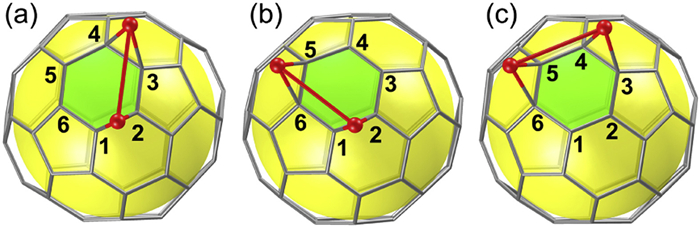
Recently, our group achieved notable progress in synthesizing cuprofullerenes via solvothermal methods [26-31], in which Cu(Ⅰ) atoms bind on C=C of C60 surface in a η2-fashion, different from these copper(Ⅰ) pentaaryl[60]fullerides [32]. Trifluoroacetic acid (HLF) was found to promote formation of Cu2- and Cu3-based cuprofullerenes, where Cu2[(μ2-κ1:κ1)-LF]2 or Cu3[(μ2-κ1:κ1)-LF]3 units bind hexagons in (μ2-η2:η2)2- or (μ3-η2:η2:η2)3—C60 fashions, respectively [33]. Compared to the Cu3-based cuprofullerenes, Cu2-based ones offer greater coordination diversity, as each Cu2LF2 unit can bind a hexagon in three distinct orientations (Scheme 1), tentatively termed as α, β and γ configurations, whereas each Cu3LF3 unit has only one binding site on a specific hexagon. Consequently, regioisomerism arises both from distributions of Cu2LF2 units across different hexagons and from their orientations on different C=C bonds within the same hexagons. Therefore, for ExMFs based on multiple Cu2LF2 units, the potential for regioisomeric C60@(Cu2LF2)n is vast, and achieving controlled synthesis of such orientation-based regioisomeric ExMFs poses a formidable challenge.
Scheme 1
Scheme 1.
Schematic representation of three distinct binding orientations of one Cu2LF2 unit on a hexagon of C60 surface. (a) α configuration on C1=C2 and C3=C4 bonds. (b) β configuration on C1=C2 and C5=C6 bonds. (c) γ configuration on C3=C4 and C5=C6 bonds. Note that there is only one orientation for a Cu3LF3 unit binding on a specific hexagon. LF ligands are omitted for clarity. Red ball represents Cu atom.
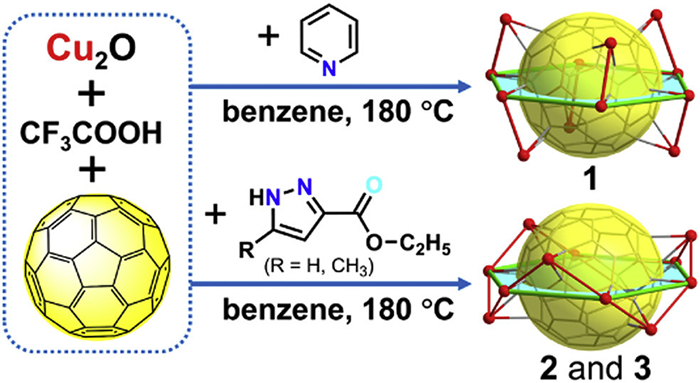
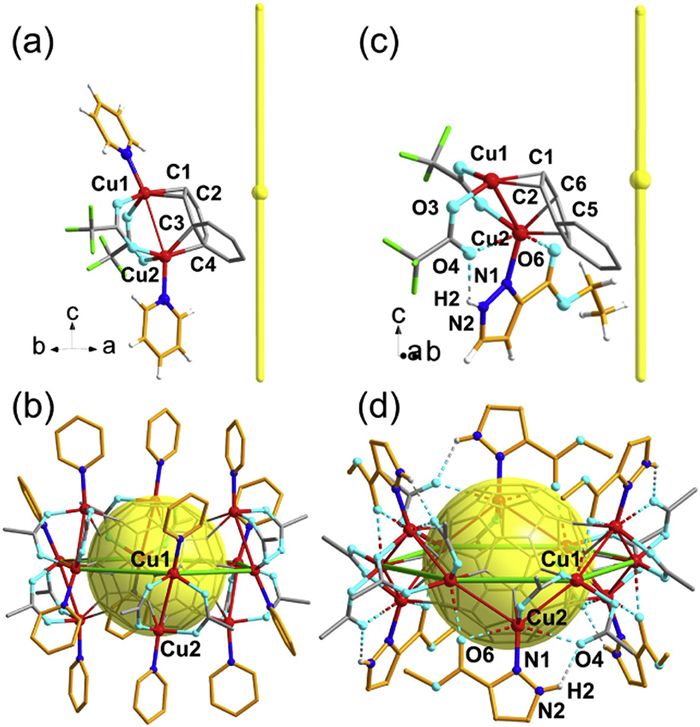
Herein we report three dodecanuclear cuprofullerenes: C60@(Cu2LF2LPy2)6 (1), C60@(Cu2LF2LPz)6 (2) and C60@(Cu2LF2LmPz)6 (3). They were prepared in benzene as dark and dark-red crystal (Fig. S1 in Supporting information) at 180℃ using Cu2O, C60, HLF, and either pyridine (LPy), ethyl 1H-pyrazole-3-carboxylate (LPz), or ethyl 5-methyl-1H-pyrazole-3-carboxylate (LmPz) as reactants (Scheme 2). They crystallize in R-3 space group as discrete molecule-based complexes (Table S1 in Supporting information), with six Cu2LF2 units arranged on the six hexagons around the equatorial belt of C60 molecules (Fig. S2 in Supporting information). Each cuprofullerene molecule exhibits S6 symmetry aligned along crystallographic c axis (Fig. 1 and Fig. S3 in Supporting information). Notably, the different types of weak interactions, including C—H···F, π···π, C—H···π, N—H···O, and Cu···O resulting from auxiliary ligands LPy and LPz/LmPz, lead to distinct distributions of the six Cu2LF2 units over various C═C from the six same hexagons around the equatorial belt, giving rise to regioisomeric cuprofullerenes. This equatorial belt presents S6 symmetry, different from the equatorial cycle with S5 symmetry [25].
Scheme 2
Scheme 2.
Schematic illustration of preparing the regioisomeric cuprofullerenes.
The asymmetric unit of 1 features a single Cu2LF2LPy2 unit canopying on a naphthalene fragment with Cu1 and Cu2 atoms over C1=C2 and C3=C4 bonds respectively (Fig. 1a). The two axial sites of Cu2LF2 unit are occupied by two LPy ligands, completing the tetrahedral coordination geometry around Cu atoms (Fig. 1a). The overall molecule structure exhibits S6 symmetry, with the six Cu1 atoms arranged in an equatorial plane with Cu···Cu distance of 5.4538(1) Å, while the other six Cu2 atoms alternately positioned on two sides of the equatorial plane (Figs. 1b and 2a). The coordination bond lengths of Cu-O range from 1.9918(2) Å to 2.0940(1) Å, Cu-N from 2.0568(2) Å to 2.0642(3) Å, and Cu-C from 2.0302(1) Å to 2.0541(2) Å (Table S2 in Supporting information), similar to previous reports [27,28].
Figure 2
Figure 2.
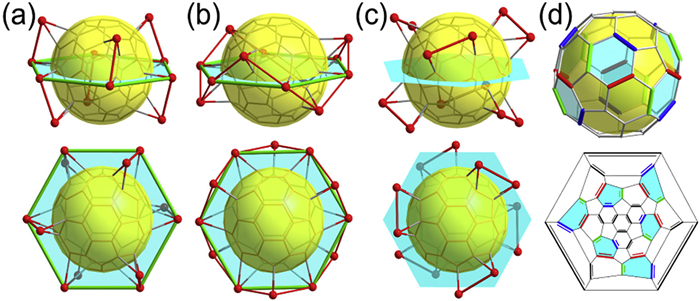
Structural comparisons of (a) 6α, (b) 6β and (c) 6γ regioisomers for C60@(Cu2)6 from side (top) and top (bottom) view. The big cyan hexagons in (a-c) represent the equator plane crossing over the six C1=C2 bonds. (d) The coordinating hexagons in the three regioisomers are highlighted in cyan as steric model (top) and Schlegel diagram (bottom), the C1=C2, C3=C4 and C5=C6 are colored in red, blue and green.
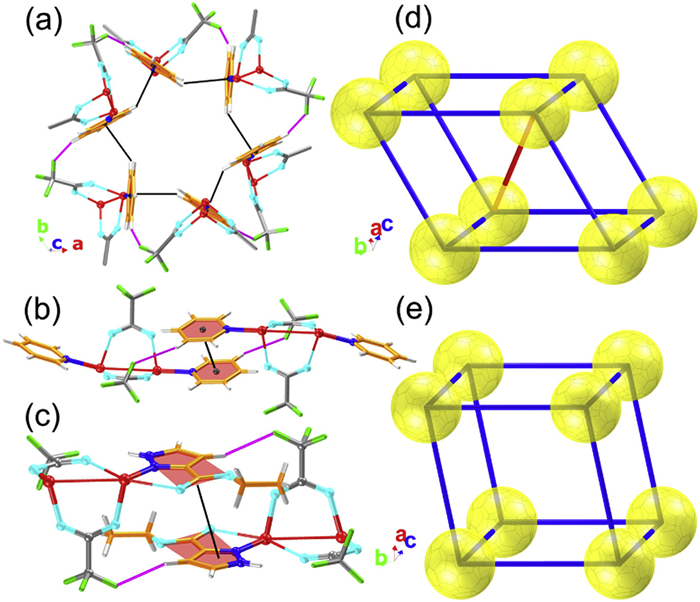
The C60@(Cu2LF2LPy2)6 molecules pack together through intermolecular C—H···π, C—H···F, and π···π weak interactions (Figs. 3a and b, Fig. S4 in Supporting information). Along the c axis, there are six edge-to-face C—H···π (distances of 3.0457 and 3.2712 Å) interactions among the six LPy ligands and C—H···F (dF···H = 2.4969 Å) interactions between CF3 groups and LPy ligands among adjacent cuprofullerenes (Fig. 3a), with a center distance of 13.0825 Å between C60 balls. Additionally, each cuprofullerene molecule interacts with six others through twelve C—H···F (dF···H = 2.6568 Å) interactions and six π···π interactions (d = 3.5162 Å) between LPy ligands (Fig. 3b), resulting in a center distance of 17.4761 Å between C60 balls. Overall, each cuprofullerene molecule interacts with eight others through these weak intermolecular interactions, forming a three-dimensional (3-D) supramolecular framework (Fig. 3d). The synergistic π···π and C—H···F interactions (Fig. 3b) facilitate the formation of a three-periodic 6-c pcu network (Fig. 3d, blue) [34,35], while the edge-to-face C—H···π and C—H···F interactions along c direction in Fig. 3a, acting as one-dimensional rods (Fig. 3d, red), cross-link the 6-c nodes of the pcu network along the c axis, resulting in a classical 8-c bcu network (Fig. 3d and Fig. S4) [34,35].
Figure 3
Figure 3.
Intermolecular weak interactions in (a) 1, (b) 2 and (c) 3. 3D packing frameworks to show an 8-c bcu net in (d) 1 and (e) a 6-c pcu net in 2 and 3. C—H···π in (a) and π···π in (b, c) interactions are shown in black line, and C—H···F in (a-c) are shown in pink line. Note that the red stick in (d) represents the edge-to-face C—H···π and C—H···F interactions along c axis shown in (a) and the blue sticks represent the π···π and C—H···F interactions shown in (b, c).
In contrast, isostructural 2 and 3 exhibit three notable differences in their asymmetric units (Fig. 1c, Figs. S2 and S3). (1) The Cu1 and Cu2 atoms are bound to C1=C2 and C5=C6 bonds of a naphthalene fragment respectively, keeping C3=C4 unoccupied. (2) Only one LF ligand (O1O2) binds to Cu2 unit in a (μ2-κ1:κ1)-LF fashion, while another LF ligand binds to Cu2 unit with O3-Cu1 coordination bond and O4···Cu2 weak interaction (dO4···Cu2 = 2.8193(1) and 2.7574(2) Å). (3) Only one LPz ligand binds to Cu2 unit via a Cu2-N1 bond (dCu-N = 1.9640(2) and 1.9504(5) Å). These arrangements introduce two additional weak interactions: A hydrogen bond between N2-H2···O4 (dH2···O4 = 2.0702(2) and 2.0770(1) Å) and a weak O6···Cu2 interaction (dO6···Cu2 = 2.5155(4) and 2.563(5) Å) between the carbonyl O from LPz/LmPz and Cu2 atom. Consequently, the Cu2 atoms adopt an elongated trigonal bipyramidal coordination geometry (Fig. S5 in Supporting information), markedly different from the arrangement in complex 1.
Through S6 symmetry operations, 2 and 3 exhibit a slightly altered molecular structure than complex 1. Six Cu1 atoms on the C1=C2 bonds form an equatorial plane with Cu1···Cu1 distances of 5.4230(1) and 5.4224(1) Å, slightly shorter than that in 1. Meanwhile, six Cu2 atoms on the C5=C6 bonds are arranged alternately on the two sides of the Cu1 equatorial plane. However, as illustrated in Fig. 1, the C5=C6 bonds are located at the shared ortho-position of two C1=C2 bonds around a pentagon, resulting in Cu2 atoms having similar distances (3.1750(6) and 3.4963(2) Å in 2, 3.1740(1) and 3.5076(2) Å in 3) to the two neighboring Cu1 atoms on the equatorial hexagon (Figs. 1d and 2b). The longer Cu1···Cu2 are further bridged by the μ2—O6 atom from C═O of LPz/LmPz, with O6···Cu1 and O6···Cu2 distances from 2.5155(4) Å to 2.6214(2) Å. Thus, the twelve Cu atoms form a macrocycle resembling a chair hexane encapsulating the C60 ball, representing a typical regioisomeric coordination geometry distinct from that of 1 (Fig. 1b).
In the packing structures of complexes 2 and 3, each cuprofullerene molecule interacts with six others, with distances among neighboring C60 balls of 16.7903(1) in 2 and 17.1614(2) Å in 3 through π···π weak interactions between LPz/LmPz ligands with distances between LPz/LmPz planes of 3.5885 and 3.5781 Å, and C—H···F weak interactions (dF···H = 2.6207 Å in 2 and 3.3157(3) Å in 3) between LF and LPz/LmPz ligands (Fig. 3c and Fig. S6 in Supporting information). Through these weak interactions, their packing structures exhibit a three-periodic classical 6-c pcu network [34,35], similar to that observed in complex 1. Along c axis, the distances between neighboring cuprofullerenes are 22.1474(1) Å in 2 and 23.1656(2) Å in 3, significantly larger than those in complex 1, indicating no notable weak interactions along c axis in complexes 2 and 3. The larger distances result in a higher total solvent-accessible volume of 36.6% (4793.2 Å3 per unit cell volume of 13,086.4 Å3) in 2 and 39.7% (5618.7 Å3 per unit cell volume of 14,135.9 Å3) in 3, compared to 5.0% (485.6 Å3 per unit cell volume of 9735.3 Å3) in 1, as revealed by PLATON calculations [36]. However, the precise positions of crystallized solvent molecules remain undetermined.
The complexes showcase novel orientation-based coordination regioisomeric C60@(Cu2)6 geometries, with C60 binding six pairs of Cu2 units (12 Cu atoms) at slightly different orientation around the equatorial region. Here the C60@Cu12 coordination geometry in 1 is described as 6α configuration (Fig. 2a), then 2 and 3 are 6β configuration (Fig. 2b). It is conceivable that the proposed 6γ configuration with Cu2 canopying on C3=C4 and C5=C6 bonds excluding the six equatorial C1=C2 bonds (Scheme 1c) represents the third orientation-based regioisomeric configuration (Fig. 2c), which shares the same six hexagons around the equatorial plane as the 6α and 6β configurations (Fig. 2d). However, this configuration has yet to be synthesized, and we are actively pursuing its formation.
The auxiliary ligands LPy and LPz/LmPz play pivotal roles in facilitating the 6α and 6β configurations. In complex 1, the planar LPy ligand leads to minimal intramolecular interactions but promotes strong intermolecular interactions such as C—H···π, C—H···F, and π···π, tightly packing the cuprofullerene molecules into a more compact structure. Conversely, the N—H and ester groups in LPz/LmPz ligands not only facilitate multiple intramolecular weak interactions (N—H···O, C=O···Cu) but also introduce steric crowding that drives the formation of 6β configuration diverging from 6α configuration. This steric effect may cause one O atom of LF to weakly coordinate to the Cu atom by N—H···O hydrogen interactions. Due to the absence of functional groups along the S6 symmetry in complexes 2 and 3, significant supramolecular interactions are lacking along this direction, resulting in a 6-c supramolecular packing structure, whereas complex 1 demonstrates additional one-dimensional supramolecular interactions along c direction, contributing to the formation of a novel 8-c framework.
Powder X-ray diffraction (PXRD) confirms the crystalline purity of fresh samples (Fig. S7 in Supporting information). Complexes 2 and 3 exhibit broad and noisy PXRD patterns due to gradual loss of crystallinity upon air exposure. They rapidly decompose in common polar solvents (alcohol, ethyl acetate, chloroform, N,N-dimethylacetamide), limiting their applications in various chemical environments. Thermogravimetric analysis (Fig. S8 in Supporting information) shows complex 1 loses 58% weight between 200℃ and 300℃, corresponding to complete loss of LPy (25.0%) and LF (35.8%). Complexes 2 and 3 lose solvent prior to 200℃, followed by 56% and 59% weight loss before 350℃, matching departure of LPz (22.8%) and LF (37.2%) in complex 2, and LmPz (24.7%) and LF (36.0%) in complex 3.
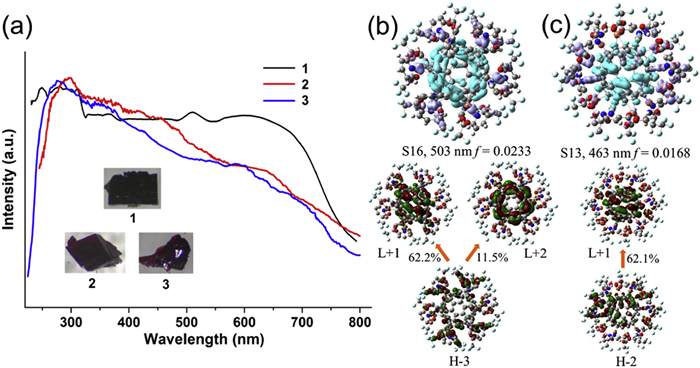
Their optical properties were explored through solid-state UV–vis diffuse reflectance spectra (Fig. 4a). Complex 1 demonstrates broad absorptions across the entire UV–vis range (250–750 nm), with a weak peak absorption observed at 500–550 nm, consistent with its black appearance (Fig. S1a). Complexes 2 and 3 show similar absorptions across the UV–vis spectrum; however, as the absorption energy decreases, the intensities gradually weaken, with two weak peaks appearing at 450–500 nm and 550–600 nm, reflecting their dark red crystalline appearances (Figs. S1b and c).
Figure 4
Figure 4.
(a) UV–vis diffuse reflectance spectra in the solid state of complexes 1, 2 and 3 with inset crystal photographs. EDD maps (density transferring from the parts in purple to cyan) of the selected (b) S16 (complex 1) and (c) S13 (complex 2) excited states (top) and spatial plots of the involved molecular orbitals with dominant contributions (bottom). H, HOMO; L, LUMO.
Detailed time-dependent density functional theory (TD-DFT) calculations were performed to investigate their electronic structures and photophysical mechanisms using unoptimized molecular structures as calculation models (theoretical calculation details in Supporting Information). The calculated results indicate that the absorptions extend from UV to near 600 nm, aligning closely with the experimental findings. The electron density difference (EDD) maps reveal that multiple vertical transitions contribute to the observed absorptions, including charge transfer from (Cu(Ⅰ), O) to π*(C60) and π to π* transitions within C60 moieties, similar with those reported cuprofullerene carboxylates [25,27].
The calculated lowest transition energy of the S1 state for 1 is 596 nm, involving the orbital transitions of H → L (42.1%), H → L + 1 (22.3%) and H → L (20.7%). However, much higher transition energies of the S1 state present in 2 (565 nm, H–1 → L (48.7%), H → L + 1 (41.9%)) and 3 (571 nm, H → L + 1 (48.9%), H–1 → L (48.9%)) (Tables S5-S13 in Supporting information), consistent with experimental absorption data (Fig. 4a). Such lower transition energy in 1 maybe tentatively ascribe to the much higher contributions of Cu for the involved HOMO in 1 (near 30%) than in 2 (near 14%) and 3 (near 15%), which are controlled by electron-donating pyridine in 1 and electron-withdrawing pyrazole in 2 and 3.
In 1, significant absorptions (0.08 > f (oscillator strength) > 0.01) occur at S16-S24 states with transition energies ranging from 503 to 480 nm (Fig. S9a in Supporting information), closely matching the measured peak absorptions at 500–550 nm (Fig. 4a). These excited states involve several frontier orbital transitions, such as from H–3, H–4, H–7, H–9 to L, L + 1, and L + 2. For instance, the transitions of H-3 → L + 1 and H-3 → L + 2 contribute 62.2% and 11.5% to S16 (503 nm, f = 0.0233), while H–4 → L + 1, H–4 → L + 2, and H–3 → L contribute 29.5%, 25.8%, and 23.5% to S20 (495 nm, f = 0.0876), respectively (Fig. 4b and Fig. S10 in Supporting information). The calculated atom and fragment contributions indicate that Cu(Ⅰ) accounts for >40%, O from LF ligand contributes nearly 20%, and C60 contributes approximately 20% to these frontier occupied orbitals, while C60 dominates the contributions (74%−83%) for the frontier unoccupied orbitals (L, L + 1 and L + 2). The contributions from LPy to these frontier orbitals are too small to be negligible. Thus, charge transfers from (Cu(Ⅰ), O) to π*(C60) dominate the absorptions, with minor contributions from π to π* transitions within C60 moieties.
In complex 2, the most significant electronic transitions occur at S13 (463 nm, f = 0.0168), S18 (455 nm, f = 0.0462), and S20-S23 (445–424 nm, f = 0.1841–0.1115) (Fig. 4c and Fig. S11 in Supporting information), exhibiting slightly higher transition energies compared to 1. These dominant transitions primarily involve charge transfer from H–2, H–5, and H–7 to L, L + 1, and L + 2. For instance, the H–2 → L + 1 transition contributes 62.1% to the S13 excitation, while H–2 → L + 2 and H–5 → L account for 32.7% and 16.8% to the S20 state (445 nm, f = 0.1841), respectively. Cu(Ⅰ) centers contribute approximately 30%–40%, O atoms from LF contribute about 20%–30%, and C60 contributes 35%–40% to the occupied orbitals. The corresponding unoccupied orbitals (L, L + 1, L + 2) are predominantly localized on C60 with 71%−79% contributions. Contributions from the LPz ligand to these orbitals are below 10%. Consequently, the optical absorptions in complex 2 are dominated by charge transfer from (Cu(Ⅰ), O) moieties to π* orbitals of fullerene, with only minor contributions π → π* excitations within C60 ball, similar to complex 1. Similar results present for the isostructural 3 (Fig. S12 in Supporting information).
In summary, we have successfully synthesized three dodecanuclear cuprofullerene trifluoroacetates, C60@(Cu2LF2LPy2)6, C60@(Cu2LF2LPz)6 and C60@(Cu2LF2LmPz)6, featuring distinct regioisomeric coordination modes around the equatorial belt of C60 cage. The choice of axial auxiliary (LPy and LPz/LmPz) ligands critically governs orientation of Cu2LF2 units, enabling controlled access to regioisomeric architectures (6α and 6β configurations). Subtle variations in weak supramolecular interactions and ligand steric crowd direct these regioisomeric outcomes and influence supramolecular packing motifs. Photophysical studies combined with TD-DFT calculations demonstrate that the optical absorptions are dominated by charge transfer from Cu(Ⅰ) centers and O atoms of fluorocarboxylates to fullerene π* orbitals, witnessing the electronic communication within these complexes. This work not only enriches the structural diversity of cuprofullerenes but also provides a strategic approach to rationally control regioisomerism in exohedral metallofullerenes, paving the way for tailored design of fullerene-based functional materials with potential applications.
CRediT authorship contribution statement
Ting-Ting Zou: Software, Investigation, Formal analysis, Data curation. Yi-Chun Zhang: Investigation, Formal analysis, Data curation. Yu-Li Liu: Investigation, Formal analysis, Data curation. Ju-Rong Yang: Methodology, Data curation. Shun-Ze Zhan: Writing – review & editing, Writing – original draft, Visualization, Supervision, Project administration, Methodology, Funding acquisition, Conceptualization. Hong Cai: Validation, Software, Resources, Methodology, Investigation. Dan Li: Writing – review & editing, Supervision, Project administration, Funding acquisition, Conceptualization.
Declaration of competing interest
The authors declare that they have no known competing financial interests or personal relationships that could have appeared to influence the work reported in this paper.
Acknowledgments
This work was financially supported by the National Natural Science Foundation of China (Nos. 22431006, 92461309, 22471151), the Guangdong Major Project of Basic and Applied Research (No. 2019B030302009), the Guangdong Basic and Applied Basic Research Foundation (Nos. 2025A1515010315, 2023A1515011630), and Guangdong-Hong Kong Joint Laboratory for Preparation and Application of Ordered Structural Materials of Guangdong Province (No. 2023B1212120011). We thank Dr. Ng Seik Weng (Malaysia) for the contributions to process the crystallography data.
Supplementary materials
Supplementary material associated with this article can be found, in the online version, at doi:10.1016/j.cclet.2025.112121.
Scheme 1
Schematic representation of three distinct binding orientations of one Cu2LF2 unit on a hexagon of C60 surface. (a) α configuration on C1=C2 and C3=C4 bonds. (b) β configuration on C1=C2 and C5=C6 bonds. (c) γ configuration on C3=C4 and C5=C6 bonds. Note that there is only one orientation for a Cu3LF3 unit binding on a specific hexagon. LF ligands are omitted for clarity. Red ball represents Cu atom.
Figure 2
Structural comparisons of (a) 6α, (b) 6β and (c) 6γ regioisomers for C60@(Cu2)6 from side (top) and top (bottom) view. The big cyan hexagons in (a-c) represent the equator plane crossing over the six C1=C2 bonds. (d) The coordinating hexagons in the three regioisomers are highlighted in cyan as steric model (top) and Schlegel diagram (bottom), the C1=C2, C3=C4 and C5=C6 are colored in red, blue and green.
Figure 3
Intermolecular weak interactions in (a) 1, (b) 2 and (c) 3. 3D packing frameworks to show an 8-c bcu net in (d) 1 and (e) a 6-c pcu net in 2 and 3. C—H···π in (a) and π···π in (b, c) interactions are shown in black line, and C—H···F in (a-c) are shown in pink line. Note that the red stick in (d) represents the edge-to-face C—H···π and C—H···F interactions along c axis shown in (a) and the blue sticks represent the π···π and C—H···F interactions shown in (b, c).
Figure 4
(a) UV–vis diffuse reflectance spectra in the solid state of complexes 1, 2 and 3 with inset crystal photographs. EDD maps (density transferring from the parts in purple to cyan) of the selected (b) S16 (complex 1) and (c) S13 (complex 2) excited states (top) and spatial plots of the involved molecular orbitals with dominant contributions (bottom). H, HOMO; L, LUMO.


 DownLoad:

 下载:


 下载:

