Citation:
Fangyuan Ma, Rui Bai, Jianqi Ye, Wei Gao, Jian Zhang, Haitao Huang, Dan Wen. Size engineering of gold aerogels to boost CO2 attachment and electrocatalysis[J]. Chinese Chemical Letters,
2027, 38(1): 112117.
doi:
10.1016/j.cclet.2025.112117
Size engineering of gold aerogels to boost CO2 attachment and electrocatalysis
English
Size engineering of gold aerogels to boost CO2 attachment and electrocatalysis
State Key Laboratory of Solidification Processing, School of Materials Science and Engineering, Northwestern Polytechnical University, Xi’an 710072, China
b.
Department of Applied Physics, The Hong Kong Polytechnic University, Hong Kong 999077, China
Received Date:
22 September 2025 Accepted Date:
13 November 2025 Revised Date:
11 November 2025 Available Online:
12 January 2027
Abstract:
Noble metal aerogels (NMAs), derived from preformed colloidal nanoparticles, are an emerging class of porous materials with significant potential for electrocatalysis. However, the controllable synthesis and function-oriented design of NMAs, and their structure-activity relationship in electrocatalysis remain great challenges. Here, we report a straightforward size engineering strategy to synthesize Au aerogels via a combined pH-dopamine induced gelation of Au nanoparticles with different sizes. The resultant Au aerogels, with tunable ligament sizes, exhibit exceptional electrocatalytic performance in the conversion of CO2. Interestingly, enlarging the ligament size of Au aerogels enhances their electrocatalytic activity, leading to a remarkable electrocatalytic reduction of CO2 to CO (65.7 mA/cm2 at -0.64 V vs. RHE) with a Faradaic efficiency of 96%. Both in situ electrochemical attenuated total reflectance-Fourier transform infrared spectroscopy and molecular dynamics simulations reveal that the electrocatalytic enhancement effect on Au aerogels can be attributed to the increased CO2 attachment to larger ligament size. This work not only achieves the controllable size engineering of metal aerogels but also offers insight into their structure-activity relationship in CO2 reduction, which paves the way for a rational design of NMAs for electrocatalysis.
Noble metal aerogels (NMAs) appear as emerging functional porous materials, which combine the intrinsic activity of noble metal nanoparticles with monolithic and porous features of aerogels, thus showcasing bright prospects in electrocatalysis [1-6]. This is primarily due to the three-dimensional (3D) porous architectures of NMAs, which furnish abundant surface-exposed reaction sites (large surface area), facilitate electron transfer (metallic skeletons), and accelerate the diffusion processes of reactants/products (high porosity) [7-9]. Additionally, these unique structures endow NMAs with self-supported characteristic and high usage of noble metals [10,11]. As a result, remarkable progresses have been witnessed in the past two decades in utilizing NMAs for various electrocatalytic reactions, including those in fuel cells, water splitting, and CO2 reductions [12-17].
To further enhance the catalytic performance of NMAs, considerable efforts have been devoted to manipulating their morphology, component, surface, etc. [18-20]. For instance, PdNi hollow nanosphere derived NMAs were synthesized by Cai et al., which significantly improved the electrocatalytic activity for ethanol oxidation through precise control of morphology and composition [21].
Recently, the Wen group reported a general molecular engineering strategy for NMAs, leveraging the synergistic effect between NMAs and the surface porphyrin to boost oxygen reduction by over 10 times in both mass and specific activities [22]. Overall, from the perspective of noble metal-based catalysts, morphology tailoring remains one of the most efficient methods for improving their catalytic performance [23-26]. Despite the significant advancements in NMA synthesis and electrocatalysis, challenges in rational control over their morphology (i.e., size) remains, leading to great difficulties in understanding of the structure-performance relationship.
The electrocatalytic reduction of CO2 holds significant promise for establishing an artificial carbon cycle but is hindered by the poor efficiency and selectivity of catalysts [27,28]. Au-based catalysts, renowned for their remarkable catalytic activity and product selectivity in CO2 reduction, show immense potential when integrated with the structural benefits of metal aerogels [29-31]. In this work, we pioneered a fine manipulation of the ligament size in Au aerogels via a combined pH-dopamine strategy. Specifically, employing the beta-cyclodextrin capped-Au nanoparticles (β-CD-Au NPs) of varying sizes (6.8 ± 0.7, 10.9 ± 0.9 and 15.1 ± 3.6 nm) as the building blocks, we realized the controllable synthesis of Au aerogels with corresponding ligament sizes of 10.8 ± 2.4, 18.1 ± 3.6 and 23.7 ± 4.2 nm, denoted as Au11, Au18 and Au24, respectively. Furthermore, the resulting Au aerogels with tunable ligament sizes exhibited high-performance electrocatalytic CO2 conversion. And the larger ligament sizes of the Au aerogels were associated with higher catalytic performance in CO2 reduction. Notably, a high catalytic current of 65.7 mA/cm2 with a Faradaic efficiency of 96% was achieved with Au24. In situ electrochemical attenuated total reflectance-Fourier transform infrared (ATR-FTIR) spectroscopy and molecular dynamics (MD) simulations unveiled enhanced CO2 attachment to Au24, which contributes to its remarkable electrocatalytic activity. Moreover, this enhanced electrocatalysis can also be attributed to the larger ligament size of the Au aerogels, which exposes a greater hydrophobic interface, thereby suppressing hydrogen evolution reaction (HER), and consequently enhancing selectivity.
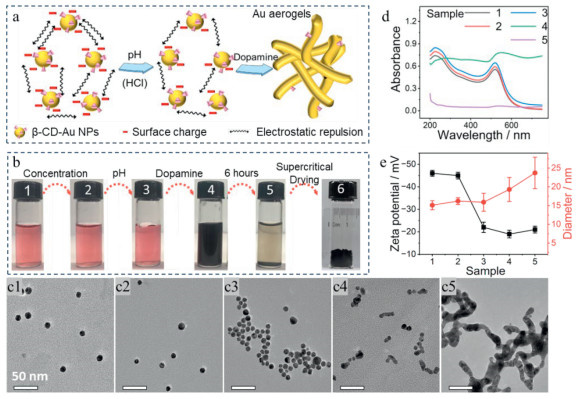
The fabrication of Au aerogels with finely tunable ligament size was implemented by employing Au NPs with different sizes as building blocks through a combined pH-dopamine strategy (Fig. 1a). Initially, the size-adjustable Au NPs were synthesized by the reduction of HAuCl4 with β-CD in an alkaline aqueous solution. By simply tuning the concentration of β-CD, which served as both capping ligand and reducing agent, the β-CD-Au NPs with varying diameters (6.8 ± 0.7, 10.9 ± 0.9 and 15.1 ± 3.6 nm) were successfully prepared (Figs. S1 and S2 in Supporting information). Subsequently, the sols were concentrated by approximately threefold using ultracentrifugation, thereby reducing the distance between individual building blocks and increasing both the frequency of NP collisions and the vdW attraction between nearby NPs [32]. The gelation of Au NPs was triggered by adjusting the pH to 2.4 and subsequently introducing dopamine into the sols within 3 min. Typically, fluffy black hydrogels formed at the bottom of the solution within 6–12 h, depending on the size of the Au NPs and the concentration of dopamine. Finally, the Au aerogels were obtained by supercritical CO2 drying of the above hydrogels.
Figure 1
Figure 1.
(a) Schematic illustration of the size engineering of Au aerogels by a combined pH-dopamine induced strategy. (b) The optical photos, (c) TEM images, (d) UV–vis spectra and (e) zeta-potentials as well as diameter histogram for the gelation of the Au NPs (15.1 nm). 1–5 represent the original Au NPs, the concentrated Au NPs, the Au NPs with the pH adjustment to 2.4, the Au NPs (pH 2.4) with the addition of 0.1 mmol/L dopamine and after 12 h, respectively. Sample 6 is the optical photo of the Au aerogels (Au24).
Herein, the gelation process of Au NPs was elucidated using the Au hydrogels derived from β-CD-Au NP (15.1 ± 3.6 nm) colloids via the aforementioned pH-dopamine strategy. As depicted in Fig. 1b, the color of the Au NP colloids remained unchanged until the introduction of dopamine, which causing a rapid transition from Indian red to dark grey. The fluffy black solid settled down with prolonged time, ultimately yielding a self-supported hydrogel within 12 h. Following further washing and supercritical CO2 drying, the Au24 aerogels were obtained. The combined pH-dopamine gelation for the Au24 hydrogels was further monitored using transmission electron microscope (TEM) and ultraviolet-visible (UV–vis) spectrophotometer. As shown in Fig. 1c and Fig. S3 (Supporting information), the uniform and well-dispersed Au NPs exhibited no significant changes in microscopic morphology and retained a diameter of approximately 15 nm after concentration and pH adjustments. However, upon the introduction of dopamine, small assemblies composed of several NPs formed, eventually leading to the formation of large-scale interconnected nanowire networks within 12 h, with an average diameter of 23.7 ± 4.2 nm. The morphology of the resulting Au24 aerogels remained nearly stable across dopamine concentrations ranging from 0.03 mmol/L to 0.15 mmol/L (Fig. S4 in Supporting information). The corresponding surface plasmon resonance (SPR) peak exhibited the similar trend of changes as observed in the TEM images (Fig. 1d). The SPR peaks of Au NPs stabilized at 520.5 nm after concentration and the pH adjustments. Upon rapidly introducing dopamine into the sols, the SPR peak immediately red-shifted to 541.2 nm and broadened. After 12 h of settling, only a very small SPR peak at approximately 541.2 nm was detected, indicating most of the Au NPs assembled into large nanowire networks and settled down.
It is well-documented that the β-CD-Au NPs gelation can be triggered by dopamine through host-guest interaction, as well as the strong affinity between dopamine and the Au core [33-35]. However, the addition of dopamine into the concentrated Au colloids with varying sizes only resulted in the formation of small assemblies of nanochains (Fig. S5 in Supporting information). The surface charge of Au NPs during the gelation was monitored via zeta-potential analysis (Fig. 1e). A notable decrease from −46 mV to −22 mV was observed after adjusting the pH to 2.4. This decline could be attributed to the pH adjustment of the Au sols, which inhibited the hydrolysis of hydroxyl (O—H) groups, thus diminishing the effect of electrostatic repulsion [36]. Consequently, the lower surface charges led to a decrease in the stability of the NPs, initiating the gelation process of the Au NPs. Eventually, the pH-adjusted Au NPs formed irregular precipitates on the 7th day, while the original and concentrated Au NP colloids remained almost unchanged (Figs. S6 and S7 in Supporting information). This rapid decrease in surface potential was also observed during the pH adjustment of Au NPs with other diameters (Fig. S8 in Supporting information). Hence, it is speculated that the decrease in pH lowered the surface charge of the Au NP colloids, rendering them unstable and facilitating NPs collision and assembly. Subsequently, the addition of dopamine induced their further assembly into interconnected nanowire networks, thereby enabling the size engineering of Au hydrogels.
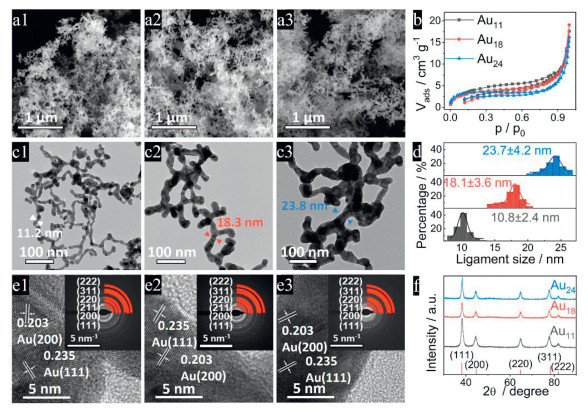
After supercritical CO2 drying, three Au aerogels (Au11, Au18 and Au24), derived from the β-CD Au NPs with different diameters, exhibited similar 3D structures with hierarchical porosity, as observed by scanning electron microscopy (SEM) and N2 physisorption. Figs. 2a1-a3 reveal the interconnected networks of nanowires with numerous bifurcations, comprising pores ranging from meso- to macro-scale. The characteristic isotherms of the different Au aerogels belong to type Ⅱ, characteristic of macroporous materials, consistent with the open 3D framework observed in SEM and TEM images (Fig. 2b and Fig. S9 in Supporting information). By fitting the data to a Brunauer-Emmett-Teller (BET) equation, the surface areas of the Au11, Au18 and Au24 aerogels were determined to be 15.7, 12.6, and 10.2 m2/g, respectively. The TEM images displayed in Figs. 2c1-c3 presented the typical morphology of metal aerogels with highly-branched nanowires, differing in ligament size. They were estimated to be 10.8 ± 2.4, 18.1 ± 3.6, and 23.7 ± 4.2 nm, respectively (Fig. 2d), indicating successful size engineering of the Au aerogels. High-resolution TEM (HRTEM) images and selected area electron diffraction (SAED) showed a face-centered-cubic (fcc) polycrystalline structure of metallic Au in all Au aerogels. The d-spacing measured from the lattice fringes of different samples consistently aligned with the (111) and (200) crystal planes of fcc Au (Figs. 2e1-e3). The diffraction rings can be assigned to the (111), (200), (220), (311), and (220) planes, in agreement with the X-ray diffraction (XRD) patterns (Fig. 2f). Additionally, various characterizations were performed to understand the surface and composition of the Au aerogels with different ligament sizes. Both the FTIR spectra (Fig. S10 in Supporting information) and high-resolution spectra of C 1s from X-ray photoelectron spectroscopy (XPS, Fig. S11 in Supporting information) confirmed the presence of β-CD in all Au aerogels. The Au percentages of the Au11, Au18 and Au24 aerogels derived from the thermogravimetric analysis were estimated to be 94.8, 97.0 and 97.5 wt%, respectively (TGA, Fig. S12 in Supporting information). These findings are in good agreement with the results from the inductively coupled plasma optical emission spectroscopy (ICP-OES, Table S1 in Supporting information). In addition to compositional analysis, XPS measurements of the Au 4f region (Fig. S13 in Supporting information) revealed that all samples contained only metallic Au0, indicating a uniform valence state across different ligament sizes.
Figure 2
Figure 2.
(a1-a3) SEM images, (b) N2 physisorption isotherms, (c1-c3) TEM images and (d) the corresponding histogram of the ligament size of the Au11, Au18 and Au24 aerogels. (e1-e3) SAED and HRTEM images as well as (f) XRD patterns of the Au11, Au18 and Au24 aerogel.
Briefly, the size engineering of the Au aerogels was successfully achieved through a combined pH-dopamine-induced strategy, allowing the production of a series of Au aerogels with varying ligament sizes by adjusting the size of the building blocks. Notably, this manipulation of ligament size had minimal impact on the physicochemical properties of the Au aerogels, including crystal structure, surface characteristics and porosity. Furthermore, the versatility of this approach was demonstrated by employing citrate-capped Au NPs (Cit-Au NPs) with different diameters (15.3 ± 1.3, 22.3 ± 3.7, 31.0 ± 5.3 and 50.0 ± 6.7 nm), which yielded Au aerogels with corresponding ligament sizes (17.4 ± 2.4, 24.2 ± 2.8, 39.2 ± 6.4 and 53.1 ± 7.5 nm) (Fig. S14 in Supporting information). This universality underscores the robustness and applicability of the novel strategy for size engineering of NMAs.
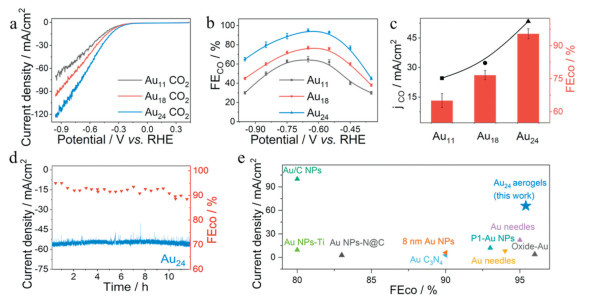
Given the superior performance of Au-based catalysts for CO2 reduction and the precise size manipulation of the Au aerogels as described above, we evaluated the electrocatalytic activity of these Au aerogels with different ligament sizes for CO2 reduction reaction (CO2RR) using an H-cell setup. Fig. 3a illustrated the linear sweep voltammograms (LSV) curves of the Au11, Au18 and Au24 aerogels coupled with carbon paper in a CO2-saturated 0.5 mol/L KHCO3 solution. The polarization curves of the Au24 aerogels depicted an increase in both onset potential and cathodic current compared to the N2-saturated solution, indicating effective CO2 reduction by the Au aerogels (Fig. S15 in Supporting information). Specifically, as observed from the voltammetry profiles, the Au24 aerogels exhibited a large current density of 120 mA/cm2 at −0.91 V vs. RHE, with an onset potential of −0.14 V. These findings suggest that the Au24 aerogels had the lowest onset potential compared to the Au18 aerogels (−0.17 V) and Au11 (−0.20 V), along with the highest current density at the cathodic potential region of −0.14~−0.94 V. The superior electrocatalytic CO2RR activity of the Au24 aerogels was further confirmed by the partial current density results in Fig. S16 (Supporting information). Gas chromatography (GC) analysis of the CO2RR products by the Au aerogels revealed CO and H2 as the main products (Figs. S17 and S18 in Supporting information). No other gas or liquid products were detected, as confirmed by mass spectrum analysis (Fig. S19 in Supporting information) and proton nuclear magnetic resonance (NMR) (Fig. S20 in Supporting information).
Figure 3
Figure 3.
(a) LSV curves of the Au11, Au18 and Au24 aerogels coupled with carbon paper in CO2-saturated 0.5 mol/L KHCO3 solution. (b) FECO curves of the Au11, Au18 and Au24 aerogels in different potentials ranged from −0.34 V to −0.94 V. (c) The comparison of current density and FECO of the Au11, Au18 and Au24 aerogels at −0.64 V. (d) Long-term stability of the Au24 aerogels at −0.64 V and the corresponding FECO during CO2 reduction. (e) The comparison of current density and FECO between the Au24 aerogels and other reported Au-based catalysts.
The selectivity of CO2 conversion to CO was investigated using the Au aerogels with different ligament sizes by varying the applied potentials. In Fig. 3b, the Faradaic efficiency of CO2 to CO (FECO) for the Au11, Au18, and Au24 aerogels was plotted against the applied potential ranging from −0.34 V to −0.94 V. The FECO initially increased and then decreased as the potential increased. Remarkably, the Au24 aerogels achieved an impressive FECO of 96% at an applied potential of −0.64 V, significantly higher than those of the Au18 (76.6%) and Au11 (65%) aerogels at the same potential. This trend suggests that an increase in the nanowire ligament size of the Au aerogels enhanced activity towards CO2RR, accompanied by remarkable selectivity for CO production (Fig. 3c). This trend remains consistent even after normalizing the current densities by the electrochemical active surface area (ECSA) (Figs. S21 and S22 in Supporting information). Furthermore, the long-term durability of the Au24 aerogels was assessed by monitoring the current density and FECO over 12 h at a specific potential of −0.64 V (Fig. 3d). Both the current density and the corresponding FECO remained consistently stable, with values of approximately 58.8 mA/cm2 and 89%, respectively, after the stability test (in comparison with the initial values of 59.7 mA/cm2 and 94%, respectively). There was almost no noticeable decline over time, indicating the robust stability of the Au24 aerogels in CO2RR. Additionally, the microstructures of the Au24 aerogels, especially the ligament size, remained unchanged after the 12-h electrocatalytic stability test (Figs. S23 and S24 in Supporting information).
Overall, compared with the reported nano-Au-based catalysts and the corresponding β-CD-AuNPs (Fig. 3e, Fig. S25 and Table S2 in Supporting information), the Au aerogels especially Au24 possessed superior performance on CO2 conversion to CO, showing high activity, selectivity and stability with large current density. The impressive electrocatalytic CO2 reduction demonstrated by the Au aerogels derived from the preformed Au NPs can be attributed to the facile integration of unique structures of NMAs and prominent activity of Au. Interestingly, this catalytic performance is ligament-size-dependent, with both catalytic current density and FECO showing significant increases as the ligament size of the Au aerogels enlarges. To elucidate the underlying mechanisms of the ligament-size-dependent CO2 electrocatalytic properties, in situ electrochemical ATR-FTIR spectroscopy and MD simulations were employed.
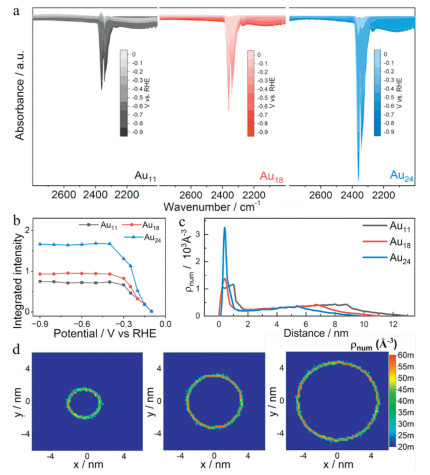
In situ ATR-FTIR tests were performed on the Au11, Au18 and Au24 aerogels by applying potentials ranging from −0.1 V to −0.9 V (Fig. 4a). The in situ ATR-FTIR spectra exhibited two prominent peaks at 2340 and 2360 cm-1, corresponding to the asymmetric stretching of the O=C=O bond [37]. These peaks are commonly associated with CO2 adsorption on the catalyst surface, with the peak at 2360 cm-1 specifically indicative of adsorbed gaseous carbon dioxide, while the peak at 2340 cm-1 is also influenced by CO2 in the solvent [38]. At an applied potential of −0.3 V, the peak at 2360 cm-1 significantly broadened on the Au24 aerogels compared to those on the Au18 and Au11 aerogels, suggesting a stronger adsorption capacity of CO2 at a lower potential for the Au24 aerogels. Furthermore, as the applied potential increases, the growth rate of the 2360 cm-1 peak area varied, with the Au24 aerogels exhibiting the fastest growth rate. Specifically, it was 1.7 and 2.3 times higher than that of the Au11 and Au18 aerogels, respectively. The integrated intensity stabilized at −0.4 V, with the value for Au24 being 2.3 times and 1.8 times higher than those of Au11 and Au18, respectively (Fig. 4b). These results indicate that the increased ligament size of the Au aerogels effectively enhances CO2 attachment, thereby promoting their electrocatalysis.
Figure 4
Figure 4.
(a) In situ electrochemical ATR-FTIR spectra recorded, and (b) integrated band intensities recorded at the Au11, Au18 and Au24 aerogels during electrocatalytic reduction of CO2 from −0.1 V to −0.9 V. (c) The number density distribution of CO2 along the direction perpendicular to the models, and (d) two-dimensional number density distribution (counted individually for each atom) at the Au11, Au18 and Au24 aerogels.
Furthermore, MD simulations were conducted to explore the surface attachment of CO2 on the Au aerogels with different ligament sizes under exposure to CO2 [39,40]. Herein, Au nanowires with varying ligament sizes were selected to represent the structure of the Au aerogels (Figs. S26 and S27 in Supporting information). The radial distribution function (RDF) analysis revealed notable differences in the attachment behavior of CO2 to the Au nanowires. Specifically, the RDF peak corresponding to the attachment between CO2 and Au24 exhibited the highest intensity, with a value of approximately 0.0033 Å-3 and a close distance of approximately 0.38 Å (Fig. 4c). The attachment of CO2 to Au18 followed a similar pattern to that of Au24 with a slightly lower density at 0.0013 Å-3. Conversely, for Au11, the RDF displayed two peaks: one at 0.32 Å and another, of greater intensity, at 1.03 Å. However, both peaks exhibited considerably lower intensities than those of Au18 and Au24. This observation is further supported by the two-dimensional number density distribution plot depicted in Fig. 4d, where larger-sized nanowires exhibited a higher proportion of red regions, representing a greater amount of adsorbed CO2. These findings are consistent with the results obtained from the in situ electrochemical infrared investigations.
It is widely recognized that the adsorption of CO2 on the catalyst surface plays a crucial role in its subsequent activation, leading to the generation of intermediates and followed by cleavage of C=O bonds [41-43]. However, this process is challenging due to the stable molecular structure of CO2 and the substantial negative redox potential involved [44]. The results from both MD simulations and in situ ATR-FTIR spectroscopy unambiguously demonstrate that the ligament size of the Au aerogels profoundly influences the adsorption density and distance of CO2. Specifically, larger ligament sizes of the Au aerogels result in higher surface adsorption density of CO2 at closer positions, ultimately facilitating CO2 reduction and enhancing their electrocatalytic CO2RR activity.
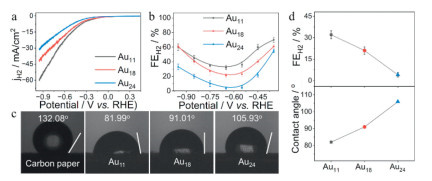
Additionally, the high CO selectivity can be attributed to the suppression of the hydrogen evolution reaction (HER), a major competitive reaction during CO2RR at the Au aerogels. The HER activity of the Au aerogels with different ligament sizes were evaluated in 0.5 mol/L KHCO3 solution saturated with N2. Fig. 5a showed the Au11 aerogels exhibited the highest current density of 26.6 mA/cm2 at −0.64 V, which was 1.3 and 2.5 times higher than those of the Au18 and Au24 aerogels, respectively. Meanwhile, the Au11 aerogels displayed the largest FE of H2 of 32% at −0.64 V (FEH2, Fig. 5b), indicating that a larger proportion of electrons were utilized for evolving H2 during the CO2RR. In contrast, Au18 and Au24 aerogels, which exhibited lower HER activity, produced less H2 during the CO2 reduction. The static contact angle of the Au11 aerogels was estimated to be 81.99°, making them more hydrophilic compared to the Au18 (91.01°) and Au24 (105.93°) aerogels, respectively (Fig. 5c). This suggests that an increase in the ligament size of the Au aerogels led to a decrease in surface hydrophilicity, likely due to the exposure of a larger area of the nano-Au, as revealed by BET and electrochemical surface area measurements. It is well-documented that a more hydrophilic surface allows smaller H2 gas bubbles to leave the electrode surface more rapidly, enabling a larger surface area to continuously participate in ongoing H2 evolution [45,46]. Here, the Au aerogels with less hydrophilic surface (Au24) inhibited the activity of the HER, reducing the FE of H2, thereby facilitating the selectivity for the conversion of CO2 to CO (Fig. 5d) [47,48]. Meanwhile, although the hydrophobic interface may impede the interaction between CO2 dissolved in the electrolyte and the catalyst, this limitation can be mitigated by supplying gaseous CO2. Consequently, the activity of the CO2RR remains unaffected [49].
Figure 5
Figure 5.
(a) LSV curves of the Au11, Au18 and Au24 aerogels coupled with carbon paper in N2-saturated 0.5 mol/L KHCO3 solution. (b) FEH2 plots of the Au11, Au18 and Au24 aerogels in different potentials from −0.34 V to −0.94 V. (c) Static contact angles of carbon paper modified with the Au11, Au18 and Au24 aerogels. (d) The comparisons of static contact angle and FEH2 among the Au11, Au18, and Au24 aerogels.
By integrating the advantages of nano-Au in CO2RR and the structural benefits of NMAs, all the Au aerogels demonstrated high activity and selectivity for the reduction of CO2 to CO, with catalytic performance closely associated with the ligament size. Among these, the Au24 aerogels exhibited the most impressive electrocatalytic performance, achieving a high current density of 65.7 mA/cm2 with a FECO of 96%. The noteworthy observation is that the diverse sizes of the Au aerogels derived from the Cit-Au NPs displayed a consistent trend whereby larger ligament sizes corresponded to enhanced electrocatalytic properties (Figs. S28 and S29 in Supporting information). This superior performance can be primarily attributed to two factors: (1) The Au aerogels with larger ligament size possessed enhanced CO2 attachment, thereby promoting the activity; (2) The Au aerogels with larger ligament size exposed a greater hydrophobic interface, thereby suppressing HER and consequently enhancing the selectivity.
In summary, we demonstrated controllable synthesis and functional design of Au aerogels, offering a promising avenue for enhancing the electrocatalytic conversion of CO2. By manipulating the ligament size of Au aerogels through the pH-dopamine induced gelation method, we uncovered a direct correlation between the ligament size and the electrocatalytic performance. Specifically, larger ligament sizes of the Au aerogels were found to significantly enhance the CO2 attachment and suppress the hydrogen evolution reaction, leading to remarkable improvements in both activity and selectivity for CO2 reduction. The Au24 aerogels, in particular, exhibited outstanding electrocatalytic performance, achieving high current densities and a high Faradaic efficiency of 96% for CO production. Our findings not only advance the fundamental understanding of structure-activity relationships in metal aerogels but also offer practical insights to the rational design of efficient electrocatalysts for CO2 conversion.
The authors declare that they have no known competing financial interests or personal relationships that could have appeared to influence the work reported in this paper.
Acknowledgments
This work was supported by the National Natural Science Foundation of China (No. 22374119) and the Key Project of Natural Science Fund of Shaanxi Province (No. 2023-JC-ZD-06). F. Ma acknowledges the financial support from the Hong Kong Polytechnic University.
Supplementary materials
Supplementary material associated with this article can be found, in the online version, at doi:10.1016/j.cclet.2025.112117.
[1]
W. Liu, A.K. Herrmann, N.C. Bigall, et al., Acc. Chem. Res. 48 (2015) 154–162. doi: 10.1021/ar500237c
Figure 1
(a) Schematic illustration of the size engineering of Au aerogels by a combined pH-dopamine induced strategy. (b) The optical photos, (c) TEM images, (d) UV–vis spectra and (e) zeta-potentials as well as diameter histogram for the gelation of the Au NPs (15.1 nm). 1–5 represent the original Au NPs, the concentrated Au NPs, the Au NPs with the pH adjustment to 2.4, the Au NPs (pH 2.4) with the addition of 0.1 mmol/L dopamine and after 12 h, respectively. Sample 6 is the optical photo of the Au aerogels (Au24).
Figure 2
(a1-a3) SEM images, (b) N2 physisorption isotherms, (c1-c3) TEM images and (d) the corresponding histogram of the ligament size of the Au11, Au18 and Au24 aerogels. (e1-e3) SAED and HRTEM images as well as (f) XRD patterns of the Au11, Au18 and Au24 aerogel.
Figure 3
(a) LSV curves of the Au11, Au18 and Au24 aerogels coupled with carbon paper in CO2-saturated 0.5 mol/L KHCO3 solution. (b) FECO curves of the Au11, Au18 and Au24 aerogels in different potentials ranged from −0.34 V to −0.94 V. (c) The comparison of current density and FECO of the Au11, Au18 and Au24 aerogels at −0.64 V. (d) Long-term stability of the Au24 aerogels at −0.64 V and the corresponding FECO during CO2 reduction. (e) The comparison of current density and FECO between the Au24 aerogels and other reported Au-based catalysts.
Figure 4
(a) In situ electrochemical ATR-FTIR spectra recorded, and (b) integrated band intensities recorded at the Au11, Au18 and Au24 aerogels during electrocatalytic reduction of CO2 from −0.1 V to −0.9 V. (c) The number density distribution of CO2 along the direction perpendicular to the models, and (d) two-dimensional number density distribution (counted individually for each atom) at the Au11, Au18 and Au24 aerogels.
Figure 5
(a) LSV curves of the Au11, Au18 and Au24 aerogels coupled with carbon paper in N2-saturated 0.5 mol/L KHCO3 solution. (b) FEH2 plots of the Au11, Au18 and Au24 aerogels in different potentials from −0.34 V to −0.94 V. (c) Static contact angles of carbon paper modified with the Au11, Au18 and Au24 aerogels. (d) The comparisons of static contact angle and FEH2 among the Au11, Au18, and Au24 aerogels.


 DownLoad:

 下载:


 下载:

