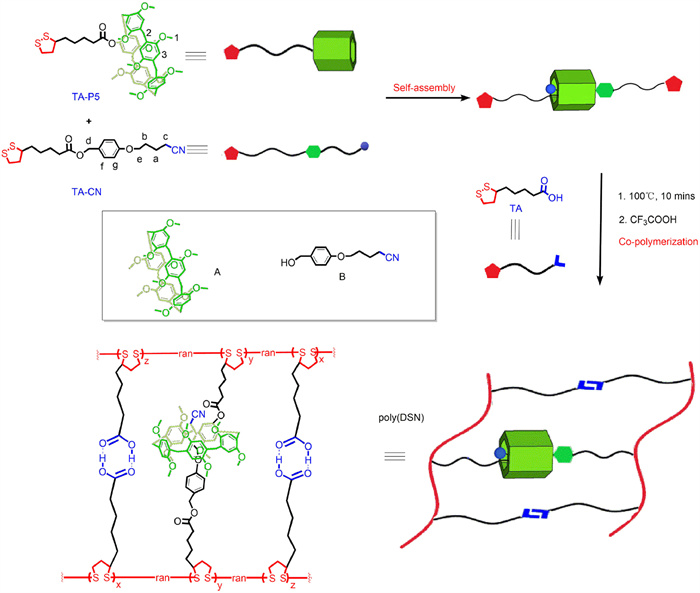
Scheme 1.
Cartoon diagram of preparation of dynamic supramolecular network polymer.

Dynamic supramolecular network crosslinked by hydrogen bonds and pillar[5]arene-based host–guest interaction
Zhanqi Cao , Zheng Yang , Wang Wang , Pan Li , Yue Sun , Wankai An , Guoxing Liu , Xin Zheng , Caoyuan Niu , Sijia Rao , Wenyan Zhang


Dynamic materials [1-4], owing to their excellent self-adaptive, self-repair and recyclable performance, gained widespread attention in self-healing materials [5-7], biomedical fields [8,9] and recyclable materials [10-12]. Dynamic chemistry, including dynamic covalent [13-15] and supramolecular noncovalent [16-18], provides a fundamental optional approach for building dynamic materials [19]. These materials exhibit universal application, from microscopic molecular self-assembly [20,21] to macroscopic mechanical motion [22-24]. With the increasing awareness of green environmental protection in recent years, material scientists utilize the concept of dynamic chemistry to transform traditional polymer materials, pushing exponential development of the field [25,26]. Although human have gained many milestone achievements in dynamic chemistry area [27,28], it still needs to develop the concepts or methods of dynamic materials, especially those combining the advantage between dynamic covalent and supramolecular noncovalent materials.
Dynamic covalent, combining the advantage of stability in classic covalent and reversibility in noncovalent band, presents prominent characteristic dynamics and reversibility [29-31]. Among many kinds of dynamic covalent, dynamic disulfide bond has attracted wide publicity due to its multifunctionality, biodegradable and rearrangement characteristics [32-35]. Thus, utilizing the dynamic responsiveness and repairability of dynamic disulfide bonds to develop smart materials has been a popular research field [36,37]. As important noncovalent bond driving forces in supramolecular chemistry field, hydrogen bond [38-41] and host–guest interaction [42-44] play vital roles in constructing supramolecular polymers. Hydrogen bond presents strong binding force, dynamic reversibility and has a wide application in the construction and improving performance of supramolecular polymers [45-48]. Host–guest recognition, depending on the noncovalent force between macrocycle host and guest, brings different components together to construct functional materials and expand supramolecular application [49-55]. Pillar[5]arenes, as the latest generation macrocycle host molecules, since first reported by Ogoshi in 2008 [56], have gained widespread attention [57-60]. In summary, hydrogen bond and pillararene are chosen as representatives to prepare dynamic supramolecular polymers.
Here, we report a dynamic supramolecular network polymer [poly(DSN)], in which the backbone is constructed by poly(disulfides) and the framework of side chain is cross-linked by hydrogen bond and the pillar[5]arene-based host–guest interaction (Scheme 1). The poly(DSN) is prepared by disulfide-mediated ring-opening polymerization (ROP) and acid catalysis without any protection reported by Qu group’s method [61]. The polymer shows stronger stress mechanical properties and excellent closed-loop chemical recycling performance. The design concept is environment friendly and provides an idea for future sustainable materials.
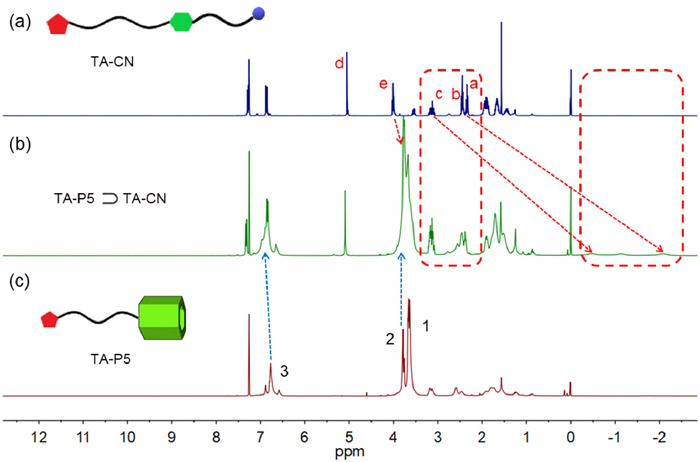
The idea originated from our long-term interests in preparation of supramolecular polymers. Hydrogen bonds and host–guest interaction was introduced into the polymer to collaborative construct dynamic supramolecular polymers network. In previous reports, the pillar[5]arene and neutral nitrile molecule had strong inclusion capacity via host–guest interaction [62], thus they were used to construct side chain crosslinking network. Firstly, the compound TA-P5 and TA-CN were used to test the host–guest interaction (Fig. 1). As shown in Fig. 1b, after the guest molecular TA-CN self-assembling with TA-P5, the related NMR signals of H2 and H3 on host TA-P5 shifted downfield slightly because of the deshielding effect, while the signals of Ha-Hc on the guest TA-CN broadened and shifted upfield due to the shielding effect. The chemical shifts change of the protons indicating the neutral guest TA-CN was successfully included into the cavity of host TA-P5. Then in the concentration dependent titration experiment of 1H NMR spectra (Fig. S1 in Supporting information), as the amount increase of TA-CN, the signals of protons H3 on TA-P5 became broad and shifted downfield gradually due to the deshielding effect, while the signals of protons Hf, Hg on benzene ring of TA-CN increased gradually. The results further proved the inclusion behavior between the compound TA-P5 and TA-CN. The complexation stoichiometric ratio between the compound TA-P5 and TA-CN was 1:1 (Fig. S2 in Supporting information) according to the NMR data in titration experiment (Fig. S1). What is more, a two-dimensional (2D) NOESY experiment was also performed to prove self-assembly behavior (Fig. S3 in Supporting information). Correlated signals were observed between protons H3 and Hc, as well as H1/H2 and Ha/Hc, further confirmed the complexation between pillar[5]arene and the neutral nitrile group. All above results supported the host–guest interaction between TA-P5 and TA-CN.
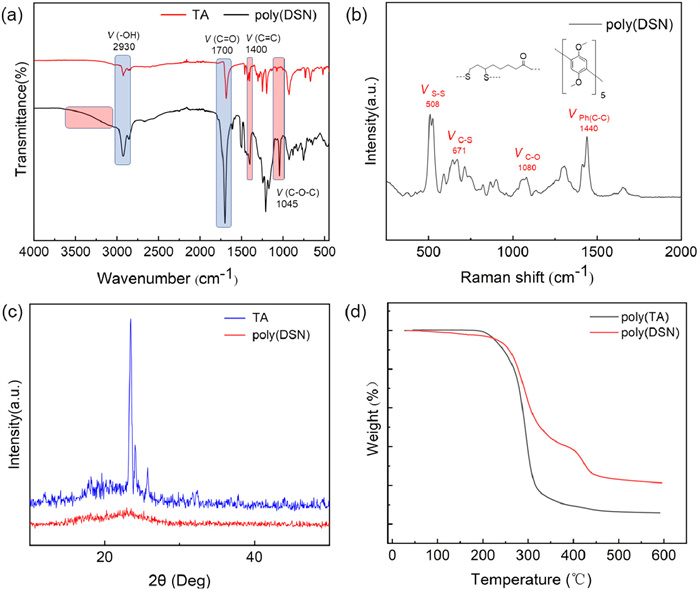
Then the poly(DSN) was prepared by self-assembly between TA-P5 and TA-CN and then followed by copolymerization with thioctic acid (details see Supporting information). Firstly, the compound TA-P5 and TA-CN were self-assembly in CHCl3 solution, and then thioctic acids were added to achieve copolymers poly(DSN) through disulfide-mediated ring-opening polymerization (ROP) in the present of CF3COOH (TFA) catalyst under 100 ℃. ATR-IR and Raman spectrum was used to prove the bond formation in polymer network. The broad absorption bond of ATR-IR at around 3300 cm−1 confirmed the presence of hydrogen bond (Fig. 2a) and 1045 cm−1 attributed to the stretching vibration of C–O–C. The Raman peak at 508 cm−1 attributed to the formation of S-S bond (Fig. 2b). X-ray diffraction (XRD) showed that the TA monomer was highly crystalline before polymerization and became amorphous network structure after polymerization (Fig. 2c). Thermogravimetry analysis (TGA) results displayed the decomposition temperature increased after introducing P5-based host–guest interaction (Fig. 2d). The material structure of the polymer was characterized by scanning electron microscopy (SEM) (Fig. S4 in Supporting information). At observational resolution, the cross-sectional SEM images was dense structure (Fig. S4a), derived from polymer networks spatial cross-linking. All above experimental data confirmed the successful construction of supramolecular polymers.
Mechanical experiments were utilized to confirm the effects of host guest interactions on material properties. After introduction the host–guest crosslinkers, the tensile stress-strain curves of poly(DSN) presented obvious improved mechanical performances comparing with hydrogen bond crosslinking in poly(TA) (Fig. 3a). Samples only with hydrogen bonds cross-linking network poly(TA) exhibited good elongation and weak mechanical property. After introduction the host–guest crosslinkers, the elongation of the poly(DSN) declined while the mechanical strength increased significantly (Fig. 3a). Then repeated experiments were performed to prove the results were of reproducible (Fig. S5 in Supporting information). The corresponding error bars reflected the degree of data dispersion was small, and the curve was repeatable. In order to prove the mechanical property change was due to the crosslinking of the host-guest interaction rather than the introduction of rigid aromatic hydrocarbons, a comparative experiment was conducted. The model compounds A and B without esterification with thioctic acid were co-polymerized with thioctic acid in the same proportion. The controlled experiment polymer poly(CE) presented weaker mechanical property compared with poly(TA) (Fig. 3a). The results further proving the introduction of host-guest interactions was beneficial for improving the mechanical properties of materials.
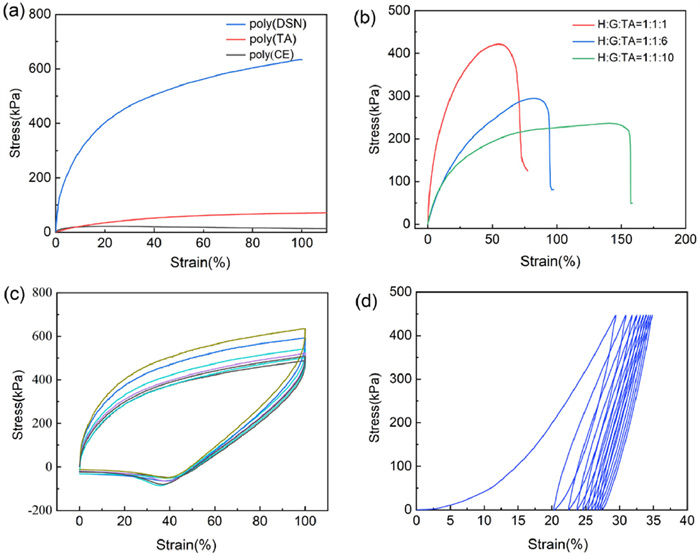
The poly(DSN) with different equivalents of host-guest compound (TA-P5 and TA-CN) and thioctic acid (molar ratio = H:G:TA) were prepared to confirm the influence of host–guest interaction on the polymer mechanical performance. As the proportion of host-guest interaction increasing and lipoic acid decreasing, the poly(DSN) presented stronger stress and weaker strain (Fig. 3b), attributing to the strong force between host and guest interaction and hydrogen bond ratio reducing. Then material sample with better ideal stress-strain curve (H:G:TA=1:1:6) was selected as representative to test the cyclic tensile property. In cyclic tensile curves (Fig. 3c), the continuous cyclic process resulted in residual strain, attributing to three dynamic chemical bonds among the cross-linked networks, such as hydrogen bond, host-guest interaction and dynamic covalent disulfide bond. After interval of 1 min, the polymer elasticity almost recovered, indicating that the poly(DSN) had remarkable characteristics of fast kinetics and dynamic adaptive. After stretching >5 times, the cyclic tensile curves tended to be stable and showed good fatigue resistance. After multiple cycles, the cross-sectional SEM images of polymer showed the structure had no obvious changes (Fig. S4b), indicated that the polymer network had high elasticity and toughness. Finally, in cyclic compression experiments (Fig. 3d), the poly(DSN) presented linear responsiveness at initial stage resulting from its good elasticity. After several cycles, due to the energy dissipation mechanism between non-covalent bonds in polymer network, the curve tended to stabilize.
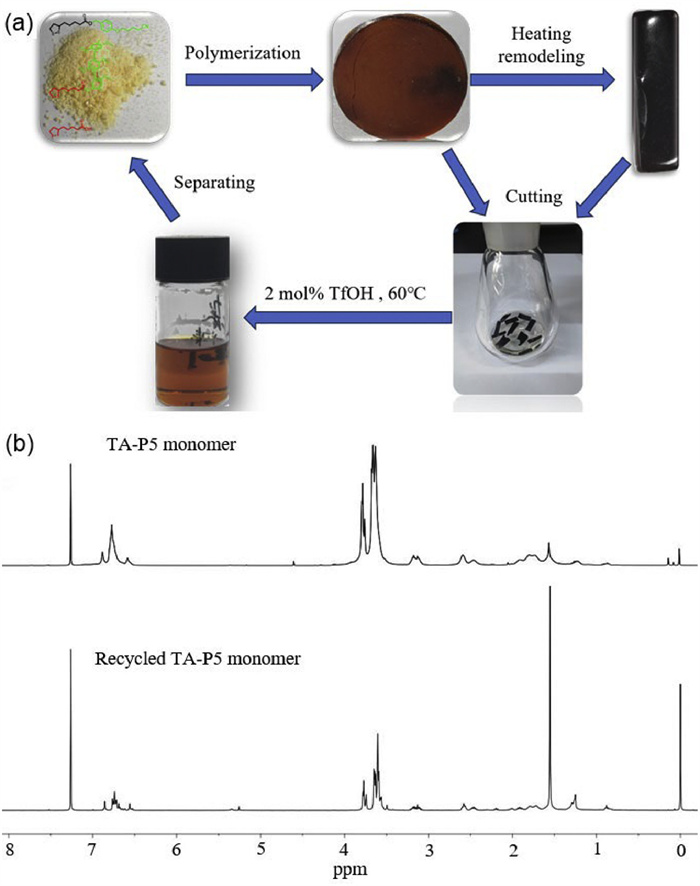
The reversibility of the poly(DSN) was investigated to prove the application prospect of the material. The schematic diagram of the cycle of polymerization and depolymerization of poly(DSN) was exhibited in Fig. 4a. Insoluble solid was suspended in chloroform solution under 60 ℃ and then 2 mol% TfOH was added. The mixture dissolved entirely in 5 min and obtained brown solution. The depolymerization product TA-P5 with a 66% recovery rate was further confirmed by 1H NMR spectroscopy compared with original TA-P5 monomer (Fig. 4b). The depolymerization product yield of TA-P5 is not ideal. One possible reason is that the monomer structure is somewhat complex, leading to minor side reactions during the depolymerization process. Designing simpler monomers to prepare similar polymers is the striving direction in future work. The recovered compounds were once again used to prepare dynamic supramolecular polymer. The stress-strain curves showed that the mechanical properties of the polymer were the same as those of the original polymer. The result proved the poly(DSN) could chemically recycled and the material showed good application prospect in the sustainable development aspect.
In this work, a dynamic supramolecular network polymer is prepared depending on the cooperative crosslinking between the pillar[5]arene-based host–guest interaction and hydrogen bond and the main chain skeleton composing of the dynamic disulfide bonds through disulfide-mediated ring-opening polymerization (ROP). The polymer materials have well dynamic reversibility and mechanical property due to the dynamic chemical bond. The key factor originates from three dynamic chemical bonds among the cross-linked networks: Hydrogen bond, host-guest interaction and dynamic covalent disulfide bond. These three chemical bonds all have dynamic reversibility, while the pillar[5]arene-based host–guest interaction have larger complexation constant and stronger binding force, resulting in the materials presenting better mechanical property comparing with dynamic supramolecular polymer constructing from pure thioctic acid. What is more, this material has well chemical recyclability and shows potential applications in the field of environmental protection. The design concept of this material combines the advantages of dynamic covalent bonding and host-guest chemistry, promoting the development of dynamic chemical and supramolecular chemistry. Its promising application is to prepare next-generation plastics with self-repair and recyclable capability.
The authors declare that they have no known competing financial interests or personal relationships that could have appeared to influence the work reported in this paper.
Zhanqi Cao: Writing – review & editing. Zheng Yang: Writing – review & editing. Wang Wang: Writing – review & editing. Pan Li: Writing – review & editing. Yue Sun: Writing – review & editing. Wankai An: Writing – review & editing. Guoxing Liu: Writing – review & editing. Xin Zheng: Writing – review & editing. Caoyuan Niu: Writing – review & editing. Sijia Rao: Writing – review & editing. Wenyan Zhang: Writing – review & editing.
This work was supported by funding from the National Natural Science Foundation of China (No. 21901063), Key Science and Technology Foundation of Henan Province (No. 242102230178), Natural Science Foundation of Henan province (No. 242300421350), Young Talents Personnel Fund of Henan Agricultural University (No. 30500604), the Science and Technology Innovation Foundation of Henan Agricultural University (No. 2023CXZX006).
Supplementary material associated with this article can be found, in the online version, at doi:
N.D.A. Watuthanthrige, P. Chakma, D. Konkolewicz, Trends Chem. 3 (2021) 231–247. doi: 10.1016/j.trechm.2020.12.005
S. Panja, D.J. Adams, Chem. Soc. Rev. 50 (2021) 5165–5200. doi: 10.1039/D0CS01166E
S.V. Wanasinghe, O.J. Dodo, D. Konkolewicz, Angew. Chem. Int. Ed. 61 (2022) e202206938. doi: 10.1002/anie.202206938
M.J. Webber, M.W. Tibbitt, Nat. Rev. Mater. 7 (2022) 541–556. doi: 10.1038/s41578-021-00412-x
N. Roy, B. Bruchmann, J.M. Lehn, Chem. Soc. Rev. 44 (2015) 3786–3807. doi: 10.1039/C5CS00194C
T. Song, B. Jiang, Y. Li, et al., ES Mater. Manuf. 14 (2021) 1–19.
N. Wen, T. Song, Z. Ji, et al., React. Funct. Polym. 168 (2021) 105041. doi: 10.1016/j.reactfunctpolym.2021.105041
A.R. Studart, Angew. Chem. Int. Ed. 54 (2015) 3400–3416. doi: 10.1002/anie.201410139
W. Zhou, Z. Qiao, E. Nazarzadeh Zare, et al., J. Med. Chem. 63 (2020) 8003–8024. doi: 10.1021/acs.jmedchem.9b02115
C. Li, L. Wang, Q. Yan, et al., Angew. Chem. Int. Ed. 61 (2022) e202201407. doi: 10.1002/anie.202201407
T.Y. Du, B.M. Shen, J.Y. Dai, et al., J. Am. Chem. Soc. 145 (2023) 27788–27799. doi: 10.1021/jacs.3c10708
N. Roy, V. Schädler, J.M. Lehn, Acc. Chem. Res. 57 (2024) 349–361. doi: 10.1021/acs.accounts.3c00683
B. Qin, S. Liu, J.F. Xu, Angew. Chem. Int. Ed. 62 (2023) e202311856. doi: 10.1002/anie.202311856
N. Zheng, Y. Xu, Q. Zhao, et al., Chem. Rev. 121 (2021) 1716–1745. doi: 10.1021/acs.chemrev.0c00938
A.G. Orrillo, R.L.E. Furlan, Angew. Chem. Int. Ed. 61 (2022) e202201168. doi: 10.1002/anie.202201168
Z. Cao, F. Yang, D. Wu, et al., Polym. Chem. 14 (2023) 1318–1322. doi: 10.1039/D3PY00026E
X. Yang, W. Wang, R. Bai, et al., J. Am. Chem. Soc. 147 (2025) 10540–10548. doi: 10.1021/jacs.5c00108
Z. Cao, D. Wu, M. Li, et al., Chin. Chem. Lett. 33 (2022) 1533–1536. doi: 10.1016/j.cclet.2021.09.001
Q. Zhang, D.H. Qu, B. Feringa, et al., J. Am. Chem. Soc. 144 (2022) 2022–2033. doi: 10.1021/jacs.1c10359
L. Liu, Y. Deng, D.H. Qu, et al., Angew. Chem. Int. Ed. 64 (2025) e202424147. doi: 10.1002/anie.202424147
J. Deng, R. Bai, J. Zhao, et al., Angew. Chem. Int. Ed. 62 (2023) e202309058. doi: 10.1002/anie.202309058
Z. Zhang, J. Zhao, X. Yan, Acc. Chem. Res. 57 (2024) 992–1006. doi: 10.1021/acs.accounts.4c00006
Z. Zhang, W. You, P. Li, et al., J. Am. Chem. Soc. 145 (2023) 567–578. doi: 10.1021/jacs.2c11105
S. Borsley, D.A. Leigh, B.M.W. Roberts, Angew. Chem. Int. Ed. 63 (2024) e202400495. doi: 10.1002/anie.202400495
N.R. Boynton, J.M. Dennis, N.D. Dolinski, et al., Science 383 (2024) 545–551. doi: 10.1126/science.adi5009
J. Lee, D. Lee, C.H. Ahn, et al., Adv. Funct. Mater. 35 (2025) 2414842. doi: 10.1002/adfm.202414842
Y. Deng, Q. Zhang, B.L. Feringa, Adv. Sci. 11 (2024) 2308666. doi: 10.1002/advs.202308666
J. Deng, S. Qu, Z. Gu, et al., CCS Chem. 8 (2026) 961–973. doi: 10.31635/ccschem.025.202505681
J.Y. Zhang, L.H. Zeng, J. Feng, Chin. Chem. Lett. 28 (2017) 168–183. doi: 10.1016/j.cclet.2016.07.015
Z. Lei, H. Chen, S. Huang, et al., Chem. Rev. 124 (2024) 7829–7906. doi: 10.1021/acs.chemrev.3c00926
Z. Wan, N. An, C. Xu, et al., Polym. Chem. 16 (2025) 636–651. doi: 10.1039/D4PY01204F
Q. Zhang, C.Y. Shi, D.H. Qu, et al., Sci. Adv. 4 (2018) eaat8192. doi: 10.1126/sciadv.aat8192
C.Y. Shi, Q. Zhang, B.S. Wang, et al., ACS Appl. Mater. Interfaces 13 (2021) 44860–44867. doi: 10.1021/acsami.1c11679
C.Y. Shi, D.D. He, Q. Zhang, et al., Natl. Sci. Rev. 10 (2023) nwac139. doi: 10.1093/nsr/nwac139
J. Wu, X. Liu, L. Chen, et al., ACS Appl. Polym. Mater. 6 (2024) 4778–4788. doi: 10.1021/acsapm.4c00346
Z. Tang, Z. Liu, M. You, et al., ACS Appl. Polym. Mater. 6 (2024) 330–340. doi: 10.1021/acsapm.3c02002
J. Huang, Z. Gong, Y. Chen, Polymer 242 (2022) 124569. doi: 10.1016/j.polymer.2022.124569
W. Niu, Z. Li, F. Liang, et al., Angew. Chem. Int. Ed. 63 (2024) e202318434. doi: 10.1002/anie.202318434
J. Wu, F. Zeng, Z. Fan, et al., Adv. Funct. Mater. 34 (2024) 2410518. doi: 10.1002/adfm.202410518
H. Qiao, B. Wu, S. Sun, et al., J. Am. Chem. Soc. 146 (2024) 7533–7542. doi: 10.1021/jacs.3c13392
Q. Deng, S. Han, Y. Wu, et al., Angew. Chem. Int. Ed. 64 (2025) e202415386. doi: 10.1002/anie.202415386
Z.Q. Wang, X. Wang, Y.W. Yang, Adv. Mater. 36 (2024) 2301721. doi: 10.1002/adma.202301721
Y.H. Song, Y.J. Gu, Z. Lei, et al., Nano Lett. 25 (2025) 4476–4484. doi: 10.1021/acs.nanolett.5c00090
W.J. An, X.Y. Yu, C.H. Liu, et al., Adv. Sustain. Syst. 9 (2025) 2500018. doi: 10.1002/adsu.202500018
S.J.D. Lugger, S.J.A. Houben, Y. Foelen, et al., Chem. Rev. 122 (2021) 4946–4975.
S. Bujosa, A. Doncel-Giménez, N. Bäumer, et al., Angew. Chem. Int. Ed. 61 (2022) e202213345. doi: 10.1002/anie.202213345
Y. Liu, L. Wang, L. Zhao, et al., Chem. Soc. Rev. 53 (2024) 1592–1623. doi: 10.1039/D3CS00705G
T. Xiao, X. Li, L. Zhang, et al., Chin. Chem. Lett. 35 (2024) 108618. doi: 10.1016/j.cclet.2023.108618
S. Yan, M. Yang, X. Deng, et al., J. Am. Chem. Soc. 147 (2025) 12766–12776. doi: 10.1021/jacs.5c00968
Y.Y. Liu, X.Y. Yu, Y.C. Pan, et al., Sci. China Chem. 67 (2024) 1397–1441. doi: 10.1007/s11426-024-1971-4
T. Chen, J. Wang, R. Tang, et al., Chin. Chem. Lett. 34 (2023) 108088. doi: 10.1016/j.cclet.2022.108088
D. Wu, Z. Yang, Y. Xia, et al., Chin. Chem. Lett. 36 (2025) 110353. doi: 10.1016/j.cclet.2024.110353
H. Li, Z. Li, C. Lin, et al., Nat. Commun. 15 (2024) 5315. doi: 10.1038/s41467-024-49540-2
G. Liu, Y. Li, C. Tian, et al., Chin. Chem. Lett. 35 (2024) 109403. doi: 10.1016/j.cclet.2023.109403
X. Fan, Y. Fan, Y. Dang, et al., Chin. Chem. Lett. 36 (2025) 110648. doi: 10.1016/j.cclet.2024.110648
T. Ogoshi, S. Kanai, S. Fujinami, et al., J. Am. Chem. Soc. 130 (2008) 5022–5023. doi: 10.1021/ja711260m
T.H. Shi, S. Ohtani, K. Kato, et al., Trends Chem. 5 (2023) 537–550. doi: 10.1016/j.trechm.2023.04.004
L. Zhou, Y. Zhou, L. Fang, et al., Chin. Chem. Lett. 35 (2024) 109509. doi: 10.1016/j.cclet.2024.109509
X.Y. Lou, K. Zhang, Y. Bai, et al., Angew. Chem. Int. Ed. 64 (2025) e202414611. doi: 10.1002/anie.202414611
L. Wu, Y. Meng, X. Zheng, et al., Chin. Chem. Lett. 36 (2025) 110808. doi: 10.1016/j.cclet.2024.110808
B.S. Wang, Q. Zhang, Z.Q. Wang, et al., Angew. Chem. Int. Ed. 62 (2023) e202215329. doi: 10.1002/anie.202215329
C. Li, Chem. Commun. 50 (2014) 12420–12433. doi: 10.1039/C4CC03170A

Figure 1 1H NMR spectra (400 MHz, CDCl3, 298 K) of (a) nitrile guest TA-CN, (b) 2.0 mmol/L TA-P5 + 2.0 mmol/L TA-CN, and (c) host TA-P5.

Figure 2 Characterization of the polymer structures. (a) ATR-IR spectra of TA and poly(DSN). (b) Raman spectra of poly(DSN). (c) XRD spectra of TA monomer and poly(DSN). (d) TGA of poly(TA) and poly(DSN).

Figure 3 Mechanical properties. (a) Strain−stress curves of poly(TA), poly(CE), and poly(DSN). (b) Strain−stress curves of different equivalents compound in poly(DSN). (c) Cyclic tensile curves of poly(DSN). (d) Cyclic compression curves of poly(DSN).

 扫一扫看文章


扫一扫关注我们
 DownLoad:

 下载:
下载:

 下载:
下载: