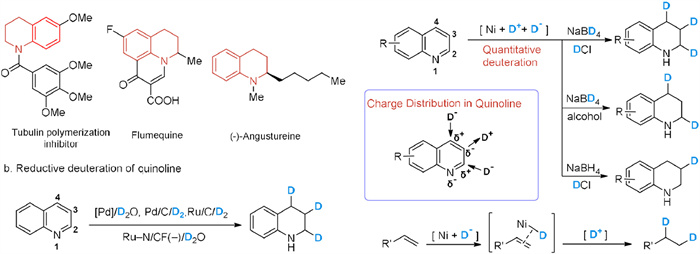
Scheme 1.
Deuteration methods of quinolines and alkenes.

Nickel-catalyzed quantitative deuterated reduction of quinolines and alkenes
Wenyan Zhao , Tiantian Liang , Dongcheng Zheng , Jiali Qiu , Juan Zheng , Yandong Wu , Wenhan Xu , Liang Liu , Fei Ye


1,2,3,4-Tetrahydroquinolines can be generated through reduction of quinolines [1–16], converting the planar aromatic ring system into saturated three-dimensional scaffold, enhancing molecular conformational flexibility [17–19]. This scaffold is widely found in various pharmaceutical molecules [20–22] such as the antibacterial agent flumequine, a tubulin polymerization inhibitor with anti-tumor activity, and a deuterated topiramate, which exhibits enhanced metabolic stability than its non-deuterated counterpart (Scheme 1a) [23]. Substituting hydrogen atoms with deuterium atoms in the piperidine ring of tetrahydroquinoline, without drastically altering its biological function, can provide a promising route for developing next-generation drugs [24–28]. These methods typically involve catalytic deuteration using heterogeneous catalytic systems such as Pd or Ru catalysts in the presence of D2 or D2O (Scheme 1b), which usually result in full deuteration of heterocycles [29,30]. More recently, electrochemical technique has been used in the field of reductive deuteration of quinolines by Lei and Li, in which N-containing heterocycles and even benzene rings can be fully deuterated [31]. These developments also deliver products that are fully deuterated at the 2-, 3-, and 4-positions of quinolines, lacking control over site-selectivity, particularly the deuterium-labelling multiplicity (i.e., whether one, two, or three sites on the pyridine ring are deuterated). Therefore, a selective and number-controllable deuteration manner at specific positions within the tetrahydroquinolines scaffold remains elusive.
Charge-distribution analysis reveals that the quinoline ring possesses partial positive charge character at the C-2 and C-4 positions, while the C-3 position exhibits partial negative charge character [32]. Therefore, in principle, the 2- and 4-positions are susceptible to attack by nucleophilic deuteride (D−), whereas the 3-position favors attack the electrophilic deuterium cations (D+). Inspired by the NiH-catalyzed reduction of π system [33–48], herein, we designed a Ni-catalyzed sequential deuteration reaction utilizing a combination of nucleophilic and electrophilic deuterating reagents to selectively introduce 1, 2, or 3 deuterium atoms onto the quinoline ring (Scheme 1c). Nearly quantitative deuteration at each position were achieved in the mono-deuteration, di-deuteration, and tri-deuteration products. We further successfully extend this scope to various alkenes and other N-containing heterocycles. Scale-up reaction demonstrates the utility of our method. The difference between this method and reported method are also displayed in the example of a real drug molecule Quinfamide-d3.
Unsubstituted quinoline was chosen as the model substrate to test our design (Table 1). The reaction was conducted in CH3CN under purple LED light irradiation over 12 h with Ni(dppf)Cl2 as the catalyst, 4,4’-di-tert-butyl-2,2’-bipyridyl L1 as the ligand, NaBD4 as the reductive deuterating reagent, and DCl as the electrophilic deuterating reagent. Tetrahydroquinoline-d3 1 was obtained with 91% yield with approximately 95% deuterium incorporation (D-incorporation) at each position of piperidine ring (entry 1). Replacing the catalyst with NiI2 or NiCl2 resulted in a dramatic decrease in both yield and D-incorporation selectivity (entries 2 and 3). Furthermore, replacement of DCl with other electrophilic deuterium sources (entries 4 and 5) or substitution of L1 with other ligands (entries 6–8) also resulted in reduced yield and deuteration ratio. In the absence of light, the reaction did proceed, but the yield declined by 20% and the deuteration ratio of at the 2-position (D2) decreased by 12% (entry 9). The observation suggests an added beneficial effect of light irradiation (for UV–vis experiment, see Fig. S5 in Supporting information), although we do not have any structure information of potential intermediate under excited state.
 DownLoad:
CSV
DownLoad:
CSV
 |
|||||
| Entry | Deviations | Yield (%)b | Ratio (%)c | ||
| D1 | D2 | D3 | |||
| 1 | None | 91 | 97 | 94 | 94 |
| 2 | NiI2 instead of Ni(dppf)Cl2 | 32 | 94 | 64 | 95 |
| 3 | NiCl2 instead of Ni(dppf)Cl2 | 20 | 64 | 66 | 68 |
| 4 | B(OD)3 instead of DCl | 35 | 98 | 95 | 92 |
| 5 | tBuOD instead of DCl | 35 | 97 | 34 | 86 |
| 6 | L2 instead of L1 | 62 | 97 | 94 | 89 |
| 7 | L3 instead of L1 | 65 | 98 | 97 | 81 |
| 8 | L4 instead of L1 | 30 | 83 | 43 | 92 |
| 9 | Without light | 71 | 96 | 82 | 92 |
| a Conditions: quinoline (0.10 mmol), NaBD4 (2.0 equiv.), DCl 20 wt% in D2O (1.0 equiv.), Ni(dppf)Cl2 (20 mol%), Ligand (20 mol%), and MeCN (0.50 mL) were irradiated with light at 20 ℃ for 12 h under argon atmosphere. b Isolated yields. c Deuterium incorporation was determined by 1H NMR spectroscopy. |
|||||
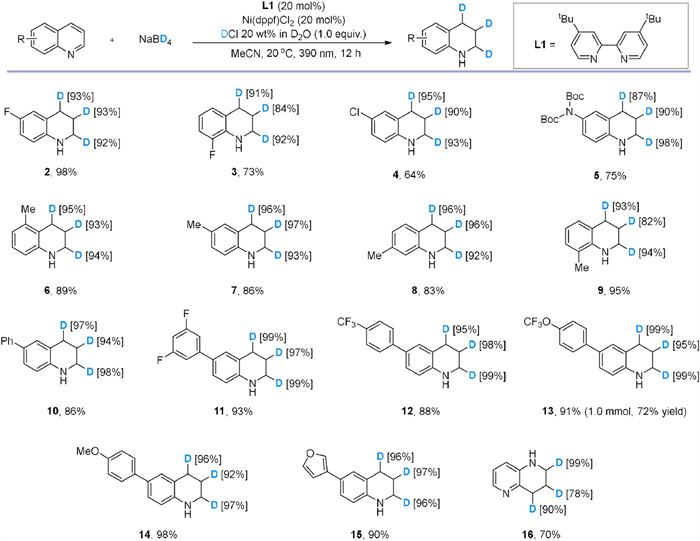
We next explored the substrate scope of this protocol (Scheme 2). A range of quinolines bearing electron withdrawing groups such as F (2, 3), Cl (4) furnished corresponding deuterated tetrahydroquinolines-d3 (1,2,3,4-tetrahydroquinoline-2,3,4-d3) in approximately 64%−98% yields with deuteration rates about 90% at each position. The electron-donating groups such as N(Boc)2 (5), methyl (6–9) at various sites on the quinoline ring were converted to the labelled products in 75%−95% yields with about 90% deuteration rates. Additionally, phenyl substituted quinolines bearing either electron withdrawing groups (F, CF3, OCF3) or electron-donating groups (OMe) reacted smoothly to afford desired products 10–15 with 86%−98% isolated yields, and deuteration rates range from 92% to 99%. Furthermore, 1,5-naphthyridine was also applicable to this system with 70% yield (16).
To exploit the advantage of the sequential reduction strategy, tetrahydroquinoline-d2 was further explored (Scheme 3). After slight adjustment of the optimized reaction conditions, the reaction performed best in CH3CN under purple LED irradiation for 12 h using NiI2 as the catalysts, sarcosine L3 as the ligand, NaBD4 as the reductive deuterium reagent, and 2,2,3,3,4,4,5,5-octafluoro-1-pentanol (OFP) as the electrophilic proton source. K2S2O8 was added to enhance the reaction yield (For more details of the reaction condition optimization, see Table S4 in Supporting information).
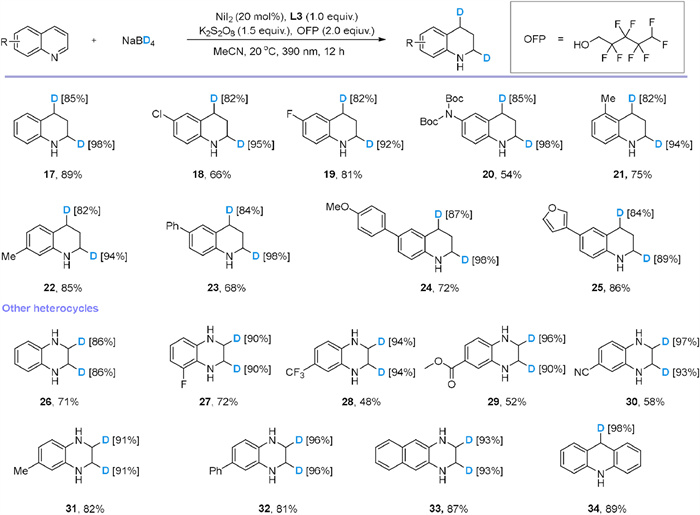
Detrahydroquinoline-d2 (1,2,3,4-tetrahydroquinoline-2,4-d2, 17) was afforded in 89% yield with deuteration rates about 90% at 2- and 4-positions. The 3-position was selectively bound with a protium atom. Quinolines bearing electron withdrawing groups such as halogens (18 and 19) or delivered the di-deuteration products in 66%−81% yields. Moreover, electron-rich substrates containing N(Boc)2 20, methyl (21 and 22), phenyl (23 and 24), or furanyl (25) reacted smoothly, providing the products in up to 86% yield with deuteration rates greater than 85%. Additionally, other heterocycles such as quinoxaline (26) and its derivatives bearing F (27), CF3 (28), CO2Me (29), and CN (30), Me (31), or phenyl (32) afforded the desired products in 50%−80% yields. Di-deuteration can also occur for polycyclic fused aromatic rings such as naphthalene derivatives (33) and acridine (34) in 87%−89% yield with deuteration rates of 93%−98%.
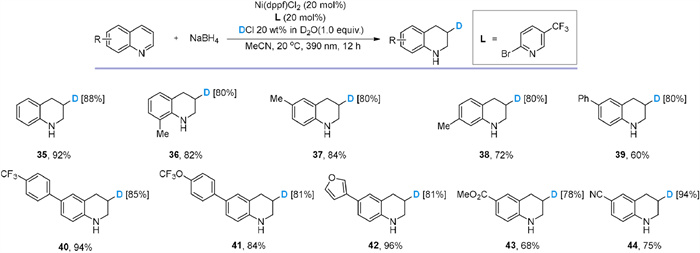
We further inverted the protium and deuterium sources displayed in Scheme 3, by replacing the nucleophilic NaBD4 and electrophilic OFP to nucleophilic NaBH4 and electrophilic DCl (Scheme 4), to evaluate the versatility of our sequential-reduction protocol. Under the optimized conditions, Ni(dppf)Cl2 (20 mol%), ligand (20 mol%), NaBH4 (2.0 equiv.), DCl (2.0 equiv.), light irradiation, MeCN, 20 ℃, 12 h, quinoline was converted to the mono-deuterated 1,2,3,4-tetrahydroquinoline-3-d1 (35) in 92% yield, with selective deuteration at the 3-position (88% D rates, see Table S5 in Supporting information for details). This protocol proved broadly tolerant of diverse functionality. Electron-rich substrates bearing methyl (36–38), phenyl (39–41), or furyl (42) groups underwent mono-deuteration in 60%−90% yields with approximately 80% D-incorporation rates. Electron-withdrawing substituents such as ester and cyano on the quinoline ring were likewise tolerated in the reaction, furnishing products 43 and 44 in around 70% yields and high site-selectivity.
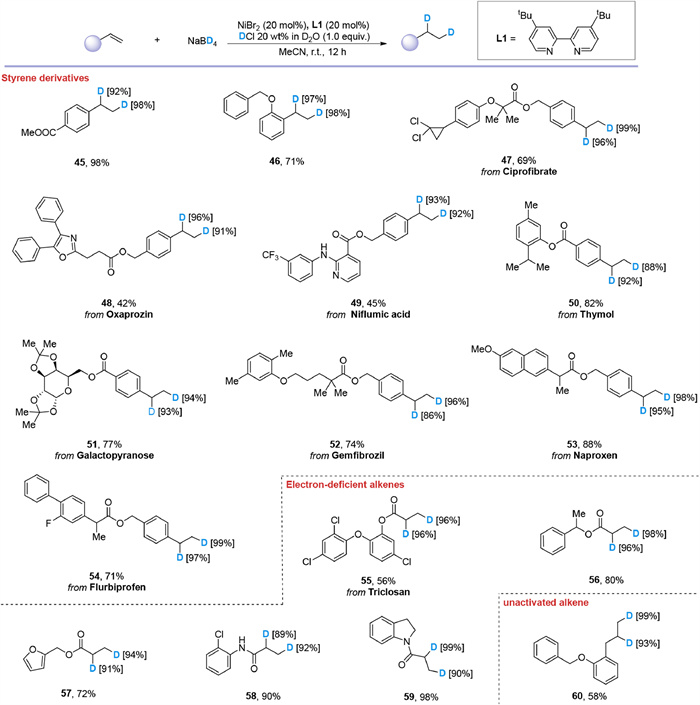
Building on the versatile and selective deuteration of quinolines, the methodology was extended to reductive deuteration of alkenes (Scheme 5) [49–52]. Under similar conditions as in Scheme 1, with NiBr2 replacing the original Ni catalyst (see Table S6 in Supporting information for details), various drug derivatives such as ciprofibrate (47), oxaprozin (48), niflumic acid (49), thymol (50), galactopyranose (51), gemfibrozil (52), naproxen (53) and flurbiprofen (54) successfully delivered the desired deuterated reduction products in 42%−88% yields with generally greater than 90% deuteration rates. Moreover, electron-deficient alkenes bearing β-unsaturated ester or amide groups produced 1,2-di-deuterated products 55–59 in 56%−98% yields with deuterium incorporation rates greater than 90% at both the α- and β-positions. Notably, unactivated alkenes also underwent effective double-deuteration, as seen in the conversion of compound 60, with the deuteration rate reach 97%.
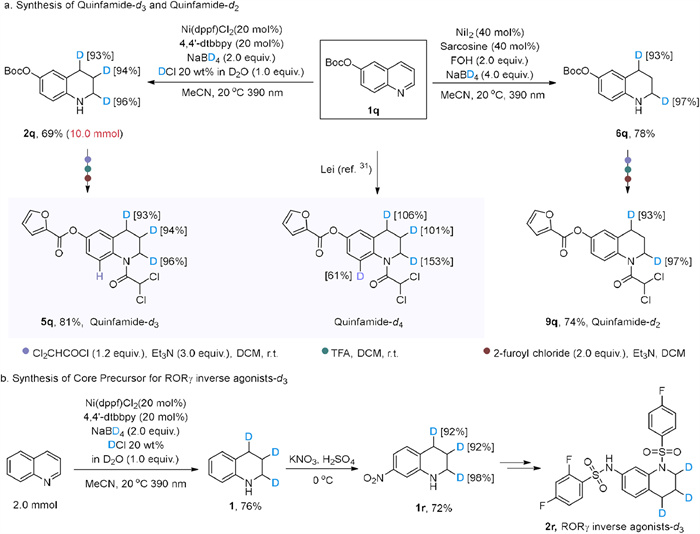
To demonstrate the synthetic utility of the methodology, we attempted to prepare compound 2q via our deuterated reduction method on a 10.0 mmol scale, which afforded 1.74 g of compound 2q in 69% yield (Scheme 6a). Following up a 3-step transformation, 2q can produce Quinfamide-d3 5q in 81% total yield with deuteration rate greater than 90% at each position. Very recently, Lei and Li reported an electrocatalytic pathway can also yield Quinfamide-d4, while the deuteration rate and site-selectivity are different from our approach (Scheme 6a) [31]. Moreover, we can also transfer 6q into Quinfamide-d2 9q, to provide a potential alternative for drug development (Scheme 6a). Furthermore, compound 1, synthesized by our methods, can be nitrated to afford compound 1r with 72% yield, which is a key precursor for synthesizing drug molecule 2r (Scheme 6b) [53].
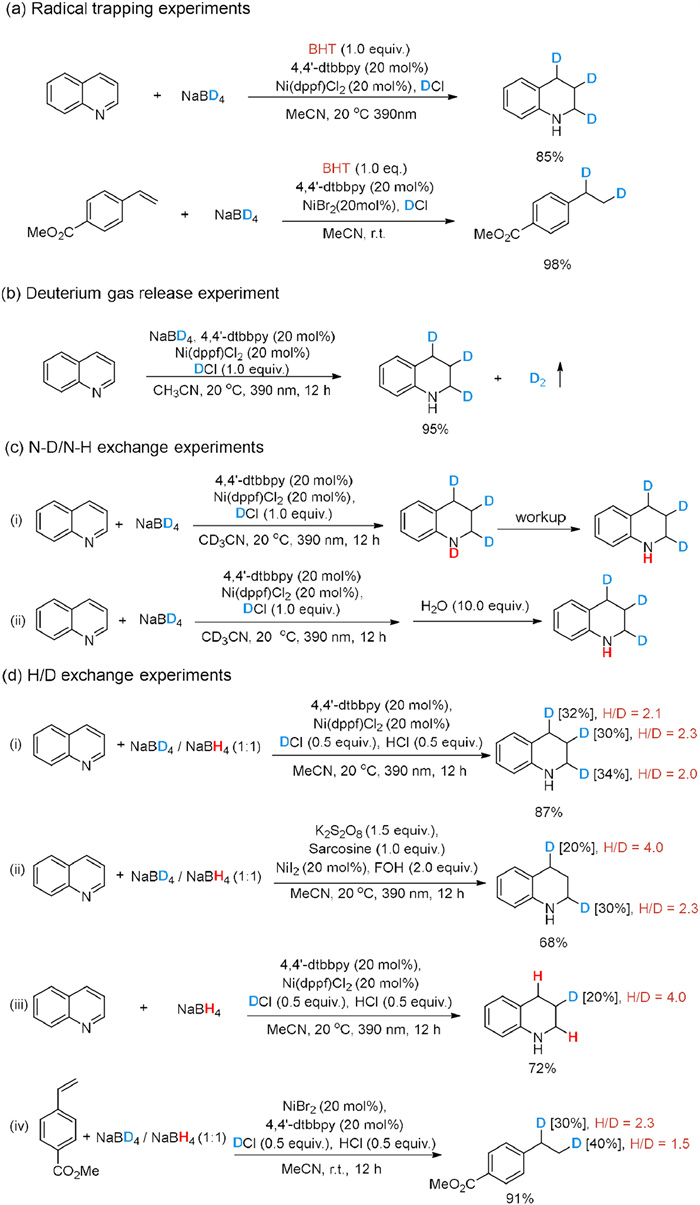
Mechanistic experiments were conducted to gain deeper insight into the reaction (Scheme 7). First, the addition of the radical-trapping agent butylated hydroxytoluene (BHT) did not inhibit the reaction, suggesting that a radical-mediated mechanism is unlikely (Scheme 7a). Second, we detected the generation of deuterium gas (D2) under standard conditions with online mass spectrometer (PM QMS) (for D2−MS, see Fig. S3 in Supporting information). With slow releasing of in-situ generated D2 gas, the target reaction proceeded successfully, which demonstrate the reaction is unlikely to involve D2-mediated reduction of quinoline (Scheme 7b). Furthermore, N–D bond formed in the reaction system, which was subsequently converted to N–H during workup (Scheme 7c). Under the reaction conditions, a trace amount of 1,2-dihydroquinoline-2-d1 (~5%) was also isolated and confirmed by 1H NMR spectroscopy (see Supporting information, Page S371), suggesting an initial 1,2-addition to the C═N bond at 1,2-positions (Fig. S6 in Supporting information). What’s more, kinetic isotope effect (KIE) experiments, including intermolecular competition experiment of tri-deuteration, di-deuteration, and mono-deuteration, revealed that C-D bond formation is possibly the rate-limiting step (Scheme 7d). Overall, the reaction is likely mediated by a Ni(Ⅱ)–D species [54] and proceeds in two stages: Addition of Ni–D to C═N and C═C bonds, and subsequent protonolysis of the Ni intermediates by selected electrophilic D+ or H+ reagents (see Fig. S6 for details).
In summary, we have developed a Ni-catalyzed, site- and stoichiometry-selective deuteration strategy that enables precise incorporation of deuterium atoms at specific positions on N-containing heterocycles and various alkenes, overcoming limitation of the precedent methods that reply on a single deuterium source and often furnish fully deuterated tetrahydroquinolines. By leveraging a sequential protocol that combines nucleophilic and electrophilic deuterium and protium sources, controlled mono-, di-, and tri-deuteration of 1,2,3,4-tetrahydroquinolines was achieved under operationally simple conditions. The method demonstrates broad functional group tolerance with the consumption of inexpensive, commercially available deuterating reagents, to realize high deuterium incorporation with excellent site specificity, and can potentially shed light on drug discovery as well as mechanistic study applications.
The authors declare that they have no known competing financial interests or personal relationships that could have appeared to influence the work reported in this paper.
Wenyan Zhao: Writing – review & editing, Writing – original draft, Project administration, Methodology, Investigation, Formal analysis, Data curation. Tiantian Liang: Writing – review & editing, Writing – original draft, Resources, Formal analysis, Data curation. Dongcheng Zheng: Investigation, Formal analysis, Data curation. Jiali Qiu: Formal analysis, Data curation. Juan Zheng: Formal analysis, Data curation. Yandong Wu: Resources, Formal analysis, Data curation. Wenhan Xu: Formal analysis, Data curation. Liang Liu: Writing – review & editing, Writing – original draft, Investigation, Formal analysis, Data curation. Fei Ye: Writing – review & editing, Writing – original draft, Methodology, Funding acquisition.
We are grateful to the National Natural Science Foundation of China (No. 22201088) for financial support, and startup funding from Central China Normal University (CCNU). We also are grateful to the Knowledge Innovation Program of the Wuhan-Shuguang Project (No. 20230202010203081); the Cultivation Program of Wuhan Institute of Photochemistry and Technology (No. GHY2023KF003). We thank Prof. Zhu Luo from Central China Normal University for mass spectrometric measurement of D2.
Supplementary material associated with this article can be found, in the online version, at doi:
M.P. Wiesenfeldt, Z. Nairoukh, T. Dalton, et al., Angew. Chem. Int. Ed. 58 (2019) 10460–10476. doi: 10.1002/anie.201814471
D.S. Wang, Q.A. Chen, S.M. Lu, et al., Chem. Rev. 112 (2012) 2557–2590. doi: 10.1021/cr200328h
M. Rueping, A.P. Antonchick, T.A. Theissmann, Angew. Chem. Int. Ed. 45 (2006) 3683–3686. doi: 10.1002/anie.200600191
R. Adam, J.R. Cabrero-Antonino, A. Spannenberg, et al., Angew. Chem. Int. Ed. 56 (2017) 1–6.
Y. Wang, B.B. Dong, Z.K. Wang, et al., Org. Lett. 21 (2019) 3631–3634. doi: 10.1021/acs.orglett.9b01055
S. Adak, S.E. Braley, M.K. Brown, Org. Lett. 26 (2024) 401–405. doi: 10.1021/acs.orglett.3c04096
F. Chen, A. Surkus, L. He, et al., J. Am. Chem. Soc. 137 (2015) 11718–11724. doi: 10.1021/jacs.5b06496
A. Karakulina, A. Gopakumar, I. AkÅok, et al., Angew. Chem. Int. Ed. 55 (2016) 292–296. doi: 10.1002/anie.201507945
Y. Lu, Y. Yamamoto, A.I. Almansour, et al., Chin. J. Catal. 39 (2018) 1746–1752. doi: 10.1016/S1872-2067(18)63151-1
D. Ren, L. He, L. Yu, J. Am. Chem. Soc. 134 (2012) 17592–17598. doi: 10.1021/ja3066978
L. Lückemeier, T. De Vos, L. Schlichter, et al., J. Am. Chem. Soc. 146 (2024) 5864–5871. doi: 10.1021/jacs.3c11163
T.L. Wang, L.G. Zhuo, Z.W. Li, et al., J. Am. Chem. Soc. 133 (2011) 9878–9891. doi: 10.1021/ja2023042
S.M. Treacy, A.L. Smith, R.G. Bergman, et al., J. Am. Chem. Soc. 146 (2024) 29792–29800. doi: 10.1021/jacs.4c11482
Z.L. Wang, L. Chen, G.L. Mao, et al., Chin. Chem. Lett. 31 (2020) 1890–1894. doi: 10.1016/j.cclet.2020.02.025
M.H. Zhang, N. Zhang, Q. Zhao, et al., Chin. Chem. Lett. 36 (2025) 110081. doi: 10.1016/j.cclet.2024.110081
L.Y. Huang, H. Zhang, Y.J. Cheng, et al., Chin. Chem. Lett. 33 (2022) 2569–2572. doi: 10.1016/j.cclet.2021.10.004
F. Lovering, J. Bikker, C. Humblet, et al., J. Med. Chem. 52 (2009) 6752–6756. doi: 10.1021/jm901241e
M. Aldeghi, S. Malhotra, D.L. Selwood, et al., Chem. Biol. Drug. Des. 83 (2014) 450–461. doi: 10.1111/cbdd.12260
A. Kaithal, T. Wagener, P. Bellotti, et al., Angew. Chem. Int. Ed. 61 (2022) e202206687. doi: 10.1002/anie.202206687
V. Sridharan, P.A. Suryavanshi, J.C. Menendez, Chem. Rev. 111 (2011) 7157–7259. doi: 10.1021/cr100307m
I. Muthukrishnan, V. Sridharan, J.C. Menendez, Chem. Rev 119 (2019) 5057–5191. doi: 10.1021/acs.chemrev.8b00567
P. Yadav, A. Kumar, I. Althagafi, et al., Curr. Top. Med. Chem. 21 (2021) 1587–1622. doi: 10.2174/1568026621666210526164208
C. Schmidt, Nat. Biotechnol. 35 (2017) 493–494. doi: 10.1038/nbt0617-493
J. Atzrodt, V. Derdau, W.J. Kerr, et al., Angew. Chem. Int. Ed. 57 (2018) 1758–1784. doi: 10.1002/anie.201704146
S. Kopf, F. Bourriquen, W. Li, et al., Chem. Rev. 122 (2022) 6634–6718. doi: 10.1021/acs.chemrev.1c00795
T. Piyali, M. Serafini, S. Cargnin, et al., J. Med. Chem. 62 (2019) 5276–5297. doi: 10.1021/acs.jmedchem.8b01808
T.G. Gant, J. Med. Chem. 57 (2014) 3595–3611. doi: 10.1021/jm4007998
J. Peng, G.P. Luo, C. Wu, et al., Chin. Chem. Lett. 36 (2025) 111255. doi: 10.1016/j.cclet.2025.111255
A. Kumar, E. Yasmin, S. Dhole, T. Wagh, V. Arora, Patent, WO2023194812, 2023.
A. Palazzolo, T. Naret, M. Daniel-Bertrand, et al., Angew. Chem. Int. Ed. 59 (2020) 20879–20884. doi: 10.1002/anie.202009258
F.X. Bu, Y.Q. Deng, J. Xu, et al., Nature 634 (2024) 592–599. doi: 10.1038/s41586-024-07989-7
M. Escolano, D. Gaviña, G. Alzuet-Piña, et al., Chem. Rev. 124 (2024) 1122–1246. doi: 10.1021/acs.chemrev.3c00625
Z.K. Liu, L. Qin, Y. Wei, et al., Chin. J. Chem. 43 (2025) 1673–1678. doi: 10.1002/cjoc.70039
L.J. Xiao, L. Cheng, W.M. Feng, et al., Angew. Chem. Int. Ed. 57 (2018) 461–464. doi: 10.1002/anie.201710735
Y.L. He, Y.L. Cai, S.L. Zhu, J. Am. Chem. Soc. 139 (2017) 1061–1064. doi: 10.1021/jacs.6b11962
H. Song, W.J. Zhang, H. Zhou, et al., ACS Catal. 13 (2023) 3644–3654. doi: 10.1021/acscatal.3c00559
L. Kania, H. Unvera, Polyhedron 187 (2020) 114649. doi: 10.1016/j.poly.2020.114649
Z.K. Zhang, S. Bera, C. Fan, et al., J. Am. Chem. Soc. 144 (2022) 7015–7029. doi: 10.1021/jacs.1c13482
L.P. Meng, J.J. Yang, M. Duan, et al., Angew. Chem. Int. Ed. 60 (2021) 23584–23589. doi: 10.1002/anie.202109881
J. Nguyen, A. Chong, G. Lalic, Chem. Sci. 10 (2019) 3231–3236. doi: 10.1039/c8sc05445b
Y.Q. Li, Y.X. Luo, L. Peng, et al., Nat. Commun. 11 (2020) 417. doi: 10.1007/s10815-019-01652-1
K. Vasudevan, B.L. Scott, S.K. Hanson, Eur. J. Inorg. Chem. 30 (2012) 4898–4906. doi: 10.1002/ejic.201200758
J.D. Liu, H.G. Gong, S.L. Zhu, Angew. Chem. Int. Ed. 60 (2021) 4060–4064. doi: 10.1002/anie.202012614
N.A. Eberhardt, H. Guan, Chem. Rev. 116 (2016) 8373–8426. doi: 10.1021/acs.chemrev.6b00259
A. Tenaglia, E. Terranova, B. Waegell, J. Mol. Catal. 40 (1987) 281–287. doi: 10.1016/0304-5102(87)80092-5
M.J. Tenorio, M.C. Puerta, P. Valerga, J. Chem. Soc., Dalton Trans. (1996) 1305–1308.
X. Wen, X.Z. Shi, X.L. Qiao, et al., Chem. Commun. 53 (2017) 5372. doi: 10.1039/C7CC02140B
F. Chen, X.Y. Zhao, W.H. Miao, et al., Chin. Chem. Lett. 36 (2025) 110239. doi: 10.1016/j.cclet.2024.110239
J. Luo, L.J. Lu, M. Montag, et al., Nat. Chem. 15 (2023) 1384–1390. doi: 10.1038/s41557-023-01313-y
A. Kurimoto, R.S. Sherbo, Y. Cao, et al., Nat. Catal. 3 (2020) 719–726. doi: 10.1038/s41929-020-0488-z
Z.P. Vang, A. Reyes, R.E. Sonstrom, et al., J. Am. Chem. Soc. 143 (2021) 7707–7718. doi: 10.1021/jacs.1c00884
M. Espinal-Viguri, S.E. Neale, N.T. Coles, et al., J. Am. Chem. Soc. 141 (2019) 572–582. doi: 10.1021/jacs.8b11553
X.S. Wu, X.Y. Luo, C.C. Li, et al., Acta Pharmacol. Sin. 45 (2024) 1964–1977. doi: 10.1038/s41401-024-01274-z
D. Behera, S. Thiyagarajan, P.K. Anjalikrishna, et al., ACS Catal. 11 (2021) 5885–5893. doi: 10.1021/acscatal.1c01148

Scheme 2 Substrate scope of substituted 1,2,3,4-tetrahydroquinoline-2,3,4-d3. Standard conditions: Ni(dppf)Cl2 (20 mol%), ligand (20 mol%), NaBD4 (0.20 mmol, 2.0 equiv.), MeCN (0.50 mL), quinoline (0.10 mmol, 1.0 equiv.) and DCl 20 wt% in D2O (0.10 mmol, 1.0 equiv.) were irradiated with light at room temperature for 12 h under argon atmosphere. Isolated yield was given. Deuterium incorporation was determined by 1H NMR spectroscopy.

Scheme 3 Substrate scope of substituted 1,2,3,4-tetrahydroquinoline-2,4-d2. Standard conditions: NiI2 (20 mol%), Sarcosine (0.10 mmol, 1.0 equiv.), K2S2O8 (0.15 mmol, 1.5 equiv.), NaBD4 (0.20 mmol, 2.0 equiv.), MeCN (0.50 mL), quinoline (0.10 mmol, 1.0 equiv.) and 2,2,3,3,4,4,5,5-octafluoro-1-pentanol (0.20 mmol, 2.0 equiv.) were irradiated with light at room temperature for 12 h under argon atmosphere. Isolated yield was given. Deuterium incorporation was determined by 1H NMR spectroscopy.

Scheme 4 Substrate scope of substituted 1,2,3,4-tetrahydroquinoline-3-d1. Standard conditions: Ni(dppf)Cl2 (20 mol%), ligand (20 mol%), NaBH4 (0.20 mmol, 2.0 equiv.), MeCN (0.50 mL), quinoline (0.10 mmol, 1.0 equiv.) and DCl 20 wt% in D2O (0.10 mmol, 1.0 equiv.) were irradiated with light at room temperature for 12 h under argon atmosphere. Isolated yield was given. Deuterium incorporation was determined by 1H NMR spectroscopy.

Scheme 5 Substrate scope of reductive deuteration of alkenes. Standard conditions: alkene (0.10 mmol, 1.0 equiv.), NiBr2 (0.020 mmol, 20 mol%), 4,4’-dtbbpy (0.020 mmol, 20 mol%), NaBD4 (0.20 mmol, 2.0 equiv.), MeCN (0.50 mL) and DCl 20 wt% in D2O (0.10 mmol, 1.0 equiv.) were irradiated at room temperature for 12 h under argon atmosphere. Isolated yield was given. Deuterium incorporation was determined by 1H NMR spectroscopy.
Table 1. Optimization studies.a
|
|||||
| Entry | Deviations | Yield (%)b | Ratio (%)c | ||
| D1 | D2 | D3 | |||
| 1 | None | 91 | 97 | 94 | 94 |
| 2 | NiI2 instead of Ni(dppf)Cl2 | 32 | 94 | 64 | 95 |
| 3 | NiCl2 instead of Ni(dppf)Cl2 | 20 | 64 | 66 | 68 |
| 4 | B(OD)3 instead of DCl | 35 | 98 | 95 | 92 |
| 5 | tBuOD instead of DCl | 35 | 97 | 34 | 86 |
| 6 | L2 instead of L1 | 62 | 97 | 94 | 89 |
| 7 | L3 instead of L1 | 65 | 98 | 97 | 81 |
| 8 | L4 instead of L1 | 30 | 83 | 43 | 92 |
| 9 | Without light | 71 | 96 | 82 | 92 |
| a Conditions: quinoline (0.10 mmol), NaBD4 (2.0 equiv.), DCl 20 wt% in D2O (1.0 equiv.), Ni(dppf)Cl2 (20 mol%), Ligand (20 mol%), and MeCN (0.50 mL) were irradiated with light at 20 ℃ for 12 h under argon atmosphere. b Isolated yields. c Deuterium incorporation was determined by 1H NMR spectroscopy. |
|||||
 下载: 导出CSV

 扫一扫看文章


扫一扫关注我们


 下载:
下载: