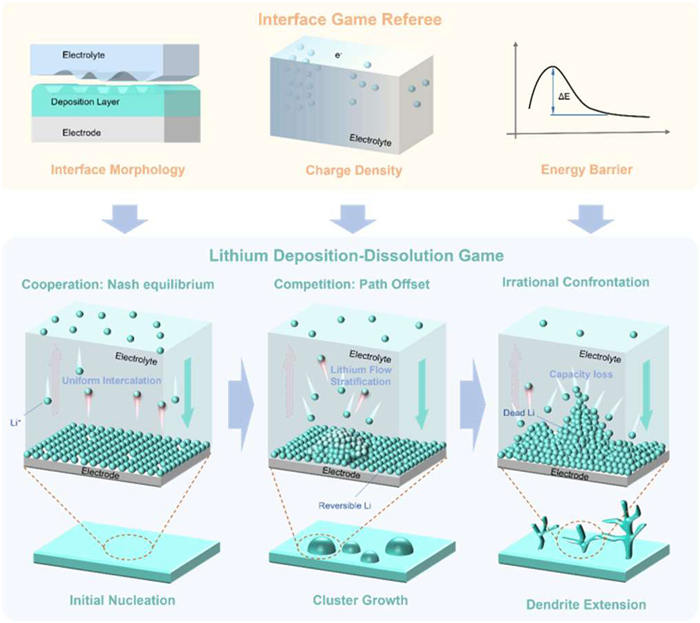
Figure 1.
Three game stages and influencing factors of lithium deposition dissolution.

Strategic interfacial gameplay: Lithium plating–stripping dynamics in solid-state battery anodes
Yefan Sun , Zhaoxia Peng , Xiaopeng Zhu , Xuanzhuo Liu , Xinhua Liu , Shichun Yang , Xiaoyu Yan , Wenhan Zhao , Justice Delali Akoto , Nadeen S B M Alotaibi , Rui Tan


Driven by the accelerating momentum of the global energy transition and transportation electrification, the demand for high-performance electrochemical energy storage has reached unprecedented levels. Lithium-based batteries, which have already dominated portable electronics and electric vehicles, are now expected to support applications in large-scale energy storage, aerospace, and high-speed transportation. These emerging scenarios impose more stringent requirements for safety, cycle life, and energy density. While liquid electrolyte-based lithium-ion batteries have achieved remarkable commercial success, their performance ceiling is gradually becoming evident. Thermal runaway triggered by exothermic side reactions, leakage of volatile electrolytes, and uncontrollable interfacial degradation collectively pose inherent risks that are difficult to overcome through incremental improvements. Consequently, the exploration of next-generation battery technologies has shifted toward solid-state architectures.
All-solid-state batteries (ASSBs), which replace combustible liquid electrolytes with solid ionic conductors, are widely regarded as disruptive innovations in battery design. Their solid-state nature offers intrinsic advantages in terms of thermal stability and mechanical robustness, significantly mitigating safety concerns. More importantly, ASSBs open the door to employing lithium metal as the anode. Owing to its ultrahigh theoretical specific capacity and low electrochemical potential, lithium metal is considered the “holy grail” anode material. When paired with high-voltage cathodes, lithium-metal-based ASSBs possess a theoretical energy density exceeding 500 Wh/kg, far beyond the limits of current lithium-ion batteries [1-3]. To realize this promise, a wide range of solid electrolytes, including oxides, sulfides, polymers, and their composites, have been investigated. Each system has unique advantages and challenges: Oxides exhibit excellent stability but often suffer from brittle mechanics and poor interfacial contact; sulfides provide high ionic conductivity yet face issues of interfacial reactivity and sensitivity to moisture; polymers offer processability and flexibility but limited ionic conductivity at room temperature; and composite electrolytes attempt to integrate these merits but introduce new complexity in design.
Despite these technological advances, the Achilles heel of lithium-metal ASSBs lies in their interfacial instability. Unlike liquid electrolytes, which can wet and dynamically adapt to electrode morphology, solid electrolytes form rigid contacts with lithium, making the interface prone to heterogeneous reactions and structural degradation. At the microscopic level, lithium deposition during charging rarely proceeds uniformly. Local current hotspots lead to dendritic protrusions, which not only compromise cycling efficiency but also risk internal short circuits. During stripping, incomplete lithium dissolution leaves behind electrically isolated “dead lithium”, causing irreversible capacity loss [4,5]. Moreover, stress accumulates due to repeated volume changes, inducing mechanical fractures and void formation at the solid–solid interface. The solid electrolyte interphase (SEI), if formed, evolves differently from liquid systems, often exhibiting poor ionic conductivity and mechanical fragility. These multilayered interfacial failures collectively undermine the long-term stability of ASSBs [6,7].
Historically, interfacial instability has been interpreted through the lenses of thermodynamics or kinetics. Thermodynamic arguments emphasize electrochemical potential mismatches, phase stability, or interfacial energies as the driving forces for failure [8]. Kinetic models highlight ionic transport limitations, nucleation barriers, or diffusion gradients. While valuable, these perspectives are inherently reductionist. Recently, advanced characterization techniques, such as operando electron microscopy, synchrotron-based imaging, and scanning probe methods, combined with multiphysics simulations have revealed that the lithium deposition and stripping behaviors are far from linear [9]. Instead, they display strong nonlinearity, asymmetry between plating and stripping, and even history dependence, where past interfacial states significantly influence future evolution. These complexities cannot be adequately captured by static energy barriers or isolated defect models [10].
To gain deeper insight into the complex dynamics of lithium plating and stripping in solid-state batteries, a recently proposed analytical framework draws inspiration from game theory. In this perspective, plating and stripping are regarded as “strategic players” that compete and coexist within the same physical field, while multiple system variables, including charge transfer, ion transport, morphological evolution, interfacial tension, and mechanical stress, function as continuously adapting strategies responding to local conditions. The interfacial environment, defined by morphology, charge density, and the energy landscape, serves as the arena of this game. Under ideal conditions, plating and stripping can reach a quasi-equilibrium analogous to a Nash equilibrium, where deposition and dissolution pathways are matched, dead lithium formation is minimized, and the interfacial morphology evolves in a controlled manner [11]. However, this balance is extremely fragile: Even slight perturbations such as local heterogeneity in electrolyte conductivity, variations in surface roughness, or thermal fluctuations can disrupt feedback mechanisms. Once the strategic choices of plating and stripping diverge, the system can rapidly descend into runaway degradation, manifested as dendrite penetration or interfacial delamination [12].
To further reduce the conceptual barrier for readers from different disciplines, we provide a concise parameter mapping to clarify the correspondence between electrochemical/mechanical variables and game-theoretic terminology. In this mapping, the players are the two fundamental driving processes—lithium plating and stripping [13]. The strategies correspond to tunable or evolving local physical quantities and design variables, including local overpotential, ionic/electronic flux distributions, stack pressure and interfacial stress, and interfacial chemistry and morphology; these strategies can be regarded as “moves” that can be selected by the processes or externally regulated [14]. The payoffs represent the ultimate energetic and performance outcomes at the interface, such as lowered interfacial energy, improved Coulombic efficiency, reduced impedance, and maintained structural integrity, whereas negative payoffs manifest as dead-lithium accumulation, increased local resistance, or short-circuit risk [15,16]. Among these parameters, overpotential acts as an immediate strategic cost or incentive: A higher local overpotential can temporarily lower the deposition barrier and accelerate local metal enrichment, but it also increases energy consumption and the likelihood of side reactions, thereby diminishing long-term payoffs. Ionic and electronic fluxes determine resource supply and action matching; when their distribution becomes asymmetric, one “player” may gain a local advantage and drive strategy imbalance. Interfacial stress functions both as a constraint and as a payoff modifier: Localized stress concentration alters the feasibility of certain strategies and amplifies long-term penalties [17]. The ideal state approximates a dynamic Nash-like equilibrium, where plating and stripping strategies achieve a balance between short-term gains and long-term stability across coupled multiphysical fields. In contrast, if a local strategy, such as rapid deposition along high-field tips, yields short-term benefits but accumulates long-term costs, it constitutes an irrational confrontation, ultimately inducing interfacial degradation or internal short circuits [18,19]. This mapping not only provides conceptual clarity but also outlines a pathway toward quantitative modeling, wherein overpotential, flux, and stress can be treated as dynamic strategic variables with time-dependent payoff functions and constraints, combined with operando characterization and multiphysics simulation to progressively extend the qualitative framework into a predictive quantitative tool.
This game-like behavior also exhibits evolutionary characteristics. At early stages, the system tends to cooperate: Lithium deposits spread relatively evenly, stresses are accommodated, and stripping pathways are symmetric. With repeated cycling, however, stress concentrations, field distortions, and SEI degradation accumulate, gradually shifting the system from cooperative play to competitive, and eventually to irrational confrontation. In this noncooperative regime, local optimization by each process leads to global failure, a hallmark of evolutionary game traps [20]. Such insights highlight that lithium interfacial stability cannot be attributed to a single dominant factor but rather is the emergent outcome of multiphysics interactions adjusting dynamically through feedback loops [21].
From a broader perspective, this analogy underscores a philosophical shift: Interfacial stability in solid-state batteries should not be viewed as unilateral control or suppression of one process but as a dynamic equilibrium emerging from conflict and compromise. Deposition is not absolute aggression, nor is stripping absolute retreat; rather, they counterbalance and reinforce each other. The solid–solid interface thus crystallizes the results of this ongoing strategic interplay. Viewing interfacial evolution as a game provides a conceptual framework that integrates electrochemical, mechanical, and thermal couplings into a coherent picture, enabling new pathways for rational interface design.
Building on this perspective, the present review introduces a game-theoretic framework for understanding lithium deposition–stripping dynamics in ASSBs. Specifically, we conceptualize deposition and stripping as multifactorial interfacial strategies and analyze their interplay across dimensions of interfacial energy, morphological evolution, stress distribution, and charge transport. Beginning with the dynamic balance of deposition–stripping, we systematically discuss asymmetric evolution mechanisms, critical instability thresholds, and electrolyte-dependent game behaviors. By articulating the systemic contradictions inherent in lithium interfacial dynamics and exploring potential reconciliation pathways, this review aims to provide both theoretical insights and practical guidance for interfacial engineering in next-generation solid-state batteries.
Lithium deposition and stripping are not only electrochemical processes but also reflect a deeper dialectic of balance and evolution. Ideally, both reactions should proceed reversibly along identical pathways, ensuring interfacial stability and high cycling efficiency. In practice, however, nonideal factors such as limited ion transport, charge-transfer asymmetry, interfacial stress, and structural heterogeneity often lead to pronounced irreversibility. As a result, deposition and stripping clearly exhibit asymmetry, accompanied by dendrite growth, dead lithium formation, and contact degradation, which severely compromise battery safety and lifespan. From a game-theoretic perspective, deposition and stripping can be regarded as strategic players in a dynamic interfacial system. Their interactions are governed by multiphysics coupling, electrochemical, mechanical, and morphological processes, that continuously adjust to local feedback. The ultimate outcome may be cooperative balance, metastable adaptation, or irreversible failure, depending on how these strategies evolve under cycling conditions.
In solid-state batteries, lithium deposition and stripping constitute the fundamental electrochemical cycling process. Formally, deposition during charging results from electron reduction, whereas stripping during discharging corresponds to lithium oxidation and its return to the electrolyte. However, this bidirectional process is far from strictly symmetric; instead, it evolves under the influence of complex interfaces and dynamic energy fields. As shown in Fig. 1, from a game-theoretic perspective, deposition and stripping can be viewed as a contest between a “forward strategy” and a “reverse strategy”. In an ideal equilibrium, these processes converge to a dynamic Nash-like state, where local morphology, electric-field distribution, and ionic transport collectively constrain both sides to adopt optimal responses—neither attempting unilateral optimization nor deviating from the established reaction pathway. Such a balance would, in principle, ensure interfacial symmetry and kinetic reversibility [22]. In practice, however, this equilibrium is rarely sustained. If stripping cannot be adjusted in real time to the prior deposition pathway or if interfacial reconstruction fails to compensate for localized stress, the system drifts into misaligned pathways. This mismatch manifests as irreversible structural damage, incomplete reactions, and cumulative instability [23]. For example, during lithium deposition, a sluggish ionic supply relative to interfacial reaction rates or surface roughness heterogeneity drives lithium migration preferentially along low-resistance channels, leading to elevated local current densities [24]. These “hot spots” induce the formation of dendritic protrusions rather than uniform interfacial coverage. More critically, such dendrites often fail to dissolve along their original growth paths, leaving electronically isolated metallic residues, commonly referred to as “dead lithium” [25,26]. Once dead lithium accumulates, its detrimental effects escalate via positive feedback. As it is electronically insulating and typically encapsulated within inhomogeneous SEI layers, dead lithium increases the local charge-transfer resistance [27]. Simultaneously, it distorts the electric field distribution, causing subsequent deposition to nucleate preferentially near the residue sites, thereby increasing spatial heterogeneity [28]. This mechanism establishes a self-reinforcing degradation loop throughout cycling: Dead lithium induces uneven deposition → uneven deposition generates more dead lithium → the interfacial structure progressively deteriorates [29].
To investigate these mechanisms quantitatively, researchers have combined multiple in situ imaging techniques with impedance spectroscopy. During early cycling, lithium deposition and stripping remain relatively synchronized, resulting in good electrochemical reversibility. However, as cycling progresses into the mid-to-late stages, interfacial chemical changes and mechanical evolution drive gradual SEI reconstruction, deviation of ionic transport pathways, and accumulation of interfacial stress. These factors induce pronounced spatial heterogeneity in deposition, with rapid lithium accumulation in localized “hot spots” on the electrode surface, while stripping pathways become unpredictable owing to structural mismatch [30,31]. At the system level, this evolution reflects a gradual disruption of the underlying game: The initially symmetric equilibrium between deposition and stripping deteriorates over time, weakening cooperative dynamics, blurring interfacial “rules”, and producing asymmetric response pathways, ultimately driving the lithium-metal anode into an irreversible degradation trajectory [32,33]. Zhang et al. combined environmental TEM (ETEM) with in situ AFM to visualize the full growth and fracture of individual lithium dendrites in three dimensions [34]. Under purely mechanical loading without external electric fields (Fig. 2a), dendrites initially remain upright, then bend slightly, and fracture at a critical strain of 801 s. This failure is driven by volumetric stress and interfacial mechanics rather than electrochemistry, reflecting substantial internal stress accumulation during growth. Dendrite evolution involves spherical nucleation, rapid axial growth, and localized collapse, producing dispersed “lithium islands” that cause irreversible capacity loss and perturb subsequent deposition. Wang et al. used in situ electrochemical AFM (EC-AFM) to study Li–In alloy anodes [35]. During discharging, layered LixIn transforms into a wrinkled SEI shell due to lithium extraction, volumetric contraction, and interfacial stress release (Figs. 2b and c). ToF-SIMS analyses revealed sulfur enrichment and a uniform chemical composition (Figs. 2d and e). Portions of the SEI trap metallic lithium, forming irreversible dead lithium that reduces the capacity and disturbs the local current density, potentially promoting further dendrite growth.
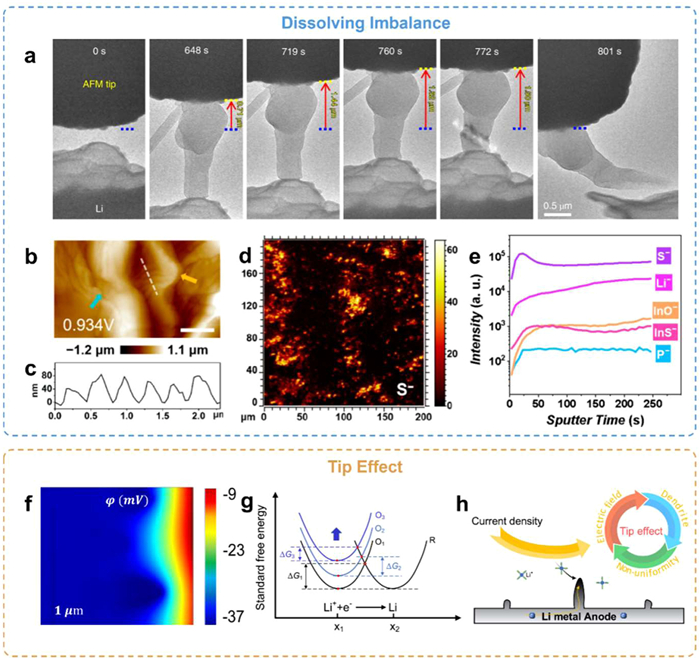
Modeling simulations further support the experimental observations described above. Qiao et al. combined theoretical modeling with experimental data to systematically reveal the “tip effect” triggered by localized electron enrichment under high current densities [36]. As shown in Fig. 2f, potential-field simulations indicate significant potential gradients at the dendrite tips, increasing the local electron potential and reducing the reduction energy barrier by approximately 40%. Fig. 2g further demonstrates that this field distortion induces highly concentrated lithium-ion flux at the tip region, reaching 2.5 times that of adjacent planar areas. This local reaction advantage establishes a positive feedback loop: Electron enrichment → field distortion → enhanced ion flux → barrier reduction → accelerated dendrite growth (Fig. 2h). Importantly, the schematic also illustrates that during stripping, the tip’s “structural sealing” effect prevents complete dissolution of lithium, producing electrochemically inactive dead lithium. This finding fundamentally explains the disruption of spatiotemporal symmetry in lithium–metal deposition–stripping processes.
Lithium deposition and stripping constitute the fundamental cycling unit in solid-state batteries, yet they are not strictly symmetric. Instead, they engage in a dynamic “game” influenced by the interfacial stress, electric field distribution, and structural evolution. Ideally, deposition and stripping proceed along coordinated pathways, maintaining reversible reactions and balancing the interface morphology and ion flux [37,38]. In practice, however, delayed stripping, insufficient interfacial reconstruction, and other factors induce pathway misalignment, preventing the complete reversal of deposition and leading to the formation of dendrite remnants and dead lithium. The presence of dead lithium further perturbs the local electric field and increases the interfacial impedance, promoting localized deposition and establishing a progressively amplified negative feedback loop. Essentially, this process represents an asymmetric strategic game between deposition and stripping: One side continuously optimizes local reaction conditions, whereas the other becomes increasingly constrained by path dependence, resulting in cumulative irreversible degradation of the interface.
Deposition and stripping, as two mutually inverse processes, are governed by distinct rate-limiting factors from a reaction-kinetics perspective. Deposition is dominated by ion reduction, which relies on the electron supply, interfacial energy barriers, and formation of nucleation sites, whereas stripping primarily depends on lithium-ion deintercalation and interfacial desorption. The inherent asymmetry in these critical steps and interfacial conditions gives rise to an intrinsic “asymmetric game” between the two processes.
From the perspective of lithium-ion transport and mass transfer, solid electrolytes lack the highly efficient ion-conduction channels present in liquid systems. Li+ migration relies primarily on lattice vacancies or interfacial diffusion [39] and preferentially occurs along regions of low stress and potential-energy minima under an electric field, exhibiting “directional competitive deposition” characteristics [40]. Zhao et al. developed an electrochemomechanical model that couples diffusion, phase-field interface evolution, and mechanical response [41], revealing the synergistic evolution of interfacial vacancies, current-density distribution, and deposition morphology. Simulations indicate that during charging, Li+ migration predominantly occurs via substitutional diffusion within the lithium lattice, accompanied by continuous generation and annihilation of interfacial vacancies, forming dynamic local “void structures”. As shown in Fig. 3a, when vacancies aggregate at the electrode–electrolyte interface, current lines bend sharply around void edges, creating localized “hot spots” with increased current density, which drive preferential Li+ growth at these interface discontinuities and induce directional dendrite nucleation and propagation. This process exhibits pronounced spatial selectivity: Fig. 3d shows that current-induced “hot spots” guide Li+ accumulation in low-energy regions during early deposition and accelerate void closure in later stages, producing local asymmetry in the interface morphology. Analysis of the deposition interface evolution trajectories in Figs. 3b and c demonstrated that directional deposition is strongly regulated by the coupled interface stress field and potential gradient: Regions of stress relaxation overlapping with chemical potential minima form “energy valleys” that serve as strategic sites for preferential Li+ occupation. This stress–field–vacancy coupling disrupts spatial uniformity, leading to highly localized, competitive deposition at microdefects and revealing an intrinsic game-like mechanism between interface structure evolution and deposition kinetics.
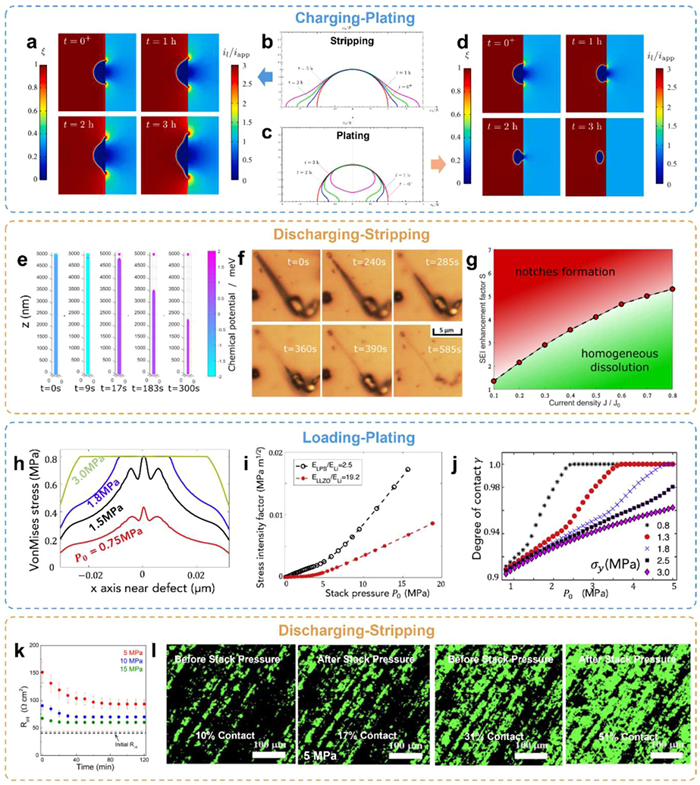
In contrast, lithium stripping during discharge lacks analogous directional driving forces. Li+ migration pathways are more dispersed and constrained by the electrolyte and interfacial state, making it difficult to replicate the original deposition pathways precisely [42]. This pathway mismatch leads to incomplete lithium removal in certain regions, forming irreversible “lithium voids” or electrochemically inactive dead lithium, which not only reduces the capacity but also perturbs the local current distribution during subsequent deposition, creating hotspots that trigger preferential dendrite growth [43]. Werres et al. systematically elucidated the mechanisms of nonuniform lithium stripping through combined in situ experiments and numerical simulations [44]. As shown in Fig. 3e, portions of the lithium morphology persist as residual islands even after bulk stripping, forming “stripping-lag regions”. The quantitative analysis in Fig. 3f confirms that these regions are unable to participate in electrochemical reactions in a timely manner, ultimately converting into dead lithium or interfacial voids, causing irreversible capacity loss. The nonuniformity originates from local variations in the interface microstructure, electronic contact quality, and ion/electron transport capability, preventing synchronous lithium extraction. The multiphysics simulations in Fig. 3g further reveal the impact of these residual structures on subsequent deposition: The lag regions induce local current density concentrations during the next cycle, forming “current hotspots” that promote preferential lithium growth in the original dead-lithium zones, thereby acting as nucleation sites for dendrites.
From the perspective of interfacial stress, lithium deposition in solid-state systems is often accompanied by substantial volume changes and localized stress accumulation. Under the constraint of rigid solid electrolytes, lithium deposition generates compressive stresses at the interface, which can induce extrusion, cracking, or delamination of the SEI layer or solid–solid interfaces [45]. Tu et al. employed a two-dimensional finite element model to systematically reveal the key mechanisms by which deposition-induced local stress concentration drives interfacial morphology evolution and affects lithium deposition uniformity [46]. As shown in Fig. 3h, the von Mises stress at the defect sites reaches 3 MPa under applied stack pressure, which locally elevates the overpotential by 3 mV and provides an initial driving force for nonuniform deposition. Further analysis indicates that when the stack pressure exceeds 6 MPa (Fig. 3i), the stress intensity factor K1 approaches the fracture toughness of typical solid electrolytes, suggesting that the thermodynamic driving force from the local stress concentration is sufficient to fracture low-toughness electrolyte materials. This “stress–current feedback loop” amplifies initial morphological heterogeneities, significantly influencing lithium deposition pathways. As illustrated in Fig. 3j, when the applied pressure fails to meet the critical condition P0 > 2.2σy, the contact retention ratio γ < 1 directly compromises the dynamic reversibility of the deposition and stripping processes.
During the stripping stage, in principle, the stresses accumulated during deposition should be partially relieved through lithium deintercalation. However, the low plasticity of solid electrolytes and the irreversible evolution of interfacial structures often hinder complete stress relaxation, resulting in the so-called “stress history memory effect” [47,48]. Such residual stresses not only compromise the structural integrity of the interface but also introduce additional physical barriers along the stripping pathways, reducing lithium desorption and oxidation efficiency, thereby exacerbating interfacial contact loss and irreversible capacity degradation. Over prolonged cycling, this microscopic structural damage progressively accumulates, becoming a critical factor limiting battery lifetime and rate performance. Zaman et al. monitored the interfacial resistance evolution in symmetric Li–LLZO cells, providing direct evidence of the stress history memory effect during stripping [49]. As shown in Fig. 3k, even under elevated stack pressure, the interfacial resistance gradually decreases only from a poststripping peak of 150 Ω cm2 to ~100 Ω cm2, which is far from the initial state, indicating incomplete interface reconstruction. The limited recovery stems from the low plasticity of the solid electrolyte, which cannot accommodate volumetric changes, whereas local lithium creep is insufficient to repair complex microscopic defects. Furthermore, the contact area comparison in Fig. 3l shows that even under 15 MPa stacking pressure, the maximum poststripping contact area is restored to only ~51% of the initial value, highlighting the persistent “residual” stress effect. This retained stress continuously damages the interface, creating additional geometric and energetic barriers during stripping, reducing lithium deintercalation and oxidation efficiency, and causing local lithium retention and “dead lithium” formation. With cycling, such microscopic damage accumulates, and the interface mismatch worsens, ultimately becoming a key limitation for the cycling stability and high-rate performance of solid-state batteries.
Moreover, the dynamic mismatch between the deposition rates and stripping rates becomes particularly pronounced under high-rate conditions. During fast charging, the externally applied current forces rapid lithium deposition on the anode surface, often occurring even before the interface is fully activated or electronic conduction pathways are adequately established, leading to pronounced “nonuniform deposition” phenomena [50,51]. In the subsequent high-rate discharge process, lithium dissolution is constrained by Li+ diffusion and interfacial desorption kinetics and cannot match the deposition speed [52]. This rate mismatch results in lithium accumulation at certain interfacial regions, forming localized “Li-rich zones” that are difficult to fully strip and readily serve as nucleation sites for dendrite growth in subsequent cycles, especially in areas with poor contact or stress concentration [53].
This asymmetry represents not only structural observations but also system-level behavior. To mitigate such effects, researchers have explored strategic interventions by, on the one hand, designing bifunctional interfacial materials that simultaneously enable rapid Li+ conduction and possess self-healing capabilities to facilitate dissolution [54-56] and, on the other hand, implementing intelligent charging protocols, such as multistep constant current or pulsed current schemes, to accommodate the inherent rate disparity between deposition and stripping. These approaches aim to guide the system from a “nonequilibrium asymmetric game” toward a more balanced interfacial dynamics regime [57-59].
In any competitive or game-like system, there exists a critical threshold between equilibrium and disequilibrium. Once external perturbations exceed the system’s intrinsic regulation capacity, irreversible structural evolution may ensue. In the context of lithium deposition and stripping, such a “critical tipping point” manifests as abrupt transitions in interfacial states, sudden changes in electrochemical behavior, and, in extreme cases, catastrophic failure of structural and functional integrity. Understanding the underlying causes and the detailed evolution pathways of these transitions is therefore essential for elucidating the limits of interfacial stability and guiding strategies to mitigate irreversible degradation.
From an electrochemical perspective, the tipping point between deposition and stripping is often associated with a “local polarization threshold”. When the deposition rate surpasses the Li+ diffusion supply, localized polarization zones form at the interface, leading to elevated local electric field gradients and promoting the development of sharp morphologies [60,61]. Even if the current is subsequently reduced or reversed, the system rarely returns to its initial smooth interface, indicating a transition from reversible disequilibrium to irreversible disequilibrium [62]. Cai et al. investigated lithium deposition boundaries on graphite anodes [63], providing systematic evidence ranging from interfacial morphology evolution to electrochemical response and cycling stability. As shown in Fig. 4a, increasing the deposited lithium fraction from 0% LiC6 to 100% LiC6 drives the surface morphology from sparse, uniform deposits to extensive coverage, eventually forming highly asymmetric, clustered, and dendritic-like structures. This abrupt morphological evolution indicates that once deposition exceeds a critical threshold, nucleation behavior becomes dominated by local electric fields rather than the original planar growth, resulting in strong nonlinear amplification. Correspondingly, Figs. 4b and c demonstrate the electrochemical signature of this transition: Pristine graphite shows a typical three-plateau lithiation curve, whereas partially deposited electrodes exhibit extended low-potential plateaus below 0 V, reflecting severe polarization and insufficient Li+ transport to sustain the deposition reaction. This crossing of the “local polarization threshold” is further corroborated in Figs. 4d and e, where the initial Coulombic efficiency (CE) of dendritic systems shows a slight recovery but rapidly decreases with cycling, ultimately reaching an average CE of 92.2% compared with 99.5% in uniform deposition systems. These observations collectively highlight that once the critical polarization threshold is exceeded, the deposition–stripping pathway irreversibly departs from its initial reversible state.
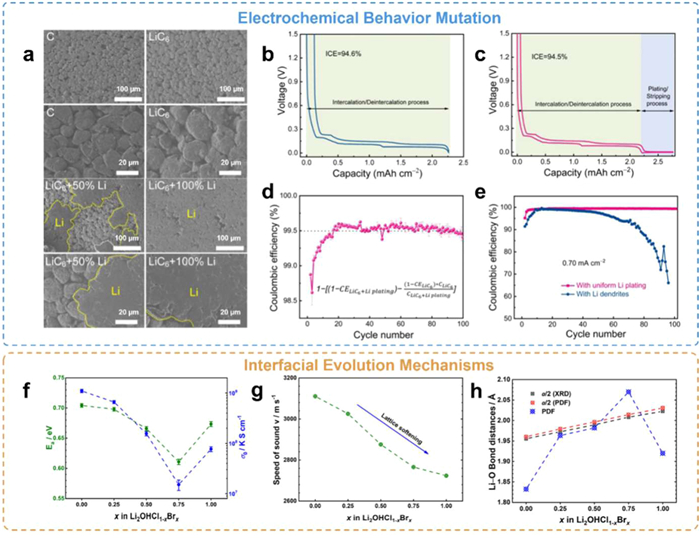
The evolution of the interfacial structure can also trigger abrupt transitions. After several cycles of nominally uniform deposition, the interface between solid-state electrolytes and the anode may develop cracks or intermediate phases due to local volume changes or chemical side reactions [64,65]. These defective regions exhibit distinct conductivity and interfacial energy compared with the pristine interface, leading to subsequent lithium deposition to preferentially accumulate at these sites, thereby disrupting the original uniform deposition–stripping pattern and inducing systemic imbalance [66-68]. Deng et al. investigated Li2OHCl1-xBrx perovskite electrolytes [69], revealing the profound influence of local structural changes on ion transport. As shown in Fig. 4f, although Br doping theoretically expands the lattice and lowers the migration barrier, the experimental Arrhenius factor σ0 and activation energy Ea both decrease, resulting in reduced overall ionic conductivity. This nonlinear behavior indicates the presence of “hidden barriers” at the microscopic scale. Fig. 4g shows a decrease in the sound velocity with increasing Br content, suggesting lattice softening; however, the conductivity does not improve, implying that softening occurs heterogeneously, forming coexisting soft and rigid regions that promote local defect aggregation. Moreover, Fig. 4h highlights nonlinear variations in Li–O bond lengths, indicating significant local lattice distortions despite long-range structural order. These local perturbations alter Li+ potential landscapes, disturb migration pathways, and may create ion traps, ultimately breaking the spatial symmetry of deposition. Over repeated cycles, such microstructural imbalance evolves into severe electrochemical heterogeneity, manifesting as a loss of conductive pathways and current focusing at defects, representing a critical “microscopic-to-macroscopic” transition that underpins the shift of the interface from stable to unstable deposition–stripping behavior.
At the macroscopic level, fluctuations in operational parameters such as temperature, current density, and applied pressure can also trigger abrupt transitions in lithium deposition behavior [70,71]. Elevated temperatures enhance Li+ mobility in solid electrolytes, potentially accelerating deposition beyond the system’s adaptive capacity. Conversely, a reduction in external pressure may degrade interfacial contact, promoting void formation and resulting in “contact loss” during the stripping process, ultimately leading to performance failure. Identifying and controlling these critical thresholds is therefore essential for maintaining long-term reversibility in the deposition–stripping process.
In the deposition and dissolution processes of solid-state battery anodes, the interface is not only a physical boundary but also a “battlefield” for chemical reactions and charge transfer. As Li+ ions traverse the electrolyte–anode interface, the experienced interfacial energy barriers, electron-transfer pathways, and local reaction activities govern the morphology and reversibility of deposition while subtly shaping the overall game-like dynamics between deposition and dissolution. This chapter analyzes the “invisible hand” at the interface from the perspectives of interfacial energy and electron–ion cooperative behavior, elucidating how it orchestrates the microscopic strategies of deposition and dissolution.
In any electrochemical system, the interfacial energy governs both the thermodynamic driving force and the morphological evolution and pathway selection of reactions. In solid-state lithium metal anodes, as Li+ ions migrate from the electrolyte to the interface and reduce to metallic Li, the interfacial energy acts as a “stake” in this microscopic game, directing deposition toward distinct local morphologies.
From a thermodynamic perspective, the interfacial energy comprises three main components: The contact energy between the electrolyte and metallic Li, the formation energy of new phases within the electrode–electrolyte interfacial gap, and the surface energy barrier that Li atoms must overcome to integrate into the metallic lattice during deposition [72,73]. When the total interfacial energy between the SEI and Li metal is below a certain threshold, Li atoms can more easily diffuse laterally along the interface, forming uniform, two-dimensional layer-like deposits [74,75]. Such interfacial effects effectively suppress local vertical accumulation, reducing the risk of stress concentration and interface failure. Conversely, if the SEI interfacial energy is excessively high in a particular direction, the lateral diffusion barrier for Li atoms increases, leading to preferential local Li accumulation and the formation of three-dimensional island- or dendrite-like morphologies, which may even induce mechanical damage at the interface [76]. Liu et al., through careful theoretical calculations and design, elucidated the thermodynamic and kinetic regulatory mechanisms of interfacial properties on Li deposition [77]. As shown in Figs. 5a–c, first-principles calculations were used to systematically assess the interfacial energy (γ) and Young’s modulus (E) between various common inorganic SEI components and Li substrates. The results (Fig. 5b) revealed significant differences in γ among the components, with SrF2 exhibiting extremely high interfacial energy and a relatively large modulus. Critically, the authors proposed the composite parameter “γE” as a core descriptor for evaluating the dendrite-suppressing capability of SEI phases. The comparison data in Fig. 5c indicate that SrF2 possesses the highest γE value among the candidates, suggesting optimal dendrite inhibition potential. Physically, a high γ lowers the energy barrier for lateral Li diffusion along the SEI/Li interface, promoting uniform two-dimensional deposition, whereas a high E provides mechanical strength to resist vertical penetration by Li whiskers. The synergistic effect of γ and E thus governs the deposition morphology, with high γE values ensuring uniform, dendrite-free Li deposition from both thermodynamic and mechanical perspectives.
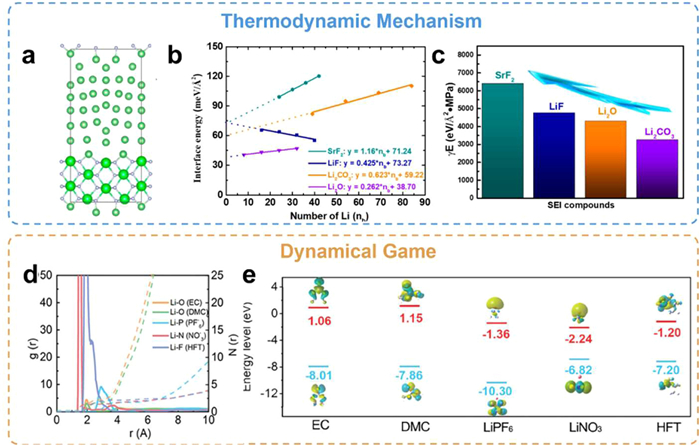
From a kinetic perspective, Li deposition is not a simple “attachment” process at the interface but requires Li+ ions to traverse a space-charge layer to undergo electron reduction. This process is influenced by multiple factors, including the local electric field distribution, lattice matching at the surface, and the availability of ion transport channels [78]. As a result, even thermodynamically favorable deposition pathways may be redirected owing to kinetic “friction”. This tug-of-war manifests experimentally, as distinct solid electrolytes exhibit markedly different deposition morphologies under identical temperature and voltage conditions [79]. Jiang et al. revealed that the solvation structure of Li+ and interfacial energy differences are critical determinants of deposition behavior [80]. As shown in Fig. 5d, in conventional carbonate electrolytes, the first solvation shell of Li+ is dominated by EC/DMC, forming a solvated shell whose reduction products are mainly organic, resulting in SEI layers with low ionic conductivity and poor mechanical properties. These structures promote local Li+ accumulation and dendrite growth. In contrast, the introduction of HFT/LiNO3 additives transforms the solvation structure into an anion-dominated configuration, with NO3- and HFT entering the first solvation shell to form a composite SEI enriched in Li3N and LiF. HOMO–LUMO energy analysis (Fig. 5e) indicates that HFTs and NO3-, owing to their lower LUMO levels, are preferentially reduced, thereby optimizing the interfacial kinetics. This modification leads to a high interfacial energy LiF/Li3N SEI, lowering the lateral diffusion barrier for Li atoms and inducing uniform deposition, whereas anion-dominated solvation accelerates Li+ desolvation and suppresses local concentration polarization. Furthermore, this kinetic “game” is coupled with electrode crystallography. On highly oriented surfaces, anisotropic interfacial energy distributions result in different growth rates and morphological evolution across crystal facets. In this scenario, interfacial energy “guides” deposition along the minimum free-energy path, whereas kinetic mechanisms act as a “counterbalance”, redistributing deposition directions among competing pathways. This interplay embodies the complex game-like dynamics between Li deposition and stripping [81].
Therefore, interfacial energy is not a static physical quantity but one of the dynamic “players” in the deposition–stripping game. By tuning the interfacial composition, constructing lattice-matched surfaces, or even applying external fields to manipulate the energy barrier landscape, this game-like mechanism can be actively controlled, guiding the deposition–stripping process toward an ordered and controllable evolution.
The charge-transfer process constitutes the core “move” in the deposition–stripping game. At the interface, Li+ ions must not only undergo reduction but also match their transfer rate with the electronic conductivity to achieve efficient deposition. Any mismatch between electron and ion flux, constituting an “asynchronous game”, directly leads to deteriorated deposition morphology, localized interfacial accumulation, and the formation of “dead Li” [82].
From a mechanistic perspective, the charge-transfer process can be divided into two parallel subgames: Li+ transport through the solid-state electrolyte and electron (e-) transport within the anode or interfacial modification layer. The former is generally limited by the intrinsic ionic conductivity of the electrolyte, whereas the latter depends on the continuity of the electronic pathways in the anode and interfacial conductors [83-85]. Wu et al. reported that at sulfide solid-state electrolyte/Li metal interfaces, a space-charge layer readily forms, significantly impeding Li+ migration and reducing the interfacial transport efficiency [86]. This layer modifies the local electric field and introduces additional barriers, preventing uniform Li+ delivery across the anode surface and causing preferential deposition, current localization, and dendrite initiation. As shown in Fig. 6a, Li+ migration in the 80Li2S–20P2S5 glass–ceramic results in a low activation energy of 0.21 eV, indicating excellent bulk transport. However, Fig. 6b reveals that the grain boundary resistance accounts for 35% of the total impedance, highlighting substantial interfacial transport barriers. At the interface, Li+ must undergo reduction (Fig. 6c), while its transfer rate must synchronize with electron transport to enable efficient deposition. This “electron–ion synergistic” mechanism exhibits a critical threshold: When the current density exceeds this limit (turning point in Fig. 6a), an asynchronous flux mismatch triggers dendrite penetration, localized interfacial accumulation, and the formation of “dead Li”.
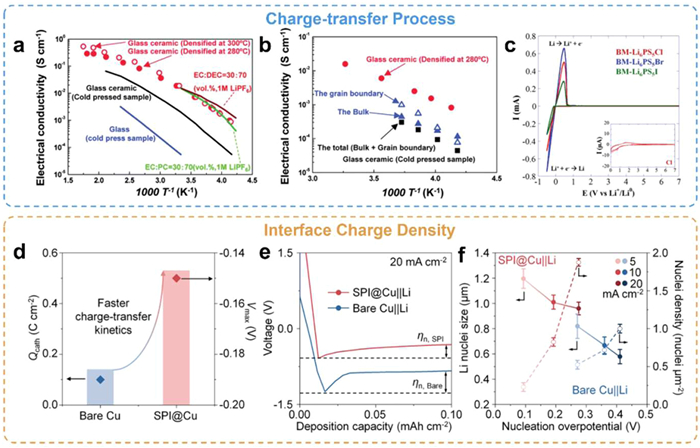
Moreover, variations in the interfacial charge density during Li deposition can induce local electric field perturbations, further disrupting the dynamic balance between electron and ion transport [87,88]. Under high-rate charging conditions, limited charge-transfer kinetics rapidly generate polarized regions at the interface, producing steep electric field gradients that evolve into nucleation sites for Li dendrites. Wen et al. systematically analyzed interfacial electrochemical evolution in Li metal batteries under extreme fast-charging (XFC) conditions and demonstrated that high current densities quickly disrupted the steady-state ionic transport between the electrode and electrolyte, resulting in severe interfacial polarization [89]. As shown in Fig. 6d, when the current density exceeds 10 mA/cm2, the available plating charge on the SPI@Cu electrode significantly surpasses that on the bare Cu electrode, highlighting the rapid breakdown of the interfacial ionic equilibrium. Correspondingly, severe polarization zones form at the interface (Fig. 6e). With increasing charging rate (Fig. 6f), the mismatch between Li+ reduction and electron supply intensifies, causing the local potential near the interface to rise by more than 190 mV and amplifying the electric field. In regions where charge transfer is kinetically limited, these nonequilibrium fluxes sharply alter the local field gradient, promoting preferential Li growth at potential peaks, which ultimately serve as dendrite nucleation sites.
The synergistic mechanism of charge transfer is not only critical for regulating the Li deposition morphology but also provides guiding principles for interface engineering. Strategies such as constructing dual-conductive interfaces [90], introducing composite interlayers with both electronic and ionic conductivity [91], or applying pulsed current to modulate the charge-transfer kinetics [92] have been widely validated as effective “game-intervention” approaches. The core of these strategies lies in breaking the “transfer asymmetry” between electrons and ions, thereby achieving rhythmic control over the deposition–stripping process.
In solid-state batteries, pressure is not only a mechanical parameter but also a “political instrument” for regulating the Li-metal anode interface. The evolution of the interfacial structure during deposition and stripping is influenced not only by the intrinsic properties of the materials but also profoundly by external mechanical boundary conditions. Poor contact, uneven stress, or constrained expansion can cause Li deposition to deviate from the ideal path, whereas appropriately applied pressure can help maintain high interfacial integrity and uniform deposition. Mechanically imposed constraints thus act as a “power intervention” mechanism, exerting decisive control over the dynamic game between deposition and stripping. This chapter analyzes the logic of pressure intervention from three perspectives: The game of interfacial stress, the evolution of contact failure, and the pathways for pressure-mediated regulation.
Lithium deposition is a process characterized by substantial volumetric change. During reduction and deposition, metallic Li undergoes a volumetric expansion far exceeding that of conventional carbon anodes, reaching approximately 100%. As Li+ ions are reduced at the interface, newly formed Li atoms accumulate and occupy space, inducing local volume growth. If the material structure or external environment cannot accommodate sufficient strain, significant interfacial stress will accumulate, potentially triggering cracks, delamination, or even catastrophic material failure [93].
The evolution of interfacial stress inherently represents a bidirectional game: On the one hand, Li deposition drives the interface outward, generating a “structural expansion pressure”; on the other hand, the rigid solid-state electrolyte and the mechanical constraints of the cell casing counteract “compressive resistance”. The interplay between these forces maintains the interface in a persistent nonequilibrium state that dynamically evolves throughout the deposition process [94]. Specifically, in the absence of external pressure, volumetric expansion during deposition can induce interfacial arching or delamination, forming “microvoid” structures that destabilize Li+ migration paths and lead to nonuniform deposition. Conversely, under constant applied pressure, external forces can suppress morphology perturbations induced by deposition, guiding Li to spread laterally in a two-dimensional fashion and preventing the initial conditions for dendrite nucleation [95].
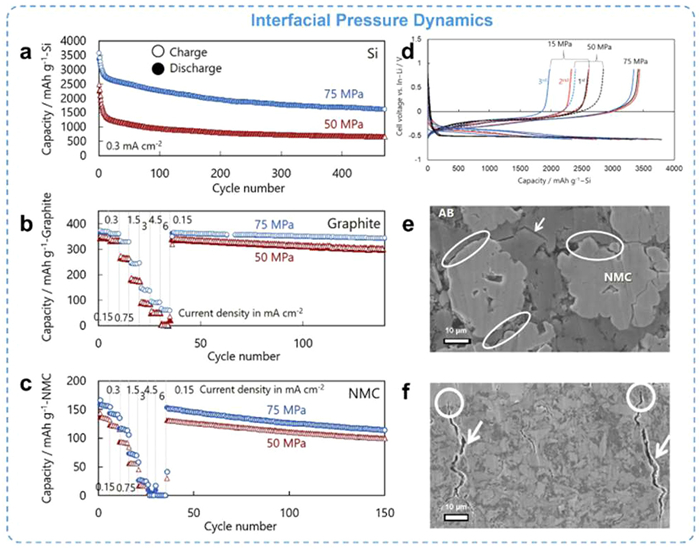
However, pressure regulation itself exhibits a “too much or too little” game characteristic. Excessive external pressure can induce plastic deformation or even cracking of the solid-state electrolyte, whereas insufficient pressure fails to maintain effective interfacial contact, facilitating the formation of local voids during deposition [96]. Yamamoto et al. reported that under insufficient pressure, contact among the active material, solid electrolyte, and conductive additive fails, resulting in interfacial voids and microcracks (Fig. 7d), significantly increasing the interfacial resistance and interrupting ion/electron transport pathways, ultimately causing an abrupt capacity fade and a shortened cycle life [97]. This phenomenon is particularly pronounced in Si-based anodes: Under low pressure (<20 MPa), Si particles experience concentrated volumetric expansion stress, leading to frequent fracturing, whereas microcrack proliferation further aggravates interfacial contact loss (Fig. 7f). Conversely, excessively high pressure can improve interfacial contact through plastic deformation (Figs. 7a–c, where the Si/Li-In75 cell at 75 MPa retains 64% capacity, significantly higher than 39% at 50 MPa), but it simultaneously induces irreversible mechanical damage to the solid electrolyte and active materials. Under high pressure, Si particles exhibit “amoeba-like” deformation (Fig. 7f), indicating that the yield strength of the material has increased; although interfacial adhesion is increased, fatigue failure may accelerate. The cracks observed in the NMC composite layer (Fig. 7e) further confirm that volumetric changes in the anode propagate through the thin solid electrolyte layer to the cathode, placing the cathode–electrolyte interface at risk of mechanical degradation under high-pressure conditions.
Therefore, to maximize stability during deposition–stripping cycles, pressure must be optimally tuned in conjunction with material properties, structural morphology, and the electrochemical environment. This control is not a simple linear optimization but rather represents a typical dynamic game: Pressure acts as a “mediator”, intervening in the tension between deposition and structural evolution and guiding the system to seek a balance between local optima and overall stability.
The interfacial contact state serves as a critical indicator of solid-state battery reliability. Ideally, the solid electrolyte and the anode should maintain a continuous, gap-free interface to ensure efficient coupling of electrons and Li+ ions. In practice, however, the significant volume changes and mechanical perturbations accompanying Li deposition and stripping often induce periodic “contact–loss” fluctuations at the interface, ultimately accelerating the degradation of the electrochemical performance.
During the stripping process, Li metal at the original interface is oxidized into ions and migrates into the electrolyte, progressively thinning the interfacial Li layer. When the stripping rate exceeds the lateral replenishment rate of Li, the preexisting deposition layer becomes “hollowed out”, forming a discontinuous contact structure referred to as an “interfacial cavity” [98]. This structural disruption directly interrupts electronic contact, breaks electron pathways, and prevents effective ionic transport, ultimately generating electrochemically inactive regions. More critically, such contact failure often results in a chain effect [99,100]. Microcavities formed at the early stage of stripping act as “hotspots” in the subsequent deposition cycle because of the current concentration, intensifying local deposition and further enlarging the cavities, thereby exacerbating interfacial degradation. Through repeated cycles, local contact failure gradually evolves into global failure. This “point–line–plane” propagation pathway essentially represents a collapse of collective behavior arising from the superposition of multiple local games, i.e., a “collective game collapse”. Moreover, since solid electrolytes generally lack the self-wetting capability inherent to liquid electrolytes, once contact failure occurs, the system cannot spontaneously self-heal and must rely on external interventions such as applied pressure or temperature for recovery. This inherent “irreversibility” constitutes a key distinguishing feature in the interfacial game of solid-state systems and imposes greater demands on material and structural design. To mitigate this failure pathway, researchers have proposed various strategies:
First, constructing an intermediate layer with flexible modulation capability is an effective strategy. For example, ion-conductive polymer layers or LiF–Li3PO4 composite interlayers can provide structural buffering under volumetric changes. Liu et al. developed a polymer-based composite electrolyte (CPE) system with excellent overall performance through an innovative filler design strategy. In their work, vertically aligned LATP nanoparticles were incorporated into a PEO-based electrolyte, and a unique CPE structure was fabricated via an ice-templating method [101]. As shown in Fig. 8a, ionic conductivity measurements at 30 ℃ revealed a value of 6.8 × 10⁻⁶ S/cm, which is five times greater than that of conventional randomly dispersed filler systems. This significant enhancement arises from the continuous ionic transport channels constructed by the vertically aligned fillers, effectively reducing the interfacial resistance. Importantly, the mechanical testing results in Figs. 8b and c demonstrate that the CPE system maintains excellent ionic conductivity while exhibiting outstanding mechanical properties. Tensile tests (Fig. 8b) indicate ideal flexibility, whereas compressive tests (Fig. 8c) confirm effective resistance against external stress.
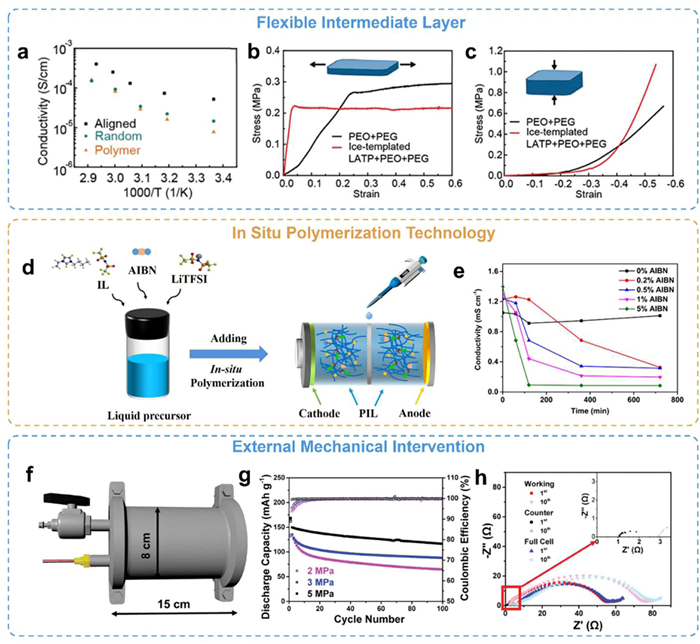
The development of in situ polymerization techniques enables the direct polymerization of electrolyte monomers or prepolymers at the electrode interface or within the battery, forming a solid-state electrolyte that ensures intimate interfacial contact and optimized ionic transport pathways. Ma et al. innovatively developed an interface engineering approach based on in situ polymerization [102]. By introducing a 1-vinyl-3-butylimidazolium dication monomer together with an azobis-isobutyronitrile (AIBN) initiator system into the battery, polymerization was carried out at 60 ℃ to generate a polyionic liquid solid-state electrolyte. As shown in Fig. 8d, this unique fabrication process allows the liquid precursor to fully infiltrate electrode pores, forming tight electrode/electrolyte interfacial contacts after polymerization and establishing uniform ion transport channels. Systematic optimization revealed that using 0.5 wt% AIBN as the initiator produced the PIL-SPE-LiTFSI-40 electrolyte with the best interfacial stability and ionic conductivity. As shown in Fig. 8e, this electrolyte maintained a stable ionic conductivity of 4 × 10⁻³ S/cm even after 700 min of aging, significantly outperforming samples prepared with other initiator concentrations, confirming that the optimized in situ polymerization process results in both a stable interface and an efficient ion-conductive network.
Third, external mechanical interventions, such as periodically applied external loads, can dynamically regulate cavity evolution during the stripping process [103]. Chen et al. designed an innovative gas-pressure–based isobaric pouch cell holder (IPCH), whose core structure is shown in Fig. 8f. The device applies uniform, continuous, and precisely adjustable cyclic pressure through a sealed gas chamber, effectively compensating for interfacial stress fluctuations caused by electrode volume changes during cycling [104]. The advantages of this design were confirmed through comparative experiments. Performance testing (Fig. 8g) demonstrated that batteries using the IPCH exhibited excellent cycling stability and capacity retention due to superior interfacial contact. Detailed analysis confirmed that maintaining a cyclic pressure above 2 MPa effectively suppressed interface cavity formation and electrode material delamination. Moreover, the electrochemical impedance spectra (Fig. 8h) showed that under the stable pressure provided by the IPCH, the overall interfacial resistance was significantly reduced, indicating greatly improved electrode/electrolyte contact. Combined electrochemical impedance spectroscopy (EIS) and FIB-SEM analyses revealed that this periodic mechanical load acts as a “dynamic massage”, maintaining tight contact between the electrodes and the solid-state electrolyte during critical stages such as stripping, enabling dynamic adjustment and repair of interfacial cavities, and substantially enhancing long-term cycling performance and structural integrity.
In recent years, “closed-loop pressure feedback systems” that integrate pressure sensing and regulation functions have gradually emerged. By employing flexible sensors to monitor interfacial contact in real time, analyzing the game dynamics through algorithms, and automatically adjusting the applied external load, these systems enable “game-feedback regulation” of the deposition process. Laboratory prototypes have already demonstrated preliminary success, providing both theoretical guidance and technical directions for the design of next-generation intelligent battery architectures.
The interfacial game behavior of lithium deposition and stripping is largely constrained by the electrolyte material system. The type of solid-state electrolyte not only defines the ionic migration pathways, interfacial charge distribution, and morphological basis of the reactive zones but also shapes the boundary conditions of the game through its intrinsic mechanical properties, interfacial compatibility, and reaction activity. In recent years, polymers, sulfides, oxides, and their composite systems have all played important roles in solid-state battery research. However, each method has distinct strengths and limitations in supporting lithium deposition–stripping equilibrium, resulting in a complex landscape where multiple strategies coexist without a universally optimal solution. This chapter analyzes, from a materials perspective, the strategic behaviors and systemic challenges of lithium deposition–stripping in typical electrolyte systems, revealing a realistic picture of “local advantages versus overall compromise”.
Polymer electrolytes (PEs) possess intrinsic advantages in mitigating interfacial contact issues because of their excellent flexibility and processability. Their low Young’s modulus (~1–10 MPa) allows them to accommodate the volumetric changes induced by lithium deposition on the anode, preventing the formation of interfacial voids and maintaining reversible deposition over extended cycles [105,106]. In addition, polymer electrolytes such as PEO–LiTFSI exhibit moderate ionic conductivity (10-5–10-4 S/cm), enabling basic electrochemical functionality at intermediate to low temperatures [107]. As shown in Fig. 9a, the XRD patterns of the P(VDF-HFP) polymer layer indicate a semicrystalline structure, which endows it with a low Young’s modulus capable of adapting to anode volume changes and suppressing interfacial void formation, thereby sustaining long-term interfacial stability. An impedance spectroscopy analysis (Fig. 9b) revealed that a 100 μm-thick P layer in a Li/PEs/Li symmetric cell exhibited stable interfacial resistance, confirming its effective interfacial adaptation. From the perspective of the deposition–stripping game, however, polymer systems also have several critical limitations. First, their intrinsic electronic insulation restricts lithium deposition to be governed primarily by ionic concentration gradients and local electric fields, which easily leads to uneven current distribution, irregular deposition, and dendrite growth. Second, thermogravimetric analysis (Fig. 9c) revealed that P begins to decompose at 430 ℃; although compositing with LATP can increase the thermal stability to 460 ℃, it remains significantly lower than that of inorganic solid electrolytes, and high-temperature polymer chain rearrangement can compromise the interfacial integrity [108].
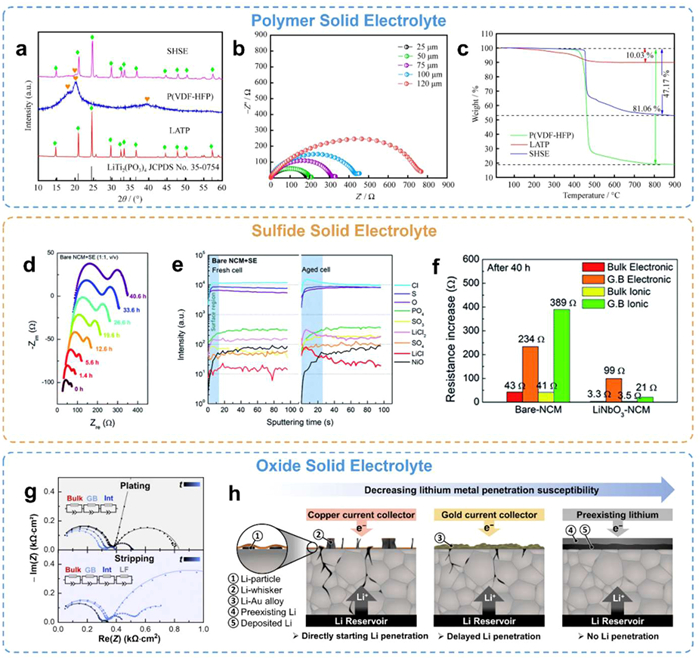
In contrast, sulfide electrolytes (SEs) exhibit high room-temperature ionic conductivity and relatively low interfacial resistance, substantially increasing the uniformity of lithium deposition rates and making them among the most widely studied inorganic electrolyte types [109]. Sulfides such as Li6PS5Cl and Li10GeP2S12 not only kinetically support rapid lithium deposition but also possess moderate mechanical compliance, partially mitigating stress accumulation induced by lithium volumetric expansion [110]. However, sulfide systems also face severe interfacial reactivity issues. Metallic lithium readily undergoes uncontrollable side reactions upon contact with sulfides, forming interfacial products such as Li2S and Li3P [111]. These reaction products can, to some extent, serve as in situ SEI layers, providing electrochemical passivation; however, if the layer thickness is not well controlled, it can form a high-resistance barrier, fracture the interface, and severely disrupt deposition/stripping pathways, leading to “interfacial game failure” [112-114]. Jung et al. employed multiscale characterization to reveal the key features of sulfide electrolytes, such as argyrodite-type Li6PS5Cl, in solid-state batteries [115]. Impedance spectroscopy (Fig. 9d) reveals an initial interfacial resistance as low as ~100 Ω, confirming an ionic conductivity of up to 10-3 S/cm at room temperature, which significantly improves the deposition uniformity and kinetic performance at the lithium metal anode. Nevertheless, time-dependent impedance evolution (Fig. 9e) exposes inherent limitations of sulfides: Chemical side reactions cause a dramatic increase in the grain boundary ionic resistance, far exceeding the bulk resistance, indicating preferential accumulation of reaction products at the grain boundaries. TOF-SIMS depth profiling (Fig. 9f) further confirmed the formation of metallic sulfides (NiS, CoS, and MnS) and LiCl at the bare NCM cathode/electrolyte interface, with the layer thickness approximately doubling as aging progressed. While these products can act as in situ SEI passivation layers, excessive thickening leads to high-resistance effects; for example, the grain boundary resistance contribution of the bare NCM reaches 60%, severely hindering lithium-ion transport across the interface. Moreover, chemical side reactions are not isolated events: Chemical degradation induces a mechanical stress concentration, forming a “chemomechanical coupled failure” chain reaction that directly disrupts the stability of the lithium deposition/stripping pathways.
Oxide electrolytes (OEs), such as Li7La3Zr2O12 (LLZO), have long been regarded as “corrosion-resistant” materials because of their excellent chemical stability and wide thermodynamic stability window. The intrinsic ionic conductivity of these materials can reach 10-4–10-3 S/cm, and their chemical reactivity with metallic lithium is significantly lower than that with sulfides. From a “passive protection” perspective, oxides appear to act as the most “composed arbiters” in the interfacial deposition–stripping game [116]. Nevertheless, during lithium deposition and stripping, oxide systems exhibit a unique “structural game dilemma”. The high rigidity and brittleness of these materials make sufficient deformation buffering against severe volumetric changes in the lithium anode difficult, rendering interfacial contact extremely sensitive. Even minor surface unevenness or stress perturbations can induce cracks, microvoids, and local electric field concentrations at the interface, resulting in a “mechanical game bias”. More critically, LLZO and similar materials may exhibit electronic conduction under certain conditions. Krauskopf et al. provided deep insight into the complexity and challenges of LLZO garnet electrolytes in practical applications [117]. Although LLZO, with its high shear modulus and low interfacial reactivity, is theoretically predicted to suppress lithium dendrite formation, experimental evidence reveals substantial lithium penetration within the material. Dynamic impedance analysis (Fig. 9g) elucidates the essence of this process: During lithium deposition, both the bulk and grain boundary resistances of LLZO decrease synchronously, indicating rapid penetration of lithium along internal pathways, forming “dynamic short circuits”. Upon current reversal, the resistances recover, confirming the reversibility of this penetration at the microscale and highlighting the irrational deposition and stripping behavior of lithium along preferential conductive paths. Importantly, this penetration originates from intrinsic structural heterogeneity in LLZO. The mechanistic schematic (Fig. 9h) illustrates the core concept of a “channel-type structural game imbalance”: Grain boundaries, microcracks, and lattice defects form localized electronic leakage paths. Once established, Li+ ions preferentially reduce at the termini of these channels, depositing metallic lithium rapidly (②), with rates far exceeding those of uniform interfacial deposition (①). This deposition is not confined to grain boundaries or pores and may even occur within single-crystal interiors or isolated micropores, eventually evolving into dendrites that traverse the electrolyte, leading to catastrophic interfacial failure. Additionally, the poor wettability between oxides and metallic lithium often creates regions of poor interfacial contact, reducing the effective reaction area and increasing the local current density. In the absence of external pressure, microvoids formed during stripping can easily expand, forming a “local game failure chain” [118,119]. Therefore, although oxide systems offer chemical stability advantages, their deficiencies in mechanical adaptability and interfacial compatibility result in the characteristic challenges of “cold-start difficulty and local uncontrollability” in the lithium deposition–stripping game.
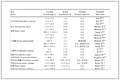
From a game-theoretic perspective, polymer, sulfide, and oxide electrolytes each exhibit distinct strategic advantages and intrinsic weaknesses during the lithium deposition–stripping process, forming a complex interfacial dynamic game. The overarching patterns of this game among the three electrolyte types are summarized in Table 1. Owing to their flexible and adaptive structural strategies, polymer electrolytes can buffer volumetric changes and maintain the long-term reversibility of the deposition process. However, their intrinsic electronic insulation and limited thermal stability constrain strategic robustness under high-rate and high-temperature conditions, rendering the interfacial game prone to loss of control. Sulfide electrolytes achieve a dynamic balance between high ionic transport rates and mechanical compliance, yet their aggressive chemical reactivity with metallic lithium introduces a clear risk of uncontrolled interfacial byproducts, severely perturbing long-term deposition–stripping pathways and increasing the probability of game failure. Oxide electrolytes, despite offering a wide thermodynamic stability window that seemingly provides an ideal “composed arbiter” for interfacial interactions, suffer from brittle rigidity and potential electronic conduction pathways, making them highly susceptible to local game dilemmas and resulting in irrational strategy imbalances at the interface. This intricate interplay of structural and electrochemical mechanisms underscores that effective interface optimization in solid-state battery design must integrate multiple dimensions: Mechanical flexibility, chemical stability, and electrochemical adaptability. Only through such a multidimensional equilibrium can a truly long-term steady-state balance be achieved in the lithium deposition–stripping game.
 DownLoad:
CSV
| Dimension | Polymer electrolytes (PEs) | Sulfide electrolytes (SEs) | Oxide electrolytes (OEs) |
| Representative materials | PEO-LiTFSI | Li6PS5Cl, Li10GeP2S12 | Li7La3Zr2O12 (LLZO) |
| Ionic conductivity | 10-5–10-4 S/cm | >10-3 S/cm | 10-4–10-3 S/cm |
| Young's modulus | 1–10 MPa (highly flexible) | 1–10 GPa (moderately flexible) | >150 Gpa (rigid) |
| Anode interface issues | Electronic leakage causes dendrites; poor thermal stability | Severe side reactions produce high-resistance layers | Poor wettability leads to inadequate contact; electronic leakage risk |
| Cathode interface issues | Low voltage tolerance (~3.8 V); unstable at high temperatures | Narrow electrochemical window; multiple side reactions | Best stability, compatible with high voltages |
| Strategic advantage | Flexible buffering of volume changes maintains interface contact | Ultrahigh ionic conductivity enables uniform and fast deposition | Widest stability window; chemically inert protection |
| Inherent weakness | Insufficient stability, prone to loss of control under high load | Uncontrolled side reaction layers cause continuous interface degradation | Rigid and brittle, contact-sensitive, prone to internal short circuits |
| Game role | Flexible Mediator | Efficient speedster | Sturdy defender |
| Core strategy | Adaptability overcomes force-buffering stress through deformation | Winning through speed-fast transport to gain advantage | Maintaining stability through stillness-chemical inertia builds defense |
| Game risk | Loss of control-dendrite growth under high temp/current | Costly victory-side reactions alter game rules | Internal betrayal-defects lead to internal dendrite penetration |
| Key to victory | Long-term, reversible enhance stability and improve electronic insulation | Suppress side reactions and construct stable interface phases | Improve interface contact and eliminate internal defects |
Faced with the inherent “gain–loss” dilemma of single-component electrolyte systems, mixed electrolytes have recently emerged as a promising strategy to reconcile conflicting performance requirements and achieve mutually favorable deposition–stripping outcomes. The core concept of mixed electrolytes lies in realizing a triple match of mechanics, chemistry, and charge transport through material compounding or interfacial engineering [120]. Uniformly dispersing inorganic electrolyte particles within a polymer matrix not only enhances the overall ionic conductivity and mechanical strength but also introduces flexible interfacial modulators to alleviate the volumetric stress generated during deposition. Furthermore, by constructing multilayer gradient architectures, it is possible to balance local deposition rates across different regions, guiding morphology evolution toward a stable two-dimensional layer [121]. Liu et al. investigated a mixed solid-state electrolyte composed of PEO and Li6PS5Cl and demonstrated that integrating inorganic particles with polymer electrolytes can partially mitigate the “trade-off” dilemma [122]. By introducing suitable ionic liquids, particularly those with poor compatibility with the polymer matrix, the local interfacial polarization environment is significantly improved, reducing the ionic diffusion barrier at the interface. As a result, the overall ionic conductivity increased to 2.47 × 10⁻⁴ S/cm, and the Li-metal battery exhibited stable room-temperature cycling with a Coulombic efficiency as high as 99.9%. Multinuclear solid-state NMR further revealed the local structure and ion transport mechanism at the organic–inorganic interface, confirming that the ionic liquid effectively mitigated the hindrance of ion transport by the interfacial decomposition products. He et al. Utilizedoperando synchrotron X-ray fluorescence imaging (XRF) to directly reveal, for the first time, the unique two-step dynamic self-healing mechanism of their developed plastic ceramic electrolyte (PCE) [123]. This mechanism originates from its dynamic non-covalent (–CH3···CF3) cross-linked polymer network. The study found that when millimeter-scale defects form during battery cycling, the first step involves the flexible polymer matrix (tracked by the S element) infiltrating and migrating into the defective area. Subsequently, facilitated by the mobile polymer network, the second step involves the directional migration of micron-sized LATP ceramic particles (tracked by the P element) to ultimately fill the void completely. This dynamic repair process continues during battery operation, achieving a high healing rate of up to 22.6 µm/h, which accelerates as the defect size decreases. This effectively eliminates "hotspots" for dendrite initiation, ensuring the structural integrity and long-term cycling stability of the electrolyte.
From a game-theoretic perspective, mixed electrolytes create a “multirole game scenario”: The flexible polymer matrix acts as a “mediator” to absorb stress fluctuations; inorganic fillers serve as “arbiters”, providing structural support and continuous ion pathways; and multiphase interfaces constitute a “strategy space”, guiding dynamic reconstruction of deposition–stripping processes. This “cooperative game” architecture endows the battery system with enhanced adaptability and fault tolerance under complex perturbations. However, the greatest challenge of mixed systems lies in their compatibility and interfacial connectivity. Discontinuous ion transport or pronounced interphase polarization may trigger “strategy conflicts”, leading to local reaction pathway deviations and disordered deposition. Moreover, the stability of multiphase interfaces evolves continuously during cycling, and long-term performance remains subject to extensive experimental validation. Current research focuses on interface-control modeling, optimization of interfacial conductivity, and nanostructure design to realize a truly “cooperative deposition–cooperative stripping” mechanism. The integration of functionally graded composites and digital twin control methods may establish mixed electrolytes as the dominant paradigm for interfacial game regulation.
This work examines lithium plating and stripping at solid-state battery anodes from a game-theoretic perspective, revealing their dynamic evolution under multiphysical fields and interfacial effects. It should be emphasized that the present game-theoretic framework is intended as a qualitative conceptual model that integrates electrochemical, mechanical, and morphological couplings. Developing quantitative, predictive models remains a major challenge, requiring accurate parameterization of interfacial energy landscapes, coupled multi-physics rate constants, and real-time feedback mechanisms. Future work combining high-resolution operando characterization with machine-learning-assisted multi-scale simulations will be essential to translate the qualitative framework into quantitative predictive tools. The process reflects not only mass transport and phase changes but also a “plating–stripping game” governed by multifactor interfacial coupling. Ideally, plating and stripping resemble a cooperative game under a “Nash equilibrium”, maintaining symmetry and reversibility. In practice, however, nonuniform ion transport, mismatched charge transfer, interfacial stress, and structural defects often drive the system into a noncooperative state, causing dendrite formation, dead lithium, and interfacial mismatch. Asymmetry between plating and stripping underlies interface instability: Plating follows the electron supply, energy barriers, and stress distributions (“directional competition”), whereas stripping is limited by detachment and electronic paths, forming dead lithium and voids that further disrupt subsequent cycles. Therefore, external interventions such as interface design, stress control, and charging strategies are crucial. Pressure acts as a “game regulator”, where moderate pressure improves contact and uniformity, but excessive pressure may damage the electrolyte. Different electrolyte types have distinct game characteristics. Polymer electrolytes are flexible and interface friendly but have limited thermal and electronic stability; sulfide electrolytes offer high ionic conductivity and low interfacial resistance but face chemical reactivity and electronic leakage; and oxide electrolytes are mechanically strong and chemically stable but rigid and have poor performance in terms of the interfacial wetting limit. No single electrolyte is universally optimal; mixed electrolytes and synergistic interfacial design are key to achieving a balanced plating–stripping game.
Looking forward, translating the plating–stripping game into actionable engineering strategies is the next critical challenge. The strategic confrontation between deposition and dissolution manifests in each cycle’s electrochemical response, morphological evolution, and structural degradation. As shown in Fig. 10, only through a dynamic name rule library, self-healing game buffer zone, and system game symbiosis can this game be brought under control, shifting from a game observer to a game operator. Future development may proceed in three directions:
(1) Future efforts should leverage artificial intelligence and multiphysics simulations to construct a real-time data-driven “dynamic game rule library”. Functioning as an omniscient "referee," this system aims to establish dynamic rules for lithium ion migration and deposition behavior, enabling a shift from static, passive homogenization strategies to dynamic and adaptive precise regulation. The core pathway involves the deep integration of machine learning and real-time sensing technologies to analyze critical thresholds and build a "digital twin" of lithium metal batteries. By quantifying the "nash equilibrium" point in the deposition–dissolution game under various operating conditions, the system dynamically adjusts "game rules", such as current protocols, and applies mechanical pressure, actively guiding lithium ions to achieve a uniform distribution within the stress field. This approach fundamentally prevents game imbalance caused by local tip effects. For example, an impedance-guided adaptive charging protocol can be implemented in which real-time EIS is continuously monitored. When a threshold increase in interfacial resistance is detected, signaling the onset of localized lithium accumulation, the control system can automatically reduce the charging current or switch to a pulsed-current mode to relieve interfacial polarization and suppress dendritic growth. Such feedback-driven regulation exemplifies the practical realization of intelligent interfacial governance.
(2) Constructing a “self-healing game buffer zone” with sensing and response capabilities is crucial for stabilizing the electrode interface. This interlayer acts as a flexible “buffer and mediator”, actively absorbing stress fluctuations and side reactions generated during the deposition–dissolution game. It converts adversarial conflicts into reversible elastic deformation through instant self-healing, thereby maintaining interfacial stability. By developing intelligent material systems with mechanoelectrochemical coupling, such as stress-sensitive polymers and dynamic reversible cross-linking networks, the interlayer can achieve in situ rheological adjustment or chemical bond reorganization when localized stress concentrations or microcracks (signs of game imbalance) are detected. This enables timely buffering of volume change-induced damage, providing a continuously stable "battlefield" for lithium deposition and ensuring that the game remains within controllable limits. For example, an impedance-guided adaptive charging protocol can be implemented in which real-time electrochemical impedance spectroscopy (EIS) is continuously monitored. When a threshold increase in interfacial resistance is detected—signaling the onset of localized lithium accumulation, the control system can automatically reduce the charging current or switch to a pulsed-current mode to relieve interfacial polarization and suppress dendritic growth. Such feedback-driven regulation exemplifies the practical realization of intelligent interfacial governance.
(3) The ultimate goal is to establish a systemic game-based symbiosis that transcends the isolated design of individual components such as electrodes, electrolytes, and current collectors. This holistic approach requires system-level thinking, transforming the relationships among components from zero-sum competition into synergistic collaboration, where each part functions complementarily to achieve a “1 + 1 > 2” symbiotic effect. By implementing codesign strategies, such as engineering gradient current collectors, developing bifunctional composite electrolytes, and optimizing electrode macrostructures, the deposition location, morphology, and dissolution pathways of lithium can be guided. This is analogous to planning an optimal “playing field and route” for the game, steering the deposition–dissolution process of lithium metal toward a thermodynamically and kinetically favored flat and uniform mode. Ultimately, this ensures the global stability and symbiotic success of the entire battery system over long-term cycling.
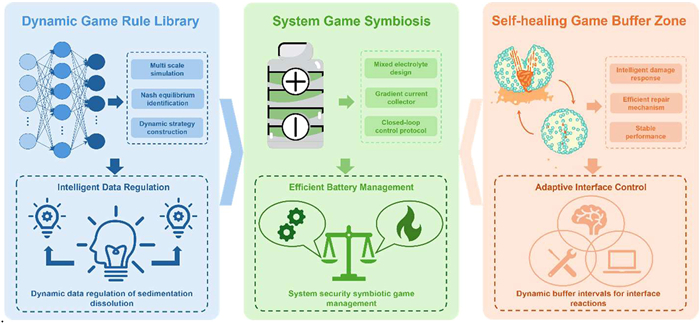
Yefan Sun: Validation, Resources, Investigation. Zhaoxia Peng: Software, Funding acquisition. Xiaopeng Zhu: Software, Resources. Xuanzhuo Liu: Investigation, Formal analysis. Xinhua Liu: Writing – review & editing, Investigation. Shichun Yang: Supervision, Project administration, Conceptualization. Xiaoyu Yan: Validation, Resources. Wenhan Zhao: Methodology, Formal analysis. Justice Delali Akoto: Resources. Nadeen S B M Alotaibi: Investigation. Rui Tan: Investigation.
The authors declare that they have no known competing financial interests or personal relationships that could have appeared to influence the work reported in this paper.
This work was supported by National Natural Science Foundation of China (No. 52476172), the Fundamental Research Funds for the Central Universities (No. 501QYJC2025146001) and related national project support.
J. Janek, W.G. Zeier, Nat. Energy 8 (2023) 230–240. doi: 10.1038/s41560-023-01208-9
C. Li, Z.Y. Wang, Z.J. He, et al., Sustainable Mater. Technol. 29 (2021) e00297. doi: 10.1016/j.susmat.2021.e00297
D.X. Wu, F. Wu, eTransportation 16 (2023) 100224. doi: 10.1016/j.etran.2022.100224
Y.H. Xiao, Y. Wang, S.H. Bo, et al., Nat. Rev. Mater. 5 (2020) 105–126. doi: 10.1038/s41578-019-0157-5
Y.F. Sun, Z.J. Zhang, Y.T. Jin, et al., Int. J. Heat. Mass Transf. 235 (2024) 126157. doi: 10.1016/j.ijheatmasstransfer.2024.126157
A.M. Bates, Y. Preger, L. Torres-Castro, et al., Joule 6 (2022) 742–755. doi: 10.1016/j.joule.2022.02.007
R.S. Chen, Q.H. Li, X.Q. Yu, L.Q. Chen, H. Li, Chem. Rev. 120 (2020) 6820–6877. doi: 10.1021/acs.chemrev.9b00268
S. Wang, H. Xu, W. Li, A. Dolocan, A. Manthiram, J. Am. Chem. Soc. 140 (2018) 250–257. doi: 10.1021/jacs.7b09531
T.F. Liu, J.L. Zheng, H.L. Hu, et al., Energy Chem. 55 (2021) 272–278. doi: 10.1016/j.jechem.2020.07.009
B. Thirumalraj, T.T. Hagos, C.J. Huang, et al., J. Am. Chem. Soc. 141 (2019) 18612–18623. doi: 10.1021/jacs.9b10195
X.Q. Yu, R.S. Chen, L.Y. Gan, H. Li, L.Q. Chen, Engineering 21 (2023) 9–14. doi: 10.1016/j.eng.2022.06.022
L.Y. Gan, R.S. Chen, X.Q. Yu, H. Li, Chin. Phys. B 31 (2022) 118202. doi: 10.1088/1674-1056/ac9221
S.J. Yang, J.K. Hu, F.N. Jiang, et al., InfoMat 6 (2024) e12512. doi: 10.1002/inf2.12512
Y.L. Liao, X.L. Wang, H. Yuan, et al., Adv. Mater. 37 (2025) 2419782. doi: 10.1002/adma.202419782
S. Li, S.J. Yang, G.X. Liu, et al., Adv. Mater. 36 (2024) 2307768. doi: 10.1002/adma.202307768
X.L. Wang, Y. Li, J. Liu, et al., Angew. Chem. Int. Ed. 64 (2025) e202421101. doi: 10.1002/anie.202421101
Y.L. Liao, J.K. Hu, Z.H. Fu, et al., Energy Chem. 80 (2023) 458–465. doi: 10.1016/j.jechem.2023.02.012
S.J. Yang, H. Yuan, N. Yao, et al., Adv. Mater. 36 (2024) 2405086. doi: 10.1002/adma.202405086
C. Che, R.P. Zhang, Y. Li, et al., Adv. Mater. 37 (2025) 2506504. doi: 10.1002/adma.202506504
L.M. Riegger, R. Schlem, J. Sann, W.G. Zeier, J. Janek, Angew. Chem. Int. Ed. 60 (2021) 6718–6723. doi: 10.1002/anie.202015238
D. Santhanagopalan, D. Qian, T. McGilvray, et al., Phys. Chem. Lett. 5 (2014) 298–303. doi: 10.1021/jz402467x
C. Shi, L. Zhang, X.T. Wang, et al., ACS Appl. Mater. Interfaces 14 (2022) 51931–51940. doi: 10.1021/acsami.2c15101
J. Wan, H.J. Yan, R. Wen, L.J. Wan, ACS Energy Lett. 7 (2022) 2988–3002. doi: 10.1021/acsenergylett.2c01069
D. Avadanii, S. Ganschow, M. Stypa, et al., ACS Energy Lett. 10 (2025) 2061–2067. doi: 10.1021/acsenergylett.5c00101
Y.M. Jiang, F.M. Ye, Chem. Eur. J. 30 (2024) 202400424. doi: 10.1002/chem.202400424
J. Lee, Y. Park, J.W. Choi, Nano Converg. 12 (2025) 25. doi: 10.1186/s40580-025-00491-4
Q.W. Yin, T.Y. Li, H.Z. Zhang, et al., Energy Chem. 96 (2024) 145–152. doi: 10.1016/j.jechem.2024.04.033
K.B. Hatzell, Joule 4 (2020) 719–721. doi: 10.1016/j.joule.2020.03.021
C.B. Jin, O.W. Sheng, G.Y. Wei, et al., Nat. Rev. Chem. 2 (2025) 553–568. doi: 10.1038/s41570-025-00722-6
H. Li, S. Guo, H. Zhou, Energy Chem. 59 (2021) 191–211. doi: 10.1016/j.jechem.2020.11.020
S. Lang, M. Colletta, M.R. Krumov, et al., Proc. Natl. Acad. Sci. U. S. A. 120 (2023) e2220419120. doi: 10.1073/pnas.2220419120
Y.F. Liang, D.H. Song, W.J. Wu, et al., Molecules 29 (2024) 29092118.
N. Hallemans, D. Howey, A. Battistel, et al., Electrochim. Acta 466 (2023) 142939. doi: 10.1016/j.electacta.2023.142939
L.Q. Zhang, T.T. Yang, C.C. Du, et al., Nat. Nanotechnol. 15 (2020) 94–98. doi: 10.1038/s41565-019-0604-x
J. Wan, Y.X. Song, W.P. Chen, et al., J. Am. Chem. Soc. 143 (2021) 839–848. doi: 10.1021/jacs.0c10121
D.D. Qiao, X.Z. Wei, J.G. Zhu, et al., Cell Rep. Phys. Sci. 5 (2024) 101961. doi: 10.1016/j.xcrp.2024.101961
Z.Y. Ning, G.C. Li, D.L.R. Melvin, et al., Nature 618 (2023) 287–293. doi: 10.1038/s41586-023-05970-4
K.J. Jun, Y. Chen, G. Wei, X. Yang, G. Ceder, Nat. Rev. Mater. 9 (2024) 887–905. doi: 10.1038/s41578-024-00715-9
F. Zhu, M.S. Islam, L. Zhou, et al., Nat. Commun. 11 (2020) 1828. doi: 10.1038/s41467-020-15544-x
L.C. Zhang, J.F. Yang, C.L. Li, et al., J. Power Sources 449 (2020) 227610. doi: 10.1016/j.jpowsour.2019.227610
Y. Zhao, R.Z. Wang, E. Martínez-Pañeda, J. Mech. Phys. Solids. 167 (2022) 104999. doi: 10.1016/j.jmps.2022.104999
M. Yang, Y. Liu, Y. Mo, Nat. Commun. 14 (2023) 2986. doi: 10.1038/s41467-023-38757-2
H. Liu, X.B. Cheng, J.Q. Huang, et al., ACS Energy Lett. 5 (2020) 833–843. doi: 10.1021/acsenergylett.9b02660
M. Werres, Y.B. Xu, H. Jia, et al., ACS Nano 17 (2023) 10218–10228. doi: 10.1021/acsnano.3c00329
R.Z. Zheng, C. Kim, Mech. Sci. Technol. 37 (2023) 4149–4157. doi: 10.1007/s12206-023-0731-z
Q.S. Tu, L. Barroso-Luque, T. Shi, G. Ceder, Cell Rep. Phys. Sci. 1 (2020) 100106. doi: 10.1016/j.xcrp.2020.100106
S.Y. Han, C. Lee, J.A. Lewis, et al., Joule 5 (2021) 2450–2465. doi: 10.1016/j.joule.2021.07.002
M. Alabdali, F.M. Zanotto, M. Chouchane, et al., Energy Storage Mater. 70 (2024) 103527. doi: 10.1016/j.ensm.2024.103527
W. Zaman, L. Zhao, T. Martin, et al., ACS Appl. Mater. Interfaces 15 (2023) 37401–37409. doi: 10.1021/acsami.3c05886
M. Song, S.Y. Choe, J. Power Sources 436 (2019) 226835. doi: 10.1016/j.jpowsour.2019.226835
Z. Li, J. Huang, B.Y. Liaw, V. Metzler, J. Zhang, J. Power Sources 254 (2014) 168–182. doi: 10.1016/j.jpowsour.2013.12.099
T. Waldmann, M. Kasper, M. Wohlfahrt-Mehrens, Electrochim. Acta 178 (2015) 525–532. doi: 10.1016/j.electacta.2015.08.056
L.L. Que, W. Chen, J. Power Sources 557 (2023) 232538. doi: 10.1016/j.jpowsour.2022.232538
H. Li, F. Lian, N. Meng, et al., Adv. Funct. Mater. 31 (2021) 2008487. doi: 10.1002/adfm.202008487
S.X. Deng, X. Li, Z.H. Ren, et al., Energy Storage Mater. 27 (2020) 117–123. doi: 10.1016/j.ensm.2020.01.009
Y. Wang, D.X. Wu, P.H. Chen, et al., Adv. Funct. Mater. 34 (2024) 2309822. doi: 10.1002/adfm.202309822
Y.J. Song, X. Sun, S.F. Lou, F. Sun, J. Wang, Prog. Mater. Sci. 147 (2025) 101339. doi: 10.1016/j.pmatsci.2024.101339
C. Doerrer, X.W. Gao, J.F. Bu, et al., Nano Energy 134 (2025) 110531. doi: 10.1016/j.nanoen.2024.110531
W.j. Li, Z.Y. Chen, Y.S. Chen, et al., Adv. Funct. Mater. 34 (2024) 2312832. doi: 10.1002/adfm.202312832
Y. Lee, B. Ma, P. Bai, Energy Environ. Sci. 13 (2020) 3504–3513. doi: 10.1039/d0ee01874k
L.T. Qian, T. Or, Y. Zheng, et al., Renewables 1 (2023) 114–141. doi: 10.31635/renewables.023.202200014
L. Stolz, S. Hochstädt, S. Röser, et al., ACS Appl. Mater. Interfaces 14 (2022) 11559–11566. doi: 10.1021/acsami.2c00084
W.L. Cai, C. Yan, Y.X. Yao, et al., Angew. Chem. Int. Ed. 60 (2021) 13007–13012. doi: 10.1002/anie.202102593
L.H. Zhao, M. Feng, C.S. Wu, et al., Nat. Commun. 16 (2025) 4283. doi: 10.1038/s41467-025-59567-8
F. Pei, L. Wu, Y. Zhang, et al., Nat. Commun. 15 (2024) 351. doi: 10.1038/s41467-023-43467-w
X. Liu, R. Garcia-Mendez, A.R. Lupini, et al., Nat. Mater. 20 (2021) 1485–1490. doi: 10.1038/s41563-021-01019-x
T.P. Hu, J.X. Tian, F.Z. Dai, et al., J. Am. Chem. Soc. 145 (2023) 1327–1333. doi: 10.1021/jacs.2c11521
T.K. Schwietert, V.A. Arszelewska, C. Wang, et al., Nat. Mater. 19 (2020) 428–435. doi: 10.1038/s41563-019-0576-0
Z. Deng, M.Y. Ou, J. Wan, et al., Chem. Mater. 32 (2020) 8827–8835. doi: 10.1021/acs.chemmater.0c02173
M.T. Agne, T. Böger, T. Bernges, W.G. Zeier, PRX Energy 1 (2022) 031002. doi: 10.1103/PRXEnergy.1.031002
H. Cui, Y. Song, D. Ren, L. Wang, Joule 8 (2024) 29–44. doi: 10.1016/j.joule.2023.11.012
D.H.S. Tan, A. Banerjee, Z. Chen, Y.S. Meng, Nat. Nanotechnol. 150 (2020) 170–180. doi: 10.1038/s41565-020-0657-x
X. Fan, L. Chen, X. Ji, et al., Chem. 4 (2018) 174–185. doi: 10.1016/j.chempr.2017.10.017
V. Reisecker, F. Flatscher, L. Porz, et al., ChemRxiv. 1 (2022) 26434. doi: 10.26434/chemrxiv-2022-6dpzs
J.S. Kim, G. Yoon, S. Kim, et al., Nat. Commun. 14 (2023) 782. doi: 10.6109/jkiice.2023.27.6.782
R. Xu, X.B. Cheng, C. Yan, et al., Matter 1 (2019) 317–344. doi: 10.1016/j.matt.2019.05.016
S. Liu, X. Ji, J. Yue, et al., J. Am. Chem. Soc. 142 (2020) 2438–2447. doi: 10.1021/jacs.9b11750
Y. Ren, E.D. Wachsman, J. Electrochem. Soc. 169 (2022) 040529. doi: 10.1149/1945-7111/ac644f
J. Sun, J. Peng, T. Ring, et al., Energy Environ. Sci. 15 (2022) 5284–5299. doi: 10.1039/d2ee01833k
J. Jiang, M. Li, X. Liu, et al., Adv. Energy Mater. 14 (2024) 2400365. doi: 10.1002/aenm.202400365
Z. Tu, S. Choudhury, M.J. Zachman, et al., Joule 1 (2017) 394–406. doi: 10.1016/j.joule.2017.06.002
C.D. Fincher, C.E. Athanasiou, C. Gilgenbach, et al., Joule 6 (2022) 2794–2809. doi: 10.1016/j.joule.2022.10.011
R. Yu, C. Wang, H. Duan, et al., Adv. Mater. 35 (2023) 2207234. doi: 10.1002/adma.202207234
X. Han, L. Gu, Z. Sun, et al., Energy Environ. Sci. 16 (2023) 5395–5408. doi: 10.1039/d3ee01696j
B.A. Tappan, K. Geng, D. Vivona, et al., ACS Appl. Mater. Interfaces 17 (2025) 18255–18267. doi: 10.1021/acsami.4c21180
J. Wu, S. Liu, F. Han, X. Yao, C. Wang, Adv. Mater. 33 (2021) 2000751. doi: 10.1002/adma.202000751
J. Zheng, C. Sun, Z. Wang, Angew. Chem. Int. Ed. 60 (2021) 18448–18453. doi: 10.1002/anie.202104183
M.W. Swift, Y. Qi, Phys. Rev. Lett. 122 (2019) 167701. doi: 10.1103/PhysRevLett.122.167701
P. Wen, H. Wang, S. Han, et al., Joule 9 (2025) 102004. doi: 10.1016/j.joule.2025.102004
S. Zhang, F. Zhao, L. Li, X. Sun, Energy Environ. Sci. 18 (2025) 6530–6539. doi: 10.1039/d5ee01767j
H. Yang, N. Wu, Energy Sci. Eng. 10 (2022) 1643–1671. doi: 10.1002/ese3.1163
A. Parejiya, R. Amin, M.B. Dixit, et al., ACS Energy Lett. 6 (2021) 3669–3675. doi: 10.1021/acsenergylett.1c01573
M.J. Counihan, J. Lee, P. Mirmira, et al., Energy Mater. 5 (2025) 500032. doi: 10.20517/energymater.2024.195
A. Banerjee, X. Wang, C. Fang, E.A. Wu, Y.S. Meng, Chem. Rev. 120 (2020) 6878–6933. doi: 10.1021/acs.chemrev.0c00101
G. Bucci, T. Swamy, Y.M. Chiang, W.C. Carter, J. Mater. Chem. A 5 (2017) 19422–19430. doi: 10.1039/C7TA03199H
K.G. Naik, M.K. Jangid, B.S. Vishnugopi, N.P. Dasgupta, P.P. Mukherjee, Adv. Energy Mater. 15 (2025) 2403360. doi: 10.1002/aenm.202403360
M. Yamamoto, Y. Terauchi, A. Sakuda, A. Kato, M. Takahashi, J. Power Sources 473 (2020) 228595. doi: 10.1016/j.jpowsour.2020.228595
H. Wang, H. Gao, X. Chen, et al., Adv. Energy Mater. 11 (2021) 2102148. doi: 10.1002/aenm.202102148
Y. Liu, M. Xu, K. Yang, et al., Chain 3 (2026) 152–186. doi: 10.23919/chain.2026.000009
J.S. Yoon, H. Sulaimon, D.J. Siegel, J. Mater. Chem. A 11 (2023) 23288–23299. doi: 10.1039/d3ta03814a
S. Liu, W. Liu, D. Ba, et al., Adv. Mater. 35 (2023) 2110423. doi: 10.1002/adma.202110423
F. Ma, Y. Liu, T. Huang, et al., Energy Convers. Manage. 22 (2024) 100570.
X. Qin, L. Zhao, J. Han, et al., ACS Nano 19 (2025) 17760–17773. doi: 10.1021/acsnano.5c03017
Y.T. Chen, J. Jang, J.A.S. Oh, et al., Adv. Energy Mater. 14 (2024) 2304327. doi: 10.1002/aenm.202304327
M. Newman, J. Liu, H. Jang, et al., J. Mater. Chem. A 13 (2025) 7917–7928. doi: 10.1039/D4TA08556F
J.M. Whiteley, P. Taynton, W. Zhang, S.H. Lee, Adv. Mater. 27 (2015) 6922–6927. doi: 10.1002/adma.201502636
X. Meng, Y. Liu, Y. Ma, et al., Adv. Mater. 35 (2023) 2212039. doi: 10.1002/adma.202212039
Y. Xia, T. Fujieda, K. Tatsumi, P.P. Prosini, T. Sakai, J. Power Sources 92 (2001) 234–243. doi: 10.1016/S0378-7753(00)00533-4
J. Lee, T. Lee, K. Char, K.J. Kim, J.W. Choi, Acc. Chem. Res. 54 (2021) 3390–3402. doi: 10.1021/acs.accounts.1c00333
J. Lau, R.H. DeBlock, D.M. Butts, et al., Adv. Energy Mater. 8 (2018) 1800933. doi: 10.1002/aenm.201800933
S. Chen, D. Xie, G. Liu, et al., Energy Storage Mater. 14 (2018) 58–74. doi: 10.1016/j.ensm.2018.02.020
M. Otoyama, A. Sakuda, M. Tatsumisago, A. Hayashi, ACS Appl. Mater. Interfaces 12 (2020) 29228–29234. doi: 10.1021/acsami.0c05050
J. Li, J. Luo, X. Li, et al., EcoMat 5 (2023) 12383. doi: 10.1002/eom2.12383
C.D. Alt, N.U.C.B. Müller, L.M. Riegger, et al., Joule 8 (2024) 2755–2776. doi: 10.1016/j.joule.2024.07.006
S.K. Jung, H. Gwon, S.S. Lee, et al., J. Mater. Chem. A 7 (2019) 22967–22976. doi: 10.1039/c9ta08517c
M. Shoji, E.J. Cheng, T. Kimura, K. Kanamura, J. Appl. Phys. A 52 (2019) 103001. doi: 10.1088/1361-6463/aaf7e2
T. Krauskopf, R. Dippel, H. Hartmann, et al., Joule 3 (2019) 2030–2049. doi: 10.1016/j.joule.2019.06.013
S. Wang, Y. Wu, T. Ma, et al., ACS Nano 16 (2022) 16158–16176. doi: 10.1021/acsnano.2c04905
R. Davis, F. Abdeljawad, J. Lillibridge, M. Haataja, Acta Mater. 78 (2014) 271–281. doi: 10.1016/j.actamat.2014.06.037
Z. Yu, C. Gan, A.S. Mijailovic, et al., Adv. Energy Mater. 15 (2025) 2403179. doi: 10.1002/aenm.202403179
B.T. Tham, M.S. Park, J.H. Kim, J. Moon, J. Mater. Chem. A 11 (2023) 15968–15978. doi: 10.1039/d3ta01787g
M. Liu, S. Zhang, E.R.H. van Eck, et al., Nat. Nanotechnol. 17 (2022) 959–967. doi: 10.1038/s41565-022-01162-9
Y. He, C. Wang, R. Zhang, et al., Nat. Commun. 15 (2024) 10015. doi: 10.1038/s41467-024-53869-z

Figure 2 Dynamic equilibrium and unbalanced tip effect of lithium deposition: (a) The entire process of a single lithium dendrite gradually bending and ultimately breaking from its initial upright state under axial mechanical loading. Reproduced with permission [34]. Copyright 2020, Authors. (b, c) Initial morphology and nanoscale geometric information of surface wrinkles in LixIn alloy after delamination revealed by in situ EC-AFM. (d) ToF SIMS deep analysis reveals the evolution behavior of sulfide components in the SEI layer on the In electrode surface. (e) Two-dimensional distribution map of ToF-SIMS data showing the nonuniform aggregation behavior of S- ions on the surface of the Li electrode. Reproduced with permission [35]. Copyright 2021, American Chemical Society. (f) Potential gradient distortion in the dendritic tip region under electric field simulation. (g) Marcus electrode reaction kinetics theory. (h) Very vicious cycle of needle-like dendritic growth. Reproduced with permission [36]. Copyright 2024, The Authors.

Figure 3 Asymmetric game of lithium deposition and dissolution: (a) Phase field evolution and current density distribution during the stripping process under a single cavity model. (b, c) Evolution of aggregate morphology under lithium deposition and dissolution. (d) Evolution of the phase field and distribution of current density during the sedimentation process under a single cavity model. Reproduced with permission [41]. Copyright 2022, The Authors. (e) Quantitative statistical results of the residual lithium area ratio in different regions after lithium stripping. (f) In situ optical microscopy reveals the dynamic evolution of the interface morphology during the lithium stripping process. (g) Regulatory effect of the residual interface structure on the current density distribution during the sedimentation period. Reproduced with permission [44], Copyright 2023, Authors. (h) Stress concentration effect in the defect area of the lithium metal/solid electrolyte interface. (i) Fracture risk window of solid electrolytes. (j) Mechanical control threshold for contact loss. Reproduced with permission [46]. Copyright 2020, Elsevier. (k) Evolution trend of the interface resistance during a 2-h standing period after lithium dissolution under different pressure conditions. (l) Two-dimensional projection diagram of the electrode-electrolyte interface contact area before and after dissolution. Reproduced with permission [49]. Copyright 2023, American Chemical Society.

Figure 4 Balance to the critical point of imbalance: (a) Surface morphology evolution of the graphite anode under different lithium deposition capacities. (b, c) Voltage capacity curves of the graphite electrode without and without metal-lithium deposition at a low current density. (d) Evolution of the cyclic Coulomb efficiency of the graphite electrode under different deposition morphologies. (e) Statistical analysis of the average Coulombic efficiency of metallic lithium under different deposition morphologies. Reproduced with permission [63]. Copyright 2021, Wiley‐VCH GmbH. (f) Trend chart of the activation energy and Arrhenius prefactor (σ0) under different Br doping ratios. (g) Curve of the sound velocity with the Br content in the Li2OHCl1₋xBrx system. (h) Comparison of the nonlinear trends of the Li-O bond length with the Br content. Reproduced with permission [69]. Copyright 2020, American Chemical Society.

Figure 5 Interface energy game between lithium dissolution and deposition: (a) Atomic structure of the SrF2/Li interface. (b) Relationship between the interface energy (γ) of different SEI components (LiF, SrF2, Li2O, Li2CO3) and lithium metal and the number of Li atoms. (c) Comparison of the dendrite inhibition ability (γE value) of various SEI components. Reproduced with permission [77]. Copyright 2020, American Chemical Society. (d) Solvation structures and Li+ coordination environments of different electrolyte systems. (e) HOMO-LUMO energy levels and reduction tendencies of the electrolyte components. Reproduced with permission [80]. Copyright 2024, Wiley‐VCH GmbH.

Figure 6 Cooperation and competition between electrons and ions: (a) Arrhenius curve of Li7P3S11. (b) Volume resistance and grain boundary resistance of microcrystalline glass materials. (c) Electrochemical stability window of the Li6PS5X electrolyte. Reproduced with permission [86]. Copyright 2020, Wiley‐VCH GmbH. (d) SPI@Cu dynamic characteristics of interface charge transfer with a bare copper electrode. (e) Evolution of the lithium deposition overpotential at high magnification. (f) Correlation between the nucleation overpotential and deposition morphology. Reproduced with permission [89]. Copyright 2025, Elsevier.

Figure 7 Dynamic equilibrium under mechanical constraints: (a-c) Cyclic performance of Si/Li–In, graphite/Li–In, and NMC/Li–In half-cells under compressive stresses of 50 and 75 MPa. (d) Si/Li half-cell charge discharge curves under different pressures. (e, f) Secondary electron image of a Si/NMC full-cell cross-section under a compression pressure of 75 MPa. Reproduced with permission [97]. Copyright 2020, Elsevier.

Figure 8 Improvement in interface contact failure: (a) Conductivity, (b) tensile stress curve, and (c) compressive stress curve of three materials: Aligned, random, and polymerized at different temperatures. Reproduced with permission[101]. Copyright 2022, Wiley‐VCH GmbH. (d) Schematic diagram of the PIL-SPE preparation process. (e) Relationship between the ion conductivity and polymerization time of PIL-SPE-LiTFSI-40 prepared with different AIBN initiators. Reproduced with permission [102]. Copyright 2024, The Royal Society of Chemistry. (f) Schematic diagram of the isobaric bag-type battery fixture for gas pressure. (g) Capacity retention and Coulombic efficiency plots of pouch batteries manufactured at 500 MPa and cycled at 5, 3, and 2 MPa. (h) Nyquist plots of cathode Li (working), anode Li (counter), and full-cell (anode cathode) EIS at 50% charge during the 1st and 10th discharges. Reproduced with permission [104]. Copyright 2024, Authors.

Figure 9 Strategy game for different electrolyte systems: (a) LATP solid electrolyte, P(VDF-HFP) polymer layer, and sandwich structure composite electrolyte. (b) Interface impedance evolution of Li symetric batteries with different thicknesses of P(VDF-HFP) polymer layers. (c) Thermogravimetric analysis (TGA) curves of LATP, P(VDF-HFP), and SHSE. Reproduced with permission [107]. Copyright 2021, Youke Publishing Co., Ltd. (d) EIS spectra of uncoated bare NCM and silver electrolyte composite materials. (e) TOF-SIMS curve as a function of sputtering time for fresh and aged bare NCM cells. (f) Compared with that of fresh batteries, the resistance of bare NCM or LiNbO3-coated NCM increases after 40 h of chemical reaction aging. Reproduced with permission [115]. Copyright 2013, Royal Society of Chemistry. (g) Grain boundary resistance during the sedimentation and dissolution stages. (h) LLZO lithium deposition behavior framework. Reproduced with permission [117], Copyright 2019, Elsevier.

Figure 10 Future development directions for solid-state battery deposition dissolution.
Table 1. Comparison of the roles of polymer, sulfide, and oxide solid electrolytes in games.
| Dimension | Polymer electrolytes (PEs) | Sulfide electrolytes (SEs) | Oxide electrolytes (OEs) |
| Representative materials | PEO-LiTFSI | Li6PS5Cl, Li10GeP2S12 | Li7La3Zr2O12 (LLZO) |
| Ionic conductivity | 10-5–10-4 S/cm | >10-3 S/cm | 10-4–10-3 S/cm |
| Young's modulus | 1–10 MPa (highly flexible) | 1–10 GPa (moderately flexible) | >150 Gpa (rigid) |
| Anode interface issues | Electronic leakage causes dendrites; poor thermal stability | Severe side reactions produce high-resistance layers | Poor wettability leads to inadequate contact; electronic leakage risk |
| Cathode interface issues | Low voltage tolerance (~3.8 V); unstable at high temperatures | Narrow electrochemical window; multiple side reactions | Best stability, compatible with high voltages |
| Strategic advantage | Flexible buffering of volume changes maintains interface contact | Ultrahigh ionic conductivity enables uniform and fast deposition | Widest stability window; chemically inert protection |
| Inherent weakness | Insufficient stability, prone to loss of control under high load | Uncontrolled side reaction layers cause continuous interface degradation | Rigid and brittle, contact-sensitive, prone to internal short circuits |
| Game role | Flexible Mediator | Efficient speedster | Sturdy defender |
| Core strategy | Adaptability overcomes force-buffering stress through deformation | Winning through speed-fast transport to gain advantage | Maintaining stability through stillness-chemical inertia builds defense |
| Game risk | Loss of control-dendrite growth under high temp/current | Costly victory-side reactions alter game rules | Internal betrayal-defects lead to internal dendrite penetration |
| Key to victory | Long-term, reversible enhance stability and improve electronic insulation | Suppress side reactions and construct stable interface phases | Improve interface contact and eliminate internal defects |
 下载: 导出CSV

 扫一扫看文章


扫一扫关注我们

 下载: