State Key Laboratory of National Security Specially Needed Medicines, Beijing Institute of Pharmacology and Toxicology, Beijing 100850, China
b.
Key Laboratory of Inorganic-Organic Hybrid Functional Material Chemistry, Ministry of Education, Tianjin Key Laboratory of Structure and Performance for Functional Molecules, College of Chemistry, Tianjin Normal University, Tianjin 300387, China
nankaimqb@sina.com (Q. Meng). 1 These authors contributed equally to this work.
Received Date:
16 April 2025 Accepted Date:
13 October 2025 Revised Date:
30 September 2025 Available Online:
15 July 2026
Abstract:
The fentanyl (Fen) analogs-related drug crisis is a global focus that has badly affected social stability. In view of multitudinous overdose deaths, there is a great need for a portable and sensitive analytical approach that can quickly discriminate these dangerous recreational substances. Herein, an extended biphenarene-based fluorescence displacement sensor assay was constructed by integrating two reporter pairs, where terphen[3]arene sulfate and quaterphen[3]arene sulfate act as receptors, and rhodamine 123 acts as the optimal indicator. The formed supramolecular assay was able to completely classify four analogs, including Fen, 3-methylfentanyl, sufentanil and remifentanil in aqueous phosphate buffered saline, artificial urine, mouse plasma, or even real urine sample from model mice. Moreover, mixed samples containing different proportions of cocaine, heroin and ketamine could also be discriminated with 100% accuracy.
As a typical class of psychoactive substances, opioid drugs of abuse have posed a serious threat to human health, family harmony, and social stability [1-3]. Excessive use of these drugs causes a dramatic increase of mortality, and more than 70% events are associated with synthetic fentanyl (Fen) analogs, mainly including Fen, 3-methylfentanyl (3-MeFen), sufentanil (SFen) and remifentanil (RmFen) [4-8]. Likely due to the feasibility of their syntheses, subtle addiction, and intense pleasure, Fen analogs are increasingly popular in illicit channels in the form of pure samples or mixed narcotics [9,10]. As tolerance develops, addicts need to continuously enhance their dosage to recreate the initial euphoria, such operation significantly raises the risk of overdose and life-threatening consequences [11-13]. For Fen analogs-induced poisoning, the main antagonists in clinical practice include naloxone, nalmefene and naltrexone, and medical staff should implement proper treatment schemes according to specific substance [14,15]. Therefore, on-site rapid discrimination of Fen analogs is extremely significant for both inspection officials to combat crime and medical personnel to send aid in a timely and effective manner.
The routine analytical approaches toward Fen analogs are restricted by the present detection techniques, such as gas or liquid chromatography coupled to mass spectrometry, capillary electrophoresis, nuclear magnetic resonance, immunoassays, which commonly need sophisticated devices, complicated procedures, high operating and maintenance costs [16-22]. Optimal approaches for Fen analogs are quite suited to front-line operators due to their ease of use, low cost, and high sensitivity [23-25]. While a single sensing unit readily produces signal output toward specific analyte, it is still challenging to discriminate highly similar Fen analogs through such optimal manner [26-28]. Sensor arrays have been proved to be a feasible way to address the above problem, which takes into account the simultaneous cross-reactive interaction of sensor units toward a group of analytes, creating a distinctive pattern of fingerprint of each analyte, enabling better accuracy and more robust interference resistance [29-31]. The key task of constructing a sensor assay is to seek proper sensor units, and chemical synthesis is a powerful approach to produce new molecules with sensing function. However, such covalent synthesis still has inevitable matters, including complicated molecular design, tedious synthesis, dubious sensing performance [27].
Alternatively, macrocycle supramolecular chemistry represents an elegant approach to construct sensor arrays [32-35]. For instance, the indicator displacement assay (IDA), in which a competitive analyte is added to a solution of dye/macrocycle complex and then displacement of dye by analyte modulates the optical signal, can be applied to achieve the above goal [36-38]. Recently, our group has developed a modular strategy for customizing macrocycles, termed biphen[n]arenes. Through replacement of their functional modules, reaction modules and linking modules, a certain scale of macrocycle library has been established [39-41]. The facile functionalization and excellent recognition properties enable their enormous potential in sensing applications. In this work, we set up a fluorescence displacement sensing assay based on two water-soluble extended biphenarene derivatives with variations in the cavity size, giving desirable selectivity in discriminating highly similar Fen analogs.
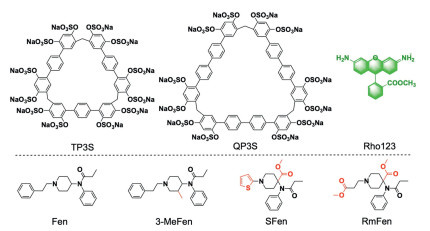
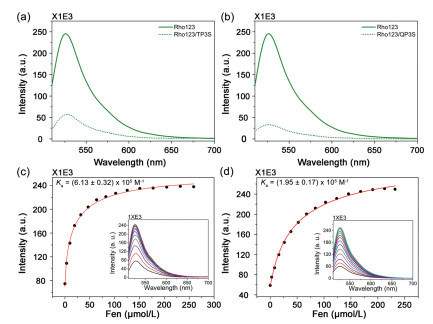
As mentioned above, Fen, 3-MeFen, SFen and RmFen, four highly similar opioids usually abused by addicts as analytes were used in this work to evaluate the discrimination potency of the constructed sensing array. In view of size/charge matching of each host-guest pair, two macrocyclic derivatives were screened, namely terphen[3]arene sulfate (TP3S) and quaterphen[3]arene sulfate (QP3S) (Fig. 1). Among them, the synthesis procedure of QP3S drew on that of TP3S, which was synthesized in a one-step with pyridine solution of perhydroxylated quaterphen[3]arene and pyridine sulfur trioxide complex. The obtained product was verified after purification by 1H and 13C NMR spectroscopy (Figs. S1 and S2 in Supporting information). For constructing a sensing array, single sensing unit should be established first and the key requirement of such unit could produce visible signal after contact with target analyte [27]. Currently, change of fluorescence intensity served as output signals which was generated by conducting IDA. As shown in Figs. 2a and b, rhodamine 123 (Rho123) was chosen as optimal indicator due to its high brightness as well as drastic complexation-induced quenching of fluorescence on account of photoinduced electron transfer (Ifree/Ibound = 4.32 for Rho123/TP3S and Ifree/Ibound = 7.43 for Rho123/QP3S), and Rho123 was respectively bound to TP3S or QP3S to create two sensing units. As shown in Figs. S4 and S5 (Supporting information), upon 1:1 complexation with TP3S or QP3S, the fluorescence of Rho123 is quantitatively quenched without any shift of emission maximum, indicating a PET quenching mechanism. Subsequent introduction of Fen analogs caused displacement of indicator from macrocyclic cavities to regenerate intrinsic emission of Rho123 to various degree. The differential signal outputs of single sensing unit mainly originated from variances of binding affinity between macrocycles and analytes, and the association constants of them were determined by competitive titration experiments, as shown in Figs. 2c and d, and Figs. S6-S11 (Fen/TP3S, (6.13 ± 0.32) × 106; 3-MeFen/TP3S, (1.01 ± 0.55) × 106; SFen/TP3S, (3.61 ± 0.24) × 105; RmFen/TP3S, (7.07 ± 0.27) × 104; Fen/QP3S, (1.95 ± 0.17) × 105; 3-MeFen/QP3S: (1.69 ± 0.21) × 106; SFen/QP3S, (5.85 ± 0.90) × 105; and RmFen/QP3S, (5.80 ± 0.50) × 104 L/mol). Although the macrocyclic receptors exhibited stronger binding affinities toward the optimal indicator, the concentration of analytes in following test samples far exceed that of the reporter indicator and competitive displacement process can function normally under these conditions.
Figure 1
Figure 1.
Chemical structures of the employed extended biphenarene hosts (terphen[3]arene sulfate, TP3S; and quaterphen[3]arene sulfate, QP3S), reporter dye (rhodamine 123, Rho123), and fentanyl analogs (fentanyl, Fen; 3-methylfentanyl, 3-MeFen; sufentanil, SFen; remifentanil, RmFen) as target analytes in this work.
Figure 2.
Fluorescence quenching of Rho123 (1.0 μmol/L) by host-guest complexation of (a) TP3S (1.0 μmol/L) and (b) QP3S (1.0 μmol/L), λex = 500 nm and λem = 530 nm. (c) The associated competitive titration curve of Fen at λem = 530 nm and fit according to a 1:1 competitive binding model. Insert: competitive fluorescence titration of Fen in the presence of Rho123/TP3S (1.0 μmol/L/1.0 μmol/L) in 10 mmol/L PBS buffer at pH 7.4, λex = 500 nm. (d) The associated competitive titration curve of Fen at λem = 530 nm and fit according a 1:1 competitive binding model. Inset: competitive fluorescence titration of Fen in the presence of Rho123/QP3S (1.0 μmol/L/1.0 μmol/L) in 10 mmol/L PBS buffer at pH 7.4, λex = 500 nm.
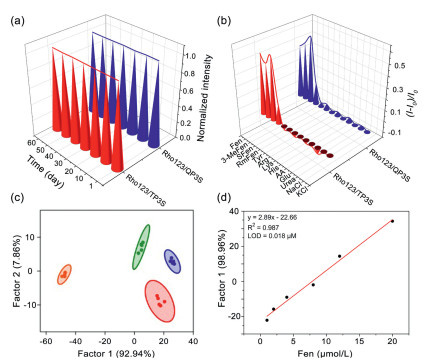
Based on the above favorable findings, a sensor array was then constructed by combining Rho123/TP3S and Rho123/QP3S sensing units. Before verification of its practicability, the signal stability and anti-interference ability were evaluated. As shown in Fig. 3a, no obvious fluorescence intensity changes of Rho123/TP3S and Rho123/QP3S could be monitored when left at room temperature for 60 days. The stability of sensor assay inherited from its single component, and thus these results suggested that the formed pattern possessed relatively high stability. Likewise, the anti-interference potency of each sensing unit was respectively examined. As shown in Fig. 3b, addition of representative endogenous substances including amino acids, glucose, urea, metal ions, caused no sharp fluorescence change for Rho123/TP3S or Rho123/QP3S, validating the excellent response selectively integrated sensor assay toward Fen analogs.
Figure 3
Figure 3.
(a) The fluorescence stability of two sensor units after storage for different days. (b) Fluorescence response patterns of two sensor units against upon addition of four target analytes (10 µmol/L) and various biological co-existing species (Tyr: tyrosine, Arg: arginine, Lys: lysine, His: histidine, AA: ascorbic acid, Glu: glucose, 100 μmol/L) in 10 mmol/L PBS buffer at pH 7.4. Canonical score plot for the two factors of simplified fluorescence response patterns in (c) PBS buffer obtained from LDA with 95% confidence ellipses (n = 5 independent experiments). Red symbols: Fen, blue symbols: 3-MeFen, green symbols: SFen, orange symbols: RmFen. (d) The set-up calibration line of the factor 1 for quantitatively determining the Fen concentrations in PBS buffer.
Next, we utilized linear discriminant analysis (LDA) method to simplify the dataset produced by array approach. As shown in Fig. 3c and Fig. S12 (Supporting information), two most significant LDA factors (Factor 1 = 92.94% and Factor 2 = 7.86%) were generated to build a two-dimensional score plot with 95% confidence ellipses, and 20 points (4 Fen analogs × 5 replicates) were well clustered into 4 distinct groups without overlap in aqueous phosphate buffered saline (PBS). Equal discrimination performances were also observed in artificial urine or mouse plasma (Figs. S13-S16 in Supporting information). Furthermore, the limit of detection (LOD) of such assay toward Fen was estimated to evaluate its sensitivity potency. As shown in Fig. 3d, the Factor 1 scores responded to the concentrations of Fen from 1 μmol/L to 20 μmol/L with good linear relationship (R2 = 0.987), and LOD for Fen was calculated to be 0.018 μmol/L by 3σ/slope method. The constructed sensor assay in this work was comparable to or even slightly superior to other commercial immunoassay kits reported in the literature in working solution or real body fluid [42-45]. Taken together, the above results revealed that the constructed sensor assay with high sensitivity could well differentiate Fen in presence of other structurally similar analogs under various conditions.
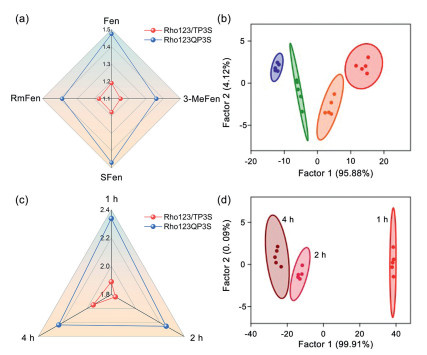
Fen analogs act on opioid receptors in brain, leading to release of dopamine which provides a pleasant sensation for drug users, and thus creates physical and psychological dependencies by osmosis [46,47]. Accompanied with development of tolerance, addicts continuously increase administration amount to get the same effect, aggravating overdose-induced risks [11-13]. Among them, some addicts with poisoning symptoms need to be treated by various schemes based on specific substances. For example, repeated administration of naloxone should be supplied for Fen-poisoned addicts, and nalmefene serves as preferred antagonist for SFen [14,15]. Therefore, clear discrimination of Fen analogs in body fluid sample of senseless addicts is pretty significant for first aid treatment. We respectively intravenously injected four Fen analogs to Kunming mouse and after 1 h, urine samples were collected to investigate the discrimination potency of the constructed sensor assay. As shown in Figs. 4a and b, all four analogs were classified with 100% accuracy. Paradoxically, the response signal of RmFen that exhibited weakest interactions with two macrocycles were stronger than that of 3-MeFen and SFen, which was probably because metabolic rate of RmFen was quite fast with a half-life of about 10 min [48]. As mentioned above, Fen with huge circulation causes the highest number of such nasty accidents, and ascertainment of Fen-poisoning duration is conducive to sort out the setting priorities of these events. For this task, we further employed extended biphenarene-based assay to validate the discrimination outcome of urine samples with different metabolic time. As shown in Figs. 4c and d, three administration intervals (1, 2 and 4 h) were well clustered into 3 distinct groups without any overlap. The correct classification and jackknifed classification of the LDA analysis indicated 100% accuracy in differentiating the pattern.
Figure 4
Figure 4.
(a) Radar diagram of the sensor array with model mice administered with four Fen analogs (2.0 mg/kg). (b) Canonical score plot for the two factors of simplified fluorescence response patterns in model mice obtained from LDA. n = 5 independent experiments. (c) Radar diagram of the sensor array with model mice administrated with Fen. (d) Canonical score plot for the two factors of simplified fluorescence response patterns in model mice obtained from LDA. n = 5 independent experiments. Red symbols: Fen, blue symbols: 3-MeFen, green symbols: SFen, orange symbols: RmFen.
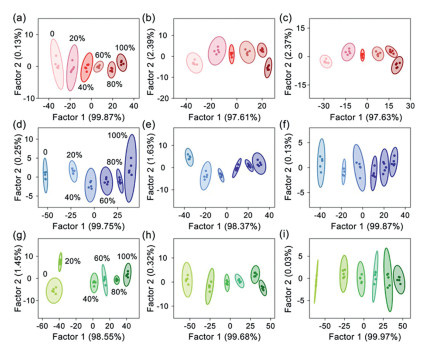
Previous survey reports have shown that Fen is frequently doped as an adulterant in other illicit agents like cocaine and heroin, resulting in mass graves of addicts [9,10]. It is crucial for inspection officials to discriminate Fen in blended narcotics to properly handle the addicts in the first place. Therefore, we prepared Fen solutions mixed with different proportions of cocaine, heroin and ketamine to test the ability of the supramolecular sensor assay to discriminate real samples that might be encountered in the process of law enforcement. As shown in Fig. 5a and Fig. S17b (Supporting information), through LDA analysis, the two-dimensional score plot with 95% confidence ellipses showed six clusters for Fen containing 0, 20%, 40%, 60%, 80% and 100% cocaine were clearly distinguished from each other. Notably, the cluster of this pure narcotic was significantly far from Fen-containing samples. Similar discrimination outcomes could be found in artificial urine or mouse plasma (Figs. 5b and c, Figs. S17b and c in Supporting information), and the current assay was able to function normally in mixed samples with various ratios of heroin and ketamine (Figs. 5d-i, and Figs. S18 and S19 in Supporting information). These findings indicated that the constructed sensor array was useful for discrimination of Fen in complex analytes such as illegal narcotic samples.
Figure 5
Figure 5.
Canonical score plot against mixtures of Fen and cocaine using Rho123/TP3S and Rho123/QP3S in (a) PBS buffer, (b) artificial urine, and (c) plasma. Canonical score plot against mixtures of Fen and heroin using Rho123/TP3S and Rho123/QP3S in (d) PBS buffer, (e) artificial urine, and (f) plasma. Canonical score plot against mixtures of Fen and ketamine using Rho123/TP3S and Rho123/QP3S in (g) PBS buffer, (h) artificial urine, and (i) plasma. 100%: 10 µmol/L Fen.
In summary, we have achieved the optimal discrimination of structurally similar Fen analogs by virtue of array sensing. The functional principle was the IDA method, where the competitive binding of analytes caused the regeneration of fluorescence signals of reporter dye in two sensing units, Rho123/TP3S and Rho123/QP3S. The rationale behind the discrimination was the differential binding strength between two extended biphenarenes and various narcotics. The constructed sensor assay exhibited good stability, sensitivity and anti-interference potency, which could well differentiate these four Fen analogs in PBS solutions, artificial urine or mouse plasma. In addition, such assay was able to normally function in real urine samples of model mice and different administration intervals were also classified with 100% accuracy. More importantly, the current supramolecular sensor assay approach showed the ability to discriminate mixed samples containing different proportions of cocaine, heroin and ketamine. In view of plentiful biphenarene library and their excellent recognition properties, the biphenarene-based sensor assay is easily amenable for other target analytes, so that versatile differential sensing applications can be envisaged.
Declaration of competing interest
The authors declare that they have no known competing financial interests or personal relationships that could have appeared to influence the work reported in this paper.
CRediT authorship contribution statement
Longming Chen: Writing – original draft, Methodology, Investigation, Formal analysis, Data curation. Chengyang Tian: Writing – original draft, Methodology, Investigation, Data curation. Kaili Jiang: Methodology, Investigation, Formal analysis, Data curation. Ziliang Zhang: Methodology, Formal analysis, Data curation. Di Gao: Methodology, Investigation. Shujie Lin: Formal analysis, Data curation. Junyi Chen: Writing – review & editing, Writing – original draft, Supervision, Funding acquisition. Chunju Li: Writing – review & editing, Supervision, Resources, Project administration. Qingbin Meng: Writing – review & editing, Writing – original draft, Supervision, Investigation, Funding acquisition.
Acknowledgment
We would like to thank Dr. Ruibin Su for providing the samples.
Supplementary materials
Supplementary material associated with this article can be found, in the online version, at doi:10.1016/j.cclet.2025.111961.
X. Du, M. Ma, Y. Zhang, et al., Angew. Chem. Int. Ed 62 (2023) e202301857. doi: 10.1002/anie.202301857
[42]
R.E. Wharton, J. Casbohm, R. Hoffmaster, et al., J. Anal. Toxicol. 45 (2021) 111–116. doi: 10.1093/jat/bkaa181
[43]
T.M. Brunt, C. Nagy, A. Bulcheli, et al., Drug Test. Anal. 9 (2017) 188–198. doi: 10.1002/dta.1954
[44]
M.S. Krieger, J.L. Yedinak, J.A. Buxton, et al., Harm. Reduct. J. 15 (2018) 7. doi: 10.1186/s12954-018-0213-2
[45]
M. Karamouziam, C. Dohoo, S. Forsting, et al., Harm. Reduct. J. 15 (2018) 46. doi: 10.1186/s12954-018-0252-8
[46]
M. Schackmuth, S. Kerrigan, Forensic Toxicol. 37 (2018) 231–237.
[47]
N.D. Volkow, World Psychiatry 20 (2021) 195–196. doi: 10.1002/wps.20846
[48]
K. Moussawi, M.M. Ortiz, S.C. Gantz, et al., Sci. Adv. 6 (2020) e413.
Figure 1
Chemical structures of the employed extended biphenarene hosts (terphen[3]arene sulfate, TP3S; and quaterphen[3]arene sulfate, QP3S), reporter dye (rhodamine 123, Rho123), and fentanyl analogs (fentanyl, Fen; 3-methylfentanyl, 3-MeFen; sufentanil, SFen; remifentanil, RmFen) as target analytes in this work.
Figure 2
Fluorescence quenching of Rho123 (1.0 μmol/L) by host-guest complexation of (a) TP3S (1.0 μmol/L) and (b) QP3S (1.0 μmol/L), λex = 500 nm and λem = 530 nm. (c) The associated competitive titration curve of Fen at λem = 530 nm and fit according to a 1:1 competitive binding model. Insert: competitive fluorescence titration of Fen in the presence of Rho123/TP3S (1.0 μmol/L/1.0 μmol/L) in 10 mmol/L PBS buffer at pH 7.4, λex = 500 nm. (d) The associated competitive titration curve of Fen at λem = 530 nm and fit according a 1:1 competitive binding model. Inset: competitive fluorescence titration of Fen in the presence of Rho123/QP3S (1.0 μmol/L/1.0 μmol/L) in 10 mmol/L PBS buffer at pH 7.4, λex = 500 nm.
Figure 3
(a) The fluorescence stability of two sensor units after storage for different days. (b) Fluorescence response patterns of two sensor units against upon addition of four target analytes (10 µmol/L) and various biological co-existing species (Tyr: tyrosine, Arg: arginine, Lys: lysine, His: histidine, AA: ascorbic acid, Glu: glucose, 100 μmol/L) in 10 mmol/L PBS buffer at pH 7.4. Canonical score plot for the two factors of simplified fluorescence response patterns in (c) PBS buffer obtained from LDA with 95% confidence ellipses (n = 5 independent experiments). Red symbols: Fen, blue symbols: 3-MeFen, green symbols: SFen, orange symbols: RmFen. (d) The set-up calibration line of the factor 1 for quantitatively determining the Fen concentrations in PBS buffer.
Figure 4
(a) Radar diagram of the sensor array with model mice administered with four Fen analogs (2.0 mg/kg). (b) Canonical score plot for the two factors of simplified fluorescence response patterns in model mice obtained from LDA. n = 5 independent experiments. (c) Radar diagram of the sensor array with model mice administrated with Fen. (d) Canonical score plot for the two factors of simplified fluorescence response patterns in model mice obtained from LDA. n = 5 independent experiments. Red symbols: Fen, blue symbols: 3-MeFen, green symbols: SFen, orange symbols: RmFen.
Figure 5
Canonical score plot against mixtures of Fen and cocaine using Rho123/TP3S and Rho123/QP3S in (a) PBS buffer, (b) artificial urine, and (c) plasma. Canonical score plot against mixtures of Fen and heroin using Rho123/TP3S and Rho123/QP3S in (d) PBS buffer, (e) artificial urine, and (f) plasma. Canonical score plot against mixtures of Fen and ketamine using Rho123/TP3S and Rho123/QP3S in (g) PBS buffer, (h) artificial urine, and (i) plasma. 100%: 10 µmol/L Fen.


 DownLoad:

 下载:
下载:


 下载:
下载:

