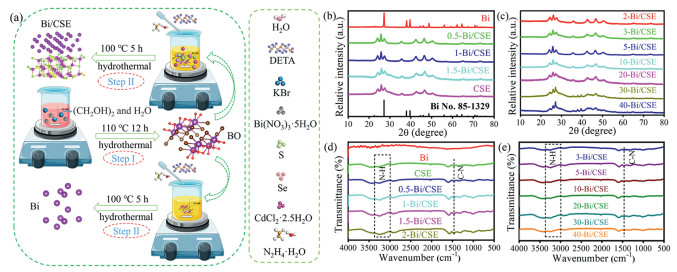
Figure 1.
(a) Synthesis process flowchart of Bi, BO, and Bi/CSE. (b, c) XRD patterns and (d, e) FT-IR spectra of Bi/CSE prepared with different Bi feeding ratios (0, 0.5, 1, 1.5, 2, 3, 5, 10, 20, 30, 40, and 100 wt%).

Enhanced photocatalytic hydrogen production and dichlorvos degradation via efficient charge transfer in Schottky-structured Bi/CdS0.25Se0.75-diethylenetriamine nanocomposites
Ao-Yun Meng , Juan Li , Zhen-Hua Li , Guo-Yuan Xiong , Yan Sun , Zhen Li , Jin-Feng Zhang , Chun-Sheng Li


Following the above findings summarized in the abstract, it is essential to place this work in the broader context of energy and environmental challenges. Accompanying the rapid development of industrialization and agricultural intensification, humanity is confronted with increasingly severe challenges of energy scarcity and environmental degradation [1-8]. Hydrogen, as a pristine energy carrier, has its photocatalytic synthesis widely acknowledged as one of the paramount avenues for sustainable advancement; concurrently, the copious application of pesticides in agricultural production, along with their residual deposits, has emerged as a critical menace to both ecological integrity and food security [9-16]. Hence, the design of avant‐garde photocatalytic materials that simultaneously facilitate energy generation and environmental remediation has ascended as a focal point in contemporary materials science research [17-25].
Conventional single semiconductor materials, such as TiO2 [19], ZnO [14], and CdSe [8,57], although endowed with inherent photocatalytic properties, suffer from deleterious issues including pronounced recombination rates of photogenerated electron–hole pairs, constricted spectral responsiveness, and suboptimal stability, thereby severely constraining their practical applicability [26-35]. To surmount these limitations, researchers have engineered composite materials via the coupling of disparate semiconductor constituents, thereby enhancing the overall photocatalytic efficiency [36-45]. For instance, prevalent architectures such as Type-Ⅱ, Z-scheme, and S-scheme heterojunctions exploit the optimization of interfacial band alignments to efficaciously segregate charge carriers and bolster catalytic performance [37]. Nonetheless, these semiconductor–semiconductor heterostructures remain beset by constraints such as limited interfacial charge transport efficiency and elevated interfacial resistances [46-52].
In contrast, the Schottky junction formed between metals and semiconductors has progressively garnered widespread attention due to its unique interfacial charge transfer mechanism. The Schottky structure, characterized by a robust built-in electric field, promotes the rapid separation and conveyance of photogenerated electron–hole pairs, substantially mitigating carrier recombination and thereby markedly enhancing both the catalytic efficiency and stability. Moreover, the incorporation of metallic species serves to broaden the light absorption spectrum of the material, further optimizing its photocatalytic performance [53-55].
Motivated by these insights, this work builds upon preceding investigations by in situ reducing BiOBr to elemental Bi, which was subsequently combined with modified CSE to form a stable and efficient Bi/CSE Schottky structure. This synergistic design integrating organic–inorganic hybridization with Schottky junctions is reported here for the first time. It is noteworthy that CSE was deliberately chosen as the basis, since previous studies have demonstrated that CSE exhibits the optimal photocatalytic hydrogen evolution activity, thereby providing a rational foundation for further modification [56]. In this system, the introduction of DETA not only significantly improves the stability and photocatalytic activity of the single photocatalyst but also enables the formation of an organic–inorganic hybrid material [8,57], while the coupling of Bi with CSE further establishes a Schottky junction that greatly enhances interfacial charge transfer efficiency. Experimental results demonstrate that Bi/CSE exhibits excellent performance in both photocatalytic hydrogen evolution and organophosphorus pesticide (dichlorvos) degradation: With 1% Bi precursor loading, 1-Bi/CSE achieves a hydrogen evolution rate of 5.6 mmol g-1 h-1, 3.1 times higher than pristine CSE (1.8 mmol g-1 h-1), while maintaining stable activity over five cycles (10 h); with 20% Bi precursor loading, 20-Bi/CSE degrades 85.2% of dichlorvos within 80 min, outperforming pristine Bi (58.9%) and CSE (47.6%), and retains high activity over five cycles (400 min). Further analyses including KPFM, XPS, fs-TAS, and theoretical calculations confirm that the enhanced performance originates from the synergistic effect between the organic–inorganic hybrid matrix and the Bi–CSE Schottky junction. This study not only proposes a new strategy that integrates Schottky structures with DETA modification, but also demonstrates for the first time its superior dual functionality in photocatalytic hydrogen evolution and organophosphorus pesticide degradation, providing new insights into the design and application of multifunctional photocatalysts for energy sustainability, environmental management, and food safety.
Based on the above considerations, the synthesis of the designed photocatalysts was first performed in order to verify the feasibility of the proposed strategy. As shown in Fig. 1a, we added a predetermined quantity of Bi(NO3)3·5H2O, KBr, and a specific volume of ethylene glycol ((CH2OH)2) to deionized water. The resulting suspension was stirred vigorously in a reaction vessel for 2 h, then subjected to a hydrothermal treatment at 110 ℃ for 12 h. Upon completion, the product was washed three times with deionized water and anhydrous ethanol, then subsequently freeze-dried for 18 h to yield high-purity BO. The precise reagent quantities are provided in Table S1 (Supporting information).
Building upon the aforementioned protocol, the synthesized BO was employed as the substrate. A predetermined quantity of hydrazine hydrate, DETA, and water was introduced into the system, which was stirred rigorously for 1 h to ensure complete homogenization. The mixture was then subjected to a hydrothermal treatment in an autoclave at 100 ℃ for 5 h, facilitating the in situ reduction of Bi3+ in BO to generate elemental Bi. Upon completion, the product was washed three times with deionized water to expunge residual impurities and subsequently freeze-dried for 18 h to yield high-purity metallic Bi. Moreover, if fixed amounts of Se, CdCl2·2.5H2O, and S are incorporated during the synthesis while adhering to the same conditions as for the Bi fabrication, Bi/CSE Schottky heterojunction nanocomposites can be produced. By modulating the feed ratio of BO, composites with varying proportions can be attained, thereby optimizing their photocatalytic performance. Furthermore, omitting BO under otherwise identical conditions permits the synthesis of pure CSE. Fig. 1a illustrates the synthesis process, and Table S1 (Supporting information) lists the reagent quantities.
Figs. 1b and c illustrate the X-ray diffraction (XRD) profiles of the synthesized Bi/CSE composite materials. The principal diffraction peaks corresponding to metallic bismuth are in complete concordance with those documented in the standard PDF card No. 85–1329, attesting to the high purity and exemplary crystallinity of the synthesized Bi. Concurrently, the diffraction patterns of the CSE support exhibit peak positions and morphologies that align with previously published data [56], thereby substantiating the successful synthesis of the CSE matrix. With the progressive increase in Bi loading, the diffraction peak intensities become markedly enhanced and evolve into sharper profiles, indicative of an increased deposition of Bi nanoparticles on the CSE substrate and an elevation in crystallinity. At lower Bi concentrations, the relatively feeble Bi diffraction signals tend to partially overlap with the peaks of the support; however, under higher Bi loading conditions, the crystalline peaks attributable to metallic Bi become conspicuously pronounced, confirming the successful deposition of Bi onto the CSE matrix, potentially accompanied by a moderate increase in crystallite size. This morphological evolution is crucial for augmenting light-harvesting efficiency and facilitating the separation of photogenerated charge carriers in photocatalytic processes.
Figs. 1d and e present the Fourier-transform infrared (FT-IR) spectra of the aforementioned composite series, covering a spectral range from 4000 cm-1 to 400 cm-1, thereby unveiling multiple characteristic absorption bands. Given that the CSE and Bi/CSE systems incorporate DETA as an organic modifier, a moiety replete with carbon, nitrogen, and hydrogen atoms, the spectra distinctly exhibit broad absorption bands associated with N–H and C–N vibrational modes. This spectral evidence not only corroborates the successful incorporation of DETA into the composite but also provides a robust foundation for optimizing the material’s surface chemical environment. Moreover, with increasing Bi content, subtle shifts in both the position and intensity of select vibrational bands are observed, implying potential interfacial interactions between the Bi nanoparticles and the CSE support. Such interactions are instrumental in modulating the active surface sites and expediting the charge separation and transfer processes integral to enhanced photocatalytic activity.
Fig. S1 (Supporting information) present a comprehensive XPS analysis of the surface chemical states and interfacial charge-transfer behaviors of CSE, Bi, and the Bi/CSE nanocomposites. As shown in Fig. S1a, the survey spectra obtained under dark conditions clearly display the characteristic peaks of Cd 3d, Se 3d, S 2p, and Bi 4f, confirming the coexistence of constituent elements in the composite. Although the survey spectra do not show a clear N 1s signal due to its low intensity, the high-resolution Cd 3d region (Fig. S1b) reveals a distinct N 1s peak, confirming the successful incorporation of DETA into CSE and validating the formation of the organic–inorganic hybrid. Meanwhile, both Cd 3d and Se 3d spectra (Figs. S1b and c) exhibit positive binding-energy shifts for 1-Bi/CSE relative to pristine CSE, and these shifts are further enhanced under illumination. This indicates reduced electron density around Cd and Se atoms, signifying electron migration from CSE to Bi under photoexcitation. Similarly, the S 2p spectra (Fig. S1d), deconvoluted into S 2p3/2 and S 2p1/2 components, also show consistent positive binding-energy shifts for 1-Bi/CSE compared with CSE, with more pronounced shifts under light. The fitted doublets more accurately describe the chemical state of sulfur, while the envelope peaks qualitatively support the same conclusion. Both results consistently demonstrate that S atoms lose electron density upon Bi coupling and illumination, further confirming interfacial electron transfer from CSE to Bi.
In the Bi 4f region, pristine Bi exhibits characteristic Bi0 and Bi3+ peaks (Fig. S1e). For 1-Bi/CSE, only Bi3+ peaks are observed and Bi0 signals are absent, which is attributed to the extremely low Bi loading leading to complete oxidation during measurement. In contrast, 20-Bi/CSE (Fig. S1f) shows clear Bi0 peaks, unambiguously verifying the presence of metallic Bi in the composite. Moreover, Bi 4f spectra of both 1-Bi/CSE and 20-Bi/CSE exhibit negative binding-energy shifts relative to pristine Bi, and these shifts are more significant under illumination. Taken together with the positive shifts of Cd, Se, and S, this provides strong evidence of interfacial electron redistribution: Bi becomes electron-rich while CSE becomes electron-deficient, consistent with the formation of a Schottky junction. Collectively, the coherent binding-energy shifts across all elements confirm effective electron migration from CSE to Bi, demonstrating that DETA incorporation enhances the intrinsic activity of CSE, while the Bi–CSE Schottky junction accelerates interfacial charge transfer. Such systematic binding-energy shifts not only reveal interfacial electron transfer but also provide direct evidence for the successful fabrication of the Bi/CSE nanocomposite.
After confirming the elemental composition and interfacial electronic interactions by XPS, the morphological and structural features of the samples were further examined. As depicted in Figs. S2a‒g (Supporting information), a systematic characterization of the morphology and microstructure of the CSE, metallic Bi, and the resultant Bi/CSE composite was conducted using scanning electron microscopy (SEM) and transmission electron microscopy (TEM). Specifically, Fig. S2a displays the SEM image of the CSE, which exhibits a rod-like aggregated morphology with a width of approximately 20 nm and localized lengths exceeding 1 μm. This configuration not only facilitates the subsequent deposition of metallic constituents but also provides an extensive SBET that is conducive to photocatalytic reactions. Fig. S2b presents the SEM image of Bi, revealing an agglomerated or flocculent assembly with dimensions surpassing 200 nm; however, certain regions display particulate structures, ostensibly resulting from the accumulation of numerous nanoparticles. If Bi exists in a nanoparticulate form, then upon coupling with the CSE, these Bi particles would effectively interface with the substrate, thereby establishing heterojunctions. Fig. S2c illustrates the SEM image of the 1-Bi/CSE nanocomposite, wherein the formation of Bi nanoparticles is conspicuously manifested during synthesis, with the nanoparticles being uniformly dispersed and not excessively agglomerated, intertwining with the CSE support—a configuration that abbreviates the migration path of photogenerated charge carriers at the nanoscale and consequently augments charge separation efficiency.
The TEM analysis corroborates the aforementioned morphological features. Figs. S2d and e display the TEM images of the CSE and Bi, respectively; the former elucidates the strip-like microstructural details of the CSE, while the latter reveals that Bi is characterized by relatively compact agglomerated particles. Fig. S2f, pertaining to the Bi/CSE composite, further demonstrates that Bi nanoparticles adhere intimately to the surface of the CSE matrix. The high-resolution TEM (HRTEM) image (Fig. S2g) distinctly identifies the lattice coherence and interfacial interactions between Bi and CSE, thereby providing direct evidence for the efficient charge transfer within this composite system during photocatalytic processes.
Furthermore, Figs. S2h–m (Supporting information) exhibit the TEM mapping of the Bi/CSE composite, delineating the spatial distribution of C, Se, S, Cd, N, and Bi. The uniform dispersion of Se, S, and Cd is intimately associated with the CSE framework, whereas the Bi element is predominantly concentrated in the loaded regions, indicating that the employed synthesis strategy has effectively amalgamated metallic Bi with the CSE support. This coexistence of multiple elements and the intimate interfacial contact not only expedites the separation of photogenerated electron–hole pairs but also furnishes additional active sites during reactions, which is pivotal for enhancing the degradation of organic contaminants or promoting photocatalytic water splitting. To further observe the structural coupling between Bi nanoparticles and CSE nanorods, TEM morphological tracing was performed at the 1-Bi/CSE composite interface (Fig. S3 in Supporting information). Fig. S3 clearly reveals the stacking of rod-like structures with nanoparticles. A few cases of rod–particle coupling were identified and subjected to HRTEM imaging, as exemplified in Fig. S2g, with the tracing process also involving TEM elemental mapping.
After establishing the morphological and structural characteristics of the Bi/CSE composites, their photocatalytic performance was systematically evaluated. Figs. 2a–c comprehensively delineate the photocatalytic hydrogen evolution performance, stability, and photoresponse of CSE, Bi, and various Bi/CSE nanocomposites under visible light irradiation. As illustrated in Fig. 2a, pristine CSE manifests a hydrogen production rate of approximately 1.8 mmol g-1 h-1, whereas pure Bi exhibits virtually negligible hydrogen evolution activity. With incremental increases in Bi doping, the hydrogen evolution activity of the Bi/CSE composites initially surges before subsequently diminishing; at a Bi feeding ratio of 1%, the activity attains an apex of roughly 5.6 mmol g-1 h-1. This observation indicates that at this particular ratio, the heterojunction interface achieves an optimal confluence of bandgap alignment and charge transfer efficiency. Further augmentation of the Bi content, however, deleteriously affects the catalytic performance, presumably owing to the excessive introduction of recombination centers or the occlusion of active sites. Additionally, Fig. 2b presents the kinetic curve for hydrogen evolution, which mirrors the trend observed in the bar graph, thereby further substantiating that the 1-Bi/CSE sample exhibits markedly superior photocatalytic performance relative to the other investigated specimens.
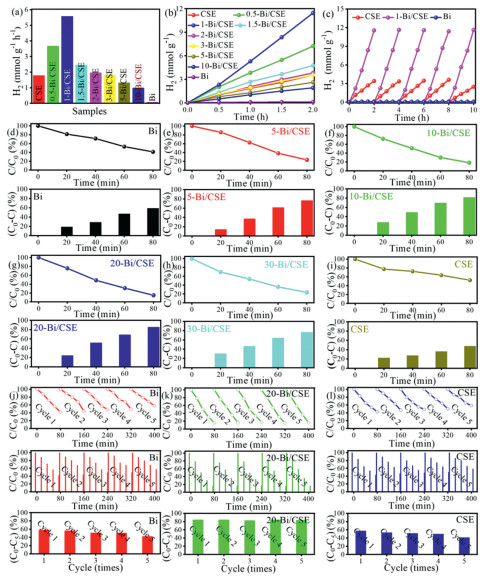
The cyclic experiments depicted in Fig. 2c reveal that the 1-Bi/CSE sample retains high stability over five successive cycles, demonstrating exceptional durability and pronounced resistance to photocorrosion. In stark contrast, pure Bi persistently displays extremely low activity, reinforcing the notion that the judicious incorporation of a modest amount of Bi significantly bolsters the catalyst’s robustness. Furthermore, the photoelectrochemical measurements showcased in Fig. S4a (Supporting information) indicate that the photocurrent density of the 1-Bi/CSE sample is substantially elevated compared to that of pristine CSE and pure Bi. This evidences that the Bi/CSE heterojunction efficaciously facilitates the separation and transfer of photogenerated charge carriers, thereby markedly augmenting the photoelectric conversion efficiency and overall photocatalytic hydrogen evolution activity. In summation, the strategic doping of an optimal amount of Bi can effectively ameliorate the band structure alignment and charge transport properties of the CSE catalyst, culminating in enhanced photocatalytic hydrogen evolution performance and superior long-term stability.
Figs. 2d‒i systematically illustrate the influence of Bi doping concentration on the photocatalytic degradation efficacy of the Bi/CSE nanocomposites for degrading DDVP, in juxtaposition with pure Bi and CSE. As depicted in Figs. 2d‒i and Fig. S4b (Supporting information), pure Bi and CSE intrinsically manifest certain degradation activity for DDVP, achieving degradation rates of 58.9% and 47.6% within 80 min, respectively. Upon Bi incorporation, the degradation performance of the composites is markedly augmented, displaying a progressive improvement with increasing Bi content, and peaking at an 85.2% degradation efficiency when the feeding ratio reaches 20%. At this juncture, the elevated Bi content likely engenders a more abundant heterojunction interface and a greater density of surface active sites, which efficaciously facilitate the separation and migration of interfacial charge carriers, thereby significantly amplifying the generation of potent oxidizing species.
Figs. 2j–l visually demonstrate the cyclic performance of the photocatalysts, further confirming that the Bi/CSE nanocomposite exhibits significantly enhanced stability compared to pure Bi and CSE under prolonged cycling conditions. As shown in Figs. 2j–l, cyclic experiments reveal that the degradation performance of pure Bi and CSE diminishes substantially after five cycles, retaining merely approximately 72.7% and 72.5% of their initial activity, respectively, whereas the 20-Bi/CSE sample remarkably maintains 99.3% of its original degradation efficiency, underscoring its exceptional stability. Furthermore, as shown in Figs. S4c–e (Supporting information), the XRD patterns of Bi, CSE, as well as 1-Bi/CSE and 20-Bi/CSE, exhibit only slight sharpening of diffraction peaks after cycling, which can be attributed to partial recrystallization. Apart from this minor change, the overall diffraction patterns remain essentially unchanged, confirming the crystalline stability of all three systems. It should be noted that although the intrinsic photocatalytic stability of pure Bi and pristine CSE is relatively poor due to photocorrosion and structural degradation during long-term operation, their fundamental crystal frameworks are highly stable. By contrast, the Bi/CSE composites not only inherit this inherent crystallographic robustness but also benefit from the synergistic effect of the organic–inorganic hybrid framework and the Schottky junction, which effectively suppresses photocorrosion and improves overall durability. This demonstrates that the enhanced performance of the Bi/CSE composites is derived from both the stable crystalline structures and the interfacial electron transfer advantages afforded by the composite design. In sum, through the judicious modulation of the Bi doping concentration, it is feasible to achieve differentiated performance optimization of Bi/CSE composites for both photocatalytic hydrogen evolution and degradation applications, offering an efficacious strategy for the development of multifunctional photocatalytic materials.
After verifying the structural stability of the composites, their photophysical properties were further investigated to elucidate charge-carrier dynamics. As shown in Fig. S4f (Supporting information), the photoluminescence (PL) spectra reveal that pristine Bi exhibits the strongest emission intensity, indicative of significant carrier recombination, while pure CSE shows the weakest PL response, attributed to its poor light-excitation capability. With increasing Bi content in the composites, the PL intensity gradually decreases, signifying progressive suppression of electron–hole recombination. It is generally recognized that excessively strong PL corresponds to rapid carrier recombination, whereas excessively quenched PL may reflect insufficient light absorption. Hence, a moderate PL intensity often represents an optimal balance between light absorption and charge separation, which can lead to higher photocatalytic efficiency.
Fig. S4g (Supporting information) systematically characterizes the SBET and pore structure attributes of CSE, Bi, and various Bi/CSE nanocomposites via Brunauer-Emmett-Teller (BET) analysis, thereby providing critical structural insights to elucidate the performance disparities observed in photocatalytic hydrogen evolution and DDVP degradation. As shown in Fig. S4g, the SBET of CSE, 1–Bi/CSE, 10–Bi/CSE, 20–Bi/CSE, 30–Bi/CSE, and pure Bi are determined to be 45.29, 62.08, 52.08, 33.29, 16.31, and 1.75 m2/g, respectively. Notably, 1–Bi/CSE exhibits the highest SBET, implying that the judicious incorporation of a moderate amount of Bi significantly enhances the dispersion of nanocrystals and mitigates particle agglomeration. This improvement substantially increases the density of accessible catalytic active sites and mass transfer efficiency, thereby facilitating the generation and desorption of hydrogen molecules during the photocatalytic hydrogen evolution process, which translates into superior catalytic performance. Conversely, with further increases in Bi content, the SBET progressively diminishes, primarily due to exacerbated particle aggregation that renders the material structure more compact, thus reducing the effective contact area. Interestingly, despite its relatively lower SBET, 20–Bi/CSE manifests the optimum activity in the photocatalytic degradation of DDVP; this is likely attributable to the enriched heterojunction interfaces afforded by a higher Bi loading, which markedly promote the separation and transport of photogenerated charge carriers and, in turn, elevate the generation efficiency of potent oxidizing species, achieving high degradation efficiency even under a diminished surface area.
Fig. S4h (Supporting information) displays the nitrogen adsorption–desorption isotherms, where all samples exhibit a prototypical Type Ⅳ isotherm accompanied by a pronounced hysteresis loop, unambiguously reflecting their mesoporous characteristics (with the inset in Fig. S4h indicating that the majority of pores are distributed in the range of 2–50 nm, consistent with a mesoporous structure). The presence of a mesoporous framework is conducive to the rapid adsorption and diffusion of reactants, thereby enhancing the effective interaction between the reactants and catalytic active sites and ultimately optimizing the overall photocatalytic performance. These findings underscore that an appropriate SBET and pore structure are quintessential for achieving high-efficiency photocatalytic degradation and hydrogen evolution reactions.
Finally, the UV–vis diffuse reflectance spectra in Fig. S4i (Supporting information) show that CSE exhibits stronger visible-light absorption than Bi, while the absorption of Bi/CSE nanocomposites gradually approaches that of Bi with increasing Bi content, resulting in a general decrease in absorption intensity. This trend indicates that excessively strong absorption may lead to recombination losses, whereas overly weak absorption restricts photon utilization. Thus, an appropriate absorption strength combined with efficient charge separation is essential for achieving superior photocatalytic performance. By integrating the PL results that demonstrate enhanced charge-carrier separation, the BET analysis that reveals optimized surface area and mesoporous structures, and the UV–vis spectra that illustrate tunable light-harvesting behavior, it can be concluded that the synergistic effect of Schottky junctions and organic–inorganic hybridization not only balances light absorption with charge dynamics but also enhances the structural stability of the composites. Together with the experimental evidence of high hydrogen evolution and pesticide degradation activities, as well as excellent cycling stability, these findings confirm that the outstanding bifunctional photocatalytic performance of Bi/CSE originates from the multiple enhancements in optical, electronic, and structural properties provided by this synergistic strategy.
To further elucidate the charge-separation efficiency and carrier stability beyond the morphological, structural, and performance characterizations, femtosecond transient-absorption (fs-TAS) spectroscopy was employed. Figs. 3a–c show the fs-TAS spectra and carrier dynamics of pristine CSE. In Fig. 3a, a pronounced ground-state-bleach (GSB) appears at 571 nm, consistent with the alloy bandgap (~2.05 eV, ~600 nm), indicating population of states near the CBM/VBM and attenuation of ground-state absorption. Fig. 3b reveals that the bleach remains centered at 571 nm with an initial amplitude of –40 mOD, gradually recovering toward baseline from 160 fs to 250 ps. The kinetic trace at 571 nm in Fig. 3c recovers over hundreds of picoseconds, evidencing a long recombination lifetime in the undoped sample.
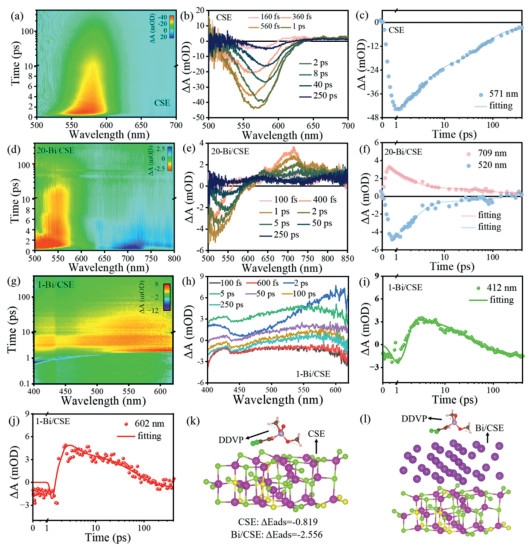
Figs. 3d–f present 20-Bi/CSE. In Fig. 3d, a GSB at 520 nm decays within a few picoseconds, while a persistent positive band emerges at 709 nm. Spectral cuts (Fig. 3e) confirm a rapid ~2 ps decay of the 520 nm bleach and a long-lived growth at 709 nm. Kinetic fitting (Fig. 3f) shows an initial –4.5 mOD bleach at 520 nm that vanishes within ~10 ps, whereas the 709 nm positive signal is markedly long-lived.
Figs. 3g–j summarize 1-Bi/CSE. Fig. 3g displays a broad positive absorption across 460–620 nm with an early negative feature at 412 nm that quickly inverts. Consistently, Fig. 3h shows positive excited-state absorption (ESA) dominating the visible range from 100 fs to hundreds of picoseconds. The 412 nm kinetics (Fig. 3i) invert from negative to positive within 1–2 ps, indicating ultrafast interfacial charge separation. At 602 nm (Fig. 3j), the positive signal rises to ~+5 mOD at 2–3 ps and decays only slowly beyond 200 ps, indicating efficient electron extraction into Bi with long-lived holes on the semiconductor side and little persistent band-edge bleach.
Taken together, these spectral features provide clear evidence of loading-dependent charge-transfer behavior. Comparison among CSE, 1-Bi/CSE, and 20-Bi/CSE reveals that Bi deposition establishes a Schottky junction at the semiconductor/metal interface, enhancing the built-in field and accelerating electron injection into Bi. Accordingly, the band-edge GSB of CSE is rapidly quenched in the composites, while long-lived positive bands appear and red-shift/strengthen with Bi loading (≈602 nm in 1-Bi/CSE; ≈709 nm in 20-Bi/CSE), indicative of persistent hole populations and ESA. The kinetics follow a two-regime model: Sub-ps–few-ps carrier cooling and electron transfer (responsible for the 412 nm sign inversion in 1-Bi/CSE and the fast 520 nm bleach decay in 20-Bi/CSE), followed by hundreds-of-ps hole retention on CSE (sustained positive ΔA at 602–709 nm) with electrons accumulated on Bi for reduction reactions. This spectroscopic picture is consistent with Figs. 3k–l: DFT calculations reveal stronger adsorption of DDVP on Bi/CSE (ΔEads = –2.556 eV) than on CSE (ΔEads = –0.819 eV), rationalizing enhanced surface activation at the electron-rich Bi/semiconductor junction and the role of long-lived holes. Thus, although the bleach lifetime becomes shorter upon Bi addition, the charge-separated state is significantly prolonged in the composites, which is the decisive factor correlating with photocatalytic activity.
In addition, distinct and systematic differences are observed. CSE is dominated by a long-lived 571 nm bleach. 1-Bi/CSE shows little persistent band-edge bleach but a long-lived positive band near 602 nm, accompanied by an early 412 nm inversion, reflecting rapid electron extraction and a moderate interfacial field. 20-Bi/CSE exhibits a 520 nm bleach that decays within ~2–10 ps, along with the strongest and most persistent positive band at 709 nm, indicative of stronger band bending and more complete electron injection. Therefore, with increasing Bi loading, the bleach decays faster while the positive absorption red-shifts and persists longer, reflecting systematic modulation of charge separation and recombination dynamics by Bi content.
To further uncover the origin of the outstanding photocatalytic activity beyond morphology, performance, and XRD analyses, we resolved the directionality of interfacial charge transfer and the working mechanism by combining theory with in situ measurements. The differential charge density (Fig. 4a) clearly shows electron accumulation on the Bi side and depletion on the CSE side, indicating that electrons flow from CSE to Bi upon contact and establish a built-in electric field across the junction directed from CSE to Bi. To validate this directionality experimentally, in situ KPFM was performed (Figs. 4b–e). The AFM topography (Fig. 4b) reveals a well-defined Bi/CSE interface; surface-potential maps in the dark (Fig. 4c) and under illumination (Fig. 4d), together with the A–B line profile (Fig. 4e), show that the mean surface potential decreases from about 486 mV to 398 mV, yielding a surface photovoltage (SPV) of –88 mV. This negative SPV demonstrates that photoexcited electrons migrate from the CSE semiconductor to the Bi metal while holes remain in CSE, consistent with Schottky-type charge separation.
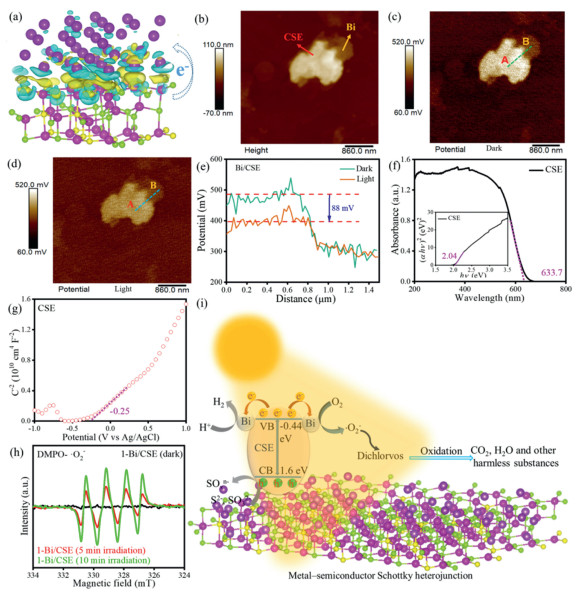
Complementary optical and electrochemical characterizations are summarized in Figs. 4f–h: The UV–vis diffuse reflectance spectrum (Fig. 4f) evidences broad absorption from 200 nm to 600 nm with an absorption edge at about 633.7 nm; Tauc analysis gives a bandgap of 2.04 eV. Using the Mulliken electronegativity method, the conduction- and valence-band positions of CSE are estimated to be –0.44 V and +1.60 V vs. NHE, respectively, in good agreement with the Mott–Schottky plot (Fig. 4g, positive slope for n-type; flat-band potential –0.25 V), consistent with the typical 0.1–0.3 V offset between the flat-band and CB edge. Electron paramagnetic resonance (Fig. 4h) shows ·O2– signals that arise under illumination and increase with irradiation time, indicating continuous reduction of dissolved O2 by electrons accumulated on Bi.
On the basis of these results, Fig. 4i depicts the working mechanism of the Bi/CSE Schottky heterojunction: Under visible light, electrons excited in CSE are rapidly injected into and enriched on Bi to reduce O2 to ·O2– radicals and to drive H2 evolution, while the holes retained in CSE participate in the oxidation of organics such as DDVP and/or in hydroxyl radical generation. Directional charge separation across the Schottky junction thus suppresses recombination and synergistically enhances both pollutant degradation and hydrogen evolution.
Building on the preceding results of photocatalytic performance and mechanistic studies, in summary, constructing an organic–inorganic hybrid-based Schottky heterostructure of Bi/CSE provides a practical strategy to simultaneously enhance photocatalytic hydrogen evolution and dichlorvos degradation, with its key mechanism lying in the accelerated separation of photogenerated charge carriers enabled by this structure. At a Bi precursor loading of only 1%, the 1-Bi/CSE catalyst achieves a hydrogen evolution rate of 5.6 mmol g-1 h-1, approximately 3.1 times that of pristine CSE, while maintaining excellent stability over multiple cycles. With 20% Bi precursor loading, the 20-Bi/CSE sample reaches 85.2% dichlorvos degradation within 80 min and shows negligible activity decay during prolonged cycling. fs-TAS, KPFM, XPS, and theoretical calculations consistently confirm that the Bi/CSE–DETA interface drives directional electron transfer from CSE to metallic Bi, thereby suppressing carrier recombination and enhancing pollutant adsorption. Overall, this study demonstrates that organic–inorganic hybrid-based Schottky heterostructures hold significant potential for sustainable energy conversion and environmental remediation.
Ao-Yun Meng: Writing – original draft, Conceptualization. Juan Li: Investigation, Conceptualization. Zhen-Hua Li: Conceptualization. Guo-Yuan Xiong: Funding acquisition. Yan Sun: Data curation. Zhen Li: Writing – review & editing, Methodology, Funding acquisition. Jin-Feng Zhang: Software, Funding acquisition. Chun-Sheng Li: Software, Methodology.
The authors declare that they have no known competing financial interests or personal relationships that could have appeared to influence the work reported in this paper.
This research received funding from several sources: the National Natural Science Foundation of China (No. 42407636), the Excellent Research and Innovation Team of Anhui Province Universities in 2024 (No. 2024AH010007), the Project of Science and Technology Innovation Team of Anhui Science and Technology University (No. 2023KJCXTD003), Anhui Province Outstanding Young Teachers Cultivation Program (No. YQZD2025064), the Anhui Province Discipline (specialty) Professional Leader Cultivation Project (No. DTR2024015), the Natural Science Research Project for Colleges and Universities in Anhui Province (No. 2023AH051861), the Talent Introduction Foundation of Anhui Science and Technology University (No. SPYJ202201), the Anhui Province Key Laboratory for Control and Application of Optoelectronic Information Materials (No. OIM-2024-04).
Supplementary material associated with this article can be found, in the online version, at doi:
J.N. Lu, S.N. Gu, H.D. Li, et al., J. Mater. Sci. Technol. 160 (2023) 214–239. doi: 10.1016/j.jmst.2023.03.027
J. Wang, Z.L. Wang, K. Dai, et al., J. Mater. Sci. Technol. 165 (2023) 187–218. doi: 10.1016/j.jmst.2023.03.067
L.X. Wang, J. Sun, B. Cheng, et al., J. Phys. Chem. Lett. 14 (2023) 4803–4814. doi: 10.1021/acs.jpclett.3c00811
B.C. Zhu, C.J. Jiang, J.S. Xu, et al., Mater. Today 82 (2025) 251–273. doi: 10.1016/j.mattod.2024.11.012
B.C. Zhu, J. Sun, Y.Y. Zhao, et al., Adv. Mater. 36 (2024) 2310600. doi: 10.1002/adma.202310600
C. Cheng, J.J. Zhang, B.C. Zhu, et al., Angew. Chem. Int. Ed. 62 (2023) e202218688. doi: 10.1002/anie.202218688
X.W. Ruan, D.P. Meng, C.X. Huang, et al., Adv. Mater. 36 (2024) 2309199. doi: 10.1002/adma.202309199
Z. Li, W. Liu, C.X. Chen, et al., Acta Phys. Chim. Sin. 39 (2023) 2208030.
T. Zhou, X. Han, W.W. Shen, et al. Chin. Chem. Lett. 36 (2025) 110415. doi: 10.1016/j.cclet.2024.110415
W. Li, A.Y. Meng, C.S. Li, et al., J. Colloid Interface Sci. 677 (2025) 704–717.
Y.M. Xia, Z.M. He, G. He, et al. Chin. Chem. Lett. 36 (2025) 111521. doi: 10.1016/j.cclet.2025.111521
W.J. Fang, J.W. Yan, Z.D. Wei, et al., Chin. J. Catal. 60 (2024) 1–24.
Z. Liu, Y.Q. Bian, G. Dawson, J.W. Zhu, K. Dai. Chin. Chem. Lett. 36 (2025) 111272. doi: 10.1016/j.cclet.2025.111272
Z.C. Jiang, B. Cheng, L.Y. Zhang, et al., Chin. J. Catal. 52 (2023) 32–49. doi: 10.1016/S1872-2067(23)64502-4
F. Kolahdouzan, N. Goodarzi, M. Setayeshmehr, et al., Chin. J. Catal. 70 (2025) 230–259. doi: 10.1016/S1872-2067(24)60214-7
A. Krishnan, K. Archana, A.S. Arsha, et al., Chin. J. Catal. 68 (2025) 103–154. doi: 10.1016/S1872-2067(24)60156-7
W.H. Wang, G.P. Zhang, Q.F. Wang, Chin. Chem. Lett. 35 (2024) 109193. doi: 10.1016/j.cclet.2023.109193
G.X. Liu, R.D. Chen, B.Q. Xia, et al., Chin. J. Catal. 61 (2024) 97–110. doi: 10.1016/S1872-2067(24)60014-8
W.K. Wang, S.B. Mei, H.P. Jiang, et al., Chin. J. Catal. 55 (2023) 137–158. doi: 10.1016/S1872-2067(23)64551-6
X.Y. Liu, K.L. Wu, Y.C. Tang, et al. Chin. Chem. Lett. 36 (2025) 110882. doi: 10.1016/j.cclet.2025.110882
C.Y. Yang, Q.Y. Rong, F.Y. Shi, et al. Chin. Chem. Lett. 35 (2024) 109767. doi: 10.1016/j.cclet.2024.109767
B.B. Zhao, W. Zhong, F. Chen, et al., Chin. J. Catal. 52 (2023) 127–143. doi: 10.1016/S1872-2067(23)64491-2
M. Eshete, X.Y. Li, L. Yang, et al., Small Sci. 3 (2023) 2200041. doi: 10.1002/smsc.202200041
K.L. Huang, C.H. Li, H.Z. Li, et al., ACS Appl. Nano Mater. 3 (2020) 9581–9603. doi: 10.1021/acsanm.0c02481
K.H. Leong, A. Abd Aziz, L.C. Sim, et al., Beilstein J. Nanotechnol. 9 (2018) 628–648. doi: 10.3762/bjnano.9.59
Y.F. Li, M.H. Zhou, B. Cheng, et al., J. Mater. Sci. Technol. 56 (2020) 1–17.
C. Liu, C. Kong, F.J. Zhang, et al., J. Korean Ceram. Soc. 58 (2021) 135–147. doi: 10.1007/s43207-020-00103-3
M.J. Molaei, J. Am. Ceram. Soc. 107 (2024) 5695–5719. doi: 10.1111/jace.19920
C. Mondal, Oriental J. Chem. 40 (2024) 374–391. doi: 10.13005/ojc/400208
A.A. Oladipo, F.S. Mustafa, Beilstein J. Nanotechnol. 14 (2023) 291–321. doi: 10.3762/bjnano.14.26
L. Paramanik, S. Subudhi, K.M. Parida, Mater. Res. Bull. 155 (2022) 111965. doi: 10.1016/j.materresbull.2022.111965
S. Patnaik, D.P. Sahoo, K. Parida, Renew. Sustain. Energy Rev. 82 (2018) 1297–1312. doi: 10.1016/j.rser.2017.09.026
C. Prasad, X.F. Yang, Q.Q. Liu, et al., J. Ind. Eng. Chem. 85 (2020) 1–33.
B. Rhimi, C.Y. Wang, D.W. Bahnemann, J. Phys. Energy 2 (2020) 042003. doi: 10.1088/2515-7655/abb782
F. Almomani, A. Al-Rababah, M. Tawalbeh, et al., Fuel 332 (2023) 125905. doi: 10.1016/j.fuel.2022.125905
L. Biswal, R. Mohanty, S. Nayak, et al., J. Environ. Chem. Eng. 10 (2022) 107211. doi: 10.1016/j.jece.2022.107211
Y.J. Bao, S.Q. Song, G.J. Yao, et al., Sol. RRL 5 (2021) 2100118. doi: 10.1002/solr.202100118
W.K. Chong, B.J. Ng, L.L. Tan, et al., Energy Fuels 36 (2022) 4250–4267. doi: 10.1021/acs.energyfuels.2c00291
J. Cui, Y. Ge, P. Li, et al., China Ceram. 57 (2021) 9–18.
A.A. Fauzi, A.A. Jalil, N.S. Hassan, et al., Chemosphere 286 (2022) 131651. doi: 10.1016/j.chemosphere.2021.131651
Z. Geng, Y. Wang, Z. Yang, New Chem. Mater. 49 (2021) 269–274, 279. doi: 10.3934/dcdsb.2020140
X.H. He, T.H. Kai, P. Ding, Environ. Chem. Lett. 19 (2021) 4563–4601. doi: 10.1007/s10311-021-01295-8
X. Li, Y. Bai, X. Shi, et al., Mater. Adv. 2 (2021) 1570–1594. doi: 10.1039/d0ma00938e
D. Long, J. Zhou, H. Shi, et al., Chem. Ind. Eng. Prog. 38 (2019) 2756–2767.
S. Roy, ACS Appl. Mater. Interfaces 12 (2020) 37811–37833. doi: 10.1021/acsami.0c11245
V. Soni, P. Singh, Q.H.H. Phan, et al., Chemosphere 293 (2022) 133541. doi: 10.1016/j.chemosphere.2022.133541
Sonu, V.D., S. Sharma, et al., J. Saudi Chem. Soc. 23 (2019) 1119–1136. doi: 10.1016/j.jscs.2019.07.003
G. Wang, Z. Liu, X. Liu, Chemistry 76 (2013) 689–697.
X. Wang, G. Zhang, L. Yang, et al., Wiley Interdiscip. Rev. Comput. Mol. Sci. 8 (2018) e1369. doi: 10.1002/wcms.1369
H.T. Yu, X. Quan, Prog. Chem. 21 (2009) 406–419.
Q.P. Zhang, J. Li, M. Xu, J. Phys. D Appl. Phys. 55 (2022) 483001. doi: 10.1088/1361-6463/ac941a
X.L. Zheng, Y.Q. Yang, Y.M. Song, et al., Interdiscip. Mater. 2 (2023) 669–688. doi: 10.1002/idm2.12120
Q. Fan, L. Zhong, L. Feng, et al., Mater. Rev. 31 (2017) 106–111.
A. Sherryna, M. Tahir, ACS Appl. Energy Mater. 4 (2021) 11982–12006. doi: 10.1021/acsaem.1c02241
K. An, J.T. Hu, J.F. Wang, Phys. Chem. Chem. Phys. 25 (2023) 19358–19370. doi: 10.1039/d3cp01425h
A.Y. Meng, R.Q. Yang, W. Li, et al., J. Materiomics. 11 (2025) 1009199.
W. Li, A.Y. Meng, Z. Li, et al., J. Cent. South Univ. 31 (2024) 4572–4585. doi: 10.1007/s11771-024-5838-6

Figure 1 (a) Synthesis process flowchart of Bi, BO, and Bi/CSE. (b, c) XRD patterns and (d, e) FT-IR spectra of Bi/CSE prepared with different Bi feeding ratios (0, 0.5, 1, 1.5, 2, 3, 5, 10, 20, 30, 40, and 100 wt%).

Figure 2 (a) Photocatalytic H2 evolution rates for CSE, Bi, and various Bi/CSE. (b) Time-dependent H2 production curves for CSE and different Bi/CSE samples. (c) Cycling tests of H2 evolution for CSE, 1-Bi/CSE, and Bi. photocatalytic degradation curves for (d) Bi, (e) 5-Bi/CSE, (f) 10-Bi/CSE, (g) 20-Bi/CSE, (h) 30-Bi/CSE, (i) CSE. Photocatalytic cycling curves for (j) Bi, (k) 20-Bi/CSE, (l) CSE.

Figure 3 Femtosecond transient absorption spectra, kinetic traces, and fitting analyses for (a‒c) pristine CSE, (d‒f) 20-Bi/CSE and (g‒j) 1-Bi/CSE. (k) Calculated DDVP adsorption energy on CSE. (l) Calculated DDVP adsorption energy on pristine Bi/CSE.

Figure 4 (a) Differential charge density of the Bi/CSE nanocomposite. Atomic force microscopy (AFM) height image of the 20-Bi/CSE heterojunction: (b) KPFM surface-potential maps, (c) dark and (d) light. (e) Surface-potential profile along the designated A–B line. (f) UV–vis DRS spectrum with corresponding Tauc plot of CSE. (g) Mott–Schottky analysis of the CSE. (h) EPR spectra of 1-Bi/CSE for ·O2– detection in dark and under light. (i) Schematic of the metal–semiconductor Schottky junction.

 扫一扫看文章


扫一扫关注我们
 DownLoad:
 下载:
 下载: