Received Date:
10 July 2025 Accepted Date:
29 September 2025 Revised Date:
23 September 2025 Available Online:
15 January 2026
Abstract:
Catalysts are key for olefin polymerization reactions and are also ubiquitous in catalysis science. Multi-nuclear metal catalysts have witnessed enhanced performances in catalytic reactions relative to mono-nuclear catalysts, but which substantially involve multi-step, tedious, and difficult synthesis. Herein, this study reports an intriguing approach to construct multi-nuclear catalysts for the milestone α-diimine nickel catalysts using an oligomeric strategy. A polymerizable norbornene unit is incorporated into the α-diimine ligand backbone, leading to the formation of the monomeric nickel catalyst Ni1 and its corresponding oligomeric nickel catalysts (Ni3 and Ni5) with varying degrees of polymerization (DP = 3 and 5). Notably, the oligomeric catalyst Ni5 was facilely scaled up (50 g-level), showed enhanced thermal stability, exhibited 4.6 times higher activity, and yielded polyethylene elastomer with a 379% increased molecular weight in ethylene polymerization, compared to the monomeric catalyst Ni1. Catalytic performance enhancements of oligomeric catalysts were found to be DP-dependent. The kilogram-scale polyethylene, produced using Ni5 in a 20 L reactor, presented a highly branched all-hydrocarbon structure, which demonstrated typical elastic properties (tensile strength: 4 MPa, elastic recovery: SR = 72%) along with great processability (MFI = 3.0 g/10 min), insulating characteristics (volume resistivity = 2 × 10¹⁶ Ω/m), and hydrophobicity (water vapor permeability: 0.03 g/m2/day), suggesting potentially practical applications.
The advancement of olefin polymerization technologies has been fundamentally driven by continuous innovations in organometallic catalysts. Following Ziegler and Natta’s groundbreaking discovery of Ti-based catalysts in the 1950s, the field has witnessed successive generations of catalytic systems ranging from Phillips catalysts to metallocene catalysts and post-metallocene catalysts [1–7]. These breakthroughs in catalyst technology have notably propelled the development of the global polyolefin industry [8].
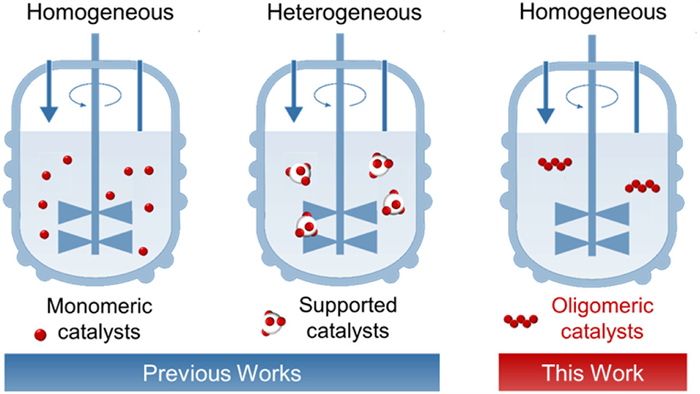
Olefin polymerization employs two principal methodologies: homogeneous solution processes and heterogeneous gas/slurry-phase systems (Fig. 1). Homogeneous catalysis, typically mediated by solvent-soluble molecular catalysts such as metallocenes, excels in producing low-crystallinity plastomers and elastomers [9,10]. This method is not optimal for semi-crystalline polyolefins such as high-density polyethylene (HDPE) and isotactic polypropylene (iPP), where these polymers are insoluble in the reaction medium. To prevent reactor fouling and ensure smooth operations, morphologically uniform polymer particles are required, thereby enabling a continuous process [11,12]. As such, it becomes pertinent to prepare immobilized catalysts by combining the catalyst with inorganic or organic supports, through covalent [13–15], ionic [16–20], or hydrogen bonding [21]. However, immobilization of catalysts often negatively affected their performance especially for catalytic activity [22,23]. Particularly for late transition metal catalysts (e.g., α-diimine Ni(Ⅱ) systems) that exhibit chain-walking behavior [24–37], immobilization on either silica or other inorganic support often suppresses the characteristic branching density, diminishing the unique elastomeric properties of resultant polyethylenes [38,39].
Figure 1
Figure 1.
Synopsis of olefin catalytic polymerization type. Homogeneous solution polymerization using monomeric catalysts, heterogeneous gas-phase or slurry-phase polymerization using supported catalysts (previous works), and oligomeric catalysts promoted homogeneous solution polymerization (this work).
Recently, in terms of the important role of multi-nuclear catalysts in enhancing olefin polymerization, polymeric catalysts have garnered interest as an innovative catalyst design approach [40–46]. Unlike traditional multi-nuclear catalysts that always require multi-step, tedious, and difficult synthesis, polymeric catalysts offered a more straightforward synthesis, facilitating the transition from mono-nuclear to multi-nuclear catalyst through polymerizable groups such as the common unsaturated double bonds. Representative advances included poly(norbornene-graft-styrene)-supported Ti and Zr phenoxy-imine catalysts, demonstrating one order of magnitude higher activity over monomeric analogues in ethylene polymerization [47], and styrene-derived polymeric α-diimine Pd(Ⅱ) catalysts, achieving improved tolerance to polar comonomers, leading to higher activities as well as higher molecular weights in ethylene–methyl acrylate copolymerization [46].
In this study, we report a strategy of oligomeric Ni(Ⅱ) catalysts for chain walking ethylene polymerization. Through rational introduction of polymerizable norbornene moiety into the milestone α-diimine Ni(Ⅱ) catalyst, we achieved a control over catalyst oligomerization via ring-opening metathesis polymerization (ROMP) (Fig. 2a). Through the control of the degree of polymerization (DP) of the oligomeric catalysts, two highly active Ni(Ⅱ) catalysts were prepared. Notably, compared to their monomeric nickel counterpart, the oligomeric variants exhibited remarkable improvements in both catalytic activity and polymer molecular weight. By using a 20 L polymerization reactor, a kilogram scale of polyethylene (PE) elastomer was successfully produced in an activity level of 107 g mol-1 h-1. Notably, these polyethylenes were highly branched and showcased amorphous properties and excellent transparency: hallmark attributes of elastomers.
Figure 2
Figure 2.
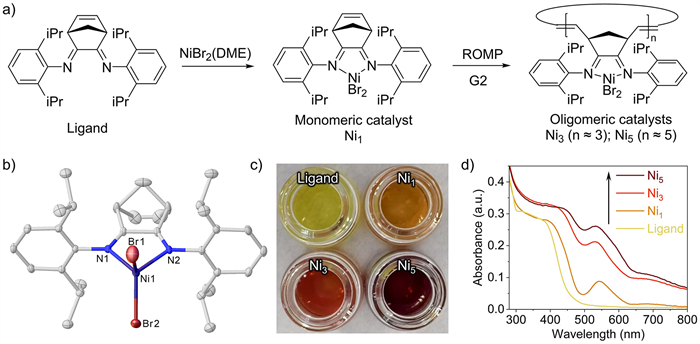
(a) Synthetic route of monomeric catalyst Ni1 and subsequent oligomerization via ROMP to yield the corresponding oligomeric catalysts Ni3 (DP ≈ 3) and Ni5 (DP ≈ 5). (b) Solid-state structure of Ni1. (c) CH2Cl2 solutions of ligand and Ni1, Ni3, Ni5 at a concentration of 9 × 10⁻³ mol/L. (d) UV–vis spectroscopy of the four solutions in (c) with 1 cm optical path.
The synthetic route for the oligomeric nickel catalysts for chain walking olefin polymerization in this study was delineated in Fig. 2a. The polymerizable ligand was designed by installing a ring-opening metathesis polymerization (ROMP) type cyclic olefin unit into the α-diimine ligand, which was synthesized by the reaction of a norbornene-modified diketone [48] and 2,6-diisopropyl aniline (detailed synthetic procedures and characterizations were provided in Supporting information). Subsequent coordination of the ligand with stoichiometric NiBr2(DME) (DME = 1,2-dimethoxyethane) yielded the monomeric catalyst Ni1 (Fig. 2b). Oligomerization of Ni1 was then achieved via G2 (the 2nd generation Grubbs catalyst) mediated ROMP, producing well-defined oligomeric catalysts Ni3 and Ni5 with degrees of polymerization (DP) of 3 and 5, respectively. Compared with conventional multi-nuclear catalysts that require sophisticated structural design and intricate synthesis procedures, the strategy of oligomeric nickel catalysts offered a more efficient synthesis process to construct a multi-nuclear structure. For instance, the production of Ni5 can be efficiently scaled up to 50 g in a laboratory (Supporting information).
Comprehensive structural characterization of the ligand and catalysts was performed using NMR (nuclear magnetic resonance) spectroscopy, MS (mass spectrometry), and elemental analysis (Supporting information). A distinct chromatic evolution was observed among these ligand and catalysts: Solutions transitioned progressively from yellow (free ligand) to orange (monomeric Ni1), and ultimately to deep red/maroon for oligomeric Ni3 and Ni5 (Fig. 2c). This transition was correlated with characteristic UV–vis spectral changes (Fig. 2d), where an absorption peak emerged at 540 nm from the ligand to Ni1. This peak corresponded to green light, resulting in a shift in the solution’s color from yellow to orange, which can be attributed to the pronounced metal-to-ligand charge transfer (MLCT) absorptions in the visible range of 500–600 nm [49]. Both Ni3 and Ni5 exhibited absorption within this range with heightened intensity, in which Ni5 with the higher DP demonstrated the most intense absorption, accounting for the gradual deepening of the solution color.
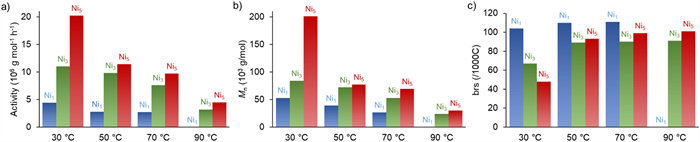
Under the activation of methylaluminoxane (MAO), Ni1, Ni3, and Ni5 were employed in ethylene polymerization (Table 1). In general, the catalytic performance of these three catalysts demonstrated similar trends across varying reaction conditions, producing highly branched PE (Fig. 3). As the reaction temperature increased from 30 ℃ to 90 ℃, a decrease in both catalytic activity and polymer molecular weight was observed, along with an increase in polymer branching density. These observations were consistent with previous reports [14]. Higher temperatures could cause partial deactivation of the catalyst and lower solubility of ethylene. The former reduced the active species, while the latter led to a slower chain growth rate. Both factors contributed to a decrease in catalytic activity. The reduction in polymer molecular weight and increase in branching density can be attributed to a higher propensity for β-H elimination at a higher temperature, thereby accelerating chain transfer and chain walking [50,51]. As ethylene pressure elevated from 1 bar to 4 bar and 8 bar, both catalytic activity and polymer molecular weight were enhanced (Table 1, entries 11, 13 and 14). Concurrently, the polymer branching density witnessed a gradual decline. This can be attributed to the rise in ethylene concentration, which resulted in an accelerated chain growth rate [52]. Notably, replacing toluene with industrially favorable hexane (Table S4 in Supporting information) resulted in comparable polymer molecular weights but enhanced catalytic activity.
Table 1
Table 1.
Effect of temperature on ethylene polymerization with Ni(Ⅱ) catalysts.a
a Reaction conditions: Nickel molar number in catalyst (1 µmol), MAO (500 equiv.), toluene/CH2Cl2 (98/2 mL), polymerization time (30 min), unless noted otherwise. b Activity is in unit of g mol-1 h-1. c Determined by GPC in 1,2,4-trichlorobenzene at 150 ℃ using a light scattering detector. d brs = Number of branches per 1000C, as determined by 1H NMR spectroscopy.
Figure 3
Figure 3.
Comparison of ethylene polymerization activated by MAO between monomeric Ni1 and oligomeric Ni3 and Ni5 in terms of (a) activity, (b) polymer molecular weight, and (c) branching density.
It is noteworthy that oligomeric catalysts Ni3 and Ni5 demonstrated remarkable enhancement in catalytic performance relative to the monomeric catalyst Ni1 in terms of thermostability, catalytic activity, and polymer molecular weight (Fig. 3). Under identical reaction conditions, Ni5 significantly outperformed Ni3 and Ni1 in both catalytic activity and polymer molecular weight (Figs. 3a and b). At 30 ℃, Ni5 exhibited 4.6-fold higher activity (20.2 × 10⁶vs. 4.4 × 10⁶ g mol-1 h-1) and 3.8-fold greater polymer molecular weight (201 vs. 53 kDa) than Ni1 (Table 1, entry 9 vs. 1). Even at 90 ℃, Ni3 and Ni5 retained substantial activities (3.2 × 10⁶ and 4.5 × 10⁶ g mol-1 h-1, respectively), while Ni1 was complete deactivation. The enhanced catalytic performance scaled with the increase of the DP of oligomeric catalysts, as Ni5 (DP ≈ 5) consistently surpassed Ni3 (DP ≈ 3) across all tested conditions, indicating a DP-dependent feature (Table 1, entries 5–12). In addition, the polymer branching densities of PE produced by multi-nuclear catalysts (Ni3 and Ni5) were found to be lower than that produced by the monomeric Ni1. This could be attributed to the increased steric hindrance surrounding the metal centers due to the formation of multi-nuclear architectures, which effectively reduced β-H elimination and chain-walking, thus resulting in a decreased branching density.
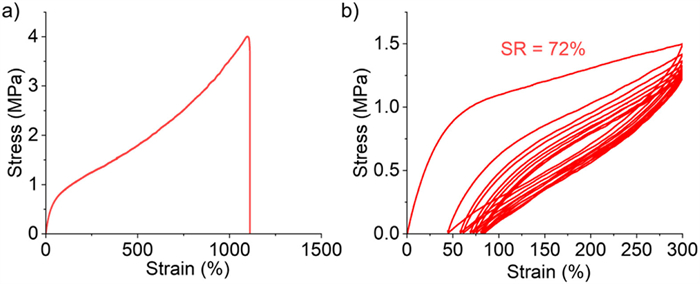
Ethylene polymerization using Ni1, Ni3, and Ni5 activated by diethyl aluminum chloride (Et2AlCl) was also systematically investigated in parallel with MAO (Table S1 and Fig. S1 in Supporting information). Polymerization results showed that Ni1, Ni3, and Ni5 catalysts exhibited up to 2-fold enhanced activities (22.8 × 10⁶vs. 11.4 × 10⁶ g mol-1 h-1) when activated by Et2AlCl compared to MAO (Table S1, entry 10 vs. Table 1, entry 10), while demonstrated a reduction in polymer molecular weights (Mw = 77.4 kDa vs. 49.9 kDa). Notably, both catalytic systems displayed analogous temperature- and structure-dependent trends, with oligomeric Ni3 and Ni5 demonstrating superior performance in both activity and polymer molecular weight compared to the monomeric Ni1 catalyst (Fig. 3 and Fig. S1). This consistent behavior over different activator underscored the advantage of oligomeric catalyst in ethylene polymerization. The synthesized highly branched polyethylene displayed properties akin to conventional elastomers. An exemplary sample (Table S1, entry 9; brs = 72/1000C) achieved a tensile strength of 4.0 MPa with 1100% of elongation at break, exhibiting typically elastic recovery of 72% (Fig. 4). In contrast, samples with a lower branching density (Table 1, entry 9; brs = 48/1000C) exhibited enhanced tensile strength (23.8 MPa, Fig. S54 in Supporting information). Moreover, the polymer branching density also influenced materials density (Table S3 in Supporting information). Specifically, the less branched sample (Table 1, entry 9) exhibited a higher density (0.890 g/cm3) compared to its highly branched counterpart (Table S1, entry 9; 0.879 g/cm3).
Figure 4
Figure 4.
Stress-strain curve and plots of hysteresis experiments of (a) ten cycles at a strain of 300% and (b) for the highly branched polyethylene sample (Table S1, entry 9).
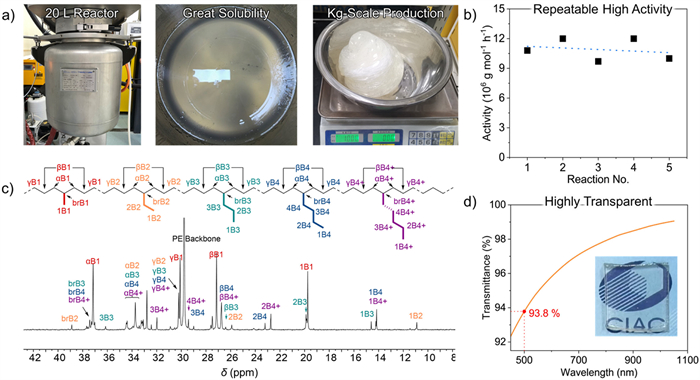
Scale-up experiments conducted in a 20 L high-pressure reactor (20 bar of ethylene pressure) at hexane confirmed the potentially industrial viability of oligomeric catalysts (Fig. 5). Ni5 achieved remarkable productivity of 107 g mol-1 h-1 (approximately 15 kgPE/gCat), producing 1 kg of branched polyethylene with moderate molecular weight (Mw = 91.1 kDa) and excellent melt processability (melt flow index, MFI = 3.0 g/10 min at 190 ℃/2.16 kg). This significantly outperformed the sample from Table 1, entry 9 (MFI = 0.023 g/10 min) with higher molecular weight of Mw = 488 kDa. Notably, Ni5 demonstrated consistent activities over five repeated polymerizations, suggesting an outstanding repeatability (Fig. 5b). In contrast, the monomeric Ni1 exhibited significantly lower activity (2.4 × 10⁶ g mol-1 h-1, approximately 3.6 kgPE/gCat) and molecular weight (Mw = 14.7 kDa) under identical conditions, as detailed in Table 2.
Figure 5
Figure 5.
(a) Kilogram-scale of highly branched PE produced via a 20 L reactor. (b) Scale-up ethylene polymerizations using Ni5 was repeated for 5 times (Table S2 in Supporting information). (c) 13C NMR spectrum (CDCl3, 25 ℃) of branched PE (Table 2, entry 2). (d) Optical properties of highly branched PE produced in a 20 L reactor (Table 2, entry 2).
a Reaction conditions: Nickel molar number in catalyst (100 µmol), MAO (500 equiv.), hexane (13 L), ethylene pressure (20 bar), polymerization time (1 h), temperature (~65 ℃), unless noted otherwise. b Activity is in unit of g mol-1 h-1. c Determined by GPC in 1,2,4-trichlorobenzene at 150 ℃ using a light scattering detector. d brs = Number of branches per 1000C, as determined by 1H NMR spectroscopy. e Determined by DSC (second heating).
1 kg of polyethylene prepared by Ni5 in a 20 L reactor exhibited highly branched architecture with a complicated branching pattern, including methyl (B1), ethyl (B2), propyl (B3), butyl (B4) and longer branches (B4+) (Fig. 5c). 13C NMR [53] spectrum revealed that methyl branching at 19.88 ppm was the most branching pattern, contributing up to 70% of the content, followed by longer branches than butyl (B4+, 14.30 ppm) with a content of 13%. This high branching structure endowed the PE with notable properties such as a low melting point (46 ℃), low density (0.850 g/cm3), excellent ductility (Fig. S54), good solubility, and high transparency due to reduced crystallinity. In detail, the highly branched PE could fully dissolve in the reaction solvent (hexane) without any precipitation, yielding a clear, transparent, and highly viscous solution with polymer content up to 10.4 wt% after polymerization (Fig. 5a). Also, the polymer film exhibited high transparency, with a transmittance reaching 93.8% at 500 nm (sample thickness: 0.17 mm) (Fig. 5d). This all-hydrocarbon structure endowed such highly branched polyethylene with good insulation properties, achieving a volume resistivity of 2 × 10¹⁶ Ω/m. Coupled with hydrophobicity, it exhibited a water vapor permeability of 0.03 g/m2/day, comparable with commercial polyolefin elastomer (Table S3), suggesting potentially practical applications.
In summary, this work presented an oligomeric approach for α-diimine nickel catalyst design, which advances the conventional mono-nuclear nickel catalysts and reforms the multi-nuclear nickel catalysts using a complicated synthesis. By incorporating norbornene-modified ligands followed by ring-opening metathesis polymerization, oligomeric nickel catalysts with varied degree of polymerization (DP) were constructed. Comprehensive evaluation revealed that the oligomeric catalyst strategy significantly governed catalytic performance enhancements: Ni5 demonstrated 4.6-fold higher activity and produced polyethylene with 379% increased molecular weight, relative to the monomeric counterpart Ni1. Notably, these improvements were intensified as the DP of the oligomeric catalyst increased, indicating the effectiveness of the oligomeric catalyst strategy. The resultant highly branched polyethylenes exhibited remarkable elastic recovery (72%), while kilogram-scale synthesis in a 20 L reactor indicated potentially industrial application. In contrast to previous modifications that have majorly relied on tedious ligand substituents, the oligomeric nickel catalyst described in this work has witnessed a key step to enhance the catalytic performance in olefin polymerization. This provides a new avenue for the development of late-transition metal catalysts and beyond. At present, we are working for new polyolefin catalysts by using this oligomeric catalyst strategy.
Declaration of competing interest
The authors declare that they have no known competing financial interests or personal relationships that could have appeared to influence the work reported in this paper.
The authors are thankful for financial support from the National Natural Science Foundation of China (Nos. 22401274, U23B6011), and the Jilin Provincial Science and Technology Department Program (No. 20250102070JC).
Supplementary materials
Supplementary material associated with this article can be found, in the online version, at doi:10.1016/j.cclet.2025.111930.
R.M. Patel, P. Jain, B. Story, S. Chum, Polyethylene: an account of scientific discovery and industrial innovations, in: W.H. Flank, M.A. Abraham, M.A. Matthews (Eds.), Innovations in Industrial and Engineering Chemistry, American Chemical Society, 2008, pp. 71–102.
Figure 2
(a) Synthetic route of monomeric catalyst Ni1 and subsequent oligomerization via ROMP to yield the corresponding oligomeric catalysts Ni3 (DP ≈ 3) and Ni5 (DP ≈ 5). (b) Solid-state structure of Ni1. (c) CH2Cl2 solutions of ligand and Ni1, Ni3, Ni5 at a concentration of 9 × 10⁻³ mol/L. (d) UV–vis spectroscopy of the four solutions in (c) with 1 cm optical path.
Figure 3
Comparison of ethylene polymerization activated by MAO between monomeric Ni1 and oligomeric Ni3 and Ni5 in terms of (a) activity, (b) polymer molecular weight, and (c) branching density.
Figure 4
Stress-strain curve and plots of hysteresis experiments of (a) ten cycles at a strain of 300% and (b) for the highly branched polyethylene sample (Table S1, entry 9).
Figure 5
(a) Kilogram-scale of highly branched PE produced via a 20 L reactor. (b) Scale-up ethylene polymerizations using Ni5 was repeated for 5 times (Table S2 in Supporting information). (c) 13C NMR spectrum (CDCl3, 25 ℃) of branched PE (Table 2, entry 2). (d) Optical properties of highly branched PE produced in a 20 L reactor (Table 2, entry 2).
Table 1.
Effect of temperature on ethylene polymerization with Ni(Ⅱ) catalysts.a
Entry
Cat.
T (℃)
P (bar)
Yield (g)
Act. (106)b
Mn (kDa)c
Mw/Mnc
brsd
1
Ni1
30
8
2.2
4.4
53.0
2.65
104
2
Ni1
50
8
1.4
2.8
39.2
2.57
110
3
Ni1
70
8
1.3
2.7
26.5
2.92
111
4
Ni1
90
8
trace
–
–
–
–
5
Ni3
30
8
5.5
11.0
83.8
2.67
67
6
Ni3
50
8
4.9
9.8
72.0
2.86
89
7
Ni3
70
8
3.8
7.6
53.0
2.10
90
8
Ni3
90
8
1.6
3.2
23.5
1.94
91
9
Ni5
30
8
10.1
20.2
201
2.43
48
10
Ni5
50
8
5.7
11.4
77.4
2.56
93
11
Ni5
70
8
4.9
9.7
69.3
2.67
99
12
Ni5
90
8
2.2
4.5
30.2
1.95
101
13
Ni5
70
1
1.2
2.4
28.7
2.21
116
14
Ni5
70
4
2.4
4.8
32.1
1.99
115
a Reaction conditions: Nickel molar number in catalyst (1 µmol), MAO (500 equiv.), toluene/CH2Cl2 (98/2 mL), polymerization time (30 min), unless noted otherwise. b Activity is in unit of g mol-1 h-1. c Determined by GPC in 1,2,4-trichlorobenzene at 150 ℃ using a light scattering detector. d brs = Number of branches per 1000C, as determined by 1H NMR spectroscopy.
Table 2.
Ethylene polymerization using Ni1 and Ni5 in a 20 L reactor.a
Entry
Cat.
Yield (g)
Act. (106) b
Mw (kDa) c
Mw/Mnc
brs d
Tm (℃)e
1
Ni1
~240
~2.4
14.7
2.78
78
/
2
Ni5
~1000
~10.0
91.1
1.86
82
46
a Reaction conditions: Nickel molar number in catalyst (100 µmol), MAO (500 equiv.), hexane (13 L), ethylene pressure (20 bar), polymerization time (1 h), temperature (~65 ℃), unless noted otherwise. b Activity is in unit of g mol-1 h-1. c Determined by GPC in 1,2,4-trichlorobenzene at 150 ℃ using a light scattering detector. d brs = Number of branches per 1000C, as determined by 1H NMR spectroscopy. e Determined by DSC (second heating).


 DownLoad:

 下载:
下载:


 下载:
下载:

