Received Date:
26 August 2025 Accepted Date:
28 September 2025 Revised Date:
25 September 2025 Available Online:
15 December 2026
Abstract:
The methylidyne radical (CH·) and oxygen-bearing complex organic molecules (COMs), such as dimethyl ether (DME, CH3OCH3), are recognized to be of great importance in interstellar chemistry. However, despite its potential role in the growth and evolution of interstellar COMs, the reaction between CH· and DME has not yet been studied experimentally or theoretically. In this work, we measured the rate coefficients using the pulsed laser photolysis-laser induced fluorescence (PLP-LIF) technique, and characterized reaction product via vacuum ultraviolet (VUV) photoionization reflectron time-of-flight mass spectrometry (Re-TOFMS) under uniform supersonic low-temperature flow conditions. The rate coefficients were determined to range from 3.7 × 10⁻¹⁰ cm3 molecule-1 s-1 to 1.6 × 10⁻¹⁰ cm3 molecule-1 s-1 at temperatures of 25–100 K. By combining mass spectroscopy results and the newly calculated potential energy surface, we identified the dominate reaction pathway, which leads to the formation of CH3O· + C2H4. Astrochemical modelling further revealed that this reaction serves as a gas-phase reaction source for CH3O· in the cold interstellar environments.
Complex organic molecules (COMs), defined in astrochemistry as carbon-containing molecules with six or more atoms [1], are extensively detected in the interstellar medium (ISM) [2], mainly toward dark clouds [3,4], low-mass [5,6] and high-mass [7,8] star-forming regions. Among these, oxygen-bearing complex organic compounds (O—COMs) have been extensively studied for decades because they serve as bridges between simple atoms/molecules and prebiotic species [9]. Molecular mass growth processes leading to prebiotic molecules in deep space could provide an exogenous source of vital biomolecules for early life evolution [10,11].
Dimethyl ether (DME, CH3OCH3) ranks among the most abundant and widely detected O—COMs in the ISM, with confirmed detections in cold molecular clouds including TMC-1 [4], L1689B [12], B1-b [13], L1544 [14], Barnard 5 [15], and L483 [16]. The ubiquity of DME suggests its active participation in diverse chemical networks governing COMs formation in these cold, dark interstellar environments. Multiple reaction pathways have been identified for DME conversion to formaldehyde (H2CO) [17,18] and methyl formate (HCOOCH3) [19,20], which are key intermediates to form more complex prebiotic molecules including sugars and nucleic acids [10,21,22]. This chemical evolution establishes DME as a crucial precursor in the astrochemical pathways to vital biomolecules necessary for the origins of life.
Methylidyne radical (CH·) has been observed extensively in interstellar clouds with high abundance, e.g., (1.5 ± 0.5) × 10–8 relative to H2 in TMC-1 [3,23]. CH· also serves as a proxy for the H2 column density in the diffuse ISM [24]. Due to the unique molecular structure involving an unpaired electron and an empty molecular orbital, CH· is highly reactive and feasible to react with other molecules via barrierless insertion mechanism. Methylidyne radical has been revealed to play important roles in the chemical evolution of COMs in the cold interstellar medium and planetary atmospheres, especially in the growth of carbon chain and formation of unsaturated COMs [25–28]. Given high abundance of both CH· and DME in cold dark environments, it is necessary to study this title reaction theoretically and experimentally under cold conditions.
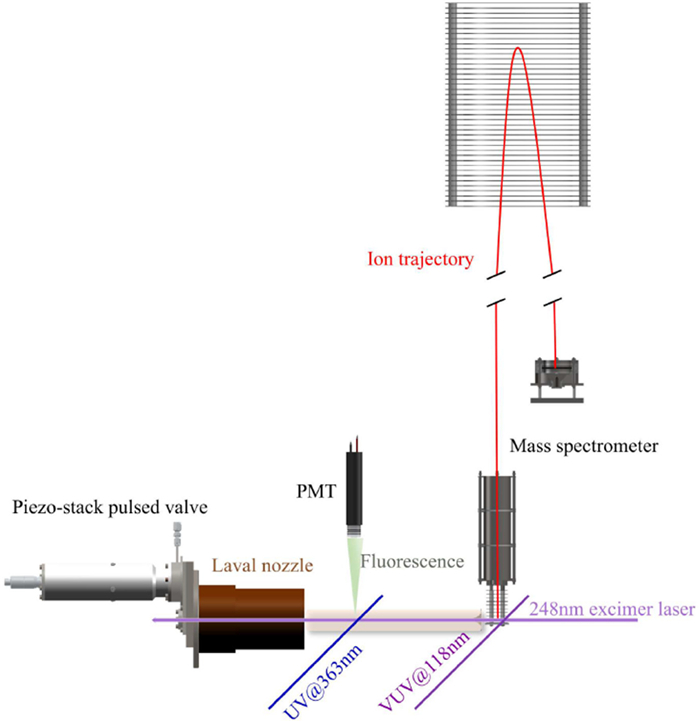
The bimolecular reaction kinetics of CH· with DME were investigated under low-temperature uniform flow conditions using a pulsed Laval nozzle supersonic flow apparatus (Fig. 1). A series of convergent–divergent Laval nozzles were utilized to produce stable and isentropic supersonic flows. These well-defined nozzles allow the generation of uniform gas flows at temperatures ranging from 25 K to 100 K, simulating interstellar or planetary environments where evolutions of chemical species are intriguing. Each nozzle configuration corresponds to a specific Mach number (between 3.2 and 6.0), resulting in distinct flow temperatures and densities. The characterization of these uniform flows was achieved by pitot measurements [29,30].
Figure 1
Figure 1.
The low-temperature kinetics apparatus based on pulsed de Laval nozzle, coupled with the LIF and the Re-TOFMS techniques. The uniform flow generated from the nozzle (pink), the laser lights for photolysis and detection, the collected fluorescence (green cone) and the ion trajectory (red break line) are also shown.
The reaction rate coefficients under various low-temperature conditions were measured employing the pulsed laser photolysis-laser induced fluorescence (PLP-LIF) technique [31–34]. The nascent CH radicals, initially generated with vibrational and rotational excitation, undergo rapid relaxation due to the high bath gas density in the uniform flow [30]. Consequently, exponential fits for extracting kobs were applied starting at a delay time of 20 µs for N2 flow (or 30 µs for Ar and He flow), following Eq. 1:
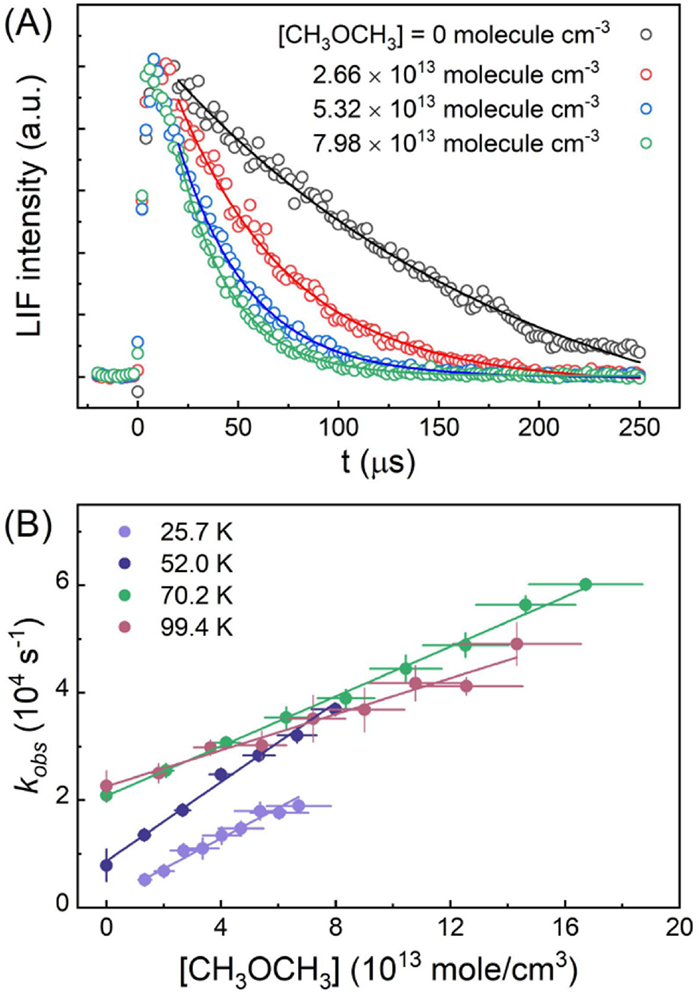
where [CH]0 is the initial CH radical concentration, and [CH]t represents its instantaneous concentration at reaction time t. Fig. 2A displays representative time-resolved LIF traces of CH radical decay at 52.0 K for various DME concentrations. The CH· signal decay rate increases with higher [DME], indicating efficient bimolecular reaction under pseudo-first-order conditions ([DME] > > [CH]). The pseudo-first-order reaction rate kobs is expressed as:
kobs=k2[DME]+kother
(2)
where kother accounts for the side reaction and diffusion losses of CH radicals. By plotting kobs against [DME], the second-order rate coefficient k2 for the title reaction was determined from the linear slope, as depicted in Fig. 2B.
Figure 2
Figure 2.
(A) Time-resolved LIF traces of CH radical decay versus several DME concentrations within the N2 Laval nozzle of 52.0 K, pseudo-first-order reaction rates of CH radical, kobs, were obtained from single exponential fits. (B) kobsversus [CH3OCH3] at different temperatures, along with their linear fits whose slopes represent the reaction rate coefficients k2.
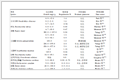
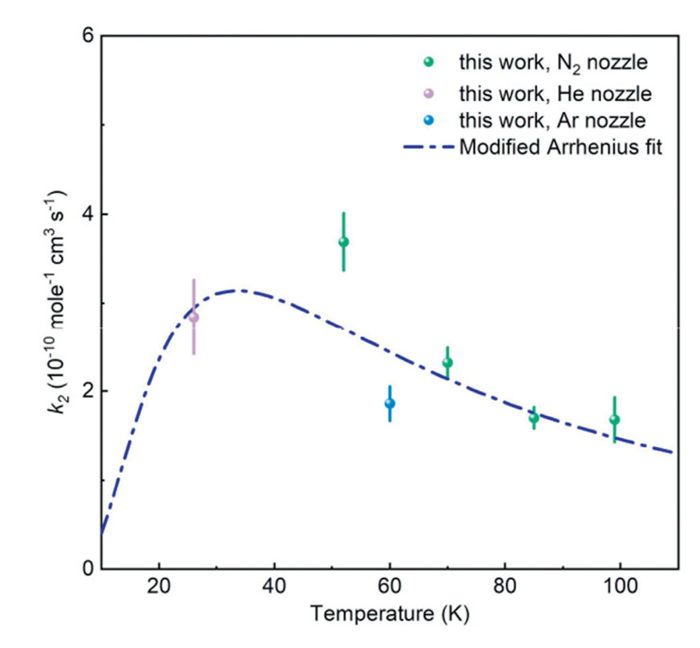
A summary of the measured rate coefficients for the CH· + DME reaction at different temperatures is listed in Table 1. The values range from 3.7 × 10⁻¹⁰ cm3 molecule-1 s-1 to 1.6 × 10⁻¹⁰ cm3 molecule-1 s-1 over 50–100 K, exhibiting a moderate negative temperature dependence. This trend is consistent with reactions involving a submerged barrier [35]. As the temperature decreases from 50 K to 25 K, the rate coefficients decline slightly from 3.7 × 10⁻¹⁰ cm3 molecule-1 s-1 to 2.8 × 10⁻¹⁰ cm3 molecule-1 s-1. To describe the temperature dependence of k2(T) and extrapolate to lower temperatures, a modified Arrhenius formula (Eq. 3) was fitted to the data, as shown in Fig. 3:
a Total density of the supersonic low-temperature uniform flow, error represents the non-uniformity along the flow axis. b Experimental condition and rate coefficient for CD· + CH 3OCH 3 reaction, distinguished in italics.
Figure 3
Figure 3.
Comparison of second order reaction rate coefficients (solid dots), k2, for the CH· + CH3OCH3 reaction versus temperatures and the modified Arrhenius fit (dash dotted blue line).
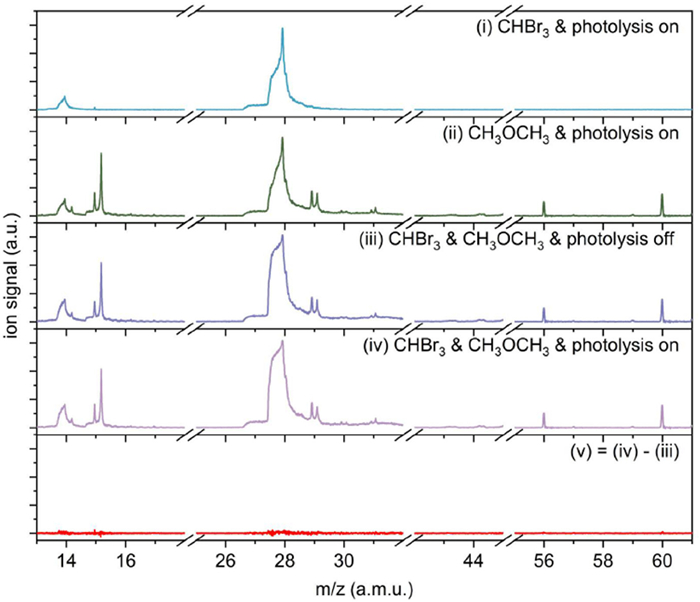
Additionally, the product information is of great importance to unravel the reaction mechanism between CH· and DME. Selected experiments were conducted using vacuum ultraviolet (VUV, 118.27 nm) photoionization reflectron time-of-flight mass spectrometry (Re-TOFMS) to identify reaction products at reaction time of 200 μs. To discriminate the source of all the ions, several parallel experiments of variable controlling were implemented by introducing only either of the reactants or setting the on/off of the photolysis laser (Fig. 4).
Figure 4
Figure 4.
VUV photoionization mass spectra under different conditions at kinetic time of 200 μs, T = 52.0 K, [CH3OCH3] = 7.98 × 10¹³ molecule/cm3. Mass spectrum of (ⅰ) only CHBr3 with photolysis laser on, (ⅱ) only CH3OCH3 with photolysis laser on, (ⅲ) both CHBr3 and CH3OCH3 present with photolysis laser off, (ⅳ) both CHBr3 and CH3OCH3 present with photolysis laser on, and (v) subtraction of (ⅲ) from (ⅳ).
No product mass peak was detected using VUV photoionization ReTOFMS after background subtraction, as shown in Fig. 4(v). The broad peaks at mass-to-charge ratio (m/z) of 14 and 28 (Fig. 4(ⅰ)-(ⅳ)) originate from the bath gas N2, likely due to the multiphoton ionization by the VUV laser. A comparison of Fig. 4(ⅱ), (ⅲ) and (ⅳ) reveals a high degree of similarity, suggesting that most ion signal peaks arise from sample impurities (m/z = 56 and 60) and the dissociative ionization of DME (m/z = 15 and 29) [36]. Since no direct reaction product was discernible in the mass spectra, potential energy surface (PES) calculations were performed to explore possible reaction pathways (Fig. 5).
Figure 5
Figure 5.
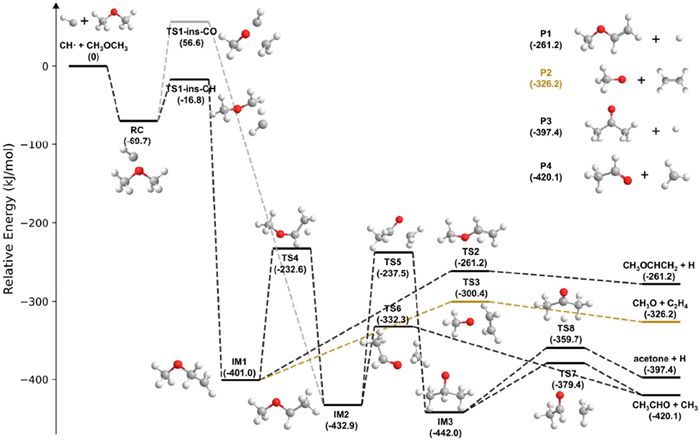
Potential energy surfaces of CH·+ CH3OCH3 reaction obtained at the CCSD(T)/aug-cc-pVTZ//B2PLYP-D3/aug-cc-pVTZ level of theory. All energy values are in kJ/mol with the ZPE corrections relative to the reactants. The brown golden line indicates the most probable reaction route.
The interaction between the two reactants forms a complex in the entrance channel (RC, −69.7 kJ/mol) with a bond length of approximately 1.67 Å between the central O and the incoming C atom. This complex then evolves through two pathways, the C—H insertion and C—O insertion. In the C—H insertion pathway, CH· inserts into a C—H bond of DME, forming the intermediate CH3OCH2CH2 (IM1, −401.0 kJ/mol), via transition state (TS1-ins-CH) with a submerged barrier (−16.8 kJ/mol). In contrast, the C—O insertion pathway proceeds through a positive barrier transition state (TS1-ins-CO, 56.6 kJ/mol), forming CH3OCHCH3 (IM2) via CH· insertion into the C—O bond of DME. The substantial barrier in the C—O insertion pathway renders this route thermally inaccessible at the studied temperatures unless quantum tunneling occurs. To investigate this possibility, the reaction rate coefficient for the deuterated methylidyne radical (CD·) and DME was measured at 52.0 K. The obtained value of 4.3 × 10⁻¹⁰ cm3 molecule-1 s-1 matches that of the CH· + CH3OCH3 reaction under same conditions, demonstrating a negligible kinetic isotope effect (KIE) [37,38]. This finding reveals that the title reaction proceeds exclusively through the C—H insertion mechanism to form IM1.
Four distinct reaction product channels were calculated through isomerization and decomposition pathways originating from the highly energetic intermediate IM1 (−401.0 kJ/mol relative to reactants). Product channel P1 (CH3OCH═CH2 + H, −261.2 kJ/mol) is generated through direct H elimination via transition state TS2. Product channel P2 (CH3O· + C2H4, −326.2 kJ/mol) is yielded via C—O bond cleavage through TS3. IM1 can also isomerize through TS4 to form IM2 (−432.9 kJ/mol), which further isomerize to IM3 (−442 kJ/mol) via TS5 (involving a side methyl transfer from the central O atom). IM3 then leads to two product channels: P3 (acetone + H, −397.4 kJ/mol) by H loss via TS8, and P4 (CH3CHO + CH3·, −420.1 kJ/mol) by CH3 loss via TS7. Alternatively, P4 could also be generated directly from IM2 by losing a methyl moiety via TS6. Complete computational details, including optimized geometries and harmonic vibrational frequencies for all stationary points, are provided in Supporting information.The calculated product pathways include two H elimination channels, P1 and P3, producing H + CH3OCH═CH2 and H + acetone, respectively. Both products have adiabatic ionization energies (8.95 eV for CH3OCH═CH2 [39] and 9.7 eV for acetone [40]) below the photon energy of VUV ionization laser (10.48 eV), making them theoretically detectable under our experimental conditions. However, the absence of any signal at m/z = 58 indicates that neither CH3OCH═CH2 (58 amu) nor acetone (58 amu) is formed under the uniform supersonic low-temperature flow conditions.
The most exothermic channel P4, yielding CH3· + CH3CHO (−420.1 kJ/mol), involves products with ionization energies of 9.84 eV (methyl) [41] and 10.23 eV (acetaldehyde) [42], both within the present VUV detection range. However, Fig. 4(v) shows no evident mass peaks at m/z = 15 or 44. The observed bimodal features around m/z = 15 in Fig. 4(ⅱ) and (ⅳ) likely originate from dissociative ionization of DME, as they persist in DME-only experiments. The complete disappearance of these signals after subtracting Fig. 4(ⅳ) from (ⅲ) provides conclusive evidence against methyl radical and acetaldehyde formation in the title reaction. Therefore, we exclude the CH3· elimination pathway (P4) under present experimental conditions.
The calculated product channel P2 yields CH3O· + C2H4 (−326.2 kJ/mol). Both products have high ionization energies (10.72 eV [43] for CH3O· and 10.51 eV [44] for C2H4), exceeding the photon energy of the VUV photoionization laser. Consequently, neither product of P2 can be detected in our current setup. Nevertheless, the stationary point calculations indicate that product channel P2 is the most favorable reaction pathway. Unlike P3 and P4 product channels, which involve multiple transition states and complex wells, P2 products (CH3O· + C2H4) can be generated via direct cleavage of the C—O bond in intermediate IM1 (CH3OCH2CH2·). Although product channel P1 can also form directly from IM1, it has a larger barrier and reaction enthalpy than P2. Given that P1, P3 and P4 were not detected experimentally in the present Re-TOFMS study and secondary reactions are negligible under current uniform flow conditions, we suggest that CH3O· + C2H4 is the main product channel for the CH· + CH3OCH3 reaction under low-temperature conditions investigated here, with the measured reaction rate coefficient described as Eq. 3.
The methoxyl radical (CH3O·) is a reactive and transient species that plays a critical role in astrochemical environments, particularly within cold dense molecular clouds. As a pivotal intermediate in chemical networks, CH3O· contributes to the formation and destruction of O-bearing COMs like formaldehyde (CH2O) [45], methyl hydroperoxide (CH3OOH) and methyl formate (HCOOCH3) [46]. And it is regarded as a central intermediate for CO hydrogenation [47]. Observationally, CH3O· has long posed a challenge for spectroscopists due to its Jahn-Teller effect and strong spin-orbit coupling, making its abundance difficult to determine [48]. To date, CH3O· has been detected in the ISM toward the B1-b cold core [13], four prestellar cores [49] and the L483 dense core [16]. Since these cold sources share similar environmental conditions with TMC-1, e.g., a rotational temperature of 10 K and comparable levels of chemical evolution, they exhibit a common upper limit of fractional abundance of CH3O·, 10–10 relative to H2 [50].
Astrochemical models have been developed to include extensive network of molecular species and chemical reactions to explore the chemical evolution of cold molecular clouds. However, current models underestimate the abundance of CH3O· by several orders of magnitude [45,51]. In this work, we performed a homogeneous astrochemical modeling of a dark molecular cloud (with a density of 2 × 104 cm−3 and a temperature of 10 K) using the RATE22 database [45], supplemented by the reaction CH· + CH3OCH3 → CH3O· + C2H4 from our study. DME is a well-documented molecule in TMC-1 with a typical fractional abundance of 2.5 × 10⁻¹⁰ relative to H2 [4]. Since known gas-phase formation pathways for DME are insufficient to explain its observed abundance under cold conditions, current astrochemical models significantly underestimate the abundance of CH3OCH3, thereby reducing the contribution from the CH· + CH3OCH3 → CH3O· + C2H4 reaction. Several attempts have been made by other groups to replicate observed CH3OCH3 abundance in the model by involving surface chemistry on icy grain mantles followed by non-thermal, like chemical, UV, cosmic ray, desorption processes [19,52,53]. Consequently, our model assumed an initial DME relative abundance of 2.5 × 10⁻¹⁰ to account for these non-thermal desorption processes.
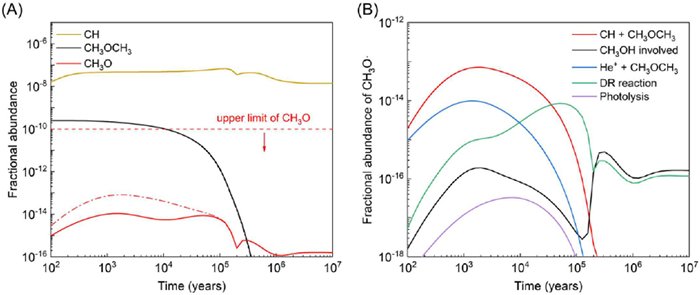
The model yielded intriguing insights, as illustrated in Fig. 6A. The fractional abundances of CH· and DME remained nearly unchanged regardless of whether our kinetic measurements were included, as the title reaction represents only a minor loss pathway compared to reactions with more abundant species (e.g., O, N, and H). Although the predicted CH3O· abundance at all times remains below the observed value, the predicted abundance in the early stage (102–105 years) increases by nearly an order of magnitude due to the inclusion of the title reaction. This highlights the significance of including of the title reaction—unless the fractional abundance of DME drops below 5 × 10–12. This finding underscores the importance of the CH· + CH3OCH3 reaction in producing CH3O· when DME abundance reaches observed levels.
Figure 6
Figure 6.
(A) Abundances of key reagents and products of the title rection relative to abundance of molecular hydrogen versus time in the cold cloud model of TMC-1. The solid lines show evolution of those key species without our kinetic measurements, while the dash dotted lines represent the species evolution considering the CH· + CH3OCH3 kinetic results. The red dotted line at fractional abundance of 10–10 marks the upper relative abundance limit of CH3O· in TMC-1. (B) CH3O· evolution contribution of all possible reactions from the UMIST model. These reactions are sorted into five categories. CH3OH involved: reactions between radical (e.g., ·CN, O, F, Cl, ·OH) and CH3OH. DR: dissociative recombination reactions. Photolysis: CH3OCH2 photolysis process. For further information, see SI.
The UMIST Database includes several CH3O· formation pathways, which were categorized into five groups by us (see Supporting information). To assess their relative contributions, we tested each category in the astrochemical model while setting all other reaction rates to zero. As shown in Fig. 6B, both CH· + CH3OCH3 and He+ + CH3OCH3 contribute significantly at early times due to the high DME abundance, with the title reaction dominating—confirming its role as a key gas-phase CH3O· source. At later stages (> 105 y), as DME abundance declines in the model, dissociative recombination (DR) reactions and CH3OH involved reactions become increasingly important and eventually dominate. These results further confirms that the CH· + CH3OCH3 reaction dominates the gas-phase formation to CH3O· at low temperatures when CH3OCH3 reaches its observed abundance.
In this work, we measured the rate coefficients of the reaction between CH· and DME (CH3OCH3) using a Laval nozzle apparatus coupled with PLP-LIF method. Additionally, mass spectroscopy of the reaction was performed under 52.0 K N2 flow conditions with VUV photoionization to reveal product information. Although PES calculations suggest four possible reaction pathways, no direct reaction products were observed in the Re-TOFMS study. The comparable reaction rate coefficients between CH· + DME and CD· + DME indicate that the reaction proceeds via CH· insertion into the C—H bond of the methyl group, which features a submerged barrier. We ruled out three possible product channels (two H-loss pathways and one CH3· loss pathway) due to their absence in the mass spectra. Instead, the CH3O· + C2H4 channel is identified as the most likely product pathway. The measured rate coefficients and reaction mechanism for the title reaction may serve as a benchmark for CH· reaction with ethers and other O-bearing COMs. Astrochemical modelling suggests that this reaction could be a gas-phase source of CH3O·, feeding into larger networks of O-bearing COMs formation. Investigating this reaction may also enhance our understanding of the chemical evolution of organic complexity in cold molecular clouds and star-forming regions, with direct implications for molecular inventories in pre-stellar cores and protoplanetary disks.
The authors declare that they have no known competing financial interests or personal relationships that could have appeared to influence the work reported in this paper.
Acknowledgments
This work was supported by the National Natural Science Foundation of China (Nos. 22273103 and 22288201); Dalian Institute of Chemical Physics (No. DICP I202230); The authors gratefully acknowledge the Dalian Coherent Light Source (No. 31127.02.DCLS) for support and assistance.
Supplementary materials
Supplementary material associated with this article can be found, in the online version, at doi:10.1016/j.cclet.2025.111919.
Y. Lu, D.H. Quan, Q. Chang, L.F. Chen, D. Li, Astrophys. J. Suppl. Ser. 277 (2025) 8. doi: 10.3847/1538-4365/ad9b88
[51]
V. Wakelam, P. Gratier, J.C. Loison, et al., Astron. Astrophys. 689 (2024) A63. doi: 10.1051/0004-6361/202450606
[52]
Z. Peeters, S.D. Rodgers, S.B. Charnley, et al., Astron. Astrophys. 445 (2006) 197–204. doi: 10.1051/0004-6361:20053651
[53]
A. Paulive, C.N. Shingledecker, E. Herbst, Mon. Not. R. Astron. Soc. 500 (2021) 3414–3424.
Figure 1
The low-temperature kinetics apparatus based on pulsed de Laval nozzle, coupled with the LIF and the Re-TOFMS techniques. The uniform flow generated from the nozzle (pink), the laser lights for photolysis and detection, the collected fluorescence (green cone) and the ion trajectory (red break line) are also shown.
Figure 2
(A) Time-resolved LIF traces of CH radical decay versus several DME concentrations within the N2 Laval nozzle of 52.0 K, pseudo-first-order reaction rates of CH radical, kobs, were obtained from single exponential fits. (B) kobsversus [CH3OCH3] at different temperatures, along with their linear fits whose slopes represent the reaction rate coefficients k2.
Figure 3
Comparison of second order reaction rate coefficients (solid dots), k2, for the CH· + CH3OCH3 reaction versus temperatures and the modified Arrhenius fit (dash dotted blue line).
Figure 4
VUV photoionization mass spectra under different conditions at kinetic time of 200 μs, T = 52.0 K, [CH3OCH3] = 7.98 × 10¹³ molecule/cm3. Mass spectrum of (ⅰ) only CHBr3 with photolysis laser on, (ⅱ) only CH3OCH3 with photolysis laser on, (ⅲ) both CHBr3 and CH3OCH3 present with photolysis laser off, (ⅳ) both CHBr3 and CH3OCH3 present with photolysis laser on, and (v) subtraction of (ⅲ) from (ⅳ).
Figure 5
Potential energy surfaces of CH·+ CH3OCH3 reaction obtained at the CCSD(T)/aug-cc-pVTZ//B2PLYP-D3/aug-cc-pVTZ level of theory. All energy values are in kJ/mol with the ZPE corrections relative to the reactants. The brown golden line indicates the most probable reaction route.
Figure 6
(A) Abundances of key reagents and products of the title rection relative to abundance of molecular hydrogen versus time in the cold cloud model of TMC-1. The solid lines show evolution of those key species without our kinetic measurements, while the dash dotted lines represent the species evolution considering the CH· + CH3OCH3 kinetic results. The red dotted line at fractional abundance of 10–10 marks the upper relative abundance limit of CH3O· in TMC-1. (B) CH3O· evolution contribution of all possible reactions from the UMIST model. These reactions are sorted into five categories. CH3OH involved: reactions between radical (e.g., ·CN, O, F, Cl, ·OH) and CH3OH. DR: dissociative recombination reactions. Photolysis: CH3OCH2 photolysis process. For further information, see SI.
Table 1.
Experimental conditions and corresponding rate coefficients for CH· + CH3OCH3 reaction.
T (K)
Bath gas
Ntotala (1016 molecule/cm3)
[DME] (1013 molecule/cm3)
k2 (T) (10–10 cm3 molecule-1 s-1)
25.7 ± 2.8
He
2.39 ± 0.40
1.34–6.71
2.84 ± 0.42
52.0 ± 2.2
N2
1.26 ± 0.13
0–7.98
3.69 ± 0.32
60.1 ± 5.4
Ar
13.3 ± 1.8
0–9.31
1.86 ± 0.19
70.2 ± 3.4
N2
4.29 ± 0.51
0–16.7
2.32 ± 0.17
85.1 ± 4.8
N2
4.50 ± 0.62
0–9.90
1.70 ± 0.20
99.4 ± 6.2
N2
6.62 ± 1.03
0–14.3
1.68 ± 0.25
52.0 ± 2.2b
N2
1.26 ± 0.13
0–7.68
4.30 ± 0.25
a Total density of the supersonic low-temperature uniform flow, error represents the non-uniformity along the flow axis. b Experimental condition and rate coefficient for CD· + CH 3OCH 3 reaction, distinguished in italics.


 DownLoad:

 下载:


 下载:

