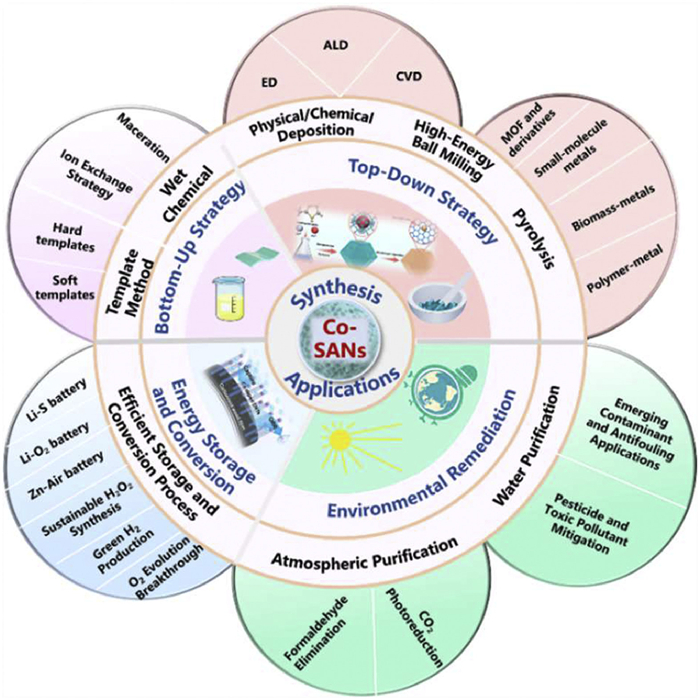
Scheme 1.
Schematic of cobalt single-atom nanozymes (Co-SANs) from rational design to cross-disciplinary applications in environmental remediation and energy storage and conversion.

Atomic precision of cobalt single-atom nanozymes in environmental remediation and energy sustainability
Shuai He , Chao Gong , Mengru Li , Jiahang Wu , Qingjie Xi , Xiaoyu Geng , Xinchao Li , Haijun Nie , Xiaoyan Zhu , Zhenlian Han , Dingsheng Wang , Ligang Wang , Pei Liu


Single-atom nanozymes (SANs) represent a revolutionary class of artificial enzymes that integrate the atomic precision of single-atom catalysis (SACs) with the multifunctionality of nanozymes [1,2]. While SANs draw on the atomic-level design principle of SACs, they differ fundamentally in core positioning and application scenarios, thus, clarifying these distinctions is critical to avoid conceptual ambiguity. SANs are purpose-designed to mimic natural enzymes: They typically operate under mild conditions (pH 5–9, ambient temperature) and are evaluated using enzyme-specific metrics, including Michaelis–Menten kinetics (characterized by Km and Vmax values), substrate specificity, and biocompatibility [3]. In contrast, SACs are optimized for industrial chemical transformations, such as Fischer–Tropsch synthesis (FTS), under harsh conditions (e.g., high temperature and pressure), and assessed by turnover frequency (TOF), conversion rate, and product selectivity [4,5]. These distinctions delineate the scope of SANs in this review, with emphasis on their applications in environmental remediation and sustainable energy technologies [6,7]. To illustrate this scope further: Co-SANs, for instance, exhibit classic enzyme-mimetic behavior in environmental remediation (aligning with the SANs framework), but their role in energy conversion relies more on electrocatalytic mechanisms—making this specific application better categorized under the umbrella of single-atom electrocatalysis rather than SANs.
By anchoring isolated metal atoms (loading < 1.5 wt%) within tailored nano scaffolds, SANs achieve near-100% atom utilization, exceptional stability, and tunable catalytic properties, advantages that surpass traditional nanozymes which are plagued by aggregation-induced inactivation and limited activity [8]. This atomic-scale design enables precise modulation of coordination environments and electronic structures, resulting in catalytic activities 10–100 times higher than conventional nanozymes [9,10]. These features render SANs particularly promising for applications demanding high efficiency and sustainability, such as pollutant degradation, carbon neutrality initiatives, and renewable energy production [11].
However, the reliance on precious metals (e.g., Pt, Ag) in SANs restricts scalability due to cost and scarcity [12,13]. Cobalt single-atom nanozymes (Co-SANs) have emerged as a compelling alternative, leveraging cobalt’s natural abundance [14], multifunctional redox activity (+2, +3 oxidation states), and cost-effectiveness. For instance, the average cost of cobalt is approximately 1%–2% that of platinum, while maintaining comparable catalytic performance in many redox reactions [15,16]. Moreover, Co-SANs exhibit tailored coordination environments that facilitate efficient catalytic processes—from oxidant activation for pollutant degradation to electron-transfer reactions in energy systems [17]. These advantages position Co-SANs as economically viable candidates for large-scale industrial deployment, especially in sectors where catalyst cost and metal availability are critical constraints.
Recent breakthroughs have significantly reshaped the nanozyme landscape. For instance, Ji et al. established a unified activity descriptor linking electronic structure to peroxidase-like activity, enabling rational design across metal centers [18]. Similarly, Chen et al. demonstrated dynamic coordination evolution in Pt-based nanozymes under reaction conditions, revealing previously overlooked active states [19]. These insights underscore the importance of atomic-level control and real-time characterization in advancing nanozyme functionality.
Despite significant progress, research on Co-SANs remains fragmented across environmental and energy applications [20]. Critical knowledge gaps include: (1) Rational design strategies for engineering coordination environments (e.g., N/C coordination, defects) to enhance activity under harsh conditions (e.g., extreme pH, high temperature); (2) Atomic-scale mechanistic insights into reactive oxygen species (ROS) generation and electron-transfer pathways; (3) Scalable synthesis methods meeting industrial demands for environmental and energy technologies.
This review addresses these gaps by systematically analyzing Co-SANs from atomic-level design to cross-cutting applications in environmental remediation and energy storage and conversion (Scheme 1). We first decode the interplay between coordination geometry, electronic structure, and catalytic performance in pollutant degradation (e.g., 4-nitrophenol, formaldehyde) and energy conversion (e.g., Li-S batteries, water splitting). Case studies illustrate how atomic precision enables Co-SANs to outperform conventional catalysts through stimuli-responsive kinetics and synergistic multi-reaction pathways. Finally, we propose strategies to overcome synthesis scalability and stability challenges, deepen mechanistic understanding via in situ techniques, and integrate Co-SANs with renewable energy systems. Our goal is to establish a “design-mechanism-application” framework accelerating the translation of Co-SANs into scalable solutions for interconnected sustainability challenges.
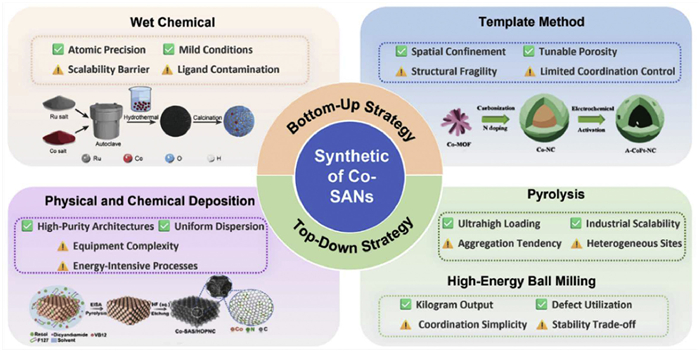
The bottom-up strategy employs mononuclear metal complexes, such as metal-organic frameworks, and metal phthalocyanines, as precursors, utilizing techniques such as physical/chemical deposition (e.g., atomic layer deposition, magnetron sputtering) [21], template confinement, or wet-chemical synthesis [22,23] to anchor and reduce metal atoms onto carrier surfaces. Key to this strategy is leveraging surface vacancies, defects, or functional groups (e.g., hydroxyl, amino) to immobilize metal precursors via strong coordination bonds [24–26]. For instance, topological defects in graphene act as “atomic traps” to capture metal ions, while the microporous structure of zeolite molecular sieves suppresses atomic agglomeration through spatial confinement effects [27]. These methods excel at constructing active centers with well-defined coordination configurations Co-N4 or Co-O4, providing ideal models for mechanistic studies at the atomic scale [28].
Wet-chemical synthesis, a cornerstone for single-atom nanomaterials, is renowned for procedural simplicity and operational flexibility [29,30]. This approach encompasses several prominent strategies, including maceration, co-precipitation, and ion exchange, unified by two principles: (1) Reinforcing metal-support interactions to stabilize isolated atomic sites and (2) Inhibiting atomic aggregation through controlled surface chemistry [31,32]. The process involves dispersing metal precursors onto supports via tailored reactions, where surface defects enable robust coordinative bonding—critical for maintaining atomic dispersion [33,34]. A typical protocol comprises three stages [35]: (1) Immobilization—Anchoring precursors (e.g., metal ions) via coprecipitation, impregnation, ion exchange, or electrostatic adsorption; (2) Ligand elimination—Removing excess ligands/solvents through drying/calcination to refine atomic structure; (3) Active site activation—Reducing anchored species to generate catalytically active single atoms. Notably, these methods offer scalable potential for diverse applications the anchored [36].
Maceration: This strategy leverages solution-based mixing to anchor precursors via adsorption/ion exchange [37]. Yang et al. synthesized atomically dispersed Co-N4/NG by homogenizing g-C3N4, Co(NO3)2·6H2O, and surfactant F127 with nitrogen-doped graphene (Figs. 1A-C) [38]. High-angle annular dark-field scanning transmission electron microscopy (HAADF-STEM, Fig. 1D) confirmed isolated Co sites, while F127 suppressed aggregation and promoted Co–N coordination. Chu et al. extended this to polycyclic aromatic hydrocarbon frameworks (Co-TPML, Fig. 1E), where energy-dispersive X-ray spectroscopy (EDX) and HAADF-STEM (Figs. 1F-J) verified atomic-scale Co dispersion [39]. Yang et al. further advanced the technique using cytidine monophosphate ligands to enhance coordination stability for water oxidation [40], demonstrating maceration’s adaptability in tailoring atomic environments.
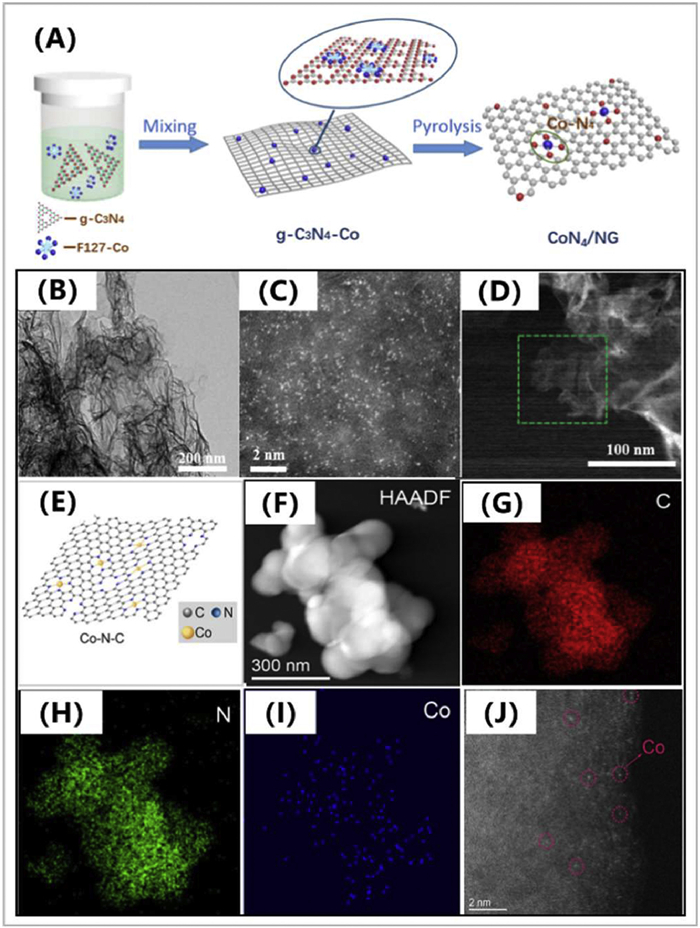
Co-precipitation method: This stands as another widely adopted method in this field, enabling atomic-level metal integration within supports [41]. Dostagir et al. employed a coprecipitation approach to synthesize cobalt-doped ZrO2 catalysts (denoted as CoZrOX(Y)), dissolving Co(NO3)2·6H2O and zirconyl nitrate in deionized water before inducing precipitation via gradual addition of NH4OH under vigorous stirring [42]. The resultant precipitate was dried and calcined to obtain the final catalyst. Combined characterization and computational analysis revealed uniform dispersion of cobalt atoms within the tetragonal ZrO2 lattice, with each Co atom adopting a five-oxygen coordination environment, a structural feature critical for catalytic reactivity. Shah et al. advanced this methodology by developing Co single atoms on RuO2 (o-SANs/RuO2) through hydrothermal precipitation (Fig. 2A). High-resolution transmission electron microscopy (HRTEM, Fig. 2B), HAADF-STEM (Fig. 2C) and EDX mapping (Fig. 2D) confirmed isolated Co sites, which enhanced bifunctional water-splitting activity via atomic precision in redox kinetics [43].
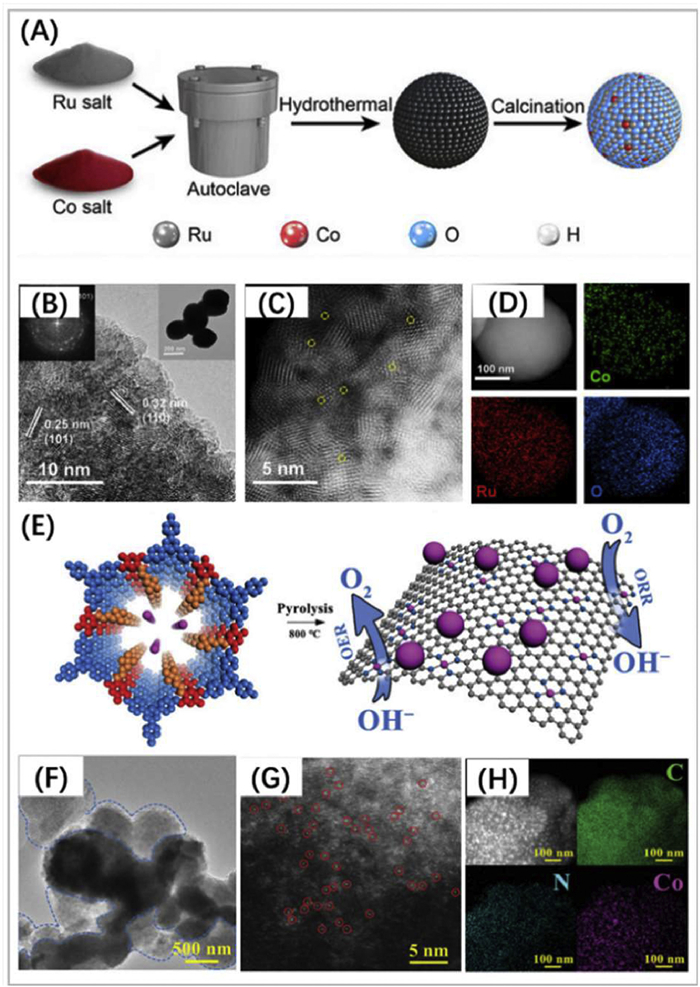
Ion exchange strategy: Guo et al. utilized ionic covalent organic frameworks (iCOFs) as sacrificial templates to anchor atomic Co sites (Co-SA) via ion exchange (Fig. 2E) [44]. Post-pyrolysis yielded Co-SA and Co-NP hybrids, with TEM (Fig. 2F) and HAADF-STEM (Fig. 2G) confirming isolated atoms (red circles) and uniform Co distribution (Fig. 2H). This highlights ion exchange’s efficacy in simultaneously controlling atomic and nanoscale structures.
Advantages and challenges of wet-chemical methods: Wet-chemical synthesis offers inherent advantages in operational simplicity, equipment versatility, and scalable production, aligning seamlessly with industrial manufacturing requirements. Nevertheless, persistent scientific challenges demand systematic resolution to unlock its full capabilities. The central scientific hurdle revolves around achieving atomic-scale dispersion control of cobalt precursors through precise reaction kinetics manipulation, which is a critical determinant for optimizing both single-atom site density and catalytic efficiency. Notably, the prevention of metal aggregation during synthesis, requiring coordinated strategies in ligand coordination design, carrier defect engineering, and thermal parameter optimization, emerges as a common technical challenge across Co-SACs development. Overcoming these intertwined kinetic and structural barriers will ultimately enable the transformation of wet-chemical methods into reliable platforms for standardized production of high-performance single-atom catalysts.
Template-based synthesis stabilizes single atoms through structural or molecular guidance [45,46], classified into: (1) Hard templates (e.g., carbon nanotubes, SiO2), which confine precursors in nanochannels before etching [47,48]; (2) Soft templates (e.g., surfactants, biomolecules), which direct metal deposition under mild conditions [49,50]. Both enable precise modulation of coordination environments, critical for oxygen reduction reaction (ORR) and water splitting [51].
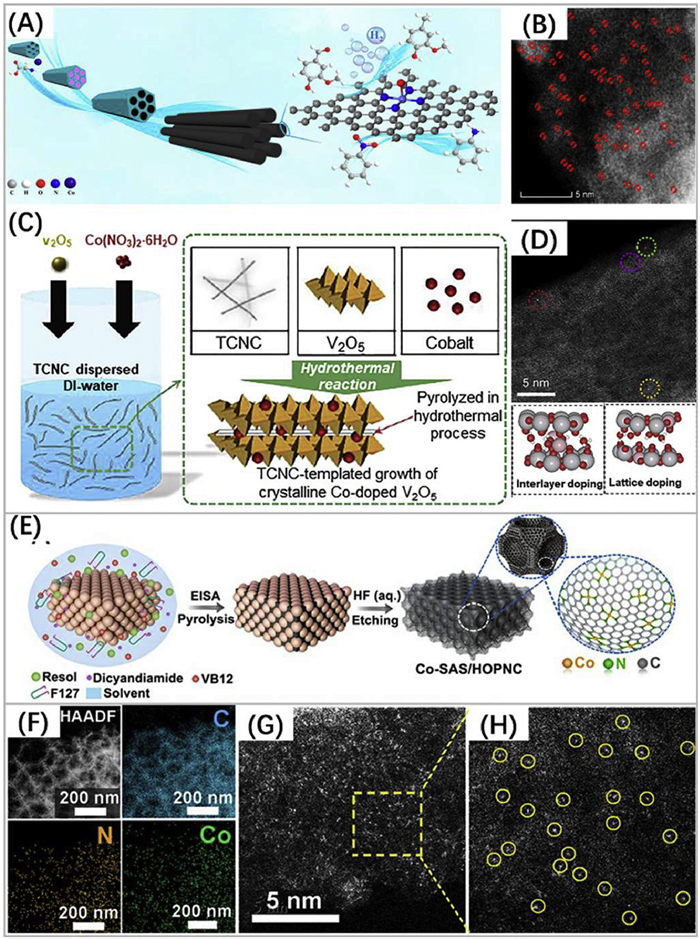
Zhang et al. leveraged SiO2 hard templates (MCM-41, SBA-15, FDU-12) to study pore geometry effects on Co dispersion in N-doped carbon (Co@NC, Fig. 3A). SBA-15-derived Co1@NC (Fig. 3B) showed superior activity in lignin upgrading [52]. Yu et al. employed NaCl templates to maximize Co-N4 site exposure in 3D porous nanosheets for Zn-air batteries [53]. Zhang et al. utilized cellulose nanocrystals to confine Co in V2O5 nanobelts (CoVO NBs), achieving > 450 h stability via lattice-stabilized atomic sites (Figs. 3C and D) [54]. To mitigate pore collapse in hard templates, Sun et al. developed dual-templated hierarchical Co-SANs/HOPNC (Figs. 3E–H) with interconnected macropores/mesopores (716 m2/g), optimizing mass transport [55]. Li et al. further enhanced ORR activity 11-fold through carbon defects in Co-N4 sites [56], demonstrating template methods’ versatility in engineering atomic-scale architectures [57].
Unlike bottom-up strategy, the top-down methods deconstruct bulk metals/nanoparticles via pyrolysis or ball milling [58]. Pyrolysis reconstitutes metal nodes into atomically dispersed Co-NX sites (e.g., ZIF-67 carbonization) [59], while ball milling fragments particles via mechanochemical effects [60], enabling scalable production. However, precise control of active site architectures remains challenging.
These techniques enable atomic-scale site engineering through controlled metal deposition [61,62]. Key methods include:
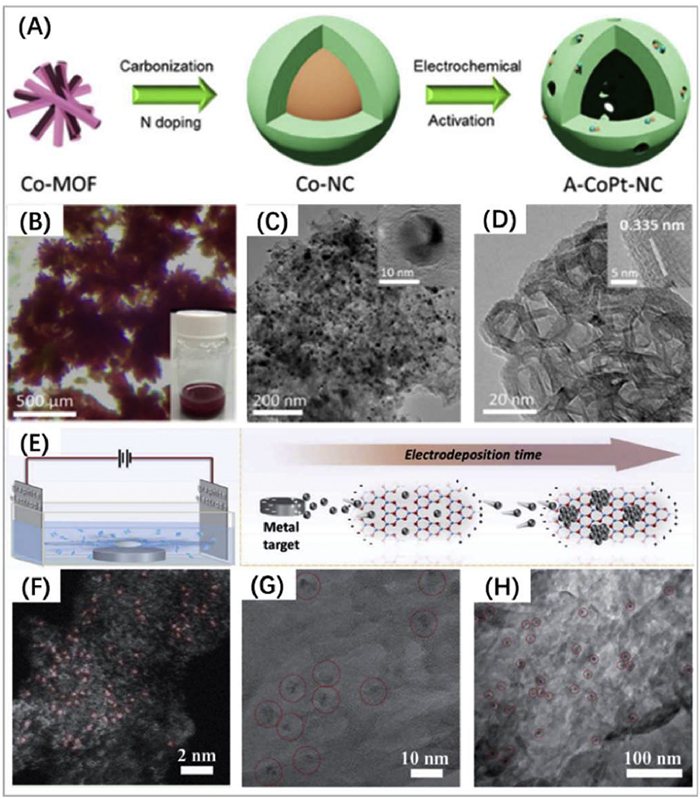
Electrochemical deposition (ED): ED operates via electrochemical redox reactions, where electrode electron flow and solution ion migration reduce metal ions into discrete atomic/nanoscale species depositing on conductive substrates [63]. This yields SANs with uniform atomic dispersion and high surface area, critical for electrocatalysis. Zhang et al. pioneered ED for Co-Pt single-atom catalysts (A-CoPt-NC) (Figs. 4A–D), where cyclic etching created atomic sites with superior ORR activity [64]. Later work extended ED to >30 SANs, including cathodic Co SA for hydrogen evolution reaction (HER) and anodic sites for oxygen evolution reaction (OER), achieving 1.39 V@10 mA/cm2 in water splitting [65,66]. Yan et al. tuned Co size on carbon nitride via deposition time (Figs. 4E–H), with density functional theory (DFT) confirming charge transfer modulation at atomic clusters [67]. This work highlights ED’s versatility in engineering atomic-to-nanoscale structures for solar energy conversion.
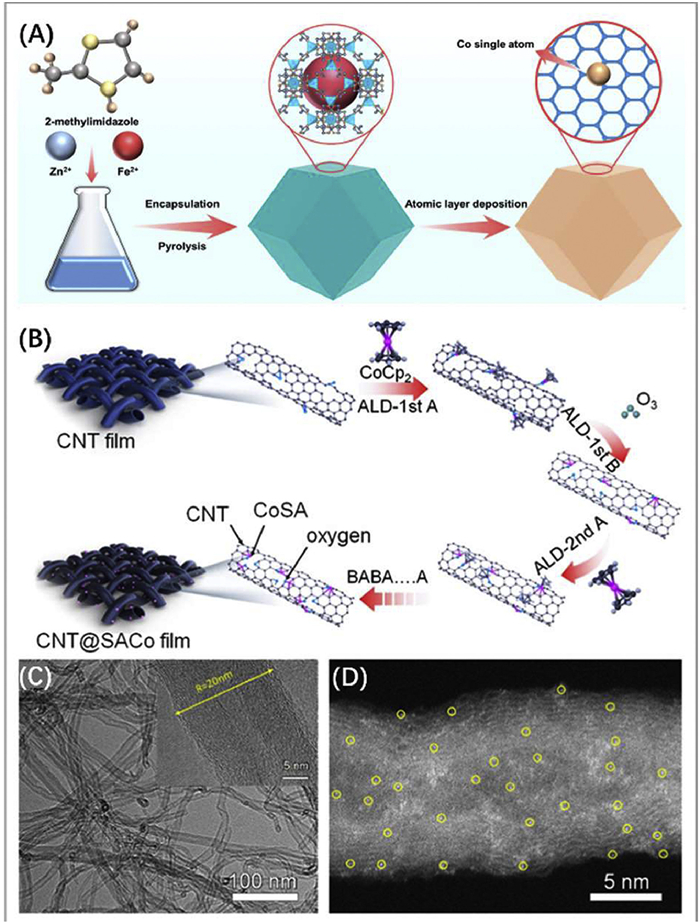
Atomic layer deposition (ALD): ALD is a transformative layer-by-layer technique enabling atomic-precision film growth via self-limiting surface reactions with gaseous precursors [68,69]. By cycling precursor exposures, it deposits materials with angstrom-scale control, ideal for tailoring SAN structures [70]. Xu et al. anchored Co atoms on zinc-iron zeolitic imidazolate framework (ZnFe ZIF, Fig. 5A) via 20 ALD cycles, ensuring atomic dispersion [71]. In a complementary approach, Lin et al. functionalized CNTs to deposit isolated Co sites (CNT@SACo, Figs. 5B–D), enhancing Li-S battery capacity (880 mAh/g) via atomic-level interfacial control [72].
Chemical vapor deposition (CVD): CVD employs gas-phase or gas-solid phase reactions to deposit solid products on substrates with precise structural control, ideal for synthesizing high-purity nanomaterials [73,74]. Rao et al. developed plasma-assisted CVD for high-loading Co-N4 sites (2.5 wt%) on N-doped carbon, achieving 0.896 V half-wave potential for ORR, surpassing Pt/C [75]. DFT revealed dynamic Co-N4 evolution during catalysis, highlighting CVD’s utility in rational catalyst design.
Pyrolysis thermally decomposes precursors to anchor isolated metal atoms, ensuring high dispersion and stability [76,77]. Pyrolysis methods for SANs synthesis can be categorized into four primary types based on precursor materials: Those are metal-organic framework (MOF) and derivative pyrolysis [78], polymer-metal pyrolysis [79], small-molecule-metal pyrolysis [80], and biomass-metal pyrolysis [81].
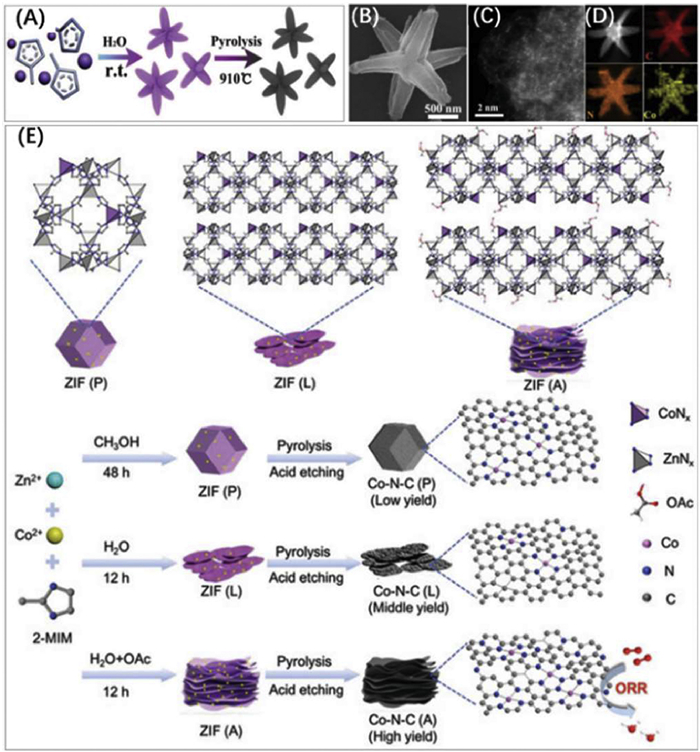
MOF and derivative pyrolysis: Yin et al. pyrolyzed a bimetallic Zn/Co MOF (Zn1/Co1-BMOF) to fabricate Co single atoms on nitrogen-doped carbon (Co SA/N-C) with >4 wt% cobalt loading, showcasing MOFs’ potential for high-metal-loading SANs [82]. Jin et al. mitigated agglomeration in ZIF-67 pyrolysis via ligand mediation (ascorbic acid, citric acid, EDTA), yielding bifunctional catalysts (AA-MOF-Co, etc.) with enhanced Co-NX dispersion after 800 ℃ treatment [83]. These ligands stabilize metal complexes, homogenizing Co-NX moieties and refining coordination environments to boost electronic structure and stability. Zhou et al. reported a 3D star-shaped hybrid MOF-derived single-atom cobalt catalyst (CoSA/N-C) by pyrolyzing a hybrid ZIF-L/ZIF-8 precursor at 900 ℃ (Fig. 6A) [84]. SEM revealed its distinctive morphology (Fig. 6B), while HAADF-STEM and elemental mapping confirmed atomic Co dispersion and uniform C/N/Co distribution (Figs. 6C and D). Gao engineered accordion-like (Fig. 6E) MOF precursors, also demonstrating structural control over atomic sites for enhanced ORR [85].
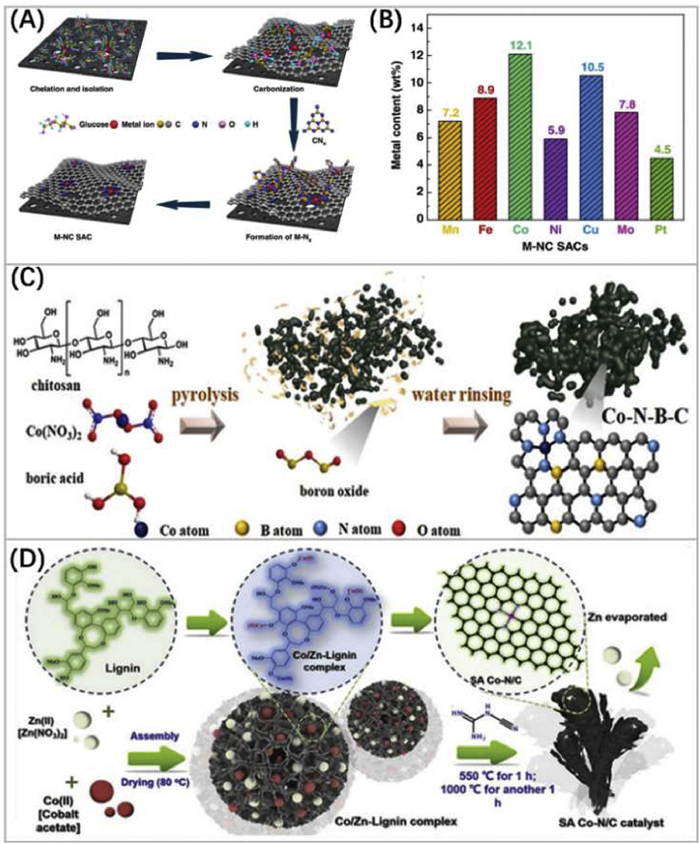
Small-molecule-metal pyrolysis: Herein, small molecules serve as dual-function precursors: They provide coordinated C/N atoms and stabilize metal complexes, enabling precise control over atomic dispersion and electronic structure to enhance catalytic activity and durability [86]. Zhao et al. introduced a “cascade anchoring” strategy (Fig. 7A) to tune metal loading universally [87]. Controlled pyrolysis immobilizes M-NX moieties (M=Co, Cu, etc.) in carbon matrices; for Co-based catalysts, this achieves a high loading of 12.1 wt% (Fig. 7B), with loading tunable via precursor design. Notably, Li et al. achieved ~10.2 wt% Co in N-doped carbon nano boxes (Co@CNB-N4) with efficient bifunctional water-splitting activity [88]. Xiong et al. further reported an ultrahigh 23.58 wt% Co using dicyandiamide-formaldehyde precursors, with FT-EXAFS confirming exclusive single-atom Co (no clusters/nanoparticles) [89].
Biomass-metal pyrolysis: Biomass-derived carbon enables sustainable SANs synthesis via intrinsic functional moieties and porous structures, which immobilize metals and boost catalytic performance [90,91]. Lignin exemplifies this versatility—its oxygen-rich groups strongly coordinate transition metals, forming complexes that inhibit atomic aggregation through spatial confinement [92].
Innovative thermal strategies enhance these properties. Xu et al. developed H3BO3-assisted pyrolysis to fabricate Co/N/B tri-doped carbon (Co-N-B-C) via 800 ℃ carbonization under N2 (Fig. 7C) [93]. Molten B2O3 (from in situ H3BO3 transformation) accelerates graphitization and suppresses Co nanoparticles, yielding hierarchical porosity (S8et = 523 m2/g) and atomic Co dispersion (4.2 wt%) via synergistic doping (B for thermal stability, N for active site stabilization). Complementarily, Qi et al. used lignin’s structure to synthesize N-coordinated Co single-atom catalysts (SA-Co-N/C) with 2.45 wt% loading via Zn-mediated confinement (Fig. 7D) [94]. Lignin’s groups chelate Co-Zn complexes; Zn evaporation during calcination creates vacancies, with the remaining Co atoms anchoring at these sites via tetrahedral N coordination to enable excellent persulfate activation. Both examples underscore biomass precursors' potential for fabricating cost-effective, high-performance single-atom catalysts through rational pyrolysis design.
Polymer-metal pyrolysis: This method leverages coordination-active matrices to anchor metal centers via well-defined bonds, enhancing atomic dispersion and structural stability [95]. Lin et al. designed a cobalt-perylene diimide (Co-PDI) catalyst using a two-step impregnation-calcination method, where atomically dispersed Co atoms bridge PDI layers to create directional charge-transfer pathways [96]. This work demonstrates atomic-level engineering to optimize charge transport and surface reactivity in polymer semiconductors. Li et al. synthesized Co-PAQ with Co-N2O2 motifs, where protonic solvents optimized H2 dissociation for selective hydrogenation [97].
High-energy ball milling, a mechanochemical approach, enables scalable SANs fabrication via operational simplicity, solvent-free processing, and precise atomic dispersion control [98]. Intense mechanical forces pulverize bulk materials and homogenize metal precursors with supports, strengthening interactions for atomic-level dispersion [99]. Recent advances confirm industrial viability, enabling kilogram-scale production with tunable loading and enhanced durability. For example, Gan et al. achieved 100% atomic dispersion in Pt1/Co alloys via solvent-free milling of acetylacetonates at kilogram scale [100]. Han et al. expanded versatility by grinding bulk metals (Fe, Co, Ni, Cu) into atomic configurations across supports, with loading regulated via impact frequency and duration [101].
While conventional wet ball milling suffers from solvent dependency and environmental concerns, innovative solvent-free variants address these challenges. Li et al. integrated milling with molten salts to form Co1/V2O5, where polarization weakened V-O bonds for uniform Co-O coordination (Fig. 8A) [102]. Wang et al. synthesized Co-S/N co-doped SACs (Co-SNC) via “mechanical detachment-acid leaching” [103], where ball milling exfoliates surface Co atoms followed by selective acid removal of excess metal.

Innovative strategies further enhance sustainability. Yu et al. ball-milled polymeric carbon nitride (PCN) to increase surface energy, enabling saturation adsorption of Co2+ ions before calcination, yielding Co-PCN with enhanced metal-loading capacity (Fig. 8B) [104]. Sun et al. directly milled polyacrylamide aerogel with anhydrous CoCl2 to synthesize amidoxime-functionalized PAO-Co, achieving atomic dispersion without post-treatment, minimizing environmental impact (Fig. 8C) [105]. These advances highlight ball milling’s role in bridging lab and industrial scales. Current focus includes in situ characterization (e.g., real-time XRD/Raman) to decode mechanisms and expanding to refractory metals (W, Mo) for high-temperature catalysis [106].
Bottom-up and top-down strategies exhibit distinct trade-offs in Co-SANs synthesis (Scheme 2 and Table 1). Bottom-up approaches (e.g., wet-chemical synthesis, template methods) excel in atomic-level precision: They enable tailored coordination environments (e.g., Co-N4 vs. Co-N3O) and controlled active site density, critical for optimizing structure-dependent catalytic properties like peroxidase-like activity [107]. However, their scalability is limited by complex precursor preparation and batch-to-batch variability, hindering industrial-scale production. In contrast, top-down methods (e.g., pyrolysis, high-energy ball milling) offer superior scalability—pyrolysis of MOFs or biomass precursors can be scaled to kilogram quantities—and lower production costs, but they sacrifice atomic precision, often resulting in heterogeneous coordination environments (e.g., mixed Co-Nx and Co-Oγ sites) that complicate structure-activity relationship analysis.
 DownLoad:
CSV
| Parameter | Bottom-up | Top-down |
| Coordination precision | High (e.g., defined Co-N4) | Moderate (limited control) |
| Metal loading | Low–moderate (<5 wt%) | High (up to 23.58 wt% [89]) |
| Scalability | Laboratory-scale | Industrial-scale (kg-level [100]) |
| Cost effectiveness | Moderate (complex precursors) | High (bulk precursors) |
| Toxicity | Moderate (solvents) | Low (solvent-free) |
Recent advances have begun to bridge these gaps. For instance, defect engineering in top-down strategies now enables atomic-level control: Sulfur vacancies introduced into MoS2 surfaces via plasma treatment act as “atomic traps” for cobalt, stabilizing Co-S4 coordination and optimizing d-band centers to enhance ORR activity [108,109]. This merges the scalability of top-down processing with the precision of bottom-up design. Similarly, ALD has been integrated into top-down workflows to refine active sites: ALD cycles can precisely adjust Co coordination numbers (e.g., from Co-N5 to Co-N4) in pyrolyzed MOF-derived catalysts, selectively amplifying oxidase-like activity for biosensing applications [107]. These hybrid approaches leverage the strengths of both strategies—scalability and precision—overcoming their inherent limitations.
Collectively, these diverse synthesis strategies, each with its own merits and limitations, provide powerful toolkits for tailoring Co-SANs with desired atomic structures for targeted applications. Understanding the structure-performance correlations discussed herein is crucial for rational catalyst design, enabling the optimization of Co-SANs for diverse fields from environmental remediation to energy conversion [110,111].
Beyond synthesis strategies, recent studies have broadened the functional landscape and mechanistic insights of nanozymes, offering valuable directions for rational enzyme mimicry. For instance, Chen et al. demonstrated atomic-level regulation of Co-SANs to enhance catalase-like activity, highlighting the importance of coordination environment engineering [112]. Song et al. developed a bioinspired NiCo2O4 nanozyme with a self-adaptive hierarchical structure, enabling mechanical bacterial capture and catalytic ROS generation for resistance-free antibacterial therapy [113]. Zhu et al. revealed that native and Fe-loaded human ferritin nanoparticles exhibit potent catalase-like activity, effectively detoxifying H2O2 and mitigating oxidative stress in neurodegenerative disease models [114]. Complementing these experimental advances, Guo et al. systematically reviewed the atomic-level engineering of SANs, highlighting structure–function correlations and their biomedical applications. Together, these studies enrich the conceptual and practical toolkit for nanozyme design, reinforcing the versatility of Co-SANs across environmental and biomedical domains.
Co-SANs mimic natural enzymes by anchoring atomically dispersed Co centers within precisely engineered coordination environments (e.g., Co–N4, Co–N3). These active sites catalyze pollutant degradation via oxidant activation pathways, such as peroxymonosulfate (PMS) or peroxydisulfate (PDS), generating ROS including sulfate radicals (SO4•-), hydroxyl radicals (•OH), and singlet oxygen (1O2) [115]. These ROS initiate oxidative cleavage of persistent organic pollutants (POPs), heavy metals, and emerging contaminants [116]. The nanozyme-like behavior arises from enzyme-mimetic kinetics, such as substrate specificity and turnover frequency, which are tunable through coordination environment engineering. To visualize these catalytic pathways and mimicry mechanisms, a schematic illustration (Scheme 3) is provided.
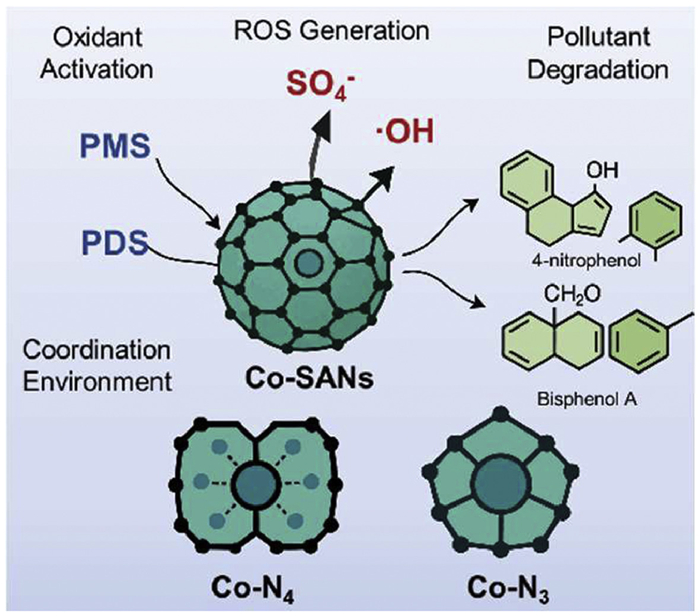
The catalytic mechanisms visualized in Scheme 3 establish a fundamental basis for Co-SANs’ practical utility in environmental remediation. Building on these atomic-level design principles, i.e., the atomic dispersion of Co active centers and the precise engineering of their coordination environments—Co-SANs offer transformative potential for environmental remediation [117]. Their maximized atom utilization and tunable surface chemistry enable efficient activation of oxidants and selective degradation of contaminants [118,119]. In contrast to conventional remediation materials (e.g., bulk metal oxides, non-dispersed metal catalysts), which are plagued by low atomic utilization, poor catalytic selectivity, and limited scalability—Co-SANs achieve superior catalytic efficiency and scalability in treating organic pollutants, heavy metals, and gaseous toxins. This advantage directly addresses the urgent challenges posed by rapid industrialization and environmental deterioration [120].
The atomic precision of Co-SANs enables targeted activation of oxidants for degrading persistent aquatic contaminants resistant to traditional methods [121]. Pollutants like 4-nitrophenol (4-NP), oxidized bisphenol A (BPA), emerging organic contaminants (EOCs), sulfadiazine (SDZ), roxarsone (ROX), and imidacloprid (IMI) remain resistant to traditional degradation methods, posing an ongoing challenge [122–124]. Here, the coordination environment of single Co atoms (e.g., Co-Nx) dictates their ability to activate PMS/PDS and generate reactive radicals (SO4•−, •OH, 1O2), driving selective degradation [115].
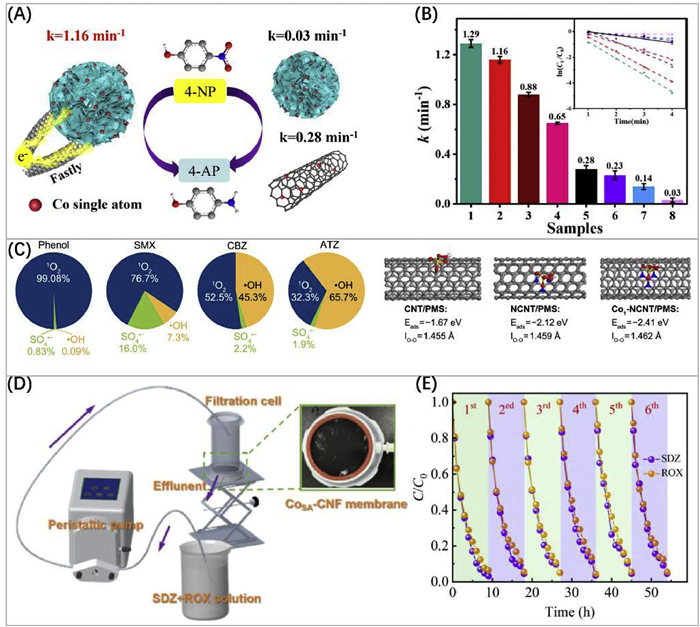
For example, Deng et al.’s Co1-MoS2/CNT heterojunction utilized atomic Co sites to enhance electron density via p-n junctions, achieving an apparent rate constant (k = 1.16 min-1) for 4-NP reduction, 38.6 × higher than bulk controls (Figs. 9A and B) [125]. The atomic dispersion of Co optimizes charge transfer at the heterojunction interface, demonstrating how carrier engineering synergizes with single-site catalysis. Li et al. showed Co-N4 sites on N-graphene act as electron-transfer hubs for PMS activation, achieving TOF = 12.52 min-1 [126]. Pyrrolic N facilitated BPA adsorption, while Co-N4 accelerated radical generation. The dual role of the coordination environment (N-type/Co center) highlights the multifunctionality achievable only at atomic precision. Liang et al. proved low-coordination Co-N3 sites outperform Co-N4 in PDS activation due to stronger oxidant adsorption and faster SO4•− generation [127]. This underscores the critical role of coordination number, a key structural parameter tunable via synthesis, indicating oxidant adsorption and activation kinetics, highlighting their potential for real-world wastewater treatment [128,129].
Beyond traditional pollutants, emerging EOCs and membrane fouling pose growing challenges in water treatment. Co-SANs, with their tailorable surface chemistry and atomic-level active sites, enable dual-function systems that degrade EOCs while mitigating fouling.
Yang et al. functionalized ceramic membranes with Co1-NCNT CM, integrating them with a PMS system to degrade EOCs (e.g., phenols, sulfonamides) and mitigate membrane fouling [130]. Cobalt-N3 active sites, whose coordination was optimized via template synthesis, generated 1O2 for selective oxidation, achieving >90% removal efficiency while repulsive interactions with natural organic matter (NOM) minimized fouling (Fig. 9C). This multi-functional architecture demonstrates how atomic precision in active site design enables synergistic pollutant degradation and fouling control, advancing secondary wastewater treatment.
Xia et al. synthesized electrospun (CoSA-CNFs) for adsorptive removal of SDZ and ROX, designing a continuous-flow membrane device with rapid regeneration via PMS activation (Figs. 9D and E) [131]. The material’s high adsorption capacity and durability stem from atomic Co dispersion, which maximizes binding sites without compromising structural integrity. This work exemplifies scalable applications of Co-SANs in industrial wastewater treatment, leveraging atomic-level control for both adsorption and catalytic regeneration.
Pesticides like IMI persist in water systems due to their stable molecular structures, requiring catalysts with precise radical generation capabilities [132,133]. DFT-guided Co atomic design allows precise optimization for recalcitrant pollutants like IMI. For example, Wang et al. employed S-doped Co-SANs to activate PMS for IMI degradation, combining DFT and computational toxicology to optimize sulfur doping levels [134]. The S-modified Co-S4-C0 catalyst, where sulfur adjusts Co’s electronic structure, exhibited enhanced PMS activation, generating SO4•− and •OH radicals that efficiently cleaved IMI’s C-N and C-Cl bonds. DFT revealed that sulfur doping adjusted the d-band center of cobalt, improving PMS adsorption and electron transfer kinetics, critical for radical generation. This work establishes sulfur doping as a viable strategy to enhance Co-SANs’ redox activity for pesticide-contaminated water treatment, linking dopant-induced structural changes to catalytic performance.
Co-SANs exhibit excellent lab-scale performance in degrading model pollutants (e.g., 4-NP, BPA) via PMS/PDS activation, but real-world matrices pose critical challenges: Competitive adsorption of natural organic matter and inorganic ions blocks Co–NX sites, suspended solids and biofouling impede mass transfer, and acidic pH or high oxidant loads induce Co2+ leaching, while mixed ROS generation and scavenging by background constituent’s lower oxidant utilization efficiency [125]. To overcome these limitations, we propose: (1) Hierarchical meso–/macroporous carbon or hybrid membrane–adsorber supports to preconcentrate contaminants and resist fouling, (2) Heteroatom dopant (S, P, B) introduction and controlled defect engineering to strengthen Co–support coordination and direct selective ROS pathways, (3) Continuous-flow or fluidized-bed reactors with membrane-integrated modules for dynamic residence-time control and on-line backwashing, and (4) Synergistic coupling of PMS/PDS activation with photothermal or ultrasonic excitation to enhance radical generation kinetics while minimizing secondary byproduct formation [131].
Co-SANs extend their atomic precision to gas-phase catalysis, where maximized active site accessibility and tailored redox properties address key challenges in air quality management [135]. Gaseous pollutants, including volatile organic compounds (VOCs), carbon monoxide (CO), nitrogen oxides (NOX), and formaldehyde (HCHO), pose severe threats to ecological balance and public health [136], with NOX contributing to photochemical smog formation and HCHO (WHO Group 1 carcinogen) inducing chronic respiratory disorders [137,138]. The absence of inactive bulk atoms in Co-SANs allows full utilization of Co centers for adsorption and activation, critical for dilute pollutant removal.
CO2 photoreduction to value-added chemicals is a pivotal strategy for carbon neutrality, requiring catalysts with high selectivity and activity [139]. Single-atom confinement prevents Co aggregation during the photoreduction process, thereby sustaining high catalytic activity for CO2-to-fuel conversion [140,141].
Zuo et al. engineered Co-MNS, a single-atom catalyst with 6.0 wt% cobalt loading, using ultrathin MOF nanosheets as a substrate via a bottom-up synthesis strategy (Fig. 10A) [142]. Under visible-light irradiation, this catalyst achieved a record-breaking CO2-to-CO conversion rate of 7041 µmol g-1 h-1 with 86% selectivity (Figs. 10B-D), surpassing all previously reported MOF-based photocatalysts. The Co-N4 moieties, whose coordination was precisely controlled via MOF pyrolysis, on the high-aspect-ratio nanosheet surface served as active sites, facilitating CO2 adsorption and the formation of COOH* intermediate formation through enhanced charge separation and surface reactivity. This study provides both theoretical and technical foundations for developing high-efficiency, low-cost photocatalytic CO2 reduction materials, advancing the utilization of CO2 resources, and supporting the achievement of carbon neutrality goals.
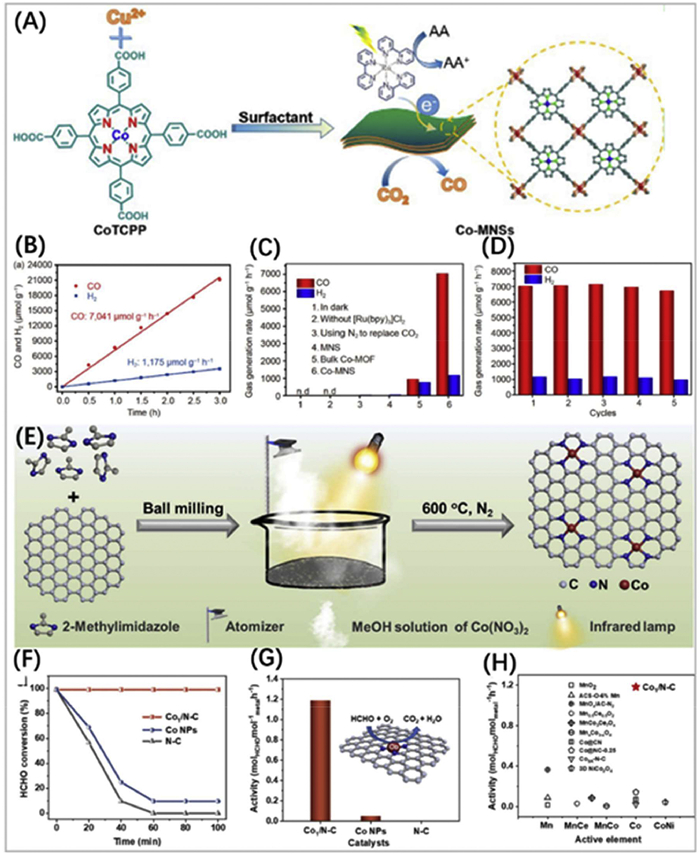
In a parallel effort, Wang et al. developed 0.8-CoISAS/MMNC-900, a novel hierarchical porous catalyst featuring atomically dispersed Co-N4 sites embedded in N-doped carbon with micro-mesoporous architecture, via a SiO2− assisted pyrolysis-adsorption-pyrolysis strategy [143]. The catalyst exhibited superior photocatalytic CO2 reduction performance, achieving a CO production rate of 7261 µmol g-1 h-1 (CO selectivity: 90.1%), and exceptional stability. The hierarchical porosity, engineered via template methods—optimized mass transport and active site accessibility, while the Co-N4 coordination environment minimized over-reduction side reactions. These findings highlight the critical role of multi-scale morphological engineering in enhancing photocatalytic CO2 conversion, providing a blueprint for scalable catalyst design.
As a ubiquitous indoor pollutant, HCHO poses significant health risks through chronic exposure, necessitating efficient room-temperature elimination technologies [144]. Atomic dispersion mitigates the formation of Co-Co ensembles that drive incomplete oxidation, thereby enabling complete HCHO mineralization at ambient temperature. Zhang et al. demonstrated this advantage through their Co1/N-C catalyst, synthesized via a universal precursor atomization method ensuring atomic cobalt dispersion (Fig. 10E) [145]. This system achieved unparalleled activity (100% HCHO removal at 50 ppm, 25 ℃) and durability (>500 h without decay) (Figs. 10F–H), outperforming all reported non-noble metal catalysts. Mechanistically, HCHO adsorbs onto surface hydroxyl groups, forming formate intermediates that undergo synergistic activation at pyrolysis-tuned Co-N4 sites. Crucially, atomic Co dispersion reduces the energy barrier for rate-limiting formate decomposition, accelerating complete oxidation to CO2 and H2O. This work demonstrates how stabilized atomic Co sites overcome the rapid sintering and deactivation inherent to nanoparticle-based systems.
Co-SANs have demonstrated record-breaking CO2-to-CO photoreduction rates and 100% formaldehyde removal with >500 h stability at ambient temperature [142], yet practical air-purification applications face three main hurdles: Catalyst deactivation and byproduct accumulation during prolonged HCHO oxidation, limited photoreduction selectivity due to competing multi-electron pathways, and suboptimal visible-light absorption and charge separation in existing Co-SAN systems [146]. To address these challenges, we propose: (1) Integrating photothermal coupling to locally elevate catalyst temperature, accelerate reaction kinetics, and promote intermediate desorption; (2) embedding plasmonic metal–Co-SAN heterojunctions (e.g., Au or Ag nanoparticles) to extend and intensify visible-light harvesting at atomic Co sites; and (3) deploying optimized light-reactor designs, such as thin-film or microfluidic photoreactors with uniform irradiation and precise thermal management, to maximize photon utilization, maintain active-site integrity, and ensure stable long-term performance [147,148].
Co-SACs demonstrate broad application potential in energy storage and conversion technologies, including fuel cells, metal-air batteries, electrocatalytic water splitting, and renewable chemical (H2O2) synthesis, by leveraging atomic-scale active sites to optimize redox kinetics and material utilization [149,150]. Their tunable coordination environments and high atomic efficiency (e.g., template-mediated spatial confinement, pyrolysis-derived Co-Nx coordination), address critical challenges in energy storage and conversion, offering sustainable alternatives to noble metal catalysts [151].
Building on the atomic-level design principles, particularly the precise engineering of Co-NX coordination and porous carrier architectures, Co-SANs have emerged as transformative solutions for Li-S batteries [152]. They tackle long-standing challenges such as polysulfide shuttling and sluggish redox kinetics through their uniquely dispersed active sites, which maximize atomic utilization and tailor interactions with sulfur species.
Li-S batteries, despite their high theoretical energy density (2600 Wh/kg), face critical challenges from polysulfide shuttle effects and low sulfur conductivity, which degrade cycle stability and rate performance [153,154]. Recent advancements address these issues through synergistic material design, as exemplified by two landmark studies:
Lin et al. demonstrated a breakthrough in mitigating polysulfide shuttling through atomic-level catalyst design, anchoring cobalt single atoms on N-doped porous carbon (CoSAC-NPC) as a multifunctional interlayer (Fig. 11A) [155]. This architecture, leveraging porous carriers engineered via template methods, combined physical confinement, chemisorption, and catalytic conversion of polysulfides. This architecture combined physical confinement, chemisorption, and catalytic conversion of polysulfides, achieving a high specific capacity of 1457.9 mAh/g at 0.1 C (Fig. 11B) and exceptional cyclability (788.7 mAh/g retained after 400 cycles at 0.5 C). This work underscores how atomic precision in active site distribution bridges the gap between theoretical promise and practical Li-S battery performance.
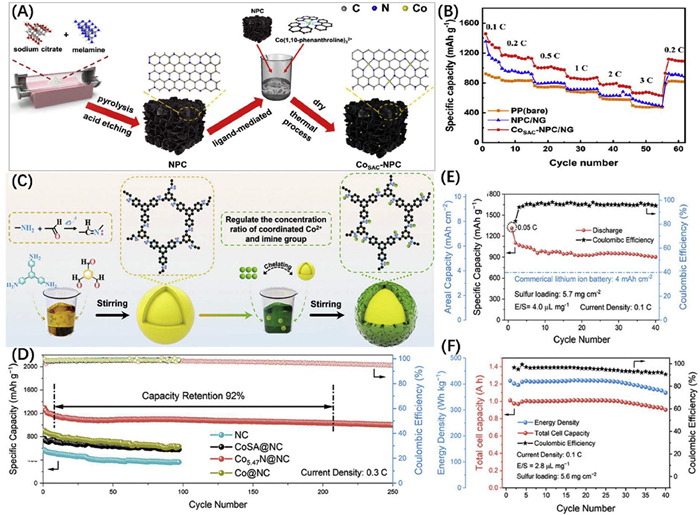
Building on this progress, Li et al. utilized COF-derived carbon substrates with intrinsic chelation to anchor cobalt species, yielding a hierarchical Co5.47N@NC catalyst with Co single atoms, nanocrystals, and nanoparticles (Fig. 11C) [156]. This design, optimized via pyrolysis, tuned the d-band center of Co, reducing polysulfide conversion barriers by 23% and delivering industrial-grade metrics: 1314 mAh/g at 5.7 mg/cm2 sulfur loading and 411 Wh/kg pouch cell energy density (Figs. 11D-F). The synergy between single atoms (for catalytic conversion) and nanoparticles (for conductivity) highlights how atomic-scale engineering enables multi-functional performance.
Collectively, these works showcase paradigm-shifting atomic-precision strategies—from d-band modulation to spatial site engineering to overcome Li-S electrochemistry limitations. Nevertheless, critical challenges persist under high sulfur loading, including polysulfide shuttling, active-site passivation, and rapid capacity decay [157,158]. Future optimization requires: (1) Multifunctional interfaces integrating physical confinement and chemical adsorption [159]; (2) Hierarchical pore architectures enhancing mass transport and sulfur utilization [160]; (3) Machine learning-guided catalyst design to optimize adsorption energetics for polysulfides [161].
Leveraging the dynamic coordination adaptability of Co-SACs, enabled by their atomic dispersion and tunable Co-Nx environments, researchers have made significant strides in addressing the kinetic limitations of Li-O2 batteries, particularly in optimizing ORR/OER processes and enhancing cycle stability [162].
Li-O2 batteries promise ultrahigh energy density (~3505 Wh/kg) but suffer from sluggish ORR/OER kinetics and inadequate cycling stability [163]. Co-SANs mitigate these issues by enabling dynamic coordination evolution of active sites [164,165]. Zheng et al. engineered a quasi-free Co1-N3, where operational conditions induce a transition from Co1-N3 to O*-Co1-N2 configurations, made possible by the labile coordination of single atoms. This adaptive structure enhances adsorption of key intermediates (LiO2, Li2O2) and directs epitaxial growth of lamellar Li2O2 crystals [166], reducing charge-discharge overpotentials, achieving low polarization (>2.0 mA/cm2 rate capability) and extended cycle stability (>200 cycles). This establishes a new paradigm for dynamic electrocatalyst design, where atomic-scale flexibility drives performance. Huang et al. integrated Co-SACs with a recyclable LiBr redox mediator (RM) to regulate LiOH formation/decomposition, addressing capacity fading in Li2O2-based batteries [167]. During discharge, Co-N4 sites drive 4e− ORR to produce LiOH; during charge, Br3− species decompose LiOH at a moderate potential (3.6 V vs. Li/Li+), enabling simultaneous mediator regeneration and electrolyte purification. The atomic dispersion of Co ensures efficient electron transfer, critical for mediating both steps.
Despite their high theoretical energy density, Li-O2 batteries face critical barriers to commercialization, including low round-trip efficiency, high overpotentials, and irreversible Li2O2 decomposition [168]. Future breakthroughs demand: (1) Design a dynamic active site regulation mechanism (e.g., reversible evolution of Co-Nx structure during reactions) to enhance the adsorption and conversion capacity of intermediates; (2) Incorporate electrolyte functional additives to regulate reaction pathways and suppress byproduct formation.
Building on the atomic-scale design principles (e.g., tunable Co-NX coordination via pyrolysis and template methods), Co-SACs have emerged as promising catalysts for Zn-air batteries [169]. Their atomically dispersed Co-Nx sites, enabled by precise synthesis strategies, optimize ORR/OER kinetics by maximizing active site exposure and tailoring O2 adsorption energy, addressing critical limitations of noble metal catalysts (e.g., high cost, scarcity) while boosting energy conversion efficiency and cycle stability [170].
To overcome sluggish ORR kinetics in metal-air systems, Chen et al. developed a bio-inspired Co/CoN4PCF catalyst, mimicking sea anemone structures to integrate highly conductive activated carbon fibers (ACF) with cobalt single atoms and nanoparticles (Figs. 12A-C) [171]. This architecture leverages Co-N4 sites as the core active centers: Their atomic dispersion ensures maximum exposure for O2 adsorption, while the porous “anemone” structure enhances mass transport. The catalyst achieved a half-wave potential of 0.90 V and a limiting current density of 6.1 mA/cm2 for ORR (Figs. 12D and E), translating to a peak power density of 196 mW/cm2 in Zn-air batteries, surpassing commercial Pt/C (Fig. 12F). This work highlights how atomic-scale Co-N4 sites synergize with hierarchical carriers to balance activity and conductivity.
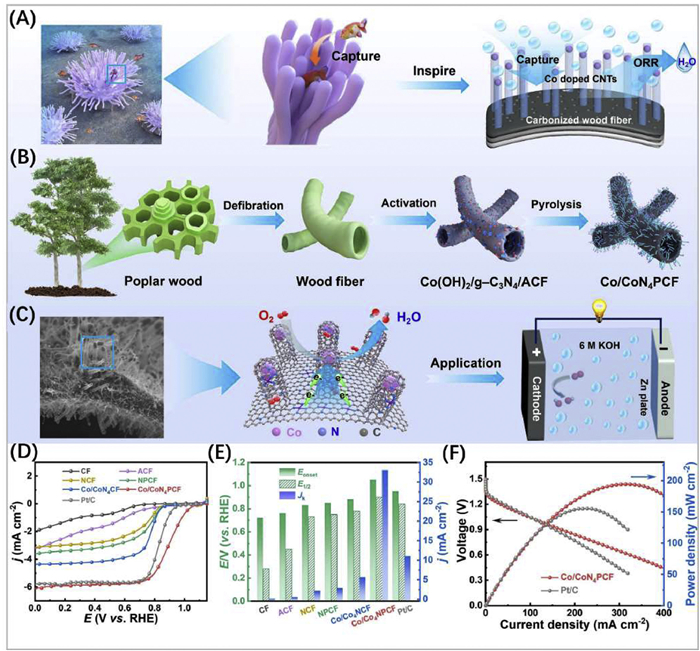
Furthermore, Zou et al. optimized carrier engineering by leveraging N-doped graphene’s (NrGO) three-dimensional porosity, engineered via template methods to anchor Co-N4 single atoms [172]. The interconnected pores enhance active site accessibility, while the Co-N4 coordination tunes the electronic structure for stronger O2 adsorption. This design achieved an onset potential of 1.05 V, a half-wave potential of 0.84 V, and a peak power density of 240 mW/cm2 with 233-h stability, demonstrating how porous carriers amplify the advantages of atomic-scale active sites.
Addressing the key challenges of electron transfer efficiency and active site exposure, Wang et al. introduced a core-shell structured catalyst (Co-TPG-IPOF/KB) with asymmetrically coordinated Co single atoms on an ionic porous organic framework [173]. The porous framework (specific surface area: 614 m2/g) ensures uniform dispersion of Co sites, while asymmetric coordination modulates electron density enhancing electron transfer and substrate binding. This design delivered a half-wave potential of 0.842 V, superior methanol resistance, and 189 mW/cm2 peak power in Zn-air batteries, underscoring the synergy between porous organic frameworks and atomic-scale coordination.
Askari et al. focused on bifunctional performance, designing a Co-N-C electrocatalyst with Co-N4 sites derived from modified ZIF-11 [174]. The Co-N4 sites (tunable via MOF pyrolysis) synergize with pyridinic nitrogen to optimize ORR/OER dual activity, achieving a half-wave potential of 0.859 V (ORR) and 1.544 V overpotential (OER), alongside a record 1580-cycle lifespan. This highlights how ligand environment (pyridinic nitrogen) modulates single-atom activity for long-term stability.
To address low-temperature energy storage challenges, Yan et al. anchored Co single atoms on high-curvature carbon, inducing geometric strain that modulates Co d-orbital distribution [175]. This strain engineering, unique to atomic-scale systems, enhances OOH* adsorption, enabling a kinetic current density of 31.09 mA/cm2 at 0.85 V (89-fold higher than planar counterparts) and 54.8 mW/cm2 peak power at −40 ℃. This extends Co-SACs’ application to extreme environments, leveraging atomic precision for structure-activity control.
Despite these advancements, practical Zn-air batteries still face critical challenges that hinder large-scale deployment: The progressive deactivation of Co-NX active sites, structural degradation of catalyst carriers under prolonged charge-discharge, and reduced performance induced by ambient moisture (a common airborne interference) [172,174]. To address these bottlenecks, three synergistic strategies have emerged: (1) Coordination armor through S-integrated Co-S4-C0 motifs, where covalent S-Co bonds suppress demetallization during potential cycling [134]; (2) Conductive ceramic carriers utilizing RuO2 substrates that maintain structural integrity at harsh anodic potentials (>1.8 V) via inherent oxidation resistance [43]. This multi-faceted approach concurrently addresses metal-center stability, carrier durability, and environmental interference—key bottlenecks in practical deployment.
H2O2 serves dual roles as a renewable energy carrier and a high-value chemical, finding widespread use in pharmaceuticals, environmental remediation, and industrial processes [176]. Conventional anthraquinone-based H2O2 synthesis suffers from energy-intensive multi-step reactions and hazardous byproducts [177], driving demand for green electrochemical alternatives via the two-electron oxygen reduction reaction (2e− ORR). This approach enables sustainable H2O2 generation from air and water using renewable electricity, with SACs emerging as ideal catalysts, their atomically precise active sites (e.g., Co-N4 coordination) and tunable electronic structures allow precise optimization of selectivity and productivity.
Gao et al. addressed the scarcity of acidic-stable electrocatalysts by systematically engineering transition metal-based SANs (Co, Mn, Fe) for H2O2 synthesis, establishing clear structure-performance relationships (Fig. 13A) [178]. By anchoring Co single atoms on N-doped graphene matrices, both catalytic activity and 2e− ORR selectivity was enhanced. The Co-SANs system outperformed conventional noble-metal catalysts in acidic media, achieving a high H2O2 production rate with >90% Faradaic efficiency and superior stability (Fig. 13B). Key to this performance was the tuning of the d-band center of Co-N4 sites, an atomic-scale electronic modulation enabled by precise coordination engineering, which optimized OOH* intermediate adsorption, thereby accelerating 2e− pathway kinetics.
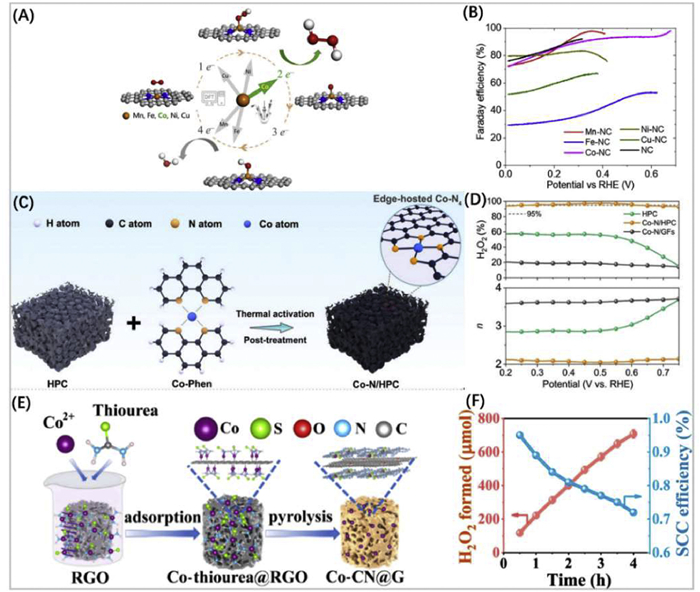
Furthermore, Tian et al. advanced the atomic-level understanding by revealing the decisive role of geometric site localization in 2e− ORR pathway selection [179]. In alkaline media, edge-anchored Co-N4 sites (synthesized via defect engineering) demonstrated 95% selectivity for H2O2 synthesis, significantly outperforming basal plane counterparts (Fig. 13C). An edge-rich Co-N/HPC catalyst achieved a H2O2 yield of 1.72 mol h-1g-1, with oxygen-functionalized carbon edges further enhancing reaction kinetics (Fig. 13D). This study highlights how atomic-scale site localization (a structural parameter tunable via synthesis) dictates selectivity, providing critical insights for scalable electrochemical H2O2 production.
In contrast to electrocatalysis, Wang et al. revolutionized photochemical routes by integrating photothermal and photocatalytic effects in a seawater-based system [180]. Their Co–CN@G heterostructure, featuring atomically dispersed cobalt on a S-doped carbon nitride/graphene matrix, achieved agent-free H2O2 photosynthesis from natural seawater (Fig. 13E). The dual mechanism, enabled by atomic Co sites (uniformly dispersed via wet-chemical methods), suppressed charge recombination and accelerated kinetics, yielding a 0.72% solar-to-chemical conversion efficiency under simulated sunlight (Fig. 13F). This breakthrough demonstrates a carbon-neutral alternative to energy-intensive industrial methods, leveraging atomic precision for efficient light-driven H2O2 synthesis.
Despite these advancements, electrocatalytic H2O2 synthesis still faces three critical limitations for practical deployment: Low 2e− ORR selectivity, poor catalyst stability under extreme acidic/alkaline conditions (inducing Co leaching and active site decay), and uneven Co-based active site dispersion (impairing mass transport and kinetics) [178]. To address these bottlenecks and advance efficient, sustainable production, future optimization strategies should focus on three directions: (1) Engineer Co-N4 sites with precisely tuned d-band centers (via coordination engineering like heteroatom doping) to favor the 2e− ORR pathway and suppress 4e−-mediated water formation [181]; (2) Enrich edge-localized Co single-atom sites (via carbon support defect engineering) to enhance H2O2 selectivity and kinetics—edge sites strongly adsorb *OOH intermediates (key for 2e− ORR) versus basal plane sites [182]; (3) Explore hybrid photothermal-electrocatalytic systems (integrating Co-based single-atom catalysts with light-harvesting matrices like S-doped carbon nitride/graphene) for sustainable seawater-based H2O2 production, leveraging synergistic effects to suppress salt-induced deactivation [183].
Transitioning to green hydrogen production is pivotal for achieving carbon neutrality [184]. While hydrogen serves as a zero-emission energy carrier, over 95% of its current output relies on fossil fuel-based methods like steam methane reforming, generating substantial CO2 emissions [185]. Alkaline water electrolysis, powered by renewable energy, offers a scalable and sustainable pathway for high-purity hydrogen production [186,187]. However, its reliance on scarce and costly noble metal catalysts (e.g., Pt) for the HER hinders industrial scalability [188,189]. Co-SACs have emerged as high-performance, cost-effective alternatives, leveraging their atomically dispersed active sites and tunable coordination environments to address HER challenges.
Kang et al. pioneered a room-temperature strategy to enhance photocatalytic hydrogen production by engineering axial Co-S bonds in graphitic carbon nitride (C3N4) [190]. The resulting Co-(N, S)/C3N4 structure features cobalt atoms coordinated to four N and one S atom—this specific coordination (tunable via wet-chemical doping) leverages S’s high electronegativity to weaken hydrogen adsorption energy, thereby boosting evolution efficiency. This catalyst achieves a hydrogen production rate of 10 mmol g-1 h-1, 10-fold higher than conventional transition metal/C3N4 and 2.5-fold higher than Pt nanoparticle systems, demonstrating how sulfur-mediated electronic tuning of single-atom Co sites optimizes HER kinetics.
For industrial-scale electrolysis, Huang et al. developed a hetero-structured catalyst (Co-O-C-O/CoO/CF) integrating oxygen-coordinated cobalt single atoms with oxygen-doped carbon and CoO nanowires [191]. DFT calculations revealed that optimized d-band centers and binding strengths for H* and OH* intermediates reduce reaction energy barriers, enabling ultralow overpotentials (24.8 mV at 10 mA/cm2) and 1000-h stability at 1000 mA/cm2 in alkaline electrolytes. This design exemplifies scalable HER electrocatalysts for industrial deployment.
These advancements demonstrate that Co SACs, through electronic modulation, heterostructure engineering, and multifunctional design, address key challenges in green hydrogen production, bridging the gap between laboratory innovation and industrial applicability.
However, conventional HER catalysts face three key challenges hindering green hydrogen scaling: High overpotentials at industrial current densities (100–500 mA/cm2) causing significant energy penalties; poor alkaline activity due to sluggish water dissociation kinetics; structural degradation under sustained high-current operation [192]. To address these limitations, optimization strategies includes: (1) Heterointerface engineering (e.g., Co-O-Co/CoO) balances H*/OH* adsorption to accelerate Volmer kinetics while lowering overpotentials [190]; (2) Electronic modulation via S/N co-doping optimizes d-band centers for enhanced electron transfer in alkaline media [193].
As the anodic half-reaction of water splitting, the OER is as critical as HER for sustainable hydrogen production, with wide-ranging applications in energy conversion systems (e.g., water electrolysis, metal-air batteries) [194,195]. Oxygen, a colorless, odorless, and non-toxic gas comprising ~21% of Earth’s atmosphere, is indispensable for these processes. Co-SACs have emerged as high-performance OER catalysts, leveraging their atomically precise active sites to enhance efficiency and stability [196].
For example, Wang et al. engineered a visible-light-driven photocatalyst by immobilizing cobalt single atoms on carbon quantum dots (CQDs) derived from vitamin B12 pyrolysis [197]. The Co-N4-configured CQDs achieved dual functionality as light-harvesting antennae and atomically dispersed cobalt carriers (3.27 wt% loading). This system demonstrated exceptional visible-light absorption, accelerated charge separation, and minimized electrochemical impedance. The atomically dispersed Co sites delivered an oxygen evolution rate of 168 µmol g-1 h-1 during water oxidation, alongside high imine conversion (~90%, >99% selectivity). Complete photodegradation of organic dyes further demonstrated its versatility in oxidative transformations.
Beyond visible-light photocatalysis, electrocatalytic approaches have also leveraged Co-SACs to achieve breakthroughs in OER efficiency and durability. Yang et al. developed a mesoporous silica-templated cobalt single-atom catalyst (Co-TOK) through spatial confinement and calcination [46]. The Co-O-Si anchored structure achieved a low OER overpotential of 0.45 V at 10 mA/cm2. Remarkably, Co-TOK retained 98% initial activity after 100 stability cycles, demonstrating unparalleled durability. This work establishes a scalable strategy for synthesizing stable, high-efficiency single-atom OER catalysts [198].
Building on these structural and electrochemical innovations, recent efforts have focused on synergistic modifications to amplify photocatalytic efficiency. For instance, Haq et al. synergized N doping with Co-SACs integration by decorating calcium niobate nanosheets with urea-derived nitrogen species [199]. The optimized Ca2Nb2O10-XNX-Co SA system achieved a photocatalytic oxygen evolution rate of 727.22 µmol g-1 h-1. This performance leap stems from enhanced charge carrier separation, facilitated by N doping and the uniform dispersion of Co single atoms, highlighting the critical role of dopant-atom synergy in advancing OER technologies.
This review systematically consolidates the fragmented research landscape of Co-SANs by establishing a cohesive “design-mechanism-application” framework, thereby achieving the initial goal of bridging their critical roles in environmental remediation and sustainable energy conversion. The key findings are:
(1) Structural regulation as the core driver of performance: Precise engineering of coordination geometry (e.g., Co-N3, Co-N4) and electronic structure enables Co-SANs to efficiently activate oxidants (PMS/PDS) for pollutant degradation in environmental remediation and optimize redox kinetics (ORR/OER, polysulfide conversion) in energy storage/conversion, laying the foundation for their cross-domain applicability.
(2) Synthesis strategies facilitate tailored structural design through inherent trade-offs. Diverse synthesis approaches, including bottom-up pyrolysis and top-down chemical vapor deposition, have been developed to realize the precise structural regulation. While each strategy offers unique advantages in controlling atomic dispersion (a key to achieving target Co-Nx configurations), all face shared challenges in scalability and long-term stability. These findings clarify the technical pathways for translating structural design into practical catalysts, while highlighting priorities for synthetic optimization.
(3) Cross-domain application breakthroughs validate the “bridging” potential: The superior performance enabled by structural regulation (and supported by optimized synthesis) has driven significant breakthroughs across both environmental and energy fields. In environmental remediation, Co-SANs enable efficient degradation of pollutants (e.g., 4-NP, HCHO) via ROS generation and promote CO2 photoreduction; in energy systems, they mitigate polysulfide shuttling in Li-S batteries, drive bifunctional ORR/OER catalysis in Zn-air batteries, and facilitate sustainable H2 production. These results directly validate their role as “bridging materials” connecting environmental and energy sustainability.
Despite significant progress, Co-SANs still face critical challenges that demand focused research.
(1) Synthesis scalability remains a primary hurdle. Current methods struggle to balance large-scale production with high catalytic activity, necessitating the development of green routes using renewable precursors or bio-inspired processes to enable industrial translation.
(2) Stability under harsh conditions presents both a challenge and an opportunity. Beyond preventing aggregation or leaching, understanding the dynamic evolution of single-atom sites in real harsh environments (e.g., acidic wastewater, high-temperature battery operations) is emerging as a critical frontier. Recent advances in operando techniques, including in situ X-ray absorption spectroscopy (XAS) [200] and environmental transmission electron microscopy (ETEM) [201], along with molecular dynamics simulations [202], have enabled real-time tracking of atomic-scale transformations. These approaches are instrumental in revealing transient states and reaction intermediates, thereby informing the rational design of robust and long-lived catalysts.
(3) Atomic-level mechanistic ambiguity persists as a key barrier. To clarify the dynamic evolution of active sites during pollutant degradation (e.g., ROS generation pathways) and energy reactions (e.g., OER intermediate adsorption), the integration of operando characterization techniques with advanced theoretical calculations is critical [182]. This combined approach enables real-time tracking of structural and electronic changes while providing theoretical insights into reaction energetics and charge transfer pathways [183]. For instance, a recent study by Yang et al. employed in situ XAS alongside DFT simulations to elucidate the electron-transfer mechanism and ROS formation dynamics in SANs under oxidative conditions [203]. Such methodologies bridge the gap between atomic structure and catalytic performance, offering a robust framework for rational catalyst design.
(4) Integration with renewable systems is another pressing need. Co-SANs need to be better integrated with renewable energy (e.g., solar-driven water splitting) and industrial wastewater treatment processes to achieve practical sustainability [203,204].
Future perspectives include:
(1) Developing scalable synthesis techniques (e.g., solvent-free ball milling, continuous flow reactors) for industrial-grade Co-SANs. Notably, Gan et al. [100] demonstrated kilogram-scale production of atomically dispersed Pt1/Co alloys via solvent-free mechanochemical milling of acetylacetonate precursors, achieving uniform dispersion and enhanced durability. Critically, pilot-scale feasibility was validated by Han et al. [101], who established a versatile platform for grinding bulk metals (Fe, Co, Ni, Cu) into atomic configurations with precisely regulated loading through impact parameter modulation. Inspired by this, future efforts should focus on regulating the ratio and dispersion of dual or triple single-atom metals (e.g., Co-Fe, Co-Ni-Mn) to avoid aggregation during large-scale production [185]. Such multimetallic combinations are expected to introduce synergistic effects by modulating the electronic structure, optimizing intermediate adsorption energies, and enabling multi-pathway catalytic reactions [205].
(2) Engineering Co-SANs with hierarchical structures to enhance mass transport in environmental and energy reactions [206–208].
(3) Applying machine learning (ML) to predict catalytic performance and accelerate the design of Co-SANs for specific pollutants or energy reactions. Given the complexity of atomic-scale interactions, ML models should be trained on integrated datasets combining experimental measurements (e.g., turnover frequency, coordination geometry) [209] and theoretical descriptors (e.g., d-band center, adsorption energy) [210]. Feature engineering based on coordination environments and electronic structures can enhance model interpretability, while cross-validation and transfer learning strategies ensure robustness and generalizability across diverse catalytic systems [211,212].
(4) Exploring hybrid systems (e.g., Co-SANs coupled with photocatalysts or microbial fuel cells) to synergistically improve environmental and energy efficiency.
Shuai He: Writing – original draft, Investigation. Chao Gong: Writing – original draft. Mengru Li: Visualization. Jiahang Wu: Software. Qingjie Xi: Methodology. Xiaoyu Geng: Investigation. Xinchao Li: Validation. Haijun Nie: Validation. Xiaoyan Zhu: Supervision. Zhenlian Han: Writing – review & editing. Dingsheng Wang: Writing – review & editing, Supervision. Ligang Wang: Writing – review & editing, Funding acquisition. Pei Liu: Writing – review & editing, Funding acquisition, Conceptualization.
The authors declare that they have no known competing financial interests or personal relationships that could have appeared to influence the work reported in this paper.
This work was supported by the National Natural Science Foundation of China (No. 32202158), the Beijing-Tianjin-Hebei Fundamental Research Cooperation Project (No. B2024202090) and Sponsored by CNPC Innovation Found (No. 2024DQ02–0311). We also thank the Haihe Laboratory of Sustainable Chemical Transformations (No. 24HHWCSS00009) for financial support on this work.
X.Y. Wang, W.J. Wei, S.Y. Zhou, et al., Angew. Chem. Int. Ed. 64 (2025) e202505085. doi: 10.1002/anie.202505085
B.C. Ye, W.H. Li, X. Zhang, et al., Adv. Mater. 36 (2024) 2402747–2402803. doi: 10.1002/adma.202402747
C. Peng, R.Y. Pang, J. Li, et al., Adv. Mater. 36 (2024) 2211724. doi: 10.1002/adma.202211724
R.T. Hannagan, G. Giannakakis, M. Flytzani-Stephanopoulos, E.C.H. Sykes, Chem. Rev. 120 (2020) 12044–12088. doi: 10.1021/acs.chemrev.0c00078
L. Jiao, H. Yan, Y. Wu, et al., Angew. Chem. Int. Ed. 59 (2020) 2565–2576. doi: 10.1002/anie.201905645
X.Y. Zhong, X.W. Wang, L. Cheng, et al., Adv. Funct. Mater. 30 (2020) 1907954. doi: 10.1002/adfm.201907954
L. Jiang, N. Kon, T.Y. Li, et al., Nature 520 (2015) 57–62. doi: 10.1038/nature14344
X.T. Wang, H. Niu, X.H. Wan, et al., ACS Sustain. Chem. Eng. 10 (2022) 7692–7701. doi: 10.1021/acssuschemeng.2c01648
X.F. Chen, Y. Wang, M. Feng, et al., Chin. Chem. Lett. 34 (2023) 107969. doi: 10.1016/j.cclet.2022.107969
P.Y. Qi, C. Luo, Y. Pan, et al., Colloids Surf. B: Biointerfaces 227 (2023) 113347. doi: 10.1016/j.colsurfb.2023.113347
L. Lv, H. Tan, Y. Kong, et al., Angew. Chem. Int. Ed. 63 (2024) e202401943. doi: 10.1002/anie.202401943
Y. Xiong, J.C. Dong, Z.Q. Huang, et al., Nat. Nanotechnol. 15 (2020) 390–397. doi: 10.1038/s41565-020-0665-x
M.Y. Chang, Z.Y. Hou, M. Wang, et al., Angew. Chem. Int. Ed. 60 (2021) 12971–12979. doi: 10.1002/anie.202101924
C.S. MacNeil, L.N. Mendelsohn, T.P. Pabst, et al., J. Am. Chem. Soc. 144 (2022) 19219–19224. doi: 10.1021/jacs.2c07745
H. Yan, H. Cheng, H. Yi, et al., J. Am. Chem. Soc. 137 (2015) 10484–10487. doi: 10.1021/jacs.5b06485
S. Stambula, N. Gauquelin, M. Bugnet, et al., J. Phys. Chem. C 118 (2014) 3890–3900. doi: 10.1021/jp408979h
Z.X. Song, M.N. Banis, H.S. Liu, et al., ACS Catal. 9 (2019) 5365–5374. doi: 10.1021/acscatal.8b04504
S.F. Ji, B. Jiang, H.G. Hao, et al., Nat. Catal. 4 (2021) 407–417. doi: 10.1038/s41929-021-00609-x
Y.J. Chen, P.X. Wang, H.G. Hao, et al., J. Am. Chem. Soc. 143 (2021) 18643–18651. doi: 10.1021/jacs.1c08581
H.C. Yang, P.F. Duan, Z.C. Zhuang, et al., Adv. Mater. 37 (2025) 2415265. doi: 10.1002/adma.202415265
A.A. Vernekar, D. Sinha, S. Srivastava, et al., Nat. Commun. 5 (2014) 5301. doi: 10.1038/ncomms6301
L. Jiao, W.Q. Xu, H.Y. Yan, et al., Anal. Chem. 91 (2019) 11994–11999. doi: 10.1021/acs.analchem.9b02901
M.F. Huo, L.Y. Wang, Y.W. Wang, Y. Chen, J.L. Shi, ACS Nano 13 (2019) 2643–2653.
H.D. Shen, X.Y. Zhan, S. Hong, et al., Nano Res. 16 (2023) 10713–10723. doi: 10.1007/s12274-023-5880-y
C.C. Zhang, Y.N. Liu, P.R. Bao, et al., Chin. Chem. Lett. 36 (2025) 111212.
N.N. Ji, H.Y. Sheng, S.L. Liu, et al., Nano Res. 17 (2024) 7900–7908. doi: 10.1007/s12274-024-6774-3
Y.C. Chai, W.L. Dai, G.J. Wu, N.J. Guan, L.D. Li, Acc. Chem. Res. 54 (2021) 2894–2904. doi: 10.1021/acs.accounts.1c00274
T.J. Ni, H. Zhang, L.P. Zhou, et al., Chin. Chem. Lett. 36 (2025) 110659. doi: 10.1016/j.cclet.2024.110659
M. Dhiman, V. Polshettiwar, Chem. Cat. Chem.10 (2018) 881–906. doi: 10.1002/cctc.201701431
M.Y. Pang, M. Yang, H.H. Zhang, et al., Nano Res. 17 (2024) 9371–9396. doi: 10.1007/s12274-024-6923-8
Y. Wu, L. Jiao, X. Luo, et al., Small 15 (2019) 1903108. doi: 10.1002/smll.201903108
M.T. Agler, B.A. Wrenn, S.H. Zinder, L.T. Angenent, Trends Biotechnol 29 (2011) 70–78. doi: 10.1016/j.tibtech.2010.11.006
J.B. Wu, L.K. Xiong, B. Zhao, M.L. Liu, L. Huang, Small Methods 4 (2020) 1900540. doi: 10.1002/smtd.201900540
Q.S. Wang, D.F. Zhang, Y. Chen, W.F. Fu, X.J. Lv, ACS Sustain. Chem. Eng. 7 (2019) 6430–6443. doi: 10.1021/acssuschemeng.8b06273
H.T. Zhang, S.Y. Fang, Y.H. Hu, Catal. Rev. 64 (2022) 491–532. doi: 10.1080/01614940.2020.1821443
R.J. Yan, S. Sun, J. Yang, et al., ACS Nano 13 (2019) 11552–11560. doi: 10.1021/acsnano.9b05075
Z.Y. Liu, H. Malik, M.B.K. Niazi, et al., Chin. Chem. Lett. 36 (2025) 111494.
L. Yang, L. Shi, D. Wang, Y. Lv, D. Cao, Nano Energy 50 (2018) 691–698. doi: 10.1016/j.nanoen.2018.06.023
C.H. Chu, J. Yang, X.C. Zhou, et al., Environ. Sci. 55 (2021) 1242–1250. doi: 10.1021/acs.est.0c06086
H. Yang, F.S. Li, S.Q. Zhan, et al., Nat. Catal. 5 (2022) 414–429. doi: 10.1038/s41929-022-00783-6
K. Jiang, Y.Z. Xu, F.H. Cao, et al., Green Carbon 3 (2025) 139–147. doi: 10.1016/j.greenca.2024.11.003
N.H.M. Dostagir, R. Rattanawan, M. Gao, et al., ACS Catal. 11 (2021) 9450–9461. doi: 10.1021/acscatal.1c02041
K. Shah, R.Y. Dai, M. Mateen, et al., Angew. Chem. Int. Ed. 61 (2022) e202114951. doi: 10.1002/anie.202114951
J.M. Guo, W.Q. Li, Y.C. Xu, et al., Small Methods 7 (2023) 2201371. doi: 10.1002/smtd.202201371
Y. Han, X.H. Tang, X.Y. Wu, et al., Spectrochim. Acta A: Mol. Biomol. Spectrosc. 332 (2025) 125778–125787. doi: 10.1016/j.saa.2025.125778
Y. Wang, X.R. Song, K. Zhang, et al., Ind. Eng. Chem. Res. 63 (2024) 8200–8207. doi: 10.1021/acs.iecr.4c00816
J.J. Song, R.Y. Wang, J.L. Wang, et al., J. Environ. Chem. Eng. 12 (2024) 114728. doi: 10.1016/j.jece.2024.114728
S. Bora, P. Mukherjee, K. Seenivasan, Energy Fuels 39 (2025) 3226–3242. doi: 10.1021/acs.energyfuels.4c05389
Y.F. Fu, Z.Q. Zhu, Y.H. Chen, et al., Chem. Eur. J. 31 (2025) e202403624. doi: 10.1002/chem.202403624
G. Liu, Z.X. Shi, C.N. Guo, D.Y. Gu, Z.B. Wang, Angew. Chem. Int. Ed. 137 (2025) e202418746. doi: 10.1002/anie.202418746
I.P. Limarev, S.A. Belova, A.V. Vologzhanina, et al., Process Saf. Environ. Prot. 192 (2024) 285–299. doi: 10.1016/j.psep.2024.10.030
L.K. Zhang, N.Z. Shang, S.T. Gao, et al., ACS Catal. 10 (2020) 8672–8682. doi: 10.1021/acscatal.0c00239
N.F. Yu, H. Chen, J.B. Kuang, et al., Nano Res. 15 (2022) 7209–7219. doi: 10.1007/s12274-022-4382-7
J.Y. Zhang, W.H. Chen, Chem. Catal. 2 (2022) 928–930. doi: 10.1080/13691457.2022.2084926
T.T. Sun, S. Zhao, W.X. Chen, et al., Proc. Natl. Acad. Sci. U. S. A. 115 (2018) 12692–12697. doi: 10.1073/pnas.1813605115
Z.Y. Wu, P. Zhu, D.A. Cullen, et al., Nat. Synth. 1 (2022) 658–667. doi: 10.1038/s44160-022-00129-x
Y. Li, J.X. Chen, P.W. Cai, Z.H. Wen, J. Mater. Chem. A 6 (2018) 4948–4954. doi: 10.1039/c7ta10374c
C.Z. Zhu, S.F. Fu, Q.R. Shi, D. Du, Y.H. Lin, Angew. Chem. Int. Ed. 56 (2017) 13944–13960. doi: 10.1002/anie.201703864
Q.M. Chen, S.Q. Li, Y. Liu, et al., Sens. Actuator. B: Chem. 305 (2020) 127511. doi: 10.1016/j.snb.2019.127511
T. Gan, Q. He, H. Zhang, et al., Chem. Eng. J. 389 (2020) 124490. doi: 10.1016/j.cej.2020.124490
J. Fonseca, J.L. Lu, ACS Catal. 11 (2021) 7018–7059. doi: 10.1021/acscatal.1c01200
M.L. Li, M. Liu, F. Qi, F.R. Lin, A.K.Y. Jen, Chem. Rev. 124 (2024) 2138–2204. doi: 10.1021/acs.chemrev.3c00396
K. Jiang, R.A. Gerhardt, Carbon 7 (2021) 70. doi: 10.3390/c7040070
L.Z. Zhang, J.M.T.A. Fischer, Y. Jia, et al., J. Am. Chem. Soc. 140 (2018) 10757–10763. doi: 10.1021/jacs.8b04647
L.G. Wang, H. Su, Z. Zhang, et al., Angew. Chem. Int. Ed. 62 (2023) e202314185. doi: 10.1002/anie.202314185
Z.R. Zhang, C. Feng, C.X. Liu, et al., Nat. Commun. 11 (2020) 1215. doi: 10.1038/s41467-020-14917-6
B. Yan, Y. He, G.W. Yang, J. Mater. Chem. A 10 (2022) 1899–1908. doi: 10.1039/d1ta08279e
F. Grillo, H.V. Bui, D.L. Zara, et al., Small 14 (2018) 1800765. doi: 10.1002/smll.201800765
M.J. Lu, Z.X. Wang, G. Luo, et al., Chin. Chem. Lett. 35 (2024) 108638. doi: 10.1016/j.cclet.2023.108638
N.C. Cheng, X.L. Sun, Chin. J. Catal. 38 (2017) 1508–1514. doi: 10.1016/S1872-2067(17)62903-6
R. Xu, J.T. Chen, L. Dong, et al., ACS Appl. Nano. Mater. 7 (2024) 20438–20444. doi: 10.1021/acsanm.4c03442
Q.Y. Lin, B. Ding, S. Chen, et al., ACS Appl. Energy Mater. 3 (2020) 11206–11212. doi: 10.1021/acsaem.0c02141
R.J. Zhang, Y.J. Sun, F. Jiao, et al., Nano Res. 16 (2023) 8937–8944. doi: 10.1007/s12274-023-5602-5
C.L. Li, T. Liao, D.P. Chen, et al., Chin. Chem. Lett. 35 (2024) 110557.
P. Rao, D.X. Wu, T.J. Wang, et al., eScience 2 (2022) 399–404. doi: 10.1016/j.esci.2022.05.004
J.L. Ma, X.Z. Li, Y.C. Li, et al., Adv. Powder Mater. 1 (2022) 100058. doi: 10.1016/j.apmate.2022.100058
X.Y. Wang, Y.Z. Pan, J.R. Yang, et al., Angew. Chem. Int. Ed. 63 (2024) e202404295. doi: 10.1002/anie.202404295
L.L. Zou, Y.S. Wei, C.C. Hou, C.X. Li, Q. Xu, Small 17 (2021) 2004809. doi: 10.1002/smll.202004809
S. De, A.S. Burange, R. Luque, Green Chem. 24 (2022) 2267–2286. doi: 10.1039/d1gc04285h
A. Modak, Chem. Asian J. 18 (2023) e202300671. doi: 10.1002/asia.202300671
Y.S. Wu, H.T. Wang, J.B. Peng, J.L. Zhang, M.Y. Ding, Chem. Eng. J. 454 (2023) 140156. doi: 10.1016/j.cej.2022.140156
P.Q. Yin, T. Yao, Y. Wu, et al., Angew. Chem. Int. Ed. 55 (2016) 10800–10805. doi: 10.1002/anie.201604802
H.H. Jin, R.H. Yu, C.X. Hu, et al., Appl Catal. B: Environ. 317 (2022) 121766. doi: 10.1016/j.apcatb.2022.121766
L. Zhou, P. Zhou, Y.L. Zhang, et al., J. Energy Chem. 55 (2021) 355–360. doi: 10.1016/j.jechem.2020.06.059
J.J. Gao, Y.X. Hu, Y. Wang, et al., Small 17 (2021) 2104684. doi: 10.1002/smll.202104684
W.G. Liu, L.L. Zhang, X. Liu, et al., J. Am. Chem. Soc. 139 (2017) 10790–10798. doi: 10.1021/jacs.7b05130
L. Zhao, Y. Zhang, L.B. Huang, et al., Nat. Commun. 10 (2019) 1278. doi: 10.1038/s41467-019-09290-y
T. Li, S.Y. Ren, C. Zhang, et al., Chem. Eng. J. 458 (2023) 141435. doi: 10.1016/j.cej.2023.141435
Y. Xiong, W.M. Sun, Y.H. Han, et al., Nano Res. 14 (2021) 2418–2423. doi: 10.1007/s12274-020-3244-4
J.K. Li, G.H. Wang, W.J. Sui, et al., Adv. Colloid Interface Sci. 329 (2024) 103176. doi: 10.1016/j.cis.2024.103176
J.N. Tiwari, N.K. Dang, S. Sultan, et al., Nat. Sustain. 3 (2020) 556–563. doi: 10.1038/s41893-020-0509-6
H. Zhou, S. Hong, H. Zhang, et al., Appl. Catal. B: Environ. 256 (2019) 117767. doi: 10.1016/j.apcatb.2019.117767
C.X. Xu, J.X. Wu, L. Chen, et al., Energy Environ. Mater. 7 (2024) e12569. doi: 10.1002/eem2.12569
Y.F. Qi, J. Li, Y.Q. Zhang, et al., Appl. Catal. B: Environ. 286 (2021) 119910. doi: 10.1016/j.apcatb.2021.119910
W.X. Li, Z.H. Guo, J. Yang, et al., J. Electrochem. Energy Rev. 5 (2022) 9. doi: 10.1167/tvst.11.3.9
Z. Lin, Y.Q. Wang, Z.M. Peng, et al., Adv. Energy Mater. 12 (2022) 2200716. doi: 10.1002/aenm.202200716
M.H. Li, C.C. Zhang, Y. Tang, et al., ACS Catal. 12 (2022) 11960–11973. doi: 10.1021/acscatal.2c03200
X.H. He, H. Zhang, X.C. Zhang, et al., Nat. Commun. 13 (2022) 5721. doi: 10.1038/s41467-022-33442-2
H. Bian, X.Y. Yuan, N. Zhang, et al., Chin. Chem. Lett. 36 (2025) 111034. doi: 10.1016/j.cclet.2025.111034
T. Gan, Y.F. Liu, Q. He, et al., ACS Sustain. Chem. Eng. 8 (2020) 8692–8699. doi: 10.1021/acssuschemeng.0c02065
G.F. Han, F. Li, A.I. Rykov, et al., Nat. Nanotechnol. 17 (2022) 403–407. doi: 10.1038/s41565-022-01075-7
Z.J. Li, X.W. Lu, R.F. Zhao, et al., Small 19 (2023) 2207941. doi: 10.1002/smll.202207941
H.L. Wang, X. Wang, J. Pan, et al., Angew. Chem. 133 (2021) 23338–23342. doi: 10.1002/ange.202109356
F. Yu, T.T. Huo, Q.H. Deng, et al., Chem. Sci. 13 (2022) 754–762. doi: 10.1039/d1sc06555f
W.Y. Sun, L.J. Feng, J.C. Zhang, et al., Adv. Sci. 9 (2022) 2105008. doi: 10.1002/advs.202105008
C. Weidenthaler, Crystals 12 (2022) 345. doi: 10.3390/cryst12030345
Y. Xu, H.Y. Yin, F. Xiao, J. Phys. Mater. 4 (2021) 44013. doi: 10.1088/2515-7639/ac1ab7
H.Y. Zhang, S.T. Zhang, Z.C. Zhang, Chemosensors 12 (2024) 209. doi: 10.3390/chemosensors12100209
R.Z. Tian, Y.J. Li, Z.W. Xu, J.Y. Xu, J.Q. Liu, Int. J. Mol. Sci. 24 (2023) 15712. doi: 10.3390/ijms242115712
B. Tang, Q.Q. Ji, X.L. Zhang, et al., Angew. Chem. Int. Ed. 64 (2025) e202424135. doi: 10.1002/anie.202424135
Y. Tao, J.P. Guan, J. Zhang, et al., Angew. Chem. Int. Ed. 63 (2024) e202400625. doi: 10.1002/anie.202400625
Y.J. Chen, B. Jiang, H.G. Hao, et al., Angew. Chem. Int. Ed. 62 (2023) e202301879. doi: 10.1002/anie.202301879
N.N. Song, Y. Yu, Y.N. Zhang, et al., Adv. Mater. 36 (2024) 2210455. doi: 10.1002/adma.202210455
F.Y. Zhu, J.Y. He, L.F. Kong, et al., Nano Res. 18 (2025) 94907189. doi: 10.26599/nr.2025.94907189
J.T. Zhang, H. Hu, Z. Li, X.W. (David) Lou, Angew. Chem. Int. Ed. 55 (2016) 3982–3986. doi: 10.1002/anie.201511632
G.J. Wu, S. Li, L.P. Luo, et al., Nano-Micro Lett. 17 (2025) 238. doi: 10.1021/acs.jpclett.4c03235
F.N. Liu, Z. Li, H.Y. Wei, et al., Nano Res. 17 (2024) 2298–2307. doi: 10.1007/s12274-023-6039-6
A.J. Cohen, M. Brauer, R. Burnett, et al., Lancet 389 (2017) 1907–1918. doi: 10.1016/S0140-6736(17)30505-6
J. Lelieveld, J.S. Evans, M. Fnais, D. Giannadaki, A. Pozzer, Nature 525 (2015) 367–371. doi: 10.1038/nature15371
Y.N. Shang, X. Xu, B.Y. Gao, S.B. Wang, X.G. Duan, Chem. Soc. Rev. 50 (2021) 5281–5322. doi: 10.1039/d0cs01032d
J. Shen, M.H. Tang, Z.H. Shi, et al., Angew. Chem. Int. Ed. 64 (2025) e202423626. doi: 10.1002/anie.202423626
K.K.H. Dizayee, S.J. Judd, Membranes 12 (2022) 391. doi: 10.3390/membranes12040391
W.H. Qi, P.V. Skov, K.J.D.J. Gregersen, et al., Aquaculture 594 (2025) 741381. doi: 10.1016/j.aquaculture.2024.741381
H.B. Wan, Z.Z. Lv, J.C. Jiang, et al., Chin. Chem. Lett. 36 (2025) 110023. doi: 10.1016/j.cclet.2024.110023
Z.Y. Deng, Y.H. Chen, Q. Tian, et al., Sep. Purif. Technol. 336 (2024) 126284. doi: 10.1016/j.seppur.2024.126284
X.N. Li, X. Huang, S.B. Xi, et al., J. Am. Chem. Soc. 140 (2018) 12469–12475. doi: 10.1021/jacs.8b05992
X.Y. Liang, D. Wang, Z.Y. Zhao, et al., Appl. Catal. B: Environ. 303 (2022) 120877–120888. doi: 10.1016/j.apcatb.2021.120877
Y. Gao, C.D. Yang, F.L. Sun, et al., Angew. Chem. Int. Ed. 64 (2025) e202415755. doi: 10.1002/anie.202415755
S.W. Wang, L.G. Wang, X.D. Zhou, et al., Nano Res. 18 (2025) 94907137. doi: 10.26599/nr.2025.94907137
J.X. Yang, J. Zhao, H.S. Wang, et al., Environ. Sci. Ecotechnol. 21 (2024) 100416. doi: 10.1016/j.ese.2024.100416
S.M. Xia, F. Chen, Z. Shi, et al., Chem. Eng. J. 499 (2024) 156594. doi: 10.1016/j.cej.2024.156594
Y.T. Cheng, H.Y. Wang, Y.Y. Wu, et al., J. Hazard. Mater. 477 (2024) 135345. doi: 10.1016/j.jhazmat.2024.135345
J.Z. Wang, T.H. Ha, C. Chiemchaisri, M.C. Lu, J. Water Process Eng. 63 (2024) 105504. doi: 10.1016/j.jwpe.2024.105504
Z.H. Wang, J.X. Yang, G.C. Lv, X.M. Sun, H.J. Wang, Ecotoxicol. Environ. Saf. 289 (2025) 117714–117724. doi: 10.1016/j.ecoenv.2025.117714
H. Sun, J.Y. Liu, Chin. Chem. Lett. 34 (2023) 108018. doi: 10.1016/j.cclet.2022.108018
G.Q. Liu, H. Zhang, P.F. Wang, et al., Angew. Chem. Int. Ed. 64 (2025) e202509362. doi: 10.1002/anie.202509362
X.J. Wang, S. Hong, H.L. Lian, et al., J. Hazard. Mater. 420 (2021) 126565. doi: 10.1016/j.jhazmat.2021.126565
J.K. Xia, J.W. Xu, B. Yu, et al., Angew. Chem. Int. Ed. 63 (2024) e202412740. doi: 10.1002/anie.202412740
Y.D. Zhang, Y.J. Sun, Q.Y. Wang, et al., Angew. Chem. Int. Ed. 63 (2024) e202405637. doi: 10.1002/anie.202405637
Y. Yang, W.J. Zhang, G.C. Wu, et al., Angew. Chem. Int. Ed. 64 (2025) e202504423. doi: 10.1002/anie.202504423
M.Y. Zhang, W. Zhu, Z.Y. Liu, et al., Angew. Chem. Int. Ed. 64 (2025) e202510206. doi: 10.1002/anie.202510206
Q. Zuo, R. Cui, L. Wang, et al., Sci. China Chem. 66 (2023) 570–577. doi: 10.1007/s11426-022-1498-y
Y.H. Wang, T.Y. Zheng, Y.C. Jin, et al., Sci. China Mater. 67 (2024) 1292–1300. doi: 10.1007/s40843-023-2793-3
Z.Y. Jiang, Y.D. Wang, C.W. Chen, C. He, Chin. Chem. Lett. 35 (2024) 109400. doi: 10.1016/j.cclet.2023.109400
H. Zhang, G.H. Guo, Z.Y. Wang, et al., Appl. Catal. B: Environ. 333 (2023) 122774. doi: 10.1016/j.apcatb.2023.122774
C. Ayappan, S.K. Kannan, T. Ochiai, et al., Trends Chem. 7 (2025) 134–148. doi: 10.1016/j.trechm.2025.01.006
H.L. Yang, D.D. Zhang, Y. Luo, et al., Small 18 (2022) 2202939. doi: 10.1002/smll.202202939
A.L. Gao, B.J. Wan, S.C. Ren, et al., Small 21 (2025) 2411690. doi: 10.1002/smll.202411690
J.A. Powell, Y.H. Yang, H.C. Zhou, Inorg. Chem. Front. 12 (2025) 2194–2209. doi: 10.1039/d4qi03205e
J. Sun, N. Wang, Z.Z. Qiu, L.X. Xing, L. Du, Catalysts 12 (2022) 843. doi: 10.3390/catal12080843
Z.A. Sandhu, M.A. Raza, N.S. Awwad, et al., Mater. Adv. 5 (2024) 30–50. doi: 10.1039/d3ma00822c
H. Raza, S.Y. Bai, J.Y. Cheng, et al., Electrochem. Energy Rev. 6 (2023) 29. doi: 10.1007/s41918-023-00188-4
Y.Y. Chen, Y. Liao, L. Li, et al., Green Chem. 27 (2025) 4235–4243. doi: 10.1039/d5gc00414d
T.P. Huang, X.M. Yao, X.X. Chen, et al., Chin. Chem. Lett. 36 (2025) 111414.
F.J. Lin, C.L. Huang, X.Y. Jiang, J.Q. Liao, Y.Y. Li, ACS Sustain. Chem. Eng. 12 (2024) 3478–3490. doi: 10.1021/acssuschemeng.3c06093
M. Li, H. Liu, Z. Cheng, et al., Adv. Energy Mater. 15 (2025) 2405766–2405777. doi: 10.1002/aenm.202405766
B. Zhang, J.Y. You, P. Liu, Y.Q. Li, W.J. Wang, J. Mater. Chem. A 13 (2025) 17884–17897. doi: 10.1039/d5ta01365h
J.B. Liu, C.J. Lin, Q.S. Xie, D.L. Peng, R.J. Xie, Chem. Eng. J. 430 (2022) 133099. doi: 10.1016/j.cej.2021.133099
X.Q. Ma, H.L. Zheng, L.B. Fang, et al., Sens. Actuator. B: Chem. 426 (2025) 137075. doi: 10.1016/j.snb.2024.137075
C. Chen, X.C. Tang, M.J. Wang, et al., Mater. Today 88 (2025) 526–551. doi: 10.1016/j.mattod.2025.05.021
Y.H. Wei, J. Wu, Y.X. Wu, et al., Adv. Mater. 34 (2022) 2201736. doi: 10.1002/adma.202201736
X. Tang, S.H. Qi, J. He, et al., Chin. Chem. Lett. 35 (2024) 110622.
Q. Xia, Y.J. Zhai, L.L. Zhao, et al., Energy Mater. 2 (2022) 200015.
A.W. Zhou, D.S. Wang, Y.D. Li, Microstructures 2 (2022) 2022005.
J.T. Li, X.X. Bi, K. Amine, J. Lu, Adv. Energy Sustain. Res. 2 (2021) 2100045. doi: 10.1002/aesr.202100045
L.J. Zheng, Y. Yan, X.X. Wang, et al., Energy Storage Mater. 56 (2023) 331–341. doi: 10.1016/j.ensm.2023.01.024
K. Huang, Z.X. Lu, S.L. Dai, et al., Mater. Today Catal. 8 (2025) 100090.
S. Maiti, M.T. Curnan, S. Subhalaxmi, et al., Small 21 (2025) 2505334. doi: 10.1002/smll.202505334
S.A. Xie, H.C. Jin, C. Wang, et al., Chin. Chem. Lett. 34 (2023) 107681. doi: 10.1016/j.cclet.2022.07.024
L.G. Wang, H. Su, G.Y. Tan, et al., Adv. Mater. 36 (2024) 2302642. doi: 10.1002/adma.202302642
Y.Y. Chen, Y. Wu, L. Li, et al., Chem. Eng. J. 475 (2023) 145993–146004. doi: 10.1016/j.cej.2023.145993
J.X. Zou, L.S. Bao, Q.F. Sun, et al., Small 21 (2025) 2409506–2409517. doi: 10.1002/smll.202409506
T.P. Wang, Y.N. Liang, L. Xu, et al., Surf. Interfaces 58 (2025) 105897–105907. doi: 10.1016/j.surfin.2025.105897
S. Askari, S. Dwivedi, M.S. Alivand, et al., Small 21 (2025) 2411574–2411588. doi: 10.1002/smll.202411574
Y. Yan, B.H. Wen, M.K. Liu, et al., Adv. Funct. Mater. 34 (2024) 2316100. doi: 10.1002/adfm.202316100
S. Yang, A.V. Casadevall, L. Arnarson, et al., ACS Catal. 8 (2018) 4064–4081. doi: 10.1021/acscatal.8b00217
Y.H. Yi, L. Wang, G. Li, H.Z. Guo, Catal. Sci. Technol. 6 (2016) 1593–1610. doi: 10.1039/C5CY01567G
J.J. Gao, H.B. Yang, X. Huang, et al., Chem 6 (2020) 658–674. doi: 10.1016/j.chempr.2019.12.008
Y. Tian, M. Li, Z. Wu, et al., Angew Chem. Int. Ed. 61 (2022) e202213296. doi: 10.1002/anie.202213296
W. Wang, Q. Song, Q. Luo, et al., Nat. Commun. 14 (2023) 2493. doi: 10.1002/ps.7431
Y.D. Yang, Y. Xiao, L.J. Zhang, et al., Appl. Catal. B: Environ. Energy 347 (2024) 123792. doi: 10.1016/j.apcatb.2024.123792
Z.X. Liu, M.T. Mo, B.B. Xiao, et al., Appl. Catal. B: Environ. Energy 377 (2025) 125510. doi: 10.1016/j.apcatb.2025.125510
Y.N. Xu, S.Y. Ai, T.T. Wu, et al., Angew. Chem. Int. Ed. 64 (2025) e202421990. doi: 10.1002/anie.202421990
S.Y. Guan, Y.Y. Liu, S.L. Liu, et al., Angew. Chem. Int. Ed. 64 (2025) e202506869. doi: 10.1002/anie.202506869
S.Y. Guan, Z.L. Yuan, S.Q. Zhao, et al., Angew. Chem. Int. Ed. 63 (2024) e202408193. doi: 10.1002/anie.202408193
F. Luo, S.Y. Pan, Y.H. Xie, et al., J. Energy Chem. 90 (2024) 1–6.
Y.P. Li, S.W. Niu, P.G. Liu, et al., Angew. Chem. Int. Ed. 63 (2024) e202316755. doi: 10.1002/anie.202316755
M. Li, H.Y. Zhu, Q. Yuan, et al., Adv. Funct. Mater. 33 (2023) 2210867. doi: 10.1002/adfm.202210867
R. Yao, Y. Wu, K.Y. Zhang, et al., J. Energy Chem. 98 (2024) 503–511. doi: 10.1016/j.jechem.2024.07.020
N. Kang, L.W. Liao, X. Zhang, et al., Nano Res. 17 (2024) 5114–5121. doi: 10.1007/s12274-024-6411-1
J.F. Huang, Y.T. Wang, J. Li, et al., Chem. Eng. J. 500 (2024) 156990. doi: 10.1016/j.cej.2024.156990
L.F. Chen, R.U.R. Sagar, J. Chen, et al. Int. J. Hydrog. Energy 46 (2021) 19338–19346. doi: 10.1016/j.ijhydene.2021.03.075
C.H. Zhang, X. Liu, C. Zhen, et al., Chem. Catal. 5 (2025) 101169.
S. Jang, Y.H. Yun, J.G. Lee, et al., Nano Res. 17 (2024) 10208–10215. doi: 10.1007/s12274-024-6900-6
F. Zhang, T. Liao, C. Yan, Z.Q. Sun, Nano Res. 17 (2024) 587–601. doi: 10.1007/s12274-023-6102-3
Z.A. Hu, H. Wu, X. Yong, et al., eScience 5 (2025) 100403. doi: 10.1016/j.esci.2025.100403
Q. Wang, J. Li, X.J. Tu, et al., Chem. Mater. 32 (2020) 734–743. doi: 10.1021/acs.chemmater.9b03708
W.Q. Jia, L.C. Miao, X.J. Cao, et al., eScience 5 (2025) 100427.
S.Ul Haq, C.L. Dong, Y.C. Huang, et al., J. Phys. Energy. 6 (2024) 45002–45014. doi: 10.1088/2515-7655/ad7903
C.T. Chantler, G. Bunker, P. D’Angelo, S.D. Moreno, Nat. Rev. Methods Primers 4 (2024) 89. doi: 10.1038/s43586-024-00366-8
J. Dai, Y.F. Sun, Z.W. Liu, et al., Angew. Chem. Int. Ed. 63 (2024) e202409673.
Z.M. Song, Z. Tang, Y. Zhang, et al., Chin. Chem. Lett. 36 (2025) 110680. doi: 10.1016/j.cclet.2024.110680
J.R. Yang, C.X. Zhu, W.H. Li, X.S. Zheng, D.S. Wang, Angew. Chem. Int. Ed. 63 (2024) e202314382. doi: 10.1002/anie.202314382
X.Q. Mu, S.L. Liu, M.Y. Zhang, et al., Angew. Chem. Int. Ed. 63 (2024) e202319618. doi: 10.1002/anie.202319618
Y. Wang, F.Y. Ma, G.Q. Zhang, et al., Nano Res. 17 (2024) 9397–9427. doi: 10.1007/s12274-024-6940-7
H.X. Lin, Y.X. Liu, J.G. Deng, et al., Environ. Sci. Adv. 4 (2025) 33–56. doi: 10.1039/d4va00241e
J. Zhao, Y.X. Zhang, Z.C. Zhuang, et al., Angew. Chem. Int. Ed. 63 (2024) e202404968. doi: 10.1002/anie.202404968
D.X. Jiao, D.T. Zhang, D.W. Wang, et al., Nano Res. 16 (2023) 11511–11520. doi: 10.1007/s12274-023-5773-0
G.O. Kayode, M.M. Montemore, JACS Au 4 (2024) 80–91. doi: 10.1021/jacsau.3c00419
T. Taniike, A. Fujiwara, S. Nakanowatari, F. García-Escobar, K. Takahashi, Commun. Chem. 7 (2024) 11. doi: 10.1038/s42004-023-01086-y
S. Singh, R.B. Sunoj, Digit. Discov. 1 (2022) 303–312. doi: 10.1039/d1dd00052g
R.J. Zeng, Y.L. Li, X.H. Hu, et al., Nano Lett. 23 (2023) 6073–6080. doi: 10.1021/acs.nanolett.3c01454

Scheme 1 Schematic of cobalt single-atom nanozymes (Co-SANs) from rational design to cross-disciplinary applications in environmental remediation and energy storage and conversion.

Figure 1 (A) Schematic illustration of the synthesis of single atom CoN4/NG catalyst. (B) SEM image of CoN4/NG. (C) TEM image of CoN4/NG. (D) HAADF-STEM image of the CoN4/NG with cobalt atom bright points. Copied with permission [38]. Copyright 2018, Elsevier. (E-J) EDX and HAADF-STEM images of Co-TPML. Reproduced with permission [39]. Copyright 2020, American Chemical Society.

Figure 2 (A) Schematic illustration of the synthesis process. (B) HRTEM image. The left inset: Corresponding SAED pattern. The right inset: The TEM image. (C) AC-HAADF-STEM image. (D) STEM image and EDX elemental mapping of Co-SANs/RuO2. Copied with permission [43]. Copyright 2022, Wiley-VCH. (E) The preparation of CoSA&CoNP-10 by pyrolysis of iCOFs-Co precursor under Ar at 800 ℃. (F) TEM images of CoSA&CoNP-10. (G) Aberration-corrected HAADF-STEM image of Co single atoms (red circle regions) in the CoSA&CoNP-10 catalyst. (H) HAADF-STEM image and the corresponding EDS element mappings of C, N, and Co. Copied with permission [44]. Copyright 2023, Wiley-VCH.

Figure 3 (A) Schematic illustration for the formation of Co1@NC-(SBA). (B) HAADF-STEM images of Co1@NC-(SBA). Copied with permission [52]. Copyright 2020, American Chemical Society. (C) Schematic synthesis of CoVO30 NBs. (D) HAADF-STEM image and the calculated Co-doped configurations. Copied with permission [54]. Copyright 2022, Elsevier. (E) Schematic illustration of the preparation of Co-SAS/HOPNC. (F) HAADF-STEM image and corresponding EDS maps of Co-SAS/HOPNC. (G, H) AC HAADF-STEM images of the Co-SAS/HOPNC. Isolated single Co atoms are marked with light-yellow circles. Copied with permission [55]. Copyright 2018, PANS.

Figure 4 (A) Schematic illustration of the synthesis procedure of A-Co Pt-NC. (B) An optical photo of the Co-MOF crystal. The inset image shows Co-MOF in the DMF solution. (C) TEM images of the Co-NC composite. The inset TEM image demonstrates the core-shell structure. (D) TEM images of A-Co Pt-NC. The inset TEM image demonstrates the hollow graphitic shells. Copied with permission [64]. Copyright 2018, American Chemical Society. (E) Schematic diagram of the fabrication process for Co1/CN SAC and CoOx/CN. Pure Co target was employed as the metal atom source, and CN suspension in water was used as the bath solution. (F) AC-HAADF-STEM image of Co1/CN showing the apparent atomic dispersion of Co atoms on CN. (G) HRTEM image of CoOx/CN. (H) TEM image of CoOx/CN. Copied with permission [67]. Copyright 2021, Royal Society of Chemistry.

Figure 5 (A) Schematic illustration of the synthesis of Co1/ZIF. Copied with permission [71]. Copyright 2024, American Chemical Society. (B) Schematic illustration of the preparation process of the CNT@SACo interlayer by the ALD method. (C) TEM image (inset: High-resolution TEM image) and (D) HAADF-STEM image of CNT@SACo. Copied with permission [72]. Copyright 2020, American Chemical Society.

Figure 6 (A) Schematic illustration for synthesis of CoSA-N-C star-like catalysts. (B) SEM image of CoSA-N-C. (C) Atomic-resolution HAADF-STEM image of the CoSA-N-C. (D) The elemental mappings of CoSA-N-C. Co (yellow), C (red), and N (orange). Copied with permission [84]. Copyright 2021, Elsevier. (E) Schematic illustration of the atomic structure of different ZIFs and the synthesis process of Co-N-C (P), Co-N-C (L), and Co-N-C (A) catalysts. Copied with permission [85]. Copyright 2021, Wiley-VCH.

Figure 7 (A) The cascade anchoring strategy for the synthesis of M–NC SANs. (B) Metal loading in M–NC SANs. Copied with permission [87], Copyright 2019, Springer Nature. (C) Schematic diagram of the preparation of Co-N-B-C. Copied with permission [93]. Copyright 2023, Wiley-VCH. (D) Preparation scheme of lignin-based SA Co-N/C catalyst. Copied with permission [94]. Copyright 2021, Elsevier.

Figure 8 (A) Schematic illustration showing the synthesis of Co1/V2O5. Copied with permission [102]. Copyright 2023, Wiley-VCH. (B) Schematic illustration for synthesis of single-atom CoⅡ-OH modified PCN(BM-PCN/Co-c). Copied with permission [104]. Copyright 2021, Royal Society of Chemistry. (C) Schematic diagram for the preparation of Co-single-atom anchored uranium adsorbent PAO-Co. Copied with permission [105]. Copyright 2022, Wiley-VCH.

Figure 9 (A) Schematic reaction mechanism of Co1−MoS2/CNT in 4-NP/NaBH4 system. (B) Relation between different catalysts and value of rate constant (k) for 4-NP reduction. Copied with permission [125]. Copyright 2024, Elsevier. (C) Contribution of different reactive species to the degradation of contaminants and the adsorption energy of PMS on three catalysts (CNT, NCNT, and Co1-NCNT). Copied with permission [130]. Copyright 2024, Elsevier. (D) The schematic diagram and photograph of the continuous flow filtration cell. (E) Recyclability of the CoSA-CNF membrane in a continuous flow filtration cell. Copied with permission [131]. Copyright 2024, Elsevier.

Figure 10 (A) Synthetic illustration of the ultrathin MOF nanosheet-based cobalt single-atom catalyst for visible-light-driven photocatalytic CO2-to-CO conversion. (B) Photocatalytic time-dependent CO and H2 yields by Co-MNSs. (C) Comparison of CO2 photocatalytic performance under various reaction conditions. (D) The cycling stability of Co-MNSs with duration time of 3 h for each cycle. Copied with permission [142]. Copyright 2023, Springer Nature. (E) Schematic diagram of the synthesis of Co1/N-C. (F) The HCHO removal rate and catalytic activity (G) of Co1/N-C, Co NPs, and N-C. (H) Activity comparison of Co1/N-C with the reported non-noble metal catalysts. Copied with permission [145]. Copyright 2023, Elsevier.

Figure 11 (A) Schematic illustration of the fabrication of Co SANS-NPC. (B) Rate performance Li−S battery performance with NPC/NG interlayer@PP, Co SAC-NPC/NG interlayer@PP, and pristine PP separator. Copied with permission [155]. Copyright 2024, American Chemical Society. (C) Schematic illustration of different Co-based catalysts anchored on the surface of COF-derived carbon. (D) Cycling stability at 0.3 C. (E) Cycling performance of the Co5.47N@NC-based Li-S battery with high sulfur loading and low E/S ratio. (F) Cycling performance of the 1.0 Ah-level pouch cell at 0.1 C based on the Co5.47N@NC electrode. Copied with permission [156]. Copyright 2025, Wiley-VCH.

Figure 12 (A) Schematic illustration of the highly active catalyst structure inspired by the morphology and predation process of sea anemones. (B) The synthetic scheme of Co/CoN4PCF. (C) The Co/CoN4PCF structure and its application in ZABs. (D) RDE polarization curves on CF, ACF, NCF, NPCF, Co/CoN4CF, Co/CoN4PCF and (E) commercial Pt/C electrodes. Comparison of Eonset, E1/2 and Jk at 0.75 V of Co/CoN4PCF and the corresponding reference electrodes. (F) Discharge polarization curves and corresponding power density curves. Copied with permission [171]. Copyright 2023, Elsevier.

Figure 13 (A) Schematic of ORR along the 2e− or 4e− pathway on transition metal SANs (M = Mn, Fe, Co, Ni, and Cu) anchored in N-doped graphene. (B) Faradic efficiency of H2O2 production as a function of potential. Copied with permission [178]. Copyright 2020, Science. (C) Schematic illustration of the fabrication procedure of Co-N/HPC catalyst from hierarchically porous carbon (HPC) and Co-Phen. (D) Calculated 2e−-ORR selectivity and electron transfer number (n) as a function of applied potentials. Copied with permission [179]. Copyright 2020. Wiley-VCH. (E) Schematic illustration of the synthesis of Co–CN@G. (F) Changes in the amounts of H2O2 generated on Co–CN@G and the solar-to-chemical (SCC) efficiency under AM1.5 G simulated sunlight irradiation. Copied with permission [180]. Copyright 2023. Nature.
Table 1. Inherent trade-offs of bottom-up and top-down approaches.
| Parameter | Bottom-up | Top-down |
| Coordination precision | High (e.g., defined Co-N4) | Moderate (limited control) |
| Metal loading | Low–moderate (<5 wt%) | High (up to 23.58 wt% [89]) |
| Scalability | Laboratory-scale | Industrial-scale (kg-level [100]) |
| Cost effectiveness | Moderate (complex precursors) | High (bulk precursors) |
| Toxicity | Moderate (solvents) | Low (solvent-free) |
 下载: 导出CSV

 扫一扫看文章


扫一扫关注我们


 下载: