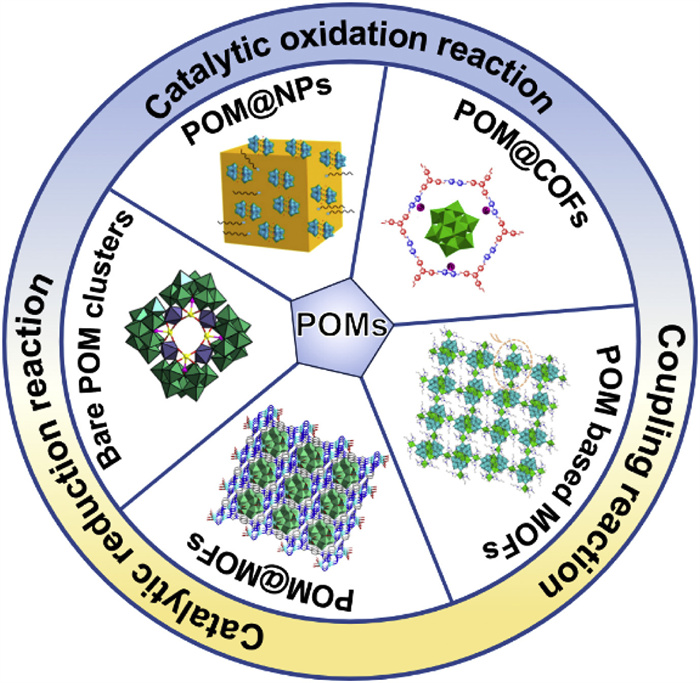
Figure 1.
Schematic representation of various categories of POMs-based photocatalysts.

Recent advances in polyoxometalates-based photocatalysts for sustainable selective organic transformation
Meiyu Zhang , Yuanzhe Li , Rakesh Kumar Gupta , Mengjun Lou , Yushan Jiang , Zhen Li , Yalin Zhang , Jiayi Zhang , Xianqiang Huang , Qingde Zhang , Qinggang Sun , Di Sun


Photocatalytic organic synthesis takes advantage of green energy and sustainable devices, which contribute thousands of functional organic molecules or pharmaceutical molecules through chemical reactions under environmentally and economically friendly conditions [1-6]. For example, substantial efforts have focused on the targeted conversion of aromatic alcohols to produce aromatic aldehydes, which serve as essential intermediates in chemical synthesis and are extensively utilized as precursors in the fine chemical industry [7-10]. Another prominent example is the controlled oxidation of amines to synthesize imines and their derivatives. These compounds are essential intermediates vital for the synthesis of medicines, insecticides, dyes, bioactive nitrogen-containing compounds, and agrochemicals [11-13]. To overcome high activation barriers of organic substrate, such reactions need to employ efficient photocatalysts to reduce the binding energy between the organic substrate and the reactive site for the synthesis of desired oxidative, reductive, and coupling products [14,15].
Polyoxometalates (POMs) represent a distinctive category of inorganic complexes consisting of metal-oxygen anionic clusters, typically derived from redox-active metals like molybdenum (Mo), tungsten (W), vanadium (V), niobium (Nb), and tantalum (Ta), all featuring d0 electronic configurations [16-22]. POMs present attractive properties for catalysis, including strong redox potential, variable acidity, and exceptional thermal and chemical stability. These properties can be precisely controlled at the atomic level by modifying the elemental composition, structure, or by integrating supplementary metal cations into the POMs framework. Moreover, the advantages of the atomically tunable structure, variable pH, intrinsic redox, and thermal stability stimulate the potential of POMs [23-28]. Most importantly, the unoccupied d-orbitals from high-valence metal centers make POMs as electron reservoirs to perform reversible multielectron transformation [29-32]. These unique photoinduced charge-transfer properties endow them appealing for various photocatalytic organic synthesis reactions applications. POMs-based materials are extensively studied for a range of oxidation reactions, including the oxidation of aromatic alcohols [33,34], benzene [35], toluene [36,37], amines to imine [38,39], sulfides [40,41] and heterocyclic compounds [42-44].
Significant advancements have been made in POMs-based compounds for organic synthesis, including the development of various forms, such as POMs clusters [19,23], POMs-based metal-organic frameworks (POMOFs) [45-47], POM molecules confined into metal-organic frameworks (POM@MOFs) [48] and POM molecules supported on semiconductor or nanoparticle substrates (POM@Substrates) (Fig. 1) [31,49,50]. Although POMs show absolute dominance for photocatalytic organic synthesis reactions, some deficiencies still deserve special attention. For instance, following the photocatalytic process, the poor structural stability of the solid-state compound (the generation of extra species with the decomposition of POMs) and the absence of active sites result in low catalytic activity. Although ruthenium-based POM photocatalysts have demonstrated outstanding performance, the use of precious metals raises concerns regarding economic viability. Additionally, the challenging problem of the difficulty in re-coordination and embedding of high-nuclear POMs into MOF frameworks or pores needs to be carefully considered and addressed.
This review presents a detailed analysis of the benefits, recent developments, and challenges of POMs-based photocatalysts in driving diverse organic transformations, including selective oxidation, reduction, and coupling reactions. Additionally, we discuss emerging perspectives on recent innovations and future trajectories in organic synthesis, aiming to inspire fresh approaches for the design of POMs-based photoredox systems that facilitate the efficient and sustainable production of high-value chemicals.
The exceptional capabilities of POMs-based crystalline materials in electron, proton, and oxygen atom transfer have garnered significant attention for their applications in organic synthesis [17,28,51]. Particularly, the multiformity and tunability of POMs-based materials at the atomic level were deemed to be the most favorable traits for photocatalysis [20,22]. The strong redox ability ensures POMs to easily donate and accept elections reversibly in the photocatalytic process, which affords a critical prerequisite for POMs to be a promising organic reaction photocatalyst. So far, diverse novel synthesis approaches or assembly strategies based on POMs have been proposed to promote the photocatalytic activity for various organic transformations.
POMs, also known as polymetallic oxide clusters, are constructed from high oxidation state metals such as V, Mo, and W bonded with oxygen [52-54]. Their structures can be readily modified, allowing for precise control over key properties, including acidity, electronic state, and redox potential. These tunable characteristics make POMs highly adaptable for various photocatalytic applications. Their inherent photosensitivity, favorable energy band structure, and broad light absorption spectrum confer POMs with exceptional photochemical properties. Acting as “electronic relays” in photocatalysis, POMs facilitate efficient electron-hole separation through rapid, reversible, and stepwise multi-electron transfer processes [55-57].
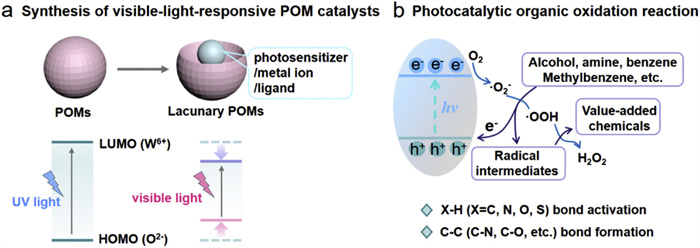
Considering the POM molecules reported in photocatalysis are mainly homogeneous catalysts, proper photosensitizers and/or sacrificial agents need to be introduced to complete the catalytic reaction cycle. Until now, several strategies have been employed to regulate the structure of POMs for achieving prominent photocatalytic organic conversion performance (Fig. 2a) [18,25]. For instance, substituting transition metals (e.g., Fe, Co, Ni) within the POMs framework can create synergistic effects among polymetallic active species, effectively boosting the conversion efficiency of organic substrates [58]. Additionally, embedding metal cations into vacant POMs sites extends their light absorption range by adjusting the HOMO and LUMO energy levels [59]. Besides, connecting photosensitizers to the unoccupied sites of lacunary POMs through phosphonate or siloxane linkages provides a flexible approach to boost substrate conversion.
POMs can easily couple with other nanomaterials based on its structure-tunable characteristics. Recently, a "one stone, two birds" strategy has been employed to develop POMs composites, implementing the advantages of two distinct materials into a single hybrid system [48,60-65]. This approach leverages the synergistic effects of each component to enhance photocatalytic activity by improving light absorption, optimizing molecular orbital alignment, and facilitating efficient separation of photogenerated charge carriers. Typically, POMs molecules are linked with organic ligands or encapsulated within host materials to create POMs-based inorganic-organic hybrids with atomically precise, highly dispersed active sites. Common strategies for synthesizing highly selective heterogeneous catalysts include immobilizing POMs within the nanocages of covalent organic frameworks (COFs) [66,67] and MOFs [48,61,68-71], or loading them onto carbon-based substrates such as graphene and carbon nitrides [69,72] and semiconductor supports (e.g., oxide, sulfide) [37,62,66,73,74].
To achieve visible-light-responsive photocatalysts, photosensitizers with targeted light absorption characteristics, such as organometallic complexes and C60 fullerenes, can be incorporated with POMs through electrostatic interactions or covalent bonding [75,76]. Moreover, embedding POMs within the cavities of MOFs and COFs for organic transformations provides distinct advantages: (1) The well-defined pore sizes and uniform structures of MOFs/COFs prevent POMs aggregation; (2) Tailoring the organic components of MOFs/COFs ensure organic catalytic reactions proceed smoothly by adjusting their hydrophobic and hydrophilic microenvironments; (3) The high surface area of MOFs/COFs offers multiple available active sites for catalysis; (4) The confined channels and cages of MOFs/COFs enable rapid diffusion of reactants and products. Besides, the directional electron migration between POMs and MOFs/COFs provides valuable insights into charge transport mechanisms, paving the way for further exploration of efficient photocatalytic systems. Herein, we have systematically presented the composite types for POM integration-including immobilization within COF nanocages, anchoring in MOF channels, loading on carbon-based substrates (graphene, carbon nitride), and supporting on semiconductor carriers (oxides, sulfides) through a table (Table 1). Simultaneously, summary of POM-based composites in terms of key parameters (light absorption range, charge separation efficiency, and stability) and their respective advantages, limitations, and representative applications have also been provided.

 DownLoad:
CSV
| Carrier type | Light absorption range | Factors affecting charge separation | Chemical stability | Advantages | Limitations | Application scenarios |
| MOFs | Visible-NIR | Energy level-matched | Weak acid/base resistant | High porosity, tunable structure | Limited stability in strong acids/bases | Diffusion-controlled reactions |
| COFs | Visible-NIR | Low exciton binding energy | Organic solvent resistant | High surface area, tunable pores | Limited stability in strong acids/bases | Sterically constrained reactions |
| Carbon-based | NIR | High conductivity | Strong acid/base resistant | High electron mobility, chemically inert | Possible weak interfacial bonding with POMs | Harsh acid/alkali environments |
| Semiconductors | UV–visible | Heterojunction | Oxides > sulfides | Precise bandgap engineering, abundant active sites | Sulfides prone to photocorrosion, Oxides with low visible light utilization | Multi-electron reduction |
Usually, the electron-hole pairs gathered under light excitation can induce the generation of active oxygen species (e.g., ·O2–, 1O2 or ·OH) for various photocatalytic organic reactions. Benefiting from rapid mediate electron, proton, and oxygen atom migration capacities, POMs-based compounds have attracted significant interest in the last few years as prospective platforms for remarkable photoredox organic transformations, especially the photocatalytic oxidative transformation of organic molecules (Fig. 3). The light absorption of POMs catalysts can be extended to the visible light spectrum by engineering the HOMO and LUMO energy levels, which is favorable for driving redox reactions of organic substrates, including benzyl alcohol, benzene, toluene, and methyl phenyl sulfide. Generally, POMs solutions present high oxidation ability with the electron transfer from oxygen to the metal centers (M = W and Mo) when exposed to light irradiation. The photoexcited POMs receives electrons from the organic substrate and then undergoes reduction during the oxidation of organic compounds. The photoreduced POMs can be further oxidized and return to their original oxidation state in the presence of O2, which is an important procedure to ensure that the photocatalytic reaction continues.
Upon being exposed to visible light, charge carriers, specifically electrons (e–) and holes (h+), are generated and subsequently transferred to the surface of the catalyst. Initially, O2 is reduced to an essential reactive species ·O2– by photoinduced e–, which facilitates the protonation of organic substrates to yield the corresponding anionic intermediates and ·OOH. Afterwards, photoinduced h+ oxidize organic anion intermediate into an anionic radical that undergoes further oxidation by ·OOH to yield the end product. Simultaneously, H2O2 is also generated as one of the valuable products (Fig. 2b). Considering POMs catalysts have been extensively used in the manufacturing of diverse fine chemicals in a greener and more sustainable way in the presence of molecular O2 (Fig. 4) [54,77], there is an urgent need to summarize various types of photocatalytic oxidation reactions catalyzed using POMs-based catalysts. An overview of the performance of various reported POMs-based catalysts in achieving selective photocatalytic organic transformations is presented in Table 2.
 DownLoad:
CSV
| Photocatalysts | Substrates (Con., mmol/L) | Reaction time (h) | Light source (gas) | Efficiency | Ref. |
| H3PW12O40/SiO2 | Benzyl alcohol (40) | 2.5 | 400 W mercury lamp (O2) | yield: 75% | [79] |
| POM/ZrO2 | Benzyl alcohol (1000) | 4 | 400 W mercury lamp (O2) | yield: 81% | [80] |
| Zn-based host-guest material | Benzyl alcohol (100) | 11 | 300 W Xe-lamp, 320–780 nm (air) | conv.: 67% | [81] |
| HPM/ZIS | Benzyl alcohol (20) | 5 | 300 W Xe-lamp, λ > 420 nm (O2) | yield: 100% | [82] |
| CsPbBr3/Ni4P2 | Benzyl alcohol (5) | 6 | 300 W Xe-lamp, λ > 400 nm (O2) | yield: 100% | [83] |
| HPMo@MIL-100(Fe) | Benzyl alcohol (67) | 4 | 300 W Xe-lamp, λ ≥ 420 nm (O2) | conv.: 21% | [84] |
| [K(H2O)][Cu(DPNDI)][Cu(DPNDI)(CH;CN)(H2O)] [Cu1.5(DPNDI)1.5H1.5P2W18O62]·2H2O | Benzyl alcohol (500) | 16 | 10 W LED lamp, (O2) | conv.: 75% | [85] |
| [Ag3L2(OH)][Na(H2O)0.5][PW12O40] H2O | Benzyl alcohol (48) | 12 | 10 W LED lamp, λ = 365 nm (O2) | conv.: 99% | [34] |
| [W10O32]{[Cp3Zr3(μ3–O)(μ2–OH)3]2(BPDC)3}2 ·12DMA·2CCl4 | Benzyl alcohol (100) | 22 | 45 W LED lamp, λ = 385 nm (O2) | conv.: 97% | [33] |
| Pd-Bi-BTC | Benzyl alcohol (0.2) | 4 | 300 W Xe-lamp, λ > 420 nm (O2) | conv.: 86% | [87] |
| Mo1/ZnIn2S4 | Benzyl alcohol (10) | 4 | 300 W Xe-lamp, λ > 420 nm (Ar) | yield: 96% | [88] |
| HMNRs | Methylbenzene (3 mL) | 48 | 300 W Xe- lamp (O2) | rate: 2254 mmol h-1 g-1 | [37] |
| Co4W22-DPNDI | Methylbenzene (189) | 72 | 10 W LED lamp, λ = 365 nm (O2) | conv.: 80.5% | [36] |
| K8H33[{Cu0.5(H2O)4}{Cu2(O3PCH2COO)(1,4,9-α-P2W15O56)}]·4Cl·60H2O | Methylbenzene (47) | 48 | 10 W LED lamp, λ = 365 nm (O2) | conv.: 97% | [89] |
| {[Zn(PYI)3][H3PW11O39Zn-(PYI)]}·3H2O | Amines (167) | 36 | 10 W LED lamp (O2) | yield: 92% | [91] |
| Cs2Na4H7[(SbW9O33)6{Ru(H2O)5}(RuCl3)(RuO6)2 {W(H2O)}6(WO)4{WO2(H2O)}2{WO2(H2O)2}2 {WO5(H2O)}]·43H2O | Aniline (1000) | 12 | 10 W LED lamp (H2O2) | conv.: 99% | [92] |
| Na13H5[Ru4(H2O)2(Cl)2(WO2)4(AsW9O33)4]·43H2O | Aniline (1 mmol) | 24 | 10 W LED lamp (O2) | yield: 97.1% | [93] |
| [(Ru(OH))2O(W5O18)2]8− | Aniline (500) | 24 | 10 W LED lamp, λ > 400 nm O2 | conv.: 97.1% | [94] |
| [(W5O18)-(Ru2W8O31)]12− | Aniline (500) | 24 | 10 W LED lamp, λ > 400 nm O2 | conv.: 96.8% | [94] |
| K6H[{Ru2Cl(H2O)(CH3COO)2}{WO(H2O)}2 (PW9O34)2]·14H2O | Aniline (1 mmol) | 24 | 10 W LED lamp, λ > 400 nm (O2) | yield: 97.2% | [95] |
| {Cu4(C26H16N4O4)4(-CH3CN)2[SiW12O40]} 4H2O | Aniline (2000) | 16 | 10 W LED lamp (O2) | yield: 98.06% | [96] |
| {[Cd(DMF)2Ru(bpy)2(dcbpy)]2(POMs)(DMF)2}xDMF (PMo-1, POMs = [PMoⅥ11MoⅤO40]4−, x = 5) | Aniline (1000) | 0.5 | 10 W LED lamp (O2) | yield: 99.6% | [38] |
| NaRh-SiW12 | Aniline (1 mmol) | 12 | 10 W LED lamp (O2) | yield: 96.1% | [39] |
| (NH4)41H7[K3(H2O)3(P2W15Ta3O62)6(Mo2O4CH3 CO2)3(MoO3)2]·85H2O | Aniline (100) | 24 | AM 1.5 G, (O2) | yield: 97% | [97] |
| (Hbiz)5{Co(H2O)3[Co(H2O)2]2}{Co[Mo6O12(OH)3 (PO4)(HPO4)3][Mo6O12(OH)3(PO4)2(HPO4)2]}·3H2 | Aniline (333) | 12 | 300 W Xe lamp, 400–780 nm (H2O2) | conv.: 97% | [98] |
| PBW11, AsBW11, and SiBW11 | Aniline (400) | 24 | 43 W LED lamp, λ = 370 nm | yield: 57% | [99] |
| [Co-(H2O)2DABT]2[CrMo(OH)5O19]{Co-CrMo6}, [Zn-(H2O)2DABT]2[CrMo(OH)5O19] {Zn-CrMo6} | Dibenzothiophene (200) | 8 | 300 W xenon arc lamp, λ > 420 nm | conv.: 99% | [102] |
| PW12−M@COFs | Methyl phenyl sulfide (67) | 3.5 | 10 W 425 nm LED, (O2) | conv.: 98% | [104] |
| [Eu2L(BPDC)1.5(DMF)6]n | Methyl phenyl sulfide (10) | 1 | 10 W LED lamp, λ = 450 nm (O2) | conv.: 100% yield: 99% | [103] |
| [CoⅡ(bcbpy)2(θ-Mo8O26)0.5]·5H2O | 2-Chloroethyl ethyl sulfide (167) | 5 | 300 W Xe lamp (H2O2) | conv.: 98% | [108] |
| [MⅡ(4-PBPY)2(H2O)]-[MⅡ(H2O)4][CoⅢ 2MoⅥ10H4O38]·nH2O (M = Cu, n = 10 for 1; M = Co, n = 11 for 2) | Methyl phenyl sulfide (200) | 6 | 10 W LED lamp, λ = 450 nm (O2) | conv.: > 99% | [105] |
| {[Zn(1-pIM)3]2[Zn6(AsW9O33)2(1-pIM)6]·2(1-HpIM)·2H2O}n (LCU-20){[Zn(1-ipIM)3]2[Zn6(SbW9O33)2(1-ipIM)6]·2(1-HipIM)}n (LCU-21) | Methyl phenyl sulfide (250) | 36 | 10 W LED lamp (O2) | yield: 99% | [106] |
| ((n-C4H9)4N)5[SiW11(Sn(CH2)2HCNC16H9)O39] | Methyl phenyl sulfide (200) | 3 | 150 W Xe-lamp, λ ≥ 420 nm (O2) | yield: 87% | [107] |
| (C2H8N)6[SiW11CdO39][Ru(bpy)2(dcbpy)] DMF·5.5H2O | Thioanisole (167) | 11 | 10 W LED lamp, λ > 400 nm (O2) | yield: 99.5% | [40] |
| ZnMo6/C3N4 | Dibenzothiophene (20) | 3 | 300 W Xe-lamp (H2O2) | conv.: 100% | [41] |
| IL-POMs | Benzene (116) | 10 | 500 W mercury lamp, λ ≤ 365 nm | conv.: 20.9% | [35] |
| K2Na2H5[(Fe(H2O)4)3(P2W15Nb3O62)2]·24H2O | Benzylic C–H oxidation (0.4 mmol) | 24 | 10 W blue LED lamp (O2) | yield: 76% | [109] |
| CdS/H5PMo10V2O40/g-C3N4 | Lignin (6.6) | 4 | 300 W Xe lamp | rate: 32.7 mg/g lignin | [110] |
| Mo132 | Lignin (25) | 6 | 300 W Xe-lamp (O2) | yield: 8.8% | [111] |
| Ag8(mttz)4(H2O)[PWWⅥ11O40]·H2O | cis-Cyclooctene (10 mL) | 32 | 300 W Xe lamp, λ > 460 nm | conv.: 70.15% | [115] |
| {Au8Ag26} | α-Terpinene (50) | 2 | 10 W LED lamp, λ = 630 nm (O2) | conv.: >99% | [43] |
| POM@PCN-222 | Aromatic aldehydes (1 mmol), methyl acetoacetate (2 mmol), ammonium acetate (1 mmol) | 5 | 1 W LED lamp (O2) | yield: 90% | [116] |
| [Zn(1-ipIM)3]2[Zn6(AsW9O33)2(1-ipIM)6]·2(1-HipIM) | Aromatic aldehydes (500), methyl acetoacetate (1000), ammonium acetate (500) | 48 | 10 W LED lamp (O2) | yield: 87% | [44] |
| Ag-Nb/W | 2-Phenylimidazo[1,2-a]pyridine (1.5) | 1.5 | 10 W LED lamp, 430–440 nm (O2) | yield: 78% | [117] |
| CR-SiW12 | Cyclohexanone (500) | 3 | 10 W LED lamp, λ > 400 nm (O2) | yield: 94.1% | [42] |
| H14[(Co(H2O)3)2(C10H8N2)4(P4W30Nb6O123)]·4 (C10H8N2)·8H2O | N-Aryl-tetrahydroisoquinoline (100) | 10 | 10 W LED lamp, λ > 400 nm (O2) | yield: 97% | [118] |
| (TBA)6 [P2V3W15O59(TrisDPA)] | Togni reagent (200) | 7 | 300 W Xe-lamp, λ >385 nm | conv.: 100% | [122] |
| [N(C4H9)4]5{MnMo6O18[CuI2(OCH2)3CN═CH–C5H4N]2}·2DMA | (Azidomethyl)benzene (1 mmol), phenylacetylene (1 mmol) | 6 | 20 W house-used incandescent lamp | yield: > 99% | [112] |
| TPPA-Cd-SiW10V2 | Aryl nitrile (250), amine (750) | 24 | 500 W Xe lamp (N2) | yield: 92% | [113] |
| CuW6-TPT | Phenylacetylene (167) | 8 | 10 W LED lamp (O2) | conv.: 98% | [114] |
| CoW-DPNDI-PYI | 4-Bromobenzaldehyde (25) | 24 | 10 W LED lamp (N2) | conv.: 93% | [121] |
Aldehydes and ketone derivatives serve as critical intermediates in the synthesis of fine chemicals are typically synthesized via the selective oxidation of alcohols. The transformation of benzyl alcohol into aldehydes or ketones is a particularly prevalent reaction in organic synthesis. Recently, significant advances have been made in the photocatalytic aerobic oxidation of benzyl alcohol, a process that benefits from mild reaction conditions [78]. Currently, the development of photocatalysts is influenced by the limited active sites and poor interfacial charge transport, which is unfavorable for achieving excellent photocatalytic activity and high product selectivity. So far, the functionalized POMs-based MOFs and POMs/semiconductor nanocomposite have been cleverly designed and applied to photocatalytic organic conversions.
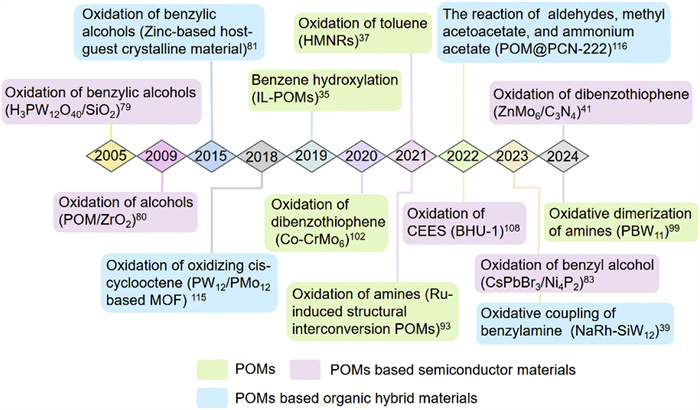
In 2005, Farhadi et al. developed a reusable heterogeneous photocatalyst (H3PW12O40/SiO2) that successfully realized the oxidation of primary and secondary benzylic alcohols to their respective aldehydes and ketones under light irradiation [79]. In 2009, Farhadi et al. synthesized phosphotungstic acid-zirconia (POM/ZrO2) nanocomposite through embedding of H3PW12O40 into zirconia matrix with the aid of sol-gel technique [80]. As green, recyclable photocatalysts, POM/ZrO2 shows excellent yields in the synthesis of carbonyl compounds using alcohols as substrates. In 2015, Lu et al. synthesized an unusual radical-mediated zinc-based host-guest crystalline material by connecting π electron-absent organic section and POMs via close interactions from anion-π and C–H···anion [81], which shows prominent photocatalytic performance in oxidation of benzylic alcohols with high selectivity resulting from the highly efficient charge migration between NDI, combined other molecules, and POMs center.
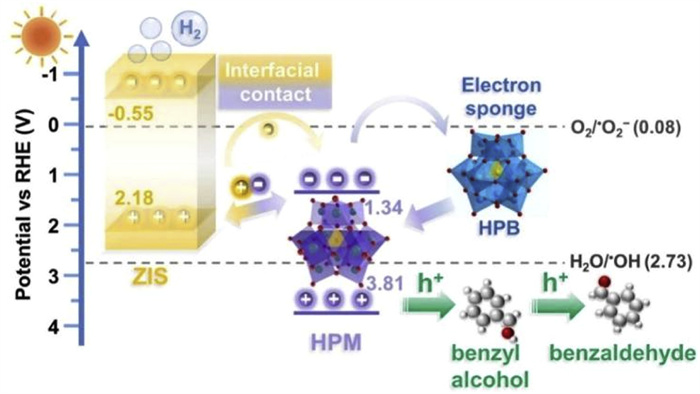
In 2022, Huang et al. design a POM-coupled ZnIn2S4 bifunctional Z-type photocatalyst (HPM/ZIS) with strong redox capacity, which is the first example of POM-based catalysts for oxidation of aromatic alcohol along with H2 evolution (Fig. 5) [82]. Interestingly, the sub-nanometer dimensions of POM building blocks as an "electron bridge" endow molecular-level interfacial contact, ensuring accelerated interfacial charge transfer kinetics. POM/ZIS presents an outstanding photoredox superiority for alcohol conversion coupled with H2 formation, achieving a 100% yield of benzaldehyde and an H2 evolution rate of 10.6 mmol g−1 h−1, with the formation of carbon-centered radicals (Ⅰ) and oxygen-centered radicals (Ⅱ). Furthermore, POM clusters with sub-nanometer size provide favorable conditions for interfacial contact at molecular level that guarantees efficient interfacial charge transfer by serving as an "electron bridge". Ultimately, a distinguished nearly 100% yield of benzaldehyde is acquired by POM/ZIS nanocomposites in an anaerobic environment.
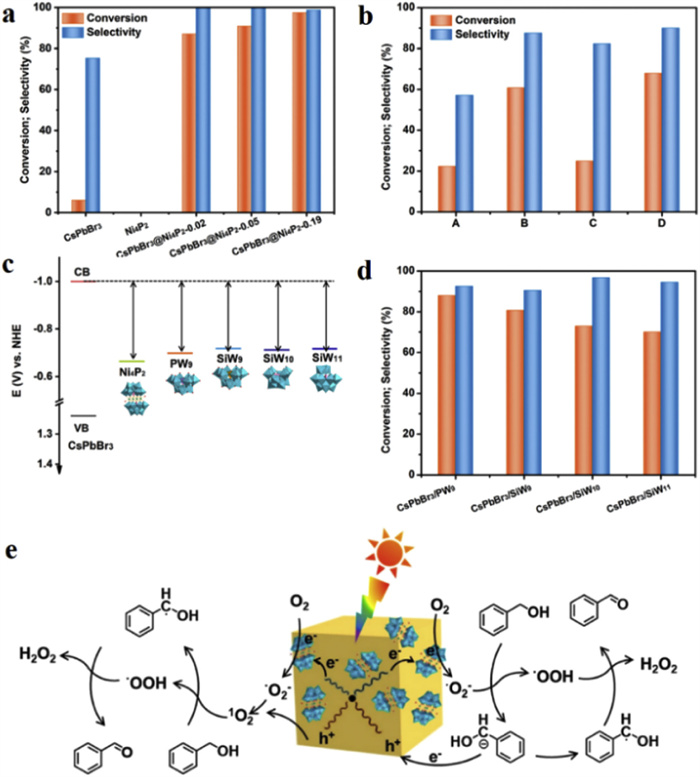
In 2023, Yang et al. constructed a CsPbBr3/Ni4P2 composite via an electrostatic assembly with integration of broadband spectrum response of CsPbBr3 and the multielectron migration property of Ni4P2 (Fig. 6) [83]. The compatible LUMO energy levels of Ni4P2 and CsPbBr3 accelerate the transfer of photoinduced electrons from CsPbBr3 to Ni4P2. Meanwhile, Ni4P2 with multi-electron/proton-transferring traits remarkably promotes the transfer of the electrons between CsPbBr3 and O2 by acting as a redox shuttle, enabling CsPbBr3/Ni4P2 superior photocatalytic performance in the benzyl alcohol oxidation to benzaldehyde with almost 100% conversion. In this method, the photogenerated e– transform O2 to form ·O2–. Meanwhile, a part of ·O2– can be further oxidized to produce 1O2. Importantly, both of ·O2– and 1O2 induce deprotonation of the benzyl alcohol, generating alkoxide anion intermediate and anionic radical, respectively, with the formation of ·OOH. Particularly, the alkoxide anion intermediate is converted into an anionic radical by the photogenerated h+. Finally, the resulted anionic radical reacts with ·OOH to give the expected benzaldehyde and H2O2 (Fig. 6e).
Later, Liang et al. embedded an easily available Keggin-type POM, H3PMo12O40, into the voids of MIL-100(Fe) (HPMo@MIL-100(Fe)) [84], resulting in highly dispersion of HPMo at the atomic level with an abundant porous structure in MIL-100(Fe). HPMo@MIL-100(Fe) demonstrated remarkable benzylic alcohol conversion efficiencies with high benzaldehyde selectivity (90%–100%) benefiting from the favorable light absorbance and sufficient separation of photoinduced carriers. Specifically, the benzyl alcohol could be oxidized to be radical cations by holes from HPMo@MIL-100(Fe) in photocatalysis, which further combine with dioxygen to obtain the corresponding aldehydes.
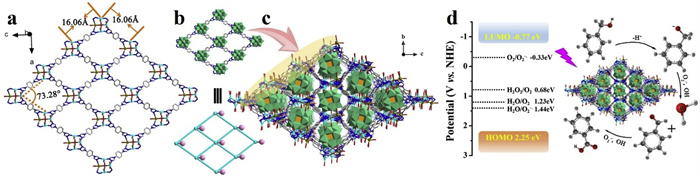
In 2022, by employing multinuclear cationic Ag-triazole clusters as nodal points to construct assemblies with rigid bridging ligands (L) and polyoxoanions, Han et al. successfully constructed three Keggin-type polyoxotungstate-based POMOFs: [Ag3][PW12], [Ag4][SiW12], and [Ag][Ag4L3][BW12] (Fig. 7) in the presence of multinuclear cationic Ag-triazole clusters that work well as nodes in the assembly 3D framework structure process [34]. The synergistic effect among cationic Ag-triazole clusters and Keggin-type POMs significantly enhanced the separation of photoinduced electrons and holes and allowed the active species to engage in redox processes. Consequently, compound [Ag3][PW12] appears to have the best photocatalytic activity, achieving ca. 99% selectivity in oxidizing benzyl alcohol to benzoic acid.
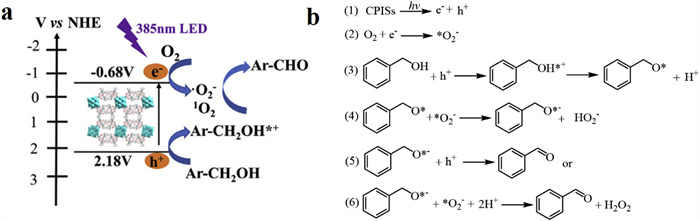
Currently, crystalline porous ionic salts (CPISs) constructed by electrostatic interaction as novel porous materials have gained considerate concern in the field of organic transformation. In 2023, Xuan et al. assembled three CPISs 1–3 with open channels in the presence of POM clusters {W10}/{SiW12} and cationic Zr-based capsules via electrostatic interactions and hydrogen bonding [33]. Among which, CPISs 1 shows the best activity in photocatalytically controlled conversion of aromatic alcohols to arylaldehydes, exhibiting excellent selectivity (>99%) profit from the synergistic action of {W10} and Zr-capsule. (Fig. 8) Under light irradiation, CPISs absorb photons to generate electrons (e-) in the conduction band (CB) and holes (h+) in the valence band (VB) (Fig. 8). Upon accepting an e- from CB, O2 forms the ·O2-. The h+ attack the -OH of benzyl alcohol (PhCH2OH), which results in electron abstraction, generating the benzyl alcohol radical cation (PhCH2OH*+). PhCH2OH*+ rapidly loses a proton, transforming into the benzyl alkoxy radical (PhCH2O*). The methylene group (-CH2-) of the PhCH2O* interacts with the·O2- so that the ·O2- abstracts a proton from the -CH2- to yield the benzaldehyde anion radical (PhCHO*-) and the hydroperoxyl anion (HO2-). PhCHO*- is oxidized by h+ to lose an e- and produce benzaldehyde (PhCHO). In another reaction, PhCHO*- reacts with the ·O2- in which PhCHO*- is oxidized to be PhCHO while the ·O2- combines with a proton to form hydrogen peroxide (H2O2).
Later, the same ligands were utilized to synthesize Cu(Ⅰ) metal node-assisted 3D Cu(Ⅰ)W-DPNDI in the presence of Dawson-type POM [P2W18O62]6 [85]. The superior light response, strong redox ability, and stable structure enable Cu(Ⅰ)W-DPNDI potential advantage for benzyl alcohol oxidation. Interestingly, benzyl alcohol can be converted into benzaldehyde by Cu(Ⅰ)WDPNDI as a photocatalyst and H2O2 as an oxidant. Notably, Cu(Ⅰ)W-DPNDI shows prominent catalytic performance with a high selectivity exceeding 99% and a desired benzaldehyde yield up to 75% within 16 h. Actually, photocatalysis and heterogeneous Fenton-like catalysis jointly contribute to the whole process. The ·OH can be produced through the reaction of Cu(Ⅰ) sites and H2O2. It was proposed that Cu(Ⅰ) and POM collectively promoted the ET and ROS (generation of reactive oxygen species) processes.
In 2024, Niu et al. introduced a supramolecular POM-based composite Ru(bpy)3Ru8 through clever inserting Ru oxo cluster and [Ru(bpy)3]2+ in a single complex system [86], which presents an outstanding photocatalytic activity with simultaneous oxidation of 1-(4-chlorophenyl)ethanol and production of H2 at impressive rates of 1596 μmol g-1 h-1 and 2563 μmol g-1 h-1, respectively. Moreover, assembly 1 has demonstrated excellent performance in photocatalytic overall water splitting (System 1). A 15-fold enhancement in hydrogen evolution rate is achieved in the triethanolamine sacrificial system (System 2). Notably, concurrent H2 production couple with 1-(4-chlorophenyl)ethanol oxidation (System 3) reactions reach a desired hydrogen evolution rate of 1.60 mmol g−1 h−1. Two potential pathways involving carbon-centered radical and oxygen-centered radical mechanisms were suggested as plausible mechanisms for the above reaction. Notably, although single or dual-metal-sites modified semiconductors achieve conversion and selectivity comparable to polyoxometalate-based composites in the catalytic oxidation of benzyl alcohol, this occurs at significantly lower substrate concentrations [87,88], indicating the distinct advantages of polyoxometalate systems for higher concentration organic catalytic transformations.
The photocatalytic toluene oxidation to produce high-value oxygenated compounds in the presence of O2 and H2O represents a promising but arduous task for the sustainable utilization of available raw materials. Nonetheless, the harsh conditions are typically required to break a high dissociation energy (375.4 kJ/mol) in the saturated C(sp3)-H bond during the oxidation of toluene. In addition, achieving high chemical selectivity is also a challenging problem that needs to be addressed. Thus, the POMs-based heterogeneous photocatalyst with strong activation ability for C–H bonds under mild conditions is urgently needed to be developed.
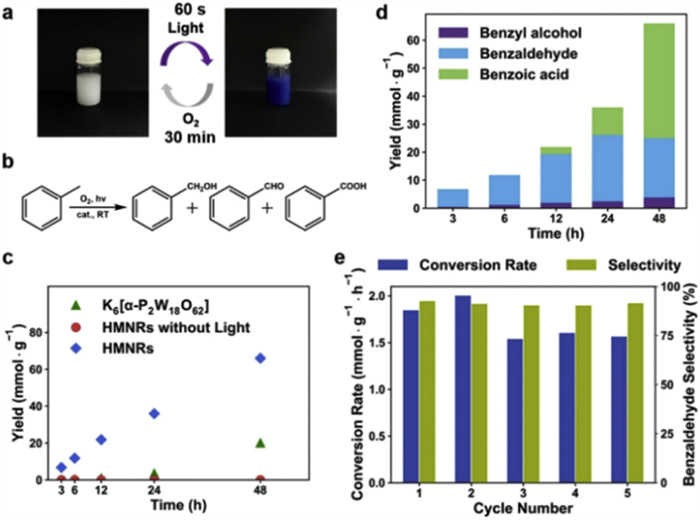
The considerable potential of microporous materials confined with POMs for catalysis is well known due to the integration of the prominent redox ability of POMs and the unique structure of microporous materials. Inspired by this, in 2021, Wang et al. successfully synthesized helical microporous nanorods (HMNRs) utilizing POM clusters as constituents by adopting a facile one-pot hydrothermal process [37]. The HMNRs exhibit excellent photocatalytic activity in toluene oxidation with desired benzaldehyde selectivity (94%) and excellent durability due to the unique structure (Fig. 9). Obviously, this research paves the way for exploring novel possibilities in the fabrication and utilization of microporous POM composites.
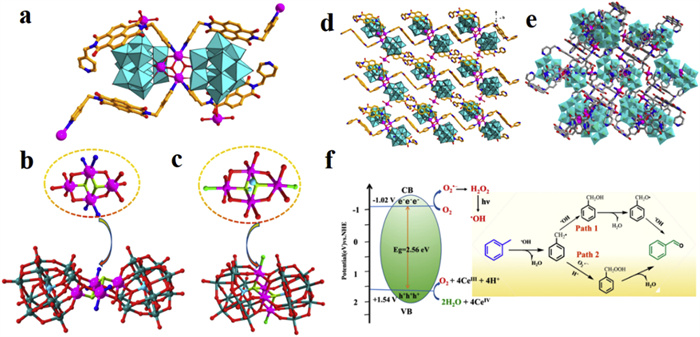
In 2022, Han et al. constructed a novel metal-organic framework (POMOF), {Co4W22-DPNDI} composed of Co4-sandwiched POM anion (Co4W22) and N,N′-bis(4-pyridylmethyl)naphthalene diimide (DPNDI) organic linked molecule [36]. The covalent bonding and anion···π interactions in Co4W22-DPNDI enable the directional alignment of POMs and photoactive organic groups, facilitating efficient electron-hole separation and establishing a shorter pathway for charge carrier migration, thereby achieving electron transfer along with proton migration. As a result, the {Co4W22-DPNDI} complex demonstrates remarkable catalytic performance in triggering the reaction of the C(sp3)-H bond in toluene by utilizing light as an energy source and water as a source of oxygen (Fig. 10). The specific reaction mechanism is as follows: Photogenerated holes oxidize H2O to produce O2 under irradiation. Then, photoinduced electrons reduce O2 to get ·O2– and H2O2. Afterwards, the obtained H2O2 was decomposed to form highly active ·OH in succession under light irradiation. Under the action of ·OH and/or the hole, toluene undergoes dehydrogenation to produce benzyl radical. Subsequently, benzyl radicals combine with ·OH to form benzyl alcohol, which further loses a hydrogen atom to yield benzaldehyde. Additionally, ·O2– can oxidize the benzyl radical and generate benzaldehyde by removing an H2O molecule (Fig. 10f). In brief, the combined action of ·OH and ·O2– results in exceptional photocatalytic performance and selectivity in toluene oxidation under moderate conditions.
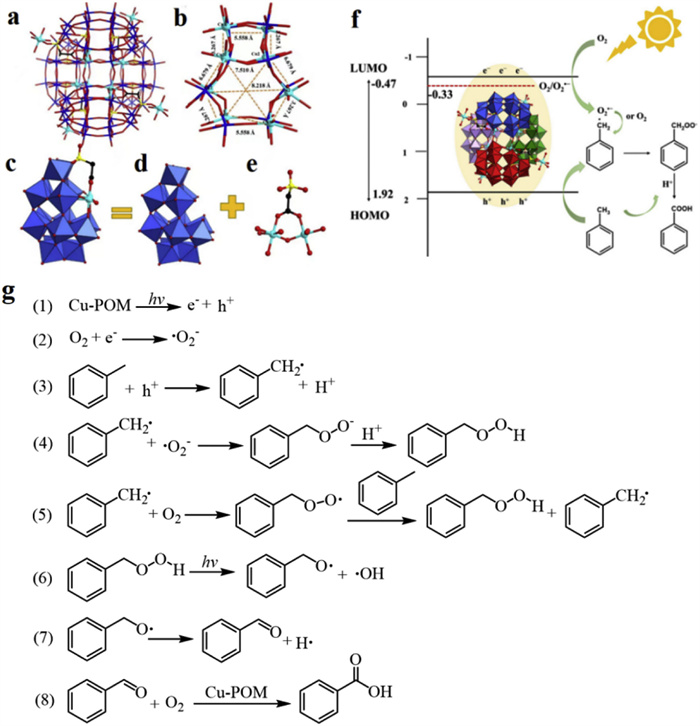
In 2024, Niu et al. intentionally assembled an original high nucleus Cu-containing POM, K8H33[{Cu0.5(H2O)4}{Cu2(O3PCH2COO)(1,4,9-α-P2W15O56)}]4·Cl·60H2O (Cu-POM) decorated by organic monophosphonate through conventional aqueous method [89]. The resulted 3D framework is established by the connection of a polyanion and lateral {Cu(H2O)4}2+. Notably, the Cu-containing POM demonstrates a superior performance for producing benzoic acid with a conversion of 97% by activating C(sp3)-H bond of toluene in an O2 atmosphere (Fig. 11). Cu-POM absorbs photons under light irradiation, generating e- in the LUMO orbital and h+ in the HOMO orbital. The photogenerated electrons in the LUMO orbital reduce O2 to form the ·O2-. Simultaneously, h+ in the HOMO orbital oxidize toluene, generating a benzyl radical (PhCH2·). The PhCH2· undergoes radical coupling with the ·O2- to produce benzylperoxyanion (PhCH2OO-). Under acidic conditions, the PhCH2OO- combines with H+ to yield benzyl hydroperoxide (PhCH2OOH). Alternatively, the PhCH2· reacts directly with O2, forming a benzylperoxy radical (PhCH2OO·) through O–O bond formation. Then, the PhCH2OO· abstracts a hydrogen atom via intermolecular hydrogen transfer from an adjacent molecule, generating PhCH2OOH and regenerating a PhCH2·. PhCH2OOH undergoes homolytic cleavage under light irradiation, producing a benzyloxy radical (PhCH2O·) and a ·OH. The PhCH2O· is further oxidized to benzaldehyde (PhCHO). Finally, PhCHO is oxidized by O2 to benzoic acid (PhCOOH) via a photocatalytic oxidation process.
The imines and imine derivatives hold great significance in organic transformations by acting as important intermediates to synthesize diverse valuable fine chemicals, such as pharmaceuticals and agrochemicals. Particularly, controlled oxidation of amines to imines by photocatalytic technology has attracted much consideration due to its green, environmentally friendly and sustainable characteristics [90]. Currently, the employment of easily controllable and recyclable POM-based photocatalysts with unique structures that are demanded for the oxidation of amines is much sought after. In the context of photocatalytic selective coupling reactions, free-radical coupling is an important reaction type widely applied for organic synthesis, which can be achieved through the generation of free radicals. In these reactions, the free radicals generated from organic substrates will combine with each other to form products with new chemical bonds and molecular structures.
Recently, significant endeavors have been directed to the utilization of effective POMs-based homogeneous or heterogeneous catalysts for the production of imines through the oxidation of amines. To achieve this, POMs-based catalysts should satisfy the following fundamental characteristics: (1) Strong redox capacity to trigger the multielectron transfer; (2) activation of O2 to obtain superoxide radical ·O2–; (3) high structural stability to guarantee long-term catalytic reaction; (4) high universality for most benzyl amine derivatives with various functional groups. Until now, POMs-based photocatalysts have been designed and modulated to be applied for different photocatalytic coupling reactions involving radical coupling mechanisms.
The scarcity of reported studies can be attributed to the challenges associated with synthesizing multifunctional catalysts capable of achieving a complete redox reaction pathway cycle. In 2019, Han’s group developed a 3D POM-based framework, {[Zn-(PYI)3][H3PW11O39Zn-(PYI)]}·3H2O (ZnWPYI), through the assembly of [PZnW11O39]5 anion, Zn2+, and chiral amino catalyst PYI [91]. ZnWPYI was studied for oxidation of alkenes and amines to synthesis of imines using O2 as an oxidant. As a visible light-responsive photocatalyst, [PZnW11O39]5 can easily activate O2 to form ·O2–, which then participate in the oxidation of benzylamine radicals or alkenes, leading to the formation of aldehydes through a four-membered transition state. As a result, ZnWPYI exhibits desired aldehyde selectivity (>99%) in the oxidation of alkenes. Importantly, introducing PYI into the ZnWPYI structure accelerates the conversion of aldehydes into imine ion intermediates while ensuring POM strong stability, ultimately resulting in significant boosted photocatalytic activity.
In 2021, Niu et al. used a controllable synthesis technique to design two multifunctional Ru-containing POM-based photocatalysts, namely (SbW9O33)6{Ru(H2O)5}(RuCl3)(RuO6)2 (Ru-POM-1) and (SbW9O33)6(RuCl3)2 (Ru-POM-2) [92]. Particularly, (SbW9O33)6{Ru(H2O)5}(RuCl3)(RuO6)2 containing high active component demonstrates superior photocatalytic activity in the redox cycle concerning aniline, which is obviously better than that of Ru-free isomorphic catalyst. Remarkably, a single multifunctional catalyst can successfully finish a redox cycle by facilitating the oxidation of aniline to nitrobenzene based on several distinguishable intermediates (azoxybenzene, azobenzene, and nitrosobenzene). Subsequently, nitrobenzene was further photoreduced back to aniline. In addition, the activation of H2O2 was mainly accomplished by the H2O molecules connected to Ru atoms, as confirmed by heat treatment experiments. The design flexibility of Ru-POM offers potential avenues for guiding the rational design and advancement of additional multifunctional Ru-POM catalysts.
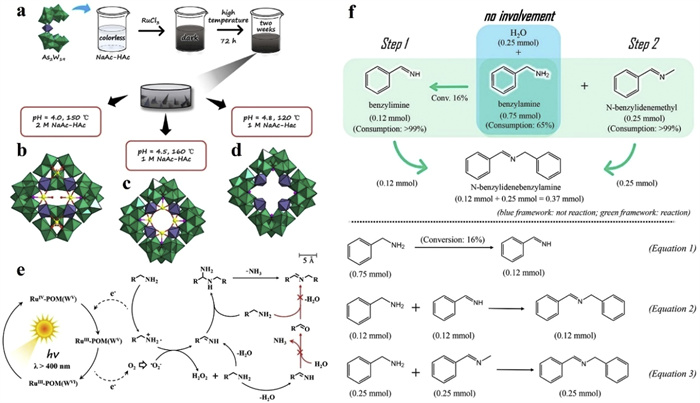
In 2021, Niu et al. successfully designed three Ru-induced structural interconversion POMs, Na13H5[Ru4(H2O)2(Cl)2(WO2)4(AsW9O33)4]·43H2O (Ru-POM-3), K5Na9H8[Ru2(WO2)4(AsW9O33)4]·50H2O (Ru-POM-4), and KNa13H14[(WO2)4(AsW9O33)4]·34H2O (Ru-POM-5) [93], which exhibit comparable structural features with the exception of the number of active centers. Ru-POM-3 presents highly efficient in the heterogeneous photocatalysis of oxidizing amines to produce imines, achieving a turnover number (TON) of 486 and a turnover frequency (TOF) of 20 h−1 (Fig. 12). The reaction process is revealed as follows: Firstly, Ru-POM-3 undergoes one-electron transfer process from the RuⅢ site to POM(WⅥ) site to produce the active species, RuⅣ-POM(WⅤ) under light excitation. Subsequently, the newly formed RuⅣ-POM(WⅤ) intermediate reacts with amine substrates to produce amine carbocations and RuⅢ-POM(WⅤ). The RuⅢ-POM(WⅤ) transfer electron to O2 to generate superoxide radical anion (·O2–) and further back to the normal state. The intermediate benzylimine and H2O2 were collected through the reaction of ·O2– and benzylamine cationic radicals. Afterwards, the intermediate benzylimine underwent subsequent coupling with a benzylamine cation radical to yield another intermediate, affording the final imine product (RCH═NCH2R) with the removal of NH3 (Fig. 12f). Importantly, it was evidenced that the element contents of active sites contribute to outstanding catalytic performance.
In 2022, Wang et al. introduced the largest Ru-containing polyoxometalates, NaH11[(RuO6)(AsW9O33)3{(W6O3)(H2O)6}]2·53H2O (NaH11·Ru·53H2O) [59], which is assembled by two RuⅢ cations and six lacunary Keggin fragments. NaH11·Ru·53H2O shows inherent redox ability and prominent photocatalytic activity resulted from the synergistic effect of oxygen-rich polyoxometalates and Ru-containing metal cluster. As an effective catalyst, NaH11·Ru·53H2O realized higher selectivity in the anilines oxidation and afforded different azoxybenzene derivatives.
In 2022, Niu et al. constructed two structurally fascinating Ru-based POMs, [(Ru(OH))2O(W5O18)2]8− (Ru2W10) and [(W5O18)(Ru2W8O31)]12− (Ru3W13) using the analogical synthetic procedure but only discrepancy in acidity term [94]. The sodium salts of the above POMs-based compounds were found to exhibit exceptional photocatalysis in the visible light-driven oxidation reaction of benzylamine. Under optimal conditions, both catalysts (Ru2W10) and (Ru3W13) demonstrated good to excellent yields in the oxidation of a majority of primary benzylamine compounds containing diverse substituents (H, F, Cl, Br, and Me) (Fig. 13).
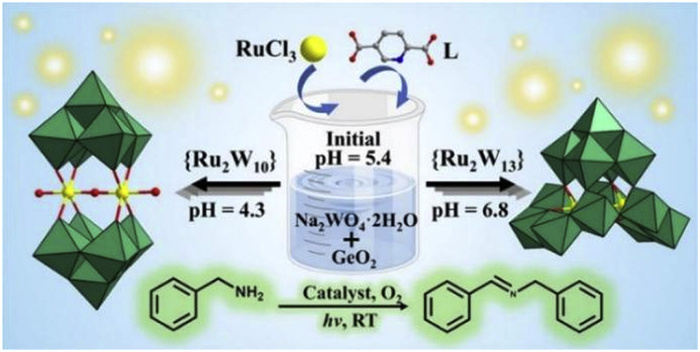
The strategy of utilizing different coordination modes to tune building blocks and organic ligands has been employed to create POM clusters with enhanced structural stability. In 2022, Niu et al. successfully synthesized an original binuclear Ru-containing POM Ru2(PW9O34)2 by the reaction of precursor P2W19 with RuCl3 in a malonic acid solution [95], which features excellent light response in the visible region. Satisfactorily, Ru2(PW9O34)2 exhibits remarkable photocatalytic activity for the oxidation of benzylamine to N-benzylidenebenzylamine (97.2% yield and 99% selectivity) using O2 as an oxidant. Additionally, Ru2(PW9O34)2 shows superior photocatalytic universality in catalyzing various benzylamine derivatives in which their substituents have different electronic effects (electron-donating and electron-withdrawing). Notably, the RuⅣ-POM(WⅤ) reactive intermediate induced by charge transfer between WⅤ-WⅥ oxidizes the amines to generate amine radical cations. In this process, the RuⅣ-POM(WⅤ) was reduced to RuⅢ-POM(WⅤ), which subsequently undergoes oxidation to return to its original state, RuⅢ-POM(WⅥ), by affording an electron towards O2 to generate ·O2−. The formation of ·O2− is observed as a critical step in the oxidation reaction of benzylamine.
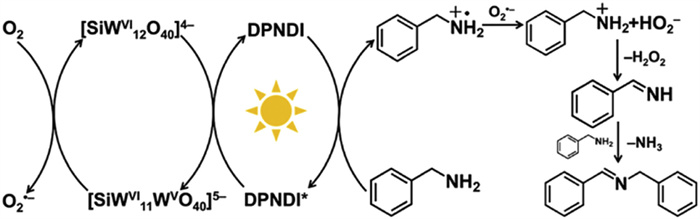
In 2021, Han et al. constructed a new POM based MOF SiW-Cu-DPNDI composed of Keggin-type [SiW12O40]4- anion, a N,N’-bis(4-pyridylmethyl)naphthalene diimide (DPNDI) ligand, and a Cu(Ⅰ) cation [96]. SiW-Cu-DPNDI demonstrated exceptional catalytic activity in oxidizing amines to imines, achieving high stability and reusability under moderate conditions (Fig. 14). The photosensitizer DPNDI was firstly photoexcited to afford holes (DPNDI*), which subsequently reacted with benzylamine, triggering the creation of benzylamine radical cations. The reaction proceeds as the photoexcited electron transfers from DPNDI to [SiW12ⅥO40]4-, giving [SiWⅥ11WⅤO40]5-. Moreover, O2 was reduced to ·O2–, with the reoxidation of [SiW12O40]5- to [SiW12O40]4-. Clearly, [SiW12O40]4– and DPNDI were necessary components to drive the oxidation reaction.
In 2022, the two crystalline POMOFs were firstly prepared by inserting the photosensitizer [Ru-(bpy)2(H2dcbpy)]Cl2 and Keggin-type POM anions ([PMoⅥ11MoⅤO40]4-, [SiW12O40]4−) into a single framework [38]. A series of trapping experiments point out that the ROS species, including ·O2−, 1O2, and H2O2, jointly contribute to the oxidative coupling of benzylamine. Additionally, in situ EPR measurements reveal that photogenerated electrons migrate from metalloligand radicals to POMs, subsequently transferring to O2 to form the ·O2− radical. As an exceptionally active target photocatalyst, [PMoⅥ11MoⅤO40]4 based POMOFs achieve a high yield (99.6%) in the oxidative coupling reaction of amines while exhibiting remarkable recyclability and reusability. These superior performance attributes can be credited to the favorable visible light absorbance characteristic and highly efficient carriers’ separation rate within the assembly.
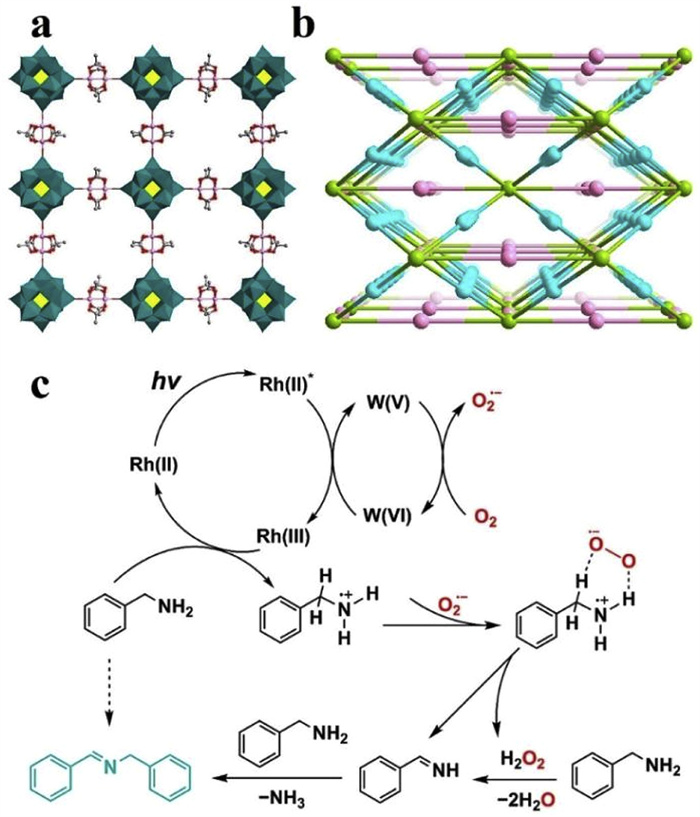
In 2023, Niu et al. assembled four POMOFs, (NaRh-SiW12), (NaRh-GeW12), (NaRh-AsW12), and (NaRh-GaW12) using Rh2(OAc)4 and POMs as raw materials [39]. Under light illumination, the POMs can capture photogenerated electrons created in the Rh2(OAc)4 constituent with the W(Ⅵ) site reduced to W(Ⅴ). Then, photogenerated electrons were further transferred to O2 and activated to form ·O2– an important intermediate for oxidative coupling of benzylamine. Simultaneously, benzylamine undergoes oxidation by the photogenerated hole, resulting in the generation of a benzylamine radical cation. Subsequently, benzylamine radical cation was oxidized into pH–CH═NH by ·O2– with the formation of H2O2. On the other hand, pH–CH═NH is also obtained by the reaction of H2O2 and benzylamine. Eventually, pH–CH═NH combines with benzylamine to afford benzalaniline, releasing NH3 by a nucleophilic addition reaction. In brief, the synergistic effect of Rh2(OAc)4 or POMs realizes prominent oxidative coupling activity from benzylamine to imines with a high yield of 96.1% (Fig. 15).
In view of the specific charge polarization traits exhibited by the Dawson type Ta/W mixed-addenda POM, selecting {P2W15Ta3} as a nucleophilic structural building unit may be a sensible decision. In 2021, Chen et al. firstly synthesized the Mo/Ta/W ternary mixed-addenda POM (P2W15Ta3O62)6(Mo2O4CH3CO2)3(MoO3)2 in which Ta/W POM reacts with molybdates in acetic acid/ammonium acetate solutions [97]. Under sunlight stimulation, the Mo/Ta/W ternary POM showed notable catalysis in the oxidative coupling of primary benzyl amine compounds having diverse substituents (H, Me, OMe, CF3, and Cl) to yield the respective coupling products, during which the visible light-induced charge migration from benzylamine to the photocatalyst was detected. In summary, the incorporation of novel mixed-addenda POMs contributes to the diversification of the POM family, which offers opportunities for advancing the potential development of POM materials.
In 2023, Wang et al. utilize a recently developed complex based on {Co[P4Mo6]} as a model catalyst for visible light driven transformation of aniline to azobenzene [98]. The Mo and Co reactive centers from the catalyst promote the oxidation process of aniline through the cooperative impact of Brønsted and Lewis acid sites, giving an outstanding 97% conversion rate and 96% selectivity after 12 h. In 2024, Newton et al. successfully synthesized three hybrid POMs, PBW11, AsBW11, and SiBW11, through a universal functionalization strategy with organic groups [99]. The three hybrid POMs as heterogeneous photocatalysts were used for the oxidative dimerization of amines. The hybrid PBW11 obtained by organophosphonate showed superior activity in the oxidative amine dimerization reaction, which highlights the significance of carefully selecting the templating anion and linker group for advancing organic synthesis.
Sulfoxides show extensive applications in the medicinal and agrochemical sectors by serving as the valuable intermediates applied for organic synthesis, which are usually obtained by oxidation of sulfides [100]. Moreover, sulfur dioxide are urgently needs to be removed through the desulfurization process due to the environmental pollution they generate. Thus, photocatalytic production of sulfoxides by the controlled oxidation of sulfides under mild conditions represents an efficient and atom-economical method for producing desired oxidized organic products [101].
To enhance the efficiency and practicality of sulfoxide production, it is essential to develop highly active POMs-based photocatalysts by integrating metal-organic units with POMs exhibiting metal-to-metal charge transfer (MMCT) behavior, thereby improving their visible light absorption capabilities. In 2020, Xu et al. successfully prepared two fascinating POMs-based metal-organic complexes {Co-CrMo6} and {Zn-CrMo6} under hydrothermal conditions [102]. Both of them are isostructural except for the difference in the metal centers (Co/Zn) from Anderson-type [CrMo6(OH)5O19]4– polyanions sector. Intriguingly, {Co-CrMo6} shows a prominent removal rate of 99% in the oxidation of dibenzothiophene at 50 ℃, which can be ascribed to rich Co sites with strong activation ability. In 2022, Yang et al. synthesized three POMs-based metal-organic frameworks (3D POM-MOFs) by Ln ions and pyridyl-POMs [103] and aimed to explore their potential for photocatalytic sulfide conversion. Tb-1, Eu-1, and Tb2 exhibited high selectivity in the oxidation of various types of sulfides to their respective sulfoxides with the assistance of Ru(bpy)3(OTf)2. Among which, Eu-1 demonstrated the maximum conversion rate (100%) and exceptional sulfoxide selectivity (97%) with 1O2, h+, and ·O2− as the main ROSs under an O2 atmosphere, which can be credited to the cooperative effect of the directional charge transfer among cationic photosensitizer and POM unit and lewis acid sites of Ln ions.
In 2022, An and Xu et al. successfully developed a family of innovative POM-based photocatalysts, PW12−M@COFs (M = Ag+, Cu2+, Ni2+) through the electrostatic interactions among POM anions and cationic porous M@COFs [104]. The strong visible light adsorption endows PW12−M@COFs potential advantages to oxidation of sulfides as superior photocatalysts. Notably, the synthesized PW12-Ag@COFs demonstrate exceptional catalytic performance in the conversion of sulfides to sulfoxides, achieving a 98% conversion rate for MPS with 99% selectivity. Singlet oxygen and superoxide radicals function as the reactive oxygen species driving this reaction.
In 2023, An and Xu et al. designed and synthesized two containing Cu and Co POMs-based metalloviologen frameworks (M = Cu for 1; M = Co for 2) with a two-dimensional layered structure [105]. Particularly, Cu POM exhibits outstanding photocatalytic activity, selectively converting MPS to MPSO with nearly 100% yield within 6 h. The mechanism revealed that photoexcited electrons originating from viologen migrate towards the POM site, where they facilitate the formation of reactive oxygen species (O2*) from O2, playing a vital role in oxidizing the substrates and achieving the target product.
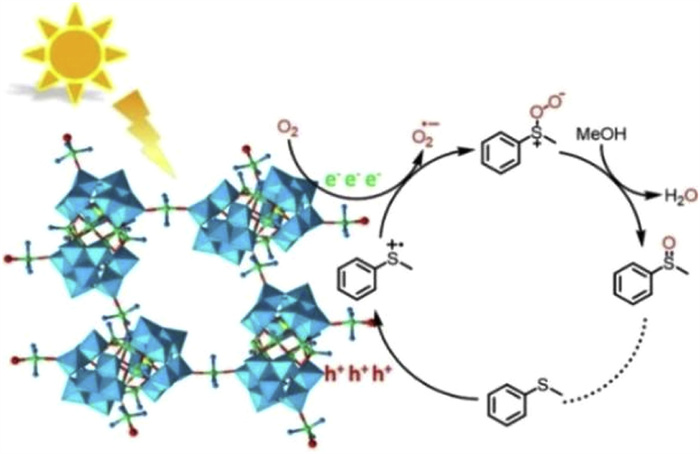
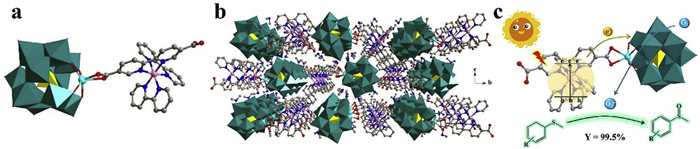
In 2023, Sun et al. constructed two sandwiched-type POMs-based open frameworks (POTOFs), a 2D layer framework (LCU-20), and a 3D open framework structure (LCU-21) by manipulating the substituent tails outside the imidazole and extending the zinc-imidazole metal-organic linker [106]. Particularly, the excellent visible-light absorbance characteristic on POTOFs arises from the chromophores generated by the charge transfer of metal-to-metal in combination with polyanions and the zinc-imidazole structure (Fig. 16). Significantly, the as-synthesised LCU-20 firstly demonstrated novel heterogeneous photocatalytic activity under white LED light, achieving a high yield (~99%) and exceptional selectivity (~99%) in sulfide oxidation, attributed to the formation of ·O2– and h+ active species. Under visible light, LCU-20 generates electrons and holes; the electrons reduce O2 to form ·O2–, while the holes oxidize MSP to produce the MPS radical cation. The ·O2– species then combine with the radical cation to produce a methyl phenyl persulfoxide intermediate, which subsequently gains protons from MeOH, yielding the target product and producing H2O.
In 2021, Karimian et al. constructed an organic-inorganic hybrid material where the pyrene molecule is covalently bonded to the unoccupied POM site and applied it for photoxidation of sulfides under an O2 atmosphere [107]. As a result, this unique hybrid POM exhibited successful aerobic conversion of diverse sulfides to their respective sulfoxides. In 2023, Wang and Niu et al. synthesized an original hybrid POM crystal (RuCd-SiW) by combining metalloligands [Ru(bpy)2(dcbpy)] and absent POM [40]. With the addition of the metalloligand, RuCd-SiW was able to absorb light in the visible spectrum. Under visible light excitation, RuCd-SiW exhibits outstanding catalytic performance in the controlled conversion of sulfides, achieving a 99.5% yield in the conversion of thioanisole to methylsulfoxidebenzene (TON 497.5 and TOF 103 h–1) (Fig. 17). Additionally, a strong photocatalytic generalizability was also realized by RuCd-SiW in catalyzing various thioanisole compounds containing electron-donating or electron-withdrawing groups, achieving high yields.
In 2024, Su et al. synthesized ZnMo6/C3N4 composites derived from Anderson-type POMs (NH)4H6ZnMo6O24, characterized by Zn2+ ions core encircled by six MoⅥ centers in a planar arrangement for photocatalytic oxidative desulfurization [41]. The doping of ZnMo6 onto C3N4 markedly effectively enhanced the adsorption ability of dibenzothiophene (DBT) and accelerated charge transfer and separation of electron-hole pairs. Consequently, the best catalyst (50% ZnMo6/C3N4) exhibited a desulfurization rate of 100% within just 2 h, even with a low dosage of catalyst.
In addition to phenyl sulfide, the oxidation of alkane sulfide has also raised concerns. In 2022, Wang et al. published a study on the synthesis of a novel cobalt-viologen 2D framework based on [θ-Mo8O26]4− isopolymolybdate incorporation [108], demonstrating its potential for photocatalytic conversion of 2-chloroethyl ethyl sulfide (CEES). Satisfactory 98% CEES conversion yield and 97% selectivity to CEESO are achieved over BHU-1 within only 5 min with ·O2− and e− as the critical active species in the CEES oxidation.
Creating highly efficient, recyclable heterogeneous photocatalysts by pairing specific POMs anions with organic cations is essential for the controlled conversion of benzene to phenol using O2. In 2019, Wang et al. constructed the distinctive POMs paired ionic salts (IL-POMs) by combining quinoline cations with Keggin-structured phosphotungstic (PW) anions [35]. The presence of long alkyl chains in IL-POMs allowed them to function as heterogeneous photocatalysts. Utilizing atmospheric air as the exclusive terminal oxidant, IL-POMs achieved a target yield of 20.9% with over 99% selectivity in benzene hydroxylation to phenol. The high catalytic activity of the IL-POMs hybrid is assigned to the distinctive redox properties of the POMs anions, which enhance the transport and separation of photogenerated carriers.
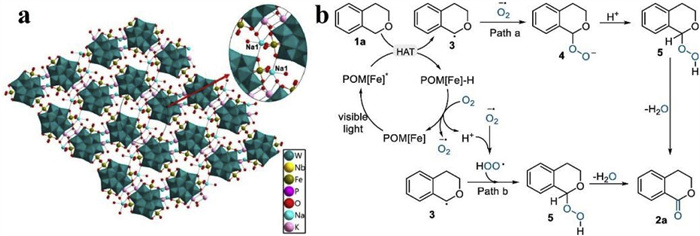
The photo-driven controlled oxidation of common C–H bonds to desirable C=O bonds via POMs-based photocatalysts presents a highly promising method for synthesizing carbonyl-containing compounds. In this direction, Chen et al. synthesized two POMs dimers, namely POM[Fe] and POM[Cr], containing transition metal Nb/W by reacting Fe3+/Cr3+ with Nb/W mixed-addendum POM (Fig. 18) [109]. Particularly, POM[Fe] exhibits prominent catalytic activity in selectively oxidizing sp3 C–H bonds to generate the needful carbonyl product and displays excellent reusability in the recycling experiments under visible light. Notably, the catalytic reaction occurs with a hydrogen atom transmit mechanistic involving participation of superoxide radicals (Fig. 18b).
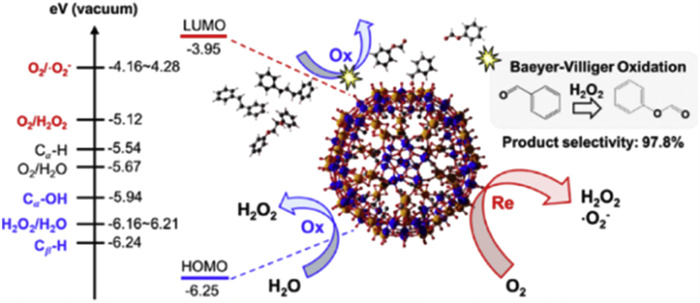
In 2022, Zhao et al. constructed a Z-scheme CdS/HPA-2/CN material under hydrothermal conditions and explored its application in lignin depolymerization [110]. This photocatalyst achieved a total yield of 32.7 mg/g lignin, producing vanillin and vanillic acid in DMF/formic acid (v/v = 40/10) after 4 h, with active species like h+, ·O2−, and ·OH collectively influencing the depolymerization of lignin. In 2023, Chi et al. utilized giant Keplerate POMs Mo132 as model photocatalysts for evaluating selective C–C bond cleavage of the β-O-4 lignin compound. The redox potentials of Mo132 varied with modulating metal compositions [111], which directly affect covalent bond decoupling. Benefiting from the improved H extraction ability and the produced LMCT linkage at the Cα-OH site, Mo132 exhibits exceptional selectivity in cleaving C–C bonds using lignin as a model, resulting in the generation of phenyl formate (yield: 8.8%, selectivity: 97.8%). Interestingly, water-derived active species (for example, ·OH and H2O2) facilitated successful homolytic LMCT-driven Cα-Cβ decoupling in a water-based environment (Fig. 19).
In 2022, Zhou et al. assembled an anderson-type POM, [N(C4H9)4]5{MnMo6O18[CuI2(OCH2)3CNCHC5H4N]2}·2DMA, in which [MnMo6O18] units and Cu sites coordinated by organic moieties were incorporated on both sides [112]. This catalyst achieves almost complete conversion when devoted to azide-alkyne cycloaddition within a 4 h irradiation. A possible explanation for above catalytic reaction was suggested as follows: The photoinduced electrons resulted from the visible light-responsive photosensitive Anderson-type [MnMo6O18] unit transfer to Cu(Ⅱ) to produce Cu(Ⅰ) ions. Following this, Cu(Ⅰ)-acetylide intermediate can be formed by the primary Cu(Ⅰ) ions activating the alkynyl group connected in the substrates. Afterwards, the coordinated Cu(Ⅰ) ions can readily integrate with the electrophilic N atom in the azides. Simultaneously, Cu(Ⅰ)-involved metallacycle intermediate can be formed with the terminal N atoms bonding to the β-C position of the acetylide intermediate. Ultimately, the participating Cu(Ⅰ) ions were further removed by the metallacycle contraction process along with the protonation, affording the final product.
To overcome the limitations caused by diffusion in photoinduced electron transfer (PET) processes occurring in solution, Duan et al. introduced a coordination polymer composed of a triphenylamine-derived dye and a Keggin POM used as an electron relay [113]. This innovative approach enables efficient photocatalytic radical couplings, resulting in the synthesis of valuable α-amino C–H arylation products. The strong redox ability as well as long life in photoinduced charge-separation pairs guarantee multiple electrons to migrate from electron donors to acceptors. Besides, a stepwise transfer on single-electron and deprotonation mechanism was clarified during the production of the a-amino carbon-centered radical.
In 2024, Han et al. constructed a pristine POMOF CuW6-TPT composed of Lindqvist-type polyanion [W6O19]2, photosentizer TPT, and binuclear Cu(Ⅰ) units, which shows excellent light absorption ability and unique conductivity [114]. Upon light irradiation, Cu(Ⅰ)-phenylacetylide produced by abundance Cu(Ⅰ) catalytic centers to activate phenylacetylene is clined to occur a reductive single-electron transfer (SET) process and form Cu(Ⅰ)-phenylactetylide intermediate. This intermediate then participates in a Paternò-Büchi (2 + 2) cycloaddition with benzoquinone, forming a transient Cu(Ⅱ)-oxetane ring. Besides, the recombination photogenerated charge-hole can be effectively inhibited based on [W6O19]2- capturing photogenerated electrons. As a result, CuW6-TPT exhibited superior catalytic performance in promoting the oxidation of benzoquinone with terminal alkynes, yielding aryl ketones featuring hydroxyl groups.
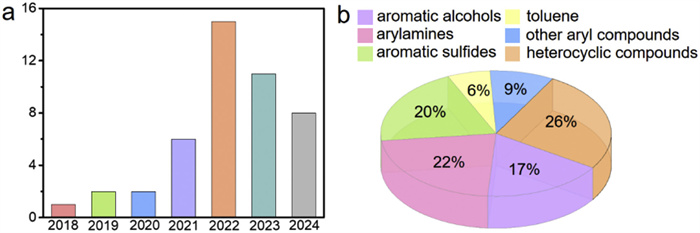
In brief, POMs-based materials demonstrate exceptional performance in photocatalytic oxidation of aryl compounds. High selectivity and conversion are achieved in benzyl alcohol oxidation. Certain systems significantly enhance charge carrier utilization through the synergistic photocatalytic oxidation-hydrogen production effect. Notably, the generation mechanisms and reaction kinetics of reactive oxygen species (e.g., ·OH, ·O2-) require further investigation. For toluene C(sp3)-H bond activation, the composites of POMs with microporous materials (HMNRs) or MOFs lower energy barriers to enable efficient transformations under mild conditions, highlighting the critical role of precise material design in selectivity control. The synergy between photosensitizers (DPNDI, Ru(bpy)3) and POMs markedly improves light-harvesting and charge separation efficiency in benzylamine oxidative coupling reaction. However, the activity limitations persist for benzylamine derivatives bearing strong electron-withdrawing groups (e.g., -NO2, -CF3). Remarkably, POM-based composites deliver near-quantitative conversion and selectivity (>99%) in sulfide oxidation by relying on ·O2-/h+ synergistic effects. The system exhibits broad substrate scope, including substituted sulfides (e.g., thioanisole) and alkyl sulfides (e.g., CEES).
Cyclopentene is widely recognized for its versatility in the synthesis of numerous high-quality and specialized chemicals, which advance the development of the chemical industry as crucial chemical intermediates. Nevertheless, designing heterogeneous catalysts with high activity and selective for epoxidation remains a challenge. Liu et al. prepared two new POMs-based MOF Ag8[PWⅤWⅥ11O40] and Ag8[PMoⅤMoⅥ11O40], by the hydrothermal reactions involving AgNO3, mttz, H3PW12O40, and H3PMo12O40, respectively [115]. Both compounds exhibit exceptional selectivity in oxidizing cis-cyclooctene to epoxycyclooctane under mild conditions. The promoted epoxycyclooctane selectiveness by the oxidation of cis-cyclooctene observed in Ag8[PWⅤWⅥ11O40] is attributed to the combined action resulting from coordination interactions and the presence of abundant Ag active sites.
In 2024, Suzuki et al. fabricated surface-exposed gold (Au)-Ag alloy nanoclusters with a core-shell structure by the reaction of the Ag nanocluster within [P8W48O184]40- and Au [43]. Consequently, Au atoms replaced multiple Ag atoms at the nanocluster’s core. The obtained {Au8Ag26} alloy nanocluster presented substantially enhanced photocatalytic activity in the aerobic oxidation of α-terpinene by forming 1O2 as an active oxygen specie (Fig. 20). These investigations provide important understandings on the design and redox capabilities of POM-stabilized alloy nanoclusters, thereby fostering further exploration in synthesizing diverse metal nanoclusters and understanding their catalytic properties.

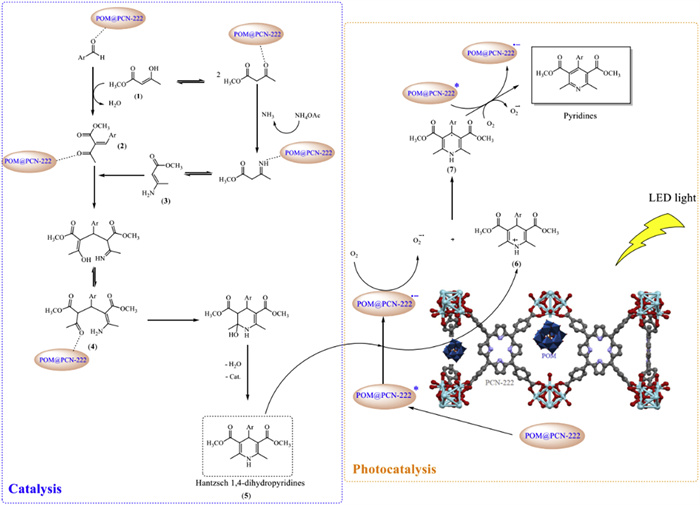
The solar-powered direct conversion of 1,4-dihydropyridines into pyridine derivatives in a single step is of great concern and highly desirable. In 2022, Sanchooli et al. construct a unique porous POM@PCN-222 material by incorporating a Keggin-type POM, H3PW12O40, into mesoporous PCN-222 via a facile impregnation method [116]. The POM@PCN-222 was used for the one-pot production of pyridine derivatives using aldehydes, methyl acetoacetate, and ammonium acetate as starting materials in an O2 atmosphere. Importantly, the outstanding performance in the synthesis of N-heterocycles over POM@PCN-222 can be credited to the synergistic effects of Lewis acidic sites from PW12 and Zr6 nodes, enhanced photosensitizing properties, and the distinctive photothermal advantages of the porphyrin linkers (Fig. 21).
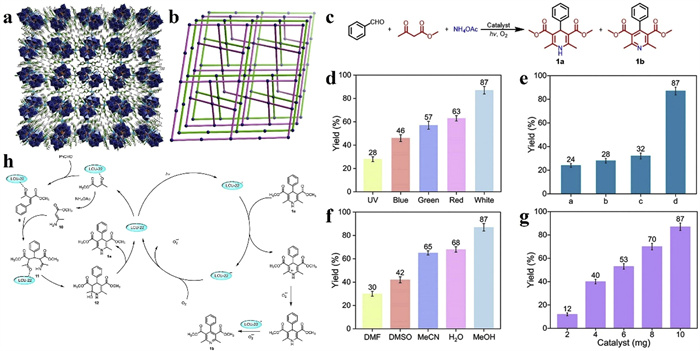
In 2022, Sun et al. demonstrated a unique 2-fold interpenetrated lvt POM-based open framework, LCU-22 [44]. In this structure, Zn6 rings bridged by trivacant polyoxotungstates function as cluster nodes, forming a 3D open framework in the presence of four [Zn(1-ipIM)3]2+ units. The cooperative effect between the Lewis acidic Zn sites and the oxidative sites of the POM units in LCU-22 was found to reduce the energy threshold necessary for the reaction, ensuring a smooth reaction pathway. Notably, LCU-22, characterized by its exceptional stability as a heterogeneous photocatalyst across a broad pH spectrum, presented dramatically boosted catalytic activity for production of pyridine compounds under moderate conditions, achieving yields as high as 87% (Fig. 22).
In 2023, Chen et al. synthesized silver-modified polyniobotungstate (AgNb/W) by selecting Nb/W mixed-addendum POM [P2W15Nb3O62]9− to react with the Ag+ ion, which was devoted to the ring-opening oxidation reaction using 2-phenylimidazo[1,2-a]pyridine [117]. As a high-efficiency heterogeneous photocatalyst, Ag-Nb/W demonstrates exceptional capability for simultaneous C–C and C–N bond cleavage in 2-phenylimidazo[1,2-a]pyridine, resulting in the synthesis of various N-(pyridin-2-yl)amides as the oxidative ring-opening products with isolated yields (65%−78%) under extremely mild conditions. A singlet oxygen is proved to participate in oxidative reactions as the primary active species. No reduction in catalytic activity is detected after recycling eight times, demonstrating Ag-Nb/W remarkable recyclability.
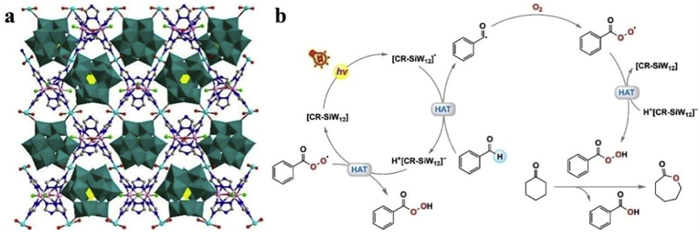
In 2023, Niu et al. firstly constructed a crystalline POM-based MOF photocatalyst containing trinuclear ruthenium clusters, CR-SiW12, and investigated its photocatalytic performance in the Baeyer-Villiger oxidation of cyclohexanone [42]. CR-SiW12 exhibited high activity in these oxidation reactions, effectively converting cyclohexanone to ε-caprolactone and achieving an impressive TON of 941 and a TOF of 274.5 h–1 (Fig. 23). Moreover, the reaction yield of 91.3% was recorded by SiW12 after five cycles of reactions, thereby demonstrating its high structural durability. In this catalytic process, benzaldehyde was first converted to C6H5CO· with the removal of a hydrogen atom catalyzed by [CR-SiW12]*. Subsequently, C6H5CO·combine with O2 to generate C6H5COOO· radical. Afterward, C6H5COOO·radical receives H+ from H+[CR-SiW12]- to generate perbenzoic acid via the reverse HAT mechanism. Finally, a reaction between perbenzoic acid and cyclohexanone leads to the synthesis of ε-caprolactone and benzoic acid with the intramolecular rearrangement of Criegee adduct intermediates (Fig. 23b).
In 2024, Niu et al. synthesized two 3D metalloligand-modified POM@MOF materials, Ru-NiMo and Ru-CoMo, by forming coordination bonds between {CdM3O12} clusters containing bimetals (M = Ni or Co) and Ru metalloligands [42]. An ideal conversion yield (95.5%) from cyclohexanone to ε-caprolactone was achieved over Ru-NiMo under visible light excitation. Also, a TON of 955 and TOF of 440 h–1, along with yield of 4.4%, suggest Ru-NiMo as the most promising candidate for Baeyer-Villiger oxidation.
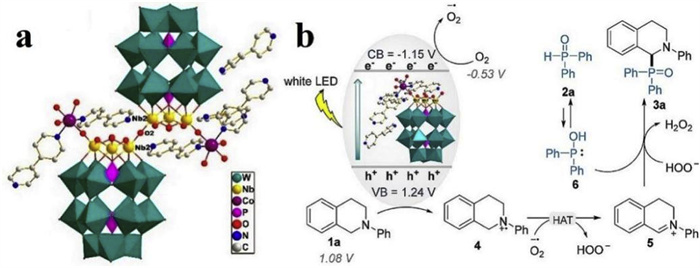
Furthermore, Yu et al. develop a new organic-inorganic hybrid material, Co-POM, resulted from a Nb/W blended-addendum POM [118], which shows effective phosphorylation of N-aryl-tetrahydroisoquinoline under visible light excitation (Fig. 24). Acting as a highly effective heterogeneous photocatalyst, Co-POM facilitates the synthesis of desired products with excellent yields (up to 97%) for diverse phosphorus reagents in an O2 atmosphere. The strong redox capability of Co-POM enables the reduction of O2 to ·O2–, while oxidizing N-aryl-tetrahydroisoquinoline to generate intermediate 4. Subsequently, the ·O2– species reacts with the intermediate 4 to afford imine ion 5, which further undergoes nucleophilic addition to yield the target product with the addition of 6 (Fig. 24b).
The strategy of confining POMs within MOFs via coordination interactions efficiently immobilizes active sites, significantly reducing metal leaching while enhancing catalyst recyclability. Structural design of flexible MOFs or extra-large pore POMs facilitates diffusion and activation of sterically bulky cyclic olefin substrates. This material design philosophy demonstrates transferability to other catalytic systems. POMs-based composites exhibit exceptional activity and selectivity advantages in photocatalytic synthesis of pyridine derivatives. However, the critical challenges persist regarding substrate generality and industrial-scale applicability, necessitating future research focused on synergistic innovation between material design and reaction engineering. Notably, for catalytic processes involving complex mechanisms (e.g., esterification and phosphorylation), the continued exploration of innovative reaction pathways remains essential to drive sustained progress in the field.
In photocatalytic reduction reactions, POMs-based photocatalysts create electrons and holes upon stimulation by visible light, enabling multielectron transfer to substrates to initiate reactions. The continuous separation of photoinduced carriers is maintained with the assistance of sacrificial reagents. In this section, we will discuss the latest developments in POMs-based photocatalysts for controlled reduction reactions, focusing on controlled reductive dehalogenation of haloketones and the reduction of aryl halides.
In 2020, Niu’s group prepared an organic-inorganic hybrid polyoxometalates containing 5.66 Rh atoms, named as [Na0.17Rh0.83Ⅲ(C6H8N2)2Cl2]2(C8H8N2)2[As4W40O140Rh4Ⅳ(C6H4N2S)2]·nH2O (Rh-POM) [119]. The optimal hybrid (0.05 mol%) showed exceptional photocatalytic activity, achieving a 96.2% yield of aniline with 99% selectivity in the reduction of nitrobenzene, using N2H4·H2O as the reductant (Fig. 25). Notably, aniline derivatives with electron-withdrawing groups (F, Cl, and Br) outperformed those with electron-donating groups (Me, Et, iPr, C(Me)3, and OMe). Moreover, the oxidation of anilines was also demonstrated through the above Rh-based catalyst to obtain excellent azobenzene’s yield.
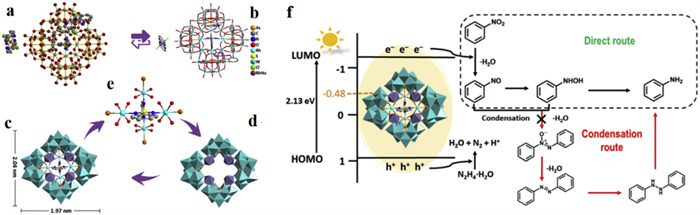
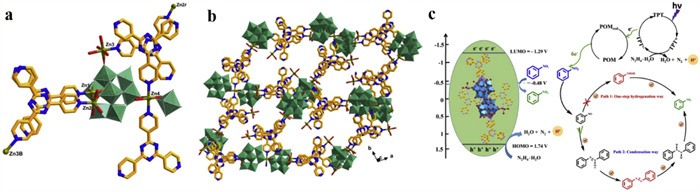
Additionally, the same group successfully constructed a new metal-free POM-based framework (ZnW-TPT) by selecting Keggin-type [SiZnW11O39]6 and 2,4,6-tri(4-pyridyl)-1,3,5-triazine (TPT) with excellent light absorbance as raw materials for photocatalytic reduction of nitroarenes to anilines [120]. Particularly, POMs serve as electron acceptors that largely hinder the recombination of photogenerated carriers during photocatalysis, while the import of N2H4·H2O ensures the rapid extraction of photogenerated h+ (Fig. 26). In brief, the combination of POM and photoactive MOF synergistically enhances the separation of photogenerated electron-hole pairs and effectively triggers selective hydrogenation of nitrobenzene. Furthermore, the intermediate azobenzene was detected, indicating that the reduction of nitrobenzene proceeds through a condensation reaction rather than a hydrogenation process.
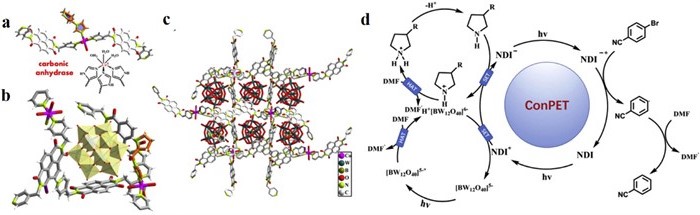
In 2020, Niu et al. utilized a heterogeneous approach to construct CoW-DPNDI-PYI photocatalyst embedding POMs and amine molecules into a naphthalenediimide (NDI)-based polymer for the reduction of diverse arylbromides and chlorides [121]. Benefiting from hydrogen atom transfer (HAT) and SET mechanisms, the electron donors POMs and amine catalysts enable the efficient ConPET process to proceed smoothly (Fig. 27). Consequently, CoW-DPNDI-PYI demonstrated photocatalytic activity in reducing aryl halides. Additionally, CoWDPNDI-PYI effectively catalyzes the cycloaddition of CO2 with epoxides under moderate conditions through two pathways for CO2 activation: (1) The nitrogen atom in HPYI reacts with CO2 to form a carbamate compound, and (2) the hydroxide group of CA, which mimics the Co site, interacts with CO2 and generates a bidentate carbonate.
In 2024, Blanchard et al. introduced a copper(Ⅱ)-POM conjugate in which the Cu-dipyridylamine complex and Dawson-type [P2V3W15O62]9- polyanion are only integrated in virtue of electrostatic interactions [122], which is highly active in catalytically photoreduce Togni’s reagent to generate CF3 radicals, the obtained CF3 radical being captured with TEMPO.
It is noteworthy that the designed catalytic system achieves excellent yield in the reduction of nitrobenzene to aniline with using N2H4·H2O as the reductant. However, the reliance on N2H4·H2O as a chemical reducing agent contradicts green chemistry principles. Future research should focus on developing more environmentally friendly catalytic systems such as photocatalytic systems utilizing H2O or H2 as hydrogen sources to replace conventional chemical reductants. Additionally, the systematic investigations into the reductive transformation of aryl halides remain scarce, particularly requiring further breakthroughs in developing efficient catalytic systems and elucidating underlying reaction mechanisms.
Polyoxometalates (POMs), with their dual capability to store protons and electrons, have emerged as a powerful platform for sustainable and selective photocatalytic organic transformations. Their inherent structural versatility, strong redox properties, tunable light absorption, and defined active sites make them well-suited for green catalytic applications. This review has highlighted significant advancements in POMs-based photocatalysts, focusing on their classifications and applications in selective organic transformations. However, despite these advances, fundamental challenges remain, particularly in enhancing selectivity, stability, and scalability.
Most studies focus on single-metal POMs, such as vanadium, molybdenum, or tungsten-based systems, while the potential of incorporating traditional transition metals like iron, cobalt, and copper remains underexplored. Such metals could widen the range of catalytic reactions and improve selectivity. Incorporating organic functional groups, such as nitrogen-rich conjugated molecules (e.g., porphyrins or phthalocyanines), through covalent or electrostatic interactions could expand visible-light absorption in POM-based materials. Tuning redox potentials, charge migration paths, and light absorption properties by structural adjustments and functional group addition can further enhance POM photocatalysis. High-nuclear, electron-rich POMs with multi-electron transfer capabilities are particularly promising for oxidation and reduction reactions, though embedding them within MOF/COF frameworks remains a challenge. Designing microporous MOF nanocages with flexible structural design and organic linkers may provide ideal confinement for POM molecules, stabilizing them while maintaining catalytic efficiency.
Current POMs-based photocatalysis largely focuses on substrates like benzyl alcohol and amines, typically for selective oxidation and coupling reactions. Few studies have explored lignin depolymerization, where POMs could potentially enable selective C–C bond cleavage in lignin’s β-O-4 linkages. Expanding research into such applications could open new routes for sustainable transformations. Additionally, although controlled conversion of benzyl alcohol to benzaldehyde is well-documented, expanding this process to produce other valuable products, such as hydrobenzoin, is essential. Introducing specific metal active sites in lacunary POMs, allowing precise control over metal coordination, could enable selective production of high-value coupling products.
Understanding how heterometallic active sites interact within POMs-based photocatalysts to impact yield and selectivity in organic transformations is essential for advancing selectivity. In situ techniques could reveal insights into specific active sites, charge transfer dynamics between POMs and their support structures, and energy transition pathways. Such studies are crucial for elucidating structure-activity relationships, ultimately enabling the intelligent creation of highly selective POMs-based photocatalysts tailored for specific organic reactions.
Harsh reaction conditions, including high pH levels and photocorrosion, can compromise POMs structural stability, leading to decomposition and metal oxide formation. Achieving gram-scale transformations with POMs-based catalysts under natural sunlight is essential for industrial applications but remains challenging. Strategies to enhance stability and scalability include: (1) Developing ultra-stable POMs-based compounds by optimizing reaction conditions and selecting compatible components. (2) Expanding reaction scales through the use of mobile catalytic setups designed for outdoor sunlight exposure, enabling large-scale organic transformations in real-world conditions.
Surprisingly, the significant progress has been made in exploring the scalable transformation of POM-based systems. For example, Li and Chen et al. screened the molecular clusters [P2W17VO62]7- {P2W17V} and [P2W15V3O62]9- {P2W15V3} as suitable redox mediators, constructing a solar-light-driven photocatalytic-electrolytic relay system for hydrogen evolution (HER) and oxygen evolution (OER) [123]. Among these, the vanadium-substituted {P2W15V3} polyoxometalate exhibited rapid redox kinetics, multi-electron transfer capability, and strong pH buffering capacity. When coupling a typical BiVO4 photocatalyst for O2 production with an electrolysis subsystem using {P2W15V3}3- as the electron redox mediator for H2 production, the rapid H2 generation was achieved at a low voltage of 0.6 V. This system attained a Faradaic efficiency exceeding 98.5% while maintaining long-term stable operation.
Furthermore, J. Vaitla and B. Chakraborty team developed a photocatalyst based on an Anderson-type polyoxometalate, [Mo7O24@γ-FeO(OH)]. Utilizing visible light, this catalyst drives the selective bond cleavage of in situ generated highly strained oxetanes, enabling the one-pot synthesis of benzoindene and dihydrophenanthrene frameworks from dienyl sulfonium ylides and electron-deficient alkynes [124]. Practicality and functional expansion studies demonstrated that this reaction can be successfully conducted on a gram scale under aqueous conditions/sunlight irradiation. The products exhibit significant fluorescence (emission wavelength 414–460 nm), making them suitable for OLED materials. Additionally, they can be derivatized into key intermediates such as brominated naphthalenes and indolones.
Overcoming these challenges and implementing innovative strategies can unlock the full potential of POMs-based photocatalysts in sustainable selective organic transformations. By designing more robust, efficient, and versatile POM systems, the field can progress toward practical applications, advancing eco-friendly production of high-value chemicals while supporting broader goals in green chemistry.
POMs-based photocatalysts have demonstrated exceptional potential in green chemistry, offering sustainable, selective pathways for organic transformations, including essential oxidation and coupling reactions to produce high-value compounds like aldehydes, ketones, and imines. POMs’ unique redox capabilities, structural adaptability, and thermal stability make them particularly suited for selective transformations under mild conditions, contributing to environmentally sustainable synthesis.
Recent advances in POMs design have focused on enhancing catalytic efficiency and stability through strategic modifications, such as transition metal doping, embedding within MOFs or COFs, and creating hybrids with semiconductor materials like titanium dioxide and zinc oxide. These enhancements broaden the light absorption spectrum, improve charge separation, and strengthen catalytic durability, positioning POMs as promising catalysts for industries such as pharmaceuticals, agrochemicals, and fine chemicals. The integration of POMs with MOFs or COFs, in particular, has proven effective in preventing aggregation and degradation while enhancing molecular access to active sites, resulting in improved reaction rates and selectivity.
Nevertheless, significant challenges remain in achieving scalable and economically feasible POMs-based photocatalysts, particularly in terms of maintaining structural stability over multiple catalytic cycles, recyclability, and the high costs associated with precious metals in some POM systems. Future research should focus on developing economically viable, durable catalysts by reinforcing POM stability through innovative designs, such as protective encapsulations and cost-effective metal substitutions. Additionally, the synthesis of resilient POM hybrids and optimized support configurations may reduce degradation over successive reaction cycles, further enhancing recyclability and efficiency.
Advancing these areas holds promise for establishing POMs-based systems as key platforms in sustainable chemical synthesis, supporting eco-friendly production of high-value chemicals with minimal environmental impact. Continued research and development in this field will drive the industrial adoption of POMs-based photocatalysts, strengthening their role in green chemistry applications and enabling scalable, sustainable organic transformations across diverse industries.
Meiyu Zhang: Validation, Methodology, Investigation. Yuanzhe Li: Methodology, Investigation, Data curation. Rakesh Kumar Gupta: Writing – review & editing, Methodology. Mengjun Lou: Validation, Investigation. Yushan Jiang: Methodology, Conceptualization. Zhen Li: Visualization, Methodology. Yalin Zhang: Visualization, Resources. Jiayi Zhang: Methodology, Conceptualization. Xianqiang Huang: Writing – review & editing, Supervision, Project administration, Funding acquisition. Qingde Zhang: Methodology, Conceptualization. Qinggang Sun: Data curation, Writing – review & editing. Di Sun: Writing – review & editing, Supervision, Project administration, Investigation, Funding acquisition.
The authors declare that they have no known competing financial interests or personal relationships that could have appeared to influence the work reported in this paper.
The work was financially supported by the National Natural Science Foundation of China (Nos. 22571135, 21871125, 22325105, 22201159, 52261135637, 22171164 and 92361301); the Natural Science Foundation of Shandong Province (Nos. ZR2023MB018, ZR2017MB061 and ZR2023QB203), the foundation of State Key Laboratory of Coal Conversion (No. J24–25–902) and the Key Projects of Dongying City School Cooperation Funds (No. SXHZ-2023–02–15).
N.Y. Huang, Y.T. Zheng, D. Chen, et al., Chem. Soc. Rev. 52 (2023) 7949–8004. doi: 10.1039/d2cs00289b
W.K. Shang, Y.G. Li, H.W. Huang, et al., ACS Catal. 11 (2021) 4613–4632. doi: 10.1021/acscatal.0c04815
Y.H. Shi, Z.F. Zhao, D. Yang, et al., Chem. Soc. Rev. 52 (2023) 6938–6956. doi: 10.1039/d2cs00797e
X.S. Sun, X.D. Zhang, Y. Xie, Matter 2 (2020) 842–861. doi: 10.1016/j.matt.2020.02.006
Y.Y. Li, X.H. Li, Z.X. An, et al., Chin. Chem. Lett. 36 (2025) 109716. doi: 10.1016/j.cclet.2024.109716
L.Q. Xiong, J.W. Tang, Adv. Energy Mater. 11 (2021) 2003216. doi: 10.1002/aenm.202003216
Y.Y. Dong, Y.L. Su, Y.F. Hu, et al., Small 16 (2020) 2001529. doi: 10.1002/smll.202001529
P.X. Li, X.Y. Yan, S.Y. Gao, et al., Chem. Eng. J. 421 (2021) 129870. doi: 10.1016/j.cej.2021.129870
J. Wu, Y. Wang, S. Zhang, et al., Appl. Catal. B: Environ. 332 (2023) 122741. doi: 10.1016/j.apcatb.2023.122741
M.H. Yu, N. Wang, K. Lin, et al., J. Mater. Chem. A 11 (2023) 4302–4309. doi: 10.1039/d2ta09989f
Y.X. Guo, B. Liu, J.W. Zhang, et al., Appl. Catal. B: Environ. 350 (2024) 123915. doi: 10.1016/j.apcatb.2024.123915
S.T. Li, Y.R. Li, H.W. Huang, Adv. Funct. Mater. 34 (2024) 2313883. doi: 10.1002/adfm.202313883
T. Zhang, W.T. Wang, X.L. Jiang, et al., Green Chem. 26 (2024) 3338–3345. doi: 10.1039/d3gc04644c
Z.Y. Gao, F. Yu, M.Y. Zhang, et al., Angew. Chem. Int. Ed. 64 (2025) e202516079. doi: 10.1002/anie.202516079
X. Wang, B.H. Wang, C. Peng, et al., ACS Catal. 15 (2025) 13288–13301. doi: 10.1021/acscatal.5c02654
V. Das, R. Kaushik, F. Hussain, Coord. Chem. Rev. 413 (2020) 213271. doi: 10.1016/j.ccr.2020.213271
W.M. Guan, G.X. Wang, B. Li, et al., Coord. Chem. Rev. 481 (2023) 215039. doi: 10.1016/j.ccr.2023.215039
A.J. Li, S.L. Huang, G.Y. Yang, Dalton Trans. 52 (2023) 18133–18136. doi: 10.1039/d3dt03274d
J.C. Liu, J.W. Zhao, C. Streb, et al., Coord. Chem. Rev. 471 (2022) 214734. doi: 10.1016/j.ccr.2022.214734
J.X. Liu, X.B. Zhang, Y.L. Li, et al., Coord. Chem. Rev. 414 (2020) 213260. doi: 10.1016/j.ccr.2020.213260
K.J. Qin, D.J. Zang, Y.G. Wei, Chin. Chem. Lett. 34 (2023) 107999. doi: 10.1016/j.cclet.2022.107999
L.J. Xu, C.M. Wang, K. Yu, et al., Coord. Chem. Rev. 481 (2023) 215044. doi: 10.1016/j.ccr.2023.215044
M.J.W. Budych, K. Staszak, A. Bajek, et al., Coord. Chem. Rev. 493 (2023) 215306. doi: 10.1016/j.ccr.2023.215306
M. Taghizadeh, E. Mehrvarz, A. Taghipour, Rev. Chem. Eng. 36 (2020) 831–858. doi: 10.1515/revce-2018-0058
Z.H. Ni, H.J. Lv, G.Y. Yang, Molecules 27 (2022) 8799. doi: 10.3390/molecules27248799
J. Gu, W. Chen, G.G. Shan, et al., Mater. Today Energy 21 (2021) 100760. doi: 10.1016/j.mtener.2021.100760
X.Y. Zhang, H. Li, N. Xu, et al., Inorg. Chem. Front. 12 (2025) 3823–3832. doi: 10.1039/D5QI00460H
H.Y. Zhao, Y.Z. Li, J.W. Zhao, et al., Coord. Chem. Rev. 443 (2021) 213966. doi: 10.1016/j.ccr.2021.213966
D.J. Zang, H.Q. Wang, Polyoxometalates 1 (2022) 9140006. doi: 10.26599/pom.2022.9140006
L. Guo, L. He, Q.H. Zhuang, et al., Small 19 (2023) 2207315. doi: 10.1002/smll.202207315
K. Xia, K. Yamaguchi, K. Suzuki, Angew. Chem. Int. Ed. 62 (2022) e202214506.
Z.M. Wang, X. Xin, M. Zhang, et al., Sci. China Chem. 65 (2022) 1515–1525. doi: 10.1007/s11426-022-1276-4
Q.X. Gu, X.L. Zhao, M. Meng, et al., Chin. Chem. Lett. 34 (2023) 107444. doi: 10.1016/j.cclet.2022.04.042
S.M. Zhang, Y. Wang, Y.Y. Ma, et al., Inorg. Chem. 61 (2022) 20596–20607. doi: 10.1021/acs.inorgchem.2c03472
L.Y. Zhang, Q. Hou, Y. Zhou, et al., J. Mol. Catal. 473 (2019) 110397.
J.C. Jiao, X.M. Yan, S.Z. Xing, et al., Inorg. Chem. 61 (2022) 2421–2427. doi: 10.1021/acs.inorgchem.1c03150
B. Yu, S.M. Zhang, X. Wang, Angew. Chem. Int. Ed. 60 (2021) 17404–17409. doi: 10.1002/anie.202105587
Y.N. Liu, K.H. Ji, J. Wang, et al., ACS Appl. Mater. Interfaces 14 (2022) 27882–27890. doi: 10.1021/acsami.2c05654
Y.N. Liu, L.N. Li, S. Meng, et al., Inorg. Chem. 62 (2023) 12954–12964. doi: 10.1021/acs.inorgchem.3c01749
K.H. Ji, Y.N. Liu, Y.H. Luo, et al., J. Phys. Chem. C 127 (2022) 256–264. doi: 10.1109/lifetech53646.2022.9754851
D.Y. Zhao, Q. Liu, H.Y. Lü, et al., Coll. Surf. A: Physicochem. Eng. Asp. 699 (2024) 134677. doi: 10.1016/j.colsurfa.2024.134677
Y.N. Liu, J. Wang, L.N. Li, et al., Chem. Mater. 35 (2023) 3941–3950. doi: 10.1021/acs.chemmater.3c00120
M. Kamachi, K. Yonesato, T. Okazaki, et al., Angew. Chem. Int. Ed. 63 (2024) e202408358. doi: 10.1002/anie.202408358
X.Q. Huang, S. Liu, G. Liu, et al., Appl. Catal. B: Environ. 323 (2023) 122134. doi: 10.1016/j.apcatb.2022.122134
X.F. Chen, H.Z. Wu, X.J. Shi, et al., Nanoscale 15 (2023) 9242–9255. doi: 10.1039/d3nr01176c
Y.W. Liu, B.X. Wang, Q. Fu, et al., Angew. Chem. Int. Ed. 60 (2021) 22522–22528. doi: 10.1002/anie.202109538
Y. Zhang, Y.F. Liu, D. Wang, et al., Polyoxometalates 2 (2023) 9140017. doi: 10.26599/pom.2022.9140017
M. Samaniyan, M. Mirzaei, R. Khajavian, et al., ACS Catal. 9 (2019) 10174–10191. doi: 10.1021/acscatal.9b03439
C.L. Liu, M.A. Moussawi, G. Kalandia, et al., Angew. Chem. Int. Ed. 63 (2024) e202401940. doi: 10.1002/anie.202401940
M. Zhang, Z. Li, Y.Q. Feng, et al., Green Chem. 25 (2023) 10091–10100. doi: 10.1039/d3gc03468b
J.W. Zhang, Y.C. Huang, G. Li, et al., Coord. Chem. Rev. 378 (2019) 395–414. doi: 10.1016/j.ccr.2017.10.025
H.X. Bi, M.S. Guo, J. Du, et al., Coord. Chem. Rev. 518 (2024) 216092. doi: 10.1016/j.ccr.2024.216092
P. Wang, Z.T. Wang, P.S. Wang, et al., Polyoxometalates 3 (2024) 9140047. doi: 10.26599/pom.2023.9140047
G.P. Yang, Y.F. Liu, Y.G. Wei, Coord. Chem. Rev. 521 (2024) 216172. doi: 10.1016/j.ccr.2024.216172
Y. Benseghir, A. Lemarchand, M. Duguet, et al., J. Am. Chem. Soc. 142 (2020) 9428–9438. doi: 10.1021/jacs.0c02425
Y.O. He, Y.M. Fu, X. Meng, et al., Inorg. Chem. 61 (2022) 11359–11365. doi: 10.1021/acs.inorgchem.2c01539
Q. Huang, J. Liu, L. Feng, et al., Natl. Sci. Rev. 7 (2020) 53–63. doi: 10.1093/nsr/nwz096
S.D. Mürtz, J.C. Raabe, M.J. Poller, et al., ChemCatChem. 16 (2024) e202301632. doi: 10.1002/cctc.202301632
H.F. Li, M.G. Yang, Z.L. Yuan, et al., Chin. Chem. Lett. 33 (2022) 4664–4668. doi: 10.1016/j.cclet.2021.12.081
Q.S. Lai, X.X. Li, S.T. Zheng, Coordin. Chem. Rev. 482 (2023) 215077. doi: 10.1016/j.ccr.2023.215077
Y. Liu, C.S. Tang, M. Cheng, et al., ACS Catal. 11 (2021) 13374–13396. doi: 10.1021/acscatal.1c03866
K. Suzuki, N. Mizuno, K. Yamaguchi, ACS Catal. 8 (2018) 10809–10825. doi: 10.1021/acscatal.8b03498
A. Ebrahimi, L. Krivosudský, A. Cherevan, et al., Coord. Chem. Rev. 508 (2024) 215764. doi: 10.1016/j.ccr.2024.215764
Y.L. Hu, Y.Y. Wang, J.W. Zhao, et al., Coord. Chem. Rev. 506 (2024) 215724. doi: 10.1016/j.ccr.2024.215724
Z.M. Chi, S.Q. Chu, B.Q. Wang, et al., Talanta 297 (2026) 128591. doi: 10.1016/j.talanta.2025.128591
M. Lu, M. Zhang, J. Liu, et al., J. Am. Chem. Soc. 144 (2022) 1861–1871. doi: 10.1021/jacs.1c11987
T. Wang, Y.Q. Zhu, W. Wang, et al., Nano Res. 17 (2024) 5975–5984. doi: 10.1007/s12274-024-6626-1
A. Solé-Daura, Y. Benseghir, M.H. Ha-Thi, et al., ACS Catal. 12 (2022) 9244–9255. doi: 10.1021/acscatal.2c02088
R.C. Shi, X. Han, J.L. Xu, et al., Small 17 (2021) 2006416. doi: 10.1002/smll.202006416
Y. Liang, Z. Zhang, X.F. Su, et al., Angew. Chem. Int. Ed. 62 (2023) e202309030. doi: 10.1002/anie.202309030
M.L. Yang, X.M. Wang, C.J. Gómez-García, et al., Adv. Funct. Mater. 33 (2023) 2214495. doi: 10.1002/adfm.202214495
Z.R. Zhang, H.Y. Sui, W.X. Shi, et al., Angew. Chem. 137 (2025) e202416711. doi: 10.1002/ange.202416711
Q.Y. Hu, S.S. Chen, T. Wågberg, et al., Angew. Chem. Int. Ed. 62 (2023) e202303290. doi: 10.1002/anie.202303290
G.B. Yuan, H.Y. Ge, W.X. Shi, et al., Angew. Chem. Int. Ed. 62 (2023) e202309934. doi: 10.1002/anie.202309934
H.Y. Li, L.R. Zheng, Q.C. Lu, et al., Sci. Adv. 9 (2023) eadi6595. doi: 10.1126/sciadv.adi6595
Y. Guan, H.P. Xiao, X.X. Li, et al., Polyoxometalates 2 (2023) 9140023. doi: 10.26599/pom.2023.9140023
G. Liu, Y.F. Chen, Y.L. Chen, et al., Adv. Mater. 35 (2023) 216172.
K. Gao, Y. Cheng, Z.Y. Zhang, et al., Angew. Chem. Int. Ed. 63 (2024) e202319488. doi: 10.1002/anie.202319488
S. Farhadi, M. Afshari, M. Maleki, et al., Tetrahedron Lett. 46 (2005) 8483–8486. doi: 10.1016/j.tetlet.2005.10.019
S. Farhadi, M. Zaidi, Appl. Catal. A: Gen. 354 (2009) 119–126. doi: 10.1016/j.apcata.2008.11.024
J.Z. Liao, H.L. Zhang, S.S. Wang, et al., Inorg. Chem. 54 (2015) 4345–4350. doi: 10.1021/acs.inorgchem.5b00041
F.S. Xing, R.Y. Zeng, C.C. Cheng, et al., Appl. Catal. B: Environ. 306 (2022) 121087. doi: 10.1016/j.apcatb.2022.121087
Y.Y. Dong, Y.Q. Feng, Z. Li, et al., ACS Catal. 13 (2023) 14346–14355. doi: 10.1021/acscatal.3c03977
R.W. Liang, R. Chen, F.F. Jing, et al., Dalton Trans. 44 (2015) 18227–18236. doi: 10.1039/C5DT02986D
C. Si, X.L. Liu, T. Zhang, et al., Inorg. Chem. 62 (2023) 4210–4219. doi: 10.1021/acs.inorgchem.2c04318
H.F. Li, W.J. Chen, Y.H. Sun, et al., Fuel 356 (2024) 129647. doi: 10.1016/j.fuel.2023.129647
G. Yang, Y. Wu, X.Y. Wu, et al., Appl. Catal. B: Environ. 380 (2026) 125757. doi: 10.1016/j.apcatb.2025.125757
W.X. Liu, J.W. Jiang, Z.H. Li, et al., Angew. Chem. Int. Ed. 64 (2025) e202507312. doi: 10.1002/anie.202507312
J.Y. Liu, H.F. Li, W.J. Lei, et al., Inorg. Chem. 63 (2024) 10603–10610. doi: 10.1021/acs.inorgchem.4c00973
W.J. Xu, B.X. Huang, G. Li, et al., ACS Catal. 13 (2023) 5723–5732. doi: 10.1021/acscatal.3c00284
Z.L. Shi, J. Li, Q.X. Han, et al., Inorg. Chem. 58 (2019) 12529–12533. doi: 10.1021/acs.inorgchem.9b02056
H.F. Li, Z.L. Yuan, W.J. Chen, et al., J. Mater. Chem. A 11 (2023) 10813–10822. doi: 10.1039/d3ta00498h
H.F. Li, W.J. Chen, Z.L. Yuan, et al., Inorg. Chem. 61 (2022) 9935–9945. doi: 10.1021/acs.inorgchem.2c00718
Y.J. Zhao, R. Wan, H.F. Li, et al., Inorg. Chem. 61 (2022) 12097–12105. doi: 10.1021/acs.inorgchem.2c00664
W. Chen, H. Li, J. Song, et al., Inorg. Chem. 61 (2022) 2076–2085. doi: 10.1021/acs.inorgchem.1c03282
J. Li, B.W. Chang, H.Y. Zhao, et al., J. Mater. Sci. 56 (2021) 6676–6688. doi: 10.1007/s10853-020-05707-y
S.J. Li, G. Li, P.P. Ji, et al., ACS Appl. Mater. Interfaces 11 (2019) 43287–43293. doi: 10.1021/acsami.9b16694
X.L. Wang, X.D. Liu, N. Xu, et al., Inorg. Chem. 62 (2023) 12181–12186. doi: 10.1021/acs.inorgchem.3c01907
N. Tsang, A.J. Kibler, S.P. Argent, et al., Chem. Sci. 15 (2024) 14685–14691. doi: 10.1039/d4sc03534h
X.Y. Dong, F.L. Zhang, Y.X. Wang, et al., Appl. Catal. B: Environ. 345 (2024) 123660. doi: 10.1016/j.apcatb.2023.123660
B. Zeng, W.L. Sheng, F.W. Huang, et al., Chem. Eng. J. 474 (2023) 145559. doi: 10.1016/j.cej.2023.145559
J.B. Yang, J.H. Pan, Y.H. Zhu, et al., Inorg. Chem. 61 (2022) 11775–11786. doi: 10.1021/acs.inorgchem.2c01497
D.G. Ke, S.L. Huang, G.Y. Yang, Inorg. Chem. 61 (2022) 20080–20086. doi: 10.1021/acs.inorgchem.2c03504
Q.S. Zhu, H.Y. An, T.Q. Xu, et al., Appl. Catal. A: Gen. 662 (2023) 119283. doi: 10.1016/j.apcata.2023.119283
Y.H. Chen, H.Y. An, S.Z. Chang, et al., Inorg. Chem. 62 (2023) 10120–10130. doi: 10.1021/acs.inorgchem.3c00565
X.Q. Huang, S. Liu, Z. Zhou, et al., Inorg. Chem. Front. 10 (2023) 1465–1474. doi: 10.1039/d3qi00018d
D. Karimian, F. Zangi, Catal. Commun. 152 (2021) 106283. doi: 10.1016/j.catcom.2021.106283
L. Yang, Z. Zhang, C.N. Zhang, et al., Inorg. Chem. Front. 9 (2022) 4824–4833. doi: 10.1039/d2qi00838f
Y. Ma, F. Gao, W. Xiao, et al., Chin. Chem. Lett. 33 (2022) 4395–4399. doi: 10.1016/j.cclet.2021.12.023
M.Y. Cui, C. Liang, W. Zhao, et al., Fuel Process. Technol. 238 (2022) 107481. doi: 10.1016/j.fuproc.2022.107481
H.J. Lee, E.S. Cho, ACS Sustain. Chem. Eng. 11 (2023) 7624–7632. doi: 10.1021/acssuschemeng.2c06011
L. Qin, R. Ren, X.X. Huang, et al., J. Solid State Chem. 310 (2022) 123052. doi: 10.1016/j.jssc.2022.123052
Z. Ming, T.X. Zhang, W.M. Tian, et al., Chem. Commun. 57 (2021) 12812–12815. doi: 10.1039/d1cc04209b
T. Zhang, J.C. Jiao, K.X. Guo, et al., J. Catal. 429 (2024) 115287. doi: 10.1016/j.jcat.2023.115287
X.L. Lin, M.L. Zhang, M.M. Zhu, et al., Inorg. Chem. Front. 5 (2018) 2493–2500. doi: 10.1039/c8qi00648b
S. Karamzadeh, E. Sanchooli, A.R. Oveisi, et al., Appl. Catal. B: Environ. 303 (2022) 120815. doi: 10.1016/j.apcatb.2021.120815
S.J. Li, N. Li, G. Li, et al., Polyoxometalates 2 (2023) 9140024. doi: 10.26599/pom.2023.9140024
F. Gao, W.N. Xiao, S.J. Li, et al., ACS Appl. Mater. Interfaces 14 (2022) 19278–19284. doi: 10.1021/acsami.1c23753
W.J. Chen, H.F. Li, Y.Z. Jin, et al., Chem. Commun. 58 (2022) 9902–9905. doi: 10.1039/d2cc03076d
J.C. Jiao, H. Sun, C. Si, et al., ACS Appl. Mater. Interfaces 14 (2022) 16386–16393. doi: 10.1021/acsami.1c24911
J.C. He, J. Li, Q.X. Han, et al., ACS Appl. Mater. Interfaces 12 (2019) 2199–2206. doi: 10.1007/s00259-019-04355-y
W.X. Wang, L.M. Chamoreau, G. Izzet, et al., J. Am. Chem. Soc. 145 (2023) 12136–12147. doi: 10.1021/jacs.3c01716
L.P. Cui, S. Zhang, Y. Zhao, et al., Nat. Commun. 16 (2025) 3674. doi: 10.1038/s41467-025-58622-8
D.S. Davas, L. Mallick, D.K. Gopalakrishnan, et al., Angew. Chem. Int. Ed. 64 (2025) e202507189. doi: 10.1002/anie.202507189

Figure 2 (a) Approaches for designing visible-light-responsive POMs catalysts, including hybridization with photosensitizers, metal ion substitution, and the insertion of ligand (substrate) at vacant sites of lacunary POMs. (b) Proposed reaction pathway for photocatalytic organic oxidation over POMs-based catalysts, using O2 as the oxidant.

Figure 3 Timeline showing the mainstream development in the advancement of POMs-based photocatalysts for selective organic oxidation reactions.

Figure 4 (a) Numbers of recent publications on POMs-based photocatalysts for organic oxidation reactions. (b) Overview of studies on POMs-based photocatalysts in organic synthesis, specifically for the oxidation of benzyl alcohol, aniline, phenyl sulfide, methylbenzene, and various other phenyl and heterocyclic compounds.

Figure 5 Diagram depicting the Z-scheme pathway for the transfer of photogenerated carriers among HPM and ZIS heterojunctions, where HPB represents the reduced form of HPM induced by an internal electric field. Reprinted with permission [82]. Copyright 2022, Elsevier.

Figure 6 Photocatalytic activities of (a) CsPbBr3 and CsPbBr3/Ni4P2-x composites and (b) control experiments, where A, B, C, and D signify CsPbBr3+NiCl2, CsPbBr3+PW9, CsPbBr3+NiCl2+PW9, and CsPbBr3+Ni4P2, respectively. (c) Diagram of the energy levels for CsPbBr3 and POM anions. (d) Photocatalytic performances of various CsPbBr3/POM composites. (e) Plausible pathway for photocatalytic benzyl alcohol oxidation by the CsPbBr3/Ni4P2 composite under visible light. Reprinted with permission [83]. Copyright 2023, American Chemical Society.

Figure 7 (a) 2D structure of [Ag3][PW12]. (b) Polyhedral view of the 2D structure and its topology in [Ag3][PW12]. (c) 3D structure of [Ag3][PW12]. (d) Proposed mechanism for the photocatalytic oxidation of benzyl alcohol by [Ag3][PW12] under light exposure. Reprinted with permission [34]. Copyright 2022, American Chemical Society.

Figure 8 (a) The possible photocatalytic oxidation mechanism of aromatic alcohols with CPISs as photocatalyst. (b) The reaction pathway diagram for photocatalytic oxidation of benzyl alcohol to benzaldehyde catalyzed by CPISs. Reprinted with permission [33]. Copyright 2023, Elsevier.

Figure 9 (a) Photochromic response of HMNRs in toluene. (b) Schematic of the proposed photocatalytic pathway for toluene oxidation using HMNRs. (c) Comparison of toluene oxidation conversion rates catalyzed by HMNRs and K6[α-P2W18O62]·14H2O. (d) Product yields of benzyl alcohol, benzaldehyde, and benzoic acid after 3, 6, 12, 24, and 48 h of photocatalysis. (e) Catalytic stability of HMNRs. Reprinted with permission [37]. Copyright 2021, John Wiley and Sons.

Figure 10 (a) Coordination environment of {Co4W22-DPNDI}. (b) Structure of sandwich-type {Co4W22}. (c) Structure of the representative sandwich polyanion {Co4W18}. (d) 2D network of {Co4W22-DPNDI} along the c axis. (e) 3D architecture of {Co4W22-DPNDI} along the b axis. (f) Possible catalytic pathway for photocatalytic toluene oxidation using {Co4W22-DPNDI. Reprinted with permission [36]. Copyright 2022, American Chemical Society.

Figure 11 (a) Structure of Cu-POM. (b) Distances of eight Cu atoms. (c) {Cu2(OPCH2COO)(1,4,9-α-P2W15O56)}11- polyoxoanion. (d) Polyhedral diagrams of [1,4,9-α-P2W15O56]12-. (e) [Cu2(OPCH2COO)] segment. (f) Schematic illustration of photocatalytic oxidation of the resistant C(sp3)–H bond in toluene to form benzoic acid using Cu-POM as the catalyst. (g) The possible reaction pathway diagram for photocatalytic oxidation of toluene to benzoic acid catalyzed by Cu-POM. Reprinted with permission [89]. Copyright 2024, American Chemical Society.

Figure 12 (a) Synthetic pathway for producing Ru-POM-3–6 by adjusting the number of active sites. Schematic representations of polyoxoanion structural configurations: (b) structure of Ru-POM-3, (c) structure of Ru-POM-4, and (d) structure of Ru-POM-5. (e) Suggested mechanism for photocatalytic oxidation of amines to imines. (f) Experimental confirmation of the suggested mechanism for coupling primary amines. Reprinted with permission [93]. Copyright 2022, American Chemical Society.

Figure 13 Diagram showing the synthesis of photocatalysts {Ru2W10} and {Ru3W13} and their application in the light-driven oxidation of amines to imines. Reprinted with permission [94]. Copyright 2022, American Chemical Society.

Figure 14 Proposed pathway for the photocatalytic aerobic oxidation of benzylamine to imine using SiW-Cu-DPNDI. Reprinted with permission [96]. Copyright 2021, Springer Nature.

Figure 15 (a) 2D framework of NaRh-SiW12. (b) Simplified 3D POMOF structure showing Rh2(OAc)4 and POM units. (c) Proposed mechanism for amine oxidative coupling catalyzed by NaRh-SiW12. Reprinted with permission [39]. Copyright 2023, American Chemical Society.

Figure 16 Schematic representation of the proposed pathway for the selective photooxidation of MPS with O2 using LCU-20 under LED light. Reprinted with permission [106]. Copyright 2023, Royal Society of Chemistry.

Figure 17 (a) Asymmetric unit structure of RuCd-SiW. (b) 3D structural view of RuCd-SiW observed from the a-axis. (c) Plausible reaction pathway for the controlled oxidation of sulfides catalyzed by RuCd-SiW. Reprinted with permission [40]. Copyright 2023, American Chemical Society.

Figure 18 (a) 2D structure of POM[Fe]. (b) Plausible reaction mechanism of POM[Fe]. Reprinted with permission [108]. Copyright 2022, Elsevier.

Figure 19 Schematic illustration of the selective C–C bond cleavage of the β-O-4 lignin using Mo132 as model photocatalysts. Reprinted with permission [111]. Copyright 2023, American Chemical Society.

Figure 20 Schematic depiction of the photocatalytic aerobic oxidation of α-terpinene using Au8Ag26 alloy nanocluster. Reprinted with permission [43]. Copyright 2024, John Wiley and Sons.

Figure 21 Plausible reaction pathway for the one-pot visible-light-driven preparation of pyridines employing POM@PCN-222. Reprinted with permission [116]. Copyright 2022, Elsevier.

Figure 22 (a) 3D structure of LCU-22. (b) Interpenetrated lvt networks with 4-connected, 2-fold symmetry. (c) Photosynthesis reaction for pyridine derivative formation. (d) Impact of various light sources. (e) Impact of various catalysts: a) ZnCl2; b) Na2WO4; c) a mixture of ZnCl2 and Na2WO4; d) LCU-22. (f) Impact of various solvents. (g) Impact of various amounts of LCU-22. (j) Possible pathway for cascade hantzsch reaction and dehydrogenation utilizing LCU-22. Reprinted with permission [44]. Copyright 2023, Elsevier.

Figure 23 (a) 2D structure of CR-SiW12. (b) Suggested photocatalytic mechanism for the Baeyer-Villiger oxidation of cyclohexanone by CR-SiW12. Reprinted with permission [42]. Copyright 2023, American Chemical Society.

Figure 24 (a) Structure of Co-POM. (b) Plausible mechanism for the photocatalytic phosphorylation of N-aryl-tetrahydroisoquinoline over Co-POM. Reprinted with permission [118]. Copyright 2022, American Chemical Society.

Figure 25 Crystal structure of Rh-POM. (a) ORTEP diagram. (b) Stick model. (c) Polyhedral view of the {As4W40}. (d) Polyhedral view of Rh-POM. (e) Structure of the {Rh4}. (f) Two proposed routes for nitrobenzene reduction. Reprinted with permission [119]. Copyright 2022, Royal Society of Chemistry.

Figure 26 (a) Coordination pattern of {ZnW-TPT}. (b) 3D framework of {ZnW-TPT} as observed from the c-axis. (c) Suggested photocatalytic mechanism for the reduction of nitrobenzene. Reprinted with permission [120]. Copyright 2022, American Chemical Society.

Figure 27 (a) Coordination arrangement of Co(Ⅱ) in CoW-DPNDI-PYI. (b) Interactions among the POM core, DPNDI and PYI ligands. (c) Formation of a 2D square grid pattern with alternating coordinated and unbound DPNDI observed from the b-axis. (d) Suggested photocatalytic reduction mechanism of aryl halides using CoW-DPNDI-PYI. Reprinted with permission [121]. Copyright 2020, American Chemical Society.
Table 1. Summary of POM-based composites in terms of key parameters (light absorption range, charge separation efficiency, and stability) and their respective advantages, limitations, and representative applications.
| Carrier type | Light absorption range | Factors affecting charge separation | Chemical stability | Advantages | Limitations | Application scenarios |
| MOFs | Visible-NIR | Energy level-matched | Weak acid/base resistant | High porosity, tunable structure | Limited stability in strong acids/bases | Diffusion-controlled reactions |
| COFs | Visible-NIR | Low exciton binding energy | Organic solvent resistant | High surface area, tunable pores | Limited stability in strong acids/bases | Sterically constrained reactions |
| Carbon-based | NIR | High conductivity | Strong acid/base resistant | High electron mobility, chemically inert | Possible weak interfacial bonding with POMs | Harsh acid/alkali environments |
| Semiconductors | UV–visible | Heterojunction | Oxides > sulfides | Precise bandgap engineering, abundant active sites | Sulfides prone to photocorrosion, Oxides with low visible light utilization | Multi-electron reduction |
 下载: 导出CSV
Table 2. Summary of the performance of reported POMs-based catalysts in selective photocatalytic organic transformation.
| Photocatalysts | Substrates (Con., mmol/L) | Reaction time (h) | Light source (gas) | Efficiency | Ref. |
| H3PW12O40/SiO2 | Benzyl alcohol (40) | 2.5 | 400 W mercury lamp (O2) | yield: 75% | [79] |
| POM/ZrO2 | Benzyl alcohol (1000) | 4 | 400 W mercury lamp (O2) | yield: 81% | [80] |
| Zn-based host-guest material | Benzyl alcohol (100) | 11 | 300 W Xe-lamp, 320–780 nm (air) | conv.: 67% | [81] |
| HPM/ZIS | Benzyl alcohol (20) | 5 | 300 W Xe-lamp, λ > 420 nm (O2) | yield: 100% | [82] |
| CsPbBr3/Ni4P2 | Benzyl alcohol (5) | 6 | 300 W Xe-lamp, λ > 400 nm (O2) | yield: 100% | [83] |
| HPMo@MIL-100(Fe) | Benzyl alcohol (67) | 4 | 300 W Xe-lamp, λ ≥ 420 nm (O2) | conv.: 21% | [84] |
| [K(H2O)][Cu(DPNDI)][Cu(DPNDI)(CH;CN)(H2O)] [Cu1.5(DPNDI)1.5H1.5P2W18O62]·2H2O | Benzyl alcohol (500) | 16 | 10 W LED lamp, (O2) | conv.: 75% | [85] |
| [Ag3L2(OH)][Na(H2O)0.5][PW12O40] H2O | Benzyl alcohol (48) | 12 | 10 W LED lamp, λ = 365 nm (O2) | conv.: 99% | [34] |
| [W10O32]{[Cp3Zr3(μ3–O)(μ2–OH)3]2(BPDC)3}2 ·12DMA·2CCl4 | Benzyl alcohol (100) | 22 | 45 W LED lamp, λ = 385 nm (O2) | conv.: 97% | [33] |
| Pd-Bi-BTC | Benzyl alcohol (0.2) | 4 | 300 W Xe-lamp, λ > 420 nm (O2) | conv.: 86% | [87] |
| Mo1/ZnIn2S4 | Benzyl alcohol (10) | 4 | 300 W Xe-lamp, λ > 420 nm (Ar) | yield: 96% | [88] |
| HMNRs | Methylbenzene (3 mL) | 48 | 300 W Xe- lamp (O2) | rate: 2254 mmol h-1 g-1 | [37] |
| Co4W22-DPNDI | Methylbenzene (189) | 72 | 10 W LED lamp, λ = 365 nm (O2) | conv.: 80.5% | [36] |
| K8H33[{Cu0.5(H2O)4}{Cu2(O3PCH2COO)(1,4,9-α-P2W15O56)}]·4Cl·60H2O | Methylbenzene (47) | 48 | 10 W LED lamp, λ = 365 nm (O2) | conv.: 97% | [89] |
| {[Zn(PYI)3][H3PW11O39Zn-(PYI)]}·3H2O | Amines (167) | 36 | 10 W LED lamp (O2) | yield: 92% | [91] |
| Cs2Na4H7[(SbW9O33)6{Ru(H2O)5}(RuCl3)(RuO6)2 {W(H2O)}6(WO)4{WO2(H2O)}2{WO2(H2O)2}2 {WO5(H2O)}]·43H2O | Aniline (1000) | 12 | 10 W LED lamp (H2O2) | conv.: 99% | [92] |
| Na13H5[Ru4(H2O)2(Cl)2(WO2)4(AsW9O33)4]·43H2O | Aniline (1 mmol) | 24 | 10 W LED lamp (O2) | yield: 97.1% | [93] |
| [(Ru(OH))2O(W5O18)2]8− | Aniline (500) | 24 | 10 W LED lamp, λ > 400 nm O2 | conv.: 97.1% | [94] |
| [(W5O18)-(Ru2W8O31)]12− | Aniline (500) | 24 | 10 W LED lamp, λ > 400 nm O2 | conv.: 96.8% | [94] |
| K6H[{Ru2Cl(H2O)(CH3COO)2}{WO(H2O)}2 (PW9O34)2]·14H2O | Aniline (1 mmol) | 24 | 10 W LED lamp, λ > 400 nm (O2) | yield: 97.2% | [95] |
| {Cu4(C26H16N4O4)4(-CH3CN)2[SiW12O40]} 4H2O | Aniline (2000) | 16 | 10 W LED lamp (O2) | yield: 98.06% | [96] |
| {[Cd(DMF)2Ru(bpy)2(dcbpy)]2(POMs)(DMF)2}xDMF (PMo-1, POMs = [PMoⅥ11MoⅤO40]4−, x = 5) | Aniline (1000) | 0.5 | 10 W LED lamp (O2) | yield: 99.6% | [38] |
| NaRh-SiW12 | Aniline (1 mmol) | 12 | 10 W LED lamp (O2) | yield: 96.1% | [39] |
| (NH4)41H7[K3(H2O)3(P2W15Ta3O62)6(Mo2O4CH3 CO2)3(MoO3)2]·85H2O | Aniline (100) | 24 | AM 1.5 G, (O2) | yield: 97% | [97] |
| (Hbiz)5{Co(H2O)3[Co(H2O)2]2}{Co[Mo6O12(OH)3 (PO4)(HPO4)3][Mo6O12(OH)3(PO4)2(HPO4)2]}·3H2 | Aniline (333) | 12 | 300 W Xe lamp, 400–780 nm (H2O2) | conv.: 97% | [98] |
| PBW11, AsBW11, and SiBW11 | Aniline (400) | 24 | 43 W LED lamp, λ = 370 nm | yield: 57% | [99] |
| [Co-(H2O)2DABT]2[CrMo(OH)5O19]{Co-CrMo6}, [Zn-(H2O)2DABT]2[CrMo(OH)5O19] {Zn-CrMo6} | Dibenzothiophene (200) | 8 | 300 W xenon arc lamp, λ > 420 nm | conv.: 99% | [102] |
| PW12−M@COFs | Methyl phenyl sulfide (67) | 3.5 | 10 W 425 nm LED, (O2) | conv.: 98% | [104] |
| [Eu2L(BPDC)1.5(DMF)6]n | Methyl phenyl sulfide (10) | 1 | 10 W LED lamp, λ = 450 nm (O2) | conv.: 100% yield: 99% | [103] |
| [CoⅡ(bcbpy)2(θ-Mo8O26)0.5]·5H2O | 2-Chloroethyl ethyl sulfide (167) | 5 | 300 W Xe lamp (H2O2) | conv.: 98% | [108] |
| [MⅡ(4-PBPY)2(H2O)]-[MⅡ(H2O)4][CoⅢ 2MoⅥ10H4O38]·nH2O (M = Cu, n = 10 for 1; M = Co, n = 11 for 2) | Methyl phenyl sulfide (200) | 6 | 10 W LED lamp, λ = 450 nm (O2) | conv.: > 99% | [105] |
| {[Zn(1-pIM)3]2[Zn6(AsW9O33)2(1-pIM)6]·2(1-HpIM)·2H2O}n (LCU-20){[Zn(1-ipIM)3]2[Zn6(SbW9O33)2(1-ipIM)6]·2(1-HipIM)}n (LCU-21) | Methyl phenyl sulfide (250) | 36 | 10 W LED lamp (O2) | yield: 99% | [106] |
| ((n-C4H9)4N)5[SiW11(Sn(CH2)2HCNC16H9)O39] | Methyl phenyl sulfide (200) | 3 | 150 W Xe-lamp, λ ≥ 420 nm (O2) | yield: 87% | [107] |
| (C2H8N)6[SiW11CdO39][Ru(bpy)2(dcbpy)] DMF·5.5H2O | Thioanisole (167) | 11 | 10 W LED lamp, λ > 400 nm (O2) | yield: 99.5% | [40] |
| ZnMo6/C3N4 | Dibenzothiophene (20) | 3 | 300 W Xe-lamp (H2O2) | conv.: 100% | [41] |
| IL-POMs | Benzene (116) | 10 | 500 W mercury lamp, λ ≤ 365 nm | conv.: 20.9% | [35] |
| K2Na2H5[(Fe(H2O)4)3(P2W15Nb3O62)2]·24H2O | Benzylic C–H oxidation (0.4 mmol) | 24 | 10 W blue LED lamp (O2) | yield: 76% | [109] |
| CdS/H5PMo10V2O40/g-C3N4 | Lignin (6.6) | 4 | 300 W Xe lamp | rate: 32.7 mg/g lignin | [110] |
| Mo132 | Lignin (25) | 6 | 300 W Xe-lamp (O2) | yield: 8.8% | [111] |
| Ag8(mttz)4(H2O)[PWWⅥ11O40]·H2O | cis-Cyclooctene (10 mL) | 32 | 300 W Xe lamp, λ > 460 nm | conv.: 70.15% | [115] |
| {Au8Ag26} | α-Terpinene (50) | 2 | 10 W LED lamp, λ = 630 nm (O2) | conv.: >99% | [43] |
| POM@PCN-222 | Aromatic aldehydes (1 mmol), methyl acetoacetate (2 mmol), ammonium acetate (1 mmol) | 5 | 1 W LED lamp (O2) | yield: 90% | [116] |
| [Zn(1-ipIM)3]2[Zn6(AsW9O33)2(1-ipIM)6]·2(1-HipIM) | Aromatic aldehydes (500), methyl acetoacetate (1000), ammonium acetate (500) | 48 | 10 W LED lamp (O2) | yield: 87% | [44] |
| Ag-Nb/W | 2-Phenylimidazo[1,2-a]pyridine (1.5) | 1.5 | 10 W LED lamp, 430–440 nm (O2) | yield: 78% | [117] |
| CR-SiW12 | Cyclohexanone (500) | 3 | 10 W LED lamp, λ > 400 nm (O2) | yield: 94.1% | [42] |
| H14[(Co(H2O)3)2(C10H8N2)4(P4W30Nb6O123)]·4 (C10H8N2)·8H2O | N-Aryl-tetrahydroisoquinoline (100) | 10 | 10 W LED lamp, λ > 400 nm (O2) | yield: 97% | [118] |
| (TBA)6 [P2V3W15O59(TrisDPA)] | Togni reagent (200) | 7 | 300 W Xe-lamp, λ >385 nm | conv.: 100% | [122] |
| [N(C4H9)4]5{MnMo6O18[CuI2(OCH2)3CN═CH–C5H4N]2}·2DMA | (Azidomethyl)benzene (1 mmol), phenylacetylene (1 mmol) | 6 | 20 W house-used incandescent lamp | yield: > 99% | [112] |
| TPPA-Cd-SiW10V2 | Aryl nitrile (250), amine (750) | 24 | 500 W Xe lamp (N2) | yield: 92% | [113] |
| CuW6-TPT | Phenylacetylene (167) | 8 | 10 W LED lamp (O2) | conv.: 98% | [114] |
| CoW-DPNDI-PYI | 4-Bromobenzaldehyde (25) | 24 | 10 W LED lamp (N2) | conv.: 93% | [121] |
下载: 导出CSV

 扫一扫看文章


扫一扫关注我们

 下载: