Received Date:
11 August 2025 Accepted Date:
23 September 2025 Revised Date:
14 September 2025 Available Online:
15 December 2026
Abstract:
Dual-mode temperature management technologies based on passive radiative cooling (PRC) and solar heating (SH) have garnered significant attention to adapt to seasonal temperature fluctuations. Yet, the development of switchable dual-mode temperature management materials featuring simple fabrication processes and superior thermal conductivity remains a challenge. Here, we demonstrate a dual-mode thermal regulator by assembling of Al2O3 and black Al nanoparticles directly on a high-thermal-conductivity Al sheet with laser surface direct writing (LSDW) and further spraying polytetrafluoroethylene (PTFE) as the self-cleaning layer. The thermal regulator has a high overall thermal conductivity of 32.1 W m−1 K−1. The black Al/PTFE side exhibits high solar absorptivity (~90%) and achieves an 11.3 °C temperature elevation in winter. The Al2O3/PTFE demonstrates excellent infrared emissivity (>96%) and high solar reflectivity (~90%), enabling 4.4 °C sub-ambient cooling in summer. PRC and SH can be switched by flipping to adapt to seasonal temperature variations. We envision this dual-mode thermal regulator has great potential for indoor energy-saving when integrated with buildings, offering a viable solution to address energy crises and reduce greenhouse gas emissions.
Approximately 2.6 billion people live in regions requiring heating and cooling, which significantly increases indoor thermal regulation demand [1,2]. Conventional thermal management systems, such as air conditioning, consume 15% of global energy and emit massive CO2, exacerbating global warming [3,4]. This energy demand will triple by 2050, intensifying pressure on sustainability goals [5]. Consequently, passive indoor thermal management approaches operating without external energy consumption are increasingly being adopted as viable solutions [6]. Among these, passive radiative cooling (PRC) [7-9] and solar heating (SH) [10,11] technologies have emerged as promising alternatives [12].
PRC materials can self-reduce surface temperature by effectively reflecting sunlight in the 0.3–2.5 µm wave band and emitting energy into outer space in the form of thermal radiation in the atmospheric transparency window (8–13 µm) [13,14]. A wide range of highly efficient PRC materials, including inorganic particle composites [15,16], porous polymers [17], and nano-fiber-based materials [18,19] have been developed. Conversely, SH materials leverage their high solar absorption and low infrared emissivity to convert solar energy into thermal energy for heating [20]. Materials such as plasmonic metamaterials [21,22], graphene [23,24], and MXene [25,26] have been developed. However, single-mode PRC and SH are unable to satisfy the high requirements imposed by seasonal and weather variations [27,28]. Therefore, research on switchable dual-mode temperature management has garnered significant attention [29,30]. Min et al. designed a smart thermal-gated bilayer membrane composed of Al2O3-nanoparticle-composited PNIPAm hydrogel and an rGO layer. The smart membrane is white at high temperatures and can achieve 5 ℃ radiative cooling under sunlight with a solar reflectivity of 0.96 and a mid-infrared emissivity of 0.95. At low temperatures, the PNIPAm turns transparent and the underlying rGO layer enables solar heating [31]. Besides adaptive thermochromism [32,33] for dynamic adjustment, switching between heating and cooling modes can also be achieved through means such as physical flipping [34-36] and deformation [37]. However, most current studies mainly rely on multi-component materials or involve tedious preparation processes. Integrating SH and PRC into a single monolithic material via straightforward manufacturing processes presents a promising approach to zero-energy thermal management [38-40]. Meanwhile, effective heat exchange between cooling/heating materials and the target object should also be considered [41,42]. During the PRC process, internal heat should be quickly transferred to the surface and dissipated outside with highly thermal conductive materials. Similarly, during the SH process, the solar-thermal energy should be efficiently and rapidly conducted to the target object with a highly thermal conductive absorber, reducing heat loss outward [43-45]. Gu et al. reported a PEEK-based HO-BN&AMFs/PEEK composite, which has an in-plane thermal conductivity of 5.95 W m−1 K−1 (25.87 times that of pure PEEK) and achieves an 8.28 ℃ temperature reduction [46].
Herein, Al2O3 and black Al nanoparticles were directly assembled on Al sheet as the dual-mode functional layer with laser surface direct writing (LSDW) and then spray-coated with polytetrafluoroethylene (PTFE) as a self-cleaning layer. The inherent high thermal conductivity of the Al sheet facilitates efficient heat exchange between the functional surfaces and the target building, enabling effective temperature regulation. The overall thermal conductivity of the regulator can be as high as 32.1 W m−1 K−1. Al2O3/PTFE showed excellent infrared emissivity (>96%) and high solar reflectivity (~90%), achieving sub-ambient cooling of 4.4 ℃ in the summer outdoor experiment. Black Al/PTFE exhibited high absorptivity (~96%) in the solar light band, achieving a winter temperature elevation of 11.3 ℃. Furthermore, the regulator is superhydrophobic and resistant to acids and alkalis. The device can easily switch between cooling and heating modes by flipping to adapt to complex cooling/heating scenarios. Our strategy shows great potential in the large-scale production of dual-mode regulators and broad infrastructure applications with efficient PRC and SH.
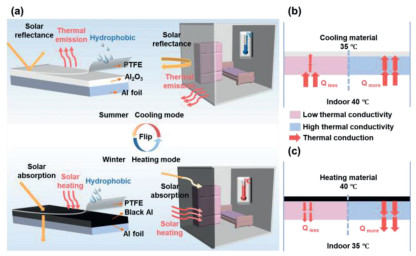
As shown in Fig. 1a, a dual-mode self-cleaning thermal regulator is used for indoor temperature regulation. Al2O3/PTFE with high reflectivity and excellent emissivity was used for summer cooling and black Al/PTFE with outstanding light absorption properties for winter indoor heating. Both functional layers were coated with hydrophobic PTFE to ensure self-cleaning capabilities. Cooling and heating modes can be easily switched for seasonal indoor temperature needs. The thermal conductivity of the regulator plays an important role in ensuring efficient heat transfer between the target space and the functional layer. For example, on a hot summer day, heat will be continuously generated inside the building due to the operation of equipment, human activities, and other processes. The functional layer temperature of the regulator is lower than the indoor temperature (Fig. 1b). Only when the regulator has high thermal conductivity can the thermal energy be efficiently transferred from the indoor space to the low-temperature Al2O3/PTFE layer. Similarly, high thermal conductivity is equally indispensable during the heating process. The functional layer temperature is higher than the indoor temperature in heating mode (Fig. 1c). The thermal energy will be efficiently transferred from the black Al/PTFE layer to the indoor space only when the regulator has high thermal conductivity.
Figure 1
Figure 1.
(a) Schematic of dual-mode self-cleaning thermal regulator. Al2O3 and black Al nanoparticles were architected on high-conductivity Al foil as the functional layers for passive radiative cooling and solar heating. The hydrophobic PTFE works as the self-cleaning layer. Cooling and heating modes can be easily switched via flipping for seasonal indoor temperature needs. Heat transfer process in (b) cooling and (c) heating modes between the target space and different functional layers. Only a thermal regulator with excellent thermal conductivity enables efficient cooling/heating.
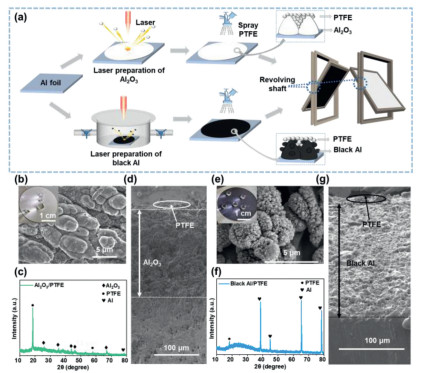
The fabrication process of the PRC layer and the SH layer with self-cleaning ability is schematically shown in Fig. 2a. During the LSDW process, Al2O3 was obtained in air, and black Al was obtained in an Ar atmosphere. Then, PTFE was sprayed on the Al2O3/black Al surface to achieve a hydrophobic surface. Specifically, during the preparation of Al2O3, excessive power combined with an extremely slow scanning speed caused excessive overheating, which led to the fracture of the Al sheet. On the other hand, low power and a slow scanning speed cannot provide the oxidation temperature required for preparing Al2O3, resulting in very low reflectivity (Fig. S1 in Supporting information). We finally chose a power of 50% P0 (P0 = 50 W) and a scanning rate of 20 mm/s to prepare Al2O3. Black Al was fabricated under a higher power of 60% P0 and a faster scanning speed of 800 mm/s. During this process, the Al sheet was rapidly heated to vaporization and the evaporated Al atoms were immediately cooled and metallically combined with the substrate to finally form a micro-nano structure. Al2O3/PTFE and black Al/PTFE were fabricated on both sides of the same Al sheet and can be switched by flipping the Al sheet.
Figure 2
Figure 2.
Surface morphology of the Al2O3/PTFE and black Al/PTFE. (a) Fabrication of the dual-mode self-cleaning thermal regulator of Al2O3/PTFE and black Al/PTFE. (b) Optical image and SEM image of Al2O3/PTFE. (c) XRD spectra of Al2O3/PTFE. (d) Cross-sectional SEM image of Al2O3/PTFE. (e) Optical image and SEM image of black Al/PTFE. (f) XRD spectra of black Al/PTFE. (g) Cross-sectional SEM image of black Al/PTFE.
The Al2O3 contained 55 wt% Al and 45 wt% O, and the surface distribution was uniform (Figs. S2a–c in Supporting information). The shape of the Al2O3 at micro-size was similar to grape bunches (Figs. S2d–f in Supporting information). Fig. 2b shows the optical image and surface views of white and hydrophobic Al2O3/PTFE coating on silver-white aluminum sheet. The surface became slightly smoother after spraying with PTFE. From the XRD spectra, it can be seen that the chemical composition of the cooling side was mainly composed of Al2O3 and PTFE (Fig. 2c). Fig. 2d shows the cross-section views of the Al2O3/PTFE-Al sheet. The thickness of Al2O3 was about 195 µm. The black Al shows an Al content as high as 92.7 wt% and an O content of only 7.3 wt% (Figs. S3a–c in Supporting information). Nanostructured Al particles were closely arranged into a coral-like hierarchical structure (Figs. S3d–f in Supporting information). This structure will cause the incident light to undergo multiple internal reflections in the depth direction, endowing the black Al with excellent light absorption ability [47]. Fig. 2e shows the optical image and surface views of black Al/PTFE coating on silver-white aluminum sheet. From the XRD spectra, the chemical compositions of the heating side were Al and PTFE (Fig. 2f). Fig. 2g shows the cross-section views of the black Al sheet. The thickness of black Al/PTFE was about 170 µm. It should be noted here that the Al sheet is less prone to cracking or delamination with localized rapid heating and cooling during the laser processing. Combined with the mask-free and high-efficiency laser surface direct writing technology, it is easy to achieve large-scale production of aluminum-based functional materials with practical application potential.
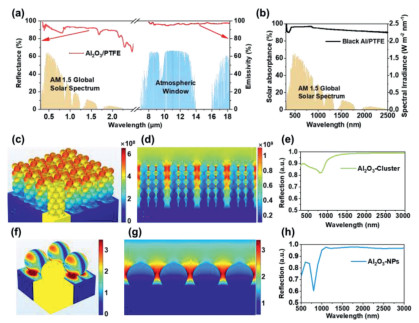
As shown in Fig. 3a and Fig. S4 (Supporting information), Al2O3/PTFE had excellent infrared emissivity (>96%) and a high solar reflectivity (~90%). Black Al/PTFE demonstrated good solar absorptivity under sunlight (~90%) (Fig. 3b). The high solar reflectivity of Al2O3-Al sheet here can be attributed to the large bandgap of Al2O3 and the strong Mie scattering effect because of the nano-micro Al2O3 particles. On the other hand, in the 8–13 µm atmospheric transparency window, the vibrational modes of Al-O bonds generate strong infrared absorption, contributing to the high emissivity [48-51]. Furthermore, to better understand the optical properties of Al2O3, we employed the finite element method in COMSOL Multiphysics to comprehensively explore the absorption mechanism. Considering that the size of the nanoparticles prepared on the Al sheet is non-uniform, a model was established with five nanospheres of 10 nm radius arranged around a central nanosphere of 7.5 nm radius. The spacing between each surrounding nanosphere and the central one is 0.36 nm, and the distance between adjacent surrounding nanospheres is 1 nm, as shown in the yellow structure of Fig. 3c. The local electric field on the nanoparticle surfaces was visualized by color gradients, in which the intensity corresponds to the field strength. Under resonant excitation by sunlight, the electric field distribution around the nanoclusters was accurately calculated. Fig. 3d illustrates intense interactions between photoelectrons. Similarly, a computational model of large-scale structures was further constructed, simulating a spheroidal array of spherical particles adhered to the Al substrate. The particles have a diameter of 500 nm, and the array features a structural period of 600 nm. The electric field distribution exhibits a strong field between the particles, implying that the inter-particle coupling model has a significant effect on spectral absorption (Figs. 3f and g). As shown in Figs. 3e and h, the Al2O3 clusters and large-scale Al2O3 microparticles exhibit large reflection coefficients in the visible and NIR regions, which agree well with the experimental results.
Figure 3
Figure 3.
Optical properties and the system modeling of the absorption mechanism. (a) Spectral reflectance and emissivity of Al2O3/PTFE. (b) Solar absorptance of black Al/PTFE. (c) Structure of Al2O3 nanocluster schematic (yellow structure) and electric field intensity of the nanoparticle surfaces (rainbow structures). (d) Electric field distribution and (e) simulated reflection of the nanoscale clusters. The simulated results for Al2O3 particles with a diameter of 500 nm and an array structural period of 600 nm. (f) Structure schematic (yellow structure) and electric field intensity of the microparticle surfaces (rainbow structures). (g) Electric field distribution and (h) reflection profiles of the large (microscale) particles.
Similarly, due to strong light-electron interactions, a strong electric field exists around black Al clusters and microparticles, generating a localized field enhancement effect. When light interacts with the micro-nano structure, localized electromagnetic field enhancement occurs at specific positions, thereby enhancing light-material interactions at the microscopic level and significantly improving the material’s light absorption efficiency. The absorption curve reveals that the clusters contribute to high absorption in the visible spectrum (500–1000 nm), with a 780 nm peak from resonant black Al surface plasmons, while the microparticles exhibit high near-infrared absorption (Fig. S5 in Supporting information). After spraying PTFE, Black Al/PTFE still exhibited a high solar absorptivity (Fig. S6 in Supporting information). Besides, even though black Al/PTFE exhibited thermal emission within the atmospheric window band (Fig. S7 in Supporting information), these factors would not undermine its SH performance, primarily due to its robust solar absorption capabilities.
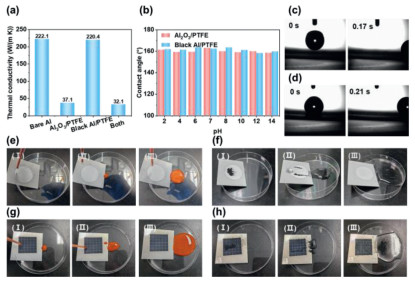
The heat exchange capability of the regulator plays an important role in the PRC and SH process. Thus, the thermal conductivity of the Al sheets after being coated with functional layers was tested (Fig. 4a). The thermal conductivities of the Al sheet and black Al/PTFE-Al sheet both exceeded 220 W m−1 K−1, demonstrating excellent thermal transport capabilities. It should be noted here that the holistic thermal conductivity of the aluminum sheet decreased to 37.1 W m−1 K−1 after being coated with Al2O3/PTFE functional layer, which could be mainly attributed to the intrinsic low thermal conductivity of Al2O3. When one side is black Al and the other side is Al2O3/PTFE functional layer, the holistic thermal conductivity is 32.1 W m−1 K−1. Although this value was relatively lower compared to the former two, it still far surpassed the thermal conductivity of air and can ensure the well performance in subsequent outdoor experiments. When exposed to the real environment, the material will be subject to adhesion and immersion in rainwater and morning dew. Therefore, the self-cleaning ability of the sample is especially crucial. As shown in Fig. 4b, we tested the contact angles of Al2O3/PTFE and black Al/PTFE, which are about 160° at different pH values. This superhydrophobic performance was attributed to the C-F bonds in the molecular structure of PTFE, which are stable and have extremely low surface energy [52]. Furthermore, the micro-nano structure on its surface also aided in the improvement of hydrophobic properties. When Al2O3/PTFE and black Al/PTFE are placed on the ground with an angle of about 5°, water droplets can quickly roll off their surface (Figs. 4c and d, Fig. S8 in Supporting information). We then used sludge and carbon powder to simulate real-life sewage and dust to demonstrate the self-cleaning ability. As shown in Figs. 4e and f, orange sludge can easily roll off the slant Al2O3/PTFE surface, and carbon powder can be easily washed with water. Black Al/PTFE also presents a similarly self-cleaning ability (Figs. 4g and h). When PTFE was not used, pure Al2O3 and black Al are hydrophilic and can be easily polluted (Figs. S9 and S10 in Supporting information). This self-cleaning thermal regulator will reduce maintenance costs and extend its service life.
Figure 4
Figure 4.
Thermal conductivity and self-cleaning performance of the regulator. (a) Thermal conductivities of untreated Al sheets, Al2O3/PTFE-Al sheets, black Al/PTFE-Al sheets, and Al2O3/PTFE-Al sheet-black Al/PTFE. (b) Contact angles of Al2O3/PTFE and black Al/PTFE at different pH values. (c, d) Dynamic change of water droplets on the surface of Al2O3/PTFE and black Al/PTFE. The inclined angle is approximately 5°. (e) The fluxion behaviors of orange sludge on Al2O3/PTFE surfaces. (f) The process of carbon powder washing with water at the surface of Al2O3/PTFE. (g) The fluxion behaviors of orange sludge on black Al/PTFE surfaces. (h) The process of carbon powder washing with water at the surface of black Al/PTFE.
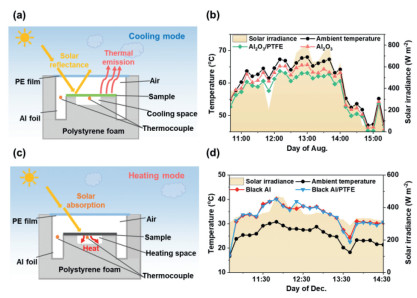
To demonstrate the cooling/heating performance of the dual-mode self-cleaning thermal regulator in a real environment, we conducted outdoor experiments using the home-made device (Fig. S11 in Supporting information). The test schematic diagrams of the cooling/heating performance outdoors are shown in Figs. 5a and c. The cooling side reflected the sunlight and radiated the thermal energy into outer space. The heating side absorbed the sunlight and transferred the heat to the space below the sample. Heat conduction between the inner wall of the box and the ground could be ignored because of the low thermal conductivity of the polystyrene foam. We carried out outdoor cooling experiments on a hot summer day. As shown in Fig. 5b, Al2O3/PTFE could achieve a cooling effect of 2–4 ℃ compared to the ambient temperature. Under the condition of 726 W/m2 solar radiation, a cooling effect of 4.4 ℃ could be achieved. An outdoor heating experiment on a winter day showed that compared with the ambient temperature, the heating effect of 11.3 ℃ was achieved under the solar radiation of 424 W/m2. It should be noted here that the heating effect of 11.1 ℃ could be achieved with pure black Al (Fig. 5d), indicating that the PTFE layer did not affect the heating effect of the regulator. Moreover, black Al/PTFE also had excellent heating performance in the summer (Fig. S12 in Supporting information).
Figure 5
Figure 5.
Passive radiative cooling and solar heating performance. (a) Schematic diagram of the device for passive radiative cooling. (b) Temperature evolution curves of the chamber interior space with Al2O3 and Al2O3/PTFE from 10:40 to 15:20 outdoors (August 03, 2024, at the campus of the University of Jinan). (c) Schematic diagram of the device for solar heating. (d) Temperature evolution curves of the chamber interior space with black Al and black Al/PTFE from 10:40 to 14:30 outdoors (December 20, 2024, at the campus of the University of Jinan).
In summary, we propose a dual-mode self-cleaning thermal regulator for PRC and SH by LSDW. The high thermal conductivity of the Al ensures efficient heat transfer between the functional layers and the target space. Its overall thermal conductivity is 32.1 W m−1 K−1. Al2O3/PTFE shows excellent infrared emissivity (>96%) and high solar reflectivity (~90%), achieving sub-ambient cooling of 4.4 ℃ in summer. Black Al/PTFE exhibited high absorptivity (~90%) in the solar spectrum range and achieved a temperature increase of 11.3 ℃ in winter. Meanwhile, the regulator has excellent acid-alkali resistance and self-cleaning capability, enhancing the durability. The regulator can be easily switched between cooling/heating modes by flipping, adapting to seasonal variations. The strategy of preparing dual-mode regulators through LSDW offers great potential for widespread infrastructure applications and commercial deployment.
The authors declare that they have no known competing financial interests or personal relationships that could have appeared to influence the work reported in this paper.
Acknowledgments
The authors acknowledge funding support from the Project of 20 Items of University of Jinan (No. 202228078), the Taishan Scholars Program of Shandong Province (Nos. tsqn201812085, tstp20240515), Innovative Research Team in Higher Educational Institutions of Shandong Province (No. 2023KJ107), and the National Natural Science Foundation of China (Nos. 52472097, 52302256).
Supplementary materials
Supplementary material associated with this article can be found, in the online version, at doi:10.1016/j.cclet.2025.111885.
Y. Tian, H. Shao, X. Liu, et al., ACS Appl. Mater. Interfaces 13 (2021) 22521–22530. doi: 10.1021/acsami.1c04046
Figure 1
(a) Schematic of dual-mode self-cleaning thermal regulator. Al2O3 and black Al nanoparticles were architected on high-conductivity Al foil as the functional layers for passive radiative cooling and solar heating. The hydrophobic PTFE works as the self-cleaning layer. Cooling and heating modes can be easily switched via flipping for seasonal indoor temperature needs. Heat transfer process in (b) cooling and (c) heating modes between the target space and different functional layers. Only a thermal regulator with excellent thermal conductivity enables efficient cooling/heating.
Figure 2
Surface morphology of the Al2O3/PTFE and black Al/PTFE. (a) Fabrication of the dual-mode self-cleaning thermal regulator of Al2O3/PTFE and black Al/PTFE. (b) Optical image and SEM image of Al2O3/PTFE. (c) XRD spectra of Al2O3/PTFE. (d) Cross-sectional SEM image of Al2O3/PTFE. (e) Optical image and SEM image of black Al/PTFE. (f) XRD spectra of black Al/PTFE. (g) Cross-sectional SEM image of black Al/PTFE.
Figure 3
Optical properties and the system modeling of the absorption mechanism. (a) Spectral reflectance and emissivity of Al2O3/PTFE. (b) Solar absorptance of black Al/PTFE. (c) Structure of Al2O3 nanocluster schematic (yellow structure) and electric field intensity of the nanoparticle surfaces (rainbow structures). (d) Electric field distribution and (e) simulated reflection of the nanoscale clusters. The simulated results for Al2O3 particles with a diameter of 500 nm and an array structural period of 600 nm. (f) Structure schematic (yellow structure) and electric field intensity of the microparticle surfaces (rainbow structures). (g) Electric field distribution and (h) reflection profiles of the large (microscale) particles.
Figure 4
Thermal conductivity and self-cleaning performance of the regulator. (a) Thermal conductivities of untreated Al sheets, Al2O3/PTFE-Al sheets, black Al/PTFE-Al sheets, and Al2O3/PTFE-Al sheet-black Al/PTFE. (b) Contact angles of Al2O3/PTFE and black Al/PTFE at different pH values. (c, d) Dynamic change of water droplets on the surface of Al2O3/PTFE and black Al/PTFE. The inclined angle is approximately 5°. (e) The fluxion behaviors of orange sludge on Al2O3/PTFE surfaces. (f) The process of carbon powder washing with water at the surface of Al2O3/PTFE. (g) The fluxion behaviors of orange sludge on black Al/PTFE surfaces. (h) The process of carbon powder washing with water at the surface of black Al/PTFE.
Figure 5
Passive radiative cooling and solar heating performance. (a) Schematic diagram of the device for passive radiative cooling. (b) Temperature evolution curves of the chamber interior space with Al2O3 and Al2O3/PTFE from 10:40 to 15:20 outdoors (August 03, 2024, at the campus of the University of Jinan). (c) Schematic diagram of the device for solar heating. (d) Temperature evolution curves of the chamber interior space with black Al and black Al/PTFE from 10:40 to 14:30 outdoors (December 20, 2024, at the campus of the University of Jinan).


 DownLoad:

 下载:


 下载:

