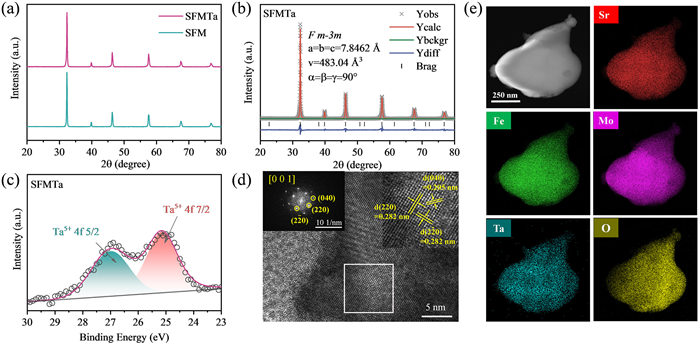
Figure 1.
(a) XRD patterns of SFM and SFMTa samples. (b) Rietveld refinement plot of SFMTa sample. (c) XPS spectra of Ta 4f. (d) HR-TEM images of SFMTa along with corresponding FFT images. (e) EDX results of SFMTa sample.

Enhancing proton mobility through radius-matched Ta5+ doping in Sr2Fe1.5Mo0.5O6-δ triple-conducting oxide for high-efficiency protonic ceramic electrolysis cells
Zhen Liu , Qi Zhang , Yongqi Zhang , Rongzheng Ren , Chunming Xu , Zhenhua Wang , Jinshuo Qiao , Wang Sun , Kening Sun


Protonic ceramic electrochemical cells (PCECs), utilizing proton-conducting electrolyte like BaZr0.1Ce0.7Y0.1Yb0.1O3-δ (BZCYYb), efficiently produce hydrogen via water electrolysis at intermediate temperatures (350-700 ℃) [1]. The generated proton transport to the fuel electrode produces hydrogen gas, effectively separating dry hydrogen from water vapor and oxygen, reducing purification costs [2,3]. However, slow air electrode kinetics and degradation under high steam concentrations hinder their large-scale deployment [4]. Perovskite-based mixed ionic and electronic conducting (MIEC) materials like La0.6Sr0.4Co0.2Fe0.8O3-δ and Ba0.5Sr0.5Co0.8Fe0.2O3-δ have been explored as air electrodes for their high conductivity and catalytic activity [5,6]. While these materials show poor hydration and limited proton transport with the oxygen evolution reaction (OER) activity confined to the triple-phase boundaries. Additionally, high steam concentrations cause significant degradation, reducing the material’s performance and stability [7,8].
Recently, triple-conducting oxides (TCOs) that concurrently transport electrons (e-), oxide ions (O2-), and protons (H+) have gained wide attentions [9]. The water electrolysis at TCOs involves adsorption of steam on the surface, oxygen formation and desorption, and proton transport to the electrolyte [10]. Among these, oxygen vacancies serves as adsorption sites for water, facilitating the proton defects (
|
|
(1) |
The species
Recently, the double perovskite material Sr2Fe1.5Mo0.5O6-δ (SFM) has shown promise as an air electrode matrix due to its high OER activity and stability in water electrolysis [16]. However, the OER performance of pure SFM perovskite remains inadequate. Conventional strategies to enhance its properties involve introducing lower-valent cations (e.g., Zr4+, Y3+) into the B-site of SFM perovskite to increase oxygen vacancies and proton defects, facilitating the proton uptake and mobility [17,18]. Nevertheless, a challenge arises due to the large ionic radius mismatch between these dopants (e.g., Zr4+ = 0.72 Å, Y3+ = 0.90 Å) and the host Mo5+/6+ cations (0.61 Å/0.59 Å). This mismatch induces local lattice distortion, primarily manifesting as tilting and deformation of BO6 octahedra of SFM pervoskite. Such octahedral distortion disrupts the crystal symmetry, affecting the pathways for proton hopping and increasing the energy barrier for proton movement. While this distortion might modestly enhance OER activity to some extent, prolonged operation may induce further structural changes that compromise the material’s long-term stability [19]. Therefore, selecting dopant cations with closely matched ionic radii is critical to minimize lattice strain and ensure both high performance and long-term structural stability.
Herein, tantalum (Ta5+) is introduced into SFM material to form a triple-conducting air electrode material Sr2Fe1.5Mo0.4Ta0.1O6-δ (SFMTa) for PCECs. The heterovalent substitution of Mo5+/6+ by Ta5+ creates more oxygen vacancies and the compatible ionic radius of Ta5+ (0.64 Å) and Mo5+/6+ (0.61 Å/0.59 Å) minimize lattice distortion, facilitating the hydration process and improving proton mobility. Thanks to these advantages, the single cell with SFMTa air electrode exhibits excellent electrolysis performance, achieving a higher current density of 2.17 A/cm2 at 1.3 V and 700 ℃, and maintaining stable operation for 120 h without significant degradation. This study presents a novel design strategy for developing PCEC air electrode, providing a practical approach for their application.
X-ray diffraction (XRD) patterns of the calcined SFM and SFMTa powders (Fig. 1a) reveal cubic phase structures without impurity phases, indicating successful Ta5+ doping in SFM. XRD Rietveld refinement further verifies that both samples crystallize in the double-perovskite structure with the Fm-3m space group. Notably, XRD refinement reveals a slight increase in the unit cell volume, from 482.49 Å3 for pristine SFM (Fig. S1 in Supporting information) to 483.04 Å3 for SFMTa (Fig. 1b). This minor lattice expansion is attributed to the partial substitution of Mo5+/6+ with the larger Ta5+ ion, and the formation of extra oxygen vacancies [20]. The unit cell volume change is approximately 0.11%, compared to 4.69% of Sr2Fe1.5Mo0.4Y0.1O6-δ (SFMY) [17] and 1.78% of Sr2Fe1.5Mo0.4Zr0.1O6-δ (SFMZ) [18], indicating the favorable ionic radius compatibility between Ta5+ and the Mo-site cations. The X-ray photoelectron spectroscopy (XPS) spectra of Ta 4f further validate the successful incorporation of Ta5+ (4f7/2, 25.14 eV) into the SFM structure (Fig. 1c) [21]. Scanning electron microscopy (SEM) images show smooth surfaces and uniform particle sizes of both samples, with an average particle diameter of approximately 900 nm for both materials (Fig. S2 in Supporting information). The High-resolution transmission electron microscopy (HR-TEM) diaplays the crystal structure of SFMTa (Fig. 1d). The two orthogonal facets are assigned to the (220) and (2
The oxygen vacancy concentration and proton defects (
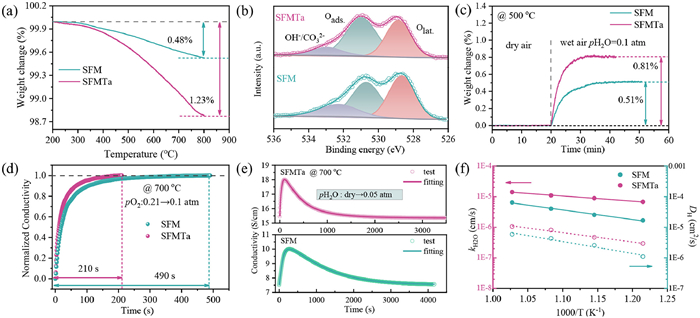
The generation and migration abilities of charge carriers (O2- and H+) are crucial for optimal OER performance in air electrode materials. The electrical conductivity relaxation (ECR) measurements show that SFMTa has a shorter conductivity relaxation time (210 s) than SFM (490 s) at 700 ℃ when the oxygen partial pressure switches from 0.21 atm to 0.1 atm (Fig. 2d). The calculated oxygen bulk-diffusion coefficient (DO,chem) are 2.43 × 10⁻⁵ cm2/s for SFM and 3.40 × 10⁻⁵ cm2/s for SFMTa, suggesting superior oxygen ion migration capability of SFMTa material (Fig. S5 in Supporting information). The ECR measurements after a sudden change in steam partial pressure reveal a nonmonotonic conductivity response as pH2O increases from 0 to 0.05 atm, initially rising sharply, then decreasing and stabilizing (Fig. 2e). This phenomenon is attributed to the mobility of holes (h·), oxygen vacancies (
The electrochemical impedance spectroscopy (EIS) spectra from symmetrical cells of SFM and SFMTa electrodes are tested in air atmosphere. The plots are fitted using an equivalent circuit model, L-R-QRh-QRi-QRl. The polarization resistance (Rp) is composed by Rh, Ri, and Rl, representing the resistances associated with the primary processes, including gas adsorption/diffusion and charge transfer during the OER. Fig. 3a shows that Rp of the SFMTa cell is 0.129 Ω cm2 at 700 ℃, lower than SFM electrode (0.166 Ω cm2). EIS plots of SFM and SFMTa cells from 550 ℃ to 700 ℃ are displayed in Fig. S6 (Supporting information). The reduced Rp of SFMTa indicates enhanced OER electrochemical activity. Arrhenius analysis reveals that SFMTa has a lower OER activation energy (0.948 eV) than SFM (0.993 eV), confirming the beneficial effect of Ta doping on the activity enhancement (Fig. 3b). Distribution of relaxation times (DRT) analysis of the EIS spectrum at 700 ℃ (Fig. 3c) reveals distinct peaks in three frequency ranges: Low frequency (LF, 10-2-1 Hz), intermediate frequency (IF, 1-104 Hz), and high frequency (HF, 104-105 Hz), corresponding to gas diffusion, surface exchange/ion transfer, and charge transfer, respectively [30]. Ta5+ doping significantly reduces resistances in the IF and HF regions, thus enhancing the surface gas adsorption and ion transfer process. Furthermore, the effect of different pO2 on the SFMTa electrode is analyzed using EIS and DRT curves (Fig. S7 in Supporting information). The Rp value decreases from 0.129 Ω cm2 to 0.070 Ω cm2 as the pO2 rises from 20% to 100%. Three peaks corresponding to distinct processes are observed, following the relationship of Rp = k(pO2)-n (Fig. S8 in Supporting information). The relatively high values of n in the LF (n = 0.43) and IF (n = 0.47) regions reflect the sensitivity to the changes in pO2, indicating that O2 content influences the gas diffusion process and surface reaction kinetics [31].
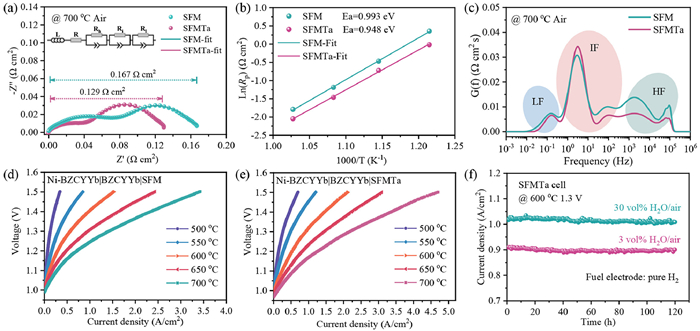
The electrochemical performance for OER is assessed using single cells with SFM and SFMTa air electrodes with pure hydrogen in the fuel electrode and a 3 vol% H2O/air mixture in the air electrode, tested at 500-700 ℃. The cross-sectional image of the tested cell shows a sandwich structure consisting of a porous SFMTa electrode (~22 μm), a dense BZCYYb electrolyte (~15 μm), and a NiO-BZCYYb support layer (Fig. S9 in Supporting information). After sintering, the cell structure remains intact with strong interfacial bonding, facilitating the water electrolysis reaction. Compared to the SFM electrode, Ta5+ doping notably enhances the current density. For instance, SFMTa based single cell exhibits the corresponding current densities of 2.17, 1.43, 0.92, 0.48 and 0.26 A/cm2 at 700, 650, 600, 550 and 500 ℃ (Fig. 3e), respectively, which are higher than SFM cell (Fig. 3d). Furthermore, the SFMTa cell exhibits relatively higher current density than that of other recently reported air electrodes (Fig. S10 and Table S3 in Supporting information). Additionally, the durability of the SFMTa single cell is evaluated under a voltage of 1.3 V at 600 ℃ (Fig. 3f). The cell exhibits no significant performance degradation over approximately 120 h under 3 vol% H2O/air, indicating the stability during steam electrolysis conditions. To evaluate its practical applicability, XRD analysis is conducted to assess the structural change after exposure to 30 vol% H2O/air at 600 ℃ for 10 h. The material maintains a stable perovskite crystal structure (Fig. S11 in Supporting information). Moreover, the single cell is subjected to a stability test under 30 vol% H2O/air atmosphere. The results indicate an improvement in current density as steam concentration increased, while electrolysis stability is still maintained throughout the 120 h test. The durability test confirms that radius-matched Ta5+ doping maintains perovskite structural stability under harsh steam electrolysis conditions and enhances the OER activity of the air electrode.
In summary, a TCO air electrode of SFMTa has been successfully constructed and evaluated in PCECs. XRD Rietveld refinement confirms close ionic radius matching between Ta5+ dopants and host Mo-sites, ensuring the structural stability and reducing the distortion of the BO6 octahedron in SFMTa. TGA, EPR and O2-TPD results indicate that Ta5+ doping increases the oxygen vacancy concentration, providing multiple active sites for the proton defects formation. TGR and ECR results reveals the enhanced hydration capability and proton mobility of SFMTa. When tested in air with 3 vol% H2O at 700 ℃, the SFMTa electrode-based single cell achieves a high current density of 2.17 A/cm2 at 1.3 V. Besides, the cell operates stably for 120 h without noticeable degradation. This approach offers a practical solution using ionic radius matching strategy developing efficient and long-lasting air electrodes for PCECs.
Zhen Liu: Writing – original draft, Methodology, Data curation, Conceptualization. Qi Zhang: Software, Methodology, Data curation. Yongqi Zhang: Methodology, Data curation. Rongzheng Ren: Writing – review & editing, Formal analysis, Conceptualization. Chunming Xu: Supervision, Resources, Methodology. Zhenhua Wang: Writing – review & editing, Methodology, Funding acquisition, Conceptualization. Jinshuo Qiao: Validation, Supervision, Project administration. Wang Sun: Validation, Methodology, Conceptualization. Kening Sun: Validation, Software, Methodology.
The authors declare that they have no known competing financial interests that could have appeared to influence the work reported in this paper.
This work was financially supported by the National Key R&D Program of China (No. 2022YFB4002501).
Supplementary material associated with this article can be found, in the online version, at doi:
X. Chen, N. Yu, Y. Song, et al., Adv. Mater. 36 (2024) e2403998. doi: 10.1002/adma.202403998
Z. Wang, Y. Wang, J. Wang, et al., Nat. Catal. 5 (2022) 777–787. doi: 10.1038/s41929-022-00829-9
A.K. Azad, A.M. Abdalla, A. Afif, et al., Sci. Rep. 11 (2021) 19382. doi: 10.1038/s41598-021-98987-6
L. Lei, Z. Tao, X. Wang, et al., J. Mater. Chem. A 5 (2017) 22945–22951. doi: 10.1039/C7TA05841A
A. Grimaud, F. Mauvy, J.M. Bassat, et al., J. Electrochem. Soc. 159 (2012) B683. doi: 10.1149/2.101205jes
S. Li, K. Xie, J. Electrochem. Soc. 160 (2013) F224. doi: 10.1149/2.027303jes
A. Egger, M. Perz, E. Bucher, et al., Fuel Cells 19 (2019) 458–471. doi: 10.1002/fuce.201900006
M. Choi, S.J. Kim, W. Lee, Ceram. Int. 47 (2021) 7790–7797. doi: 10.1016/j.ceramint.2020.11.124
J. Sun, R. Ren, H. Yue, et al., Chin. Chem. Lett. 34 (2023) 107776. doi: 10.1016/j.cclet.2022.107776
F. He, D. Song, R. Peng, et al., J. Power Sources. 195 (2010) 3359–3364. doi: 10.1016/j.jpowsour.2009.12.079
X. Yang, L. Jia, B. Pan, et al., J. Phys. Chem. C 124 (2020) 8024–8033. doi: 10.1021/acs.jpcc.0c01284
Y. Zhang, Y. Wang, Z. Liu, et al., Adv. Funct. Mater. 35 (2025) 2422531. doi: 10.1002/adfm.202422531
Z. Du, W. Gong, K. Xu, et al., J. Mater. Chem. A 12 (2024) 28066–28073. doi: 10.1039/d4ta05666c
E. Vollestad, R. Strandbakke, M. Tarach, et al., Nat. Mater. 18 (2019) 752–759. doi: 10.1038/s41563-019-0388-2
J. Zhang, Z. Ma, Y. Ye, et al., Energy Fuels 39 (2025) 7502–7512. doi: 10.1021/acs.energyfuels.5c00458
L. Song, Y. Qiao, Y. Zhao, et al., Ceram. Int. 50 (2024) 24987–24994. doi: 10.1016/j.ceramint.2024.04.175
R. Ren, J. Sun, G. Wang, et al., Sep. Purif. Technol. 299 (2022) 121780. doi: 10.1016/j.seppur.2022.121780
R. Ren, Z. Wang, X. Meng, et al., ACS Appl. Energy Mater. 3 (2020) 4914–4922. doi: 10.1021/acsaem.0c00486
X. Liu, S. Wei, S. Cao, et al., Adv. Mater. 36 (2024) 2405970. doi: 10.1002/adma.202405970
Y. Li, X. Chen, Y. Yang, et al., ACS Sustain. Chem. Eng. 5 (2017) 11403–11412. doi: 10.1021/acssuschemeng.7b02511
M. Li, W. Zhou, V.K. Peterson, et al., J. Mater. Chem. A 3 (2015) 24064–24070. doi: 10.1039/C5TA07178J
T. Hu, F. He, M. Liu, et al., Prog. Mater. Sci. 133 (2023) 101050. doi: 10.1016/j.pmatsci.2022.101050
H. Ding, W. Wu, C. Jiang, et al., Nat. Commun. 11 (2020) 1907. doi: 10.1038/s41467-020-15677-z
Z. Liu, X. Yang, C. Xu, et al., Chem. Eng. J. 512 (2025) 162268. doi: 10.1016/j.cej.2025.162268
J. Zhu, G. Liu, Z. Liu, et al., Adv. Mater. 28 (2016) 3511–3515. doi: 10.1002/adma.201505959
M. Jo, H. Bae, K. Park, et al., Chem. Eng. J. 451 (2023) 138954. doi: 10.1016/j.cej.2022.138954
Y. Huang, F. He, K. Xu, et al., Adv. Funct. Mater. 34 (2024) 2409598. doi: 10.1002/adfm.202409598
J. Gao, X. Song, F. Zhou, et al., J. Power Sources 218 (2012) 383–392. doi: 10.1016/j.jpowsour.2012.05.070
Y. Lu, M. Qin, S. Zhang, et al., Chin. Chem. Lett. 36 (2025) 110567. doi: 10.1016/j.cclet.2024.110567
K. Xu, H. Zhang, Y. Xu, et al., Adv. Funct. Mater. 32 (2022) 2110998. doi: 10.1002/adfm.202110998
Y. Xu, K. Xu, F. Zhu, et al., ACS Energy Lett. 8 (2023) 4145–4155. doi: 10.1021/acsenergylett.3c01722

Figure 1 (a) XRD patterns of SFM and SFMTa samples. (b) Rietveld refinement plot of SFMTa sample. (c) XPS spectra of Ta 4f. (d) HR-TEM images of SFMTa along with corresponding FFT images. (e) EDX results of SFMTa sample.

Figure 2 SFM and SFMTa samples: (a) TGA curves at 200-800 ℃ in an argon atmosphere. (b) O 1s XPS spectra. (c) Thermogravimetric relaxation curves. (d) ECR responses curves from pO2 = 0.21 to 0.1 atm in dry air at 700 ℃. (e) ECR response curves when switching the atmospheres from dry to pH2O = 0.05 atm at 700 ℃. (f) The fitted kH,chem and DH,chem value from 550-700 ℃.

Figure 3 (a) EIS spectra of BZCYYb electrolyte-supported symmetrical cells in dry air at 700 ℃. (b) Arrhenius plots for Rp from symmetrical cells in dry air at 700 ℃. (c) DRT analysis of SFM and SFMTa symmetrical cells at 700 ℃. I-V curves of (d) SFM and (e) SFMTa cell from 500 ℃ to 700 ℃ in 3 vol% H2O/air. (f) Stability test of SFMTa cell at 1.3 V and 600 ℃ with 3 vol% H2O/air and 30 vol% H2O/air.

 扫一扫看文章


扫一扫关注我们
 DownLoad:
 下载:
 下载: