Henan Key Laboratory of Polyoxometalate Chemistry, College of Chemistry and Molecular Sciences, Henan University, Kaifeng 475004, China
b.
School of Chemistry and Materials Science, Jiangxi Key Laboratory for Mass Spectrometry and Instrumentation, East China University of Technology, Nanchang 330013, China
erick@ecut.edu.cn (G. Yang). 1 These authors contributed equally to this work.
Received Date:
11 June 2025 Accepted Date:
23 September 2025 Revised Date:
17 September 2025 Available Online:
15 December 2026
Abstract:
The synthesis of zirconium-based polyoxometalates (POMs) has always been an attractive yet challenging research objective, especially for POMs with high nuclear zirconium cluster. Herein, by introduction of pyrazine-2,3-dicarboxylic acid into the reaction system of K12[H2P2W12O48]·24H2O and ZrOCl2·8H2O, a novel threaded phosphotungstate wheel anchored by a heptanuclear zirconium cluster [N(CH3)4]18K2[(Zr7(OH)4(PO4)2(Pzdc)4(H2O)16)(P6W39O147(H2O)3)]·43H2O (H2Pzdc = pyrazine-2,3-dicarboxylic acid) (Zr7) has been successfully synthesized via one-pot method and characterized by PXRD pattern, IR spectra and TGA. The analysis of X-ray crystallography reveals that compound Zr7 crystallizes in the orthorhombic space group Pnma. Notably, compound Zr7 is currently the largest odd-nuclearity pure zirconium cluster based on POMs. Furthermore, compound Zr7 exhibits remarkable catalytic activity as a Lewis acid-base catalyst for the cyclization reaction of benzenediamines and 1,3-diketones, affording the valuable 3H-benzo[b][1,4]diazepines up to 99% yield.
Polyoxometalates (POMs) are a crucial class of anionic metal-oxygen clusters composed of pre-transition metals (M = VⅤ, NbⅤ, TaⅤ, MoⅥ, WⅥ) with diverse elemental compositions, nuclearities, and physicochemical properties. POMs exhibit a high negative charge, remarkable thermal stability, excellent redox properties, structural diversity, and tunable functionality. Due to these unique characteristics, POMs have been widely explored for applications in catalysis [1-16], proton conduction [17-19], and functional materials [20-23]. Lacunary POMs, formed through controlled removal of metal-oxo units from plenary POMs, typically demonstrate high catalytic activity, along with enhanced oxidation resistance and thermal stability. Lanthanide (Ln) cations or transition metal (TM) can readily incorporate into the defect sites of lacunary POMs to form metal-substituted POMs (MSPs) [24-27]. To date, MSPs have emerged as a significant research branch due to their diverse structures and unique properties, have attracted increasing interest and are currently one of the most active groups, of which most of the TMs are Mn, Fe, Co, Ni, Cu, Zn and so on [28,29]. However, research progress on zirconium-substituted POMs (ZrSPs) has been comparatively slow, possibly due to two reasons: (1) The propensity of zirconium ions to undergo hydrolysis in aqueous solutions, and (2) the tendency of terminal hydroxyl groups to participate in dehydration reactions, mainly leading to the formation of dispersed oligomeric species. It is worth noting that ZrSPs have excellent performance in catalysis [30]. Consequently, the ongoing development of novel high-nuclearity ZrSP materials holds significant reference value for future research.
Currently, research on ZrSPs remains limited, with the majority of studies focusing on even-nuclearity zirconium cluster architectures, including dinuclear, tetranuclear, hexanuclear, and octanuclear systems [31-37]. Until 2014, Yang et al. successfully synthesized a high-nuclearity ZrSPs, Na10K22[Zr24O22(OH)10 (H2O)2(W2O10H)2(GeW9O34)4(GeW8O31)2]·85H2O, under hydrothermal conditions [38]. This structure exhibits the highest nuclearity among reported Zr4+-incorporated POMs to date, containing an unprecedented number of zirconium ions within its porous framework. In contrast, studies on odd-nuclearity zirconium clusters in ZrSPs remain scarce. In 2006, Nomiya and coworkers achieved the first synthesis of a mono-zirconium-substituted Wells-Dawson-type phosphotungstate, [Zr(α2-P2W17O61)2]16−, via a conventional aqueous solution method [39]. Subsequently, Hill's team reported two analogous mono-ZrSPs ([{P2W15O54(H2O)2}2Zr]12− and [{P2W15O54(H2O)2}Zr{P2W17O61}]14−) [40]. Limited examples contain trinuclear Zr clusters, including Chiral Zr3-substituted Dawson-type POMs {[α-P2W15O55(H2O)]Zr3(μ3-O)(H2O)(L-tartH)[α-P2W16O59]}15−, {[α-P2W15O55(H2O)]Zr3(μ3-O)(H2O)(D-tartH)[α-P2W16O59]}15− [41], sandwich-type POM [Zr3O(OH)2(SiW9O34)2]12− [42], [Zr3Na3O3(H2O)3](A-α-GeW9O34)2]11− [43], and mixed-type trivacant POM ligand-stabilized Zr3 clusters [Zr3(μ2-OH)2(μ2-O)(A-α-GeW9O34)(1,4,9-α-P2W15O56)]14− [44]. In 2019, Yang and colleagues successfully synthesized a Zr5 cluster-based POMs, [{Zr5(μ3-OH)4(OH)2}@{Zr2(OAc)2(α-GeW10O38)2}2]22−, under ambient conditions [45]. In 2022, they also reported a hepta-zirconium-doped POMs, [SbZr7O6(OH)4(B-α-GeW9O34)2(B-α-GeW11O39)2]21−, under hydrothermal conditions [46].
In recent years, our group has focused on developing synthetic methods for zirconium cluster-based POMs. In 2024, we accomplished the first successful synthesis of a trinuclear Zr-cluster-incorporated POMs, [{Zr(C2O4)2}3(PO4)(P6W39O150)]39−, via confined-space assembly within a tungsten-oxide wheel framework [47]. To expand the family of POMs featuring higher odd-nuclearity zirconium clusters, we adopted a dual-ligand templating approach that synergistically combines organic carboxylates with inorganic phosphate ([PO4]3−) within the confined geometry of a lacunary tungsten-oxide wheel. Fortunately, we obtained a novel {Zr7} cluster-threaded wheel-like polyoxotungstate [N(CH3)4]18K2[(Zr7(OH)4(PO4)2(Pzdc)4(H2O)16)(P6W39O147(H2O)3)]·43H2O (H2Pzdc = pyrazine-2,3-dicarboxylic acid) (Zr7) utilizing K12[H2P2W12O48]·24H2O as precursor via aqueous solution [48]. Notably, compound Zr7 is currently the largest odd-nuclearity pure zirconium cluster based on POMs.
Single-crystal X-ray diffraction analysis confirms that compound Zr7 is crystallized in the orthorhombic space group Pnma (Table S1 in Supporting information). The simulated PXRD pattern obtained from single-crystal data shows excellent agreement with the experimental pattern, confirming the high phase purity of the sample (Fig. S1 in Supporting information). Bond valence sum (BVS) calculations confirm that the oxidation states of W, P, and Zr are +6, +5, and +4, respectively (Table S2 in Supporting information).
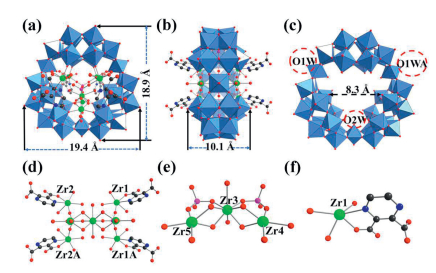
The molecular unit of Zr7 comprises a wheel-like polyanion [(Zr7(OH)4(PO4)2(Pzdc)4(H2O)16)(P6W39O147(H2O)3)]20− (Zr7a), 18[N(CH3)4]+, 2K+ and 43 lattice water molecules. Remarkably, polyanion Zr7a exhibits a wheel-like architecture (Fig. 1a and Fig. S3 in Supporting information). The wheel-like polyanion exhibits external and inner diameters of approximately 19.4 and 8.3 Å, respectively, with corresponding height and thickness dimensions of 18.9 and 10.1 Å (Figs. 1a–c). The basic structure of Zr7a consists of a coronal cluster [P6W39O147(H2O)3]30− {P6W39} unit (Fig. 1c) and a butterfly-shaped [Zr7(OH)4(PO4)2(Pzdc)4(H2O)16]10+ {Zr7} cluster (Fig. 1d). Notably, the {P6W39} unit in Zr7a exhibits significant structural differences compared to the previously reported analogue by the Wang’s team [49]. Previous studies revealed distinct orientations of the aqua ligands on the three {WO(H2O)} linkers within the {P6W39} shell layer. Specifically, two aqua ligands were oriented inward (O1W, O2W), while one pointed outward (O3W). In contrast, in the {P6W39} shell layer of Zr7a, two aqua ligands were stuck out of the shell (O1W, O1WA, symmetric code A = x, 1.5-y, z), while one pointed into the shell (O2W). The butterfly-shaped {Zr7} cluster consists of a central {Zr3(OH)4(H2O)4} {Zr3} unit (Fig. 1e) bridged by two [PO4]3- groups and four {Zr(Pzdc)(H2O)3} moieties (Fig. 1f), wherein both P atoms are symmetry-related and aligned with the principal axis of the wheel-shaped polyanion Zr7a. It is worth noting that the three Zr4+ ions in the {Zr3} cluster adopt a non-planar arrangement, with an interatomic angle of 119.38° In the {Zr3} cluster, three Zr ions form a triangle, with interatomic distances of 3.524(1), 3.524(1), and 6.085(1) Å (Fig. S4 in Supporting information). The Zr−O bond distances in the structure range from 1.620(1) Å to 2.690(1) Å. Interestingly, the four Pzdc2− ligands specifically bind to Zr4+ ions as bidentate ligands, forming a rectangle. Upon further analysis, the four Zr atoms (Zr1, Zr1A, Zr2, and Zr2A) are located on the same plane (Plane 1), and the distances between the four Zr4+ ions are 5.806(1), 7.994(2), 5.811(1), and 7.994(2) Å, respectively (Fig. S5 in Supporting information).
Figure 1
Figure 1.
(a) Top view of the polyhedral/ball-and-stick representation of Zr7a. (b) Side view of the polyhedral/ball-and-stick representation of Zr7a. (c) Polyhedral representation of the wheel-like polyanion {P6W39}. (d) Ball-and-stick representation of {Zr7} cluster. (e) Ball-and-stick representation of {Zr3} segment. (f) Zr1 and the H2Pzdc ligand coordination mode.
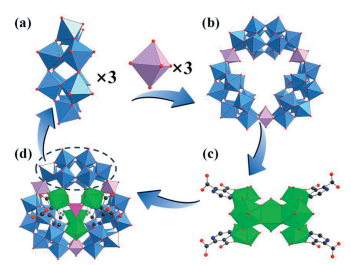
Alternatively, the structure of Zr7a can be described as a closed-ring cluster [P6W39O147(H2O)3]30− composed of three hexavacant Dawson-type [P2W12O48]14− {P2W12} segments and three {WO(H2O)} segments (Figs. 2a and b), which encapsulates a butterfly-shaped cluster {Zr7(OH)4(PO4)2(Pzdc)4(H2O)16} (Figs. 2c and d). It is worth noting that in this crown-shaped {P6W39}, the adjacent {P2W12} subunits form an angle of approximately 60°. Moreover, the angle between the {P2W12} and {WO(H2O)} linkers is 120° (Fig. S6 in Supporting information). The three {P2W12} units are interconnected by three {WO(H2O)} hinge groups, avoiding the potential tension between the {P2W12} subunits. The {Zr7} cluster exhibits distinct coordination environments across its seven crystallographically independent Zr4+ ions. The Zr1 and Zr2 atoms in the {Zr7} cluster both adopt eight-coordinate triangular dodecahedral geometries. The Zr3 atom exhibits an eight-coordinate geometry described as a biaugmented trigonal prism configuration, with oxygen donors derived from three distinct sources: Two hydroxyl groups, two terminal aqua ligands (O3W), and two phosphate oxygen atoms from [PO4]3- groups. Both Zr4 and Zr5 atoms exhibit seven-coordinate pentagonal bipyramidal geometries, with oxygen donors originating from four distinct sources: Two hydroxyl groups, two oxo donors from the {P2W12} fragment, two terminal aqua ligands (Zr4: O4W/O90; Zr5: O7W/O87), and one phosphate oxygen from a [PO4]3- group (Fig. S7 in Supporting information).
Figure 2
Figure 2.
Polyhedral representation of (a) {P2W12} and {WO(H2O)} building unit and (b) the wheel-like {P6W39} unit. Polyhedral/ball-and-stick representation of (c) {Zr7} cluster and (d) polyanion Zr7a.
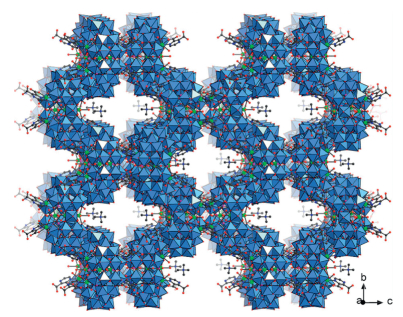
As shown in Fig. 3, these wheel-shaped polyanion Zr7a are stacked together, forming a cross-shaped channel structure along the a axis. Within the channels, discrete [N(CH3)4]+ cations stabilize the structural framework through both electrostatic interactions and hydrogen bonding. Furthermore, the ordered packing arrangement of polyanion Zr7a along the b axis and c axis is shown in Figs. S8 and S9 (Supporting information).
Figure 3
Figure 3.
Packing representation of polyanions Zr7a viewed along the a axis.
It is worth noting that ZrSPs show remarkable Lewis acid activity due to the Lewis acid nature of the zirconium ion and the nucleophilic surfaces with large negative charges of the polyanion. Based on our expertise in POM-catalyzed heterocycle synthesis [50-54], we propose that compound Zr7 holds great potential in catalyzing the construction of benzodiazepines. Benzodiazepines are a significant class of heterocyclic compounds with diverse biological properties, including anti-inflammatory, antitumor, sedative, and antifungal effects [55-57]. The Lewis acid-catalyzed condensation of benzenediamine with 1,3-diketones represents the most straightforward and efficient synthetic route to benzodiazepines [58-61]. Although numerous catalytic systems based on this strategy have been developed, critical challenges such as environmental pollution from metal catalysts and organic solvents, as well as harsh reaction conditions, remain unresolved. Therefore, we attempted to utilize compound Zr7 as an efficient and environmentally friendly catalyst to catalyze the condensation of benzenediamine with 1,3-diketones for the synthesis of benzodiazepines.
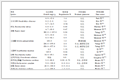
The catalytic performance of compound Zr7 was initially evaluated through the model condensation reaction between o-phenylenediamine (1a) and acetylacetone (2a) under solvent-free conditions (Table 1). In the presence of 0.1 mol% Zr7, the reaction proceeded at room temperature for 10 min, affording product 3a in 61% yield (entry 1). In contrast, only a 22% yield of 3a was obtained without a catalyst (entry 2), clearly demonstrating the essential catalytic role of compound Zr7 in this transformation. Systematic optimization studies were then performed to improve the reaction yield. The temperature had a notable impact on the reaction efficiency; increasing the temperature led to a higher yield of 3a, with the optimal yield of 80% achieved at 60℃ (entries 3–6). Subsequently, extending the reaction time to 1 h further enhanced the yield to a maximum of 97% (entries 7–10). Finally, screening of the catalyst loading revealed that neither increasing nor decreasing the amount of compound Zr7 resulted in higher yield (entries 11 and 12). Therefore, the optimal catalytic conditions were established as: 0.1 mol% compound Zr7 as the catalyst, solvent-free, 60℃ for 1 h, resulting in a yield of 97% for 3a.
a Reaction conditions: o-phenylenediamine ( 1a, 1 mmol), acetyl acetone ( 2a, 1 mmol), solvent-free, Zr7 (0.1 mol%) for 10 min. b GC determined the yields with biphenyl as the internal standard.
To investigate the versatility of the catalytic system, we examined its performance with diverse benzenediamines and 1,3-diketones under optimized conditions (Table 2). Benzenediamines bearing electron-donating groups (-Me and -OMe) were successfully transformed into the corresponding benzodiazepines with the yields of 95%, 93%, and 92%, respectively (3b-3d). The system also demonstrated good tolerance toward electron-withdrawing groups (-F, -Cl, and -Br), affording the desired products in excellent yields (3e-3g). Notably, the electron-withdrawing substituents slightly enhanced reaction efficiency, likely due to their favorable electronic effects on the condensation process. Furthermore, the catalytic system proved compatible with disubstituted benzenediamines. Both 5,6-dimethyl and 5,6-dichloro substituted benzenediamines were efficiently converted to the corresponding products 3h and 3i with 95% and 99% yields, respectively. We subsequently expanded the substrate scope to various 1,3-diketone derivatives. The reactions between benzenediamine and various substituted 1,3-diketones proceeded smoothly, delivering the desired products (3j, 3k, 3l) in excellent yields. These results demonstrate the broad applicability and excellent functional group tolerance of this catalytic system for benzodiazepine synthesis.
Table 2
Table 2.
Substrate scope of compound Zr7 catalyzed for the synthesis of benzodiazepines.a
a Reaction conditions: diamine (1 mmol), 1,3-diketone (1 mmol), compound Zr7 (0.1 mol%), 60℃, 1 h. b Isolated yields.
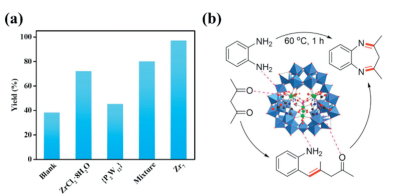
Finally, we performed some control experiments to elucidate the structure-activity relationship and investigate the reaction mechanism. As shown in Fig. 4a, both ZrOCl2·8H2O and K12[H2P2W12O48]·24H2O ({P2W12}) promoted the reaction, but ZrOCl2·8H2O exhibited a significantly higher yield than {P2W12}. These results indicate that Zr4+ plays a dominant role in the catalytic process, and the oxygen-rich surface of {P2W12} may activate diamines to promote the reaction. Based on the above results, a plausible catalytic mechanism was also proposed in Fig. 4b. The Zr atom with Lewis acid activity for activation of 1,3-diketones, and the peripheral oxygen atoms of W-O-W species act as Lewis base for activation of diamines. The whole reaction undergoes successive Lewis acid-base catalyzed dehydration condensation reaction to afford the final product.
Figure 4
Figure 4.
(a) Control experiments. (b) Possible catalytic mechanism.
In conclusion, a wheel-shaped polyoxotungstate framework incorporating a threaded {Zr7} cluster was successfully isolated. Remarkably, this novel butterfly motif {Zr7} cluster is unprecedented in POM chemistry and coordination chemistry, differing from other Zr-based clusters. Moreover, compound Zr7 demonstrates remarkable Lewis acid-base catalytic activity in the condensation of benzenediamines with 1,3-diketones. This environmentally friendly approach allows for the efficient synthesis of valuable benzodiazepines in excellent yields under solvent-free and mild reaction conditions.
The authors declare that they have no known competing financial interests or personal relationships that could have appeared to influence the work reported in this paper.
Acknowledgments
This work was financially supported by the National Natural Science Foundation of China (Nos. 22071043, 22371040) and Jiangxi Provincial Natural Science Foundation (No. 20232ACB213005).
Supplementary materials
Supplementary material associated with this article can be found, in the online version, at doi:10.1016/j.cclet.2025.111882.
[1]
Y. Dong, Y. Feng, Z. Li, et al., ACS Catal. 13 (2023) 14346–14355. doi: 10.1021/acscatal.3c03977
B.E. Evans, K.E. Rittle, M.G. Bock, et al., J. Med. Chem. 31 (1988) 2235–2246. doi: 10.1021/jm00120a002
[58]
X.Q. Pan, J.P. Zou, Z.H. Huang, et al., Tetrahedron Lett. 49 (2008) 5302–5308. doi: 10.1016/j.tetlet.2008.06.082
[59]
R. Kumar, P. Chaudhary, S. Nimesh, et al., Green Chem. 8 (2006) 519–521. doi: 10.1039/b601993e
[60]
G.P. Yang, S.X. Shang, B. Yu, et al., Inorg. Chem. Front. 5 (2018) 2472–2477. doi: 10.1039/c8qi00678d
[61]
X. Zhou, M.Y. Zhang, S.T. Gao, et al., Chin. Chem. Lett. 20 (2009) 905–908. doi: 10.1016/j.cclet.2009.03.033
Figure 1
(a) Top view of the polyhedral/ball-and-stick representation of Zr7a. (b) Side view of the polyhedral/ball-and-stick representation of Zr7a. (c) Polyhedral representation of the wheel-like polyanion {P6W39}. (d) Ball-and-stick representation of {Zr7} cluster. (e) Ball-and-stick representation of {Zr3} segment. (f) Zr1 and the H2Pzdc ligand coordination mode.
Figure 2
Polyhedral representation of (a) {P2W12} and {WO(H2O)} building unit and (b) the wheel-like {P6W39} unit. Polyhedral/ball-and-stick representation of (c) {Zr7} cluster and (d) polyanion Zr7a.
a Reaction conditions: o-phenylenediamine ( 1a, 1 mmol), acetyl acetone ( 2a, 1 mmol), solvent-free, Zr7 (0.1 mol%) for 10 min. b GC determined the yields with biphenyl as the internal standard.


 DownLoad:



 下载:


 下载:

