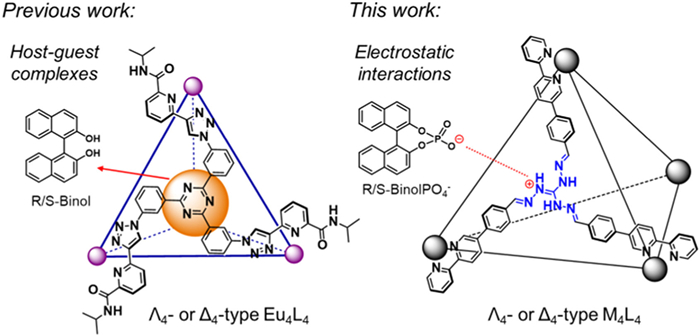
Scheme 1.
Using neutral molecules/anions to induce chirality in different types of tetrahedral cages.

Electrostatic-driven formation of homochiral tetrahedral MⅡ4L4 cages by using chiral anionic inducers
Ya-Liang Lai , Juan Su , Xian-Chao Zhou , Yong-Liang Huang , Xue-Zhi Wang , Shuixing Zhang , Xiao-Ping Zhou


Chirality exists widely in living systems for many essential biological processes. Exploring the factors that can affect chiral assembly and interaction in artificial systems is therefore of interest in both understanding the chirality origin and may lead to the discovery of bioinspired applications [1-3]. Metal-organic cages (MOCs) are structurally well-defined supramolecular assemblies, constructed through coordination-driven self-assembly of organic ligands and metal ions or clusters [4-7]. Owing to their precisely tailored nanocavities and modular architectures, MOCs have emerged as versatile platforms for separation [8,9], catalysis [10,11], stabilization of reactive species [12], sensing [13,14], and drug delivery [15,16]. The introduction of chirality into MOCs constitutes a pivotal strategy, not only for advancing our understanding of chiral phenomena in biological systems but also for expanding the functional utility of these supramolecular constructs [17]. Presently, CMOCs, featuring well-defined asymmetric cavities, are extensively employed in enantioselective separation [18], chiral recognition [19], asymmetric catalysis [20,21], and circularly polarized luminescence [22-25].
The construction of CMOCs is predominantly achieved through the integration of intrinsically chiral ligands. Furthermore, the three-pronged coordination of metal ions in MOCs can induce Δ or Λ stereochemical configurations arising from the spatial orientation of coordinating ligands, thereby governing the overall chirality of the assembly [26,27]. However, when employing achiral ligands, MOC formation invariably yields racemic mixtures. To address this inherent limitation, an alternative approach involves induction in racemic MOCs via the encapsulation of chiral guest species [28-33]. For instance, Nitschke et al. [34] demonstrated efficient chiral induction by incorporating the chiral guest cryptophane-11 into the cavity of a racemic Fe4L4 cage, resulting in the formation of enantiopure CRY@Fe4L4 complexes. Similarly, the Sun group achieved chiral MOCs synthesis by encapsulating chiral guests R/S-Binol within lanthanide tetrahedral cages, which exhibited pronounced circularly polarized luminescence (Scheme 1) [22]. While these strategies have proven effective, they fundamentally rely on the formation of stable host-guest supramolecular complexes through weak non-covalent interactions to enable chiral transfer. This requirement presents a substantial challenge in the rational design of mutually complementary host-guest systems with optimal steric and weak force matching. Despite the ubiquitous presence of counter anions in most MOCs, the utilization of chiral anions as structural inducers for constructing CMOCs remains relatively unexplored.
In this study, we report the synthesis of two racemic tetrahedra cages with the general formula MⅡ4L4 (1-Fe and 1-Zn) via coordination-driven self-assembly of a guanidine-based tripyridyl donor L·Cl with Fe2+/Zn2+ ions (Scheme 1). The presence of multiple guanidinium moieties within these MOCs facilitates robust electrostatic interactions with anions, providing both positive charge localization and hydrogen-bond donor sites. To achieve chiral induction, enantiomerically enantiopure R/S-1,1′-binaphthyl-2,2′-diyl hydrogenphosphate etramethylammonium (R/S-BinolPO4Me4N) was employed as a chiral anionic inducer in the cage solution. This chiral inducer subsequently mediates stereoselective assembly, enabling resolution of enantiomerically excess products through peripheral guest binding. Systematic NMR spectroscopy and circular dichroism studies confirmed that this was the chiral induction of the cationic cages by the chiral counter anions outside the cavities. In contrast, the chiral induction was unsuccessful when using either neutral inducers or ligands lacking cationic character (2-Zn), further underscoring the critical role of electrostatic interactions between the host framework and chiral anions in facilitating efficient chiral transfer (Scheme 1).
The ligand L·Cl was synthesized by the Suzuki cross-coupling reaction with 5‑bromo‑2,2-bipyridine and 4-formylphenylboronic acid (Figs. S1-S7 in Supporting information). As shown in Fig. 1, 1-Fe and 1-Zn with the general formula MⅡ4L4 were obtained by heating Fe(OTf)2/Zn(OTf)2, L·Cl in DMSO at 60℃ for 12 h, respectively. The crystals were obtained by slow diffusion of ethyl acetate into DMSO solutions of 1-Fe and 1-Zn (see Supporting information for details). The products were characterized by NMR, electrospray ionization time-of-flight mass spectrometry (ESI-TOF-MS), and single-crystal X-ray diffraction (SCXRD).
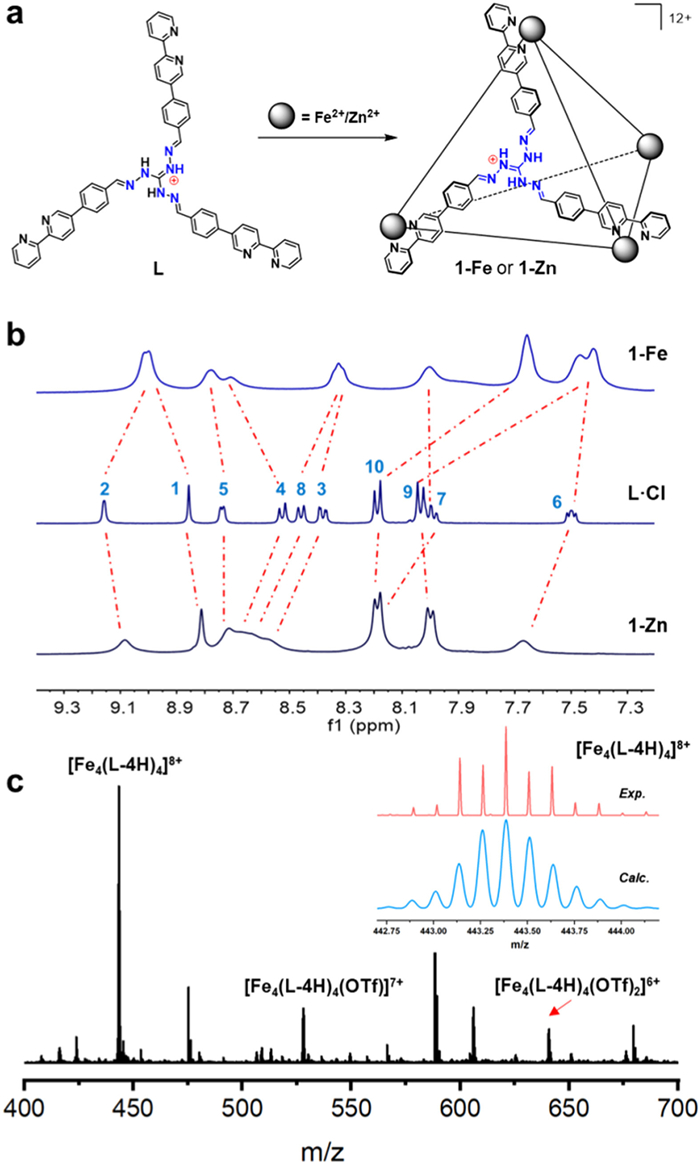
Compared to the ligands L·Cl, the proton signals in 1H NMR spectra of 1-Fe and 1-Zn appeared to be significantly shifted downfield or upfield (Fig. 1 and Figs. S8-S13 in Supporting information). Meanwhile, the proton signals after coordination of the ligand to the metal center are broadened, and some signals were indistinguishable, which was more common in MOCs and may be due to the slow tumbling motion of the cage on the NMR time scale [35,36]. Nevertheless, for 1-Fe and 1-Zn, the 1H NMR spectrum showed only one set of ligand resonances in DMSO‑d6, indicative of the formation of a well-dissociated and highly symmetric assembly. The diffusion-ordered spectroscopy (DOSY) spectra of 1-Fe and 1-Zn confirmed that all peaks between 7.2 ppm and 9.3 ppm had the same diffusion coefficient (Figs. S10 and S13). The hydrodynamic diameter calculated from the Stokes-Einstein equation [37] is 30 Å for both 1-Fe and 1-Zn, which are both larger than that of the individual ligands (Fig. S6). The 19F NMR spectra of 1-Fe and 1-Zn show only one signal, indicating that the cavity is not encapsulated with OTf− anions (Fig. S14 in Supporting information).
To unequivocally determine the stoichiometry of the self-assembled products, we conducted ESI-TOF-MS analysis of 1-Fe and 1-Zn (Fig. 1c and Figs. S15-S18 in Supporting information). The MS spectrum of 1-Fe exhibited prominent peaks at m/z = 443.3850 and 528.0049, corresponding to [Fe4(L-4H)4]8+ and [Fe4(L-4H)4(OTf)]7+, respectively. Notably, we also observed characteristic peaks corresponding to protonated species, including a well-resolved signal at m/z = 549.4277, 665.8242 attributable to the [Fe4(L-3H)4(OTf)2]7+ and [Fe4(L-3H)4(OTf)2]6+ fragments (Fig. S16). In addition, there were sets of peaks with charge states from 8+ to 4+ for 1-Zn at m/z = 448.1250, 533.4226, 485.6219, 554.8501, 672.1526, 1195.4307, corresponding to [Zn4(L-4H)4]8+; [Zn4(L-4H)4(OTf)]7+; [Zn4(L-2H)4(OTf)2]8+; [Zn4(L-3H)4(OTf)2]7+; [Zn4(L-3H)4(OTf)3]6+; [Zn4(L)4(OTf)8]4+, respectively, which were in good agreement with their calculated values (Figs. S17 and S18). These results provide definitive evidence for the [4 + 4] stoichiometry of the metal-ligand assembly, with all detected signals showing excellent agreement between experimental and simulated isotopic distributions.
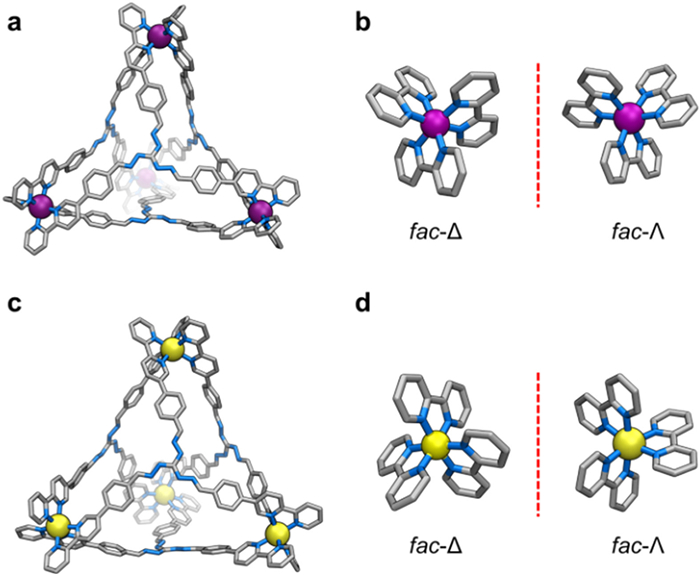
Single-crystal X-ray diffraction analysis unambiguously confirmed the structural composition of the assemblies (Table S1 in Supporting information). Crystallographic determination revealed that 1-Fe crystallizes in the orthorhombic Pnnn space group, while 1-Zn adopts the triclinic P-1 space group. Both structures display M4L4-type tetrahedral architectures with metal centers exhibiting exclusively homochiral configurations (ΔΔΔΔ or ΛΛΛΛ) within each cage. These enantiomeric forms were present in equal proportions in the crystalline state, resulting in racemic mixtures with overall T-symmetric character (Fig. 2, Figs. S19 and S20 in Supporting information). Structural analysis indicated remarkably similar dimensions for both cages, with calculated cavity volumes of 1113 Å3 (1-Fe) and 1120 Å3 (1-Zn) as determined by VOIDOO analysis [38]. The metal-metal separation distances were measured at 20.6–22.1 Å for Fe2+ centers and 21.4–21.9 Å for Zn2+ centers, reflecting the nearly identical spatial arrangements of the two isostructural assemblies. All anions are located on the outside of the cavity, which is consistent with the 19F NMR analysis of 1-Fe and 1-Zn.
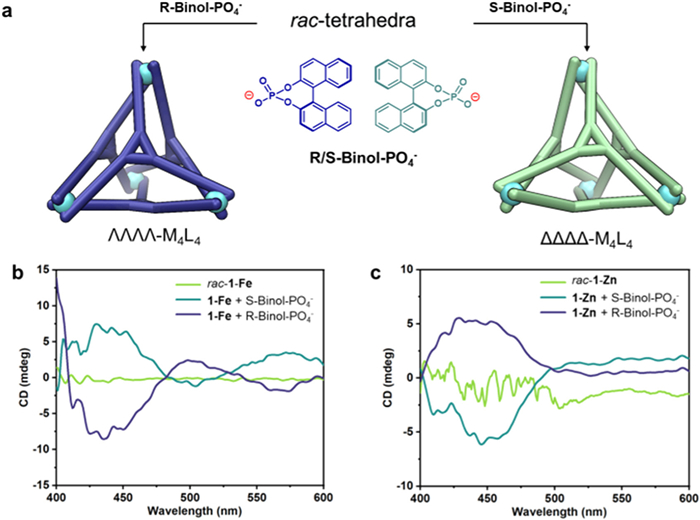
In order to obtain homochiral cages, we employed chiral anion additives to induce the formation of enantiopure products [28,39]. Chiral BinolPO4Me4N was chosen as the chiral anions inducer based on the following points: (1) X-ray diffraction analysis confirmed that 1-Fe and 1-Zn are racemates in the absence of any chiral factors; (2) The protonated guanidinium moieties in these MOCs facilitate direct electrostatic interactions with anionic species and hydrogen-bond donor sites; (3) The pKa value of BINOL derived phosphoric acids (3.56) is significantly higher than that of trifluoromethanesulfonic (0.3) in DMSO, which may lead to a hydrogen bond donor or highly charged cation cage that is more inclined to interact with R/S-BinolPO4− [40,41]. First, quaternary ammonium salts containing chiral R/S-BinolPO4− anions were obtained via alkalinization (Figs. S21 and S22 in Supporting information). Comparative analysis via circular dichroism (CD) spectroscopy revealed that in the absence of R/S-BinolPO4−, the CD spectra of 1-Fe, and 1-Zn did not show a significant Cotton effect (Fig. 3). However, when excess R/S-BinolPO4− (100 equiv., based on cages) was added directly to DMSO solutions of 1-Fe, and 1-Zn (5 × 10⁻⁵ mol/L), respectively, the solutions of the tetrahedral cages show strong CD signals at the wavelength range 400–600 nm (Fig. 3). Notably, the CD spectra of 1-Fe with R-BinolPO4− feature negative first Cotton effect, while those of 1-Fe with S-BinolPO4− show mirror images with positive first Cotton effect, which indicates the formation of a single chiral ΛΛΛΛ−1-Fe or ΔΔΔΔ−1-Fe (Fig. 3b) [42,43]. As expected, both enantiomers ΛΛΛΛ−1-Zn and ΔΔΔΔ−1-Zn were successfully obtained with the addition of R and S-BinolPO4Me4N into the racemic solutions, respectively (Fig. 3c). It can be noted that 1-Zn with the same stereoconfiguration exhibits the opposite Cotton effect to 1-Fe, which is consistent with the reported works [44]. UV absorption spectra showed that these chiral signals were all located within the absorption wavelength range of these structures (Figs. S23 and S24 in Supporting information), further demonstrating the success of chiral induction. Upon removal of the chiral inducer by ethyl acetate extraction, the enantiomerically excess 1-Zn and 1-Fe revert to a racemic state, demonstrating no observable chiral memory effect (Figs. S25 and S26 in Supporting information).
To systematically investigate this induction mechanism, we performed controlled experiments. Firstly, a racemic tetrahedral cage 2-Zn with a similar structure was synthesized based on literature reports (Scheme 1, see Supporting information for details) [45], which differs from 1-Fe and 1-Zn in that the ligand is neutral; the structure was verified by 1H NMR spectrum (Fig. S27 in Supporting information). The cavity volume of cage 2-Zn was 528 Å3 (calculated by VOIDOO [38], Fig. S28 in Supporting information), which is sufficient to accommodate the R/S-BinolPO4− anion (∼329 Å3, calculated by Materials Studio 2018), providing the spatial prerequisite for host-guest complex formation. It was shown that the addition of R/S-BinolPO4− to 2-Zn does not produce a significant chiral signal except for the inducer (Fig. S29 in Supporting information). Secondly, CD spectrum revealed that the addition of excess R-BinolPO4− anions to solutions of free L·Cl ligand in DMSO‑d6 failed to induce any detectable chiral signals (Fig. S30 in Supporting information). Finally, the neutral chiral molecule R/S-Binol (R/S-[1,1′-binaphthyl]−2,2′-diol) was introduced as an inducer into DMSO solutions of 1-Fe and 1-Zn, resulting in featureless CD spectra (Figs. S31-S33 in Supporting information). The above results suggest that the electrostatic interactions between the positive charges on the tetrahedral faces and the chiral anions may be the key factors for the transfer of chirality.
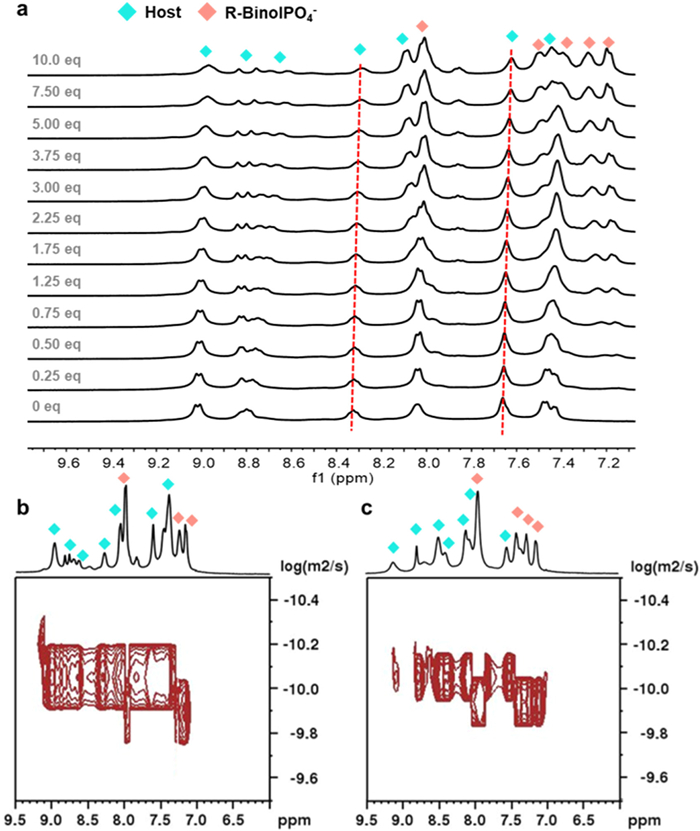
Furthermore, we employed UV–vis and NMR techniques to try to analyse the interaction between 1-Fe/1-Zn and R/S-BinolPO4− (Figs. S34-S48 in Supporting information). As an example, the interaction between 1-Fe and R-BinolPO4− was investigated through comprehensive titration experiments in DMSO‑d6. Upon gradual addition of R-BinolPO4− (0–10.0 equiv.) to 1-Fe (5 × 10⁻⁵ mol/L), its proton resonance gradually shifted upfield, suggesting the presence of an interaction between them. However, no segregation signal was detected, suggesting that the complex between the cage and the inducer exhibited fast dynamics on the NMR time scale and did not form a stable host-guest complex (Fig. 4a, Figs. S34 and S35). This was further supported by DOSY spectra showing inconsistent diffusion coefficients of the inducer and the host (Figs. 4b, and c). In addition, 31P NMR spectrum showed no new signals generated after R-BinolPO4− added, suggesting that 1-Fe and 1-Zn do not encapsulate the inducer and that the chiral induction process may occur outside the cavity (Fig. S36). Job plot studies based on the UV–vis spectra found that complexes of 1-Fe and 1-Zn with R/S-BinolPO4− in DMSO were all 1:1 receptor−substrate binding models (Figs. S37-S44) [46,47]. Calculation of the apparent binding constants using integrals yields a binding constant of (15.42 ± 0.63) L/mol for R-BinolPO4−, while 1-Zn has a binding constant of (5.66 ± 0.07) L/mol for R-BinolPO4− (Figs. S45 and S46). These very small binding constants may be the main reason why large amounts of inducers need to be added to achieve chiral transfer. More importantly, the strong nuclear Overhauser effect (NOE) cross-peaks were observed between the resonance signals of the outside R-BinolPO4− and that of the active proton in the ligand (Figs. S47 and S48). This evidence points to the presence of close through-space contacts between cages and chiral anionic molecules, which further confirms the mechanism of chiral induction.
In summary, the rational design and synthesis of two cationic tetrahedral MⅡ4L4 cages is reported, achieved via coordination-driven assembly of guanidinium-based ligands with Fe2+/Zn2+ ions. The effective mediation of stereochemical transfer to these architectures by chiral R/S-BinolPO4− anions acting as anionic inducers is established. Enantioselective resolution of the racemic cages into enantiomerically excess products was enabled through electrostatic interaction between the anions and cages, which was confirmed by comprehensive characterization by CD, UV–vis spectroscopy, and NMR spectroscopy. The host-guest encapsulation mechanism was excluded. Our work provides an advanced example for precise stereochemical control in supramolecular assemblies using anionic inducers. The new strategies are expected to be applied in designing functional materials based on chiral metal-organic cages. Studies on the chiral sensing and asymmetric catalytic functions of these electrostatically induced enantiopure cages are currently being conducted.
Ya-Liang Lai: Writing – review & editing, Writing – original draft, Visualization, Software, Resources, Methodology, Investigation, Funding acquisition, Formal analysis, Data curation. Juan Su: Writing – original draft, Data curation. Xian-Chao Zhou: Software, Data curation. Yong-Liang Huang: Data curation. Xue-Zhi Wang: Writing – review & editing, Writing – original draft, Data curation. Shuixing Zhang: Writing – review & editing, Resources, Funding acquisition. Xiao-Ping Zhou: Writing – review & editing, Writing – original draft, Visualization, Validation, Supervision, Software, Resources, Project administration, Methodology, Investigation, Funding acquisition, Formal analysis, Data curation, Conceptualization.
The authors declare that they have no known competing financial interests or personal relationships that could have appeared to influence the work reported in this paper.
This work was financially supported by the National Key Research and Development Program of China (No. 2023YFF1204600), National Natural Science Foundation of China (Nos. 22171106, 22301103, 82227802 and 22375075), Guangdong Natural Science Foundation (No. 2022A1515011937), Guangdong Basic and Applied Basic Research Foundation (No. 2022A1515110523), China Postdoctoral Science Foundation (No. 2025M770972) and Jinan University.
Supplementary material associated with this article can be found, in the online version, at doi:
J. Lv, X. Gao, B. Han, et al., Nat. Rev. Chem. 6 (2022) 125–145. doi: 10.1038/s41570-021-00350-w
Y. Sang, M. Liu, Chem. Sci. 13 (2022) 633–656. doi: 10.1039/d1sc03561d
M. Liu, L. Zhang, T. Wang, Chem. Rev. 115 (2015) 7304–7397. doi: 10.1021/cr500671p
R. Chakrabarty, P.S. Mukherjee, P.J. Stang, Chem. Rev. 111 (2011) 6810–6918. doi: 10.1021/cr200077m
T.R. Cook, P.J. Stang, Chem. Rev. 115 (2015) 7001–7045. doi: 10.1021/cr5005666
T. Tateishi, M. Yoshimura, S. Tokuda, et al., Coord. Chem. Rev. 467 (2022) 214612. doi: 10.1016/j.ccr.2022.214612
Y.L. Lai, M. Xie, X.C. Zhou, et al., Angew. Chem. Int. Ed. 63 (2024) e202402829. doi: 10.1002/anie.202402829
Y.L. Lai, J. Su, L.X. Wu, et al., Chin. Chem. Lett. 35 (2024) 108326. doi: 10.1016/j.cclet.2023.108326
D. Zhang, T.K. Ronson, Y.Q. Zou, et al., Nat. Rev. Chem. 5 (2021) 168–182. doi: 10.1038/s41570-020-00246-1
Z. Ashbridge, J.N.H. Reek, Nat. Syn. 3 (2024) 1197–1207. doi: 10.1038/s44160-024-00606-5
Y.L. Lu, Y.P. Wang, K. Wu, et al., Acc. Chem. Res. 57 (2024) 3277–3291. doi: 10.1021/acs.accounts.4c00467
S. Hasegawa, S.L. Meichsner, J.J. Holstein, et al., J. Am. Chem. Soc. 143 (2021) 9718–9723. doi: 10.1021/jacs.1c02860
Y.L. Lai, H.-J. Zhang, J. Su, et al., Chin. Chem. Lett. 34 (2023) 107686. doi: 10.1016/j.cclet.2022.07.029
D.J. Bell, L.S. Natrajan, I.A. Riddell, Coord. Chem. Rev. 472 (2022) 214786. doi: 10.1016/j.ccr.2022.214786
W. Zhu, J. Guo, Y. Ju, et al., Adv. Mater. 31 (2019) 1806774. doi: 10.1002/adma.201806774
N. Judge, L. Wang, Y.Y.L. Ho, et al., Macromol. Res. 26 (2018) 1074–1084. doi: 10.1007/s13233-018-6156-3
M. Pan, K. Wu, J.H. Zhang, et al., Coord. Chem. Rev. 378 (2019) 333–349. doi: 10.1016/j.ccr.2017.10.031
K. Wu, K. Li, Y.J. Hou, et al., Nat. Commun. 7 (2016) 10487. doi: 10.1038/ncomms10487
W. Li, L. Sun, C. Liu, et al., J. Mater. Chem. C 10 (2022) 9216–9221. doi: 10.1039/d2tc01655a
X. Li, J. Wu, C. He, et al., Small 15 (2019) 1804770. doi: 10.1002/smll.201804770
J. Ruan, Z. Li, C. Yin, et al., ACS Catal. 14 (2024) 7321–7331. doi: 10.1021/acscatal.4c01087
S.J. Hu, X.Q. Guo, L.P. Zhou, et al., J. Am. Chem. Soc. 144 (2022) 4244–4253. doi: 10.1021/jacs.2c00760
Y. Zhou, H. Li, T. Zhu, et al., J. Am. Chem. Soc. 141 (2019) 19634–19643. doi: 10.1021/jacs.9b07178
K. Wu, J. Tessarolo, A. Baksi, et al., Angew. Chem. Int. Ed. 61 (2022) e202205725. doi: 10.1002/anie.202205725
X. Meng, X.Y. Cai, Q.R. Ding, et al., Chin. Chem. Lett. 36 (2024) 110402. doi: 10.1016/j.cclet.2024.110402
J. Yang, X.Y. Chang, K.C. Sham, et al., Chem. Commun. 52 (2016) 5981–5984. doi: 10.1039/C6CC01635A
B. Sun, S.S. Nurttila, J.N.H. Reek, Chem. Eur. J. 24 (2018) 14693–14700. doi: 10.1002/chem.201801077
Y.Q. Li, L. Fu, Z.Y. Jiang, et al., Angew. Chem. Int. Ed. 64 (2025) e202503833. doi: 10.1002/anie.202503833
H. Zhu, L. Pesce, R. Chowdhury, et al., J. Am. Chem. Soc. 146 (2024) 2379–2386. doi: 10.1021/jacs.3c11321
R. Singha, P. Maity, D. Samanta, Chem. Eur. J. 30 (2024) e202401013. doi: 10.1002/chem.202401013
W. Xue, K. Wu, N. Ouyang, et al., Angew. Chem. Int. Ed. 62 (2023) e202301319. doi: 10.1002/anie.202301319
P. Howlader, S. Mondal, S. Ahmed, et al., J. Am. Chem. Soc. 142 (2020) 20968–20972. doi: 10.1021/jacs.0c11011
W. Xue, L. Pesce, A. Bellamkonda, et al., J. Am. Chem. Soc. 145 (2023) 5570–5577. doi: 10.1021/jacs.3c00294
D. Zhang, T.K. Ronson, J.L. Greenfield, et al., J. Am. Chem. Soc. 141 (2019) 8339–8345. doi: 10.1021/jacs.9b02866
Y.L. Lu, J.Q. Song, Y.H. Qin, et al., J. Am. Chem. Soc. 144 (2022) 8778–8788. doi: 10.1021/jacs.2c02692
Z. Zhang, Y. Yang, J. Wang, et al., Inorg. Chem. Front. 12 (2025) 5389–5396. doi: 10.1039/d5qi00756a
J.T. Edward, J. Chem. Educ. 47 (1970) 261. doi: 10.1021/ed047p261
G.J. Kleywegt, T.A. Jones, Acta Crystallogr. Sect. D 50 (1994) 178–185. doi: 10.1107/S0907444993011333
Q. Bai, Y.M. Guan, T. Wu, et al., Angew. Chem. Int. Ed. 62 (2023) e202309027. doi: 10.1002/anie.202309027
F.G. Bordwell, Acc. Chem. Res. 21 (1988) 456–463. doi: 10.1021/ar00156a004
P. Christ, A.G. Lindsay, S.S. Vormittag, et al., Chem. Eur. J. 17 (2011) 8524– 8528. doi: 10.1002/chem.201101157
Y.J. Hou, K. Wu, Z.W. Wei, et al., J. Am. Chem. Soc. 140 (2018) 18183–18191. doi: 10.1021/jacs.8b11152
N. Ousaka, Y. Takeyama, H. Iida, et al., Nat. Chem. 3 (2011) 856–861. doi: 10.1038/nchem.1146
Y.Q. Zou, D. Zhang, T.K. Ronson, et al., J. Am. Chem. Soc. 143 (2021) 9009– 9015. doi: 10.1021/jacs.1c05172
L. Yang, X. Jing, B. An, et al., Chem. Sci. 9 (2018) 1050–1057. doi: 10.1039/c7sc04070a
Y.L. Loukas, J. Pharm. Pharmacol. 49 (1997) 944–948. doi: 10.1111/j.2042-7158.1997.tb06021.x
L. Fielding, Tetrahedron 56 (2000) 6151–6170. doi: 10.1016/S0040-4020(00)00492-0

Scheme 1 Using neutral molecules/anions to induce chirality in different types of tetrahedral cages.

Figure 1 (a) Schematic diagram of the assembly of 1-Fe and 1-Zn. (b) Partial 1H NMR spectra (400 MHz) of ligand L·Cl and MOCs 1-Fe and 1-Zn. (c) High-resolution mass spectrum of 1-Fe. The inset shows the calculated (blue) and experimental (red) isotopic patterns of the +8 peak at m/z = 443.3755, corresponding to [Fe4(L-4H)4]8+.

Figure 2 X-ray crystal structures of (a) 1-Fe, (c) 1-Zn, and corresponding facial coordination in Δ/Λ absolute configuration of octahedral (b) Fe2+ and (d) Zn2+ centers. Color labels: Fe, purple; Zn, yellow; C, gray; N, blue. Anions and hydrogen atoms have been omitted for clarity.

Figure 3 (a) Schematic representation of the induction of chiral anions in the racemic tetrahedron M4L4. (b) CD spectra after addition of the chiral anion R/S-BinolPO4− to 1-Fe, and (c) 1-Zn (DMSO, 5 × 10⁻⁵ mol/L).

Figure 4 (a) Partial 1H NMR spectra after stepwise dropwise addition of R-BinolPO4− (0–10 equiv.) to a DMSO solution of 1-Fe (5 × 10⁻³ mol/L). (b) DOSY spectrum after addition of 4 equiv. of R-BinolPO4− to 1-Fe. (c) Partial DOSY spectra after addition of 4 equiv. of R-BinolPO4− to 1-Zn (DMSO, 5 × 10⁻³ mol/L). The DOSY spectra reflect the different diffusion coefficients of 1-Fe/1-Zn and R-BinolPO4−.

 扫一扫看文章


扫一扫关注我们
 DownLoad:
 下载:
 下载: