Citation:
Ruiyang Xiao, Zonghao Luo, Zongsu Wei, Daisuke Minakata, Richard Spinney, Stanisław Wacławek, Weizhi Zeng, Chongjian Tang. Beyond the bench: Evaluating the reliability of chemical scavengers in radical-based advanced oxidation processes[J]. Chinese Chemical Letters,
2026, 37(5): 111853.
doi:
10.1016/j.cclet.2025.111853
Beyond the bench: Evaluating the reliability of chemical scavengers in radical-based advanced oxidation processes
English
Beyond the bench: Evaluating the reliability of chemical scavengers in radical-based advanced oxidation processes
Institute of Environmental Engineering, School of Metallurgy and Environment, Central South University, Changsha 410083, China
b.
Chinese National Engineering Research Center for Control & Treatment of Heavy Metal Pollution, Changsha 410083, China
c.
Centre for Water Technology (WATEC) & Department of Biological and Chemical Engineering, Aarhus University, Ole Worms Alle 3, 8000 Aarhus C, Denmark
d.
Department of Civil, Environmental, and Geospatial Engineering, Michigan Technological University, 1400 Townsend Drive, Houghton, MI, 49931, United States
e.
Department of Chemistry and Biochemistry, The Ohio State University, Columbus, OH, 43210, United States
f.
Institute for Nanomaterials, Advanced Technologies and Innovation, Technical University of Liberec, Studentská 1402/2, Liberec 1 46117, Czech Republic
* Corresponding authors at: Institute of Environmental Engineering
Received Date:
09 March 2025 Accepted Date:
17 September 2025 Revised Date:
08 July 2025 Available Online:
15 May 2026
Abstract:
Chemical scavengers are frequently used to quantify the contribution of target radicals to contaminant removal in natural and engineered waters. While favored for their ease of use and versatility across systems, improper selection can lead to significant kinetic and mechanistic misinterpretations. This study presents a critical evaluation of chemical scavengers in radical-induced reactions across various environmental scenarios. Specifically, we demonstrate that in systems containing both target and coexisting radicals, commonly used scavengers can react with both species, complicating the measurement of reaction kinetics and leading to misinterpretation of target radical contributions. In addition, we discuss the challenges associated with applying scavengers in heterogeneous systems, where the distribution of scavengers and target compounds across interfaces significantly impacts the evaluation of radical contributions. Further, our insights from non-steady-state systems into radicals' dynamic behavior and transient phenomena are often overlooked in other steady-state conditions. We address interactions between scavengers and triplet excited-state compounds in photochemical systems, emphasizing the importance of selecting appropriate scavengers to ensure accurate kinetic profiling and radical quantification. These findings hold significant implications for advancing scavenger research across a broad range of chemical research and practical applications.
A radical is an atomic, molecular, or ionic species characterized by at least one unpaired valence electron [1], making it highly reactive in various waters [2,3]. In natural waters, radicals play a crucial role in accelerating metal cycling and transforming natural organic matter [4]. In engineered waters, radicals, such as hydroxyl (•OH) and sulfate (SO4•−) radicals, are used to degrade microbiological and organic contaminants [5–7]. Kinetic studies of these contaminants degradation are often carried out to quantify the contribution of specific radicals to the overall cycling and removal processes [8,9]. However, such quantification has proven challenging due to their intermediacy, high reactivity, and highly branched reaction patterns. Advanced analytical techniques, such as electron paramagnetic resonance (EPR) spectroscopy and time-resolved absorption and fluorescence spectroscopy, are employed for the detection and quantification of radical species [10–12].
As an alternative to these technically demanding, sophisticated instruments, chemical scavenging is used for quantification in both steady-state and non-steady-state systems due to its widespread availability, ease of use, and high efficiency. Chemical scavengers achieve this by reacting with either (ⅰ) the target radical (TR), where the contribution is inferred from the reduction in the degradation of target compounds (TCs) [13], or (ⅱ) the coexisting radical (CR), where the contribution is assessed by the extent to which the degradation of TCs remain unaffected after the addition of scavengers [14]. For example, in UV/persulfate (PS) systems, SO4•− is TR and •OH is CR. In UV/H2O2 systems, •OH is TR and O2•−/HO2• (pKa = 4.8) is CR. Scavengers are employed in a broad spectrum of radical research, including photocatalytic elimination, in situ chemical oxidation, and electrocatalytic processes [15–17], evidenced by the number of over 1000 annual publications since 1997, according to the Web of Science database.
There are established criteria for the selection of a radical scavenger, including selectivity and reactivity with TR, prevention of secondary radical formation, and stability. The use of an inappropriate scavenger could result in potential misinterpretation in reaction kinetic profiling. For example, selecting different scavengers with varying concentrations for a single TR can result in orders of magnitude differences when measuring the reaction rate constant (k, L mol−1 s−1) [18,19]. Further, chemical scavengers may not accurately reflect the role of TR in TC degradation during treatment processes, especially in heterogeneous systems where the added scavenger partitions and accumulates at interfaces. Last, in a photochemical system, quantifying the involvement of TR is a daunting task because the scavenger could react with the triplet excited states of TCs (3TC*) formed upon irradiation, thereby promoting its transformation [20].
This study aims to highlight potential issues and concerns in evaluating radical contributions to removing organic contaminants in natural and engineered waters. While being extensively employed, even experienced researchers often easily overlook these issues with chemical scavengers. Specifically, we discuss frequently encountered issues in radical scavenger studies with respect to: Reactions in homogeneous systems, reactions in heterogeneous systems, and interactions with 3TC*. Recognizing these allows for a more comprehensive assessment and their integration into various aspects of reactions.
In a multi-radical homogeneous system containing both TR and CR, the addition of a scavenger not only eliminates CR but also reacts with TR to some extent. For example, in •OH-based advanced oxidation processes (AOPs) where •OH (TR) and O2•−/HO2• (CR) coexist, p-benzoquinone (p-BQ) has been widely used to eliminate O2•− with a reported k value of 9.0 × 10⁸ L mol−1 s−1. However, •OH also reacts rapidly with p-BQ (1.2 × 10⁹ L mol−1 s−1) [21,22]. This competition interferes with the kinetic analysis related to the TC. In such a system, four possible reactions occur (Eqs. 1–4):
TR+TC→k1P
(1)
TR+scavenger→k2P
(2)
CR+TC→k3P
(3)
CR+scavenger→k4P
(4)
where P can be any product. The selection should be based on the difference in scavenging capacity, which is the product of k4 and the scavenger concentration [23,24]. Often, the majority of current studies select scavengers under the assumption that CR is completely quenched and TR is largely unaffected, with the rate constant k4 significantly greater than that k2. Below, we will provide the impact of scavengers' concentrations by examining both steady-state and non-steady-state systems and highlight how the concentration levels affect the contribution of TR to overall TC removal.
In a steady-state system, the degradation of TC with (w) and without (w/o) scavenger can be described by Eqs. 5 and 6, respectively:
−d[TC]dt=k1[TR]w,ss[TC]+k3[CR]w,ss[TC]
(5)
−d[TC]dt=k1[TR]w/o,ss[TC]+k3[CR]w/o,ss[TC]
(6)
where [TR]w, ss and [CR]w, ss are the steady-state concentration of TR and CR with scavenger, respectively; [TR]w/o, ss and [CR]w/o, ss are the steady-state concentration of TR and CR without scavenger, respectively. When the addition of excessive scavenger completely quenches CR, the degradation of TC (Eq. 5) can be simplified to:
−d[TC]dt=k1[TR]w,ss[TC]
(7)
Based on Eqs. 6 and 7, the contribution (%) of TR to the degradation of TC can be expressed as (Eq. 8):
However, if scavengers react with TR, it will result in a low [TR]w, ss compared to [TR]w/o, ss. Thus, the % contribution of TR to the degradation of TC is underestimated. In a Fe2+/PS system, the generated SO4•− reacts with OH− to form •OH. For eliminating •OH and quantifying the degradation efficiency of anisole by SO4•−, 1 mol/L tert–butyl alcohol (TBA) (6.0 × 10⁸ L mol−1 s−1) was added into the system [25]. However, despite the low reactivity of TBA with SO4•− (8.0 × 10⁵ L mol−1 s−1), TBA can also quench SO4•− with a scavenging capacity of 8.0 × 10⁵ s−1, potentially leading to an approximately 10% overestimation of •OH contribution [26,27]. demonstrated that although TBA concentration over 0.1 mol/L was sufficient to scavenge •OH and inhibit trichloroethene degradation in their PS-activated system, a higher TBA concentration (0.5 mol/L) further enhanced the inhibition, thus also resulting in an underestimation of SO4•− contribution.
In addition, although alcohols with fewer α-hydrogens, such as isopropyl alcohol (IPA) and TBA, exhibit higher reactivity toward both •OH and SO4•−, this higher reactivity does not always translate into superior scavenging performance. In photocatalytic processes, IPA can have a dual role: Inhibition of the process by quenching valence band hole (hVB+) and O2•− [28], or promotion of the process as an electron donor by providing electrons to the conduction band to reduce target compounds [29]. The dominant mechanisms of IPA can be determined by comparing the degradation rate of TCs with and without IPA. This duality suggests that the effectiveness of alcohols as scavengers is highly system-dependent. Conversely, alcohols with more α-hydrogens, such as ethanol (EtOH), can be a better alternative in some systems due to their different reactivity profiles. However, the choice of scavenger must still be approached with caution. For example, in the UV/H2O2 system, TBA has been shown to be a better •OH scavenger than EtOH or methanol (MeOH) because the regeneration capacity of H2O2via peroxyl radicals follows the order MeOH > EtOH > TBA. This finding implies that using MeOH or EtOH could lead to an underestimation of •OH concentration [14,30]. Note that MeOH and EtOH as •OH scavengers are not recommended because the resulting methoxy and ethoxy radicals are also highly reactive, introducing complexity and potential interference.
This is particularly true for UV/PS systems; the resulting radicals also interfere with the decomposition of the precursor PS. A recent study showed that the decomposition rate of PS dropped from 0.096 min−1 without any alcohols to 0.074, and 0.053 min–1 after adding 1 mmol/L MeOH and TBA, respectively, whereas it increased after adding IPA (0.100 min−1) and EtOH (0.103 min−1) [31,32]. The changes in the decomposition rate can be explained by unexpected reactions between PS and alcohols-induced secondary radicals, such as alcohol radicals and O2•−.
In a non-steady state system, the decay rates of CR and TR can be described (Eqs. 9 and 10):
−d[CR]dt=k3[CR][TC]+k4[CR][scavenger]
(9)
−d[TR]dt=k1[TR][TC]+k2[TR][scavenger]
(10)
For Eq. 9, to ensure adequate quenching of CR by the scavenger, the following criteria should be met (Eq. 11):
k4[CR][scavenger]>>k3[CR][TC]
(11)
Simplified to:
k4[scavenger]>>k3[TC]
(12)
Eq. 12 illustrates that the scavenging capacity should be significantly higher than k3[TC]. Similarly, for Eq. 10, in order to ensure a complete reaction of TR by TC (not by the scavenger), the following criteria should be met (Eq. 13):
k1[TR][TC]>>k2[TR][scavenger]
(13)
Simplified to:
k1[TC]>>k2[scavenger]
(14)
With Eqs. 12 and 14, the appropriate scavenger concentration range can be obtained:
k2k1<<[TC][scavenger]<<k4k3
(15)
Eq. 15 indicates that, instead of considering [scavenger], the ratio of the [TC] and the [scavenger] should be taken into account. For example, the one-electron redox kinetics of Ru(bpy)32+ have been investigated in a pulse radiolysis system, and 0.1 mol/L TBA as a scavenger was added for quenching •OH [33]. Nevertheless, the TBA not only scavenges CR, but also reacts with TR hydrated electron (eaq−) with the k value of 1.4 × 10⁷ L mol−1 s−1, resulting in a significant reduction of the degradation of Ru(bpy)32+. The concentration of TC (40 µmol/L) used in their system was remarkably lower than that of TBA (0.1 mol/L), resulting in the ratio of [TC] to [scavenger] being slightly higher than the k2/k1 ratio (1.7 × 10⁻⁴). The selection does not meet Eq. 15, potentially leading to a misinterpretation of the reaction. It should be noted that in Eq. 15, the quality of k values with scavengers is crucial. A significant portion of these k values were derived from the classic literature by Neta et al. and Buxton et al. in 1988 [21,34]. In order to update the current database, additional reactivity data with other alcoholic and ionic scavengers should be carefully measured and summarized.
In heterogeneous systems (e.g., TiO2 catalysts and ultrasonic cavitation bubbles), reactive species are typically generated at various interfaces and subsequently released into bulk solutions [35,36]. The reactive species then participate in the degradation of TCs both at the interfaces and within the bulk solution [37]. However, when scavengers are applied to these systems, they may partition to the interfaces to varying extents depending on their specific physicochemical properties, such as hydrophobicity, volatility, and adsorption behaviors at heterogeneous interfaces [38,39].
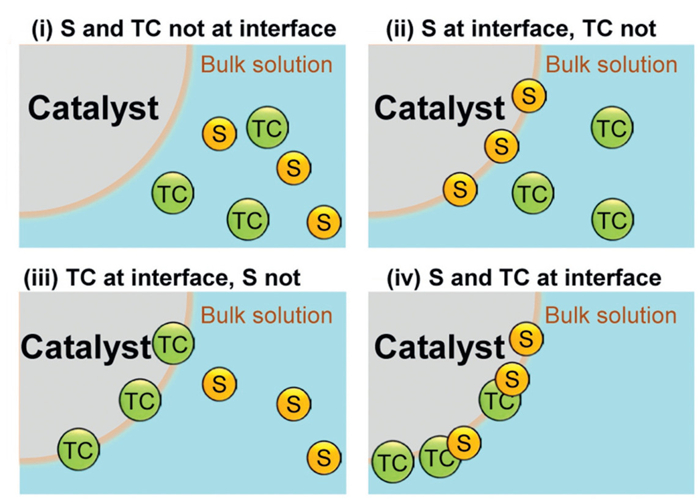
In a solid-liquid system, heterogeneous AOPs with various catalysts eliminate TCs from water by generating TR through the activation of precursors such as H2O2, O3, and peroxymonosulfate (PMS) [40,41]. In order to clarify the involvement of TR in these systems, four possible scenarios can be considered (Fig. 1): (ⅰ) Both scavengers and TCs are not adsorbed at the interfaces; (ⅱ) scavengers are adsorbed at the interfaces, while TCs are not; (ⅲ) TCs are adsorbed at the interfaces, while scavengers are not; (ⅳ) both scavengers and TCs are adsorbed at the interfaces of the catalysts. Scenarios (ⅰ) and (ⅱ) are trivial. Scenario (ⅰ) can be treated as a homogeneous reaction. In scenario (ⅱ) TC is degraded only in the bulk solution, and the adsorbed scavenger will not interfere with the evaluation of the degradation kinetics of TCs in the bulk phase. Scenario (ⅲ) represents the "worst-case" condition where TR at interfaces can react with TC also present on the surface. Adding scavengers to the bulk solution will not interfere with the reaction between TR and TC at the interfaces. This explains why, in many studies, the degradation of TC cannot be completely inhibited despite large amounts of scavengers [42,43]. For example, the p-BQ is generally used as a scavenger for O2•−. However, for O2•− generated at catalyst interface, the performance of p-BQ may be significantly compromised. This is because the p-BQ is relatively hydrophilic with logKOW of 0.27, and its interaction with catalyst surface might be limited, thereby impairing its ability to effectively scavenge O2•− at catalyst interface. However, these studies often attributed the residual degradation processes to CR, resulting in an underestimation of the contribution of TR.
Figure 1
Figure 1.
Schematic representation of the four possible distribution scenarios of TC (green symbols) and scavenger (yellow symbols) molecules in solid-liquid system. Due to differences in hydrophobicity, TC and S may either adsorb onto the catalyst interface or exist freely in the bulk solution.
In scenario (ⅳ), where both scavenger and TC are adsorbed at interfaces, the commonly used selection of a scavenger is often based on the rationale that k1 is significantly less than k2 in the bulk phase. This approach neglects the issue that the TR at the interface is not easily accessible to TC and scavengers due to limited mass transfer, making the k values in the bulk solution irrelevant at the interfaces. Note that the non-radical sites can also be affected by scavenger adsorption, particularly in scenario (ⅳ) where both scavengers and TCs are adsorbed onto the catalyst interface. In scenario (ⅲ), where scavengers are not adsorbed, non-radical sites are less likely to be directly impacted by scavenger adsorption. However, the interaction of TCs with the catalyst interface may still influence the reactivity of these sites. In addition, the amounts of scavengers and TC adsorbed on catalysts should also be considered. Specifically, to ensure the adequate removal of TR at the interface and eliminate their interference with TCs, the following criteria (scavenging capacity at the interface) should be met (Eq. 16):
k1iqh,TC<<k2iqh,scavenger
(16)
where k1i and k2i refer to the rate constants of TR with TC and scavenger at the interface, and qh, TC and qh, scavenger represent the amount of TC and scavenger adsorbed on a catalyst, respectively, and can be described as (Eq. 17) [44]:
qh=∑1nNεCe
(17)
where qh is the amount adsorbed on a catalyst, which generally increases with the increase of octanol-water partitioning coefficients (Kow) of TCs, N is the number of adsorption sites with a binding energy ε, and Ce is the concentration of TCs/scavengers at equilibrium. Commonly used scavengers, such as short-chain alcohols, furfuryl alcohol, KI, and NaN3 are typically either compounds with low Kow or ionic substances [45,46]. Therefore, for hydrophobic TCs, their qh may be significantly less than that of scavengers, which should be carefully considered.
Ultrasound, as an emerging AOP, has shown great promise in removing TCs from aqueous solutions [47,48]. The collapse of cavitation bubbles generates localized hot spots with the temperature up to 5000 K, which initiate thermolytic and oxidation reactions to produce •OH, HO2•/O2•−, and other reactive oxygen species (ROS) [49]. These radicals can both oxidize TCs at a bubble interface or in bulk solution after they diffuse [50].
Chemical scavengers are also frequently used to quantify the contribution of •OH to the degradation of TCs during the sonolysis [51,52]. Ideally, in the absence of adsorption of either scavengers or TCs on the bubbles, the reaction can be considered to proceed in a homogeneous system. However, volatile scavengers may interact with the bubble interface and enter cavitation bubbles [53,54]. They not only quench •OH in the gas, interfacial, and bulk regions of cavitation bubbles but also decrease the cavitation energy available for the thermolysis of H2O and adsorbed TCs [50,55]. Therefore, short-chain alcohols such as TBA and MeOH, due to high volatility and surface activity, may partition to bubble surfaces and inhibit the thermolysis of TC while scavenging •OH, resulting in altered bubble dynamics and an overestimation of the •OH contribution [56]. Consequently, without confirmation that scavengers do not interact with cavitation bubbles, attempts to deduce mechanisms and reaction sites for the overall degradation of TCs remain speculative.
In addition, in the gas region of cavitation bubbles, the volatile scavenger, such as TBA decomposed into isobutene and water with estimated temperature of 3600 K:
(CH3)3COH→ΔCH2=C(CH3)2+H2O
(18)
The resulting isobutene is an unstable species, which subsequently undergoes thermolysis to other radicals, potentially interfering with the degradation kinetics of •OH with TCs [57,58].
Similar to the cavitation bubbles in sonochemical systems, ozonation represents another heterogeneous system where the application of scavengers for TR elimination may also raise concerns. In aqueous solutions, O3 undergoes two types of reactions simultaneously: (ⅰ) Direct reactions involving O3 and TCs; and (ⅱ) indirect reactions, where •OH produced by O3 decay, react with TCs. After adding scavengers, direct reactions at gas-liquid interface behave similarly to those in cavitation bubbles. However, for indirect reaction at the gas-liquid interface, high concentrations of scavengers can not only affect the quantification of TR contributions but also fundamentally alter the reaction mechanisms. In particular, TBA, due to its high reactivity with •OH and low with O3 (3 × 10⁻³ L mol–1 s–1), is commonly used to evaluate the role of •OH during ozonation [59]. Many studies have shown that high concentration TBA interrupts the radical chain reactions essential for promoting O3 decomposition into various ROS, not only •OH, but also O2•− and O3•− [60,61]. Rather than only acting as an •OH scavenger, TBA alters the ozone mechanism compared to the conditions without TBA.
Photochemical transformation of TCs in various UV-based AOPs has emerged as a well-established and critically important research area [62,63]. UV light is frequently employed in conjunction with chemical oxidants such as H2O2, PS, and free chlorine to generate highly reactive oxidative radicals, which are crucial for the degradation of TCs [64,65]. The radical-induced degradation pathways are vital for the efficient removal of TCs from environmental matrices [66]. The kinetics and mechanisms of these processes have been extensively studied using chemical scavengers like IPA and TBA to quantify the contributions of specific radicals [67].
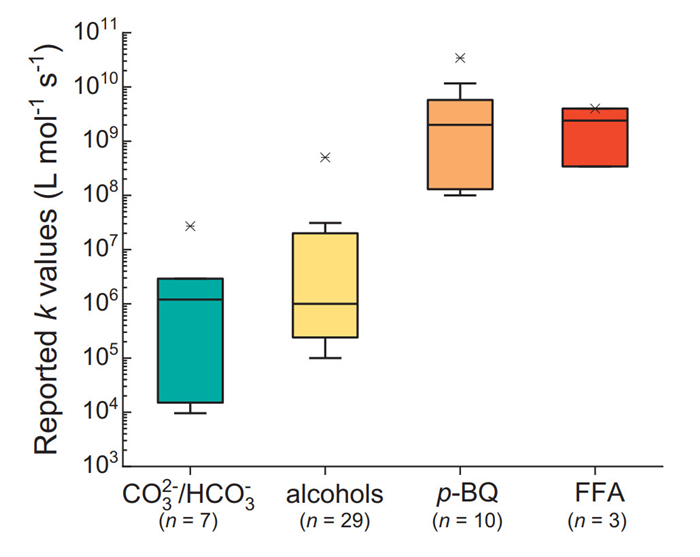
The use of scavengers also presents significant challenges in identifying the contribution of TR within these photochemical systems, even in the absence of CR. In many studies, the direct photolysis of TC follows a self-sensitized pathway to form the 3TC*, and scavengers are involved in the reaction with 3TC* [68–70]. Therefore, despite this process being minor, the occurrence of such a reaction between 3TC* and the scavenger reduces the inhibitory effect on TC degradation, leading to an underestimation of the contribution of TR. The quenching reaction rate constant (kq) values for quenching excited-state naproxen were reported to range from 106 L mol−1 s−1 to 108 L mol−1 s−1, demonstrating a significant promotion of scavengers in the degradation of TCs. This also indicates that the use of scavengers in AOPs leads to misinterpretation of reaction kinetics. We summarized a series of the reported k values of commonly used scavengers (HCO3−/CO32− for reactive chlorine species, alcohols for SO4•− and •OH, p-BQ for O2•−, and furfuryl alcohol FFA for 1O2) with 3TC* (Table 1). In general, TCs containing carbonyl functional groups, such as quinones and ketones, are readily excited to form 3TC*, and exhibit high reactivity towards these scavengers. Fig. 2 illustrates that the median k values of all these selected scavengers are greater than 106 L mol−1 s−1 (scavengers are typically used in high concentrations), indicating a non-negligible role of scavengers in the degradation of TCs. The outliers in Fig. 2 include the kq values for the reactions between triplet duroquinone and HCO3−/CO32−(teal column) [71,72], triplet p-BQ and alcohols (yellow column) [73–83], and triplet pyranine and p-BQ (golden column) [70,84–87]. The accelerating effect was pronounced for p-BQ and FFA, as their reported k values were all above 108 L mol−1 s−1 [70,87–89]. Unfortunately, the limited existing data (n = 3 for FFA) in the literature hampers a comprehensive assessment of this 1O2 scavenger. It is important to note that, although widely used, FFA is not recommended as 1O2 scanveger (azide and L-histidine are more suitable) because (ⅰ) it does not specifically react with 1O2 in the presence of other ROS, and (ⅱ) FFA can react with precursor oxidant such as PMS [90]. Instead, FFA is more suitable as a probe, as both FFA and its reaction products with 1O2 can be optically monitored.
Table 1
Table 1.
Comparison of the quenching reaction rate constant (kq, L mol−1 s−1) for the chemical scavengers (HCO3−/CO32−, IPA, p-BQ, and FFA) with 3TCs* (For example, the kq for 3β-lapachones* with IPA is 2.96 × 10⁵ L mol−1 s−1. (a) 1a to 1d and 2a to 2d refer to derivatives and specific functional groups (see the reference); (b) 3benzoquinone* with ethanol; (c) 3benzoquinone* with tert–butanol).
Figure 2.
Comparison of the reported kq values of commonly-used scavengers (HCO3−/CO32−, alcohols, p-BQ, and FFA, we selected these ones because they represent scavengers for common reactive species in AOPs) with 3TC* (the horizontal black lines of each box plot from top to down represent maximum, upper-quartile, median, lower-quartile and minimum values). The outliers include the kq values for the reactions between triplet duroquinone and HCO3−/CO32−(teal column), triplet p-BQ and alcohols (yellow column), and triplet pyranine and p-BQ (golden column).
Meanwhile, the reaction between scavenger and 3TC* can inhibit the formation of transient products from TC, leading to an overestimation of the contribution of TR [20,91]. For example, the degradation of 4–chloro-2-methylphenoxy acetic acid (MCPA) was investigated under UV irradiation in aqueous solution [20]. The addition of the •OH scavenger IPA reduced the formation of excited-state MCPA, possibly by increasing its vertical excitation energy, thereby significantly inhibiting the direct photolysis of MCPA. Since MCPA is transformed by both •OH and direct photolysis, the use of IPA can lead to an overestimation of the contribution of •OH to MCPA degradation. In certain conditions, IPA can interact with 3TC*, promoting photodegradation of ground-state TC. This interaction can lead to an underestimation of •OH contribution to TC degradation.
In a similar investigation on the contribution of •OH to the photochemical degradation of cilastatin in the presence of dissolved organic matter (DOM), 100 mg/L TBA was added to the system [92]. It was determined that the addition of TBA exerted minimal influence on DOM-induced cilastatin degradation, suggesting that the transformation process does not significantly involve •OH. However, the experimental data obtained with such alcoholic scavengers should be treated with caution, as alcohols can react with both •OH and 3TC*. To verify the involvement of radicals in these processes, one should provide additional evidence, such as identifying intermediates and analyzing the decay kinetics of products.
Chemical scavengers are widely employed to quantify contributions in chemical reactions, and their reliability directly impacts their interpretation. Unfortunately, this important aspect has not been adequately recognized by radical chemists and scavenger practitioners in various environmental areas. In this study, we critically evaluated the complexities associated with using chemical scavengers in both homogeneous and heterogeneous systems, highlighting key insights that influence the accuracy of radical contribution assessments. The selection of scavengers, particularly in multi-radical systems, significantly impacts the interpretation of reaction kinetics, with inappropriate concentrations leading to either overestimation or underestimation of radical contributions. In addition, in heterogeneous systems, scavengers may partition at interfaces, altering their efficiency in scavenging radicals and influencing degradation kinetics. This necessitates a careful consideration of scavenger physicochemical properties, adsorption characteristics and mass transfer behaviors at interfaces. Finally, our experiences with a non-steady-state system (i.e., laser flash photolysis) enabled us to observe many dynamic behaviors and transient phenomena that are often overlooked in steady-state conditions, such as UV/H2O2 and UV/PS systems. In particular, radical scavengers can react with 3TC*, complicating assessments in these steady-state systems. These findings underscore the need for more comprehensive databases of k values and improved scavenger selection criteria for radical-induced reactions.
Declaration of competing interests
The authors declare that they have no known competing financial interests or personal relationships that could have appeared to influence the work reported in this paper.
R. Xiao gratefully acknowledges the lasting influence of Dr. Dionysiou, who will always have a place in his heart. Funding from National Natural Science Foundation of China (Nos. 52121004 and 22376220), the Science and Technology Innovation Program of Hunan Province (Nos. 2024RC1017 and 2024RC1012) are acknowledged.
[1]
M. Chiesa, E. Giamello, M. Che, Chem. Rev. 110 (2010) 1320–1347. doi: 10.1021/cr800366v
Figure 1
Schematic representation of the four possible distribution scenarios of TC (green symbols) and scavenger (yellow symbols) molecules in solid-liquid system. Due to differences in hydrophobicity, TC and S may either adsorb onto the catalyst interface or exist freely in the bulk solution.
Figure 2
Comparison of the reported kq values of commonly-used scavengers (HCO3−/CO32−, alcohols, p-BQ, and FFA, we selected these ones because they represent scavengers for common reactive species in AOPs) with 3TC* (the horizontal black lines of each box plot from top to down represent maximum, upper-quartile, median, lower-quartile and minimum values). The outliers include the kq values for the reactions between triplet duroquinone and HCO3−/CO32−(teal column), triplet p-BQ and alcohols (yellow column), and triplet pyranine and p-BQ (golden column).
Table 1.
Comparison of the quenching reaction rate constant (kq, L mol−1 s−1) for the chemical scavengers (HCO3−/CO32−, IPA, p-BQ, and FFA) with 3TCs* (For example, the kq for 3β-lapachones* with IPA is 2.96 × 10⁵ L mol−1 s−1. (a) 1a to 1d and 2a to 2d refer to derivatives and specific functional groups (see the reference); (b) 3benzoquinone* with ethanol; (c) 3benzoquinone* with tert–butanol).


 DownLoad:

 下载:
下载:


 下载:
下载:

