Collaborative Innovation Center of Henan Province for Green Manufacturing of Fine Chemicals, Key Laboratory of Green Chemical Media and Reactions, Ministry of Education, School of Chemistry and Chemical Engineering, Henan Normal University, Xinxiang 453007, China
b.
College of Energy, Soochow Institute for Energy and Materials InnovationS (SIEMIS), Key Laboratory of Advanced Carbon Materials and Wearable Energy Technologies of Jiangsu Province, Soochow University, Suzhou 215006, China
Received Date:
30 June 2025 Accepted Date:
11 September 2025 Revised Date:
08 September 2025 Available Online:
15 July 2026
Abstract:
Aqueous zinc-ion batteries (ZIBs) have gained tremendous interests by virtue of their intrinsic safety, low cost and favorable theoretical capacities. As the promising candidates of cathode materials of ZIBs, ammonium vanadates (NVO) have captured widespread attentions owing to their tunable chemical properties and enhanced structural stabilities owing to the existence of NH4+ in the [VO]n layers. However, the pristine NVO fails to meet the expectations due to the strong interlayer electrostatic repulsion and comparatively sluggish transfer kinetics, which necessitates the exploration of appropriate modification strategies to fully dig its potential. Herein, this review systematically summarizes five core molecular engineering strategies, intercalation, defect, interfacial, doping, and structural engineering strategies, and their significances in modulating structural and electrochemical properties of NVO are elaborately discussed. Moreover, the perspectives on the future developments and potential energy-related applications of NVO are presented. This review is anticipated to deepen the researchers' understandings of the potentials of molecular engineering strategies on improving zinc-ion storage capabilities of cathode materials, and further promote the practicality of NVO in ZIBs.
The severe fossil fuel consumption and the goal of realizing carbon neutrality readily accelerate the development of sustainable and clean energy [1], and the high-efficient electrochemical energy storage (EES) devices are regarded as the most promising resorts to fulfill the escalating demands of new-energy vehicles and portable electronic devices [2,3]. Up to now, various metal-ion-battery systems have been developed for EES devices (Fig. 1a). As the representative of metal-ion batteries, lithium-ion batteries (LIBs) have been widely commercialized owing to their comparatively high energy density and favorable operation life [4]. Nevertheless, the safety concerns causing by the adoption of flammable organic electrolyte and high cost hamper their further rise in grid-scale EES systems and hybrid vehicles, and the chase of inherently safe EES devices promotes the research progress of aqueous metal-ion batteries [5,6]. In particular, aqueous zinc-ion batteries (ZIBs) have gained tremendous interests by virtue of their comparatively low redox potential (−0.76 V vs. standard hydrogen electrode), low cost and desirable theoretical capacity (820 mAh/g) [7,8]. Besides, the favorable air stability and facile assembly procedures further facilitate the industrialization of ZIBs, making them as the competitive candidates for next-generation large-scale grid EES devices [9]. Up to now, numerous cathode materials of ZIBs have been developed, such as vanadium-based cathodes [10–12], manganese-based cathodes [13–15], Prussian blue analogs (PBAs) [16,17], transition metal dichalcogenides (TMDs) [18–20], and emerging organic electrodes [21–23]. Compared to other reported cathodes, vanadium-based cathodes possess favorable capacities and acceptable voltage plateaus (Fig. 1b), enabling them to be one of the most competitive candidates for the cathode materials of ZIBs. However, vanadium-based cathodes generally suffer from the severe structural variations due to the inevitable vanadium dissolution and the sluggish transfer kinetics of Zn2+ (zinc-ions) causing by the strong electrostatic repulsion and solvation/desolvation effects, thereby resulting in the inferior cycling stability and failing to meet their expectations. Consequently, the rational modification strategies are highly desired to realize the favorable cycling stabilities and industrial applications of vanadium-based cathodes.
Figure 1
Figure 1.
(a) The radar diagram of various metal-cations as charge carriers for rechargeable batteries. (b) The comparison in the specific capacity and voltage plateau of commonly adopted cathode materials for ZIBs. (c) The comparisons of the initial capacities (0.1 A/g) and cycle numbers to the capacity retention of 80% of commonly reported vanadium-based cathodes at specific current densities.
To date, a series of vanadium-based cathodes have shown their talents in storing Zn2+, such as vanadium oxides [24–26], metal-cation vanadates [27–29], ammonium vanadates (NVO) [11,30,31], and vanadium phosphates [32–34]. By virtue of the enhanced structural stabilities, NVO-based cathodes generally possess the favorable cycling stabilities and Zn2+ storage capabilities at high current density compared to vanadium oxides and vanadium phosphates (Fig. 1c). Note that the reported metal-cation vanadates generally possess the better cycle lifespans than pristine NVO by virtue of the higher stabilities of metal-cations in serving as interlayer "pillars". However, the introduction of multivalent metal-cations would further aggravate the electrostatic effect between Zn2+ and cathode material, leading to the sluggish transfer kinetics of Zn2+. In contrast, monovalent NH4+ can alleviate this adverse effect to some extent, hence, NVO general exhibits the better rate performances than metal-cation vanadates, and the lower cost of its precursor further endows it with favorable commercialization value. Moreover, the lifespan gap between NVO and metal-cation vanadates can be effectively eliminated with the adoption of rational molecular engineering strategies, and the modified NVO-based cathodes are able to present the comparable cycle lifespans to that of metal-cation vanadates, suggesting the great application potentials of NVO in ZIBs.
Specifically, with the common formula of (NH4)xVyOz, NVO is generally comprised of VO5 square pyramids and VO6 octahedra or VO4 tetrahedra with typical layered structures (Table 1 and Fig. 2) [35,36], and it has drawn researchers' attention in recent years by virtue of its tunable structural properties and unique advantages. The NH4+ ions are located at the interlayers of [VOn] layers, and they can form the hydrogen bond network via N–H···O bonds, thus greatly strengthening the overall structural stability by serving as extra interlayer "pillars" [37]. Hence, NVO-based electrodes generally possess the better cycling stabilities and long-term cycling performances than pristine vanadium oxide-based electrodes. Moreover, the existence of NH4+ ions can further enlarge the interlayer distance of [VOn] layers, which significantly facilitates the transfer of metal-ions. As a result, NVO-based electrodes have been extensively adopted in numerous EES devices, such as LIBs [38], sodium-ion batteries (SIBs) [39], potassium-ion batteries (PIBs) [40], and supercapacitors (SCs) [41]. However, the potentials of NVO in storing Zn2+ have been not revealed until 2019, Tang et al. [30] and Lai et al. [42] fabricated NH4V4O10 flake and NH4V3O8 nanobelt serving as cathode materials for ZIBs, respectively, and both the NVO cathodes present the reversible intercalation/deintercalation behaviors of Zn2+. Though pristine NVO cathodes with specific morphologies are able to possess enhanced Zn2+ storage capabilities [43–45], they still suffer from the following drawbacks: (1) The extra NH4+ would further aggravate the electrostatic repulsion between Zn2+ and NVO, thus increasing the migration barrier of Zn2+ and lowering its transfer kinetics; (2) The NH4+ would be inevitably removed during the repeated cycling process, causing the structural collapse and unfavorable cycling stability; (3) The extra NH4+ would occupy partial interlayer space and may hinder the transfer of Zn2+, resulting in the sluggish transfer kinetics [11]. Therefore, pristine NVO generally fails to present desirable electrochemical performances, and appropriate modification strategies are highly desired to fully utilize the potentials of NVO cathodes. Aiming to mitigate the above adverse effects of NVO cathodes, significant progress has been made by researchers in recent years, and several related reviews have been published. For instance, Zheng et al. elaborately summarized the progress of ammonium salt-based electrodes in the realm of EES [35], and Liu et al. discussed the recent progress of vanadium-based cathodes in ZIBs [46]. As one of the most competitive cathode materials of ZIBs, NVO-based cathodes come on stage in recent years, whereas the summaries pertaining to the modification strategies of NVO-based cathodes and relevant discussions in previous reviews are still insufficient and incomplete. Therefore, a review that focuses on summarizing the state-of-the-art modification strategies of NVO and their mechanisms is highly desirable.
Table 1
Table 1.
The structural parameters of several typical NVO materials.
Figure 2.
The crystal structures of the several typical NVO materials. Reproduced with permission [30]. Copyright 2019, The Royal Society of Chemistry.
As the most direct ways to modulate the physical and chemical properties of target material at the molecular level [47], molecular engineering strategies have been adopted for promoting Zn2+ storage capabilities of NVO-based cathodes in recent years. In general, the advanced molecular modification strategies of NVO could be roughly classified into four categories according to their principles (Fig. 3), including intercalation engineering, defect engineering and interfacial engineering. Different molecular engineering strategies can promote the electrochemical properties of NVO-based cathodes from different aspects. Besides, these strategies are sometimes compatible, and two or more strategies can be simultaneously adopted by researchers to synergistically alleviate the intrinsic drawbacks of NVO and boost its Zn2+ storage capability. Herein, for the first time, we systematically summarize the modification strategies of NVO based on previous reports, reveal their intrinsic mechanisms and shed light on the general structural design strategies and applicable prospects of NVO in next-generation EES devices. This review is anticipated to strengthen the comprehension of the structure-activity relationship of NVO-based cathodes, thus making the utmost of the potentials of NVO-based materials and effectively promoting their electrochemical performances in ZIBs and other EES devices.
Figure 3
Figure 3.
The general molecular engineering strategies of NVO-based cathodes and their relevant advantages.
Intercalation engineering is the most common and effective way to promote the electrochemical properties of layered electrodes [48]. Specifically, the adopted intercalators for NVO-based cathodes could be briefly classified into three categories: Metal-ions, organic molecules and conductive polymers, and those intercalators are expected to strengthen the structural stability, increase overall conductivity and contribute more active sites for Zn2+ [49]. Herein, the common intercalators are summarized and their individual advantages are discussed in this part.
2.1
Metal-ion intercalator
As one of the most common intercalators for layered materials, metal-ion intercalator is also widely adopted in NVO-based electrodes by virtue of the following advantages: (1) Most of metal-ion intercalators could be easily intercalated into the interlayers of NVO via facile hydrothermal/solvothermal methods, suggesting its high feasibility; (2) Metal-ions can further enhance the structural stability of NVO by serving as extra interlayer "pillars"; (3) The intercalated metal-ions are able to modulate the electronic structure of NVO and effectively improve its conductivity. Up to now, numerous metal-ion intercalators have been explored, including alkali-metal-ions (such as Li+, Na+, K+ and Rb+) [50–56], multivalent metal-ions (such as Mg2+ and Ba2+) [57–59], and noble metal-ions [60]. For instance, Cao et al. introduced potassium-ions into the interlayers of NH4V4O10via a facile hydrothermal method (Fig. 4a) [50]. Compared to pristine NVO, the introduction of K+ significantly reduces the crystallinity of NVO (Fig. 4b), which is beneficial for its long-term cycling stability by mitigating the mechanical stress during electrochemical process. In addition, K+ can further lower the valance of vanadium and the bond strength of V-O bond (Fig. 4c). Consequently, the proposed K+-intercalated NVO exhibits the promoted cycling stability, and a high reversible capacity of 172 mAh/g can be retained after 1000 cycles at 5 A/g (Fig. 4d), corresponding to a favorable capacity retention of 81.6%. Similarly, Wang et al. adopted Rb+ intercalator to improve the electrochemical properties of NH4V4O10 (Fig. 4e) [55]. The introduction of Rb+ would decrease the interlayer content of labile NH4+ and take over the role of interlayer "pillars", resulting in larger content of V4+ (Fig. 4f) and expanded interlayer distance (Fig. 4g). Note that the intercalated Rb+ also contributes to the regulations of electrolyte and zinc anode. Specifically, partial Rb+-ions would immerse into electrolyte, suppress the generation of byproducts and regulate the growth of zinc dendrite, thus realizing its multi-functionality and superb long-term cycling performance (Fig. 4h). Besides the alkali-metal-ions, multivalent metal-ions are also adopted as intercalators for NVO. Due to their comparatively larger radiuses, the interlayer distances of NVO-based cathodes with multivalent metal-ion intercalators are generally larger than that of alkali-metal-ion intercalated NVO cathodes. Yao et al. hired Mn(CH3COO)2 as the precursor to introduce Mn2+ intercalator into (NH4)2V10O25 [59]. The intercalated Mn2+-ions would partially occupy the accommodation of NH4+-ions and serve as new interlayer "pillars" to further strengthen the stability of [VO]n layers, thus resulting in the enhanced cycling stability. In addition, the appropriate multivalent metal-ion intercalators may also be able to participate in the formation of cathode/electrolyte interface (CEI) layer. Since the stable and uniform CEI layer is vital to the cycling stability of NVO-based cathodes, numerous papers focus on constructing the CEI layer for NVO-based cathodes via electrolyte engineering [61] and separator modification strategies [62]. Recently, the Ca2+ and Sr2+ intercalators have proven their potentials in forming stable CEI layers for vanadium-based cathodes by interacting with electrolytes [63,64]. Therefore, those multivalent metal-ion intercalators may also be able to promote the formation of CEI layer for NVO-based cathodes, while it has been not revealed so far. Nevertheless, the adoption of multivalent metal-ion intercalators may further aggravate the electrostatic repulsion effect between Zn2+ and interlayer cations. The electrochemical performances of metal-ion intercalated NVO cathodes are summarized in Table 2, and all the cathodes present much improved cycling stabilities than pristine NVO cathodes. Nevertheless, several issues are needed to be taken into consideration when adopting metal-ion intercalators: (1) Most reported metal-ion intercalations are realized via the hydrothermal/solvothermal methods with certain ratios of metal-ion precursors, while not all the metal-ions can intercalate into [VO]n layers, so how to precisely control and quantify the detailed number of intercalated metal-ions in NVO? (2) The introduction of extra metal-ion would further strengthen the electrostatic repulsion effect between Zn2+ and interlayer cations, thereby slacking the transfer kinetics of Zn2+, hence the merits and extra adverse effects contributed by metal-ion intercalators need to be balanced; (3) Most reports focus on revealing the positive influences of metal-ion intercalators on cathodes, while their potential influences on electrolyte and zinc anode need to be further uncovered.
Figure 4
Figure 4.
The typical cases of metal-ion intercalated NVO cathodes. (a) The structure of K-NVO and (b) its XRD spectrum. (c) The EXAFS fitting curves of pristine NVO and K-NVO, and (d) the long-term cycling performance of K-NVO. Reproduced with permission [50]. Copyright 2024, Elsevier Inc. (e) XRD patterns and (f) V 2p spectra of Rb-intercalated NVO and pristine NVO. (g) HRTEM image of Rb-intercalated NVO and (h) its long-term cycling performance. Reproduced with permission [55]. Copyright 2024, American Chemical Society.
As the promising alternatives of metal-ions, organic-molecule intercalators have been widely adopted in layered materials (such as TMDs) to mitigate structural variation by serving as the buffer layers [65]. For instance, Zong et al. adopted the choline (C5H14ON+) and Zn2+ as intercalators to promote the electrochemical property of layered V2O5 [66]. Benefitting from the large "body" of C5H14ON+, the interlayer distance of V2O5 is greatly expanded to 13.5 Å, thus effectively boosting the intercalation/deintercalation processes of Zn2+. However, only a few organic molecules, such as ethylene glycol (EG) and imidazole molecules, have verified their merits in boosting Zn2+ storage capabilities of NVO-based cathodes [67–69]. Organic-molecule intercalators can not only strengthen the structural stability of NVO by serving as interlayer "pillars" and improve the overall conductivity, as well as the metal-ion intercalators, but also possess potential multi-functionalities by virtue of their high polarities and abundant functional groups. Moreover, the introduction of organic molecules could be realized by the facile self-assembly processes, which are more convenient than that of metal-ions. For example, Chen et al. introduced the EG molecules into interlayer of NH4V4O10via facile self-assembly process (Fig. 5a), and its (001) plane shifts from 9.2° (~9.6 Å) to 7.46° (~11.84 Å) after the intercalation of EG (Fig. 5b), corresponding to interlayer distance expansion of ~23% [67]. Meanwhile, the introduction of EG can greatly reduce the bandgap of NVO from 0.905 eV (pristine NVO) to 0.015 eV, thus improving its electronic conductivity (Figs. 5c and d). As a result, the EG-intercalated NVO delivers a high capacity of 254.8 mAh/g after 1000 cycles at 10 A/g, which is significantly larger than that of pristine NVO cathode. Similarly, Kong et al. immersed NVO nanoflake arrays into the N,N-dimethylformamide (DMF) solution to fabricate DMF-intercalated NVO cathode [70]. The high polarity carbonyl group of DMF can electrostatically interact with NH4+ and enable it to be fixed in the [VO]n layers, while its low polarity alkyl group can attract the Zn2+ with the weaker electrostatic effect, thus leading to the fast transfer kinetics of Zn2+. Besides, the interlayer distance of NVO significantly expands to 12.6 Å with intercalation of DMF molecules, further providing the larger space for the accommodation of Zn2+, hence the much-improved Zn2+ storage capability of NVO is realized. Besides utilizing the polarities, the functional groups of organic molecules can be also exploited. Tang et al. hired imidazole molecule as multifunctional intercalator for NVO cathode [69]. The imidazole molecules can not only serve as interlayer "pillars" to stabilize [VO]n layers and expand the interlayer distance (Fig. 5e), but also contribute more active sites for Zn2+ to storage by virtue of the unique coordination reaction between their C=N group and Zn2+, which are witnessed by the ex-situ characterizations (Figs. 5g and h) and thereby realizing the dual-mode Zn2+ storage mechanism and enhanced electrochemical performances (Fig. 5f). In addition, organic-molecule intercalator can also collocate with metal-ion intercalator to co-intercalate into the [VO]n layers of NVO, and synergistically promote its Zn2+ storage capability [71]. Up to now, only a few organic molecules have been exploited as intercalators for NVO cathodes (Table 3), and the following issues could be considered aiming to efficiently utilize the organic- molecule intercalators in future: (1) Organic molecules possess various polarities and tunable functional groups that can be exploited, rationally utilizing those characteristics of organic molecules and realizing their multi-functionalities are crucial to the enhancement of Zn2+ storage capabilities of NVO cathodes; (2) The content of organic-molecule intercalator is reported to be an influential factor for the structure and morphology of NVO [68], and more detailed researches are highly desired.
Figure 5
Figure 5.
The typical cases of organic-molecule intercalated NVO cathodes. (a) The structural illustration of EG-intercalated NVO cathode and (b) its XRD patterns. DOS spectra of (c) pristine NVO and (d) EG-intercalated NVO. Reproduced with permission [67]. Copyright 2023, American Chemical Society. (e) XRD spectra and (f) cycling performances of pristine NVO and INVO, the corresponding ex-situ (g) XPS spectra and (h) FTIR spectra of INVO. Reproduced with permission [69]. Copyright 2024, American Chemical Society.
Conductive polymer is another kind of promising intercalators for layered electrodes to enhance their structural stabilities and strengthen the internal conductive networks [72]. In general, the introduction of conductive polymer intercalators can contribute the following advantages for NVO-based cathodes: (1) Significantly expand the interlayer distance of NVO by virtue of their comparatively larger "bodies"; (2) Improve its structural stability by serving as interlayer "pillars" and squeezing out partial NH4+ to mitigate the structural collapse causing by the irreversible deammoniation during cycling process; (3) Enhance its conductivity by contributing the interlayer conductive networks. Up to now, numerous conductive polymers have been adopted as intercalators to promote Zn2+ storage capabilities of NVO-based cathodes (Table 4), such as polyaniline (PANI) [73–76], polypyrrole (PPy) [77,78], poly(3,4-ethylenedioxythiophene) (PEDOT) [79,80], and poly-o-phenylenediamine (PoPDA) [81]. Early in 2020, Bin et al. firstly adopted the PEDOT as intercalator and fabricated PEDOT-intercalated NH4V3O8 cathode via the ultrasonic-assisted self-assembly process and in-situ polymerization process (Fig. 6a) [79]. The introduction of PEDOT effectively expands the interlayer distance of NH4V3O8 from 7.9 Å to 10.8 Å (Fig. 6b), thus offering the larger space for the accommodation of Zn2+. Besides, the high conductivity of PEDOT can also contribute to the internal conductive networks, further improving the overall electronic conductivity. As a result, the PEDOT-intercalated NVO cathode presents the larger CV area (Fig. 6c) and boosted Zn2+ storage capability compared to pristine NVO cathode. Specifically, it can deliver a superb capacity retention of 94.1% (160.6 mAh/g) after 5000 cycles at 10 A/g (Fig. 6d), indicating its greatly enhanced structural stability and favorable application potential. Similarly, the introduction of PANI and PPy can also realize the improvement of structural stability and overall conductivity. For example, it is reported that PANI and PPy can expand the interlayer distance of NVO to 10.8 and 8.9 Å from 7.9 Å (pristine NH4V3O8), respectively [74,78]. Aiming to further dig the potentials of polymer intercalators, their functional groups could be also exploited. Li et al. hired PoPDA as intercalator and fabricated the PoPDA@GO-intercalated NH4V3O8 cathode via a facile hydrothermal method [81]. In addition to expanding its interlayer distance (Fig. 6e) and enhancing its structural stability by serving as interlayer "pillars", PoPDA can also contribute extra Zn2+ storage capacity via the coordination reaction between Zn2+ and its C=N group, which is similar to that of imidazole intercalator, and the reversible transformation and rearrangement of C=N/C-N-Zn can be verified by relevant ex-situ characterizations (Fig. 6g), thereby realizing the organic-inorganic dual-mode active sites for Zn2+ to storage (Fig. 6h) and the significantly promoted Zn2+ storage capability (Fig. 6f). Moreover, polymer intercalators can also be adopted together with other intercalators to synergistically boost electrochemical properties of NVO. Zhao et al. introduced Na+ and PANI into the interlayer of NH4V4O10 simultaneously, and its interlayer distance greatly expanded to 13.8 Å, which is larger than that of mono-intercalator intercalation [73]. As a result, the proposed Na+ and PANI co-intercalated NH4V4O10 cathode delivers a favorable capacity retention (92%, ~250 mAh/g) after 5000 cycles at 5 A/g. However, in consideration of the large "bodies" of polymers, the content of intercalated polymer needs to be carefully considered, since the excessive polymers may block off the interlayer pathways of Zn2+ and lead to the sluggish transfer kinetics. In addition, the functional groups of polymers can be also utilized, and developing the conductive polymer intercalators with abundant coordinate sites for Zn2+ (such as C=N group) are highly desirable.
Table 4
Table 4.
The electrochemical properties of polymer intercalated NVO-based cathodes.
Figure 6.
The typical cases of conductive polymer intercalated NVO cathodes. (a) The fabrication processes of PEDOT-intercalated NVO cathode and (b) its XRD patterns; the comparison of (c) CV curves and (d) long-term cycling performances of pristine NVO and PEDOT-intercalated NVO. Reproduced with permission [79]. Copyright 2020, Elsevier Inc. (e) The enlarged interlayer distance of NVO causing by the intercalation of PoPDA and (f) the electrochemical performances of proposed NVO/PoPDA@GO cathode. (g) The ex-situ XPS spectra of NVO/PoPDA@GO cathode and (h) the Zn2+ storage mechanism of PoPDA. Reproduced with permission [81]. Copyright 2024, Wiley-VCH GmbH.
Besides above intercalators, several inorganic molecules have been also hired as intercalators to boost Zn2+ storage capability of NVO. For instance, Xu et al. introduced C3N4 molecules into the interlayers of V2O5via the facile self-assembly process, and C3N4 can not only serve as nitrogen source to promote the transformation from V2O5 to layered NH4V4O10 in subsequent hydrothermal procedure, but also play the role of interlayer "pillars" to enhance structural stability of NH4V4O10 [82]. The C3N4-intercalated NVO cathode possesses the larger interlayer distance (10.1 Å) and more oxygen defects, thus presenting boosted Zn2+ storage capability, and a high reversible capacity of 219.9 mAh/g can be retained after 10,000 cycles at 10 A/g, suggesting its superb cycling stability. Qiu et al. embedded CO2 molecules into the layers of NH4V4O10via a self-assembly process and subsequent in-situ decomposition of H2C2O4·H2O [83]. The CO2 molecules can not only expand interlayer distance of NVO, but also immobilize the NH4+via hydrogen bonds, thus mitigating structural deformation causing by the deammoniation during cycling processes and guaranteeing the favorable stability of NVO framework. After 1000 cycles at 10 A/g, the proposed CO2-intercalated NVO cathode maintains a favorable capacity of 214 mAh/g, which is far larger than that of pristine NVO cathode. The above cases indicate the great potentials of inorganic-molecule intercalators in modulating the structural transformation of vanadium-based materials and stabilizing interlayer NH4+ "pillars". Nevertheless, compared to organic molecules and polymers, inorganic molecules possess the less functional groups to be modified and exploited, making it hard to realize the multi-functionality of intercalators (such as contribute extra active sites for Zn2+ storage), and they generally own the inferior conductivities, which are unfavorable to the overall electron transfer. Hence, inorganic-molecule intercalators may not be as attractive as other types of intercalators.
3.
Defect engineering
Defect engineering is another common strategy to modulate electronic structure of NVO and promote its electrochemical performances [84]. Up to now, the proposed defect engineering strategies for NVO could be summarized in two categories: NH4+ (cation) defect engineering and oxygen (anion) defect engineering. In general, the existence of NH4+ defects can effectively reduce the electrostatic repulsion effect and provide more transfer routes for Zn2+ [11], while the introduction of oxygen defects can lower the energy barrier of Zn2+ diffusion and facilitate its redox processes [85]. Herein, the introduction methods of those defects and their detailed influences in promoting Zn2+ storage capabilities of NVO are elaborately summarized in this part.
3.1
Ammonium-ions defects
The existence of interlayer NH4+ "pillars" is vital to maintaining the overall structural stability of NVO during the electrochemical processes. However, the excess number of NH4+ would further aggravate the electrostatic repulsion effect between Zn2+ and NH4+, and occupy the transfer routes of Zn2+, resulting in the inferior transfer kinetics and rate performances [86–88]. Hence, rationally modulating the number of NH4+ "pillars" to balance the structural stability of NVO and transfer kinetics of Zn2+ can further improve cycling performances and power densities of NVO-based cathodes (Table 5). Moreover, the introduction of NH4+ defects can also partially increase the content of V5+ in NVO, which is conducive to the redox reactions of vanadium and the increase of electrochemical capacity. In general, the removal of NH4+ cations can be realized by the heat treatment or acid treatment. Heat treatment is the most direct way to remove NH4+ cations from interlayers of NVO and the heating temperature plays the vital role in modulating the number of removed NH4+ cations, since the deficiency of NH4+ is proportionate to the calcination temperature and the NVO would completely convert to V2O5 at more than 400 ℃ [89]. Zheng et al. prepared NVO nanobelts with abundant oxygen vacancies firstly and removed partial NH4+via the mild calcination process at 300 ℃ (Fig. 7a) [90]. The ratio of NH4+ defect is estimated about 12.6% based on the thermal gravimetric (TG) curve (Fig. 7b) and the variation of N/V ratio of XPS spectrum. The removal of NH4+ is proven to be beneficial for the mitigation of interlayer electrostatic interaction and reduction of migration barrier of Zn2+. Consequently, the NH4+-deficient NH4V4O10 cathode possesses an initial capacity of 355 mAh/g at 0.3 A/g (Fig. 7c), and maintains a favorable capacity of 202 mAh/g after 1000 cycles at 3 A/g (Fig. 7d), which is far larger than that of pristine NVO and excessively calcined NVO (which is already transformed to vanadium-based oxide). Similarly, Liu et al. further verified the removal necessity of NH4+, and they suggested that the N atom of NH4+ possesses strong electrostatic interaction with Zn, which would significantly retard the transfer of Zn2+ during electrochemical processes [86]. Aiming to further expand the interlayer distance of NVO and compensate the structural variation causing by the partial removal of NH4+, the Al3+ was pre-intercalated into the [VO]n layers (AlNVO). As a result, the proposed NH4+-deficient AlNVO cathode owns the enhanced Zn2+ storage capability and cycling stability than pristine NVO, suggesting the compatibility of NH4+-defect engineering with other molecular engineering strategies. Note that the optimal calcination temperature may vary from the detailed structure of NVO. The optimal annealing temperature of NH4V4O10 is reported to be 300 ℃, while Tang et al. indicated that the NH4V3O8 cathode which is calcined at 350 ℃ possesses the optimal degree of NH4+ defects (~68.5% based on the calculation of N/V ratio) and upmost electrochemical performance, compared to those NH4V3O8 cathodes calcined at 325 and 375 ℃ [11]. Another advantage of heating treatment method is that the extra oxygen defects can be also generated during the calcination process, which is also in favor of the promotion of Zn2+ storage capabilities of NVO. The emergence of oxygen defects can further alleviate the interlayer electrostatic effect between V-O layer and Zn2+ and enhance the conductivity of NVO, thus synergistically boosting the Zn2+ transfer kinetics with ammonium-ion defects [90]. However, the ammonium-ion defects and oxygen defects will simultaneously emerge in the heating treatment process, and it may be hard to evaluate the specific contribution of ammonium-ion defects and oxygen defects individually. Besides the heat treatment method, acid treatment is also capable to realize the removal of NH4+. Chen et al. hired the hydrochloric acid to remove partial NH4+ from NH4V4O10via the facile stirring process (Fig. 7e), and the removal degree of NH4+ is highly relative to the content of HCl [88]. With the increased content of HCl, the (001) peak gradually shifts to the lower position, indicating the enlarged interlayer distance (Fig. 7f). Though the excess removal of NH4+ can lead to the larger interlayer distance of NVO, its Zn2+ transfer kinetics is inferior to the NVO cathode with moderate NH4+ defects (Figs. 7g and h), which may be due to the structural deterioration (or transformation) of NVO causing by the excess removal of NH4+. In conclusion, NH4+ defects can effectively weaken the interlayer electrostatic repulsion effect and expand the interlayer distance, while the excess removal of NH4+ may cause the structural deformation and impede Zn2+ diffusion. Hence, the optimal degrees of NH4+ defects for various NVO materials need to be further revealed, and an approach that can precisely regulate the number of NH4+ defects is highly desired.
Table 5
Table 5.
The electrochemical properties of NH4+-deficient NVO-based cathodes.
Figure 7.
The typical cases of NH4+-deficient NVO cathode. (a) The illustration of NVO-300 cathode with oxygen vacancies and NH4+ defects and (b) its TG curve. (c) The initial charge-discharge curve of NVO-300 and (d) its long-term cycling performances. Reproduced with permission [90]. Copyright 2022, Elsevier B.V. (e) The fabrication processes of NH4+-deficient NVO cathode via acid treatment. (f) XRD spectra and (g) EIS spectra of NVO samples with various acid contents. (h) The long-term cycling performances of NH4+-deficient NVO and pristine NVO. Reproduced with permission [88]. Copyright 2022, Elsevier B.V.
Oxygen defects can not only effectively modulate electronic structure of NVO and improve its intrinsic conductivity, but also provide more active sites for Zn2+ to storage and thereby boosting its electrochemical capacity (Table 6). Moreover, the introduction of oxygen defects is suggested to be beneficial to the inhibition of vanadium dissolution [91]. Generally, oxygen defects can be created via one-step hydrothermal method directly or extra reduction process, and various reductants have been adopted for NVO up to now, such as N2H4·H2O [92], thiourea [93], and glucose [94]. He et al. hired oxalic acid as the reductant to prepare oxygen-deficient NH4V4O10-x microspheres via the facile one-step hydrothermal approach (Fig. 8a) [85]. The removal of high-electronegative oxygen can not only alleviate the strong interaction between Zn2+ and NVO host and accelerate the intercalation/deintercalation processes of Zn2+, but also provide extra pathways for Zn2+ along c axis in its layer structure [95,96], thus leading to the much enhanced transfer kinetics of Zn2+. Note that the fast Zn2+ transfer kinetics of proposed oxygen-deficient NH4V4O10-x could be maintained even at −30 ℃ (Fig. 8b). Consequently, it possesses favorable Zn2+ storage capability at both room temperature (an initial capacity of 434 mAh/g is achieved at 0.1 A/g, Fig. 8c) and low temperature conditions (a high capacity retention of ~94% is maintained after 2600 cycles at 2 A/g and −30 ℃, Fig. 8d), indicating the merits of oxygen defect engineering in promoting practical application potentials of NVO at extreme working conditions. Bai et al. proposed an oxygen-defect regulation strategy by adopting glucose as reductant, and its aldehyde group can grab the lattice oxygen of NVO to form the carboxyl group and generate defects during hydrothermal process [94]. The number of oxygen defect is increased with the increased content of glucose reductant, and those introduced oxygen defects can effectively reduce the bandgap of pristine (NH4)2V10O25 from 1.9 eV to direct bandgap, confirming the enhanced conductivity of NVO contributed by oxygen defects in theory. However, the excess oxygen defects may also cause structural collapse as well as the NH4+ defects, and the optimal Zn2+ storage performances are generally owned by those NVO cathodes with moderate oxygen defects. Besides, oxygen defects could be generated with other defects simultaneously under appropriate reductive conditions. Li et al. adopted an extra reduction process by using oxalic acid as reductant to simultaneously create oxygen defect and vanadium defect into NH4V4O10 (Fig. 8e) [97]. The introduction of vanadium defect can weaken the interaction between Zn2+ and NVO, thus reducing the binding energy of Zn2+ and accelerating its transfer (Fig. 8f), while the existence of oxygen defect is conducive to the increment of 3d electron of V below Fermi energy and the reduction of coordination interaction of Zn-O. The above advantages synergistically endow the proposed vanadium-deficient and oxygen-deficient NVO cathode with the much lower Zn2+ migration barrier compared to pristine NVO (Fig. 8g), thereby resulting in the enhanced transfer kinetics. As a result, the NVO cathode with dual defects presents the enhanced apparent diffusion coefficient of 7.5 × 10⁻¹⁰ m-2 s-1, which is greatly larger than that of oxygen-deficient NVO (4.5 × 10⁻¹⁰ m-2 s-1) and pristine NVO (2.7 × 10⁻¹⁰ m-2 s-1). Moreover, though oxygen defects can provide more active sites for Zn2+ to storage and improve specific capacity, they are unable to enhance the cycling stability of NVO. However, with the help of vanadium defects, the NVO cathode owns remarkable long-term cycling stability and a high reversible capacity of 210 mAh/g could be retained after 8000 cycles at 15 A/g, indicating the great potential of synergistic effect of multiple defects (Fig. 8h). In summary, the advantages of oxygen-defect strategy on NVO cathode lie in the following aspects: (1) Reduce the bandgap of NVO and improve its conductivity; (2) Weaken the interaction between Zn2+ and NVO host, and accelerate intercalation/deintercalation processes of Zn2+; (3) Provide more active sites for Zn2+ to storage and improve the specific capacity. However, the excess number of oxygen defects may lead to the structural collapse and inferior cycling stability, thus the content of oxygen defect in NVO should be elaborately regulated, and a mild method that can precisely control the content of oxygen defect is required. Moreover, since oxygen-defect strategy cannot contribute to the structural stability of NVO, it is better to combine this strategy with other molecular engineering strategies (such as intercalation engineering) in order to strengthen the long-term cycling stability of NVO and obtain the upmost Zn2+ storage performance.
Table 6
Table 6.
The electrochemical properties of oxygen-deficient NVO-based cathodes.
Figure 8.
The typical cases of oxygen-deficient NVO cathode. (a) The STEM image of oxygen-deficient NH4V4O10 and its corresponding intensity line profile and (b) its calculated Zn2+ diffusion coefficients at room temperature and −30 ℃. (c) The discharge-charge curves of oxygen-deficient NH4V4O10 at room temperature and (d) its cycling performance at −30 ℃. Reproduced with permission [85]. Copyright 2020, Elsevier B.V. (e) The EPR spectra of V and O of proposed NH4V4O10. (f) The weak interaction structure between Zn2+ and oxygen-deficient NH4V4O10 and (g) its calculated energy barrier of Zn2+ migration. (h) The comparison of long-term cycling performances of proposed NVO electrodes. Reproduced with permission [97]. Copyright 2023, Elsevier B.V.
Interfacial engineering is an extensively adopted modification strategy aiming to modulate or boost the intrinsic properties of target material [98]. Specifically, the adoption of interfacial engineering is expected to contribute the following functions to NVO-based cathodes: (1) Improving the overall conductivity and constructing the conductive network to accelerate the transfer of electron and Zn2+; (2) Strengthening structural stability and mitigating structural variation of NVO during the cycles; (3) Providing abundant active sites or surface area to storage/adsorb the extra Zn2+ and promoting the specific capacity. By virtue of its typical 2D layered structure and abundant oxygen groups, it is easy to construct the 2D/2D and 2D/3D heterostructures for vanadium-based oxides via the facile hydrothermal/solvothermal methods or self-assembly process [99,100]. Up to now, carbonaceous materials and 2D active materials are the two main categories that adopted for NVO to construct the interfaces, which will be discussed in this section.
4.1
Carbonaceous interface
Carbonaceous materials possess favorable conductivities and surface areas, which enable them to collaborate with active materials to construct conductive network and storage more metal-ions [101]. Moreover, carbonaceous materials can also enhance the structural stability of host material by serving as buffer layer to alleviate the structural variation during electrochemical processes, or serve as substrate to well disperse host materials and effectively mitigate their aggregation or restacking [102]. In particular, numerous typical carbonaceous materials have been adopted to boost the Zn2+ storage capabilities of NVO-based cathodes, such as graphene oxide (GO) [91], reduced graphene oxide (rGO) [103], and carbon nanotube (CNT) [104]. For instance, Jiang et al. hired alkali-treated carbon cloth (ACC) as flexible substrate to disperse the (NH4)2V10O25 nanosheet [105]. The adoption of ACC substrate effectively mitigates the aggregation of NVO and construction of conductive interfacial between ACC and NVO guarantee the fast transfer of electron, thus presenting favorable cycling stability and a high capacity retention of 93.4% can be achieved after 1000 cycles at 2 A/g. In addition, Jiang et al. used multi-walled CNTs as substrate to grow (NH4)0.38V2O5 nanoribbons serving as binder-free freestanding cathode [104]. Similarly, the high conductivity and abundant pores of CNT guarantee the favorable transfer of electron and electrolyte filtration between the interfacial of NVO and CNT substrate, thereby resulting in the enhanced cycling stability and energy density of 343 Wh/kg at a power density of 110 W/kg. In addition to constructing the 2D/3D interfaces, NVO can also form the 2D/2D heterostructure interface with 2D carbonaceous materials. Liu et al. prepared the NH4V4O10/rGO heterostructure via the microwave-assisted chemical deposition method [106]. The introduction of rGO interface can not only expand the interlayer distance of NH4V4O10 from 9.76 Å to 10.82 Å, but also effectively reduce the bandgap of NVO by virtue of the orbital hybridization effect between the 2p orbitals of O atom from NVO and C atom from rGO, leading to the metallic properties of NVO/rGO heterostructure. Those advantages enable NVO/rGO composite cathode to possess much larger Zn2+ diffusion coefficients and enhanced long-term cycling performances than pristine NVO cathode, indicating the significance of introducing conductive interface on improving Zn2+ storage capability of NVO. Likewise, the construction of NVO/carbonaceous interface can also collaborate with other strategies to realize the exertion of multiple molecular engineering strategies (such as defect engineering) and achieve the better electrochemical performances than that of single strategy [107]. Moreover, the carbonaceous interface is also expected to be served as extra CEI layer to further enhance the stability of NVO. Li et al. pre-implanted the amorphous carbon interface into MnV2O4 to be served as CEI layer, and the constructed MnV2O4@C heterostructure exhibits the favorable zinc-ion storage capability and cycling stability by virtue of the introduced hydrophobic and conductive CEI layer [108]. This strategy may be also suitable for the NVO-based cathodes. Moreover, an extra built-in electric field is also verified in the NVO/CC interface [109], and the existed interfacial electrical field may also contribute to the formation and stabilization of CEI layer. Unfortunately, the relevant researches are still insufficient, and more papers are required to further reveal the potential of interfacial engineering strategy on constructing the CEI layers for NVO-based cathodes.
4.2
2D material interface
By virtue of its typical 2D layered characteristic and abundant oxygen content, NVO can form the 2D/2D heterostructure with other 2D conductive materials beyond 2D carbonaceous materials easily. By coupling with 2D functional materials, the electronic structure of NVO can be elaborately modulated. In addition, 2D active materials can provide more sites for Zn2+ to storage and improve the overall capacity. However, only a few 2D functional materials have been adopted to construct heterostructure interfaces with NVO (Table 7), such as MXene and MoS2 [110–112]. As an emerging 2D layered material, MXene owns favorable conductivity and abundant surface functional groups, enabling it to be extensively used in energy-related applications [113]. In particular, the NVO/MXene heterostructure could be prepared via the facile self-assembly method or vacuum filtration process, and the intrinsic flexibility of MXene film can generally endow the NVO/MXene composite with favorable potentials in flexible energy storage devices. Qi et al. fabricated the freestanding (NH4)2V10O25@MXene heterostructure film via a facile vacuum filtration method [114]. The unique hierarchical structure of this NVO@MXene hybrid film can provide more active sites for Zn2+ and the conductive network of MXene shell guarantees the fast transfer kinetics of electron and Zn2+, thus resulting in the enhanced Zn2+ diffusion coefficient (10-10-10-11 cm2/s) than pristine NVO cathode. Nie et al. constructed the NH4V4O10@MXene heterojunction through the electrostatic self-assembly process (Fig. 9a) [111]. The interlaminar MXene nanosheets are able to maintain the stability of expanded layered structure of NVO during cycling processes. Moreover, their favorable conductivities further enrich the interlayer conductive networks and facilitate the Zn2+ transfer process, leading to the significantly decreased diffusion barrier of Zn2+ (Fig. 9b). Consequently, the proposed NVO@MXene heterostructure delivers favorable long-term cycling stability and rate performance. Specifically, a high reversible capacity of 110 mAh/g can be sustained after 2000 cycles at 5 A/g (Fig. 9c), with the smooth and flawless electrode surface morphology, verifying the merits of those introduced MXene interfaces in alleviating structural collapse during electrochemical processes. Moreover, introducing extra MXene-based heterostructure interfaces is suggested to be beneficial to enhance the stability of oxygen defects of vanadium oxide [115], which may be also suitable for that of NVO-based cathodes and further promote the utilization of defect engineering strategy in NVO, and more interfacial functions of MXene are needed to be further explored. In addition to MXene, TMDs have been also adopted to construct the heterostructure interfaces with NVO recently. Lee et al. constructed the 1D/2D NVO nanorod/1T MoS2 nanosheet composite via the facile sonication process (Fig. 9d) [112]. The MoS2 nanosheets with abundant 1T ratio possesses favorable conductivity and hydrophilicity, allowing the fast transfer of Zn2+ and electrons in the interfaces of NVO and MoS2. Besides, MoS2 can also provide extra active sites for Zn2+ and contribute to the overall capacity. As a result, the NVO@MoS2 composite exhibits enhanced rate performance (Fig. 9e) and cycling stability. Notably, it is able to present the high capacities of 319.5 and 149.8 mAh/g at 0.2 and 10 A/g, respectively, and maintain the boosted capacity retention of 92.5% after 2000 cycles at 10 A/g. Compared to the carbonaceous interfaces, the utilization of NVO/2D material interface may be able to contribute more advantages beyond improving overall conductivity, such as generate/stabilize extra oxygen defects or modulate the electronic structure of NVO, whereas only a few 2D functional materials have been studied up to now. Hence, the merits of other 2D multifunction active materials in NVO-based cathodes are needed to be further explored.
Table 7
Table 7.
The electrochemical properties of NVO-based cathodes with 2D-material interfaces.
Figure 9.
The typical cases of NVO cathodes with other 2D active material interfacial. (a) The fabrication process of NH4V4O10@MXene cathode; the comparison of (b) Zn2+ diffusion barriers and (c) long-term cycling stability at 5 A/g of NH4V4O10@MXene and pristine NH4V4O10. Reproduced with permission [111]. Copyright 2023, Elsevier B.V. (d) The preparation process of 1D/2D NVO nanorod/MoS2 composite and (e) its rate performance. Reproduced with permission [112]. Copyright 2023, Elsevier B.V.
Doping engineering is an extensively used strategy to tailor the physicochemical properties of electrode materials to perform the enhanced electrochemical performances [116]. Differing from the intercalation engineering strategy (which allows intercalators to insert into the interlayers), doping engineering strategy aims to substitute the target elements with specific dopants or stuff dopants into its lattices. Therefore, doping engineering can directly tailor the electronic structure, and it has been proven to be an effective way to boost the Zn2+ storage capabilities of common cathode materials (such as vanadium-based and manganese-based cathodes) [117–119]. In general, the commonly adopted dopants can be classified into two categories: metal-ion dopants and nonmetal dopants (Table 8) [120]. Based on the previous reports, the introduction of heteroatom dopants normally will not alter the pristine crystal structures of NVO, which may be due to their comparatively lower contents (usually less than 10%). The main influences of dopants on NVO lie in the following two aspects: (1) Conductivity. The specific heteroatom dopants can donate their electrons to NVO and increase the electron density, thus greatly boosting overall conductivity [121]. (2) Morphology. The introduction of dopants can also promote the morphology transformation of NVO and alter its interlayer distance, which enables researchers to optimize the morphology by regulating the content of dopant. Up to now, several metal-ion dopants have proven their merits. He et al. fabricated the Ti-doped NH4V4O10 by using titanium isopropoxide as Ti source [122]. Notably, with the introduction of Ti dopant, the size of NVO nanobelt is greatly reduced, which is expected to promote the electrolyte infiltration and facilitate the diffusion of Zn2+. Consequently, the Ti-doped NVO owns the boosted Zn2+ diffusion coefficient (4.2 × 10⁻¹⁰–9.9 × 10⁻¹¹ cm2/s) and cycling stability than pristine NVO (8.8 × 10⁻¹¹–1.2 × 10⁻¹² cm2/s). Wang et al. prepared Mo-doped NH4V4O10via the facile hydrothermal method (Fig. 10a) [123]. Similarly, the introduction of Mo dopant can also alter the morphology of NVO (from nanoplate to nanorod and nanowire with the increased content of Mo dopant) and facilitate electrolyte infiltration. Moreover, by substituting partial V atoms with Mo atoms, the bandgap of pristine NVO is greatly reduced from 2.10 eV (Fig. 10b) to 1.36 eV (Fig. 10c), thus enhancing the overall conductivity. In addition, Mo dopants can also trigger the variation of interlayer distance, which is revealed by the shift of its (001) peak (Fig. 10d). With the increased conductivities and expanded interlayer distances, all the Mo-doped NVO cathodes present larger Zn2+ diffusion coefficients than pristine NVO (Fig. 10e), and the optimal cathode retains a reversible capacity of ~250 mAh/g after 500 cycles at 0.5 A/g (Fig. 10f). In addition to metal-ion dopants, the merits of nonmetal-ion dopants in NVO-based cathodes have been also revealed. Unlike the metal-ion dopants, which are served as the substitutes of V atoms, nonmetal-ion dopants generally target at the O atoms, and thus modulating the coordinated environment of V atoms. Zhuang et al. hired NH4F as fluorine precursor to fabricate F-doped NH4V4O10, and partial oxygen sites are substituted by the F atoms with the higher electronegativity and larger radius (Fig. 10g) [124]. With a substitution content of ~6%, the proposed NVO exhibits the expansion interlayer distance of 10.5 Å from 9.8 Å (Fig. 10h). Moreover, the introduction of F-dopant can further narrow the bandgap of NVO and increase the density state near the Fermi energy level, resulting in the much-enhanced conductivity (Figs. 10i and j). Benefitting from the above advantages, the F-doped NVO cathode exhibits boosted Zn2+ storage capability and cycling stability, it can maintain the reversible capacities of 363 and 274 mAh/g after 100 cycles at 0.1 A/g (Fig. 10k) and 2000 cycles at 4 A/g, respectively, which is far larger than that of pristine NVO. Though nonmetal dopants possess great potentials in ameliorating Zn2+ storage capability of NVO, the relevant researches are still insufficient, and the following issues need to be further revealed: (1) The influence of nonmetal dopants on altering the morphology and structure of NVO; (2) The specific relationship between the content of dopant and Zn2+ storage capability. Besides, those dopants may able to endow NVO with other unexplored functions. For instance, Deng et al. suggested that F dopant can promote the formation of hydrophobic surface on V2O5 and inhibit the vanadium dissolution, thus improving the Zn2+ storage capability of V2O5 [125]. Those advantageous phenomena may be also detected in F-doped NVO materials, while it has not been experimentally substantiated yet.
Table 8
Table 8.
The electrochemical properties of metal-ion and nonmetal-ion doped NVO-based cathodes.
Figure 10.
The typical cases of doping engineering strategies of NVO cathodes. (a) The structure of Mo-doped NH4V4O10 cathode; the calculated band structures of (b) Mo-doped NVO and (c) pristine NVO. (d) XRD spectra, (e) Zn2+ diffusion coefficients and (f) cycling performances of Mo-doped NVO cathodes with various content of Mo dopant at 0.5 A/g. Reproduced with permission [123]. Copyright 2020, Elsevier B.V. (g) The structure of F-doped NH4V4O10 and (h) its XRD spectrum. The calculated PDOS spectra of (i) pristine NVO and (j) F-doped NVO. (k) The cycling performances of F-doped NVO and pristine NVO cathodes. Reproduced with permission [124]. Copyright 2023, Wiley-VCH GmbH.
Structural engineering strategy aims to alleviate the intrinsic drawbacks of active materials by tailoring their morphologies and constructing the optimized stack modes. In general, structural engineering strategies can effectively alter the physical characteristics of active materials, such as active surface area and the conductivity, which are crucial to their electrochemical properties. Specifically, previous researches have suggested that the morphology and structure play the important role in improving lithium-ion storage capability of NVO [126], and various morphologies of NVO have been developed by modulating the fabrication conditions (such as hydrothermal temperature or pH value) [38,127], including nanobelt [128], nanoflake [129], and nanorod [130]. Since the morphologies and structures are vital to the Zn2+ storage capabilities of cathode materials [131], those characteristics of NVO-based cathodes need to be elaborately designed to fully utilize their potentials in storing Zn2+. Up to now, various morphologies of NVO-based cathodes have been proposed and their Zn2+ storage capabilities are studied (Table 9), including nanoribbons [104], nanoflakes [132], nanobelts [133], and numerous 3D architectures (such as nanoflowers and nanospheres) [134,135]. Up to now, numerous strategies have been proposed to modulate the morphology and structure of NVO. Wang et al. fabricated a series of (NH4)2V4O9 samples with various morphologies by adjusting the content of citric acid additive in precursor solution (Fig. 11a) [136]. The introduction of citric acid additive is suggested to be able to increase the coordination number of vanadium-ions, and the addition of a small content of citric acid will inhibit the anisotropic growth of NVO crystal, leading to the structural transformation from nanobelts to square plates. With the increased content of citric acid, citrate will spontaneously cross-link to form the carbon spheres and induce the self-assembly of NVO plates (Fig. 11b). When the vanadium ions are surrounded by excessive citrates, the growth of NVO is further depressed and finally resulting in the formation of nanodots. Moreover, this structural evolution is accompanied by the variation of interlayer distance and the introduction of oxygen defects, which are beneficial to the fast transfer of Zn2+. Consequently, the optimal NVO nanodots exhibit enhanced cycling stability and a favorable capacity retention of 81% can be achieved after 5000 cycles at 5 A/g (Fig. 11c). Sun et al. adopted the self-template strategy to prepare the novel 3D decussate NH4V4O10 superstructure (Fig. 11d) [137]. Note that the pH value plays a vital role in controlling morphology of NVO, and this self-assembly process can be only triggered when the pH value is larger than 1.7, owing to the improvement of electrical attraction interaction causing by the comparatively larger pH value. Compared to the typical layered structure of NVO, this unique and open 3D decussate structure possesses the larger active surface area and more Zn2+ transfer channels, thus exhibiting the improved diffusion coefficient of Zn2+ (10–8.6–10–10.2 cm2/s, Fig. 11e) and Zn2+ storage capability. Consequently, this novel 3D structure endows NVO with favorable cycling performances and a superb capacity retention of 90% can be remained after 2100 cycles at 5 A/g (Fig. 11f). In addition to modulating the fabrication parameters (such as precursor content and pH value), the morphology of NVO can be also regulated by the subsequent treatment processing. By adopting the appropriate drying method, the morphologies and structures of NVO products can be tailored [138].
Table 9
Table 9.
The electrochemical properties of NVO-based cathodes with specific morphologies and structures.
Figure 11.
The typical cases of structural engineering strategies of NVO cathodes. The (a) morphology evolution, (b) the relevant mechanism of NVO with various content of citric acid and (c) their cycling performances at 5 A/g. Reproduced with permission [136]. Copyright 2023, Elsevier B.V. (d) The fabrication process and SEM image of 3D decussate NH4V4O10, and (e) its calculated Zn2+ diffusion coefficient. (f) The long-term cycling performances of 3D decussate NH4V4O10 at 5 A/g. Reproduced with permission [137]. Copyright 2021, American Chemical Society.
Constructing composite architecture with other conductive materials is another effective structural strategy for NVO to improve its electrochemical properties. As the blue-eyed boy of researchers, carbonaceous material has been extensively adopted to serve as the conductive substrate, coating layer or pillars to disperse active materials and stabilize the overall stability [139]. Up to now, numerous carbonaceous materials have substantiated their merits on improving Zn2+ storage capabilities of NVO, such as carbon cloth [105], carbon fiber (CF) [132], and rGO [140]. For instance, Jiang et al. adopted the amorphous carbon matrix to encapsulated the (NH4)2V3O8 nanoparticles by using glucose as carbon source [141]. The conductive carbon matrix can effectively accelerate the transfer of electron and mitigate the aggregation of (NH4)2V3O8 nanoparticles, thus the proposed (NH4)2V3O8/C cathode exhibits enhanced Zn2+ diffusion coefficient (~10–10 cm2/s) and cycling stability (a high reversible capacity of 135 mAh/g could be remained after 2000 cycles at 1 A/g). Though the advantages of numerous carbonaceous materials in promoting electrochemical behaviors of NVO have been verified, the researches pertaining to the positive influence of their structures are still insufficient, and those carbonaceous substrates/architectures with specific structures, such as hollow sphere and core-shell structure, are expected to perform the better Zn2+ storage capabilities together.
7.
Conclusions and perspectives
The past few years have witnessed the escalating developments in elucidating the potentials of NVO-based cathodes in ZIBs owing to their unique physical and chemical properties. Herein, the state-of-the-art modification strategies of NVO-based materials at the molecular level are systematically summarized, and the relevant electrochemical performances are also compared. As aforementioned, the commonly adopted molecular engineering strategies for NVO can be briefly classified into five categories in general: intercalation engineering, defect engineering, interfacial engineering, doping engineering and structural engineering. The positive influences of each modification strategy are summarized in detail to reveal their unique contributions on NVO, such as tuning the electronic structure, mitigating electrostatic repulsion and inhibiting vanadium dissolution. Note that the Zn2+ storage capabilities of NVO-based cathodes can be further optimized by synergistically exploiting multiple molecular engineering strategies. Meanwhile, the deficiencies of these molecular engineering strategies are discussed to clarify the unsolved issues and future research directions. We believe that this review can deepen the researchers' comprehension of the potentials of NVO-based materials, and further facilitating the exploitation of NVO-based cathodes with superb Zn2+ storage capabilities and transfer kinetics. Moreover, the summarized molecular engineering strategies of NVO may also suitable for other analogues with typical [VO]n layered structures, thus further squeezing the merits of vanadium-based cathodes in ZIBs.
As one of the most prevalent models of aqueous batteries, aqueous Zn-MnO2 battery has made great progress in its commercialization process by virtue of its low cost (less than 70 ¥/kWh), non-toxicity and favorable energy density [142]. However, MnO2 possesses the comparatively low capacity (~200–300 mAh/g at 0.1 A/g) and inferior cycle lifespan due to the inevitable Mn dissolution. In contrast, NVO-based cathodes generally exhibit the favorable capacities (larger than 400 mAh/g at 0.1 A/g) and power densities, whereas the comparatively high cost of vanadium makes its cost (~300–450 ¥/kWh) far larger than that of MnO2 [143]. Therefore, to improve the competitiveness of NVO-based cathodes, they need to further reflect their values of high stabilities and power densities, and the relevant modification strategies are required to maintain/promote the above advantages, thus guaranteeing their great potentials in long-duration and high-power-density energy storage devices to realize their commercialization values. Notwithstanding the considerable efforts, NVO-based cathodes have not yet reached their full potentials, and some challenges and opportunities need to be further revealed. Based on the previous researches, we herein propose the relevant suggestions as listed below (Fig. 12), and hope they can accelerate the development of NVO-based electrodes in ZIBs and other energy-related fields.
Figure 12
Figure 12.
The promising prospects of NVO-based electrodes in future developments.
For NVO-based cathodes, the general modification aspects lie in the following points: (1) The overall conductivity; (2) the transfer kinetics of Zn2+ in the interfaces and electrolyte; (3) the transfer kinetics of Zn2+ in the interlayer of NVO; (4) the structural stability (suppression of vanadium dissolution); (5) the extra active sites for Zn2+ storage. Generally, the single molecular engineering strategy can simultaneously realize two or three above goals. For instance, intercalation engineering can simultaneously accelerate the Zn2+ transfer kinetics in the interlayer of NVO by expanding its interlayer distance, and strengthen its structural stability by supplying extra interlayer "pillars". The interfacial engineering can not only accelerate the Zn2+ transfer kinetics in the interfaces by generating internal electric field or providing more channels for Zn2+ to transfer, but also improve the overall conductivity. Though the adoption of single molecular engineering strategy can effectively enhance the Zn2+ storage capability of NVO, the proposed electrochemical behaviors are still far from its extremums. Therefore, multiple molecular engineering strategies are desired to simultaneously improve all the five goals of NVO, thus fully digging the potentials of NVO-based cathodes. By utilizing the synergistic effects of those molecular engineering strategies, NVO-based cathodes are expected to possess the significantly boosted electrochemical properties. For instance, Liu et al. simultaneously adopted the defect engineering and structural engineering to suppress the vanadium dissolution of (NH4)2V10O25 and improve its structural stability [91], while Liu et al. used the intercalation engineering and defect engineering synchronously to accelerate the Zn2+ transfer kinetics of NH4V4O10 cathode [86], and all the proposed cathodes exhibit the better performances than that of NVO cathodes with single modification strategy, indicating the positive influence of the use of multiple molecular engineering strategies. In addition, several extra advanced modification strategies beyond aforementioned strategies are also proposed recently, such as the electrochemical activation strategy [144], electrode recipe optimization strategy [145], and the in-situ phase transformation strategy [146]. Those strategies can promote the Zn2+ storage capabilities of NVO from different aspects, and they may be able to collaborate with above molecular engineering strategies to further alleviate the intrinsic drawbacks of vanadium-based cathodes and modulate their electrochemical properties.
In addition, with the rise of advanced computer science, the crucial parameters of molecular engineering strategies of NVO can be further optimized by means of computer science techniques. Usually, the DFT calculations based on the first-principle are often adopted to reveal the mechanism of the enhanced electrochemical properties of NVO, while there is still a lack of the established prediction technology to guide the structure design of NVO-based cathodes. With the rise of computer science, machine learning (ML) technology has been gradually used in the energy-related fields, such as Li-S battery and LIBs [147,148], and guide to the structure optimization of active materials. Specifically, ML technology may be able to be adopted to predict the optimal parameters of aforementioned modification strategies, such as the optimal O/NH4+ defect content (defect engineering), the optimal intercalators/intercalation contents (intercalation engineering) and the optimal dopants/doping content (doping engineering) of NVO. However, none of the reported researches pertaining to the NVO-based cathodes used the ML method, and the electrochemical behaviors of NVO-based cathodes guided by the ML technology are highly expected.
7.2
Mechanism study
Advanced characterization technologies are crucial to reveal the structural variation and the structure-function relationships of NVO-based cathodes. However, there is still a lack of papers pertaining to the advanced characterization techniques and dynamic investigation of NVO. In addition to the ordinary characterization technologies (such as XRD, Raman and EPR), more elaborate characterizations, such as X-ray absorption spectroscopy (XAS) [149] and scanning electrochemical microscopy (SECM), are highly desired to further reveal the modified properties of NVO samples. For instance, the X-ray absorption near-edge structure (XANES) spectroscopy can effectively disclose the variation of electronic structure of NVO, thus verifying the positive influences contributed by the defect engineering/intercalation engineering strategies, while the extended X-ray absorption fine structure (EXAFS) spectroscopy can substantiate the change of coordination environment of V atoms to verify the effectiveness of doping engineering strategy. Moreover, the built-in electric field generated by the interfacial engineering strategy can be also witnessed by the SECM technique. Unfortunately, the above advanced characterization techniques are still rarely applied in previous researches pertaining to the modification of NVO-based cathodes.
In addition to the advanced characterization techniques, the dynamic investigations of NVO during the cycling process are also highly required because they can effectively promote the understandings of storage mechanisms and structural evolutions [150]. Though researchers have adopted various in-situ/ex-situ technologies (such as XRD, XPS TEM) to monitor the charging/discharging processes of NVO-based cathodes in ZIBs, the merits contributed by those molecular engineering strategies need to be further witnessed during the electrochemical reaction processes. In recent years, in-situ X-ray microtomography technology has been widely adopted in LIBs to monitor its lithiation process [151,152]. Similarly, it may be also applied to monitor the intercalation/deintercalation processes of Zn2+ in NVO-based cathodes. Moreover, the synchrotron radiation X-ray 3D nano-computed tomography (3D nano-CT) technique is also hired in Li-S battery system to obtain the inner structural variation very recently [153]. The above technologies enable researchers to monitor the electrochemical processes and observe the structural evolution real-timely. Besides, they can also combine with other in-situ technologies to further reveal the metal-ion intercalation/deintercalation processes [154]. The utilization of above advanced dynamic characterizations in ZIBs is expected to greatly strengthen the comprehension of energy storage mechanisms and the merits of molecular engineering strategies of NVO-based cathodes, while there are no relevant reports yet.
7.3
Practicability validation
Industrial practicability is one of the most important characteristics to evaluate the potentials of cathodes in ZIBs [155]. Though the Zn2+ storage capabilities of NVO-based cathodes have been extensively studied, their relevant electrochemical properties are generally obtained from the tests of coin cells in most of the reported papers, and their commercial potentials have not been fully revealed. Hence, the electrochemical Zn2+ storage capabilities of NVO-based cathodes that based on the tests of Ah-level pouch batteries are highly expected, while only a few papers have indicated the application potentials of NVO in pouch batteries yet [156].
The working reliability under the wide-temperature-range conditions is another crucial parameter to assess the commercial practicability of electrode. Specifically, the low working temperature can significantly decelerate the transfer kinetics of Zn2+ (especially at the CEI) in ZIBs, thus resulting in the inferior transfer kinetics and electrochemical properties [157]. Due to the university of the working conditions at low temperature (such as high-latitude area, abysmal region and outer space), squeezing the application potentials of NVO-based cathodes at low-temperature conditions is crucial to accelerate the commercialization progress of NVO. He et al. adopted the defect engineering strategy to fabricate the NH4V4O10-x·nH2O microspheres serving as cathode for ZIBs [85]. With an oxygen-deficient ratio of ~1.5%, the proposed NH4V4O10-x·nH2O possesses a high capacity of 329.3 mAh/g after 100 cycles at 0.1 A/g under the condition of −30 ℃ (about 95.8% of its capacity at room temperature), indicating its favorable tolerance to low-temperature condition. Ren et al. used structural engineering strategy to constructed the 3D hierarchical NH4V4O10 microsphere, and it maintains ~90 mAh/g after 3000 cycles at 5 A/g [135]. However, in consideration of the retarded Zn2+ transfer kinetics at the CEI, the interfacial engineering strategy may be one of the most effective ways to alleviate the drawbacks caused by the severe conditions, while it has not been verified yet. By rationally constructing the multi-field coupling (such as magnetic field and piezoelectricity field)/conductive interfaces, NVO-based cathodes are expected to perform the better Zn2+ transfer kinetics and electrochemical properties at low-temperature condition. In addition, it is suggested that the optimization of solvation sheath structure in electrolyte can also accelerate the Zn2+ transfer kinetics and promote the low-temperature Zn2+ storage capability of NH4V4O10 [158]. Therefore, by combining the molecular engineering strategies of NVO cathode and the electrolyte engineering strategies, the promising electrochemical properties of NVO-based cathodes at low-temperature condition are highly expected. Besides, the electrochemical performance of NVO under high-temperature condition is also important for its commercialization. However, only one paper reported its performance under high-temperature condition (a capacity of ~400 mAh/g can be retained after 100 cycles at 5 A/g and 50 ℃ for NH4V4O10 cathode) [135], and more researches are needed to further reveal and optimize their electrochemical properties at harsh working conditions to further promote its commercialization value.
7.4
Emerging applications
As aforementioned, NVO-based electrodes have been extensively adopted in various metal-ion batteries, such as LIBs and PIBs [130], by virtue of their comparatively larger interlayer distances and stability layered structures. Recently, ammonium-ion batteries (AIBs) have gained tremendous attentions because of the inherent safety and smaller hydration radius (3.31 Å) of the NH4+ charge carriers [159]. In view of the successful applications of NVO-based electrodes in ZIBs and other metal-ion batteries, the using of NVO-based hosts in AIBs is on the agenda. Compared to other host materials, NVO owns larger interlayer distance and its [VO]n layers can provide numerous sites to store the ammonium-ions via hydrogen bonds, thus exhibiting the great potentials in AIBs. Very recently, Krishnan et al. proposed a NH4V4O10/MXene nanocomposite serving as NH4+ host material, and it can maintain a high capacity retention of ~98% after 5000 cycles at 1 mA/cm2 [160]. However, the relevant papers are still insufficient, and the storage mechanisms of NVO-based electrodes need to be further elucidated. Based on their application cases in ZIBs, it can be concluded that those proposed molecular engineering strategies may also applicable for the NVO electrodes in AIBs. For instance, adopting the defect engineering to partially remove its interlayer ammonium-ions can provide more space to store the external ammonium-ions, introducing appropriate heteroatoms (such as N) via doping engineering can endow NVO with more active sites to form hydrogen bonds with NH4+ and thereby increasing the ammonium-ion storage capacity, and the using of structural engineering strategy can improve the active surface area of NVO and significantly improve the pseudocapacitive storage capacity of NH4+. Hence, the great potentials of NVO in AIBs are expected by rationally adopting the molecular engineering strategies. Moreover, the merits of NVO-based electrodes in the emerging calcium-ion batteries (CIBs) are preliminarily revealed recently [161]. Wang et al. proposed a freestanding (NH4)2V6O16@GO@CNT composite serving as the cathode of CIBs, and it can deliver a favorable capacity of 134.9 mAh/g after 300 cycles at 0.1 A/g [162]. However, the positive influences contributed by molecular engineering strategies and the storage mechanisms of NVO-based cathodes still remain to be revealed due to the lack of related papers, and we believe this review would further accelerate the exploration of NVO-based electrodes in CIBs and other emerged energy-related applications.
Declaration of competing interest
The authors declare that they have no known competing financial interests or personal relationships that could have appeared to influence the work reported in this paper.
CRediT authorship contribution statement
Kang Zhang: Writing – original draft, Data curation, Conceptualization. Jin Zhao: Writing – original draft, Formal analysis, Data curation, Conceptualization. Pengcheng Su: Formal analysis, Data curation. Mingkun Wang: Formal analysis, Data curation. Kexin Wan: Conceptualization. Hongwei Tang: Writing – review & editing. Dai-Huo Liu: Writing – review & editing, Formal analysis. Jingyu Sun: Writing – review & editing, Funding acquisition, Formal analysis. Yihui Li: Writing – review & editing, Funding acquisition, Conceptualization.
[1]
D. Griggs, M. Stafford-Smith, O. Gaffney, et al., Nature 495 (2013) 305. doi: 10.1038/495305a
J. Wang, Y. Zhang, F. Qiao, et al., Adv. Mater. 36 (2024) 2403371. doi: 10.1002/adma.202403371
Figure 1
(a) The radar diagram of various metal-cations as charge carriers for rechargeable batteries. (b) The comparison in the specific capacity and voltage plateau of commonly adopted cathode materials for ZIBs. (c) The comparisons of the initial capacities (0.1 A/g) and cycle numbers to the capacity retention of 80% of commonly reported vanadium-based cathodes at specific current densities.
Figure 4
The typical cases of metal-ion intercalated NVO cathodes. (a) The structure of K-NVO and (b) its XRD spectrum. (c) The EXAFS fitting curves of pristine NVO and K-NVO, and (d) the long-term cycling performance of K-NVO. Reproduced with permission [50]. Copyright 2024, Elsevier Inc. (e) XRD patterns and (f) V 2p spectra of Rb-intercalated NVO and pristine NVO. (g) HRTEM image of Rb-intercalated NVO and (h) its long-term cycling performance. Reproduced with permission [55]. Copyright 2024, American Chemical Society.
Figure 5
The typical cases of organic-molecule intercalated NVO cathodes. (a) The structural illustration of EG-intercalated NVO cathode and (b) its XRD patterns. DOS spectra of (c) pristine NVO and (d) EG-intercalated NVO. Reproduced with permission [67]. Copyright 2023, American Chemical Society. (e) XRD spectra and (f) cycling performances of pristine NVO and INVO, the corresponding ex-situ (g) XPS spectra and (h) FTIR spectra of INVO. Reproduced with permission [69]. Copyright 2024, American Chemical Society.
Figure 6
The typical cases of conductive polymer intercalated NVO cathodes. (a) The fabrication processes of PEDOT-intercalated NVO cathode and (b) its XRD patterns; the comparison of (c) CV curves and (d) long-term cycling performances of pristine NVO and PEDOT-intercalated NVO. Reproduced with permission [79]. Copyright 2020, Elsevier Inc. (e) The enlarged interlayer distance of NVO causing by the intercalation of PoPDA and (f) the electrochemical performances of proposed NVO/PoPDA@GO cathode. (g) The ex-situ XPS spectra of NVO/PoPDA@GO cathode and (h) the Zn2+ storage mechanism of PoPDA. Reproduced with permission [81]. Copyright 2024, Wiley-VCH GmbH.
Figure 7
The typical cases of NH4+-deficient NVO cathode. (a) The illustration of NVO-300 cathode with oxygen vacancies and NH4+ defects and (b) its TG curve. (c) The initial charge-discharge curve of NVO-300 and (d) its long-term cycling performances. Reproduced with permission [90]. Copyright 2022, Elsevier B.V. (e) The fabrication processes of NH4+-deficient NVO cathode via acid treatment. (f) XRD spectra and (g) EIS spectra of NVO samples with various acid contents. (h) The long-term cycling performances of NH4+-deficient NVO and pristine NVO. Reproduced with permission [88]. Copyright 2022, Elsevier B.V.
Figure 8
The typical cases of oxygen-deficient NVO cathode. (a) The STEM image of oxygen-deficient NH4V4O10 and its corresponding intensity line profile and (b) its calculated Zn2+ diffusion coefficients at room temperature and −30 ℃. (c) The discharge-charge curves of oxygen-deficient NH4V4O10 at room temperature and (d) its cycling performance at −30 ℃. Reproduced with permission [85]. Copyright 2020, Elsevier B.V. (e) The EPR spectra of V and O of proposed NH4V4O10. (f) The weak interaction structure between Zn2+ and oxygen-deficient NH4V4O10 and (g) its calculated energy barrier of Zn2+ migration. (h) The comparison of long-term cycling performances of proposed NVO electrodes. Reproduced with permission [97]. Copyright 2023, Elsevier B.V.
Figure 9
The typical cases of NVO cathodes with other 2D active material interfacial. (a) The fabrication process of NH4V4O10@MXene cathode; the comparison of (b) Zn2+ diffusion barriers and (c) long-term cycling stability at 5 A/g of NH4V4O10@MXene and pristine NH4V4O10. Reproduced with permission [111]. Copyright 2023, Elsevier B.V. (d) The preparation process of 1D/2D NVO nanorod/MoS2 composite and (e) its rate performance. Reproduced with permission [112]. Copyright 2023, Elsevier B.V.
Figure 10
The typical cases of doping engineering strategies of NVO cathodes. (a) The structure of Mo-doped NH4V4O10 cathode; the calculated band structures of (b) Mo-doped NVO and (c) pristine NVO. (d) XRD spectra, (e) Zn2+ diffusion coefficients and (f) cycling performances of Mo-doped NVO cathodes with various content of Mo dopant at 0.5 A/g. Reproduced with permission [123]. Copyright 2020, Elsevier B.V. (g) The structure of F-doped NH4V4O10 and (h) its XRD spectrum. The calculated PDOS spectra of (i) pristine NVO and (j) F-doped NVO. (k) The cycling performances of F-doped NVO and pristine NVO cathodes. Reproduced with permission [124]. Copyright 2023, Wiley-VCH GmbH.
Figure 11
The typical cases of structural engineering strategies of NVO cathodes. The (a) morphology evolution, (b) the relevant mechanism of NVO with various content of citric acid and (c) their cycling performances at 5 A/g. Reproduced with permission [136]. Copyright 2023, Elsevier B.V. (d) The fabrication process and SEM image of 3D decussate NH4V4O10, and (e) its calculated Zn2+ diffusion coefficient. (f) The long-term cycling performances of 3D decussate NH4V4O10 at 5 A/g. Reproduced with permission [137]. Copyright 2021, American Chemical Society.


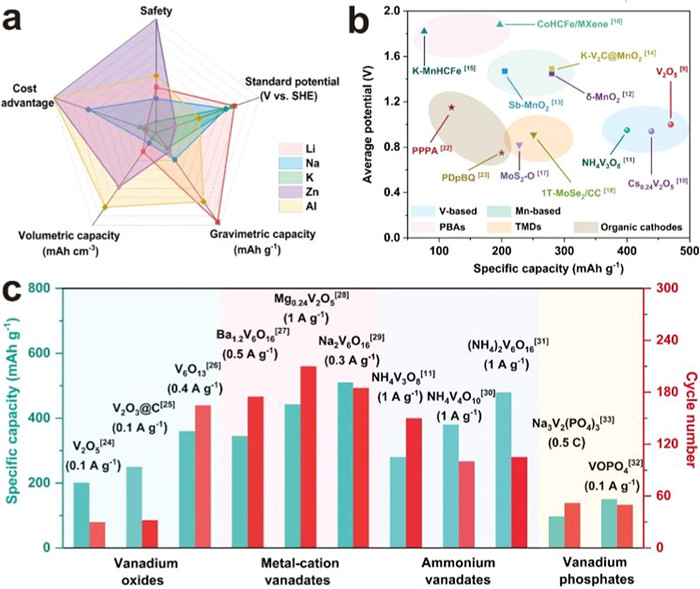
 DownLoad:
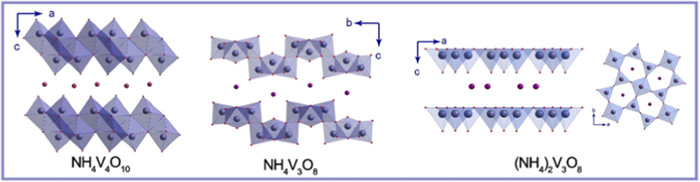
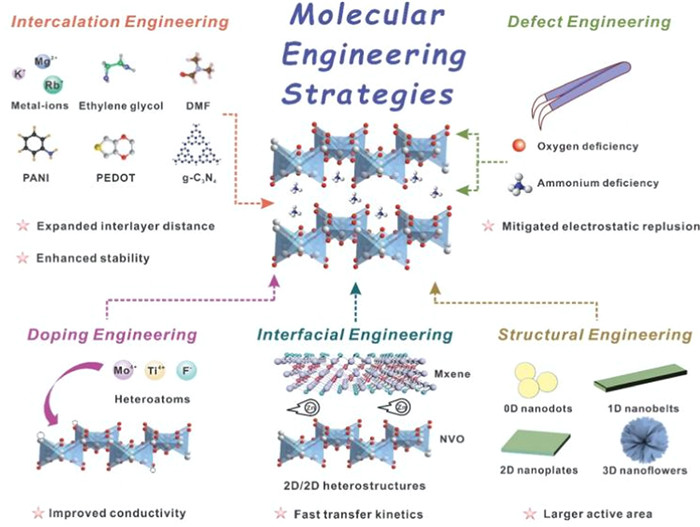
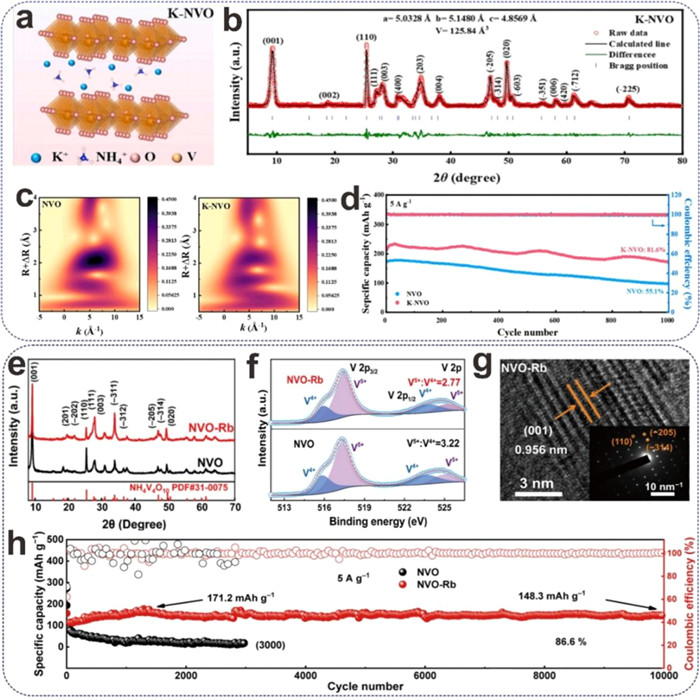
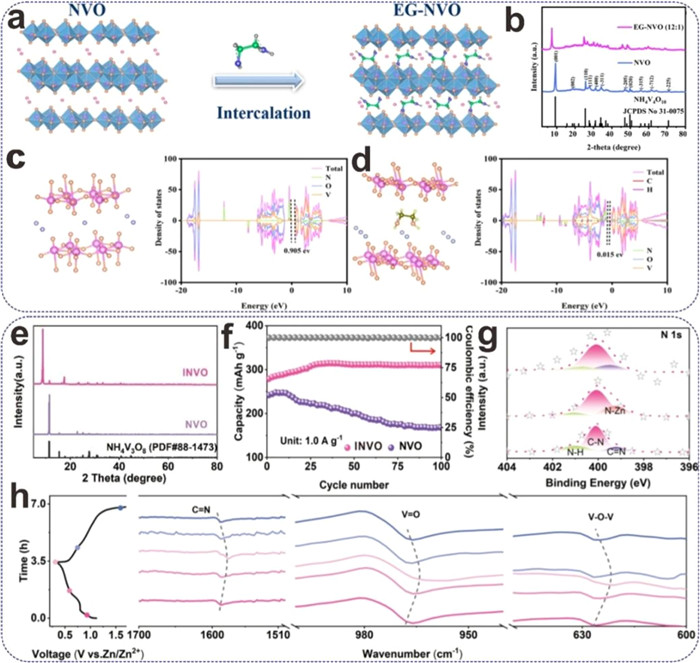
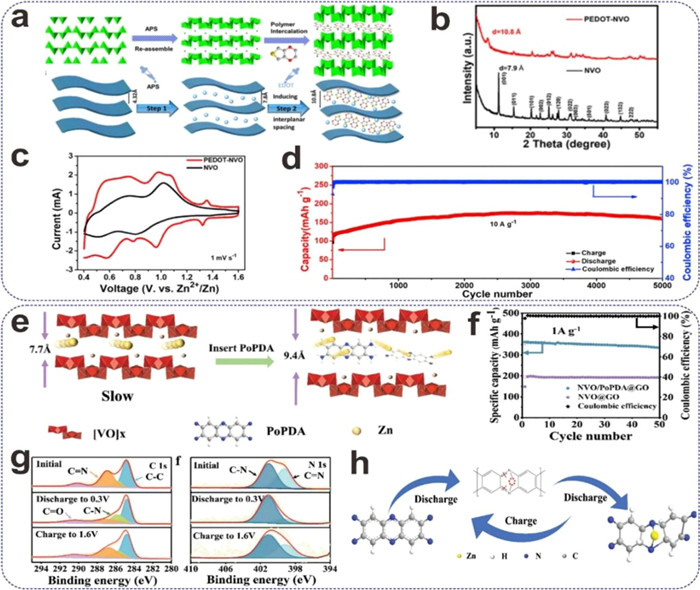
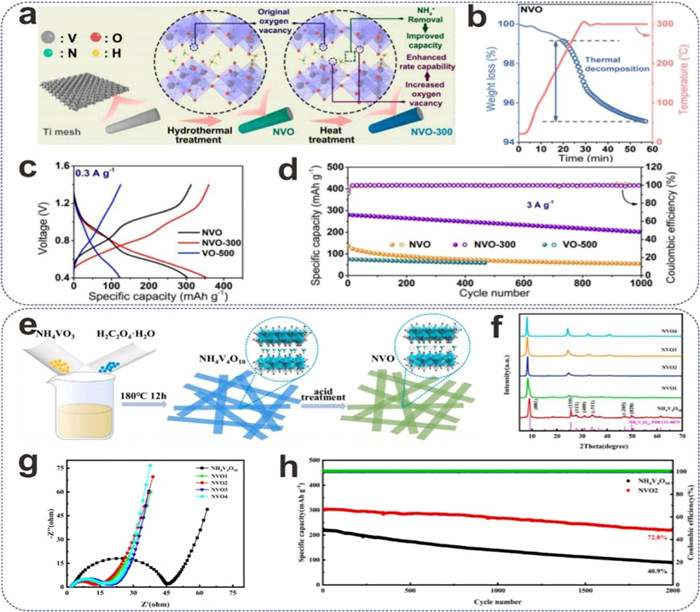
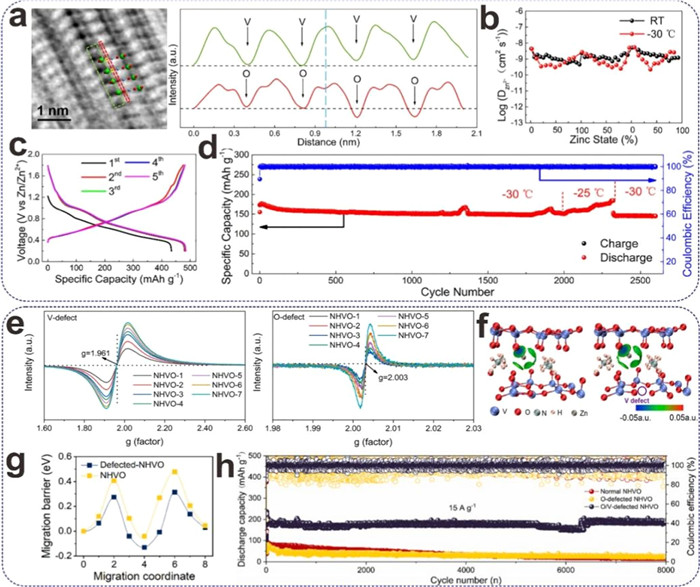
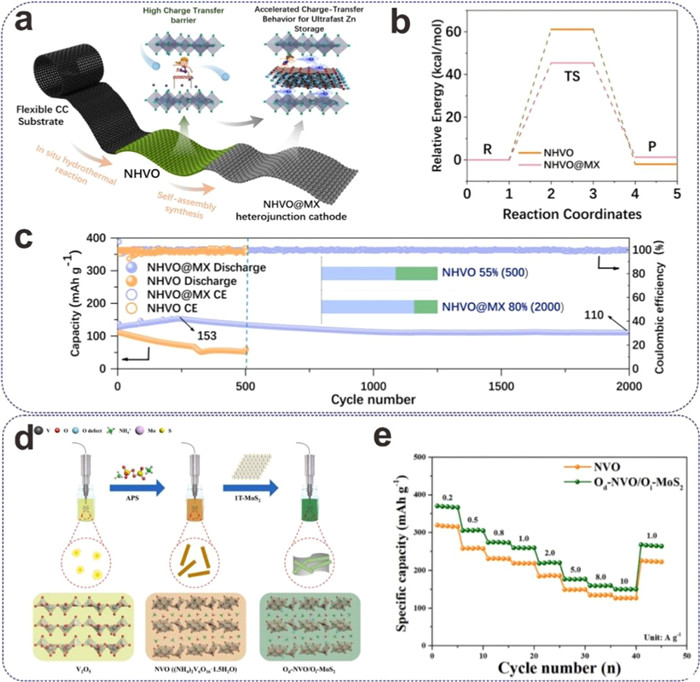
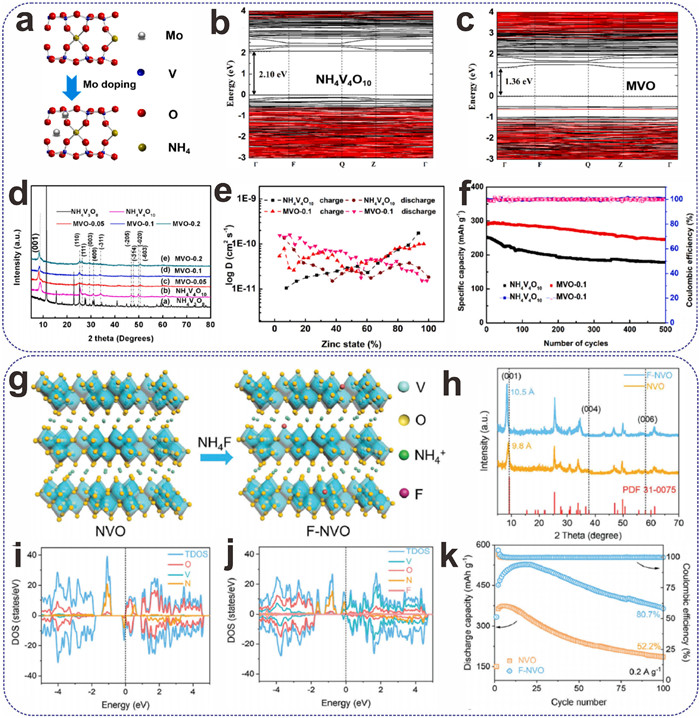
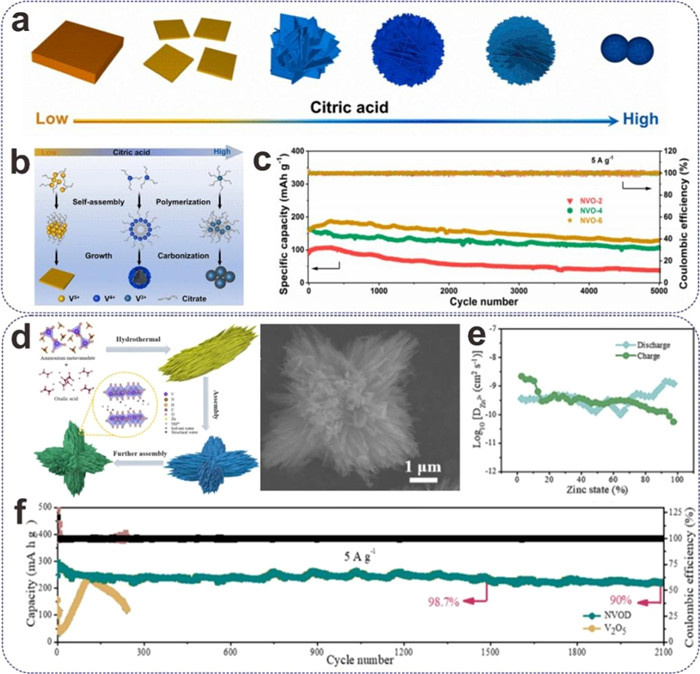
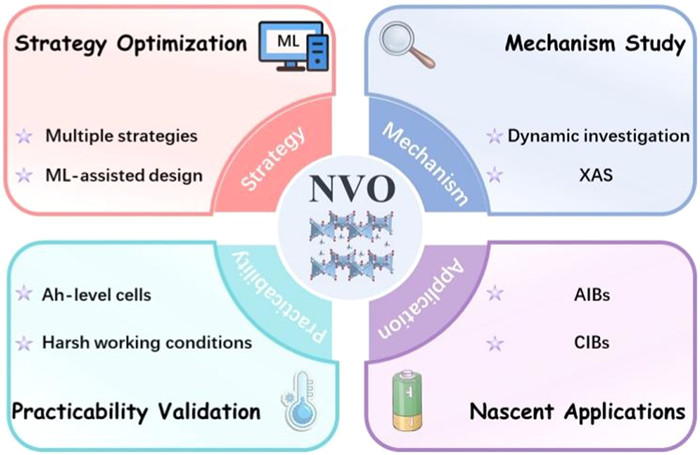

 下载:
下载:


 下载:
下载:

