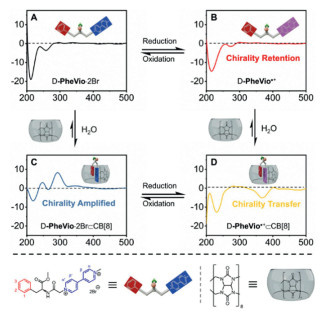
Figure 1.
CD signals of phenylalanine-modified viologen under variable conditions illustrating the switchable supramolecular chirality within CB[8] confinement.

Switchable supramolecular chirality of phenylalanine-modified viologen within cucurbit[8]uril confinement
Zhimin Sun , Shuo Guo , Jia-Qi Zhao , Ze-Qi Chen , Zhao-Xian Li , Chunju Li , He-Lue Sun


Chirality is one of the most essential characters in nature [1]. During the evolution of nature, l-amino acids and d-sugars have been selected as the main building blocks to construct living functional systems, such as proteins, DNA and RNA. As well known, molecules display significantly different behaviors in confined space rather than that in diluted solution [2]. The confined space plays important roles in living systems such as enzymic catalysis and transition of key substances [3,4]. Additionally, chirality can be induced and/or amplified within structurally confined environments, which are further utilized to regulate various biological processes [5,6]. A case in point is that the chaperonins, which have typical nano basket structures in vitro, can efficiently fold into three-dimensional functional structures in vivo and promote its biological functions [7,8]. Inspired from nature, artificial confined space, including molecular cages, metal-organic frameworks, covalent-organic frameworks, has been drawn increasing attention due to their outstanding behavior in the field of chiral catalysis, chiral amplified and chiral transition [9-16].
Macrocycle hosts, bearing a suitable cavity, provide an advantageous confined space. In the early stages, cyclodextrins and their derivatives, bearing chiral hydrophobic cavity, were widely investigated due to their potential applications in chiral catalysis, chiral sensing and chiral transition [17-20]. Recently, artificial chiral macrocycle host, represented by pillararene, have been chosen as important building blocks to construct chiral systems [21-24]. Notably, these macrocycle host are generally chiral or composed of chiral components. In contrast, cucurbit[n]urils (CB[n]s), featuring an inner hydrophobic cavity, are achiral and non-chromophoric host molecules, which cannot induce chirality directly. Specially, CB[8] is capable of forming ternary host-guest inclusion complex via charge-transfer (CT) interactions and radical pairing interactions [25-27]. In terms of this unique property of CB[8], the binary complex constructed by CB[8] and a cationic aromatic molecule can be used as a chirality sensor to detect series of neutral aromatic molecules, where ICD signals appeared spontaneously as a result of forming ternary complexes [28-30]. However, the mechanism of chirality amplification within CB[8] remains poorly understood.
With these in mind, herein, a supramolecular induced chiral amplification system was constructed via CB[8] and phenylalanine modified viologen derivative (d/l-PheVio⋅2Br). As shown in Fig. 1, an amplified ICD signal (phase C) was observed in the inclusion complex of d/l-PheVio⋅2Br⊂CB[8] due to the formation of a self-complex through CT interactions within the confined space of CB[8], which was fully charactered by UV–vis, 1H NMR and crystal experiments. Reduced by sodium dithionite (SDT), d/l-PheVio2+ converted to d/l-PheVio·+ (phase D), which lead to an unusual self-complex within CB[8] instead of the traditional 1:2 inclusion complex, giving significant various CD signals. Moreover, controlling the viologen redox state enables a reversible chiroptical switch, showcasing the potential of confined host-guest systems for dynamic chirality regulation.
By virtue of the fascinating redox responsive behavior towards optical [31-33], chemical [34-36] or electric stimuli [37,38], viologen has been widely investigated as guest molecules for CB[n]. Taking advantage of the CT interaction in the confined cavity, the binary inclusion of viologen derivatives⊂CB[8] can bind π-electron-rich molecules to form stable ternary complexes. Meanwhile, an amplificated chirality can be observed in the ternary complexes when chiral aromatic amino acid, such as phenylalanine, work as the second guest molecule. As shown in Fig. S1 (Supporting information), the guest molecule d/l-PheVio⋅2Br was synthesized via Menshutkin reaction [39] from d/l-1 and 1-methyl-4,4′-bipyridinium in a satisfactory yield without any tedious treatments, which was fully characterized by 1H NMR, 13C NMR and HR-ESI Mass spectrometry (Figs. S4-S9 in Supporting information).
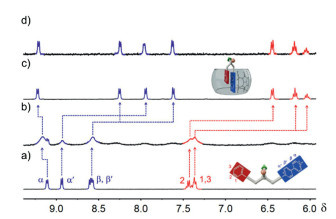
With the guest molecules d/l-PheVio⋅2Br in hand, the host-guest recognition behaviors with CB[8] were initially investigated. According to the Job's plot analysis of UV–vis spectral data (Fig. S12 in Supporting information), the complexation stoichiometry of d/l-PheVio⋅2Br and CB[8] should be 1:1 or n: n. The high-resolution electrospray ionization mass spectrometry was further conducted to confirm the stoichiometry. As displayed in Figs. S10 and S11 (Supporting information), the corresponding ion peak of d-PheVio⋅2Br⊂CB[8] was fortunately detected at 859.7907, which was calculated at 859.7905 for [M-2Br]2+/2. The similar observation was also found for l-PheVio⋅2Br⊂CB[8]. These results indicated d/l-PheVio⋅2Br and CB[8] formed 1:1 inclusion complex. The apparent binding constants (Ka) were calculated as 1.41 × 10⁷ and 1.84 × 10⁷ L/mol for the association of d/l-PheVio⋅2Br with CB[8] through the UV–vis titration data (Fig. S13 in Supporting information). To gain more information of the inclusion complex of d/l-PheVio⋅2Br⊂CB[8], 1H NMR titration tests were further carried out (Fig. 2). The α′, β, and β′ protons of bipyridinium and aromatic protons of phenylalanine shift upfield in various degrees with the addition of CB[8] (Figs. 2a-d), which hold consistent until the CB[8] reached equivalent to d-PheVio⋅2Br. Analogous upfield shifts of the corresponding protons were also observed in the complex l-PheVio⋅2Br⊂CB[8] (Fig. S14 in Supporting information). Moreover, the exchange between free and bound species was fast or intermediate on the NMR timescale, resulting in averaged or broadened signals that obscure the individual components (Fig. 2b). Combined these results together, it could be reasonably deduced that a stable d/l-PheVio⋅2Br⊂CB[8] was constructed in aqueous solution, in which the benzene moiety and the connected pyridinium formed a typical face-to-face π-π stacking in the cavity of CB[8].
Meanwhile, a character CT absorption peak was found at around 300 nm during analysis the UV–vis spectra (Fig. S15 in Supporting information), indicating a self-CT-complex of PheVio⋅2Br was formed in the cavity of CB[8] [40-43]. To gain further understanding of self-CT-complex in CB[8], cyclic voltammetry (CV) measurements were accomplished. d/l-PheVio⋅2Br with bipyridinium units can be characterized through two consecutive reversible one-electron reduction process [44], d/l-PheVio2++ e− ⇋ d/l-PheVio·+ + e− ⇋ d/l-PheVio. The first reduction process is electrochemically reversible; however, the second reduction process is not since uncharged fully reduced d/l-PheVio is insoluble in water [45]. Therefore, CV measurements of d/l-PheVio⋅2Br and d/l-PheVio⋅2Br⊂CB[8] were carried out from 0 to −0.8 V with regard to characterize the first one-electron reduction process. Voltammograms of d/l-PheVio⋅2Br exhibited a single reduction process with a half wave potential at −583 mV vs. Ag/AgCl, which related to the first reduction of d/l-PheVio⋅2Br (Fig. S16 in Supporting information). In the presence of CB[8], the half wave potentials for the first reduction process displayed a 65 mV anodic shift to −518 mV as a result of positive electrostatic cooperativity (Fig. S16). The formation of the self-CT-complex, d/l-PheVio⋅2Br, inside of the cavity of CB[8] mitigate intermolecular electrostatic repulsion of bipyridinium units [46,47].
Generally, the 1:1 host-guest complex, d/l-PheVio⋅2Br⊂CB[8], can be obtained with the guest molecule formed as a self-CT-complex within the cavity of CB[8] according to the aforementioned experimental analyses. The results agree with the fact that CB[8] possesses a highly negative and uniform electrostatic potential cavity, which stabilizes donor-acceptor CT interactions. As the confirmation of the host-guest complex, d/l-PheVio⋅2Br⊂CB[8], formation, which necessitates further analysis of the induced chirality amplification due to the supramolecular confinement effects of CB[8].
CD spectroscopy, a commonly used tool to analyze the chirality and optical activity of chiral molecules [48], were conducted to investigate the induced chirality of d/l-PheVio⋅2Br and d/l-PheVio⋅2Br⊂CB[8]. As displayed in Fig. 3a, free d/l-PheVio⋅2Br gave an obvious nonbisignate Cotton effects at 213 nm, which was assigned to chiral phenylalaninate unit of PheVio⋅2Br. Distinctively, the host-guest complex, d-PheVio⋅2Br⊂CB[8], displayed two positive Cotton effects at 290 and 246 nm, whereas a mirrored spectrum was observed for that of l-PheVio⋅2Br⊂CB[8]. Regarding the fact that the d/l-PheVio⋅2Br formed self-CT complex in the confined cavity of CB[8], these amplified ICD signals should be attributed to chirality transfer from chiral amino acids to self-CT complex within the steric constraints of CB[8]. Furthermore, variable temperature experiments were managed to reveal thermal stability of the induced chirality. There is basically no change in CD spectra of d/l-PheVio⋅2Br⊂CB[8] from 298 K to 358 K, suggesting that the host-guest induced chirality of d/l-PheVio⋅2Br⊂CB[8] was thermodynamic stable (Fig. S17 in Supporting information).
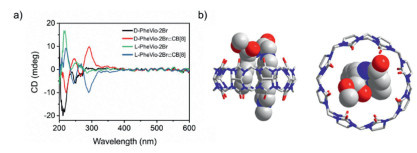
Fortunately, the X-ray crystal structure of d-PheVio⊂CB[8] were obtained to give direct structural evidence of induced chirality amplification based on the chiral self-CT-complex. As shown in Fig. 3b, the guest molecule, d-PheVio⋅2PF6, is completely encapsulated within the cavity of CB[8] to form the host-guest complex. Meanwhile, the configuration of d-PheVio⋅2PF6 (Fig. 3b) indicates that the formation of typical self-CT-complex between π-electron-deficient viologen moiety and π-electron-rich aromatic ring of phenylalanine moiety. Critically, the amplified ICD signals arise from effective chirality transfer between viologen and chiral phenylalanine moieties of the self-CT-complex in steric crowding confinement of CB[8].
The redox responsive ability of host-guest complex was further investigated by CD and UV–vis spectroscopic experiments. The reduction of d/l-PheVio⋅2Br⊂CB[8] was achieved with addition of SDT as a reductant agent. UV–vis absorption spectra were measured for a 1 × 10⁻⁴ mol/L aqueous solution of d/l-PheVio⋅2Br⊂CB[8] and revealed characteristic absorption bands at 400 and 600 nm, which indicated the formation of radical cations of bipyridinium units (Fig. 4) [32,49,50]. It is worth noting that no characteristic absorption bands in 800–1000 nm region for dimeric radical cations were observed (Fig. S18 in Supporting information) [51,52]. EPR spectroscopic measurements of the aqueous solution d/l-PheVio⋅2Br⊂CB[8] after reduction by SDT displayed resonance signals corresponding to the unpaired electron of bipyridinium radical cations (Fig. S19 in Supporting information).
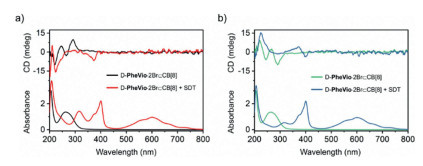
Thereafter, CD spectroscopic analyses for the reduced d/l-PheVio⋅2Br⊂CB[8] were uncovered. As shown in Fig. 4a, the host-guest ICD signals of d-PheVio⋅2Br⊂CB[8] at 246 and 290 nm vanished following the addition of SDT, whereas two negative nonbisignate Cotton effects at 224 and 370 nm were observed, which were assigned to phenylalaninate and bipyridinium radical cations respectively. Similar phenomena were also observed for the reduced l-PheVio⋅2Br⊂CB[8] (Fig. 4b). The CD spectra of solutions containing the guest molecule d/l-PheVio·2Br following reduction with SDT exhibited only negative/positive non-bisignate Cotton effects at 219 nm, with no CD signals observed around 400 nm in contrast to the d-PheVio2+⊂CB[8] complex (Fig. S20 in Supporting information). These observations indicate that the radical cations are encapsulated within the cavity of CB[8] after the chemical reduction, and CB[8] maintains chiral interactions between the radical cations of viologen and the phenylalaninate moiety to complete the chiral transfer. With the formation of bipyridinium radical cations, the self-complex of d/l-PheVio⋅2Br⊂CB[8] through CT interactions in CB[8] was disassociated. The theoretical calculations of the complex d/l-PheVio⋅2Br⊂CB[8] and its corresponding radical cations were also carried out. Based on the optimized structure of d-PheVio2+⊂CB[8], the stimulated CD spectrum (Figs. S22 and S23 in Supporting information) is agreement with the experimental result. Molecular orbital (MO) calculations (Fig. S24 in Supporting information) indicate that typical CT interactions between viologen and the aromatic ring of the phenylalanine moiety would be diminished when the radical cation formed.
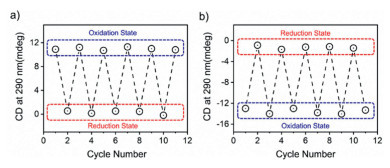
As previously noted, d/l-PheVio⋅2Br allowed to display the complexation induced chirality amplification within the cavity of CB[8] via host-guest interactions, which achieved the chirality transfer with the chemical reduction. Therefore, it was primary to investigate the reversibility of the redox-driven chirality transfer process. CD spectroscopic analyses were conducted for sequentially reducing via introducing SDT and oxidizing via purging air a 1 × 10⁻⁴ mol/L solution of d/l-PheVio⋅2Br⊂CB[8]. To our delight, d/l-PheVio⋅2Br⊂CB[8] exhibited excellent reversibility and repetitiveness of redox-switchable processes (Fig. 5 and Fig. S21 in Supporting information).
In conclusion, we have developed a CB[8]-based supramolecular system that achieved confinement-induced chirality amplification and redox-responsive chiral switching. The 1:1 host-guest complex utilizes intramolecular CT interactions of the phenylalanine-modified viologen to transfer chiral information from phenylalanine moiety to viologen unit within the CB[8] cavity, generating distinct amplified ICD signals, which are unambiguously validated by single-crystal X-ray diffraction analysis. Notably, upon chemical reduction, the ICD signals vanish concomitantly with the emergence of unusual CD signals of viologen radical cations, demonstrating chirality transfer enabled by the CB[8] confinement. The system undergoes exceptional reversible redox-driven transitions, highlighting the dynamic control over supramolecular chirality through external stimuli. Overall, this work underscores the role of confined environments in supramolecular chirality generation and provides a viable strategy for designing dynamic chiral materials with potential applications in stimuli-responsive chiral recognition.
The authors declare that they have no known competing financial interests or personal relationships that could have appeared to influence the work reported in this paper.
Zhimin Sun: Writing – original draft, Funding acquisition, Formal analysis. Shuo Guo: Formal analysis, Data curation. Jia-Qi Zhao: Data curation. Ze-Qi Chen: Data curation. Zhao-Xian Li: Writing – original draft, Investigation, Data curation. Chunju Li: Conceptualization. He-Lue Sun: Writing – review & editing, Writing – original draft, Funding acquisition, Formal analysis, Conceptualization.
We acknowledge the financial support of the National Natural Science Foundation of China (No. 22471057), Natural Science Foundation of Hebei Province (Nos. 226Z1501G, B2024205039). We also gratefully acknowledge the support from the National Demonstration Center for Experimental Chemistry Education of Hebei Normal University.
Supplementary material associated with this article can be found, in the online version, at doi:
M. Liu, L. Zhang, T. Wang, Chem. Rev. 115 (2015) 7304–7397. doi: 10.1021/cr500671p
J. Rebek, Jr., Acc. Chem. Res. 42 (2009) 1660–1668. doi: 10.1021/ar9001203
A. Küchler, M. Yoshimoto, S. Luginbühl, F. Mavelli, P. Walde, Nat. Nanotechnol. 11 (2016) 409–420. doi: 10.1038/nnano.2016.54
I.J. Minten, V.I. Claessen, K. Blank, et al., Chem. Sci. 2 (2011) 358–362. doi: 10.1039/C0SC00407C
B. Ma, A. Bianco, Nat. Rev. Mater. 8 (2023) 403–413. doi: 10.1038/s41578-023-00561-1
Q. Sallembien, L. Bouteiller, J. Crassous, M. Raynal, Chem. Soc. Rev. 51 (2022) 3436–3476. doi: 10.1039/d1cs01179k
J. Frydman, F.U. Hartl, Science 272 (1996) 1497–1502. doi: 10.1126/science.272.5267.1497
A.M. Slavotinek, L.G. Biesecker, Trends Genet. 17 (2001) 528–535. doi: 10.1016/S0168-9525(01)02413-1
J. Gao, G. Ouyang, P. Zhou, et al., J. Am. Chem. Soc. 146 (2024) 18104–18116. doi: 10.1021/jacs.4c05141
Q. -Q. Wang, Acc. Chem. Res. 57 (2024) 3227–3240. doi: 10.1021/acs.accounts.4c00583
J. Dong, Y. Liu, Y. Cui, Acc. Chem. Res. 54 (2021) 194–206. doi: 10.1021/acs.accounts.0c00604
X. Wu, X. Han, Q. Xu, et al., J. Am. Chem. Soc. 141 (2019) 7081–7089. doi: 10.1021/jacs.9b02153
B. Hou, S. Yang, K. Yang, et al., Angew. Chem. Int. Ed. 60 (2021) 6086–6093. doi: 10.1002/anie.202013926
S. Guo, L.Y. Hu, Q.Y. Meng, et al., J. Colloid Interface Sci. 657 (2024) 913–920. doi: 10.1016/j.jcis.2023.12.052
Z. Sun, X.H. Guo, Y. Zhao, et al., Chin. Chem. Lett. 35 (2024) 109162. doi: 10.1016/j.cclet.2023.109162
C. Yang, Chin. Chem. Lett. 24 (2013) 437–441. doi: 10.1016/j.cclet.2013.03.028
M. Otagiri, K. Ikeda, K. Uekama, O. Ito, M. Hatano, Chem. Lett. 3 (1974) 679–682. doi: 10.1246/cl.1974.679
S. Takenaka, N. Matsuura, N. Tokura, Tetrahedron Lett. 15 (1974) 2325–2328. doi: 10.1016/S0040-4039(01)92246-4
L. Chen, Y. Chen, Y. Zhang, Y. Liu, Angew. Chem. Int. Ed. 60 (2021) 7654–7658. doi: 10.1002/anie.202017001
K. Kano, H. Hasegawa, J. Am. Chem. Soc. 123 (2001) 10616–10627. doi: 10.1021/ja0112644
H. Zhu, Q. Li, Z. Gao, et al., Angew. Chem. Int. Ed. 59 (2020) 10868–10872. doi: 10.1002/anie.202001680
J. Ji, Y. Li, C. Xiao, et al., Chem. Commun. 56 (2020) 161–164. doi: 10.1039/c9cc08541f
J. Ji, X. Wei, W. Wu, et al., J. Am. Chem. Soc. 144 (2022) 1455–1463. doi: 10.1021/jacs.1c13210
C.T. Yang, D.D. Wang, S. Chen, et al., Chin. Chem. Lett. 36 (2025) 110820. doi: 10.1016/j.cclet.2025.110820
W.S. Jeon, A.Y. Ziganshina, J.W. Lee, et al., Angew. Chem. Int. Ed. 42 (2003) 4097–4100. doi: 10.1002/anie.200351925
C. Hu, F. Tian, Y. Zheng, et al., Chem. Sci. 6 (2015) 5303–5310. doi: 10.1039/C5SC01496D
S.J. Barrow, S. Kasera, M.J. Rowland, J. del Barrio, O.A. Scherman, Chem. Rev. 115 (2015) 12320–12406. doi: 10.1021/acs.chemrev.5b00341
F. Biedermann, W.M. Nau, Angew. Chem. Int. Ed. 53 (2014) 5694–5699. doi: 10.1002/anie.201400718
G. Ghale, W.M. Nau, Acc. Chem. Res. 47 (2014) 2150–2159. doi: 10.1021/ar500116d
L. Mao, S. Li, X. Zhang, Z.T. Li, D. Ma, Chin. Chem. Lett. 35 (2024) 109363.
Y. Orimoto, K. Ishimoto, Y. Aoki, J. Phys. Chem. C 122 (2018) 4546–4556. doi: 10.1021/acs.jpcc.7b10281
Y. Yang, G. Wang, K. Li, et al., Chin. Chem. Lett., 36 (2025) 110123. doi: 10.1016/j.cclet.2024.110123
X. Li, J. Yang, Y.W. Yang, Mater. Chem. Front. 7 (2023) 1463–1481. doi: 10.1039/d3qm00151b
X. Zhang, C. Peng, J. Jiang, Small 20 (2024) 2401651. doi: 10.1002/smll.202401651
J.C. Barnes, E.J. Dale, A. Prokofjevs, et al., J. Am. Chem. Soc. 137 (2015) 2392–2399. doi: 10.1021/ja512959g
S. Dhiman, K. Jalani, S.J. George, ACS Appl. Mater. Interfaces 12 (2020) 5259–5264. doi: 10.1021/acsami.9b17481
K. Madasamy, D. Velayutham, V. Suryanarayanan, M. Kathiresan, K.C. Ho, J. Mater. Chem. C 7 (2019) 4622–4637. doi: 10.1039/c9tc00416e
L. Cao, G. Fang, Y. Wang, Langmuir 33 (2017) 980–987. doi: 10.1021/acs.langmuir.6b04317
N. Menschutkin, Z. Phys. Chem. 5 (1890) 589–600. doi: 10.1515/zpch-1890-0546
A. Das, S. Ghosh, Angew. Chem. Int. Ed. 53 (2014) 2038–2054. doi: 10.1002/anie.201307756
M. Asakawa, W. Dehaen, G. L'Abbé, et al., J. Org. Chem. 61 (1996) 9591–9595.
F. Biedermann, O.A. Scherman, J. Phys. Chem. B 116 (2012) 2842–2849. doi: 10.1021/jp2110067
H.J. Kim, J. Heo, W.S. Jeon, et al., Angew. Chem. Int. Ed. 40 (2001) 1526–1529. doi: 10.1002/1521-3773(20010417)40:8<1526::AID-ANIE1526>3.0.CO;2-T
P.L. Anelli, P.R. Ashton, R. Ballardini, et al., J. Am. Chem. Soc. 114 (1992) 193–218. doi: 10.1021/ja00027a027
M. Bria, G. Cooke, A. Cooper, et al., Tetrahedron Lett. 48 (2007) 301–304.
Y. Nambu, K. Yamamoto, T. Endo, J. Chem. Soc., Chem. Commun. (1986) 574–576.
J.W. Park, N.H. Choi, J.H. Kim, J. Phys. Chem. 100 (1996) 769–774.
H.H. Jo, C.Y. Lin, E.V. Anslyn, Acc. Chem. Res. 47 (2014) 2212–2221. doi: 10.1021/ar500147x
J. Zhou, S. Hou, J. Zhang, et al., Chin. Chem. Lett. 32 (2021) 725–728.
Z. Sun, Y. Ni, T. Prakasam, et al., Chem. Eur. J. 27 (2021) 9360–9371. doi: 10.1002/chem.202100601
X.H. Zhou, Y. Fan, W.X. Li, et al., Chin. Chem. Lett. 31 (2020) 1757–1767.
C.K. Lee, C. Gangadharappa, A.C. Fahrenbach, D.J. Kim, Adv. Mater. 36 (2024) 2408271.

Figure 1 CD signals of phenylalanine-modified viologen under variable conditions illustrating the switchable supramolecular chirality within CB[8] confinement.

Figure 2 Partial 1H NMR spectra of d-PheVio⋅2Br with (a) 0 equiv., (b) 0.5 equiv., (c) 1.0 equiv. and (d) 1.5 equiv. of CB[8]. [d-PheVio⋅2Br] = 1 × 10⁻³ mol/L, 400 MHz, D2O, 298 K.

Figure 3 (a) CD spectra of d/l-PheVio⋅2Br (1 × 10⁻⁴ mol/L) and d/l-PheVio⋅2Br⊂CB[8] (1 × 10⁻⁴ mol/L) in H2O at 298 K. (b) Crystal structure of the d-PheVio⋅2PF6⊂CB[8] complex. Hydrogen atoms and counterions have been omitted for clarity.

Figure 4 (a) CD and UV–vis spectra of d-PheVio⋅2Br⊂CB[8] (1 × 10⁻⁴ mol/L) and d-PheVio⋅2Br⊂CB[8] (1 × 10⁻⁴ mol/L) after adding SDT as a reductant in H2O at 298 K. (b) CD and UV–vis spectra of l-PheVio⋅2Br⊂CB[8] (1 × 10⁻⁴ mol/L) and l-PheVio⋅2Br⊂CB[8] (1 × 10⁻⁴ mol/L) after adding SDT as a reductant in H2O at 298 K.

 扫一扫看文章


扫一扫关注我们
 DownLoad:
 下载:
下载:

 下载:
下载: