Received Date:
06 July 2025 Accepted Date:
08 September 2025 Revised Date:
21 August 2025 Available Online:
15 November 2026
Abstract:
Achieving high negative Poisson’s ratios (NPR) in atomically thin materials remains a fundamental challenge, yet critical for next-generation impact-resistant metamaterials and flexible electronics. However, achieving high NPR values in two-dimensional (2D) systems remains fundamentally challenging. Herein, we report a systematic computational exploration of NPR phenomena in monolayer M2C MXenes (M = Sc, Ti, Zr, V, Nb, Ta, Mo), revealing an electronic hybridization-driven auxetic mechanism in Mo2C (υ = -0.11) distinct from geometric re-entrant paradigms. Through transition metal doping, we achieve unprecedented NPR enhancement, Re-doped Mo2C attains an ultrahigh υ = -0.59, representing a 5-fold improvement and setting a new benchmark for 2D auxetics. Crucially, these engineered systems concurrently exhibit exceptional hydrogen evolution reaction (HER) catalytic activity, with Ni-doped Mo2C (3.13%) achieving a near-ideal ΔG*H of -0.06 eV, surpassing platinum’s performance. Orbital reconstruction and electronic redistribution synergistically enable dual-functionality: NPR amplification and catalytic optimization within a single material platform. We propose doped MXenes as a universal design paradigm for multifunctional metamaterials, simultaneously addressing mechanical resilience and sustainable energy conversion.
Poisson's ratio (PR, υ) and Young's modulus (YM) are the key physical parameters of material mechanical characterization [1-4]. While conventional materials exhibit positive Poisson's ratios (PPR, υ > 0), auxetic materials with negative Poisson's ratios (NPR, υ < 0) display counterintuitive lateral expansion under tension [5]. Recent decades have witnessed growing interest in two-dimensional (2D) auxetics due to their potential in energy absorption [6-9], aerospace [10-13], and biomedical applications [14-16]. Breakthroughs in graphene [17], phosphorene [18], and transition metal dichalcogenides (TMDs) [19] have spurred exploration of 2D NPR phenomena. Quantum confinement effects in these atomically thin systems amplify emergent mechanical behaviors, enabling fundamental studies of auxetic mechanisms. Through sustained research advancements, experimental characterizations, and theoretical simulations have convergently confirmed intrinsic NPR effects in numerous 2D monolayers, including TiN [20] heets, Ag2S [21], Zn2C [22], SnSe [23], Be2C [24], as well as advanced systems like Be5C2 [25], WN4 [26], and R-Cu2Se [10]. Notably, non-geometric NPR has been observed in 1T-TMDs [19] where electron orbital quantum effects drive bond-angle adjustments. Beyond orbital hybridization, alternative strategies such as strain engineering [27], interfacial coupling [28], and phase transitions [29] have also demonstrated NPR tunability in 2D systems. Despite advances, most 2D auxetics suffer from modest NPR values (< −0.2) and lack multifunctionality—a key limitation for practical applications. Consequently, engineering 2D materials with enhanced NPR values and elucidating their fundamental origins remain central scientific challenges in this burgeoning field.
MXenes, a class of 2D transition metal (TM) carbides/nitrides, have emerged as promising candidates for auxetic engineering [30]. MXenes offer unprecedented tunability via TM doping, suggesting a unique platform to concurrently engineer auxeticity and catalytic activity through electronic reconstruction. Their general formula, Mn+1XnTx (n = 1 – 4), comprises early transition metals (M), carbon/nitrogen (X), and surface terminations (T = -F, -OH, or -O) [31]. Their unique combination of high conductivity, hydrophilicity, and tunable surface chemistry makes them ideal for applications in energy storage, sensors, and flexible electronics [32-34]. Critically, TM doping has been theoretically and experimentally exploited to modulate MXene properties, such as enhancing catalytic performance in Mo2CO2via Mn and Fe doping [35] or optimizing catalytic sites in Ti3C2Tx, though systematic NPR engineering remains unexplored. Wu et al. [36] first reported NPR behaviour in W2C MXenes in 2018. Subsequent studies hinted at doping-induced mechanical modulation (e.g., Mo2CO2’s strain-sensitive elasticity [35]), yet no prior work has achieved targeted NPR amplification via TM doping in MXenes. This knowledge gap underscores the critical need to systematically explore NPR phenomena across MXenes, which may provide fundamental insights for designing 2D materials with enhanced auxetic performance.
Through unbiased crystal structure prediction via particle swarm optimization (CALYPSO) coupled with first-principles calculations, we systematically identified seven thermodynamically stable M2C MXenes (M = Sc, Ti, Zr, V, Nb, Ta, Mo), with stability rigorously confirmed by cohesive energy analysis, phonon dispersion, and molecular dynamics simulations. Crucially, Mo2C exhibits a significant NPR (υ = −0.11) arising from strain-induced d-p orbital hybridization and anomalous bond-angle expansion, a mechanism transcending conventional geometric auxetic paradigms. Herein, we bridge the gap in MXene doping strategies by leveraging TM doping for NPR enhancement—a paradigm distinct from prior geometric/phase-transition approaches. TM doping enables precise electron-redistribution control over NPR modulation: Re-doped Mo2C achieves a landmark υ = −0.59 (5 × enhancement), while Co-Mo2C shows moderated improvement (υ = −0.14). Strikingly, Ni and Rh doping not only suppress NPR (υ = −0.06/−0.005) but concurrently optimize hydrogen adsorption energetics, with Ni-Mo2C reaching a near-ideal hydrogen evolution reaction (HER) ΔG*H (−0.06 eV). This work establishes that Re doping activates strain amplification via orbital reconstruction, while Ni doping redirects electronic states toward catalytic optimization, demonstrating a unified strategy for dual-function metamaterials. The engineered systems show exceptional promise for synergistic applications: Re-Mo2C in ultrarobust composites and sensitive strain sensors, and Ni-Mo2C as a platinum-surpassing electrocatalyst. No prior study has achieved simultaneous giant NPR amplification and platinum-surpassing catalysis in 2D materials via targeted doping.
First-principles density functional theory (DFT) [37,38] calculations were performed using the CASTEP [39,40] module within Materials Studio, employing the Perdew-Burke-Ernzerhof (PBE) via the generalized gradient approximation (GGA) exchange-correlation functional [41]. The computational parameters included a 450 eV plane-wave energy cutoff and a 19 × 19 × 5 k-point mesh. The convergence thresholds are strictly defined as follows [42]: Self-consistent field (SCF) tolerance of 5 × 10⁻⁷ eV/atom; maximum stress <0.02 GPa; maximum atomic displacement less than 5 × 10⁻⁴ Å; interatomic force <0.01 eV/Å; energy less than 5 × 10⁻⁶ eV/atom. The validity of these settings has been established through systematic benchmarking studies [43,44]. To address the underestimation of band gaps by the standard GGA functional, the hybrid functional (HSE06) [45] was utilized to better predict the band structures of the TM-Mo2C (TM = Ni, Re, Co, Rh) monolayer system. To ensure the consistency of the methodology, the structure of tungsten dicarbide (W2C), which is also an MXene material, has been optimized using the same DFT parameters [30]. As demonstrated in Table S1 (Supporting information), the calculated lattice parameters la = lb =2.87 Å and W-C bond length dM-C = 2.119 Å, which exhibit a high degree of agreement (deviation Δ < 0.5%) with published experimental and theoretical data [46], thereby substantiating the reliability of our computational framework. The calculation details for the elastic constants, YM, and PR are provided in Note S1 (Supporting information). The calculation details for phonon dispersion calculations and molecular dynamics simulations are provided in Note S2 (Supporting information). The specific structural prediction steps for the ground-state configuration of 2D carbides using the CALYPSO methodology are provided in Fig. S1 and Note S3 (Supporting information).
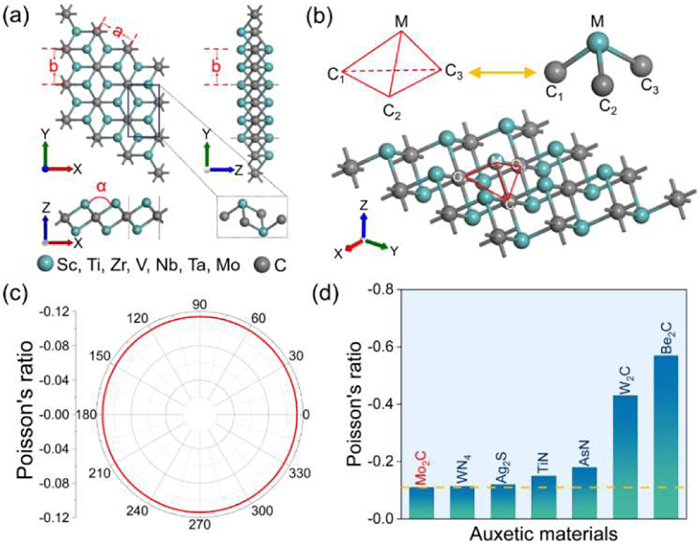
As depicted in Fig. 1a, the primitive unit cell of the M2C monolayer comprises two TM atoms (M = Sc, Ti, Zr, V, Nb, Ta, Mo) and one carbon atom, adopting an hcp layered configuration. The carbon atomic layer is intercalated between dual metal layers, characteristic of MXene architectures. Metal cations (Mo2+) exhibit distorted trigonal coordination with three carbon anions (C4-), yielding a Mo-C bond length of 2.11 Å. Each C4- anion coordinates six M2+ cations, forming edge-sharing M6C octahedra. Cross-sectional analysis reveals a zigzag corrugation pattern, simultaneously exhibiting both mirror symmetry (with m-plane perpendicular to the c-axis and c-glide plane) and centrosymmetry (space group P63/mmc). Fig. 1b illustrates the local symmetric atomic configuration governing NPR evolution, with critical geometric parameters (lattice constants a/b, angle α) quantified in Table S2 (Supporting information). For a detailed discussion on the stability of the M2C monolayer, please refer to Table S2, Note S4, Figs. S2 and S3 (Supporting information).
Figure 1
Figure 1.
(a) The views of the geometry structures of M2C (M = Sc, Ti, Zr, V, Nb, Ta, Mo). The coordination environments of the M atoms are presented in rectangular shapes with dashed lines. (b) Localized lattice morphology and atoms of M2C. (c) PR versus orientation for monolayer Mo2C. (d) Comparison of the NPR of monolayer Mo2C with other NPR structures in the literature.
The YM exhibits relatively low values in flexible materials (Fig. S4 in Supporting information). As demonstrated in the figures, both YM and PR of all M2C compounds display isotropic mechanical behaviour, indicating uniform elastic responses under multidirectional strain. The calculated YM values for M2C monolayers range from 88 N/m to 155 N/m (Table S3 in Supporting information), which is significantly lower than the values reported for graphene (335 N/m) and hexagonal boron nitride (BN). These results align with prior studies on 2D materials and validate our computational methodology. For instance, the calculated YM for graphene (335 N/m) closely matches reported theoretical predictions (332–334 N/m) [18,47], and experimental measurements (340 N/m) [48], ensuring methodological consistency. It is also notable that Mo2C exhibits a distinct NPR of −0.11 (Fig. 1c), which exceeds the values reported for borophene (υ = −0.053) [49] and PN (υ = −0.078) [50], and penta-graphene (υ = −0.068) [51], while remaining comparable to Ag2S (−0.12) [21], TiN monolayers (−0.15) [20], and WN4 (−0.114) (Fig. 1d) [26]. It is crucial to note that the emergent NPR in Mo2C deviates from conventional re-entrant mechanisms observed in isostructural M2C counterparts (e.g., Sc2C, Ti2C, Fig. S4b). This anomaly suggests a non-geometric origin, likely arising from strong d-p orbital hybridization. This phenomenon is analogous to the electronic effect-dominated NPR in 1T-TMDs. The selective manifestation of NPR among M2C systems with similar hybridization patterns provide critical insights into electronic modulation of auxetic behaviour, offering new design principles for tailoring mechanical metamaterials.
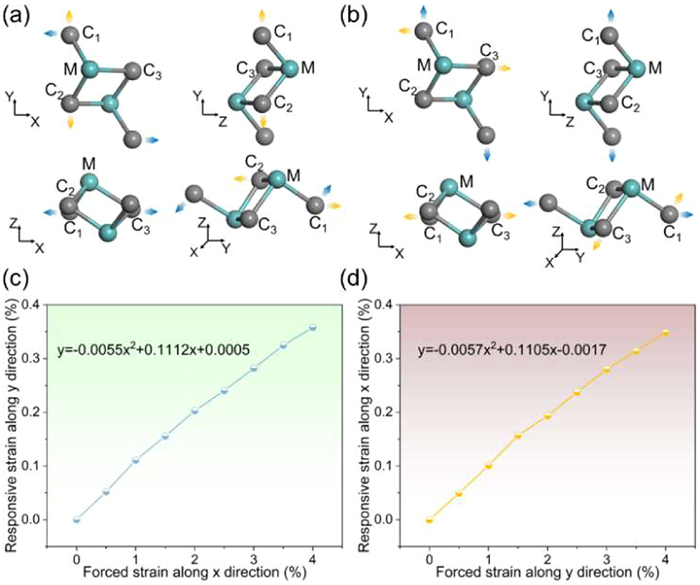
To unravel the origin of NPR in Mo2C, we propose a mechanistic framework based on the evolution of tetrahedral configurations formed by TM atoms (M) and carbon sites (C1, C2, C3) (Figs. 1b, 2a and b). The primordial unit of monolayer Mo2C contains two Mo atoms and one C atom, but due to symmetry, the displacement patterns of the two Mo atoms are equivalent. Therefore, the mechanistic interpretation of NPR can be understood by tracing the evolution of a tetrahedron consisting of C1, C2, C3, and Mo atoms. Tracking these tetrahedral distortions reveals the NPR mechanism: (1) x-direction strain (Fig. 2a): Applied tensile strain elongates the Mo-C1 bond (l1), increasing the ∠C1MoC2 angle (θ) and displacing C1/C2 atoms outward, thereby inducing lateral expansion. (2) y-direction strain (Fig. 2b): Similar tetrahedral flattening occurs, with C3 displacement elongating the C2-C3 distance (dC2-C3) and amplifying transverse deformation.
Figure 2
Figure 2.
Local atomic displacements corresponding to NPR along the (a) x and (b) y directions, respectively. Strain-driven mechanical response along the (c) x and (d) y directions, respectively. The blue and orange arrows indicate the strain-driven atomic displacements in compression and response, respectively.
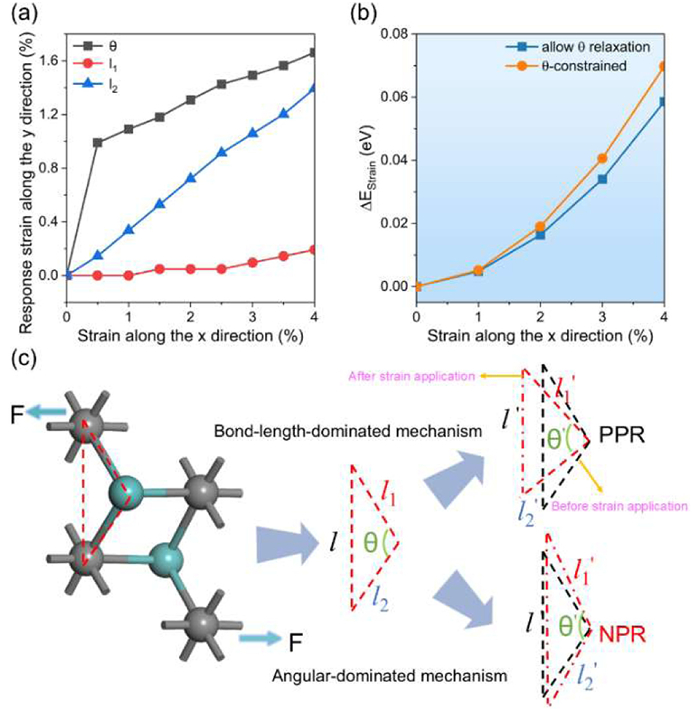
Critically, the Mo2C monolayer structure investigated here—with its auxetic properties—is a novel prediction from our CALYPSO-based structural search. Prior studies on MXenes (e.g., Wu et al. [36] on W2C) focused on geometric re-entrant mechanisms, but no literature has reported this specific Mo2C configuration or its electronic-driven NPR. Figs. 2c and d quantify the lattice parameter response to uniaxial strain, where PR (υ1 = − ∂ε1/∂ε2) is derived from the linear fit of ε1=−υ1ε2+υ2ε22+υ3. The intrinsic NPR values (υx = −0.111, υy = −0.110) align with elastic constant calculations, confirming auxetic behaviour. To clarify the novelty, we explicitly contrast our electronic mechanism with conventional geometric paradigms: Geometric mechanisms (e.g., in re-entrant honeycombs [9] or penta-graphene [51]) rely on hinged or rotating units that expand laterally under tension via rigid bond-angle changes, without electronic contributions. As illustrated in Fig. 3a, the geometric response of monolayer Mo2C under strain reveals an anomalous increase in the C1−Mo–C2 bond angle (θ), which contrasts with conventional materials. The electronic mechanism in Mo2C arises from strain-induced d-p orbital hybridization locking bond lengths, forcing anomalous bond-angle expansion, as schematically depicted in Fig. 3c. This quantum effect dominates over geometric adjustments, as evidenced by lower strain energy in angular-dominated modes (Fig. 3b). This distinction highlights a fundamental difference: Geometric NPR is structure-dependent, while electronic NPR stems from intrinsic orbital interactions, enabling tunability via doping. Similar non-geometric mechanisms have been reported in 1T-TMDs (driven by d-orbital rearrangements) [19] and TiN [20] monolayers (via charge redistribution), underscoring the generality of electronic-driven auxeticity beyond MXenes.
Figure 3
Figure 3.
(a) Geometric response driven by strain along the x-direction of the monolayer Mo2C, including bond length (l1 = dM-C1, l2 = dM-C2), characteristic angle (θ = ∠C1MC2). (b) ∆Estrain calculations for monolayer Mo2C were performed at different strains. The blue curve signifies the bond angle dominant mode, while the orange curve denotes the bond length dominant mode. (c) Two competing modes in the evolution of NPR include the bond-length-dominated mechanism and the angular-dominated mechanism.
To resolve this anomaly, we systematically compared strained geometric and electronic responses across M2C systems. Key parameters include: Bond lengths (l1 = dM-C1, l2 = dM-C2), characteristic angle (θ = ∠C1MC2) (Fig. S5 in Supporting information). Applying tensile strain to monolayer M2C results in significant changes to both characteristic lengths l1 and l2, demonstrating a dynamic structural response to mechanical deformation. Table S4 (Supporting information) also provides more detailed structural information of the M2C systems at different strains to provide a more adequate criterion to study the dynamic response of the structure to mechanical deformation. It is noteworthy that under identical crystallographic configurations, the C-Mo-C bond angle (θ) in monolayer Mo2C displays an anomalous increase along the x-strain direction (Fig. 3a), contrasting with a pronounced decrease in θ for other carbides under comparable deformation conditions (Fig. S6 in Supporting information). This counterintuitive angular modulation correlates with the behaviour of lattice expansion in monolayer Mo2C, directly contributing to the manifestation of NPR effects. The anomalous increase in the C-Mo-C bond angle (θ) under tensile strain in monolayer Mo2C suggests lattice deformation mechanisms distinct from conventional materials. This counterintuitive angular response, potentially linked to electronic structure modifications, induces lateral lattice expansion and ultimately manifests as a structure-independent NPR behaviour. To elucidate the underlying deformation modes, we propose two competing geometric scenarios (Fig. 3c): (1) A bond-length-dominated mechanism prioritizing interatomic distance adjustments over angular changes; (2) An angular-dominated mechanism favoring θ realignment before bond elongation. These modes exhibit opposing contributions to Poisson's ratio - the former conducive to PPR development, while the latter promotes NPR behaviour. Through systematic energy calculations under different strains (Fig. S7 in Supporting information), we demonstrate that monolayer Mo2C exhibits significantly lower strain energy (∆Estrain, ∆Estrain = Estrained − Eunstrained) when allowing θ relaxation (angular-dominated mode, Fig. 3b), indicating its inherent preference for angular adjustment. In contrast, other M2C compounds show minimal energy penalty under θ-constrained simulations, revealing bond-length-dominated deformation pathways (Figs. S7a-f). This fundamental difference in energy relaxation mechanisms directly accounts for the unique NPR phenomenon observed in Mo2C, angular reorientation enables efficient elastic energy dissipation through in-plane lattice expansion, overcoming the structural limitations of conventional metallic materials.
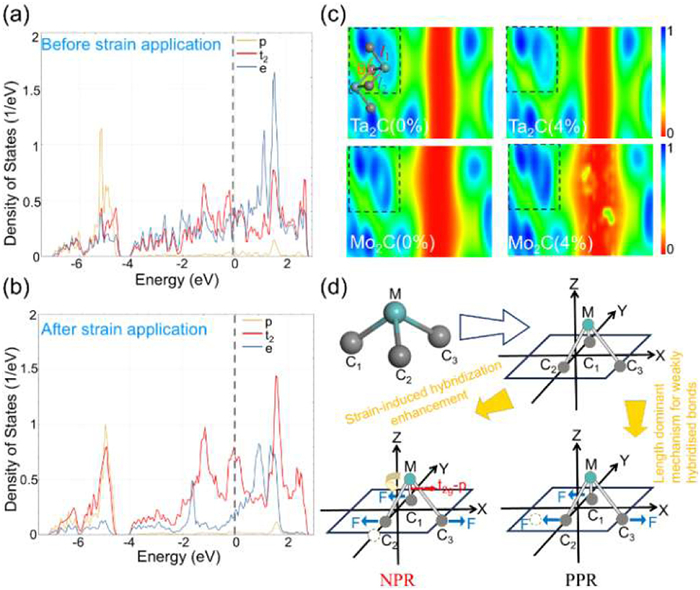
To further elucidate the origin of the novel NPR behaviour in monolayer M2C, we systematically investigate its fundamental electronic characteristics. As shown in Fig. 4, the projected density of states (PDOS) reveals that Mo's 4d orbitals split into two groups: t2 (dxy, dyz, dzx) and e (dx2−y2, dz2), with strong hybridization evident between Mo’s t2 orbitals and C's 2p orbitals near the Fermi level (Fig. 4a).
Figure 4
Figure 4.
(a) PDOS for Mo2C monolayer. (b) PDOS of the Mo2C monolayer after applying strain. The DOS shown in the figure are t2 (dxy
This pronounced orbital interaction distinguishes Mo2C from geometric auxetics. Under tensile strain, the electron cloud in the Mo-C bond region stretches along the z direction (ELF analysis, Fig. 4c), leading to sparser lateral density and Coulomb repulsion—an effect absent in bond-length-dominated systems like Ti2C or V2C. For comparative analysis, we examined the Nb2C monolayer with an analogous structure to Mo2C. Surprisingly, despite sharing structural similarity, Nb2C exhibits significantly weaker t2-p orbital hybridization in the −7∼ −4 eV range compared to Mo2C (Fig. S8e in Supporting information). Extending this investigation confirms Mo2C's uniqueness: Its NPR stems from synergistic static hybridization and dynamic strain-induced redistribution, whereas geometric mechanisms (e.g., in Ag2S [21] or Zn2C [22]) lack such electronic responsiveness. Such hybridization originates from substantial wavefunction overlap between layer-internal Mo d-orbitals and C p-orbitals, as visually demonstrated by electron localization functions (ELF) in Fig. 4c and Fig. S9 (Supporting information). The pronounced electron cloud overlap forms covalent bonds with enhanced electron sharing, contrasting sharply with other M2C compounds exhibiting minimal overlap. Crystal orbital Hamiltonian population (COHP) analysis further quantifies this covalency. The integrated COHP values at the Fermi level (values of −0.016 < −0.12 < −0.19 < −0.26 < −0.40 < −0.42 < −0.55 for Sc2C, Ti2C, Zr2C, V2C, Nb2C, Ta2C, and Mo2C, respectively, Fig. S10 in Supporting information) directly correlate with bond strength - higher negative values indicate stronger covalent interactions. To quantify the strength of the response of the intra-layer chemical bonding interactions upon application of stress, the integral crystal orbital Hamiltonian population (ICOHP) between M and C1 atoms was extracted (Fig. S11 in Supporting information). The ICOHP of monolayer Mo2C increases by > 7% for a 4% increase in strain, which is significantly faster than the ICOHP of monolayer Ta2C (no > 2%). The accelerated growth of the ICOHP suggests a heightened intralayer interaction response. This intrinsic covalent rigidity acts as a "pre-tensioned spring" mechanism, locking bond orientation and prioritizing angular adjustment during deformation. Indeed, Mo2C's distinct geometric response mode (Fig. S6) originates from this hybridization-induced energy landscape where bond length modification becomes energetically unfavorable. Under tensile strain, the electron cloud in the Mo-C bond region stretches along the z direction (ELF analysis), leading to the expansion of the hybridization region in the z direction (Fig. 4c). This extension breaks the symmetry of the original electron cloud distribution, resulting in a more inhomogeneous distribution of the electron cloud in the transverse direction (y-direction). This gradient change leads to a sparser electron density distribution in the lateral region, triggering localized electron repulsion. Strain-induced electron density gradient creates localized Coulomb repulsion (Fig. 4c), forcing lateral expansion to minimize energy. In contrast, other M2C compounds lacking such hybridization exhibit negligible electron redistribution capacity, favoring elastic deformation through bond length adjustment. This synergistic effect of strong static hybridization and dynamic strain-induced electronic reorganization ultimately enables Mo2C's unique NPR behaviour.
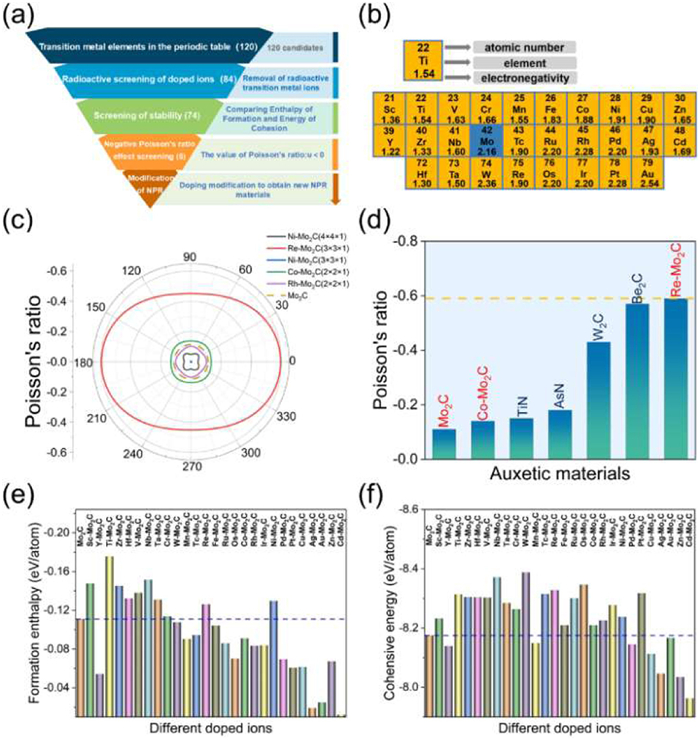
For the Mo2C monolayer, the NPR originates from the strong d-p orbital hybridization locking the bond lengths, followed by strain-induced electron redistribution leading to enhanced hybridization, forcing the strain energy to be released through the anomalous increase of the bond angle, triggering the in-plane transverse expansion. Therefore, it is promising to devise strategies to alter the electron distribution in Mo2C monolayers to design new NPR materials. Additionally, the NPR value of monolayer Mo2C remains inferior to the NPR structures documented in the literature (Fig. 1d). Consequently, efforts can be made to modulate the NPR value of monolayer Mo2C through existing material modifications. In advanced materials design, TM doping has become a central means of modulating properties such as spin transport, photoelectric response, and catalytic activity, and the study of its mechanism provides a theoretical basis for the design of next-generation functional materials. Here, we consider substitutional atom doping and select 27 major TM atoms from the periodic table (Figs. 5a and b) to replace the Mo atoms in the Mo2C monolayer (The employment of Hg metal as a TM dopant is deemed unfeasible due to its liquid state, high toxicity, and chemical instability. Moreover, it has been determined that the elements Rf, Db, Sg, Bh, and Hs should be ruled out as candidates for TM doping due to their inherent radioactivity). Three different doping concentrations were considered, where a Mo atom in a 4 × 4 × 1 (32 Mo, 16 C), 3 × 3 × 1 (18 Mo, 9 C), and 2 × 2 × 1 (8 Mo, 4 C) Mo2C supercell was replaced by one of the major 28 TM atoms. The corresponding TM doping concentrations at different Mo2C supercells were 3.13% (1/32), 5.56% (1/18), and 12.5% (1/8), respectively. To assess the difficulty of doping, the formation energy after doping was judged by calculating the formation energy after doping, with larger absolute values implying easier doping ability. Therefore, we calculated the formation energies of each of the 27 TM atoms at three different doping concentrations (Fig. 5e and Fig. S12 in Supporting information). The formation energies (ΔEf′)were calculated by the following equation [44]:
Figure 5.
(a) Multi-level screening computational workflow to screen materials for high stability and NPR for Mo2C doping systems. (b) Periodic table of elements with doped metal atoms, Mo, and doped TM atoms marked in dark blue and orange, respectively. (c) NPR of TM-doped Mo2C monolayer as a function of orientation. (d) Comparison of monolayer Mo2C doped modified NPR with other NPR structures in the literature. (e) Calculated formation energy for the Mo2C system with a selected doping concentration of 5.56% (3 × 3 × 1). (e) Calculated cohesion energy for selected Mo2C systems with a doping concentration of 5.56% (3 × 3 × 1).
where Edoped and EMo2C denote the total energies of the TM-doped Mo2C and freestanding Mo2C, respectively; while ΔETM=ETMfree−EMohostrepresents the difference between the potential energy of TM atoms in the free state and the potential energy of Mo atoms in Mo2C, and Ntotal represents the total number of atoms in the system, respectively. The formation energies of pristine Mo2C at the three doping concentrations are −0.06 eV (3.13%), −0.11 eV (5.56%), and −0.10 eV (12.5%), respectively, and the absolute values of the doped formation energies are higher than those of the pristine Mo2C implying that they show good doping ability for the Mo2C monolayer system (Fig. 5e and Fig. S12). In addition, the cohesive energy of the crystals, which reflects the stability of the crystal structure, was calculated. The larger the absolute value of the cohesion energy, the more stable the crystal structure is. The formation energies (Ecoh′)were calculated by the following equation [44]:
where Etotal is the total energy of the doped system, nMo, nC, is the number of atoms of Mo and C, Eatom,Mo, Eatom,C, Eatom,TM is the potential energy of isolated Mo, C and TM atoms and Ntotal represents the total number of atoms in the system. According to the calculation, the undoped Mo2C monolayer shows a stable crystal structure with cohesive energies of −8.20 eV (3.13%), −8.18 eV (5.56%), and −8.16 eV (12.5%) at three doping concentrations, respectively. When the absolute value of the doped cohesive energy is smaller than that of the original Mo2C monolayer, the structure is considered unstable due to the large lattice distortion. Therefore, after stability screening, 20 (3.13%), 19(5.56%), and 15 (12.5%) stable doping systems were selected as potential candidates for NPR materials based on Mo2C monolayers, respectively (Fig. 5f and Fig. S12).
Importantly, after final calculations, we found that five doping systems (3.13% Ni-Mo2C, 5.56% Re-Mo2C, 5.56% Ni-Mo2C, 12.5% Co-Mo2C, and 12.5% Rh-Mo2C) retained the NPR effect, and Re-Mo2C and Co-Mo2C showed −0.59 and −0.14, respectively, of the enhanced NPR effects (Fig. 5c and Table S5 in Supporting information). Among them, surprisingly, the NPR of 5.56% Re-Mo2C is as high as −0.59, which is a significant 5-fold enhancement over pristine Mo2C (−0.11), whereas 12.5% Co-Mo2C (−0.14) vs. 12.5% Rh-Mo2C (−0.10) exhibits a tunable mechanical response property. The rest of the doped systems, on the other hand, resulted in the disappearance of the NPR phenomenon in the doped TM-Mo2C. This finding validates the previously proposed strategy that TM doping can preserve and amplify the NPR effect through electronic recombination, while potentially abolishing it.
To ensure the structural stability of the five doped systems with NPR behaviour, we investigated the stability of TM-modified Mo2C at 300 K using MD simulations at 10 ps (Fig. S13 in Supporting information). It can be seen that no obvious structural remodeling or metal migration occurs, and the energy oscillates slightly around the equilibrium after the simulation, indicating that the TM-modified Mo2C has a high thermodynamic stability.
The computational design of TM-doped Mo2C (Re: 5.56%, Ni: 3.13%, Co/Rh: 12.5%) demonstrates thermodynamic viability, yet practical synthesizability warrants contextualization. Recent advances in MXene doping provide encouraging precedents: (1) Concentration feasibility: Successful synthesis of Mo-doped Ti3C2Tx [52] confirms achievable doping levels within our target range (3.13%−12.5%). Our formation energy calculations (Fig. 5e) show comparable or lower ΔEf′ values for Re/Ni-doped systems (−0.11 to −0.15 eV/atom) versus reported experimental systems. (2) Dopant compatibility: Co and Ni doping in carbides has experimental precedence—Co-doped Mo2C electrocatalysts [53] and Ni-incorporated Mo2C enhanced activity of CO hydrogenation demonstrate chemical compatibility of these dopants in TM carbides. (3) Synthesis pathways: Post-etching doping methods [54] (e.g., molten salt treatment of MAX phases) could facilitate Re/Ni substitution, while in-situ doping during MXene crystallization [53] may better control low-concentration dopants like Ni (3.13%).
Remaining challenges include precise dopant site control and surface termination management, particularly for Re-doped systems requiring high-temperature processing. Nevertheless, the favorable formation energies (Fig. 5e), cohesive energies (Fig. 5f), and thermal stability (Fig. S13) provide a solid foundation for experimental realization.
This newly proposed strategy is the first to achieve the modulation of the NPR effect through TM substitution doping, which opens up a new paradigm of “electronic structure-mechanical properties” synergistic optimization for the design of functional materials. At the same time, it is also revealed that TM doping dynamically regulates the electron cloud distribution and bonding directionality of Mo2C, which provides a new atomic-scale perspective for understanding the constitutive relationship of NPR materials. Secondly, the concentration-dependent NPR was discovered. Among them, the newly discovered Re-doped system (5.56%) has one of the highest NPRs reported for 2D materials (Fig. 5d), which provides an ideal candidate for the development of ultra-flexible devices and impact-resistant materials. Finally, the feasibility of achieving ultra-high NPR values (−0.59) has been demonstrated, which opens up new avenues for designing auxiliary materials for use in extreme environments.
Remarkably, NPR modulation via TM doping directly correlates with HER activity. While Re doping maximizes NPR through orbital reconstruction, Ni doping redirects electrons to optimize H-adsorption sites, demonstrating a unified electronic origin for dual functionality.
As shown in Fig. S14 (Supporting information), electronic structure analysis reveals that five TM-doped Mo2C systems (3.13% Ni-Mo2C, 5.56% Re-Mo2C, 5.56% Ni-Mo2C, 12.5% Co-Mo2C, and 12.5% Rh-Mo2C) exhibit metallic character. This property renders them suitable as electrocatalysts for the HER, as high electrical conductivity minimizes resistive energy losses and enhances electrochemical efficiency.
To evaluate their HER activity, we calculated the Gibbs free energy of hydrogen adsorption (ΔG*H), where * denotes the catalyst) [29]. The HER pathway under standard conditions is:
Here, ΔEH is the hydrogen adsorption energy, ΔEZPE is the zero-point energy (ZPE) correction, and TΔSH represents the entropy contribution. Computational details follow established methods: ΔEZPE was estimated as 0.05 eV using the H2 vibrational frequency (2730 cm⁻1), and TΔSH as 0.20 eV at 298 K. EH*, E*, and EH2 represent the energy of the catalyst during adsorption of H, the energy of the catalyst, and the energy of the gas phase H2, respectively.
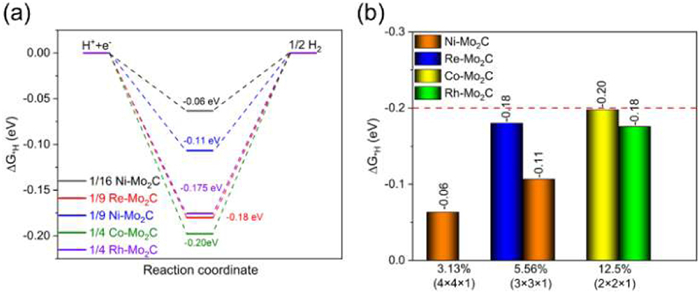
Materials with |ΔG*H | < 0.20 eV are considered promising HER electrocatalysts, with |ΔG*H | < 0.09 eV representing near-ideal activity (e.g., Pt: ΔG*H = −0.09 eV, at a H coverage of 1/4) [55].
For each doped system, ΔG*H was computed at eight adsorption sites (Figs. S15 and S16 in Supporting information) across three H coverages (1/4, 1/9, 1/16) using 2 × 2 × 1, 3 × 3 × 1, and 4 × 4 × 1 supercells (Table S5).
All five doped systems exhibited favorable HER activity (Fig. 6 and Fig. S16). Remarkably, 3.13% Ni-Mo2C achieved an optimal ΔG*H of −0.06 eV at the S2 site, surpassing Pt’s benchmark value (−0.09 eV) in proximity to the thermodynamic ideal (0 eV). The exceptional ΔG*H (−0.06 eV) of 3.13% Ni-Mo2C demonstrates its potential as a high-performance, non-precious HER electrocatalyst. This value not only exceeds Pt’s activity but also suggests feasibility for large-scale hydrogen production. Future work could focus on: (1) Validating catalytic stability under operational conditions, (2) exploring synergistic effects of multi-metal doping, and (3) scaling synthesis for practical electrolyzer integration. These findings establish TM-doped Mo2C as a compelling platform for next-generation energy conversion technologies.
Figure 6
Figure 6.
(a) Free energy diagram of HER in TM-Mo2C (TM = Ni, Re, Co, Rh) at different H coverage. (b) Calculation of ΔG*H values at different doping concentrations in TM-Mo2C (TM = Ni, Re, Co, Rh).
To contextualize the breakthrough NPR enhancement via TM doping in Mo2C, we systematically contrast our strategy with alternative approaches reported for MXenes and related 2D materials. Geometric design strategies: Re-entrant architectures (e.g., penta-graphene [51] with υ = −0.068) rely on structural topology but face intrinsic NPR limitations (< −0.1). Strain engineering in Zn2C [22] achieves υ = −0.18, yet requires external loading (≈6% strain) and sacrifices structural integrity. Intrinsic material screening: Discovery of natural auxetics like WN4 (υ = −0.114) [26] and Be5C2 (υ = −0.21) [25] remains constrained by modest NPR values and limited tunability. Electronic modulation approaches: Electronic properties in 1T-TMDs [19] enable non-geometric NPR (υ ≈ −0.1), but lack amplification mechanisms. TM doping in Mo2C (this work) breaks conventional limits via orbital reconstruction, delivering 5.56% Re-Mo2C: Record υ = −0.59 (5 × enhancement vs. pristine); 12.5% Co-Mo2C: Tunable υ = −0.14. As quantified in Fig. 5d and Table S4, Re-Mo2C's NPR (−0.59) surpasses all reported 2D auxetics, including strain-engineered systems (Ag2S [21]: −0.12) and intrinsic auxetics (TiN [20]: −0.15). Crucially, TM doping uniquely enables concurrent optimization of mechanical and catalytic properties—unachievable via geometric or phase-transition strategies.
The strain-induced d-p hybridization and bond-angle expansion mechanism, while elucidated for Mo2C, exhibits selective transferability across MXenes and broader 2D materials. Our systematic analysis reveals:
Applicability across Mxenes: Among the seven stable M2C MXenes (M = Sc, Ti, Zr, V, Nb, Ta, Mo), significant NPR (υ = −0.11) is uniquely observed in Mo2C, while the others exhibit PPR (e.g., Ta2C: + 0.52). This selectivity arises from Mo2C’s distinct orbital hybridization strength: Its Mo-C bonds possess a higher ICOHP value (−0.55) compared to those in Nb2C (−0.42) and Ta2C (−0.40) (Fig. S10), enabling critical bond-locking and angular adjustment during strain. Importantly, this mechanism is transferable to doped systems, as demonstrated by Re-doped Mo2C (υ = −0.59), where enhanced d-orbital reconstruction (Fig. 4b) further amplifies the NPR effect, confirming its generality within electronically similar MXenes.
Design principles for new NPR materials: Electronic prerequisites and a geometric indicator. Electronically, candidate materials should exhibit both strong bonding (ICOHP < −0.5, exemplified by Mo2C: −0.55 and Re-Mo2C: −0.62) and high orbital hybridization responsiveness (ICOHP increase > 7% under modest strain, e.g., 4% per Fig. S11). Geometrically, a key signature under tension is the anomalous expansion of specific bond angles (e.g., ∠C-Mo-C expansion in Mo2C, contrasting with the typical decrease observed in Ti2C, Fig. 3a). Significantly, these principles extend beyond MXenes, successfully explaining NPR phenomena in materials like 1T-TMDs [19] (governed by d-orbital distortion) and TiN [20] (mediated by charge redistribution), thereby validating their broad applicability to diverse material systems.
Thus, the electronic mechanism serves as a general design principle for NPR materials, prioritizing systems with: (1) Strong pre-strain hybridization (ICOHP < −0.5), (2) high orbital response to strain (ΔICOHP/ε > 1.75%/%), and (3) anomalous angular expansion under tension.
By decoding the dual role of electronic reconstruction in doped MXenes, we bridge two traditionally disjointed domains: Mechanical metamaterials and electrocatalysis. The Re/Ni-Mo2C systems exemplify a materials design strategy where strain-amplified auxeticity and catalytic optimization share a common electronic origin. Strategic doping unlocks unprecedented performance: Re-Mo2C achieves a record 2D NPR of −0.59, while Ni-Mo2C simultaneously attains exceptional HER catalysis ΔG*H = −0.06 eV, outperforming Pt. Crucially, these advances are not isolated—DFT analyses reveal that orbital reconstruction underpins NPR enhancement, while the resultant electronic redistribution optimizes hydrogen adsorption energetics. This dual functionality demonstrates the power of atomic-scale electronic engineering to concurrently tailor mechanical and electrochemical properties. The ultrahigh NPR of Re-Mo2C positions it as an ideal candidate for next-generation impact-resistant composites, biomedically adaptive implants, and strain-amplified sensors. Equally significant, the Ni-Mo2C system establishes a new paradigm for non-precious HER electrocatalysts operating at industrial-relevant efficiency. This synergy suggests transformative applications: e.g., Re-Mo2C-based strain sensors operating in corrosive electrolytes, or Ni-Mo2C electrocatalysts with intrinsic impact resistance for robust hydrogen reactors. Future efforts should prioritize experimental synthesis of these computationally validated materials and explore their mechano-catalytic coupling effects in operational devices. Collectively, this work provides both fundamental insights into strain-dependent quantum phenomena and a transformative strategy for creating multifunctional metamaterials that bridge structural mechanics and sustainable energy technologies.
The authors declare that they have no known competing financial interests or personal relationships that could have appeared to influence the work reported in this paper.
Acknowledgments
This work was financially supported by the Basic research program of Natural Science in Shaanxi Province, China (No. 2024JCJCQN-19), Youth Innovation Team Research Project of Shaanxi Provincial Education Department (No. 23JP170), and the Shaanxi Longlin Nanofiber Technology Co., Ltd.
Supplementary materials
Supplementary material associated with this article can be found, in the online version, at doi:10.1016/j.cclet.2025.111807.
J.K. Noerskov, T. Bligaard, A. Logadottir, et al., ChemInform 36 (2005) e12154. doi: 10.1002/chin.200524023
Figure 1
(a) The views of the geometry structures of M2C (M = Sc, Ti, Zr, V, Nb, Ta, Mo). The coordination environments of the M atoms are presented in rectangular shapes with dashed lines. (b) Localized lattice morphology and atoms of M2C. (c) PR versus orientation for monolayer Mo2C. (d) Comparison of the NPR of monolayer Mo2C with other NPR structures in the literature.
Figure 2
Local atomic displacements corresponding to NPR along the (a) x and (b) y directions, respectively. Strain-driven mechanical response along the (c) x and (d) y directions, respectively. The blue and orange arrows indicate the strain-driven atomic displacements in compression and response, respectively.
Figure 3
(a) Geometric response driven by strain along the x-direction of the monolayer Mo2C, including bond length (l1 = dM-C1, l2 = dM-C2), characteristic angle (θ = ∠C1MC2). (b) ∆Estrain calculations for monolayer Mo2C were performed at different strains. The blue curve signifies the bond angle dominant mode, while the orange curve denotes the bond length dominant mode. (c) Two competing modes in the evolution of NPR include the bond-length-dominated mechanism and the angular-dominated mechanism.
Figure 5
(a) Multi-level screening computational workflow to screen materials for high stability and NPR for Mo2C doping systems. (b) Periodic table of elements with doped metal atoms, Mo, and doped TM atoms marked in dark blue and orange, respectively. (c) NPR of TM-doped Mo2C monolayer as a function of orientation. (d) Comparison of monolayer Mo2C doped modified NPR with other NPR structures in the literature. (e) Calculated formation energy for the Mo2C system with a selected doping concentration of 5.56% (3 × 3 × 1). (e) Calculated cohesion energy for selected Mo2C systems with a doping concentration of 5.56% (3 × 3 × 1).
Figure 6
(a) Free energy diagram of HER in TM-Mo2C (TM = Ni, Re, Co, Rh) at different H coverage. (b) Calculation of ΔG*H values at different doping concentrations in TM-Mo2C (TM = Ni, Re, Co, Rh).


 DownLoad:

 下载:


 下载:

